
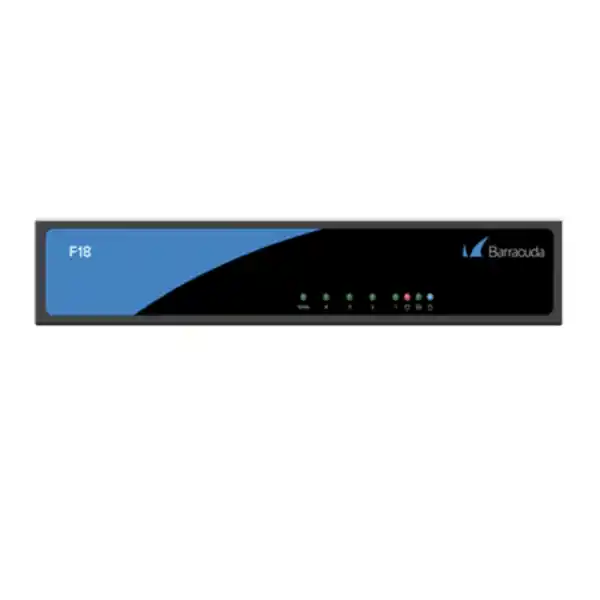
Barracuda CloudGen Firewall F12 Revision A
A compact, fanless CloudGen Firewall platform for branch offices, retail locations, professional workspaces, remote facilities, and distributed edge sites that need secure Gigabit Ethernet, VPN, SD-WAN, application-aware policy enforcement, and practical centralized operations without the footprint of a rack-scale appliance.
What the F12 Revision A is designed to solve
The Barracuda CloudGen Firewall F12 Revision A sits at the compact edge of the CloudGen Firewall hardware family. Its value is not simply that it has five copper Gigabit Ethernet interfaces. The larger design objective is to place policy enforcement, secure site connectivity, WAN path control, remote-access functions, traffic classification, and branch-level network services into a small appliance that can operate in offices where space, noise, local IT staffing, and power budgets are constrained. For a Dubai company with a head office plus multiple small branches, a service business with customer-facing locations, a retailer with distributed stores, or an enterprise that maintains temporary project offices, the F12 can act as the controlled boundary between local users, internet circuits, private WAN services, headquarters resources, and cloud applications.
Barracuda’s CloudGen architecture is especially relevant when connectivity requirements are more demanding than a simple internet gateway. Modern branches may use Microsoft 365, ERP and CRM services, hosted voice platforms, private cloud workloads, public cloud infrastructure, remote administration, guest Wi-Fi, payment or point-of-sale systems, IP surveillance, and headquarters applications at the same time. Those traffic classes do not have identical business value or tolerance for delay. The firewall therefore has to do more than permit or deny ports. It needs to identify applications, maintain state, enforce security controls, steer important sessions onto suitable WAN paths, preserve VPN availability, and provide an operational model that scales beyond a single site.
The F12 Revision A is a hardware platform rather than a promise of one fixed performance result. Real firewall capacity depends on firmware release, security services enabled, SSL inspection scope, packet size, application mix, VPN encryption, number of concurrent sessions, logging intensity, routing design, and WAN characteristics. For that reason, FourTeck does not recommend choosing this model from interface speed alone. A five-port Gigabit chassis can still be undersized if every flow needs deep inspection, malware scanning, heavy encryption, complex QoS, and high concurrent-session density. Conversely, the platform can be a very efficient fit for a controlled branch with moderate user counts, predictable application demand, and well-defined inspection policies.
For UAE customers evaluating this appliance, FourTeck Firewall Dubai can help map business requirements to the hardware, license subscriptions, deployment topology, migration steps, and post-installation support model. That sizing stage is important because the best result comes from treating the F12 as part of an end-to-end branch architecture rather than as an isolated box.
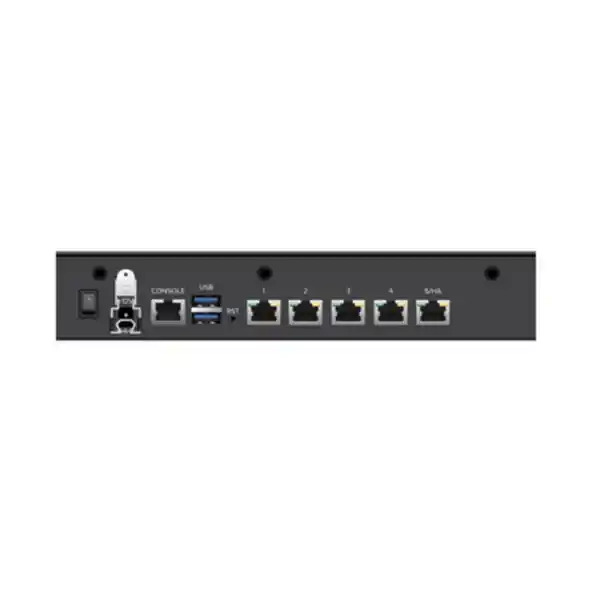
Five 10/100/1000 Mbps RJ45 interfaces provide a practical port count for separating WAN, internal LAN, management, guest, voice, DMZ, or secondary-uplink roles through physical interfaces or VLAN-aware switching architecture.
The compact fanless design is well suited to offices without dedicated server rooms, reducing acoustic impact while still requiring appropriate ventilation, stable power, and operation inside the specified temperature range.
An internal SSD of 80 GB or better supports the operating environment, logs, system data, and appliance functions with solid-state storage appropriate for a compact network security device.
An RJ45 serial console plus two USB 3.0 ports give administrators local service and recovery options. The serial console uses 19200 baud, 8 data bits, one stop bit, no parity, and no handshake.
CloudGen Firewall software can combine stateful inspection, application-aware controls, VPN, SD-WAN functions, identity-aware policies, web controls, IPS, malware protection, and optional advanced threat services according to licensing.
The platform is designed for distributed environments where administrators need consistent policy, configuration, monitoring, and secure connectivity across many offices rather than manually treating every branch as an unrelated firewall.
Hardware architecture and physical specifications
At the hardware level, the F12 Revision A uses an Intel Apollo Lake CPU platform with 2 GB of RAM and SSD storage specified as 80 GB or better. Barracuda lists the chassis as a desktop form factor measuring approximately 23.2 cm wide, 15.3 cm deep, and 4.4 cm high, with an appliance weight of about 2.0 kg. Those dimensions make the unit easy to place on a secure shelf or desktop in a branch communications area, but the physical installation should still be planned like enterprise network infrastructure. It should not be buried under paperwork, stacked between heat-generating devices, positioned where cabling can be easily disturbed, or left in an unsecured customer-accessible area.
Cooling is fanless. That has two operational advantages in many UAE office environments: it eliminates fan noise and removes a moving mechanical cooling component. Fanless, however, does not mean ventilation is optional. Barracuda specifies an operating temperature range of 0°C to +40°C and operating humidity from 5% to 95% non-condensing. In Dubai, where ambient outdoor temperatures can greatly exceed that operating envelope, the appliance should be installed in an air-conditioned indoor location with reliable environmental control. Small storerooms, ceiling voids, external cabinets, unconditioned security rooms, or enclosed racks with poor airflow can exceed safe temperatures even when the general office feels comfortable.
The external power supply accepts 100–240 V AC at 50–60 Hz and provides 12 V DC output. The listed power-supply rating is 45 W, while maximum heat dissipation is specified at 26.7 W, or 90.9 BTU. Average energy efficiency is listed above 93 percent. These values make the appliance straightforward to place behind a correctly sized UPS for branch use. A UPS is strongly recommended not because the firewall consumes a large amount of power, but because it becomes a connectivity dependency: a brief power interruption that restarts the firewall can break active VPN sessions, voice calls, cloud transactions, remote desktop sessions, and branch access to centralized applications.
The hardware sheet specifies an operating altitude up to 2,000 metres, storage temperature from -20°C to +70°C, and non-operating humidity up to 95% non-condensing. The system MTBF is listed as greater than five years. Compliance entries include CE emissions, CE electrical safety, FCC emissions, RoHS compliance, FCC Part 15 subparts, and applicable ANSI and ICES references. Procurement teams should still confirm the exact regulatory documentation, power adapter, warranty status, and regional entitlement associated with the unit being quoted because the manufacturer notes that components can change over time as hardware supply and technology evolve.
The desktop appliance does not include L-shaped rack-mount brackets in the standard package; Barracuda indicates those brackets must be ordered separately. Wall-mount brackets are not specified, and there is no DIN-rail clip. That detail matters when standardizing branches: if the customer wants every firewall secured in a 19-inch rack, the accessory requirement should be captured in the bill of materials before shipment rather than discovered during installation. For office refresh projects, FourTeck can combine firewall supply with broader UAE IT infrastructure services covering rack preparation, structured patching, UPS placement, migration planning, and onsite cutover coordination.
Port map, interface planning, and network segmentation
All five primary network interfaces are 10/100/1000 Mbps copper Ethernet using RJ45 connectors. Barracuda’s default port documentation identifies physical port 1 as operating-system interface p1 and marks it as the management port, while ports 2 through 5 map to p2 through p5. The fact that the appliance has five interfaces is more important architecturally than it first appears. A small branch can easily require separate connectivity for a primary internet circuit, a secondary internet circuit, an internal switch, a DMZ or guest segment, and a management or service network. Alternatively, several logical segments can be trunked to a managed switch using VLANs, preserving physical interfaces for WAN diversity.
A sensible port plan should be created before deployment. For example, p1 may remain a dedicated management or trusted internal interface during staging. Another port can terminate the primary ISP handoff, a third can connect the backup ISP or private MPLS service, a fourth can carry a VLAN trunk to the LAN switching environment, and the fifth can support a physically separated DMZ or a dedicated administrative network. The exact roles are not fixed; they should follow the customer’s redundancy, security-zone, routing, and operational requirements. What matters is avoiding a casual cabling design in which every network is bridged into one flat trusted zone simply because the site is small.
Segmentation reduces the impact of compromise. A branch may contain corporate notebooks, employee phones, printers, CCTV recorders, IP cameras, biometric attendance equipment, access-control systems, voice endpoints, wireless access points, guest devices, smart displays, and locally hosted controllers. Many of those devices have very different risk profiles and patching cycles. The F12 can sit at the routing and enforcement point between VLAN-backed security zones so that an IoT or guest device does not automatically inherit the same access privileges as a managed corporate workstation. Policy can then be expressed in terms of source network, destination service, user or role where supported, application type, and business need.
When planning VLAN trunks, the access switch becomes part of the security design. Switch ports should be mapped carefully, native VLAN behavior should be controlled, unused ports should be disabled, and management interfaces should reside on dedicated administrative networks where possible. The firewall should not be expected to compensate for a completely unmanaged LAN. Likewise, if multiple WAN circuits are used, verify each provider’s handoff mode, static or dynamic addressing, PPPoE requirements where applicable, routed subnet allocation, upstream NAT behavior, DNS service, and any restrictions on IPsec or other VPN protocols.
The appliance also provides two USB 3.0 ports and one RJ45 serial console. The serial settings are 19200 baud, 8 bits, one stop bit, no parity, and no handshake. Console access is valuable when IP connectivity is unavailable or a configuration change blocks remote management. In distributed deployments, however, console recovery still requires someone physically present or an out-of-band console design, so change control and tested rollback procedures remain essential.
Next-generation firewall security capabilities
CloudGen Firewall security starts with stateful deep packet inspection. Instead of making decisions only from source address, destination address, and port number, the firewall can inspect network traffic with awareness of connection state and higher-level content. Barracuda describes a single-pass inspection architecture in which multiple security mechanisms can be applied as traffic is processed rather than serially handing the same flow through unrelated proxy stages. From an engineering perspective, the operational advantage is policy consolidation: firewalling, application visibility, intrusion prevention, malware controls, web policy, SSL inspection, and advanced threat options can be orchestrated within one security platform.
Intrusion Detection and Prevention is designed to identify attacks that exploit network protocols, operating systems, applications, and databases. Relevant threat classes include injection attacks, exploit attempts, privilege escalation, cross-site scripting, buffer overflows, scanning, directory traversal, denial-of-service patterns, backdoors, worms, spyware, and other malicious traffic. IDS/IPS effectiveness depends on current signatures, appropriate policy, correct placement, and carefully considered exception handling. Administrators should not simply turn every possible signature to its most aggressive setting without observing application behavior. A production IPS policy should protect critical traffic while minimizing false positives that could disrupt legitimate workloads.
Application Control extends policy beyond traditional port assumptions. Many modern applications use HTTPS, dynamic infrastructure, content-delivery networks, and overlapping service ports. Application-aware policy can help distinguish business services from bandwidth-heavy or prohibited traffic even when both appear over common ports. Administrators can use application category, user, group, location, or time-based context to shape acceptable usage, block unwanted software, prioritize critical traffic, and enforce bandwidth policies. This becomes particularly important at branches where the internet link carries both mission-critical SaaS sessions and discretionary web traffic.
Web filtering can add URL-category and user-oriented control to internet access. A branch can use web policy to restrict risky destinations, reduce exposure to malicious downloads, limit categories that conflict with corporate policy, and improve visibility into browsing activity. DNS-based protective mechanisms can also help identify or prevent clients from reaching known malicious infrastructure. Barracuda describes botnet and spyware protection using DNS sinkholing, where requests for malicious domains can be redirected internally so administrators can identify potentially infected endpoints while preventing communication with the external malicious service.
Malware protection and Advanced Threat Protection should be evaluated in the subscription design. Barracuda’s malware capabilities can scan supported web, email, and file-transfer protocols using signature and heuristic methods. Advanced Threat Protection is an optional subscription intended to analyze unknown files through reputation checks and sandbox-style behavioral analysis. Those services strengthen security, but they also increase inspection workload and can affect sizing. If the branch carries significant HTTPS traffic, SSL inspection policy becomes another critical design factor because visibility into encrypted sessions requires controlled interception, certificate deployment, privacy exclusions, and application compatibility testing.
An effective F12 deployment therefore starts with a traffic classification plan. Identify which flows require full inspection, which must bypass decryption for legal, privacy, or application reasons, which destinations are trusted only by business need, and which applications deserve guaranteed bandwidth. That approach is more defensible than enabling every feature globally and hoping the branch remains stable. Security should be deep where risk justifies it, but policy should remain measurable, documented, and operationally supportable.
Secure SD-WAN, WAN resilience, and application-aware routing
One of the distinguishing reasons to deploy a CloudGen Firewall at a small branch is the integration of SD-WAN functions with security. A conventional branch architecture may require a firewall, a separate WAN optimizer, a link-balancing device, and manual VPN configuration. CloudGen Firewall combines many of those connectivity controls so that policy can consider link quality and application requirements while traffic remains subject to security enforcement. This is valuable in the UAE, where a branch may have a primary business broadband circuit, a secondary connection from another provider, and possibly a private WAN or cellular backup path through supporting equipment.
Barracuda’s SD-WAN capabilities include dynamic bandwidth and latency detection, application-based routing, adaptive session balancing, bandwidth protection, link failover, and traffic shaping. Instead of treating every WAN circuit as interchangeable, the firewall can use measured characteristics to decide whether a path is suitable for a particular application. A voice or interactive remote-desktop session is sensitive to latency, jitter, and loss; a large software update is generally more tolerant. If the network can recognize these differences, it can protect business-critical interactive traffic from bulk transfers and steer sessions toward the available path that best fits policy.
Application-based routing is especially useful when a branch uses both internet-delivered SaaS and private applications hosted at headquarters or in a data centre. Microsoft 365 traffic might exit directly to the internet, while ERP traffic can traverse an encrypted site-to-site tunnel. Voice signaling and media can receive dedicated QoS treatment. Backup traffic can be scheduled or routed over a lower-cost path. Guest internet access can be prevented from consuming the same priority queue as corporate communications. The firewall’s ability to combine application identity with routing decisions helps make the WAN an active policy domain rather than a collection of static default routes.
For VPN, Barracuda supports its TINA tunneling technology as well as IPsec and client-to-site options. TINA is designed for resilient site-to-site connectivity, including multiple transport paths inside a logical VPN relationship. CloudGen SD-WAN can balance sessions across available uplinks and use active measurements to respond when one link degrades. In appropriate configurations, traffic duplication can send selected packets over two transports to reduce the effect of loss for demanding applications. These features can be useful for business locations where connectivity failure has immediate operational impact, such as retail, logistics, customer service, clinics, hospitality operations, or project sites.
Resilience still depends on physical diversity. Two WAN interfaces connected to the same provider, same building riser, same fibre route, and same upstream aggregation point may fail together. A well-designed redundant branch therefore evaluates carrier diversity, last-mile diversity, handoff equipment, power backup, DNS behavior, public IP requirements, and local cabling. The firewall can automate failover only when an alternate path truly remains available.
SD-WAN policies should also define what happens during degraded mode. When the primary circuit fails, the backup service may offer less bandwidth. The correct response may be to preserve ERP, POS, voice, remote administration, and critical SaaS while temporarily restricting guest access, backups, operating-system updates, high-resolution streaming, or other discretionary traffic. CloudGen traffic shaping and bandwidth protection can express these priorities. This gives the business a graceful degradation strategy rather than a binary choice between full service and total outage.
For organizations with several UAE locations, a branch firewall strategy should be standardized. Interface roles, VPN naming, route metrics, monitoring objects, QoS classes, log destinations, DNS behavior, NTP, administrator access, and change processes should follow templates. Standardization reduces troubleshooting time because engineers can compare one site against a known-good baseline. It also makes future rollout easier if the business expands from Dubai to Abu Dhabi, Sharjah, the Northern Emirates, or regional markets.
VPN, remote access, identity, and zero-trust alignment
Branch connectivity is only one part of the access problem. Organizations also need to control how administrators, travelling staff, home users, suppliers, and contractors reach protected applications. CloudGen Firewall supports client-to-site VPN and site-to-site VPN functions, with the base licensing documentation listing unlimited VPN clients for client-to-site, TINA, and IPsec use. Actual remote-access design still depends on authentication, authorization, endpoint posture, licensing, and the security requirements of the applications being exposed.
Multi-factor authentication should be treated as a baseline for remote administrative and user access. Barracuda supports MFA capabilities including time-based one-time passwords, and CloudGen Firewall can integrate authentication with common enterprise identity services such as Active Directory, RADIUS, LDAP/LDAPS, TACACS+, certificate-based methods, and other supported systems. Identity awareness allows network policy to move beyond static IP addresses. Where identity integration is appropriate, administrators can apply rules based on users or groups and connect access decisions to organizational roles.
The design objective should be least privilege. A remote accounting user may need only specific finance applications. An outsourced support engineer may need access to a defined management host during approved hours. A branch administrator may require device management but not unrestricted access to user subnets. A contractor may require one web application and nothing else. Network-level controls should reinforce application permissions rather than simply creating a broad remote-access tunnel that places every authenticated user inside the trusted LAN.
Barracuda also positions CloudGen Firewall as an enforcement point for Zero Trust Network Access with its SecureEdge Access portfolio. Zero trust is not achieved merely by buying a product; it is an architecture that verifies identity and context, minimizes implicit trust, and restricts access to what is required. For customers moving from traditional VPN toward application-specific access, the F12 can remain part of the branch enforcement architecture while remote-access strategy evolves.
Before enabling remote access, FourTeck recommends documenting user populations, application destinations, authentication sources, MFA method, endpoint requirements, split-tunnel policy, DNS behavior, logging, session timeout, emergency access, certificate handling, and support escalation. A technically functional VPN that has not been governed can become a persistent security risk. The goal is controlled connectivity with auditable policy, not merely successful tunnel establishment.
Licensing and subscription planning for the F12
The hardware is only one part of a complete CloudGen Firewall purchase. Barracuda’s licensing model separates the base firewall entitlement from several security and operational subscriptions. For CloudGen Firewall hardware appliances, the base license is associated with the appliance, while Barracuda documentation states that an Energize Updates subscription is mandatory for the first year of purchase. After that period, customers can renew the subscription; if it is not renewed, the hardware can continue with the base license but with limited functionality. Because subscription policy can change and entitlements differ by offering, the quotation should always identify exact license terms and renewal duration rather than using a generic line such as “firewall license included.”
The documented base license includes core next-generation firewall functions such as Application Control reporting, SSL Inspection on supported models, SD-WAN, and VPN capabilities. Energize Updates adds continuously maintained security and support-related components. Additional subscriptions can include Malware Protection, Advanced Threat Protection, Advanced Remote Access, and Barracuda Firewall Insights. Not every branch needs every option, but the security architecture must explicitly decide which protections are required and where they will be delivered.
For example, if endpoint protection and a secure web gateway already perform certain malware and URL inspection functions, the customer may choose a different service mix than a standalone branch that relies heavily on the firewall for layered defense. If files downloaded at the branch need sandbox analysis, Advanced Threat Protection may be justified. If the organization requires portal-based SSL VPN and advanced network access features, Advanced Remote Access should be considered. If centralized reporting and historical visibility are operational priorities, reporting subscriptions or management platforms should be included in the design.
Renewal planning is an operational issue, not just a procurement issue. Security subscriptions that silently expire can change the protection level of the site. Organizations should record license start dates, renewal dates, support contacts, appliance serial details, contract identifiers, and budget ownership in a central asset-management process. Renewal reminders should be handled well before expiration so there is time to validate quantities, support coverage, and business requirements.
FourTeck can quote the appliance together with the relevant subscriptions and services rather than separating hardware from the operating model. Customers can also use the FourTeck UAE site to coordinate broader networking, security, communications, and infrastructure requirements when the firewall is part of a larger branch rollout.
Sizing methodology: when the F12 is a good fit
A limited number of users, moderate SaaS traffic, one or two WAN circuits, site-to-site VPN, segmented LANs, and manageable inspection demand can align well with a compact five-port platform.
POS or business applications, guest access, CCTV or IoT isolation, cloud management, voice services, and resilient connectivity can benefit from application-aware policy and WAN failover.
Compact footprint, desktop deployment, VPN to headquarters, controlled internet access, and repeatable configuration make the model relevant where infrastructure must be rolled out quickly.
Organizations with many small sites can use standardized policy, VPN, SD-WAN and centralized operations, provided each site’s traffic profile fits the appliance capacity.
Sizing should begin with measured or estimated traffic, not employee count alone. Ten engineering users moving large CAD files through VPN can consume more resources than fifty users performing light SaaS and email work. A branch with extensive SSL decryption, IPS, malware scanning, logging, and multiple VPN tunnels can place greater load on the firewall than another branch with the same internet circuit but simpler policy. Likewise, short bursts matter: a 100 Mbps average does not reveal whether traffic peaks near the WAN limit every morning when cloud sync, operating-system updates, backups, and video meetings begin simultaneously.
A proper sizing interview should capture WAN bandwidth, expected growth, peak utilization, concurrent users, concurrent sessions where known, application categories, cloud destinations, VPN volume, number of tunnels, encryption requirements, inspection services, SSL decryption scope, inbound publishing, routing protocols, high-availability expectations, log retention, and branch criticality. If the organization expects rapid bandwidth growth or wants to turn on additional security services later, capacity headroom should be reserved rather than buying for today’s average load only.
The physical port count also needs headroom. Five interfaces can be enough for many branch designs, but a site requiring several independent WANs, multiple physically isolated zones, out-of-band management, and dedicated DMZ links may need a larger appliance or VLAN-based consolidation through managed switches. Port-speed requirements matter too: all primary Ethernet interfaces on the F12 are Gigabit copper. A site with multi-gigabit WAN, 2.5GbE/5GbE access, fibre handoffs requiring SFP, or a high-speed data-centre edge should use a model with the appropriate interfaces and processing capacity rather than adapting the F12 beyond its intended role.
The safest sizing decision is a workload-based decision. FourTeck can review the branch topology and expected security stack before quotation so the customer knows whether the F12 is a comfortable fit, a borderline fit, or the wrong class of appliance. That avoids two expensive outcomes: overspending on unnecessary capacity, or installing a firewall that becomes the bottleneck as soon as stronger inspection is enabled.
Dubai and UAE deployment considerations
A firewall deployment in Dubai should be designed around the actual branch environment, not only the logical network diagram. Environmental conditions are important because the F12’s specified operating range ends at +40°C. Air-conditioned office areas usually remain well below that limit, but small telecommunications cupboards can become much hotter when doors are closed and switches, routers, UPS systems, NVRs, and power supplies accumulate heat. During a site survey, check airflow, cabinet ventilation, ambient temperature, dust exposure, electrical stability, and physical security.
Power continuity is equally significant. The firewall’s 45 W external power supply makes UPS sizing straightforward, but backup time should be based on the complete communications stack, not the firewall alone. If the firewall remains powered while the ISP ONT, access switch, Wi-Fi controller, or core switch shuts down, users still lose service. Critical branches should therefore place the firewall, carrier handoff, switching, and required voice or wireless infrastructure on coordinated UPS protection. Where a generator is available, the UPS should bridge the startup interval and condition short disturbances.
ISP diversity should be validated technically and contractually. Two contracts from different sales brands do not guarantee independent physical paths. For high-availability sites, ask providers about last-mile routes, building entry points, upstream infrastructure, service-level terms, public IP allocations, and failover behavior. If cellular backup is planned through a separate modem or router, test signal strength, data limits, NAT behavior, inbound restrictions, and VPN stability before calling the design complete.
UAE organizations often operate hybrid environments that mix local offices with cloud platforms, data-centre resources, hosted PBX services, remote users, and regional branches. The firewall policy should reflect that hybrid reality. Direct internet breakout for trusted SaaS may reduce latency, while sensitive or legacy applications may remain reachable only through encrypted tunnels. DNS should be resilient. NTP should be reliable because certificates, authentication, and logs depend on correct time. Monitoring should detect both complete link failure and degraded performance that users perceive as slowness even though the interface remains technically up.
Change windows should be planned around business operations. Retail outlets, clinics, customer service centres, warehouses, and hospitality sites may have only narrow periods when connectivity can be interrupted. Migration should therefore include pre-staging, configuration review, cable labels, backups of the old firewall, a tested rollback plan, verified ISP credentials, VPN preconfiguration, and an acceptance checklist. The objective is to reduce the cutover to controlled cable movement and validation rather than live troubleshooting from a blank configuration.
For multi-country organizations using the UAE as a regional hub, security policy and branch standards should also account for remote operations. FourTeck’s Africa regional technology coverage can support organizations that want consistent procurement and network design principles across UAE and African offices while still adapting to local carriers, logistics, and site conditions.
Finally, document the operational owner. A branch firewall that no one clearly owns tends to accumulate outdated objects, unused VPNs, temporary rules, old administrator accounts, and expired subscriptions. Define who approves policy changes, who monitors alerts, who handles renewals, who manages certificates, who contacts Barracuda support, and who coordinates onsite access. Technology is easier to support when responsibility is as clearly defined as the configuration.
Recommended deployment topologies
The F12 is flexible enough to support several branch patterns. The correct topology depends on whether the site prioritizes simplicity, WAN resilience, segmentation, private application access, or centralized control. The following patterns illustrate common approaches without prescribing a single configuration for every customer.
One ISP terminates on the F12, while one or more LAN VLANs connect through a managed switch. Site-to-site VPN protects access to headquarters resources. Guest, corporate, voice, and IoT networks are separated by policy. This is the simplest topology but depends on one WAN service, so the business must accept the outage risk or rely on a later backup option.
Two independent internet services connect to separate interfaces. SD-WAN and link monitoring steer traffic according to availability, latency, and policy. Critical applications retain priority if the backup link has lower capacity. The design should use genuine carrier diversity and test both failover and failback behavior before production acceptance.
A branch can combine a private circuit for legacy or sensitive applications with local internet breakout for cloud services. The firewall determines which traffic follows each path and can maintain encrypted overlays where required. This avoids backhauling every SaaS session through headquarters while preserving controlled routes for internal systems.
POS, CCTV, guest Wi-Fi, corporate devices, and facilities equipment occupy separate VLANs. Inter-zone traffic is denied by default and opened only for required services. Internet access is categorized and shaped. Remote vendor access is restricted to defined systems rather than permitting broad entry into the branch LAN.
Most user traffic goes directly to SaaS and public cloud services, while VPN connectivity remains for selected private applications. Application-aware routing and web security policies protect the internet edge. Monitoring focuses on WAN quality because user experience depends heavily on cloud reachability and DNS performance.
The F12 is deployed at multiple similarly sized sites using repeatable naming, policy templates, VPN design, logging, administrator roles, update procedure, and acceptance testing. Centralized operations reduce configuration drift and make troubleshooting more predictable as the organization adds locations.
Migration from an existing firewall
Replacing an existing firewall is not a direct exercise in copying rules. Old configurations often contain years of temporary exceptions, duplicate objects, obsolete servers, disabled VPN peers, unused NAT entries, legacy protocols, and rules whose business owners are unknown. A migration to the F12 should treat the old policy as evidence to be reviewed rather than as a configuration that must be replicated exactly. The objective is to preserve legitimate business connectivity while reducing accumulated risk.
Start with discovery. Export or document interface addressing, VLANs, static routes, dynamic routing where used, DHCP scopes, DNS forwarding, NTP, administrator access, policy objects, NAT, inbound published services, site-to-site tunnels, client VPN settings, authentication integration, certificates, web filtering, application controls, QoS, logging, and monitoring. Match each critical rule to an application or owner. If a rule cannot be explained, do not automatically discard it during the cutover; instead flag it for controlled validation so an unknown dependency does not become an outage.
Pre-stage the F12 away from the production path. Load the appropriate firmware, register licenses, apply subscriptions, define interface labels, configure management access, build objects, create routing and VPN configuration, set log destinations, and test administrative authentication. Where possible, establish VPNs using temporary addressing or a lab connection before the final cutover. Store a configuration backup after staging and again after production acceptance.
The cutover plan should have a numbered sequence: notify stakeholders, capture final old-firewall backup, verify ISP status, record current public IPs, confirm cable labels, stop risky changes, move WAN and LAN connections, validate interface link, verify default route, test DNS, test critical SaaS, test internal applications, validate VPN, place an inbound test call if voice depends on the network, test remote access, confirm logging, and monitor errors. If a defined checkpoint fails and cannot be corrected inside the maintenance window, follow the rollback plan rather than improvising indefinitely.
Post-migration work is just as important. Remove temporary allow rules used for testing, close old remote-access paths, revoke obsolete certificates where appropriate, update monitoring, archive the prior configuration securely, document new port mappings, record license details, and schedule a follow-up policy review after users have returned to normal activity. A clean handover turns the F12 from a successful one-night migration into a supportable long-term security platform.
Policy engineering for a small but security-critical branch
Small offices often receive weaker security policy than large sites even though they handle the same corporate identities and cloud data. The F12 is most valuable when policy is deliberately engineered. Begin with zones: corporate users, servers if present, management, voice, printers, CCTV and IoT, guest, DMZ, and WAN. Not every branch needs every zone, but each trust boundary should be explicit. Then define permitted flows by business function rather than allowing broad any-to-any access between internal networks.
Outbound internet policy should prioritize known business applications and inspect traffic according to risk. SSL decryption can dramatically improve visibility because so much web traffic is encrypted, yet it must be implemented with certificate distribution, legal review, privacy exclusions, and application exceptions. Financial, health, government, certificate-pinned, or otherwise sensitive categories may require bypass rules based on organizational policy. The aim is transparent governance, not indiscriminate interception.
Inbound publishing should be minimized. If a branch can use outbound-initiated cloud access or VPN instead of exposing an internal service to the internet, that generally reduces attack surface. Where publishing is necessary, restrict destination ports, source addresses when possible, IPS policy, logging, and management ownership. Administrative interfaces should never be casually exposed to the public internet. Remote administration should use dedicated secure access paths with MFA and limited source or role permissions.
Logging should be designed for useful evidence, not maximum volume without retention planning. Denied traffic, authentication, VPN status, administrator changes, security events, and important policy hits should be retained and, where possible, forwarded to centralized systems. Excessive debug logging can consume resources and bury useful events. Conversely, insufficient logging makes incident investigation almost impossible. The right balance depends on regulatory requirements, incident-response process, and available log-management infrastructure.
Policy naming conventions improve support. Names such as “Allow_Network1_to_Network2” quickly become meaningless. Use labels tied to service and owner, such as “BR01_Corp_to_M365,” “BR01_POS_to_PaymentGateway,” or “VendorX_to_Controller_HTTPS.” Include change-ticket references in comments where the platform supports them. Six months later, administrators should be able to understand why a rule exists without reconstructing the project from memory.
Operations, monitoring, backup, and lifecycle management
A firewall is an operational system, not a set-and-forget appliance. Once the F12 is in production, the organization needs a recurring routine for firmware review, security updates, configuration backups, license status, certificate expiry, administrator accounts, VPN health, WAN quality, hardware alerts, and policy housekeeping. The workload can be light for a single branch, but it becomes significant when dozens of small sites are deployed. Standard procedures and centralized management therefore provide value beyond convenience.
Firmware changes should follow release-note review and staged deployment. New releases can deliver security fixes, features, and platform improvements, but production upgrades should still be tested against VPN interoperability, routing, authentication, application inspection, and branch-specific dependencies. Maintain a known-good backup, document the currently running release, verify the appliance model is supported by the target release, and define a recovery path before starting. Barracuda’s hardware documentation lists the F12 Revision A with a minimum required firmware of 8.0.1; later release compatibility should always be checked against the manufacturer’s current release and migration documentation at the time of upgrade.
Hardware indicators help onsite diagnosis. The F12 has front power, disk, status, and port LEDs, with status behavior indicating normal operation, booting or update activity, and certain error states. Acoustic signals can indicate boot and installation status. These indicators are useful when a remote engineer is guiding onsite staff, but they are not a replacement for monitoring. The organization should receive alerts for link failure, tunnel status, system problems, and security events before an end user reports that the branch is offline.
Configuration backups should be stored securely outside the appliance. A backup kept only on the firewall is unavailable if the unit fails. Retain at least a current production backup and selected historical versions around significant changes. Protect those files because they may contain network addressing, policy objects, certificates, VPN information, and other sensitive configuration data. Access should be limited to authorized administrators and integrated with the customer’s broader backup and credential-management process.
Review administrator accounts quarterly or according to company policy. Remove departed staff, reduce unnecessary privileges, require MFA where supported, and avoid shared accounts for routine administration. Emergency access credentials should be controlled, tested, and stored securely. Every configuration change should be attributable to a person or process so incident investigation and audit remain possible.
At end of life or replacement, sanitize the appliance according to organizational data-handling procedures, terminate or transfer licenses correctly, remove it from management systems, revoke associated credentials and certificates, and update asset records. If the business keeps a cold spare, understand the vendor process for transferring entitlement after a failure. Lifecycle planning ensures that the firewall remains supportable from procurement through retirement rather than becoming unmanaged infrastructure after the initial project team moves on.
Performance expectations and responsible capacity planning
It is tempting to judge a firewall by the speed printed next to its Ethernet ports. Five Gigabit interfaces do not imply that every combination of security inspection, VPN encryption, SSL decryption, malware analysis, IPS, application control, logging, and SD-WAN processing can sustain line rate simultaneously. Model-specific throughput should be validated from the applicable Barracuda datasheet or sizing tool for the exact software and subscription combination being proposed. Where the manufacturer does not publish a current workload figure for a specific revision, engineering should avoid inventing one.
The most useful performance benchmark is the customer’s workload. Measure peak internet utilization over at least representative business periods. Identify traffic that will traverse VPN. Estimate how much encrypted web traffic will be decrypted. Determine whether the branch hosts inbound services. Understand the number of IP phones, cameras, guest devices, and application sessions. Capture packet-loss and latency on existing WAN links so poor provider performance is not incorrectly attributed to the new firewall after migration.
Security features have different processing characteristics. Stateful firewalling is generally lighter than full SSL inspection plus IPS and malware scanning. Many small encrypted sessions can behave differently from a few large transfers. VPN encryption consumes CPU resources. Logging every allowed session at high verbosity creates more overhead than logging only policy and security events. SD-WAN probing and path management add modest but real operational work. The cumulative design matters more than any single feature checkbox.
Headroom is also a resilience feature. If normal utilization already drives a firewall close to capacity, a backup-WAN event can change the traffic pattern and increase processing pressure at exactly the time the business needs stability. Growth, software updates, new cloud applications, additional guest usage, and security-policy expansion can all increase demand. For that reason, the chosen appliance should have capacity margin rather than matching the current average exactly.
If analysis shows that the F12 would operate near its practical limit, selecting the next appropriate CloudGen Firewall class is usually more cost-effective than forcing a compact branch model into a role it was not intended to serve. The appliance should be chosen because it fits the security and connectivity profile, not because it is the smallest model available.
Why enterprises choose a compact CloudGen Firewall at the edge
Distributed organizations face a recurring architectural tension: every site needs credible security and reliable connectivity, but many sites do not justify a large rack appliance or local network engineer. The F12 Revision A addresses that gap by packaging CloudGen Firewall capabilities in a fanless desktop platform. A branch can use the same broad policy concepts as larger sites while keeping physical footprint, power use, and cabling requirements manageable.
The integration of security and SD-WAN is significant. If a separate router controls WAN paths while an independent firewall enforces security, troubleshooting can cross multiple management systems and vendors. When application classification, link monitoring, VPN, QoS, and firewall policy operate on one platform, administrators have a more coherent view of why traffic followed a path and why it was allowed, blocked, shaped, or rerouted. Consolidation does not remove the need for good design, but it can reduce operational complexity.
The appliance is also suited to templated rollouts. A business can define a standard branch blueprint with corporate VLANs, guest isolation, VPN relationships, approved SaaS breakout, DNS, QoS, logging, and administrator access. Each site then receives only the differences required for local addressing, ISP details, and business applications. This reduces configuration drift and accelerates deployment when opening new offices.
For procurement, a standardized edge platform simplifies spares, training, support procedures, documentation, and license management. The organization can maintain a repeatable acceptance checklist and known cable map. Help-desk staff can recognize LED states and escalate with useful information. Network engineers can compare metrics across branches. Security teams can review policy in a consistent structure. These operational benefits can outweigh minor differences in hardware cost because long-term support often costs more than the initial appliance.
FourTeck approaches the F12 as part of that operational system. Hardware supply can be combined with design, configuration, migration, onsite services, and broader network integration. For customers who work across multiple technology categories, FourTeck Global provides an additional route to coordinate multi-region infrastructure requirements while the UAE team handles local deployment needs.
Detailed implementation sequence
1. Discovery and requirements. Record business-critical applications, user groups, internet bandwidth, provider handoffs, VLANs, IP addressing, current firewall rules, NAT, VPNs, remote users, authentication systems, public services, DNS, DHCP, logging, monitoring, compliance requirements, and expected growth. Classify the branch according to outage impact so redundancy and support coverage reflect business risk.
2. Sizing and bill of materials. Confirm the F12 has suitable interface type, port count, capacity, and environmental fit. Select base entitlement and subscriptions. Include rack accessories if the unit will be mounted in a cabinet, patch leads, UPS capacity, console cable requirements, managed switching, and secondary WAN equipment where applicable. Capture service requirements such as staging, onsite installation, policy migration, and post-cutover support.
3. Logical design. Define zones, VLANs, routing, WAN preference, SD-WAN behavior, VPN topology, naming conventions, firewall objects, application policy, web policy, IPS profile, SSL inspection, NAT, QoS, identity integration, administrator roles, log targets, DNS, NTP, and monitoring. Document what traffic should happen during a degraded WAN event, not only during normal operation.
4. Pre-staging. Power the appliance in a controlled environment using the supplied adapter, verify hardware status, load the approved firmware, register licensing, set management access, build configuration, and back it up. Test authentication and VPN where possible. Label physical ports to match the migration plan. Record serial and entitlement data in the customer’s asset system.
5. Change preparation. Schedule a maintenance window, notify users and service owners, freeze unrelated network changes, verify contact details for both ISP providers, prepare rollback instructions, capture the old firewall configuration, and define success criteria. For sites with remote-only IT support, arrange an onsite contact who can identify cables and follow console or power instructions if needed.
6. Cutover and validation. Move connections according to the documented sequence, verify link and addressing, confirm internet routing, test DNS, validate representative business applications, test site-to-site VPN, test remote access, check guest or IoT isolation, confirm inbound published services, and monitor logs for unexpected denies. Test failover by deliberately disconnecting the primary path only after normal service is stable and stakeholders permit the test.
7. Handover. Provide the final port map, management method, administrator list, configuration backup, software version, license details, renewal dates, VPN inventory, monitoring details, support escalation, and change process. Train the designated customer team on basic status checks and incident information to collect before escalation.
8. Optimization review. After several weeks of representative production traffic, review utilization, WAN quality, application classification, security events, SSL bypasses, policy hits, unused rules, and alert volume. Adjust QoS, inspection, and monitoring based on evidence. This turns the deployment from an initial configuration into an optimized branch service.
Technical specification reference
| Category | Barracuda CloudGen Firewall F12 Revision A |
|---|---|
| Ethernet interfaces | 5 × 10/100/1000 Mbps RJ45 |
| Default management port | Port 1 / p1 |
| USB | 2 × USB 3.0 |
| Serial console | 1 × RJ45 serial console; 19200 baud, 8 bits, 1 stop bit, no parity, no handshake |
| CPU platform | Intel Apollo Lake |
| Memory | 2 GB RAM |
| Storage | SSD, 80 GB or better |
| Form factor | Desktop, fanless |
| Dimensions | Approximately 23.2 × 15.3 × 4.4 cm (W × D × H) |
| Appliance weight | Approximately 2.0 kg |
| Power supply | Single external PSU, 100–240 V AC input, 50–60 Hz, 12 V DC output, 45 W rating |
| Maximum heat dissipation | 26.7 W / 90.9 BTU |
| Operating temperature | 0°C to +40°C |
| Operating humidity | 5% to 95%, non-condensing |
| Operating altitude | Up to 2,000 m |
| MTBF | Greater than 5 years |
| Minimum firmware baseline | 8.0.1 or higher; confirm target-release compatibility before upgrades |
Manufacturer specifications can change by production batch or documentation revision. Confirm the exact supplied appliance, included accessories, regional power components, entitlement, and current software compatibility on the final quotation.
Frequently asked technical questions
No SFP interface is listed for the F12 Revision A. Its five primary network ports are 10/100/1000 Mbps RJ45 copper. Fibre WAN handoffs therefore need appropriate provider CPE or media conversion, or a different firewall model with native optical interfaces.
The chassis is fanless, so it avoids normal fan noise. It can still provide acoustic status signals during installation or boot events. Fanless operation does not remove the requirement for ventilation and temperature control.
Yes, the five Ethernet interfaces can be assigned for multiple WAN roles, and CloudGen Firewall includes SD-WAN and link-management functions. The final design must account for port allocation, provider handoffs, and the desired failover or load-sharing policy.
Yes. CloudGen Firewall supports site-to-site VPN technologies including TINA and IPsec, with SD-WAN features designed for resilient multi-uplink connectivity. Tunnel count and traffic load should be included in sizing.
Advanced Threat Protection is an optional subscription. The exact quotation should state which subscriptions are included, their term, renewal requirements, and what features remain available under the base entitlement.
Yes. FourTeck can assist with sizing, staging, VLAN and routing design, policy migration, SD-WAN, VPN, licensing, onsite cutover, testing, documentation, and ongoing UAE support according to project scope.
Decision recap: choose the F12 for the right branch profile
The Barracuda CloudGen Firewall F12 Revision A is best understood as a compact enterprise branch platform. It offers five copper Gigabit Ethernet interfaces, a fanless Intel Apollo Lake-based desktop design, 2 GB RAM, SSD storage, local console access, and the CloudGen software stack for firewalling, VPN, SD-WAN, application control, and subscription-based security services. It is physically simple but logically capable, making it attractive for distributed offices where the network edge must do more than basic NAT.
Choose this model when the branch has a moderate workload, Gigabit-or-lower copper interface requirements, a small number of WAN and LAN physical connections, and a strong need for integrated security plus resilient connectivity. Validate a larger model when the site expects multi-gigabit interfaces, native fibre, high inspection volume, extensive SSL decryption, heavy encrypted traffic, very high session density, many physical zones, or rapid near-term growth. The correct firewall is the one that preserves security with comfortable capacity margin.
FourTeck can help turn those considerations into a practical architecture and quotation. The objective is not to sell the smallest or largest appliance; it is to deploy a branch edge that remains secure, understandable, maintainable, and appropriately sized through its service life.
Quotation input checklist
Primary and backup ISP bandwidth, handoff type, static IPs, PPPoE if used, public subnet requirements, carrier diversity, and any private WAN circuits.
Approximate staff, guest devices, phones, cameras, POS terminals, servers, IoT systems, printers, and expected three-year growth.
Required IPS, application control, web filtering, malware protection, SSL inspection, ATP, DNS controls, and logging depth.
Number of site-to-site tunnels, VPN traffic volume, remote-user population, MFA requirement, authentication source, and zero-trust roadmap.
Corporate, server, voice, guest, CCTV, IoT, management, DMZ and other VLANs; switching model; trunk requirements; DHCP ownership.
Staging, migration, rack installation, cabling, onsite cutover, documentation, training, monitoring, SLA, subscription term, and renewal management.
Plan your Barracuda F12 deployment with FourTeck Dubai
Share your current firewall model, ISP bandwidth, branch user count, VLANs, VPN requirements, security subscriptions, and expected growth. FourTeck can review whether the Barracuda CloudGen Firewall F12 Revision A is the appropriate platform and prepare a bill of materials covering appliance, licensing, accessories, configuration, migration, and support.
For multi-site projects, provide a site matrix instead of separate requests. A single matrix can capture branch location, WAN services, user/device count, critical applications, required VPN peers, onsite access constraints, and target cutover dates. This makes it easier to standardize the design while identifying branches that need a different appliance class.
• Whether five 1GbE copper ports are sufficient
• Which security subscriptions are required
• WAN failover and SD-WAN policy
• VPN, identity, MFA and remote access
• Environmental, rack and UPS requirements
• Migration, rollback, testing and support scope
Procurement note
Before issuing a purchase order, confirm the exact F12 Revision A hardware, current availability, regional warranty, supplied power adapter, firmware entitlement, subscription term, renewal pricing basis, and any optional rack accessory. Where the appliance is part of a new branch, include switching, wireless, UPS, structured cabling, and ISP handoff readiness in the same implementation checklist so network dependencies are not discovered during cutover.
FourTeck can provide a consolidated UAE quotation and technical scope covering hardware supply through production handover. This helps align procurement, network engineering, security policy, and onsite execution around one documented branch design.

Reviews
There are no reviews yet.