
Multi-Gigabit L2+ Switching for UAE Business Networks
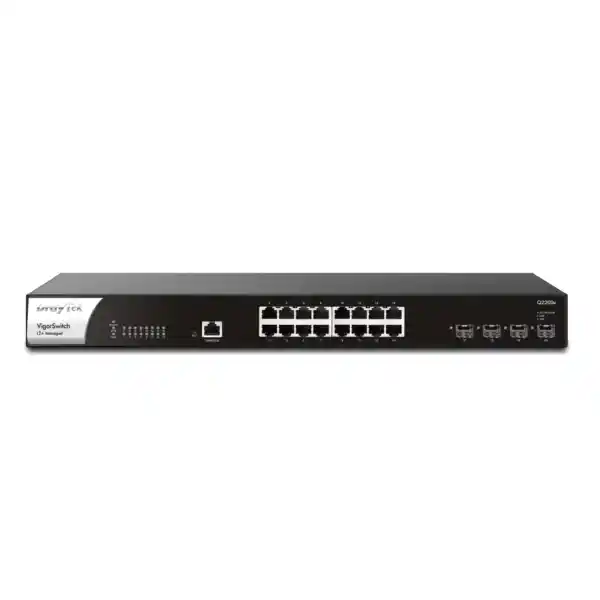
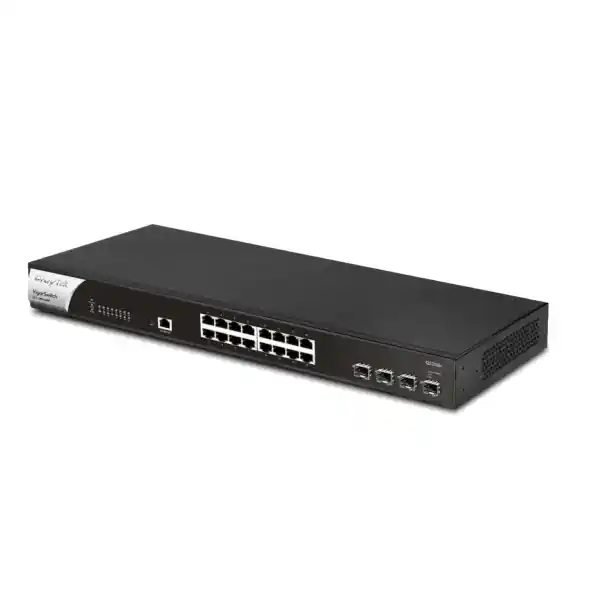
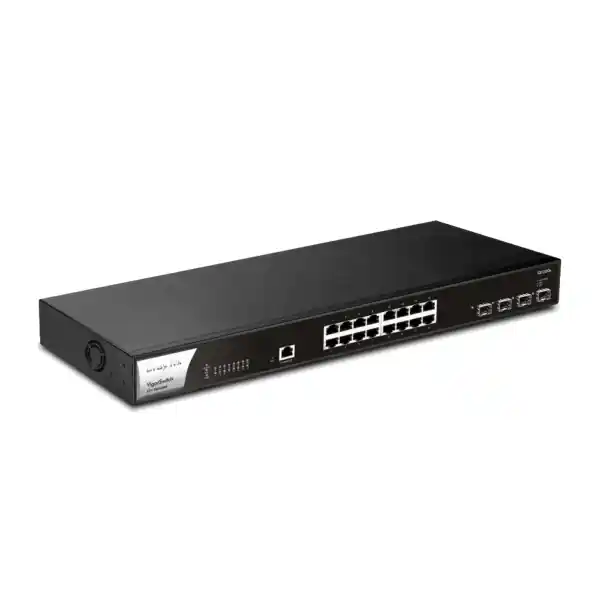
DrayTek VigorSwitch Q2200x – 16-Port 2.5GbE Managed Switch with 4 × 10G SFP+
The DrayTek VigorSwitch Q2200x is designed for networks that have outgrown ordinary Gigabit Ethernet but do not need PoE on every access port. Sixteen multi-gigabit copper interfaces deliver 10/100/1000/2500Mbps connectivity for Wi-Fi 6 access points, workstations, NAS appliances, compact servers and high-performance edge devices, while four 1/10G SFP+ interfaces provide flexible high-speed aggregation and uplink capacity. With a 160Gbps switching fabric, Layer 2+ routing functions, VLAN-aware DHCP services, LACP, STP/RSTP/MSTP, advanced QoS, multicast controls, access authentication and centralized DrayTek management, the Q2200x can serve as a capable core or distribution switch for small and medium business environments across Dubai and the wider UAE.
Multi-gigabit RJ45 access ports supporting 10/100/1000/2500Mbps Ethernet.
1G/10G optical or DAC-capable uplinks for aggregation, servers and backbone connections.
Switching capacity intended to sustain simultaneous traffic across the multi-gigabit port set.
Rack-mountable managed switching with VLAN routing, DHCP functions and static routing support.
What the VigorSwitch Q2200x is designed to solve
Many UAE business networks now have endpoints that can exceed the practical limits of a 1Gbps access layer. Wi-Fi 6 access points can aggregate multiple wireless clients and push more than one gigabit of traffic toward the wired LAN. Modern workstations often ship with 2.5GbE interfaces. NAS appliances increasingly provide 2.5GbE, 5GbE or 10GbE connectivity. Virtualization hosts, backup servers, media production systems and analytics workstations may also generate short, heavy bursts that expose a conventional Gigabit switch as the bottleneck. The Q2200x addresses that transition without forcing every copper endpoint onto a full 10GBASE-T infrastructure. Its sixteen 2.5GBase-T interfaces reuse familiar RJ45 cabling and provide an intermediate performance tier that is easier to deploy in existing offices.
The second design problem is aggregation. If multiple 2.5GbE clients are active at the same time, a single 1Gbps uplink can become oversubscribed immediately. Four SFP+ interfaces capable of 10Gbps allow the Q2200x to connect to upstream switches, routers with suitable interfaces, servers, storage systems or another aggregation layer at far higher speeds. Administrators can also use link aggregation where the peer device supports compatible LACP or static trunking. This makes the switch useful not just as a faster access device but as a small core or distribution platform in networks where traffic must move efficiently between user VLANs, servers and internet edge devices.
The third requirement is operational control. Raw port speed alone does not make a business switch. The Q2200x adds VLAN segmentation, inter-VLAN routing, DHCP server capability, security controls, traffic prioritization, multicast management, monitoring, LLDP/LLDP-MED and integration with DrayTek management platforms. These functions allow IT teams to build structured networks for departments, voice, wireless, surveillance, guests, servers and management rather than placing all devices in one flat broadcast domain. For organizations planning a multi-gigabit refresh, the result is a platform that improves both throughput and network architecture.
Hardware architecture and port map
| Hardware element | Specification | Deployment value |
|---|---|---|
| Copper access ports | 16 × 10/100/1000/2500Mbps RJ45 | Supports legacy Fast/Gigabit devices and newer 2.5GbE endpoints on the same switch. |
| High-speed uplinks | 4 × 1G/10G SFP+ | Suitable for fiber, compatible SFP/SFP+ modules or supported direct-attach designs. |
| Switching capacity | 160Gbps | Provides fabric headroom for concurrent multi-gigabit access and 10G aggregation traffic. |
| Forwarding rate | Up to 119.04Mpps at 64-byte frames | Important for high packet-per-second workloads and many simultaneous flows. |
| Packet buffer | 12Mbit | Provides buffering during transient congestion and speed transitions between ports. |
| Jumbo frame | Up to 10KB | Can reduce protocol overhead for storage and selected server workloads when end-to-end support is enabled. |
| Management console | RJ45 console plus network management services | Provides an out-of-band-style local configuration path during commissioning or recovery. |
| Form factor | 1U, 440 × 205 × 44mm | Fits standard equipment racks with a relatively shallow chassis depth. |
| Power | AC 100–240V; maximum consumption listed at 45W | Universal AC input simplifies deployment across common UAE power environments. |
A critical sizing note is that the Q2200x is the non-PoE member of this family. Its copper ports provide network connectivity, not PoE power. If the project requires the switch itself to power access points, cameras, phones or other powered devices, the power budget must be supplied by another PoE switch or injectors, or the PoE-capable DrayTek family alternative should be evaluated. This distinction matters in wireless and surveillance bills of materials because port speed and power delivery are separate requirements.
Why 2.5GbE matters for Wi-Fi 6 and modern client access
A Wi-Fi 6 access point may have an aggregate wireless radio capacity that exceeds one gigabit, especially when many capable clients are active at the same time. Connecting such an AP to a 1GbE switch can impose a wired bottleneck even when the radio layer has additional capacity. A 2.5GbE switch port raises that ceiling without immediately requiring 10GbE copper on every edge port. The Q2200x therefore fits well in designs where the wireless system, endpoint hardware and cabling are evolving faster than the existing LAN core.
2.5GBase-T is also attractive because many offices already have structured copper cabling that can support multi-gigabit Ethernet over appropriate distances and installation quality. The actual result depends on cable category, termination quality, patch leads, electromagnetic conditions and channel length, so professional validation remains important. In practical retrofit projects, however, moving from 1Gbps to 2.5Gbps is often less disruptive than replacing an entire horizontal cabling plant for 10GBASE-T. That makes the Q2200x relevant for Dubai offices where network upgrades must be completed with minimal interruption to occupied floors.
The sixteen copper ports also auto-negotiate lower speeds, so the network does not need to become multi-gigabit everywhere on day one. Printers, phones, legacy PCs and building devices can remain at 100Mbps or 1Gbps while new workstations, access points and storage endpoints use 2.5Gbps. This mixed-speed behavior supports phased migration. IT teams can prioritize the endpoints that benefit most from additional bandwidth and progressively upgrade adapters, access points and server links as budgets and refresh cycles allow.
10G SFP+ uplinks: avoiding an aggregation bottleneck
Sixteen 2.5GbE interfaces create a theoretical aggregate edge demand far above 10Gbps, so uplink design determines how the switch behaves under simultaneous traffic. The Q2200x provides four 1/10G SFP+ ports, giving architects multiple ways to distribute traffic. One 10Gbps uplink may be sufficient for a branch office where internet access is the dominant workload and most clients are lightly utilized. A larger office with local servers, backups, Wi-Fi traffic and inter-VLAN flows may benefit from multiple 10G links or LACP trunks to an upstream switch or capable server.
SFP+ is particularly useful in equipment rooms because it supports fiber transceiver choices and direct-attach options subject to compatibility and distance requirements. Fiber can provide electrical isolation and longer reach between cabinets or floors, while a compatible DAC can be cost-effective for short rack-to-rack or switch-to-server links. The correct optic depends on the fiber type, connector, path length and peer interface. A procurement team should therefore treat the transceiver as part of the link design rather than as an interchangeable accessory.
Because the SFP+ ports also support 1Gbps operation, the Q2200x can be introduced into older optical environments before the upstream infrastructure moves to 10G. That backward compatibility supports staged upgrades, but it is important to understand the oversubscription consequence: sixteen 2.5GbE access ports feeding a single 1Gbps uplink will not deliver multi-gigabit end-to-end throughput. The design should match uplink capacity to real traffic flows, especially for local server access, east-west file transfer, virtual machine backup and high-density wireless.
Layer 2+ architecture and wire-speed VLAN routing
The Q2200x is positioned as an L2+ managed switch. In practice, that means it combines the switching functions expected from a business Layer 2 platform with selected Layer 3 capabilities, including static routing, VLAN routing and DHCP server functionality. This is valuable when a network needs to keep local inter-VLAN traffic on the switching infrastructure rather than sending every packet to the internet firewall or router. For example, users in a workstation VLAN accessing a local file server VLAN can be routed through the Q2200x while internet-bound traffic still follows the default path toward the security gateway.
Offloading local inter-VLAN forwarding can reduce unnecessary load on the WAN router and improve latency for internal applications. It also means that some LAN services can continue functioning even if the internet edge device is temporarily unavailable, depending on how addressing, default gateways and services are designed. DrayTek highlights DHCP server support on its L2+ switches for this reason: a core switch can continue assigning local addresses for configured VLANs even when an upstream router is offline. For resilient office operations, separating local switching/routing duties from WAN duties can be useful.
L2+ does not mean the switch should automatically replace a dedicated firewall. Security policy between sensitive zones may still require stateful inspection, application controls, VPN termination, threat prevention or logging that belongs on a security gateway. A good architecture decides which VLAN relationships can be routed locally and which must traverse the firewall. The Q2200x provides the switching and selected routing tools to implement that design efficiently rather than forcing one routing pattern for every network.
VLAN segmentation for departments, servers, guests, voice and surveillance
VLANs are fundamental to turning a fast switch into a manageable business network. The Q2200x supports 802.1Q tag-based VLANs and additional VLAN methods such as MAC-based, protocol-based, management, voice and surveillance VLAN functions. A UAE office can use these tools to isolate corporate workstations from guest Wi-Fi, separate IP phones from user data, keep cameras and NVR systems away from ordinary client devices, place servers in controlled subnets and reserve a dedicated management VLAN for switches, access points and other infrastructure.
The switch supports up to 512 VLANs, which is significantly more than most SMB deployments require and provides space for structured segmentation across floors, tenants, departments or service types. The important design task is not to create the maximum number of VLANs, but to define clear trust boundaries and traffic paths. Each VLAN should have an addressing plan, DHCP scope or static addressing policy, gateway, DNS behavior, allowed inter-VLAN relationships and monitoring approach. Naming conventions should also be standardized so the operational team can understand the topology from the configuration alone.
QinQ support can be useful in selected service-provider or multi-tenant scenarios where customer VLAN tags need to be carried through another tagged domain. For ordinary enterprise LANs, 802.1Q access and trunk assignments will be the primary mechanism. The Q2200x allows administrators to build tagged uplinks to firewalls, routers, Wi-Fi controllers or other switches while presenting untagged access VLANs to endpoints that do not understand VLAN tagging. Correct native VLAN and allowed-VLAN configuration is essential to avoid accidental leakage or unreachable services.
Link aggregation with up to eight LAG groups
The Q2200x supports static link aggregation and IEEE 802.3ad LACP, with up to eight link aggregation groups and up to eight members per group according to DrayTek specifications. Link aggregation can improve resilience and aggregate bandwidth between compatible network devices, but it should be understood correctly. A LAG does not generally make one individual flow use the sum of all member links. Traffic is distributed according to a hashing method, so the greatest benefit appears when multiple concurrent sessions can be balanced across members.
For a server with multiple compatible interfaces, LACP may provide redundant paths and additional aggregate throughput across simultaneous client sessions. Between switches, a LAG can provide more capacity than a single uplink and protect against the loss of one member, provided both ends are configured consistently. In a network carrying storage, backup and user traffic at the same time, this can materially improve practical utilization. The peer device must support the same aggregation method, VLAN trunking and speed assumptions.
Architects should also compare LACP with simply using independent routed links. In smaller networks, aggregated Layer 2 trunks are straightforward. In more complex environments, routed uplinks can reduce spanning-tree dependencies and limit broadcast domains. The Q2200x is often deployed in SMB topologies where LACP is appropriate, but the choice should follow the overall failure model, upstream capabilities and operational skills. Four 10G SFP+ interfaces provide useful flexibility for either redundant aggregation or dedicated service links.
Spanning tree, loop protection and resilient Layer 2 design
Redundant Ethernet links improve availability only when loops are controlled. The Q2200x supports classic STP, Rapid Spanning Tree Protocol and Multiple Spanning Tree Protocol. RSTP is generally preferred over legacy STP for faster convergence in modern Ethernet networks, while MSTP can map groups of VLANs into different spanning-tree instances in more sophisticated designs. These features allow redundant switch paths to remain physically connected without creating uncontrolled broadcast loops.
Loop protection adds another operational safeguard. A loop can be introduced accidentally by patching two access ports together, connecting unmanaged switches incorrectly or misconfiguring redundant links. Broadcast storms can consume bandwidth and CPU resources quickly, causing widespread service impact. A managed network should combine spanning-tree configuration with sensible edge-port practices, storm control and documented patching. The Q2200x includes both spanning-tree and traffic-control tools that support this layered approach.
For multi-switch installations, root bridge placement deserves deliberate planning. The core or distribution layer should usually have predictable spanning-tree priority rather than allowing the election to depend on default bridge identifiers. LACP trunks should also be configured before redundant physical links are brought into production. These details matter in UAE offices with several wiring closets, because a fault in one floor should not destabilize the entire campus LAN. Good switch configuration turns physical redundancy into controlled resilience.
QoS for voice, conferencing and business-critical traffic
Not every packet has the same sensitivity to delay. File copies can tolerate short pauses, while voice and real-time video are far more affected by latency, jitter and packet loss. The Q2200x provides eight QoS queues, SPQ and WRR scheduling methods, rate limiting and classification/remarking options based on CoS, DSCP, CoS-to-DSCP relationships and IP precedence. This gives administrators a toolkit for prioritizing time-sensitive traffic when links become congested.
Voice VLAN and LLDP-MED functions can simplify IP phone deployment. LLDP-MED allows compatible endpoints to learn network policy information, while the switch can identify voice devices and place traffic into the intended VLAN and priority treatment. A well-designed voice deployment still requires end-to-end QoS consistency: the switch, router, firewall, WAN service and phone system should agree on marking and trust boundaries. Prioritizing traffic on one switch cannot compensate for congestion elsewhere in the path.
Rate limiting is useful when a device or service should not consume unrestricted bandwidth. Guest access, non-critical cameras, lab systems or backup jobs can be constrained according to business policy. However, arbitrary limits can also reduce user experience or backup windows, so they should be based on measured traffic and application requirements. The Q2200x makes the controls available; network design determines how they are applied.
Multicast controls for video, discovery and one-to-many traffic
Multicast traffic can be efficient when one source needs to reach multiple receivers, but unmanaged multicast can behave like flooding on parts of a Layer 2 network. The Q2200x supports IGMP Snooping, IGMP Querier functions and IPv6 MLD Snooping. These mechanisms help the switch learn which ports actually require specific multicast groups and forward streams only where they are needed instead of distributing them unnecessarily across every interface in a VLAN.
This matters in environments with IPTV, surveillance streams, conferencing systems, service discovery or specialized industrial/business applications. Proper multicast handling can reduce needless bandwidth consumption and keep access ports cleaner. The listed multicast group capacity is 256, which is more than sufficient for many SMB use cases but should still be checked if the installation has unusually high channel counts or specialized multicast-heavy applications.
IPv6 readiness should also be considered during network design even when the current LAN is predominantly IPv4. The Q2200x includes MLD Snooping, IPv6 ACL capability and an IPv6 DNS resolver function according to DrayTek. Organizations adopting dual-stack networks can therefore apply managed multicast and access policy concepts on IPv6 rather than treating it as an unmanaged parallel path.
Access security: 802.1X, MAC authentication, RADIUS and TACACS+
The Q2200x supports 802.1X and MAC-based authentication, with RADIUS and TACACS+ listed as authentication-server options. These features allow an organization to move beyond the assumption that any device plugged into an Ethernet socket should receive full network access. With 802.1X, a compatible endpoint can authenticate before normal access is granted. MAC-based methods can help with devices that do not support an interactive 802.1X supplicant, although MAC addresses alone are not a strong identity and should be treated accordingly.
Centralized authentication can also improve management accountability. Rather than sharing one local administrator password among technicians, a RADIUS or TACACS+-based design can centralize credentials and, depending on the server and policy design, improve logging or role control. The switch additionally supports multiple administrative accounts with two privilege levels. For an enterprise team, these features help align network access with joiner/mover/leaver processes and reduce reliance on shared credentials.
Authentication should be combined with physical security and segmentation. A network cabinet that is accessible to unauthorized users can expose console ports, patching and reset controls. Likewise, authenticated devices should still be placed into appropriate VLANs and be subject to firewall or ACL rules. The Q2200x provides the enforcement tools at the access layer, while the organization defines the identity, authorization and incident-response model around them.
DHCP Snooping, Dynamic ARP Inspection and IP Source Guard
Layer 2 attacks and accidental misconfiguration can disrupt a network even when the perimeter firewall is functioning normally. The Q2200x includes DHCP Snooping, Dynamic ARP Inspection and IP Source Guard. DHCP Snooping can distinguish trusted interfaces that lead toward legitimate DHCP infrastructure from untrusted client-facing ports and validate DHCP behavior. This can reduce the risk of an unauthorized DHCP server handing out incorrect gateways or DNS information to users.
Dynamic ARP Inspection can use trusted binding information to examine ARP traffic, helping defend against certain forms of ARP spoofing. IP Source Guard can restrict traffic based on expected source addressing information. These controls are most effective when implemented as a coordinated system with carefully defined trusted ports, DHCP behavior and static exceptions. Enabling them without understanding the topology can block legitimate devices, especially infrastructure with static IP addresses or atypical DHCP behavior.
The switch also includes IP Conflict Prevention. DrayTek’s approach can identify address conflicts and block misconfigured or malicious hosts according to configured host/port expectations. This is valuable in networks where fixed-address cameras, printers, access-control devices or servers coexist with DHCP clients. A duplicate address can create intermittent failures that are difficult to troubleshoot. Detecting the conflict close to the access port helps shorten fault isolation.
DHCP server capability for distributed and resilient LAN services
DrayTek includes DHCP server functionality on the Q2200x as part of its Layer 2+ feature set. This can be useful when the switch is performing VLAN routing and should issue addresses directly to local clients. Instead of sending every DHCP and inter-VLAN dependency to the internet router, the core switch can manage address pools for selected local segments. That design can reduce workload on the edge device and allow internal addressing services to remain available if the WAN gateway is restarted or temporarily unavailable.
A DHCP plan should be documented with scope ranges, exclusions, reservations, lease durations, DNS servers, default gateways and any special options required by phones, provisioning systems or boot services. Critical infrastructure should not be assigned casually from broad dynamic pools. Where fixed addresses are required, reservations or managed static assignments should be used consistently. The Q2200x can support these network services, but address management remains an operational discipline.
For larger environments with centralized Windows, Linux or appliance-based DHCP, the existing server may remain the better system of record. The fact that the Q2200x can provide DHCP does not mean every deployment should move the function. The correct choice depends on redundancy goals, centralized administration, logging, directory integration and disaster recovery. FourTeck engineers can design either model and use the switch’s VLAN and routing functions accordingly.
ONVIF-aware surveillance management without confusing switching and PoE
The Q2200x includes ONVIF-friendly functions that can discover compatible surveillance devices, present a topology, provide access to live video in the management interface and expose selected maintenance actions such as network settings, reboot or factory-reset functions where supported. This can improve visibility when cameras and NVRs are spread across VLANs because the switch becomes another operational viewpoint for the surveillance network.
The important caveat is power. The Q2200x has no PoE budget and does not power cameras directly. A surveillance design that uses this switch must therefore provide PoE from dedicated access switches or injectors. In some architectures, that is exactly the intention: PoE camera switches sit at the edge while a Q2200x acts as a fast aggregation or routing switch. Multiple camera-switch uplinks can feed the Q2200x, and 10G SFP+ interfaces can connect toward the NVR or core where sustained recording traffic is concentrated.
Surveillance traffic can be substantial. Camera resolution, frame rate, codec, scene complexity and retention policy affect bitrate and storage. The network should be sized for both steady-state recording and administrative viewing. VLAN segmentation, multicast handling where applicable, QoS policy and uplink capacity should be considered alongside storage design. The ONVIF features assist management; they do not replace end-to-end CCTV engineering.
Monitoring, mail alerts, sFlow, SNMP and RMON
Operational visibility is essential once a switch becomes part of the business core. The Q2200x supports SNMP v1, v2c and v3, RMON groups, sFlow, SNTP, LLDP and mail alert functions. SNMP can feed network monitoring systems with interface status, counters and device health information. SNMPv3 is preferable where supported because it can provide stronger authentication and privacy than older community-string approaches. RMON extends traffic and event monitoring concepts, while sFlow can provide sampled traffic visibility for analytics platforms that understand the protocol.
DrayTek lists mail alerts for port status, port speed, system restart, IP conflict, hardware monitoring, device checks and ONVIF camera snapshot events. These notifications can help a small IT team discover problems before a user opens a ticket. Alerting should still be tuned carefully. Too many low-value notifications create noise and cause important events to be ignored. The best practice is to connect switch telemetry to an operational process with ownership, severity levels and escalation paths.
LLDP is useful for topology discovery because neighboring devices can exchange identity and capability information. LLDP-MED extends those ideas for media endpoints such as IP phones. When combined with port descriptions and documented VLANs, these protocols make troubleshooting significantly faster. Instead of tracing every cable manually, the administrator can use switch information to understand which endpoint or downstream device is connected to which port and how it is negotiating.
Device Check and proactive endpoint monitoring
The Q2200x can perform ping-based Device Check monitoring for selected LAN devices. The switch periodically verifies reachability and can issue a mail alert when the target stops responding. This is a simple feature, but it can be valuable for infrastructure that lacks a full monitoring agent, such as printers, controllers, NVRs, specialized appliances or remote network devices. Placing basic reachability checks at the switch layer provides an additional signal about whether an endpoint is alive.
Ping reachability is not the same as application health. A server can reply to ICMP while its database is unavailable, and a camera can respond to ping while its video stream has failed. Device Check should therefore be treated as one layer in a monitoring stack rather than as a complete service-health platform. SNMP, application probes, log collection and user-experience monitoring can provide deeper context.
For smaller UAE organizations that do not yet operate a dedicated NMS, the built-in alerts are still a meaningful step beyond reactive troubleshooting. They can identify a link or endpoint outage closer to the time it occurs. FourTeck can also integrate switch monitoring into broader IT services and managed infrastructure workflows when the network requires centralized oversight, periodic review and configuration management.
Management choices: local GUI, CLI services and DrayTek platforms
The Q2200x provides a web-based management interface and supports local management services including HTTP, HTTPS, Telnet and SSH v2. In production, encrypted management methods such as HTTPS and SSH should be preferred, while insecure legacy services should be disabled where operational requirements allow. Management access should be restricted to a dedicated management VLAN or trusted administrator subnets instead of being exposed broadly to user networks.
The switch can also participate in DrayTek’s management ecosystem. VigorRouter Switch Management can discover supported devices, provide hierarchical views and simplify tasks such as VLAN provisioning. VigorConnect offers centralized management for supported switches and access points, while VigorACS provides broader centralized provisioning, monitoring, alarms, maintenance and reporting across compatible DrayTek infrastructure. According to DrayTek, Q2200x support in VigorConnect and VigorACS is available from firmware 2.7.1.
The appropriate management platform depends on scale. A single switch may be manageable directly. A site with multiple DrayTek switches and APs benefits from a consolidated view. A multi-branch organization can gain more value from a centralized platform that reduces repetitive configuration and exposes health information across locations. Regardless of platform, configuration backup should be part of the operating procedure. The Q2200x supports backup/restore and dual-image capability, which can help with controlled maintenance and recovery.
For broader network and security projects, FourTeck can align the Q2200x with firewall, WAN, wireless and server infrastructure through the FourTeck UAE technology portfolio rather than treating the switch as an isolated purchase.
OpenVPN client and secure management use cases
DrayTek lists OpenVPN client functionality among the Q2200x management features. This can be useful in specific management architectures where the switch needs to establish an encrypted path toward a remote management environment. The feature should not be confused with a full branch VPN firewall. The Q2200x remains a managed L2+ switch; perimeter security, site-to-site VPN policy, internet threat prevention and remote-user VPN services are generally better handled by a dedicated security gateway designed for those functions.
When secure remote management is required, organizations should begin with network segmentation, management-plane access controls, strong credentials, firmware maintenance and encrypted protocols. Remote reachability should be provided only through trusted paths, such as a management VPN, jump host or centralized controller, according to the organization’s security model. Exposing switch management interfaces directly to the public internet is not appropriate.
The switch also supports access lists for management control, allowing administrators to define which sources can reach management services. Combined with a dedicated management VLAN, RADIUS/TACACS+ authentication and logging, this supports a more defensible operational posture. For projects that need a coordinated firewall and switching architecture, the Firewall Dubai FourTeck site provides a route into security-focused consultation and product planning.
Deployment topology 1: multi-gigabit Wi-Fi access layer
A common Q2200x deployment is a wired aggregation switch behind Wi-Fi 6 access points. The access points connect to 2.5GbE copper ports while one or more 10G SFP+ links connect upstream to the main core or security stack. Corporate SSIDs can map to employee VLANs, guest SSIDs to isolated internet-only VLANs and specialist devices to separate IoT or voice VLANs. The Q2200x carries the tagged VLANs and can route selected local segments where that is appropriate.
Because the Q2200x does not provide PoE, the APs need separate power. In a ceiling-mounted office deployment, that normally means PoE is delivered by a different PoE switch or injectors. Architects should compare the operational simplicity of a single PoE multi-gigabit switch against the cost and topology advantages of a non-PoE aggregation switch. The Q2200x makes most sense where power is already solved or where the switch is aggregating downstream PoE access switches rather than directly powering endpoints.
The benefit of 2.5GbE is strongest when the rest of the path is equally capable. A 2.5GbE AP port feeding a congested 1Gbps core will not improve end-to-end performance. Conversely, a 10G uplink from the Q2200x into a capable core gives multiple APs room to share bandwidth. Capacity planning should look at aggregate client demand, WAN speed, local application traffic and backup windows rather than simply counting radio data rates.
Deployment topology 2: NAS, backup and creative-production network
Studios, engineering teams, media departments and data-heavy SMBs often need faster access to central storage. A Q2200x can connect 2.5GbE workstations to a NAS or server attached through 10G SFP+, allowing several users to access storage concurrently without every desktop requiring 10GbE. The design is particularly attractive when end-user devices already include 2.5GbE interfaces or can be upgraded economically.
Jumbo frames up to 10KB may improve efficiency in selected storage environments, but they should only be enabled when the entire path supports a consistent MTU. A mismatched MTU can create hard-to-diagnose connectivity problems. For many deployments, standard Ethernet frames perform adequately and are simpler. If jumbo frames are used, the switch, server, NAS, NIC drivers, virtualization layer and any intermediate equipment should be validated together.
Storage performance also depends on disk arrays, SSDs, CPU, protocol, file sizes and concurrent workload. A 10G network connection does not guarantee 10Gbps of application throughput. The Q2200x removes one potential network bottleneck, but end-to-end benchmarking remains essential. For rack-based projects that combine switching with compute or storage infrastructure, FourTeck can coordinate network design with server and storage planning through its broader global FourTeck solutions portfolio.
Deployment topology 3: compact core for a multi-VLAN SME
In a compact SME network, the Q2200x can sit at the center of the LAN. User devices, access points or downstream switches connect to the 2.5GbE ports, while SFP+ links connect to servers, a firewall or another distribution device. VLANs separate users, voice, guests, cameras, servers and management. The switch can route approved local VLAN relationships and provide DHCP services, while the firewall handles internet access and security-sensitive inter-zone traffic.
This architecture keeps high-volume internal traffic local. For example, workstations reaching a file server do not need to hairpin through a low-throughput router if security policy permits switch-based routing. At the same time, a guest VLAN can be forced toward the firewall and denied access to internal networks. Voice traffic can be prioritized through QoS, and camera traffic can be segmented into a surveillance VLAN. Centralized monitoring provides the operational view across the core.
The key design decision is where the security boundary belongs. VLAN routing on the switch is efficient, but it is not equivalent to stateful firewall inspection. Sensitive environments may route more VLANs through the firewall despite the additional load. Others may allow high-trust server/user traffic to route locally and use ACLs for basic control. The Q2200x supports either approach, provided the upstream firewall and routing design are sized accordingly.
Deployment topology 4: aggregation for surveillance and building systems
Large camera counts are often distributed across several PoE access switches located near camera groups. Those access switches can uplink to the Q2200x, which aggregates traffic toward one or more NVRs or a central core. Using 10G SFP+ for the NVR/core path prevents a 1Gbps bottleneck when multiple camera streams are being recorded, reviewed or exported. The Q2200x’s ONVIF-aware management features can add useful device visibility to this architecture.
Building systems such as access control, attendance devices, intercoms and IoT gateways can also be segmented onto dedicated VLANs. These devices often have long refresh cycles and may run at 100Mbps or 1Gbps, which the Q2200x can still accommodate. The higher-speed switch is therefore not wasted when some endpoints are slow; its value lies in aggregation, segmentation and future-ready uplinks.
Security is especially important for cameras and building-control equipment because they are frequently installed by separate contractors and may receive less frequent firmware attention than user PCs. A dedicated VLAN, controlled management access, DHCP/ARP protections where appropriate and firewall policy can reduce exposure. The switch contributes the segmentation and enforcement foundation while the broader security architecture controls cross-zone access.
Sizing the Q2200x for real workloads
Switch sizing should start with traffic patterns, not only port count. Sixteen 2.5GbE ports provide up to 40Gbps of nominal full-rate access bandwidth in one direction if every port were transmitting simultaneously, while four 10G SFP+ interfaces provide substantial aggregation capacity. In ordinary offices, endpoints rarely sustain maximum line rate at the same time, so practical oversubscription is normal. The correct ratio depends on whether traffic is primarily internet-bound, server-bound or exchanged locally between access ports.
An internet-centric office with a 1Gbps or 2Gbps WAN may use 2.5GbE mainly to remove local bottlenecks and support high-performance Wi-Fi, with a single 10G uplink easily exceeding WAN demand. A media or backup environment can generate far more east-west traffic and may justify multiple 10G uplinks or a directly attached 10G server. A surveillance network creates steady flows rather than user-driven bursts, so aggregate camera bitrate should be calculated explicitly.
Packet rate is another factor. Small-packet workloads can stress forwarding resources differently from large file transfers. DrayTek lists a forwarding rate of 119.04 million packets per second for 64-byte packets under test conditions. Actual application performance varies with configuration, traffic mix and network conditions. Features such as ACLs, monitoring, routing and security controls should be validated in the intended design rather than assuming every datasheet maximum will be reached simultaneously.
Finally, count future ports. A switch that is already nearly full at installation leaves no room for growth, temporary devices or redundancy. If the site needs more than sixteen copper access ports, the Q2200x can aggregate additional access switches, but the topology and uplinks should be planned from the start. Sometimes two smaller switches provide better distribution; in other cases a higher-port-count core is more efficient. Port count, location and failure domains should all influence the choice.
Cabling, optics and installation planning in the UAE
Multi-gigabit upgrades often reveal cabling issues that were invisible at lower speeds. Existing copper runs should be assessed for cable category, length, termination quality, patch-panel condition and patch leads. 2.5GBase-T is designed to operate over common structured cabling types within applicable standards, but a poor installation can still produce errors, down-negotiation or unstable links. Certification testing is especially valuable in older offices where cabling records are incomplete.
For SFP+ links, optics must match the fiber plant and the peer. Single-mode and multimode transceivers are not interchangeable, and wavelength, connector type and supported distance matter. Direct-attach copper may be appropriate inside a rack but is not a substitute for structured fiber across floors. The transceiver compatibility policy of both connected devices should be checked before procurement to avoid commissioning delays.
The Q2200x is a 1U rack-mount device measuring approximately 440 × 205 × 44mm. Although the chassis is relatively shallow, rack depth, cable-management space and front/rear clearance should be confirmed. Equipment rooms in the UAE should have appropriate cooling, dust control and UPS protection. DrayTek lists an operating temperature of 0 to 50°C and non-condensing operating humidity of 10 to 90 percent; these are equipment limits, not a recommendation to run network rooms near the upper boundary continuously.
Power design should consider the 45W listed maximum consumption of the switch plus any separate PoE equipment, routers, firewalls, servers and storage in the same rack. A UPS should be sized for total load, desired runtime and battery aging. Because the Q2200x itself does not power edge devices, its UPS load is modest compared with a high-budget PoE switch, but the complete rack may still be substantial.
Firmware, lifecycle and change-management practice
DrayTek’s current quick-start documentation for the Q2200x references firmware version 2.9.8 dated January 8, 2026. Firmware evolves, so production deployments should verify the current recommended release at the time of installation rather than treating a product page as the definitive update source. Release notes should be reviewed for fixes, behavior changes, security updates and upgrade prerequisites.
A controlled upgrade procedure begins with a configuration backup, a recorded rollback plan and a maintenance window. Dual-image capability can improve recovery options, but it does not eliminate the need for backups. Critical switches should also have current diagrams, management addresses, VLAN tables, uplink details and administrative credentials stored securely. When a switch fails or must be replaced, documentation can reduce restoration time dramatically.
Change management is equally important for ordinary configuration. VLAN changes, spanning-tree priorities, LACP modifications and ACL updates can affect multiple systems at once. Changes should be peer-reviewed where practical, tested against the intended topology and scheduled with business impact in mind. Configuration snapshots before and after major work make troubleshooting easier.
For organizations that prefer implementation support, FourTeck can provide design, configuration and integration assistance across switching, security and related infrastructure. This is especially useful when the Q2200x is part of a wider refresh involving firewall replacement, Wi-Fi upgrades, server migration or structured cabling remediation.
Performance expectations and what the datasheet numbers mean
The 160Gbps switching-capacity figure represents the internal fabric capability used to move frames between ports under appropriate conditions. It should not be interpreted as the throughput that a single user, server or uplink will see. An individual copper port is limited by its negotiated speed, up to 2.5Gbps, and an individual SFP+ port is limited to 10Gbps. Application throughput is lower than raw Ethernet line rate because protocol overhead, endpoint performance, storage speed, TCP behavior and traffic contention all matter.
Similarly, the 119.04Mpps forwarding-rate figure is a maximum test-oriented measure for small frames. Real networks contain mixed packet sizes and services. A large file transfer may stress throughput, while many small transactions may stress packet processing. The switch should be selected based on a realistic combination of port speeds, traffic directions and services rather than a single headline metric.
Link aggregation also requires nuanced expectations. Two 10G links in an LACP group can provide up to 20Gbps of aggregate link capacity, but one source/destination flow commonly hashes to one member and remains limited by that member’s speed. Multiple clients and sessions are where aggregation typically provides the greatest benefit. This is why storage, virtualization and switch-to-switch design should consider flow distribution as well as total bandwidth.
FourTeck can help translate workload estimates into a practical port and uplink plan. In many projects, the right question is not whether the Q2200x is ‘fast enough’ in isolation, but whether the end-to-end path—from client NIC to switch, uplink, router or server—has balanced capacity and appropriate failure tolerance.
When the Q2200x is a strong fit
Wi-Fi 6 uplink upgrade
Use 2.5GbE copper for access points whose wired interface can exceed Gigabit speeds, while aggregating multiple APs over 10G SFP+.
Fast workstation access
Give engineering, media, design or data-heavy users 2.5GbE connectivity without requiring 10GBASE-T on every desk.
NAS and local server traffic
Aggregate 2.5GbE users toward a 10G-connected storage or server platform and reduce access-layer bottlenecks.
Compact routed core
Use VLAN routing, DHCP and static routes for selected local services while retaining a dedicated firewall at the internet edge.
Surveillance aggregation
Aggregate downstream PoE camera switches and use ONVIF-aware management without relying on the Q2200x for endpoint power.
Phased network migration
Run legacy 100M/1G devices and newer 2.5G endpoints together while progressively moving backbone links to 10G.
When to choose a different switch architecture
The Q2200x is not automatically the right switch for every multi-gigabit project. If the access layer must power Wi-Fi access points, cameras or IP phones directly, a PoE-capable multi-gigabit switch can reduce the number of devices and power injectors. If most endpoints require 10GbE copper, a 2.5GbE access switch may not provide enough edge bandwidth. If the site needs more than sixteen copper ports in one chassis, a higher-density platform may simplify cabling and management.
Likewise, if the switch is expected to perform advanced dynamic routing, large-scale VRF segmentation, enterprise chassis stacking or deep security inspection, a more feature-rich Layer 3 or data-center platform may be appropriate. The Q2200x is aimed at L2+ SMB/core use, not every possible enterprise routing role. A correct bill of materials starts by defining required functions rather than forcing one product into an unsuitable role.
FourTeck can compare the Q2200x with alternative managed switches based on port density, PoE budget, uplink type, VLAN scale, routing requirements, management model and budget. That design step is particularly useful when a project combines wireless, CCTV, IP telephony and server traffic because each workload creates different port and power demands.
Technical specification summary
| Model | DrayTek VigorSwitch Q2200x |
| Switch class | L2+ managed, rack-mountable 1U |
| Copper ports | 16 × 10/100/1000/2500Mbps RJ45 |
| Fiber/uplink ports | 4 × 1G/10G SFP+ |
| PoE | No PoE output on Q2200x |
| Switching capacity | 160Gbps |
| Forwarding rate | 119.04Mpps at 64-byte packets |
| Buffer | 12Mbit |
| Jumbo frame | Up to 10KB |
| VLAN | Up to 512 VLANs; 802.1Q, MAC-based, protocol-based, management, voice and surveillance VLAN; basic QinQ |
| Layer 3 functions | Static route, VLAN route, DHCP server |
| Spanning tree | STP, RSTP, MSTP |
| Aggregation | Static and LACP; up to 8 groups with up to 8 members per group |
| QoS | 8 queues, SPQ, WRR, CoS, DSCP, CoS-DSCP, IP precedence, rate limiting |
| Multicast | IGMP Snooping, IGMP Querier, MLD Snooping; up to 256 multicast groups |
| Security | 802.1X/MAC authentication, RADIUS, TACACS+, IP Source Guard, DHCP Snooping, DAI, IP Conflict Prevention, storm control, DoS defense, loop protection |
| Monitoring | SNMP v1/v2c/v3, sFlow, RMON, SNTP, LLDP, LLDP-MED, mail alerts, Device Check |
| Management | Web GUI, HTTPS, SSH v2, config backup/restore, dual image, DrayTek SWM, VigorConnect, VigorACS |
| Power input | AC 100–240V @ 0.9A; max. power consumption listed as 45W |
| Dimensions | 440 × 205 × 44mm |
| Environmental | Operating 0–50°C; storage -20–70°C; operating humidity 10–90% non-condensing |
UAE procurement and project-planning considerations
For Dubai and UAE deployments, procurement should include more than the switch chassis. A complete quote may require SFP+ transceivers or DAC cables, rack accessories, patch cords, structured cabling remediation, UPS capacity, fiber patch panels, spare optics and installation services. If Wi-Fi access points or cameras will connect directly, the quote must also include the external PoE source because the Q2200x does not provide PoE. Identifying these dependencies before purchase prevents commissioning delays.
Compatibility should be checked at both ends of every uplink. The switch may support 1G/10G SFP+, but the peer device, optic type and fiber plant determine whether the link will establish correctly. Network diagrams should indicate interface speed, optic model, fiber type and VLAN mode. This level of detail is especially useful when different contractors are responsible for cabling, security, Wi-Fi and servers.
Availability and lead times can vary by distribution channel. For business-critical projects, consider whether spare switches or optics should be held locally and whether configuration backups are accessible to the support team. A replacement chassis is only useful if the VLAN, routing and management configuration can be restored quickly.
FourTeck can provide UAE-focused sourcing and integration guidance. The objective is to deliver a bill of materials that matches the actual topology rather than simply quoting a switch by model number. This helps control cost while reducing the risk of missing optics, power components or compatible uplinks.
Decision recap: what you are getting with the Q2200x
Access speed
Sixteen copper ports deliver up to 2.5Gbps each while remaining backward-compatible with 1Gbps, 100Mbps and 10Mbps Ethernet endpoints.
Aggregation
Four 1/10G SFP+ ports provide backbone, server and switch-to-switch connectivity with support for static and LACP aggregation.
Core services
VLAN routing, static routes and DHCP server capability allow selected internal traffic and addressing services to live on the switch.
Segmentation
Extensive VLAN support, voice/surveillance VLAN functions, QinQ and multicast controls support structured multi-service LANs.
Security
802.1X, RADIUS/TACACS+, DHCP Snooping, DAI, IP Source Guard and IP Conflict Prevention strengthen access-layer control.
Important limitation
The Q2200x is not a PoE switch. Plan a separate PoE power source for access points, cameras and phones that require power over Ethernet.
Quotation input checklist
For an accurate UAE quotation and topology recommendation, provide the following project information. These details allow the switch, optics and services to be sized together instead of quoting a bare chassis that may not match the deployment.
Number of 100M/1G/2.5G clients, Wi-Fi APs, servers and downstream switches.
List devices needing PoE/PoE+/PoE++ so separate power switching can be included if necessary.
Firewall, router, core switch, server or NVR model and its available 1G/10G interfaces.
Single-mode or multimode, connector type, approximate distance and existing patch-panel information.
Required user, guest, voice, server, CCTV, IoT and management VLANs plus routing/security expectations.
Available rack units, rack depth, UPS capacity, cooling conditions and required runtime.
Standalone management, VigorRouter SWM, VigorConnect, VigorACS or third-party monitoring requirements.
Supply only, installation, configuration, migration, testing, documentation or ongoing support.
FourTeck consultation for DrayTek VigorSwitch Q2200x in Dubai and UAE
The best use of the Q2200x is as part of an end-to-end network design that balances multi-gigabit access, 10G aggregation, VLAN segmentation, firewall capacity, Wi-Fi architecture, storage traffic and operational management. FourTeck can review an existing topology or design a new deployment, identify whether the non-PoE Q2200x fits the access/core role, select uplink media and define the required VLAN, routing and monitoring configuration.
For supply-only requirements, provide the quantity and required optics. For deployment projects, share the current switch/firewall models, number of users, Wi-Fi and CCTV requirements, server/NAS links, rack location and preferred migration window. A technical review can then determine whether a single Q2200x is sufficient or whether the design should include additional PoE access switches, redundant uplinks or a higher-density core.
FourTeck supports networking, cybersecurity and infrastructure projects across the UAE. If the project extends beyond switching, related planning can include firewall sizing, access-point connectivity, server links, network monitoring and managed IT support. The goal is a clean bill of materials and an implementation plan that matches the business workload, not merely the headline speed of one device.
Need a validated Q2200x bill of materials?
Send the port count, PoE requirements, rack location, SFP+ distance, VLAN plan and upstream device details. FourTeck can match the switch with compatible uplink media, deployment services and adjacent infrastructure requirements.
You can also explore the wider FourTeck portfolio for UAE switching, security and IT infrastructure planning. Technical recommendations should always be validated against the current firmware, transceiver compatibility and project topology at the time of deployment.

Reviews
There are no reviews yet.