
DrayTek VigorSwitch PQ2300xb in UAE
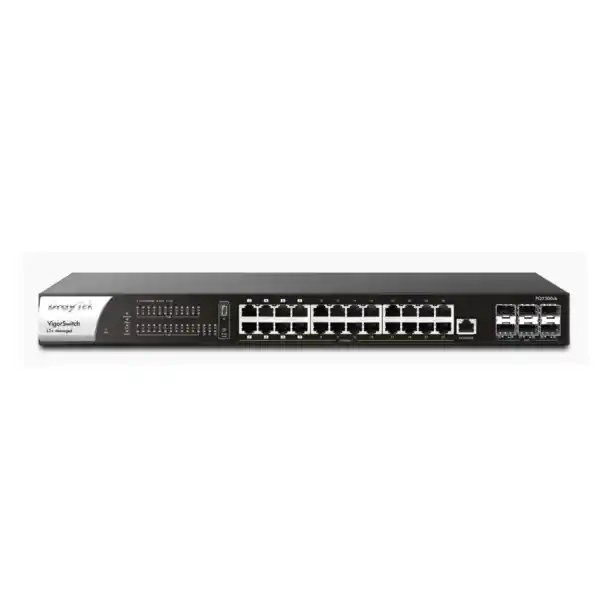
The DrayTek VigorSwitch PQ2300xb is built for organizations that have outgrown ordinary Gigabit access switching but do not want the cost, heat, and cabling disruption of moving every endpoint to 10GbE. Its 24 multi-gigabit copper ports operate up to 2.5Gbps, all 24 can provide PoE, eight support 802.3bt PoE++ power delivery, and six SFP+ interfaces provide 1G or 10G aggregation. With a 400W PoE budget, 240Gbps switching capacity, Layer 2+ routing features, stackable operation, network access controls, multicast optimization, surveillance awareness, and centralized management options, the platform is designed for modern SME, branch, campus, hospitality, retail, education, healthcare, and mixed IoT networks in the UAE.
Best use: multi-gig PoE access or compact core/aggregation for offices with Wi-Fi 6, high-resolution CCTV, IP telephony, IoT, and fast uplinks.
Access: 24 × 2.5GbE RJ-45 PoE ports.
High power: 8 × PoE++ plus 16 × PoE+.
Uplinks: 6 × 1G/10G SFP+.
Total PoE: 400W budget.
Why the VigorSwitch PQ2300xb Matters in a Modern UAE LAN
A large percentage of business access networks are still designed around a one-gigabit-per-port assumption. That was sufficient when most wired clients were desktops, VoIP handsets, printers, and ordinary 802.11ac access points. Today, a single access switch may need to serve Wi-Fi 6 access points with multi-gig Ethernet interfaces, high-resolution IP cameras, video analytics appliances, digital signage, point-of-sale equipment, building management devices, small servers, workstations, and edge gateways. The bottleneck has therefore moved away from the endpoint radio or local compute resource and toward the access layer. The PQ2300xb addresses that bottleneck by making 2.5GbE the normal copper access speed rather than a premium feature available on only a few ports.
This is especially useful in buildings where existing structured cabling is a major investment. 2.5GBASE-T was created to provide higher throughput over familiar twisted-pair Ethernet infrastructure under appropriate cabling conditions. An organization can therefore improve the bandwidth available to compatible access points and endpoints without immediately redesigning the entire horizontal cabling plant for 10GBASE-T. That is important in UAE offices, schools, hotels, clinics, warehouses, shops, and multi-floor commercial facilities where opening ceilings, replacing cable routes, or interrupting tenants can be expensive and operationally disruptive.
The switch is also valuable because bandwidth and endpoint power are engineered together. A fast access point is not useful if the access switch cannot provide the power level the device requires. The PQ2300xb includes eight PoE++ ports supporting IEEE 802.3bt with up to 90W per port and sixteen PoE+ ports supporting up to 30W per port, subject to the overall 400W budget. This combination creates a practical mix: high-power devices can be concentrated on the first PoE++ group while conventional cameras, phones, and wireless devices can use the remaining PoE+ capacity. For UAE solution architects, that makes the device easier to size than a switch where only bandwidth or only power has been modernized.
Hardware Architecture and Port Map
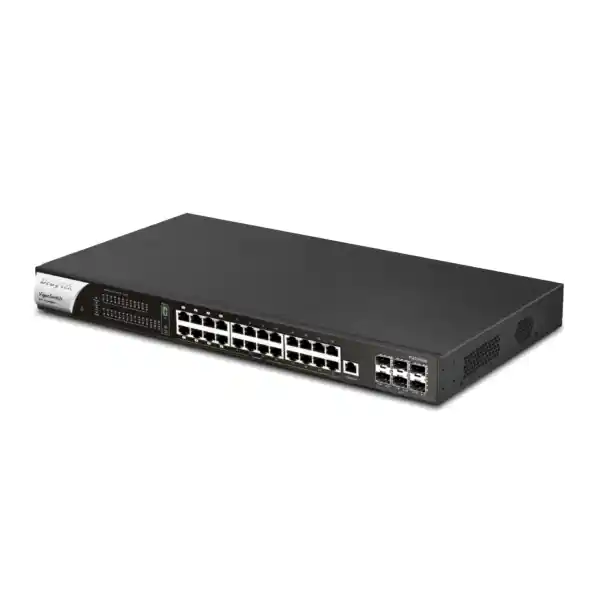
The front-access design combines twenty-four multi-gig copper interfaces with six SFP+ interfaces and an RJ-45 console port. Ports 1 through 24 are the primary endpoint-facing interfaces and negotiate 10Mbps, 100Mbps, 1Gbps, or 2.5Gbps according to the connected device and cabling conditions. The PoE implementation is divided by power capability: eight ports support PoE++ under 802.3bt in addition to backward-compatible PoE and PoE+, while sixteen ports support standard 802.3af/802.3at operation. This matters because it allows the administrator to reserve the highest-power ports for devices such as advanced wireless access points, PTZ cameras, compact edge systems, display controllers, or other equipment that can require more than 30W.
Ports 25 through 30 are SFP+ interfaces operating at 1Gbps or 10Gbps. Six separate SFP+ ports give the switch significantly more uplink flexibility than a conventional 24-port access switch with only two or four uplinks. Depending on design requirements, these interfaces can be allocated to redundant core links, server connections, firewall transit, stack-related paths, NVR connectivity, inter-floor trunks, or remote building links. The exact optical module or DAC selection must be matched to distance, fiber type, connector type, interoperability policy, and environmental requirements. The SFP+ ports should therefore be treated as an architectural resource rather than merely as spare uplinks.
DrayTek publishes a switching capacity of 240Gbps and a forwarding rate of 178.56 million packets per second for 64-byte traffic. The product specification also identifies a 16Mbit packet buffer and support for jumbo frames up to 12KB. These figures help explain how the switch is intended to operate under mixed access and aggregation loads. They should not be interpreted as an application-layer throughput guarantee because real network performance also depends on frame size, endpoint behavior, link aggregation design, VLAN routing policy, cabling, optics, traffic patterns, control-plane activity, and other enabled features.
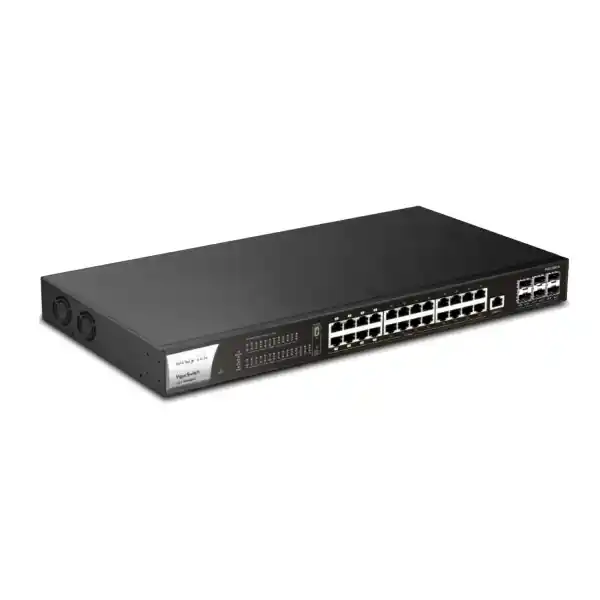
The physical chassis is 1U rack-mountable and measures approximately 440 × 281 × 44mm, with a published weight of about 4.52kg. AC input is rated for 100–240V, and DrayTek also specifies backup DC inputs for power resilience. Maximum power consumption is listed at 550W, reflecting the fact that the switch may be delivering a substantial portion of its power externally through PoE. The operating temperature range is published as 0°C to 50°C, so equipment-room airflow, rack loading, dust control, and cooling remain important in UAE deployments.
2.5GbE Access: More Than a Headline Speed
Moving from 1GbE to 2.5GbE provides two and a half times the nominal line rate on compatible links. In practice, the benefit appears most clearly when the endpoint can actually generate or receive more than one gigabit of useful traffic. Modern Wi-Fi 6 access points are a strong example because aggregate wireless capacity across multiple radios and clients can exceed what a single 1GbE wired uplink can transport. Connecting such an AP to a 2.5GbE switch port removes a common wired bottleneck and allows the wireless system to use more of its available capacity.
The same logic applies to workstations handling large design files, local backup targets, media systems, or edge appliances with 2.5GbE NICs. However, 2.5GbE should not be sold as an automatic 2.5× improvement for every application. Internet speed, server storage, protocol overhead, WAN firewall throughput, remote cloud performance, and end-device capabilities can still determine the actual user experience. FourTeck designs the access layer as part of an end-to-end path rather than treating the switch link speed as an isolated metric.
Why 10G SFP+ Uplinks Are Essential
A multi-gig access switch can create more aggregate traffic than a single one-gigabit uplink can carry. The PQ2300xb therefore provides six 10G-capable SFP+ interfaces so uplink design can scale with access capacity. A single 10G trunk offers four times the nominal bandwidth of one 2.5GbE access link and ten times that of a conventional 1GbE uplink, making it suitable for connection to a core switch, aggregation layer, server, storage system, or firewall that can sustain the rate.
Where redundancy or additional aggregate capacity is required, static link aggregation or LACP can combine multiple links, subject to traffic hashing behavior and the capabilities of the peer device. Link aggregation increases total path capacity across multiple flows and can provide resilience to a member-link failure, but it does not normally make one individual flow exceed the speed of a single member link. This distinction is important when sizing backup jobs, storage transfers, surveillance recording, or high-volume server connections.
PoE Engineering: 8 × PoE++ + 16 × PoE+ with a 400W Budget
Power over Ethernet must be designed from the total budget backward, not by multiplying the maximum per-port rating by the number of ports. The PQ2300xb has a 400W aggregate PoE budget. Its eight 802.3bt-capable ports can each supply up to 90W at the switch port, while the remaining sixteen PoE+ ports can provide up to 30W each. Because the aggregate theoretical maximum of every port operating at its individual ceiling would exceed 400W, a real deployment must calculate the actual expected draw of each powered device and leave operating margin.
For example, if a design uses four high-power devices budgeted at 60W each, those devices alone reserve 240W. That leaves approximately 160W from the 400W pool for the remaining powered endpoints. If ten ordinary cameras are each budgeted at 12W, another 120W is required, leaving approximately 40W before allowing additional engineering headroom. This example is intentionally conservative: actual negotiated power and device consumption may be lower, but using the endpoint vendor’s maximum or design requirement produces a safer procurement plan than assuming average consumption.
The switch supports scheduled PoE operation, which can be useful for noncritical endpoint classes that do not need continuous power. It also supports device checking behavior that can monitor selected devices and take remedial action such as cycling PoE when a device becomes unresponsive. Those capabilities can reduce manual intervention for remote or difficult-to-reach endpoints, but automated power cycling should be configured carefully. A failed ping can be caused by routing policy, endpoint firewalling, congestion, maintenance, or monitoring design rather than a true device failure.
PoE sizing in UAE projects should also consider UPS capacity and runtime. If a switch draws significant power while feeding cameras, access points, phones, and IoT devices, the UPS must support both the switch electronics and the downstream PoE load. A UPS sized only for the base switch consumption may provide much less runtime than expected once the connected devices are energized. FourTeck can incorporate switch, PoE endpoint, UPS, and rack power calculations into a single bill of materials through its UAE IT services practice.
Switching Capacity, Forwarding, Buffering, and What the Numbers Mean
The published 240Gbps switching capacity is a fabric-level figure describing the switch’s ability to move traffic internally. On a device with twenty-four 2.5GbE access ports and six 10GbE SFP+ ports, high fabric capacity is important because many ports can become busy at once. A hotel may have dozens of wireless clients behind multiple access points; an office may run cloud synchronization and local backup simultaneously; a surveillance deployment may push continuous streams toward recorders; and a school may combine classroom Wi-Fi, IP telephony, cameras, and administration traffic on the same access chassis. In all of these cases, the aggregate load can exceed the demand generated by any single endpoint.
The 178.56Mpps forwarding specification is measured using 64-byte packets, a demanding traffic pattern because the switch must process a much larger number of packets for a given amount of payload. Actual business traffic consists of many frame sizes and protocols. Large file transfers tend to use larger frames, while voice, DNS, transactional traffic, security events, and certain application patterns can create many smaller packets. The presence of a forwarding figure therefore provides useful engineering context, but application throughput should still be validated against the complete topology.
A 16Mbit buffer helps absorb short bursts when packets arrive on ingress faster than a destination egress port can transmit them. Buffers are not a substitute for proper capacity planning. Sustained oversubscription eventually fills any finite buffer and introduces drops or delay. This is why uplink design, QoS, traffic distribution, and application behavior matter. A twenty-four-port switch filled with 2.5GbE endpoints should not automatically be connected upstream through a single 1GbE path if the expected workload is high.
Jumbo frame support up to 12KB can be relevant for storage, virtualization, or specialized data flows, but jumbo frames should only be enabled where the complete end-to-end path supports a compatible MTU. A partial jumbo deployment can create hard-to-diagnose fragmentation or connectivity problems. For ordinary office and Internet traffic, the standard Ethernet MTU remains the safer baseline unless an application design explicitly calls for larger frames.
Layer 2+ Architecture: VLAN Routing Without Forcing Every Flow Through the Firewall
The VigorSwitch PQ2300xb is positioned as a Layer 2+ managed switch. In practical design terms, that means it combines the switching functions expected at the access or distribution layer with selected Layer 3 capabilities such as static routing, VLAN routing, and DHCP server operation. This can reduce unnecessary traffic traversal through an Internet gateway when two internal networks need controlled connectivity and the network policy permits local inter-VLAN routing.
Consider a business with separate VLANs for staff, voice, surveillance, wireless infrastructure, and management. If every permitted interaction between these networks must cross an external router over a narrow trunk, the router and trunk can become bottlenecks. By assigning routed VLAN interfaces on the PQ2300xb, appropriate internal traffic can be switched and routed closer to the source. The Internet firewall can remain responsible for WAN security, VPN, Internet policy, advanced threat inspection, NAT, and any inter-VLAN flows that must be inspected at the firewall.
This architecture should be designed with security policy in mind. Routing locally for performance is not automatically better if it bypasses inspection that the organization requires. For environments with strong east-west security controls, sensitive user groups or servers may still need firewall-mediated segmentation. The best design chooses intentionally which VLANs may route at the switch and which must traverse a security appliance. The availability of switch-based VLAN routing is therefore a tool for architecture, not a reason to bypass the security model.
The switch also includes DHCP server capability. In branch or small-campus deployments, DHCP scopes can be provided directly from the Layer 2+ switch for selected VLANs, reducing dependency on a separate server or router for address assignment. Important endpoints can be planned with reservations or fixed addressing where operationally appropriate. DHCP configuration must be coordinated with DHCP snooping, relay behavior if used elsewhere, IP addressing plans, and redundancy requirements to avoid duplicate servers or conflicting scopes.
VLAN Design: Up to 512 VLANs and Multiple Classification Methods
The product specification lists support for up to 512 VLANs and includes 802.1Q tag-based VLANs, MAC-based VLANs, protocol-based VLANs, management VLANs, voice VLANs, and surveillance VLANs. For most UAE business deployments, 802.1Q VLANs form the core segmentation method because they integrate cleanly with routers, firewalls, wireless controllers, access points, IP PBXs, servers, and other standards-based switching platforms.
A practical VLAN design begins with functions, not arbitrary numbers. Management interfaces should be isolated from normal user traffic. Voice endpoints benefit from a dedicated VLAN with appropriate QoS trust and routing policy. CCTV devices should usually be separated from staff clients and Internet-facing guest networks. Corporate wireless users and guest wireless users should remain logically distinct even if they share the same access points. IoT equipment should be grouped according to risk and operational need rather than mixed into a flat office subnet.
The PQ2300xb also supports GVRP and basic QinQ. GVRP can assist with VLAN registration in compatible environments, while QinQ can encapsulate customer VLAN tags inside a provider-style outer tag for particular multi-tenant or transport designs. These are useful tools, but they should not be enabled simply because the switch supports them. In most SME networks, manually documented 802.1Q trunks and access policies are easier to audit. In carrier-like or building-aggregation designs, QinQ can be valuable when multiple tagged networks need transport across an intermediate domain without rewriting the inner VLAN structure.
For procurement and deployment in Dubai, Abu Dhabi, Sharjah, and other UAE locations, FourTeck can align the switch VLAN plan with firewall zones, wireless SSIDs, VoIP networks, CCTV recorder segments, and server subnets. Additional information about network security integration is available through the Firewall Dubai platform, where switching and firewall policy can be considered as one architecture rather than separate purchases.
Spanning Tree and Loop Resilience
The PQ2300xb supports classic STP, Rapid Spanning Tree Protocol, and Multiple Spanning Tree Protocol. These mechanisms protect Layer 2 networks against forwarding loops when redundant links exist. A loop can consume bandwidth rapidly, flood broadcast traffic, destabilize MAC learning, and make an otherwise healthy LAN unusable. RSTP provides faster convergence than classic STP, while MSTP can map groups of VLANs to different spanning-tree instances in more complex designs.
Spanning tree works best when the topology is intentional. Root bridge selection, port priorities, edge-port settings, trunk design, and interaction with link aggregation should be documented. Loop protection adds another defensive mechanism, but it is not a substitute for good physical and logical topology. During a switch refresh, the migration plan should identify all redundant paths before old and new equipment are connected simultaneously.
Link Aggregation with Static or LACP Groups
The switch supports up to eight aggregation groups with up to eight members per group, using static aggregation or LACP. LACP is normally preferred when both sides support it because it allows devices to negotiate member participation and detect certain mismatches. Aggregation is useful for uplinks to core switches, server NIC teams, NAS systems, and other infrastructure where capacity and link-level resilience are required.
Traffic distribution depends on the hashing algorithm and the characteristics of individual flows. A four-link LACP bundle can provide substantial aggregate throughput when many flows are present, but a single TCP connection generally stays on one member and remains limited by that member’s speed. Designers should therefore calculate both aggregate and single-flow requirements. For a backup server that needs one very fast flow, a native 10G SFP+ connection may be more predictable than several slower links combined.
Stacking: Up to Four Compatible Switches as a Coordinated System
DrayTek specifies stacking for up to four devices with line or ring topology options. Stacking is valuable when an organization needs more ports but wants a more unified management and resiliency model than several independent switches. The product family includes stack-oriented functions such as configuration and firmware synchronization, centralized monitoring, and failover behavior. DrayTek also notes compatibility constraints: stacking is supported between appropriate models with the same port configuration, including the PQ2300xb and Q2300x pairing described by the manufacturer, rather than being universally interchangeable across unrelated series.
A four-switch stack can provide a substantial pool of multi-gig access ports, but physical design remains important. Stack topology, uplink distribution, PoE loading, rack power, cooling, and downstream patching must all be considered. If all critical uplinks terminate on one physical member, the stack may remain logically operational after a member issue while still losing the external path that matters. Better designs distribute key dependencies and document which member supplies which floors, access points, cameras, and upstream links.
Ring topology can improve resilience compared with a simple line because there is an alternate stack path if one stack connection is interrupted, subject to the supported design and configuration. Administrators should still confirm the exact firmware requirements and deployment procedure before implementation. During planned upgrades, stack-wide firmware coordination can simplify maintenance, but change windows should account for service impact, configuration backup, rollback planning, and compatibility validation.
Access Security: 802.1X, MAC Authentication, DHCP Snooping, DAI, and IP Source Guard
A modern managed switch is part of the security boundary. The PQ2300xb supports 802.1X and MAC-based authentication, allowing port access decisions to integrate with identity or endpoint policy. 802.1X is appropriate for managed environments where supplicants, credentials, and a RADIUS service are available. MAC authentication can help with devices that cannot run an 802.1X client, but a MAC address is not a strong secret and can be spoofed. It should therefore be combined with segmentation and additional controls rather than treated as equivalent to certificate-based authentication.
RADIUS and TACACS+ support can centralize authentication for network administration or access workflows depending on the design. Central authentication improves accountability compared with widely shared local credentials because individual accounts can be logged, revoked, and assigned policy. The switch also supports two levels of administrator privilege, which helps separate full configuration authority from lower-level operational access where appropriate.
DHCP snooping builds trust around DHCP message sources so unauthorized or accidental DHCP servers do not easily override the intended address-assignment process. Dynamic ARP Inspection uses trusted binding information to validate ARP behavior and can reduce certain local spoofing attacks. IP Source Guard can restrict source IP behavior on access ports based on trusted information. These technologies are most effective when designed together; enabling one feature without correct trusted-port definitions can cause legitimate traffic to fail, while overly broad trust can weaken the protection.
Storm control, DoS defense, IP conflict prevention, and loop protection provide further safeguards for common Layer 2 operational failures or abusive traffic patterns. None of these replace a firewall, endpoint security, NAC platform, or monitoring system. Their role is to make the access layer more disciplined and harder to disrupt through basic misconfiguration or unauthorized behavior.
For UAE networks with compliance, guest access, contractor devices, or multiple tenant groups, the security design should begin with trust boundaries and required communication flows. Then VLANs, 802.1X, ACLs, DHCP protections, routing, and firewall policies can be assigned deliberately. Buying a capable switch is only the first step; converting those capabilities into a predictable control model is what produces the security benefit.
QoS for Voice, Video, Wireless, and Business-Critical Traffic
The switch provides eight QoS queues and supports scheduling methods including strict priority and weighted round robin. It can classify or remark traffic using CoS, DSCP, CoS-to-DSCP mappings, and IP precedence. Rate limiting is also supported. These features allow latency-sensitive traffic such as voice to receive predictable treatment during congestion, while bulk transfers and lower-priority traffic can be prevented from monopolizing an oversubscribed link.
QoS works only when there is a clear trust policy. If every endpoint can mark its own traffic as highest priority and the switch trusts all markings blindly, users or applications may unintentionally defeat the queue design. A better architecture defines which ports or device classes are trusted, which markings are rewritten, and how traffic should map into the available queues. IP phones and managed access points are common trust candidates, while general-purpose user ports may require stricter handling.
Voice VLAN functionality helps identify IP telephony traffic and place compatible endpoints into the intended VLAN or service class. Surveillance VLAN features similarly support camera-oriented designs. These automation mechanisms can simplify deployment, but administrators should still document the resulting VLAN IDs, trunks, routing rules, and QoS behavior. Automatic classification does not remove the need for an architectural plan.
The objective of QoS is not to create bandwidth that does not exist. If a link is continuously overloaded, queues determine which traffic suffers first but cannot make all traffic lossless. Capacity planning and QoS therefore work together: sufficient uplink bandwidth handles expected average and burst loads, while QoS protects sensitive applications during temporary contention.
Multicast, IPTV, and Efficient One-to-Many Distribution
Multicast traffic can become inefficient in a Layer 2 network if every stream is flooded to every port. The PQ2300xb supports IGMP snooping, IGMP querier functionality, MLD snooping for IPv6, multicast group filtering and throttling, and Multicast VLAN Registration. DrayTek lists support for up to 256 multicast groups. These capabilities are relevant in IPTV, digital signage, surveillance, market-data, media distribution, and other environments where the same stream may serve many receivers.
IGMP snooping observes host membership messages and forwards IPv4 multicast traffic toward the ports that have interested receivers rather than treating the stream like an unknown broadcast. An IGMP querier maintains membership state when no multicast router is present on the VLAN. MLD plays a corresponding role for IPv6 multicast. Correct querier placement matters; duplicate or absent queriers can create confusing group behavior.
MVR can be useful when multicast services need distribution across multiple subscriber VLANs while preserving segmentation. This is common in hospitality or service-provider-like networks where guest or room networks must remain separated but receive a common IPTV feed. The design should account for source location, receiver VLANs, upstream multicast routing, querier responsibility, and bandwidth per stream.
For a hotel deploying hundreds of TVs, or a campus distributing live video to many classrooms, multicast efficiency can reduce duplicated traffic significantly compared with sending a separate unicast stream to every destination. However, the application and upstream infrastructure must support multicast correctly. The switch cannot convert an arbitrary unicast service into multicast; it optimizes forwarding for multicast traffic that already exists.
ONVIF-Friendly Surveillance Integration
The PQ2300xb includes ONVIF-oriented surveillance features designed to make IP camera networks easier to visualize and maintain. It can discover supported ONVIF devices, present surveillance topology information, provide a user interface for real-time video streaming, and expose selected device-maintenance functions such as device information, network settings, time settings, reboot, and factory reset. These features are useful in deployments where the access switch powers and connects a large number of cameras.
The operational benefit is context. A normal switch interface tells the administrator that a MAC address exists on a port. An ONVIF-aware interface can make the attached camera easier to identify and relate to the surveillance topology. When a security team reports that a camera is unavailable, network operations can more quickly identify its switch port, PoE state, connectivity, and associated network information before dispatching someone physically to the site.
This does not replace a dedicated video management system or NVR. The switch is responsible for access connectivity, power, segmentation, and operational visibility; the VMS remains responsible for recording, analytics, retention, user permissions, playback, and the broader surveillance workflow. Keeping those roles clear avoids overestimating what an ONVIF-aware switch is designed to do.
In a surveillance-heavy design, PoE and uplink calculations are critical. Twenty-four cameras may fit physically on the switch, but their combined PoE draw and aggregate encoded video bitrate must be checked. PTZ cameras with heaters, IR illuminators, or auxiliary functions can consume more power than fixed cameras. Multiple high-bitrate 4K streams can also create meaningful sustained traffic toward an NVR. The 400W PoE budget and 10G uplink options give the PQ2300xb useful headroom when the bill of materials is engineered properly.
Management Options: Local GUI, CLI, SNMP, sFlow, SWM, VigorConnect, and VigorACS
The switch can be administered through a web-based graphical interface, and the product specification lists local services including HTTP, HTTPS, Telnet, and SSHv2. Secure administration should favor HTTPS and SSH over unencrypted protocols. Administrative access should be restricted to a management VLAN or dedicated management network, and access-control rules should limit which source systems can reach the switch management interface.
Configuration backup and restore are supported, as is dual-image capability. A disciplined change process should back up the active configuration before firmware upgrades, major VLAN changes, or routing modifications. Dual images can improve recoverability during firmware operations, but they do not eliminate the need for maintenance planning, compatibility review, and a rollback procedure.
For monitoring, the switch supports SNMP v1, v2c, and v3, along with RMON groups and sFlow. SNMPv3 is preferred where authentication and encryption are required. sFlow can provide sampled traffic visibility to a compatible collector, which is useful for identifying top talkers, traffic shifts, unexpected application flows, or capacity trends without capturing every packet. Syslog-style centralized event collection and alerting should be integrated with the organization’s operational monitoring platform.
DrayTek also supports centralized management through Vigor Router Switch Management, VigorConnect, and VigorACS. Depending on the surrounding DrayTek environment, these tools can provide discovery, provisioning, monitoring, hierarchical views, alarms, scheduled maintenance, remote operations, and configuration coordination. Central management becomes more valuable as switch count grows because it reduces the risk that identical policies are configured differently on each device.
The best management model depends on scale. A single branch may be comfortable with local administration plus configuration backups. A multi-branch organization benefits more from centralized inventory, firmware visibility, alerts, templates, and maintenance scheduling. FourTeck can integrate DrayTek switching with broader UAE network operations through the FourTeck UAE infrastructure team.
IPv6 Readiness
The PQ2300xb includes IPv6-oriented functions such as MLD snooping, IPv6 ACL capability, and an IPv6 DNS resolver. That matters because enterprise networks increasingly operate dual-stack even when administrators still think of IPv4 as the primary addressing model. IPv6 should not be left unmanaged merely because no formal rollout has been announced; operating systems and applications may already use IPv6 locally.
A controlled dual-stack deployment needs address planning, router advertisement policy, DNS behavior, security filters, monitoring, and multicast awareness. IPv6 ACLs should be reviewed separately from IPv4 controls because an IPv4 rule set does not automatically protect an IPv6 path. MLD snooping limits unnecessary IPv6 multicast flooding in a similar way to IGMP snooping for IPv4. Organizations that do not intend to use IPv6 should still understand what IPv6 behavior exists on endpoints and infrastructure rather than assuming it is absent.
LLDP and LLDP-MED
LLDP allows network devices to advertise identity, capabilities, and interface information to directly connected neighbors. This improves topology visibility and troubleshooting. LLDP-MED extends discovery for media endpoints such as IP phones, enabling more structured exchange of network policy and endpoint information where supported.
In a VoIP deployment, LLDP-MED can assist with voice VLAN and endpoint policy coordination, but the exact behavior depends on the phone vendor and configuration. Network teams should validate interoperability in a pilot before a large rollout. LLDP data is also valuable for documentation: when an engineer inspects a switch remotely, neighbor information can help identify the device connected to a particular port, reducing the need to trace every cable manually.
Deployment Topology 1: Wi-Fi 6 Access Layer
A common use for the PQ2300xb is an office or school floor with multiple Wi-Fi 6 access points. Each AP connects to a 2.5GbE PoE port, allowing the wired uplink to carry more than one gigabit when client density and radio capacity justify it. High-power APs can use the PoE++ ports, while devices within PoE+ limits can use the other ports. The remaining switch ports can serve phones, cameras, desktop docks, meeting-room equipment, printers, or IoT controllers.
Wireless SSIDs map to VLANs carried as tags over the AP uplink. A corporate SSID may route to internal applications, a voice SSID may receive priority, an IoT SSID may be restricted to specific services, and a guest SSID may be routed directly toward a firewall or Internet gateway with no access to internal systems. The switch’s VLAN and QoS capabilities help preserve those boundaries on the wired side.
One or more 10G SFP+ uplinks connect the floor switch to the distribution or core layer. If twenty access points are active, the design does not assume all twenty simultaneously transmit 2.5Gbps. Instead, utilization statistics, client counts, application mix, and expected growth determine the oversubscription ratio. A 10G uplink may be sufficient for one floor, while a larger environment might use two 10G links in LACP or distribute uplinks across redundant core switches.
This topology is especially effective as an upgrade path from Gigabit switching. The organization can replace the access switch first, migrate compatible APs to 2.5GbE, retain ordinary Gigabit endpoints on the same copper ports, and then increase uplink capacity. That staged approach reduces the need for an all-at-once network refresh.
Deployment Topology 2: CCTV and Physical Security Network
For a CCTV deployment, the PQ2300xb can act as a camera access switch with direct PoE delivery and high-capacity uplinks to NVR or VMS infrastructure. Camera ports are normally assigned to a surveillance VLAN. Management interfaces may be accessible only from security operations and designated administration systems. Internet access for cameras is restricted or eliminated unless a documented service requires it.
PoE++ ports are useful for PTZ cameras, multi-sensor cameras, outdoor housings, or other devices whose power requirement exceeds the 30W PoE+ class. Standard fixed cameras can use the PoE+ ports. The total camera count is therefore only one dimension of sizing; the watts required by each camera, especially with IR, heater, wiper, motor, or analytics features active, must be summed against the 400W budget.
Network throughput should be calculated using configured video bitrate rather than image resolution alone. A 4K camera can be configured at different frame rates, codecs, quality levels, and variable-bitrate ceilings. Multiplying the expected maximum bitrate by the number of cameras gives a better estimate of sustained uplink demand. Recording traffic may run continuously, so a design that appears acceptable during casual daytime observation can still saturate at peak recording settings.
The ONVIF-aware functions provide additional operational visibility. Combined with ping monitoring and controllable PoE, the switch can help support staff distinguish between a device that has lost network reachability, a port that is down, and a camera that may need a controlled restart. This can reduce dispatches to remote security cabinets, although automated recovery actions should still be logged and monitored.
Deployment Topology 3: SME Core or Collapsed Core
In a smaller organization, the PQ2300xb can operate as a compact collapsed core where access, limited routing, and aggregation are consolidated into one device. Servers or NAS systems can connect through SFP+ interfaces if their network adapters support suitable optics or DAC cables. Floor switches can uplink at 10G, while local users and access points connect directly to the 2.5GbE ports. Static routes and VLAN interfaces can handle selected internal paths.
This architecture reduces device count and can be cost-effective, but it concentrates dependency. If one chassis is responsible for access, inter-VLAN routing, and multiple uplinks, a failure affects more services. Organizations that require higher availability should consider stacking, redundant upstream systems, backup power, spare hardware strategy, or a separate core layer depending on business impact and recovery-time requirements.
The six SFP+ ports make the collapsed-core model unusually flexible for a 24-port switch. Two ports might connect to redundant firewalls, two to servers or storage, and two to downstream switches. Alternatively, multiple ports can form LACP groups. Port planning should be documented before procurement because transceiver types and fiber patching depend on the final topology.
A collapsed core should not be confused with a full enterprise routing platform. The switch’s Layer 3 features are intentionally practical rather than a replacement for every function of a dedicated router or next-generation firewall. Dynamic WAN routing, threat inspection, advanced VPN, NAT, application control, and Internet security remain responsibilities of appropriate upstream devices.
Deployment Topology 4: Hospitality, Retail, and Multi-Service Edge
Hotels, restaurants, retail stores, and mixed-use facilities often place many service classes on the same structured cabling system. One switch may support guest Wi-Fi, staff Wi-Fi, POS terminals, IP phones, cameras, digital signage, IPTV, access control, sensors, and back-office systems. The PQ2300xb is well suited to this pattern because it combines multi-gig access, PoE, multicast controls, VLAN segmentation, voice and surveillance awareness, and 10G uplinks.
Segmentation is essential. POS traffic should not share an unrestricted broadcast domain with guest devices. Security cameras should not be accessible from public wireless networks. Building-control or IoT systems may require communication only with a limited management server. IP phones require call signaling and media paths but not necessarily broad access to business data networks. By representing these functions as separate VLANs and enforcing routing policy upstream or on selected switch interfaces, the infrastructure can remain physically consolidated without becoming logically flat.
Multicast controls are useful where IPTV is part of the guest experience. QoS protects voice and time-sensitive traffic during bursts. PoE scheduling can power down selected noncritical devices during planned hours, though services such as security, access control, or emergency communications normally remain continuously powered. Monitoring through SNMP, sFlow, centralized management, and alerts helps a managed service team identify anomalies before they become guest-facing outages.
Retail and hospitality networks also benefit from predictable replacement and remote troubleshooting. If a remote store loses a camera or AP, support engineers need to know whether the switch sees the device, whether PoE is active, and whether the uplink is healthy. The PQ2300xb’s management depth supports that operational model when deployed with consistent templates and documentation across sites.
Power, Thermal, and Rack Planning for UAE Conditions
The UAE climate makes equipment-room design particularly important. The switch’s published operating range extends to 50°C, but running any actively cooled network device near the upper limit continuously can reduce thermal margin. Network cabinets should be located in conditioned spaces wherever possible, with unobstructed airflow, clean intake paths, and enough ventilation to remove the heat produced by both the switch electronics and PoE power conversion.
PoE switches can be significantly warmer than non-PoE models because they are effectively power supplies for many downstream devices. A 400W PoE load plus internal switching consumption eventually becomes heat somewhere in the electrical and endpoint system. The rack must therefore be planned around real power draw, not just the 1U physical height. Multiple high-power PoE switches installed directly together can create a dense thermal zone in a small wall cabinet.
The 440mm width fits standard rack mounting with the supplied rack kit, while the 281mm depth is manageable in many communications cabinets. Designers should still account for front patch cords, SFP+ module clearance, rear power connectors, cable bend radius, and PDU placement. A shallow cabinet that fits the bare switch may still be too tight once cables and airflow requirements are included.
UPS sizing should use worst-case or design-case wattage for the switch plus the powered endpoints that must remain online. If the business needs thirty minutes of runtime for cameras and Wi-Fi during a power interruption, the UPS battery capacity must support the complete PoE load for that period. In larger sites, a centralized UPS may provide better efficiency and maintenance than multiple small units, but electrical design, redundancy, and circuit loading should be reviewed by qualified specialists.
For critical environments, the backup DC input capability can be incorporated into an appropriate resilience design. Backup power should be engineered according to DrayTek’s supported electrical specifications rather than improvised. Power source separation, grounding, surge protection, PDU quality, and maintenance access are all part of the reliability model.
Copper Cabling Considerations for 2.5GbE
One reason 2.5GbE is attractive is that it can often provide a useful bandwidth upgrade without replacing every installed copper cable. However, link performance still depends on cable category, run length, workmanship, patch panels, patch cords, electromagnetic environment, and connector condition. An old cable that negotiates 1GbE reliably is not automatically guaranteed to deliver 2.5GbE under all conditions.
During a switch migration, critical 2.5GbE links should be tested and documented. If a port repeatedly negotiates at 1GbE or experiences errors, the cause may be cabling rather than the switch or endpoint. Cable certification is especially worthwhile for access-point runs above ceilings, where replacing or retesting after deployment is inconvenient. Patch cords should also be checked; a high-quality permanent link can still be compromised by a damaged short patch lead.
PoE adds another dimension because current travels through the same cable. High-power 802.3bt deployments require attention to conductor quality, bundle heating, terminations, and standards-compliant cabling practices. Large cable bundles carrying significant PoE power can experience additional temperature rise. Structured cabling designers should account for the applicable cabling standard, ambient conditions, bundle size, and power class.
The most reliable procurement process therefore treats the switch, endpoint NIC or AP, and cable path as one channel. Testing only the switch specification does not validate the complete physical layer. FourTeck can coordinate active network and structured-cabling requirements so the installed system is capable of negotiating the intended multi-gig speeds consistently.
SFP+ Optics, DAC Cables, and Fiber Uplink Planning
The six SFP+ cages support 1G or 10G operation, but the transceiver or cable is selected separately according to the link. Short intra-rack or adjacent-rack connections can often use direct-attach copper when both endpoints support compatible DAC cables. DAC offers low latency, low power, and straightforward installation over short distances. Fiber is preferred when distance, electrical isolation, cable routing, or building-to-building connectivity requires it.
Multimode fiber is common inside buildings for shorter 10G links, while single-mode fiber supports much longer distances and is often selected for campus or inter-building paths. The exact optical standard, wavelength, connector, and distance must match at both ends. Mixing incompatible optics can produce a link that never comes up even though each individual transceiver is functional.
Fiber design should include patch-panel loss, connector count, splice loss if applicable, optical budget, and polarity. For redundant links, routes should be physically diverse where a single cable cut must not interrupt both paths. Installing two fibers in the same conduit provides logical redundancy but not protection against damage to that conduit.
Transceiver compatibility should be confirmed before procurement. Generic modules may function in some platforms, but operational support depends on vendor policy and module coding. A production bill of materials should list the switch, exact transceiver part, fiber type, patch lead, remote endpoint, and intended link speed so there is no ambiguity during installation.
Sizing Methodology: How Many PQ2300xb Switches Does a Site Need?
Switch sizing begins with physical port count. Count every planned wired endpoint: access points, cameras, phones, workstations, printers, meeting-room systems, controllers, servers, uplinks, and any reserved ports for future expansion. Then determine which endpoints need PoE and which require 802.3bt rather than ordinary PoE+. Port count alone may suggest one switch, but high-power endpoint count can change the answer because only eight ports provide PoE++ capability.
Next calculate the PoE budget. For each powered device, use the manufacturer’s required PoE standard and maximum or engineered power figure. Sum those values and reserve design headroom. The 400W total is shared; adding a new 60W device later may force reallocation if the original design consumed nearly the entire budget. A switch that is physically half empty can still be power-limited.
Then evaluate bandwidth. Identify endpoints with 2.5GbE capability and estimate their realistic traffic. Determine how much aggregate traffic needs to leave the switch and where it goes. Internal traffic between devices on the same VLAN may remain local, while server, Internet, NVR, and inter-VLAN traffic may traverse SFP+ uplinks. Select one or more 10G links according to the expected oversubscription ratio and resilience target.
After capacity comes resiliency. Decide whether the site requires a single switch, a stack, spare hardware, dual uplinks, backup power, or independent failure domains. A small branch can tolerate a simpler topology if replacement can be arranged quickly. A hotel, hospital department, or security operations site may require more redundancy because an outage affects many users or critical systems.
Finally, account for growth. A design with all 24 ports filled on day one has no easy path for a new AP, camera, or desk. Leaving 15–25 percent physical capacity where budget permits can reduce future disruption. The same principle applies to PoE wattage, SFP+ ports, rack space, UPS load, and fiber strands.
Migration from a 1GbE PoE Switch
Replacing an existing switch should be planned as a controlled migration rather than a simple cable swap. Start by exporting the old switch configuration and documenting VLANs, trunks, native VLANs, LACP groups, spanning-tree roles, management addresses, PoE assignments, static routes, DHCP scopes, and monitoring settings. Port descriptions are especially valuable because they map logical configuration to physical devices.
Build the PQ2300xb configuration before the maintenance window where possible. Create VLANs, management access, uplink trunks, QoS, authentication, DHCP protections, monitoring, and administrative accounts. Do not enable features such as 802.1X or DHCP snooping in enforcement mode until the trust model and endpoint behavior have been tested. A migration becomes unnecessarily risky when many unrelated control changes are introduced simultaneously.
During cutover, move uplinks and a small group of test endpoints first. Verify management reachability, VLAN tagging, DHCP, DNS, Internet access, internal routing, voice registration, AP operation, camera recording, and monitoring. Then migrate remaining ports in documented groups. If a problem appears, a staged process makes it easier to isolate the cause than moving all 24 endpoints at once.
After migration, verify link negotiation. Devices that previously ran at 1GbE may remain at 1GbE because their NICs are not multi-gig, which is normal. Compatible endpoints expected to run at 2.5GbE should be checked individually. Review error counters and PoE status after the network has operated under normal load. A successful cutover is not just one where the lights turn green; it is one where the expected speed, power, VLAN, security, and monitoring state are all confirmed.
Firmware, Configuration Governance, and Lifecycle Operations
Managed switches should be treated as maintained systems rather than install-and-forget hardware. Firmware can address defects, interoperability issues, security concerns, and feature behavior. Before upgrading a production switch, review the relevant release notes, confirm the target version supports the required functions, back up the configuration, and schedule an appropriate maintenance window. If the switch is part of a stack, confirm the supported stack upgrade process and version consistency requirements.
As of September 2026, DrayTek’s public resource center lists firmware 2.10.9 for the VigorSwitch PQ2300xb. That version reference should not be hard-coded into long-term operational documentation as though it will always remain current. Procurement and deployment teams should verify the latest supported firmware at the time of installation and again during scheduled maintenance cycles.
Configuration governance is equally important. A change to a trunk VLAN list can disconnect an entire floor. A misplaced trusted-port setting can weaken DHCP snooping. An accidental routing change can bypass a firewall path. Administrative changes should therefore be logged, backed up, and reviewed. Naming conventions for VLANs, interfaces, LAGs, and descriptions improve clarity when multiple engineers support the environment.
Central management becomes increasingly valuable in multi-site deployments because it can reduce configuration drift. If ten branches are supposed to use the same voice VLAN and QoS policy, templates and centralized visibility are more reliable than manually recreating the configuration from memory at every site. The objective is repeatability: the same technical intent should produce the same configuration across the fleet.
UAE Procurement and Deployment Considerations
For UAE customers, product selection should include more than the switch part number. A complete quotation may require SFP+ modules, DAC cables, rack accessories, patch cords, UPS capacity, fiber termination, structured cabling, installation, configuration, testing, documentation, and ongoing support. Leaving those items until after the switch arrives can delay commissioning even when the main hardware is in stock.
The first procurement question is availability and lead time. The second is compatibility. Confirm the endpoint PoE class, uplink optics, peer-device SFP+ support, rack depth, voltage environment, and firmware requirements before purchase. If the switch is replacing another brand, capture the existing VLAN and trunk design so interoperability can be tested in advance.
UAE sites also vary greatly in physical conditions. A climate-controlled data room in Dubai is different from a wall cabinet near a loading bay, warehouse, outdoor security location, or industrial space. The published operating range should be compared with the actual cabinet temperature, not the building’s thermostat. Dust ingress, restricted ventilation, and direct solar heating can raise equipment temperature substantially.
For organizations operating both in the Gulf and Africa, a consistent switching design can simplify support while regional logistics and local site conditions are handled separately. FourTeck’s Africa technology coverage can support businesses that want common architecture principles across multiple countries without assuming that power, procurement, connectivity, or support conditions are identical in every market.
Documentation should be part of the delivered project. A useful handover package includes switch management IP, firmware version, VLAN table, port map, LAG configuration, SFP+ inventory, PoE budget, stack topology if used, uplink diagram, routing summary, administrator access process, configuration backup, and monitoring integration. This information turns a hardware installation into a supportable network asset.
Where the PQ2300xb Fits — and Where Another Switch May Be Better
The PQ2300xb is a strong fit when a project needs a full set of multi-gig copper ports, meaningful PoE capacity, several high-power PoE++ endpoints, and multiple 10G uplinks in a 1U form factor. It is particularly attractive when Wi-Fi 6, high-resolution surveillance, or mixed IoT workloads are driving the upgrade from ordinary 1GbE access switching.
It may be more switch than necessary for a small office with only a handful of Gigabit PCs and phones. If no endpoint can use 2.5GbE, no device requires PoE++, and uplink demand is modest, a simpler Gigabit PoE+ model may deliver better economics. The correct product is the one that matches the application rather than the one with the highest specifications.
Conversely, some high-density or data-center environments may require more than the PQ2300xb offers. A campus core might need 25G, 40G, or 100G interfaces, large dynamic routing tables, modular redundancy, redundant hot-swap power supplies, or much higher port density. An enterprise access layer may require a different stacking model, advanced NAC integration, or a specific vendor ecosystem. Those requirements should be identified before standardizing on any switch family.
The 400W PoE budget also establishes a practical boundary. Even though eight ports can deliver up to 90W individually, all powered devices share the same total budget. A project with many simultaneously high-power endpoints may need additional switches or a higher-power model. PoE design should therefore be based on watts, not just the number of RJ-45 sockets.
FourTeck can compare the PQ2300xb against alternative DrayTek or multi-vendor options according to port density, PoE class, PoE budget, uplink speed, Layer 3 requirements, stacking, management tooling, and budget. The objective is to prevent both undersizing and unnecessary overspecification.
Technical Specification Summary
| Category | DrayTek VigorSwitch PQ2300xb |
|---|---|
| Copper access ports | 24 × RJ-45, 10M/100M/1G/2.5GbE |
| PoE++ ports | 8 × 802.3af/at/bt, up to 90W per supported port |
| PoE+ ports | 16 × 802.3af/at, up to 30W per supported port |
| Total PoE budget | 400W |
| SFP+ ports | 6 × 1G/10G SFP+ |
| Switching capacity | 240Gbps |
| Forwarding rate | 178.56Mpps at 64-byte packets |
| Packet buffer | 16Mbit |
| Jumbo frame | Up to 12KB |
| VLAN capacity | Up to 512 VLANs |
| Layer 3 functions | Static routing, VLAN routing, DHCP server |
| Spanning tree | STP, RSTP, MSTP |
| Link aggregation | Static and LACP; up to 8 groups with up to 8 members per group |
| Stacking | Up to 4 compatible devices; line or ring topology |
| Authentication | 802.1X, MAC authentication, RADIUS, TACACS+ |
| Security controls | IP Source Guard, DHCP snooping, Dynamic ARP Inspection, storm control, DoS defense, IP conflict prevention, loop protection |
| QoS | 8 queues, SPQ, WRR, CoS, DSCP, CoS-DSCP, IP precedence, rate limiting |
| Multicast | IGMP snooping, IGMP querier, MLD snooping, multicast filtering/throttling, MVR |
| Monitoring | SNMP v1/v2c/v3, RMON, sFlow, alerts, port monitoring |
| Chassis | 1U rack mount, approximately 440 × 281 × 44mm |
| Operating temperature | 0°C to 50°C |
Frequently Asked Technical Questions
Can every copper port run at 2.5Gbps?
Yes. All 24 RJ-45 access ports support negotiation up to 2.5GbE. The connected endpoint and cable path must also support 2.5GbE. A normal 1GbE client can still connect and will negotiate at the lower supported speed.
Can all 24 ports deliver 90W?
No. Eight ports are PoE++ capable up to 90W per port, while sixteen are PoE+ capable up to 30W per port. All ports also share the 400W total PoE budget, so endpoint power requirements must be calculated.
Does it replace a firewall?
No. VLAN routing and ACL-related switch controls can handle selected internal functions, but Internet security, advanced inspection, VPN, NAT, application policy, and threat protection remain functions of a suitable firewall or security gateway.
Is it suitable for Wi-Fi 6?
Yes. The 2.5GbE access ports are specifically useful for access points whose aggregate wireless capacity can exceed a 1GbE uplink. PoE++ ports also provide headroom for higher-power AP models when their requirements fall within the supported PoE classes and budget.
Can I use 10G fiber uplinks?
Yes. Six SFP+ interfaces support 10G and can also operate at 1G with compatible modules. The correct transceiver, fiber type, connector, distance, and peer-device compatibility must be selected.
Can it route between VLANs?
Yes. The Layer 2+ feature set includes static routing and VLAN routing. Whether traffic should be routed locally or sent through a firewall depends on security policy and inspection requirements.
Does it support DHCP server functions?
Yes. DHCP services can be provided for VLAN interfaces in supported designs. DHCP scope planning should be coordinated with existing servers, relay behavior, DHCP snooping, and address-management policy.
Can several switches be stacked?
Yes. DrayTek specifies stacking of up to four compatible devices using line or ring topology. Compatibility and firmware requirements should be checked before building the stack.
Decision Recap: When to Choose the DrayTek VigorSwitch PQ2300xb
Choose it for bandwidth
Select the PQ2300xb when ordinary 1GbE access is becoming a bottleneck and you want 24 multi-gig copper ports without jumping to 10GBASE-T on every endpoint.
Choose it for PoE
Use it when the access layer must power a mix of ordinary PoE+ devices and higher-power 802.3bt equipment, with a design that fits inside the 400W aggregate budget.
Choose it for uplinks
Six 10G SFP+ interfaces provide room for redundant cores, servers, NVRs, firewalls, downstream switches, and high-speed aggregation without consuming copper access ports.
Choose it for segmentation
Layer 2+ routing, 512-VLAN capacity, voice/surveillance VLANs, ACL-related controls, and access security features support disciplined separation of users, voice, cameras, guests, IoT, and management.
Choose it for operations
Stacking, SNMPv3, sFlow, LLDP, centralized DrayTek management, configuration backup, dual image, PoE scheduling, and monitoring features make it suitable for managed business infrastructure.
Validate before ordering
Confirm PoE wattage, PoE++ port count, SFP+ optics, cabling condition, uplink topology, rack environment, UPS capacity, VLAN design, firmware, and support requirements before purchase.
Quotation Input Checklist
A useful quotation is based on deployment requirements rather than only quantity. Providing the information below allows FourTeck to size the switch, PoE load, uplinks, optics, and services more accurately.
City, building type, rack location, available U-space, cabinet depth, ventilation, and power environment.
Number of APs, cameras, phones, workstations, IoT devices, servers, and spare ports required for growth.
Model and maximum wattage of each powered device, especially equipment requiring PoE++.
Number of 10G links, destination devices, fiber type, distance, connector type, and redundancy requirement.
Existing VLAN IDs, subnets, trunks, firewall zones, DHCP sources, and any switch-routed networks.
SNMP, syslog, monitoring collector, VigorACS/VigorConnect needs, admin authentication, and backup requirements.
Stacking, dual uplinks, backup DC power, UPS runtime, spare hardware, and required recovery time.
Supply only, installation, configuration, migration, testing, documentation, AMC, remote support, or onsite support.
Plan the PQ2300xb as a Complete Network Component, Not an Isolated Box
The DrayTek VigorSwitch PQ2300xb brings together four capabilities that increasingly need to coexist at the access layer: 2.5GbE endpoint connectivity, high-power PoE, 10G aggregation, and managed segmentation. Its 24 multi-gig copper interfaces provide a practical upgrade path for Wi-Fi 6 and other bandwidth-intensive endpoints; eight PoE++ ports support high-power devices; sixteen additional PoE+ ports serve conventional powered endpoints; and six SFP+ ports give designers substantial freedom for core, server, firewall, and fiber connectivity.
The technical value becomes strongest when the surrounding design is correct. PoE must fit inside the 400W budget, uplinks must match aggregate traffic, VLAN routing must respect the security architecture, SFP+ modules must match the fiber path, rack cooling must suit UAE conditions, and management should be integrated with monitoring and backup processes. FourTeck can supply the hardware alone or design the surrounding switching, firewall, wireless, surveillance, power, and migration plan as a coordinated solution.

Reviews
There are no reviews yet.