
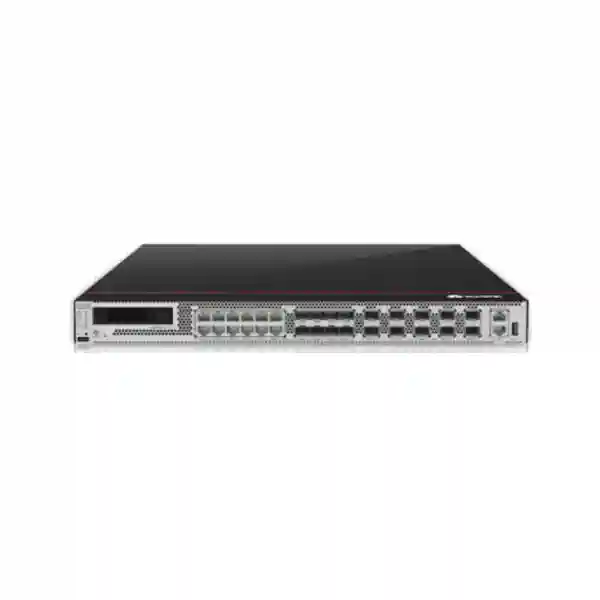
Huawei HiSecEngine USG6000G
High-performance perimeter defense, intelligent threat inspection, encrypted traffic visibility, secure SD-WAN, advanced VPN, and unified policy control for modern enterprise networks in Dubai and across the United Arab Emirates.
What the Huawei HiSecEngine USG6000G is designed to do
The Huawei HiSecEngine USG6000G family is positioned as a new generation of enterprise security gateways for organizations that need far more than basic stateful firewalling. In a modern UAE enterprise, the perimeter is expected to carry internet access, private WAN traffic, cloud connectivity, remote-user VPN, business-to-business tunnels, SaaS sessions, real-time communications, and increasingly large volumes of TLS-encrypted traffic. At the same time, the security stack is expected to identify applications, control user behavior, detect exploits, prevent malware, enforce URL policy, inspect DNS activity, and provide enough performance headroom to avoid becoming the bottleneck of the network. The USG6000G architecture is aimed at this convergence point: forwarding, content inspection, cryptographic processing, policy enforcement, and intelligent threat analysis are brought together in one security platform.
Huawei currently documents the high-performance fixed-configuration branch of the USG6000G family as the HiSecEngine USG6800G series, including the USG6855G, USG6875G, and USG6885G. These systems are 2U appliances with very high interface density and multiple dedicated acceleration engines. Huawei also announced desktop G-series firewalls for multi-branch use, but the specifications and ordering information vary by model and software release. For this reason, a professional USG6000G project should begin with workload sizing rather than selecting hardware from headline firewall throughput alone. Internet circuit rate, encrypted traffic percentage, threat-prevention profile, east-west versus north-south inspection, session count, tunnel count, interface media, redundancy, and expected growth all influence the correct model.
FourTeck can support UAE customers with design and procurement planning through the FourTeck UAE team, while complex firewall projects can be aligned with the specialist resources available through Firewall Dubai. For environments where the security refresh is part of a broader infrastructure or managed-services initiative, customers can also coordinate implementation dependencies through FourTeck IT Services UAE. Regional organizations with cross-border operations can reference FourTeck Africa for wider deployment coordination.
Architecture: dedicated engines for forwarding, inspection, and encryption
Adaptive Security Engine
Huawei describes a forwarding-and-control-separated architecture in which the Adaptive Security Engine dynamically allocates resources to service modules. This matters when a firewall is running several intensive services simultaneously, because packet forwarding, threat detection, and session handling compete for compute resources on conventional designs. Dynamic resource allocation is intended to improve utilization while preserving service performance under changing traffic conditions.
Network Processor Acceleration
Dedicated network-processing functions accelerate short-packet forwarding and large session workloads. In practical network design, this is important for transaction-heavy applications, DNS, web services, API traffic, virtual desktop environments, and distributed systems where packet rates and connection setup can be more demanding than raw bandwidth figures suggest.
Pattern-Matching Engines
Pattern matching accelerates application identification and intrusion-prevention inspection. This gives the firewall the ability to evaluate payload characteristics, signatures, protocol behavior, and content-security indicators without relying only on ports and IP addresses. For enterprise policy teams, that enables controls closer to the actual business application.
Encryption and Decryption Engines
Dedicated cryptographic acceleration supports high-volume IPsec and TLS inspection use cases. This is strategically important because encryption is now standard for web, cloud, API, and application traffic. A firewall that cannot sustain cryptographic workloads at production rates may force security teams to bypass inspection or accept major performance loss.
The architectural implication is that USG6000G sizing should be based on enabled security services, not merely line-rate packet forwarding. A 10 Gbps internet circuit does not automatically mean that a 10 Gbps firewall is sufficient, because real performance depends on packet size, session creation, SSL decryption, IPS profile depth, antivirus scanning, logging, URL classification, VPN usage, and the mix of applications crossing the gateway. A properly designed deployment reserves headroom for traffic bursts, policy expansion, new cloud services, WAN growth, and software features that may be enabled later. This is especially relevant in UAE enterprises where internet upgrades from 1/10 Gbps to 25/40/100 Gbps can happen during the life of the security platform.
USG6800G model matrix within the USG6000G family
Huawei’s R25C10 documentation identifies three fixed 2U USG6800G models. The values below should be treated as vendor reference figures measured under defined test conditions; actual production throughput varies with traffic patterns, enabled services, software version, policy complexity, and deployment environment.
| Metric | USG6855G | USG6875G | USG6885G |
|---|---|---|---|
| IPv4 firewall throughput, 1518/512/64-byte UDP | 450/360/135 Gbps | 750/600/225 Gbps | 1 Tbps/720/270 Gbps |
| NGFW throughput, enterprise mix | 75 Gbps | 125 Gbps | 150 Gbps |
| Threat protection throughput, enterprise mix | 67.5 Gbps | 112.5 Gbps | 135 Gbps |
| IPsec VPN throughput | 126 Gbps | 210 Gbps | 252 Gbps |
| SSL inspection throughput | 45 Gbps | 95 Gbps | 105 Gbps |
| Concurrent HTTP/1.1 sessions | 170 million | 290 million | 350 million |
| New HTTP/1.1 sessions per second | 4.5 million | 7.5 million | 9 million |
| Maximum IPsec VPN tunnels | 192,000 | 320,000 | 384,000 |
| Maximum security policies | 200,000 | 200,000 | 200,000 |
The table illustrates why a model should be selected against the real inspection profile. The ratio between plain firewall throughput and enterprise-mix threat-protection throughput is significant. If a design team compares only the 1 Tbps large-packet firewall headline of the USG6885G with a competing device’s full-security throughput, the comparison is not meaningful. Procurement specifications should normalize test conditions and ask for the performance relevant to the intended feature set.
How to interpret firewall, NGFW, and threat-protection throughput
Firewall throughput is primarily a forwarding measure. It indicates how rapidly the appliance can process packets under defined conditions with core firewall functions active. It is useful for understanding platform capacity, but it is not a complete proxy for real-world security performance. Packet size has a large effect because processing 64-byte packets requires far more packets per second than processing 1518-byte packets at the same bandwidth. For service-provider peering, DDoS-prone internet edges, voice environments, or high-frequency transaction systems, packet-per-second capability can matter as much as gigabits per second.
NGFW throughput adds functions such as application awareness and intrusion prevention. Huawei publishes both HTTP 100K-file and enterprise-mix figures in its current documentation. Enterprise-mix values are more useful for planning because business traffic is heterogeneous: SaaS applications, encrypted browsing, software updates, database sessions, collaboration traffic, DNS, API calls, backups, remote access, and cloud connectors all have different packet sizes and connection characteristics. Even then, a published benchmark remains a baseline rather than a guarantee for a production environment.
Threat-protection throughput is more relevant for customers intending to run antivirus and IPS across internet-bound traffic. The USG6885G, for example, is documented at 135 Gbps for enterprise-mix threat protection with firewall, service awareness, IPS, and antivirus enabled. This is substantially lower than its raw firewall throughput but is still extremely high for a fixed 2U security appliance. The difference is expected: deep packet inspection requires the system to classify applications, parse protocols, compare content against signatures, evaluate behavior, and sometimes reconstruct files or streams before a policy decision is made.
SSL inspection deserves separate attention because encrypted traffic creates a two-sided cryptographic workload. The firewall may need to terminate a client-side TLS session, inspect the decrypted content, and then establish a second encrypted session toward the destination. Certificate handling, cipher suite, TLS version, session reuse, object size, and concurrent connection rate all affect performance. Huawei publishes reference SSL inspection throughput of 45 Gbps, 95 Gbps, and 105 Gbps for the USG6855G, USG6875G, and USG6885G respectively under its stated test method. An organization expecting 80 Gbps of inspected encrypted traffic should therefore not size purely on 100 Gbps interfaces; it should consider SSL inspection capacity, peak utilization, bypass categories, and future growth.
A practical design target is to maintain comfortable sustained headroom instead of running the firewall near a laboratory maximum. Many enterprises use a planning threshold where normal busy-hour utilization remains materially below the expected production capacity, leaving room for bursts, failover, policy expansion, and attack conditions. In an active-passive cluster, the surviving appliance must be able to carry the complete workload after a node failure. In an active-active design, engineers must still calculate what happens when traffic redistributes, because the cluster should not become overloaded at precisely the moment redundancy is needed.
Threat prevention and intelligent security functions
The USG6000G platform is intended to consolidate multiple threat-prevention controls at the network edge. Huawei documents integrated firewalling, VPN, intrusion prevention, antivirus, bandwidth management, anti-DDoS functions, URL filtering, application control, web application protection capabilities, DNS security, anti-botnet controls, and advanced malware analysis features. Whether a particular function is available in a specific software release or license bundle should be verified during ordering. This is important because enterprise security platforms frequently separate base networking functions from subscription-driven intelligence feeds such as IPS, URL categorization, antivirus, reputation data, advanced malware detection, or cloud-assisted analysis.
Application identification and control: Huawei’s current USG6800G documentation states support for more than 6,000 preset applications with classification by categories and risk labels, plus user-defined applications. Application-aware policy is useful because port-based controls no longer represent modern software behavior. A web application may use TCP 443 like thousands of other services, while collaboration, file sharing, remote access, tunneling, and proxy tools can traverse standard web ports. Application identification allows security rules to distinguish business-approved services from risky or unauthorized applications even when they share transport protocols.
Intrusion prevention: The IPS engine is designed to detect vulnerability exploitation and malicious protocol behavior. Huawei documents more than 25,000 predefined signatures and coverage across operating systems, databases, web servers, middleware, and common web attacks. For security engineers, the value of IPS is not the signature count by itself but the ability to apply tuned profiles. High-severity exploit signatures may be blocked broadly, while lower-confidence or environment-specific rules can begin in alert mode. Policy design should consider exposed services, application inventory, false-positive tolerance, and the difference between internet ingress, outbound browsing, partner links, and internal segmentation zones.
Antivirus and file inspection: Huawei documents inspection for protocols including HTTP, FTP, SMTP, POP3, IMAP4, NFS, and SMB, with malware categories covering trojans, worms, spyware, ransomware, botnet programs, backdoors, and other malicious software. In practice, network antivirus complements endpoint protection rather than replacing it. It can stop known or suspicious objects at a choke point before they reach users or servers, but encrypted traffic must generally be decrypted for content inspection, and file-size or protocol limitations should be understood when building a security policy.
Advanced malware prevention: Huawei describes heuristic and AI-assisted detection, semantic analysis, emulation techniques, reputation information, and sandbox integration for suspicious files. This is valuable for detecting evasive or previously unknown samples that may not match a traditional signature. Design teams should decide which file types are submitted for deeper analysis, what happens while a verdict is pending, how privacy-sensitive files are handled, and whether cloud or local sandboxing is appropriate for the organization’s data-governance requirements.
DNS security: DNS is a control plane for nearly every modern application and also a common channel for command-and-control, phishing, malware distribution, and data exfiltration. Huawei documents detection of malicious DNS requests using reputation, AI, and knowledge-graph techniques, including C2 domains, algorithmically generated domains, compromised sites, and phishing-related domains. DNS sinkholing can redirect malicious resolutions to a controlled destination, allowing analysts to identify infected clients and investigate incidents rather than simply blocking traffic without context.
URL and web security: Huawei describes a cloud URL database exceeding 560 million URLs across more than 130 categories. Category-based filtering can enforce acceptable-use policy, block malicious destinations, reduce exposure to risky content, and apply different policies to departments or user groups. HTTPS filtering may be possible by category without decryption in some cases, while deeper content inspection requires TLS decryption. The platform also documents support for HTTP/2 and QUIC policy handling, which is increasingly important because many modern services no longer rely only on traditional HTTP/1.1 traffic.
Encrypted traffic inspection: where security and performance meet
Why TLS inspection matters
Most web and cloud traffic is encrypted, and attackers use the same encryption standards as legitimate applications. Without inspection, a firewall may know the destination domain, IP address, or certificate metadata but may not see the file, exploit payload, script, or command channel carried inside the encrypted session. TLS inspection restores visibility by acting as an authorized intermediary, subject to corporate policy, legal requirements, and privacy controls.
For UAE enterprises, the technical design should be coordinated with legal, HR, compliance, and data-protection teams. Sensitive categories such as financial services, healthcare portals, personal webmail, government systems, or certificate-pinned applications may require bypass rules. The goal should be risk-based visibility rather than decrypting every session indiscriminately.
Certificate and endpoint readiness
Outbound decryption generally requires endpoints to trust the enterprise certificate authority used by the firewall. This is straightforward for centrally managed Windows, macOS, or mobile fleets when certificate distribution is integrated with directory services or MDM. It becomes more complex for unmanaged BYOD, IoT, operational technology, legacy applications, and embedded systems. A deployment plan should therefore identify which device populations can be inspected safely.
Certificate pinning and mutual TLS can break if intercepted. Engineers should test high-value SaaS applications, payment systems, ERP clients, cloud agents, backup software, developer tools, and security products before enabling broad inspection. A staged rollout with observability and bypass controls is safer than a single global switch.
Capacity planning for decryption should include peak encrypted throughput, concurrent TLS sessions, session setup rate, average object size, cipher suites, and the percentage of traffic bypassed. A company with a 40 Gbps internet edge but only 15 Gbps of decryptable traffic may fit a different platform profile from a company with 25 Gbps of internet traffic where nearly all business applications require inspection. SSL inspection throughput is therefore one of the most decision-relevant specifications for a security refresh.
Secure SD-WAN, IPsec VPN, and branch interconnection
The USG6000G family is not limited to perimeter filtering. Huawei documents secure SD-WAN EVPN capability and very large IPsec tunnel scales on the USG6800G models. Secure SD-WAN can combine routing intelligence, multi-link selection, encrypted overlays, and security policy at the enterprise edge. For a UAE organization with headquarters in Dubai or Abu Dhabi and branches across the Emirates, this can reduce dependence on a single private WAN technology while allowing internet, leased-line, MPLS, 5G, or broadband circuits to participate in a policy-driven overlay.
Huawei lists secure SD-WAN EVPN throughput at 243/121 Gbps for the USG6855G, 405/202 Gbps for the USG6875G, and 486/243 Gbps for the USG6885G under 1400/512-byte UDP conditions, with 7,000 tunnels on each model in the current datasheet. The same document lists IPsec VPN throughput of 126 Gbps, 210 Gbps, and 252 Gbps respectively with AES-256 and SHA-256 using 1420-byte packets. These values demonstrate that cryptographic performance is a central design goal of the platform, but engineers should still validate tunnel overhead, routing convergence, QoS, dynamic path selection, and the behavior of real applications under loss and latency.
For branch-to-headquarters connectivity, IPsec can protect traffic over any routed underlay. Dynamic routing can exchange reachable prefixes, while policy-based or route-based VPN designs control which networks participate. In a large deployment, route-based tunnels are generally easier to automate and scale because they integrate naturally with routing protocols and SD-WAN policy. Address planning is critical; overlapping RFC1918 ranges between acquired companies, partner networks, and branch offices can complicate VPN design and may require NAT or segmentation strategies.
For remote users, Huawei documents SSL VPN support with model-dependent throughput and user limits. The USG6855G is listed at 21 Gbps SSL VPN throughput, the USG6875G at 35 Gbps, and the USG6885G at 42 Gbps. Maximum concurrent user values in the current datasheet are significantly higher than the default licensed quantities, which means licensing should be planned against expected concurrent users rather than employee headcount. A company with 10,000 employees may have only 2,500 simultaneous remote users, or it may have 8,000 during a business-continuity event. The required license and capacity should reflect the peak concurrency scenario.
Traffic steering can also optimize multiple egress links. Huawei describes static and dynamic steering based on bandwidth, weight, priority, and real-time link conditions. This can be used to keep latency-sensitive voice or ERP traffic on the best path while moving bulk updates, backups, or guest traffic to lower-cost links. Security policy and path-selection logic should be designed together; an application should not bypass intended inspection merely because a different WAN circuit becomes active.
Interfaces, chassis design, and data-center integration
Huawei’s current USG6800G hardware documentation lists a common fixed-interface layout across the USG6855G, USG6875G, and USG6885G: four 400GE QSFP-DD ports, four 100GE QSFP28 ports, and thirty-two 25GE SFP28 ports. This is a high-density mix that allows a fixed 2U appliance to connect directly to core, spine, distribution, WAN, or data-center switching layers without additional interface cards. It also supports migration paths from 10/25 Gbps server and leaf environments toward 100/400 Gbps aggregation.
The physical design is 2U with documented dimensions of 442 x 600 x 86.1 mm. The appliances use dual AC power supplies and install in a standard 19-inch rack. Maximum power consumption in the current datasheet is listed as 655 W for the USG6855G, 864 W for the USG6875G, and 951 W for the USG6885G. These figures should be incorporated into rack power budgets, UPS sizing, PDU capacity, cooling calculations, and data-center thermal planning. A redundant power design should connect the two firewall PSUs to independent PDUs or power feeds where possible, rather than placing both supplies behind the same failure domain.
Operating temperature is documented at 0°C to 45°C with 5% to 95% non-condensing humidity. UAE data centers are normally climate controlled, but intake temperature, hot-aisle recirculation, dust management, and rack density still deserve attention. Security appliances can experience high sustained CPU and acceleration-engine utilization during inspection bursts, so stable cooling is part of availability engineering. Edge rooms, warehouses, and industrial sites may need environmental monitoring or specialized enclosures if conditions approach vendor limits.
Optional internal SATA storage is supported in the documented fixed models, with capacities including 240 GB, 480 GB, 960 GB, 1.92 TB, and 3.84 TB depending on ordering options. Local storage can be useful for logs, reporting, packet capture, or forensic workflows, but centralized log retention is usually recommended for enterprise environments. Sending security logs to a SIEM or dedicated management platform preserves evidence if the appliance fails and enables correlation across firewalls, servers, endpoints, cloud platforms, and identity systems.
High availability and resilient perimeter design
A firewall protects a critical boundary, so a production design should avoid making the firewall itself a single point of failure. High-availability architecture generally requires at least two appliances, redundant power, redundant upstream and downstream links, and careful state-synchronization design. The exact HA mode supported and recommended depends on the USG6000G model, software release, routing design, and feature set, so the implementation should be validated against Huawei’s release-specific documentation before change control approval.
In a typical active-passive design, one firewall carries production traffic while the peer synchronizes relevant state and is prepared to take over. This architecture is operationally straightforward and makes capacity planning conservative: each unit should be able to handle the full expected workload. Active-active designs can improve resource utilization but introduce additional considerations around traffic symmetry, session ownership, routing, load distribution, and failure behavior. If northbound traffic enters one device and returns through another without compatible state sharing, applications may experience resets even though both appliances are healthy.
Link redundancy matters as much as chassis redundancy. Two firewalls connected to a single core switch still share a switch failure domain. A stronger design uses independent upstream routers or core switches, dual-homed links, redundant LAGs where appropriate, diverse ISP handoffs, and physically separate power sources. In data centers, designers may place the firewalls between redundant spine or border pairs. In campus environments, the firewalls may connect to a resilient distribution core with dynamic routing controlling convergence.
Failover testing should be part of acceptance, not an emergency experiment. Test firewall reboot, link failure, upstream routing loss, ISP failure, power-feed failure, synchronization interruption, and planned software upgrade scenarios. Record convergence time for critical applications, voice, remote access, and site-to-site VPN. Validate that logging and monitoring generate clear alarms. A redundant architecture is only trustworthy when failure behavior has been observed under controlled conditions.
Segmentation, virtual firewalls, and multi-tenant security
Huawei documents support for up to 2,048 virtual firewalls on the USG6800G fixed models. Virtualization allows a physical platform to host logically separated security contexts, each with its own policy boundaries, interfaces, routing, and administrative scope depending on the configured architecture. This is useful for large enterprises, service providers, managed-service environments, campus segmentation, and shared data centers where separate business units or tenants must remain operationally isolated.
The practical benefit is consolidation without collapsing trust zones. A group with finance, retail, logistics, guest services, research, and OT networks may choose separate virtual contexts so policies and routing can evolve independently. A managed-service provider can partition customer environments while preserving a shared hardware platform. A data center can separate production, development, DMZ, and partner zones. However, maximum virtual firewall count is not the same as a recommended production count; memory, sessions, policies, logs, interfaces, and management complexity must also be considered.
Policy design should follow the principle of least privilege. Rather than building a flat internal network and relying only on perimeter filtering, organizations can segment sensitive applications and user populations with explicit policy between zones. Examples include limiting user VLANs from reaching server management interfaces, separating guest internet access from corporate networks, isolating backup systems, controlling OT-to-IT communication, and restricting data-center east-west paths. A high-capacity firewall is particularly valuable when segmentation traffic is large enough that lower-end devices would create bottlenecks.
Administrative separation is equally important. Role-based management should limit who can change global settings, security policy, VPN configuration, and logging. Change workflows should include peer review, scheduled implementation windows, rollback procedures, and configuration backups. When multiple virtual systems are used, naming conventions and object governance prevent duplicate or ambiguous policies from becoming an operational risk.
Policy design and application-aware access control
Large firewalls can support very large policy databases, but policy quality matters more than raw rule count. Huawei lists a maximum of 200,000 security policies on the USG6800G models. That scale is valuable for complex organizations, yet an unmanaged rule base can become difficult to audit and risky to modify. A clean policy architecture organizes rules by trust boundary, application, identity, business purpose, and ownership rather than creating thousands of isolated exceptions.
A good migration begins by inventorying existing rules and classifying them as required, obsolete, redundant, overly permissive, or undocumented. Rules such as any-to-any access, wide port ranges, permanent temporary exceptions, and unused objects should be reviewed. Application-aware policy can then replace some port-based rules. For example, permitting general TCP 443 from a user network to the internet gives very different control from explicitly allowing approved collaboration, CRM, banking, and productivity applications while blocking anonymizers, unsanctioned file-sharing services, and remote-access tools.
User and group awareness can make policy more expressive when integrated with identity systems. A finance user may need access to specific payment services, while engineering users may require code repositories and cloud development tools. Contractors may receive a limited application set and restricted internal destinations. When policy reflects identity and application rather than only IP address, the controls map more naturally to business requirements.
Policy logging should be selective but sufficient. Logging every allowed packet is unnecessary and can overwhelm storage, but logging sessions, security events, denied traffic, configuration changes, VPN activity, and high-risk applications supports incident response. Retention periods should align with organizational requirements and regulatory expectations. Centralized SIEM integration through standard mechanisms such as Syslog is useful because Huawei’s documentation also identifies open integration support including NETCONF, SNMP, SSH, and Syslog-based management ecosystems.
Centralized management, automation, and operations
Huawei positions SecoManager as a centralized security management platform for its firewall and security products. Central management becomes increasingly important when an enterprise deploys multiple firewalls across headquarters, branches, campuses, and data centers. Without a common policy and monitoring plane, engineers must make changes device by device, which increases configuration drift and makes incident investigation slower. Central orchestration can provide common templates, policy tuning, asset visibility, and coordinated threat handling.
The USG6800G can also be managed through Huawei iMaster NCE-Campus in supported scenarios. This is relevant for organizations building an integrated campus architecture where switching, routing, WLAN, and security are managed through a broader network-controller framework. Whether SecoManager, NCE-Campus, local management, or a mixed operational model is most suitable depends on the customer’s installed Huawei ecosystem, automation requirements, scale, and security-operations structure.
APIs and standard management protocols are essential for mature operations. Huawei documents NETCONF integration and compatibility with third-party management based on SNMP, SSH, and Syslog. NETCONF can support structured configuration automation. SNMP can expose health metrics to network-monitoring tools. Syslog can send events to SIEM platforms. SSH supports controlled administrative access. Automation should be protected with dedicated service accounts, least-privilege permissions, certificate or key-based authentication, source restrictions, and change logging.
Operational dashboards should focus on actionable metrics: interface utilization, packet drops, CPU and engine utilization, session count, new sessions per second, SSL inspection load, IPsec tunnel state, threat events, policy hit counts, certificate expiration, license status, HA synchronization, storage utilization, and update status. Thresholds should be established before the firewall reaches capacity. For example, sustained session growth over several months can indicate that a platform upgrade is needed long before user experience is affected.
Configuration management should be disciplined. Back up configurations before and after approved changes, maintain version history, record software versions, document license entitlements, and keep diagrams aligned with live connectivity. When the firewall is a shared platform for many business services, operational accuracy becomes as important as raw security capability.
Sizing methodology for a UAE enterprise deployment
Selecting between USG6000G models should begin with measurable workload data. Start with all northbound and east-west links that may traverse the firewall. Record average and peak bandwidth for internet, private WAN, cloud interconnect, data-center segmentation, partner connections, remote-access VPN, backup flows, and large internal services. Where traffic statistics are unavailable, collect at least several weeks of interface and flow telemetry rather than designing from circuit speed alone. A 40 Gbps link may average only 8 Gbps today, but the appliance should be sized for realistic peaks and growth rather than present averages.
Step 1 — Define the security profile. Decide which sessions will use basic firewalling, application identification, IPS, antivirus, URL filtering, DNS security, SSL inspection, or advanced malware analysis. Performance depends on the active profile. If 80% of internet traffic must run through TLS decryption plus IPS and antivirus, threat-protection and SSL figures matter far more than raw firewall throughput. If the firewall is primarily an internal segmentation gateway with mostly trusted high-volume flows, packet forwarding and session scale may dominate.
Step 2 — Calculate encrypted traffic. Measure the share of TLS and QUIC traffic and estimate what percentage can legally and technically be decrypted. Identify excluded categories such as banking, healthcare, government services, pinned applications, or unmanaged devices. The remaining encrypted volume should fit comfortably within the appliance’s SSL inspection capability after accounting for peaks and failover.
Step 3 — Measure sessions and connection rate. Concurrent session count shows how much state the firewall must maintain, while new sessions per second show how rapidly that table changes. Web-scale applications, DNS resolvers, mobile apps, microservices, and API gateways can generate enormous connection rates even when bandwidth is moderate. The USG6800G models publish very high session limits, but the production design should still validate real traffic because application behavior can be bursty.
Step 4 — Define VPN scale. Count site-to-site tunnels, SD-WAN overlays, partner tunnels, cloud VPNs, and concurrent remote users. For remote access, use peak simultaneous users rather than total licensed employees. For branches, include planned acquisitions, temporary sites, disaster-recovery locations, and cloud regions. Tunnel scale should include headroom for routing design and future expansion.
Step 5 — Check interface requirements. The fixed USG6800G appliances provide 25/100/400GE connectivity. Confirm the exact optic or DAC/AOC requirements, fiber type, connector type, switch compatibility, breakout design, and redundancy. An appliance can be computationally adequate but operationally unsuitable if its interface mix does not align with the existing network.
Step 6 — Size for HA failure mode. If two firewalls normally share traffic, consider whether one unit can carry the entire load after a failure. Capacity should be tested against the degraded state, not only the normal state. Redundancy that collapses under full load during failover is not true resilience.
Step 7 — Add growth margin. Network traffic tends to increase over the useful life of a firewall. Cloud adoption, higher-resolution video, additional SaaS platforms, data replication, AI workloads, and remote collaboration can accelerate bandwidth consumption. A multi-year plan should model at least one realistic growth scenario. The cost of slightly more firewall capacity at initial purchase may be lower than an unplanned platform replacement two years later.
Step 8 — Validate licensing. Confirm which security services, update subscriptions, virtual systems, remote-access users, and support services are included in the proposed bill of materials. Hardware capability without the required subscriptions can leave an organization with an appliance that cannot deliver the planned security outcome.
Deployment scenario: enterprise headquarters internet edge
At a large headquarters, the firewall usually sits between the campus core and one or more ISP edge routers. The design may include dual internet providers, public services in a DMZ, outbound employee internet access, remote-access VPN, cloud-bound traffic, and partner connections. The USG6000G can apply different security profiles to each traffic class. Inbound public services may receive strict IPS and web-focused controls. User browsing may receive application control, URL filtering, DNS security, antivirus, and TLS inspection. Partner links may use IPsec and narrowly defined network-to-network policies.
BGP or static routing may be used toward ISPs depending on public addressing and resiliency requirements. Internally, OSPF, IS-IS, BGP, or static routes may connect to the enterprise core depending on architecture. Route convergence should be tested with firewall HA because routing and session state need to recover together. If NAT is used for outbound traffic, address pools should be sized for session density and source-port consumption, particularly in environments with thousands of users behind a small set of public IP addresses.
Public-facing services should ideally be separated into DMZ zones rather than placed directly on trusted server networks. Reverse proxies, load balancers, WAF services, and application delivery controllers may sit behind or alongside the firewall. The security policy should permit only required service ports, and management interfaces should never be exposed to the public internet without strict controls.
Deployment scenario: data-center border and internal segmentation
In a data center, the firewall can protect north-south traffic entering or leaving application environments and can also enforce east-west segmentation between server zones. The 25/100/400GE interface mix on the fixed USG6800G models is relevant to modern leaf-spine fabrics where aggregation links already operate at 100 or 400 Gbps. A fixed appliance with native high-speed interfaces can reduce the number of external adapters or interface cards required in the security path.
For internal segmentation, throughput should be estimated from application flows rather than internet bandwidth. Backup, replication, storage, database, virtualization, and analytics traffic can dwarf internet usage. Security architects should decide which east-west flows genuinely require Layer 7 inspection and which can use lighter firewall controls. Applying maximum-depth inspection to every internal transfer may consume unnecessary resources and add latency without proportional risk reduction.
Virtual firewalls can map to business units, environments, or tenants. Separate contexts may protect production, development, PCI-like payment zones, partner environments, and shared infrastructure. The routing design should avoid accidental hairpinning of large volumes through the firewall when inspection is not required. Conversely, traffic that must cross a trust boundary should not bypass policy through alternate routes.
High availability in a data center should integrate with the fabric’s redundancy model. Link aggregation, ECMP, dynamic routing, and gateway placement can all affect traffic symmetry. Before implementation, engineers should create a packet-path diagram for normal state and each failure state. The diagram should show which firewall receives the first packet, where return traffic goes, how sessions synchronize, and how routing converges after a node or link failure.
Deployment scenario: campus egress and distributed branches
A large campus can use the USG6000G at the internet egress to secure thousands of users, wireless devices, guest networks, voice systems, building-management systems, and cloud applications. Application control can prioritize business-critical services, while bandwidth management can prevent non-essential traffic from consuming disproportionate capacity. URL filtering and DNS security can reduce user exposure to malicious or inappropriate destinations, while IPS and malware controls protect both inbound and outbound flows.
For branch networks, Huawei announced G-series desktop models designed to combine firewall, router, and switch functions, including options with 5G and PoE in the product family. Exact branch model capabilities should be verified separately because the USG6500G desktop specifications differ from the high-performance USG6800G fixed appliances. An enterprise can still design a common policy framework where the headquarters uses a USG6800G-class system and branches use smaller G-series devices managed through a centralized platform.
Branch security design should distinguish local internet breakout from backhauled traffic. Local breakout can improve SaaS performance and reduce WAN cost, but it requires consistent security controls at each site. Central policy orchestration, DNS security, secure SD-WAN tunnels, and unified logging become important because the enterprise perimeter is distributed across many locations rather than concentrated at headquarters.
Licensing and subscription planning
A firewall bill of materials should separate hardware, base software, security subscriptions, remote-access licenses, virtual-system entitlements, storage, optics, support, and any centralized management components. Huawei’s ordering documentation for the USG6800G family includes licenses for virtual firewalls, SSL VPN concurrent users, IPS update services, URL filtering updates, antivirus updates, threat-protection bundles, malicious-traffic AI detection upgrades, industrial control security, content-security functions, IPv6-related features, and N1 support or subscription packages. Availability and bundle names can differ by region and software release, so every quotation should be validated against the current UAE ordering guide.
Security subscriptions are operationally significant. IPS without current signatures becomes progressively less effective against new vulnerabilities. URL filtering relies on current categorization data. Antivirus and malware detection depend on updated intelligence. Organizations should therefore budget for subscription renewal as part of lifecycle cost, not only the initial appliance purchase. A three- or five-year total-cost model can make support and security-service costs more predictable.
Remote-access licensing should be aligned to concurrent users. The current datasheet shows a default/maximum structure for SSL VPN users, meaning the hardware may support far more users than are initially licensed. During sizing, the organization should estimate normal concurrency, peak work-from-home scenarios, third-party access, emergency operations, and planned workforce growth. Overbuying every named user can waste budget, while under-licensing concurrency can become a serious business-continuity issue during an incident.
Virtual firewall licensing also deserves attention in shared environments. If the initial design needs 20 virtual systems but the long-term plan is 100, procurement should evaluate whether it is more efficient to license growth upfront or expand later. The same principle applies to centralized management, logging, and support. The best bill of materials is not the largest one; it is the one that maps clearly to the intended security architecture and lifecycle plan.
UAE procurement and implementation considerations
Enterprise firewall procurement in the UAE usually involves more than choosing an appliance. Customers may require local delivery, warranty coordination, implementation services, optics and cabling, rack installation, migration planning, onsite change windows, support SLAs, and documentation. Government, finance, healthcare, education, hospitality, logistics, and large private enterprises may also have internal compliance or procurement requirements that shape the design.
Lead time should be checked early for the exact chassis, power supplies, storage, optics, licenses, and support package. High-speed 100GE and 400GE designs often depend on specific transceivers, fiber plant, and switch-side compatibility. A security appliance arriving before the required optics or cabling can delay a migration even though the main hardware is available. For brownfield environments, confirm whether existing switch optics can be reused and whether breakout cables are supported at both ends.
Migration services should include policy conversion, object cleanup, VPN mapping, NAT review, routing validation, SSL certificate planning, logging integration, and rollback procedures. A like-for-like rule import is rarely ideal because it carries forward years of technical debt. A refresh project is an opportunity to remove obsolete rules, standardize naming, rationalize address groups, and align application controls with current business requirements.
Testing should cover throughput, failover, VPN, DNS, critical SaaS applications, ERP, voice, video conferencing, backup, remote access, and public services. TLS decryption should be staged to user groups and application categories rather than enabled globally on the first night. Baseline latency and packet loss before migration so post-change results can be compared objectively.
Documentation should include a final topology, interface map, IP addressing, routing design, HA design, policy summary, VPN inventory, certificate dependencies, license inventory, support contacts, backup procedure, monitoring thresholds, and renewal dates. This operational package makes the firewall maintainable after the installation team leaves and reduces risk during future upgrades.
Migration from an existing firewall platform
A firewall replacement should be treated as a controlled network transformation rather than a hardware swap. Begin by exporting configuration, route tables, NAT rules, VPN definitions, security objects, certificates, user mappings, and policy-hit data from the existing platform. Policy-hit statistics can reveal rules that have not been used for months and may be candidates for removal. Address objects should be normalized because duplicate objects with different names create confusion during translation.
Build the target policy in logical stages. Start with foundational network objects, zones, interfaces, routing, and HA. Then add NAT and security policies. Next configure VPN, application controls, URL filtering, IPS, antivirus, and TLS inspection profiles. Finally integrate logging, monitoring, authentication, and centralized management. Separating these stages makes troubleshooting easier because engineers can isolate which layer introduced an issue.
For critical applications, conduct pre-migration testing in a lab or parallel environment where possible. Reproduce representative traffic rather than only ping tests. Validate long-lived TCP sessions, large file transfers, SIP and RTP, APIs, database connections, cloud agents, and certificate-pinned applications. If the existing firewall performs NAT or policy-based routing, confirm that session return paths remain symmetric after cutover.
The change window should have measurable checkpoints. Confirm physical link state, routing adjacency, DNS reachability, internet access, published services, VPN tunnels, remote access, logging, and key business applications in sequence. Define rollback triggers before the change. If a critical service cannot be restored within an agreed period, the team should know exactly how to return traffic to the previous firewall rather than improvising under time pressure.
After migration, monitor the firewall closely for several days. Look for unexpected denies, asymmetric routing, high CPU or engine utilization, session spikes, MTU problems, VPN instability, certificate errors, and application complaints. Then perform a policy-tuning phase based on observed traffic. A successful migration is not complete when packets first pass through the new firewall; it is complete when the environment is stable, documented, monitored, and supportable.
Performance validation and acceptance testing
Vendor benchmark figures are valuable for product comparison, but enterprise acceptance should validate the deployment against business traffic. Synthetic tests can confirm link speed, packet forwarding, latency, and basic loss behavior. However, a firewall’s most important behaviors often emerge under mixed traffic: many simultaneous sessions, SSL decryption, IPS, antivirus, VPN, logging, and policy lookup. Testing should therefore include both controlled synthetic traffic and representative application flows.
For high-speed 100GE or 400GE environments, a single test host may not generate enough packets to exercise the firewall. Multiple traffic generators or distributed hosts may be required. Measure throughput in both directions, packet loss, latency, jitter, CPU utilization, security-engine utilization, session count, and new-session rate. If the design includes HA, repeat tests after forcing a failover to ensure the surviving node handles the intended load.
TLS inspection testing should include a range of cipher suites and application types. Verify that browsers trust the enterprise certificate authority, that pinned applications bypass correctly, that user experience remains acceptable, and that security profiles detect known test indicators. Do not use live malware in production validation. Use vendor-approved test files, benign indicators, or controlled lab tools designed to verify antivirus and IPS behavior safely.
Document acceptance thresholds before testing. Examples include maximum tolerated failover time, minimum inspected throughput, target latency, required VPN convergence, and zero packet loss for specific application classes. When thresholds are agreed in advance, the team can make objective pass/fail decisions instead of debating subjective impressions after the change.
Security operations after go-live
A firewall delivers value only when its intelligence, policies, and operations remain current. Establish a recurring review process for firmware, threat-signature updates, subscription status, certificates, VPN peers, administrators, policy changes, unused rules, and system health. Emergency security fixes may require accelerated change windows, while routine feature upgrades should be tested and scheduled with rollback plans.
Threat events should feed an incident-response workflow. A blocked exploit may indicate routine internet noise, but repeated events against a specific public service can justify further investigation. Malware detections should be correlated with endpoint alerts. DNS sinkhole hits can reveal compromised devices. Unexpected outbound VPN or tunneling applications may indicate policy violations. The firewall is therefore both an enforcement point and a telemetry source.
Policy recertification is particularly important in large environments. Business owners should periodically confirm that access is still required. Temporary vendor rules should have expiration dates. Rules for decommissioned servers should be removed. Address groups and application objects should be reviewed for accuracy. A clean rule base improves both security and troubleshooting speed.
Capacity trends should be reviewed quarterly or monthly depending on scale. Track bandwidth, sessions, SSL inspection utilization, VPN user peaks, log rate, storage consumption, and HA state. When sustained utilization begins to approach internal thresholds, capacity expansion can be planned calmly rather than as an emergency response to service degradation.
Why the USG6000G family is relevant to high-capacity UAE networks
The main engineering value of the HiSecEngine USG6000G generation is the attempt to preserve security depth at very high traffic rates. Enterprises no longer want to choose between turning on threat protection and keeping their internet or data-center links fast. The documented USG6800G performance profile, high session scale, dedicated acceleration engines, 25/100/400GE interfaces, and security-service integration make the platform relevant to environments where traditional midrange firewalls cannot sustain full inspection.
That does not mean the largest model is automatically the right choice. A 1 Tbps raw firewall figure is unnecessary for many organizations, while the smaller USG6855G may already exceed required threat-protection capacity by a wide margin. Conversely, an organization with 80–100 Gbps of TLS inspection may need to look beyond basic NGFW throughput and focus on decryption capacity, failure-mode headroom, and future growth. The correct model emerges from the workload, not from the product name.
For FourTeck customers, the recommended process is to build a requirement profile first, then map that profile to the appropriate USG6000G model, licenses, optics, and support package. This produces a more defensible quotation and a more reliable deployment than starting with a chassis and attempting to fit the environment around it.
Decision recap: match the firewall to the security workload
Choose by inspected throughput
Use NGFW, threat-protection, and SSL inspection performance as primary sizing metrics when advanced security services will be enabled. Raw firewall throughput is a platform reference, not the final production sizing number.
Check sessions and tunnels
Validate concurrent sessions, new sessions per second, IPsec tunnel count, SD-WAN overlay scale, and remote-access concurrency. High-bandwidth networks can still fail if state tables or tunnel limits are undersized.
Design the interfaces early
Map every 25GE, 100GE, and 400GE connection, including optics, fiber, switch compatibility, LAGs, and redundant paths. Interface planning can affect the bill of materials as much as the firewall chassis.
Plan for failure, not just normal load
Size HA so one surviving appliance can support the required business traffic during maintenance or failure. Test routing convergence, state synchronization, VPN recovery, and application continuity before production sign-off.
Quotation input checklist for Huawei HiSecEngine USG6000G
To prepare an accurate UAE quotation and deployment recommendation, provide the technical details below. If some values are unknown, FourTeck can help derive them from existing topology diagrams, interface statistics, firewall reports, or traffic monitoring.
Internet circuit speeds, peak utilization, east-west traffic, cloud links, backup traffic, and expected growth.
IPS, antivirus, URL filtering, DNS security, TLS decryption, application control, sandboxing, and WAF requirements.
Concurrent sessions, new sessions per second, NAT scale, public services, and expected application profile.
Site-to-site tunnels, SD-WAN branches, cloud VPNs, remote-user concurrency, and encryption requirements.
25/100/400GE port counts, transceiver types, fiber distances, breakout requirements, and switch models.
HA mode, dual ISP design, routing protocols, rack power, dual PDU availability, and failover objectives.
Structured consultation and next-step design review
A productive design review should produce four outputs: a validated traffic and threat profile, a model and license recommendation, a physical and logical topology, and a migration plan. FourTeck can use the information in the checklist to prepare a solution aligned with the customer’s current infrastructure and growth objectives. The review should also identify dependencies outside the firewall, such as ISP routing, core-switch upgrades, optics, fiber, certificate services, directory integration, SIEM connectivity, and remote-access client requirements.
For organizations comparing multiple firewall platforms, the comparison should normalize equivalent security functions. Ask for enterprise-mix threat-protection throughput, SSL inspection performance, session capacity, interface density, VPN scale, policy limits, management capabilities, licensing model, support options, and lifecycle cost. Avoid comparing a raw firewall number from one vendor against full-security throughput from another. Technical equivalence creates a fair procurement decision.
For existing Huawei estates, the USG6000G may also fit into a broader operational model with centralized security and campus management tools. For mixed-vendor networks, open management interfaces such as Syslog, SNMP, SSH, and NETCONF can support integration with established monitoring and automation workflows. Either way, the deployment should be driven by measurable business and security requirements rather than vendor-specific assumptions.
The final proposal should state the selected model, all hardware options, optics, power supplies, licenses, support term, implementation scope, migration assumptions, testing plan, and exclusions. That level of clarity reduces procurement surprises and gives the operations team a documented baseline for the firewall’s entire lifecycle.

Reviews
There are no reviews yet.