
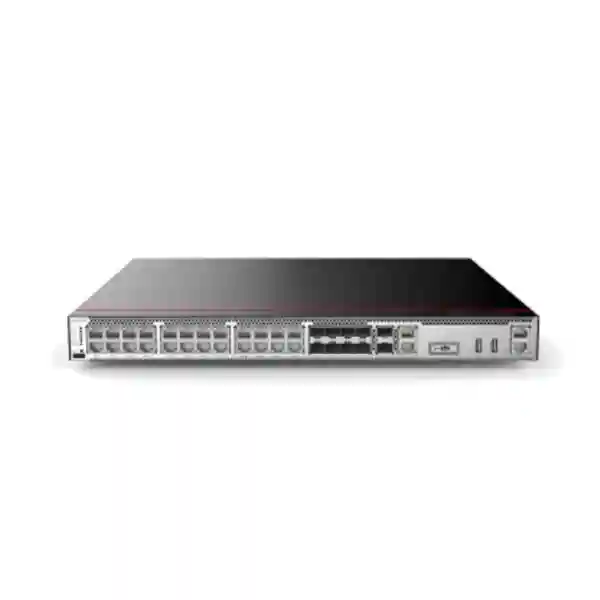
Huawei HiSecEngine USG6650F Firewall for Dubai and UAE Enterprise Networks
The Huawei HiSecEngine USG6650F is positioned for organizations that need significantly more than basic stateful firewalling. In a modern UAE enterprise, the perimeter is no longer a single Internet edge; it is a policy enforcement fabric spanning corporate users, cloud services, server segments, remote sites, mobile access, SaaS applications, partner connectivity, guest networks, voice systems, operational environments, and workloads that may reside in local data centers or public cloud regions. The USG6000F family addresses this reality by combining high-speed packet processing with application-aware security controls, intrusion prevention, antivirus capabilities, URL control, encrypted-traffic handling, VPN services, segmentation functions, and centralized operations. FourTeck approaches the USG6650F as an architecture component rather than a box-only purchase, aligning ports, optics, routing, high availability, policies, licenses, software release, and support with the real traffic profile of the customer.
Best-fit project profiles
Medium-to-large enterprise Internet edges, 10 Gigabit campus exits, security zones between user and server networks, private-cloud borders, data-center north-south security, branch aggregation, IPsec hub gateways, SSL remote-access environments, and organizations consolidating multiple security functions into a centrally governed firewall platform.
Direct answer: what is the Huawei HiSecEngine USG6650F?
Huawei HiSecEngine USG6650F is an enterprise firewall model associated with Huawei’s USG6000F security platform. Current Huawei materials publicly list the closely matched USG6650F-K variant within this family, and that distinction matters when a quotation is being prepared because the suffix can affect hardware BOM, regional availability, software support matrix, included components, and licensing. For web-search and procurement continuity this page retains the requested product name, Huawei HiSecEngine USG6650F, while technical sizing should always be completed against the exact purchasable part number offered in the UAE at the time of order.
The platform is designed to sit at high-value enforcement points where security decisions must be made at high packet rates without forcing the network team to build a collection of disconnected appliances. In practical terms, the firewall can be used to separate trusted from untrusted networks, enforce application and user policies, terminate encrypted VPNs, inspect threat-bearing sessions, restrict web access, identify malicious patterns, control east-west or north-south flows depending on topology, and provide operational telemetry for incident response. Its value is not simply a headline throughput figure. The more important engineering question is whether the appliance can deliver the required security services at the organization’s real traffic mix, connection rate, encryption ratio, session count, interface density, and resilience requirement.
FourTeck therefore recommends sizing the USG6650F around protected throughput rather than raw line rate alone. A 10 Gbps Internet circuit can create very different firewall load depending on whether traffic is mostly large-file transfer, many short HTTPS connections, voice, video, SaaS, public web applications, site-to-site VPN, remote access, or small-packet transactional traffic. Threat inspection, SSL decryption, logging, application identification, IPS, antivirus scanning, URL categorization, and policy complexity all consume resources differently. Proper design begins with those workloads, then maps them to the exact Huawei datasheet for the release and SKU being quoted.
Hardware and interface architecture for high-speed enterprise edges
10GE-first uplink design
Huawei material for the closely matched USG6650F-K identifies a fixed interface profile built around 10 x 10GE SFP+ ports, complemented by Gigabit Ethernet connectivity including GE combo and RJ45 interfaces. This is useful for UAE customers connecting redundant ISP handoffs, core or aggregation switches, DMZ fabrics, server zones, MPLS/SD-WAN routers, and clustered firewall peers without immediately consuming external media converters. Because optics are project-specific, the BOM should state SR, LR, single-mode, multimode, DAC, or other supported media rather than assuming transceivers are included.
Compact rack deployment
The USG6650F-K generation is documented as a compact rack-class appliance and is commonly associated with a 1U deployment profile. For production planning, rack depth, rail or mounting requirements, front-to-rear airflow, cable bend radius, SFP+ access, redundant power feeds, and service clearance should be checked before installation. A firewall that physically fits a rack may still be awkward to maintain if patch panels, vertical PDUs, cable managers, or shallow wall cabinets restrict access.
Power and resilience
Huawei’s recent model-family material identifies standard dual-power redundancy for the USG6650F-K and a maximum power figure around 242 W for that hardware variant. The correct data-center design uses independent A and B feeds where available, each backed by the site’s UPS strategy. Power sizing should include the firewall pair, adjacent switches, optics, management appliances, logging systems, and any external modem or CPE required by the ISP.
Procurement precision
Huawei model naming can include suffixes tied to generation, region, hardware variation, or commercial packaging. For this reason FourTeck does not treat a web model string as a complete BOM. The quotation should validate exact part number, software version, entitlement, subscriptions, accessories, optics, cable type, storage requirements, power cords, support term, and whether the project needs a single appliance or an HA pair.
Performance engineering: why headline firewall throughput is only the beginning
Security appliances are often compared using one large number, but experienced architects rarely size that way. Raw firewall throughput is normally measured under a defined packet size and feature state. Real production traffic contains a mix of packet sizes, protocols, encrypted sessions, bursts, asymmetric flows, short-lived connections, long-duration downloads, east-west service calls, DNS, voice, collaboration media, database traffic, remote desktop, SaaS, and Internet browsing. Every enabled security function can change the effective throughput and latency envelope. Consequently, USG6650F sizing should be based on the protected service chain that will actually be enabled on day one and expected within the design horizon.
One useful methodology is to separate traffic into classes: clean transit traffic that needs stateful inspection; application-aware traffic that requires identification and policy control; threat-inspected web traffic using IPS and antivirus; encrypted traffic that may require SSL inspection; IPsec traffic for site-to-site overlays; remote-access VPN traffic; and server-publishing traffic where latency and deterministic behavior are critical. Next, estimate peak concurrent sessions, new sessions per second, aggregate bandwidth, packet-per-second demand, connection churn, log generation, and growth. The firewall pair should then be sized against the most demanding combination rather than an average utilization figure.
For organizations with dual 10 Gbps Internet links, for example, a simplistic design might assume that a 20 Gbps aggregate firewall rating is sufficient. In reality, an active/standby HA pair must be evaluated for failover conditions, because a single surviving node may need to process all traffic. If the design uses active/active distribution, session ownership and routing behavior must be considered. If SSL inspection is enabled for a substantial percentage of outbound traffic, cryptographic processing may become the constraining factor before raw forwarding. If the environment hosts customer-facing services, a sudden spike in new connections can matter more than sustained megabits per second. These are the conditions that separate a resilient security design from a specification-sheet purchase.
FourTeck can support this sizing process for Dubai and UAE customers by translating circuit sizes, VLANs, routing protocols, VPN counts, application categories, user populations, server zones, and security requirements into a practical BOM. For wider network or infrastructure projects, customers can also review FourTeck UAE for integrated enterprise IT delivery and FourTeck IT Services UAE for implementation-oriented support around network, systems, migration, and managed technical activities.
Security services that turn the USG6650F into an NGFW platform
A next-generation firewall is useful because policy can move beyond source IP, destination IP, and port number. In an enterprise environment, applications increasingly use HTTPS, dynamic cloud endpoints, content delivery networks, and shared infrastructure. Traditional port-based rules can therefore become too broad. The HiSecEngine platform is designed to combine stateful firewall controls with security services such as application identification, intrusion prevention, antivirus protection, URL filtering, malicious-domain controls, threat intelligence integration, VPN functions, and policy-based segmentation, subject to the selected software release and subscriptions.
Intrusion prevention is particularly important at the boundary between untrusted and trusted networks. IPS analyzes traffic patterns and payload characteristics against signatures and behavioral indicators, helping identify exploit attempts, protocol abuse, known vulnerabilities, scanning behavior, and other suspicious activity. IPS effectiveness depends on signature freshness, correct profile selection, tuning, exception handling, and the quality of the logging workflow. Enabling every possible signature in blocking mode without testing can create avoidable false positives. A better process starts with policy objectives, applies profiles to relevant traffic, monitors detections, and then tunes according to business applications.
Antivirus and malicious-file controls add another inspection layer for supported protocols and file transfers. URL filtering helps organizations govern web access by category or policy rather than maintaining manual lists of millions of websites. Application control can distinguish business applications from risky or non-business use even when they share common ports. These controls become more meaningful when mapped to identity, department, network zone, device class, or specific business service. For example, the finance VLAN may have a different web and application policy from a guest Wi-Fi network, while an application server zone may have a tightly constrained outbound profile.
The firewall should also be integrated into the incident-response workflow. Logs that remain only on the appliance are difficult to correlate and may be lost during storage pressure or hardware events. Exporting appropriate events to a SIEM, syslog platform, SOC workflow, or centralized manager allows teams to identify recurring threats, investigate blocked connections, tune policies, and satisfy audit requirements. The right logging level balances visibility with storage and performance. Not every allowed session needs the same level of retention as a high-severity IPS event, administrator change, failed authentication, or VPN security alert.
SSL inspection and encrypted traffic design
A large share of enterprise Internet traffic is encrypted, which protects confidentiality but also limits what traditional inspection engines can see. SSL inspection addresses this by allowing the security gateway, under authorized enterprise policy, to decrypt selected outbound or inbound TLS sessions, inspect them, and then re-encrypt them. This is a powerful control but also one of the most demanding functions on a next-generation firewall. It affects compute requirements, certificate management, privacy policy, application compatibility, operational troubleshooting, and user experience.
Organizations should therefore not enable decryption indiscriminately. A practical rollout normally starts by classifying applications and destinations. Sensitive categories such as personal banking, healthcare, or legally protected services may be exempted according to organizational policy and applicable law. Business SaaS applications may require testing because certificate pinning, mutual TLS, custom clients, or modern transport protocols can react differently to interception. Internal enterprise applications may need their own CA strategy. The security team must also ensure that endpoint devices trust the enterprise inspection certificate where required.
From a performance perspective, SSL inspection can materially reduce effective throughput compared with a raw firewall benchmark because the appliance is participating in cryptographic operations for both sides of a session. Cipher suite, key exchange, certificate size, session reuse, TLS version, object size, and concurrent connection rate influence workload. This is why a customer with a 5 Gbps encrypted Internet profile can require more firewall capacity than a customer with a 10 Gbps mostly unencrypted private WAN. For USG6650F projects, the expected percentage of traffic to be decrypted should be specified before hardware approval.
Operationally, SSL inspection must be paired with exception processes and monitoring. When a business application fails, engineers need a structured way to determine whether the cause is routing, DNS, policy, decryption, IPS, certificate validation, MTU, or application behavior. Documented bypass rules should be narrow, time-bounded when possible, and reviewed periodically. A mature deployment uses decryption as a targeted security control, not as an all-or-nothing switch.
IPsec VPN, remote access, and secure branch connectivity
The USG6650F can be designed as a VPN concentration point for site-to-site connectivity and, depending on licensing and release, remote-access services. This is particularly relevant in the UAE, where enterprises often operate offices, warehouses, retail sites, accommodation facilities, clinics, schools, service centers, and project locations spread across multiple emirates or connected to regional operations outside the country. VPN design should begin with topology and trust boundaries rather than simply enabling a tunnel between two public IP addresses.
For site-to-site IPsec, define which networks are permitted, how routes are learned, whether NAT is required, which peer owns primary connectivity, and what happens when one ISP fails. Route-based VPNs are often easier to scale than large collections of policy-based tunnels because they allow dynamic routing and clearer interface-based policy. Cryptographic profiles should use current, approved algorithms and key lengths. Dead-peer detection, tunnel monitoring, anti-replay settings, MTU/MSS behavior, and fragmentation need validation, especially when applications use large packets or when the WAN path includes additional encapsulation.
Remote-access VPN requires an identity architecture. User authentication may come from local accounts for small deployments, but enterprise environments usually integrate with centralized directory or identity systems. Multi-factor authentication should be considered for privileged and remote users. Authorization should be role-based: a contractor may need access to one maintenance subnet, while internal IT administrators may need broader but audited access. Split tunneling versus full tunneling should be decided based on security, bandwidth, cloud access, and inspection requirements. Endpoint posture and client software lifecycle should also be part of the operating model.
Capacity planning should include the number of simultaneously connected users, the bandwidth each user is expected to consume, the cryptographic overhead, and the effect of security inspection on VPN traffic after decryption. The project should also account for licensing limits where applicable. A firewall that easily handles the packet throughput may still be unsuitable if the required number of VPN peers, remote users, certificates, or routing objects exceeds the supported design envelope for the selected release.
High availability for business-critical firewall services
For most production enterprise deployments, a single firewall creates an avoidable point of failure. High availability uses two appliances so one can continue protecting traffic if the active node, a power feed, a software process, or a connected path fails. The exact Huawei HA mechanisms and supported topologies depend on software release and configuration, but the engineering principles remain consistent: synchronize relevant state, monitor critical links, avoid asymmetric routing where it breaks stateful inspection, and test failover under realistic traffic.
A robust HA design has redundant upstream and downstream connectivity. Connecting both firewalls to the same single switch simply moves the single point of failure. Better designs use resilient switch pairs, dual links or link aggregation where appropriate, separate power feeds, and redundant ISP or WAN paths. VLAN design should ensure both members can reach the same security zones without creating loops. Routing protocols or tracked static routes should react predictably during failover. If NAT is used, session synchronization and public address ownership need validation so established connections behave as expected.
Maintenance is another reason to deploy HA. Firmware upgrades, policy changes, hardware replacement, and troubleshooting become less disruptive when traffic can be moved safely to the peer. However, HA should not be treated as a substitute for change control. Both nodes can still be affected by a bad policy, incompatible software, configuration error, or shared upstream failure. Configuration backups, release notes, pre-change snapshots, staged upgrades, rollback steps, and post-change verification remain necessary.
FourTeck can help UAE customers define the complete resiliency chain: firewall pair, switch topology, ISP handoffs, dynamic routing, HA heartbeat links, management access, power feeds, monitoring, and failure tests. For data-center projects that also require compute and rack infrastructure, the FourTeck Server Dubai resource can be used alongside firewall planning so security, switching, server connectivity, and physical rack architecture are coordinated rather than purchased independently.
Segmentation: turning firewall policy into a practical zero-trust control
Many organizations still place most internal users and servers behind a permissive LAN policy and rely on the Internet firewall primarily for outbound access. That design is increasingly difficult to defend because compromised endpoints can move laterally. The USG6650F can be placed at strategic internal boundaries to create security zones and enforce least-privilege communication. This does not require putting every device on a separate network. The goal is to identify meaningful trust boundaries and control the flows that cross them.
Typical zones include corporate users, privileged administration, guest Wi-Fi, voice, CCTV, building management, IoT, printers, server front end, application services, databases, backup networks, development environments, external partners, DMZ services, and management interfaces. Each zone should have a purpose and a defined policy. For example, guest users may reach the Internet but not internal RFC1918 networks. Printers may communicate with approved print servers and management systems but not initiate arbitrary outbound connections. Application servers may reach database servers only on required service ports. Administrative interfaces may be reachable only from a privileged management subnet.
Segmentation is effective when rules are understandable and reviewable. A policy table should include source zone, source identity or network, destination, application or service, action, security profile, logging, business owner, purpose, and review date. Avoid generic objects such as Any-to-Any unless the exception is temporary and documented. Naming conventions matter: a rule called RULE-1027 tells an auditor little, while FINANCE-USERS-TO-ERP-HTTPS immediately communicates intent. The same principle applies to address groups, application groups, and NAT rules.
Zero trust is often discussed as a product category, but in firewall engineering it becomes concrete through explicit policy, verified identity, segmentation, continuous logging, and minimized privileges. The firewall contributes enforcement and visibility, while directory systems, endpoint security, MFA, NAC, SIEM, and cloud controls supply additional context. A well-designed USG6650F deployment can therefore become one component of a broader zero-trust architecture without relying on marketing labels alone.
Routing, NAT, and integration with enterprise switching
Enterprise firewalls frequently participate in routing, and that role should be designed deliberately. Static routes are simple and suitable for small topologies, but larger sites benefit from dynamic routing when multiple paths, redundant cores, or many branch networks are involved. The exact routing protocols supported by the selected Huawei release should be verified against the software documentation. Whether using static or dynamic routing, the objective is deterministic forwarding that preserves session symmetry through the stateful firewall.
NAT policy also deserves careful planning. Source NAT is commonly used for Internet access, while destination NAT or server mapping publishes internal applications. In environments with multiple public address blocks or ISPs, source-address pools and policy-based egress can become complex. The firewall needs unambiguous rules for which traffic should be translated, which traffic should remain un-NATed for VPNs, and how return traffic finds the correct path. Overlapping private addresses across partner or acquired networks may require translation at VPN boundaries.
The switching design determines how security zones reach the firewall. A common approach uses 802.1Q trunks from redundant core switches to the firewall pair, with subinterfaces representing zones. Another approach uses routed point-to-point links between the firewall and Layer 3 core. Routed designs can reduce Layer 2 failure domains, while trunk designs can be operationally convenient for many zones. The right option depends on campus architecture, HA requirements, routing protocols, available interfaces, and the need to extend VLANs across the firewall boundary.
Physical interface capacity should be mapped before finalizing VLAN design. A firewall with multiple 10GE SFP+ ports can separate external, internal, DMZ, HA, and high-volume zones onto dedicated links, but some environments will still prefer aggregated links for resilience. Optic type, switch compatibility, fiber plant, transceiver reach, and supported speeds should be part of the BOM. A 10GE port on paper is not a complete connection until both ends, optic types, fiber mode, patching, and connector standards are validated.
Security policy migration from an existing firewall
Replacing an existing firewall is not simply a matter of converting rules line by line. Legacy policies usually contain years of accumulated exceptions, unused objects, duplicate rules, shadowed entries, disabled rules, temporary NATs, forgotten VPN definitions, obsolete servers, and services that no longer have owners. Migrating that configuration unchanged carries the same technical debt into the new platform. A better migration uses the replacement project as an opportunity to rationalize policy while preserving required business access.
The process begins with discovery. Export the current rule base, objects, NAT, routes, VPNs, interface mappings, certificates, address groups, service groups, schedules, user mappings, security profiles, and logging settings. Compare that information with live traffic logs to identify which rules are actually used. Speak with application owners for critical systems. Determine which public IP addresses and DNS records are tied to the existing firewall. Document dependencies such as site-to-site peers that restrict configuration by source IP, remote-access clients, monitoring systems, syslog servers, authentication servers, and management jump hosts.
Next, normalize the policy into a vendor-neutral matrix before recreating it on the Huawei platform. This makes it easier to see redundant rules and to confirm the business intent behind each flow. During cutover, keep changes controlled. Freeze nonessential firewall modifications before migration, capture the final delta, and perform pre-checks on routing, ARP, VLAN tagging, HA state, NAT, VPNs, DNS dependencies, and management access. A rollback plan should define exactly how to restore the prior firewall if a critical service cannot be recovered within the approved window.
Post-cutover validation should be service-based rather than device-based. It is not enough that the new firewall shows interfaces up. Test Internet browsing, inbound published applications, branch VPNs, remote access, DNS, email, ERP, voice, cloud services, backups, monitoring, management access, and any industry-specific system. Then inspect logs for unexpected denies, session resets, asymmetric flows, decryption failures, IPS blocks, or NAT mismatches. The stabilization period is where many subtle policy issues are found and corrected.
Management, logging, monitoring, and operational governance
A firewall becomes a business-critical platform once multiple offices, applications, and security functions depend on it. Operational discipline is therefore as important as initial configuration. Management access should be restricted to dedicated trusted networks and approved administrators. Remote administrative exposure directly from the Internet should be avoided unless there is a carefully designed, strongly authenticated management architecture. Use named accounts rather than shared credentials where possible, apply role-based privileges, and log configuration changes.
Time synchronization is foundational. Firewall logs, SIEM alerts, VPN records, authentication events, switch logs, endpoint detections, and server logs must share accurate time to reconstruct incidents. NTP should use trusted sources and redundancy. DNS and certificate validation also rely on predictable system configuration. Backup routines should capture firewall configuration after approved changes and store copies outside the appliance. Test restoration procedures instead of assuming a backup file will be sufficient during an emergency.
Monitoring should cover more than CPU and memory. Track interface errors, drops, utilization, session count, new session rate, HA state, tunnel status, packet loss, latency, storage usage, subscription status, threat update status, temperature, power-supply state, fan alarms, routing adjacency, policy hits, denied traffic, and critical security events. Establish thresholds based on normal behavior so alerts are meaningful. A firewall that stays at high utilization during business peaks may need tuning or capacity expansion before users experience noticeable degradation.
Security updates and signatures require lifecycle management. IPS and malware protection lose effectiveness when signatures are stale. Software releases may contain fixes, new capabilities, protocol changes, and security patches. Upgrade decisions should consider vendor recommendations, release maturity, compatibility, downtime, HA behavior, backup, and rollback. Do not treat firmware upgrades as routine reboots; they can change default behaviors and supported features. Maintain an inventory showing model, serial number, software version, subscriptions, support expiry, and configuration ownership.
For customers that want a broader specialist discussion around firewalls and perimeter security in Dubai, FourTeck maintains a dedicated Firewall Dubai resource. The internal site link is intentionally separate from the contact action at the bottom of this page, which is reserved for quotation and consultation requests.
UAE deployment considerations: circuits, facilities, compliance, and support
A UAE firewall project should be designed around the local operating environment rather than copied from a generic global diagram. Internet circuits may be delivered as Ethernet handoffs, provider-managed routers, or diverse links from separate telecommunications paths. The enterprise may have multiple public IP ranges, cloud connectivity, leased lines, SD-WAN, branch VPNs, or partner circuits. Confirm who owns routing on each handoff, which side performs NAT, whether BGP is involved, and how failover is expected to work. Circuit redundancy is meaningful only when physical routes and upstream dependencies are sufficiently diverse.
Facility conditions also matter. Dubai data rooms range from purpose-built data centers to small office racks. Verify rack depth, grounding, cooling, dust control, ambient temperature, redundant power, UPS runtime, generator coverage, and physical security. Even a compact 1U firewall needs appropriate airflow and service clearance. Fiber patching should be labeled and documented. Use structured cable management so a future replacement does not require tracing an undocumented bundle under outage pressure.
Compliance requirements vary by industry and organization. Financial institutions, healthcare organizations, government-related entities, education, retail, and multinational companies can have different obligations concerning logging, data handling, access control, encryption, retention, change management, incident response, and third-party connectivity. A firewall supports those requirements by enforcing policy and creating evidence, but compliance is broader than any single appliance. Configuration should therefore be aligned with the customer’s approved security framework and legal or regulatory obligations.
Support planning is especially important for perimeter equipment. Clarify whether the organization requires 8×5 or 24×7 assistance, the expected replacement SLA, on-site engineering, remote troubleshooting, spare strategy, and escalation process. Critical enterprises may justify keeping compatible optics, power components, and cables on hand. Documentation should include network diagrams, interface maps, IP addressing, routing, NAT, VPN peers, HA topology, support contacts, and secure access procedures.
FourTeck can coordinate the firewall as part of a larger enterprise technology stack rather than isolating it from the rest of the network. Customers with cross-border operations can also reference FourTeck Global for broader project context while retaining UAE-specific design and deployment requirements for the local site.
Licensing and subscriptions: what should be confirmed before purchase
Enterprise firewalls commonly separate hardware capability from security subscriptions and support entitlements. The exact Huawei packaging available for the USG6650F family should be confirmed at quotation because bundles can change by region, software generation, sales program, and lifecycle status. Never assume that a hardware appliance automatically includes every advanced security service for the desired term. The BOM should explicitly state what is included, how long it is licensed, and what happens when the subscription expires.
Typical items to validate include intrusion-prevention updates, antivirus or malware protection, URL categorization, application or threat-intelligence services, centralized management rights, remote-access VPN limits, cloud-security integration, logging or analytics components, software upgrade rights, and vendor support. Some features may exist in the operating system but require an entitlement to receive current signatures or cloud lookups. Others may have default capacity with optional expansion. This is why an accurate quote needs the desired security functions and user/tunnel scale, not only the model name.
Subscription term should match the organization’s budgeting and lifecycle plan. One-year licensing lowers initial commitment but creates annual renewal work and may introduce budget risk. Multi-year licensing can simplify operations and align with the expected hardware lifecycle. For high-availability pairs, verify whether each appliance requires its own entitlement and whether centralized management or analytics is licensed per device, capacity, tenant, or feature. Do not infer licensing from another Huawei model because packaging can differ.
The practical outcome is a quote that separates mandatory from optional components. Mandatory items include the appliance, required power and rack accessories, essential optics, and the security services needed to meet the stated policy. Optional items might include additional transceivers, longer support term, expanded VPN capacity, advanced management, spare hardware, installation, migration, policy cleanup, training, or managed monitoring. This structure makes procurement decisions clear and avoids discovering missing functionality during deployment.
Reference architecture 1: redundant enterprise Internet edge
A common USG6650F deployment places two firewalls in an HA pair between redundant Internet circuits and a resilient campus core. Each firewall connects upstream to one or two provider-facing devices and downstream to a pair of core switches. Public services sit in one or more DMZ zones. Corporate users, guest access, voice, management, and server networks remain logically separated on the internal side. The firewalls provide Internet NAT, inbound publishing, application-aware policy, IPS, web control, VPN termination, and security logging.
The routing decision determines how quickly the network converges when a circuit or firewall fails. With static routing, tracked next hops can withdraw a failed path. With dynamic routing, the firewalls and upstream/downstream devices exchange reachability and converge according to protocol timers and policy. Public addressing may require provider coordination during failover. If each ISP owns a different address block, outbound NAT can follow the active egress while inbound services may need DNS, BGP, load balancing, or application-level failover.
Security policies should distinguish outbound user traffic from server traffic. User web access can use application, URL, IPS, and malware profiles. Server outbound access can be more restrictive, allowing only operating-system update repositories, backup destinations, DNS, NTP, monitoring, or other explicit services. Inbound DMZ publication should expose only required ports to the specific server or reverse proxy, with threat inspection aligned to application behavior. Management networks should not be reachable from the Internet.
The HA pair must be tested by physically disconnecting links and, during an approved window, failing the active node. Measure packet loss, session preservation, routing convergence, VPN recovery, and monitoring alarms. Testing only the logical HA status is insufficient. The design is successful when the entire traffic path behaves predictably under the same failures the business expects the architecture to survive.
Reference architecture 2: data-center segmentation and server protection
In a data-center role, the USG6650F can enforce policy between external networks, application zones, database networks, shared services, backup systems, management networks, and tenant or departmental segments. This architecture is particularly useful when the organization needs more control than VLAN separation alone provides. The firewall sees traffic crossing defined trust boundaries and can apply stateful rules, application controls, threat inspection, and logging to those flows.
Data-center traffic can be very different from branch or user Internet traffic. East-west flows may consist of high-bandwidth backup, storage, database replication, virtualization, and microservice communication. Sending every east-west packet through a firewall can create unnecessary bottlenecks, so segmentation boundaries should be chosen based on risk. For example, user-to-server and partner-to-server traffic may require inspection, while large trusted backup replication inside a protected infrastructure zone may be better handled through separate controls. The objective is security with sustainable throughput and latency.
Server publishing also requires careful NAT and load-balancer coordination. If a reverse proxy or ADC sits in front of web servers, decide whether the firewall sees the original client IP or only the proxy address. Logs become more useful when application and firewall telemetry can be correlated. Health checks, asymmetric paths, source NAT on load balancers, and return routing should be documented. Database connections should not be published directly to untrusted networks unless there is a specific controlled business requirement.
For virtualized data centers, map firewall zones to the actual switching and hypervisor architecture. Some east-west security may be implemented in virtual network controls while the USG6650F protects north-south boundaries. The design should avoid overlapping responsibilities that complicate troubleshooting. Each enforcement point needs a clear purpose, ownership, and logging path.
Reference architecture 3: hub firewall for multi-branch IPsec
Organizations with many UAE or regional branches can use the USG6650F as a central IPsec hub. Each branch establishes one or more tunnels to the main site, carrying private routes for applications, voice, management, and shared services. Redundant head-end firewalls protect against device failure, while dual Internet links at the hub reduce provider dependency. Branches with two WAN circuits can build redundant tunnels and use routing metrics or SD-WAN logic to select the best path.
Tunnel scale is only one dimension. Encryption throughput, packet size, route count, tunnel churn, monitoring, and failure convergence matter equally. A large retail or service network may have hundreds of branches that generate moderate bandwidth but many small transactions. A smaller number of engineering sites may generate fewer tunnels but very high data volumes. Centralized security can also cause traffic tromboning if branches send cloud or SaaS traffic back to the hub. Local Internet breakout can reduce latency but requires equivalent branch security controls.
Routing should prevent accidental branch-to-branch communication unless explicitly required. Segmentation can isolate business units, franchise sites, contractors, or countries. If multiple branches use overlapping private subnets, translation may be necessary, but overlapping addressing increases operational complexity and should be corrected where feasible. Consistent IP planning dramatically simplifies firewall policy, monitoring, and troubleshooting.
VPN monitoring should alert when a tunnel is down, flapping, or carrying abnormal traffic. Logs should include peer identity, negotiation failures, authentication events, rekey issues, and route availability. For critical branches, monitoring should distinguish a failed tunnel from a failed local ISP, power outage, or remote firewall problem. This allows the operations team to direct support to the right layer quickly.
Threat-prevention policy tuning for real networks
Security profiles are most effective when they match the traffic being inspected. Applying the same IPS and antivirus policy to every zone may be easy to configure but can be inefficient or disruptive. User browsing, public web servers, DNS, email relays, database traffic, VoIP, and backup flows have different risk patterns. A tuned USG6650F deployment creates security profiles by traffic purpose and applies them to rules where the inspection has value.
For outbound users, start with application identification, URL categorization, anti-malware, and IPS profiles appropriate for client systems. For inbound web services, focus on server-side exploit protection, restricted publishing, and application-specific controls. For DNS, monitor unusual query patterns and restrict resolvers. For administrative protocols such as SSH or RDP, limit source networks and users rather than exposing them broadly. For database services, allow only known application hosts and required ports. The firewall is most defensible when policy follows application architecture.
Tuning requires logs. When a signature blocks legitimate traffic, the response should not be to disable IPS globally. Identify the exact signature, affected application, source, destination, and protocol. Determine whether the application is triggering a false positive, using a deprecated protocol, or actually exposing a vulnerable behavior. Create the narrowest exception possible and document why it exists. Periodically review exceptions because application upgrades may eliminate the original need.
The same principle applies to URL and application categories. Broadly blocking an entire category may interfere with legitimate research, vendor portals, cloud storage, or embedded application dependencies. Policy should reflect organizational risk and business requirements. Where user identity is available, controls can differ by department or role. Security becomes easier to maintain when the business understands why a category is restricted and has an approval path for exceptions.
Capacity planning worksheet for the USG6650F
Before requesting a final quotation, collect measurable requirements. Start with WAN bandwidth: list every Internet, MPLS, leased-line, cloud, and private circuit, including current and planned speed. Record whether the firewall sees the full circuit or only selected VLANs. Add expected growth for at least the next three years. A site using 40 percent of a 5 Gbps link today can still outgrow a firewall quickly after cloud migration, new offices, higher-resolution video, centralized backups, or SaaS adoption.
Next, quantify users and devices. Employee count alone is insufficient because one person can have a laptop, phone, tablet, virtual desktop, and IoT devices. Add servers, guest users, cameras, access points, phones, printers, building systems, and branch devices. Estimate concurrent sessions and new sessions during peaks. High-density Wi-Fi environments and public portals can create significant connection churn even when bandwidth looks modest.
Then classify security functions. What percentage of traffic will use IPS? Antivirus? URL filtering? Application control? SSL inspection? How many remote-access users will be connected simultaneously? How many site-to-site VPNs are required now and after expansion? Are there inbound public services? Is the firewall expected to perform dynamic routing, NAT at scale, DHCP, or other network services? Will logs be stored locally, sent to a SIEM, or managed centrally?
Finally, define resiliency. Is an HA pair mandatory? Are there two ISPs? Two core switches? Independent power feeds? Does the organization require maintenance without downtime? What is the acceptable outage during failover? What support SLA is needed? These questions affect the quantity of appliances, optics, cables, licenses, installation effort, and testing plan. The result is a design that can be defended technically and financially.
When these inputs are available, FourTeck can compare them with the exact Huawei release and BOM being offered. This is particularly important because the user’s requested USG6650F name is commonly represented in current Huawei collateral by the USG6650F-K variant, and procurement should match the actual orderable unit rather than relying on an abbreviated model string.
Optics and cabling: avoiding last-mile deployment delays
High-speed firewalls frequently arrive before the correct optics have been specified. The USG6650F family uses 10GE SFP+ connectivity as an important part of its high-capacity interface design, but an SFP+ cage alone does not define the physical link. The project must identify distance, fiber type, connector type, patch-panel path, switch-side optic, and vendor compatibility. Multimode SR optics are common inside a data room, while LR optics are used for longer single-mode runs. Direct-attach copper can be cost-effective for very short rack-level connections when supported at both ends.
Check the existing fiber plant before ordering. OM3 and OM4 multimode have different reach characteristics from single-mode OS2. Legacy patch panels may use connectors that require adapters or specific patch cords. Polarity and cleanliness matter; dirty fiber connectors can create intermittent errors that look like firewall or switch faults. Label both ends and document which firewall port connects to which switch, ISP, or server segment.
For copper Gigabit links, confirm cable category and distance. Management interfaces should connect to an out-of-band or restricted management network where possible. Console access should be available for recovery. If the rack uses dual power distribution, route power cords separately to A and B feeds. Avoid running power and data in a way that blocks airflow or makes hot-swap servicing difficult.
A complete BOM therefore includes the small components that make the appliance usable: correct power cords for the site, rack accessories, supported transceivers, fiber or DAC cables, console requirements, patching, and labels. These items are inexpensive relative to the firewall but are frequent causes of installation delays when overlooked.
Migration runbook: recommended implementation sequence
A structured deployment reduces risk. Begin with a design workshop and collect the current network diagram, IP plan, existing firewall configuration, circuit details, public IP ranges, VPN peer list, critical applications, authentication sources, logging destinations, and change window. Agree which services are in scope and which will remain on the existing platform. Confirm acceptance criteria before configuration begins.
Stage the firewall offline. Apply the approved software release, base hardening, administrator roles, NTP, DNS, management addressing, interface naming, zones, routing, address objects, service objects, policies, NAT, VPNs, security profiles, logging, and HA settings. Where possible, use a lab or isolated connection to validate management, routing adjacencies, VPN negotiation, certificate chains, and integration with authentication or SIEM systems.
Before cutover, take final backups of the old platform and confirm rollback steps. Freeze rule changes or establish a delta process. Verify that ISP routers, switches, VLAN trunks, routing neighbors, and patch cables are ready. During cutover, move one dependency at a time when feasible and validate each major service. Use packet captures and session tables if behavior differs from expectation rather than making broad emergency policy changes without diagnosis.
After traffic stabilizes, test HA failover, VPN resilience, ISP failover, inbound services, critical SaaS, DNS, email, voice, ERP, cloud connectivity, monitoring, and administrative access. Review security logs for false positives and unexpected denies. Close temporary migration rules. Update diagrams and asset records with final port mappings, software version, licenses, and support information.
The final step is operational handover. Provide the customer’s IT team with configuration backup, diagrams, rule-base overview, VPN inventory, support contacts, upgrade guidance, monitoring thresholds, and change procedures. If managed support is included, define escalation levels and response responsibilities. A firewall project is complete only when the operations team can maintain it safely after the installation engineers leave.
Common design mistakes to avoid
Sizing only on ISP speed: a firewall protects sessions and applications, not just bandwidth. Small packets, connection rate, SSL decryption, threat inspection, and VPN encryption can dominate resource usage. Size for the protected workload and failover case.
Buying a single unit for a critical site: one appliance creates a maintenance and hardware-failure risk. Where business continuity matters, use HA with redundant upstream, downstream, and power design.
Assuming all subscriptions are included: advanced security services and support may be licensed separately or bundled for a defined term. Validate every required feature in the quotation.
Ignoring optics: 10GE ports require compatible transceivers and cabling. Confirm distance, fiber type, connector, switch compatibility, and spare strategy before deployment.
Migrating every legacy rule: clean the policy before conversion. Remove obsolete objects and create business-readable rules that can be audited later.
Enabling SSL inspection everywhere on day one: decryption can affect performance, privacy, and application compatibility. Roll it out by category, test exceptions, and measure impact.
Keeping logs only on the firewall: export important events to a central system so incident investigations can correlate firewall, endpoint, server, and identity evidence.
Skipping failure testing: a design is not highly available because the dashboard says both peers are healthy. Test real link, node, circuit, and routing failures under an approved plan.
Why FourTeck for Huawei HiSecEngine USG6650F projects in Dubai
FourTeck’s role in a firewall project is to connect procurement with engineering. That means helping the customer define the exact model and suffix, validating the BOM, choosing interfaces and optics, aligning security subscriptions, and planning the integration with switches, WAN circuits, servers, identity services, VPN peers, logging platforms, and high availability. This approach is especially valuable when a product model appears in multiple collateral generations or regional variants, as with the USG6650F and the currently documented USG6650F-K family reference.
For greenfield deployments, FourTeck can help create a zone model, IP plan, routing approach, NAT design, VPN architecture, HA topology, security-profile strategy, and logging workflow. For replacement projects, the focus shifts to configuration discovery, rule cleanup, translation, validation, cutover, rollback, and post-migration tuning. In both cases, success is measured by business services remaining secure and available, not by the firewall merely powering on.
Projects can be scoped around supply only, supply plus configuration, full migration, or broader infrastructure integration. The correct scope depends on the customer’s internal skills, change-control process, documentation quality, and support requirements. FourTeck can also help identify dependencies outside the firewall—such as switch VLANs, provider routing, DNS changes, certificates, or server gateways—that commonly determine whether the cutover succeeds.
For pricing, availability, and exact orderable part confirmation in the UAE, submit the project requirements rather than only the product name. The more complete the input, the more accurate the recommendation and quotation can be.
Technical FAQ
Is USG6650F the same as USG6650F-K?
Current Huawei material prominently exposes the USG6650F-K variant in the USG6000F family. Because suffixes can map to specific hardware or commercial variants, the exact quoted SKU should be confirmed. This page preserves the requested USG6650F name while using careful family-level engineering language.
Does it support 10 Gigabit connectivity?
Huawei material for the closely matched USG6650F-K shows a strong 10GE SFP+ interface profile, including ten 10GE SFP+ service ports along with Gigabit Ethernet connectivity. Exact supported optics should be validated for the chosen BOM and release.
Can it be deployed in high availability?
The platform is intended for enterprise security use where resilient deployment is common. The final HA method, synchronization behavior, supported topology, and upgrade process should be validated against the exact software release and Huawei documentation used for the project.
Is it suitable for a 10 Gbps Internet circuit?
Potentially, but circuit rate alone is not enough to approve a firewall. The design must account for IPS, antivirus, application control, SSL decryption, VPN, packet size, sessions, connection rate, and HA failover. FourTeck recommends sizing against protected throughput and real traffic mix.
Are subscriptions required?
Some advanced security functions or update services may require licensing or subscription entitlements. The exact bundle should be stated in the quotation, including term length, support, threat updates, management, and any VPN-related limits.
Can FourTeck migrate from another firewall vendor?
Migration can include current-state assessment, policy normalization, object conversion, NAT and VPN recreation, cutover planning, rollback, service validation, and post-cutover tuning. Scope depends on the source platform and configuration complexity.
Decision recap: where the USG6650F fits
Choose it for capacity and integration
The platform makes sense when the design needs high-speed 10GE connectivity, enterprise firewalling, application-aware security, threat prevention, VPN, segmentation, and centralized operations in one security gateway.
Validate the exact variant
Do not approve procurement based only on the abbreviated model name. Confirm whether the orderable UAE unit is USG6650F-K or another exact suffix, and validate hardware, software, optics, subscriptions, and support.
Size for security-on performance
Use traffic mix, SSL inspection, IPS, antivirus, VPN, sessions, connection rate, and HA failover as sizing inputs. Raw firewall throughput is only one part of the capacity calculation.
Plan the full path
The firewall depends on correct switching, routing, ISP handoffs, DNS, certificates, identity, logging, and power. Treat the project as an end-to-end architecture rather than a standalone appliance replacement.
Quotation input checklist
To receive an accurate Huawei HiSecEngine USG6650F proposal for Dubai or the wider UAE, provide as many of the following details as possible. Missing items can be resolved during technical consultation, but complete input reduces BOM uncertainty and helps prevent under-sizing.
Final consultation panel: confirm the correct Huawei firewall BOM before ordering
The Huawei HiSecEngine USG6650F is best evaluated as part of a complete security architecture. Current Huawei collateral gives strong visibility to the USG6650F-K variant, so the first procurement task is to confirm the exact UAE-orderable model and software generation. From there, the project should validate 10GE and Gigabit interfaces, optics, power, HA, subscriptions, VPN scale, protected throughput, SSL inspection, logging, support, and migration scope.
FourTeck can use your existing firewall configuration or network diagram to build a more precise recommendation. For a greenfield site, provide circuit speeds, user count, VLANs, server zones, branch count, security services, and availability requirements. For a replacement, include the current model, rule count, VPN peers, NAT, and known performance issues. The objective is to deliver a firewall design with sufficient headroom, predictable failover, maintainable policy, and a clearly documented BOM.
Final specifications, licensing, support terms, availability, and included accessories remain subject to the exact Huawei part number and regional quotation. This is particularly important for suffix-specific models and evolving software releases. A technical validation before purchase prevents assumptions from becoming deployment risks.


Reviews
There are no reviews yet.