
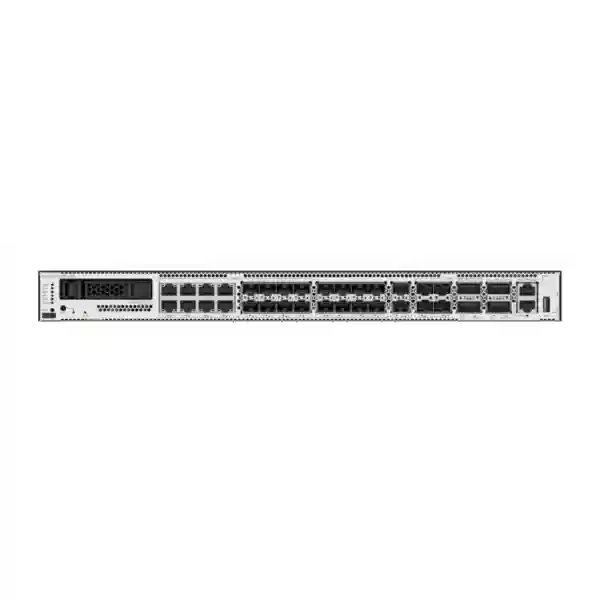
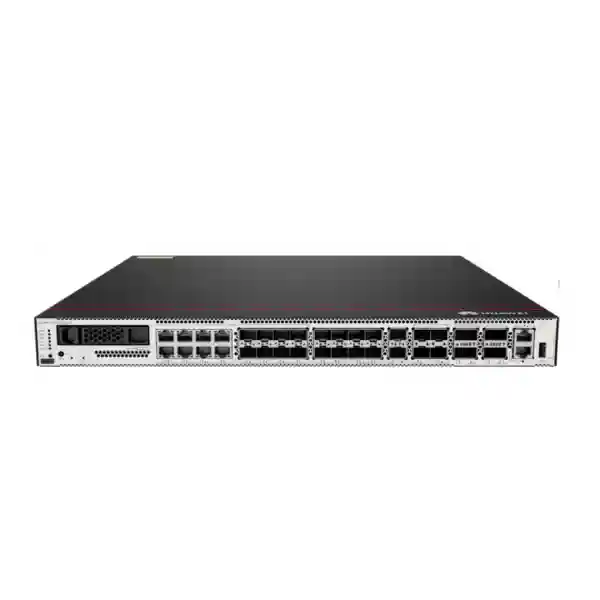
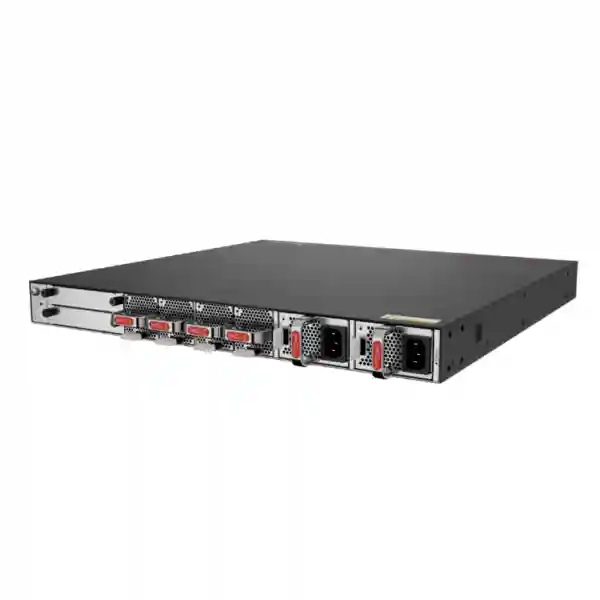
Huawei HiSecEngine USG6656F Enterprise AI Firewall
High-density 100GE security for headquarters, campus borders, data-center edge, encrypted WAN and inspection-intensive enterprise networks.
We size the platform against inspected traffic, encrypted traffic, session concurrency, connection rate, interface topology, HA requirements, log volume and security-service scope rather than relying on one headline throughput number.
Direct Answer: What Is the Huawei HiSecEngine USG6656F?
The Huawei HiSecEngine USG6656F is a fixed-configuration, rack-mount enterprise next-generation firewall in Huawei’s USG6000F family. It is positioned for networks that need substantially more than basic perimeter filtering: high-speed stateful inspection, application and user-aware policy enforcement, intrusion prevention, anti-malware functions, URL control, encrypted-traffic inspection, IPsec VPN, SSL VPN, secure SD-WAN functions, virtualization and centralized management. In a UAE enterprise, those capabilities make the platform relevant to Internet edges, large campus gateways, headquarters aggregation, data-center borders, regulated network zones, multi-site WAN hubs and private-cloud interconnection points.
For the USG6656F, Huawei publishes an IPv4 firewall throughput rating of up to 50/50/40 Gbps depending on packet size in the referenced test profile, up to 20 million concurrent HTTP 1.1 sessions, and up to 500,000 new sessions per second. Huawei also publishes 30 Gbps IPsec VPN throughput for AES-256 plus SHA256 with 1420-byte traffic, a maximum of 20,000 IPsec VPN tunnels, 10.5 Gbps SSL inspection throughput, 3 Gbps SSL VPN throughput, and a default/maximum concurrent SSL VPN user figure of 100/10,000 subject to licensing and software conditions. The current series data also lists up to 150,000 security policies and as many as 2,048 virtual firewalls. These figures are laboratory specifications, not a promise that every production design will operate at those numbers under every enabled feature set.
The most important purchasing question is therefore not simply whether the appliance has enough raw firewall throughput. It is whether the USG6656F retains adequate capacity after the intended combination of IPS, anti-malware, URL filtering, application identification, SSL decryption, VPN, logging and SD-WAN services are enabled. FourTeck designs the deployment around the real traffic mix and growth horizon. For UAE organizations that want a broader infrastructure engagement, our FourTeck UAE team can align firewall selection with switching, wireless, server, cloud and site rollout requirements.
Published IPv4 large/medium-packet firewall throughput reaches 50 Gbps in Huawei’s specified test profile.
High concurrent-session capacity supports dense enterprise, campus, data-center and service-rich environments.
Published AES-256/SHA256 IPsec throughput provides substantial headroom for encrypted site interconnects.
QSFP28, QSFP+, SFP28, SFP+ and GE combo connectivity accommodates mixed-speed aggregation and uplinks.
Performance Profile and What the Numbers Mean
Enterprise firewall performance must be interpreted as a set of different workloads. Stateful firewall throughput measures packet forwarding while maintaining connection state, but it does not represent the same processing load as application identification, IPS pattern matching, file inspection or TLS decryption. The USG6656F is designed to perform these functions in a single security platform, yet each service consumes processing resources. A design that only carries trusted east-west private traffic can be sized differently from an Internet edge where most traffic is HTTPS and where decrypted inspection is expected for selected user and server flows.
Huawei’s published IPv4 throughput for the USG6656F is 50/50/40 Gbps for 1518/512/64-byte UDP traffic in the referenced test methodology. The reduction at very small packet sizes matters because packet rate, rather than bit rate, becomes the constraining factor. A network transporting large backups or bulk replication can show a very different CPU and packet-processing profile from DNS-heavy, transactional, voice, gaming, financial-market or short-flow application traffic even when the measured bandwidth is lower. Small packets increase packets per second and therefore increase state lookups, policy decisions and forwarding operations per unit of bandwidth.
The platform’s published concurrent-session figure of 20 million and new-session rate of 500,000 per second are especially relevant to large user populations, NAT-heavy Internet gateways and environments with microservices, APIs, content delivery, DNS, SaaS access and other short-lived connections. Concurrency describes how many connections can remain tracked, while new-session rate describes how quickly the firewall can establish state for arriving connections. Neither value should be treated in isolation. A design with modest aggregate bandwidth can still require high session scale, and a bandwidth-heavy design can have relatively few long-lived flows.
For security inspection, Huawei lists an NGFW throughput of up to 25 Gbps under an HTTP 100K test and approximately 8.5 Gbps under an enterprise-mix profile in the referenced release data. Threat-protection results vary by test profile; current series data publishes approximately 8 Gbps for enterprise-mix threat protection on the USG6656F. That difference between synthetic high-volume HTTP testing and a mixed enterprise profile illustrates why FourTeck does not size solely from the largest number on a datasheet. Real user traffic contains varied objects, encrypted sessions, applications, packet sizes, burst patterns and inspection requirements.
When we develop a bill of materials, we normally establish a sustained production target below the platform’s relevant inspected-throughput ceiling, then reserve capacity for growth, attacks, failover, feature expansion, software upgrades and seasonal peaks. That engineering margin is particularly important for active/passive high availability, where one surviving node may need to process the full production load after a failure. The objective is stable security enforcement under adverse conditions, not merely passing an acceptance test during normal traffic.
Hardware Architecture, Interface Density and Rack Integration
The USG6656F uses a compact 1U rack form factor measuring approximately 43.6 mm high, 442 mm wide and 420 mm deep. Huawei lists a device weight of about 8.035 kg for this hardware class. The short 420 mm depth is useful in enterprise racks where security appliances must coexist with switching, patching, power distribution and cable-management systems. Before installation, the rack design should still account for front and rear clearance, transceiver bend radius, airflow, redundant power-feed routing and maintenance access.
The fixed interface architecture is one of the strongest reasons to consider the USG6656F for high-bandwidth aggregation. Huawei’s current series hardware table lists 2 × 100GE QSFP28, 2 × 40GE QSFP+, 4 × SFP28, 10 × SFP+ and 8 × GE combo interfaces for the USG6656F platform group. This enables designs in which 100GE links connect to core or data-center switching, 40GE supports aggregation or transitional architectures, 25GE accommodates newer server and distribution uplinks, 10GE supports campus, ISP, DMZ and service-zone links, and GE combo ports provide flexible lower-speed management or service connectivity depending on the topology.
High port speed does not automatically mean every port can be driven at line rate while all inspection services are enabled. Interface capacity and security-processing capacity are separate sizing dimensions. The port map gives architects freedom to avoid external media converters or unnecessary aggregation switches, while the security throughput determines how much inspected traffic the firewall can process under the selected workload. Good design maps critical traffic classes to interfaces and policy domains while preserving enough aggregate processing capacity for the security stack.
The appliance supports optional hot-swappable 2.5-inch SATA storage in capacities published by Huawei across the series, with current data listing options from 240 GB through multi-terabyte capacities. Local storage can be useful for logs and operational functions depending on design and software support, but large enterprises should normally plan centralized logging, SIEM retention and off-box analysis rather than treating local disk as the sole security record. Retention requirements may be driven by internal governance, contracts, incident-response procedures or sector-specific obligations.
Huawei’s current hardware data specifies AC input of 100–240 V at 50/60 Hz and dual AC power supplies for the USG6656F class, with a published maximum system power figure around 183 W in current series data. A UAE deployment should place the two supplies on independent protected feeds whenever rack power architecture allows. Dual PSUs reduce exposure to a single supply or PDU fault, but they only contribute to resilience when the upstream electrical paths are themselves separated. UPS capacity, rack PDU loading, branch circuits and generator-backed supply should be considered together.
The published operating environment is 0°C to 45°C with 5% to 95% non-condensing humidity. This does not remove the need for disciplined data-room cooling. In Dubai and other hot-climate locations, the practical concern is not outdoor temperature but what happens inside the room during cooling degradation or a facility incident. Firewall availability plans should include environmental monitoring, alarm escalation and a documented response path for rising rack inlet temperatures.
Next-Generation Security Services
Application-Aware Policy
Traditional port-based rules are insufficient when multiple applications share TCP 443 or when applications dynamically select ports. Application identification allows policy to be expressed in terms closer to business intent. Security architects can separate sanctioned SaaS, remote administration, collaboration, storage, development tools and unknown applications, then apply logging, bandwidth controls or blocking according to risk and operational need.
Intrusion Prevention
IPS inspects traffic for patterns associated with exploitation, protocol abuse and known attack behavior. Effective IPS deployment requires more than enabling every signature. The policy should reflect server exposure, application stack, direction of traffic, asset value and acceptable false-positive risk. Signature updates must be maintained, while high-severity events should feed the organization’s incident-response workflow.
Anti-Malware and File Controls
File inspection contributes another security layer for allowed traffic. In practice, architects decide which protocols, directions, user groups and file categories justify inspection. Large file-transfer environments should be tested for latency and operational impact, and security policy must account for encrypted traffic because malware hidden in TLS cannot be meaningfully inspected unless the relevant session is decrypted or controlled through other security mechanisms.
URL and Web Control
Huawei publishes support for more than 130 URL-filtering categories and a cloud URL database containing hundreds of millions of entries. Category filtering is most useful when mapped to an acceptable-use and security policy instead of being treated as a generic block list. Exceptions, privileged groups, legal considerations, productivity requirements and incident investigation should all be documented.
TLS/SSL Inspection
Huawei publishes 10.5 Gbps SSL-inspection throughput for this model under its defined test condition. Decryption is one of the most demanding firewall workloads and should be scoped deliberately. Certificate deployment, unsupported applications, certificate pinning, privacy exclusions, banking and health categories, inbound server inspection, fail-open versus fail-close behavior and bypass governance all belong in the design.
Automated Security Updates
Security effectiveness depends on current intelligence and signatures. Operational design should include update reachability, entitlement validation, maintenance windows when required, monitoring for failed update jobs and a process to evaluate urgent protections. The firewall should be integrated into a broader patching and incident-management process rather than treated as an isolated security appliance.
SSL Inspection: Capacity, Trust and Policy Design
Most contemporary Internet traffic is encrypted, which changes the role of a perimeter firewall. Without TLS visibility, a device can still enforce IP, SNI, certificate, DNS, reputation and metadata-based controls, but it cannot perform the same payload inspection that it can on cleartext traffic. Organizations that need deeper visibility often implement selective TLS decryption. The USG6656F’s published SSL inspection capacity gives it room for enterprise use, but the design should determine what percentage of traffic will actually be decrypted and what cipher, certificate and application patterns will dominate.
Outbound decryption normally requires an enterprise trust model because the firewall dynamically presents certificates to clients. Managed endpoints need the appropriate enterprise CA chain, while unmanaged BYOD, IoT devices, legacy operating systems and certificate-pinned applications may require bypass rules. A poorly planned decryption rollout can cause application failures that appear unrelated to the firewall. FourTeck therefore recommends a staged approach: visibility first, controlled pilot groups second, policy tuning third and broader rollout after application exceptions are documented.
Inbound TLS inspection has a different trust model. The firewall can inspect traffic destined to published applications when private-key and certificate handling are designed appropriately. Security teams should coordinate closely with application owners because certificate renewal, load balancers, reverse proxies, content delivery networks and web application firewalls may already participate in the TLS path. Duplicate decryption can add unnecessary complexity and latency. The correct inspection point depends on where the organization wants to enforce network controls and where application-layer security functions are already present.
Decryption policy also has governance implications. Organizations may intentionally exempt certain categories or services for privacy, contractual or technical reasons. Those exemptions should not become invisible permanent holes. Each bypass should have an owner, reason, scope and review date. Security architecture is strongest when the firewall policy, endpoint controls, secure web gateway, DNS security and identity platform compensate for traffic that is deliberately not decrypted.
IPsec VPN, SSL VPN and Encrypted WAN
The USG6656F is well suited to encrypted WAN aggregation because Huawei publishes up to 30 Gbps of IPsec VPN throughput for AES-256 with SHA256 and 1420-byte packets, together with a maximum of 20,000 IPsec VPN tunnels. Those specifications allow the appliance to address a wide range of hub-and-spoke, full-mesh, partner extranet, cloud connectivity and branch aggregation requirements. Actual tunnel design should consider routing, encryption domains, rekey behavior, dead-peer detection, MTU, fragmentation, QoS, asymmetric paths and failover behavior.
Large-scale IPsec environments often fail operationally before they fail on raw crypto throughput. Certificate lifecycle, pre-shared-key governance, tunnel naming, address plans, overlapping networks, branch provisioning and monitoring can become the dominant issues. Enterprises should prefer a repeatable template, centralized ownership and documented change control. Route-based VPN designs are frequently easier to operate at scale because routing can be separated from crypto policy, although the final method should follow the organization’s interoperability requirements and software capabilities.
For remote user access, Huawei publishes 3 Gbps SSL VPN throughput for the USG6656F and a default/maximum concurrent SSL VPN user range of 100/10,000. Maximum user scale depends on the appropriate license and configuration. Sizing should account for user concurrency rather than employee count. An organization with 10,000 staff may only have 1,000 concurrent remote users, while a managed-service operation or business-continuity scenario can produce sudden concurrency spikes. Application mix matters as well: VDI, large file access and software distribution consume very different bandwidth from web-based ERP and administrative access.
Remote access should be integrated with strong identity controls. The firewall is only one enforcement point in the authentication chain. Multi-factor authentication, directory integration, privileged-access restrictions, device posture where applicable, account disablement, session timeout and logging should be aligned with the identity security model. Split tunneling should be a deliberate decision because it changes what traffic traverses enterprise inspection. Full tunneling increases central bandwidth and inspection load but gives the organization more consistent control.
FourTeck can integrate WAN and VPN design with wider UAE network services through FourTeck IT Services UAE, including migration planning, ISP coordination, routing changes, certificate preparation, testing and post-cutover verification.
Secure SD-WAN Use Cases
The USG6656F can participate in secure SD-WAN architectures where routing, path selection and security policy need to operate together. Huawei’s published data for the model includes Secure SD-WAN EVPN throughput of up to 50/40 Gbps for the referenced 1400/512-byte UDP profile and support for up to 6,000 secure SD-WAN EVPN tunnels. These capabilities are useful for organizations consolidating MPLS, DIA, broadband and other WAN circuits while maintaining centralized security and application-aware steering.
An SD-WAN design should begin with application objectives rather than tunnel count. Voice, video, interactive SaaS, transactional systems, backup, replication and bulk downloads have different sensitivity to latency, jitter and loss. Path selection policies should express those priorities. A secondary Internet link that has adequate bandwidth but poor latency may be unsuitable for voice yet acceptable for software updates. Conversely, an expensive low-latency private circuit should not necessarily carry bulk traffic when lower-cost capacity is available.
Security zoning remains essential in SD-WAN. Branch-to-branch connectivity should not automatically become unrestricted east-west access. Networks for users, servers, POS systems, OT, IoT, voice and guest access may require different routing and inspection boundaries. The firewall can enforce segmentation at the WAN edge, while centralized policy helps reduce configuration drift. For regulated or high-risk networks, route reachability should be intentionally narrower than the physical overlay permits.
During migration, it is common to operate existing WAN and SD-WAN paths in parallel. That creates a temporary routing environment with more complexity than the final state. FourTeck migration plans therefore define preference, redistribution, failback and rollback behavior before traffic is moved. The acceptance test should include not only primary-path operation but also circuit failure, tunnel recovery, asymmetric return paths, DNS dependencies and application experience during failover.
Virtual Firewalls, Segmentation and Multi-Tenancy
Huawei publishes support for up to 2,048 virtual firewalls on the USG6656F series platform, subject to software and license conditions. Virtual firewall capability allows a physical appliance to be partitioned into multiple logical security contexts. Each context can support separate policy and network constructs, which can be valuable for multi-tenant environments, managed services, business-unit separation, lab/production isolation, mergers and acquisitions, or organizations that need operational boundaries without deploying a separate hardware pair for every zone.
Virtualization is not merely a way to reduce appliance count. It changes operational governance. Administrators must decide which resources are global, which are delegated, how interfaces and VLANs are assigned, how routing is separated, how logs are tagged, and how policy ownership is divided. A strong model prevents one tenant or business unit from consuming uncontrolled resources or creating routes that affect another. Naming standards and change-control boundaries become as important as the technical feature itself.
For large UAE enterprises, virtual firewalls can support separation between corporate IT, guest services, retail operations, industrial zones, partner networks, public services, subsidiaries and development environments. They may also simplify phased migration: legacy and new policy domains can coexist on the same hardware while address plans, routes and controls are moved systematically. However, concentration also increases the impact of a chassis failure, making HA design, configuration backup and operational discipline critical.
The platform’s maximum of 4,094 VLANs and 4,094 VLANIF interfaces in published series data complements segmentation-heavy architectures. That scale does not mean thousands of VLANs should be created without reason. Segmentation should follow security trust, operational ownership, failure domains and application dependencies. Excessive micro-segmentation at the perimeter can become difficult to manage if policy intent is not documented and automated.
High Availability and Resilient Architecture
For most business-critical deployments, FourTeck recommends evaluating the USG6656F as a redundant pair rather than as a standalone appliance. The exact high-availability mode depends on network design, software support and operational objectives, but the core principle is consistent: a single firewall should not become the only point through which every critical application, Internet circuit and WAN path must pass. Redundancy must cover the entire chain, including firewall nodes, power feeds, upstream switches, downstream switches, ISP handoffs and routing.
HA capacity planning must assume failure conditions. In an active/passive pair, either node may need to carry the full traffic load. In an active/active architecture, the surviving capacity after one node fails still has to be acceptable. If normal operations already consume nearly all inspected throughput, failover can convert a hardware fault into a performance incident. FourTeck therefore keeps engineering headroom for both traffic growth and degraded operation.
State synchronization is another key factor. The desired user experience during failover depends on which session and configuration states can be synchronized, the application behavior, routing convergence and upstream/downstream detection times. Some applications recover immediately after a brief packet loss, while others reset long-lived connections. Acceptance testing should include HTTPS sessions, VPN tunnels, voice calls where relevant, long-running transfers and critical line-of-business applications rather than relying only on ping continuity.
Physical topology matters as much as HA configuration. Each firewall should connect redundantly to appropriate upstream and downstream switching, avoiding a design where both firewalls depend on one access switch or one optical path. LACP, VLAN trunks, routing adjacencies and gateway placement should be selected with failure isolation in mind. If a link fails but both appliances remain healthy, traffic should still take a deterministic path without loops or unexpected asymmetry.
Operational resilience also includes configuration backup, spare transceivers, documented replacement procedures, monitoring and support entitlement. A redundant pair is not fully resilient if nobody knows whether synchronization is healthy or if both nodes have silently lost security updates. Monitoring should alert on HA state, interface errors, resource utilization, storage, update status, VPN health and abnormal security-event rates.
UAE Deployment Scenarios
Headquarters Internet Edge
A large headquarters can use the USG6656F to terminate multiple ISP circuits, enforce outbound user policy, publish selected DMZ services, inspect inbound and outbound traffic, provide remote access and aggregate site-to-site VPNs. High-speed interfaces allow the design to connect directly to 10/25/40/100GE switching where the campus core supports those speeds.
Data-Center Border
At a data-center edge, the firewall can protect north-south flows between server networks, Internet, WAN, partner links and cloud connectivity. Virtual firewall contexts can create operational separation, while high session scale supports dense application environments. Inbound inspection should be coordinated with load balancers, WAF platforms and application delivery controllers.
Multi-Branch VPN Hub
The 20,000-tunnel published IPsec scale provides room for large branch estates and partner connectivity. The design should standardize route-based tunnels, addressing, authentication, failover and logging. Central firewalls can also apply common security controls to branch traffic when the WAN architecture deliberately backhauls or steers that traffic through the hub.
Campus Segmentation Gateway
Large campuses can place the USG6656F between trust zones such as corporate users, laboratories, guest access, voice, IoT and sensitive server networks. Routing and security enforcement can be combined, but high east-west bandwidth must be measured carefully because inspection requirements may differ by zone and because internal flows can become larger than the Internet link.
Cloud and Private-Cloud Interconnect
The firewall can protect links to private cloud, hosted infrastructure or public cloud connectivity through IPsec and routed interconnects. Teams should avoid overlapping address space, define route preference, plan MTU and ensure cloud-side security controls remain complementary rather than assuming the perimeter firewall replaces security groups, NACLs or workload controls.
Service Provider or Multi-Tenant Edge
Virtual firewalls and high policy scale can support managed environments where tenants need logical separation. Capacity governance is essential because all tenants share physical processing. Logging, delegated administration, change control, routing and incident ownership must be explicitly designed before onboarding multiple customers or business units.
Firewall Sizing Methodology for the USG6656F
Correct sizing begins with measured traffic. FourTeck asks for peak Internet throughput, WAN throughput, east-west traffic if the firewall will segment internal networks, and any expected data-center or cloud flows. The goal is to understand both aggregate bandwidth and directional asymmetry. A site that receives large inbound backups at night may have a different peak from the office-hour user load. Firewall design should cover the true operational peak rather than an average taken over a full day.
Next, we determine the security feature set. Basic stateful inspection consumes less processing than IPS, application control, anti-malware and SSL decryption operating together. The most important sizing value is therefore the vendor performance figure that most closely resembles the intended enabled services. For a threat-protection deployment, enterprise-mix threat throughput is usually more meaningful than raw firewall throughput. For a VPN concentrator, IPsec throughput and tunnel count may dominate. For a heavily encrypted Internet edge, SSL inspection can become the primary constraint.
Session behavior is evaluated separately. We review current concurrent connections, peak new-session rates and NAT requirements if monitoring data is available. If it is not, we estimate from user count, application type, proxy behavior, server exposure and business role. A campus with thousands of browser clients can create a very high number of short connections even when average bandwidth appears moderate. A data-center service may produce sustained high throughput with fewer but longer sessions.
The design then reserves growth. Many organizations replace security appliances on a multi-year cycle while bandwidth contracts, cloud usage, remote access, SaaS adoption and encryption increase each year. Buying exactly for today’s measured peak can lead to an early refresh. Growth headroom should be balanced against budget and the likelihood that future architecture changes, such as direct cloud breakout or SASE adoption, may reduce traffic through the appliance.
Failover margin is calculated after growth. For a redundant pair, the design must remain stable when one member is unavailable. If the organization plans active/active use, expected load distribution under normal operation must not hide the fact that degraded operation may concentrate traffic. Maintenance windows, upgrades and hardware replacement all create periods where one node may carry more load.
Interface sizing comes next. We map ISP handoffs, core uplinks, DMZ switching, HA links, management, out-of-band access and any dedicated service zones to the available physical ports. Transceiver type, fiber standard, distance and connector format are included in the bill of materials. A 100GE port is useful only when the corresponding optical module, switch port and cabling are compatible.
Finally, we validate subscriptions, licenses and support. Feature availability can depend on software release, service entitlement and license quantity. SSL VPN user counts, virtual-system counts and security subscriptions should be confirmed against the exact orderable configuration. This protects the project from a common procurement problem: the hardware arrives with enough performance, but the intended feature or user scale is not licensed.
Routing, NAT and Network Integration
A firewall at enterprise scale is also a routing participant. The USG6656F can be integrated into static or dynamic routing designs so that security policy follows resilient network paths. The choice between routed links, VLAN trunks and transparent insertion should reflect failure behavior, operations, address ownership and migration constraints. Routed designs often produce clearer fault domains, while transparent modes can simplify some insertions where readdressing is undesirable. The exact supported feature set should be validated for the planned software release.
NAT design deserves explicit documentation. Source NAT for Internet access, destination NAT for published services, policy NAT for partners and no-NAT rules for VPN traffic can interact in complex ways. Each rule should have a business owner and should map to a security policy. Public address conservation should not override clarity. Large NAT rule bases become difficult to troubleshoot when overlapping objects, manual exceptions and undocumented legacy entries accumulate.
For multi-ISP environments, the firewall design should define which prefixes use which provider, how return traffic is kept symmetric, what happens when one circuit fails and how inbound services are maintained. BGP may be appropriate for organizations with provider-independent addressing or advanced routing requirements, while smaller designs may use static routes and tracking. The key is deterministic behavior. A security device cannot correctly inspect a stateful session if one direction consistently bypasses it.
When the firewall sits between a campus core and external networks, first-hop redundancy and gateway placement must be clear. Some organizations terminate user VLAN gateways on the core and route selected prefixes through the firewall. Others make the firewall the gateway for sensitive segments. The second approach increases visibility but also increases traffic through the security platform. East-west throughput should be included in sizing whenever the firewall becomes a segmentation gateway.
FourTeck’s Firewall Dubai practice can develop migration-ready routing, NAT, interface and policy plans for UAE sites where firewall replacement must occur without disrupting core switching or critical published services.
Policy Engineering and Rule-Base Quality
The USG6656F supports a very large policy scale, but the goal of an enterprise firewall is not to create as many rules as possible. A large rule base that nobody understands can be less secure than a smaller, structured policy. FourTeck uses naming standards for objects, groups and rules so that administrators can identify source, destination, service, application, purpose, owner and change reference. Policy descriptions should explain business intent, not simply repeat the IP addresses already visible in the rule.
Rules should be ordered and grouped according to platform behavior and operational clarity. Specific business access generally belongs above broad catch-all rules. Temporary migration rules should have expiry dates. Emergency changes should be reviewed after the incident. Objects representing users or servers should be reused rather than duplicated under slightly different names. When an IP address changes, a well-structured object model reduces the chance that one forgotten rule points to the old address.
Logging policy needs equal attention. Logging every allowed packet can generate excessive volume without improving detection, while logging only denies can hide important context. High-risk access, administrator activity, public services, VPN authentication, security-profile actions and policy changes should be visible. The SIEM architecture should define which events are retained, normalized and alerted. Log timestamps must be synchronized through reliable NTP because incident reconstruction depends on accurate time.
Policy reviews should identify unused rules, shadowed entries, broad services, any-any access, expired temporary rules and objects no longer referenced. Deleting a rule solely because it has not been hit recently can be dangerous if it protects a quarterly process or disaster-recovery function, so review should combine telemetry with business confirmation. Security hygiene is a governance process, not an automatic cleanup button.
For greenfield deployments, a clean policy model can be built from application flows. For migration projects, existing rules are often imported or recreated in a staging configuration, then normalized and tested. The safest migration preserves required connectivity first, while optimization proceeds in controlled phases after the new platform is stable.
Identity, Administration and Operational Security
Administrative access to a firewall should be treated as privileged infrastructure access. Management interfaces should be reachable only from defined management networks or secure jump hosts. Internet exposure of the administrative plane should be avoided unless a specific controlled architecture requires it. Role-based access should separate read-only monitoring, security policy administration and system administration where the organization has multiple teams.
Authentication should integrate with centralized identity systems where practical, while maintaining a tightly controlled local recovery account for directory outages. Multi-factor authentication should be used for privileged remote access when supported in the chosen architecture. Administrator actions should be logged and sent off-box so that changes remain auditable even if the device later fails or is replaced.
Configuration backup should occur after approved changes and on a regular schedule. A backup is useful only if the team knows the software version, license state, certificates, keys and dependencies required to restore service. Highly sensitive material, including private keys and shared secrets, should be stored according to the organization’s credential-protection procedures rather than copied into generic ticket notes.
Secure management protocols such as SSH and HTTPS should replace insecure legacy access. SNMP, if used, should follow secure versions and be restricted to monitoring systems. Syslog destinations, NTP servers, DNS, update services and authentication endpoints all become management-plane dependencies. Their routes and policies should be explicitly tested in both normal and failover conditions.
The platform provides open integration options including NETCONF and common management protocols referenced in Huawei’s published ecosystem information. Automation can reduce configuration drift, but automated changes should use version-controlled templates, validation and rollback procedures. The objective is not automation for its own sake; it is repeatable, auditable operations.
Licensing and Subscription Planning
Enterprise firewall pricing consists of more than the chassis. Security subscriptions, support coverage, SSL VPN user licenses, virtual firewall quantities and other feature entitlements can materially affect the final configuration. The exact orderable bundle changes over product and software lifecycles, so FourTeck verifies the required capability against the current Huawei ordering information before quotation rather than assuming every feature is permanently included in base hardware.
Threat-prevention functions depend on current intelligence and signatures. A hardware appliance with expired subscriptions may continue forwarding traffic, but its protection value can decline if it no longer receives the services required by the intended security policy. Procurement teams should therefore budget multi-year security and support costs as part of total cost of ownership. This also avoids a common situation where renewal expense arrives unexpectedly after the first year.
SSL VPN licensing should be sized to concurrent users, not simply total employees. The platform’s published default and maximum indicate significant expansion potential, but the order must include the needed entitlement. Virtual firewall licensing likewise should reflect the number of logical contexts required now and over the expected project horizon. Overbuying every possible context is unnecessary; underbuying can delay a rollout when a new tenant or zone is created.
Support coverage should match business criticality. A firewall that protects a 24×7 data center or a revenue-generating Internet service needs a different replacement and escalation strategy from a non-critical lab gateway. Spare strategy can include vendor support SLA, a cold spare, redundant production nodes, stocked optics or a combination. The correct choice depends on tolerance for outage duration and the complexity of restoring configuration and certificates.
FourTeck can provide an itemized UAE quotation that separates appliance, power, transceivers, subscriptions, support and implementation so stakeholders can see exactly which components are essential and which are optional. This also makes future renewal planning clearer.
Migration from an Existing Firewall
Replacing a firewall is a stateful network migration, not a simple device swap. The preparation phase begins by exporting or documenting interfaces, VLANs, routing, address objects, service objects, security policies, NAT, VPNs, certificates, authentication, logging, DNS, NTP and management settings from the existing platform. Traffic-flow data should be captured before cutover because it helps distinguish active requirements from historical configuration clutter.
Policy conversion should preserve business intent while accounting for differences in object model and inspection behavior. A rule named ‘Internet Access’ on the old platform may rely on hidden defaults, implicit services or security profiles that do not map one-to-one. The migration team should identify critical application owners, especially for ERP, payment, warehouse, call-center, remote access, B2B, cloud and public-facing services.
A pre-production configuration is built and reviewed before installation. Interfaces and routes are validated, security subscriptions are activated, software level is confirmed, certificates are installed and management systems are connected. In a high-availability pair, failover is tested before production traffic is moved. Where possible, temporary transit or parallel connectivity is used so the new firewall can be staged without disconnecting the old platform prematurely.
The cutover plan lists every physical and logical step in order. It identifies who moves cables, who changes routing, who validates applications, who monitors logs and who has authority to call rollback. Expected ARP, MAC and routing convergence behavior should be understood. If public NAT addresses move between devices, upstream ARP caching can affect recovery. If BGP peers are involved, route propagation and preference changes should be anticipated.
Validation must be application-based. Successful ping is useful but insufficient. Teams should test web access, DNS, email, authentication, VPN, remote administration, critical business systems, inbound published services and any partner connections. Logs are reviewed for unexpected denies, IPS events and translation errors. Performance counters are checked to ensure inspection load remains within the planned envelope.
Rollback criteria should be objective and time-bound. If a critical service cannot be restored within the approved change window, the team should know exactly how to return to the previous state. A clean rollback plan reduces pressure on engineers and makes change approval easier because the business understands the recovery path.
Monitoring, Logging and Security Operations
After deployment, the firewall becomes a continuous source of operational and security telemetry. The monitoring system should track interface utilization, errors, drops, session count, session setup rate, CPU, memory, storage, HA state, VPN tunnels, power supplies and temperature-related alarms available from the platform. Trending these metrics gives earlier warning than waiting for user complaints.
Security monitoring should distinguish between blocked background noise and events that deserve investigation. Internet-facing firewalls naturally see scans, failed connections and automated exploit attempts. A SIEM or analytics platform should correlate high-severity IPS alerts, malware events, suspicious outbound connections, repeated authentication failures, policy changes and unusual VPN patterns. Alert tuning is essential; too many low-value alerts cause operators to ignore meaningful ones.
Log retention must be sized from events per second and average message size, not from guesswork. Enabling extensive URL, application and traffic logs for thousands of users can generate a significant daily volume. Retention requirements may range from weeks to years depending on the organization. A log architecture should define hot searchable storage, longer-term archive, backup and access controls.
Time synchronization is critical because firewall logs are often correlated with endpoint, identity, server and cloud events. Multiple NTP sources and monitoring for clock drift improve forensic reliability. Device hostnames, interface names and security-zone names should also be standardized because clear context makes SIEM queries and incident reports much easier to understand.
Routine operations should include health review, failed update checks, certificate-expiry monitoring, policy recertification, configuration backup, support-contract review and planned software maintenance. Security appliances are not install-and-forget systems. Their effectiveness depends on continual operation, updates and governance.
UAE Procurement and Project Considerations
A UAE enterprise firewall project often includes more stakeholders than the security team. Procurement needs a precise bill of materials and warranty position. Network engineers need compatible interfaces, routing and maintenance plans. Cybersecurity teams need inspection, logging and policy features. Facilities teams need rack, power and cooling. Application owners need an outage plan. Finance needs lifecycle cost, and management needs a realistic implementation window. FourTeck structures the quotation so these decisions can be made before delivery rather than during cutover.
Optics and cabling deserve early attention because the USG6656F supports multiple interface speeds and transceiver families. The exact optic depends on speed, fiber type, distance and peer compatibility. A 100GE QSFP28 uplink may use a very different optical standard from a 10GE SFP+ connection, even when both terminate in the same core switch. DAC or AOC can be appropriate for short in-rack or adjacent-rack links, while structured fiber is normally preferred across data halls or buildings.
Lead time should be assessed for the complete configuration, not only the firewall chassis. A project can be delayed by one missing optic, power component or license even when the appliance itself is available. For planned migrations, procurement dates should leave time for staging, software alignment, registration, configuration, integration testing and stakeholder acceptance.
For organizations operating across the Middle East or Africa, procurement may also need consistent design standards across countries. FourTeck can align a UAE architecture with regional branches while allowing for local ISP services, regulatory expectations, available support and logistics. Our broader FourTeck global technology practice supports customers that want consistent engineering documentation across multiple sites.
Pricing should be compared on equivalent scope. One quote may include security subscriptions, dual power, optics, implementation and support while another lists only a base chassis. A lower headline price can become more expensive once the omitted items are added. FourTeck’s quotation process identifies assumptions and optional components so the comparison remains technically meaningful.
Technical Specifications Summary
| Area | Huawei HiSecEngine USG6656F Published / Design Reference |
|---|---|
| Form factor | 1U rack-mount |
| Dimensions | Approximately 43.6 × 442 × 420 mm (H × W × D) |
| Weight | Approximately 8.035 kg |
| Fixed interfaces | 2 × 100GE QSFP28, 2 × 40GE QSFP+, 4 × SFP28, 10 × SFP+, 8 × GE combo |
| IPv4 firewall throughput | Up to 50/50/40 Gbps for 1518/512/64-byte UDP test traffic |
| IPv6 firewall throughput | Up to 50/50/25 Gbps for 1518/512/84-byte UDP test traffic |
| Concurrent sessions | Up to 20,000,000 HTTP 1.1 sessions under vendor test conditions |
| New sessions/second | Up to 500,000 HTTP 1.1 sessions per second under vendor test conditions |
| NGFW throughput | Up to 25 Gbps under the referenced HTTP 100K test; enterprise-mix performance is lower and more representative for some real deployments |
| Threat protection | Current series data lists approximately 8 Gbps for enterprise-mix threat protection on USG6656F |
| IPsec VPN | 30 Gbps AES-256 + SHA256, 1420-byte test; up to 20,000 tunnels |
| SSL VPN | 3 Gbps published throughput; 100 default / up to 10,000 concurrent users subject to license and software |
| SSL inspection | 10.5 Gbps published test result |
| Security policies | Up to 150,000 |
| Virtual firewalls | Up to 2,048 subject to license/software conditions |
| VLAN / VLANIF scale | Up to 4,094 VLANs and 4,094 VLANIF interfaces in published series data |
| External storage | Optional hot-swappable 2.5-inch SATA storage; capacities depend on current supported hardware list |
| Power | 100–240 V AC, 50/60 Hz; dual AC power supplies; current series maximum power figure around 183 W |
| Operating environment | 0°C to 45°C, 5% to 95% relative humidity, non-condensing |
Published performance results depend on Huawei’s defined test conditions, packet sizes, enabled features and software release. Production sizing should use the traffic mix and security services that most closely match the intended deployment.
Transceiver and Cabling Planning
Because the USG6656F provides multiple high-speed interface families, optics selection must be part of the firewall design rather than an afterthought. QSFP28 ports are commonly associated with 100GE, QSFP+ with 40GE, SFP28 with 25GE and SFP+ with 10GE. The actual supported modules and breakout behaviors depend on Huawei’s compatibility list and the software/hardware combination. Each firewall port must also match the peer device in speed, optical standard and fiber plant.
For multimode fiber, the distance and OM grade determine which optical standard is appropriate. For single-mode, wavelength and reach matter. A link that works on a short lab patch cord may fail after being extended through production panels and cross-connects if optical budget is not checked. Engineers should include patch-panel loss, connector count and future moves when planning longer links.
Direct-attach copper or active optical cables can simplify short equipment-to-equipment connections where both vendors support the cable type. They reduce transceiver count, but they can be less flexible when racks are rearranged. Structured fiber with separate optics often offers better operational flexibility in larger facilities. The decision is architectural, not just a unit-price comparison.
Spare optics are inexpensive compared with a critical outage caused by one failed transceiver. For high-availability firewalls, FourTeck can include spare units for the critical link types and label both ends of every production connection. Accurate cable schedules dramatically reduce troubleshooting time during maintenance or migration.
Security Architecture Beyond the Firewall
A next-generation firewall is a major control point, but it should not be expected to provide every layer of cyber defense. Endpoint security, email protection, identity governance, vulnerability management, secure configuration, backups, DNS security, cloud controls, application security and user awareness all remain necessary. The strongest use of the USG6656F is as part of a layered architecture where controls reinforce each other.
For example, SSL decryption can expose malicious payloads to network inspection, while endpoint controls can analyze process behavior after download. URL filtering can block known risky categories, while DNS security can stop domains earlier in the connection process. IPS can detect exploitation attempts, while vulnerability management reduces the number of exploitable services. VPN can encrypt traffic, while identity and MFA determine who is allowed to establish that tunnel.
Segmentation also works best when aligned with identity and asset classification. A firewall can restrict traffic from an IoT VLAN to approved services, but asset inventory tells the security team what devices should exist there. A firewall can block lateral movement between user and server zones, while endpoint detection can identify malicious behavior that never crosses a routed boundary.
FourTeck can integrate the firewall into wider infrastructure projects where switching, wireless, servers, cloud and security operations are being modernized together. Coordinating these layers reduces the risk that a new firewall is constrained by legacy VLAN design, undocumented routes, weak identity controls or incompatible physical infrastructure.
Performance Validation and Acceptance Testing
A production acceptance test should verify function before measuring speed. The team confirms management access, time synchronization, DNS, update reachability, licenses, HA status, interface negotiation, routing, NAT, security policies, VPN, logging and alerting. Only after the platform is operating correctly does performance testing provide meaningful information.
Throughput validation should use representative packet sizes and applications. A single iPerf stream may underutilize a high-speed firewall because one TCP flow is limited by endpoint behavior and latency. Multiple flows, appropriate window sizes and both directions should be tested where practical. If security profiles are part of the production design, testing them disabled proves only the raw forwarding path and should not be presented as the final production benchmark.
SSL inspection testing needs an encrypted workload and trusted test endpoints. Teams should verify certificate presentation, bypass behavior, application compatibility and security detection. If decrypted throughput is a key sizing factor, the workload should reflect the expected TLS versions and connection patterns as closely as practical. Synthetic tests are useful for comparison but should be interpreted in context.
HA testing should include link failure, device failure and power-supply scenarios permitted by the maintenance plan. The team measures convergence and verifies that routes, NAT, VPN and critical sessions recover as designed. It is particularly important to confirm that both upstream and downstream paths move to the surviving node and that asymmetric routing does not persist.
The final acceptance record should capture software version, configuration checksum or backup, license state, device serials, interface mapping, test outcomes and any agreed exceptions. This document becomes the baseline for operations and future troubleshooting.
Operational Lifecycle and Change Management
Firewall operations continue for years after installation, so lifecycle discipline matters more than one successful cutover. The organization should maintain a regular review of software advisories, security-service status, hardware health, support entitlement and certificate expiration. Changes should be tested when they affect routing, NAT, VPN, HA or major security profiles because these functions can have broad impact.
Software upgrades should begin with release-note review and compatibility checks. The team should understand upgrade path requirements, configuration changes, feature deprecations and known issues. In an HA pair, upgrade procedures may reduce outage time, but the organization should still schedule a controlled window and confirm rollback options. Configuration backups and current support access should be verified before maintenance begins.
Certificate management needs a calendar. Device management certificates, SSL VPN certificates, inbound inspection certificates and enterprise decryption CA certificates can all expire on different schedules. Certificate expiration can cause sudden user-facing outages even when the firewall hardware is perfectly healthy. Owners and renewal procedures should therefore be documented.
Capacity should be trended over time. If session counts, inspected throughput or VPN usage steadily rise, the team can plan optimization or expansion before limits are reached. A sharp increase in resource utilization may also indicate an attack, routing change or application behavior change. Monitoring is useful for both capacity planning and security detection.
When the platform eventually approaches refresh, good documentation makes replacement easier. Clean objects, current diagrams, known traffic flows and accurate licensing records reduce migration risk. Lifecycle management is therefore also preparation for the next architecture generation.
Why FourTeck for Huawei HiSecEngine USG6656F in Dubai
FourTeck approaches enterprise firewall projects as network engineering engagements rather than box sales. We start with interfaces, traffic, security controls, session behavior, topology, HA, routing, VPN and operational requirements. That approach is especially important for a platform such as the USG6656F because the hardware has significant interface and session capacity, but real production performance depends on which inspection services are enabled and how traffic is distributed.
Our project scope can include architecture review, bill of materials, optics, rack planning, staging, software alignment, subscription activation, high-availability configuration, interface mapping, routing, NAT, VPN, security profiles, object and rule creation, centralized logging, cutover planning and post-change validation. Customers can select a full implementation or use FourTeck for targeted design and migration support.
For multi-vendor environments, we plan the firewall around the existing switch, router, ISP, server, hypervisor and authentication architecture rather than forcing unnecessary redesign. A technically correct firewall can still fail operationally if the upstream routes, VLAN trunks, optics or identity integrations are not ready. Our goal is to remove those dependencies before the change window.
Organizations comparing enterprise security platforms can also use our consultation to normalize specifications. We map vendor claims to the same production requirements so raw firewall throughput is not compared against threat-protection throughput or VPN performance without context. This gives procurement and technical teams a defensible basis for selection.
Decision Recap: When the USG6656F Is a Strong Fit
Choose this class when
Your edge needs multi-10-gigabit raw firewall capacity, high session scale, 100GE/40GE/25GE/10GE interface flexibility, significant IPsec concentration, deep security inspection, virtual firewall segmentation or room for several years of network growth.
Validate carefully when
Most production traffic will be TLS-decrypted, threat inspection is required on sustained traffic close to the platform’s enterprise-mix rating, east-west segmentation adds large internal flows, or one HA node must absorb unusually high degraded-mode traffic.
Avoid oversizing by headline ports
100GE interfaces provide connectivity flexibility; they do not imply 100 Gbps of full-stack threat inspection. Size from the enabled services and expected packet/session profile, then use high-speed ports to connect cleanly to the surrounding infrastructure.
Protect lifecycle value
Budget support, subscriptions, optics, implementation, centralized logging and future license expansion. A complete lifecycle configuration provides more value than a base chassis that later requires urgent additions during deployment.
Quotation Input Checklist
For a precise Huawei HiSecEngine USG6656F quotation in Dubai or elsewhere in the UAE, provide the following project inputs. Approximate values are acceptable for an initial design; FourTeck can refine them during technical review.
Plan a Huawei USG6656F Deployment with FourTeck UAE
Send FourTeck your expected bandwidth, required security services, interface speeds, VPN scale and HA requirements. We will translate them into a practical bill of materials and deployment plan for the Huawei HiSecEngine USG6656F.
For complex environments, include a current network diagram and existing firewall model. That allows us to identify transceiver needs, routing dependencies, migration risk and whether the USG6656F has the right inspection headroom for your production traffic.
• Model and capacity validation
• HA and interface topology
• Optics and cabling BOM
• Licensing and subscription scope
• Migration and acceptance plan
• UAE supply and implementation options



Reviews
There are no reviews yet.