
Enterprise Edge Security for the United Arab Emirates
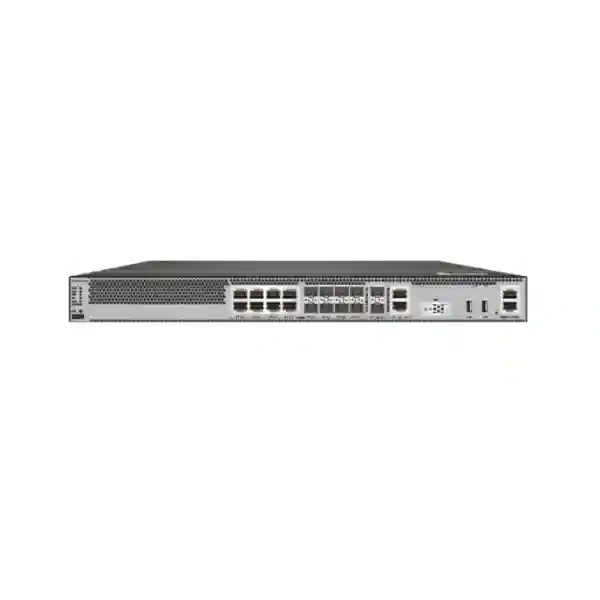
Huawei HiSecEngine USG6000E-S12 Next-Generation Firewall
The Huawei HiSecEngine USG6000E-S12 is a 1U security gateway aimed at small and mid-sized enterprise networks that need a practical combination of firewalling, application awareness, intrusion prevention, antivirus controls, VPN services, routing, segmentation, and operational visibility. For UAE organizations, it is especially relevant where internet circuits are growing beyond basic branch speeds, where 10GE optical uplinks are required to connect core switching, or where multiple WAN, LAN, server, wireless, and guest segments must be protected through one centrally governed security platform.
Published specifications for the USG6000E-S12 describe up to 2 Gbps firewall throughput, 1.6 Gbps application-layer throughput, 1.4 Gbps threat-protection throughput with major inspection functions enabled, 1.5 Gbps IPsec throughput, up to 2.5 million concurrent connections, and up to 60,000 new connections per second. Those figures make the appliance more suitable for genuine enterprise branch and compact-campus workloads than consumer or entry-level UTM products, while its fixed interface set and 1U form factor keep deployment straightforward.
Key Published Platform Figures
Firewall: up to 2 Gbps
Application layer: up to 1.6 Gbps
Threat protection: up to 1.4 Gbps
IPsec: up to 1.5 Gbps
Concurrent sessions: up to 2.5 million
New sessions: up to 60,000 per second
What the USG6000E-S12 Is Designed to Do
A modern firewall is no longer only a device that permits or denies traffic according to source address, destination address, protocol, and port. Business applications frequently use shared cloud platforms, encrypted sessions, content delivery networks, remote APIs, dynamic infrastructure, and web-based interfaces. A useful enterprise security gateway therefore needs to understand the context of traffic, connect user and application policy to network zones, and combine basic stateful inspection with higher-layer controls. The USG6000E-S12 is positioned for this role. It can consolidate perimeter firewall policy, application control, intrusion prevention, antivirus inspection, reputation and malicious-domain controls, NAT, traffic management, VPN termination, routing, and segmentation into one appliance rather than forcing a small or mid-sized organization to maintain several independent edge devices.
For a Dubai headquarters, Abu Dhabi branch, Sharjah warehouse, Ras Al Khaimah industrial office, or multi-site UAE organization, that consolidation has practical value. Internet access can be divided between corporate users, servers, guest Wi-Fi, voice systems, cameras, operational technology, and management networks while policies are kept at the security gateway. Administrators can create specific controls for business applications instead of treating every HTTPS flow as identical. Remote offices can use IPsec to build encrypted site-to-site connectivity, and mobile users can use SSL VPN capabilities where the selected license package and software configuration support the required number of users. The device can also sit behind a service-provider handoff and ahead of a core switch, or it can terminate multiple uplinks and participate directly in routing decisions.
The platform is most compelling where an organization has outgrown a basic SMB firewall but does not need a modular chassis. Its 1U rack format is easy to integrate into standard server and network cabinets. Fixed copper and optical interfaces reduce the planning overhead associated with large expansion-card platforms, while two 10GE SFP+ ports provide useful headroom for high-speed core uplinks, aggregated traffic, or fiber-based connectivity within a data room. Eight GE combo ports allow administrators to choose copper or optical media for a broad set of branch and campus designs, and two additional GE ports can support WAN, LAN, DMZ, or other routed roles according to topology.
Organizations evaluating this model should treat the throughput figures as design inputs rather than guarantees for every environment. Real application performance depends on packet size, traffic mix, security services enabled, encryption, policy complexity, logging, software release, signature set, session behavior, and topology. A firewall that forwards close to its maximum stateful rate with minimal inspection can have materially less capacity when IPS, antivirus, application identification, URL controls, TLS-related analysis, and detailed logging are all active. FourTeck therefore sizes the platform using the expected protected throughput and session profile, not only the headline firewall number. For broader infrastructure planning, customers can also consult FourTeck UAE for integrated networking and enterprise deployment requirements.
USG6000E-S12 Hardware and Performance Reference
Always validate the exact AC/DC power option, storage capacity, license bundle, software release, transceivers and support term on the final bill of materials. Commercial bundles can differ by market and project.
Security Architecture: From Stateful Inspection to Application-Aware Enforcement
At the center of the USG6000E-S12 deployment model is a zone-based security architecture. Interfaces or logical networks are associated with trust boundaries, and policy is applied when traffic crosses those boundaries. This approach is much more scalable than maintaining isolated ACLs on every switch interface because it lets the firewall become the enforcement point for flows between internet, corporate LAN, DMZ, servers, guest users, wireless networks, voice, cameras and selected management systems. Administrators can still use conventional IP and service objects, but they can also build policies around applications, users, time conditions and security profiles. The result is a policy model that follows business intent more closely than a port-only firewall.
Stateful session handling means the device tracks connection context instead of evaluating every packet as an unrelated event. That session table is why concurrent-connection capacity and new-connection rate matter. A branch with 300 employees may appear small by user count but can generate tens of thousands of simultaneous sessions because browsers, collaboration clients, operating systems, endpoint security agents, mobile devices, cloud storage, software updates and IoT systems all open multiple connections. Retail, education and guest networks can produce even more churn. With a published maximum around 2.5 million concurrent connections and 60,000 new connections per second, the USG6000E-S12 has substantially more state scale than a typical SOHO security device, although a production design should reserve headroom for traffic bursts and security services.
Application identification adds another layer of control. Instead of assuming that TCP 443 is simply generic secure web traffic, an application-aware policy engine attempts to classify the application or service inside the flow. This allows administrators to distinguish business-approved collaboration, cloud productivity, file sharing, remote administration, consumer services and other categories even when they share the same transport ports. Published product information for this model references thousands of recognizable applications and access control that can reach application-function granularity. In practice, administrators should begin with monitored visibility, discover the real traffic mix, then move to enforceable application policy gradually. Blocking broad categories without observation can disrupt legitimate business workflows.
Intrusion prevention examines traffic for patterns and behaviors associated with attacks against servers, clients, web applications and network services. The platform is marketed with broad CVE coverage and thousands of IPS signatures, including detection for vulnerability exploits, web attacks such as SQL injection or cross-site scripting, malicious remote-control activity, botnet behaviors and brute-force attempts. Signature count alone should never be used as the only measure of IPS effectiveness; update frequency, protocol decoding, evasion resistance, context, false-positive tuning and policy placement matter just as much. The practical value is that the firewall can block suspicious traffic before it reaches vulnerable internal systems, while creating logs that security staff can correlate with endpoint and server events.
Antivirus and malicious-file controls address content moving through supported protocols. These functions complement endpoint protection rather than replace it. The network firewall can stop some malicious objects earlier in the path, while endpoint security provides process-level visibility after files reach a device. A layered design is stronger because neither control has complete visibility in every circumstance. Where cloud-based file reputation or threat identification is licensed and enabled, suspicious files can be evaluated using current threat intelligence. Organizations with strict data handling requirements should review what metadata or objects are sent to cloud services and confirm that the chosen configuration aligns with internal governance and UAE regulatory obligations relevant to the sector.
Huawei’s broader HiSecEngine positioning emphasizes hardware-accelerated processing and intelligent security functions. For the USG6000E-S12 specifically, procurement teams should avoid assuming a particular internal processor, accelerator, or ASIC generation unless it is documented on the exact local datasheet or bill of materials. What matters operationally is the validated performance of the appliance with the security services the customer will actually enable. A sound design therefore uses published threat-protection and application-layer figures, then applies additional headroom rather than extrapolating from unverified chip-level claims.
Interface Map and Physical Network Design
Two 10GE SFP+ Interfaces
The 10GE ports are valuable for connecting to a core or distribution switch without forcing all firewall traffic through 1GbE links. They can be used for high-speed inside or outside connectivity depending on the design. In a compact campus, one 10GE port may face the internal core and another may support a server/DMZ aggregation or resilient uplink. In a branch data room, they can provide fiber runs over appropriate optics. The transceiver type, fiber type, distance and switch-side compatibility should be confirmed during quotation because SFP+ optics are separate engineering choices, not merely accessories.
Eight GE Combo Interfaces
Combo interfaces provide media flexibility because each logical combo position can normally be used through either its copper or optical side according to the hardware design, not both simultaneously as separate ports. That is useful in UAE facilities where the firewall may connect to nearby copper Ethernet equipment while other network zones require fiber because of building distance, electrical isolation or structured cabling standards. Designers should map the selected medium for every combo interface so installation teams know exactly which copper patch leads and SFP optics are required.
Two Additional GE Interfaces
The additional GE ports can serve WAN, LAN, DMZ, dedicated service, backup internet or other routed purposes. A common small-campus pattern is to reserve high-speed optical ports for the internal core and use copper GE interfaces for ISP handoffs or dedicated management-facing networks. The correct mapping depends on internet circuit speed, high-availability mode, switch topology, and whether services are delivered as physical Ethernet or tagged VLANs.
Management, Console, USB and M.2
A dedicated management interface helps keep administrative access separate from user traffic and is strongly recommended where an out-of-band management network is available. The console port provides local recovery and initial configuration access. USB ports support supported maintenance workflows, while the M.2 slot enables local solid-state storage options in appropriate configurations. Published listings reference 64 GB, 240 GB and 960 GB M.2 possibilities depending on commercial configuration. Final storage capacity should be confirmed rather than assumed.
Physical design should include patching, optical budget, rack depth, airflow, power feeds, labeling and service-provider demarcation. The chassis is approximately 442 mm wide, 420 mm deep and 43.6 mm high, so the rack must provide enough usable depth for the appliance, power connectors and front/rear cable bend radius. For installation, migration, cabling and wider managed infrastructure services in the UAE, see FourTeck IT Services UAE.
Threat Prevention, IPS, Antivirus and Application Control
The published 1.4 Gbps threat-protection figure is one of the most important planning numbers on the USG6000E-S12 because it represents a more realistic starting point for security-focused deployments than the 2 Gbps stateful firewall figure. Threat protection typically introduces deeper inspection work: identifying applications, decoding protocols, comparing traffic with IPS signatures, scanning supported content for malware, checking reputation data, generating logs, and applying policy actions. In a production environment, the actual result can still be lower than a datasheet number when traffic is encrypted, sessions are small and numerous, logging is intensive, multiple security profiles are chained, or the network sends a difficult traffic mix. The design target should therefore sit below the theoretical maximum and include growth capacity.
IPS deployment is strongest when profiles are tailored to the assets behind each policy. A public web server, a Windows user VLAN, a voice network, a guest segment and a database zone do not need identical attack signatures. Applying every available signature to every flow can waste resources and create unnecessary alerts. Instead, security engineers can use protected-server profiles, client profiles, severity thresholds and selected signature categories based on the actual software estate. High-confidence critical signatures may be blocked immediately, while lower-confidence or informational detections can begin in alert mode. This staged method makes it easier to identify false positives before they affect business services.
Antivirus inspection should also reflect protocol and risk. Web downloads, email-related flows where supported, file transfer services and other content-carrying protocols may warrant inspection, but very low-risk infrastructure traffic may not need identical controls. When cloud file reputation or sandbox-related services are part of the licensed package, they can extend local detection by checking current threat intelligence. Procurement teams should verify subscription duration, update entitlement and cloud-service availability for the target region. A firewall with an expired security subscription may continue basic stateful firewalling but lose the value of current signatures and reputation intelligence, which changes its risk profile substantially.
Application control can reduce risk and improve network governance when it is linked to users and business roles. Finance staff, call-center users, developers, IT administrators, contractors and guest users may need different application permissions. Rather than maintain a single broad internet rule, the organization can create policies that allow required business applications, limit risky categories, block unauthorized remote administration, and treat high-bandwidth consumer services differently during working hours. Policies can also be combined with traffic management where supported so critical applications receive predictable bandwidth during congestion.
Encrypted traffic is an architectural consideration. Modern internet usage is overwhelmingly encrypted, which means some content cannot be fully inspected unless the firewall participates in an approved decryption workflow or uses metadata and protocol behavior for classification. Decryption carries privacy, certificate, performance, compatibility and governance implications. It can affect banking applications, certificate pinning, mobile apps and regulated data. Any SSL/TLS inspection design should therefore be scoped separately, tested with representative applications, documented for users where required, and sized with additional performance margin. The published threat-protection number should not automatically be assumed to equal the performance of a comprehensive TLS decryption deployment.
Security logging completes the control loop. A prevention event that is not logged or monitored can be difficult to investigate later. The appliance should forward important system, traffic, threat, authentication and VPN events to an appropriate logging or SIEM platform, with retention that matches the organization’s incident-response and compliance requirements. Time synchronization is essential so logs can be correlated across firewall, switches, servers, endpoints, identity systems and cloud services. Where local storage is fitted, it can support on-box records, but centralized retention is still preferred for resilience and investigation.
VPN Architecture for UAE Branches, Partners and Remote Users
The USG6000E-S12 can act as a substantial VPN gateway for its class. Published specifications list up to 1.5 Gbps IPsec throughput and up to 4,000 IPsec tunnels. This is enough logical tunnel scale for many distributed organizations, but tunnel count should not be confused with practical encrypted traffic capacity. A hub serving hundreds of branches may have thousands of defined tunnels while only a fraction are active at high bandwidth. Conversely, a small number of high-speed tunnels can consume most of the available encryption capacity. Sizing should therefore start with aggregate encrypted throughput, expected concurrency, packet size, route design and failover behavior, then confirm the number of tunnels.
Site-to-site IPsec can connect Dubai, Abu Dhabi, Northern Emirates and overseas locations across public internet services. Typical topologies include hub-and-spoke, partial mesh and dual-hub designs. Hub-and-spoke is operationally simple because branches build tunnels to a central location, but it can create inefficient paths when branch-to-branch communication is common. A partial mesh reduces unnecessary backhaul for selected sites but increases routing and tunnel-management complexity. The right design depends on application placement, SaaS usage, private data-center resources and whether cloud workloads sit in the UAE, another region or multiple providers.
Dynamic routing over secure tunnels can make large VPN estates easier to operate because routes can adapt as sites or prefixes change, but the routing protocol design must be controlled carefully. Static routes are simpler for a handful of sites. OSPF or BGP-based approaches can scale better where many networks are involved, especially when dual ISPs, dual hubs or cloud connectivity are part of the architecture. Route summarization, filtering, administrative preference and failure timers should be defined before migration. A firewall is both a security device and, in many deployments, a routing participant; mistakes in either policy or routing can cause outages.
SSL VPN is useful for individual users who need secure remote access from laptops or other approved endpoints. Listings for this model commonly show 100 SSL VPN users in a base entitlement and expansion up to 800 concurrent users. The exact entitlement must be verified in the quotation because license packs and software versions can change what is available. Remote-access capacity should also include authentication architecture, multifactor authentication where applicable, DNS behavior, split-tunnel versus full-tunnel policy, endpoint posture expectations, user support, and the amount of internet traffic that will traverse the firewall.
A full-tunnel remote-access design sends the user’s internet traffic back through the corporate firewall, increasing inspection consistency but consuming more WAN and firewall capacity. Split tunneling sends only corporate destinations through the VPN and leaves general internet traffic local, reducing bandwidth consumption but making endpoint security and local internet controls more important. There is no single correct choice for every customer. Sensitive administrative access may justify full tunneling, while large remote workforces using cloud SaaS can benefit from carefully controlled split tunneling. Security, bandwidth, application behavior and user experience all need to be considered together.
For partner or supplier connectivity, use dedicated VPN and security zones rather than placing third parties inside the normal trusted network. Limit accessible destinations, services and management rights explicitly. Where possible, log partner activity separately and assign unique authentication or tunnel credentials. This reduces the blast radius of a compromised partner account or remote network and makes contractual access easier to audit.
Routing, NAT, Segmentation and Multi-WAN Design
A firewall at the enterprise edge frequently performs routing as well as inspection. The USG6000E-S12 can be integrated with static and dynamic routing designs according to the software feature set. In a simple branch, a default route may point to one ISP while internal static routes point to the core switch. In a larger environment, the firewall can exchange routes with the core and with upstream networks. The security policy should be designed alongside the routing table because traffic can only be inspected correctly when the path is predictable and symmetric enough for stateful processing.
Network Address Translation remains a core edge function. Source NAT allows private internal networks to access public services through one or more external addresses, while destination NAT or server publishing can expose specific internal services under controlled conditions. Public-facing applications should normally sit in a DMZ or similarly isolated zone rather than the same security domain as user endpoints. Only the minimum required ports should be published, and IPS, application and logging profiles should be applied based on the exposed service. If a web application firewall or reverse proxy is also deployed, the traffic path and source-address preservation requirements should be planned so logs remain useful.
Segmentation is one of the strongest reasons to deploy a capable firewall inside a mid-sized network instead of using it only as an internet gateway. By routing selected VLANs through the firewall, the organization can restrict lateral movement between users, servers, guests, cameras, printers, building systems, development environments and administration networks. This is especially valuable when legacy devices cannot run modern endpoint agents. Segmentation rules should begin from business flows: identify which source groups need which destination services, then deny or tightly limit everything else. Broad any-to-any internal policies defeat much of the benefit.
Multi-WAN deployments need more than a second default route. Engineers should define how the firewall detects failure, which applications should move to backup links, whether sessions must be re-established after failover, and how inbound services remain reachable. If both ISPs provide public address ranges, NAT rules may need to change depending on egress path. If BGP is used, routing policy, prefix advertisement and failover convergence become additional design factors. If the second link is primarily for backup, simpler health checks and policy routes may be appropriate.
Traffic steering should be based on measurable business requirements. Voice and interactive collaboration are sensitive to latency and packet loss, while backups and software distribution are more tolerant. Critical SaaS may benefit from preferred internet paths if the organization has diverse ISPs. However, sophisticated steering policies increase operational complexity. Every additional routing rule, probe and exception should have a clear owner and troubleshooting method. The cleanest design that meets the requirement is usually preferable to an elaborate design that only one engineer understands.
High Availability and Resilience Engineering
A firewall protects the network only while it is available, so resilience should be considered from the beginning. The USG6000E-S12 is offered in configurations where redundant power can be an option, and pair-based high-availability designs can reduce the impact of appliance failure when the software and license arrangement supports the required mode. The firewall pair itself is only one part of the availability chain. The deployment also depends on redundant ISP services, switch paths, optical modules, patching, power distribution, UPS capacity and configuration discipline.
When two firewalls are deployed, interfaces must be mapped consistently and connected through a topology that does not create a hidden single point of failure. If both appliances connect to a single access switch or a single ISP handoff device, that component can still take the entire service down. Dual core switches, independent links, redundant power feeds and diverse carrier paths may be justified for business-critical sites. The desired recovery objective should guide how far the design goes.
State synchronization is important because a failover that preserves configuration but drops every active session may still be disruptive. The exact stateful failover behavior depends on the configured HA mode and supported feature combination. Applications such as voice, database connections and long-lived VPN sessions can react differently to path changes. A maintenance test should therefore include real application behavior, not only a ping test. Scheduled failover exercises also reveal cabling mistakes and stale secondary configurations before a real outage.
Configuration backups should be stored outside the appliance pair, and change control should include a rollback plan. Firmware upgrades need compatibility review, especially where VPN peers, authentication systems, logging platforms and centralized management are involved. A stable security platform is the result of controlled lifecycle operations as much as it is the result of hardware redundancy.
Management, Policy Operations and Day-Two Administration
Day-two operations determine whether a firewall remains secure after installation. A clean initial rule set can become difficult to maintain when temporary exceptions, vendor access, new SaaS services, mergers, office moves and troubleshooting rules accumulate. Administrators should define naming standards for address objects, services, applications, user groups and policies. Rules should contain clear comments describing the business owner and purpose. Expiration dates are useful for temporary access so exceptions do not become permanent by accident.
Administrative access should be isolated from general user networks. Use the dedicated management interface where practical, restrict management source addresses, use secure management protocols, disable unnecessary services, and integrate administrator authentication with an appropriate identity platform. Individual administrator accounts are preferable to shared credentials because they improve accountability. Privilege levels should match operational roles: helpdesk staff may need monitoring access without the ability to change core security policy, while senior security engineers require broader rights.
Logging should balance visibility with volume. Session logging for every allowed flow can produce large data sets, especially on busy networks. High-value events include denied traffic at important boundaries, IPS and antivirus detections, configuration changes, administrator logins, VPN events, authentication failures, system health alerts, high-availability transitions and critical allowed flows. The log strategy should be designed with the storage and SIEM team so the data is actually retained and reviewed rather than generated and forgotten.
Policy reviews should remove unused rules and objects. Hit counters, traffic analysis and change history can help identify obsolete entries, but administrators must verify business ownership before deletion. Duplicate and shadowed rules complicate troubleshooting and can produce unintended access. A quarterly or semiannual policy cleanup is often more effective than waiting for a major audit.
Monitoring should include CPU and memory health, interface errors, dropped packets, session usage, new-session rate, VPN status, HA status, threat events, storage condition and license/subscription expiry. Capacity alarms should be set before critical thresholds are reached. This gives the organization time to tune policies, change architecture or plan an upgrade rather than discovering limits during a traffic surge.
How to Size the USG6000E-S12 Correctly
Start with the protected traffic requirement, not the ISP contract speed alone. A site may buy a 1 Gbps internet circuit but only use 300 Mbps today, or it may operate dual 1 Gbps links and expect aggregate traffic close to 1.5 Gbps within two years. Internal segmentation can also add traffic that never touches the internet. If users and servers communicate through firewall-controlled VLAN boundaries, east-west traffic consumes appliance capacity in addition to north-south internet traffic. The sizing worksheet should therefore include internet, site-to-site VPN, remote access, internal segmentation, DMZ and published-service flows.
Next, identify which security services apply to each flow. A basic guest internet policy may use application controls and web filtering, while a server publishing rule may use strict IPS and logging. A trusted backup VLAN may use only stateful firewalling. Remote users may consume IPsec or SSL VPN capacity. Rather than assume every byte sees every security engine, map actual policy paths. This produces a more realistic load model and makes it easier to identify where inspection is most valuable.
Use the 1.4 Gbps threat-protection figure as an upper published reference for heavy security inspection rather than sizing a fully protected environment to the 2 Gbps firewall figure. Then reserve headroom. A common engineering approach is to avoid planning continuous normal operation near a theoretical maximum because traffic grows, software changes, signatures expand and incidents create bursts. The exact reserve depends on business criticality, budget and migration options, but leaving meaningful headroom is more defensible than designing to 95 or 100 percent utilization on day one.
Session scale can be a hidden constraint. Count device types, not only employees. An office with 500 people can have 1,500 or more active IP endpoints after phones, printers, access points, cameras, meeting rooms, tablets, IoT systems and servers are included. Each endpoint can open dozens or hundreds of sessions. Guest networks and public Wi-Fi can create high churn. Published limits of 2.5 million concurrent sessions and 60,000 new sessions per second provide a strong envelope, but monitoring after deployment should confirm actual peak behavior.
For VPN sizing, calculate encrypted bandwidth in both directions. A headquarters that acts as the hub for ten branches with 100 Mbps active traffic each can approach 1 Gbps of aggregate encrypted load even before remote users and cloud tunnels are included. If internet breakout happens centrally, branch traffic may be decrypted from the site-to-site VPN, inspected, then forwarded to the internet, consuming multiple processing stages. A cloud migration can change this profile rapidly because traffic patterns shift away from traditional data-center applications.
Finally, plan for the next hardware decision. If the required protected throughput is already close to the USG6000E-S12 ceiling at purchase time, a larger firewall may provide better lifecycle economics than buying a device that needs replacement soon. Conversely, if the site requires a few hundred megabits of protected traffic with moderate growth, the S12 may offer a useful balance between capacity and footprint. FourTeck can compare the model against adjacent firewall sizes through Firewall Dubai based on interface, session, VPN and security-subscription requirements rather than a simple model-number comparison.
Deployment Topologies That Fit the Platform
1. Single-Site Internet Edge
In the simplest topology, the USG6000E-S12 sits between one or two ISP circuits and an internal core or distribution switch. The firewall performs NAT, stateful inspection, application controls, IPS, antivirus and VPN. VLAN gateways may remain on the core, with only internet-bound traffic crossing the firewall, or selected high-risk VLANs can be routed through the firewall for internal segmentation. This design suits offices where the primary requirement is secure internet access with moderate internal segmentation.
2. Branch Hub With Site-to-Site VPN
A headquarters can use the device as an IPsec hub for multiple remote branches. The 4,000-tunnel published ceiling is far above the needs of many mid-sized organizations, but encrypted throughput is the more important limit. Each branch can advertise or define its local networks, while security policies control which branches may access central servers and each other. A secondary hub can improve resilience for critical multi-site deployments.
3. Compact Campus Segmentation Gateway
The two 10GE interfaces make the device usable in a compact campus where high-speed connectivity to the core is needed. User, guest, IoT and server VLANs can be steered through firewall zones for Layer 7 policy and threat inspection. The main engineering question is east-west throughput: internal traffic can easily exceed the internet circuit speed, especially when users access local storage, CCTV, servers or virtual infrastructure. A traffic study should confirm that the selected inspection level stays within capacity.
4. DMZ and Published Application Edge
Public web, mail gateway, remote-access portal or partner-facing services can be placed in one or more DMZ zones. Destination NAT maps public addresses to internal service addresses while inbound policy allows only required protocols. IPS and logging profiles should be tuned to the exposed services. Outbound access from the DMZ back into trusted networks should be minimized. If a server is compromised, this zoning reduces the attacker’s ability to move laterally.
5. Dual-ISP Business Continuity Edge
Two internet circuits can provide availability and traffic distribution. The firewall monitors path health and changes routing according to policy. Important applications can prefer the lower-latency or more reliable link, while bulk traffic uses the alternative. Inbound services require careful DNS, BGP or NAT planning depending on how addresses are assigned. Simply connecting two ISPs does not automatically deliver seamless failover for every application.
6. High-Availability Pair
Two appliances can be designed as a resilient security edge where supported. The pair should connect to redundant switches or dual logical paths, and both units need consistent licensing and support appropriate to the HA design. Maintenance procedures should be tested so upgrades and hardware work can occur with minimal business disruption.
Licensing, Subscriptions and Bill-of-Materials Planning
Security appliances are purchased as more than hardware. The final operational capability depends on software entitlement, security subscriptions, remote-access licensing, support coverage, storage and accessories. For the USG6000E-S12, a complete quotation should specify the appliance variant, power arrangement, M.2 storage if required, threat-protection subscription term, SSL VPN entitlement, any central management or logging requirements, optical transceivers, rack accessories and vendor support period. Two quotes that both say “USG6000E-S12” can therefore represent materially different solutions.
Threat intelligence and signature-driven services should be quoted with a defined duration. IPS, antivirus, malicious-domain reputation and cloud-assisted file analysis depend on current updates. A one-year subscription may reduce initial cost, but a three-year or longer term can simplify budgeting and avoid gaps if the organization is confident in the platform lifecycle. The correct choice depends on procurement policy and replacement planning. Customers should also verify renewal pricing and the operational process for tracking expiry.
SSL VPN capacity is particularly important because published platform maximums do not necessarily equal the purchased entitlement. If a project requires 300 concurrent remote users, the quote must include enough user licensing and the authentication design must scale to that number. Similarly, virtual firewall capability may have default and maximum counts that depend on licensing or software version. Do not base a multi-tenant design only on the highest published platform number without entitlement confirmation.
Optics are another common source of procurement mistakes. A 10GE SFP+ port is not a complete fiber link by itself. The bill of materials needs compatible transceivers on both the firewall and connected switch, matching fiber type, connector type and optical reach. If the existing switch uses third-party optics, compatibility should be checked on both sides. For copper handoffs, cable category and distance must support the required Ethernet speed.
Support coverage should match business criticality. A firewall at a small branch may tolerate next-business-day hardware replacement, while a head office or revenue-critical site may need stronger response commitments and an HA pair. Support terms should be documented together with local spares strategy, configuration backup procedures and escalation contacts.
UAE Deployment and Procurement Considerations
UAE projects often combine international vendor standards with local installation realities. Internet services may arrive as copper Ethernet, single-mode fiber, provider-managed routers or managed SD-WAN handoffs. Before the firewall is ordered, the ISP presentation, public IP allocation, VLAN tagging, routing method and handoff speed should be documented. This avoids last-minute surprises such as a 10GE service delivered over an optic that was not included in the project scope, or an ISP router that must remain in place for addressing reasons.
Rack environments vary widely. A modern data room normally has controlled temperature, redundant UPS and clear front-to-back airflow, but smaller branches may place the firewall in a compact wall rack alongside switches and patch panels. The appliance dimensions, rack depth, cable bend radius and ventilation space must be checked. UAE ambient temperatures can be high outside conditioned areas, so network equipment should be installed in an environment that stays within the vendor’s supported operating range. Published listings for this model commonly reference operation up to around 45°C and storage up to 70°C, but the exact local hardware documentation should be checked before relying on those limits.
Power planning includes voltage, socket type, UPS runtime and redundant feeds. Published information lists AC input support in the 100–240 V range for AC models, which is compatible with normal UAE enterprise power environments when installed correctly. If dual power supplies are selected, connecting both to the same small power strip does not provide meaningful power-path redundancy. Where resilience matters, use independent UPS or power distribution paths where practical.
Migration planning should include the old firewall configuration, network diagrams, ISP details, VPN peer settings, public services, NAT rules, DNS dependencies, authentication systems and maintenance window. A policy translation exercise is often more valuable than copying rules literally because old configurations usually contain legacy objects and exceptions. Engineers should identify the business purpose of each rule, rebuild only what is still needed, and test critical applications with representatives from the customer team.
For organizations operating beyond the UAE, the same platform can be used in broader regional architectures, but logistics, subscriptions, support coverage and regulatory requirements can differ by country. FourTeck’s wider regional capabilities are available through FourTeck Global. The hardware model may be common, but final SKU, power cable, support contract and license packaging should be aligned to the destination market.
Documentation is part of the deliverable. A professional installation should leave behind interface maps, VLAN and zone assignments, IP addresses, routing design, NAT rules, VPN information, administrator access procedure, backup process, license inventory and escalation path. This reduces dependence on a single engineer and makes later audits, changes and troubleshooting significantly easier.
Security Policy Design Methodology
A successful firewall project should begin with traffic and business requirements, not with rule entry. First identify the major zones: internet, corporate users, privileged users, servers, DMZ, guests, voice, cameras, building systems, development, backup, management and partner networks. Not every customer needs all of these, but the exercise reveals where trust boundaries exist. Each zone should have an owner and a clear statement of which other zones it needs to communicate with.
Second, define allowed business flows. For example, corporate users may need HTTPS to internet applications, DNS to approved resolvers, printing to print servers and access to selected ERP services. Guest users may need only internet access with no route to private corporate networks. Cameras may need NTP, DNS and a connection to the recording server but not broad internet access. Backup systems may need access to protected servers but should not be reachable from ordinary user VLANs. This flow-based model creates policy that is easier to audit because every permission has a reason.
Third, attach appropriate security profiles. Internet browsing policies can use application control, web-category controls, IPS and antivirus. Published services may use strict server-side IPS. Inter-VLAN administrative traffic may use application restrictions and detailed logging. Guest traffic may use bandwidth controls and threat prevention. The goal is not to maximize the number of features enabled on every rule; it is to apply the right inspection where it reduces risk effectively.
Fourth, define logging and response. Decide which allowed sessions are logged, which denies are worth retaining, where threat events are sent, who receives critical alerts and what constitutes an incident. A high-severity IPS block against a public server should trigger a different response than a low-risk policy deny from a guest VLAN. If no team is watching the alerts, adjust the monitoring process before adding more noisy detections.
Fifth, review policy after migration. The first weeks of production reveal unexpected dependencies. Use logs to identify blocked legitimate traffic and approved but unused access. Changes should be documented and tied to business owners. After stabilization, create a recurring review process so the rule base remains intentional rather than becoming a historical archive of every request ever made.
This methodology also supports future firewall replacement. When policies are documented by business purpose instead of cryptic IP addresses alone, they can be migrated to another appliance or architecture with much less risk. Good policy design therefore protects the current network and reduces future technical debt.
Operational Scenarios and Practical Examples
Professional-services office: A 250-user Dubai office has a 1 Gbps primary internet circuit and a 500 Mbps backup circuit. Most applications are SaaS, but file services and identity systems remain local. The firewall can terminate both links, apply application controls and IPS to user browsing, publish a small DMZ, and provide remote-access VPN. The design should reserve enough protected throughput for busy periods and for growth toward greater SaaS use rather than sizing only to current averages.
Education site: A school or training facility can generate large numbers of short-lived connections from student devices. Concurrent session and new-session capacity become important even if average Mbps is modest. Student, staff, administrative, guest and IoT networks should be separated, with different application and web policies. If content inspection is extensive, the 1.4 Gbps threat-protection figure and encrypted traffic profile are more relevant than raw firewall throughput.
Retail or hospitality branch: Payment systems, guest Wi-Fi, staff devices, digital signage, cameras and building systems share the same physical site but should not share the same trust level. The firewall can place these functions in distinct security zones and restrict lateral access. Dual WAN can provide business continuity, while site-to-site IPsec connects central systems. Because guest traffic can fluctuate heavily, bandwidth and session policies should be included in the design.
Warehouse and logistics facility: Scanners, ERP terminals, IP cameras, access-control systems, Wi-Fi and operational endpoints create a mixed environment. Some devices run older software and cannot support strong endpoint controls. Network segmentation reduces exposure by allowing each device group to reach only its required services. Fiber interfaces can be useful where building distances or electrical conditions make copper less appropriate.
Multi-branch enterprise: The S12 can serve as a central VPN headend for a moderate regional estate. Branch traffic may use direct internet breakout for SaaS while private routes use IPsec to headquarters. This reduces backhaul load but requires consistent security policy at branch edges. If all internet traffic returns to headquarters, the central firewall must be sized for both decrypted branch traffic and local users.
Small data room: An organization hosting a handful of public applications can use separate DMZ, application and management zones. Public traffic is translated and inspected at the firewall, while administrative access is restricted to privileged management networks. The two 10GE interfaces can connect to the core at higher speed, but designers must ensure that aggregated internal and external traffic remains within realistic protected-throughput limits.
When the USG6000E-S12 Is a Strong Fit—and When to Size Up
The USG6000E-S12 is a strong fit when a site needs enterprise firewall functions around the one-gigabit protected-security range, wants 10GE connectivity to the local switching environment, needs substantial session capacity, and expects meaningful IPsec or SSL VPN usage. It is also attractive when interface flexibility matters more than modular expansion. The combination of 10GE SFP+, GE combo and standard GE ports supports a wide range of WAN and LAN handoffs in a single 1U appliance.
Organizations should consider a larger platform when expected sustained threat-inspected traffic approaches the published 1.4 Gbps ceiling, when TLS decryption will be extensive, when multiple multi-gigabit WAN links need to run at high utilization simultaneously, when internal segmentation traffic is several gigabits per second, or when future growth is likely to exceed the appliance within a short period. A larger model can also be justified where more 10GE interfaces, greater hardware redundancy, higher VPN capacity or larger session rates are required.
Conversely, using a much larger firewall than required can increase cost, licensing expense and operational complexity without improving security automatically. Security quality depends on policy, updates, monitoring, segmentation and lifecycle management. The right model is the smallest platform that comfortably meets current and forecast protected traffic, session, interface and resilience requirements with sufficient headroom.
A pre-sales sizing exercise should therefore collect actual utilization from the existing firewall or router if available. Peak traffic, 95th-percentile usage, session counts, VPN volume and application mix provide better evidence than user count alone. Where no reliable telemetry exists, use conservative assumptions and document them in the proposal.
Decision Recap: What This Model Brings to a UAE Security Project
Performance Envelope
Up to 2 Gbps stateful firewall throughput, 1.6 Gbps application-layer throughput and 1.4 Gbps published threat-protection throughput give the platform a clear mid-range branch and compact-campus profile. The protected figure should drive security-heavy sizing.
Connectivity
Two 10GE SFP+ ports, eight GE combo ports and two GE ports provide practical flexibility for ISP, core, DMZ and service-zone connectivity without a modular chassis.
Security Stack
Application-aware policy, IPS, antivirus, malicious-domain and related security functions let the appliance operate as a true next-generation security gateway rather than only a packet filter.
VPN Scale
Up to 1.5 Gbps published IPsec throughput, up to 4,000 IPsec tunnels and scalable SSL VPN user licensing make the platform useful for distributed and hybrid-work designs.
Session Headroom
Up to 2.5 million concurrent sessions and 60,000 new sessions per second provide room for SaaS-heavy offices, guest networks, education, retail and device-dense environments.
Operational Fit
The 1U footprint, dedicated management connectivity, optional storage and available power redundancy make it practical for enterprise racks where simplicity and serviceability matter.
Quotation Input Checklist
For an accurate UAE quotation and design, provide the following information. A complete input set avoids under-sizing, missing license packs and last-minute optical or power changes.
FourTeck Consultation for Huawei HiSecEngine USG6000E-S12 in the UAE
A successful firewall purchase is the combination of the correct appliance, the correct subscriptions, the correct optics and power configuration, and a policy design that reflects the real network. FourTeck can scope the USG6000E-S12 for new deployments, firewall replacements, branch expansions, dual-ISP projects, site-to-site VPN, remote-access VPN, segmentation and high-availability requirements. The objective is to produce a bill of materials that matches the technical design instead of treating the firewall as an isolated hardware SKU.
Before ordering, confirm the target protected throughput, user and device profile, internet circuit plan, internal VLANs, public services, VPN topology, SSL VPN concurrency, logging destination, required subscription duration and support level. Where existing infrastructure is being retained, include core switch models, available interfaces, transceiver types, VLAN design and routing protocols. This allows the migration plan to identify any compatibility or topology changes early.
For procurement and deployment discussions, FourTeck can help map the Huawei HiSecEngine USG6000E-S12 to the actual UAE site requirement and determine whether this model has suitable headroom or whether a larger platform should be considered. That decision should be based on protected traffic, session behavior, interface needs, VPN scale and business continuity rather than on a single headline throughput number.


Reviews
There are no reviews yet.