
Enterprise Campus Switching • UAE
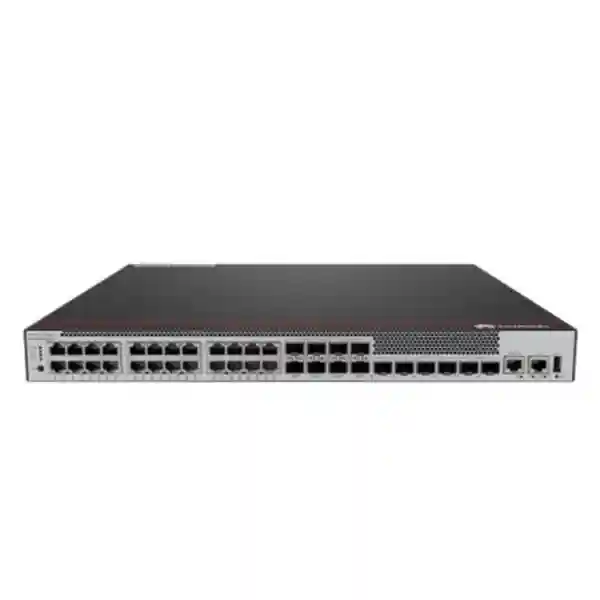
Huawei CloudEngine S5735-S24P8J4XEZ-V2
The Huawei CloudEngine S5735-S24P8J4XEZ-V2 is a feature-rich fixed campus switch designed for organisations that need dependable Gigabit access, substantial PoE+ capability, flexible multi-gigabit optical interfaces, high-speed 10GE uplinks, resilient stacking, and an enterprise routing feature set in a compact 1U form factor. It is positioned for access and aggregation roles where branch, office, education, hospitality, healthcare, retail, government, and commercial networks require more operational headroom than a basic Layer 2 switch can provide.
For UAE deployments, the model is particularly useful when a network must consolidate IP phones, wireless access points, cameras, door controllers, IoT endpoints, desktop users, printers, and other powered edge devices while preserving resilient uplinks to distribution, core, firewall, or server infrastructure. Its combination of 24 copper access ports, PoE+, additional optical bandwidth options, dynamic routing, IPv6, telemetry, and modular power architecture allows designers to treat the switch as part of a long-term campus architecture rather than as a simple port-expansion appliance.
What the S5735-S24P8J4XEZ-V2 is designed to solve
Modern campus access networks are no longer built around a single traffic type. A wiring closet may serve office users, IP telephony, Wi-Fi access points, meeting-room systems, surveillance cameras, building-management controllers, digital signage, printers, thin clients, and specialist operational devices at the same time. Those endpoint classes have different bandwidth, segmentation, availability, and power requirements. The Huawei CloudEngine S5735-S24P8J4XEZ-V2 addresses that mixed environment by combining familiar Gigabit copper edge connectivity with enterprise switching features and substantially more uplink flexibility than a conventional twenty-four-port access switch.
The architecture is useful when an organisation wants to avoid designing an access layer that becomes constrained as soon as wireless density increases or additional services are introduced. The four fixed 10GE SFP+ interfaces provide straightforward high-speed paths toward distribution or core infrastructure. The eight 2.5GE SFP interfaces add a second tier of optical flexibility, and Huawei specifies that these interfaces can be switched to two 10GE SFP+ ports. This allows the physical design to be adapted around fibre type, distance, aggregation topology, and available optics rather than forcing every deployment into one fixed uplink pattern.
The switch also adds capabilities that matter operationally in larger estates: dynamic routing protocols, IPv6, VRRP, ECMP, policy-based routing, telemetry, VLAN-based segmentation, interoperability mechanisms, dedicated stack ports, and resilient power options. These features give network architects freedom to decide where Layer 3 boundaries should live and how much intelligence should remain in the access layer. In some sites the unit can operate primarily as a centrally managed Layer 2 access switch. In others it can participate more actively in routed access, resilient aggregation, or distributed campus designs.
For UAE businesses with multiple offices, towers, warehouses, hotels, schools, clinics, branches, or retail sites, standardising on a capable access platform can simplify operations. A repeatable switch configuration reduces design variation, while sufficient port and uplink headroom makes it easier to support different local endpoint mixes. The objective is not simply to purchase a switch with more features; it is to create a predictable building block that can be deployed consistently, monitored centrally, stocked with the correct optics and power modules, and supported through a documented lifecycle.
FourTeck can support this type of deployment through its broader UAE networking and infrastructure portfolio, including design coordination, rack integration, structured implementation planning, and post-deployment support. The most important procurement step is to define the required endpoint count, PoE load, uplink architecture, fibre distances, redundancy target, software feature requirements, and power-module configuration before finalising a bill of materials.
Hardware architecture and physical interface design
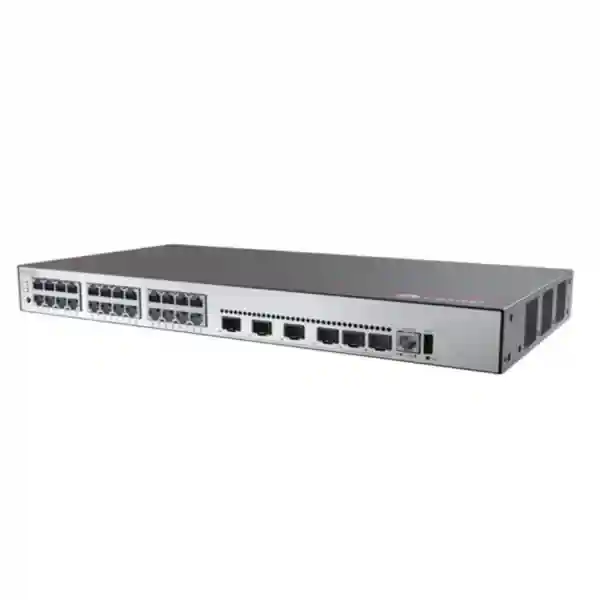
At the access edge, the S5735-S24P8J4XEZ-V2 provides twenty-four 10M/100M/1000M Base-T interfaces. That port count aligns naturally with a standard office or departmental access block because it accommodates a useful concentration of user and powered-device connections without producing an oversized failure domain. Each port can be allocated according to role through VLANs, security policies, quality-of-service policies, and other control mechanisms supported by the platform and software release.
The Gigabit access layer remains appropriate for a broad range of wired endpoints. Desktop workstations, VoIP phones, many security cameras, printers, controllers, meeting-room devices, and general-purpose appliances often do not require more than one Gigabit Ethernet of edge bandwidth. The design challenge therefore shifts toward aggregate uplink capacity, traffic bursts, wireless backhaul, east-west communication, and the ability to segregate services cleanly. The S5735-S24P8J4XEZ-V2 addresses those concerns through its optical interface mix rather than forcing every endpoint port to operate at a multi-gigabit copper speed.
Huawei specifies eight 2.5GE SFP ports on this model. These are valuable where an optical access or intermediate aggregation requirement exists, because 2.5GE can provide higher-than-Gigabit throughput without immediately consuming a full 10GE interface. In certain designs, the ports may be used for distributed fibre connections, local aggregation, specialist optical endpoints, or bandwidth-sensitive links. Because interface behaviour, supported transceivers, and software constraints can vary by release and optical module, the final fibre design should always be validated against the exact Huawei compatibility information for the intended software version.
The same group of eight 2.5GE SFP interfaces can be switched to provide two 10GE SFP+ ports. This is an important architectural detail because it allows a designer to trade port count for speed. A deployment that needs many moderate-speed optical links can retain the 2.5GE arrangement, while a deployment that needs fewer but faster uplinks can use the alternate 10GE mode. That flexibility is especially useful in phased campus upgrades where the upstream architecture may evolve from Gigabit or 2.5GE distribution toward 10GE aggregation over time.
In addition, the switch includes four fixed 10GE SFP+ interfaces. These are the most obvious candidates for uplinks to distribution switches, core switches, next-generation firewalls, server switches, or other high-throughput infrastructure. A pair of 10GE links can be used for redundant uplink design, while remaining interfaces can serve local server, cross-stack, or alternate path requirements. Link aggregation can be incorporated where the architecture calls for additional logical capacity and path resiliency, subject to the complete network design and peer capabilities.
Two dedicated 12GE stack ports are provided. Dedicated stack connectivity is beneficial because stacking does not have to consume ordinary production uplink ports. From an operations perspective, a stack can simplify switch administration and create a more cohesive access block, but stacking should still be planned carefully. Engineers should document stack-member numbering, cable routing, software compatibility, upgrade procedures, failure-domain implications, and how endpoint or uplink connections are distributed across members to avoid concentrating critical services on one physical chassis.
The chassis is a 1U system measuring approximately 442 mm wide, 420 mm deep, and 43.6 mm high. The documented packaged weight is approximately 7.59 kg. These dimensions are relevant during rack planning because access switches are often installed in wall-mounted or floor-standing communications cabinets where depth, power-strip positioning, patch-panel density, bend radius, and front-to-rear airflow must all be considered. A 420 mm chassis depth should be checked against the usable rack depth after allowing space for front patch cords and rear power connections.
Airflow for this platform is described as intake from the left, front, and right with exhaust toward the rear. In UAE installations, cabinet cooling and dust management deserve particular attention. An access switch may operate inside a telecommunications room that experiences higher ambient temperature than a data centre. Good practice includes maintaining unobstructed vents, controlling recirculation, keeping filters and rooms clean, avoiding tightly packed cable bundles across ventilation openings, and confirming that the room cooling design accounts for both switch heat and the heat generated by connected PoE infrastructure.
PoE+ engineering: budget power before you budget ports
The “P” in this model is significant because the S5735-S24P8J4XEZ-V2 supports PoE+. Power over Ethernet can reduce local power-adapter requirements for IP phones, wireless access points, cameras, and other compliant powered devices, but successful PoE design depends on electrical budgeting rather than port count alone. A twenty-four-port PoE switch does not automatically mean that every connected device can draw its maximum possible wattage under every power-supply configuration. The correct approach is to build a per-device power schedule and then match that schedule to the intended power modules, redundancy objective, input voltage, and growth allowance.
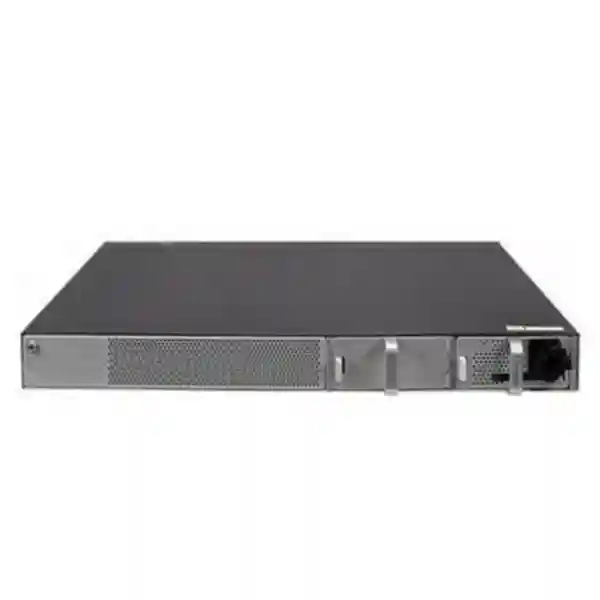
Huawei documentation for this model lists 600 W AC PoE, 1000 W AC PoE, and 1000 W DC PoE power-module options. The platform provides three power-module positions and supports redundant power planning. Depending on the installed combination and input conditions, Huawei documents configurations with up to 840 W of available PoE power. At that level, all twenty-four access ports can support IEEE 802.3at loads of 30 W per port, because twenty-four times 30 W equals 720 W before considering system-specific allocation behaviour and engineering margin.
This does not mean every deployment should be sized exactly to the maximum. A robust design starts by listing each powered device and its expected draw. A typical IP phone may consume far less than the maximum allowed by its PoE class, while an advanced wireless access point, PTZ camera, multi-sensor camera, access-control unit, or edge device can draw substantially more. Designers should use manufacturer power figures for the exact endpoint models, include startup and peak behaviour where relevant, and preserve a reasonable reserve for equipment replacement or future additions.
Redundancy changes the calculation. If the business requires continued operation after one power module fails, the network should be engineered so the remaining power modules can still support the essential PoE load. A configuration that works only while all modules are healthy may technically deliver sufficient power in normal operation but fail the availability objective during a power-module fault. Critical endpoints such as security cameras, wireless access points serving operational areas, emergency phones, and building controllers should therefore be identified separately from noncritical powered devices.
Input power conditions also matter. UAE sites commonly use stable 220–240 V AC infrastructure, but the actual branch circuit, UPS, PDU, and socket allocation still need to be checked. For installations using a UPS, calculate apparent power, real power, runtime targets, recharge behaviour, and the effect of PoE load growth. If the switch is dual-fed from independent sources, document which power module connects to which electrical path. If a generator backs the site, confirm the transfer design and whether the switching room remains cooled during generator operation.
PoE configuration can also be used as an operational tool. Network teams can identify ports that should never provide power, limit power where supported, prioritise critical devices, and use device monitoring to detect abnormal consumption patterns. This is useful when troubleshooting intermittent endpoints or validating that a replacement device has not changed the power profile. A documented PoE inventory turns the switch from a passive power source into a controllable part of the infrastructure-management process.
For a new quotation, FourTeck recommends providing the endpoint count by type rather than only a total switch quantity. Twenty IP phones, eight cameras, and six access points represent a very different power and port profile from thirty basic desktops. An accurate endpoint schedule allows the switch count, PSU configuration, uplink capacity, UPS requirement, patching, rack units, and spare-port policy to be calculated together. This approach is especially useful for hospitality, education, healthcare, and surveillance-heavy projects where the powered-device mix is substantial.
Where the switching project is part of a wider managed infrastructure programme, FourTeck’s IT services practice in the UAE can align switching, implementation, monitoring, and operational support. The aim is to prevent the common situation in which a switch is selected correctly by port count but deployed with insufficient power, inadequate UPS capacity, or an uplink architecture that limits the performance of the devices it powers.
Switching capacity, forwarding performance, and real-world traffic
Huawei publishes forwarding performance of 162 Mpps for the CloudEngine S5735-S24P8J4XEZ-V2. The stated switching capacity is 216 Gbps for the device, with a 520 Gbps system capacity figure. These specifications indicate that the platform is designed to forward high volumes of campus traffic without the architecture being dominated by a low-speed internal switching fabric. However, capacity figures should always be interpreted in the context of the intended topology, packet sizes, uplink design, service features, and actual traffic distribution.
A twenty-four-port access switch rarely experiences every edge interface transmitting at a sustained Gigabit rate simultaneously. User traffic is usually bursty, and many endpoint categories consume modest average bandwidth. The more important design question is often whether aggregated traffic can leave the switch efficiently and whether the upstream network has enough capacity to absorb the burst profile. Four fixed 10GE SFP+ interfaces provide significant flexibility for that purpose, allowing network teams to build one or more high-speed upstream paths without relying on a single constrained uplink.
Wireless traffic changes this equation because high-density Wi-Fi deployments can concentrate large numbers of users behind a smaller number of access points. Even when the access point itself is connected at Gigabit speed, aggregate traffic from several access points can push an uplink harder than traditional office desktops. Video surveillance can create the opposite profile: traffic may be steady rather than bursty, particularly when cameras continuously stream to central recorders. A mixed environment should therefore be assessed using both peak and sustained traffic assumptions.
Server or local application connectivity can introduce additional east-west traffic. If a local server, NVR, storage device, or firewall is connected directly or indirectly through the access layer, engineers should map which flows traverse the switch and which flows cross the uplinks. High packet rates generated by security tools, scanning platforms, telemetry systems, or large numbers of small transactions may stress a design differently from a few large file transfers. The published packet-forwarding metric helps demonstrate that the platform is intended for serious enterprise workloads rather than basic unmanaged access.
Network performance should therefore be validated as an end-to-end property. Switch fabric capacity is only one component. Fibre type, optic selection, transceiver distance, peer-interface speed, link aggregation, routing path, firewall throughput, WAN bandwidth, server capacity, application design, quality-of-service policy, and endpoint performance all contribute. A well-designed S5735-S24P8J4XEZ-V2 installation avoids treating a strong access-switch specification as a substitute for proper system-level sizing.
Enterprise Layer 2 segmentation and campus control
The S5735-S-V2 platform supports up to 4094 VLANs along with voice VLAN and MUX VLAN functions. In practical campus design, VLANs provide the first major layer of separation between endpoint communities. Corporate users, guests, IP phones, cameras, building-management devices, printers, access-control equipment, servers, and network-management interfaces can be placed into distinct logical segments. This reduces unnecessary broadcast scope and provides clear enforcement points for routing, firewall policy, access control, and monitoring.
Huawei also documents VLAN assignment based on MAC address, protocol, IP subnet, policy, and port. This gives administrators more choices than simple static port-based assignment. The appropriate method depends on the operational model. A highly controlled office may use centrally defined access policies, while an industrial or surveillance environment may favour predictable port-based segmentation. A mixed-use campus may combine approaches. The key is to choose a method that remains understandable during troubleshooting and does not create hidden complexity for local support teams.
MAC-layer functions include automatic learning and ageing, static and dynamic entries, blackhole MAC entries, packet filtering based on source MAC addresses, and controls around interface-based learning. These capabilities can help reduce accidental bridging behaviour, contain certain Layer 2 threats, and create more deterministic forwarding for special devices. They are most effective when deployed as part of a documented access-security policy rather than as isolated commands configured differently on every switch.
Loop prevention and interoperability are equally important. Huawei documents VBST compatibility with PVST, PVST+, and RPVST environments, helping the switch integrate into multi-vendor spanning-tree designs. LNP is described as similar to DTP, while VCMP provides functionality comparable to VTP. These features can simplify certain migration or interoperability scenarios, but they should be applied deliberately. Automatic negotiation or VLAN-propagation mechanisms must be understood by both Huawei and non-Huawei administrators before being enabled across production trunks.
An enterprise access design should document native VLAN choices, allowed VLAN lists, trunk boundaries, spanning-tree roots, edge-port behaviour, BPDU protection, loop-protection measures, and the location of routed gateways. This documentation is especially valuable during phased migrations where old and new switch platforms coexist. The S5735-S24P8J4XEZ-V2 can participate in sophisticated Layer 2 topologies, but operational simplicity should remain the objective: every control should have a clear purpose, expected failure behaviour, and troubleshooting path.
Layer 3 routing for resilient campus designs
The CloudEngine S5735-S24P8J4XEZ-V2 supports an extensive set of IP routing functions. Huawei lists static routes, RIP, RIPng, OSPF, OSPFv3, IS-IS, IS-ISv6, BGP, BGP4+, VRRP, VRRP6, ECMP, routing policies, and policy-based routing. That feature breadth gives architects the option to build anything from a simple default-route access block to a more distributed Layer 3 campus where routing takes place closer to users and devices.
Static routing remains suitable for straightforward branches with a small number of networks and predictable upstream paths. OSPF or IS-IS becomes more useful when the site contains multiple routed links, redundant distribution switches, or a larger number of subnets that should converge automatically after a failure. BGP can support specialised designs, multi-domain routing policy, data-centre edge use cases, or integration into larger routed infrastructures. The availability of these protocols does not mean they must all be used; the best design is usually the simplest protocol set that meets resiliency and scale requirements.
VRRP and VRRP6 provide gateway redundancy mechanisms when multiple Layer 3 devices share responsibility for a subnet. In a distribution or aggregation design, this can help maintain gateway availability if one routing device becomes unavailable. ECMP can distribute traffic across multiple equal-cost paths where the topology and routing protocol support it. Together, these functions allow the switch to participate in architectures that reduce dependence on a single physical uplink or gateway.
Policy-based routing and routing policies provide additional control over path selection and route handling. These tools should be used carefully because policy logic can override the behaviour an engineer would otherwise expect from the normal routing table. Before applying a policy, document the target traffic, matching conditions, next-hop behaviour, failure case, and rollback method. A policy that solves one application requirement can create unexpected paths for other traffic if its scope is too broad.
IPv6 support is increasingly important in long-lived campus designs. The platform’s routing capabilities include IPv6 variants such as RIPng, OSPFv3, IS-ISv6, BGP4+, and VRRP6. Organisations do not need to move every service to IPv6 immediately to benefit from choosing infrastructure that can support it. Dual-stack planning, management-address strategy, security-policy parity, DNS readiness, and monitoring should be considered early so that later IPv6 adoption does not require a disruptive hardware replacement.
When Layer 3 functionality is required, software version and feature entitlement should be validated during quotation. Huawei’s exact feature availability can evolve across VRP releases and commercial software arrangements. FourTeck recommends defining the required routing protocols and operational features in the project scope so the final solution is checked against the intended software train rather than assuming that every possible function will be enabled identically in every deployment.
Stacking and availability engineering
The two dedicated 12GE stack ports enable the S5735-S24P8J4XEZ-V2 to be incorporated into a stacked switching design. Stacking can simplify management by allowing multiple physical switches to operate as a coordinated logical system, depending on supported topology and software. It also gives designers a way to distribute endpoint and uplink connectivity across members, reducing the impact of a single member failure when the rest of the infrastructure is designed accordingly.
A resilient stack should not merely connect stack cables and assume redundancy has been achieved. Uplink distribution matters. Where possible, redundant upstream links should terminate on different stack members. Critical servers or appliances with dual network interfaces can also be split across members when supported by the endpoint and topology. Power feeds should be distributed, and the failure of one switch should be analysed in terms of lost edge ports, PoE devices, uplink paths, and remaining capacity.
Software maintenance is another reason to design the stack carefully. Upgrade procedures, supported mixed-version behaviour, expected reload sequence, and outage requirements should be documented. The safest approach is to maintain a current configuration backup, a validated target software image, rollback planning, and a maintenance window appropriate to the site’s criticality. In environments such as hotels, clinics, schools, warehouses, and security operations, even a short access-layer outage can disrupt multiple business services simultaneously.
The three-module power design complements stacking by allowing resilient power within each switch. Combining chassis-level redundancy with sensible stack-member distribution creates stronger availability than relying on either measure alone. For example, dual uplinks are less useful if the entire stack shares one unprotected electrical circuit. Likewise, redundant power modules cannot preserve service if every uplink terminates on one failed upstream device. Availability must be engineered across switch, stack, power, uplink, upstream gateway, cooling, and physical cabling.
For sites with strict uptime targets, the implementation plan should include failure testing before handover. Engineers can test a single uplink failure, power-module failure, stack-member loss, upstream gateway failover, and restoration sequence during a controlled window. The purpose is to confirm that the design behaves as documented and that monitoring systems generate meaningful alarms. A resilient architecture is most valuable when both the technical controls and the operating team have been tested together.
Intelligent O&M
Huawei positions telemetry as a core operations capability for the S5735-S-V2 family. Real-time or near-real-time operational data can provide deeper visibility than periodic polling alone. When integrated into a suitable management and assurance environment, telemetry can help teams observe interface behaviour, identify emerging congestion, correlate network events, and investigate user-experience issues more efficiently.
CampusInsight collaboration
Huawei highlights collaboration with iMaster NCE-CampusInsight for network fault identification and experience assurance. Organisations considering this operating model should define which management components they plan to deploy, where collectors are hosted, how devices are onboarded, what licences or subscriptions apply, and which telemetry data should be retained.
Configuration governance
Even without a full assurance platform, disciplined configuration management is essential. Standard templates, role-based access, change approval, configuration backup, software-image control, NTP, logging, SNMP or telemetry settings, and consistent naming reduce troubleshooting time and make a fleet of switches easier to audit.
Operational baselines
Teams should baseline CPU utilisation, memory, interface errors, uplink traffic, PoE consumption, temperature, fan state, power-module state, and stack health under normal conditions. A baseline makes abnormal behaviour easier to spot and provides objective evidence when capacity planning or troubleshooting is required.
Security architecture at the access layer
A campus switch sits at a critical trust boundary because it is often the first managed infrastructure device encountered by user endpoints. Security therefore begins with segmentation and port governance. Separate VLANs should be created for corporate users, guests, phones, cameras, management, and specialised systems where policy requirements differ. Inter-VLAN traffic can then be inspected or restricted at a routed control point according to the organisation’s security architecture.
Layer 2 controls can reduce common risks such as accidental loops, unauthorised bridging, uncontrolled MAC learning, or unexpected devices appearing on a port. The exact mechanisms selected should match the Huawei VRP feature set and organisational policy. Access ports should be distinguished clearly from trunks, unused ports should be handled consistently, and management access should be limited to approved networks and administrators. Configuration backups should be protected as sensitive information because they often contain topology, addressing, and operational details.
The upstream firewall remains important. The switch can segment and route, but an organisation may still want security inspection, application policy, VPN termination, threat prevention, and internet-edge controls on a dedicated security platform. The choice between routed access and centralised firewalling should be based on traffic flows and policy requirements. FourTeck’s Dubai firewall solutions can be considered when the switching project is part of a broader segmentation or perimeter-security upgrade.
Management-plane security deserves equal attention. Device administration should use secure protocols, central authentication where appropriate, role separation, strong credential controls, protected management networks, time synchronisation, and central logging. Engineers should restrict which source networks can reach administrative interfaces and should avoid exposing switch management services directly to untrusted networks. Software maintenance should be treated as a routine security responsibility rather than an emergency activity performed only after a problem appears.
Security requirements vary across sectors in the UAE, especially when networks handle sensitive business, healthcare, education, hospitality, government, or surveillance data. The switch should therefore be deployed within the organisation’s broader cybersecurity framework. That framework may include network access control, firewalls, endpoint controls, identity systems, SIEM integration, vulnerability management, configuration compliance, and incident-response procedures. The S5735-S24P8J4XEZ-V2 provides a capable campus foundation, but secure outcomes depend on the architecture built around it.
Deployment scenario 1: corporate office access
In a corporate office, one S5735-S24P8J4XEZ-V2 can serve a departmental or floor-level wiring closet. Copper access ports connect workstations, phones, printers, meeting-room systems, and wireless access points. Voice VLANs separate telephony traffic, user VLANs map employees into the required network zones, and dedicated management addressing keeps switch administration away from ordinary user segments. PoE+ reduces the need for local power adapters at desks and ceilings.
A pair of 10GE SFP+ uplinks can connect the floor switch to redundant distribution devices. If the organisation operates a collapsed core, those links may terminate on a central switch pair. If the firewall provides inter-VLAN control, the access or distribution layer can carry segmented networks toward that inspection point. Where availability is important, two access switches can be stacked and endpoints distributed across both members according to service criticality.
Deployment scenario 2: Wi-Fi and unified communications
Wireless and unified communications deployments benefit from a switch that can power edge devices while providing strong uplink capacity. Access points, IP phones, room systems, and selected collaboration appliances can use PoE+ where their power requirements fit the standard and available budget. Voice VLAN capabilities help keep telephony policy distinct from ordinary data traffic, while QoS design can prioritise latency-sensitive applications across the LAN.
The key planning variable is concurrency. A floor with many wireless users may produce short traffic bursts that aggregate quickly on the uplink. Video meetings can add sustained bidirectional traffic. Engineers should estimate active-user density, expected application behaviour, WAN breakout location, and whether local traffic crosses the switch. Ten-gigabit uplinks provide headroom, but the complete path to internet, cloud, and data-centre resources must be sized accordingly.
Deployment scenario 3: IP surveillance and physical security
Surveillance networks are highly sensitive to PoE availability and steady-state bandwidth. Cameras can draw power continuously and may transmit video streams around the clock. A proper design records the quantity, codec, resolution, frame rate, bitrate, retention architecture, and power requirement of each camera model. The S5735-S24P8J4XEZ-V2 can then be sized by both PoE wattage and aggregate video traffic rather than by camera count alone.
Security devices should normally be placed in dedicated VLANs with tightly controlled reachability. Camera traffic may travel toward network video recorders or a central VMS platform. If recording servers are local, the switch architecture should account for that east-west bandwidth. If recorders are centralised, uplink capacity becomes more important. Power redundancy is also valuable because a switch outage can simultaneously disable many cameras even if the cameras themselves are otherwise healthy.
Deployment scenario 4: hospitality and mixed-service buildings
Hotels and mixed-service buildings often place unusually diverse devices on the same physical access infrastructure. Guest Wi-Fi access points, staff terminals, IP phones, cameras, point-of-sale equipment, door systems, IPTV devices, building controls, and back-office computers may all share telecommunications rooms. The S5735-S24P8J4XEZ-V2 is well suited to such environments because its port count, PoE capabilities, segmentation features, and uplink options support a controlled multi-service access block.
The logical design should keep these services separated even when they share the same switch. Guest networks should not have direct access to operational systems. Cameras and access control should be restricted to management and security platforms. Building systems may need carefully defined application flows rather than broad LAN access. Redundant uplinks and power are especially useful because one switching failure can affect guest experience and back-of-house operations at the same time.
Deployment scenario 5: education campus
Schools, colleges, and training facilities combine dense wireless demand with classrooms, administration, laboratories, CCTV, access control, digital signage, and IP telephony. Access switches must therefore handle both variable user traffic and a large number of always-connected infrastructure devices. The S5735-S24P8J4XEZ-V2 can be deployed per floor, building zone, or communications cabinet, with stacks used where port density and availability requirements justify them.
Education environments often experience predictable peaks at class changes, examination periods, events, and software-update windows. Network monitoring should be used to observe uplink utilisation and identify areas where user growth changes the original assumptions. VLAN and routing design can separate students, staff, guests, cameras, facilities systems, and administration. The broad Layer 3 feature set also gives larger campuses options for routed building interconnection and resilient distribution.
Deployment scenario 6: healthcare and clinical facilities
Healthcare networks require careful segmentation and change control because business systems, clinical devices, phones, staff Wi-Fi, guest services, cameras, and facility systems can coexist in the same building. The switch’s VLAN and routing capabilities allow administrators to create explicit boundaries and controlled paths. Availability planning should identify which devices must remain reachable during a power-module, switch-member, or uplink failure.
Operational discipline is particularly important. Firmware changes, stack modifications, and routing-policy updates should be scheduled and tested according to the organisation’s governance process. Monitoring should cover interface errors, PoE state, environmental alarms, uplink performance, and configuration changes. The platform provides the technical tools, but the value comes from integrating them into a controlled operational model that supports predictable service.
Deployment scenario 7: branch and distributed enterprise
A distributed enterprise may standardise the S5735-S24P8J4XEZ-V2 as a branch access platform when larger locations need more redundancy and routing capability than a small office switch. Each branch can use a consistent VLAN template, management design, uplink model, and monitoring profile. Standardisation helps central IT compare sites, maintain spares, automate configuration, and troubleshoot remotely with fewer one-off variations.
Branch routing may use static routes for simple sites or dynamic protocols where multiple WAN or campus paths exist. The switch can hand traffic to an edge firewall or SD-WAN appliance while retaining internal segmentation and resilient local switching. PoE can support phones, cameras, and access points even where local IT staff are not permanently present. Remote visibility into power and port status can reduce the need for on-site troubleshooting visits.
Deployment scenario 8: regional expansion into Africa
Organisations headquartered in the UAE often operate branches and projects across Africa. A common campus-switch architecture can simplify technical governance across regions, but local power conditions, logistics, support models, optical availability, and environmental conditions may differ. FourTeck’s Africa technology coverage can support regional planning where a UAE-led standard must be adapted to local deployment realities.
The correct goal is consistency without rigidity. Configuration principles, security segmentation, naming, monitoring, and approved hardware families can be standardised, while power modules, optics, rack hardware, UPS design, and support arrangements are selected per country. This reduces operational fragmentation while respecting local infrastructure conditions.
Sizing methodology for the S5735-S24P8J4XEZ-V2
A practical sizing exercise starts with physical port demand. Count every wired endpoint, including phones, cameras, access points, printers, controllers, room systems, desktops, servers, and infrastructure links that will use copper access ports. Then apply a spare-port policy. Many organisations target a reserve so that moves, adds, and changes do not require an immediate switch purchase. The reserve percentage should reflect growth rate, closet accessibility, and the cost of adding another switch later.
Next, separate powered from non-powered endpoints. For each powered device, record the exact model, nominal consumption, maximum consumption, PoE standard, and business criticality. Sum the expected and worst-case loads, then compare them with the selected power-module configuration. Include a reserve for replacement models that may consume more power. If N+1 operation is required, calculate whether the remaining power modules can support the critical load after a module failure.
Third, estimate bandwidth. Count the uplink-facing traffic generated by each endpoint class and identify whether flows are bursty or continuous. Surveillance is typically more predictable and sustained, while office traffic may have high peaks around cloud sync, backups, software distribution, and video collaboration. Wi-Fi can aggregate many clients behind each AP. Use these traffic profiles to determine whether one 10GE uplink is sufficient, whether link aggregation is required, and whether dual diverse uplinks should be provided for availability.
Fourth, design the fibre layer. Identify each uplink distance, fibre type, connector type, available patch-panel infrastructure, and transceiver requirement. Confirm that optics are supported for the intended Huawei interfaces and peer devices. Avoid treating “SFP+” as a complete specification; the actual module, wavelength, fibre, reach, and compatibility matter. Where existing fibre is being reused, test and document it before cutover so that degraded strands do not become unexplained packet-loss problems later.
Fifth, choose the Layer 2 and Layer 3 boundary. Decide which VLANs terminate locally and which extend upstream. Define spanning-tree behaviour if Layer 2 trunks are used. If the switch participates in routing, define protocol, route summarisation, gateway redundancy, ECMP behaviour, and default route. If firewalls control inter-segment traffic, map how each VLAN reaches the firewall and make sure the uplink design can handle the resulting traffic path.
Sixth, size the rack and electrical infrastructure. Confirm cabinet depth, remaining rack units, patch-panel layout, cable managers, PDU sockets, UPS outlets, circuit capacity, earth bonding, ventilation, and cooling. Estimate heat output with realistic PoE load rather than assuming idle operation. In smaller UAE communications rooms, cooling capacity and dust control can be just as important as rack space.
Finally, define the operating model. Decide how the switch will be configured, monitored, backed up, upgraded, and supported. Record who owns credentials, where configuration backups are stored, which alarms must create tickets, how spare units are held, and what response is expected after failure. This operational sizing is often neglected, yet it determines whether a technically capable switch delivers predictable service throughout its lifecycle.
UAE procurement considerations
When procuring the Huawei CloudEngine S5735-S24P8J4XEZ-V2 in the UAE, the quotation should identify more than the base chassis. Required power modules, power cords, transceivers, stack cables, rack accessories, software or licence requirements, warranty terms, and support expectations should be itemised. A switch without the correct optics or power arrangement may arrive on time yet remain unusable for the intended deployment.
Lead time should be considered against the project schedule, particularly when a deployment requires many identical units or specific optical modules. Staged deliveries can sometimes align better with building handover, rack readiness, or phased migrations. Serial-number recording and asset tagging should be incorporated into receiving procedures so that warranty, support, location, and configuration records remain aligned throughout the equipment lifecycle.
Power selection should reflect local electrical infrastructure. The UAE commonly provides 220–240 V AC service, which aligns well with the higher-output characteristics documented for relevant Huawei PoE modules, but the project engineer should still verify actual site voltage, circuit design, UPS output, socket type, and PDU capacity. Data-centre and telecom-room standards may also require dual power paths or monitored PDUs.
Optics require equally careful attention. Specify fibre type and distance before ordering. Short-range multimode links, longer single-mode links, and inter-building connections may use different transceivers. The peer device must support the selected optic and speed. If an existing third-party optical module estate is being reused, compatibility should be confirmed rather than assumed. A small mismatch in transceiver type can delay an otherwise complete switch installation.
FourTeck’s broader global infrastructure capability can be useful when UAE procurement is part of a multi-country project. A common bill-of-material framework can be maintained while adjusting power, optics, spares, logistics, and support to the specific site. This creates a more manageable standard than independently selecting switching equipment in every geography.
Implementation lifecycle: from survey to handover
A successful deployment begins with discovery. Engineers should inspect the rack, patching, fibre, existing switch configuration, power feeds, UPS, cooling, and endpoint inventory. Logical discovery includes VLANs, IP subnets, DHCP dependencies, routing, spanning-tree topology, firewall paths, authentication systems, management tools, and monitoring. The aim is to identify hidden dependencies before any production cable is moved.
The design phase converts that information into a port map, VLAN map, uplink diagram, power budget, rack elevation, addressing plan, routing plan, and implementation sequence. Naming conventions should be agreed before configuration starts. If the switch will be stacked, member numbering and stack cabling should be shown explicitly. If multiple closets are being migrated, determine whether they will move one by one or in coordinated maintenance windows.
Preconfiguration can significantly reduce on-site risk. Base management settings, VLANs, uplink configuration, routing, logging, NTP, access controls, SNMP or telemetry, banners, and approved security settings can be loaded in advance. Software version should be verified, configuration saved, and essential commands tested in a lab or staging environment where practical. Labels should match the final rack and port documentation.
During cutover, the team should work from a controlled sequence. Confirm backups, capture current status, migrate uplinks, move endpoint groups, test gateway reachability, verify DHCP, check PoE devices, validate voice and wireless services, inspect interface errors, and confirm redundancy. High-impact services such as cameras, access control, clinical devices, payment systems, or operational applications should have named acceptance tests rather than being assumed functional because link lights are green.
Handover should include final configuration backups, software versions, serial numbers, rack location, patching, IP addresses, VLANs, routing neighbours, optics, stack details, power modules, warranty information, monitoring status, known exceptions, and escalation contacts. Documentation should reflect the installed system, not merely the original design. Any change made during cutover must be incorporated before closure.
After handover, schedule a short operational review using actual traffic and power data. Check uplink utilisation, port errors, PoE headroom, temperature, logs, and alarms. This confirms whether the design assumptions match real usage. Early review is particularly useful in newly occupied buildings where endpoint counts and user behaviour continue to change after the network is commissioned.
Migration and interoperability planning
Many organisations deploy the S5735-S24P8J4XEZ-V2 into an existing multi-vendor network rather than a greenfield environment. Migration therefore requires attention to spanning tree, trunking, VLAN propagation, link aggregation, routing adjacencies, authentication, optics, logging, and monitoring. Huawei’s documented interoperability mechanisms such as VBST are helpful, but every migration should still be validated against the behaviour of the actual peer switches and software versions in production.
Spanning-tree root placement is a common source of surprises. Before introducing the new switch, document the current root bridge for each relevant VLAN and the expected root after migration. Verify port costs and priorities where they matter. Do not allow an access switch to become an unintended root merely because default values differ across vendors. The same discipline applies to link aggregation: confirm protocol settings, member speed, VLAN list, hashing expectations, and peer configuration before adding traffic.
Routing migrations should be staged around adjacency formation and route validation. If OSPF, IS-IS, or BGP is used, verify interface addressing, timers where relevant, authentication, area or level design, route policies, and prefix expectations. Capture routing tables before and after change. A new adjacency is not enough; engineers must confirm that the intended routes are learned, unexpected routes are not introduced, and failover paths behave correctly.
Management integration should be included in the same migration plan. Add the switch to monitoring, configuration backup, inventory, logging, identity, and alerting systems as part of cutover rather than leaving this work for a later date. A production device that is not monitored or backed up is operationally incomplete even when user traffic passes successfully.
Frequently asked technical questions
Does the S5735-S24P8J4XEZ-V2 support PoE?
Yes. Huawei lists this exact model as supporting PoE+. The final available PoE budget depends on the installed power modules and input conditions, so a quotation should be based on an endpoint power schedule rather than the port count alone.
How many copper access ports are provided?
The switch provides twenty-four 10M/100M/1000M Base-T ports. These are suitable for user endpoints and supported PoE-powered devices where Gigabit Ethernet access is appropriate.
How many 10GE uplinks are available?
Four fixed 10GE SFP+ ports are provided. In addition, the eight 2.5GE SFP interfaces can be switched to two 10GE SFP+ interfaces, giving the design further flexibility when the alternate mode is appropriate.
Can the switch be stacked?
Yes. The model includes two dedicated 12GE stack ports. Stack topology, cables, software compatibility, member numbering, and upgrade procedures should be confirmed as part of the project design.
What routing protocols are supported?
Huawei documents static routing, RIP, RIPng, OSPF, OSPFv3, IS-IS, IS-ISv6, BGP, BGP4+, VRRP, VRRP6, ECMP, routing policies, and policy-based routing for this model family entry.
Is the switch suitable for IPv6 networks?
Yes. The platform includes mature IPv6 capabilities and IPv6 routing protocol support. Organisations can deploy IPv4, IPv6, or dual-stack designs according to their addressing and application strategy.
What is the forwarding performance?
Huawei publishes 162 Mpps forwarding performance for the S5735-S24P8J4XEZ-V2, together with switching-capacity figures of 216 Gbps device capacity and 520 Gbps system capacity.
Does the switch support power redundancy?
Yes. Huawei specifies three power-module positions with N+1 redundancy options. Correct PSU selection should reflect PoE budget, input voltage, availability target, and the electrical design of the site.
Is it suitable for CCTV networks?
It can be a strong fit for IP surveillance when camera power, bitrate, VLAN design, recorder location, uplink capacity, and redundancy are engineered properly. Continuous video traffic makes bandwidth and power calculations especially important.
Is it suitable for Wi-Fi access points?
Yes, provided the chosen access points are compatible with the available Ethernet speed and PoE+ power profile. Dense wireless environments should also be sized for aggregate uplink traffic and peak client concurrency.
Does it have an expansion slot?
Huawei lists one reserved rear card slot for this model. Any intended expansion should be checked against currently supported Huawei modules and the target software release.
Can it replace a simple Layer 2 access switch?
Yes, but its capabilities extend well beyond basic Layer 2 access. The value is greatest where PoE, resilient uplinks, stacking, Layer 3 routing, telemetry, and future growth justify an enterprise platform.
Detailed design guidance for architects and network engineers
When the S5735-S24P8J4XEZ-V2 is used as a standard access block, create a repeatable logical template. Define management VLAN, user VLANs, voice VLAN, camera VLAN, wireless infrastructure VLAN, guest handoff, and any operational-technology segments. Assign an addressing convention that makes site and floor location obvious. Standardise interface descriptions so that monitoring platforms and command-line troubleshooting immediately reveal what each port serves.
Build uplink resilience around failure domains rather than link count. Two uplinks connected to the same upstream chassis and power feed do not provide the same protection as links distributed across independent upstream systems. If the architecture uses stacked or virtualised distribution switches, confirm how peer-link or multi-chassis behaviour works and how failure is detected. Test the removal of one path and observe convergence rather than assuming the protocol design is sufficient.
Plan broadcast and multicast behaviour carefully in networks with cameras, voice, IPTV, discovery protocols, or building systems. Segmentation reduces unnecessary propagation, but multicast applications may require specific control and querier placement. Map which services use broadcast discovery and whether those discovery mechanisms need relays across routed boundaries. An application dependency discovered only after VLAN segmentation can delay the cutover even when the switching configuration itself is correct.
Quality of service should be designed from application requirements. Voice and interactive video are sensitive to delay and jitter, while backups and software distribution can tolerate longer transfer times. Classification and marking should be consistent across endpoints, access switches, distribution switches, firewalls, WAN routers, and service-provider handoffs where applicable. QoS configured only on one switch cannot guarantee application performance if congestion occurs elsewhere in the path.
Monitoring should focus on signals that lead to action. Interface error counters, discards, optical levels where available, link flaps, CPU, memory, temperature, power-module state, fan state, PoE consumption, stack status, routing adjacency state, and uplink utilisation all provide useful operational context. Thresholds should avoid excessive noise while still identifying meaningful degradation. Alarm ownership must be assigned so that the monitoring system does not become a collection of unattended alerts.
Configuration change control should be proportional to service importance. A small office may use a lightweight approval workflow, while a hospital, hotel, school, or multi-tenant campus may require formal maintenance windows and backout plans. Whatever the process, every significant switch change should have an objective, implementation steps, validation checks, rollback method, and owner. This creates repeatability and makes fault investigation easier when several changes occur across a network in the same period.
Capacity planning should use trend data rather than intuition. Track uplink utilisation over weeks and months. Observe whether PoE consumption is increasing as access points or cameras are added. Monitor spare port count and identify closets approaching saturation. A switch with excellent forwarding capability can still become an operational bottleneck if all ports are occupied or if the physical uplink design no longer matches growth. Trend data allows upgrades to be budgeted before users experience service degradation.
Spare strategy is important for larger fleets. Keeping one compatible spare switch, a small pool of validated transceivers, stack cables, and appropriate power modules can dramatically reduce recovery time. The exact spare quantity depends on installed base, site criticality, support contract, and supplier lead time. Store spares in a controlled location, track them as assets, and periodically confirm that they remain compatible with the software standard used in production.
Environmental monitoring should be included where telecommunications rooms are not continuously staffed. Temperature excursions, failed cooling, dust accumulation, or blocked vents can reduce reliability. The S5735-S24P8J4XEZ-V2’s airflow path should be respected during rack layout. Avoid positioning large cable bundles directly in front of ventilation areas, and make sure the cabinet allows hot air to leave the rear rather than recirculating toward switch intakes.
Finally, documentation should be designed for the person who troubleshoots the network six months later. A useful package contains physical and logical diagrams, interface descriptions, rack elevation, VLAN and subnet tables, routing relationships, stack information, power-module configuration, optics, management addresses, software version, backup location, support entitlement, and tested recovery procedures. The switch is only one component of service continuity; good documentation connects the hardware to the operational knowledge required to maintain it.
Important purchasing notes
The base model name does not define every accessory required for a working installation. Confirm the exact power modules, quantity of modules, input type, power cords, transceivers, fibre patch leads, stack cables, rack hardware, console or management accessories, support level, and any software entitlements required by the final design. These items should be written into the quotation rather than left as assumptions.
Feature support should be checked against the planned Huawei VRP software release. Enterprise platforms evolve over time, and some capabilities may depend on software version, licence package, controller integration, or feature interaction. For projects that rely on a particular routing protocol, telemetry workflow, interoperability feature, authentication method, or automation interface, state that requirement explicitly during presales validation.
Transceiver compatibility should be validated at both ends of every fibre link. The switch may support a given interface speed while the remote device, optical module, or fibre plant imposes different constraints. Document wavelength, connector, distance, fibre category, and required diagnostics. For inter-building links, also consider pathway resilience and whether diverse fibre routes are needed.
PoE should be quoted using the actual device list whenever possible. If endpoints are not yet finalised, use a conservative engineering assumption and retain growth headroom. The difference between a low-power phone environment and a wireless or surveillance-heavy site is large enough that identical switch counts can require very different PSU and UPS configurations.
Why this model fits many UAE campus projects
The strongest reason to consider the Huawei CloudEngine S5735-S24P8J4XEZ-V2 is balance. It offers a familiar twenty-four-port Gigabit copper access footprint without limiting the rest of the design to basic Gigabit uplinks. Four fixed 10GE SFP+ ports, configurable 2.5GE optical interfaces, dedicated stack ports, PoE+, Layer 3 routing, IPv6, telemetry, and resilient power options create enough architectural flexibility for both conventional and more advanced campus deployments.
That balance is especially valuable where a network refresh must serve present requirements while avoiding an early replacement cycle. Many endpoints will remain Gigabit for years, but uplink and aggregation demand can rise quickly due to cloud applications, video collaboration, Wi-Fi growth, surveillance, centralised security, and larger data transfers. Investing in uplink and routing flexibility at the access layer can therefore protect the design against changes that are difficult to predict precisely during procurement.
The modular power architecture is another practical advantage for PoE deployments. Organisations can design around actual powered-device demand and redundancy objectives rather than accepting a fixed internal power ceiling. This is useful in projects where the number or type of access points, cameras, or phones may increase after initial handover. It also supports a more deliberate availability strategy for sites where a power-module fault should not interrupt essential edge devices.
The platform’s routing and operations features help it scale beyond a small standalone switch. Dynamic routing, VRRP, ECMP, policy controls, mature IPv6 functions, telemetry, and management integration support campus architectures that evolve over time. A branch that initially uses simple Layer 2 access can later adopt routed access or more advanced monitoring without necessarily replacing the hardware, provided the required software features are available in the selected release and entitlement.
The final decision should still be based on the project design. Port count, PoE budget, optics, uplink bandwidth, stack requirements, Layer 3 features, controller strategy, power redundancy, rack depth, cooling, support, and lifecycle all need to align. When those factors match, the S5735-S24P8J4XEZ-V2 provides a capable foundation for modern UAE enterprise access networks.
Decision recap
Quotation input checklist
To prepare an accurate Huawei CloudEngine S5735-S24P8J4XEZ-V2 quotation for a UAE project, provide the following information. The more complete the input, the easier it is to avoid missing optics, power components, stack accessories, or implementation services.
Plan the switch as part of the complete network
The Huawei CloudEngine S5735-S24P8J4XEZ-V2 is most effective when it is selected as part of a complete access-layer design. FourTeck can help translate endpoint counts, PoE requirements, fibre distances, uplink bandwidth, rack conditions, redundancy, routing, security, and management requirements into a practical bill of materials for UAE deployments.
A technical consultation can also identify where the switch should sit within the campus hierarchy, whether stacking is appropriate, which 10GE or 2.5GE interfaces should be used, how power modules should be sized, and how the access layer should integrate with firewalls, wireless systems, servers, and remote sites. This reduces the risk of purchasing the correct chassis but the wrong surrounding components.
For multi-site projects, FourTeck can help keep the design standardised while accounting for local power, fibre, rack, support, and operational constraints. The result is a deployment model that can be repeated across offices and branches while retaining enough flexibility for site-specific requirements.
For technical buyers
Provide the network diagram, endpoint schedule, PoE worksheet, fibre distances, existing switch models, VLAN count, routing requirements, and high-availability expectations. This enables accurate validation of interfaces, optics, PSU configuration, stack accessories, and implementation scope.
For procurement teams
Request a clearly itemised quotation that separates the switch chassis, power modules, transceivers, stack accessories, support, and services. This makes bid comparison easier and prevents hidden dependency items from appearing late in the project.


Reviews
There are no reviews yet.