
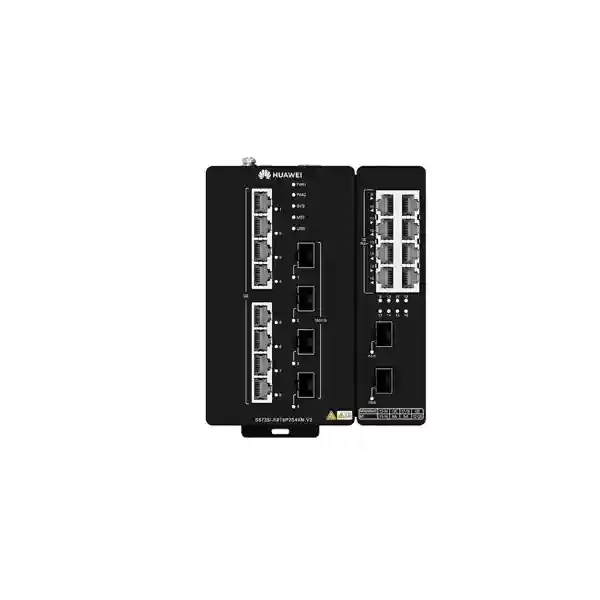
Industrial Gigabit Access • 10GE Uplinks • PoE+ • Layer 3
Huawei CloudEngine S5735I-S8T8P2S4XN-V2 UAE
A rugged DIN-rail industrial switch for high-availability edge networks where copper access, PoE-powered field devices, fiber aggregation, security, routing and environmental resilience must coexist in one compact platform.
Choose this model when the design requires 16 Gigabit copper ports with 8 PoE+ ports, 2 GE SFP, 4 x 10GE SFP+ uplinks, fanless industrial operation, dual-power backup capability, MACsec and advanced Layer 2/Layer 3 services in a DIN-rail form factor.
What the S5735I-S8T8P2S4XN-V2 is designed to do
The Huawei CloudEngine S5735I-S8T8P2S4XN-V2 belongs to Huawei’s CloudEngine S5735I-S-V2 family of industrial switches. Its role is not simply to provide Ethernet ports in a harsher enclosure. It is designed to operate as an intelligent industrial access or light aggregation node where conventional enterprise switching functions must be combined with wide-temperature tolerance, DIN-rail mounting, redundant power options, deterministic edge connectivity and practical integration with cameras, wireless access points, industrial controllers and remote field equipment.
For UAE deployments, that combination matters because network cabinets may be located in factories, warehouses, transport facilities, utility compounds, security zones, roadside infrastructure or semi-conditioned technical spaces. The switch can provide local Gigabit copper access, deliver PoE+ to selected endpoints, aggregate traffic over fiber at up to 10 Gigabit per uplink, participate in dynamic Layer 3 routing and use security functions such as 802.1X, DHCP snooping, ARP protection and MACsec. This gives designers a platform that can sit much closer to operational equipment while still supporting the management, segmentation and resiliency expected from an enterprise campus architecture.
Sixteen 10/100/1000BASE-T interfaces provide local device connectivity, with eight of those ports supporting PoE+ for powered endpoints.
Two Gigabit SFP interfaces can serve dedicated fiber access, resilient edge links or service separation where 1GE optics are appropriate.
Four 10GE SFP+ interfaces support high-capacity uplinks, redundant aggregation paths and bandwidth headroom for video or converged industrial traffic.
Huawei specifies 87 Mpps forwarding performance, with 116 Gbps device switching capability and 520 Gbps system switching capability.
Port architecture: why the mixed interface layout is useful
The interface mix is one of the strongest reasons to specify this exact model rather than a simpler industrial switch. The sixteen copper Gigabit ports support dense local attachment without forcing the designer to deploy an extra access device. Eight of these copper ports are PoE+ capable, so devices such as cameras, access points, video terminals and selected industrial IP endpoints can receive both data and power from the switch. The remaining copper ports can be reserved for non-PoE endpoints, uplinks to local panels, engineering workstations, HMIs or controllers where remote power is not required.
The two GE SFP interfaces add another design layer. They are useful when a site has legacy 1 Gigabit fiber runs, dedicated fiber links to remote panels or a requirement to separate a lower-speed service from the 10 Gigabit aggregation plane. The four 10GE SFP+ interfaces provide the capacity needed for modern uplink design. A pair can be used for resilient aggregation while remaining ports can support an additional path, a ring, a service handoff or stack-related connectivity depending on the approved software design.
This distribution of copper, 1GE fiber and 10GE fiber means the switch can bridge field-level access and aggregation roles. It can collect many lower-bandwidth device flows while avoiding an uplink bottleneck. That is especially relevant for surveillance and operational technology networks, where individual endpoints may not need high throughput but the aggregate video, telemetry, control and management traffic can become substantial.
PoE+ engineering: power the right endpoints, not just the right number of ports
The S5735I-S8T8P2S4XN-V2 provides eight PoE+ capable copper interfaces. Huawei’s published power configuration information shows that with one PAC240S56-CN power module the available PoE power is 200 W, which can support eight IEEE 802.3af devices at 15.4 W each or six IEEE 802.3at devices at 30 W each. With two PAC240S56-CN power modules, the published available PoE power rises to 240 W, allowing eight 802.3af or eight 802.3at ports to be fully loaded. Huawei also documents external 56 V DC options with up to 240 W PoE availability for this model.
A correct design should therefore be based on endpoint power classes and real consumption, not only port count. Eight PoE ports do not automatically mean every connected device can draw the maximum 30 W simultaneously under every power configuration. During quotation, the network bill of materials should identify each powered device, its maximum draw, expected cable distance, startup behavior and whether future replacement models may require higher power. The switch’s PoE budget should then include operational margin rather than being sized to an exact arithmetic total.
Huawei also documents Fast PoE and Perpetual PoE functionality in this switch family. Fast PoE can begin supplying power to powered devices shortly after switch power is restored, while Perpetual PoE is intended to maintain powered-device supply through certain switch reboot or software upgrade events. In surveillance and wireless deployments this can help reduce endpoint downtime, although the exact software release and feature behavior should always be validated against the release selected for the project.
10GE uplinks and oversubscription planning
Four 10GE SFP+ interfaces give the S5735I-S8T8P2S4XN-V2 considerably more uplink flexibility than an industrial switch limited to 1GE fiber. They can be used for a dual-homed design toward aggregation switches, for an Ethernet ring, for segmented uplinks to different network zones, or for additional fiber capacity where the access traffic profile demands it. The correct topology depends on failure-domain boundaries, Layer 2 or Layer 3 design, optical distances and the operational model of the site.
In practical sizing, calculate traffic in bursts rather than relying only on average utilization. A set of IP cameras may operate at modest average bit rates but produce bursts during high-motion scenes, firmware updates, playback, analytics or multicast replication. Wireless traffic may also be highly variable. Industrial data streams are usually smaller, but their latency and loss tolerance can be more critical. By separating service classes with VLANs and QoS while retaining high-capacity uplinks, the switch can keep operational traffic predictable even when other traffic types grow.
When two or more SFP+ uplinks are aggregated with LACP, the aggregate improves total throughput and link resiliency, but a single flow is still constrained by the hashing behavior of the bundle. Designers should therefore size the network with an understanding of flow distribution rather than assuming that a multi-link LAG behaves like one monolithic pipe for every session.
Industrial mechanical design and DIN-rail deployment
Huawei lists dimensions of 150 mm x 127 mm x 133 mm for the S5735I-S8T8P2S4XN-V2 and a chassis weight including packaging of approximately 3.07 kg. The DIN-rail format is intended for industrial cabinets and distributed technical enclosures rather than conventional office rack rows. This can reduce the need for a separate 19-inch rack in control cabinets, roadside cabinets, production areas and field facilities where DIN mounting is the normal mechanical standard.
Mechanical fit should still be checked as carefully as electrical fit. Allow clearance for fiber bend radius, copper patching, power modules, DC conductors, grounding, ventilation and technician access. Because this model is fanless and relies on natural heat dissipation, cabinet thermal design is part of the network design. A densely packed cabinet with hot power supplies and little airflow can create a very different operating environment from an open laboratory bench.
For UAE projects, enclosure selection should also account for dust, solar loading, ambient temperature, humidity, location exposure and the heat generated by PoE-powered endpoints and power conversion equipment. The switch’s industrial environmental rating does not eliminate the need for a correctly engineered cabinet. Instead, it gives the designer a more tolerant switching platform around which a complete thermal and electrical solution can be built.
Fanless cooling
Huawei specifies natural heat dissipation and no fan modules for this model. Fanless operation removes a common moving component and avoids fan noise, but places greater importance on cabinet airflow, spacing and ambient temperature management.
Wide environmental range
With industrial optical modules, Huawei publishes long-term operating ranges that vary by cabinet airflow: up to +60°C in a sealed cabinet, +70°C with specified ventilation and +75°C with stronger airflow at supported altitude conditions.
Power architecture and 1+1 backup
The S5735I-S8T8P2S4XN-V2 can use an external 240 W AC power adapter or direct external DC power, and Huawei specifies 1:1 hot backup capability for the power supply arrangement. The DC input for this PoE model is based on 56 V operation, with the documented maximum range including 54 to 57 V DC for PoE or PoE+ operation and 48 V DC for PoE operation. Maximum input current is listed at 5 A.
Redundant power is valuable only when the upstream feeds are genuinely independent. For a higher-availability design, the two supply paths should be evaluated from source to switch: separate breakers or distribution channels, independent DC sources where required, suitable surge protection, correctly sized conductors and a grounding scheme that matches the site electrical standard. Connecting two adapters to the same unprotected source provides component redundancy but does not eliminate a common upstream failure.
For industrial and surveillance deployments, power planning should also consider the effect of PoE load on the overall system. A switch drawing modest power without endpoints can become part of a much larger electrical load when eight powered devices are active. UPS sizing, DC plant capacity and backup runtime must therefore include both the switch electronics and the powered-device budget. This is particularly important when the network is expected to sustain cameras, wireless coverage or operational devices through a utility interruption.
Thermal performance for UAE cabinets
Huawei lists typical power consumption of approximately 23.2 W for the S5735I-S8T8P2S4XN-V2 and maximum device power consumption of 29.3 W without powered devices; when powered devices are present, the maximum PD power component can reach 240 W according to the documented configuration. The published maximum heat dissipation for the switch electronics without PDs is 79.16 BTU/hour, while powered devices can add a much larger thermal contribution outside the switch depending on where those endpoints are located.
The distinction between electrical power and cabinet heat is important. PoE power delivered down Ethernet cabling largely becomes heat at the remote endpoint, while losses in the supply and switch contribute locally. In outdoor or plant-floor cabinets, direct solar gain, adjacent power supplies and other automation equipment can dominate the internal thermal budget. Designers should therefore evaluate worst-case internal temperature rather than using outdoor ambient temperature alone.
For industrial optical modules at 0 to 1800 m altitude, Huawei documents long-term operation down to -40°C and upper limits that depend on enclosure airflow: +60°C in a sealed cabinet, +70°C in a vented cabinet meeting the required airflow and +75°C in a blower-equipped cabinet meeting the stronger airflow requirement. The optical transceiver type also matters, because temperature limits can differ with non-industrial or PEN optical modules. Optics should be treated as part of the environmental system, not as interchangeable accessories.
Layer 2 scale and segmentation
Huawei documents a 32K MAC address table, support for 4K simultaneous VLANs and up to 1K VLANif interfaces for the S5735I-S-V2 family. The platform supports conventional VLAN segmentation as well as functions such as Sub-VLAN, Super-VLAN, MUX VLAN, Voice VLAN, QinQ, enhanced selective QinQ, VLAN stacking and VLAN mapping. These capabilities allow the switch to serve more sophisticated industrial and campus segmentation designs than a basic unmanaged or web-smart industrial switch.
In an operational technology environment, VLANs can separate cameras, access points, controllers, building-management devices, engineering workstations, voice endpoints and management interfaces. The objective is not merely to create many VLAN IDs. A good segmentation plan aligns VLANs with trust boundaries, routing policy, firewall inspection, broadcast containment and troubleshooting. Where services must cross zones, inter-VLAN routing and security policy should be placed at a clearly defined control point.
QinQ and VLAN mapping may be useful in larger estates, managed service designs or facilities that need to transport customer or site VLANs across a shared infrastructure. These features should be applied with disciplined documentation because tag manipulation can complicate packet tracing. For typical enterprise access deployments, straightforward VLAN segmentation, a clear native VLAN policy and strict management-plane separation are usually easier to operate and audit.
Layer 3 routing at the industrial edge
The S5735I-S-V2 family supports static routes and dynamic routing protocols including RIPv1/v2, RIPng, OSPF, OSPFv3, IS-IS, IS-ISv6, BGP, BGP4+, ECMP, VRRP and VRRP6. Huawei lists up to 8192 IPv4 FIB entries and up to 3072 IPv6 FIB entries for the platform. This means the S5735I-S8T8P2S4XN-V2 can participate in a routed access or aggregation architecture instead of being restricted to Layer 2 extension.
Routed edge designs can reduce broadcast domains, contain faults and simplify the use of redundant links. OSPF is often suitable for enterprise or industrial campus routing, while BGP may be appropriate when the switch connects to larger routed domains with explicit policy requirements. VRRP can provide gateway redundancy when two devices share a virtual default-gateway role. ECMP can be used where multiple equal-cost paths are desirable and supported by the overall topology.
The presence of these protocols should not encourage unnecessary complexity. The protocol choice should follow the site’s scale, operational skill set and failure-recovery requirements. A compact facility may need only static routing and VRRP; a multi-building industrial campus may benefit from OSPF; a large service-provider-connected estate may require BGP. The platform provides options, but the best design is the simplest one that still meets resilience, convergence and policy requirements.
Resilience: ERPS, STP, Smart Link, BFD and link aggregation
Huawei documents STP, RSTP and MSTP, Smart Link, Smart Ethernet Protection, ERPS based on ITU-T G.8032, LACP, VRRP and BFD within the S5735I-S-V2 feature set. ERPS is designed for fast protection in Ethernet ring topologies, and Huawei states a 10 ms protection switching capability for the implementation described in the datasheet. This is particularly relevant to industrial sites where switches may be arranged physically in a ring across production areas, road infrastructure or utility locations.
Link aggregation with LACP can combine parallel uplinks and provide link-level redundancy. BFD can accelerate failure detection for supported routed designs, helping routing protocols react faster than they might through ordinary timers. VRRP can provide redundant default gateways. These mechanisms address different failure types, so they should be combined intentionally rather than treated as interchangeable features.
A resilient design must also avoid creating hidden common points of failure. Two fiber uplinks routed through the same duct are vulnerable to one cable cut. Two aggregation switches powered by the same PDU may fail together. A ring with both directions sharing one physical pathway does not provide true route diversity. The S5735I-S8T8P2S4XN-V2 has the protocol tools to support strong availability, but site-level resilience comes from the full topology, power system, fiber routing and operational procedures.
Security controls and MACsec
Security is a major differentiator for this model. Huawei specifically documents MACsec support on all downlink and uplink ports of the S5735I-S8T8P2S4XN-V2. MACsec protects Ethernet frames using link-layer authentication, encryption, integrity checking and replay protection. It can be valuable where traffic must traverse exposed fiber or copper segments, shared pathways or infrastructure in which the physical layer should not automatically be trusted.
The wider security set includes 802.1X authentication, MAC address authentication, AAA, RADIUS, HWTACACS, port security, sticky MAC, port isolation, blackhole MAC entries, limits on learned MAC addresses, DHCP snooping, IP/MAC/port/VLAN binding, ARP attack defense, ICMP attack defense and mechanisms against multiple denial-of-service patterns. SSH v2 and HTTPS are supported for protected management access. CPU defense, blacklists and whitelists add further control around traffic reaching the control plane.
These features should be implemented as part of an access-control architecture. For example, 802.1X can authenticate managed endpoints, MAC authentication can handle selected devices that cannot run a supplicant, DHCP snooping can establish trusted bindings, and access control lists can restrict traffic between device classes. MACsec then protects selected Ethernet links. Strong security comes from combining identity, segmentation, policy and monitoring rather than relying on any single switch feature.
QoS for converged video, voice and operational traffic
The switch family supports port-based rate limiting, traffic policing, traffic shaping, packet redirection, eight queues per port and scheduling methods including DRR, SP and DRR+SP. It can remark 802.1p and DSCP priority values and filter traffic from Layer 2 through Layer 4 using fields such as MAC addresses, IP addresses, TCP or UDP ports, protocol type and VLAN ID.
These capabilities allow the same physical switch to transport multiple traffic classes without treating them identically. Industrial control messages may be low bandwidth but latency-sensitive. Voice needs low delay and jitter. Camera video can be high bandwidth and bursty. Backup, software distribution and general data traffic can often tolerate lower priority. A QoS policy can classify these services and protect the traffic that matters most when congestion occurs.
QoS should be designed end-to-end. Marking a packet on one switch provides little benefit if the rest of the path ignores or rewrites the mark. The trust boundary should be explicit, especially because endpoint-generated DSCP values cannot always be trusted. In many networks, classification at the access edge, controlled remarking and consistent queue policy toward the aggregation layer provide a predictable approach. FourTeck can align the switch configuration with wider UAE IT services and network-operational requirements rather than treating QoS as an isolated checkbox.
Multicast for surveillance and industrial distribution
Huawei lists PIM-DM, PIM-SM, PIM-SSM, PIMv6, IGMP v1/v2/v3, IGMP snooping, IGMP fast leave, multicast VLAN, port-level multicast traffic statistics and multicast load balancing across trunk member ports. This feature depth matters in networks that distribute video or other one-to-many streams. Without multicast control, high-volume multicast can be flooded unnecessarily, consuming access bandwidth and endpoint resources.
IGMP snooping allows the switch to learn which ports have receivers for a multicast group and forward that stream only where it is required. PIM enables multicast routing across Layer 3 boundaries when the network architecture calls for it. SSM can simplify source-specific distribution in applications where receivers should subscribe to a known source and group combination.
For CCTV, multicast may be useful when multiple operators, recorders or analytics systems need to consume the same feed. For industrial environments, multicast can appear in control protocols, synchronization or replicated telemetry. The design must verify application behavior because not every video system uses multicast and not every industrial protocol should be forwarded broadly. Correctly scoped multicast boundaries reduce noise and make troubleshooting easier.
Industrial protocol forwarding and time-sensitive infrastructure
Huawei lists forwarding support for mainstream industrial protocols including PROFINET RT, EtherNet/IP, Modbus TCP, OPC UA and GOOSE. The platform also includes IEEE 1588v2 transparent-clock functionality in its published feature set. These capabilities make the switch relevant to mixed IT/OT designs where Ethernet transports both enterprise services and industrial communications.
Protocol support does not mean every industrial system can be connected without engineering. PROFINET, GOOSE and other operational protocols can have strict requirements around topology, timing, multicast handling, VLANs, redundancy and certification. The control-system vendor’s design rules should therefore be reviewed alongside the switch feature set. Where deterministic behavior or protocol-specific certification is required, the exact software release and interoperability status should be confirmed before implementation.
The advantage of using an enterprise-capable industrial switch is that OT traffic can be handled while still benefiting from modern segmentation, authentication, telemetry and routing. A plant network can therefore avoid the false choice between rugged hardware and enterprise manageability. The switch becomes an edge platform that can integrate with broader operational standards while maintaining a consistent network-management model.
IPv6 readiness
The S5735I-S-V2 series supports IPv4/IPv6 dual stack as well as routing protocols including RIPng, OSPFv3, IS-ISv6 and BGP4+. Huawei documents up to 3072 IPv6 forwarding entries and up to 3072 neighbor-discovery entries, plus functions such as Path MTU discovery, IPv6 ping and IPv6 traceroute. DHCPv6 client and relay functions and ND snooping are also included in the published feature set.
For organizations beginning IPv6 adoption, dual stack allows gradual migration rather than a disruptive forklift change. Management networks, new application segments or selected device classes can be introduced with IPv6 while existing IPv4 services continue. The routing and security policy should be designed for both protocol families from the beginning; enabling IPv6 without equivalent ACL, monitoring and authentication policy can create blind spots.
Industrial environments often retain devices for long lifecycles, so IPv6 transition can take years. A switch that can operate in pure IPv4, pure IPv6 or dual-stack environments provides more flexibility for future network evolution and reduces the risk that the access layer becomes the limiting factor in an eventual migration.
Management, telemetry and operational visibility
The published management feature set includes SNMP v1/v2c/v3, CLI, SSH v2, web-based management, RMON, system logs, multiple log hosts, traffic statistics, sFlow, NQA, telemetry, NETCONF/YANG cloud management, virtual cable testing, network quality analysis and WebMaster management. Huawei also documents integration with CampusInsight for telemetry-driven analysis and with cloud management for remote configuration, monitoring and inspection.
For operations teams, this provides multiple ways to manage the switch according to the environment. A highly controlled industrial network may rely on local CLI, SNMPv3 and an on-premises NMS. A distributed branch or city infrastructure project may value cloud-based management. Telemetry and sFlow can improve visibility beyond simple up/down polling by exposing traffic patterns and performance data that help identify congestion or abnormal behavior.
Management-plane design should include dedicated management addressing, AAA, restricted source networks, encrypted protocols, centralized logging, NTP or PTP time consistency, configuration backup and software lifecycle control. The switch supports the mechanisms, but secure operations require policy around how those mechanisms are used. For organizations standardizing network operations across multiple sites, FourTeck’s UAE technology team can map device management into the wider monitoring and support model.
WebMaster, cloud management and zero-touch operations
Huawei’s WebMaster capability is an embedded local management approach that can discover topology, present network elements and alarms, guide service provisioning, perform batch upgrades and assist with device replacement and onboarding. Huawei also documents Easy Operation functions such as zero-touch deployment, USB-based deployment, batch configuration and remote upgrades. These functions are intended to reduce the manual workload of deploying and maintaining multiple switches.
In a distributed UAE estate, standardized deployment can be more valuable than raw hardware performance. A switch installed in a remote utility cabinet or industrial site may be expensive to revisit. Predefined templates, centralized logging, secure remote access and controlled software procedures can reduce truck rolls and configuration drift. When devices are replaced, consistent automation can also reduce the chance that a field replacement differs from the intended baseline.
The choice between local, controller-based and cloud management should reflect security policy, WAN reachability, support responsibilities and change-control requirements. Some operational networks intentionally avoid cloud dependencies; others benefit from centralized SaaS-style administration. The S5735I-S-V2 platform supports multiple management models so the device can be aligned with the organization’s governance rather than forcing one operating method.
OPS programmability and automation
Huawei documents Open Programmability System, or OPS, based on Python, for the S5735I-S-V2 family. OPS allows administrators to create scripts that automate operational tasks or respond to events. Used carefully, this can help standardize repetitive maintenance actions, collect local diagnostics or integrate the switch with an organization’s operational workflow.
Automation on a network device should be governed like any other production code. Scripts need version control, testing, rollback procedures, least-privilege access and clear ownership. A convenient script can become an operational risk if it makes uncontrolled configuration changes or behaves differently after a software upgrade. The best use cases are well-defined tasks with measurable benefits and predictable failure behavior.
For larger deployments, device-local automation can complement centralized network automation. NETCONF/YANG, controller integrations and external systems can manage fleet-wide intent, while OPS can handle selected local actions. The combination gives architects several options for reducing manual CLI work while retaining control over how and where automation executes.
Licensing and software planning
Huawei states that the S5735I-S-V2 supports both traditional feature-based licensing and Huawei IDN One Software licensing, also referred to as N1 mode. The N1 packages are structured around Basic, Foundation and Advanced levels, with basic Layer 2 and Layer 3 network functions at the base and additional network automation or intelligent O&M capabilities at higher levels.
Licensing should be decided at architecture stage rather than after hardware delivery. The network team should identify which functions are required on day one, which controller or analytics systems will be used, whether future expansion is expected and how software support will be maintained. A switch can have the necessary hardware capability but still require the appropriate license or software package for the intended operational workflow.
The exact license entitlement, term and software release should be confirmed in the quotation because vendor packaging can evolve. For this reason, FourTeck quotes should tie the hardware model, power option, optics, software package and support requirement to the actual project design rather than quoting the switch chassis in isolation.
iStack and logical switch design
Huawei documents intelligent stacking, or iStack, for the S5735I-S-V2 series. iStack combines multiple physical switches into one logical device to simplify management and improve redundancy. Member devices can use inter-device link aggregation and can be managed as a single logical system. Huawei notes that stacking is performed through electrical ports for this family and that DI/DO and RS485 interfaces are unavailable when switches operate as stack members.
A stack can make access expansion operationally simpler because additional ports and switching capacity can be added while administrators manage a common logical device. However, a stack also creates shared control dependencies and specific cabling requirements. The design should therefore compare stacking against independent switches using Layer 3 routing or link aggregation. In some industrial sites, independent failure domains are preferred; in others, a logical stack reduces operational complexity.
Software version is especially important because Huawei’s documentation notes version-related support for iStack. The release used in production should be validated before the feature is included in a final design. As with any stacking technology, upgrade procedures, member compatibility, split scenarios and recovery steps should be incorporated into the operating runbook.
Where this model fits in UAE networks
The S5735I-S8T8P2S4XN-V2 is best suited to sites that need more than a simple hardened access switch. Smart manufacturing environments can use it to connect controllers, HMIs, cameras, access points and local engineering stations while sending traffic over redundant 10GE fiber. Transportation infrastructure can use DIN-rail mounting, ring resilience and fiber uplinks to connect roadside, station or depot systems. Utility and energy sites can benefit from industrial protocol forwarding, wide-temperature operation and secure management.
In surveillance networks, eight PoE+ ports can support cameras while 10GE uplinks prevent a group of high-resolution streams from being constrained by a 1GE aggregation link. In warehouses and logistics facilities, the switch can power selected wireless APs or cameras while connecting scanners, controllers and automation devices on non-PoE ports. In building and campus infrastructure, it can be installed in plant rooms or remote enclosures where a rack-mount office switch is mechanically inconvenient.
Organizations planning a broader secure edge can combine the switch with firewalls, servers, wireless systems and monitoring services sourced through FourTeck. For security-gateway integration, see the Firewall Dubai resource. For wider regional projects spanning multiple countries, the FourTeck Africa network can support consistent architecture and procurement discussions.
Sizing methodology: how to decide whether this is the correct model
Start with endpoints. Count every copper device, identify which devices need PoE+, record expected power draw and leave spare capacity for growth. Do not use only today’s active port count. Industrial sites often add cameras, sensors, APs and control devices incrementally, and a design that starts at 100 percent port utilization has no room for operational change. Reserve ports for troubleshooting and future expansion where practical.
Next, model traffic. Estimate normal and peak traffic per endpoint, then aggregate by service. Video networks should consider codec, frame rate, resolution, event bursts and simultaneous viewing or recording. Wireless should account for user density and backhaul peaks. OT traffic should be evaluated for latency sensitivity and multicast behavior. Use this information to decide whether 10GE uplinks are required and how many should be active, protected or aggregated.
Then evaluate environmental and electrical constraints. Check cabinet size, expected internal temperature, airflow, dust, humidity, grounding, power-source voltage, redundancy and UPS runtime. Select industrial-rated optics suitable for the temperature and reach. Finally, define the software architecture: VLAN count, routing protocol, multicast, authentication, management, logging, automation and licensing. If these requirements align with the model’s capability, the S5735I-S8T8P2S4XN-V2 can be an efficient consolidated edge platform.
If the design needs substantially more PoE ports, PoE++ at higher per-port power, substantially higher uplink density or a conventional rack-mount form factor, another CloudEngine model may be more appropriate. Model selection should follow requirements rather than forcing the site to fit the switch.
Optics and fiber engineering
The four SFP+ interfaces and two GE SFP interfaces make optical selection an important part of the bill of materials. Choose transceivers by speed, wavelength, fiber type, connector, reach, temperature rating and compatibility. A 10GE SR design over multimode fiber is fundamentally different from a long-reach single-mode link. For industrial cabinets, transceiver temperature range can be as important as the switch temperature rating.
Fiber path loss should include connector losses, splice losses, patch panels and engineering margin. Do not design to the absolute edge of an optic’s power budget. Where links leave buildings or travel through outdoor ducts, review grounding and surge strategy around any copper segments and use fiber where electrical isolation is desirable. Fiber route diversity should be physical, not only logical.
Document every optic by port and remote peer so that replacement stock can be maintained. Mixing unknown third-party modules across a large industrial estate can create troubleshooting difficulty, especially after software upgrades. Standardizing a small set of approved optical types by distance class simplifies spares, training and field support.
Copper cabling and PoE distance considerations
For the 10/100/1000BASE-T ports, structured cabling quality affects both data reliability and PoE performance. Cable category, conductor material, bundle size, pathway temperature and termination quality influence voltage drop and heat. In UAE industrial environments, cable trays may pass near heat sources or through areas with elevated ambient temperature. Cabling should be selected for the actual installation environment rather than only for nominal Gigabit capability.
PoE links approaching the maximum Ethernet channel length deserve particular attention when powered devices draw substantial current. Poor terminations or undersized conductors increase loss and can cause intermittent device behavior that looks like a switch problem. Certification testing after installation is recommended for critical links, especially camera or wireless runs that are difficult to access later.
Where copper exits the building or crosses zones with differing earth potential, fiber may provide a safer and more resilient alternative. The S5735I-S8T8P2S4XN-V2’s fiber interfaces allow the design to keep local copper runs short while using optical uplinks between cabinets, buildings or remote infrastructure.
Example PoE budget calculation
Consider a cabinet with four fixed cameras drawing a maximum of 12 W each, two PTZ cameras drawing 25 W each and two industrial wireless access points drawing 22 W each. The endpoint maximum is 142 W. A one-module configuration with 200 W available PoE capacity would cover this calculated maximum with 58 W of headroom. That margin is useful for startup variation, replacement devices and engineering tolerance.
If all eight endpoints were instead 30 W devices, the theoretical load would be 240 W. Huawei’s published table shows one PAC240S56-CN module supporting only six ports at the full 30 W level, whereas the two-module configuration provides 240 W and supports all eight at 30 W. The power architecture therefore changes the practical endpoint capacity even though the physical switch still has eight PoE+ ports.
This calculation should be performed from maximum device data, not average dashboards. A camera may consume more power when heaters, IR illumination or motors operate. An AP may draw more under higher radio activity or with attached USB functions. Quotations should use the worst credible endpoint profile and preserve design margin.
Reference topology 1: resilient industrial access ring
A common industrial topology places several DIN-rail switches in cabinets around a production or transport environment and connects them with fiber in a ring. Each S5735I-S8T8P2S4XN-V2 can serve local copper and PoE endpoints while its SFP+ interfaces form the high-speed ring. ERPS can provide fast protection when one ring segment fails, subject to the finalized design and release support.
The ring should be engineered so that the two directions are physically diverse where possible. If both fibers share the same duct for the entire route, the logical ring may still be severed by one civil incident. Aggregation points should have redundant power and ideally reside in separate fault domains. Management traffic should be separated from endpoint traffic, and alarms should be forwarded centrally so that a protection event is visible even if user services remain online.
For sites carrying control protocols, camera traffic and office services over the same ring, VLAN and QoS policy should preserve service boundaries. Multicast snooping can prevent video floods, while Layer 3 boundaries can contain broadcast domains. The result is a resilient shared transport rather than a flat switched ring carrying every packet everywhere.
Reference topology 2: surveillance aggregation cabinet
In a surveillance cabinet, eight PoE+ ports can connect a group of fixed or PTZ cameras while non-PoE copper ports serve ancillary devices, access control equipment, local encoders or maintenance connections. Two or more 10GE SFP+ uplinks can connect to redundant aggregation switches or a core network, providing ample bandwidth for multiple high-resolution streams and future camera upgrades.
Camera VLANs should normally be isolated from user LANs. ACLs can limit camera communication to recorders, management platforms, NTP, DNS or other explicitly required services. DHCP snooping and source bindings can reduce the risk of unauthorized addressing behavior. If the uplink passes through an exposed segment, MACsec can add Layer 2 protection where the end-to-end design supports it.
PoE resilience is as important as network resilience. If continuous recording is required during power interruption, the upstream AC or DC source and UPS must be sized for switch plus camera load for the required runtime. Dual switch power inputs should be connected to appropriately independent sources where the site architecture supports this. This prevents a robust network topology from being undermined by a single electrical failure.
Reference topology 3: warehouse wireless and automation edge
Warehouses often combine wireless access points, cameras, scanners, conveyor controls, sensors and building systems in large spaces where traditional office switching is inconvenient. The S5735I-S8T8P2S4XN-V2 can be installed in a distributed DIN-rail cabinet, power selected APs and cameras, connect automation devices on non-PoE ports and return traffic over 10GE fiber to the building distribution layer.
Wireless APs should be sized by actual power requirement and expected Ethernet throughput. If an AP uses more than 1 Gigabit of client capacity, note that the copper access ports on this model are Gigabit, so the access link itself becomes the per-AP ceiling. The switch is therefore suitable for many standard Wi-Fi deployments but should not be selected for multigigabit APs that require 2.5GE or 5GE access unless the AP can operate within 1GE constraints.
Automation endpoints can be placed in separate VLANs and routed through industrial firewalls or Layer 3 policy points. QoS can protect control traffic from large file transfers or wireless bursts. Central telemetry and logging can help operations teams distinguish physical-link issues from endpoint or application problems across a large facility.
UAE environmental and procurement considerations
Industrial networking in the UAE should account for high ambient temperatures, dust, direct solar loading, long outdoor fiber runs and the availability of suitable spares. A wide-temperature switch improves tolerance, but site cabinets still need environmental engineering. Outdoor enclosures may require shading, insulation, ventilation or active cooling depending on location and internal heat load. Dust filters and maintenance schedules may be necessary where airflow is used.
Procurement should include more than the base switch. Confirm the required power modules or DC feed arrangement, mounting accessories, optics, fiber patch cords, copper patching, surge protection, grounding hardware, licensing and support. If the switch is part of a critical system, keep appropriate cold spares and replacement optics locally. The fastest network repair often depends on having the correct transceiver or power component on hand rather than waiting for international shipment.
For UAE projects, FourTeck can structure the bill of materials around the actual topology and site constraints instead of quoting the chassis alone. This reduces the risk of receiving a capable switch without the power, optics or license needed to deploy it.
Software release and feature validation
Huawei’s product family evolves through software releases, and some functions are tied to minimum versions or specific license packages. iStack support is one documented example with release dependency. For production design, the target release should be selected before configuration templates are finalized. This allows the project team to validate routing, security, telemetry, stacking, industrial protocol and management features against one known software baseline.
Change control should also include upgrade sequencing. In a redundant ring or dual-homed site, upgrades can often be staged to preserve service, but only when the topology, protocol timers and endpoint dependencies are understood. Pre-upgrade checks should include configuration backup, hardware health, flash capacity, license status, transceiver compatibility and rollback readiness. Post-upgrade validation should verify routing adjacencies, PoE state, VLANs, security sessions, multicast and management visibility.
A standardized release across multiple sites simplifies support and troubleshooting. Exceptions should be documented with a clear business or technical reason. This is especially useful in regional deployments where many remote cabinets may otherwise drift into different feature behavior over time.
Performance interpretation: 87 Mpps and 116 Gbps
Huawei specifies 87 million packets per second forwarding performance and 116 Gbps device switching capability for the S5735I-S8T8P2S4XN-V2. The datasheet also states 520 Gbps system switching capability, distinguishing the device value from the wider system capability figure. These numbers indicate that the platform is engineered to forward traffic at rates consistent with its interface mix, but real network performance still depends on packet sizes, services enabled and topology.
For most access deployments, packet rate is more relevant than raw bandwidth when there are many small packets, such as control messages, voice or some telemetry workloads. Video and file traffic often use larger packets and are more bandwidth-oriented. A balanced design considers both. The switch also lists forwarding latency below 4 microseconds in the product feature table, which is useful for low-latency edge switching, although end-to-end application latency will include many other elements.
Performance sizing should leave headroom for failure conditions. If a redundant link fails, traffic may shift to the surviving path. A design operating every uplink near saturation during normal conditions has little resilience when a path is lost. Capacity planning should therefore test degraded modes, not just healthy-state utilization.
Security hardening checklist for deployment
Begin by placing management on a dedicated VLAN or routed management network. Disable or restrict unused management services, use SSH and HTTPS instead of clear-text protocols, deploy SNMPv3 where monitoring supports it and integrate administrator access with AAA. Restrict management-plane source addresses with ACLs and send logs to centralized collectors. Use NTP or PTP as appropriate so security events have consistent timestamps.
On access ports, disable unused interfaces or place them in a quarantined VLAN. Apply 802.1X where endpoints support it and MAC authentication where a controlled exception is required. Enable DHCP snooping and source-binding protections in networks that use DHCP. Use port security or MAC limits to reduce unauthorized downstream switching. Apply BPDU protection on edge ports when appropriate so an accidental switch connection cannot easily alter spanning-tree behavior.
For uplinks, use explicit trunk allow-lists rather than permitting every VLAN by default. Deploy MACsec where the threat model and peer support justify link-layer encryption. Maintain secure configuration backups and document local recovery procedures. Security features should be introduced through tested templates so that protection does not unintentionally block required industrial or surveillance traffic.
Operations and maintenance checklist
After installation, establish a baseline for CPU, memory, interface errors, optical power, temperature, PoE consumption and uplink utilization. Baselines make it easier to distinguish a real degradation from normal site behavior. Monitor CRC errors and link flaps on copper ports, optical receive power on fiber ports, PoE overload events and changes in MAC-address population.
For fanless equipment, maintenance focuses less on fan replacement and more on cabinet condition. Inspect vents, filters, cable routing, grounding and signs of dust accumulation. Verify that cooling assumptions remain valid after other equipment is added to the cabinet. Outdoor enclosures can change thermally as site construction, shading or nearby heat sources change.
Maintain current diagrams showing port assignments, VLANs, uplinks, fiber paths, power feeds and endpoint types. Keep a tested restore procedure and local console access plan. A technically capable switch delivers the most value when its configuration and physical connections are documented well enough that another engineer can troubleshoot the site without relying on tribal knowledge.
Frequently asked questions
How many PoE ports does it have?
Eight of the sixteen Gigabit copper ports support PoE+. The usable total PoE budget depends on the selected power configuration, so endpoint wattage must be checked as part of the design.
Does it support 10 Gigabit fiber?
Yes. The model includes four 10GE SFP+ interfaces in addition to two GE SFP ports. This supports resilient high-speed fiber uplinks and mixed 1GE/10GE optical designs.
Is it fanless?
Yes. Huawei specifies natural heat dissipation and zero fan modules. Cabinet airflow and ambient temperature still need to be engineered according to the published environmental limits.
Does it support dynamic routing?
Yes. The platform supports protocols including OSPF, OSPFv3, IS-IS, BGP, BGP4+, RIP, RIPng and VRRP as well as static routing and ECMP.
Does it support MACsec?
Yes. Huawei specifically lists MACsec on all downlink and uplink ports for the S5735I-S8T8P2S4XN-V2, providing Ethernet-frame authentication, encryption, integrity and replay protection.
Can it be used outdoors?
It is an industrial switch with wide-temperature capability, but outdoor use requires a suitable enclosure, power design, environmental protection and industrial-rated optics. The cabinet remains part of the solution.
Can it form an Ethernet ring?
Yes. Huawei documents ERPS, SEP, STP/RSTP/MSTP and Smart Link functions. ERPS is particularly relevant for protected industrial ring topologies.
Is it suitable for CCTV?
Yes, when the camera count, PoE budget and uplink bandwidth align. Eight PoE+ ports, multicast functions and four 10GE uplinks make it a strong fit for distributed surveillance cabinets.
Decision recap
Select it when
You need a DIN-rail industrial Layer 3 switch with 16 Gigabit copper ports, eight PoE+ ports, mixed GE and 10GE fiber, fanless cooling, industrial temperature tolerance and strong security.
Validate first
Confirm PoE budget, power modules, optics, software release, license package, environmental conditions, industrial protocol requirements and whether 1GE access is sufficient for every endpoint.
Design around failures
Use redundant power paths, physically diverse fiber, protected topologies and monitoring so the availability of the complete site matches the resilience features built into the switch.
Operate consistently
Standardize management, AAA, logging, software versions, templates and spare components across sites so troubleshooting and replacement remain predictable.
Quotation input checklist
To quote the correct Huawei CloudEngine S5735I-S8T8P2S4XN-V2 solution for a UAE site, provide the information below. These inputs allow the switch, power, optics and software to be matched to the actual environment instead of producing an incomplete chassis-only quotation.
Number of devices, which ports need PoE+, maximum watts per endpoint, camera/AP model numbers and expected future additions.
1GE or 10GE, single-mode or multimode, required distance, connector type, number of redundant paths and expected optical environment.
AC or DC source, redundancy requirement, UPS runtime, available DC voltage, power-distribution standard and any requirement for dual independent feeds.
Indoor or outdoor cabinet, expected internal temperature, airflow, dust level, altitude, solar exposure and enclosure cooling approach.
VLANs, routing protocol, multicast, ring protection, MACsec, 802.1X, QoS, industrial protocols and required management integrations.
Preferred Huawei software release, licensing model, controller or cloud-management requirement, warranty/support term and spare strategy.
Plan the complete Huawei industrial switching solution
FourTeck can help translate site drawings, endpoint lists, PoE loads, fiber distances, resilience requirements and management standards into a deployable bill of materials for the S5735I-S8T8P2S4XN-V2. The objective is to deliver the correct switch, power arrangement, optics, software and support model for the UAE environment rather than treating the network device as an isolated line item.
Confirm endpoint count, PoE budget, power-source design, fiber type and distance, software features, license package and environmental conditions.

Reviews
There are no reviews yet.