
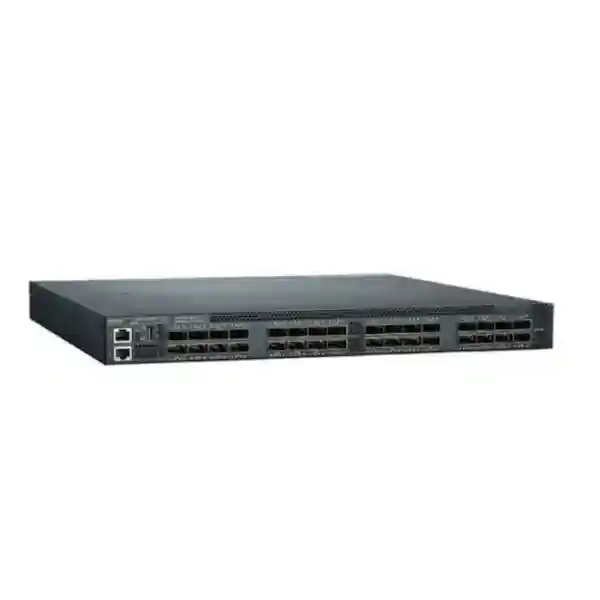
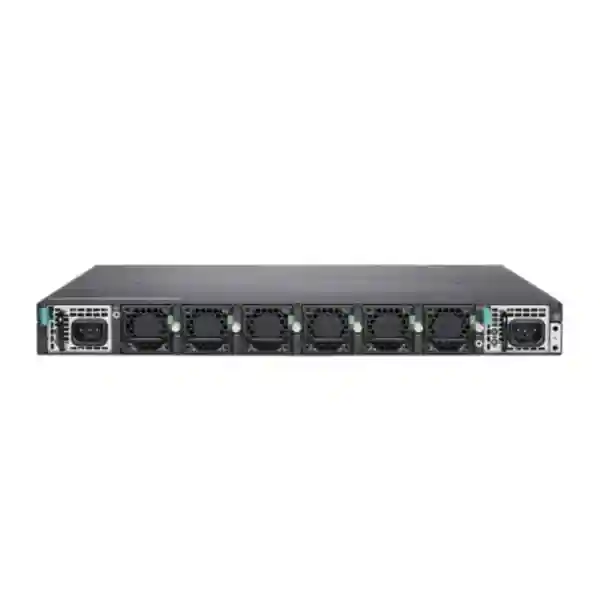
RUCKUS ICX 7850-32Q Core Switch
The RUCKUS ICX 7850-32Q is a high-end fixed-form-factor core and aggregation switch for organisations that need dense 40GbE and 100GbE connectivity without moving to a traditional modular chassis. The platform provides 32 QSFP28 ports, up to 6.4 Tbps switching capacity and a distributed stacking architecture that can scale to 12 switches. It is especially relevant when the design must carry heavy traffic between access layers, Wi-Fi infrastructure, servers, storage, campus buildings or data-centre resources while retaining a compact 1U footprint.
Direct answer for buyers
Choose the ICX 7850-32Q when your design specifically calls for a dense 40/100GbE core, high-speed aggregation, large breakout capacity or a stackable alternative to a chassis. Before ordering, confirm the exact switch bundle, power supplies, fans, airflow direction, QSFP28 optics or DAC/AOC cables, breakout requirements, software feature licences and support entitlement. The base model name alone is not a complete bill of materials.
What is the RUCKUS ICX 7850-32Q?
The RUCKUS ICX 7850-32Q is the 32-port 40/100GbE model in the ICX 7850 family. Its front-panel QSFP28 interfaces can operate at 40GbE or 100GbE, and compatible breakout assemblies can divide a port into four 10GbE or four 25GbE links. This gives architects flexibility to use the same platform for a compact 100GbE campus core, a high-density aggregation layer, server connectivity or a mixture of high-speed uplinks and lower-speed breakout connections. RUCKUS publishes a maximum switching capacity of 6.4 Tbps for the model and a forwarding capacity of 2.0 Bpps.
The platform also supports stacking, with up to 12 ICX 7850 switches in a stack and up to 9.6 Tbps aggregate stack bandwidth. RUCKUS positions the family as a distributed-chassis approach: capacity can be added in fixed 1U units and placed where it is operationally useful rather than forcing all ports into one large chassis. The design supports redundant power options, hot-swappable internal power supplies and fan assemblies, reversible airflow options and high-availability software functions. Exact resilience behaviour depends on software, topology and configuration, so the final design should be reviewed rather than inferred from a feature list.
For organisations evaluating core switching in the UAE, GCC or Africa, the most important purchasing question is not simply whether the switch has 32 ports. The more useful questions are what each port must run at, which optics and fibre plant are already installed, whether breakout is required, how many links are reserved for stacking, which routing features are needed, what redundancy model is expected and how the equipment will be powered and cooled. FourTeck can help convert those requirements into a clearer quotation request before the commercial order is placed.
QSFP28 ports
Native 40/100GbE ports, with supported breakout choices for 10/25GbE connectivity.
Switching capacity
Published maximum switching capacity for the ICX 7850-32Q platform.
Switches per stack
Scale a distributed switching architecture when the project requires additional ports or resiliency.
Fixed form factor
Compact rack footprint for high-density aggregation and core designs.
Verified technical highlights
| Item | RUCKUS ICX 7850-32Q | Buyer note |
|---|---|---|
| Core interfaces | 32 x QSFP28, native 40/100GbE | Optics, DAC/AOC and fibre type must match distance and peer interfaces. |
| Breakout | Up to 128 x 10/25GbE links | Confirm supported breakout cable or transceiver design for each target device. |
| Switching capacity | Up to 6.4 Tbps | Capacity figures are platform specifications; application performance depends on the full design. |
| Forwarding capacity | Up to 2.0 Bpps | Validate traffic profile, packet size and feature requirements during design. |
| Stacking | Up to 12 switches; up to 9.6 Tbps aggregate stack bandwidth | Up to eight ports can be used for stacking; topology and distance need planning. |
| Layer 3 | Static and dynamic routing capabilities including OSPF, BGP and VRF support | Some advanced Layer 3 capabilities require the appropriate software licence; confirm entitlement. |
| High availability | Redundant power option, hot-swappable power supplies and fans | Base and bundled SKUs may differ; verify exactly what is included. |
| Airflow | Front-to-back or back-to-front depending on installed components | Keep fan and PSU airflow direction consistent with rack cooling design. |
| Dimensions | 43.7 mm H x 440 mm W x 444.5 mm D | Check rack depth, cable bend radius and front/rear service clearance. |
| Weight | Approx. 9.1 kg in the vendor reference configuration | Final shipping weight varies with accessories and bundle contents. |
Where the ICX 7850-32Q fits
Campus core
Use the dense 100GbE interfaces to aggregate distribution or access blocks where large east-west and north-south traffic flows need a high-capacity backbone. Confirm routing, resiliency and failure-domain requirements before choosing a stack size.
Server or switch aggregation
Breakout capability can make the platform useful when many 10/25GbE server or downstream switch links must feed a smaller number of high-capacity core paths. Cable type, lane mapping and peer compatibility should be documented.
Distributed core growth
A stackable fixed-form-factor architecture can be attractive when the organisation wants to add capacity in stages. The design still requires disciplined stack-port allocation, power redundancy, fibre paths and operational change planning.
Procurement questions to answer before requesting price
A request for “RUCKUS ICX 7850-32Q price” is commercially useful only when the quotation can be matched to the actual deployment. Start by defining how many switch units are required, whether the design uses one switch or a stack, which ports operate at 100GbE or 40GbE, how many ports need 10/25GbE breakout, the link distances, fibre type, connector type and the equipment at the opposite end of each link. These details determine the optic, DAC, AOC or breakout components that must be quoted alongside the switch.
Next, confirm the power and cooling design. ICX 7850 systems support redundant power and hot-swappable components, but the ordered SKU and accessory bundle must be checked. Airflow is not a cosmetic choice: a front-to-back switch should be aligned with the cooling direction of the rack or row. If the switch is being installed in a shared data room or an existing cabinet, provide rack depth, available power feeds, PDU connector type and the intended redundancy approach.
Finally, document software and support expectations. Static routing may be sufficient in one environment while another project needs OSPF, BGP, VRF, VXLAN, MCT or a wider campus-fabric architecture. Advanced routing capability may depend on software licensing, and operational support should be aligned with the organisation’s change windows, software policy and escalation process. FourTeck can use a network diagram or bill of materials to clarify these dependencies. For UAE network planning, buyers can also review FourTeck UAE technology solutions and the verified FourTeck service catalogue when switching must be coordinated with routing, segmentation or security work.
RUCKUS ICX 7850-32Q Core Switch Dubai
Customers searching for the RUCKUS ICX 7850-32Q Core Switch Dubai are usually evaluating a high-capacity switching project rather than a simple access-switch replacement. A Dubai enterprise core can sit between many different systems: office floors, wireless access layers, server rooms, internet-edge firewalls, storage, branch links, voice platforms and cloud-connected services. The 32 QSFP28 ports are relevant when a design requires concentrated 40/100GbE connectivity, while breakout options can create many 10/25GbE links for aggregation. The correct design should begin with a port map showing which interfaces connect to distribution switches, servers, firewalls, storage or other core devices. This prevents the quotation from becoming a hardware-only proposal that omits optics or cabling.
For Dubai buyers, rack and cooling details deserve the same attention as port count. The ICX 7850-32Q is a 1U device, but dense high-speed fibre installations can consume considerable patching space and require disciplined cable management. Airflow direction should match the data-room layout, and redundant power planning should identify independent power feeds where the wider infrastructure supports them. If the switch replaces a chassis or older core, the change plan should include interface migration order, VLAN and routing verification, spanning-tree or fabric behaviour, management access, monitoring and rollback steps. High port speed does not remove the need for controlled migration.
Commercial enquiries should specify whether the requirement is supply only or includes configuration, migration, optics matching and post-change validation. Buyers should also identify software features such as OSPF, BGP, VRF, sFlow, VXLAN or Multi-Chassis Trunking that matter to the architecture, because feature entitlement and software design should be confirmed before the order. If the core connects directly or indirectly to the internet-security layer, FourTeck’s firewall deployment guidance for Dubai can help teams coordinate core-switch changes with gateway routing, VLANs and security policy instead of treating the two projects separately.
When requesting a Dubai quotation, include the number of ICX 7850-32Q units, preferred airflow direction, required power redundancy, quantity and type of QSFP28 optics, any breakout cables, fibre distances, stacking plan, software licence needs and support expectations. FourTeck can then structure the request around the full solution rather than a bare switch price. Current availability, delivery timing and warranty route should be confirmed at quotation stage because these are commercial variables, not fixed product specifications.
RUCKUS ICX 7850-32Q Core Switch UAE
A search for the RUCKUS ICX 7850-32Q Core Switch UAE often comes from organisations planning a campus refresh, new headquarters, data-centre aggregation, education network, hospitality environment or multi-building enterprise infrastructure. The switch is most useful where the design genuinely needs high-speed fibre density. It provides 32 native 40/100GbE QSFP28 ports and can use supported breakout connectivity for up to 128 10/25GbE links. Rather than selecting the unit simply because 100GbE sounds future-ready, UAE buyers should map expected traffic between access, distribution, servers, Wi-Fi, security systems and WAN or cloud edges. That traffic model determines whether the ICX 7850-32Q is correctly sized and how many high-speed ports must be reserved for uplinks, inter-switch links or stacking.
UAE projects frequently involve more than one supplier or technical team. A structured procurement pack should therefore identify demarcation points: who provides fibre, who supplies optics, who configures routing, who owns rack power, who manages the firewall, and who validates the finished migration. The switch supports a rich set of Layer 2 and Layer 3 features, but advanced routing capability can require the appropriate licence. If BGP, OSPF, VRF, VXLAN or MCT is part of the design, state that explicitly. Avoid assuming that a generic “ICX 7850” quotation includes every software entitlement, fan, power supply, transceiver and support component needed for production.
For UAE organisations standardising a wired and wireless RUCKUS environment, the broader ICX family can integrate with RUCKUS network-management approaches and Wi-Fi infrastructure. The architectural benefit comes from consistent operations, not from brand matching alone. Management reachability, firmware policy, configuration backup, monitoring, authentication, logging and change-control procedures should be agreed before go-live. Buyers can explore FourTeck UAE for wider business-network requirements and can use the perimeter firewall planning page when the new core must hand traffic to an edge-security platform.
A useful UAE quote request should list the exact deployment emirate, site type, rack details, required port speeds, link distances, fibre mode, peer equipment, quantity, redundancy model, stack design, software features and expected services. This information helps distinguish a simple hardware request from a complete network-core project. FourTeck can support product matching and quotation preparation, while actual stock, lead time, delivery options and service scope should be confirmed for the specific order.
RUCKUS ICX 7850-32Q Core Switch Uganda
Organisations researching the RUCKUS ICX 7850-32Q Core Switch Uganda may be planning a central campus, a service-provider-style aggregation point, a university or institutional network, a large commercial site, or a business that needs a resilient core for multiple buildings and high-bandwidth services. The important first step is to confirm that the project actually requires 40/100GbE density. The ICX 7850-32Q provides 32 QSFP28 ports, up to 6.4 Tbps switching capacity and breakout flexibility for 10/25GbE links. In a Ugandan project, that capability can be valuable where fibre links converge on one core and where access-layer growth would otherwise create an uplink bottleneck.
Infrastructure readiness should be reviewed carefully. High-speed switching depends on more than the switch chassis: fibre type, connector cleanliness, optic compatibility, distance, power quality, cooling and rack organisation all affect the finished result. If the site uses existing fibre, document whether links are single-mode or multimode and measure the actual path length rather than estimating from building locations. Where the core must remain available during local power events, the quotation should account for the wider UPS and generator strategy without assuming that switch-level redundant power alone solves facility power continuity. Airflow direction should also be selected to suit the rack layout.
For projects spanning multiple Ugandan sites, centralised design standards can reduce support complexity. Use consistent VLAN naming, IP addressing, routing policy, monitoring, admin authentication and configuration-backup procedures. The ICX 7850 platform supports stacking and advanced routing functions, but the final design should identify exactly which capabilities are required and whether licensing is needed. When asking for RUCKUS ICX 7850-32Q price in Uganda, include the switch quantity, optics, breakout assemblies, stack links, power components, software licences and support term. The FourTeck Uganda technology site provides a regional route for networking enquiries and project discussions.
Procurement teams should also state the final delivery location and whether the project needs configuration assistance, migration planning or remote validation. Availability and delivery conditions can vary by product bundle and project size, so they should be confirmed rather than published as fixed promises. FourTeck can help convert a network diagram and performance requirement into a bill-of-material discussion that is more useful than ordering the switch first and discovering missing optics or licences later.
RUCKUS ICX 7850-32Q Core Switch Kampala
A Kampala buyer looking for the RUCKUS ICX 7850-32Q Core Switch is usually dealing with a network that has outgrown ordinary Gigabit or 10GbE aggregation, or is planning a new high-capacity core from the start. Kampala deployments can include headquarters, campuses, data rooms, hotels, healthcare and education sites, technology businesses or multi-tenant commercial environments, but the correct design should be driven by measured traffic and topology rather than sector labels. The ICX 7850-32Q is appropriate when many high-speed links must converge in a compact rack footprint, particularly where 40/100GbE core links and 10/25GbE breakout are both needed.
For a city-based core, physical-layer planning is often the fastest way to avoid expensive mistakes. List every building or rack that connects to the core, record the fibre path and distance, identify current transceiver types, and note the expected speed after migration. If the project uses breakout, document the lane mapping so the operations team knows which logical interfaces correspond to the physical QSFP28 port. In dense racks, reserve space for fibre management and make sure patch leads do not obstruct fan exhaust or service access. The 1U form factor saves vertical space, but high port density increases the importance of neat patching.
Operational design matters just as much. Define whether the Kampala core will run as a single switch, redundant pair or stack, and identify which devices remain reachable during maintenance or failure. Routing protocols, VRFs, VLAN boundaries, monitoring and management access should be documented before cutover. If the core integrates with internet-edge security, the FourTeck firewall solution portal provides related guidance on gateways and segmentation, while FourTeck Uganda provides a region-focused route for networking requirements.
A strong Kampala quotation request therefore includes more than “one ICX 7850-32Q.” It should identify quantity, port-speed plan, fibre media, optics, breakout cables, stack requirements, airflow, power-supply configuration, software features and support expectations. Where an existing core is being replaced, include the current model and a basic topology. FourTeck can then help prepare a more complete commercial discussion, with availability and service scope confirmed for the specific project rather than assumed from online product information.
RUCKUS ICX 7850-32Q Core Switch Arua
For buyers searching for the RUCKUS ICX 7850-32Q Core Switch Arua, the procurement challenge may be less about raw port density and more about building a reliable core that is practical to support at the final site. The switch offers the same 32 native 40/100GbE QSFP28 interfaces and high-capacity stacking architecture available elsewhere, but a good Arua deployment should start by testing whether those capabilities match the actual traffic. If the environment mainly uses Gigabit access switches with modest uplinks, a smaller aggregation design may be more appropriate. If several fibre-fed buildings, servers or high-speed distribution switches converge at one site, the ICX 7850-32Q can provide substantial headroom.
Supportability should influence the bill of materials. High-speed optics are not interchangeable simply because connectors look similar, and replacement planning is easier when every optic, breakout assembly and fibre type is recorded. Where the site depends on long-distance single-mode fibre, specify distances and target speeds explicitly. Where shorter data-room links use DAC or AOC assemblies, verify compatible length and port mode. It is also sensible to identify which components are operational spares and which are installed from day one. This is not a claim that spare stock is automatically available locally; it is a design decision that the buyer can include in the quotation request.
Arua deployments that are part of a wider Ugandan organisation should follow the same management and security standards as Kampala or other locations. Use consistent firmware policy, administrator access, logging, NTP, monitoring and backup procedures, then adapt interface and routing details to the local topology. If the core connects to branch WANs or internet security, define that handoff so the routing and firewall teams agree on gateway responsibilities. Buyers can use FourTeck Uganda to discuss the location, quantity and network role with regional context.
When asking for an Arua price or availability check, provide the exact delivery destination, desired quantity, power and airflow choice, optics list, breakout requirements, software licence needs and whether the order is for a new installation or replacement. If the project includes a migration, include the existing topology and acceptable maintenance window so services can be scoped separately from hardware. Current availability, transit arrangements and warranty handling should be confirmed in the formal quotation because they vary with order conditions.
RUCKUS ICX 7850-32Q Core Switch Mbarara
The RUCKUS ICX 7850-32Q Core Switch Mbarara search is most relevant for organisations that need a central high-speed switching layer and want to understand whether a 100GbE-capable platform is justified. A campus, institution, hospital, enterprise facility or growing multi-building organisation may generate very different traffic patterns, so the first design task is to estimate what actually crosses the core. Wireless backhaul, server access, backups, video, storage, virtualisation and inter-VLAN traffic can all increase aggregation demand. The ICX 7850-32Q provides 32 40/100GbE QSFP28 ports and supports breakout to 10/25GbE, allowing one platform to serve several types of high-speed connection.
For Mbarara projects, the physical network should be treated as part of the core-switch purchase. Verify rack space and depth, cooling direction, UPS capacity, earth and power arrangements, fibre trays, patch panels and link distances. High-speed optical errors can be caused by dirty connectors, incompatible optics or poor fibre paths, so migration testing should include both link establishment and error monitoring. If the switch is installed as part of a stack, reserve and document the ports used for stacking before allocating production links. If redundant paths are planned, diagram them clearly so a single fibre cut or maintenance event does not unexpectedly isolate the site.
Software planning should be equally explicit. The platform supports Layer 3 routing and features such as VRF, BGP, OSPF, VXLAN and MCT, but advanced routing may require the appropriate licence. The design should therefore distinguish required features from optional future possibilities. This avoids paying for unnecessary components or discovering a licence requirement during commissioning. FourTeck Uganda can be used for a regional networking enquiry, while the FourTeck technical service page offers useful context when the project also involves VLAN, routing or security changes.
A complete Mbarara quote request should include quantity, port-speed matrix, optic and breakout needs, fibre distances, rack and airflow preference, power redundancy, stack design, software features and service scope. If the existing core remains in service during migration, provide that model and the intended coexistence period. Commercial availability, delivery coordination and warranty arrangements can then be confirmed against the exact bill of materials.
RUCKUS ICX 7850-32Q Core Switch Gulu
Customers researching the RUCKUS ICX 7850-32Q Core Switch Gulu should frame the decision around network architecture rather than simply ordering the highest-speed model available. The ICX 7850-32Q is a dense 40/100GbE aggregation and core switch intended for demanding environments. It makes sense when a Gulu site has several high-bandwidth fibre links, needs a strong campus backbone, aggregates multiple access or distribution blocks, or is being designed with significant future traffic growth. If those conditions do not apply, a smaller RUCKUS ICX model may provide a more economical fit. FourTeck can review the role the switch must perform before a quotation is finalised.
Where the ICX 7850-32Q is justified, port planning should separate three categories: production uplinks, stack or inter-switch links, and future capacity. The platform supports up to eight ports for stacking, so a design that consumes many ports for stack bandwidth should account for the remaining production interfaces. Breakout ports should be documented carefully because one physical QSFP28 interface may represent four logical links. This matters for labelling, monitoring and troubleshooting. Fibre distance and media must be recorded so compatible optics can be selected rather than treating every 100GbE transceiver as equivalent.
A Gulu deployment can also benefit from operational simplicity. Use a standard management VLAN or out-of-band approach, restrict administrative access, synchronise time, collect logs, monitor interfaces and maintain tested configuration backups. If the organisation operates several Uganda sites, consistent templates can reduce the support burden while still allowing local addressing and uplink differences. The FourTeck Uganda website provides a regional path for networking enquiries, and buyers can discuss whether the requirement includes only hardware or also configuration and migration support.
For a useful Gulu quotation, send the final delivery location, number of switches, stack design, required port speeds, optics or breakout assemblies, power-supply requirements, airflow direction, software licence needs and planned support term. If the switch will replace existing core equipment, include the old platform and current uplink speeds. This allows the commercial proposal to account for transition requirements instead of treating the purchase as an isolated box. Availability and delivery timing should be confirmed for the exact configuration at the time of enquiry.
RUCKUS ICX 7850-32Q Core Switch Kenya
The RUCKUS ICX 7850-32Q Core Switch Kenya is a relevant option for enterprises, campuses, service organisations and data-centre-style environments that need dense high-speed switching. The model provides 32 native 40/100GbE QSFP28 ports and can support up to 128 10/25GbE links with suitable breakout connectivity. In a Kenyan project, this flexibility can support a design where core uplinks run at 100GbE while server or downstream aggregation connections use 25GbE. The correct choice depends on current traffic, future expansion, available fibre and the capabilities of connected devices, not on port speed alone.
Buyers should prepare a simple port schedule before requesting price. Identify the peer device for each link, required speed, fibre type, distance and redundancy relationship. Then indicate which ports are expected to support stacking. RUCKUS supports stacks of up to 12 ICX 7850 units with up to 9.6 Tbps aggregate stack bandwidth, but the business value of stacking depends on topology and failure requirements. A smaller redundant design may be appropriate in one site, while a larger distributed stack can make sense in another. The architecture should explain the purpose rather than simply maximising the number of devices.
Kenya procurement teams should also separate hardware, software and services in the quotation. The switch may require specific power supplies, fans, optics, DACs, AOCs, breakout cables, routing licences and support coverage depending on the ordered SKU and project. Advanced Layer 3 functions should be checked against the intended software entitlement. For regional sourcing and networking discussions, FourTeck Kenya provides a localised technology portal. Organisations with wider continental projects can also reference FourTeck Africa for broader infrastructure requirements.
When comparing suppliers, ask each quotation to state exactly what is included instead of comparing only one headline price. Confirm model, quantity, airflow, power components, optics, software licences, support, warranty route and any configuration or delivery services. FourTeck can help prepare that scope for Nairobi or other Kenyan destinations, while stock position and delivery schedule should be confirmed at the time of order. This produces a clearer procurement record and reduces the risk of missing components during deployment.
RUCKUS ICX 7850-32Q Core Switch Kuwait
For customers searching for the RUCKUS ICX 7850-32Q Core Switch Kuwait, the main question is whether the network requires a high-density 100GbE core in a compact fixed form factor. The ICX 7850-32Q provides 32 QSFP28 ports and up to 6.4 Tbps switching capacity, making it suitable for designs with substantial inter-switch, server, storage or campus-backbone traffic. Kuwait offices and enterprise facilities may have very different network scales, so capacity should be matched to the project. A headquarters core with several high-speed distribution blocks is a different use case from a small branch that only needs a few 10GbE uplinks.
Data-room conditions should be included in the design review. The switch supports reversible airflow options depending on the installed fan and power components, so the bill of materials must align with rack cooling direction. The 1U chassis is approximately 444.5 mm deep, which should be checked against usable rack depth once cable bend radius and rear service clearance are considered. If redundant power is part of the availability plan, identify independent PDU feeds and verify which power supplies are included with the ordered bundle. Do not assume every commercial SKU ships with the same accessories.
Kuwait buyers should also plan how the core interacts with Wi-Fi, firewalls, WAN routers and data-centre resources. VLAN boundaries, dynamic routing, VRFs and security handoffs should be agreed in advance. The ICX 7850 supports advanced routing and data-centre capabilities, but some software features can be licence dependent. For country-focused procurement, FourTeck Kuwait covers enterprise networking, Wi-Fi, cybersecurity and communication infrastructure. If the switch interfaces with a security gateway, FourTeck’s network-security product catalogue can help teams review the adjacent edge-security layer.
A Kuwait quotation request should state the switch quantity, exact deployment area, required optics and cables, desired airflow, redundant power plan, stack design, software features and support term. If installation or configuration is required, separate that scope from hardware supply and provide a topology. Availability, commercial price, delivery and warranty conditions should be confirmed in the formal quotation because they depend on the exact configuration and supply route.
RUCKUS ICX 7850-32Q Core Switch Ghana
Organisations searching for the RUCKUS ICX 7850-32Q Core Switch Ghana are typically considering an enterprise core, high-speed campus backbone, server aggregation point or infrastructure refresh where 40/100GbE interfaces are required. The platform’s 32 QSFP28 ports provide considerable density in 1U, and supported breakout can turn each eligible 100GbE port into four 25GbE or 10GbE connections. That flexibility is useful when a design needs to combine high-speed backbone links with server or downstream-switch aggregation. It should still be justified with a traffic model so the organisation does not over-specify capacity while overlooking optics, cabling and routing requirements.
For Ghana projects, the most useful pre-sales document is a concise topology plus bill-of-material assumptions. Show the existing core if this is an upgrade, note the speed and media of every major uplink, identify connected firewalls and routers, and mark where redundancy is expected. If the project spans multiple buildings or facilities, include fibre distances and whether the path is single-mode or multimode. If 100GbE optics must travel across longer fibre routes, the exact transceiver choice should be based on the optical specification and peer compatibility rather than a generic “QSFP28” description.
Operational requirements should include administrator access, logging, configuration backups, monitoring and maintenance windows. Where dynamic routing is used, document OSPF or BGP intent and any VRF segmentation. The ICX 7850 family supports these capabilities, but advanced Layer 3 features can require licensing. Buyers can use FourTeck Ghana to discuss the local project context, and FourTeck Africa when procurement or standards cover multiple African countries.
When requesting an ICX 7850-32Q quote in Ghana, include quantity, switch role, port-speed plan, optics, breakout cables, stack links, airflow, power components, software licences, support and whether services are needed. Ask the commercial proposal to identify what is included and excluded. This makes quotations easier to compare and reduces deployment surprises. Current availability, delivery planning and warranty handling should be confirmed specifically for the order rather than assumed from a general product page.
RUCKUS ICX 7850-32Q Core Switch Nigeria
The RUCKUS ICX 7850-32Q Core Switch Nigeria is aimed at network designs that need substantially more capacity than a conventional access or small aggregation switch. With 32 native 40/100GbE QSFP28 ports and up to 6.4 Tbps switching capacity, it can form a compact core for large office campuses, data-centre-style environments, institutions and multi-building networks. The platform is also attractive when an organisation wants 25GbE server or switch aggregation, because supported breakout can provide up to 128 10/25GbE links. The exact fit depends on workload, topology and budget, so a requirement review should come before the purchase order.
For Nigerian deployments, continuity planning should cover the complete environment rather than only switch redundancy. Define power sources, UPS runtime objectives, cooling, rack layout, fibre diversity and the upstream/downstream devices that create single points of failure. The ICX 7850 supports redundant power options and hot-swappable components, but those features must be reflected in the ordered configuration. Similarly, a 12-switch stacking capability does not automatically mean a 12-unit stack is the best design. Use the smallest architecture that meets port, bandwidth, resilience and expansion needs while remaining easy to operate.
Routing and segmentation should be written into the scope. If the core terminates VLANs, participates in OSPF or BGP, uses VRFs, or supports VXLAN or MCT, identify those functions clearly. Some advanced Layer 3 capabilities require the appropriate software licence. Where the core connects to a firewall, align route ownership, gateway placement and failover behaviour before migration. For regional project discussions, FourTeck Nigeria provides a country-focused contact route, while FourTeck Africa can support broader cross-border procurement enquiries.
A useful Nigeria quotation should state final destination, quantity, port requirements, optics, breakout assemblies, stack design, airflow direction, power components, licences, support and service scope. If the project is an upgrade, include the existing core model and migration objective. Ask the supplier to confirm product configuration, warranty path, availability and delivery terms in writing. FourTeck can help structure the bill of materials so that commercial comparisons are based on equivalent configurations rather than incomplete headline pricing.
RUCKUS ICX 7850-32Q Core Switch Seychelles
A buyer searching for the RUCKUS ICX 7850-32Q Core Switch Seychelles may be planning a high-capacity network for a resort, enterprise campus, government or institutional environment, data room, service operation or other site where many fibre links converge. The ICX 7850-32Q is a specialised high-end platform rather than a general small-business switch. Its 32 40/100GbE QSFP28 ports and 6.4 Tbps switching capacity are most valuable when backbone traffic, server aggregation or future growth genuinely needs that scale. For smaller sites, the project should compare lower-capacity alternatives rather than selecting the 7850 only for future-proofing language.
Seychelles procurement can benefit from a complete bill of materials because missing high-speed accessories can delay commissioning even when the switch itself has arrived. Specify each optic or cable, fibre distance, connector type, breakout requirement, power supply, fan direction, support entitlement and software licence. Consider whether one or more spare optics are part of the operational strategy. The decision to hold spares should be based on the organisation’s tolerance for downtime and sourcing lead times; it should not be treated as evidence of local stock. The final commercial quotation should confirm what can actually be supplied.
If the switch becomes the central routing point, define IP addressing, VLANs, routing protocols, VRFs and gateway placement. If a firewall sits upstream, document which device owns default routing and how redundant paths behave. The FourTeck Africa platform provides a regional enquiry route for Seychelles and other African destinations. FourTeck can also help buyers review the adjacent security design through its perimeter network security guidance where the new core connects to internet-edge firewalls or segmented server environments.
For a Seychelles quote, provide the destination island or site, quantity, required port speeds, link distances, optics, breakout assemblies, stack design, power and airflow choices, software features and desired support. If installation or remote commissioning support is needed, include that as a separate service request. Availability, freight, delivery schedule and warranty process should be confirmed for the exact order, as they depend on the product bundle and final destination.
Compatibility, optics and breakout planning
A 100GbE core switch is only as useful as the links attached to it. For every planned ICX 7850-32Q interface, record the speed, optical standard or cable type, fibre mode, distance and peer device. QSFP28 describes a physical module form factor and electrical interface; it does not guarantee that any transceiver will work with any fibre plant or remote platform. Design teams should choose optics based on the supported RUCKUS options, link budget, wavelength, distance and connector requirements, and should verify interoperability for the specific peer device.
Breakout adds another layer of planning. A single QSFP28 port can provide four lower-speed lanes when a supported breakout assembly and port mode are used. This is valuable for 25GbE server aggregation or connections to downstream switches, but it changes how interfaces are labelled and monitored. Documentation should map physical port numbers to breakout lanes and to patch-panel destinations. If operations staff cannot quickly identify which cable corresponds to which logical interface, fault isolation becomes slower.
If the existing network contains mixed 10GbE, 25GbE, 40GbE and 100GbE equipment, prepare a speed-transition matrix. This allows the quotation to include the correct optics and reduces the chance of buying unnecessary media converters or incompatible modules. FourTeck can use the matrix during pre-sales review, but final compatibility should be confirmed against current vendor documentation and the specific hardware and software versions involved.
Routing, stacking and high-availability design
RUCKUS ICX 7850 supports stacking, Layer 3 routing, sFlow, VRF, BGP, VXLAN, Campus Fabric technology and Multi-Chassis Trunking capabilities. The presence of a feature in the platform does not determine how it should be deployed. A network core can be designed as a stack, as independent redundant switches, or as part of a wider fabric depending on failure domains, operational preferences and the existing access layer. The design team should decide how traffic reconverges during a device, link or power failure and how software maintenance is performed.
For stacking, identify which ports are dedicated to stack traffic, the physical path between units and the expected stack topology. RUCKUS publishes support for up to 12 switches and up to 10 km between stacked switches in the ICX 7850 family, but long-distance stacking should still be evaluated carefully against fibre design, failure isolation and operational complexity. High availability is strongest when the physical design, power feeds, fibre paths and configuration all avoid common-mode failure.
For Layer 3, separate base requirements from advanced ones. Static routes and simple internal routing may require a different licence position than BGP, OSPF, VRRP, PIM, policy-based routing or extensive VRF use. Confirm software entitlement before purchase. When the core exchanges routes with a security gateway, the routing policy should also be coordinated with the firewall team. FourTeck’s deployment planning guidance can help identify the information needed for that handoff.
Related FourTeck resources for a complete network design
Core switching rarely operates in isolation. The resources below are verified pages on the same FourTeck target website and can help a project team coordinate switching with security, migration and operational requirements. They are included as contextual links, not as claims that a firewall product is a direct substitute for the ICX 7850-32Q.
Firewall product catalogue
Useful when the core design must hand routed VLANs or high-speed links to an internet-edge security platform.
Firewall services
Relevant for projects involving VLANs, routing, segmentation, migration or coordinated changes between the core and security layer.
Palo Alto Networks PA-415
An example of a compact security platform that illustrates why core-to-firewall interface speeds and zone design must be checked during architecture planning.
Palo Alto Networks PA-410
Helpful for understanding smaller edge-security deployments and why a large core may connect to different firewall tiers at different sites.
Sophos XGS 88
A branch-security example that can be useful when a central ICX core serves sites that use smaller firewall appliances at the edge.
Palo Alto PA-Series overview
Useful when an enterprise project needs to coordinate high-capacity switching with a family of security appliances rather than one fixed firewall model.
About FourTeck
Review FourTeck’s solution approach before assigning supply, configuration or migration responsibilities in the project scope.
Contact and quotation
Send the topology, quantities, optics requirements, destination and support scope for a project-specific commercial discussion.
Frequently asked questions
How many ports does the RUCKUS ICX 7850-32Q have?
It provides 32 QSFP28 ports. These support native 40GbE or 100GbE operation. With supported breakout connectivity, the platform can provide up to 128 10GbE or 25GbE links. The practical number of production ports depends on how many interfaces are reserved for stacking or other architecture-specific functions.
What is the switching capacity?
RUCKUS publishes a maximum switching capacity of 6.4 Tbps for the ICX 7850-32Q and a forwarding capacity of 2.0 Bpps. These are platform specifications. Real network performance also depends on topology, packet characteristics, software features, link utilisation and the connected infrastructure.
Can the ICX 7850-32Q be stacked?
Yes. The ICX 7850 family supports stacking of up to 12 switches with up to 9.6 Tbps aggregate stacking bandwidth. RUCKUS documents up to eight full-duplex 100Gbps stacking ports per switch and long-distance stacking capability for the family. The exact topology should be designed around resilience, fibre paths and operational needs rather than the maximum published limits.
Does it support BGP and OSPF?
The platform supports Layer 3 routing capabilities including OSPF and BGP. Vendor documentation distinguishes base routing functions from advanced Layer 3 capabilities, so the required software licence should be confirmed for the intended configuration. Include routing requirements in the quotation request rather than assuming all advanced functions are enabled by default.
Does the switch provide PoE?
The ICX 7850-32Q itself is a high-speed fibre core/aggregation model and is not a PoE access switch. PoE-capable access switches can sit downstream and connect to the ICX 7850-32Q through high-speed uplinks. If wireless access points, IP phones or cameras require PoE, size those access switches separately.
Are power supplies and fans included?
Inclusion depends on the exact commercial SKU or bundle. Vendor references distinguish base hardware from bundled versions in which power supplies and fans are included. A quotation should state exactly which power supplies, fan assemblies and airflow direction are supplied, along with transceivers and cables.
Which optics should I order?
Optic choice depends on target speed, fibre type, wavelength, distance, connector and the peer device. Do not order generic QSFP28 modules solely by form factor. Provide a link schedule and ask for compatible RUCKUS-supported optics or cable options for each connection. Breakout links need the correct assembly and port configuration.
Can it replace a chassis core?
RUCKUS positions the ICX 7850-32Q as a high-end core switch and describes the family as a distributed-chassis alternative. Whether it can replace a particular chassis depends on required port density, module types, routing scale, redundancy, power design, feature set and operational model. A like-for-like assessment should be completed before migration.
What information should I send FourTeck for a quote?
Send the desired quantity, country and city, switch role, topology, required link speeds, fibre distances, optic or cable preferences, breakout needs, stack design, airflow, power redundancy, routing features, software licence expectations, support term and whether configuration or migration services are required. If replacing an existing core, include its model and the current uplink layout.
Decision recap
Strong fit when
Your design needs dense 40/100GbE core connectivity, substantial 10/25GbE breakout, a 1U high-capacity form factor, distributed stacking or a scalable aggregation layer for large enterprise traffic.
Review alternatives when
Most links are 1GbE or 10GbE, only a few uplinks require higher speed, PoE is needed directly on the switch, or the network does not require the routing scale and port density of a high-end core platform.
Do not omit
Optics, breakout cables, power supplies, fans, airflow direction, software licences, rack planning, fibre validation, support entitlement, migration scope and a documented acceptance test.
Quotation checklist
- Exact model: RUCKUS ICX 7850-32Q Core Switch and required quantity.
- Country, city and final delivery destination for commercial coordination.
- Planned 40GbE and 100GbE links, plus every 10/25GbE breakout requirement.
- Fibre mode, connector type, distance and peer device for each optical connection.
- Required QSFP28 optics, DAC/AOC assemblies and breakout cables.
- Single-switch, redundant-pair or stack design, including stack-port allocation.
- Power-supply quantity, airflow direction and fan requirements for the rack.
- Routing features such as OSPF, BGP, VRF, VXLAN or MCT and any licence requirement.
- Support term, firmware policy and configuration-backup expectations.
- Installation, migration, configuration, testing or documentation services if required.
Plan the complete ICX 7850-32Q solution before ordering
FourTeck can help buyers turn a product name into a project-ready requirement covering switch quantity, optics, breakout connectivity, stacking, airflow, power, licences, security handoffs and implementation scope. This is especially important for a high-capacity core platform because the cost and success of the deployment depend on the surrounding design as much as the switch itself. Share your topology or bill of materials and request a project-specific quotation for Dubai, UAE, Uganda, Kampala, Arua, Mbarara, Gulu, Kenya, Kuwait, Ghana, Nigeria or Seychelles.

Reviews
There are no reviews yet.