
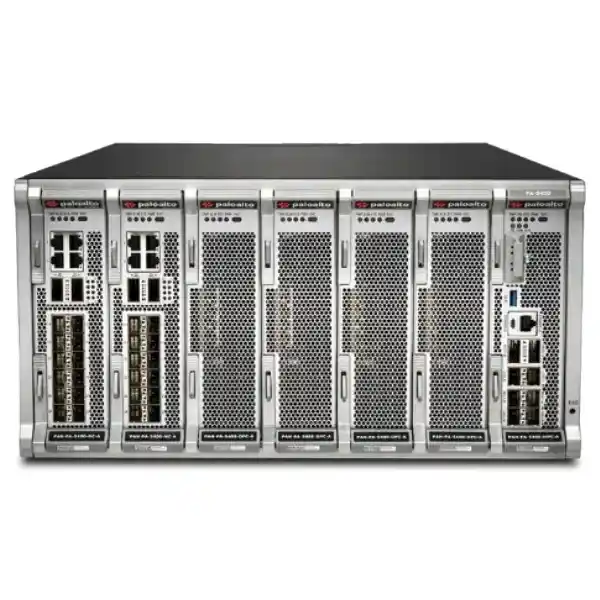
Palo Alto Networks PA-5450 Modular Next-Generation Firewall in Dubai, UAE
The PA-5450 is a chassis-based ML-powered next-generation firewall for organisations that need substantial security inspection capacity, modular interface choice and room to scale. It is intended for hyperscale data centres, internet-edge protection and large campus segmentation where a fixed appliance may not provide the required growth path.
Plan the complete system
A valid quotation should cover the chassis, required cards, power supplies, optics, subscriptions, support and implementation scope rather than only the base hardware.
Data centre, internet edge and campus segmentation
Modular chassis with networking and processing cards
Up to 189 Gbps with security services enabled
Cards, subscriptions and lifecycle dates must be confirmed
Direct answer for buyers evaluating the PA-5450
The Palo Alto Networks PA-5450 is a modular enterprise firewall platform used to inspect and control large volumes of traffic at critical network boundaries. It is best considered by organisations whose data-centre, internet-gateway or segmentation requirements exceed the practical capacity or port flexibility of a fixed appliance. The chassis needs specific operating components, including a Base Card and Management Processor Card, plus at least one Networking Card and one Data Processing Card. Before proceeding, a buyer should confirm traffic volumes, security subscriptions, decryption needs, interface speeds, redundancy, power type, rack space, management design, software compatibility and the vendor’s announced end-of-sale schedule. FourTeck can coordinate a requirement-led bill of materials and quotation for Dubai and wider UAE projects.
What it does
The PA-5450 applies application-aware security policy, threat prevention, visibility, segmentation and encrypted-traffic inspection at a scale suitable for demanding networks. Its role is not limited to packet filtering. It provides a policy enforcement point where organisations can identify applications and users, control permitted behaviour, block threats, inspect content and create consistent security rules across high-bandwidth connections.
Because the platform is modular, networking interfaces and security-processing resources are installed through separate cards. This allows the system design to follow an organisation’s actual port and performance requirements rather than forcing every buyer into one fixed hardware configuration.
Who it suits
The PA-5450 may suit large enterprises, government networks, cloud and hosting environments, telecommunications operators, universities, financial institutions and distributed organisations consolidating security at major network hubs. It is particularly relevant where the firewall must protect multiple high-speed links, support large session volumes, segment important environments or provide capacity for future expansion.
It is usually not the economical or operationally simple choice for a small branch, a modest office or a deployment where a fixed-form appliance already meets the performance and interface requirement. Correct sizing should compare the PA-5450 against current fixed and modular alternatives.
Business challenges the PA-5450 can help address
Growing inspection demand
Security services consume processing resources. A modular platform gives architects a method to plan additional processing capacity as protected traffic and inspection depth increase, subject to supported card combinations and platform limits.
High-speed interface diversity
Large networks may require a mix of interface types, speeds and transceivers. The networking-card architecture enables a more deliberate port design, but every optic, cable and interface card must be confirmed for support.
Security policy consolidation
A single high-capacity platform can reduce the number of separate security enforcement points at a major edge, provided the resulting failure domain, maintenance plan and high-availability architecture are acceptable.
Segmentation at scale
The appliance can support policy enforcement between data-centre zones, business units, user groups, server environments or campus segments. The design still depends on routing, switching, address architecture and application flows.
Core platform capabilities
Controls traffic according to applications, users, content and risk rather than relying only on ports and IP addresses.
Supports prevention services for malicious traffic, exploits and suspicious content when the appropriate subscriptions are licensed and configured.
Can inspect permitted encrypted sessions where policy, certificates, privacy requirements and performance sizing allow.
Can participate in a centrally managed Palo Alto Networks environment, with management and logging architecture selected according to operational scale.
PA-5450 suitability matrix
| Requirement | Suitable when | Confirm before ordering |
|---|---|---|
| Large internet edge | Multiple high-speed links require deep inspection and policy control. | Real traffic profile, decryption load, DDoS architecture and HA capacity. |
| Hyperscale data centre | East-west or north-south enforcement demands modular growth. | Routing design, oversubscription, card count and fault domains. |
| Campus segmentation | A large campus needs consistent policy between major zones. | User mapping, VLAN/VRF design, latency and maintenance windows. |
| Long-term expansion | The organisation expects traffic and port growth during the supported lifecycle. | End-of-sale date, support horizon, software roadmap and alternative platforms. |
Verified product information and purchasing notes
| Brand | Palo Alto Networks |
|---|---|
| Product | PA-5450 ML-Powered Next-Generation Firewall |
| Product type | Modular, chassis-based enterprise network security appliance |
| Primary deployment | Hyperscale data centre, internet edge and campus segmentation |
| Published security-services performance | Up to 189 Gbps in current manufacturer material; actual results are configuration and traffic dependent |
| Required architecture | Base Card and Management Processor Card, with at least one Networking Card and one Data Processing Card |
| Hot-swappable modules | Networking Cards and Data Processing Cards; Base Card and Management Processor Card are not hot-swappable |
| Management | Local and central management options are configuration and license dependent |
| High availability | Supported design options should be validated against software release, topology and capacity requirements |
| Licensing | Security subscriptions, support and management services are not assumed to be included; confirm exact SKUs and terms |
| Power | AC or DC bundle and redundancy requirements must be selected; power draw depends on installed modules |
| Lifecycle notice | Palo Alto Networks has announced an end-of-sale date of 22 November 2026; buyers should verify current ordering and support policy |
| Availability | Contact FourTeck for current UAE options, quantity, lead time and bill-of-material review |
Configuration, subscription and lifecycle dependencies
The PA-5450 should never be quoted as a single undifferentiated appliance. The operational system depends on the chassis bundle, management and base components, networking cards, data-processing cards, power supplies, optics, cables, software version, security subscriptions and support entitlement. The correct quantity of processing and networking cards must be selected for the target throughput, interface mix and resilience design.
Capabilities such as advanced threat prevention, DNS security, URL filtering, malware analysis, IoT visibility, SaaS security, data-loss controls or other cloud-delivered services may require separate subscriptions. Inclusion varies by bundle and commercial agreement. Buyers should ask for an itemised bill of materials that clearly separates hardware, subscriptions, support, implementation and optional services.
Lifecycle timing is especially important. The manufacturer has announced 22 November 2026 as the PA-5450 end-of-sale date. An organisation considering a new purchase should evaluate availability, long-term support, spare strategy, software roadmap and possible successor platforms before committing. Existing deployments may still have valid operational and support paths, but these should be checked against the exact serial-number entitlement and contract.
A practical purchase and deployment journey
Define the traffic baseline
Document current and expected bandwidth, session levels, application mix, SSL/TLS decryption percentage, VPN requirements and security services. Growth assumptions should be explicit rather than hidden inside a generic safety margin.
Design the chassis configuration
Select the networking and data-processing cards, power configuration, interface types, optics and cabling. Check slot usage, redundancy and maintenance procedures.
Confirm licenses and management
Choose required security subscriptions, support level, central management, logging and retention architecture. Align terms so that renewals remain manageable.
Plan implementation and validation
Prepare rack space, power, change windows, migration sequence, policy conversion, routing, certificates, testing, rollback and handover documentation.
Modular performance that follows the real network design
The main reason to evaluate the PA-5450 is its ability to separate interface capacity from security-processing capacity. A fixed appliance delivers a predetermined combination of ports and processing. A modular chassis allows an architect to choose supported networking cards for the desired connectivity and supported data-processing cards for inspection capacity. This can be valuable when a data centre needs several high-speed interfaces but expects security-processing requirements to grow at a different rate.
Modularity does not remove the need for careful engineering. Slot allocation, software support, card compatibility and power consumption must be checked as one system. A design that appears adequate from a headline throughput figure may still be unsuitable if the interface distribution, packet size, session creation rate, decryption load or logging demand has not been considered. Conversely, an oversized chassis with unnecessary cards may create avoidable capital and support cost.
FourTeck can help translate a network diagram and traffic profile into a draft bill of materials. The output should identify every required card, optic, cable, power component, license and support item so procurement teams can compare proposals on an equal basis.
Security inspection, decryption and policy control
High-capacity firewalls are commonly deployed where encrypted traffic dominates. Decryption can improve visibility into threats and prohibited applications, but it also introduces processing, certificate, privacy and operational requirements. The PA-5450 should therefore be sized with the intended decryption policy in mind rather than assuming that every connection will be processed identically.
Application-aware policy enables security teams to distinguish business applications from generic port usage. User and device context can further improve rule quality where directory, identity and telemetry integrations are properly implemented. These controls are useful for reducing broad network permissions, but they require maintained objects, accurate identity data and disciplined policy review.
Threat-prevention outcomes depend on active subscriptions, current content updates, correct security profiles, supported software and operational monitoring. A powerful chassis cannot compensate for weak policy governance. Buyers should include configuration, testing, documentation and knowledge transfer in the project scope where internal resources need assistance.
Resilience, maintenance and operational control
The PA-5450 supports modular maintenance because Networking Cards and Data Processing Cards are hot-swappable, while the Base Card and Management Processor Card are not. This distinction matters when planning component replacement and service windows. Hot-swappable does not mean risk-free: change procedures, redundancy status, traffic distribution and software health must be checked before removing a module.
For critical deployments, high availability should be designed around expected failure scenarios. The design must consider chassis failure, card failure, link failure, upstream and downstream switching, route convergence, session synchronisation, maintenance and capacity when one peer is unavailable. Each firewall in an HA pair should normally be able to carry the required traffic during a failure condition, based on the organisation’s defined service objective.
Operational control also includes central policy management, software lifecycle planning, backups, logging, alerting, certificate renewal, content updates and administrative access. Procurement teams should ask who will own each activity after handover and whether remote or onsite support is required.
Ideal business environments and use cases
Large enterprise internet gateway
A central edge carrying substantial user, cloud and partner traffic can use the PA-5450 as a policy and threat-prevention layer. Sizing must include decryption, remote access, link growth and failure-state capacity.
Data-centre perimeter
The chassis can protect north-south application traffic, partner connections and external services where interface density and inspection scale are high. Application dependencies and latency targets should be mapped first.
Internal segmentation
The platform may separate production, development, shared services, user networks and sensitive systems. Effective segmentation depends on accurate traffic discovery and a staged policy rollout.
Service-provider security edge
Providers may evaluate the modular design for high-volume security enforcement. Multi-tenancy, operational separation, routing scale, logging and commercial licensing require detailed validation.
Government or regulated network
Large public-sector and regulated environments may use the platform within a broader control framework. Compliance, data handling, procurement and audit requirements remain organisation specific.
Campus core segmentation
A major campus can enforce policy between user, guest, server, research, OT and administrative zones. Integration with switching and identity systems must be planned carefully.
Integration and operational considerations
A PA-5450 deployment interacts with routing, switching, identity services, DNS, DHCP, public-key infrastructure, SIEM platforms, monitoring tools, orchestration systems and central management. The firewall design should therefore be reviewed as part of the wider architecture rather than as an isolated appliance replacement.
Routing mode, virtual systems, interface types, VLAN design, dynamic routing, link aggregation, asymmetric paths and failover behaviour should be documented. Security teams need a clear plan for policy objects, NAT rules, security profiles, application dependencies and certificate handling. Operations teams need logging destinations, retention expectations, alert ownership and escalation procedures.
Migration from another firewall requires more than converting rules. Legacy rulebases often contain duplicates, unused objects and broad permissions. A structured migration should identify business owners, validate flows, clean obsolete policies, stage changes and maintain a rollback plan. Performance testing should use representative traffic and enabled services.
Software compatibility must also be checked. The chosen PAN-OS release, card support, subscriptions, management platform version and operational tooling should form one validated matrix. FourTeck can include compatibility review and implementation planning in the quotation when required.
Questions to resolve before requesting a quotation
Separate raw link speed from expected inspected throughput, encrypted traffic, packet profile and peak growth.
List speeds, media, port counts, optics, breakout needs, cabling and connection redundancy.
Map security outcomes to the exact subscription SKUs and terms rather than selecting every service by default.
Review the announced end-of-sale date, support policy, planned deployment life and successor options.
Define failure scenarios, peer capacity, link redundancy, maintenance expectations and recovery objectives.
Specify design review, rack installation, configuration, migration, testing, documentation, training and support coordination.
PA-5450 procurement checklist
How FourTeck can assist with PA-5450 planning
FourTeck can help buyers turn a high-level requirement into a clearer procurement specification. The process can include reviewing network diagrams, traffic estimates, existing firewall utilisation, application flows, interface requirements, subscription needs, availability objectives and implementation constraints. This information supports a more accurate chassis and card configuration.
The quotation can be structured to distinguish mandatory hardware from optional components and services. That makes it easier for procurement teams to compare the base chassis, cards, optics, subscriptions, support and professional services across proposals. Where the PA-5450 lifecycle or capacity profile makes another platform more appropriate, FourTeck can discuss suitable current alternatives without assuming equivalence.
For deployment projects, assistance may cover pre-installation checks, rack and power planning, configuration scope, policy migration, integration, testing, documentation and handover. Scope, location, access, maintenance windows and customer responsibilities should be agreed before the project is scheduled.
Explore other enterprise firewall products, review available firewall services, or contact FourTeck with your topology and sizing requirements.
UAE availability and support guidance
Contact FourTeck to confirm current UAE availability for the PA-5450 chassis, cards, power bundles, optics, subscriptions and support SKUs. Availability may depend on exact part number, quantity, license region, remaining vendor supply and lead time. Because the manufacturer has announced an end-of-sale date, buyers should request written confirmation of orderability and support entitlement before final approval.
Delivery and project coordination can be discussed after the exact bill of materials is approved. Installation and configuration should be included in the quotation when required. FourTeck can coordinate requirement discussions for businesses in Dubai, Abu Dhabi, Sharjah and Ajman through one combined project scope, with onsite activity subject to location, access, scheduling and agreed service coverage.
GCC Availability
Organisations planning PA-5450 deployments across the GCC can ask FourTeck to review the destination, required chassis configuration, subscription region, quantity, support term and implementation scope. Projects in the United Arab Emirates, Saudi Arabia, Kuwait, Qatar, Bahrain and Oman may involve different commercial, licensing, logistics and onsite-service conditions. A regional project should therefore start with one consolidated requirement document showing the exact product SKUs, deployment locations, interface needs, power options, expected timeline and local responsibilities. FourTeck can assist with quotation coordination, model and license review, delivery planning, configuration scope, installation planning and renewal guidance. Product availability, vendor lead time, service visits, project sequencing and license eligibility can vary by country, model and quantity. No stock, customs outcome or fixed delivery date should be assumed until the destination and bill of materials have been confirmed. For Kuwait-related coordination, buyers may also review FourTeck Kuwait technology support.
Africa Availability
FourTeck can assist organisations evaluating the PA-5450 for projects in Africa by reviewing the exact chassis, cards, licenses, subscriptions, accessories, power requirements, support expectations and deployment scope. Regional fulfilment can depend on destination country, remaining product availability, license rules, quantity, shipping arrangements, vendor lead time, local power standards and project access. Buyers should share the deployment country, required interfaces, expected traffic, quantity, preferred schedule and any installation or migration requirement so that the proposal reflects real conditions. For East African opportunities, information can be coordinated through FourTeck Kenya and FourTeck Uganda; broader enquiries can use FourTeck Africa. Availability, customs handling, onsite coverage and delivery timing must be confirmed for each project and should not be inferred from another country’s quotation.
Related products and services to consider
Current high-capacity PA-Series alternatives
Compare current fixed and modular platforms where lifecycle, performance, interfaces or long-term support are key selection factors.
Panorama or central management
Plan policy administration, templates, device groups, software management and operational governance for large firewall estates.
Security subscriptions
Select threat, URL, DNS, malware, data and other services according to the required security outcome and contract term.
Firewall migration services
Assess existing rules, objects, NAT, routing and operational dependencies before moving traffic to the new platform.
High-availability design
Review peer sizing, links, failure modes, maintenance and recovery testing for critical security gateways.
Lifecycle and renewal planning
Align hardware support, subscriptions, software compatibility and replacement planning before support deadlines approach.
Why businesses contact FourTeck
PA-5450 projects involve more than choosing a firewall model. Buyers contact FourTeck for requirement clarification, card selection, license mapping, compatibility review, bill-of-material guidance, quotation coordination and project-scope planning. This reduces ambiguity between proposals and helps technical and procurement teams discuss the same configuration.
FourTeck can also coordinate installation, configuration, migration, documentation and support requirements where requested. The objective is to define what is included, what remains customer supplied, which dependencies must be resolved and how the system will be validated before production use. Learn more about FourTeck’s business technology approach.
Frequently asked questions
What is the Palo Alto Networks PA-5450 mainly used for?
It is used as a high-capacity next-generation firewall for hyperscale data centres, large internet edges and campus segmentation deployments that need modular networking and processing capacity.
Is the PA-5450 a fixed appliance?
No. It is a modular chassis. The operating configuration requires a Base Card, Management Processor Card, at least one Networking Card and at least one Data Processing Card.
What throughput does the PA-5450 provide?
Current manufacturer material states up to 189 Gbps with security services enabled. Actual capacity depends on installed cards, software, traffic mix, packet size, decryption, enabled features and resilience design.
Are security subscriptions included with the chassis?
They should not be assumed to be included. The quotation must identify the exact subscriptions, support entitlement and contract terms required for the project.
Can cards be replaced while the firewall is running?
Networking Cards and Data Processing Cards are hot-swappable. The Base Card and Management Processor Card are not. Any replacement should follow approved maintenance procedures.
Has an end-of-sale date been announced?
Yes. Palo Alto Networks has announced 22 November 2026 as the end-of-sale date. Current orderability, support dates and successor options should be verified before purchase.
Can FourTeck help size the PA-5450?
Yes. FourTeck can review traffic, interfaces, decryption, subscriptions, high availability, management and implementation requirements to prepare a more complete bill of materials.
Is installation available in Dubai and the UAE?
Installation and configuration can be discussed as part of the quotation. Scope depends on location, rack and power readiness, network design, access, migration requirements and schedule.
What details are needed for an accurate quote?
Provide quantity, traffic profile, interface list, card requirements, subscriptions, support term, power preference, HA design, delivery destination and requested professional services.
Confirm the right PA-5450 configuration before ordering
Share your traffic estimates, interface requirements, subscriptions, destination and implementation scope. FourTeck can help review the bill of materials, lifecycle considerations and current UAE quotation options.

Reviews
There are no reviews yet.