
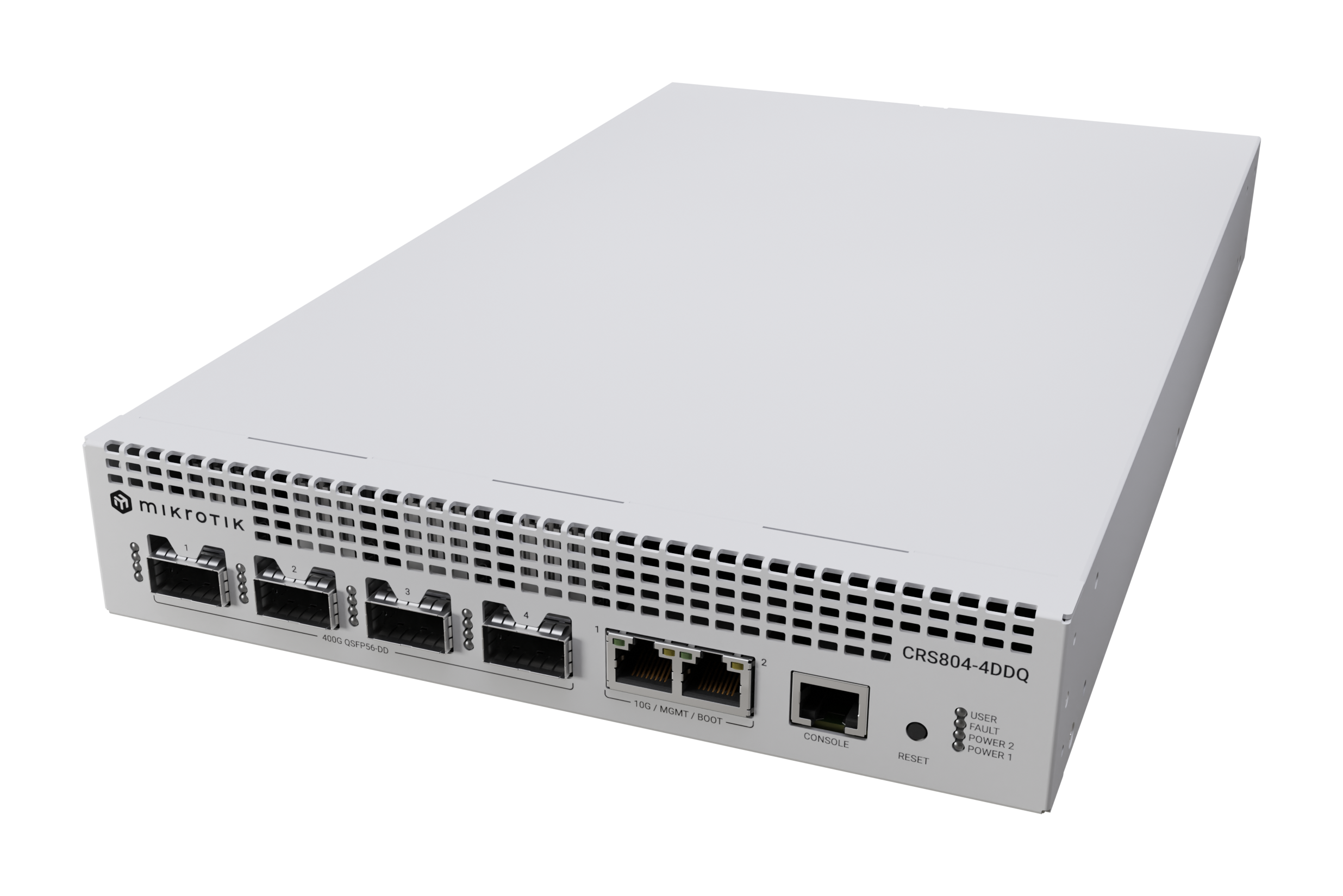
MikroTik CRS804 DDQ in Dubai, UAE
The MikroTik CRS804 DDQ is a compact 1U switch built for organisations that need four 400G QSFP56-DD ports without moving to a large chassis platform. It is suited to AI clusters, all-flash storage fabrics, laboratory networks, high-speed aggregation and compact data-centre designs where bandwidth density, rack efficiency and flexible breakout options matter.
Platform: RouterOS v7, License Level 6
Primary role: 400G switching and aggregation
Direct answer for buyers
The MikroTik CRS804 DDQ is a managed high-speed switch with four 400G QSFP56-DD ports, two multi-rate Ethernet ports capable of 10G operation, RouterOS v7 and a compact rack format. Its main purpose is to create a dense switching layer for GPU systems, storage nodes, research platforms, media workflows and high-speed aggregation. It should be considered by buyers who already understand their required link speeds, cable types and endpoint interfaces. Before proceeding, confirm whether each connection will run at native 400G or use breakout modes, whether the intended optics or direct-attach cables are supported, how the switch will be mounted, and whether the network design needs redundancy beyond the included dual power supplies.
What it does
The CRS804 DDQ concentrates very high bandwidth into a compact switch. Each of its four QSFP56-DD ports can operate as a high-capacity interface for 400G links and can also be used with supported breakout configurations for lower-speed connections. This allows the device to work as a compact spine, storage-fabric switch, AI-cluster interconnect or aggregation point where a small number of extremely fast links is more useful than a large number of lower-speed access ports.
Who it suits
This model is most relevant to data-centre teams, AI infrastructure builders, systems integrators, storage architects, research laboratories, media-production environments and enterprises planning high-speed east-west traffic. It is not intended as a conventional office access switch. Buyers should have a defined topology, known endpoint capabilities and a clear transceiver or cable plan before deployment.
Business problems the CRS804 DDQ helps address
Bandwidth bottlenecks between compute nodes
AI and scientific workloads can move large datasets between accelerators, hosts and shared storage. A low-capacity switching layer can restrict the effective performance of expensive compute resources. Four 400G ports provide a compact path for high-bandwidth node and fabric connections when the rest of the system is designed to use them.
Limited rack space
The device uses a half-width 1U form factor and includes hardware for single-device or side-by-side rack installation. This can help smaller facilities, test labs and edge-compute sites build a 400G fabric without allocating a full-depth chassis platform.
Mixed-speed migration
Not every connected system will move to 400G at the same time. Supported breakout options allow high-density ports to serve lower-speed links where the correct cable, optic and configuration are used. This makes phased migration possible, although each endpoint and breakout design must be validated.
Power and component continuity
Dual hot-swap power supplies and two hot-swap fans support serviceability in environments that cannot accept unnecessary interruption. Redundant power design is useful, but the overall power path still depends on separate circuits, PDU design and upstream electrical resilience.
Core capability band
Product-fit matrix
| Requirement | Suitable when | Confirm before ordering |
|---|---|---|
| AI or GPU cluster | A small or medium cluster needs a compact high-speed fabric. | GPU NIC speed, cable type, topology, oversubscription and protocol requirements. |
| All-flash storage | Storage nodes require 200G or 400G uplinks and low switching overhead. | Storage protocol, NIC support, MTU, latency expectations and redundancy design. |
| High-speed aggregation | Several lower-speed links must be consolidated into a small backbone. | Breakout mapping, optics, fibre type, distance and port-channel design. |
| Compact data-centre pod | Rack space and power efficiency are important. | Airflow, mounting method, power feeds and maintenance access. |
| General office access | Usually not the right fit because it lacks a large quantity of copper access ports. | Consider a lower-speed access-switch family instead. |
Verified technical information
| Brand | MikroTik |
|---|---|
| Product name | CRS804 DDQ |
| Product code | CRS804-4DDQ-hRM |
| Product type | Managed 400G rackmount switch |
| High-speed ports | 4 × 400G QSFP56-DD |
| Ethernet ports | 2 × RJ45 supporting 10M/100M/1G/10G operation |
| Console | 1 × RJ45 serial console |
| CPU | AL52400, quad-core ARM 64-bit, 2 GHz |
| Switch chip | Marvell 98DX7335 |
| Memory | 4 GB DDR4 RAM |
| Storage | 512 MB NAND |
| Operating system | RouterOS v7, License Level 6 |
| Switching throughput | 1.6 Tbps non-blocking Layer 2 throughput under official test conditions |
| Power inputs | 2 × AC, 100–240 V, 50–60 Hz |
| Maximum power consumption | 123 W with attachments; 92 W without attachments |
| Cooling | 2 hot-swap fans |
| Dimensions | 387 × 218 × 44 mm |
| Operating temperature | -10°C to 60°C |
| Ingress rating | IP20, indoor installation |
| Certifications | CE, EAC and RoHS |
| Included rack hardware | Rack brackets, rear support ears, long bracket, RMK-2×10/19 and fastening set; confirm current package contents at quotation stage. |
Compatibility and configuration dependencies
A 400G port does not by itself guarantee that every optic, cable or connected device will work in every mode. Buyers must verify the transceiver type, breakout standard, cable length, fibre grade, endpoint form factor, speed negotiation and RouterOS configuration. Breakout designs can create two 200G links or multiple lower-speed links, but the exact supported combination depends on the cable assembly and connected hardware.
For storage and AI fabrics, confirm MTU, link aggregation, traffic distribution, VLAN architecture and any protocol-specific requirements. The CRS804 DDQ is a powerful switching platform, but application performance also depends on server NICs, drivers, storage architecture, topology and workload behaviour. FourTeck can review the intended connection map before the bill of materials is finalised.
Purchase and deployment journey
Define the traffic objective
Identify whether the switch will serve GPU nodes, storage arrays, a spine layer, a test platform or a migration project. Document expected link speeds, traffic direction and redundancy requirements.
Build the physical connection map
List each endpoint, interface type, speed, distance and connector. This determines whether native QSFP56-DD optics, direct-attach cables or breakout assemblies are appropriate.
Confirm rack and power design
Decide whether one unit will occupy a 1U position or two units will be mounted side by side. Verify airflow, PDU capacity, separate power feeds and service access.
Prepare the RouterOS configuration
Plan management access, firmware version, VLANs, bridge settings, port breakout, monitoring, authentication and backup. Apply configuration in a controlled staging environment where possible.
Test before production cutover
Validate every link speed, breakout mapping, error counter, redundancy path, throughput target and monitoring alert. Record the final port map and configuration for support and future changes.
Dense 400G switching without a chassis
The main appeal of the CRS804 DDQ is concentrated bandwidth. Four native 400G interfaces allow the switch to move large volumes of east-west traffic in a very small footprint. This is valuable where the network contains only a few critical high-speed endpoints rather than dozens of access ports. A buyer should compare the number of required fabric links against the four-port limit and consider whether a second switch is needed for growth or redundancy.
Breakout flexibility for staged migration
Each QSFP56-DD interface consists of multiple high-speed lanes. With suitable breakout hardware, a port can serve lower-speed connections instead of a single native 400G link. This is useful when some servers operate at 200G, 100G, 50G, 25G or another supported rate. The operational benefit is flexibility, but the planning burden is higher because lane mapping, cable choice and endpoint compatibility must be checked carefully.
RouterOS control and serviceability
RouterOS v7 gives network teams a familiar interface for configuration, monitoring and software maintenance. Dual hot-swap power modules and replaceable fans support serviceability in rack environments. These features reduce maintenance friction, but a resilient design still requires configuration backups, tested spare procedures, power-path separation and change control.
Ideal business environments and use cases
AI laboratories and private GPU clusters
Suitable for a compact fabric connecting a small number of high-speed compute nodes, management networks and storage resources. Confirm whether the target workload requires Ethernet switching features supported by the design.
All-flash storage networks
Useful where servers and storage arrays need very high throughput for database, media, analytics or scientific datasets. Validate latency, packet-loss sensitivity and storage-protocol requirements before final selection.
Media production and rendering
Large video assets and render workloads can benefit from fast movement between workstations, render nodes and shared storage. The physical cabling design should reflect distance and fibre requirements.
Research and test environments
The compact platform is relevant to universities, engineering labs, telecom testbeds and network-development teams experimenting with 200G and 400G connectivity.
Operational and integration considerations
A successful 400G deployment starts with the endpoints. Network interface cards, transceivers, drivers and operating systems must support the target link modes. A connection shown as physically possible may still require specific firmware or lane configuration. Review the MikroTik compatibility guidance and the connected vendor’s interface documentation before purchasing optics or cables.
Cooling also deserves attention. Although the CRS804 DDQ is compact and designed for efficient operation, 400G optics can create significant heat. Keep the rack airflow path unobstructed and verify that the room can maintain the required operating temperature. Where two switches are mounted side by side, ensure that cabling does not block ventilation or fan replacement.
Management planning should include a dedicated IP plan, secure administrator access, software updates, configuration backups and monitoring. The two RJ45 interfaces are marked for management and boot functions, but the actual design should reflect the customer’s operational policy. For critical fabrics, document out-of-band access and recovery steps before production deployment.
The CRS804 DDQ should be considered part of a complete system rather than a standalone performance guarantee. Effective throughput depends on traffic patterns, packet size, endpoint capability and application behaviour. FourTeck can help translate the intended workload into a practical connection plan and quotation.
Buyer questions to resolve before ordering
Native 400G, dual 200G and lower-speed breakout designs require different cables and port settings. Define the complete port map first.
Direct-attach copper, active optical cables and pluggable optics suit different distances and rack layouts.
A single unit provides four fabric ports. Growth, dual-homing and maintenance requirements may justify two switches.
Clarify whether the quotation should include optics, breakout cables, rack installation, RouterOS configuration, testing and documentation.
Procurement checklist
- Exact model: CRS804-4DDQ-hRM
- Required switch quantity
- Native 400G or breakout design
- Endpoint port type and supported speeds
- Cable or optic type for every connection
- Link distance and fibre specification
- Rack position and mounting arrangement
- Independent AC power feeds
- RouterOS staging and update plan
- VLAN, MTU and bridge requirements
- Monitoring and backup configuration
- Installation, testing and handover scope
- Destination and requested delivery schedule
- Warranty terms to confirm in the quotation
How FourTeck can assist
FourTeck can help translate a high-level request for “400G switching” into a complete and reviewable bill of materials. That process can include confirming the exact model, reviewing endpoint ports, identifying cable and optic requirements, checking rack and power constraints, and defining whether installation or configuration support should be quoted.
For customers comparing the CRS804 DDQ with a larger switch, FourTeck can discuss port count, growth, redundancy and management expectations. The right choice depends on the number of high-speed links, the required topology and the operational impact of maintenance. A compact four-port platform can be an excellent fit for a focused fabric, while a larger environment may need additional capacity or a different architecture.
Visit the FourTeck product catalogue, explore available network services, or contact the Dubai team with your connection map.
Information for an accurate quote
Share the number of switches, endpoint models, interface speeds, link distances, breakout requirements, destination, rack arrangement and requested services. This reduces the risk of ordering incompatible cables or missing required accessories.
UAE availability and support guidance
Contact FourTeck to confirm current UAE availability for the MikroTik CRS804 DDQ. Availability may depend on quantity, vendor lead time and the exact cable or optic package required. Delivery and project coordination can be discussed after the model, destination and deployment scope are confirmed. Where installation or RouterOS configuration is required, include those services in the quotation request so that the technical scope, access requirements and handover expectations can be reviewed before scheduling.
Dubai, Abu Dhabi, Sharjah and Ajman coverage
FourTeck can coordinate product enquiries, requirement review and quotation support for organisations in Dubai, Abu Dhabi, Sharjah and Ajman. Customers should share the final destination, site type, rack details and preferred project schedule. Delivery, installation and configuration planning remain dependent on confirmed availability, access conditions, scope and resource scheduling. For multi-site projects, provide a location-by-location bill of materials so that quantities, cabling and service requirements can be separated clearly.
GCC availability
FourTeck can assist organisations planning MikroTik high-speed switching projects across the GCC with requirement review, model selection, quotation coordination, cabling guidance, configuration scope and regional project planning. Requests may come from the United Arab Emirates, Saudi Arabia, Kuwait, Qatar, Bahrain or Oman, but the final approach should be based on the exact destination and technical design rather than a generic regional assumption.
Product availability, licensing, delivery schedules, service visits, project scope and vendor lead times can vary by country, model, quantity and requirement. Buyers should confirm the destination country, required switch quantity, interface plan, cable types, preferred deployment date and any installation or configuration expectations. FourTeck can then prepare guidance that reflects the specific project. For Kuwait-related coordination, customers may also review FourTeck Kuwait resources.
Africa availability
FourTeck can help organisations in African markets evaluate the MikroTik CRS804 DDQ, associated cabling, breakout requirements, configuration scope and support expectations. The product may be relevant to research institutions, data-centre operators, universities, media environments, service providers and AI infrastructure projects that need compact high-speed Ethernet switching.
Availability and fulfilment depend on the destination, product quantity, power and regulatory requirements, shipping arrangements, vendor lead time, installation scope and local project conditions. Buyers should provide the destination country, exact model, required quantity, preferred deployment schedule and any support expectations. For regional enquiries, visit FourTeck Africa, FourTeck Kenya or FourTeck Uganda.
Related products, services and planning options
CRS812 DDQ evaluation
Consider a higher-port-count platform when the project needs more 50G, 200G or 400G interfaces. Model suitability must be reviewed against the actual topology.
400G and breakout cabling
Native QSFP56-DD DACs, optical cables and breakout assemblies should be selected by speed, distance and endpoint compatibility.
Rack installation planning
Review half-width mounting, side-by-side installation, power feeds, airflow and cable management before deployment.
RouterOS configuration support
Configuration assistance can cover management access, VLANs, bridging, monitoring, backups and production handover.
Why businesses contact FourTeck
High-speed switching purchases often fail at the accessories stage rather than the switch stage. A technically correct model can still be unusable if the wrong breakout cable, optic, fibre type or rack arrangement is selected. FourTeck helps buyers clarify requirements, review compatibility, prepare a bill of materials, coordinate quotations and define installation or configuration scope.
The process is practical: identify the workload, map every endpoint, confirm speeds and distances, review power and rack constraints, then price the complete requirement. This approach helps procurement teams compare like-for-like offers and reduces uncertainty during deployment. Learn more about FourTeck’s business technology focus.
Frequently asked questions
What is the exact MikroTik CRS804 DDQ model number?
The official product code is CRS804-4DDQ-hRM. Use the full code in procurement documents to avoid confusion with other CRS models.
How many 400G ports does it provide?
It provides four QSFP56-DD ports capable of 400G operation, subject to compatible optics, cabling and endpoint support.
Can the ports be broken out to lower speeds?
Yes. The platform supports multiple breakout modes, including 200G and lower speeds, but the exact configuration depends on the cable assembly and connected device.
Is RouterOS included?
Yes. RouterOS v7 with License Level 6 is preinstalled and licensed on the device.
Does the switch include redundant power supplies?
Yes. The product includes two hot-swap AC power supplies. Resilient operation still depends on how the two inputs are connected to upstream power sources.
Can two units be installed side by side?
Yes. The included RMK-2×10/19 mounting hardware supports two CRS804 units side by side in one 1U rack position.
Is it suitable as a normal office access switch?
Usually not. It is designed for a small number of extremely high-speed links rather than a large quantity of user-facing copper ports.
Are 400G optics or breakout cables included?
The standard product package focuses on the switch, power cords and rack hardware. Optics and network cables should be confirmed separately in the quotation.
What information is needed for a Dubai quote?
Provide quantity, endpoint models, required link speeds, cable distances, breakout plan, destination, rack requirements and any installation or configuration scope.
How can warranty terms be confirmed?
Warranty guidance can vary by sales channel and region. Ask FourTeck to state the applicable warranty terms in the formal quotation.
Plan your MikroTik CRS804 DDQ deployment
Send FourTeck your endpoint list, required speeds, distances and rack details. The team can help confirm the switch, cable package, configuration scope and current UAE quotation.