

Outdoor 2.4 GHz wireless link planning
Ubiquiti airMAX NanoBeam 2AC NBE-2AC-13 in Dubai, UAE
A compact directional radio for organisations that need to carry network traffic across an outdoor gap where trenching, leased circuits or new fibre routes may be impractical. FourTeck can assist with link assessment, model confirmation, accessories, configuration scope and quotation planning.
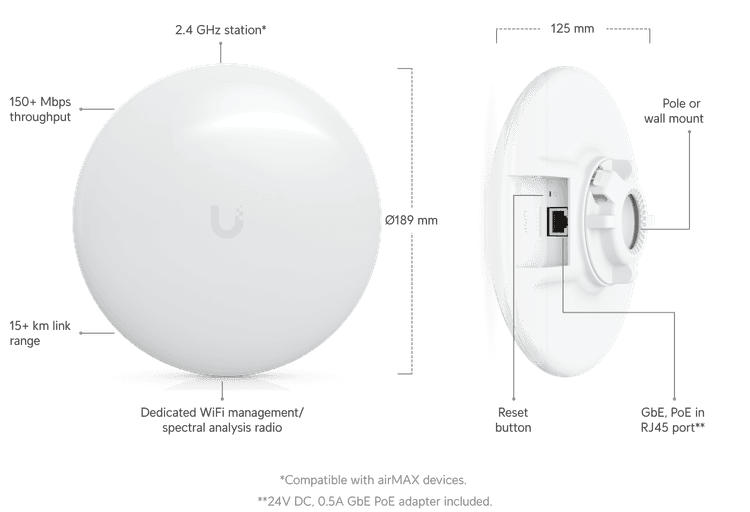
Confirm the exact regional unit, quantity, mounting method and opposite endpoint before purchase.
2.4 GHz operating band
Integrated 13 dBi directional
One Gigabit Ethernet port
24V passive PoE adapter included
Line of sight and spectrum review required
Direct answer for buyers
The NBE-2AC-13 is a Ubiquiti airMAX outdoor wireless radio built around a 2.4 GHz link and an integrated 13 dBi directional antenna. It is mainly used to connect separated network locations or operate as a station in a compatible point-to-multipoint design. It should be considered by buyers who have a clear outdoor path and need a practical alternative to installing new copper or fibre between points. Before proceeding, confirm the required data rate, path length, Fresnel-zone clearance, 2.4 GHz noise level, mounting height, grounding, passive PoE arrangement, local channel rules and the exact device that will be used at the far end.
What the NanoBeam 2AC does
The radio creates a directional outdoor wireless connection rather than broad indoor Wi-Fi coverage. Its antenna and radio are combined into one compact enclosure, reducing the need to match a separate antenna, cable and radio. In a typical deployment, Ethernet traffic enters the unit through its RJ45 port, the included passive PoE adapter supplies power over the same cable, and the radio sends the traffic toward a compatible remote endpoint.
This role is useful when two buildings need to share internet access, access-control traffic, voice, business applications or surveillance data, but a physical cable path is expensive, disruptive or unavailable. The device can also operate as a station in a compatible airMAX point-to-multipoint network. The actual design should be validated because capacity is shared, radio conditions vary, and the unit is not a general-purpose indoor access point.
Who should consider this model
The NBE-2AC-13 may suit small and medium businesses, schools, workshops, farms, warehouses, hospitality compounds, retail sites, construction offices, residential compounds and system integrators that need a focused outdoor link. It is particularly relevant where 2.4 GHz propagation is helpful and the planned throughput remains within the practical capacity of the model.
Buyers should not select it solely because it is compact or low in power consumption. Dense urban 2.4 GHz environments can be congested, and a narrow link still depends on clean spectrum and adequate line of sight. Projects needing substantially higher throughput, highly predictable latency, licensed spectrum, long carrier-grade backhaul, advanced redundancy or interference isolation may require a different product class.
Business problems this radio can help address
A separated building needs network access
A warehouse annex, guard room, workshop or office may sit beyond the economical reach of standard Ethernet. A correctly engineered NanoBeam link can carry network traffic across that outdoor gap without excavating a cable route.
A camera or gate location lacks cabling
Remote CCTV, intercom or access-control points often require connectivity but not local users. A directional bridge can provide the network path, subject to bandwidth, power, security and resilience planning.
Temporary operations need a reversible link
Construction compounds, events and temporary offices may benefit from equipment that can be mounted, aligned and later redeployed. Mounting safety, licensed channel rules and the expected project duration still need review.
A service provider needs a compact station
In a compatible airMAX point-to-multipoint topology, the unit can serve as a station. Capacity planning, base-station compatibility, subscriber count and interference management determine whether it is suitable.
Core capabilities in practical terms
Focused 13 dBi antenna
The integrated directional antenna concentrates coverage toward the intended endpoint. Alignment and unobstructed path geometry remain essential.
150+ Mbps stated throughput
Ubiquiti lists total throughput above 150 Mbps. Real application performance depends on channel width, signal, interference, protocol overhead and topology.
Gigabit wired interface
The single GbE RJ45 port avoids a 100 Mbps Ethernet bottleneck at the physical interface, although radio throughput remains the governing factor.
Outdoor-oriented enclosure
The UV-stabilised plastic enclosure and published environmental ratings support outdoor deployment when installed according to the vendor guide.
Product-fit matrix
| Requirement | Suitable when | Confirm before ordering |
|---|---|---|
| Building-to-building link | There is clear outdoor line of sight and moderate bandwidth demand. | Distance, Fresnel clearance, alignment access and remote endpoint. |
| 2.4 GHz environment | A spectrum check shows usable channels and the propagation characteristics are beneficial. | Local interference, permitted frequencies and channel width. |
| Remote surveillance endpoint | Camera bitrate and other traffic fit comfortably inside the expected link capacity. | Power, switch ports, VLANs, surge protection and recording traffic. |
| Point-to-multipoint station | The base station and software mode are compatible with the NBE-2AC-13. | Sector coverage, subscriber loading, airtime and firmware compatibility. |
| High-capacity backbone | Only when the verified throughput requirement falls within this model’s practical range. | Consider higher-capacity 5 GHz, 60 GHz, fibre or licensed alternatives where necessary. |
Verified technical information
The following values are based on Ubiquiti’s current technical specification page for model NBE-2AC-13. Regional operating limits and available channels can differ, so the deployment country and regulatory domain must be confirmed during configuration.
| Brand | Ubiquiti |
|---|---|
| Product name | airMAX NanoBeam 2AC |
| Model | NBE-2AC-13 |
| Product type | Outdoor 2.4 GHz directional wireless radio / station |
| Total throughput | 150+ Mbps stated by manufacturer; actual performance is deployment dependent |
| Channel bandwidth | 10 / 20 / 40 MHz |
| Antenna gain | 13 dBi |
| Polarisation | Dual linear |
| Operating frequency | Worldwide 2412–2472 MHz; regional restrictions apply |
| Network interface | One Gigabit Ethernet RJ45 port |
| Power method | Passive PoE, two-pair |
| Included power supply | 24V, 0.5A Gigabit PoE adapter |
| Supported voltage | 20–27V DC |
| Maximum consumption | 7.5W |
| Dimensions | Diameter 189 x 125 mm |
| Weight | 530 g |
| Enclosure | UV-stabilised plastic |
| Mounting | Pole-mount kit included; wall and window mounts not included |
| Wind survivability | 200 km/h as published by manufacturer |
| Operating temperature | -40 to 80°C |
| Operating humidity | 5–95% non-condensing |
| Certifications | CE, FCC and IC listed by manufacturer; regional suitability must be confirmed |
| Availability | Contact FourTeck for current UAE options, quantity and lead time |
Compatibility and dependency notice
The NBE-2AC-13 should be treated as one component in a complete wireless link. A working design also depends on a compatible opposite radio or base station, suitable firmware, permitted country settings, correct network configuration, mounting hardware, outdoor-rated Ethernet cabling, grounding, surge protection and a safe installation position. Passive PoE must not be confused with every form of standards-based PoE; confirm the power source before connecting the radio. Wall or window mounting accessories are not part of the standard pole-mount package. Channel availability, output power and frequency range are region dependent. Any point-to-multipoint design should also account for sector coverage, station count, airtime sharing and the capacity of the base station.
A practical purchase and deployment journey
Define the traffic
List the applications that will cross the link, including internet access, cameras, voice, cloud systems, backups and management. Record average and peak throughput, latency sensitivity and future growth.
Survey the path
Measure the distance, inspect line of sight, assess Fresnel-zone obstructions, identify mounting heights and check whether heat, movement, trees or new construction could affect the path.
Review the spectrum
A site survey should identify occupied channels and interference sources. The 2.4 GHz band can be busy in urban locations, so selection should be based on measured conditions rather than assumption.
Confirm the bill of materials
Validate radio quantity, endpoint compatibility, poles or brackets, outdoor cable, surge devices, grounding, switch ports, power sockets and weatherproof entry points.
Install and align
Mount securely, follow local safety requirements, protect cable routes and align each endpoint using signal indicators and management information. Document final mounting and cable paths.
Configure and test
Apply country settings, wireless parameters, management access, VLANs and security controls. Test throughput, packet loss, latency and application behaviour before handover.
Directional RF design and link reliability
The integrated 13 dBi antenna is central to the NanoBeam’s role. Unlike an indoor access point designed to distribute coverage around a room, this unit is intended to aim energy toward a specific direction. That focus can improve the link budget and reduce unwanted coverage outside the main path, but it does not remove the need for careful alignment. A small movement at the mounting point can change the signal at the far end, particularly where the path is long or the mount is exposed to vibration.
Line of sight is more than being able to see the other building. Radio waves also need adequate clearance around the direct path, commonly discussed as the Fresnel zone. Rooftops, walls, trees, vehicles, cranes and terrain may intrude into that area even when the endpoint itself remains visible. UAE installations should also consider future construction, rooftop equipment and heat-related movement of mounting structures. FourTeck can help buyers identify the information needed for a preliminary link review, but a physical survey may still be appropriate for critical projects.
The choice of 2.4 GHz can be useful where propagation through minor environmental effects is valued, yet this band is widely used by Wi-Fi, Bluetooth and other equipment. Strong interference can reduce modulation rates, increase retransmissions and make a link inconsistent. A buyer should therefore compare measured spectrum conditions with the required service level. Where the 2.4 GHz band is heavily occupied, a 5 GHz, 60 GHz, fibre or other alternative may provide a better design, depending on range, capacity and regulation.
Throughput, channel width and application planning
Ubiquiti publishes total throughput of 150+ Mbps for the NBE-2AC-13. This value is a useful product reference, but it should not be interpreted as a guaranteed application speed at every site. Wireless capacity changes with signal quality, noise, selected channel width, modulation, link direction, protocol overhead and the number of stations sharing airtime. In a point-to-point arrangement, both ends and the wired networks must also be configured correctly. In a point-to-multipoint arrangement, subscriber traffic shares the available radio resources.
A business should begin with its workload rather than the headline number. Several low-bitrate cameras may be practical, while many high-resolution streams, frequent cloud backup or large file transfers could consume capacity quickly. Voice and interactive applications may use relatively little bandwidth but are sensitive to packet loss and latency. A remote office may also generate bursts when operating-system updates or synchronisation tasks begin. Capacity planning should include these peaks and retain operating margin instead of designing to the absolute stated limit.
Channel width creates a trade-off. Wider channels can support higher peak rates under clean conditions, but they occupy more spectrum and may be harder to place in a congested band. Narrower channels can simplify coexistence and sometimes improve robustness, although available throughput falls. The appropriate choice depends on a spectrum survey, the business workload and regional channel rules. FourTeck can include configuration guidance in the quotation when the customer requires help selecting radio and network parameters.
Power, cabling and outdoor installation discipline
The unit uses 24V passive PoE and Ubiquiti lists a 24V, 0.5A Gigabit PoE adapter as included. Passive PoE is convenient because one Ethernet cable carries both data and power, but it requires deliberate connection. Installers must verify the correct injector, polarity and device compatibility rather than assuming that any PoE switch port is suitable. Power should be available in a protected indoor or rated enclosure location, with enough space for the injector and service access.
Outdoor Ethernet cable should be selected for the environment and routed away from sharp edges, standing water, high-voltage conductors and excessive mechanical stress. Drip loops, weatherproof entries and strain relief help protect the installation. Ubiquiti publishes ESD protection values for the radio, yet a professional design should still assess surge protection and grounding based on the building, mast and local electrical requirements. Lightning and induced surges can affect not only the radio but also connected switches, recorders and routers.
The supplied pole-mount arrangement may fit many deployments, while wall or window mounting requires separate accessories or a suitable engineered bracket. Mounting points must support wind load, permit accurate adjustment and remain accessible for maintenance without creating unsafe working conditions. The published operating temperature range is broad, but installers should avoid positions that trap heat or make cable inspection impossible. A clear photo of each proposed mounting point is useful when requesting a quotation.
Ideal business environments and use cases
Warehouse and yard connectivity
Connect a detached storage building, loading area office or gate network back to the main LAN where cable installation is difficult. Confirm camera traffic, handheld terminal roaming needs and whether separate indoor Wi-Fi is required at the remote side.
School or campus outbuilding
Provide a network path to a classroom block, security post or administration annex. The wireless bridge is only the backhaul; switches, access points and user security controls at the remote building remain separate design items.
Farm and estate operations
Carry connectivity to a pump controller, office, staff accommodation or monitoring location. Long paths, vegetation growth, solar power and lightning exposure require additional engineering attention.
Hospitality compounds
Link service buildings, gatehouses or recreational facilities. Guest Wi-Fi capacity, roaming and public-access security should be handled by the wider network design rather than assumed from the bridge alone.
Temporary project sites
Support site offices or temporary operational zones where a reusable wireless path is preferred. Availability of secure mounting, power, spectrum and later removal should be included in the project plan.
Service-provider subscriber station
Use the unit as a compatible airMAX station where coverage and capacity calculations support it. The base station, subscriber density and service profile determine the final result.
Integration and operational considerations
A wireless bridge becomes part of the customer’s routed or switched network, so the project must define how traffic will be segmented and managed. VLAN requirements, IP addressing, DHCP behaviour, management access and firewall rules should be agreed before configuration. A simple transparent bridge may be appropriate for one use case, while another project may need routed separation, restricted management access or dedicated surveillance VLANs.
Remote management should use strong credentials and controlled network access. Firmware should be reviewed as part of deployment and maintenance, but updates should be planned rather than applied without considering compatibility and service impact. For a business-critical connection, monitoring can help identify changing signal, capacity or availability before users report a problem. UISP readiness may support central operational workflows, subject to the customer’s platform and configuration.
The wired side matters equally. The remote switch must have enough ports and power for connected cameras or access points. The main site must have appropriate routing, internet capacity and security policies. Where the wireless link carries essential operations, buyers should discuss backup connectivity, spare hardware, documented configuration and recovery procedures. The NanoBeam can provide the radio path, but business continuity comes from the full design.
Buyer questions to resolve before ordering
Share coordinates, rooftop heights, photos and visible obstructions where possible.
Include camera bitrates, user internet demand, cloud applications, voice and expected growth.
Confirm whether the requirement is a matched point-to-point pair or a station joining an existing airMAX base station.
A spectrum review is important in urban areas, industrial sites and locations with many nearby Wi-Fi networks.
Specify pole diameter, wall structure, cable route, power outlet and required surge protection.
Clarify whether the quotation should include supply only, configuration, onsite installation, testing or documentation.
Procurement checklist for the NBE-2AC-13
✓ Exact NBE-2AC-13 model and regional version
✓ Required quantity and topology
✓ Opposite radio or base-station compatibility
✓ Link distance and mounting heights
✓ Measured 2.4 GHz interference conditions
✓ Expected average and peak throughput
✓ Pole, wall or window mounting requirement
✓ Outdoor-rated Ethernet cable length
✓ Passive PoE power arrangement
✓ Grounding and surge-protection requirement
✓ VLAN, IP and management configuration scope
✓ Installation, alignment and testing scope
✓ Documentation or handover requirement
✓ Current UAE availability and vendor lead time
How FourTeck can support the requirement
FourTeck can help convert a basic product request into a clearer purchasing specification. Buyers can provide the two site locations, intended applications, path photos, network diagram and expected timeline. This allows the discussion to cover whether the NBE-2AC-13 is appropriately sized, whether two units are required, what accessories should be included and whether the 2.4 GHz band is a sensible choice.
Quotation support can include model and quantity confirmation, bill-of-material guidance, mounting and cabling considerations, configuration scope and delivery coordination. Installation and alignment can be discussed as a separate or included project element where required. The exact service scope depends on site access, safety requirements, cabling distance, mounting conditions and customer responsibilities.
For wider infrastructure planning, explore FourTeck’s business technology products, review available installation and configuration services, or send the project details through the FourTeck contact team.
UAE availability and support guidance
Contact FourTeck to confirm current UAE availability for the Ubiquiti airMAX NanoBeam 2AC NBE-2AC-13. Availability may depend on the regional variant, quantity, vendor lead time and the accessories required for the final design. Delivery and project coordination can be discussed after the exact requirement is confirmed. Where the customer needs installation, alignment, cabling or configuration, that scope should be stated in the quotation request rather than assumed to be included with the hardware.
FourTeck can coordinate requirements for organisations operating across Dubai, Abu Dhabi, Sharjah and Ajman in one consolidated discussion. Share the deployment address, contact person, mounting conditions, required completion window and any site-access process. This information helps separate product supply from engineering or onsite work and supports a more accurate quotation.
GCC availability
Businesses planning NanoBeam deployments across GCC markets can contact FourTeck for requirement review, model confirmation, quotation coordination and delivery planning. A regional project may involve the United Arab Emirates, Saudi Arabia, Kuwait, Qatar, Bahrain or Oman, but each destination can have different availability, channel rules, power arrangements, import processes and service conditions. Buyers should provide the destination country, exact NBE-2AC-13 quantity, intended topology, installation address, desired timeline and whether configuration or onsite support is expected. Product supply, licensing where applicable, delivery schedules, service visits and vendor lead times can vary by country and project. FourTeck can also help review whether accessories, outdoor cabling, surge protection, mounting components or spare units should be included in the bill of materials. For Kuwait-related enquiries, customers may also review FourTeck Kuwait technology support. No local inventory, customs outcome or fixed delivery date should be assumed until the destination and requirement have been checked.
Africa availability
FourTeck can assist organisations evaluating the NBE-2AC-13 for projects in Africa, including business, education, hospitality, agricultural and service-provider environments. Regional planning should account for the destination, path conditions, quantity, local frequency rules, power stability, mounting requirements, outdoor cabling, shipping arrangements and support expectations. Buyers should share the destination country, exact device quantity, opposite endpoint, intended traffic, preferred deployment schedule and whether remote configuration or onsite coordination is required. Availability and fulfilment may depend on vendor lead time, regional product version, transport arrangements and local project conditions. For East African requirements, buyers can consult FourTeck Kenya or FourTeck Uganda; broader enquiries can be directed through FourTeck Africa. Local stock, immediate shipment, customs clearance and country-wide onsite coverage should not be assumed without project confirmation.
Related products and services to consider
Compatible opposite endpoint
A point-to-point link normally requires a suitable radio at each end. Confirm model, firmware, frequency and topology before ordering.
Outdoor cabling and surge protection
Select cable, grounding and protection components for the route, building and electrical environment rather than treating them as generic accessories.
Mounting accessories
The standard package includes pole mounting. Wall, window or specialised brackets should be confirmed for the actual surface and alignment requirement.
Higher-capacity wireless alternatives
Projects with heavier traffic or severe 2.4 GHz congestion may require a different 5 GHz, 60 GHz or licensed-band design after a path and spectrum review.
Installation and alignment service
Professional mounting, cable routing, alignment, configuration and acceptance testing can be included as a defined project scope.
Network security and segmentation
The wider network may need VLAN, firewall and management controls to separate surveillance, staff, guest or operational traffic.
Why businesses contact FourTeck
The main value of a procurement discussion is clarity. FourTeck can help identify whether the requested model matches the path, workload and existing network; separate included components from optional accessories; and document the quantity and service scope needed for a quotation. This is useful when a request initially says only “wireless bridge” but the real project includes two endpoints, poles, cable runs, switch changes, VLAN configuration, surge protection and testing.
Customers can also request compatibility review, preliminary link questions, installation planning, configuration support and regional delivery coordination. These activities are scoped according to the information provided and are not implied as automatic inclusions. Learn more about FourTeck or discuss a business technology requirement.
Frequently asked questions
Is the NBE-2AC-13 an indoor Wi-Fi access point?
No. It is an outdoor directional airMAX radio intended for focused wireless links or station use in a compatible topology. Indoor user coverage normally requires separate access points.
Can two NanoBeam 2AC units connect two buildings?
A matched pair can be used in a point-to-point design when the path, spectrum, country settings and configuration are suitable. The final design should be checked before ordering.
Does it provide 150 Mbps in every installation?
Ubiquiti states total throughput above 150 Mbps, but real application speed depends on interference, signal, channel width, protocol overhead, topology and traffic direction.
Is the PoE adapter included?
The manufacturer lists a 24V, 0.5A Gigabit passive PoE adapter as included. Confirm package contents and regional plug type in the quotation.
Can it be powered by any PoE switch?
Not automatically. The model uses 24V passive PoE, so the proposed power source must be checked for voltage, pinout and compatibility before connection.
Does the package include a wall mount?
Ubiquiti lists the pole-mount kit as included. Wall and window mounts are not included and should be specified separately where required.
Is 2.4 GHz suitable for a Dubai urban site?
It can be, but the band is often busy. A spectrum assessment and line-of-sight review should determine whether this model or another frequency is more appropriate.
What information is needed for a quotation?
Provide quantity, two endpoint locations, distance, path photos, intended traffic, mounting details, cable length, opposite device and required installation or configuration scope.
Can FourTeck assist with installation and configuration?
Installation, alignment, configuration and testing can be discussed and quoted according to site access, cabling, mounting and network requirements.
How do I confirm UAE availability and warranty?
Contact FourTeck with the exact model and quantity. Availability, vendor lead time, regional version and warranty guidance should be confirmed in the current quotation.
Plan the link before purchasing the radios
Share the endpoint locations, path distance, traffic requirement, mounting photos and required service scope. FourTeck can help confirm whether the NBE-2AC-13 is appropriate and prepare a quotation covering the correct quantity, accessories and implementation needs.

Reviews
There are no reviews yet.