

Ubiquiti airMAX PowerBeam 5AC 500 PBE-5AC-500 in Dubai, UAE
The PowerBeam 5AC 500 is built for directional outdoor wireless links where a business needs to extend network connectivity between locations with clear line of sight. Its integrated 500 mm reflector, 27 dBi gain and airMAX AC platform make it relevant for building-to-building links, remote surveillance connectivity, industrial compounds, service-provider access and temporary infrastructure where trenching fibre may be impractical.
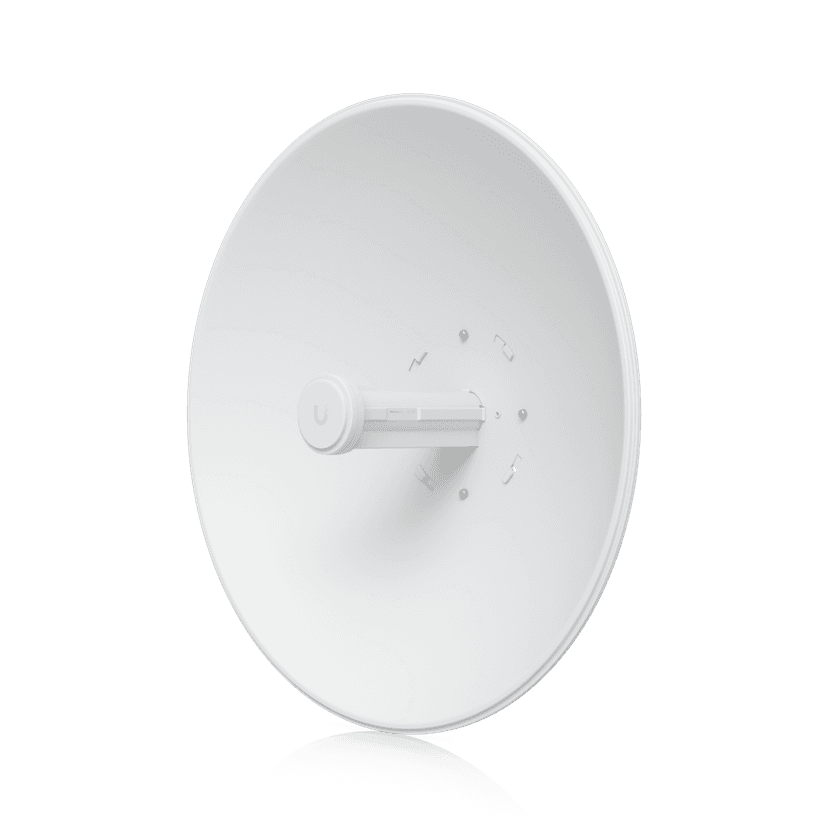
Band: 5 GHz
Antenna gain: 27 dBi
Ethernet: 1 × Gigabit RJ45
Direct answer for buyers
The Ubiquiti airMAX PowerBeam 5AC 500 is a 5 GHz outdoor wireless bridge with an integrated high-gain reflector. It is mainly used to create a directional network link between two locations or to serve compatible stations from an appropriately planned access point. Businesses should consider it when fibre installation is difficult, expensive or slow, but a clear radio path is available. Before proceeding, confirm the exact topology, link distance, Fresnel-zone clearance, required throughput, local spectrum rules, interference levels, mounting strength, power method, surge protection and whether the deployment requires two matching radios. Performance is not determined by the product alone; site conditions and engineering quality are equally important.
What it does
PBE-5AC-500 combines a 5 GHz radio, airMAX AC processing, a 27 dBi dual-linear antenna and a 500 mm reflector in one outdoor unit. The directional antenna concentrates radio energy toward the remote endpoint rather than distributing it broadly. This makes the device suitable for links that must cross a campus, industrial yard, road, farm, construction area or other gap where a cable route is difficult. It can bridge Ethernet traffic between locations and supports routing, DHCP, traffic shaping, SNMP, SSH, web management and link statistics. The design is not a replacement for careful engineering. Reliable results depend on line of sight, mounting rigidity, channel selection, legal transmit settings and correct alignment.
Who it suits
The product may suit IT departments connecting separate buildings, system integrators designing surveillance backhaul, wireless service providers, logistics operators, education campuses, farms, hospitality compounds, utilities and project teams that require a dedicated outdoor wireless path. It is most appropriate where each endpoint can be mounted securely with clear visual and radio clearance. It may be a poor choice where high-rise obstruction, dense foliage, severe co-channel interference, unstable poles or uncertain licensing conditions prevent a dependable 5 GHz path. Buyers should also avoid selecting it solely by quoted range; a link budget and site survey are more useful than a distance figure taken out of context.
Business problems the PowerBeam 5AC 500 can help address
No practical fibre route
Some sites are separated by roads, leased property, landscaping, temporary structures or ground conditions that make trenching costly. A properly designed wireless bridge can provide Ethernet connectivity without a continuous physical cable between the buildings.
Remote surveillance backhaul
Cameras, recorders or access-control points at a remote gate, yard or perimeter may need a network path back to the main site. The PowerBeam can carry that traffic when capacity, latency and reliability have been checked against the application.
Temporary or phased projects
Construction offices, events, field operations and phased developments may need connectivity before permanent civil works are complete. A wireless bridge can be moved or repurposed, although mounting, power, weather exposure and spectrum conditions must still be treated as permanent engineering concerns.
Campus network extension
Schools, warehouses, clinics, hotels and offices often occupy more than one building. A point-to-point link can extend VLANs, internet access, voice or management traffic, provided the design includes suitable switching, security and bandwidth controls.
Capability overview
Product-fit matrix
| Requirement | Suitable when | Confirm before ordering |
|---|---|---|
| Building-to-building bridge | Endpoints have clear line of sight and stable mounting | Distance, Fresnel clearance, throughput and paired quantity |
| CCTV backhaul | Camera bandwidth and latency fit the designed link capacity | Camera count, bitrate, retention architecture and redundancy |
| Longer directional path | A 27 dBi antenna is appropriate for the planned path | Link budget, legal EIRP and interference survey |
| Point-to-multipoint station | The access point and software mode are compatible | Sector design, subscriber count and channel plan |
| Harsh outdoor location | Pole, grounding and environmental planning meet site needs | Wind exposure, corrosion risk, surge protection and maintenance access |
Verified technical information
The following values are specific to the PBE-5AC-500 model. Regional operating frequencies and legal power limits may differ. Buyers should confirm the exact UAE configuration and any project-specific accessories before purchase.
| Brand | Ubiquiti |
|---|---|
| Product name | airMAX PowerBeam 5AC 500 |
| Model | PBE-5AC-500 |
| Product type | Outdoor 5 GHz directional wireless bridge |
| Antenna gain | 27 dBi |
| Polarisation | Dual-linear |
| Frequency range | Worldwide 5150–5875 MHz; actual use is region dependent |
| Channel bandwidth | PtP: 10/20/30/40/50/60/80 MHz; PtMP: 10/20/30/40 MHz |
| Network interface | 1 × Gigabit Ethernet RJ45 |
| Power method | Passive PoE, 2-pair |
| Included power supply | 24 V, 0.5 A Gigabit PoE adapter |
| Supported voltage | 20–27 V DC |
| Maximum power consumption | 8.5 W |
| Dimensions | Without radome: 520 × 520 × 308 mm; with radome: 525 × 525 × 315 mm |
| Weight | Without radome: 2.35 kg; with radome: 3.2 kg |
| Mounting | Pole mount included |
| Wind survivability | 96 km/h, subject to correct installation and site conditions |
| Operating temperature | −40 to 70 °C |
| Operating humidity | 5–95% non-condensing |
| Management and services | Web management, SSH, SNMP, discovery, bridging, routing, DHCP, ping watchdog and traffic shaping |
| Availability | Contact FourTeck for current UAE options, quantity and lead time |
Compatibility, regulatory and deployment dependencies
The PBE-5AC-500 should not be treated as a plug-and-play replacement for every outdoor link. Its airMAX AC operation is intended for compatible Ubiquiti outdoor wireless designs, and interoperability expectations should be reviewed when the remote endpoint is from another family or manufacturer. Channel availability, permitted frequencies, transmit power and dynamic frequency selection requirements can vary by country. The selected settings must comply with UAE regulations and the conditions of the actual deployment.
A pair of units is normally required for a dedicated point-to-point bridge unless one side already has a compatible access point. The included PoE adapter provides power, but it does not replace proper earthing, Ethernet surge protection, weatherproof cable entry, outdoor-rated cabling or a stable AC supply. Sites with rooftop exposure, long cable runs or frequent electrical disturbances should include a clear grounding and protection plan. An optional radome may change dimensions and wind behaviour; availability and compatibility should be confirmed as part of the bill of materials.
From requirement to working link
Define the traffic
Document current and future bandwidth, VLANs, camera streams, voice traffic, management access and any service-level expectations. This prevents selecting the radio only by range.
Survey the path
Check line of sight, Fresnel-zone clearance, roof access, pole positions, cable routes, power, grounding and nearby 5 GHz activity. Seasonal foliage and future construction should be considered.
Prepare the design
Calculate the link budget, select channel width, confirm legal limits, choose mounting and protection components, and decide whether redundancy is necessary.
Install and align
Mount both endpoints securely, weatherproof the cabling, apply grounding, align accurately and verify signal quality rather than relying on visual aiming alone.
Test and document
Measure throughput, latency, packet loss and stability under load. Record configuration, management addresses, passwords, channel settings, cable routes and maintenance access.
Directional performance and link engineering
The principal advantage of the PowerBeam 5AC 500 is not simply that it operates at 5 GHz. Its value comes from concentrating the radio beam through a large integrated reflector. This directional behaviour can improve the desired signal at the far end and reduce reception of some off-axis interference. It also means the installation is less forgiving of poor alignment than a broad-coverage access point. A small movement at the mounting point can produce a significant change at the remote endpoint, particularly on longer paths.
A buyer should therefore assess the complete path rather than purchasing two radios and hoping the signal will be sufficient. Clear visual line of sight is helpful but not always enough. The Fresnel zone, an elliptical area around the direct signal path, should also remain substantially clear. Buildings, cranes, trees, terrain and even roof edges can intrude into this zone and reduce stability. The effect may appear as lower modulation rates, packet retries, fluctuating throughput or failures during weather changes.
Channel width is another design decision. Wider channels can support higher peak throughput but consume more spectrum and are more exposed to interference. Narrower channels may provide better noise tolerance and spectral reuse at the cost of lower capacity. The correct setting depends on the application, local noise floor, path length and regulatory limits. FourTeck can help the buyer turn traffic requirements and site details into a practical radio plan instead of treating the maximum published rate as a guaranteed result.
Management, monitoring and operational control
Outdoor wireless links become part of the organisation’s network infrastructure and should be managed with the same discipline as switches, routers and firewalls. The PBE-5AC-500 provides web access, SSH, SNMP, discovery, traffic shaping and useful statistical reporting. These functions can help an administrator review link uptime, data rates, Ethernet status, packet errors and estimated wireless distance. Monitoring should be configured before the link becomes business critical, not after the first interruption.
A sensible operational design includes unique administrative credentials, restricted management access, documented firmware status, configuration backups and a defined process for changes. The radio management network should be separated where practical from user traffic. Organisations should also decide who is responsible for monitoring, how alerts will be handled and what information must be collected before a support case is raised. A link may still pass traffic while performance is deteriorating, so trends in signal quality, noise, retransmissions and modulation can be more valuable than a simple up-or-down status.
Traffic shaping and quality-of-service controls can help where the wireless path carries mixed workloads, but these settings should align with the wider network. Prioritising voice on the radio will not solve congestion elsewhere. Likewise, bridging remote networks can be convenient but may extend broadcast domains and security exposure. Buyers should decide whether the link will operate as a transparent bridge, a routed boundary or part of a larger managed topology before configuration begins.
Outdoor installation, power and resilience
The radio’s outdoor enclosure and broad operating-temperature range support demanding environments, but product ratings do not remove the need for good installation practice. The pole must be rigid enough to prevent movement, and its loading must be reviewed for local wind exposure. Rooftop parapets, lightweight masts and improvised brackets may flex or vibrate, causing alignment drift. The mounting location should also provide safe maintenance access without placing technicians near unprotected edges or electrical hazards.
The included 24 V passive PoE adapter powers the radio over Ethernet. Passive PoE is not the same as standards-based automatic PoE negotiation, so the installer must connect the correct injector and port. Outdoor-rated, UV-resistant cable should be used for exposed runs, with proper drip loops and sealed entry points. Ethernet surge protection and grounding should be included according to the building design and site risk. Cable length, route, bend radius and proximity to high-voltage equipment can all affect reliability.
Business continuity requirements should determine whether a single wireless path is sufficient. A warehouse office may tolerate a short interruption, while a security control room or production facility may need a backup route. Redundancy can involve a second wireless path, a different frequency, a wired service, cellular backup or a network design that allows rapid failover. The appropriate option depends on the consequence of downtime, not only the cost of the radio hardware.
Ideal environments and practical use cases
Warehouses and logistics yards
Connect administration blocks, gatehouses, remote storage areas or security infrastructure across a large property where cable routes are difficult. Confirm vehicle movement, cranes and future structures do not obstruct the path.
Education and corporate campuses
Extend network services between separate buildings while retaining central internet, security and management policies. Capacity should be sized for user density and peak usage, not only average traffic.
Remote CCTV locations
Carry camera traffic from perimeter poles, entrances or isolated compounds. The design should calculate aggregate bitrate, recording peaks, multicast behaviour and maintenance access.
Farms and utility sites
Link pumps, monitoring stations, offices or remote operational points across open land. Power quality, lightning exposure, dust, heat and long-term mounting stability are important.
Hospitality compounds
Provide backhaul between buildings, staff areas or service facilities. The wireless bridge should be integrated with guest-network segmentation, switching and internet capacity planning.
Temporary project offices
Establish a network path during construction or phased occupancy. Temporary use still requires safe mounting, approved spectrum settings, weather protection and documented ownership.
Integration and operational considerations
The PowerBeam link sits between network segments, so buyers should define how it interacts with switching, routing, firewalls, VLANs, DHCP, monitoring and security policy. A transparent bridge may be simple, but it can also carry broadcasts and extend faults between locations. A routed design can create clearer boundaries but requires addressing and route planning. For surveillance, the link must be evaluated with camera bitrate, codec behaviour and recorder placement. For voice, latency and jitter matter. For office access, peak user demand and cloud application traffic should be considered.
Firmware compatibility should be checked across all radios in the topology, particularly when integrating with an existing airMAX network. Configuration changes should follow a maintenance process because an incorrect channel, country setting, management address or network mode can make a remote unit difficult to reach. It is useful to maintain an out-of-band recovery plan or physical access method for each endpoint. Where the wireless path carries sensitive business traffic, encryption and higher-layer security controls should be reviewed as part of the complete network rather than assumed from the bridge alone.
Buyer questions to resolve before ordering
The answer determines radio quantity, access-point compatibility, channel planning and capacity assumptions.
Provide endpoint coordinates, mounting heights and known obstructions so the path can be assessed properly.
State current traffic, expected growth and peak loads rather than selecting solely from the maximum quoted rate.
The business impact determines whether backup connectivity, spare hardware or enhanced monitoring is justified.
Confirm access, safety, alignment tools, cabling, grounding, configuration and future support responsibility.
Frequency availability and permitted transmit settings must match the destination and regulatory requirements.
Procurement and evaluation checklist
☐ Exact model confirmed as PBE-5AC-500
☐ Required quantity and topology confirmed
☐ Endpoint coordinates and mounting heights provided
☐ Line of sight and Fresnel clearance reviewed
☐ Required throughput and application traffic documented
☐ Local 5 GHz spectrum conditions assessed
☐ Country and regulatory settings confirmed
☐ Pole, bracket and wind-loading requirements checked
☐ Outdoor Ethernet cable and connector protection included
☐ Grounding and surge protection included
☐ Power source and PoE location confirmed
☐ Radome or other accessories confirmed where required
☐ Installation, alignment and configuration scope defined
☐ Monitoring, backup and support expectations agreed
How FourTeck can assist
FourTeck can support the purchasing process by clarifying the application, confirming the exact model, reviewing the intended topology and identifying the information needed for a useful quotation. For a simple building-to-building bridge, this may include endpoint distance, mounting height, line of sight, required capacity, available power and whether installation is required. More complex projects may also need channel planning, VLAN design, CCTV traffic review, redundancy choices, remote management requirements and a documented bill of materials.
The assistance can be scoped around supply only, supply with configuration, installation planning or a broader network project. Buyers should state which responsibilities remain with their internal team and which should be included in the quotation. FourTeck can also help compare the PBE-5AC-500 with nearby Ubiquiti options where size, gain, isolation, management features or range requirements differ. Compatibility should be confirmed before substituting one model for another.
For general networking and infrastructure enquiries, visit the FourTeck product portfolio. Projects that require installation, configuration or wider network assistance can be discussed through the technology services team. Buyers can also review FourTeck business technology solutions or send the requirement directly through the Dubai contact page.
UAE availability and support guidance
Contact FourTeck to confirm current UAE availability for the Ubiquiti airMAX PowerBeam 5AC 500. Availability may depend on quantity, model revision, destination, vendor lead time and whether accessories such as radomes, surge protectors, outdoor cable or mounting components are required. Delivery and project coordination can be discussed after the exact requirement has been confirmed. Installation and configuration should be included in the quotation when the customer needs site survey, mounting, cabling, alignment, channel planning or handover documentation.
For projects in Dubai, Abu Dhabi, Sharjah and Ajman, buyers should provide the site addresses, endpoint count, expected timeline and access conditions. Rooftop permissions, working-at-height rules, building management approvals and cable-route access can affect the installation plan. A supply-only quotation may not include these services, so they should be requested explicitly. Current price, warranty terms and delivery timing must be confirmed against the exact quotation rather than assumed from online listings.
GCC availability
FourTeck can assist organisations planning PowerBeam 5AC 500 deployments across GCC markets by reviewing the intended application, destination country, quantity and project schedule before quotation. A wireless bridge selected for the UAE may require different regulatory settings, power arrangements, documentation or delivery planning when used in Saudi Arabia, Kuwait, Qatar, Bahrain or Oman. Buyers should share the exact model, number of endpoints, required accessories, link distances, installation environment and whether configuration or site support is expected. Product availability, legal radio channels, delivery schedules, service visits and vendor lead times can vary by country and requirement. FourTeck can coordinate model confirmation, bill-of-material guidance, quotation preparation and deployment planning, but local approvals, customs arrangements and site access should be confirmed by the buyer. For Kuwait enquiries, the FourTeck Kuwait technology page can provide a regional starting point.
Africa availability
Organisations in Africa can contact FourTeck for guidance on PBE-5AC-500 procurement, accessories, link planning, configuration scope and regional fulfilment. Outdoor wireless projects often vary significantly by destination because power quality, tower access, local spectrum rules, shipping arrangements, corrosion exposure, support coverage and installation resources are not the same in every market. Buyers should provide the destination country, quantity, deployment coordinates, expected link distance, required completion window and any need for installation or remote support. Availability and lead time may depend on the model, vendor supply, shipping route and local project conditions. FourTeck does not assume that one design will suit every site. East African enquiries can be coordinated through FourTeck Kenya or FourTeck Uganda, while broader regional requests can use the FourTeck Africa technology portal.
Related products and services to consider
Matched second endpoint
A dedicated point-to-point bridge normally needs a compatible radio at each end. Confirm whether the quotation is for one unit or a complete pair.
Surge and grounding components
Outdoor Ethernet protection and proper grounding reduce risk from electrical events. Selection depends on the building and cable route.
Outdoor cabling
Use suitable UV-resistant cable, weatherproof terminations and an installation method appropriate for rooftop or mast exposure.
Wireless link survey
A path and spectrum assessment can identify obstructions, interference, mounting options and realistic performance expectations.
Installation and alignment
Professional mounting, cable protection, grounding, alignment and testing can be included as a separate project scope.
Alternative airMAX models
Smaller, isolated or newer-generation options may fit different path, interference or management requirements. Compare only after the site need is clear.
Why businesses contact FourTeck
Business buyers often need more than a part number. They need confidence that the selected model fits the distance, capacity, topology, environment and support plan. FourTeck can help translate a project description into a structured requirement, identify missing information and coordinate a quotation that distinguishes hardware, accessories, installation and configuration. This reduces the risk of receiving a supply-only price when the project actually requires mounting, cable work, grounding, alignment and testing.
FourTeck can also help evaluate whether the PowerBeam 5AC 500 is the right product or whether another model, frequency, antenna format or connectivity method should be considered. The recommendation depends on the site and should not be based on brand familiarity alone. For company background, visit the FourTeck about page. For a project-specific response, use the contact page and include the model, quantity, site locations, expected throughput and desired installation scope.
Frequently asked questions
What is the PBE-5AC-500 mainly used for?
It is mainly used as an outdoor directional 5 GHz wireless bridge for connecting remote network locations. Typical applications include building-to-building links, CCTV backhaul, campus extensions and service-provider access. The final use should be based on a link design rather than the product name alone.
Do I need two PowerBeam units?
A dedicated point-to-point link normally requires a compatible radio at each endpoint. One unit may be sufficient only when the other side already has a suitable access point or bridge. Confirm the topology and quantity before ordering.
Is 450+ Mbps guaranteed on every link?
No. The figure is a vendor-stated throughput class under suitable conditions. Actual performance depends on distance, channel width, interference, signal quality, alignment, regulations, firmware, traffic type and endpoint configuration.
Does the unit include a PoE adapter?
The official specification lists a 24 V, 0.5 A Gigabit passive PoE adapter as included. Confirm the contents of the current regional package and any additional surge-protection requirements in the quotation.
Can it be installed on any pole?
No. The pole and bracket must be suitable for the radio’s size, weight and wind exposure. Movement can degrade alignment. Structural suitability, safe access and local mounting conditions should be reviewed by the installer.
Is the PBE-5AC-500 suitable for CCTV?
It can be suitable for CCTV backhaul when the aggregate camera bitrate, latency, packet-loss tolerance and recording design fit the engineered link. Camera count alone is not enough to size the connection.
Does it require a software subscription?
The base radio functions are not described as requiring a subscription in the official product specification. However, broader management, support or service arrangements may have separate requirements. Confirm the desired management platform and project scope.
What information is needed for a quotation?
Provide the exact model, quantity, endpoint locations, link distance, mounting heights, required throughput, application type, installation location, accessory needs and whether configuration, alignment or onsite work is required.
Is the PowerBeam 5AC 500 available in Dubai?
Contact FourTeck to confirm current UAE availability, quantity, price and lead time. Availability can change by model revision, vendor supply, quantity and required accessories.
Can FourTeck include installation and configuration?
Installation, alignment, cabling, grounding, configuration and testing can be discussed as part of the requirement. The exact scope depends on site access, distance, mounting conditions, network design and customer responsibilities.
Plan the link before purchasing the radios
Share the endpoint locations, link distance, required throughput, application, quantity and installation scope. FourTeck can help confirm whether PBE-5AC-500 fits the project and prepare a quotation with the required accessories and services.

Reviews
There are no reviews yet.