

Ubiquiti PowerBeam 5AC 300 ISO PBE-5AC-300-ISO in Dubai, UAE
A focused outdoor wireless bridge with a 300 mm RF-isolated reflector, designed for point-to-point and compatible point-to-multipoint client links where directional coverage, interference control and practical deployment matter.
Direct answer for buyers
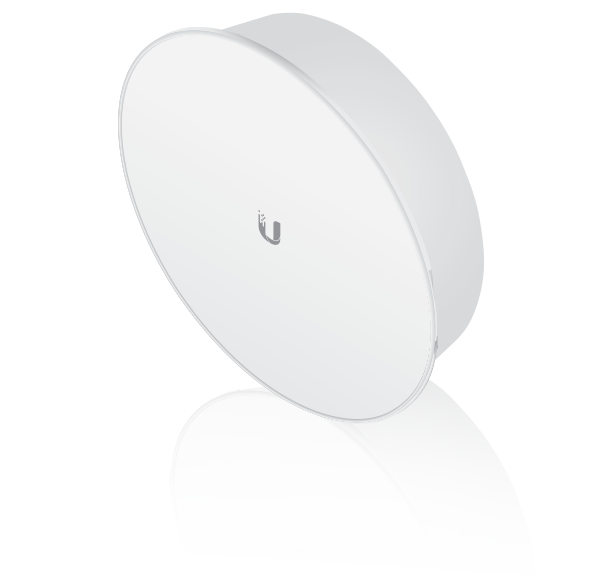
The Ubiquiti PowerBeam 5AC 300 ISO is an outdoor 5 GHz wireless bridge that combines an airMAX ac radio, a 22 dBi directional antenna and an RF-isolated 300 mm reflector in one assembly. It is mainly used to connect two sites wirelessly or serve as customer-premises equipment in a compatible airMAX network. It suits buyers who need a focused radio path and want better rejection of nearby RF energy than an open reflector can provide. Before proceeding, confirm clear line of sight, the required path performance, local frequency rules, the remote-end radio, mounting strength, cable and earthing design, and whether this exact earlier model remains the right choice compared with current PowerBeam options.
What it does
The PBE-5AC-300-ISO creates a narrow, directional 5 GHz wireless path. In a point-to-point arrangement, one radio is installed at each end and both are aligned toward one another. The link can carry Ethernet traffic between buildings, remote facilities or network distribution points. In a point-to-multipoint design, it can operate as a compatible client station connected to an airMAX ac access point, subject to network design and software compatibility.
Its integrated feed and reflector avoid a separate radio-to-antenna RF cable, reducing cable-loss concerns and simplifying the mechanical assembly. The isolator structure and metal-shielded rear design are intended to reduce unwanted RF pickup from the sides and rear, which can be useful at towers, rooftops and shared sites where several 5 GHz radios operate close together.
Who it suits
This model may suit wireless internet service providers, industrial operators, schools, hospitality properties, construction compounds, warehouses, farms, surveillance projects and enterprises needing a directional outdoor backhaul or last-mile link. It is most relevant when a buyer already uses airMAX technology or has a design that specifically calls for this model.
It is not automatically the correct choice for every outdoor link. A long path, high interference level, very high capacity requirement, non-line-of-sight route, licensed-frequency design or modern multi-gigabit backhaul may require a different radio, antenna size or frequency band. FourTeck can review the intended topology before the bill of materials is finalised.
Business challenges this model can help address
Connecting separated buildings
A directional bridge can extend a LAN between buildings without trenching a new cable, provided there is a suitable path, mounting location and lawful radio plan.
Reducing co-location interference
The RF-isolated reflector focuses energy and helps reject signals arriving outside the intended beam, which can improve link conditions at busy radio sites.
Reaching remote assets
Remote cameras, access-control systems, production areas and branch facilities can be connected where a physical cable route is impractical or too disruptive.
Standardising an airMAX estate
Organisations with an existing compatible airMAX environment may prefer a familiar management model, installation method and replacement strategy.
Core capabilities in practical terms
A 22 dBi dual-polarised antenna concentrates the wireless link toward the intended endpoint.
The reflector and rear shielding are designed to improve noise rejection in co-location environments.
A single 10/100/1000 Ethernet port carries network traffic and passive PoE power.
UV-stabilised enclosure, pole-mount hardware and radome support exposed installations when professionally deployed.
Product-fit decision matrix
| Requirement | Suitable when | Confirm before ordering |
|---|---|---|
| Building-to-building link | Both locations have clear line of sight and stable mounting points. | Path length, Fresnel-zone clearance, matching endpoint and target capacity. |
| Busy rooftop or tower | Directional isolation can help control off-axis interference. | Spectrum survey, channel availability, separation and grounding. |
| airMAX client station | The access point and configuration are compatible with the radio generation. | Firmware, protocol mode, channel width and network capacity plan. |
| Legacy replacement | An installed PBE-5AC-300-ISO must be replaced like for like. | Lifecycle status, firmware support and whether a current alternative is preferable. |
| Very high-capacity backhaul | Only when the verified design target is within the platform’s practical capability. | Real traffic requirement, latency target, fade margin and alternative newer platforms. |
Verified technical information
The following values relate specifically to the PBE-5AC-300-ISO. They should not be blended with the larger 400 mm or 500 mm PowerBeam ac ISO variants. Regional frequency permissions and usable output power remain subject to local regulation and installer configuration.
| Brand | Ubiquiti |
|---|---|
| Product name | PowerBeam 5AC 300 ISO |
| Model | PBE-5AC-300-ISO |
| Product type | Outdoor 5 GHz airMAX ac wireless bridge / CPE |
| Dish reflector | 300 mm RF-isolated reflector with protective radome |
| Antenna gain | 22 dBi |
| Polarisation | Dual linear |
| Frequency range | Worldwide hardware range 5150–5875 MHz; permitted channels are region dependent |
| Networking interface | 1 × 10/100/1000 Ethernet port |
| Power method | 24 V passive PoE, pairs 4/5 positive and 7/8 return |
| Power supply | 24 V, 0.5 A Gigabit PoE adapter listed as included in the original package |
| Supported voltage range | 20–26 VDC |
| Maximum power consumption | 5.5 W |
| Processor and memory | Atheros MIPS 74Kc at 560 MHz; 64 MB DDR2; 16 MB flash |
| Channel widths | PtP: 10/20/30/40/50/60/80 MHz; PtMP: 10/20/30/40 MHz |
| Dimensions | 364 × 364 × 276 mm with radome |
| Weight | 2.55 kg with mount |
| Mounting | Pole-mount kit included in the original package; built-in mechanical tilt ±20° |
| Operating temperature | −40 to 70 °C |
| Operating humidity | 5% to 95% non-condensing |
| Wind survivability | 200 km/h, subject to correct structure and installation |
| Availability | Contact FourTeck for current UAE status, lead time and suitable alternatives |
Compatibility, lifecycle and prerequisite notice
The PBE-5AC-300-ISO is an earlier PowerBeam ac ISO model. Buyers should not assume that a current Ubiquiti product with a similar name is mechanically, electrically or operationally identical. Confirm the exact part number, firmware path, remote-end compatibility, replacement objective and regional frequency configuration. A point-to-point link normally needs a properly matched radio at both ends; one device alone does not create a complete bridge.
The radio uses 24 V passive PoE rather than standards-based 802.3af or 802.3at PoE. Connecting it to an unsuitable power source can cause failure. The original package documentation lists a 24 V, 0.5 A Gigabit PoE adapter, but the contents of any current supplier package should be checked before purchase. Outdoor shielded cable, surge protection, earthing, weatherproof routing and suitable mast strength are deployment requirements, not optional cosmetic details.
A practical purchase and deployment journey
Define the link objective
Specify what traffic the bridge will carry, the expected busy-hour throughput, acceptable latency, critical applications, endpoint locations and whether the link is primary, secondary or temporary.
Review the path
Check distance, elevation, line of sight, Fresnel clearance, seasonal obstructions, rooftop access, pole position and cable route. A visual line alone may not provide enough radio clearance.
Validate spectrum and regulation
Survey the 5 GHz environment, choose lawful channels and power settings, account for DFS requirements where applicable and avoid designing around a frequency that cannot be used at the destination.
Confirm the complete bill of materials
Include endpoint radios, compatible power equipment, outdoor cable, surge protection, grounding materials, mounts, poles, enclosure requirements, switching ports and any installation or access equipment.
Install, align and test
Mount securely, weatherproof connections, earth the system, align both ends, verify signal quality and modulation, test Ethernet performance, record settings and confirm stability under realistic traffic.
Why RF isolation matters on shared sites
Outdoor wireless performance is determined by more than transmit power and antenna gain. A receiver can be affected by energy from nearby radios, reflections, overlapping channels and strong off-axis signals. On a clean rural path, this may be manageable. On a tower, hotel roof, industrial estate or city building, the radio may sit close to other access points, sector antennas and backhaul links. The PowerBeam ac ISO design uses a reflector isolator and a metal-plated rear housing to reduce exposure to unwanted energy arriving outside the intended direction.
For a buyer, the practical value is not a promise that interference disappears. It is a design measure that can improve the signal-to-noise environment when compared with a less isolated mounting arrangement. Results still depend on channel planning, physical separation, antenna alignment, nearby transmit levels and the spectrum conditions at both ends. A survey remains important, particularly when the link must carry voice, video, surveillance or operational traffic.
The 300 mm reflector also creates a narrower pattern than a compact panel radio, which helps focus the link but makes accurate alignment more important. Installers should use live signal data, noise measurements and capacity testing rather than relying only on visual aiming. The final alignment should be secured so that wind or maintenance activity does not shift the antenna.
Capacity, channel width and realistic expectations
The PowerBeam ac platform was designed to provide substantially higher throughput than earlier airMAX generations, and product-family documentation describes up to 450+ Mbps real TCP/IP throughput under suitable conditions. That figure should be treated as a platform capability rather than a guaranteed result for every PBE-5AC-300-ISO link. Real performance is shaped by signal level, noise floor, channel width, modulation, path quality, Ethernet conditions, software version, traffic direction and regulatory settings.
Wider channels can support more capacity but consume more spectrum and are generally more exposed to interference. Narrower channels can improve spectral efficiency and link robustness in difficult environments, but they reduce peak throughput. The model supports multiple channel widths for point-to-point use, allowing the installer to balance capacity and stability. Choosing the widest setting by default is not always the best engineering decision.
A procurement team should translate the business requirement into measurable targets. Instead of asking only whether the radio can connect two sites, define the required committed throughput, peak throughput, number of cameras or users, application sensitivity and expected growth. A link carrying office internet access has a different profile from one transporting many high-resolution camera streams. FourTeck can use these details to assess whether this model is suitable or whether a newer or larger platform should be considered.
Power, cabling and outdoor installation discipline
The PBE-5AC-300-ISO receives power through its Ethernet cable using 24 V passive PoE. This simplifies the rooftop installation because the radio does not require a mains outlet at the antenna, but it places responsibility on the designer to use the correct injector, cable and grounding method. Passive PoE is polarity and voltage specific. The installer should verify the label and wiring before energising the device.
Shielded outdoor-rated Category 5e or better cable is recommended for exposed runs. The cable should be routed with suitable drip loops, protected from sharp edges and excessive bending, and secured without crushing the jacket. Outdoor Ethernet is vulnerable to electrostatic discharge and surge events, so proper earthing and surge-protection planning are essential. The PoE injector should be installed in an appropriate indoor or protected location with access for maintenance.
Mounting hardware must be attached to a pole or structure that can withstand the antenna’s wind load. Although the product documentation lists wind survivability up to 200 km/h, that does not mean every pole, bracket, wall anchor or roof structure can support the resulting force. Structural suitability, corrosion exposure and local building conditions must be reviewed. Professional installation is especially important on elevated sites and where falling equipment could create a safety risk.
Management, monitoring and operational control
The radio is configured through the airOS platform used by its generation. Administrators can set wireless mode, frequency, channel width, power, security and network parameters, and can review signal, noise and link statistics. Diagnostic tools such as spectrum analysis and cable testing are useful during commissioning and troubleshooting, though available functions depend on firmware and hardware support.
Operationally, the device should be integrated into a documented monitoring process. Record its management address, credentials, firmware version, installation location, antenna direction, channel plan and remote endpoint. Establish who is responsible for updates and what maintenance window is available. A wireless bridge may operate quietly for long periods, but undocumented settings become a problem when a radio fails or a new administrator takes over.
Firmware should not be changed without considering compatibility with the opposite endpoint and the wider airMAX network. Because this is an earlier model, buyers should confirm the current firmware path and support expectations before deploying it in a new critical link. Where a replacement project is being planned, it may be better to evaluate both like-for-like restoration and a coordinated upgrade of both ends.
Suitable environments and use cases
Enterprise campus links
Connect an office, warehouse, workshop or gatehouse to the main network when civil works are difficult and a clear outdoor path is available.
Surveillance backhaul
Carry IP-camera traffic from a remote pole, perimeter zone or secondary building after bandwidth, power and resilience requirements are calculated.
Hospitality and property sites
Extend connectivity between blocks, service areas or staff facilities where trenching would disturb operations or finished landscaping.
Industrial compounds
Link production, storage or utility areas while accounting for metal structures, cranes, moving obstructions and local RF noise.
WISP client access
Use as a directional customer-premises radio in a compatible airMAX ac network where the access-point design and firmware are confirmed.
Temporary project connectivity
Support construction or event sites when the mount, power, security, path and later removal plan are included in the project scope.
Integration and operational considerations
A wireless bridge becomes part of the Ethernet network, so its design must account for switching, VLANs, addressing, spanning tree, broadcast traffic and security boundaries. Decide whether the link will transparently bridge one or more VLANs, whether management traffic should be separated and what happens if the wireless path fails. Connecting two networks without considering loop prevention can create a serious outage.
For surveillance deployments, calculate both average and peak camera traffic and consider recording behaviour during link interruptions. For voice or real-time control, examine latency and jitter under load. For internet extension, apply appropriate firewall and access policies at the network edge rather than assuming the radio itself replaces a security gateway. FourTeck’s technology services can be discussed when the requirement includes installation, configuration or wider network integration.
Power resilience may also matter. A PoE injector connected to an unprotected socket will stop during an outage even if the remote facility has backup power. Where continuity is important, include UPS capacity at both ends and verify how the upstream switches and routers behave. A complete link design considers every dependency, not just the two antennas.
Buyer questions to resolve before requesting a quote
A replacement may require exact compatibility, while a new project should compare current alternatives.
Share coordinates, mounting heights and known obstructions so the link can be assessed properly.
Specify real traffic targets rather than only the internet package speed at one location.
Confirm the matching radio, access point or replacement endpoint and its firmware generation.
A crowded 5 GHz site may require survey data, narrower channels or a different band.
Include access, working-at-height, cabling, grounding, alignment, testing and documentation responsibilities.
Procurement checklist
How FourTeck can assist
FourTeck can help turn a model request into a complete procurement requirement. Assistance can include checking whether PBE-5AC-300-ISO is the exact product needed, discussing current alternatives, reviewing quantities, identifying compatible power and mounting components, and coordinating a quotation. For projects rather than simple replacement purchases, the conversation can also cover path information, installation access, configuration scope, testing and documentation.
Buyers can explore the broader FourTeck technology product range, review available deployment and support services, or contact the team through the Dubai technology sales contact page. The quotation should clearly state the selected model, included accessories, installation scope, delivery destination and any current lead-time dependency.
UAE availability and support guidance
Contact FourTeck to confirm current UAE availability of the Ubiquiti PBE-5AC-300-ISO. Because this is an earlier PowerBeam ac ISO model, supply may depend on remaining channel inventory, vendor lead time, quantity and region. FourTeck can also discuss a suitable current replacement where exact model availability is limited or where a new deployment would benefit from a newer platform.
For projects across Dubai, Abu Dhabi, Sharjah and Ajman, requirement review can include delivery coordination, installation access, cable routing, mounting, configuration and testing. These services should be defined in the quotation rather than assumed to be included with the hardware. Buyers should share the site location, number of links, endpoint details, required completion window and whether working-at-height access or after-hours coordination is needed.
GCC Availability
FourTeck can assist organisations planning PowerBeam or wider outdoor wireless projects across the GCC, including the United Arab Emirates, Saudi Arabia, Kuwait, Qatar, Bahrain and Oman. The first step is to confirm whether the request is for the exact PBE-5AC-300-ISO, a legacy replacement, or a new link that should be evaluated against current Ubiquiti options. Product availability, lawful radio configuration, delivery planning, service visits and vendor lead times can vary by country, model and quantity. Buyers should provide the destination country, exact part number, number of units, link purpose, installation location, required timeline and any configuration or installation expectations. FourTeck can then coordinate a clearer quotation and identify dependencies such as passive PoE, outdoor cable, mounting, grounding and matching endpoint radios. For Kuwait-related enquiries, the FourTeck Kuwait resource may also support regional coordination. No local stock, customs outcome or fixed delivery date should be assumed until the exact requirement is reviewed.
Africa Availability
FourTeck can support product evaluation and procurement planning for organisations considering outdoor wireless links in Africa. The requirement may involve connecting offices, campuses, farms, industrial facilities, surveillance locations or service-provider sites, and each environment can have different path, power, mounting and regulatory conditions. Availability of the PBE-5AC-300-ISO may depend on the destination, quantity, remaining supply, vendor lead time and whether a current replacement is more practical. Buyers should share the destination country, exact model, number of endpoints, preferred deployment schedule, path distance and installation or support expectations. FourTeck can help review accessories, passive-PoE needs, outdoor cable, grounding and configuration scope before quotation. Regional information is available through FourTeck Africa, with additional resources for Kenya technology projects and Uganda technology requirements. Shipping, regulatory approval, customs processing and onsite service coverage must be confirmed for the specific project rather than presumed.
Related products, services and alternatives
Current PowerBeam 5AC ISO options
Consider newer PowerBeam 5AC ISO models when planning a fresh deployment or replacing both ends of an existing link.
Larger PowerBeam reflectors
Longer or more demanding paths may benefit from a higher-gain model, subject to link calculations and local rules.
Outdoor cabling and surge protection
Shielded cable, grounding components and suitable protection are necessary parts of a professional outdoor installation.
Wireless link assessment
Path review, spectrum checks and capacity planning reduce the risk of buying a radio that does not fit the site.
Installation and alignment
Professional mounting, grounding, aiming and performance testing can be included as a defined service scope.
Why businesses contact FourTeck
Businesses contact FourTeck when they need more than a model name on a quotation. Practical assistance includes clarifying whether the request is a like-for-like replacement or a new design, checking the bill of materials, identifying power and mounting requirements, reviewing compatibility, and separating hardware supply from installation and configuration services. This helps procurement teams compare quotations on the same basis and reduces omissions that can delay deployment.
FourTeck can also coordinate discussions around wider network dependencies, such as switches, UPS systems, firewall policies, VLANs and remote monitoring. The aim is to make the purchase decision clearer while leaving uncertain items—such as current availability, lifecycle position, warranty source and delivery timing—subject to confirmation. Learn more about FourTeck’s technology approach or submit project details through the contact page.
Frequently asked questions
What is the PBE-5AC-300-ISO used for?
It is used as a directional outdoor 5 GHz bridge for point-to-point links or as compatible client equipment in an airMAX ac point-to-multipoint network.
Does one unit create a complete point-to-point link?
No. A point-to-point bridge normally requires a compatible radio at each endpoint, correctly configured and aligned. Confirm whether one or two units are required for your project.
What is the antenna gain?
The PBE-5AC-300-ISO uses a 300 mm RF-isolated reflector with 22 dBi gain and dual-linear polarisation.
How is the device powered?
It uses 24 V passive PoE through the Gigabit Ethernet connection. The correct passive-PoE adapter and polarity must be used; it should not be treated as standard 802.3af/at PoE equipment.
Is the PoE adapter included?
Original product documentation lists a 24 V, 0.5 A Gigabit PoE adapter in the package. Confirm the contents of the specific current offer before ordering.
Can it be used in a crowded 5 GHz environment?
Its RF-isolated reflector is designed to improve off-axis noise rejection, but a spectrum survey and careful channel plan are still required. Isolation cannot eliminate all interference.
Is the model still current?
It is an earlier PowerBeam ac ISO model. Buyers should confirm current lifecycle, firmware and supply status and compare newer alternatives for new projects.
What information is needed for a quotation?
Provide the exact model, quantity, destination, link purpose, path distance, endpoint details, required capacity, installation scope and desired project timeline.
Can FourTeck assist with installation and configuration?
Installation, alignment, configuration and testing can be discussed and included as a defined quotation scope where required. Site conditions and access requirements must be reviewed.
How do I confirm Dubai or UAE availability?
Contact FourTeck with the quantity and destination. Availability may depend on remaining supply, vendor lead time and whether a current alternative is recommended.
Confirm the exact radio and deployment scope
Share the model, quantity, endpoint locations, path distance and installation requirements so FourTeck can prepare a clearer UAE quotation and identify any current replacement options.

Reviews
There are no reviews yet.