
Enterprise access switching for Dubai and UAE networks
HPE Aruba Networking CX 6200F 48G Switch Dubai
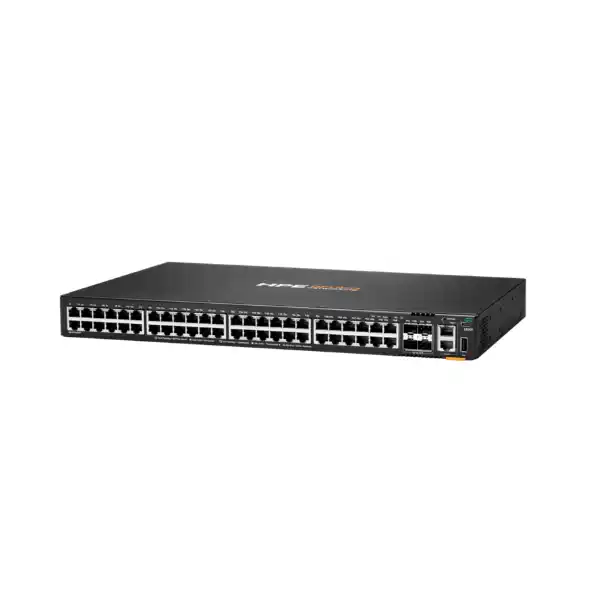
The HPE Aruba Networking CX 6200F 48G is a fixed-port access switch built for organizations that need forty-eight Gigabit Ethernet copper access connections, four 1/10G SFP+ uplink interfaces, AOS-CX management and the option to scale through Virtual Switching Framework stacking. It is especially relevant where endpoints do not need switch-delivered PoE and where network teams want a consistent CX operating model across branch or campus access layers.
Direct Answer: What Is the CX 6200F 48G?
The HPE Aruba Networking CX 6200F 48G is a fixed-configuration, non-PoE access switch in the CX 6200 family. It is mainly used to connect large groups of wired business endpoints at Gigabit Ethernet speeds while providing four 1/10G SFP+ interfaces for uplinks or stacking. It suits branch offices, campus access layers, business buildings and SMB environments that need 48 copper ports without paying for a PoE power budget they do not require. Before ordering, the most important checks are whether non-PoE access is correct, how the four SFP+ ports will be divided between uplinks and VSF links, and which optics, cables and management subscriptions are required. FourTeck can help map those requirements to the correct ordering revision, bill of materials and deployment plan.
Exact Product Identity and Buyer Context
The CX 6200F 48G sits in HPE Aruba Networking’s CX 6200 access-switch family. The “F” designation identifies the fixed-configuration branch of the family, as distinct from CX 6200M modular models with different resiliency and power-supply options. The 48G non-PoE version is designed around forty-eight copper Gigabit Ethernet access ports and four SFP+ uplink ports. Current HPE documentation shows more than one ordering revision for the 48G 4SFP+ configuration, including part-number revisions used in different ordering contexts. Because the product name supplied here does not identify a specific HPE part-number revision, the final vendor SKU should be confirmed during quotation rather than guessed.
That distinction matters in procurement. A buyer may describe the required device simply as “CX 6200F 48G,” but the bill of materials needs to capture the exact current regional orderable item, power-cord choice where applicable, transceivers or direct-attach cables, rack accessories, support coverage and any HPE Aruba Networking Central subscription that will be used. Treating the product name and the final orderable SKU as the same thing can create avoidable delays, particularly when a manufacturer introduces revision letters or region-specific orderability changes over the life of a switching family.
From a network-design perspective, this switch is best evaluated as an access-layer building block rather than a standalone box. The useful questions are how many copper endpoints must be connected, whether those endpoints need power from the switch, what uplink bandwidth is required, whether the network will be stacked, how routing boundaries are designed, and how the switches will be monitored and administered. Those factors determine whether the CX 6200F 48G is an efficient fit or whether a PoE, modular or higher-capacity alternative should be evaluated.
Who Should Consider This 48-Port Non-PoE Model?
The CX 6200F 48G is a practical candidate when a wiring closet needs a large number of conventional Gigabit Ethernet ports and the connected devices either have their own power supplies or receive power through another mechanism. Typical examples include desktop computers, workstations, printers, many servers or appliances with 1GbE interfaces, building-control devices that are independently powered, laboratory equipment, wired point-of-sale infrastructure with separate power, and downstream devices that do not draw IEEE PoE from the access switch.
It can also be attractive for organizations standardizing on AOS-CX because the operational model can align with other switches in the CX portfolio. Consistency can reduce the number of different command structures, monitoring approaches and lifecycle procedures that network teams need to maintain. The benefit is strongest when the organization already has a clear CX software policy, centralized configuration standards, naming conventions, VLAN architecture and monitoring process.
The switch is less suitable when a large proportion of endpoints are wireless access points, IP phones, surveillance cameras, badge readers or other devices expected to receive power from the Ethernet cable. In that case, choosing a non-PoE switch and then adding external injectors can complicate power planning, rack space, fault isolation and operations. The CX 6200 family includes 48-port Class 4 PoE options with different power budgets, and those should be compared when powered endpoints are central to the project.
It is also worth evaluating a different family when four 10G uplink ports are insufficient, when uplinks above 10GbE are required, when power-supply or fan redundancy is mandatory, or when the access layer needs capabilities and scale beyond the CX 6200 platform. A good procurement decision therefore starts with the network architecture rather than the port count alone.
Verified CX 6200F 48G Specifications
| Specification | CX 6200F 48G Detail |
|---|---|
| Manufacturer | HPE Aruba Networking |
| Product family | CX 6200 Switch Series |
| Configuration | 48G non-PoE fixed-port switch with 4 SFP+ uplink interfaces |
| Copper access ports | 48 x 10/100/1000BASE-T |
| Uplink ports | 4 x 1/10G SFP+ |
| Console / management interfaces | USB-C console, out-of-band management, USB Type-A host; Bluetooth adapter use supported for the CX mobile workflow |
| Switching capacity | 176 Gbps |
| Throughput capacity | Up to 130.9 Mpps |
| Average latency, 64-byte LIFO | Approximately 2.28 µs at 1 Gbps and 1.46 µs at 10 Gbps, as specified by HPE for the model |
| CPU | Quad-core ARM Cortex-A72 at 1.8 GHz |
| Memory / flash | 8 GB DDR4 and 16 GB eMMC |
| Packet buffer | 8 MB (6 MB + 2 MB) |
| VSF stack size | Up to 8 members, subject to supported models, software and stack design |
| Maximum stated stacking distance | Up to 10 km with appropriate long-range transceivers |
| Switched virtual interfaces | 128 dual-stack SVIs |
| IPv4 / IPv6 host tables | 8,192 IPv4 ARP entries and 8,192 IPv6 ND entries |
| Unicast route scale | 2,048 IPv4 routes and 1,024 IPv6 routes |
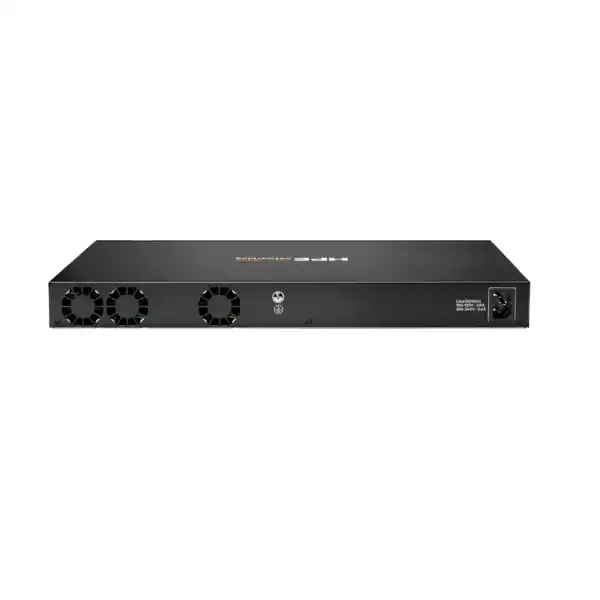
| Power supply / fans | Fixed power supply and fixed fans |
| Dimensions | 4.39 cm H x 44.2 cm W x 32.7 cm D |
| Weight | Approximately 4.45 kg |
Ordering revisions can change while the functional product name remains similar. The final quotation should therefore identify the current HPE orderable part, region-specific requirements, cable and optic selections, support coverage and management subscription separately.
Port Density, Uplinks and Why the Four SFP+ Ports Matter
Forty-eight copper ports make this switch useful where a single rack unit needs to aggregate a full access-layer patch-panel footprint. Port density alone, however, does not determine whether the design will perform well. The four SFP+ interfaces are strategically important because they can serve as 1GbE or 10GbE fiber uplinks, direct-attach inter-switch links in suitable rack layouts, or VSF stacking links. A design that consumes SFP+ ports for stacking has fewer of those interfaces remaining for northbound connectivity, so uplink and stack topology should be planned together.
For example, a resilient VSF ring commonly uses more than one link per switch to maintain stack connectivity through a member or link failure. If two of the four SFP+ interfaces are committed to the stack, the design team should confirm whether the remaining interfaces provide enough bandwidth and physical diversity for uplinks. The correct answer depends on traffic patterns, upstream switch architecture, link aggregation, redundancy expectations and the number of stacked members. A 48-port access switch can generate a much larger aggregate traffic demand than a single 10G uplink if many endpoints communicate northbound simultaneously, even though typical office utilization may be far below theoretical line rate.
Optics also need exact matching. “SFP+” describes the port class, not the final link. Fiber type, wavelength, reach, connector type, transceiver support, switch software compatibility and the optic at the opposite end all matter. For in-rack or adjacent-rack links, a supported DAC may be more practical. For building or campus fiber, the existing multimode or single-mode plant often determines which supported transceiver family should be considered. FourTeck can help translate the physical link requirement into the transceiver and cable portion of the bill of materials.
Non-PoE Design: An Important Selection Decision
The CX 6200F 48G configuration covered here is the non-PoE version. The forty-eight copper ports provide Ethernet connectivity but are not the right choice when the switch itself must supply operating power to PoE endpoints. This is not a minor specification: it can determine the entire wiring-closet power and endpoint architecture.
A non-PoE switch can be an efficient choice when most connected devices already have local power. It avoids purchasing a PoE power budget that will not be used and can simplify electrical planning for purely data-oriented endpoints. It can also work well when PoE is intentionally separated onto dedicated access switches, allowing the network team to keep powered devices such as wireless APs and cameras on a distinct switching block while general wired users occupy non-PoE ports.
The decision becomes less attractive when future expansion is expected to introduce large numbers of PoE devices. Adding midspan injectors later may solve individual cases but can create additional cabling, power adapters and operational complexity. Buyers should count current and planned PoE endpoints, identify the required IEEE power classes, consider the expected wireless refresh cycle and determine whether a PoE-capable CX 6200F model with an appropriate power budget would provide a cleaner lifecycle path. This assessment should happen before procurement because PoE capability is a hardware-selection decision, not a software feature that can be enabled later on a non-PoE model.
Switching Performance and Capacity in Practical Terms
HPE specifies 176 Gbps of switching capacity and up to 130.9 million packets per second for the CX 6200F 48G configuration. These figures indicate the forwarding capability of the platform, but they should be interpreted as part of a wider design rather than as a promise that every deployment will experience a particular application performance. End-to-end results depend on uplink sizing, oversubscription, server and endpoint capabilities, cabling quality, routing design, congestion behavior and the upstream network.
The model’s 48 Gigabit access ports can theoretically represent substantial edge bandwidth, while the uplink interfaces top out at 10GbE per SFP+ port. In normal office networks, user ports do not all sustain line-rate traffic simultaneously, so some oversubscription is expected and often appropriate. In media, engineering, backup-heavy, imaging, data-transfer or lab environments, however, traffic can be much more bursty or sustained. Those environments need a more deliberate uplink calculation.
The same reasoning applies to packet rate. Small-packet applications can place different forwarding demands on switching hardware than large sequential data transfers. HPE’s specified throughput gives a useful platform reference, but buyer decisions should be based on observed or forecast traffic. Where an existing switch is being replaced, interface counters, uplink utilization history, peak periods, broadcast levels and error statistics provide better sizing evidence than endpoint count alone. FourTeck can use those inputs to help determine whether a single 10G uplink, aggregated uplinks, a VSF design or another switch family is the more appropriate path.
AOS-CX Management and Operational Consistency
The CX 6200 family runs HPE Aruba Networking AOS-CX, the network operating system used across multiple CX switching platforms. For organizations already operating CX infrastructure, this can provide a more consistent approach to configuration, monitoring, software lifecycle and automation than introducing a switch from a different operating family. The practical value comes from standardization: consistent VLAN definitions, interface templates, access policies, logging, authentication, monitoring and change-control practices are easier to maintain when the underlying platform behavior is familiar.
The switch includes a USB-C console interface and an out-of-band management port. The console is useful for local installation, recovery and direct administrative access. Out-of-band management allows the management plane to be placed on a separate network path when the organization has dedicated management infrastructure. That separation can be valuable during troubleshooting because an administrator may retain management access even when the production data path is being reconfigured, subject to the surrounding management-network design.
HPE also documents use of a Bluetooth adapter with the CX mobile workflow. Whether that option should be included in a project depends on the installation process and current supported accessories. It should not be assumed to be included with every orderable revision. The procurement team should identify whether local console commissioning, mobile-assisted onboarding, centralized provisioning or a pre-staged configuration process will be used and make sure the necessary accessories, credentials and network reachability are available before the installation window.
Operations teams should also establish a firmware policy. Current HPE Aruba Networking Central documentation identifies supported and recommended AOS-CX software levels for the CX 6200 series, and those recommendations can change. A project should therefore validate the target software release during implementation rather than freezing an old release number into a long-lived bill of materials.
HPE Aruba Networking Central: Subscription and Management Considerations
The CX 6200 series can be managed through HPE Aruba Networking Central, but cloud management is not something to treat as an automatic no-cost property of the hardware. Current HPE licensing documentation uses Foundation and Advanced subscription tiers for switches, with the higher tier adding capabilities beyond the Foundation scope. A valid, appropriate switch subscription is required when onboarding and managing the switch through Central.
This has two procurement implications. First, the hardware purchase and the cloud-management entitlement should be planned as related but separate line items. Second, the subscription tier and term should be selected according to the management and architecture features actually required. Organizations using Central primarily for device management may have different requirements from environments adopting advanced campus-fabric or policy capabilities. Subscription naming, terms and feature packaging can evolve, so the current HPE ordering guide should be checked at quotation time.
Teams that do not intend to use Central should still define their local management and monitoring approach. AOS-CX provides local administrative interfaces and can fit into broader enterprise operational tooling, but the exact integration method should be designed rather than assumed. Consider authentication, syslog destinations, time synchronization, configuration backup, monitoring, alert routing and software upgrade responsibilities. If Central will be used, also confirm internet reachability, DNS, device onboarding workflow, HPE GreenLake workspace access, subscription assignment and the intended configuration group structure before deployment.
For a VSF stack, licensing and Central onboarding need additional attention because each device member is an individual piece of hardware even though the stack is administered as a coordinated system. The project should validate the current Central licensing and stack-onboarding requirements for all members instead of assuming that one subscription covers an entire stack.
VSF Stacking: Scale, Simpler Administration and Port Trade-Offs
HPE Aruba Networking Virtual Switching Framework, or VSF, allows compatible CX 6200 switches to form a stack that is managed as a coordinated switching system. Current HPE documentation supports up to eight members for the CX 6200 series. For the 24-port and 48-port CX 6200 family members, VSF can be formed using supported combinations of models, while the 12-port variant follows separate stacking restrictions. The exact mix, software release and topology should be validated before deployment.
Stacking can be valuable when a wiring closet needs more than 48 access ports or when administrators want a common management construct across several switches. Rather than treating each unit as an unrelated island, the stack can present a more unified operational model. This can simplify port expansion, member administration and certain failure-handling workflows. It does not remove the need for good physical design, however. Stack links are real network links with bandwidth, cable, optic and port-consumption implications.
HPE recommends 10G connectivity for maximizing available VSF link bandwidth on the CX 6200 series. The CX 6200F 48G has four 1/10G SFP+ interfaces, so a resilient stack topology can consume uplink-capable ports that might otherwise connect to the distribution layer. A network architect should therefore decide early whether the stack will use a ring or another supported topology, which ports will carry VSF, and which ports will remain for upstream connectivity.
HPE documentation also states a maximum stacking distance of up to 10 km for the model when long-range transceivers are used. That figure does not mean every multi-building design should automatically stretch a stack over long distances. Fiber path diversity, failure domains, latency, operational ownership and the impact of a remote member outage all need review. In many networks, separate access stacks or independent switches connected to a resilient distribution layer may create cleaner fault boundaries. Long-distance stacking should therefore be a conscious architecture choice, not simply a use of the maximum supported reach.
Resiliency planning should also distinguish stack resiliency from component redundancy. The CX 6200F uses fixed power supplies and fixed fans, so it does not provide the same field-replaceable redundant power architecture as modular CX 6200M options. If the design requires hot-swappable redundant power or fan components at each switch, the modular family should be evaluated rather than assuming that stacking alone solves every hardware failure scenario.
Layer 3 Capability and Access-Layer Routing
The CX 6200 family is positioned as a Layer 3 managed access-switch platform rather than a basic unmanaged or Layer 2-only device. HPE’s current series material highlights common routing functions including static routing and access OSPF. The CX 6200F 48G specification also lists 128 dual-stack switched virtual interfaces, 2,048 IPv4 unicast routes, 1,024 IPv6 unicast routes, and host-table capacities for IPv4 ARP and IPv6 Neighbor Discovery.
These numbers matter when the access layer is expected to participate in routing rather than simply trunk every VLAN upstream. A routed-access or distributed-gateway design can reduce dependence on a single Layer 2 domain, but it also requires more careful IP addressing, routing policy, redundancy and troubleshooting procedures. The fact that the switch supports routing does not automatically make it the correct place to terminate every network segment.
Organizations should decide where default gateways will live, whether routing protocols are needed, how route summarization is handled, how first-hop behavior is designed, and what security controls apply between VLANs. In smaller branches, the switch may route local user or infrastructure VLANs toward a firewall. In larger campuses, routing responsibilities may be shared with distribution or core platforms. The correct model depends on architecture and scale.
Route-table scale should be checked whenever the switch will learn a large number of networks. The published capacities are substantial for many access environments but are not equivalent to high-end core routing platforms. A project that expects large dynamic-routing tables, extensive segmentation, high route churn or internet-scale routing should evaluate a platform designed for those tasks. FourTeck can help compare the expected route and VLAN scale with the switch’s published limits before the hardware is ordered.
Access Control, QoS and Policy at the Edge
HPE positions the CX 6200 series with enterprise access features including access control lists and quality of service. At the buyer level, these features are important because the access switch is often the first managed network device that sees an endpoint’s traffic. It can therefore enforce or mark policy close to the source, subject to the capabilities of the selected AOS-CX release and the organization’s overall architecture.
Access control lists can be used to permit or deny traffic based on defined criteria. They are most useful when policy is carefully documented and tested; poorly designed ACLs can also create difficult troubleshooting conditions. Before migrating an existing access layer, inventory current ACLs, identify whether they are interface-, VLAN- or direction-specific, and verify that equivalent behavior is available and appropriate on the target platform. Avoid simply copying old policies without reviewing why they exist.
Quality of service becomes relevant when voice, video, transactional applications or other traffic classes need differentiated treatment during congestion. The switch can participate in marking, classification and queueing strategies, but end-to-end QoS requires consistent handling across the path. A switch cannot compensate for a WAN or firewall policy that ignores the selected markings. The design should therefore define trust boundaries, application priorities and uplink capacity together.
Policy requirements can also affect the HPE Aruba Networking Central subscription tier when an organization plans to use advanced Central or NetConductor functions. Rather than buying the highest tier automatically, buyers should list the intended operational and segmentation functions, then match those functions to the current HPE subscription guide. This keeps the hardware, software entitlement and security architecture aligned.
Physical Installation, Rack Depth and Power Planning
The CX 6200F 48G is approximately 4.39 cm high, 44.2 cm wide and 32.7 cm deep, with a listed weight of about 4.45 kg. Those dimensions place it in the familiar one-rack-unit access-switch class, but rack compatibility should still be checked, especially in wall cabinets or shallow telecommunications enclosures. The switch depth is only part of the space requirement: installers also need room for front patch leads, rear power cabling, airflow and service access.
The platform uses fixed fans and a fixed power supply. That simplifies the hardware compared with modular power designs, but it also means a failed power supply or fan is not handled in the same way as a hot-swappable redundant component on a modular switch. Sites with strict availability targets should incorporate this characteristic into their spare strategy, stack design and maintenance plan. For critical closets, holding a compatible spare switch may be operationally more useful than assuming component-level field replacement.
Power-cord and input requirements must be confirmed for the UAE order. Manufacturer orderables can include region- or voltage-related suffixes, and the exact supplied power cord should never be assumed from a generic model name. The project team should identify rack PDU connector type, available circuits, UPS design, expected runtime, labeling standards and whether redundant upstream electrical paths exist. Even a non-PoE switch needs stable protected power, and multiple stacked switches can create a concentrated load in one cabinet.
Airflow should remain unobstructed. Patch-cord organizers, neighboring equipment and cabinet doors should not block ventilation. In hotter environments or telecom rooms with inconsistent air conditioning, the installation team should confirm the manufacturer’s environmental limits for the exact orderable revision and compare them with measured room conditions. Do not use a generic “data center” assumption for branch cabinets that may experience higher temperatures.
Fiber, Transceivers and DAC Selection
The four SFP+ interfaces provide the physical flexibility to use supported fiber transceivers or direct-attach copper options, but the switch should not be ordered without a link-by-link plan. A transceiver must match the intended speed, fiber medium, wavelength, reach and the device at the opposite end. Existing patch panels and backbone fibers also need to be inspected because connector types and fiber grades can constrain the optic choice.
For short links inside a rack or between nearby racks, supported DAC cables can reduce the number of optical components and fiber patch cords. For longer building links, multimode or single-mode optics may be needed. If the network uses older multimode fiber, the achievable 10G distance may differ from modern fiber plant. If a campus link uses single-mode fiber, the required optic must be selected for the actual path length and optical budget rather than simply choosing the longest-range option.
Stacking creates an additional transceiver decision because VSF links may use the same SFP+ port class as network uplinks. All stack members should be documented with port numbers, link roles, cable types and destinations. This becomes particularly important during replacement or maintenance; an unlabeled stack link can be mistaken for a production uplink and create an avoidable outage.
FourTeck can assist with an optics checklist covering switch port type, remote device, link speed, distance, fiber type, connector, patching route and redundancy. The final transceiver choice should be taken from current HPE-supported options for the exact switch software and hardware revision.
Product-Fit Matrix
| Requirement | Suitable When | Confirm Before Ordering |
|---|---|---|
| 48-port wired access | A closet needs high-density 1GbE copper connectivity. | Actual active port count, growth margin and patch-panel layout. |
| Non-PoE endpoints | Connected equipment has independent power. | Any present or future AP, phone, camera or IoT PoE demand. |
| 10G uplinks | Four SFP+ interfaces provide enough uplink and stack flexibility. | Number of uplinks, aggregation design, optics and stack-port consumption. |
| VSF stacking | Up to eight compatible CX 6200 members meet the port-density requirement. | Member compatibility, AOS-CX release, topology, link speed and standby design. |
| Cloud management | HPE Aruba Networking Central fits the operating model. | Foundation or Advanced subscription, term, account and onboarding prerequisites. |
| Fixed hardware design | Component-level hot-swap redundancy is not a project requirement. | Whether fixed PSU/fans meet availability and maintenance expectations. |
Where the CX 6200F 48G Fits in the CX 6200 Family
The CX 6200 family includes both fixed CX 6200F and modular CX 6200M platforms, along with different port counts and PoE configurations. The 48G non-PoE model occupies a straightforward position: it provides a high number of 1GbE copper access ports without a PoE budget and with four high-speed SFP+ interfaces. This makes it a useful baseline for dense wired access where power delivery is not required.
A 24-port CX 6200F may be more appropriate when the closet has lower device density or when leaving half of a 48-port switch unused would be inefficient. Conversely, a 48-port PoE model should be evaluated when the connected-device mix includes powered endpoints. HPE lists 48-port Class 4 PoE CX 6200F versions with different power budgets, allowing the power design to be matched more closely to the expected endpoint load.
The CX 6200M branch becomes relevant when hardware resiliency requirements extend beyond what a fixed-power CX 6200F can provide. Modular models can offer hot-swappable redundant power supplies and fans in the family, which may be important for sites where the maintenance model requires component replacement without removing the whole switch. That capability comes with different hardware and procurement considerations and should be compared against the business impact of a switch-level failure.
The selection should therefore be made across three dimensions: access port count, endpoint power requirement and hardware resiliency. A fourth dimension is uplink scale. If the project needs faster uplinks, more uplink ports or a broader feature and capacity envelope, a different CX family may be more suitable. The goal is not to choose the largest switch available; it is to choose a platform whose port, power, uplink, stack and operational characteristics align with the real site design.
When Another Switch Should Be Evaluated
Choose PoE when endpoints need power
If many ports will serve access points, IP phones, cameras or powered IoT equipment, compare a CX 6200F PoE model and calculate the required PoE budget. A non-PoE switch plus numerous injectors is often harder to operate.
Choose modular when component redundancy matters
The CX 6200F has fixed power and fans. If the site standard requires hot-swappable redundant power supplies or field-replaceable fan modules, evaluate CX 6200M or another appropriate platform.
Choose higher uplink capability when traffic demands it
Four 10G-capable SFP+ ports may not suit designs requiring extensive 25G/50G uplinks, very high east-west traffic or a larger aggregation role. Review a higher-capacity CX family when uplink demand exceeds this access-switch profile.
A lower-capacity option can also be better. If a branch needs only 12 or 24 wired ports with limited growth, buying 48 ports for every location may increase cost, rack footprint and unused capacity. Standardization has value, but it should be balanced against realistic site requirements. A site-by-site port schedule can identify where 24-port and 48-port models can be mixed without making the operating model unnecessarily complex.
Typical Business Deployment Scenarios
Corporate office access layer
A floor or department with a large number of fixed desks can use the CX 6200F 48G to connect PCs, docking stations, printers and other wired equipment. The design should reserve ports for growth, define VLANs by role, calculate uplink utilization and decide whether voice phones or wireless APs need separate PoE switching. If the office uses softphones and independently powered wireless infrastructure, a non-PoE access block can be particularly straightforward.
Branch server and appliance connectivity
Some branches contain many small servers, security appliances, storage management interfaces or operational devices that use 1GbE and have independent power. The 48G port count can consolidate those links. Buyers should confirm whether any server workloads require multi-gigabit access or whether 10GbE server interfaces should connect directly to an aggregation platform instead of occupying a 1GbE access layer.
Education and training facilities
Labs and classrooms may need dozens of copper ports for desktops or training equipment. The non-PoE 48-port model can fit well when devices use local power. The project should consider high simultaneous traffic during imaging, software distribution or lab exercises; those activities can create stronger uplink bursts than ordinary office browsing.
Retail, hospitality back-office and operations
Back-office systems, management workstations, independently powered terminals and local appliances can consume significant wired port counts. Where PoE cameras, phones or access points are also present, separating non-PoE and PoE functions across different switch models may be operationally clean, provided the VLAN and uplink design keeps the environment easy to manage.
Campus wiring closets
In a campus, multiple CX 6200 switches can be stacked through VSF to increase port density and simplify administration. The design should verify whether 10G stack and uplink capacity is appropriate for the expected aggregate traffic and whether the fixed-power CX 6200F hardware meets resiliency standards for the building.
Deployment Planning Before the Switch Arrives
A successful switch installation starts before the hardware reaches the site. The project should produce a port schedule that identifies each expected endpoint, VLAN, access policy, port speed, description and any special requirement. This creates a clear mapping between the existing network and the new CX 6200F configuration. It also exposes whether 48 ports are actually enough once uplink, spare and future-growth needs are included.
The uplink design should specify physical media and logical behavior separately. Physical design covers SFP+ port selection, optic or DAC type, fiber path, remote switch port and redundancy. Logical design covers VLAN trunks, link aggregation, routing adjacency, spanning-tree behavior where relevant and failure handling. Combining both views prevents a common problem in which the correct transceiver is ordered but the logical architecture does not match the upstream switch configuration.
If VSF will be used, stack member numbering, link ports, topology, conductor/standby roles and split-detection approach should be documented. HPE guidance notes the importance of a standby conductor and stack resiliency. All members should run compatible software and should be staged in a controlled sequence. For Central-managed deployments, the HPE GreenLake workspace, Central service assignment and required subscriptions should be prepared before the installation date.
Management-plane requirements need equal attention. Define management VLAN or OOBM addressing, DNS, NTP, AAA or local administrative authentication, syslog, SNMP or other monitoring integrations, configuration backup, software repository access and change-control ownership. A switch can be physically installed in minutes but still remain operationally incomplete if monitoring and authentication have not been planned.
Finally, document the rollback method. If this switch is replacing an existing access stack, know how users will be returned to the original equipment if a critical configuration issue appears. Keep old patching records, configuration exports and cable labels available until acceptance testing is complete. This reduces pressure during a migration window and helps separate physical issues from software or policy issues.
Migration from an Existing Access Switch
Replacing a legacy switch is not a direct copy exercise. Existing configurations often contain years of accumulated VLANs, descriptions, unused ports, obsolete ACLs, temporary workarounds and inconsistent speed or duplex settings. Before building the CX 6200F configuration, inventory which parts of the old configuration are genuinely required. Remove abandoned elements only after confirming they are not supporting an undocumented service.
Create a port-by-port migration map. For each old interface, record the connected device or patch-panel position, access VLAN or trunk role, authentication requirement, link speed, any special policy and the new CX port. If the old switch supplied PoE but the planned CX 6200F is non-PoE, stop the migration and resolve the power mismatch before proceeding. A switch replacement should never depend on discovering endpoint power requirements during the change window.
Uplink migration needs careful sequencing. If the new switch will join an existing distribution layer, validate VLAN allow-lists, LACP settings, routing parameters and spanning-tree role on both ends. For a stack replacement, confirm whether the new VSF topology changes the number of uplinks or the way link aggregation is distributed across members. The goal is to avoid creating a single-member dependency that undermines stack resiliency.
After cutover, test more than simple link status. Verify endpoint addressing, gateway reachability, DNS, authentication, critical applications, voice or video if present, monitoring, logging and failover behavior. Check interface errors and negotiated speeds. Validate that the switch appears correctly in the chosen management platform and that configuration backups are working. Only then should old equipment be removed from the rollback plan.
Operational Monitoring and Lifecycle Management
Once deployed, the CX 6200F 48G should be treated as part of an operational system rather than a static infrastructure purchase. Monitoring should cover uplink utilization, interface errors, port flaps, environmental status, stack health where applicable, CPU and memory trends, configuration changes and software status. The exact monitoring method may be HPE Aruba Networking Central or another supported operational platform, but alert ownership and escalation paths should be defined.
Uplink utilization deserves regular review because a network that initially fits comfortably can change as users move more workloads to cloud services, video use grows, backups shift schedules or local servers are introduced. If 10G uplinks begin to run near sustained limits, remediation may involve link aggregation, traffic redesign, distribution changes or moving to a higher-uplink access platform. Monitoring allows those decisions to be made before congestion becomes a repeated user complaint.
Software lifecycle should follow vendor support guidance and internal change-control procedures. New AOS-CX releases can include fixes, security updates and feature changes, but upgrades should be validated against the installed feature set, Central compatibility and stack requirements. Organizations with many switches may use a staged rollout, beginning with a low-risk site before updating larger access stacks.
Hardware lifecycle planning should account for the fixed PSU and fan design. Maintain accurate serial and warranty records, define spare coverage for critical sites and review lifecycle notices from HPE. If the installed product reaches a stage where a successor platform becomes more appropriate, planning early gives time to test configuration migration and optic compatibility instead of making a rushed replacement after a failure.
What to Confirm for an Accurate Quotation
A useful quotation for the CX 6200F 48G is more than a line with “one switch.” The purchasing team should provide enough technical context to identify the exact hardware revision and all necessary surrounding items. This reduces follow-up cycles and helps avoid a shipment that cannot be connected or managed as intended.
Providing these details helps FourTeck distinguish hardware, licensing, optics and professional-service requirements. It also gives the buyer a clearer basis for comparing quotations because each supplier can be measured against the same technical scope rather than against a vague model description.
Buyer Questions to Resolve Before Ordering
Do all 48 ports need to be active immediately?
Not necessarily, but the expected active count determines whether a 48-port model is justified. Include spare capacity for moves and growth. If a site consistently needs fewer than 20 ports, a 24-port model may offer a cleaner fit. If it already needs more than 45 ports, plan the next expansion step rather than consuming every port on day one.
Will any endpoints need PoE now or during the refresh cycle?
If yes, identify how many and their power classes. The non-PoE CX 6200F 48G cannot become a PoE switch through licensing. A PoE-capable model may be the better purchase if AP, camera or phone growth is expected.
How many SFP+ ports are available after stacking?
That depends on the VSF topology. Stack links use physical switch interfaces, so the design should explicitly reserve ports for VSF and then calculate the remaining uplink capacity. Do this before ordering optics.
Is hardware redundancy required inside each switch?
The CX 6200F uses fixed power and fans. If field-replaceable redundant power or fan modules are a requirement, evaluate the CX 6200M family or another suitable platform. A stack improves system design but does not turn fixed components into redundant modules.
Will the switch be managed in HPE Aruba Networking Central?
If yes, the appropriate switch subscription must be included and the HPE GreenLake/Central onboarding prerequisites should be prepared. Select Foundation or Advanced based on current required features rather than assuming all Central capabilities are included with the hardware.
What is the upstream architecture?
Identify the distribution or core switch model, available port types, link aggregation design, routing boundary and fiber plant. This determines the correct uplink transceivers and helps reveal whether four 10G-capable SFP+ interfaces are sufficient.
Compatibility and Integration Checks
Compatibility should be reviewed at several layers. At the physical layer, confirm copper cabling category for 1GbE endpoints and supported optics or DACs for SFP+ connections. At the link layer, confirm LACP, VLAN trunking and spanning-tree behavior with the upstream device. At the routing layer, verify addressing and protocol requirements. At the management layer, confirm software release, authentication and platform integration.
Transceiver support should be taken from current HPE documentation for the target AOS-CX release. Even when a third-party optic can physically fit in an SFP+ cage, support behavior, diagnostics and warranty implications may differ. The safest bill of materials identifies supported transceivers by actual link requirement.
Stack compatibility is another separate check. HPE documentation allows the CX 6200 24- and 48-port members to form VSF combinations under supported conditions, while the 12-port model has a different stacking rule. If a customer plans to add this 48-port switch to an existing CX 6200 stack, provide the exact existing member models and AOS-CX version so the intended mixed stack can be validated.
Management compatibility should include HPE Aruba Networking Central if used. Current Central documentation supports the CX 6200 series but also defines software and subscription requirements. Before a large rollout, test the onboarding process with the intended tenant, group configuration and firmware policy. That turns a theoretical compatibility statement into a deployment-ready operating procedure.
UAE Deployment Considerations
For Dubai and UAE projects, availability should be confirmed against the exact current orderable revision rather than assumed from the family name. Vendor lead time can depend on quantity, regional orderability, accessories, support choices and supply conditions. FourTeck can coordinate the requirement and quotation after the technical scope is clear.
Site readiness is equally important. Confirm rack space, cooling, UPS capacity, patch panels, fiber termination, labeling and change-window access before installation. For multi-site UAE rollouts, a standard switch configuration can be combined with site-specific port maps and IP information, helping maintain consistency without forcing every branch into an identical physical design.
Where installation or configuration is required, include it in the quotation scope. Hardware delivery does not automatically include rack mounting, patching, VLAN creation, routing, Central onboarding, VSF configuration, migration or acceptance testing. Defining those activities in advance gives procurement a more accurate view of total project scope and helps technical teams prepare the necessary credentials, maintenance windows and upstream changes.
How FourTeck Can Assist
FourTeck can help UAE organizations turn the CX 6200F 48G product name into a complete purchasing and deployment requirement. Assistance can include confirming whether the non-PoE model matches the endpoint mix, identifying the correct current HPE ordering revision, reviewing 24-port versus 48-port choices, comparing PoE alternatives, checking the need for modular hardware resiliency and building the optics or DAC portion of the bill of materials.
For stacked deployments, FourTeck can help review member count, proposed VSF link layout, SFP+ port consumption and uplink capacity. For HPE Aruba Networking Central projects, the discussion can include the required subscription tier and term, onboarding prerequisites and whether advanced features are part of the intended architecture. Installation and configuration scope can be defined separately, including rack mounting, initial software preparation, VLANs, uplinks, routing, VSF, management integration, migration and handover documentation as required by the project.
Buyers can also use FourTeck to compare the CX 6200F 48G with neighboring models instead of treating the requested model as automatically correct. This is particularly useful when port growth, PoE demand, uplink speed or redundancy requirements are still being finalized. See FourTeck network product options, review available installation and configuration services, or contact FourTeck for switch sizing and quotation.
Related Options to Compare
CX 6200F 24G non-PoE: Consider a 24-port fixed model for smaller closets where forty-eight access ports would leave excessive unused capacity. It can help reduce over-provisioning while keeping the same broader CX 6200 operating family.
CX 6200F 48G Class 4 PoE models: Compare the PoE versions when wireless access points, IP phones, cameras or powered edge devices are part of the port plan. HPE offers different PoE power-budget options, so endpoint count and wattage should drive the choice.
CX 6200M: Evaluate modular CX 6200M models when hot-swappable redundant power supplies or fans are an important availability requirement. The modular approach changes the bill of materials and should be justified by the site’s resilience targets.
Higher CX switching families: If the access design requires uplinks beyond the 1/10G SFP+ profile, greater scale or additional platform capabilities, compare a suitable higher CX family rather than stretching the CX 6200F beyond its intended role.
HPE Aruba Networking Central subscriptions: If centralized cloud management is required, include the current switch subscription tier and term in the solution. The correct subscription is an operational dependency, not merely an accessory.
Frequently Asked Questions
Is the HPE Aruba Networking CX 6200F 48G a PoE switch?
The 48G configuration described on this page is the non-PoE model. Its 48 copper access ports provide 10/100/1000BASE-T data connectivity but should not be selected when the switch must power APs, phones, cameras or other PoE endpoints. HPE also offers 48-port CX 6200F Class 4 PoE variants with different power budgets. If the endpoint mix includes powered devices, compare those versions and calculate the required total PoE budget before ordering.
How many uplink ports does the CX 6200F 48G provide?
The verified configuration provides four 1/10G SFP+ ports. They can be used for supported fiber, DAC, uplink or VSF designs depending on the configuration. Because stacking can consume SFP+ interfaces, buyers should calculate the number of remaining northbound ports after the VSF topology is defined. The transceivers or cables are separate selection items and should be matched to the distance, fiber type and upstream device.
Can CX 6200F switches be stacked?
Yes. The CX 6200 series supports HPE Aruba Networking Virtual Switching Framework stacking, with current documentation listing up to eight members. Supported 24-port and 48-port CX 6200 models can be combined under the platform’s stacking rules, while the 12-port version has different restrictions. Stack topology, software release, link speed, member compatibility and conductor/standby design should be validated before deployment.
Does HPE Aruba Networking Central require a subscription for this switch?
Yes, when the switch is managed through HPE Aruba Networking Central, an appropriate switch subscription is required. HPE currently provides Foundation and Advanced subscription tiers with different feature scope. The correct tier and subscription term should be selected according to the intended management, analytics, policy and fabric requirements. Subscription packaging can change, so confirm the current HPE ordering guide during quotation.
What is the switching capacity of the CX 6200F 48G?
HPE specifies 176 Gbps of model switching capacity and throughput up to 130.9 Mpps. These platform figures are useful for comparing switch capability, but actual application performance also depends on uplink design, traffic patterns, endpoint speeds, congestion and upstream infrastructure. For high-transfer environments, review real or forecast utilization rather than relying only on the number of access ports.
Does the CX 6200F 48G have redundant power supplies?
No. The CX 6200F configuration uses a fixed power supply and fixed fans. If hot-swappable redundant power or fan modules are required by the site’s availability standard, a CX 6200M or another suitable switch family should be evaluated. Stacking can improve system-level design but does not change the fixed component architecture inside each CX 6200F member.
Which HPE part number should be ordered?
The generic “CX 6200F 48G 4SFP+” product name has appeared under multiple HPE ordering revisions. Because the request did not specify a vendor part number, the exact current UAE orderable SKU should be confirmed during quotation. This avoids incorrectly assigning a revision, region suffix or older orderable to the project. The final bill of materials should state the confirmed HPE part number separately from FourTeck’s internal product SKU.
What information should I send FourTeck for a quote?
Provide switch quantity, site count, confirmation of non-PoE requirements, expected port usage, uplink count and speed, fiber or DAC details, VSF stacking requirement, HPE Aruba Networking Central subscription needs, installation or migration scope, support expectations and the intended deployment date. If replacing existing equipment, include the old switch models and upstream switch information. These details allow the quotation to cover the complete technical requirement instead of only the chassis.
Detailed Procurement Checklist for IT and Purchasing Teams
Before a purchase order is raised, technical and commercial stakeholders should review the same checklist. This is particularly important for network hardware because a missing optic, subscription or power detail can delay deployment even when the primary switch arrives on schedule.
- Exact current orderable: confirm the vendor part-number revision for the HPE Aruba Networking CX 6200F 48G 4SFP+ non-PoE switch available for the intended UAE order.
- Quantity and topology: state whether units are independent, paired, or members of a larger VSF stack.
- Endpoint power: reconfirm that connected endpoints do not need PoE from this switch. If they do, identify quantity and power class and reconsider the model.
- Access-port growth: calculate current ports, planned moves, spare capacity and expected expansion over the switch lifecycle.
- Uplink bandwidth: decide how many 10G connections are required and whether link aggregation or physical path diversity is needed.
- VSF port usage: reserve the required SFP+ interfaces for stack links before finalizing uplink optics.
- Optics and cables: document fiber type, distance, connector, remote interface and required supported transceiver or DAC for each link.
- Management platform: determine whether HPE Aruba Networking Central will be used, and select the current appropriate switch subscription tier and term.
- Firmware plan: agree the supported AOS-CX release targeted for staging and the process for future updates.
- Rack and power: verify rack depth, mounting arrangement, airflow, PDU connectors, UPS capacity and UAE power-cord requirements.
- Upstream compatibility: identify the distribution or core switch and confirm VLAN, aggregation, routing and optic compatibility.
- Installation and migration: define whether the quotation includes physical installation, configuration, VSF setup, Central onboarding, cutover and acceptance testing.
- Support coverage: confirm the support or warranty option appropriate to the site’s service expectations rather than assuming a particular response level.
- Documentation: decide whether the project requires final port maps, configuration backup, network diagram updates, asset records or knowledge transfer.
Why Exact Scope Matters More Than a Model Name
Two customers can buy the same CX 6200F 48G switch and need very different solutions. One may install a single unit in an office with two 10G fiber uplinks and local management. Another may build an eight-member VSF stack, use HPE Aruba Networking Central, route multiple VLANs at the access layer and migrate hundreds of ports from a legacy platform. The chassis is identical in broad terms, but the deployment risk, bill of materials and service effort are not.
This is why the purchasing process should connect model selection with design. A switch quote that omits transceivers, subscriptions and stack planning may look lower but can be incomplete. Conversely, a quote loaded with high-tier subscriptions or unnecessary optics may exceed the actual requirement. A complete scope identifies which items are essential, which are optional and which are future considerations.
The same principle applies to availability. A product family can be current while a specific old part-number revision is replaced by a newer orderable. Confirming the exact vendor SKU at the time of quotation protects both technical compatibility and procurement accuracy. It also helps asset-management teams record the installed hardware correctly from the start.
FourTeck’s role can therefore extend beyond finding a switch with forty-eight ports. The useful outcome is a validated requirement that accounts for endpoint power, port growth, uplinks, stacking, optics, subscriptions, software, rack conditions, migration and support. That requirement can then be converted into a clearer quotation and implementation plan.
Plan the CX 6200F 48G Deployment with FourTeck
Contact FourTeck with your required quantity, site layout, endpoint count, uplink design, VSF requirement and management preference. We can help confirm the correct current HPE ordering revision, suitable SFP+ optics or DACs, HPE Aruba Networking Central subscription needs, and the installation or migration scope required for the UAE project. Current availability, lead time and service scheduling should be confirmed at quotation stage.

Reviews
There are no reviews yet.