
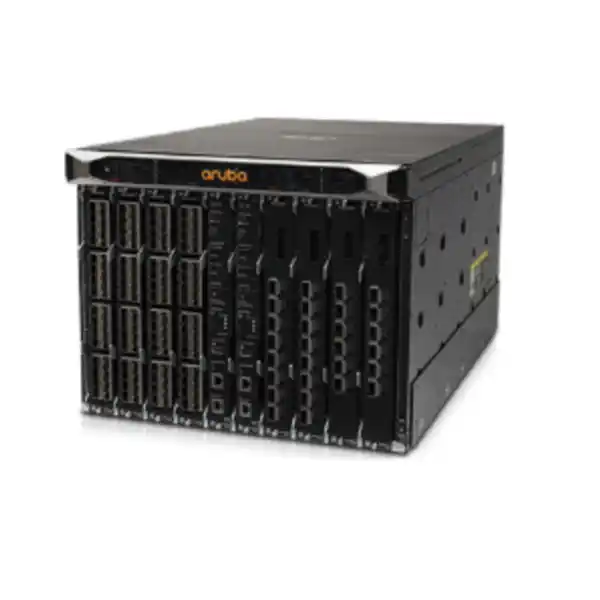
HPE Aruba Networking CX 8400 in Dubai, UAE
A high-capacity 8U modular switching platform for organizations that need resilient campus core, aggregation or data-center connectivity with configurable 10GbE, 25GbE, 40GbE and 100GbE interfaces, AOS-CX automation and carrier-class high-availability design options.
8 line-module slots
VSX high availability
10/25/40/100GbE options
Choose the architecture before the part numbers
CX 8400 is a chassis platform, not a single fixed-port switch. The right order depends on chassis bundle, line modules, management and fabric redundancy, power design, transceivers, cable media, software subscriptions and the role the switch will perform. A technically correct quotation starts with topology and capacity requirements, then maps those needs to the bill of materials.
Direct answer: what is the HPE Aruba Networking CX 8400?
A modular 8U enterprise switch series for high-capacity core, aggregation and data-center roles.
Consolidating high-speed uplinks, routing large campus segments, building resilient aggregation layers and supporting spine/leaf or core designs where modular density matters.
Large enterprises, universities, hospitals, hospitality groups, government environments, data-center operators and multi-building campuses with demanding availability and bandwidth requirements.
The exact port-speed mix, redundancy level, optics, software features and growth headroom required over the expected lifecycle.
The practical CX 8400 bill of materials for Dubai/UAE deployment, including modules, power, compatible transceivers, licensing and implementation scope.
Why the CX 8400 is different from a fixed-port switch
The HPE Aruba Networking CX 8400 is designed for buyers who need more than a predetermined set of front-panel ports. Its modular chassis lets the network design team choose line modules according to the required interface mix and then scale the platform by adding capacity as the environment grows. That is useful in a campus core where many distribution blocks may converge, in an aggregation layer serving multiple buildings or floors, or in a data-center role where 40GbE and 100GbE connectivity may be required alongside lower-speed interfaces.
HPE specifies up to 19.2 terabits per second of switching capacity and up to 7.142 billion packets per second of throughput for the distributed architecture. Switching and routing are performed in the line modules, reducing dependence on a single centralized forwarding path. The chassis provides eight line-module slots, two management-module slots, three fabric-module slots and four power-supply slots. This architecture makes the resilience design a deliberate procurement choice rather than an assumption.
For a Dubai enterprise, that distinction matters because the cost of the chassis itself is only one part of the project. A usable system may require management modules, fabric modules, power supplies, line modules, transceivers, rack hardware, software subscriptions and support. Two organizations can both ask for a “CX 8400” and require very different configurations, budgets and implementation plans.
Core buying principle
Do not size CX 8400 only by the number of ports needed today. Core-switch design should also account for uplink speed, oversubscription, east-west traffic, routing scale, failure domains, maintenance strategy, planned Wi-Fi and access-layer upgrades, server/storage growth and the number of links that must remain available during maintenance.
The most economical configuration is the one that provides the required resilience and growth path without buying line modules or software capabilities that the architecture will not use.
Key technical capabilities that affect design decisions
19.2 Tbps architecture
The published switching capacity gives the platform headroom for large aggregation and core roles. Actual design suitability still depends on the chosen modules, traffic patterns and the number of links operating concurrently.
Multi-speed modular interfaces
Available line-module choices cover 1/10/25GbE SFP-family connectivity and 40/100GbE QSFP-family connectivity. This enables mixed generations of campus and data-center links in one chassis, subject to module and transceiver support rules.
VSX resiliency
Virtual Switching Extension supports active-active designs across two independent switches, helping reduce the operational impact of control-plane events and planned upgrades when the topology is correctly engineered.
AOS-CX automation
The database-driven AOS-CX operating system includes REST APIs, Python scripting, telemetry and Network Analytics Engine capabilities that can improve consistency, troubleshooting and integration with network workflows.
Advanced Layer 2/3
The platform supports enterprise routing and switching features including BGP, OSPF, VRF, IPv6, multicast-related capabilities and EVPN/VXLAN functions. Feature planning should be matched to the deployed AOS-CX release and license level.
Redundant chassis components
Management, fabric, fan and power components can be designed for high availability. Hot-swappable modules support maintenance strategies that are difficult to achieve with smaller fixed switches.
CX 8400 platform specification overview
| Platform type | Modular enterprise campus core, aggregation and data-center switch series |
|---|---|
| Chassis height | 8U |
| Published switching capacity | Up to 19.2 Tbps, with 1.2 Tbps per slot architecture |
| Published throughput | Up to 7.142 billion packets per second |
| Line-module slots | 8 |
| Management-module slots | 2 |
| Fabric-module slots | 3 |
| Power-supply slots | 4 |
| Port-speed families | 1/10/25GbE through SFP-family modules and 40/100GbE through QSFP-family modules, depending on selected line cards and optics |
| Operating system | HPE Aruba Networking AOS-CX |
| High availability | VSX plus redundant management, fabric, fans and power options |
| Management and automation | CLI, REST APIs, Python scripting, NAE, telemetry, SNMP and integration with HPE Aruba Networking management tools, depending on licensing and deployment model |
Specifications represent the CX 8400 series architecture. A quotation should identify the exact chassis bundle, modules and software because a bare chassis and a factory bundle do not include the same components.
Chassis bundles and module choices
The two commonly referenced chassis bundle identities illustrate why the product must be quoted carefully. JL375A is the CX 8400 8-slot chassis bundle with fan trays, fans, cable manager and rack rail kit, while JL376A is a more populated bundle that includes one management module, three power supplies, two fabric modules, one 32-port 10GbE line module and one 8-port 40GbE line module in addition to the chassis components. The second bundle is closer to a deployable starting point, but it is not automatically the correct choice for every topology.
JL363A: 32-port 10GbE
A 32-port 10GbE SFP/SFP+ advanced module with hardware MACsec support. It is relevant where the core needs a high density of 1/10GbE optical or DAC-style connections, subject to supported transceiver rules.
JL687A: 32-port 1/10/25GbE
A 32-port SFP/SFP+/SFP28 module for designs that need 25GbE capability while retaining flexibility for lower-speed interfaces. This can be useful for newer server, storage or high-capacity distribution connections.
JL365A: 8-port 40GbE
An 8-port 40GbE QSFP+ advanced module suited to 40GbE uplinks and aggregation designs where that speed remains part of the installed network architecture.
JL366A: 6-port 40/100GbE
A 6-port QSFP+/QSFP28 advanced module for higher-speed backbone, inter-switch and data-center connectivity. Correct optics and distance requirements must be confirmed before ordering.
A fully populated chassis can support very high interface counts, but maximum physical port density is not the same as a recommended architecture. Designers should consider oversubscription, failure behavior, cable routing, optics power and heat characteristics, spare-port policy and the number of links that must move during maintenance. HPE also publishes transceiver-specific installation rules for certain combinations; therefore, “SFP-compatible” should never be treated as permission to select any optic with the right shape.
High availability: what VSX changes in a core design
Virtual Switching Extension is one of the most important reasons enterprises shortlist the CX 8400 for critical environments. VSX is designed around two independent switches that synchronize state while retaining separate control planes. In a well-designed topology, downstream or upstream systems can use active-active connectivity across the pair, reducing reliance on a single chassis and improving maintenance flexibility.
That does not mean buying two chassis automatically creates high availability. The surrounding design must also account for dual uplinks, LACP behavior, routing adjacencies, keepalive and inter-switch connectivity, power feeds, rack placement and the failure characteristics of connected devices. If both CX 8400 units share one electrical feed, one upstream provider or one physical cable path, the resilience objective may still be compromised.
The chassis itself also supports redundant management, fabric, fan and power components. HPE states that two power supplies are sufficient for a fully loaded chassis, while additional supplies can be used to create stronger redundancy. For a UAE deployment, the electrical design should confirm PDU type, available circuits, connector requirements and power-cord selection rather than leaving power as an afterthought.
AOS-CX, telemetry and operational control
The CX 8400 runs AOS-CX, HPE Aruba Networking’s modern switching operating system. AOS-CX uses a database-driven architecture that makes operational state accessible to system processes and automation tools. For an enterprise network team, the practical benefit is not simply “programmability”; it is the ability to standardize configuration workflows, query state through APIs, build event-driven troubleshooting logic and preserve visibility into how the network changes over time.
Network Analytics Engine can monitor conditions and help operators investigate events using telemetry and agents. REST APIs and Python scripting provide additional paths for organizations that integrate switching operations with orchestration systems, change-management workflows or custom dashboards. Traditional interfaces remain relevant as well, including CLI, SNMP, syslog-oriented workflows, NTP, LLDP and diagnostic utilities.
Management strategy should be decided during procurement. Some organizations want local CLI plus automation APIs; others want centralized configuration, monitoring and policy workflows. HPE Aruba Networking Central and NetEdit are separate management considerations, and HPE’s current QuickSpecs note that NetEdit requires a separate software license. Central subscription options are also term based. The design team should therefore distinguish “the switch can support this management approach” from “the required subscription is included in the hardware quote.”
CX Foundation licensing
HPE states that each CX switch includes an active embedded CX Foundation license at no additional cost. Foundation capabilities cover the core functions needed for enterprise deployment, including Layer 2 and Layer 3 networking, QoS, resiliency, security-related functions, NAE and other platform features. Exact feature behavior should still be checked against the software release planned for deployment.
CX Advanced and Central
CX Advanced is term based and adds capabilities such as CX Edge Insights for deeper application visibility. HPE also offers Central subscriptions, with Central Advanced including CX Advanced features in current licensing guidance. Buyers should avoid purchasing overlapping subscriptions without checking the desired management model and term.
Routing, segmentation and data-center capabilities
For Layer 3 environments, the CX 8400 supports enterprise routing technologies including static routing, OSPF, BGP, IPv6 routing and equal-cost multipath. These capabilities make it suitable for campus core designs where multiple routed distribution blocks converge, and for data-center architectures that use Layer 3 underlays. VRF support allows logical separation of routing domains, while policy-based routing and multicast features can support more specialized requirements.
The platform also supports VXLAN with BGP EVPN for modern segmentation and fabric designs. This can be valuable where the network must extend logical segments across a routed underlay, create distributed gateway functions or support leaf-spine topologies. However, VXLAN/EVPN should not be included merely because it is available. It adds design and operational considerations around route reflectors, VTEP placement, underlay routing, MTU, policy and troubleshooting. Organizations moving from a traditional collapsed core should decide whether the operational model truly requires a fabric architecture.
For storage-oriented networks, HPE lists support for Data Center Bridging features and technologies related to lossless Ethernet, iSCSI and RoCE. These environments demand much stricter validation than general campus traffic. Buffering, priority flow control, interface speed, transceiver type, server NIC capabilities and end-to-end configuration must be treated as one system. A switch feature list alone is not proof that a specific storage workload will be correctly engineered.
Where the CX 8400 tends to fit best
Large campus core
A strong fit when many distribution blocks or buildings converge on a resilient core and the organization wants modular growth, mixed uplink speeds and high routing capacity.
Aggregation layer
Useful where a network must aggregate many access or distribution switches while providing high-speed northbound links and room for future interface expansion.
Data-center core
Suitable for selected data-center designs that require modular 40/100GbE connectivity, routing, EVPN/VXLAN and resilient architecture.
High-availability enterprise edge of core
Relevant to hospitals, universities, large hospitality estates and government campuses where planned maintenance and component failure should not force a full network outage.
When a smaller or different switch may be a better choice
The CX 8400 should not be selected simply because it is the largest or most modular option. A fixed-form-factor platform can be more economical where port counts are predictable, 100GbE density is modest, chassis-level expansion is unnecessary and the business can achieve the required resilience with a pair of smaller switches. HPE Aruba Networking CX 8320 or CX 8325-class platforms may be worth comparing in designs that need core or aggregation performance without an 8U modular chassis.
Conversely, a CX 8400 configuration may be justified when slot-based growth, mixed line-card types, serviceability and redundant internal components reduce operational risk over the project lifecycle. The right comparison should include rack space, optics, support, subscription costs, expected port growth and migration effort—not only chassis price.
Sizing the CX 8400 for a real network
Sizing begins with the existing topology. Count the links that terminate on the new core, identify their current speeds and note which links are expected to upgrade within the next three to five years. Then separate access/distribution uplinks, data-center links, WAN or firewall connections, storage links, inter-core links and out-of-band management. This prevents a simple port count from hiding very different bandwidth requirements.
Next, calculate realistic traffic concentration. Twenty-four 10GbE downlinks do not always require 240Gbps of simultaneous northbound bandwidth, but a design that assumes very high oversubscription can become a bottleneck during backup windows, east-west application bursts or wireless growth. Organizations deploying newer Wi-Fi generations should also consider how multi-gigabit access-layer capacity can increase upstream demand even when user counts remain stable.
Resilience changes the calculation. In a dual-core VSX design, ask what happens when one chassis, one line module, one fabric path or one upstream link is unavailable. If the surviving system must carry the full production load, capacity should be measured during the failure state rather than only under normal operation. The same logic applies to power feeds and data-center cooling: resilience is only credible if the remaining infrastructure can sustain the load.
Optics, cabling and interface compatibility
Transceiver selection is one of the most common sources of quotation errors in modular switching projects. The line card defines the connector family and supported speeds, but the correct optic also depends on fiber type, distance, connector type, patching environment and the device on the far end. Short-reach multimode, long-reach single-mode, direct-attach copper and active optical cable options serve different physical environments.
HPE publishes supported transceivers and configuration rules for the CX 8400 modules. Some combinations have additional restrictions; for example, the 32-port 10GbE module has published limits for certain 10GBASE-T SFP+ transceivers because of thermal considerations. That is why an accurate bill of materials should identify the far-end switch or device and link distance for every non-standard connection rather than adding generic optics after the switch has been ordered.
Existing cabling also deserves attention during migration. A network using older OM2 multimode fiber may not support the same reach as OM3 or OM4 for a desired optic. Single-mode links may have the physical distance capability but still require matching wavelength and connector specifications. FourTeck can map the intended module and link type to the appropriate supported optic selection for the UAE installation.
Deployment and migration journey
Discovery and baseline
Document existing core switches, VLANs, VRFs, routing protocols, spanning-tree roles, LAGs, firewall paths, multicast, management systems, transceivers, fiber types and current utilization. Capture software versions and dependencies that may affect interoperability.
Target architecture
Decide whether the new core will use traditional Layer 2/3 boundaries, routed access, VSX, EVPN/VXLAN or a hybrid approach. Define failure behavior before selecting the hardware configuration.
Bill of materials
Select chassis bundle, management and fabric modules, line modules, power supplies, rack kit, optics, cables, subscriptions, support and spares. Confirm that each link has an appropriate supported media choice.
Staging and validation
Build the chassis, load the approved AOS-CX release, configure management, validate redundancy and test routing, VLAN, VSX and monitoring behavior before the production cutover.
Controlled cutover
Move links in a defined sequence with rollback points, maintenance-window ownership and validation checks for routing, DHCP, DNS, wireless, firewall connectivity and business-critical applications.
Dubai and UAE procurement considerations
Enterprise chassis switches are typically quote-driven because the required configuration varies widely. For UAE buyers, a meaningful quote should identify each hardware component and subscription rather than presenting a single unexplained line item. This is especially important with the CX 8400 because different bundles include different starting components and because optics are often selected separately.
Availability can also differ by module, transceiver and subscription term. A project with a fixed implementation date should validate lead time for the complete bill of materials, not just the chassis. If one required 100GbE optic or line module arrives later than the main chassis, the network may still be impossible to deploy as designed.
Support entitlement should match operational importance. A campus core may justify a stronger support level than an access switch because a failure can affect many downstream users and services. Buyers should also decide whether they need configuration assistance, migration planning, onsite installation, after-hours cutover or post-deployment validation. These services are separate from the physical switch and should be scoped explicitly.
Frequently asked buyer questions
Is the CX 8400 a fixed 100GbE switch?
No. It is a modular chassis. 100GbE connectivity is provided through the appropriate QSFP28-capable line module and supported optics. Other slots can use different module types.
Does the chassis include all modules?
Not necessarily. Bundle contents vary. JL375A is a chassis-oriented bundle, while JL376A includes selected management, power, fabric and line modules. The exact order must be checked line by line.
Can it be used in a VSX pair?
Yes, VSX is a major high-availability capability of the CX 8400. The surrounding topology, inter-switch links and dual-attached devices still need to be designed for the desired failure behavior.
Are optics included?
Do not assume they are. Transceivers and DAC/AOC cables are selected according to the chosen line modules, link speeds, fiber type and distance. They should appear explicitly in the bill of materials.
Is HPE Aruba Networking Central required?
No for basic switch operation. Central is a management subscription option. The decision depends on whether the organization wants centralized cloud or on-premises management workflows and the features included in the selected subscription.
Should we buy all eight line modules immediately?
Usually only if the design requires them. Modular growth is one of the platform’s advantages. Many organizations benefit from reserving slot capacity for future expansion rather than populating unused interfaces at the start.
Decision recap for HPE Aruba Networking CX 8400
Best justified where modular growth, mixed high-speed interfaces and chassis-level resiliency have clear operational value.
Size for normal and failure-state traffic, not only today’s average utilization.
Separate embedded Foundation functionality from term-based Advanced, Central or NetEdit requirements.
Validate line cards, transceivers, far-end devices, software releases and existing fiber infrastructure.
Design VSX, power and physical paths together so redundancy survives real failure scenarios.
Plan staging, rollback and protocol interoperability before changing the production core.
What FourTeck needs for an accurate CX 8400 quotation
Build the right HPE Aruba Networking CX 8400 configuration for your UAE network
Share your topology, port-speed mix, resilience target, optics distances and management requirements. FourTeck can turn those inputs into a practical CX 8400 bill of materials and deployment scope instead of a generic chassis quote.

Reviews
There are no reviews yet.