
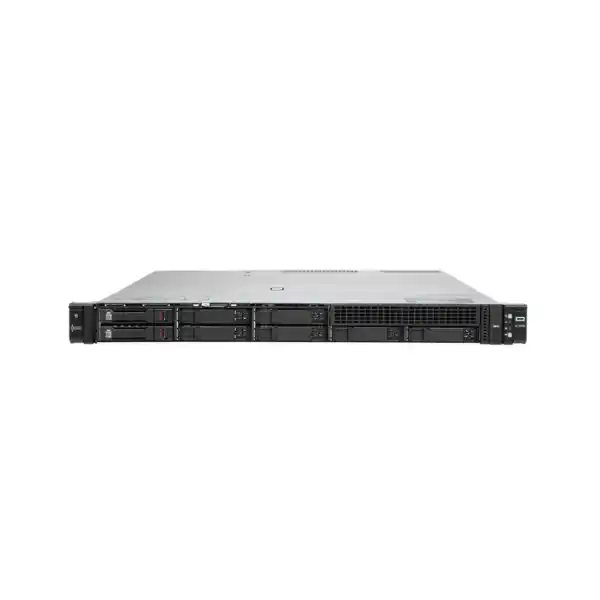
HPE Aruba Networking EdgeConnect 10150 SD-WAN Gateway Dubai
The EdgeConnect 10150, also identified as EC-10150, is a high-capacity 1U SD-WAN gateway intended for enterprise hub and data-center locations. It combines up to 12 Gbps of bidirectional WAN bandwidth capacity with encryption and features enabled, high-speed SFP28 connectivity, redundant power and storage, centralized orchestration, dynamic path control and optional WAN optimization. For UAE buyers, the key decision is not simply whether the chassis is powerful enough; the correct outcome depends on licensed WAN bandwidth, subscription tier, required security functions, optics, network-memory requirements, topology and integration with the existing WAN.
Direct answer for buyers
The EC-10150 is a physical HPE Aruba Networking EdgeConnect SD-WAN gateway designed for large enterprise hub and data-center roles. It is not a small branch appliance and should be evaluated as part of an orchestrated SD-WAN architecture.
It aggregates and steers large volumes of WAN traffic across internet, private WAN and hybrid transports while enforcing business-intent policies, segmentation, routing, security controls and resilient path selection.
Enterprises building a major regional hub, data-center SD-WAN termination point or high-capacity aggregation site should shortlist it when branch-class gateways no longer provide sufficient throughput, port density, optimization capacity or resilience.
Confirm licensed aggregate WAN bandwidth, subscription tier, interface and optic requirements, desired IDS/IPS mode, WAN-optimization requirement, expected tunnel and peer scale, and whether Orchestrator will be cloud-hosted or self-hosted.
FourTeck can translate circuit speeds, topology, security scope, application behavior and migration constraints into a bill of materials covering the gateway, software subscription, optics, optional network-memory drives and professional services.
Where the EdgeConnect 10150 fits
HPE positions the EdgeConnect 10150 for large hub and data-center locations. That positioning matters because the appliance is engineered around substantially higher scale than ordinary branch gateways. Its published WAN bandwidth capacity reaches up to 12 Gbps bidirectionally with features and encryption, and it supports up to 2,000,000 simultaneous connections. It can maintain as many as 10,000 tunnels and 4,096 fabric peers, figures that make it appropriate for centralized aggregation where a large number of EdgeConnect sites may terminate or exchange traffic through a hub. Those maxima should be treated as platform limits rather than automatic design targets; real deployments still need headroom for software features, traffic growth, inspection policy and operational resilience.
The EC-10150 is especially relevant when a business wants to consolidate several WAN functions into an SD-WAN fabric without constraining the hub on interface speed. Eight high-speed transceiver cages can operate as 1/10 Gbps SFP+ or 10/25 Gbps SFP28 interfaces, while two 10/100/1000M RJ45 data-plane interfaces add copper connectivity. HPE describes ten versatile interfaces that can be used in combinations of WAN and LAN. This gives architects room to separate carriers, internet handoffs, internal routing domains, high-speed data-center switching and migration paths instead of forcing every connection through a small number of fixed-purpose ports.
The product is less compelling for a modest branch where WAN demand is measured in a few hundred megabits and where redundant high-speed optics, large tunnel scale and data-center power requirements add cost without meaningful business benefit. In that situation a smaller EdgeConnect appliance may be easier to deploy and license. The EC-10150 becomes more defensible when the site is a strategic hub, requires multi-gigabit encrypted SD-WAN traffic, expects future WAN growth or needs the resilience and interface flexibility of a data-center-class physical gateway.
Capacity, inspection and WAN optimization
Encrypted WAN capacity
The published hardware capacity is up to 12 Gbps bidirectional with all features and encryption. This is the headline sizing figure, but licensed bandwidth and the exact traffic mix must still be validated.
IDS/IPS throughput
HPE lists IDS/IPS capacity up to 10 Gbps in Performant mode and up to 5 Gbps in Inline mode. Security-policy selection can therefore be a sizing factor at high traffic levels.
WAN optimization
Recommended WAN-optimization capacity is up to 8 Gbps bidirectional. Optional network-memory drives expand deduplication capacity when optimization is part of the design.
These three performance figures answer different questions. The 12 Gbps figure concerns overall WAN bandwidth capacity with features and encryption; the IDS/IPS numbers describe inspection capacity in specific operating modes; and the 8 Gbps recommendation relates to WAN optimization. A buyer should not treat them as interchangeable. A data center that expects 10 or 12 Gbps of aggregate SD-WAN traffic while inspecting every packet with the most demanding inline security mode may have a different sizing outcome from one that uses selective inspection or mainly depends on encrypted path steering. The most accurate design starts with traffic classes, security policy and expected peak utilization rather than with circuit speed alone.
WAN optimization is also a separate decision. EdgeConnect can use latency mitigation and data reduction to improve performance for suitable applications, but the software capability is licensed separately and the EC-10150 supports optional field-installable NVMe network-memory drives to increase data-deduplication capacity. HPE identifies an EC-10010 network-memory drive kit containing two 1.6 TB NVMe drives. Organizations that primarily use cloud applications, modern encrypted SaaS traffic or workloads that do not benefit significantly from deduplication may not need the same optimization investment as enterprises moving repetitive data between data centers or remote sites.
For procurement, the practical lesson is to separate hardware capability from usable licensed service. The chassis may have ample physical capacity, yet subscription bandwidth, optional security licensing, WAN-optimization licensing and the chosen policy model can determine how the platform is deployed. A quotation should therefore state the bandwidth tier and subscription tier explicitly rather than listing only the EC-10150 hardware.
Interfaces, routing and data-center connectivity
| Area | Published EC-10150 capability | Buyer relevance |
|---|---|---|
| High-speed data plane | 8 × cages for 1/10 Gbps SFP+ or 10/25 Gbps SFP28 transceivers | Supports multi-gigabit WAN and LAN handoffs; compatible optics must be selected for the required media and reach. |
| Copper data plane | 2 × 10/100/1000M RJ45 | Useful for Gigabit copper handoffs, staging or designs where every link does not require optical connectivity. |
| Management | 2 × 10/100/1000M RJ45 management ports plus DB-9 console | Allows dedicated out-of-band management planning separate from production traffic. |
| VLAN scale | Up to 128 IEEE 802.1Q VLANs | Relevant for segmented data-center and multi-zone designs; validate the intended VRF and policy architecture as well. |
| Routing | Static, VRRP, BGP and OSPF; up to 60,000 IPv4 and 30,000 IPv6 prefixes | Supports integration with routed data-center and WAN environments without reducing the appliance to a simple inline bridge. |
HPE also lists VRRP, OSPF with BFD, BGP with BFD, multiple IPSLA options and IEEE 802.1AX Link Aggregation support. These capabilities are important in a hub because availability depends on more than the SD-WAN tunnel itself. Fast routing convergence, link monitoring, gateway redundancy and aggregated interfaces can all influence how smoothly traffic shifts when a carrier, adjacent router, switch port or physical link fails.
Optics deserve deliberate attention during quotation. SFP+ and SFP28 cages do not mean that every transceiver is automatically included or that every third-party optic is appropriate. HPE directs customers to the hardware reference guide for compatible transceivers. The bill of materials should therefore specify the number of optical links, speed of each link, fibre type, connector, required reach and whether the handoff is from a carrier device, firewall, core switch or another router. This prevents a common deployment delay in which the gateway arrives before the correct transceivers and patching components.
Subscription licensing: a critical quotation dependency
EdgeConnect SD-WAN is not licensed as hardware alone. HPE’s current tiered subscription model uses Foundation and Advanced cloud-hosted tiers, while an Advanced on-premises option is available for organizations that need to host SD-WAN Orchestrator themselves. The subscription is selected per gateway, and HPE’s current guidance states that subscription-tier mixing within the same SD-WAN fabric is not supported. This makes licensing a design decision, not an administrative detail added after the appliance is purchased.
Foundation
Designed for essential SD-WAN and advanced NGFW capabilities with cloud-hosted Orchestrator. HPE lists Foundation bandwidth tiers at 100 Mbps, 1 Gbps and unlimited. Topology and feature limits are more constrained than Advanced.
Advanced
Provides the broader EdgeConnect SD-WAN feature set and cloud-hosted Orchestrator. It is offered across more bandwidth tiers, including an unlimited option, and suits fabrics needing greater topology, VRF, overlay and policy flexibility.
Advanced on-premises
Intended for enterprises that need to operate Orchestrator in their own hosted environment. The customer assumes responsibility for the hosting platform and its lifecycle, backup, maintenance and availability.
HPE currently offers term-based subscriptions in single- and multi-year increments, with current QuickSpecs listing 1, 3, 5 and 7-year choices. Bandwidth licensing is based on WAN-side bandwidth, so a UAE organization with multiple high-speed circuits should calculate the licensed requirement from the aggregate WAN design rather than from one primary link. For an EC-10150 being selected specifically for multi-gigabit hub duty, the quotation should make clear whether the chosen license tier allows the intended bandwidth and feature set.
Optional capabilities have their own implications. WAN Optimization is separately licensed. HPE’s current Orchestrator documentation also describes Dynamic Threat Defense, including IDS/IPS and associated protections, as an optional add-on that must be licensed for each EdgeConnect appliance where it is required. This is particularly important when a security team expects the IDS/IPS performance figures in the hardware datasheet to translate automatically into an enabled production service. Hardware capacity and feature entitlement are related but different.
For a clean procurement process, specify the number of gateways, subscription tier, term, licensed aggregate WAN bandwidth per gateway, whether WAN Optimization is required, whether Dynamic Threat Defense is required and whether Orchestrator will be cloud-hosted or customer-hosted. These details influence both initial cost and ongoing operational ownership.
Resilience, storage and physical deployment
The EC-10150 is built with data-center resilience in mind. HPE specifies 1+1 redundant 800W AC power supplies and two 480 GB NVMe system drives. The datasheet lists a mean time between failures of 300,236 hours without storage. Redundant power is useful only when the rack design also provides independent power feeds, suitable PDUs and an electrical layout that avoids connecting both supplies to the same single point of failure. A resilient SD-WAN hub should also be considered at the network and appliance level; critical sites may require a pair of gateways and a validated high-availability topology rather than relying only on redundant components inside one chassis.
The optional EC-10010 network-memory drive kit adds two 1.6 TB NVMe drives for larger WAN-optimization data-deduplication capacity. That kit should not be treated as generic extra storage. Its value is specifically tied to optimization requirements and the traffic patterns being accelerated. If WAN optimization is not licensed or the workload does not benefit from data reduction, the drive kit may not provide a useful return. Conversely, a busy hub serving many optimized branches may justify both the license and additional network memory.
Dubai data centers and server rooms should evaluate the 40°C maximum operating specification against actual rack inlet temperature rather than room thermostat settings. Heat density, airflow, blanking panels, cable obstruction and neighboring equipment can produce local conditions very different from the nominal room reading. The published thermal load is 1,443 BTU without network-memory drives and 1,518 BTU with them, so cooling capacity and rack airflow should be included in implementation planning. The chassis depth of roughly 65 cm also makes rack depth and rail compatibility worth confirming before delivery.
Security architecture and segmentation
The EC-10150 supports IPsec data-plane encryption using 256-bit AES and management-plane encryption using TLS 1.2. HPE also lists 128-bit AES disk encryption, strict password enforcement, RADIUS and TACACS+ authentication, TPM 2.0 support, FIPS 140-2 Level 1 and Common Criteria profiles for network devices, VPN gateways and stateful traffic filter firewalls. The platform also supports RFC 8784 post-quantum pre-shared keys under HPE’s CSfC listing. These capabilities give security teams a substantial foundation, but compliance should always be assessed against the organization’s exact software release, configuration, certificate requirements, logging controls and approved cryptographic policy.
EdgeConnect’s broader value is policy-driven segmentation and traffic steering under SD-WAN Orchestrator. HPE describes macro-segmentation using end-to-end VRFs and micro-segmentation using zone-based firewall and role-based policies. This allows a hub to separate user groups, applications, business units or security zones across the WAN while applying different path and security behavior. The operational gain comes from expressing intent centrally instead of managing a collection of unrelated router access lists and path preferences at each site.
Security inspection must be sized deliberately. The published EC-10150 IDS/IPS capacity is up to 10 Gbps in Performant mode and up to 5 Gbps in Inline mode. If a deployment expects near-12-Gbps encrypted WAN traffic and also demands deep inspection for the full traffic volume, those figures need to be reconciled during design. It may be appropriate to inspect selected traffic classes, distribute traffic across appliances, adopt a different architecture or leave additional capacity headroom. The correct answer depends on policy rather than on a single theoretical throughput number.
Logging and management controls also matter for integration. The appliance supports secure syslog with configurable levels, SNMPv2c and SNMPv3, SSH and HTTPS access, PKI-related standards and REST APIs. IPFIX flow reporting supports custom information elements and an option for data anonymization. Organizations with an established SIEM, NMS or automation platform should include these integrations in the deployment scope so that the new SD-WAN hub becomes part of existing operational monitoring from day one.
Management with HPE Aruba Networking SD-WAN Orchestrator
The gateway can be managed individually through its EdgeConnect SD-WAN operating system WebUI, CLI and REST API, but the normal enterprise value emerges when multiple gateways are centrally managed through HPE Aruba Networking SD-WAN Orchestrator. Orchestrator provides centralized configuration, monitoring, policy administration and network visibility across the SD-WAN fabric. It also exposes an aggregated REST API for systems integration, which can be useful for organizations that want provisioning, monitoring or reporting tied into broader automation workflows.
For a large hub, centralized policy is more than a convenience. Changes to path preference, business-intent overlays, security zones, QoS behavior and routing relationships can affect many branches simultaneously. A controlled Orchestrator design helps ensure that policy changes are repeatable, auditable and applied consistently. Operations teams should define administrator roles, authentication integration, configuration standards, change control, software-upgrade procedures, alerting and backup responsibilities before the hub enters production.
The hosting model should be settled during procurement. Foundation and Advanced subscriptions can include cloud-hosted Orchestrator, while the Advanced on-premises approach places the management platform in infrastructure controlled by the customer. Cloud hosting reduces the customer’s responsibility for the management platform lifecycle, while self-hosting may suit organizations with data-sovereignty, integration or operational-control requirements. That choice should be made with the network, security and infrastructure teams together because it changes both technical ownership and the bill of materials.
Practical sizing questions before choosing EC-10150
How much aggregate WAN bandwidth?
List every active and standby carrier, internet and private-WAN circuit at the hub. Include expected upgrades. Licensed WAN bandwidth and physical throughput should be checked against the aggregate design rather than a single circuit.
How much traffic needs inspection?
If IDS/IPS is required, estimate the percentage and peak rate of inspected traffic. The EC-10150’s inspection figures differ by mode, so security policy can influence whether one appliance provides sufficient headroom.
Is WAN optimization useful?
Identify applications, remote sites, latency and repetitive data patterns. If optimization has business value, include the optional license and determine whether additional NVMe network memory is justified.
How many branches and tunnels?
Compare the expected fabric scale with the published maximum of 10,000 tunnels and 4,096 fabric peers. Keep realistic growth and design headroom instead of sizing directly to maximum values.
What interfaces are required?
Map every carrier and LAN handoff to speed, media and connector. The gateway provides high-speed cages, but the exact SFP+/SFP28 optics and fibre patching need to match the connected equipment.
What level of availability?
Dual PSUs and redundant drives protect components inside one chassis. If the hub cannot tolerate appliance failure or planned maintenance, evaluate dual-gateway architecture and upstream/downstream redundancy.
A sensible deployment sequence
Discover
Document circuits, topology, routing, applications, security zones, traffic peaks, existing SD-WAN sites and operational constraints.
Size and license
Select the subscription tier, licensed WAN bandwidth, optional security and optimization features, and the hardware/optics bill of materials.
Stage
Rack, cable and register the gateway, validate Orchestrator connectivity, baseline management access and confirm software and policy readiness.
Integrate
Connect WAN and LAN handoffs, establish routing adjacencies, build overlays and segmentation, integrate authentication, logging and monitoring.
Migrate and validate
Move production traffic in controlled phases, test path failure, routing convergence, application behavior, policy enforcement and monitoring before final handover.
At a data-center hub, migration should be treated as a network change program rather than a device swap. Existing routers, firewalls, load balancers, carrier handoffs and data-center fabrics may all participate in traffic flow. A rollback plan, maintenance window, route preference strategy and clearly defined success tests reduce the risk of introducing asymmetric routing or unintended path changes. Where the EC-10150 is replacing an existing SD-WAN appliance, configuration migration should also account for differences in software release, licensing and policy objects.
When EC-10150 may be too much—or not enough
A balanced shortlist should compare the EC-10150 with neighboring EdgeConnect options instead of assuming that the largest-looking model is always best. HPE’s current portfolio positions the EC-10108 for medium-branch use with up to 2 Gbps WAN bandwidth, while larger hub products such as EC-L-H and EC-XL-H address multi-gigabit data-center roles. The EC-10150 extends the hub position to up to 12 Gbps and adds eight 25-Gb-capable SFP28 cages. If a site needs only one or two low-gigabit circuits, a smaller platform may reduce capital, power, rack and licensing complexity.
At the other end, a requirement can exceed the EC-10150 even when the headline WAN figure looks sufficient. Examples include security inspection needs above the relevant IDS/IPS mode capacity, a design that requires more than the available interface count, unusual optical media requirements, a fabric approaching published tunnel or peer maxima, or an availability target that demands multiple appliances. Very high growth forecasts may also justify a clustered or distributed architecture rather than sizing one gateway close to its platform limits.
The most useful comparison is therefore workload-based: WAN bandwidth, inspection rate, number of peers, routing scale, ports, optimization, resilience and license tier. This keeps the recommendation tied to measurable requirements and makes future expansion easier to explain to procurement teams.
Dubai and UAE procurement considerations
For Dubai and wider UAE deployments, quotation accuracy depends on more than the gateway model name. Buyers should confirm the regulatory and regional orderable SKU, power-cord or PDU requirements, support entitlement, software subscription, local lead time and the transceivers required for each carrier or switch connection. HPE identifies S2N65A as an EC-10150 SD-WAN gateway SKU and lists additional regulatory variants, so the exact orderable part should be matched to the intended destination and commercial channel rather than assumed from a generic online listing.
Data-center access is another practical factor. A migration may require advance rack allocation, cross-connect orders, meet-me-room coordination, remote-hands arrangements, maintenance approvals and carrier scheduling. When third-party providers control fibre handoffs, the optic and connector information should be obtained before the change window. For enterprise server rooms, power redundancy and cooling should be validated against the published electrical and thermal figures, especially when both PSUs are used on independent circuits.
FourTeck can scope supply together with implementation requirements such as rack installation, optics, initial staging, Orchestrator onboarding, routing integration, segmentation, traffic-policy migration, testing and handover. Availability, warranty and support options can vary by quotation and date, so those commercial items should be confirmed at the time of purchase rather than inferred from the technical datasheet.
Technical specification summary
| Model | HPE Aruba Networking EdgeConnect 10150 SD-WAN Gateway (EC-10150) |
| Typical role | Enterprise hub or data-center SD-WAN gateway |
| WAN bandwidth | Up to 12 Gbps bidirectional, all features plus encryption |
| Simultaneous connections | 2,000,000 |
| WAN optimization | Recommended up to 8 Gbps bidirectional; optional licensing and network-memory hardware apply |
| IDS/IPS capacity | Up to 10 Gbps Performant mode; up to 5 Gbps Inline mode |
| Maximum tunnels / peers | 10,000 tunnels; 4,096 fabric peers |
| Data-plane interfaces | 8 × 1/10 Gbps SFP+ or 10/25 Gbps SFP28 cages; 2 × Gigabit RJ45 |
| Management interfaces | 2 × Gigabit RJ45; DB-9 console |
| Routing | Static, VRRP, BGP and OSPF; up to 60,000 IPv4 and 30,000 IPv6 prefixes |
| System storage | 2 × 480 GB NVMe; optional 2 × 1.6 TB NVMe network-memory kit |
| Power | 1+1 redundant 800W AC supplies; 100–240V AC, 50–60 Hz input |
| Form factor | 1U rack mount; 4.28 × 43.46 × 64.94 cm; approximately 14.7 kg |
| Operating range | 0°C to 40°C; 10% to 80% relative humidity, non-condensing |
Decision recap
What FourTeck needs for an accurate EC-10150 quotation
Plan the HPE Aruba EdgeConnect 10150 around your real WAN
A successful EC-10150 deployment starts with the correct relationship between hardware capacity, subscription bandwidth, security policy, optics, routing and resilience. Share your hub bandwidth, interfaces, branch scale and required features with FourTeck to build a Dubai/UAE quotation that reflects the full deployment rather than only the appliance chassis.

Reviews
There are no reviews yet.