
HPE Aruba Networking CX 6300M JL658A Switch for Fibre Access and Aggregation
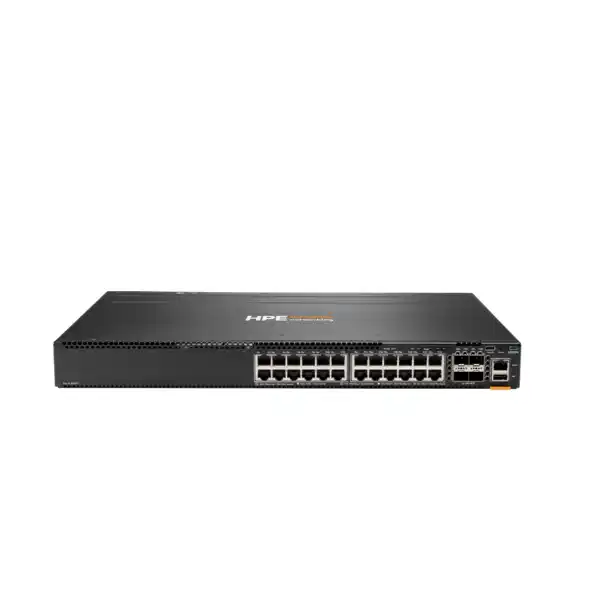
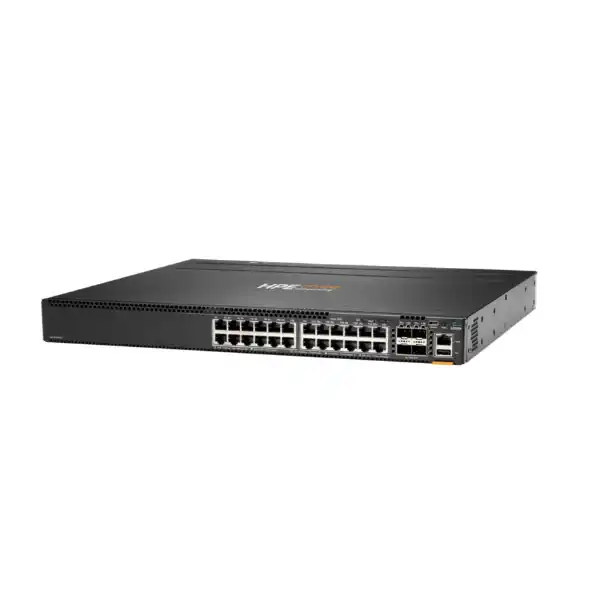
The HPE Aruba Networking CX 6300M 24-Port SFP+ and 4-Port SFP56 Switch, product number JL658A, is a modular CX 6300M platform designed for high-density fibre connectivity in enterprise campus, aggregation and selected data-centre top-of-rack environments. Its defining characteristic is the port mix: 24 SFP+ access or aggregation interfaces operating at 1G or 10G, together with four SFP56 interfaces capable of 1G, 10G, 25G or 50G operation. That combination makes the JL658A especially relevant where an organisation needs a large number of fibre-facing 10GbE links and wants higher-speed uplinks or front-plane stacking without moving immediately to a chassis platform.
This is a non-PoE switch. It does not provide electrical power to access points, IP phones, cameras or other powered Ethernet devices. Buyers comparing the JL658A with copper CX 6300M PoE variants should therefore start with the media requirement rather than the model family name. If the deployment is predominantly fibre, the JL658A can be a strong fit. If the same rack must also power endpoint devices over copper, a Smart Rate or 1GbE PoE model in the CX 6300 family should be evaluated instead.
Key Technical Specifications
| Product | HPE Aruba Networking CX 6300M 24-Port SFP+ and 4-Port SFP56 Switch |
|---|---|
| Product number | JL658A |
| PoE | Non-PoE |
| Primary network ports | 24 x 1G/10G SFP+ ports |
| High-speed ports | 4 x SFP56 ports supporting 1G/10G/25G/50G operation |
| Switching capacity | 880 Gbps |
| Throughput | 654 Mpps |
| Stacking | HPE Aruba Networking VSF, up to 10 members per stack |
| Management interfaces | USB-C console, USB Type-A host and dedicated OOBM port |
| Management options | HPE Aruba Networking Central, Web GUI, CLI and Switch Multi-Edit Software |
| Power design | Two field-replaceable hot-swappable PSU slots; at least one compatible PSU is required and ordered separately |
| Typical power consumption | 51W idle; 85W at 100% traffic rate |
| Operating temperature | 0°C to 45°C up to 5,000 ft under standard conditions; environmental limits vary with altitude and some optic types |
Why the JL658A Port Layout Matters
The JL658A should not be treated as a generic 24-port switch. Its 24 SFP+ interfaces are intended for optical or compatible SFP/SFP+ connectivity rather than ordinary RJ45 copper access. This can simplify fibre aggregation designs in buildings, campuses, industrial locations and distributed equipment rooms where many remote switches, servers or network segments terminate over fibre. It can also reduce the need for external media conversion when the installed cabling is already optical.
The four SFP56 ports provide a second tier of bandwidth above the 1G/10G SFP+ interfaces. Depending on the design, these ports can be used for high-speed uplinks, inter-switch connectivity or front-plane stacking. Their support for 1G, 10G, 25G and 50G gives a network architect room to start with a lower-speed uplink and move upward later, provided the selected transceivers, cabling and peer equipment support the target speed. The benefit is flexibility, but the exact optic cannot be assumed from the switch alone.
Performance for Enterprise Aggregation
HPE specifies 880 Gbps of switching capacity and 654 Mpps of throughput for the JL658A. Those figures position it well above a simple access-layer device and make it suitable for designs where multiple 10GbE fibre links need to converge onto faster uplinks. The switch also supports low-latency forwarding across its supported speeds, which is relevant where storage, server, voice, video or latency-sensitive enterprise traffic shares the same aggregation layer.
Performance figures should still be interpreted in the context of the complete topology. A switch with 24 x 10GbE downlinks can only deliver the intended end-to-end application performance when uplinks, peer switches, routers, firewalls, servers and storage paths are sized appropriately. If all 24 interfaces are expected to carry sustained high utilisation simultaneously, the uplink design deserves the same attention as the switch itself.
Stacking and High Availability
The CX 6300 platform supports HPE Aruba Networking Virtual Switching Framework for stacking, with up to 10 members in a stack for this model family. This allows multiple switches to be operated as a coordinated system and can simplify management, expansion and resilient access or aggregation designs. The front-panel high-speed interfaces can participate in the stack architecture, so the stacking plan directly affects how many high-speed ports remain available for other uplink duties.
A 10-member limit does not mean every deployment should be built as one maximum-size stack. Stack size, cable paths, failure domains, software maintenance strategy and physical rack distribution should be reviewed together. Larger environments may benefit from multiple smaller stacks or a different core and aggregation architecture depending on resilience requirements.
AOS-CX Layer 3 and Fabric Capabilities
The CX 6300 series runs the AOS-CX software platform and is positioned as a Layer 3 switch family. HPE documents routing and fabric capabilities across the series including BGP, OSPF, VRF, EVPN and VXLAN, together with quality-of-service and network analytics functions. These capabilities allow the JL658A to serve roles beyond simple Layer 2 aggregation when the selected software release, feature entitlement and network design support the intended function.
For advanced campus segmentation or EVPN/VXLAN designs, the requirement should be translated into a feature checklist before quotation. Some advanced capabilities within the broader CX platform can depend on software level, feature packs or associated management subscriptions. It is safer to confirm the exact operational requirement than to assume every feature mentioned for the series is automatically licensed for every deployment.
Management Options
The JL658A can be managed through the AOS-CX command-line interface and Web GUI, while HPE Aruba Networking Central provides a cloud-based management option for organisations standardising wired, wireless and WAN operations. HPE also lists Switch Multi-Edit Software for bulk configuration and validation tasks. This range of management methods is useful for buyers migrating from traditional switch-by-switch administration toward more centralised operations.
Management choice has commercial implications. An organisation planning local CLI operation may have different subscription requirements from one adopting HPE Aruba Networking Central across the estate. The procurement scope should therefore distinguish the physical switch, management subscription, support service and any advanced software entitlement rather than grouping them under one generic networking line item.
Power Supplies, Fans and Redundancy
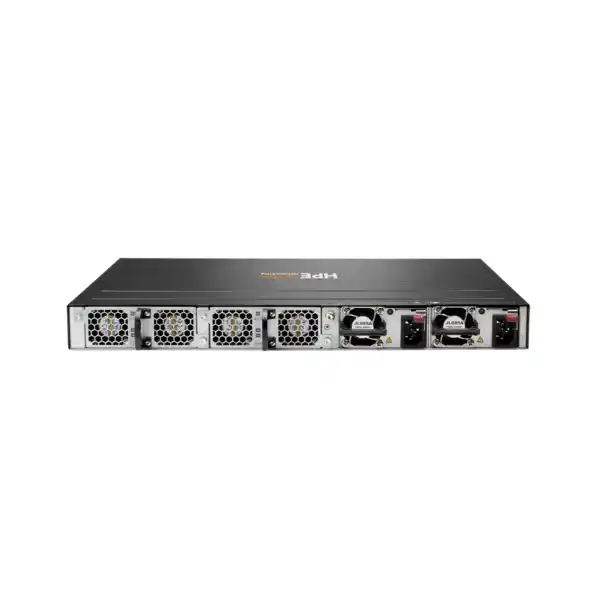
The CX 6300M JL658A has two field-replaceable, hot-swappable power-supply slots. At least one compatible power supply is required, and HPE configuration documentation treats the PSU as a separately selected component. A second PSU may be selected when the design requires power redundancy. HPE’s current product information lists the 250W JL085A as a supported PSU for this model, while ordering documentation should be checked at quotation stage for the currently approved PSU options in the destination market.
The switch uses two fan tray slots and is supplied with the required fan trays installed. Fan trays are field replaceable and hot swappable. Rack airflow and power-source diversity still need to be reviewed as part of the deployment. Redundant PSUs have limited value if both are connected to the same upstream power strip or electrical circuit.
Optics Are a Separate Design Decision
Optical transceivers are not something to select solely from the label “SFP+” or “SFP56”. The correct module depends on speed, fibre type, connector type, wavelength, transmission distance, peer-device compatibility and environmental conditions. HPE configuration documentation allows the 24 access interfaces to use compatible SFP/SFP+ transceivers and the four high-speed interfaces to use compatible SFP-family modules up to SFP56 speeds.
A procurement request should state whether each link is multimode or single-mode, the approximate distance, the required speed and the model at the far end. That information is enough to avoid many of the most common ordering errors. It also helps determine whether DAC or AOC assemblies are more appropriate for short rack-to-rack links than pluggable optical transceivers.
Environmental Considerations in Dubai Deployments
The JL658A is specified for standard operation from 0°C to 45°C up to 5,000 ft, with derating at higher altitude. HPE also notes that the operating range is reduced to 0°C to 40°C when certain 10G SFP+ LR or ER transceivers are installed. For Dubai installations, this makes equipment-room cooling and rack airflow a practical design issue rather than a minor specification detail.
The switch is intended for controlled indoor network environments. It should not be treated as an outdoor or unconditioned-space device simply because the ambient climate is within a short-duration excursion range. Data cabinets, telecom rooms and edge sites should be checked for sustained temperature, dust, airflow direction and power quality before deployment.
Where the HPE Aruba CX 6300M JL658A Fits Well
- Enterprise fibre aggregation where many 1GbE or 10GbE optical links terminate in one rack.
- Campus distribution designs that need high-speed 25GbE or 50GbE uplink options.
- Server or appliance environments where SFP+ connectivity is preferred over copper 10GBASE-T.
- Networks standardised on AOS-CX that require consistent management and operational tooling.
- Deployments that may expand through VSF stacking rather than replacing the original switch as port demand grows.
When Another CX 6300 Model May Be Better
The JL658A is not the right default choice when the access layer is dominated by copper endpoint connections. If users, cameras, wireless access points or phones need RJ45 connectivity and PoE, a CX 6300M or CX 6300F copper PoE model is normally more appropriate. Similarly, an environment that requires 10GbE copper to servers may need a Smart Rate model rather than a fibre-only design.
A newer or higher-end CX platform should also be considered if the project requires more uplink capacity, 100GbE interfaces, MACsec on specific port combinations, a different port density or a larger data-centre fabric architecture. The useful comparison is not simply price per port; it is whether the physical interfaces and operational features match the intended topology without unnecessary converters, additional switches or licensing surprises.
Information Needed for an Accurate Quotation
For a complete HPE Aruba Networking CX 6300M JL658A quotation in Dubai, the switch itself is only the starting point. A useful bill of materials should identify the number and type of optics or direct-attach cables, required uplink speeds, fibre type and distance, quantity of power supplies, power-cord requirement, stacking topology, rack location, management approach and desired support coverage. If HPE Aruba Networking Central or advanced software features are planned, those requirements should also be stated so the relevant subscription or entitlement can be included.
FourTeck can prepare the switch, compatible connectivity components and associated support as a coordinated requirement rather than separate unverified line items. Providing the existing switch model at the far end of each uplink is particularly helpful when confirming optics and migration compatibility.
Procurement Summary
The HPE Aruba Networking CX 6300M JL658A is best viewed as a dense 1/10GbE fibre switch with four flexible 1/10/25/50GbE SFP56 interfaces, strong Layer 3 capabilities and enterprise stacking. Its 880 Gbps switching capacity and 654 Mpps forwarding performance give it the headroom required for demanding aggregation roles, while AOS-CX provides a common management and automation platform across the wider CX portfolio.
The main buying dependencies are equally clear: it is non-PoE, it needs separately selected power supply hardware, and the optics or cables must be chosen for the actual link design. Buyers who confirm those three areas early can determine quickly whether JL658A is the right fit or whether a copper PoE, Smart Rate or higher-capacity CX model would better match the project.

Reviews
There are no reviews yet.