
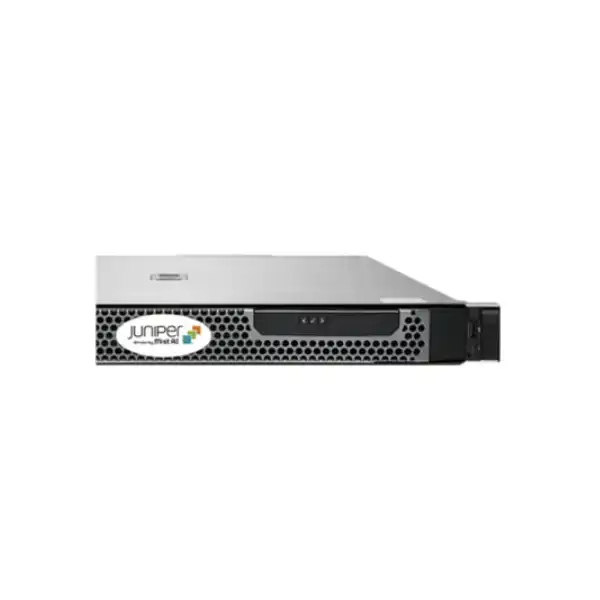
Juniper ME-X1-M Mist Edge Dubai
A compact 1U Juniper Mist Edge appliance for enterprises that need an on-premises tunnel termination point without returning to the operational model of a traditional wireless LAN controller. The ME-X1-M is rated for up to 500 access points, 5,000 clients and 4 Gbps maximum throughput, making it a practical option for many campus, branch-aggregation and segmented wireless designs where 1GbE data interfaces are appropriate.
Direct answer: what is the ME-X1-M and who should consider it?
The Juniper ME-X1-M is a physical Juniper Mist Edge appliance that places selected data-plane and edge functions on the customer premises while Juniper Mist cloud remains central to management, assurance and operational visibility. Its most common role is to terminate tunnels from Juniper access points so that user traffic can be carried to a controlled on-premises point, enabling designs such as centralized campus traffic, guest traffic redirection, VLAN extension, IoT segmentation and other use cases that need an edge data path rather than purely local AP bridging.
It should be considered by organizations already using, standardizing on or evaluating the Juniper Mist architecture and needing up to 500 APs, up to 5,000 clients and up to 4 Gbps of appliance throughput. The headline limits should not be treated as a production sizing target by themselves. AP count, real tunneled traffic, failover capacity, interface utilization, growth, subscription coverage and the number of appliances required for resilient operation all matter.
The most important factor to confirm is the intended traffic architecture: which WLANs or services will tunnel, how much traffic will actually traverse Mist Edge, where that traffic must exit, and what happens during an appliance or site failure. FourTeck can use those inputs to determine whether one ME-X1-M, a resilient ME-X1-M cluster, a higher-capacity Mist Edge model or a different design is the more appropriate choice for a Dubai or UAE deployment.
Why Mist Edge exists in a cloud-managed wireless architecture
Cloud-managed wireless does not mean every organization wants every data flow to break out locally at the access point. Many enterprise networks still have valid reasons to centralize selected user traffic: a security zone may be built around a central firewall, guest traffic may need to reach a DMZ, a campus may depend on consistent VLAN placement, or roaming behavior may benefit from an engineered tunnel architecture. The Juniper Mist approach separates cloud-based control, assurance and operations from the optional on-premises data path. ME-X1-M is one of the appliances that provides that local data-path function.
That distinction is important when replacing a traditional wireless LAN controller. A controller often combined control-plane functions, configuration workflows and centralized forwarding in one platform. Juniper Mist shifts management and operational intelligence to its cloud architecture while allowing tunnel termination to remain on premises when the network requires it. For a buyer, this means the ME-X1-M should not be evaluated as a conventional standalone controller with an isolated local management model. It is a component of the broader Juniper Mist design.
The appliance can therefore fit organizations moving from older centralized WLAN architectures without forcing an immediate redesign of every VLAN, firewall boundary or traffic-handling practice. A migration can preserve central forwarding where it is genuinely required while allowing other WLANs to remain locally bridged. That flexibility is useful when a campus contains several security zones with different requirements or when migration needs to occur building by building rather than as a single disruptive change.
For Dubai enterprises, the practical question is not whether centralized or local forwarding is universally better. The correct answer depends on application traffic, security policy, internet breakout design, WAN capacity, roaming expectations, guest access architecture and operational standards. ME-X1-M is valuable when an on-premises tunnel endpoint solves a real architecture requirement. It can be unnecessary when all WLANs can bridge locally and there is no need for the supported Mist Edge services.
A sound bill of materials therefore starts with the WLAN and network architecture, not only an AP count. FourTeck can map each SSID or traffic class to its intended forwarding behavior, identify which flows require Mist Edge, and calculate the appliance and subscription quantities from that design.
ME-X1-M verified hardware and capacity profile
| Specification | ME-X1-M value | Why it matters to the buyer |
|---|---|---|
| Maximum access points | 500 APs | Defines the hard appliance scale ceiling; resilient design normally requires operational headroom rather than planning to run at the maximum. |
| Maximum clients | 5,000 | Client density can become a sizing factor even when the AP count is comfortably below 500. |
| Maximum throughput | 4 Gbps | Tunneled traffic volume must be estimated; AP radio capacity alone does not determine appliance throughput requirements. |
| Data interfaces | 4 × 1GbE RJ-45 | The copper 1GbE interface profile must match the switch, firewall and aggregation design. Higher-speed optical requirements point to larger Mist Edge models. |
| Management interfaces | 2 × 1GbE RJ-45 | The Mist out-of-band management connection should be incorporated into management network and firewall planning. |
| Form factor | 1U rack appliance | Requires suitable rack space, rail compatibility, front/rear service clearance and data-center environmental planning. |
| Weight | 12.48 kg / 27.51 lb | Relevant to rack installation, handling and cabinet planning. |
| Operating voltage | 100–240 VAC, 50–60 Hz | Power feed and UAE-compatible power-cord selection should be confirmed in the quotation. |
| Maximum power draw | 387.5 W | Useful for PDU, UPS and thermal planning, particularly when multiple appliances are deployed for resilience. |
| Operating temperature | 10°C to 35°C | The appliance belongs in a controlled equipment environment rather than an unconditioned hot utility space. |
The maximum values above answer only the first layer of sizing. An estate with 250 APs can still require more than one appliance if traffic concentration, redundancy policy or maintenance requirements demand it. Conversely, a campus with many APs that locally bridge most user traffic may place less sustained throughput on Mist Edge than a smaller estate where every WLAN is centrally tunneled. Both AP count and actual tunnel utilization must be considered.
Five capabilities that make ME-X1-M materially different from a basic gateway
1. On-premises tunnel termination
Mist Edge can terminate tunnels from Juniper APs so selected WLAN traffic is delivered to a deliberate on-premises point. This is the foundational use case when security policy, central services or network segmentation requires more control over where wireless traffic exits.
2. Mixed local and tunneled WLANs
A Mist design does not require every SSID to use the same forwarding method. Organizations can retain local bridging where it is efficient while tunneling only the services that benefit from central policy enforcement or shared network services.
3. Guest and corporate separation
Split-tunneling and traffic-redirection capabilities allow guest and corporate traffic to follow different paths. That can simplify the placement of guest internet access, corporate application flows and security inspection points when the surrounding network is designed accordingly.
4. Segmentation use cases
Mist Edge supports architectures where IoT and other device classes need dynamic traffic segmentation. The commercial value is not the phrase “segmentation” itself; it is the ability to keep device traffic aligned with security zones, policy controls and network services without forcing one flat wireless forwarding model.
5. Cluster-based resilience
Multiple Mist Edge appliances can participate in clusters for scale and failover. High availability is therefore a design decision rather than a box-level checkbox. Appliance count, normal utilization and failover headroom have to be engineered together.
Sizing the ME-X1-M correctly: maximum scale is not the same as production design
The ME-X1-M has published maximums of 500 APs, 5,000 clients and 4 Gbps throughput. Those are useful boundaries, but an enterprise design should include operational headroom. Juniper’s high-scale Mist Edge guidance recommends planning around a maximum of 80 percent loading under normal conditions when redundancy must be accommodated. Applied to the 500-AP platform ceiling, that is approximately 400 APs as a normal-load reference point in a design that needs capacity to absorb failover. This does not mean every deployment must stop at 400 APs; it means resilient sizing must account for what another node may need to carry when a peer is unavailable.
Throughput deserves equal attention. The maximum 4 Gbps figure represents appliance capability, not a guaranteed user-experience number for every topology. Real traffic depends on the number of tunneled WLANs, application mix, internet breakout, east-west and north-south flows, guest usage, software updates, video, backup activity and event-driven spikes. A network with heavy media traffic can become throughput-constrained well before its AP ceiling. A network with many low-utilization APs can experience the reverse.
Interface architecture is another boundary. ME-X1-M uses four 1GbE copper data ports. Link aggregation and single-arm or dual-arm design can distribute traffic, but the physical interface profile remains 1GbE. If a project requires 10GbE optical data interfaces, materially higher aggregate throughput or a much larger AP estate, the ME-X2-M is a natural comparison because it increases scale to 2,000 APs and 40 Gbps while moving to 10GbE SFP+ data interfaces. Larger environments can evaluate ME-X6, which is designed for substantially higher scale and 25GbE interfaces.
Client count can also become the deciding dimension. A hospitality, education, healthcare or public venue network may have many devices per AP. Conversely, a warehouse can have broad RF coverage with relatively low user density. FourTeck therefore treats AP count, client count and tunneled throughput as three separate sizing vectors instead of assuming one is a proxy for the others.
A useful sizing request includes the number of current and planned APs, expected growth over the intended hardware lifecycle, the WLANs that will be tunneled, busy-hour throughput, required maintenance behavior, expected failover capacity and whether a secondary site or secondary cluster is part of the business continuity plan. With those inputs, the project can move from “which model is big enough?” to “which architecture remains safe during growth and failure?”
Data-port design: single-arm, dual-arm and the surrounding network
Mist Edge is not installed in isolation. The data ports must connect into a wired network that understands which side receives AP tunnel traffic and where decapsulated user traffic should go. Juniper supports single-arm and dual-arm tunnel-interface configurations. In a single-arm design, a common interface arrangement can carry upstream and downstream traffic. In a dual-arm design, downstream and upstream roles use different ports. The right choice depends on the switching, firewall and security-zone architecture around the appliance.
The tunnel IP is the virtual address used by APs to establish their tunnel toward Mist Edge. It is distinct from the out-of-band management IP used for cloud communication and device management. Juniper requires at least two IP addresses for a Mist Edge device: one for the OOBM interface and another for the tunnel interface, with the addresses placed on different subnets. This is a small design detail with large implementation consequences. If IP ranges, routing and firewall policy are not prepared before installation, the appliance can be physically racked yet remain unable to complete the intended service path.
In a dual-arm deployment, the downstream side commonly faces the network where AP tunnels arrive, while the upstream side carries user VLAN traffic toward the broader enterprise network. That can make security boundaries easier to understand, but it also introduces additional switch ports, VLAN definitions and routing dependencies. A single-arm design may simplify cabling and aggregation but still requires careful handling of tagged traffic, LACP design and fault domains.
The four 1GbE RJ-45 data ports give the ME-X1-M several connection options, but a design should not assume that simply connecting all four automatically yields a resilient 4 Gbps service. Port-channel design, switch redundancy, hashing behavior, traffic direction, cable diversity and the failure mode of the upstream switches all influence the result. Where link aggregation is used, both Mist Edge and the connected switch infrastructure must be configured consistently.
A practical deployment worksheet should identify every physical ME-X1-M port, its intended role, connected switch, switch port, VLANs, LACP membership, IP subnet, firewall zone and expected traffic direction. That level of preparation reduces ambiguity during implementation and makes troubleshooting far easier than relying on an informal diagram after the appliance arrives.
If the existing network core is standardized on 10GbE or 25GbE optical connectivity, the question is broader than whether a copper media converter could technically be introduced. Additional conversion points add operational complexity and can undermine a clean architecture. In those cases, comparing the ME-X2-M or ME-X6 interface profile before procurement is usually the better engineering exercise.
Mist cloud connectivity and firewall preparation
The management connection is fundamental to the Mist operating model. The dedicated Mist/OOBM port communicates with the Juniper Mist cloud for configuration, telemetry and service status. Initial onboarding normally uses DHCP before a static OOBM address is configured if the organization prefers one. The management path therefore needs working DNS, routing and outbound firewall access to the appropriate Juniper Mist cloud destinations.
Juniper recommends FQDN-based firewall rules because service endpoint IP addresses can change. For Mist Edge and access points, cloud environments use Juniper Mist terminator and portal hostnames over TCP 443, with the exact regional hostnames depending on the organization’s Mist cloud instance. This is why copying an old static IP allowlist into a new deployment can create intermittent onboarding or service problems later. The implementation team should reference the current Juniper firewall-port documentation for the organization’s assigned cloud environment during change planning.
Tunnel reachability is a separate concern from cloud reachability. The APs need a route to the tunnel IP, and the security devices between APs and Mist Edge must permit the required tunnel traffic for the selected design. In environments where a tunnel interface sits behind a firewall, the applicable protocol and port requirements must be allowed. This should be validated in both directions and across all branch or campus paths that will establish tunnels.
Enterprises with strict outbound filtering should include the network security team early. It is common for the wireless team to own the Mist configuration while a separate firewall team controls internet egress. If the change ticket only says “allow Mist cloud,” it may not capture the right regional FQDNs, management interface source subnet, DNS behavior or TLS inspection policy. A precise rule set avoids unnecessary exceptions and makes future audits clearer.
For a Dubai deployment spanning multiple offices, the same principle applies to every tunnel origin. The head-end appliance can be healthy and visible in Mist while a remote site fails to build the intended user-data tunnel because routing, NAT or firewall behavior differs at that branch. Pre-deployment path validation is therefore part of the architecture, not merely a troubleshooting activity.
Mist Edge subscriptions: the licensing quantity follows tunneled APs
Hardware and service are separate decisions
Buying the ME-X1-M appliance does not by itself represent the complete Mist Edge service requirement. Juniper uses Mist Edge subscriptions for the data tunneling service, so the bill of materials must include the appropriate subscription term and quantity in addition to hardware.
Subscription count is per tunneling AP
Juniper states that the number of Mist Edge subscriptions should match the number of APs tunneling to Mist Edge in the organization. A project with 300 installed APs but only 180 APs using Mist Edge tunnels therefore has a different subscription requirement from a project where all 300 tunnel.
Terms affect procurement planning
Mist Edge standard subscriptions are available in defined term lengths. The commercial decision should align with the wider Juniper Mist subscription strategy, renewal calendar, project budget and hardware support expectations rather than treating the software line as an afterthought.
The standard Mist Edge subscription SKU family is S-ME-S-1, S-ME-S-3 and S-ME-S-5 for one-, three- and five-year terms for one AP. Exact current ordering codes, bundling and commercial availability should be reconfirmed on the quotation because vendor programs can change. The underlying sizing principle remains straightforward: count the APs that will actually tunnel to Mist Edge and align the subscription term with the organization’s intended service period.
Wireless Assurance and other Juniper Mist services may also be part of the broader solution. A complete commercial review should therefore distinguish AP hardware, wireless management subscriptions, Mist Edge hardware, Mist Edge per-AP tunneling subscriptions and optional support or assurance services. Keeping those categories separate makes renewals easier to understand and reduces the risk of an appliance being purchased without the licenses needed for the intended traffic design.
High availability: design for the failure state, not only the normal state
Mist Edge supports clustering, and multiple appliances in one cluster operate in an active-active model with best-effort distribution of AP connections. If one appliance in the cluster fails, APs can fail over to the remaining devices. This is valuable, but resilience only works when the surviving capacity is sufficient. Two appliances each running near their independent maximum cannot safely absorb one another’s load during a failure.
The same logic applies during planned maintenance. Software upgrades, hardware replacement and troubleshooting can temporarily remove a node from service. If the business expects WLAN operation to continue with no intentional capacity reduction, the remaining nodes need enough AP, client and throughput headroom to carry the displaced load. This is why normal-load targets below the theoretical maximum are an important part of the design.
Juniper also supports primary and secondary cluster approaches. A secondary cluster can provide a distinct standby target when the architecture requires separation between normal and disaster-recovery roles. The right model depends on whether the organization needs appliance redundancy inside one data room, redundancy across two network rooms, or site-level survivability across physically separate facilities.
Power and upstream switching need equal consideration. A second ME-X1-M in the same rack does not protect against loss of the rack PDU, top-of-rack switch, cooling zone or room. A resilient design may require separate power circuits, separate switch members, diverse cabling and placement across failure domains. Those are infrastructure decisions surrounding Mist Edge, not features that can be enabled in software after deployment.
For organizations with strict availability requirements, FourTeck can model both the normal and failed states: how many APs terminate on each node, how much traffic each carries, which device receives failover load, and whether the switch, firewall and WAN paths remain available. The result is a bill of materials justified by failure behavior rather than an arbitrary request for “two units for redundancy.”
Where the ME-X1-M fits well
Mid-size campus central forwarding
A campus that wants selected WLANs to use a central data path can use ME-X1-M when AP count, client count and tunneled throughput remain inside its scale envelope. Typical drivers include central security inspection, common service VLANs or consistent policy placement.
Guest traffic to a controlled egress
Guest WLAN traffic can be tunneled toward a central DMZ or internet egress while corporate traffic follows a different path. This can simplify security separation when the firewall and routing architecture is built around a shared head end.
IoT segmentation
Device classes that should not share the same network treatment as employee endpoints can benefit from tunneled segmentation. The appliance becomes one part of an end-to-end policy design involving WLAN identity, VLANs, security zones and upstream controls.
Controller migration projects
Organizations moving from a legacy controller can preserve central traffic patterns while adopting Mist cloud operations. That can reduce migration risk where application or security dependencies prevent an immediate move to local bridging everywhere.
Distributed offices with central services
Branches can tunnel selected traffic to a shared Mist Edge design when WAN reachability, latency and security architecture support it. The decision should be based on application flow and failure behavior, not simply a desire to centralize everything.
When a buyer should compare another Mist Edge model
ME-X1-M is not the default answer for every Juniper Mist deployment. Its 4 Gbps throughput and 1GbE copper data interfaces deliberately position it below the larger appliances. The right comparison is driven by scale and interface requirements, not a vague preference for “more powerful” hardware.
| Model | Max APs | Max clients | Max throughput | Data interface profile | Evaluation trigger |
|---|---|---|---|---|---|
| ME-X1-M | 500 | 5,000 | 4 Gbps | 4 × 1GbE RJ-45 | Balanced fit for moderate scale where copper 1GbE data connectivity is suitable. |
| ME-X2-M | 2,000 | 20,000 | 40 Gbps | 4 × 10GbE SFP+ | Compare when 1GbE interfaces, 4 Gbps throughput or 500-AP scale is too restrictive. |
| ME-X6 | 5,000 | 100,000 | 100 Gbps | 25GbE SFP28 class | Evaluate for very large campus estates, much higher tunnel throughput or 25GbE aggregation requirements. |
A project should also consider whether a physical Mist Edge is needed at all. If the business requirement can be met through local bridging, deploying an appliance solely because a previous WLAN used a controller can add unnecessary cost and complexity. Conversely, virtual options have their own supported use cases and constraints and should not be treated as identical substitutes for a production physical tunnel-termination design without checking Juniper’s current guidance.
The strongest shortlist is therefore based on concrete boundaries: number of APs, number of clients, required tunnel bandwidth, interface media, rack strategy, resilience and future growth. Those facts produce a defensible model choice and prevent both undersizing and paying for capacity that the architecture will never use.
Physical deployment in a Dubai data room or network cabinet
The ME-X1-M is a 1U appliance, but “1U” should not be mistaken for “install anywhere.” The chassis is a data-center-class platform with active cooling, meaningful depth and a weight of about 12.48 kg. The rack must have the correct rail arrangement, enough front-to-rear clearance for installation and maintenance, and proper airflow. Juniper documentation calls out significant maintenance clearance around the chassis, so cabinet depth and service access should be checked before delivery rather than discovered during the rack-and-stack visit.
Power planning matters in resilient deployments. The hardware documentation lists a single cabled power supply for the ME-X1-M and published power consumption values that should be incorporated into UPS and PDU capacity. Where the business requires service continuity through a power-feed failure, simply installing two appliances on the same PDU does not create the desired redundancy. The appliances should be distributed across appropriate power and infrastructure failure domains wherever the site design permits.
Dubai and UAE installations also need a controlled thermal environment. The published standard operating range is 10°C to 35°C. An air-conditioned server room or compliant data-center rack is appropriate; an unconditioned storeroom, rooftop enclosure or telecommunications cupboard exposed to high ambient heat is not. The local climate makes this especially relevant because a room that appears acceptable during a cool maintenance visit can exceed equipment limits when cooling is interrupted.
Cable management should be planned before mounting. At minimum the deployment can involve the Mist management connection, one or more data connections, power and potentially local service connections during installation. In redundant designs, label each data cable by appliance, physical port, LAG and connected switch. Clear labels speed up incident response and reduce the risk of disconnecting the wrong member during maintenance.
The power cord should be confirmed for the destination country in the commercial order. Manufacturer documentation notes that country-specific cords are available and identifies a North American cord as a default in some documentation. A UAE quotation should therefore explicitly confirm the correct regional power-cord option rather than relying on a generic global part description.
For sites where rack depth, power, cooling or cable paths are uncertain, FourTeck can incorporate a physical pre-installation check into the deployment scope. That can be more valuable than resolving compatibility issues after the appliance has already arrived on site.
A practical implementation journey for ME-X1-M
1. Confirm use cases
List the WLANs or services that require Mist Edge and state why: guest DMZ, central corporate forwarding, roaming, segmentation, migration or another supported requirement. This prevents unnecessary tunneling.
2. Size capacity and failure headroom
Calculate AP count, client count and busy-hour tunneled traffic. Then model the failure state to determine how many appliances are needed for maintenance and outage scenarios.
3. Build the interface plan
Choose single-arm or dual-arm data connectivity, identify LACP groups where used, reserve switch ports and define the VLANs and security zones attached to each side.
4. Reserve IP addressing
Allocate the OOBM management IP and the tunnel IP on separate subnets. Record gateways, DNS, routing and any additional addressing required by the final topology.
5. Prepare firewall policy
Allow the current Juniper Mist regional cloud FQDNs and required tunnel traffic. Validate that TLS inspection, NAT and branch firewalls will not disrupt the control or data path.
6. Rack, cable and claim
Install the appliance in the approved rack, connect management and data links, confirm power and cooling, then onboard the unit into the correct Mist organization.
7. Create clusters and services
Configure the relevant Mist Edge cluster, tunnel termination settings and WLAN tunnel assignments. Apply subscriptions to the AP population that uses the service.
8. Test normal and failed states
Verify user connectivity, VLAN placement, internet and application access, policy enforcement, throughput and roaming. Then test a controlled node or link failure to confirm expected failover.
A successful deployment finishes with evidence, not only a green status icon. The implementation record should capture the final port map, IP addresses, cluster membership, tunneling WLANs, subscription quantity, failover test results and any exceptions accepted by the customer. That information is valuable during later expansion and support incidents.
Migration from a legacy wireless controller
ME-X1-M is particularly relevant when an organization wants the operational benefits of Juniper Mist but cannot immediately remove every centralized forwarding dependency. A legacy wireless controller may currently anchor corporate VLANs, guest DMZs, firewall policy, DHCP relays or application-specific network services. Replacing that controller involves more than swapping hardware; it requires understanding which network behaviors must remain and which can be simplified.
The first migration task is to classify existing WLANs. Some SSIDs may genuinely require central tunneling because they rely on shared security zones or roaming architecture. Others may have been centrally forwarded only because the old controller architecture required it. Juniper Mist allows a mixed model, so the project can avoid tunneling traffic that has no business reason to be centralized. That can reduce head-end bandwidth demand and simplify the wired path.
The second task is to map services behind the old controller. Record VLAN IDs, gateways, DHCP sources, DNS, authentication dependencies, captive portals, firewalls, web filters, proxies and application routes. If the old controller provided any service that Mist Edge does not replace in the same way, that dependency must be redesigned rather than assumed to move automatically.
The third task is transition sequencing. A large campus rarely benefits from a “big bang” cutover unless the environment is small and simple. A controlled migration can move one site, building or WLAN group at a time, monitor user experience and preserve a rollback path. Mist cloud visibility helps operational teams compare behavior, but the physical data-path dependencies still need careful change control.
Licensing should be synchronized with the cutover schedule. If only part of the AP estate will begin tunneling during phase one, the project should still account for the commercial model required as later phases come online. The hardware cluster should also be sized for the end-state load, not only the first migration wave, unless the organization deliberately plans a phased appliance expansion.
FourTeck can structure the migration around “retain, redesign, retire” decisions for each controller-dependent function. That produces a clearer technical scope than treating ME-X1-M as a like-for-like controller replacement and helps the buyer understand which network services change ownership after the transition.
Operational considerations after go-live
Once deployed, Mist Edge becomes part of the production path for every WLAN assigned to tunnel through it. Monitoring should therefore include more than appliance reachability. Operations teams should understand AP-to-edge tunnel state, cluster utilization, client experience, interface health, upstream network errors and whether failover is behaving as designed. A healthy appliance with an overloaded uplink can still produce a poor user experience.
Capacity should be reviewed as the wireless estate grows. New APs, denser client populations and higher-bandwidth applications can gradually consume the headroom that originally protected failover. A design that was conservative at 250 APs may become risky after two expansion phases. Maintaining an inventory of tunneling APs and observing actual traffic is more useful than relying on the original procurement assumptions years later.
Change management also matters. Firewall teams may alter outbound rules, switching teams may modify LAGs, and WAN teams may reroute branch traffic. Because Mist Edge depends on several infrastructure layers, apparently unrelated changes can affect tunnels or cloud communication. The operations runbook should document the OOBM path, tunnel path and upstream user-data path separately so incidents can be isolated quickly.
Software maintenance should follow Juniper’s current supported procedures and release guidance. In clustered environments, maintenance plans should verify which node will carry load while another is updated and should confirm capacity before starting. A redundant architecture only provides value when the team knows how to operate it during planned change.
Support contracts and lifecycle status should also be reviewed at renewal time. Hardware support, Mist Edge subscriptions and wider Mist service subscriptions can have different commercial roles. Keeping their end dates visible avoids situations where hardware remains installed but an essential service entitlement unexpectedly expires.
Buyer questions FourTeck uses before recommending ME-X1-M
How many APs will actually tunnel?
Installed AP count and tunneling AP count are not always the same. This answer influences both capacity planning and the Mist Edge subscription quantity. It also reveals whether the design is intentionally using mixed local and central forwarding.
What is the busy-hour tunneled throughput?
If the organization cannot estimate this, traffic from the existing controller, firewall or WLAN environment can often provide a baseline. Throughput can be the limiting factor even with a modest AP count.
Is one node allowed to carry the full failed-state load?
Business continuity requirements determine whether two appliances are enough, whether normal loading must be capped, or whether additional nodes and secondary clusters are needed.
Are 1GbE copper data ports acceptable?
The ME-X1-M interface profile must match the physical network design. If the standard aggregation interface is 10GbE SFP+ or expected traffic exceeds the practical 1GbE topology, compare ME-X2-M before ordering.
Where will user VLANs and security zones terminate?
This determines the upstream switch and firewall design. It also clarifies whether single-arm or dual-arm connectivity is more appropriate and which VLANs must be presented to Mist Edge.
Which Mist cloud region is the organization using?
Firewall preparation should use the current regional Juniper Mist FQDN requirements. The project should not assume a generic global allowlist when the organization is assigned to a specific cloud environment.
Procurement and quotation guidance for Dubai and the UAE
A useful quotation for Juniper ME-X1-M should identify more than the appliance part number. The commercial package can involve the physical appliance, the correct regional power cord, Mist Edge per-AP subscriptions, relevant Juniper Mist wireless subscriptions, optional extended support, implementation services and any network components required to connect the appliance into the customer environment.
Quantity should be justified by architecture. If the requirement says “500 APs,” one appliance may look sufficient from a raw capacity perspective, but it leaves no appliance-level failover headroom at the platform maximum. A business that requires maintenance without WLAN disruption may need a different node count or a larger platform. Conversely, a customer with 80 APs and no requirement for centralized forwarding on most WLANs may not need Mist Edge for every site.
The subscription line deserves explicit review. The organization should provide the number of APs that will tunnel and the preferred term. If the customer is already using Juniper Mist, existing subscription renewal dates can influence whether a one-, three- or five-year Mist Edge term creates the cleanest commercial alignment. Where the design is being phased, the subscription start date should reflect the planned service activation.
Stock status, lead time and current vendor pricing can change and should be confirmed at the time of quotation. FourTeck should not represent a product as immediately available merely because the model is listed. Enterprise buyers benefit more from a quote that clearly states validity, delivery assumptions, warranty or support terms, subscription duration and implementation exclusions.
For UAE projects that require installation, the site scope should identify the emirate, building access rules, rack location, maintenance window, cabling responsibility, switch configuration responsibility, firewall change ownership and whether remote Mist administrative access will be provided. These practical details can materially affect service effort even when the hardware bill of materials is unchanged.
If the project is replacing an existing controller, provide the current controller model, AP count, WLAN count, existing tunneled throughput, guest architecture and failover design. Those inputs help FourTeck quote not only the target hardware but the engineering effort required to move from the old data path to Juniper Mist Edge with controlled risk.
Frequently asked questions about Juniper ME-X1-M Mist Edge
Is ME-X1-M a wireless LAN controller?
It performs an on-premises centralized data-path role that can replace functions historically associated with controller forwarding, but it belongs to the Juniper Mist cloud architecture rather than acting as a traditional locally managed WLAN controller. Mist cloud remains central to management and assurance.
How many APs can the ME-X1-M support?
The published maximum is 500 APs. Production sizing should leave sufficient headroom for failover, growth and maintenance, and should also consider client count and actual tunneled throughput.
What is the maximum client scale?
Juniper publishes a maximum of 5,000 clients for ME-X1-M. In dense environments, client count can become a sizing constraint before AP count does.
What is the maximum throughput?
The published maximum throughput is 4 Gbps. Actual design headroom should account for the traffic mix, interfaces, failover condition and future growth rather than treating 4 Gbps as a desired steady-state operating point.
Does the appliance use SFP or SFP+ data ports?
No. ME-X1-M uses four 1GbE RJ-45 data ports. Buyers needing 10GbE SFP+ should compare the ME-X2-M, while much larger 25GbE designs can evaluate ME-X6.
Does Mist Edge require a subscription?
Yes for the Mist Edge tunneling service. Juniper’s standard Mist Edge subscription is licensed per AP, and the number of subscriptions should match the number of APs tunneling to Mist Edge in the organization.
Can some WLANs bridge locally while others tunnel?
Yes. Juniper Mist supports both locally bridged and tunneled WLANs. This allows an organization to centralize only the traffic that benefits from the Mist Edge data path rather than forcing every SSID through the appliance.
Can multiple ME-X1-M appliances form a cluster?
Yes. Multiple Mist Edge devices can be deployed in an active-active cluster, with APs failing over to remaining devices if a node is unavailable. Capacity must be planned so surviving nodes can carry the failed-state load.
How many IP addresses does one Mist Edge need?
Juniper requires at least two: an out-of-band management IP used for Mist cloud communication and a separate tunnel IP used by APs to establish tunnels. The addresses should be on different subnets.
Can ME-X1-M be used for guest Wi-Fi separation?
Yes, guest traffic redirection is one of the Mist Edge use cases. The broader firewall, DMZ, routing and internet-egress design still needs to be defined so tunneled guest traffic arrives at the intended security boundary.
Is ME-X1-M appropriate for a 500-AP production campus?
Five hundred APs is the published device maximum, not necessarily the right normal operating target for a resilient design. If failover is required, additional capacity or a larger model should be evaluated so another node can absorb load during an outage.
What information is needed for an accurate Dubai quote?
Provide appliance quantity if known, current and future AP counts, number of tunneling APs, expected throughput, required redundancy, preferred subscription term, rack location, interface design, implementation scope and delivery location. FourTeck can help refine the model if some of these values are still being assessed.
Technical due diligence before purchase
A precise ME-X1-M purchase decision should verify five layers: product fit, network fit, service entitlement, deployment readiness and lifecycle support. Product fit asks whether the 500-AP, 5,000-client and 4 Gbps ceilings are sufficient with proper headroom. Network fit confirms that 1GbE copper data connectivity, routing, VLANs, firewall policy and tunnel reachability match the surrounding infrastructure. Service entitlement confirms that the AP population has the required Mist Edge subscriptions and other Mist services. Deployment readiness checks rack, power, cooling, cabling and change windows. Lifecycle support validates current warranty, support and software requirements at the time of order.
The product should not be selected from AP count alone. For example, a 150-AP network can still exceed the desired traffic profile if every AP carries heavy tunneled video or large data transfers. A 350-AP network may run comfortably if tunneled WLANs carry only selected corporate or IoT traffic and normal traffic remains below the resilient capacity target. Measurements are therefore more valuable than assumptions.
Port media can be an immediate suitability test. The ME-X1-M data interfaces are 1000Base-T class RJ-45 ports, and Juniper lists no optics for this model. If a data center requires direct 10GbE optical connectivity to its aggregation switches, forcing ME-X1-M into the design with media conversion may be technically possible in some environments but can create unnecessary components and fault points. Comparing ME-X2-M is usually cleaner.
Likewise, a buyer should verify the physical chassis documentation because published dimension presentations can vary depending on whether the drawing references chassis width, rack geometry or installation details. The practical procurement requirement is to confirm the current official hardware guide and rail kit against the customer’s rack. FourTeck can do this as part of pre-installation planning rather than relying on a single marketing-table dimension.
Finally, current Juniper documentation should be treated as the authority for firewall destinations, software procedures, supported features and ordering codes. Cloud endpoint hostnames and commercial SKUs can evolve. A product page can explain the architecture accurately, but the final implementation plan and quotation should still be validated against the current Juniper documentation and the customer’s Mist organization.
This due-diligence approach is especially important in regulated or high-availability environments, where the cost of a mismatched interface, missing subscription or underestimated failover requirement is far greater than the time needed to verify it before purchase.
Decision recap: is the Juniper ME-X1-M the right Mist Edge?
What FourTeck needs for an accurate ME-X1-M quotation
If some values are not yet known, provide the network diagram and current WLAN platform details. FourTeck can use those as the starting point for sizing rather than forcing the buyer to guess a hardware quantity.
Plan the Juniper ME-X1-M around your traffic, not just your AP count
FourTeck can help Dubai and UAE organizations validate whether ME-X1-M has the right capacity and interface profile, determine the resilient appliance count, calculate Mist Edge per-AP subscription requirements, review tunnel and management IP design, and define installation or migration scope. The outcome should be a bill of materials that remains practical during growth, maintenance and failure rather than one built only around the published maximum.

Reviews
There are no reviews yet.