
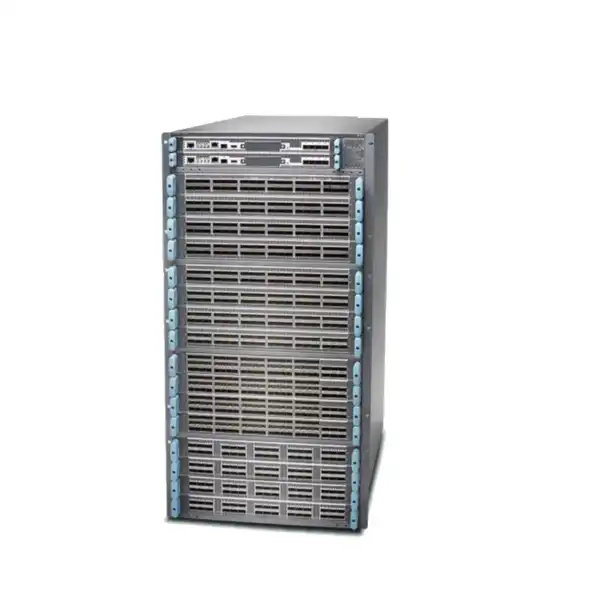
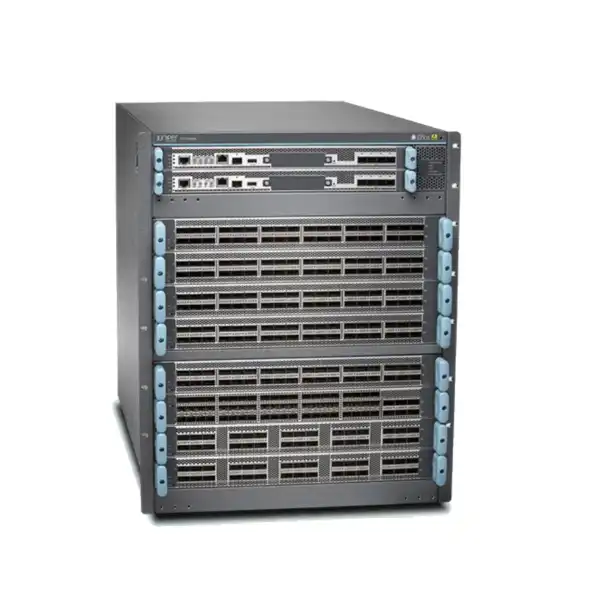
Juniper PTX10008 Packet Transport Router in Dubai
The PTX10008 is Juniper Networks’ eight-slot modular packet transport platform for high-scale IP core, peering, cloud and data-center transport environments. Its value is not defined by the chassis alone: switch-fabric generation, line-card choice, interface speeds, routing scale, software release, optics, electrical feed and redundancy policy determine the usable system you actually deploy.
Direct answer: what is the Juniper PTX10008?
The Juniper PTX10008 is a modular packet transport router built for very high-throughput routing and transport roles. It is mainly used where organizations need dense 100GbE, 400GbE or 800GbE connectivity, large-scale IP and MPLS routing, resilient core architecture and a chassis platform that can evolve by changing line cards and switch fabric rather than replacing the entire network design.
What exactly is it?
A 13U, eight-line-card-slot modular router in the PTX10000 family, engineered for packet transport and IP core scale.
What is it used for?
Internet peering, service-provider core routing, cloud backbone, data-center interconnect and high-capacity IP/MPLS transport.
Who should consider it?
Carriers, ISPs, hyperscale or large enterprise networks, exchange-connected organizations and data-center operators with multi-terabit requirements.
What must be confirmed first?
The switch-fabric generation and exact line-card architecture, because they govern capacity, software environment, interface choices and upgrade path.
What can FourTeck determine?
A bill of materials covering chassis, fabric, control, line cards, optics, power, licensing, rack integration, migration and support scope.
Why the PTX10008 is a configuration decision, not a single-box purchase
A PTX10008 quotation can look deceptively simple if it is described only as a chassis. In practice, a deployable system is assembled from several interdependent choices. The eight physical line-card slots are only one part of the design. The Switch Interface Boards determine the fabric generation and therefore the bandwidth available between line cards. The Routing and Control Boards provide the control-plane and chassis-management functions. Line cards determine physical interface density and speed. Power supplies must be sized against the installed components and the chosen redundancy policy. Fan trays and fan controllers must match the architecture. Optics must be compatible with the exact card, desired Ethernet speed, fibre plant and distance. Software release and feature licensing also matter, particularly on Junos OS Evolved systems.
This is important for Dubai buyers because a superficially attractive chassis price can omit the components that make the router usable in the intended network. A core router procurement should therefore begin with traffic and architecture rather than part number alone. The useful questions are: how much traffic must the chassis forward today; what growth is expected over three to five years; how many 100G, 400G and 800G ports are needed; which line cards are required for those ports; what resilience is expected during a component failure; and whether the existing network already uses Junos OS, Junos OS Evolved, specific routing policies, timing, management or automation tooling.
The PTX10008 can support very different systems under the same chassis name. Legacy JNP10008-SF fabric systems and newer SF3/SF5 systems do not represent the same performance, line-card family or software environment. A technically accurate quote must identify the target architecture explicitly. That distinction is the single best way to prevent a buyer from comparing unlike PTX10008 configurations by price alone.
PTX10008 buyer specification summary
The figures below describe the platform and current Juniper-documented options. Final usable capacity depends on the selected switch fabric, line cards and supported software combination, so the bill of materials should always be validated as one system.
| Specification | PTX10008 detail |
|---|---|
| Chassis form factor | 13 rack units, front-rack mounted, front-to-back airflow. |
| Line-card slots | Eight. |
| Current system capacity range | Juniper’s current PTX10000 specifications list PTX10008 from 115.2 Tbps to 230.4 Tbps with SF5 at the top end; older JNP10008-SF systems have different forwarding capacity and card support. |
| Current high-speed line cards | PTX10K-LC1201-36CD, PTX10K-LC1202-36MR and PTX10K-LC1301-36DD on supported SF3/SF5 combinations. |
| Maximum documented port speed | Up to 800GbE with PTX10K-LC1301-36DD. |
| Management | CLI plus Juniper Routing Director / Juniper Paragon Automation options; each RCB provides dedicated out-of-band management connectivity. |
| Power system | AC, DC and high-voltage options exist across configurations. Power supply count must be planned against installed component load and redundancy. |
| Operating environment | Juniper lists 0°C to 40°C at 6000 ft and up to 46°C at sea level, with 5% to 90% non-condensing relative humidity. |
| Maximum listed system weight | Up to 421 lb / 191 kg in Juniper’s current PTX10000 specification summary; actual shipping and installed weight depends on configuration. |
Switch fabric: the most important PTX10008 architecture choice
The PTX10008 has evolved through multiple switch-fabric generations. That history matters because buyers can encounter different chassis bundles, refurbished configurations, expansion proposals and upgrade discussions that all use the PTX10008 name. The original JNP10008-SF fabric is associated with standard Junos OS and older line-card families. Juniper documents 42 Tbps forwarding capacity for PTX10008 systems using this fabric. The JNP10008-SF3 fabric moves the platform to Junos OS Evolved and supports newer high-speed line cards. Juniper documents 115 Tbps-class forwarding for the SF3 architecture, while current PTX10000 portfolio specifications present 115.2 Tbps as the lower end of the modern PTX10008 system range.
The newest JNP10008-SF5 fabric is the route to the highest current chassis capacity. Juniper lists up to 230.4 Tbps for PTX10008 with SF5. It also supports the PTX10K-LC1301-36DD 28.8 Tbps line card with 36 ports capable of 800GbE. The SF5 architecture therefore makes sense when the business case includes dense 800G, a long capacity runway, or a desire to avoid buying into a fabric ceiling that will be reached before the chassis is otherwise exhausted.
Fabric choice also changes the redundancy bill. Juniper documentation distinguishes base and redundant SIB counts, and the required SIB population differs by fabric generation and performance configuration. A quote that says only “PTX10008 chassis” without identifying the exact SIB set cannot be compared meaningfully with another proposal. Ask for each SIB part number, quantity and supported software release to be visible in the bill of materials.
For an existing PTX10008 upgrade, the key question is not whether a new line card physically fits. It is whether the installed fabric, Routing and Control Boards, fan system, power system and Junos release support that card. High-speed migrations should be planned as a platform compatibility exercise rather than a slot-availability exercise.
High-speed line-card choices for SF3 and SF5 systems
PTX10K-LC1201-36CD
A 36-port QSFP56-DD line card with 14.4 Tbps line-rate throughput. Its ports can operate up to 400GbE and can be channelized for lower Ethernet rates including 200G, 100G, 50G, 25G and 10G where supported.
This is a strong fit for networks standardizing around dense 400G while still needing breakout flexibility for mixed-speed transitions.
PTX10K-LC1202-36MR
A 4.8 Tbps mixed-rate card with thirty-two QSFP28 ports for up to 100GbE and four QSFP56-DD ports for up to 400GbE. It is useful when 100G remains the dominant access or interconnect speed but a smaller number of 400G uplinks is needed.
Its economics can be more appropriate than filling 400G-capable ports where the traffic plan remains primarily 100G.
PTX10K-LC1301-36DD
A 36-port, 28.8 Tbps line card using high-density QSFP-DD interfaces capable of up to 800GbE. It uses Juniper Express 5 silicon and is the natural choice when 800G density or the highest SF5 capacity is a primary objective.
On SF3, Juniper documents a lower maximum card throughput than the card’s full 28.8 Tbps capability, making fabric selection especially important.
How to size a PTX10008 for real traffic rather than headline capacity
The headline chassis capacity is a useful upper boundary, but it is not a sizing method. A router should be sized from traffic matrices, interface counts, growth and failure conditions. Start by separating north-south internet or WAN traffic from east-west backbone traffic, inter-site replication, peering exchanges, transit, private interconnects and any service-chain traffic that will cross the PTX10008. Document peak traffic rather than monthly averages. Core networks are usually designed with headroom because an unplanned event, maintenance window or failed parallel path can redirect a large amount of traffic into the surviving chassis.
Then convert traffic into port requirements. Twenty-four 400G links do not necessarily mean 9.6 Tbps of steady-state traffic, but the design must still account for the interface bandwidth and how those ports map onto line cards and Packet Forwarding Engines. If links are distributed for resilience, their placement across line cards may matter as much as the raw slot count. If a buyer expects to move from 100G to 400G and then 800G during the economic life of the platform, it can be cheaper to choose a fabric and control architecture that supports that path from the beginning than to rebuild the chassis mid-cycle.
A second sizing dimension is route and service scale. Juniper positions PTX10008 for full-scale IP and MPLS routing, large BGP peer counts and very large routing tables. Nevertheless, a design should state actual requirements: full internet tables, number of VRFs, MPLS label scale, BGP sessions, route-policy complexity, convergence expectations and telemetry volume. These requirements influence software, Routing Engine selection and operational validation even when packet throughput appears modest.
Finally, size for the degraded state. Ask whether the system must carry full traffic after losing a line card, SIB, power supply, Routing and Control Board, upstream circuit or entire peer chassis. A production core design is not complete until the surviving topology has been tested on paper against peak traffic and routing convergence.
100G, 400G and 800G interface planning
Port speed must be chosen together with optical reach and peer capability. The PTX10008 can host line cards that support multiple Ethernet generations, but the exact pluggable transceiver depends on the line card, port mode, software release and physical link. A 400G port might connect by short-reach multimode, single-mode data-center optics, coherent pluggables or breakout assemblies depending on the application. An 800G port adds another layer of choices around fibre type, distance, connectorization, power draw and compatibility with the remote platform.
Juniper’s PTX10008 hardware documentation directs operators to the Hardware Compatibility Tool for supported optical modules and cables. That is the correct practice for procurement because “QSFP-DD” alone is not a compatibility guarantee. The form factor can describe the mechanical module while the optical specification, electrical lanes, FEC expectations and software qualification determine whether the module is appropriate. Third-party optics may be commercially attractive, but their operational and support implications should be evaluated rather than assumed.
Breakout also needs deliberate design. The PTX10K-LC1201-36CD can provide multiple lower-speed modes from its 400G-capable ports, and the PTX10K-LC1202-36MR offers mixed 100G and 400G connectivity. Breakout can ease migrations from legacy links, but it increases cable count and can complicate documentation, patching and failure isolation. In a dense Dubai data-center deployment, cable-management capacity, front-of-rack bend radius and patch-panel strategy deserve the same attention as logical port count.
Before ordering optics, document each link as a row: local line card and port, required speed, remote device and port, fibre type, connector type, estimated path length, patching losses and whether breakout is required. That simple link schedule prevents one of the most common high-speed network purchasing mistakes: buying expensive optics that match the advertised Ethernet rate but not the actual physical path or platform qualification.
IP core, MPLS and peering use cases
The PTX10008 is most compelling when packet transport is the primary job. For a service provider or large digital business, that can mean acting as a core node that moves traffic between metro, edge and international gateways. The platform’s scale is also relevant for internet peering, where organizations need many high-capacity external sessions and must hold large route tables while maintaining fast convergence. Dense 100G and 400G port options suit internet exchanges, carrier interconnections and private network interconnects where bandwidth grows faster than rack space.
MPLS remains another important application. Core networks commonly use label switching to create traffic-engineered or service-aware paths while separating transport from customer or application topology. Juniper positions the PTX10008 for full-scale IP and MPLS routing and documents segment-routing capabilities such as SPRING and traffic-engineering functions. The buyer should map those features to the exact Junos release and architecture being deployed rather than assume every software capability exists identically across legacy Junos OS and Junos OS Evolved systems.
Cloud and data-center operators can use the PTX10008 as a high-capacity backbone or DCI platform when the requirement is routed transport rather than top-of-rack switching. It can aggregate many high-speed links between data halls, campuses, colocation facilities or cloud on-ramps. The modular design is valuable where the port mix will change over time because line cards can be selected around the current stage of the migration.
The PTX10008 is not automatically the right answer for every enterprise with a fast network. Smaller sites with a handful of 100G links may obtain better economics and lower power consumption from a fixed-form-factor PTX platform or another router family. The eight-slot chassis earns its place when modularity, scale, resilience, port density and upgrade runway are valuable enough to justify data-center-grade power and space.
Junos OS versus Junos OS Evolved: confirm the software architecture
PTX10008 hardware generation and software generation are connected. Juniper documentation associates the older JNP10008-SF fabric with Junos OS, while JNP10008-SF3 and JNP10008-SF5 systems operate with Junos OS Evolved. This distinction affects more than the name of the operating system. It can influence supported hardware, upgrade procedure, feature introduction, release qualification, automation workflow and the exact compatibility matrix for line cards and control boards.
For a greenfield purchase, the software release should be chosen with the hardware bill rather than after hardware delivery. A new high-speed line card may require a minimum Junos OS Evolved release. For example, Juniper documents release dependencies for support of specific line cards and fabrics. Operators who standardize on a conservative long-lived software train should confirm that every selected component is qualified on that train before ordering.
For an existing chassis, an upgrade can therefore become a software project. Adding a newer fabric or line card can require control, cooling, power and software changes. The maintenance plan should include configuration backup, release-note review, lab or staging validation where possible, rollback preparation and verification of all required routing and operational features. The target should not merely be “the card comes online”; it should be “the entire production feature set operates as expected on the supported release.”
A FourTeck quotation can be structured around the customer’s current Junos version, desired target version and maintenance policy so that hardware compatibility and software readiness are checked together.
Routing and Control Board redundancy
The Routing and Control Board integrates routing-engine and chassis-control functions. Juniper supports one or two RCBs in the PTX10008. Base configurations can ship with one, while a second RCB enables a fully redundant control-plane arrangement. In a two-RCB system, one board acts as primary and the other as backup. When graceful Routing Engine switchover is configured, the backup can take over if the primary is removed or fails.
The commercial question is whether the router is being purchased for a role where control-plane redundancy is mandatory. A lab, migration staging chassis or noncritical environment might justify a base configuration. A production internet core, carrier backbone or high-value DCI node usually has stronger reasons to deploy redundant control. The additional board adds cost and power, but its value is measured against the consequence of a control-plane outage and the operational freedom to perform maintenance.
Redundancy also depends on software configuration. Installing two RCBs does not automatically create the intended hitless behavior. Features such as Graceful Routing Engine Switchover and nonstop active routing must be planned, enabled and tested within the supported software design. Routing protocols and peer devices should be reviewed for convergence behavior during failover. Network teams often validate redundancy during commissioning by forcing controlled switchover events while monitoring traffic loss, protocol state, alarms and management visibility.
When requesting a quote, state whether a single or dual RCB design is required and whether the goal is simple hardware redundancy or a broader high-availability outcome. This helps separate a complete production architecture from a lower-cost chassis bundle that may be appropriate only for noncritical use.
Power design, cooling and rack engineering
A PTX10008 belongs in a properly engineered equipment environment. Juniper lists the chassis at 13U, roughly 17.4 inches wide, 22.55 inches high and 32 inches deep, extending to approximately 39.37 inches with the EMI door. The current portfolio specification lists a maximum system weight of 421 lb / 191 kg. The rack must therefore be assessed for usable depth, static load, rail compatibility, adjacent equipment, cable-management clearance and service access before delivery.
Airflow is front to back. That seems simple, but it creates a firm requirement for the hot-aisle/cold-aisle orientation to match the rest of the facility. Blocking the intake with dense cabling or placing the chassis against an opposing airflow pattern can reduce thermal margin. Juniper lists operation up to 46°C at sea level under specified conditions, but a data-center design should not use the upper environmental limit as a normal target. Stable inlet temperature, clean airflow and adequate cooling capacity improve reliability and maintenance flexibility.
Power planning is configuration-specific. SF3 and SF5 systems use high-power line cards, fans, control boards and switch-fabric modules. Juniper publishes component power budgets and recommends maintaining n+1 power supplies. Its documentation also warns that a newly installed line card will not power on if doing so would exceed available power after required redundancy. This makes power-supply count a technical dependency rather than a cosmetic bundle option.
The facility feed must match the selected AC, DC or high-voltage power configuration. Juniper’s PTX10000 specifications list 200–240 VAC, -48 VDC and supported high-voltage DC ranges across the family. The exact power cords, plugs, distribution units and circuit ratings must be matched to the Dubai data-center or telecom-room electrical standard. Do not order power cords solely by country name; confirm connector type, PDU outlet, phase arrangement, feed redundancy and cable reach.
For installation, Juniper recommends a mechanical lift because of the chassis weight. The rack plan should reserve the full 13U, identify the intended RU position, verify floor and rack loading, and provide safe clearance for line-card insertion and front cable management. Those details should be completed before the hardware arrives, not during the installation window.
Optics, cables and physical-layer compatibility
High-capacity routers frequently encounter deployment delays because the chassis and line cards arrive before the optical design is complete. The PTX10008 should be procured with a port-to-port optical schedule. Each link needs a local interface type, remote interface type, Ethernet rate, fibre medium, reach, connector, patch-panel path and loss budget. When coherent or long-reach optics are involved, include wavelength and optical-network constraints as well.
Juniper publishes supported transceivers through its Hardware Compatibility Tool. This is especially important for 400G and 800G because the same external form factor can host different optical standards. The remote device must support the same Ethernet and optical mode. Forward error correction requirements should be checked across both ends. If a link traverses structured cabling, the total optical budget must include patch panels, connectors, splices and engineering margin rather than only the straight-line fibre distance.
Management cabling is simpler but still worth including in the bill. Each RCB provides a 10/100/1000BASE-T RJ-45 management port and a 1G SFP management port for out-of-band connectivity. The console uses an RJ-45 serial interface. Juniper notes that a console cable and DB-9 adapter may not be included in the package, and separately orderable USB-A or USB-C adapter options are documented. A deployment checklist should therefore include console access, OOB switch ports and the exact adapters the field engineer will use.
The most useful procurement discipline is to treat optics and management accessories as named line items rather than assumptions. This improves quotation accuracy, simplifies receiving inspection and allows the operations team to validate every physical connection before the maintenance window begins.
Operations, monitoring and automation
The PTX10008 can be managed through the Junos command-line interface and integrated with Juniper’s automation and routing-management ecosystem, including Juniper Routing Director and Juniper Paragon Automation offerings. For an operator, the important question is not whether an API or management product exists but how the router will fit into the organization’s current network operating model.
A production deployment should define configuration source of truth, change workflow, credential handling, log collection, time synchronization, telemetry, alarm routing, backup policy and software-image management. If the network already uses automation, validate the intended data models, RPCs, NETCONF or other supported interfaces against the target Junos release. New chassis generations can expose more telemetry, but collecting everything without an operations plan can overwhelm monitoring systems and create noise rather than useful visibility.
High availability should be observable. NOC dashboards should distinguish a redundant system running normally from one that is carrying traffic with a failed SIB, power supply, fan or RCB. Juniper provides chassis power and hardware status information that can be incorporated into operational monitoring. Thresholds should create actionable alerts before redundancy is exhausted. For example, an n+1 power design that loses one supply may continue forwarding normally, but the loss is still urgent because the next failure could affect service.
For Dubai deployments where the router may sit in a remote colocation facility, out-of-band access deserves particular attention. A separate management path, console server integration and documented remote-hands procedure can reduce the need for emergency site visits during software or routing incidents.
Software licensing and feature entitlement
Hardware capability and software entitlement are separate purchasing dimensions. Juniper uses licensing mechanisms for certain PTX software capabilities, and those requirements can vary by release. Juniper documentation for Junos OS Evolved includes Agile Licensing behavior for PTX10008 and identifies licensing associated with features such as VRF scale and MACsec bandwidth in relevant releases. This does not mean every deployment needs every license. It means the requested feature set must be mapped to the current licensing guide and software release before the quote is finalized.
A buyer should therefore provide more than the words “IP/MPLS core.” Specify whether the design requires large numbers of MPLS or VXLAN VRFs, MACsec, advanced automation, particular routing-scale functions or other separately entitled capabilities. If subscriptions or term-based licenses are proposed, confirm term length, support relationship, renewal process and what operational behavior occurs if the entitlement expires or is not present.
Licensing is also an upgrade consideration. An older PTX10008 that is moved to a newer software architecture may encounter different entitlement mechanisms than the team used previously. The implementation plan should include license activation, account access and verification before the maintenance window. A router that boots successfully but reports license alarms is not a finished deployment.
For procurement control, ask the quotation to separate perpetual hardware, software entitlements, subscriptions, support and services into identifiable line items. That allows finance and network teams to understand both the initial capital cost and recurring operating commitments.
A practical PTX10008 deployment journey
1. Define traffic and topology
Record current and projected throughput, peer links, core paths, DCI requirements, failure scenarios, BGP scale, MPLS services and target interface speeds. This creates the engineering basis for the chassis rather than starting from a prebuilt bundle.
2. Select fabric and control
Choose the supported SF3 or SF5 architecture, required SIB redundancy, RCB type and single- or dual-control design. Confirm the Junos OS Evolved release that supports the complete combination.
3. Build the line-card map
Allocate every 100G, 400G and 800G link to a specific line card and slot. Distribute critical links so that one card failure does not remove all connectivity to the same peer, site or service.
4. Validate power and facility
Calculate the installed component load, required n+1 or stronger power redundancy, PDU circuits, plug types, rack loading, 13U space, airflow direction and cable-management capacity.
5. Qualify optics and cabling
Use the supported transceiver list for each line card and verify link distance, fibre, connectors, FEC, breakout and remote-device compatibility. Order management and console accessories at the same time.
6. Stage, install and test
Pre-stage software, licenses and baseline configuration, then rack using appropriate lifting equipment. Test forwarding, routing convergence, RCB switchover, power redundancy, alarms and monitoring before production acceptance.
Migration from 100G or 400G core networks
A PTX10008 deployment often happens during a bandwidth transition rather than on a clean greenfield network. If the current backbone is primarily 100G, the PTX10K-LC1202-36MR can preserve substantial 100G density while introducing selected 400G ports. The PTX10K-LC1201-36CD provides a more 400G-centric path with channelization to lower rates. For networks already planning 800G, the PTX10K-LC1301-36DD and SF5 deserve evaluation so that fabric capacity does not become the next bottleneck.
Migration design should include physical and routing overlap. Avoid a plan that requires every peer or downstream router to change speed at once. Breakout, parallel links and mixed line-card populations can create an incremental path, provided the exact interoperation is supported. On the routing side, establish whether the new chassis will initially operate in parallel with the old core, replace it node by node, or take over through a maintenance cut. Each approach creates different needs for BGP policy, IGP metrics, MPLS labels and failure-domain testing.
The software migration may be equally significant. Existing operational scripts, configuration templates, monitoring parsers and automation should be tested against the target Junos architecture. A hardware-only project plan can underestimate this work. Successful migrations normally have a staging phase in which representative routing policy, telemetry, user authentication, NTP, logging and management functions are validated before traffic is moved.
For critical networks, define rollback at every stage. A rollback plan is not just “reconnect the old router”; it includes retained optics and fibres, known-good configuration, routing preference changes, console access and a decision threshold for reversing the maintenance. These details reduce the operational risk of introducing a chassis whose capacity is much larger than the system it replaces.
When PTX10008 is a strong fit
High-capacity IP core
You need multi-terabit packet transport with room to grow while retaining modular line-card expansion and redundant control, fabric, power and cooling options.
Dense peering
The network connects to multiple carriers, exchanges, clouds or content networks and needs substantial route scale plus dense 100G/400G connectivity.
400G to 800G transition
The design needs a modular route from current 400G services toward 800G without committing to a small fixed platform that may exhaust ports or switching capacity.
Large DCI backbone
Multiple data-center sites, cloud on-ramps or metro facilities exchange routed traffic at bandwidth that justifies chassis-level density and resiliency.
Carrier-grade availability
Operational policy calls for redundant control, fabric, fans and power plus tested software high-availability features and planned component maintenance.
When a smaller or different platform should be evaluated
The PTX10008 is not a universal recommendation. Its 13U footprint, high-capacity power system and modular component structure are designed for substantial networks. If an organization needs only a few 100G or 400G interfaces and has limited growth, a smaller fixed-form-factor or four-slot platform may deliver the required forwarding capacity with less rack space, lower acquisition cost and simpler spares. The correct comparison should use the number of usable ports, redundancy and five-year growth rather than chassis capacity alone.
Within the PTX10000 modular family, the PTX10004 is a natural comparison when four line-card slots are enough. It offers a smaller chassis while sharing aspects of the high-speed line-card ecosystem. Conversely, the PTX10016 should be evaluated when eight slots are already close to the projected requirement or when a much larger chassis capacity is strategically valuable. Juniper’s current specifications place the three modular systems at different rack densities and maximum capacities, allowing network architects to trade space, port density and growth headroom.
Another reason to choose differently is feature fit. The PTX family is optimized for packet transport. If the project is primarily an enterprise campus core, data-center leaf switch, firewall, broadband subscriber gateway or service appliance, another platform family may align better with the workload. Buying an extremely fast router does not compensate for choosing the wrong product role.
A balanced evaluation should therefore compare PTX10008 against the nearest smaller and larger options plus any alternative architecture already standardized by the operations team. The best result is the platform that meets required throughput, routing scale, resilience and lifecycle headroom without creating unnecessary operational cost.
PTX10008 versus PTX10004 and PTX10016
| Decision area | PTX10004 | PTX10008 | PTX10016 |
|---|---|---|---|
| Line-card slots | 4 | 8 | 16 |
| Current listed capacity range | 57.6 to 115.2 Tbps with SF5 at top end | 115.2 to 230.4 Tbps with SF5 at top end | 230.4 to 460.8 Tbps with SF5 at top end |
| Rack density | Up to six chassis per 42U rack in Juniper’s summary | Up to three chassis per 42U rack | Up to two chassis per 42U rack |
| Best starting point | Fewer slots with modular high-speed capability | Balanced modular scale for large cores and peering | Maximum modular density and growth |
| Key buyer question | Will four slots remain enough through the planning horizon? | Does eight-slot scale balance headroom and rack cost? | Is sixteen-slot capacity operationally and financially justified? |
These are platform-level comparisons. Actual capacity and port density depend on fabric and line-card population. A useful design review models the intended BOM in each chassis rather than comparing only maximum portfolio figures.
Dubai and UAE deployment considerations
Deploying a PTX10008 in Dubai is primarily a data-center engineering exercise. The region does not change the router’s fundamental protocol behavior, but facility, logistics and support choices affect project success. Confirm the target rack standard, available 13U space, rack depth, floor and rack loading, front-to-back airflow, redundant power feeds and PDU connector type. Large modular routers should be matched to the exact colocation or enterprise data-center specification before shipping.
Lead time should be discussed at component level. A chassis may be obtainable while a particular line card, fabric board, Routing and Control Board or optical module has a different supply schedule. Requesting the complete BOM early makes it easier to identify the critical path. If the project has a fixed cutover date, consider spare optics, power supplies and other field-replaceable components in the procurement plan rather than relying on post-failure shipping.
Support coverage is another regional decision. Clarify whether the requirement is manufacturer support, next-business-day replacement, more aggressive hardware replacement, FourTeck installation assistance, remote configuration support or an ongoing maintenance arrangement. For colocated equipment, determine who is authorized to access the cage, what remote-hands services can do and how failed parts will be received and returned.
Availability and price should never be inferred from a generic online listing for a chassis of this class. The commercial quote should state the exact configuration, condition if applicable, warranty/support terms, delivery location, lead time, optics and services. That makes the purchasing document an extension of the engineering design rather than a loose shopping list.
Procurement risks to remove before issuing a purchase order
Undefined fabric generation
Two PTX10008 proposals can have very different capacity and line-card compatibility. Require the SIB model and quantity to be stated.
Incomplete power population
A chassis that powers on is not necessarily a resilient production system. Confirm component load, feed design and n+1 or stronger supply count.
Wrong optics
Specify link distance, fibre, connector and peer device. Form factor and Ethernet speed alone do not prove optical compatibility.
Software mismatch
New fabrics and line cards have minimum software requirements. Validate the complete hardware set against the target Junos release.
Missing licenses or support
Separate hardware, entitlements, subscriptions and support so recurring commitments and feature requirements are transparent.
Facility surprise
Validate rack depth, load, lifting method, airflow, cable management and PDU interfaces before the delivery reaches the site.
What a complete PTX10008 quotation should contain
A useful quote should make the architecture legible to both engineering and procurement teams. At minimum, it should identify the exact PTX10008 chassis bundle, power type, switch-fabric boards and quantity, Routing and Control Boards and quantity, fan system, each line-card model and quantity, blanking components where relevant, rack-mount kit, cable-management options, power cords, management accessories, optical transceivers, breakout or direct-attach cables, software entitlement, support level and implementation services.
The quote should also explain assumptions. If optics are excluded, say so. If the customer will provide rack installation, grounding and fibre patching, those boundaries should be visible. If a price depends on a specific support term or subscription duration, record it. If a line card is proposed because the design expects a future speed migration, state the reasoning so that the purchasing team does not substitute a cheaper card that breaks the architecture.
For phased projects, divide the BOM into day-one and expansion components. A day-one chassis may have empty line-card slots but should still have enough fabric and power architecture for the intended expansion path. This helps the organization avoid buying unnecessary ports now while protecting the engineering assumptions that justify the platform.
FourTeck can prepare the quotation from a port schedule or from a higher-level requirement. The more precise the input—interface count, speed, optics reach, redundancy, software and support—the less contingency has to be built into the proposal.
Frequently asked buyer questions
How many line cards does the PTX10008 support?
The chassis provides eight line-card slots. The usable card models depend on the switch-fabric generation and supported software release. A slot count alone does not establish capacity because different cards provide very different throughput and interface mixes.
What is the maximum PTX10008 capacity?
Juniper’s current PTX10000 specifications list up to 230.4 Tbps for PTX10008 with the SF5 fabric. Older fabric generations have lower capacity, so the correct number for a specific chassis is tied to its SIBs and line cards.
Can PTX10008 provide 800GbE?
Yes. Juniper documents the PTX10K-LC1301-36DD as a 36-port line card supporting interface speeds up to 800GbE. Full line-card throughput and compatibility depend on the selected fabric and software release.
Is the PTX10008 suitable for 100G networks?
Yes, but the right card matters. The PTX10K-LC1202-36MR provides a 100G-heavy mix with selected 400G ports, while the LC1201 can channelize higher-speed interfaces to multiple lower rates. If the design will remain small, a smaller chassis should also be evaluated.
Does PTX10008 use Junos OS Evolved?
Modern SF3 and SF5 PTX10008 systems use Junos OS Evolved. Older JNP10008-SF systems are associated with standard Junos OS. The fabric architecture therefore needs to be known before software planning begins.
Can a PTX10008 be ordered with redundant control?
Yes. The chassis can operate with one or two Routing and Control Boards. Two RCBs are used for a redundant control-plane design, with software high-availability features configured and tested according to the operational requirement.
What power redundancy is recommended?
Juniper’s power-planning guidance recommends maintaining n+1 power supplies. The actual number of supplies depends on the fabric, cards, fan system, optics and input power type. A production quote should calculate this from the exact BOM.
Are optics included with the router?
Do not assume so. Chassis and line-card bundles are distinct from the optical design. The quote should list each required transceiver or cable, or clearly state that optics are excluded and will be provided by the customer.
How much rack space is required?
The PTX10008 chassis is 13U. Juniper indicates that up to three can fit in a standard 42U rack where weight, power and cooling permit. Real deployments must also reserve usable depth and cable-management clearance.
Can FourTeck install the PTX10008 in Dubai?
Installation scope can be included in a project quotation. The required work should identify rack mounting, grounding, power connection, optics and fibre patching, initial configuration, software staging, routing migration, testing and acceptance responsibilities.
What information is needed for pricing?
Provide quantity, required port speeds and counts, traffic target, preferred SF3 or SF5 architecture if known, redundancy, AC/DC power, optics distances, software features, support term, delivery location and installation scope.
Should an existing PTX10008 be upgraded to SF5?
It depends on the installed fabric, RCBs, fan system, power supplies, cards, software and future port plan. If 800G or substantially higher chassis capacity is required, SF5 is an important option, but the upgrade should be validated as a complete compatible system.
Technical due diligence for an existing PTX10008
If the project involves expansion or refurbishment rather than a new chassis, collect a hardware inventory first. Record the chassis SKU, installed SIB models, RCB models, fan trays and controllers, power-supply models and counts, line cards, optics and blanking panels. Export the current software version, active licenses and relevant chassis status. This snapshot is essential because the PTX10008 has enough generational variation that two installed systems can require very different upgrade paths.
Next, define the target state. For example, a customer may want twelve additional 400G ports, dual RCBs and a software refresh. The engineering task is to determine whether the existing fabric can support the card, whether the control and cooling components are compatible, whether the power budget still has redundant headroom and whether the target software release supports both old and new components during the transition. If the answer requires replacing several foundational FRUs, the economics of upgrading should be compared against a new chassis configuration.
Operational condition should also be assessed. Review hardware alarms, fan and power status, error history, optical levels and available spares. A core upgrade window is a poor time to discover a pre-existing degraded component. Where support contracts apply, verify entitlement and replacement procedure before touching the chassis.
This due-diligence approach avoids a common assumption: that modular means universally interchangeable. Modularity gives the platform an upgrade path, but each path still has documented compatibility boundaries.
Support, spares and lifecycle planning
A router carrying core traffic should be purchased with a support strategy, not only a warranty expectation. Decide how quickly a failed line card, RCB, SIB, fan or power supply must be replaced and whether the organization can tolerate vendor logistics time. Some operators keep local spares for the components whose failure has the highest operational consequence or whose replacement lead time is unpredictable.
Software support is equally important. The selected Junos release should align with the organization’s maintenance policy and with the hardware features required. Before each upgrade, review release notes for feature support, limitations and resolved issues. For high-scale routing, a conservative release strategy combined with lab validation is often more valuable than adopting a new train solely to access a feature that is not yet needed.
Lifecycle planning should consider the full system, including optics. A chassis may remain useful for years while interface economics change quickly. The modular PTX10008 can accommodate new line cards within supported architectures, but a long-term plan should identify when 100G links are expected to migrate to 400G, when 400G may move to 800G and whether the existing fabric leaves enough bandwidth to make those upgrades worthwhile.
For a new Dubai deployment, FourTeck can structure hardware, support and optional spares as separate elements so the network team can choose the risk level that matches the service carried by the router.
Security considerations for a core transport router
The PTX10008 is not a firewall, but security is still central to its role. Core routers carry privileged control protocols, management access and large amounts of business traffic, so the deployment should separate the management plane from production forwarding. Use dedicated out-of-band management where practical, restrict administrative access, integrate centralized authentication, log configuration changes and ensure that console access is physically controlled.
Routing security should be addressed through policy rather than assumed from platform scale. Internet peering deployments should define prefix filters, maximum-prefix behavior, route-policy controls, BGP session protection and incident procedures. Internal core deployments should similarly control protocol adjacency and management exposure. The exact hardening configuration depends on topology and Junos release, but security review should be part of commissioning rather than a later cleanup task.
Where link-layer encryption is required, Juniper documents MACsec software licensing behavior for PTX10008 under relevant Junos OS Evolved releases. That requirement should be validated against the specific line cards, port speeds and release because licensed bandwidth and feature support can affect the commercial design. Encryption requirements should be stated early, particularly on DCI links that may otherwise be assumed to be trusted private fibre.
Operational security also includes software provenance, controlled upgrade files, backup protection and change approval. A multi-terabit router can amplify the impact of a configuration error, so role-based access and peer review are practical availability controls as well as security controls.
Acceptance testing before production traffic
Commissioning should prove the design assumptions that justified the purchase. Start with inventory: confirm every SIB, RCB, fan, power supply and line card matches the approved bill of materials and is recognized without alarms. Verify the intended Junos version, active licenses, system time, management address, AAA, logging and monitoring before connecting production peers.
Test each physical link at the planned speed and inspect optical levels. Where breakout is used, verify logical port mapping against documentation and labels. Confirm MTU across representative end-to-end paths. If 400G or 800G links depend on particular FEC behavior, validate both ends rather than accepting link-up as the only proof of interoperability.
Routing tests should cover session establishment, route import/export, expected table scale, path preference and failure convergence. For redundant systems, deliberately test RCB switchover within the approved procedure. Where possible, test the loss of a power feed or supply, a redundant fabric component and a representative link to make sure alarms are generated and traffic behaves as designed. These tests are much safer before the chassis becomes the only active path.
Finish with an acceptance record that captures software version, hardware inventory, configuration checksum or backup, interface map, optics, routing status, alarm state and outstanding issues. That document becomes the baseline for future troubleshooting and upgrades.
Commercial evaluation: compare usable architecture, not chassis price
When several suppliers quote the PTX10008, the lowest headline price may describe the least complete system. One proposal might include a base chassis with minimal fabric and one RCB, while another includes redundant fabric, dual control, high-capacity line cards, optics and support. The correct comparison normalizes the bill of materials to the same technical outcome.
Create a comparison sheet with columns for chassis configuration, fabric model and quantity, RCB model and quantity, fan system, power supplies and feed type, each line card, optical modules, power cords, rack kit, support, software entitlements, installation and delivery. Add a second section for assumptions such as port speed, expected throughput, redundancy and software release. This often explains price differences immediately.
Total cost also includes facility resources. A configuration with more cards or older silicon may consume different power and cooling than a modern design delivering the same usable ports. Data-center rack space and electricity are recurring expenses, so architectural efficiency can matter over a five-year horizon. Conversely, paying for the largest possible fabric and a full set of 800G cards makes little sense if the traffic forecast will never use them.
The objective is not minimum purchase cost or maximum technical specification. It is a configuration whose capacity, resilience and upgrade path match the economic life of the service. That is the point at which the PTX10008 becomes a business decision rather than a collection of part numbers.
Decision recap for the Juniper PTX10008
What FourTeck needs for an accurate PTX10008 quotation
You do not need to provide every part number. A requirement-level brief is enough to start, but the following inputs allow the configuration to be narrowed quickly and reduce the chance of missing optics, power or licensing dependencies.
Core, peering, DCI, lab, migration or spare.
Counts of 100G, 400G and 800G ports plus expected growth.
Link distance, fibre type, connectors and peer devices.
Current peak, three-to-five-year forecast and failure-state load.
Single or dual RCB, fabric redundancy and required power resilience.
AC/DC feed, PDU connector, feed count and data-center limits.
Current Junos environment, target release, MPLS/VRF/MACsec needs.
Support term, spares, rack installation, configuration, migration and testing.
Plan the PTX10008 around your real network, not a generic bundle
Send FourTeck your required interface speeds, traffic target, redundancy level, power environment and deployment location. We can turn those inputs into a PTX10008 configuration covering the correct fabric, control boards, line cards, optics, power, software, support and implementation scope for Dubai or the wider UAE.

Reviews
There are no reviews yet.