
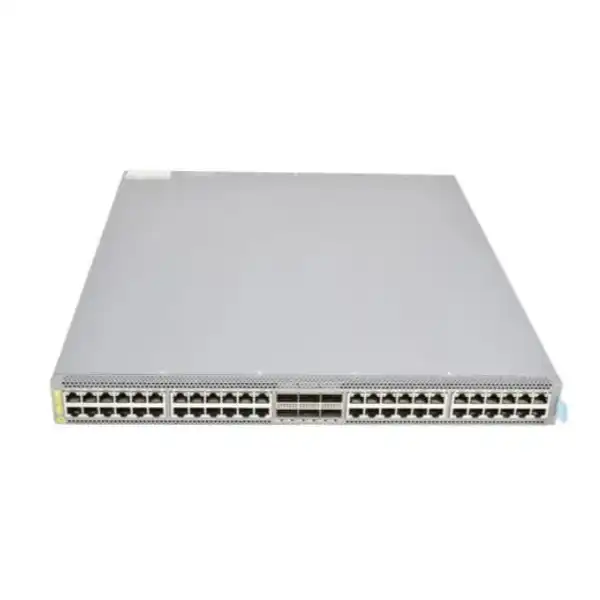
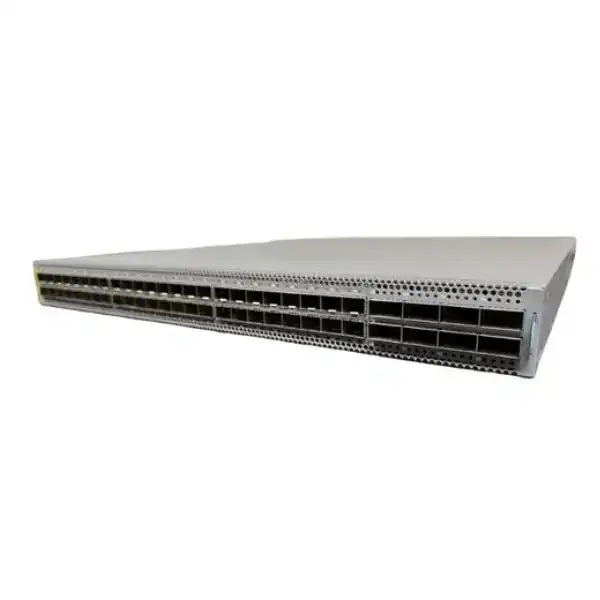
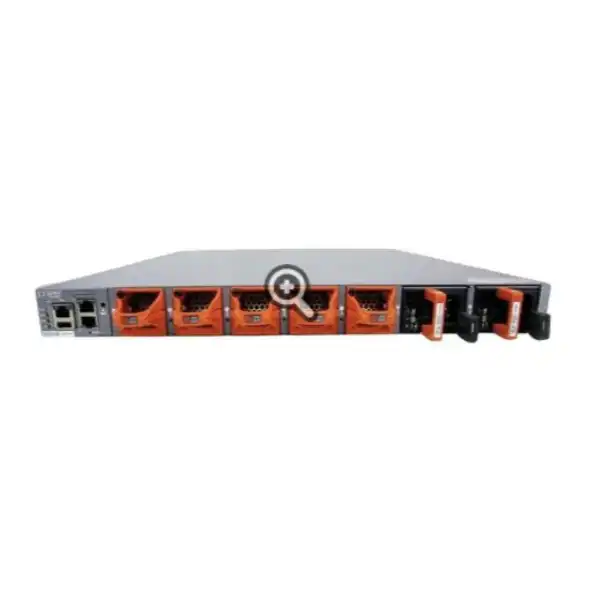
Juniper QFX5120-48YM Data Center Switch in Dubai, UAE
The QFX5120-48YM is a 1U fixed switch for organizations that need dense 1/10/25GbE server or distribution connectivity, eight 40/100GbE uplinks, low-latency Layer 2 and Layer 3 forwarding, EVPN-VXLAN fabric functions, and hardware support for MACsec across every data port. The buying decision is not only about port count: the airflow direction, AC or DC feed, optics, Junos feature tier, MACsec entitlement, support contract and intended topology all affect the final configuration.
Direct answer: what is the Juniper QFX5120-48YM?
Why the 48YM is a distinct QFX5120 model
The QFX5120 family covers several different physical connectivity patterns, and the letters at the end of the model matter. The QFX5120-48YM should not be treated as a generic substitute for every QFX5120. Its front-panel data interfaces combine 48 multi-rate SFP28 ports with eight high-speed QSFP28 uplinks, giving a useful density profile for racks in which servers, storage nodes, security appliances, hypervisors or downstream access devices connect at 10GbE or 25GbE while the leaf or distribution layer connects upstream at 40GbE or 100GbE. The model also adds MACsec capability across all ports, which changes both the security opportunity and the licensing conversation.
Juniper specifies up to 2 Tbps unidirectional and 4 Tbps bidirectional Layer 2/Layer 3 performance for the QFX5120-48YM, with forwarding latency as low as 800 nanoseconds. The platform uses a 2.9 GHz quad-core Intel CPU, 16 GB of DRAM and 100 GB of SSD storage. Those control-plane resources do not replace correct network design, but they help distinguish the 48YM from some neighboring variants and are relevant when planning operational functions, software upgrades, telemetry and routing scale.
The most useful way to evaluate this switch is therefore by workload and architecture rather than by headline bandwidth alone. A buyer should ask how many 25GbE endpoints are required now, how quickly that number could grow, how many independent 100GbE uplinks are needed, whether encryption is required on server-facing or inter-switch links, whether EVPN-VXLAN is part of the target fabric, and whether the physical rack uses front-to-back or back-to-front cooling. A correct answer to those questions usually has more commercial value than simply choosing the model with the largest nominal capacity.
Core QFX5120-48YM specifications
| Area | QFX5120-48YM detail | Buyer relevance |
|---|---|---|
| Form factor | Fixed 1U switch; approximately 4.37 × 44.09 × 52.02 cm | Confirm rack depth, rail position, cable bend radius and service clearance. |
| Downlink/access ports | 48 × SFP28 supporting 1GbE, 10GbE and 25GbE | Suited to mixed-speed migration where the optical/DAC choices are supported for the required rates. |
| Uplink ports | 8 × QSFP28 supporting 40GbE and 100GbE | Provides substantial fabric uplink capacity, but the uplink count and breakout plan must match the topology. |
| Switching performance | Up to 4 Tbps bidirectional and 2 billion packets per second | Useful for dense east-west traffic, subject to traffic patterns, protocol design and oversubscription choices. |
| Latency | As low as 800 nanoseconds | Relevant to latency-sensitive data center workloads, while application end-to-end latency still depends on the complete path. |
| Buffer | 32 MB | Traffic bursts and incast behavior should be evaluated where sustained congestion or storage patterns are expected. |
| MACsec | IEEE 802.1AE MACsec AES-256 hardware capability across all data ports | A dedicated MACsec software license is required when the feature is used. |
| Power consumption | Typical 329 W; maximum 351 W | Use the maximum value, PSU type and redundancy design when checking rack power and UPS capacity. |
| Power supplies | Two 850 W AC or DC supplies, depending on ordered variant | Do not mix AC/DC or airflow directions in the same chassis. |
| Environmental range | 0°C to 40°C operating; 5% to 90% noncondensing humidity | Data-room cooling and airflow discipline remain essential in UAE facilities. |
Port architecture: plan the speed mix before buying optics
The 48 SFP28 ports on the QFX5120-48YM support 1GbE, 10GbE and 25GbE, but a multi-rate front panel does not mean every port can be changed independently without design constraints. Juniper documents that the SFP28 interfaces are grouped in quads and that speed is configured by groups of four rather than as completely independent single-port choices. That is important in brownfield environments where a rack may contain a mixture of older 10GbE hosts and newer 25GbE servers. The migration can still be practical, but the port map should be created before installation so that each quad is assigned a compatible speed plan.
The eight QSFP28 positions support 40GbE and 100GbE and serve naturally as uplinks toward spine, core or aggregation switches. Certain ports support channelization and auto-channelization behavior, allowing a fabric designer to increase interface granularity where the Junos release, optics and breakout arrangement support the requirement. Breakout should never be assumed from connector appearance alone. The cable type, transceiver, lane mapping, remote platform and intended speed all have to be mutually compatible.
For a quotation, it is helpful to state endpoint count and speed separately. For example, “36 servers at 25GbE plus two 100GbE uplinks to each of two spines” is much more actionable than “one 48-port switch.” The first description lets the bill of materials include the correct quantity and type of SFP28 or DAC connections, QSFP28 uplinks, spare optics and patching. It also makes it possible to test whether the design leaves sensible capacity for growth rather than consuming every usable port on day one.
25GbE server access
A strong fit for racks where modern servers expose 25GbE NICs and the organization wants more per-host bandwidth than 10GbE without jumping directly to 100GbE on every endpoint.
100GbE fabric uplinks
Eight QSFP28 interfaces provide room for redundant spine connectivity, inter-switch links or other high-speed paths. Oversubscription should be calculated from real workload behavior rather than port arithmetic alone.
Mixed-speed migration
Support for 1/10/25GbE can ease staged refreshes, but port-speed grouping and optic compatibility must be accounted for. Build a port allocation sheet before the change window.
Performance means more than the 4 Tbps headline
The published forwarding capability of up to 4 Tbps bidirectional and 2 Bpps places the QFX5120-48YM in a class suitable for high-throughput leaf and distribution roles. Buyers should still distinguish switch silicon capacity from application experience. Real networks have traffic bursts, east-west fan-out, north-south flows, oversubscribed uplinks, routing convergence, encryption requirements and congestion. A switch can be nonblocking for a particular port configuration while a fabric as a whole is constrained by the number of uplinks or by a deliberate oversubscription ratio.
The 32 MB buffer is another design input. It is adequate for the target architecture of this switch, but buyers running workloads with extreme microbursts, large storage incasts or unusual congestion behavior should evaluate the end-to-end traffic pattern rather than assuming that a higher nominal port rate automatically removes queueing. Quality of service, ECMP design, link aggregation and application distribution can be as important as raw switching capacity.
The stated latency floor of 800 nanoseconds is useful for comparing switching platforms, especially for financial, trading, media or compute workloads where path delay matters. It should not be presented as the latency of an entire application transaction. Server NICs, virtualization, firewalls, routers, distance, optics and protocol processing all contribute. The better procurement question is whether the switch introduces an appropriate low-latency forwarding layer inside a design whose complete latency budget has been measured.
MACsec on every data port: valuable capability with a licensing dependency
The “M” distinction in the QFX5120-48YM is commercially important because Juniper documents IEEE 802.1AE MACsec AES-256 support across all data ports on this model. MACsec can protect Ethernet frames on supported point-to-point links, making it relevant for data center interconnect, secured campus distribution, sensitive server connections or other Ethernet paths where link-layer confidentiality and integrity are required. It can be useful when organizations want encryption below the IP layer or need a consistent link-security control inside an architecture that already uses higher-layer security for other purposes.
Hardware capability is not the same as entitlement. Under Juniper’s current QFX licensing information, MACsec on the QFX5120-48YM is a hard-enforced licensed feature and uses a dedicated QFX5K Class 1 MACsec license family. That means a buyer intending to deploy MACsec should explicitly include the appropriate term or perpetual entitlement in the commercial scope. A quote that includes only the switch chassis may be technically incomplete for the intended security outcome.
The remote device must also support a compatible MACsec implementation and the chosen key-management method. Link speed, optics, topology, redundancy and operational processes remain part of the design. Encryption is most useful when the trust boundary is defined first: identify which links need protection, why they need it, and how keys, certificates or policies will be operated over the life of the network. Applying encryption everywhere without an operational plan can add troubleshooting complexity without addressing the highest-risk paths.
For UAE projects, state the MACsec requirement at quotation time. FourTeck can then distinguish between a hardware-only deployment and one that must include the correct Juniper software entitlement, compatible peer platforms, deployment configuration and validation testing. This reduces the risk of discovering after installation that the physical switch supports the feature but the purchased software rights or remote endpoint do not match the intended encrypted link.
EVPN-VXLAN: where the QFX5120-48YM fits in a modern fabric
Juniper positions the QFX5120 family for IP fabric designs with EVPN-VXLAN overlays. In practical terms, an underlay IP network can provide routed reachability between fabric nodes while EVPN supplies the control plane for endpoint and network information and VXLAN carries tenant or segment traffic across that routed foundation. This architecture is widely used to move beyond large, failure-prone Layer 2 domains and to create scalable segmentation between workloads.
The switch can participate as a leaf, top-of-rack or distribution platform depending on the design. When used as a leaf, the 25GbE-facing ports can connect servers or appliances while 100GbE interfaces connect to redundant spines. ECMP then spreads routed traffic across available fabric paths. Where Layer 3 gateway functionality is placed on the leaf, traffic between virtualized and bare-metal workloads can be routed close to the endpoint rather than being forced through a distant centralized gateway. The exact choice between centralized and distributed gateway designs should be made from operational requirements, existing addressing, security policy and migration constraints.
Licensing matters here. In Juniper’s current Flex three-tier model for QFX Class 1 platforms, EVPN-VXLAN and VXLAN are included in the Advanced 2 and Premium 1 tiers, not the Advanced 1 tier. Buyers should therefore specify the feature set, not merely “Junos,” when requesting pricing. If the network will use EVPN-VXLAN, ESI-LAG, microsegmentation, multicast or other advanced functions, the selected license tier and Junos release should be checked against the feature requirements before the purchase order is finalized.
Migration into EVPN-VXLAN also deserves its own work plan. Existing VLANs, default gateways, first-hop redundancy, spanning tree, firewall insertion, load balancers, storage networks and external routing can all influence the cutover. A successful fabric project normally begins with an inventory of current Layer 2 and Layer 3 boundaries, then maps them into VNIs, routing instances, IP prefixes and policy domains. This prevents the overlay from becoming a new wrapper around old design problems.
The QFX5120-48YM is therefore most compelling when the intended architecture can use both its physical density and its fabric feature set. If a project is only replacing a simple access switch with no need for 25GbE density, 100GbE uplinks, EVPN-VXLAN, MACsec or low-latency data center behavior, a different model may be more economical. Product fit should come from the network architecture, not from the availability of features that may never be used.
Routing and table scale: useful numbers, but design context matters
Juniper publishes platform scale figures including up to 288,000 MAC addresses, approximately 351,000 IPv4 unicast routes, 104,000 IPv4 multicast routes, 168,000 IPv6 unicast routes, 52,000 IPv6 multicast routes, 4,093 VLANs and 64,000 ARP entries. These figures help establish the class of device and allow architects to compare expected route, host and Layer 2 scale against a known platform ceiling.
They should not be used as a guarantee that every table can simultaneously reach its individual maximum under every Junos configuration. Hardware forwarding resources are shared and feature combinations can affect practical scale. A design that is near platform limits should be validated using the exact Junos release, enabled features, route mix, next-hop behavior, EVPN entries and operational margins. Planning at 100 percent of any published maximum also leaves little room for convergence events or unexpected growth.
For most enterprise and mid-sized data center projects, the more immediate questions are usually smaller: number of connected endpoints, number of tenants or VRFs, number of VNIs, total routes learned from the fabric and WAN, and whether full Internet routing is expected. Supplying those numbers during the design phase allows the switch to be evaluated against the actual control-plane and forwarding requirements instead of relying on a single headline scale figure.
Virtual Chassis options
Juniper supports Virtual Chassis on the QFX5120 family, and the QFX5120-48YM can participate in configurations of up to four members. This can simplify management and create a logical multi-chassis system for suitable topologies.
Virtual Chassis should not be selected only to make several boxes appear as one. Failure domains, upgrade behavior, physical link layout, interconnect bandwidth and licensing must be considered. Juniper’s current licensing guidance also states that Virtual Chassis is licensed on supported QFX platforms and that advanced or premium licenses used in a Virtual Chassis must be installed consistently across member switches.
Dual-switch fabric alternatives
Some data center designs may prefer independent switches with EVPN multihoming, ESI-LAG or routed host connectivity rather than a multi-member logical chassis. The correct choice depends on the operational model and the required failure independence.
If maintenance independence and horizontal fabric scaling are strategic goals, a routed leaf-spine approach may provide cleaner fault boundaries. If operational simplicity and a familiar logical-chassis model are more important, Virtual Chassis may still be appropriate. The decision should be made at architecture level rather than after the hardware arrives.
Junos OS, automation and Mist Wired Assurance
The QFX5120-48YM runs Junos OS and can be operated through the command line, automation frameworks and centralized management workflows. For buyers with existing Juniper infrastructure, common operational constructs can reduce the learning curve and simplify configuration standards. For organizations migrating from another vendor, the transition should include not only syntax conversion but also a review of routing policy, VLAN and interface conventions, monitoring, logging, access control and change-management procedures.
Juniper Mist can manage supported QFX Series switches, and the QFX5120-48YM appears in Juniper’s Wired Assurance subscription information. This creates an option for cloud-assisted visibility and operations where the organization wants the Mist portal as part of its wired network management. Mist management is not simply “included because the switch is Juniper.” The intended service, subscription term, support combination and required Junos release should be included in the bill of materials and deployment plan.
Software release choice matters. Juniper recommends using a JTAC-suggested Junos release rather than leaving a switch on an obsolete minimum version. A production project should therefore define the target release before staging, confirm that the required features are supported in that release, test interoperability with neighboring devices and document the rollback plan. Major fabric functions, telemetry behavior and licensing enforcement can change over time, so a switch that is physically identical can have a meaningfully different operational profile depending on software.
Automation should be introduced with the same discipline. Zero-touch provisioning, templated configuration, APIs or infrastructure-as-code can reduce repetitive manual work, but a faulty template can also reproduce an error at scale. Use version control, peer review, staged deployment and validation checks. The value of automation on the QFX5120-48YM is strongest when it is tied to consistent addressing, interface naming, fabric roles and change governance.
Licensing checklist for an accurate QFX5120-48YM quote
Licensing is one of the easiest areas to under-specify because the hardware can be purchased before the full feature plan is known. Juniper’s current Flex model places QFX5120-48YM in QFX Class 1. Advanced 1, Advanced 2 and Premium 1 tiers grant different feature sets, and licenses can be subscription or perpetual depending on the SKU. The appropriate choice depends on what the network will actually run.
Licensing policy evolves, and feature availability still depends on hardware and software support. For that reason, FourTeck should be given a short functional requirement list rather than only a requested license name. “EVPN-VXLAN leaf with BGP underlay, ESI multihoming, MACsec on uplinks and Mist Wired Assurance for five years” is enough to validate the current commercial components far more reliably than “premium license required.”
Optics, DACs and cabling are part of the switch design
A QFX5120-48YM chassis without the correct media cannot connect to the intended endpoints. Juniper documents support for SFP, SFP+, SFP28, QSFP+ and QSFP28 transceivers as well as direct-attach cables across the QFX5120 platform, with exact supported items listed in the Hardware Compatibility Tool for the model. The correct choice depends on distance, fiber type, connector, wavelength, remote platform, link speed, breakout requirements and environmental conditions.
For short server-to-switch runs inside the same rack, a qualified DAC can often be simpler and more power-efficient than a pair of optical modules plus fiber. For longer links, fiber optics may be necessary. Multimode and single-mode designs have different reach, fiber plant and transceiver requirements. A data center refresh should therefore inventory existing patch panels and fiber categories before selecting transceivers. Reusing an installed cable plant is attractive only when it meets the loss budget and reach requirements of the new link speed.
Juniper recommends qualified Juniper optics and cables for full JTAC support. The vendor notes that third-party optical modules and cables that are not qualified or supplied by Juniper do not receive the same complete optics-related support, and high-power third-party modules can create thermal concerns. This is especially relevant for buyers who assume all physically compatible QSFP modules are interchangeable. Connector fit does not establish electrical, thermal, firmware or support compatibility.
Breakout designs require extra attention. A QSFP28 interface may be used as a high-speed single link or, where supported, channelized into multiple lower-speed lanes. The far-end interfaces and breakout assembly have to match the intended lane configuration. Incorrect assumptions can result in a bill of materials that has the right number of connectors but the wrong cabling architecture.
The quotation request should therefore identify each link class: server links and speed, storage links if any, switch-to-switch uplinks, cross-room or cross-building distances, fiber type, desired spare percentage and whether existing optics must be reused. FourTeck can use this information to separate mandatory connectivity items from optional spares and to flag links that need compatibility validation before purchase.
In-rack DAC
Often appropriate for short, direct server or switch connections when both endpoints support the exact cable and speed. It can reduce optic count and simplify patching, but length and bend-management still matter.
Multimode fiber
Useful for supported short-to-medium data center links where the installed fiber plant and transceiver reach align. Verify fiber category, connectors, loss and patching before selecting the optic.
Single-mode fiber
Common for longer data-center or inter-building paths. Optic reach, wavelength, power budget and remote compatibility need explicit validation, particularly for DCI designs.
Power supplies and airflow: select the exact hardware variant
Juniper offers QFX5120-48YM variants with AC or DC power and with either front-to-back or back-to-front airflow. The commonly documented AC model suffixes include AFO for front-to-back and AFI for back-to-front; DC variants use corresponding airflow choices. The switch ships with two 850 W power supplies for the chosen power architecture, and the supplies operate as redundant, load-sharing, hot-removable units when both are installed and the second supply is running.
The airflow direction of the power supplies and fan modules must match. Juniper explicitly warns against mixing power supplies with different airflow directions and against mixing AC and DC power supplies in the same chassis. This matters in hot-aisle/cold-aisle deployments because the direction of intake and exhaust has to align with the rack and room design. A mismatch can compromise cooling and can trigger system alarms.
Power redundancy also needs an upstream design. Two power supplies are most valuable when they connect to independent rack PDUs or power feeds where the site supports that architecture. Plugging both supplies into the same single failure point does not create complete power-path redundancy. The switch’s published typical consumption is about 329 W and maximum is 351 W, but rack electrical planning should also include optics, neighboring equipment, PDU loading, UPS autonomy, inrush behavior and environmental headroom.
The QFX5120 powers on when power is applied; there is no conventional chassis power switch. Installation procedures should therefore treat cable connection as an energization event. For a production change, power feeds, grounding, airflow labels, fan direction, PSU LEDs and alarm status should be checked before live traffic is moved. The quotation should specify the power and airflow requirement instead of leaving these choices to fulfillment.
Rack, cooling and environmental planning for UAE facilities
The QFX5120-48YM is a 1U device approximately 52.02 cm deep. Juniper requires installation in a rack or cabinet in a dry, clean, ventilated and temperature-controlled environment. The documented operating range is 0°C to 40°C with 5% to 90% noncondensing relative humidity. The platform is specified for operation without performance degradation up to about 1,829 meters altitude. These limits are hardware requirements, not targets for room design.
In Dubai and the wider UAE, the external climate makes reliable mechanical cooling especially important even though the equipment is normally installed in controlled indoor spaces. Data-room design should avoid exposing the switch to hot intake air, dust, condensation or blocked vents. The air-conditioning system should be sized for the complete rack heat load and for failure scenarios, not simply the switch’s normal power draw. A switch placed in a poorly ventilated cabinet can overheat even when the room temperature appears acceptable.
Juniper calls for maintenance clearance of about 30 inches, or 76.2 cm, for this model. Real installation planning should also account for the rail kit, cable management, power cord routing, transceiver insertion, service access and the ability to remove a power supply or fan without dismantling unrelated cabling. Dense 25/100GbE patching can quickly obstruct airflow or maintenance if cables are routed without a plan.
Before installation, confirm rack-unit availability, cabinet depth, front and rear service space, airflow orientation, PDU socket type, A/B feed availability, grounding, top-of-rack cable routes and labeling standards. These practical details are inexpensive to verify before delivery and expensive to correct during a live migration window.
Six deployment patterns where the QFX5120-48YM may fit
1. 25GbE top-of-rack leaf
Servers connect to SFP28 ports at 25GbE, while 100GbE uplinks connect to redundant spine switches. This is a natural fit when the rack needs significantly more bandwidth than 10GbE and the fabric is designed around routed uplinks and ECMP. Calculate oversubscription from expected traffic, not merely from the sum of NIC rates.
2. EVPN-VXLAN leaf
The switch can support a modern overlay/underlay design in which routed fabric links carry VXLAN and EVPN provides control-plane distribution. This pattern is appropriate when segmentation, scalable Layer 2 extension or distributed gateways are required. The A2/P1 software tier and exact Junos feature support should be validated.
3. Campus distribution
Juniper also positions the QFX5120 for campus distribution. High-speed fiber downlinks and uplinks can suit buildings or aggregation points that need 10/25/100GbE transport, routing and fabric functions. Compare it with campus-specific EX platforms where PoE, access-layer functions or different port media are more important than data center density.
4. MACsec-secured aggregation
Where Ethernet links cross a trust boundary, MACsec can encrypt supported connections at Layer 2. The QFX5120-48YM is interesting because MACsec hardware capability exists across all data ports. The remote peer, key-management approach and dedicated MACsec license remain mandatory design considerations.
5. High-speed appliance aggregation
Firewalls, load balancers, storage gateways, packet brokers or compute appliances can be aggregated when their interface speeds and optics align with the switch. This pattern often needs careful VLAN, routing and failure-path design so that security and service appliances are not bypassed during convergence.
6. 10GbE-to-25GbE migration
The multi-rate SFP28 ports can support a staged server refresh in which older 10GbE endpoints coexist with newer 25GbE systems. Port-speed grouping requires a deliberate map. This is especially useful when the organization wants to modernize racks gradually instead of replacing every NIC and cable in one change window.
Sizing the QFX5120-48YM for real traffic
Start with endpoints, not switch ports. List each server, storage node, appliance or downstream switch, its required interface speed, whether links are single or redundant, and whether link aggregation is used. Then map those connections into the 48 SFP28 ports while respecting the speed-grouping behavior. Keep enough spare capacity for realistic growth and for maintenance moves. A rack that consumes all 48 usable interfaces on day one can be operationally awkward even if the mathematics says it fits.
Next, calculate uplink demand. A rack with 40 active 25GbE server links has 1 Tbps of theoretical host-facing bandwidth, but that does not mean it necessarily needs 1 Tbps of simultaneous uplink bandwidth. Workload locality, east-west traffic, storage replication, backup windows, virtualization density and application behavior determine the useful oversubscription ratio. Two, four or more 100GbE uplinks may be appropriate depending on the traffic model and redundancy design.
For a leaf-spine fabric, count both steady-state and failure-state capacity. If a leaf normally uses four 100GbE uplinks split across two spines, ask whether losing one spine leaves enough capacity for peak traffic. If not, more uplinks or a different traffic engineering plan may be necessary. Similar thinking applies to link aggregation: redundancy that halves bandwidth during a failure may be acceptable for some applications and unacceptable for others.
Control-plane sizing should include approximate MAC, ARP/neighbor, IPv4 and IPv6 routes, VRFs, VLANs, VNIs and EVPN entries. Most deployments will be well below published limits, but documenting expected scale makes future growth visible and provides a baseline for monitoring. If the design is unusually large or uses complex feature combinations, validate it against Juniper’s current scale documentation for the target Junos release.
Finally, size operational support. A network with dozens of QFX switches needs consistent configuration, software lifecycle management, monitoring, backups, alarm handling and spare strategy. The switch may have enough forwarding performance for the workload while the operations team lacks the tools or processes to run it reliably. A complete design includes both packet capacity and operational capacity.
High availability: design around failures instead of only normal operation
The QFX5120-48YM provides hardware foundations for resilient networks, including dual power supplies, multiple high-speed uplinks and software features that can participate in redundant Layer 2 and Layer 3 designs. Resilience is created by architecture, however, not by a single redundant component. Both power supplies connected to one PDU, both uplinks connected to one upstream chassis, or redundant links routed through the same cable tray can leave hidden common failure points.
A strong data center design usually examines switch failure, spine failure, power-feed loss, optic failure, cable damage, software upgrade, control-plane restart and human configuration error. The network should have a defined outcome for each event. Where continuous service is required, endpoints may need dual-homing to separate leaf switches, and routing or EVPN mechanisms may be used to preserve reachability when one node is unavailable.
Maintenance deserves equal attention. A switch architecture that survives hardware failure but cannot be upgraded without a service interruption may not meet the business requirement. Review Junos upgrade procedures, feature-specific constraints, control-plane behavior and application tolerance. Lab testing is especially useful for EVPN multihoming, Virtual Chassis and security policies because convergence outcomes can depend on more than physical link state.
When FourTeck scopes installation, provide the expected service level and acceptable outage window. That information influences whether one or two switches are required, whether redundant optics and power feeds are necessary, how the migration is sequenced, and what must be tested before the old network is removed.
Migration planning: from existing switch to QFX5120-48YM
- Inventory the current network. Capture interface descriptions, VLANs, trunks, routed links, LAGs, spanning-tree settings, routing protocols, ACLs, QoS, MTU, optics, link utilization, error counters, management addresses, NTP, DNS, syslog, AAA and monitoring dependencies.
- Build the target port map. Assign each SFP28 quad and QSFP28 uplink deliberately. Identify 1/10/25GbE speed groups, breakout links, spare ports and redundant paths. Validate every optic and cable against both endpoints.
- Define the target architecture. Decide whether the switch is a conventional Layer 2/Layer 3 replacement, an EVPN-VXLAN leaf, a Virtual Chassis member or a routed distribution node. Do not copy legacy topology automatically if the refresh is intended to remove old constraints.
- Select Junos and licenses. Use a current supported release appropriate to the design. Confirm the Flex tier, MACsec entitlement and any Wired Assurance subscription before staging so features are available when testing begins.
- Stage and validate. Load the approved software, apply baseline configuration, verify redundant power and airflow, test routing neighbors, VLAN reachability, LAGs, EVPN behavior, encryption if used, monitoring and management access.
- Cut over with rollback criteria. Define what success looks like and what triggers rollback. Capture post-change traffic, errors, routing state, temperatures, alarms and application checks before declaring the migration complete.
Operations, monitoring and troubleshooting considerations
A high-speed data center switch should be monitored at both physical and protocol layers. Physical health includes temperature, fans, PSU state, optics diagnostics, interface errors, drops and link flaps. Protocol health includes routing adjacency, EVPN sessions, LAG state, MAC and ARP/neighbor behavior, spanning-tree where present, multicast state and control-plane resource usage. A dashboard showing only “port up” misses many early indicators of degradation.
Optical diagnostics can help detect rising receive loss, excessive transmit power or temperature issues before a link fails. Juniper supports digital optical monitoring on relevant transceivers. Baseline healthy values after installation and compare later changes rather than relying only on alarm thresholds. Fiber cleanliness, patch-panel condition and connector handling remain common causes of high-speed link problems.
Configuration backup is equally important. Keep versioned copies of the intended configuration and record why significant routing or policy changes were made. In automated environments, the source of truth should be clear: teams should know whether a manual CLI change is authoritative, temporary or prohibited. Uncontrolled drift creates troubleshooting uncertainty and can make a later automation run overwrite an emergency fix.
Operational documentation should include rack position, serial and asset information, management address, Junos release, license state, support contract, optics inventory, cable identifiers, upstream/downstream topology, emergency contacts and change procedures. This may appear administrative, but good records shorten incident resolution and make future expansions much safer.
Security design beyond MACsec
MACsec is a strong feature, but it is one layer of a complete switch security program. Management access should use controlled administrative paths, role-appropriate authentication, protected credentials, restricted source networks and centralized logging. Disable or avoid unnecessary services, maintain approved Junos releases and monitor configuration changes. Out-of-band management can provide valuable access during routing failures when implemented securely.
Data-plane controls should reflect the architecture. VLAN and VRF segmentation, filters, routing policy, storm control, control-plane protection and appropriate multicast boundaries can prevent one problem from spreading across the network. In EVPN-VXLAN environments, segmentation intent should be expressed consistently in VNIs, routing instances and external firewall policy. The overlay does not remove the need for clear trust zones.
Security requirements also influence licensing. If the project needs MACsec, microsegmentation-related functions or advanced routing, state those requirements before the order. This is more reliable than adding features later under outage pressure. FourTeck can use the intended controls to identify which software and deployment services must be included with the hardware.
QFX5120 family comparison
| Model | Primary port profile | When to compare it |
|---|---|---|
| QFX5120-48YM | 48 × 1/10/25GbE SFP28 + 8 × 40/100GbE QSFP28, MACsec across all ports | Best starting point in this family when dense 25GbE, eight 100GbE uplinks and MACsec are all materially useful. |
| QFX5120-48Y | 48 × 1/10/25GbE SFP28 + 8 × 40/100GbE QSFP28 | Compare when the same broad 25/100GbE density is useful but the 48YM-specific MACsec requirement is not central. |
| QFX5120-48T | 48 × 1/10GbE RJ-45 + 6 × 40/100GbE | Evaluate when copper 1/10GbE access is more useful than SFP28-based 25GbE server connectivity. |
| QFX5120-32C | 32 × 40/100GbE | Compare for spine, aggregation or high-density 100GbE roles where a larger number of QSFP28 ports matters more than 48 SFP28 access interfaces. |
A family comparison should also extend beyond QFX5120 when the project is new. If higher 100/400GbE density, different buffering, newer silicon, larger scale or a different campus architecture is required, a current QFX5130, QFX52xx or appropriate EX platform may deserve evaluation. Conversely, a smaller or simpler switch can be the better financial choice when most of the QFX5120-48YM capability would remain unused. FourTeck can compare requirements against the current Juniper portfolio rather than forcing the requested model into an unsuitable role.
When the QFX5120-48YM may not be the right choice
This model can be a strong data center or distribution switch, but it is not universal. It may be excessive for small access environments that need only a few 1GbE or 10GbE ports. It is also not an access-layer PoE switch for powering phones, cameras or Wi-Fi access points. If copper RJ-45 connectivity is the primary need, the optical SFP28-heavy front panel creates avoidable cost and complexity compared with a platform designed for copper access.
At the other end of the scale, a new fabric expecting rapid adoption of 400GbE uplinks or very high 100GbE spine density may be better served by a newer or larger QFX platform. The correct model depends on the planned lifecycle, not just current port counts. Buying exactly enough performance for today can cause an early replacement if server NIC speeds or cluster sizes are already scheduled to grow.
The 32 MB buffer and fixed 1U architecture are also design characteristics, not flaws. Workloads with extreme burst absorption requirements or specialized deep-buffer expectations should be evaluated against platforms designed for those traffic patterns. Similarly, a project that requires a specific feature available only in a different software or hardware generation should not select the 48YM simply because it meets the physical port requirement.
Balanced selection means being willing to choose another switch when it better fits the network. A useful quotation process compares the requested model to the endpoint speeds, uplink plan, fabric features, security controls, management model, expected growth and budget. The result may confirm the QFX5120-48YM, or it may identify a better Juniper alternative.
Procurement guidance for Dubai and UAE buyers
A complete QFX5120-48YM purchase normally consists of more than one switch part number. The bill of materials may include the exact AC or DC and airflow variant, compatible transceivers or DACs, breakout cables, power cords appropriate to the site, Junos feature licenses, MACsec entitlement, Mist Wired Assurance subscription, Juniper support, spare optics and installation services. The required mix depends on the deployment.
For quotation accuracy, identify quantity, deployment location, expected delivery context, rack airflow, power feed, port-speed matrix, link distances and the features that will be enabled. If the project is replacing existing equipment, include the current switch model and a configuration summary. If the project is a new fabric, provide a simple topology showing leaf and spine counts, uplink speeds and server density. This allows the commercial scope to reflect the architecture rather than only the chassis.
Support coverage should be selected from the business requirement. Consider response expectations, access to software updates, replacement logistics, planned operating life and whether the organization already has a Juniper support framework. A production data center switch should not be evaluated only on acquisition cost when downtime, software access and replacement time have business consequences.
Availability and lead time can vary by exact hardware and license SKU. It is therefore better to request a dated quote for the final configuration than to assume that any QFX5120-48YM variant is interchangeable. Airflow and power variants are particularly important because the wrong combination can require replacement rather than a simple configuration change.
FourTeck can support requirement review, bill-of-material preparation, deployment planning and installation coordination for Dubai and wider UAE projects. The aim is to make the quotation technically complete: the correct switch, the correct connectivity, the correct software rights and a deployment scope that reflects the actual network.
Implementation journey from requirement to production
Frequently asked buyer questions
Does the QFX5120-48YM have 48 ports or 56 ports?
It has 48 SFP28 ports for 1/10/25GbE plus eight QSFP28 ports for 40/100GbE, giving 56 front-panel data interfaces in the base physical count. The operational interface count can change where supported channelization is used.
Can every SFP28 port run at a different speed?
Do not plan it that way. Juniper documents speed configuration for the SFP28 interfaces in quads of four. A mixed 10/25GbE migration should therefore include a deliberate group-based port map before cables are installed.
Does it support EVPN-VXLAN?
Yes, the QFX5120 family supports EVPN-VXLAN designs. Under Juniper’s current Flex licensing table for QFX Class 1, EVPN-VXLAN and VXLAN are included in A2 and P1 tiers. Validate the exact feature and Junos release before ordering.
Is MACsec included automatically?
The QFX5120-48YM has MACsec AES-256 hardware capability on all data ports, but Juniper currently lists MACsec as a hard-enforced separately licensed feature on this platform. Include the correct entitlement when encryption is part of the requirement.
Can I use third-party optics?
Physical operation and support are separate questions. Juniper recommends supported Juniper optics and states that JTAC does not provide the same complete support for unqualified third-party modules. Validate compatibility, thermal behavior and support impact before standardizing on third-party media.
What power supplies does the 48YM use?
The QFX5120-48YM supports two 850 W AC or DC power supplies depending on the ordered variant. They are redundant and load-sharing when both are present. AC and DC supplies must not be mixed within one chassis.
Why does airflow direction matter?
The switch is available with front-to-back or back-to-front airflow. Fan and PSU direction must match the rack cooling design and each other. Wrong airflow can cause alarms, poor cooling and operational problems in hot-aisle/cold-aisle environments.
Can the QFX5120-48YM be managed through Mist?
Juniper lists QFX Series support in Mist Wired Assurance, and the QFX5120-48YM is included in current subscription information. The required subscription, support bundle and Junos release should be specified as part of the deployment.
Is it appropriate as a spine switch?
It can perform high-speed aggregation roles, but a dedicated spine design may benefit from a model with more 100GbE or higher-speed interfaces. The QFX5120-32C or newer QFX platforms may be worth comparing when QSFP density is the primary requirement.
How many switches can form a Virtual Chassis?
Juniper states that up to four QFX5120-48YM switches can participate in a Virtual Chassis. Feature licensing and operational behavior should be reviewed across every member rather than assuming one license or one failure domain covers the complete system.
What information produces the best quote?
Provide switch quantity, endpoint count and speeds, uplink count and speeds, link distances, optics preference, airflow, AC/DC feed, topology, required Junos features, MACsec use, Mist requirement, support term and whether installation or migration services are required.
Should I order spare optics and cables?
For production networks, a small site-appropriate spare pool can reduce restoration time after an optic or cable failure. The right quantity depends on installed link count, criticality, support logistics and whether multiple sites use the same standardized media.
Practical design notes for server, storage and appliance connectivity
Server connectivity often looks simple until redundancy is added. A dual-NIC server may connect one interface to each of two leaf switches, which doubles the number of required switch ports and optics relative to a single-homed count. The host bonding or teaming mode must match the network design. In EVPN environments, multihoming can offer active-active possibilities, while other designs may use active-standby NIC behavior or routed host interfaces. The choice affects traffic symmetry, failure behavior and configuration on both the server and the switches.
Storage traffic deserves its own assessment because east-west flows can be sustained and bursty. Hyperconverged clusters may generate replication and rebalance traffic during normal operations and even more during node recovery. Backup networks can create large scheduled peaks. If these flows share uplinks with user or application traffic, quality of service and capacity planning should reflect the busiest recovery or maintenance periods rather than only average utilization.
Security appliances and load balancers introduce path dependencies. Decide whether they connect as routed peers, VLAN trunks, service insertion points or transparent devices. If two appliances form an HA pair, check link counts and failure behavior on both switches. A high-speed switch can preserve physical connectivity during a device failover while traffic still fails because VLAN, routing or state synchronization was designed incorrectly.
The best port map labels each connection by function as well as interface number: server cluster, storage replication, firewall inside, firewall outside, spine A, spine B, management aggregation and spare. That naming discipline makes change review easier and lets the bill of materials be checked against the architecture before equipment reaches the rack.
Timing and synchronization use cases
Juniper documents PTP support on the QFX5120 family, making the platform relevant to industries where network timing is part of the service requirement, including financial and media environments. Timing should be scoped as an architecture rather than a checkbox. The required clock role, accuracy, upstream grandmaster design, boundary or transparent clock behavior, redundancy and measurement method all matter.
Current Juniper Flex licensing places timing PTP/SyncE functions in the Advanced 2 and Premium 1 tiers for QFX Class 1. If synchronization is required, confirm both the hardware feature support and the license tier for the target Junos release. The rest of the path—including transceivers, intermediate devices and endpoint clocks—must also meet the timing design.
For normal enterprise switching where sub-microsecond synchronization is not a business requirement, PTP support may never be used and should not influence the purchase. For specialized applications, however, timing can be one of the reasons the QFX5120 platform belongs on the shortlist. This illustrates why feature relevance matters more than the length of a datasheet.
Lifecycle and support planning
Enterprise switching projects should consider the intended service life when selecting any model. Hardware acquisition is only the beginning; the platform must receive suitable Junos releases, security fixes, feature support and hardware replacement coverage for the period in which it remains critical. Before a new deployment, check Juniper’s current lifecycle notices and recommended software release guidance for the exact product and planned operating term.
A standardization decision can create operational efficiency when several sites or racks use the same switch, optics and software baseline. Spares become reusable, configuration templates become repeatable and engineers need to maintain fewer variants. Standardization should still have a review point: when a newer generation provides materially better port economics or lifecycle, continuing to buy the old standard can become more expensive than controlled migration.
Support level should reflect restoration requirements. A lab network can tolerate a different replacement time than a revenue-producing data center. Consider local spare strategy, vendor replacement service, software entitlement, technical support access and the internal skills available to diagnose Junos, EVPN-VXLAN or optics issues. Redundant design can reduce urgency, but it does not eliminate the need to restore failed capacity.
When requesting a quote in Dubai, include the desired support term and whether the hardware is being added to an existing Juniper estate. This helps align support and licensing with existing contracts and can expose inconsistencies before the equipment is commissioned.
Decision recap: the six points that determine fit
What FourTeck needs from you for an accurate quotation
A short technical brief is enough. Supplying the points below lets the hardware, optics, licenses and services be checked together instead of quoting a bare chassis that may not produce the intended network outcome.
Number of switches and the Dubai/UAE site or data center where each unit will operate.
Count of 1GbE, 10GbE and 25GbE hosts, including dual-homed devices and expected growth.
Required 40/100GbE links, spine/core models, breakout needs and acceptable failure-state capacity.
Link distances, fiber type, connector type, DAC preference and whether existing optics must be reused.
AC or DC feed plus front-to-back or back-to-front rack airflow requirement.
EVPN-VXLAN, BGP, ESI-LAG, Virtual Chassis, PTP, MACsec, advanced routing and other required functions.
Whether Juniper Mist Wired Assurance, automation integration or existing management tools are in scope.
Desired vendor support duration, replacement expectation and any existing Juniper support framework.
Current switch model, outage window, configuration conversion, staging, installation and post-cutover validation needs.
Build the right QFX5120-48YM configuration for your UAE network
The Juniper QFX5120-48YM can be an excellent choice for dense 25GbE leaf switching, 100GbE uplinks, EVPN-VXLAN fabrics, campus distribution and MACsec-secured Ethernet, but only when the physical variant, port map, optics, licenses and topology are aligned. Share your endpoint speeds, uplink plan, airflow, software features and support requirement with FourTeck. We can turn those inputs into a technically coherent quotation and deployment scope for Dubai or the wider UAE.

Reviews
There are no reviews yet.