
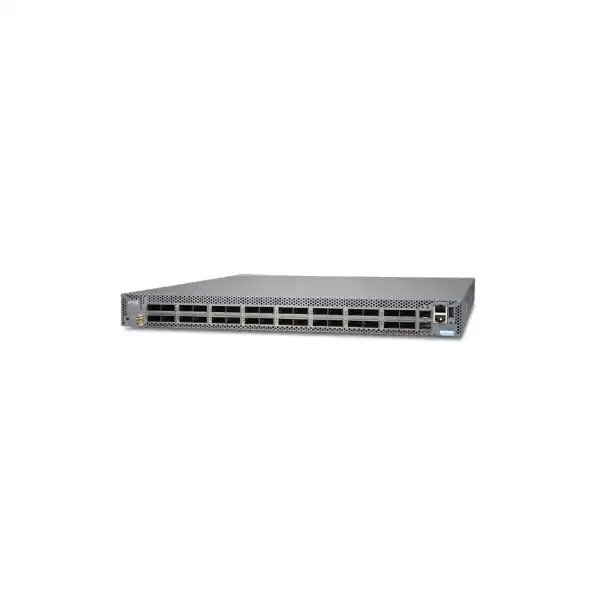
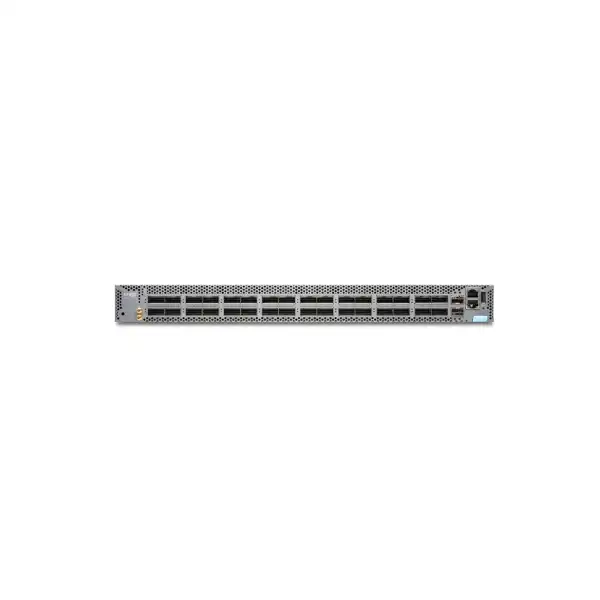
Juniper QFX5130-32CD Data Center Switch in Dubai, UAE
A high-density 32-port QSFP-DD platform for organizations designing 400GbE spine-and-leaf fabrics, high-radix IP networks, EVPN-VXLAN environments, high-speed server or storage connectivity, and selected data-center-interconnect use cases. The key purchasing decision is not simply the chassis: the correct airflow, power input, optics, breakout mapping, software tier, support and fabric role must all be aligned before ordering.
Buyer signals at a glance
- 32 high-speed QSFP-DD ports in a fixed 1U chassis
- Up to 12.8 Tbps unidirectional switching capacity
- 400/200/100/40GbE native-speed options with channelization for lower speeds
- Junos OS Evolved operating environment
- AC/DC and airflow variants require deliberate selection
Direct answer: what is the Juniper QFX5130-32CD?
The Juniper QFX5130-32CD is a fixed-configuration 1U Ethernet switch intended for high-capacity data center networks. Its defining hardware characteristic is a bank of 32 QSFP-DD high-speed ports designed around 400GbE-class connectivity, with support for multiple lower port speeds and breakout modes. It is primarily used where a network requires dense spine connectivity, a high-radix leaf or border-leaf design, fast inter-switch links, or a flexible mix of 400GbE, 200GbE, 100GbE, 50GbE, 40GbE, 25GbE and 10GbE interfaces through supported optics, cables and channelization.
It should be considered by enterprises, cloud operators, service providers, hosting environments, AI/HPC infrastructure teams and large private data centers that have a genuine need for high-speed east-west bandwidth or for a compact platform that can aggregate many lower-speed links through breakout. It is not automatically the right choice for every rack. A smaller 100GbE-heavy switch can be more economical when 400GbE density is unnecessary, while a different platform may be required where deep buffering, a different MACsec profile, different port form factors or a larger scale is the primary design driver.
The most important factor to confirm is the complete interface and deployment plan: which ports will run at which speeds, which ports will be channelized, which optics or DAC/AOC assemblies are validated, whether coherent 400ZR optics are required, what airflow direction the rack needs, whether AC or DC power is used, and which Juniper software entitlement unlocks the intended features. FourTeck can help turn those variables into a bill of materials and a model-specific quotation for Dubai and UAE deployments.
Why the QFX5130-32CD exists in a modern data center design
A data center switch should be evaluated by the role it performs in a topology, not by a headline speed alone. The QFX5130-32CD is designed for environments in which a 1U fixed switch needs to expose a large amount of high-speed bandwidth while still giving architects freedom to divide ports into smaller logical interfaces. In a spine role, its 32 high-speed cages can connect many leaf switches while keeping the fabric physically compact. In a leaf or border-leaf role, the same ports can be used for high-speed servers, appliances, storage systems, edge routers or uplinks, depending on the supported transceiver and breakout combination. This flexibility is especially useful during a multi-year migration in which 100GbE and 400GbE coexist.
Juniper positions the QFX5130 family for spine-and-leaf IP fabrics and EVPN-VXLAN data centers. That positioning matters because it indicates the switch is not merely a collection of fast Ethernet ports. The platform is designed to participate in routed underlays, BGP-based fabrics, overlay networks, link aggregation, telemetry and automation workflows. Junos OS Evolved supplies the operating environment, while additional feature entitlements can be required for specific advanced functions. A procurement decision should therefore combine hardware capacity with the actual control-plane and overlay features that the organization will deploy.
For buyers in Dubai, the practical advantage of a platform like this is consolidation. A single 1U switch can provide a very high aggregate bandwidth footprint and support multiple interface speeds, potentially reducing the number of distinct switch types required across a fabric. The tradeoff is that higher-density designs demand more careful planning around optics, heat, power, cable routing, port groups and software. Treating those dependencies as part of the design process produces a more reliable result than ordering the chassis first and discovering compatibility issues during installation.
QFX5130-32CD core hardware specifications
| Specification | QFX5130-32CD buyer detail |
|---|---|
| Form factor | Fixed 1U data center switch; approximately 17.26 in wide, 1.72 in high and 21.1 in deep. |
| High-speed ports | 32 QSFP-DD high-speed cages designed for 400GbE-class operation and supported lower speeds. |
| Additional Ethernet ports | Two dedicated 10GbE SFP+ ports are listed for the platform, in addition to out-of-band management and console connectivity. |
| Switching capacity | Up to 12.8 Tbps unidirectional, equivalent to 25.6 Tbps bidirectional aggregate capacity. |
| Forwarding | Juniper’s current line datasheet lists 5.3 Bpps. Some documentation revisions publish different packet-rate figures, so confirm against the exact software/hardware reference if packet rate is a formal sizing limit. |
| Packet buffer | 132 MB shared packet buffer. |
| MAC scale | Up to 160,000 MAC addresses in Juniper’s published hardware specifications. |
| Route scale | Published QFX5130-32CD scale includes up to approximately 1.24 million IPv4 unicast/multicast routes and 850,000 IPv6 routes. |
| ARP and VLAN scale | 32,000 ARP entries and around 4,000 VLAN IDs in current Juniper hardware specifications. |
| Jumbo frame | Up to 9216-byte jumbo frames. |
| Operating system | Junos OS Evolved; hardware explorer identifies 20.3R1-EVO as the first supported release for the QFX5130-32CD variants. |
Specification values should be treated as platform capabilities rather than a complete bill of materials. Port speed support, feature behavior and validated optics depend on the selected Junos OS Evolved release, transceiver, breakout mode and licensing.
Port architecture: 32 high-speed cages with a migration-friendly speed mix
The primary interface bank is the central reason to consider the QFX5130-32CD. Juniper documents ports 0 through 31 as supporting 40Gbps, 100Gbps, 200Gbps and 400Gbps operation, with the QSFP-class cages operating at 400Gbps by default. A design does not have to use all 32 ports at 400GbE. The value is that the switch can be programmed for a mixture of supported speeds and channelization modes, subject to the approved optical or copper media and the release-specific configuration rules.
At 400GbE, the switch can serve as a compact spine for leaf switches that each expose 400GbE uplinks. At 200GbE, each 400GbE port can be divided into two 200GbE interfaces where supported, creating a maximum of 64 200GbE logical connections before considering the two dedicated 10GbE ports. For 100GbE-heavy fabrics, channelization can create up to four 100GbE interfaces from a 400GbE port, resulting in a published maximum of 128 100/50/25/10GbE connections plus the dedicated 10GbE ports, depending on the exact breakout pattern. This allows a single chassis to support a high-radix topology without requiring a large modular switch.
The channelization options go further. Juniper documents 400GbE to 4x100GbE, 2x200GbE or 8x50GbE channelization. A 200GbE interface can be divided into 2x100GbE, a 100GbE interface can be divided into 2x50GbE or 4x25GbE, and a 40GbE interface can be divided into 4x10GbE. These combinations are valuable during technology transitions, but they also mean that a correct quotation must include the precise breakout cable or optical arrangement. A generic statement such as “we need 100G” is not sufficient because 100GbE could be delivered as a native module, a 400-to-4×100 breakout, or another topology-specific choice.
Two dedicated 10GbE SFP+ ports provide additional connectivity outside the 32 main high-speed cages. The chassis also exposes an RJ-45 management port supporting 100Mbps/1Gbps/10Gbps, an RJ-45 console port, USB connectivity and timing outputs. These management interfaces should be incorporated into the rack design from the start so that out-of-band access, console access and cable paths remain usable after the high-density front panel is fully populated.
400GbE spine density
A fabric that genuinely requires many 400GbE links can use the switch as a high-radix spine or aggregation node. The key design question is not whether the port can run at 400GbE, but what reach, fiber type, optical power, link budget and transceiver family each connection needs.
100GbE breakout scale
Channelization makes the QFX5130-32CD attractive when many 100GbE endpoints need to be aggregated into a compact chassis. A port map should be prepared before ordering so the correct number and type of breakout assemblies, patch panels and remote-end optics are included.
Mixed-speed migration
The platform can support a staged move from 10/25/40/100GbE environments toward 200/400GbE. Mixed-speed capability is most useful when the migration plan also considers adapter capabilities, server NICs, optic compatibility, lane mapping and the timing of future upgrades.
Spine, leaf and border-leaf deployment roles
In a spine role, the QFX5130-32CD can provide a large number of equal-cost high-speed links to leaf switches. This suits Clos-style fabrics where predictable east-west bandwidth and horizontal scaling are more important than relying on a single large chassis. The switch’s high port density means that one spine can connect many leaves at 100GbE, 200GbE or 400GbE, depending on the oversubscription model. When sizing a spine, count not only current leaf switches but also the number of future racks, the desired number of parallel spine planes, the per-leaf uplink speed and the resilience requirement. A high-radix spine that looks underused in year one may be justified if it prevents a disruptive redesign later.
In a leaf role, the same hardware can connect to servers, storage arrays, GPU nodes, appliances or top-of-rack downstream switches through supported breakouts. The economics depend heavily on how many logical endpoints are created from each 400GbE port. A leaf filled with 4x100GbE breakouts behaves very differently operationally from a leaf populated mainly with native 400GbE optics. Cabling density, labeling, replacement strategy and failure domains all change. A single failed 400GbE breakout assembly can affect several logical links, so operational teams should map physical and logical port relationships clearly.
A border-leaf design can use the switch to connect the internal EVPN-VXLAN fabric to routers, firewalls, data center interconnect circuits or external services. Here, the route scale, overlay behavior, feature licensing and external routing policy become as important as raw port count. Border leafs often carry more complex policy and may require additional telemetry, route filtering, multicast or service features. Confirm that the intended Junos OS Evolved release and license tier support each required function rather than assuming every function in the broader QFX family is enabled by default.
The switch can also be considered for specialized high-throughput aggregation, but it should not be forced into a role that is better served by a different architecture. If the design calls for unusually deep buffers, extensive in-line encryption on every high-speed port, a different physical connector mix, or very large scale beyond the published platform limits, compare other Juniper QFX models before finalizing the bill of materials.
EVPN-VXLAN and routed fabric capability
The QFX5130-32CD is designed for modern IP fabrics rather than only traditional Layer 2 topologies. Juniper documents EVPN-VXLAN support for the platform, allowing an IP underlay to carry VXLAN overlays whose control plane is programmed through EVPN. In practical terms, this can separate the physical routed fabric from tenant or workload segmentation. The switch can participate as a leaf or spine depending on the design, and Junos OS Evolved includes the routing and switching mechanisms used to build the underlay and overlay.
For buyers, the important distinction is between “the platform can support EVPN-VXLAN” and “the ordered system includes the software entitlement and validated release needed for the desired EVPN-VXLAN design.” Juniper’s QFX licensing documentation places QFX5130-32CD in Class 3. Advanced 2 and Premium 1 tiers include EVPN-VXLAN, while the exact feature set varies by tier. Premium 1 adds additional functions beyond Advanced 2, while Advanced 1 covers a smaller feature set. A quotation should therefore list the software SKU or entitlement period explicitly rather than leaving the software assumption open.
EVPN designs can also differ significantly. A centrally routed bridging topology, an edge-routed bridging topology, a border-leaf topology and a simple Layer 2 extension each have different routing, IRB, anycast-gateway, BGP and failure-domain requirements. Junos OS Evolved release history also matters because feature support has expanded over time. For example, Juniper added specific EVPN-VXLAN capabilities for MAC-VRF routing instances and later added an IPv6 underlay option. Buyers should define the architecture first, then select the Junos release and entitlement that support it.
Organizations using Juniper Apstra can also evaluate the platform as part of an intent-based data center fabric. Apstra can automate design, deployment and assurance across supported hardware. The operational value comes from consistent configuration and continuous validation, but it does not remove the need for correct physical design. Port speed, optics, rack airflow, cabling and power remain hardware decisions even when the logical fabric is automated.
RoCEv2, storage traffic and congestion management
The QFX5130 line is relevant to converged Ethernet environments because Juniper documents support for data center bridging mechanisms used with storage and RoCEv2 traffic. These include priority-based flow control and explicit congestion notification. For AI, HPC and NVMe-related designs, those mechanisms can be important because loss-sensitive or latency-sensitive traffic must be engineered differently from ordinary best-effort Ethernet. The switch’s high interface bandwidth is useful, but performance depends on the complete network behavior, including NIC settings, queue design, PFC boundaries, ECN thresholds, routing symmetry and traffic distribution.
Juniper describes the QFX5130 as using QoS mechanisms rather than a deep-buffer architecture to maintain performance for storage workloads. This is an important design point. Buyers should not compare the switch only by total buffer megabytes and assume that a larger buffer always produces a better storage fabric. For RoCEv2, the objective is normally to prevent persistent congestion, signal congestion early and keep packet loss under control. That requires end-to-end tuning rather than relying on one switch to absorb bursts indefinitely.
Before selecting the QFX5130-32CD for a GPU or storage fabric, document the expected traffic pattern, host adapter speeds, oversubscription ratio, maximum hop count, link speeds and whether the design uses a dedicated fabric or shares traffic classes. Confirm the Junos OS Evolved release that supports the required DCB features and validate interoperability with the server NIC or storage vendor’s recommended configuration. If the application requires a very specific lossless-Ethernet reference architecture, the design should be checked against that reference rather than inferred from generic switch capabilities.
This distinction helps avoid two common mistakes: oversizing the chassis because “400G” sounds safer, and underspecifying the software and congestion policy because the hardware speed seems sufficient. A well-designed high-speed fabric treats the switch, NICs, optics, routing policy, QoS and telemetry as one system.
400ZR and high-power optics: useful capability with a major port-planning condition
The QFX5130-32CD can support selected 400G-ZR and high-power coherent optics for data center interconnect and metro-style use cases. This can reduce the need for a separate transponder in some architectures by placing coherent optics directly into the switch. However, this capability is not equivalent to saying that every one of the 32 ports can be populated with 400ZR modules at the same time.
Juniper documents a specific thermal and power restriction for high-power 400ZR operation. Up to 16 ports are designated for 400ZR/high-power mode in a zigzag pattern, and the corresponding adjacent mapped ports must be configured as unused. This is one of the most important model-specific details to capture during procurement. A buyer planning 20 or 24 coherent 400GbE links should not assume the 32-port physical density translates directly into the same number of high-power coherent links.
The design also needs to consider reach, fiber plant, DWDM architecture, optical channel plan, link budget and the exact Juniper-approved coherent module. 400ZR is typically associated with data center interconnect applications and a nominal reach class around 80 km, but the actual supported distance depends on the optics, fiber characteristics, amplification, connector losses and optical network. The correct optical module should be selected from Juniper’s hardware compatibility information for the intended software release and link design.
For a Dubai buyer connecting separate facilities, this can be a valuable way to simplify DCI, but it must be engineered. FourTeck would need the number of DCI links, required reach, fiber type, whether the path is dark fiber or managed wavelength, desired redundancy and target optical standard before recommending a coherent bill of materials.
Junos OS Evolved and software licensing
QFX5130-32CD runs Junos OS Evolved, Juniper’s Linux-based operating environment for newer high-scale platforms. For network teams already familiar with Junos concepts, this offers a consistent operational model for configuration, routing policy, telemetry, automation and troubleshooting. The “Evolved” architecture is still a specific software train, so release compatibility should be checked against the feature set, optics and operational standards used in the target network.
Licensing is a procurement dependency. Juniper’s current licensing guide groups the QFX5130-32CD as a QFX Class 3 device and offers multiple software tiers. Advanced 1 includes core licensed capabilities such as BGP, OSPF, IS-IS, VRRP, GRE, sFlow and related features. Advanced 2 adds features including EVPN-VXLAN, ESI-LAG, multicast functions, VXLAN and timing capabilities. Premium 1 adds further service-provider-oriented capabilities such as EVPN-MPLS, Layer 3 VPN, LDP, RSVP and segment routing according to the published class matrix. The exact list can change with software and licensing revisions, so the final order should reference Juniper’s current license guide at the time of purchase.
Juniper offers subscription and perpetual licensing constructs for QFX, and public ordering information shows QFX5130-32CD software SKUs such as S-QFX5K-C3-A1, A2 and P1 families with term options. A buyer deploying a simple routed underlay may not need the same tier as a buyer deploying a full EVPN-VXLAN fabric or service-provider features. Paying for a higher tier without using the features increases cost, while selecting a lower tier that omits a required feature delays deployment. The network requirements should drive the tier.
The hardware ordering descriptions also differ by variant. Juniper lists QFX5130-32CD-AFI as hardware with base software, while some other variants are described as hardware with software services sold separately. This is another reason not to treat “QFX5130-32CD” as a complete SKU. The suffix matters, and the quotation should state exactly what software rights, subscription term and support are included.
For lifecycle planning, organizations should also decide how they will handle Junos OS Evolved upgrades, maintenance windows, configuration management and support entitlement. A high-capacity fabric switch is infrastructure that may remain in service for years. Operational processes, validated software trains and support access are part of the platform’s business value, not extras to consider after deployment.
Automation
Junos OS Evolved supports automation mechanisms such as ZTP, Python and Junos scripting. The practical benefit is repeatable provisioning and reduced manual configuration when many switches are deployed as part of a standard fabric.
Telemetry
The platform supports monitoring methods including sFlow, SNMP and Junos telemetry capabilities. Telemetry should be planned with the operations platform so performance, errors, congestion and fabric health can be observed before application users report an issue.
Intent-based fabrics
The QFX5130 family is supported in Juniper data center management workflows including Apstra. Intent-based operations can improve consistency, but organizations should confirm product support, license requirements and the desired Apstra release during architecture planning.
Airflow variants are not interchangeable purchasing details
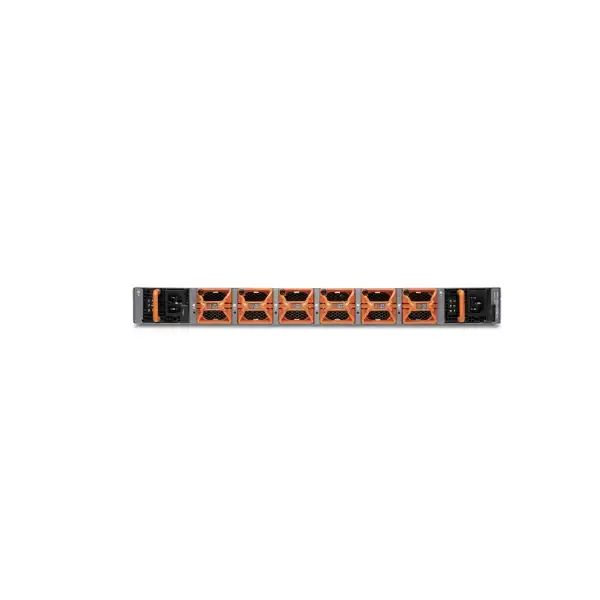
Data center airflow is a model-selection requirement. Juniper offers QFX5130-32CD variants with airflow in different directions. AFI is described as back-to-front airflow, with air entering through the back of the switch, while AFO is front-to-back airflow, exhausting toward the back. The fan and power-supply airflow direction must match the chassis design. Installing components with incompatible airflow direction can create alarms and, more importantly, undermine the rack’s thermal strategy.
The environmental limits also make airflow selection significant. Juniper’s current line datasheet lists QFX5130-32CD AFO operation from 0°C to 40°C, while AFI is listed from 0°C to 30°C. Data centers in Dubai are climate-controlled, but inlet temperature, rack density, hot-aisle/cold-aisle design and temporary cooling events still matter. The switch should be selected for the facility’s actual airflow orientation and environmental envelope, not simply for the cable-facing convenience of the port panel.
A rack drawing should identify which side faces the cold aisle, which direction server airflow moves, where the switch ports are located, and how power and network cables are routed. In some architectures, top-of-rack switches are placed with ports facing the server-facing rear of a rack, which may drive a different airflow suffix than a row in which network ports face the cold aisle. There is no universally correct suffix; the physical layout determines the correct choice.
When ordering replacement fans or power supplies later, preserve the original airflow orientation. Mixing directions is not a valid redundancy strategy. Spare-part planning should therefore record the exact chassis suffix rather than only the base model name.
Power, redundancy and rack planning
The QFX5130-32CD is available in AC and DC versions with redundant power supplies. Juniper’s published power figures differentiate AC and DC. For AC variants, the hardware guide lists a 100–240 VAC operating range, 50/60 Hz input, approximately 323 W typical consumption and up to 839 W maximum under the documented test conditions. For DC variants, Juniper lists a rated operating range around -48 to -60 VDC, a wider -40 to -72 VDC operating range, approximately 341 W typical and up to 871 W maximum. Actual consumption depends on load, optics, temperature and configuration.
High-power optics can materially change the power and thermal picture. A design that uses DACs for short intra-rack links will have a different module power profile from a switch carrying many optical transceivers, especially coherent 400ZR modules. Capacity planning should therefore use the intended optic population rather than the chassis typical-power number alone. Facility teams should confirm available PDU outlets, circuit capacity, redundancy across power feeds and any connector or cord requirements for the UAE installation.
The chassis is approximately 1U high and roughly 21.1 inches deep, with a fully loaded weight around 24.5 lb / 11.11 kg in Juniper’s hardware explorer. A compatible rack mounting arrangement is required, and Juniper lists a four-post rack kit for the platform. Before delivery, verify rack depth, rail compatibility, front/rear clearance, cable management, grounding and access to field-replaceable power and fan modules.
Power redundancy only works if the installation provides independent feeds where required. Connecting both power supplies to the same single PDU may protect against a power-supply failure but not against a PDU or upstream circuit failure. The site design should align PSU redundancy with the facility’s actual resiliency objective.
Optics, DACs, AOCs and breakout assemblies
The chassis alone does not create usable network links. Each connection requires compatible media at both ends. For very short same-rack or adjacent-rack connections, direct-attach copper can be an economical low-power option where reach and cable thickness are acceptable. Active optical cables can simplify some fixed-length high-speed runs. Pluggable optical transceivers are used where structured fiber, longer reach or more flexible patching is required. Breakout assemblies divide a high-speed port into multiple lower-speed lanes and must match both the switch’s channelization mode and the remote devices.
The transceiver decision should consider link speed, reach, connector type, single-mode versus multimode fiber, wavelength, forward-error-correction requirements, module power, temperature and the remote device. A module that physically fits a QSFP-DD cage is not automatically supported. Juniper’s Hardware Compatibility Tool should be used to verify the exact optic or cable against QFX5130-32CD and the target Junos OS Evolved release.
Breakout designs need extra discipline. If a 400GbE port becomes four 100GbE logical interfaces, the cabling plan must specify which lane maps to which endpoint. Labels should identify both the parent physical port and child interface. During troubleshooting, operations staff need to know that several apparently separate 100GbE links share one physical switch cage and one breakout assembly. This matters for maintenance because replacing one cable can affect multiple downstream devices.
For procurement, provide a port schedule rather than a total optic count. A useful schedule lists switch port, required speed, breakout mode, remote device and port, distance, fiber or copper type, optic/cable SKU, and whether a spare is required. That document reduces the risk of receiving a high-capacity switch without the media needed to bring it online.
When comparing optic costs, include power, spares and operational standardization. A lower-priced third-party optic may not provide the same support path as a Juniper-validated module. For business-critical fabrics, the support and compatibility policy should be decided consciously rather than discovered during an incident.
Migration planning from 100GbE to 400GbE
One strong reason to evaluate QFX5130-32CD is the ability to bridge generations of Ethernet speed. Many data centers are not replaced all at once. Existing leaf switches may use 100GbE uplinks while new racks use 400GbE. Servers may move from 25GbE to 100GbE, and GPU systems may introduce 200GbE or 400GbE adapters. A switch with flexible high-speed ports can reduce the need to create separate network islands for each generation.
A migration should begin with the target architecture. Decide which connections will remain at 100GbE, which will move to 400GbE, and how much oversubscription is acceptable. Then map the ports. A 400-to-4×100 breakout is useful when a new QFX5130 spine must connect to older 100GbE leaf switches. As those leaves are replaced, the breakout can be removed and the parent port can return to a higher native speed, provided the physical fiber and optics are upgraded as required.
This approach can preserve switch investment, but it should not be used to postpone every modernization decision. Breakout-heavy designs can increase cable density and operational complexity. If nearly all endpoints will remain at 100GbE for the entire service life, a switch optimized around native 100GbE ports may offer better economics or simpler cabling. The QFX5130-48C family member, for example, uses a different port mix with many 100GbE-oriented ports and 400GbE uplinks, making it worth comparing for server-facing roles.
Software migration matters too. Moving from a traditional Layer 2 topology to EVPN-VXLAN introduces changes in addressing, BGP, VTEPs, anycast gateways, operational tooling and troubleshooting. Hardware deployment and network architecture migration do not need to happen on the same day. The QFX5130-32CD can initially operate in a simpler routed design and later participate in a richer overlay if the software entitlement and release support the intended features.
For a low-risk cutover, document rollback plans, maintenance windows, configuration templates, optic compatibility, cable labels, routing adjacencies, MTU, LAG behavior and monitoring before moving production traffic. A high-capacity switch reduces physical constraints, but it does not replace disciplined migration engineering.
Sizing the QFX5130-32CD for real workloads
Sizing begins with topology. For a spine, count the number of leaf switches and the number of uplinks per leaf. If 24 leaves each require two 400GbE uplinks split across two spines, each spine may need 24 400GbE ports, leaving eight high-speed ports for growth or other connections. If the same leaves use 100GbE uplinks, the breakout options may allow a much larger leaf count from the same chassis. The correct answer depends on resilience and oversubscription, not simply on the number of physical ports.
For a server-facing leaf, count logical endpoints after breakout. A single 400GbE cage can potentially present four 100GbE interfaces or other supported channelized combinations. However, port count is not the only limit. Cable organization, transceiver power, host NIC capability, queue behavior and uplink bandwidth can become constraints first. If 128 server links are created from breakouts but the upstream design provides insufficient bandwidth, the switch’s physical density does not solve application contention.
For routing-heavy border roles, compare route scale, MAC scale, ARP/neighbor scale and policy requirements with the design margin. Juniper publishes substantial scale for QFX5130-32CD, including around 1.24 million IPv4 routes, 850,000 IPv6 routes and 160,000 MAC addresses. Those headline values should still be validated against the exact feature combination. Hardware tables can share resources across functions, and software release notes may contain mode-specific limits. If the design is close to a published maximum, obtain a formal scale check before purchase.
For loss-sensitive storage or AI traffic, model bandwidth distribution and congestion. A nonblocking switch fabric does not guarantee a non-congested network. Many-to-one communication patterns can oversubscribe an egress link even when aggregate switch capacity is high. PFC and ECN can help manage congestion, but queue design and routing entropy remain important. Consider how traffic hashes across ECMP paths and whether application flows are large enough to create persistent imbalance.
For DCI, count coherent ports separately because the 400ZR high-power restriction changes usable port density. If 16 coherent links are required, the remaining mapped adjacent ports may need to be unused. A design that mixes coherent and standard lower-power optics should be mapped port by port to avoid invalid placements. The thermal and power budget also needs to include the coherent modules.
Finally, size for operations. Reserve ports for growth where justified, plan spare optics, define software support and keep a standardized configuration model. A switch that is technically capable of full utilization on day one may be difficult to maintain if every port is occupied and no maintenance flexibility remains.
Important limitations and design cautions
First, the QFX5130-32CD should not be described as a deep-buffer switch. Juniper explicitly positions its storage performance around QoS, PFC and ECN mechanisms rather than deep buffering. Workloads that depend on unusually large buffers should be evaluated against the traffic model and alternative platforms.
Second, coherent 400ZR density is restricted. Juniper documents 16 specific ports for 400ZR/high-power operation with mapped adjacent ports configured unused. A buyer cannot assume 32 simultaneous high-power coherent modules simply because the front panel has 32 QSFP-DD cages.
Third, software features are license- and release-dependent. EVPN-VXLAN, multicast functions, MPLS-related capabilities and other features sit in specific licensing tiers for the QFX Class 3 platform. A general QFX feature list should not be treated as proof that every feature is included in every license on every release.
Fourth, airflow orientation is part of the SKU. AFO and AFI versions have different airflow directions and published environmental limits. The selected power supplies and fans must match the chassis airflow. Ordering the wrong suffix can create a physical deployment problem even when every network specification is otherwise correct.
Fifth, port channelization increases logical density but also increases cabling and operational dependency. Four lower-speed links from one parent port share physical hardware and a breakout assembly. Labeling and sparing need to reflect that relationship.
Finally, use current Juniper compatibility and release documentation during final design. High-speed optics, Junos support and feature behavior evolve. The QFX5130-32CD is a well-defined hardware platform, but a production solution is the combination of chassis, software, licenses, media and topology.
QFX5130-32CD versus nearby QFX5130 family choices
The QFX5130 family includes variants with different port mixes. QFX5130-32CD is the 32-port QSFP-DD-focused option, making it well suited when dense 400GbE or breakout flexibility is central to the design. QFX5130E-32CD is closely related but carries different scale positioning in Juniper’s published specifications, so it should not be substituted without checking route and feature requirements. QFX5130-48C uses a different combination of 100GbE-oriented SFP56-DD ports and 400GbE uplinks, which can be attractive for leaf designs that need many native 100GbE server connections without relying as heavily on breakout.
QFX5130-48CM adds MACsec capability to the 48C-style platform. This distinction matters when link-layer encryption is a formal requirement. Buyers should not assume that the “M” encryption capability of the 48CM applies to QFX5130-32CD. If broad MACsec support is required, compare the 48CM and other Juniper platforms specifically around encrypted throughput, port coverage and topology rather than choosing on port density alone.
For a spine with many high-speed leaf uplinks, QFX5130-32CD’s 32 QSFP-DD cages are often the more natural family fit. For a leaf connecting many 100GbE servers and a smaller number of 400GbE uplinks, 48C can simplify cabling because it provides a different native port mix. For a design requiring higher route scale, more ports or capabilities beyond the QFX5130 family, larger QFX platforms may need to be evaluated.
The comparison should be driven by the port map. List every required connection and speed, then calculate how many physical cages each candidate consumes. Next compare software, scale, power, optics, rack airflow and growth. This method frequently changes the “best” model because two switches with similar aggregate throughput can have very different operational fit.
FourTeck can prepare a side-by-side model selection when the buyer supplies endpoint counts, uplink speeds, routing scale, EVPN requirements, encryption requirements and preferred media. The goal is to avoid paying for density that will not be used or, conversely, buying a lower-density platform that forces an early replacement.
Procurement: choose the exact QFX5130-32CD variant
| Variant | Power | Airflow | Use when |
|---|---|---|---|
| QFX5130-32CD-AFI | Dual AC | Back-to-front / airflow-in orientation | The rack and aisle design requires this airflow direction and AC facility power. |
| QFX5130-32CD-AFO | Dual AC | Front-to-back / airflow-out orientation | The rack uses conventional front intake and rear exhaust orientation for this device position. |
| QFX5130-32CD-D-AFI | Dual DC | Back-to-front / airflow-in orientation | The facility provides -48/-60V-class DC power and the rack requires the AFI direction. |
| QFX5130-32CD-D-AFO | Dual DC | Front-to-back / airflow-out orientation | The facility uses DC plant power and needs the AFO airflow direction. |
Ordering descriptions and included software can differ among variants and over time. The final quotation should identify the full manufacturer part number, software entitlement, support service, power cords, rack kit where required, optics/cables and spares. A purchase order that states only “QFX5130-32CD” leaves important physical and licensing choices unresolved.
Installation and commissioning considerations
Installation starts before the switch reaches the site. Confirm rack position, airflow, rail kit, grounding, power feeds, PDU capacity and cable management. High-density 400GbE cabling can make the front panel crowded, especially with breakout assemblies. Leave sufficient bend radius for fiber, avoid blocking intake or exhaust paths, and label every physical cable before connecting it. If the design uses separate A and B fabrics, use a labeling convention that makes the failure domain obvious.
Commissioning should validate both hardware and software. Check chassis alarms, fan direction, PSU status, serial information and environmental readings. Load the approved Junos OS Evolved release, apply base management and security configuration, verify license status and establish out-of-band management. Time synchronization, logging, authentication, NTP/PTP requirements and telemetry destinations should be configured as part of the baseline, not added only after an incident.
For each network port, verify the configured speed, FEC mode where applicable, optic identification, receive/transmit optical levels and link counters. Breakout ports need special attention because the parent port configuration determines the child interfaces. A mismatch between switch channelization and remote-end port mode is a common cause of failed links during migrations.
Fabric commissioning should then test routing adjacencies, ECMP behavior, MTU, VLAN/VXLAN mapping, EVPN routes, multihoming if used, failure convergence and policy. For storage or RoCEv2, validate PFC/ECN behavior under load rather than assuming the default configuration is appropriate for the workload.
Finally, capture an as-built document containing the full SKU, serial number, Junos version, license tier, optics, port map, cabling, airflow, rack location and support contract. That record materially shortens future troubleshooting and spare-part replacement.
Buying the Juniper QFX5130-32CD in Dubai and the UAE
A Dubai quotation should be based on the complete deployment requirement rather than a bare chassis price. Enterprise switching projects frequently require optics, breakout cables, rack hardware, power cords, software subscriptions, support and professional services in addition to the switch. Some of those components may have different lead times. Building the bill of materials as one package reduces the risk that the switch arrives before a critical transceiver, cable or license.
For UAE projects, confirm delivery location, required quantity, target deployment date and whether the equipment is for a new build, expansion or replacement. New-build projects benefit from an early port schedule and rack elevation. Replacement projects should include the existing switch model, current cabling, transceiver types, routing design and maintenance-window constraints. That information makes it possible to identify compatibility risks before the hardware reaches the site.
FourTeck can assist with model selection, bill-of-material preparation, optics and cable matching, license selection, implementation planning and support options. The goal is to quote the QFX5130-32CD only where its 400GbE density and fabric capabilities align with the actual requirement, and to recommend a nearby alternative when a different port mix or feature set produces a cleaner design.
Frequently asked buyer questions
Does QFX5130-32CD have 32 native 400GbE ports?
The chassis has 32 QSFP-DD high-speed cages and is designed for 400GbE-class operation. Juniper lists the ports as supporting 400, 200, 100 and 40GbE modes, with lower logical speeds available through channelization. The exact usable combination depends on optics, cabling and configuration. High-power 400ZR is a special case with a documented 16-port limit and adjacent-port restrictions.
Can one 400GbE port be split into four 100GbE ports?
Yes. Juniper documents 400GbE channelization into 4x100GbE, as well as 2x200GbE and 8x50GbE options. A supported breakout cable or optical arrangement is required, and the remote devices must use compatible lane mapping, speed and FEC settings. The port schedule should identify every child interface to keep cabling and troubleshooting manageable.
Is EVPN-VXLAN included by default?
Do not assume it is included in every commercial configuration. QFX5130-32CD is a QFX Class 3 platform, and Juniper’s licensing matrix places EVPN-VXLAN in the Advanced 2 and Premium 1 tiers. Final entitlement depends on the license SKU and current Juniper policy, so a quote for an EVPN fabric should explicitly state the required software tier and term.
Can it be used for RoCEv2 or AI networking?
The QFX5130 line supports data center bridging features including PFC and ECN and is positioned for RoCEv2-capable environments. Suitability for a specific AI or GPU fabric still requires end-to-end validation of NICs, routing, congestion policy, oversubscription and software release. The switch is not a substitute for a tested lossless-Ethernet design.
How many 400ZR optics can be installed?
Juniper documents up to 16 400ZR/high-power ports on QFX5130-32CD. Those ports follow a specific zigzag pattern, and mapped adjacent ports must be configured unused. Buyers planning coherent DCI should therefore size the switch by supported high-power port placement rather than by the total count of 32 QSFP-DD cages.
What are the AC and DC options?
Juniper lists AC and DC versions, each with airflow-in and airflow-out variants. The suffix determines both power type and airflow direction. The site must confirm whether the rack uses AC or -48/-60V-class DC infrastructure and whether cooling requires back-to-front or front-to-back airflow before the SKU is selected.
What power draw should we plan for?
Juniper documents approximately 323 W typical and up to 839 W maximum for AC under stated test conditions, and approximately 341 W typical and up to 871 W maximum for DC. Optic type and population affect total rack power, especially high-power coherent modules. Facility design should use the planned optics rather than chassis-only typical consumption.
Is QFX5130-32CD suitable as a leaf instead of a spine?
Yes, depending on port requirements. Its breakout flexibility can create a dense set of server-facing or appliance-facing links, while high-speed ports can serve as uplinks. However, if most endpoints are native 100GbE, a QFX5130-48C-style port mix may be operationally simpler. Compare physical cabling and breakout dependency before deciding.
Does the switch support automation?
Junos OS Evolved provides automation mechanisms including zero-touch provisioning, Python and Junos scripting, while Juniper data center tooling such as Apstra can automate and assure supported fabrics. The best operational approach depends on whether the organization uses Junos-native automation, an intent-based controller or a broader configuration-management platform.
What should be included in a Dubai quotation?
At minimum: exact AFO/AFI and AC/DC SKU, quantity, software tier and term, support service, rack kit if required, power cords, all optics/DACs/AOCs, breakout assemblies, spare modules, implementation scope and delivery requirements. For DCI or RoCEv2, include the additional design inputs needed to validate the optical or congestion architecture.
Decision recap before you shortlist the QFX5130-32CD
Model fit
Choose it when 32 QSFP-DD high-speed ports, 400GbE density or substantial breakout flexibility align with the fabric. Compare a different QFX model when native 100GbE density, MACsec profile or other hardware characteristics are more important.
Software fit
Map BGP, EVPN-VXLAN, multicast, MPLS and other required features to the current Class 3 license tier. Record the Junos OS Evolved release and support entitlement as part of the design baseline.
Physical fit
Confirm AC or DC, AFO or AFI, rack depth, power feeds, optics, breakout cables and thermal conditions. Coherent 400ZR deployments need an explicit 16-port high-power map with adjacent-port restrictions.
What FourTeck needs for an accurate quotation
Number of switches and whether each is spine, leaf, border leaf, DCI or another role.
Required 400/200/100/50/40/25/10GbE links and the proposed breakout combinations.
Fiber type, reach, connector, DAC/AOC preference and any 400ZR or coherent DCI requirement.
EVPN-VXLAN, BGP, multicast, MPLS, telemetry, RoCEv2/DCB and automation requirements.
AC or DC input, AFO or AFI airflow, rack depth, redundant feeds and environmental constraints.
Delivery location, target date, installation, migration, configuration, testing and support expectations.
Build the QFX5130-32CD bill of materials around your fabric, not around a bare chassis
The Juniper QFX5130-32CD can be an excellent fit for high-density 400GbE and breakout-heavy data center networks, but the commercial result depends on matching the exact hardware suffix, software tier, optics, cabling, power and deployment role. Share your topology or port schedule with FourTeck to receive a Dubai/UAE quotation that accounts for the full implementation rather than only the switch model.

Reviews
There are no reviews yet.