
Juniper QFX5230-64CD Data Center Switch Dubai
A high-radix 2U switching platform for organizations that need dense 400GbE connectivity, scalable IP or EVPN-VXLAN fabrics, RoCEv2-aware Ethernet for demanding AI and storage traffic, and a clear operational path through Junos OS Evolved and Juniper data-center automation.
25.6 Tbps unidirectional
Fixed 2U form factor
Junos OS Evolved
Direct answer: what is the Juniper QFX5230-64CD?
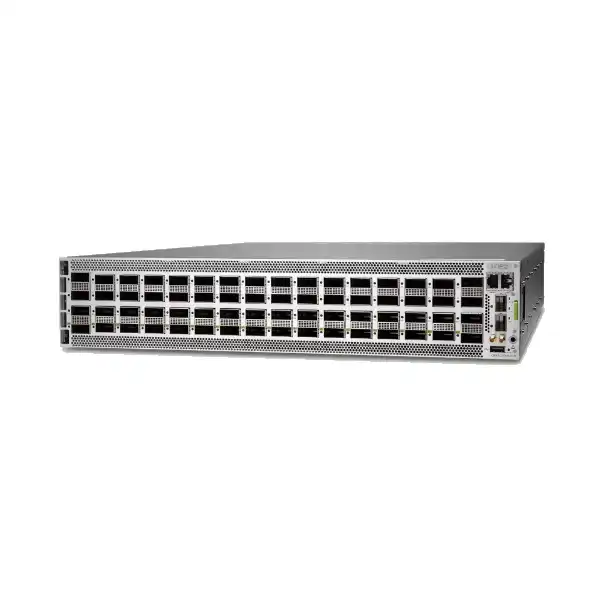
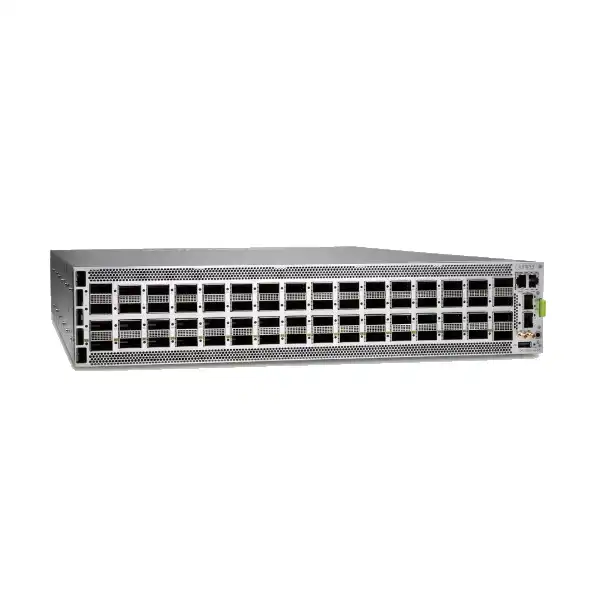
The Juniper QFX5230-64CD is a fixed 2U, high-density Ethernet switch built around 64 QSFP56-DD 400GbE ports and a switching capacity of 25.6 Tbps unidirectional, or 51.2 Tbps when traffic in both directions is counted. Its main role is not ordinary office access switching. It is intended for high-bandwidth data-center fabric positions such as spine and super-spine, including AI/ML clusters, IP storage networks, large IP fabrics, EVPN-VXLAN deployments, and selected edge or data-center-interconnect designs.
Organizations should consider the QFX5230 when the design requires high 400GbE radix, lower-speed breakout flexibility, Junos OS Evolved operations, and a platform that can participate in automated data-center fabrics. The most important factor to confirm is the complete deployment profile rather than the chassis alone: port speeds, oversubscription target, optics and reach, breakout mapping, airflow direction, power feed, rack depth, software release, automation platform, support entitlement, and growth plan all affect whether the model is the right choice.
FourTeck can help translate those design inputs into a practical UAE quotation covering the exact switch variant, compatible optics or cables, rack-mount requirements, power and airflow choice, software and support requirements, and deployment scope. That distinction matters because a 400GbE switch can be technically impressive yet still be a poor fit if its optics, fabric role, cabling plan, or operational model are not aligned with the data center.
QFX5230-64CD at a glance
The key numbers explain why the QFX5230 is primarily a fabric-class platform. They also show where careful design work is required: 400GbE density is valuable only when the leaf layer, optical reach, breakout plan and application traffic can use it efficiently.
64 × 400GbE ports
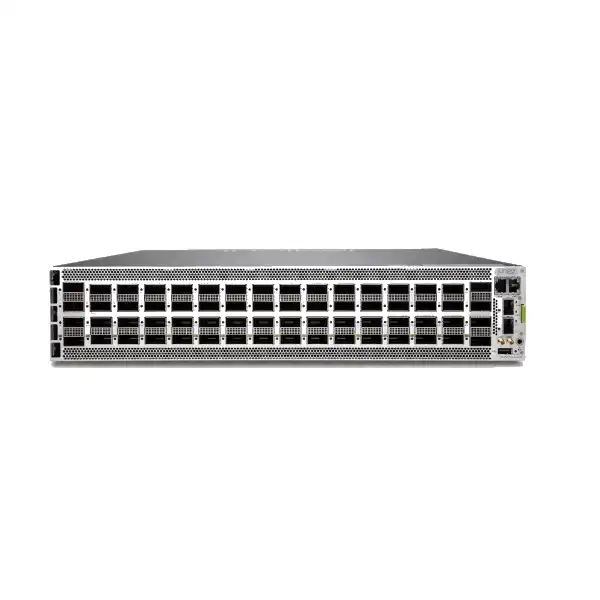
The front panel provides 64 high-density QSFP56-DD 400GbE network ports. Individual ports can support several lower speeds, and breakout can create higher logical port counts where the transceiver, cable and software configuration support the required mode.
25.6 Tbps switching
Juniper specifies 25.6 Tbps unidirectional and 51.2 Tbps bidirectional switching capacity, together with up to 10.6 billion packets per second unidirectional. Capacity planning should still model the expected traffic pattern and fabric oversubscription rather than relying on headline throughput alone.
Fixed 2U platform
The chassis is approximately 17.4 inches wide, 3.43 inches high and 25.6 inches deep, with a documented weight of about 55 lb or 25 kg when power supplies and fans are installed. Rack depth, lifting practice and service clearance should therefore be considered during site preparation.
Junos OS Evolved
The platform runs Junos OS Evolved and is designed for modern data-center operations. It can be configured through the CLI and integrated into automated workflows, including zero-touch provisioning and Juniper’s data-center automation environment.
AI and RoCEv2 readiness
For AI/ML and IP-storage fabrics, QFX5230 supports RoCEv2-related traffic-management mechanisms including priority-based flow control and explicit congestion notification. Successful lossless Ethernet design still depends on coordinated NIC, host, switch and queue configuration across the entire path.
Fabric and DCI roles
The switch can be used in IP and EVPN-VXLAN fabrics and supports coherent ZR/ZR-M optical use cases for suitable edge and data-center-interconnect designs. Optical selection must be validated against reach, fibre type, power budget, port restrictions and the intended Junos release.
Why a high-radix 400GbE switch changes the fabric design
A high-radix switch gives architects more high-speed interfaces from one chassis, which can reduce the number of spine devices required for a given set of leaf uplinks or create room for larger pods before a super-spine layer becomes necessary. With 64 native 400GbE ports, a QFX5230 can terminate a substantial number of leaf-to-spine connections. That is particularly relevant when leaf switches expose multiple 100GbE, 200GbE or 400GbE uplinks and the design goal is to maintain predictable east-west capacity between compute, storage and accelerator nodes.
Radix alone does not determine a good design. A fabric with many physical ports can still be constrained by poor oversubscription choices, asymmetric link use, mismatched breakout configurations, or application traffic that concentrates on a small set of flows. Buyers should therefore define the number of leaf switches, uplinks per leaf, desired failure tolerance, ECMP design, expected east-west traffic, scale target, and the next expansion point. That turns the QFX5230 from a large collection of ports into a measurable fabric building block.
The same logic applies to AI clusters. GPU and accelerator workloads often place more pressure on east-west bandwidth and congestion behaviour than conventional enterprise applications. If the compute layer is designed around 100GbE, 200GbE or 400GbE NICs, the spine must be evaluated as part of an end-to-end topology. The important question is not simply whether the QFX5230 supports the interface speed; it is whether the whole fabric can sustain the required number of concurrent paths, failure scenarios and workload bursts without creating unacceptable queueing or loss.
Port architecture and breakout planning
The QFX5230-64CD front panel is built around 64 QSFP56-DD 400GbE ports. Juniper documents support for 400GbE, 200GbE, 100GbE, 50GbE, 40GbE and breakout modes such as 4 × 25GbE or 4 × 10GbE on appropriate ports and media. At platform level, Juniper lists potential densities up to 64 × 400GbE, 128 × 200GbE, 256 × 100GbE, 256 × 25GbE or 256 × 10GbE, depending on how the physical interfaces are deployed. These figures describe possible interface density, not a universal cabling recipe.
Breakout planning should be completed before optics are ordered. A 400G port used as four 100G lanes needs a compatible breakout cable or optical solution at both ends, and the remote device must support the matching interface standard. Mixing native 400G links, breakout links and coherent optics in one chassis can be perfectly valid, but it creates a port-by-port dependency map that should be documented. This is especially important in migration projects where an existing leaf layer is still 100GbE while a new leaf generation moves to 200GbE or 400GbE.
The choice between DAC, AOC and optical transceivers affects reach, power draw, cable-management density and cost. Direct-attach copper is often attractive for very short intra-rack or adjacent-rack distances, while active optical cables can simplify short optical runs. Pluggable transceivers with structured fibre become more appropriate as distance, patching flexibility or data-center layout requirements increase. Coherent 400G ZR or ZR-M optics solve a different problem again: they are intended for longer-reach optical transport and DCI scenarios, so they introduce optical-line-system, fibre and power considerations beyond a standard short-reach data-center link.
A procurement bill of materials should therefore specify each intended port group, speed, remote endpoint, distance, fibre type and connector requirement. Ordering “64 ports of 400G” without that mapping can lead to incompatible optics, unused high-speed capacity or an unnecessarily expensive optical design. FourTeck can use the topology and distance information to separate chassis requirements from the transceiver and cabling bill of materials.
Core hardware specifications
| Specification | QFX5230-64CD value | Buyer relevance |
|---|---|---|
| Form factor | Fixed 2U | Plan two rack units plus practical service clearance, cable bend radius and airflow clearance. |
| Network ports | 64 × QSFP56-DD 400GbE | Suitable for dense leaf-to-spine, spine-to-super-spine and high-speed DCI facing connectivity. |
| Switching capacity | 25.6 Tbps unidirectional / 51.2 Tbps bidirectional | Use this with oversubscription and failure-domain calculations, not as a substitute for topology sizing. |
| Forwarding rate | Up to 10.6 Bpps unidirectional | Relevant to packet-heavy workloads where packet rate, not only bit rate, can matter. |
| Buffer capacity | 112 MB | RoCEv2 designs should rely on engineered congestion controls rather than assuming deep-buffer behaviour. |
| MAC scale | 128,000 | Validate endpoint scale against EVPN/VXLAN and bridging design, including growth and multitenancy. |
| IPv4 routes | 850,000 unicast/multicast routes | Useful for large routed fabrics; practical scale depends on the specific feature and release combination. |
| IPv6 routes | 360,000 unicast/multicast routes | Check dual-stack scale and route-distribution requirements when IPv6 is part of the fabric underlay or overlay. |
| VLAN scale | 4,000 | Relevant to segmentation planning; an EVPN-VXLAN design may also depend on VNI, VRF and endpoint scale. |
| ARP entries | 32,000 | Include local gateway and routed endpoint populations when assessing practical fabric scale. |
| Dimensions | 17.4 × 3.43 × 25.6 in | Confirm cabinet depth, rear clearance and power/cable routing before installation. |
| Installed weight | Approx. 55 lb / 25 kg with PSUs and fans | Plan handling, rack installation and maintenance access appropriately. |
Published scale values are useful design inputs, but feature combinations and software releases can affect practical limits. For production designs, the final architecture should be checked against the intended Junos OS Evolved release, required protocols and Juniper’s current feature documentation.
AI/ML fabrics and RoCEv2: where configuration discipline matters
One of the stronger use cases for the QFX5230 is an Ethernet fabric carrying AI/ML or high-performance storage traffic. Those environments can use RDMA over Converged Ethernet version 2, commonly written as RoCEv2, to move data with low host overhead and low latency. The switch supports the congestion-management mechanisms needed for this design approach, including priority-based flow control, explicit congestion notification and related quality-of-service functions. Juniper documentation also describes DSCP-based PFC and DCQCN-related workflows for its AI and storage designs.
The important buying point is that RoCEv2 is not enabled successfully by purchasing a capable switch alone. The NICs, server operating system, queue mappings, DSCP markings, switch class-of-service policy, ECN thresholds, PFC behaviour, MTU and topology all have to agree. A mismatch can produce pause propagation, head-of-line blocking, unfairness or poor throughput even when every component is individually rated for the link speed. For AI clusters, the design should also account for the communication pattern generated by the training framework and accelerator interconnect, because collective operations can create synchronized bursts that stress queues in different ways from ordinary TCP traffic.
Buffer capacity on the QFX5230 is documented at 112 MB. That reinforces the architectural intent: this is a high-speed switching platform that uses traffic engineering and congestion-management mechanisms rather than a deep-buffer model intended to absorb very large bursts indefinitely. Buyers moving from storage networks built around Fibre Channel or traditional TCP/IP Ethernet should therefore review whether the application stack, NICs and operational team are ready for a carefully engineered lossless-Ethernet design.
A useful acceptance plan should test more than ping and link-up status. It should measure sustained bandwidth, congestion marking, pause behaviour, packet loss, path balance and recovery when links or devices fail. For large GPU clusters, telemetry should be collected before production workloads arrive so that the baseline queue, interface and flow behaviour is understood. That turns the network into an observable system rather than an opaque transport layer.
EVPN-VXLAN and routed IP fabric positioning
The QFX5230 can serve in pure IP fabrics as well as EVPN-VXLAN architectures. In a routed IP fabric, the switch can operate as a high-capacity spine connecting leaf switches through equal-cost paths. This design is attractive when the network primarily needs Layer 3 reachability, deterministic failure domains and straightforward horizontal scaling. BGP is commonly used for the underlay, and Junos OS Evolved supports features such as BGP Additional Paths that can be relevant to resilient route selection and path visibility.
EVPN-VXLAN adds an overlay control plane and allows Layer 2 and Layer 3 services to be carried across an IP underlay. This can provide tenant segmentation, distributed gateway models and workload mobility patterns without stretching classic VLAN mechanisms through the physical topology. Juniper documents QFX5230 support for EVPN-VXLAN, including deployment in AI data-center fabrics. The specific role of the QFX5230 matters: a spine may forward encapsulated traffic without acting as the workload-facing VTEP, while a super-spine can provide an additional scale tier between pods or fabric blocks.
Designers should decide early whether the network requires a three-stage or multi-stage Clos topology, where VTEP termination will occur, how route targets and VRFs will be organized, whether multihoming is required at the leaf layer, and how route reflection or underlay peering will be implemented. Those decisions affect control-plane scale, troubleshooting workflow and the number of physical ports consumed at each tier.
For a brownfield data center, migration can be staged. A QFX5230 spine can be introduced while some leaf devices continue to carry conventional routed or VLAN-based services, provided the interoperability and software design are validated. The migration plan should define which services move first, how addressing changes are handled, what rollback path exists and when the legacy topology can be decommissioned. Attempting to redesign routing, overlay control and physical cabling simultaneously without a staged acceptance plan increases operational risk unnecessarily.
Data center interconnect and coherent optics
Juniper positions the QFX5230 for edge and data-center-interconnect use cases and documents support for 400G ZR and ZR-M optical options. That can make the platform relevant when a business wants to extend high-speed Ethernet between facilities without placing a separate packet switch in front of every optical transport function. The operational attraction is a more direct packet-to-optical path, but coherent optics require a different level of planning from short-reach data-center transceivers.
Before selecting a coherent optic, confirm the fibre route, expected loss, connector count, amplification or line-system requirements, wavelength plan, optical power limits and target reach. Juniper documentation describes ZR reach scenarios extending well beyond ordinary campus fibre, but the usable distance is always an engineering result rather than a promise based solely on the transceiver label. The optical path may include patch panels, splices, multiplexers or amplifiers that change the link budget.
The QFX5230 hardware documentation also describes a typical configuration using 48 standard 400G ports together with up to 16 400G ZR/ZR-M QDD ports. That is a useful procurement signal: if a DCI design requires a larger coherent-port population or a different optical architecture, verify the supported combination rather than assuming all 64 ports should be populated with high-power coherent modules. Thermal load, power draw and platform-specific optical support can become decisive at this density.
Automation, assurance and operational visibility
The QFX5230 is designed for environments where operating the fabric consistently is as important as forwarding speed. Juniper’s current data-center automation platform, Apstra Data Center Director, can onboard, configure and monitor QFX5230 devices within an intent-based fabric. The value of an intent model is that the operator defines the expected network outcome and the system continuously compares the deployed state against that design. This can reduce manual configuration drift across a large leaf-spine environment and give operations teams a repeatable Day 0 through Day 2+ workflow.
Automation does not remove the need for architecture. The device roles, address pools, ASN strategy, topology, interface mappings and cabling still have to be correct. What automation can improve is consistency: once the approved design is represented in the fabric model, repetitive configuration and validation can be performed in a controlled way. This is especially valuable when tens or hundreds of links must be deployed with identical policy or when a new leaf needs to be added without reinventing the configuration process.
For teams that already use infrastructure-as-code tools, Junos OS Evolved supports APIs and automation integrations including Terraform, Ansible, Python-based workflows, zero-touch provisioning, operational scripts and automatic rollback mechanisms. The best tool depends on the operating model. A cloud-focused platform team may prefer a Git-controlled workflow, while a network operations group may adopt Data Center Director for full-fabric intent and assurance. These are not mutually exclusive, but ownership and source-of-truth rules should be established before deployment so that two automation systems do not compete to manage the same configuration.
Streaming telemetry is another important component. Juniper’s telemetry interfaces can provide higher-frequency operational data than traditional polling alone. For a high-speed fabric, this is useful for observing interface utilization, queue behaviour and performance changes that may occur too quickly to appear clearly in five-minute monitoring intervals. A monitoring plan should define which telemetry data is collected, retention period, alert thresholds and the troubleshooting workflow that follows an alert.
Management interfaces and control-plane considerations
The QFX5230-64CD includes dedicated management and console connectivity in addition to its 64 high-speed network ports. Juniper documents two 10G SFP+ ports, a 10/100/1000 RJ45 management port, an RJ45 console port and USB 2.0. It also provides timing-related 10 MHz and 1 PPS SMB output. These interfaces should be included in the rack and out-of-band-management plan rather than treated as an afterthought after production cabling is complete.
The control plane uses an Intel six-core D-1637 processor and stores Junos OS Evolved on two internal 100 GB solid-state drives. For operators, the practical implication is that management, logging, software upgrade and configuration procedures follow the Junos OS Evolved model. Teams with long operational experience on classic Junos should still review release-specific behaviour and automation compatibility rather than assuming every legacy process maps identically.
Initial configuration can be performed through the console or through zero-touch provisioning. ZTP requires reachable services for DHCP and image or configuration delivery, so it is best treated as a designed onboarding workflow with security controls, not simply a convenience feature. In a secure data center, the management network should be isolated appropriately, administrator authentication should follow organizational policy, backups should be automated and software images should come from a controlled repository.
Power, cooling and airflow: critical for UAE data centers
High-density 400GbE switching concentrates a meaningful amount of power and heat in a small rack footprint. Juniper lists a typical QFX5230 power draw of about 580 W under a defined test condition using DACs at 50 percent traffic and specified ambient temperature. A published maximum of 1600 W is associated with a heavier optical and traffic condition that includes 16 ZR4 optics. These numbers should be treated as engineering references, not as a universal power bill: actual consumption depends on optical modules, link activity, environmental conditions and configuration.
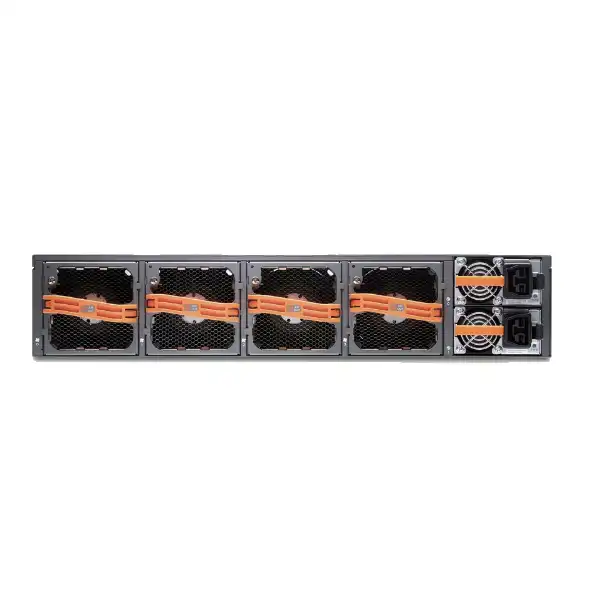
The power-supply architecture varies with airflow and AC/DC selection. Juniper documents 3000 W redundant supplies for some airflow-out AC or DC models, 2700 W AC supplies for airflow-in models and 2400 W DC supplies for airflow-in models. The switch ships with two power supplies in supported configurations, providing load sharing and redundancy when both are operational. For resilient deployment, each PSU should normally be connected to an appropriately sized independent power source or PDU path according to the data-center electrical design.
Cooling uses four field-replaceable fan modules, each containing two counter-rotating fan rotors. The platform can be ordered for port-to-FRU airflow or FRU-to-port airflow. This choice must match the rack’s hot-aisle/cold-aisle layout. Mixing airflow directions within a rack can cause hot exhaust air to feed a neighbouring device’s intake, which reduces thermal margin even when room temperature appears acceptable. The airflow code should therefore be a line item in the quotation and installation checklist.
Juniper specifies normal operation from 0°C to 40°C and operating relative humidity from 5 percent to 90 percent non-condensing. Dubai facilities with professional data-center cooling are usually designed well within equipment inlet limits, but local ambient heat makes containment, cooling redundancy and clean airflow especially important when equipment is installed in edge rooms, industrial sites or smaller server spaces rather than purpose-built data halls.
Cabinet planning also matters. Juniper calls for rack installation and describes a minimum cabinet depth of 36 inches, with adequate ventilation and cable routing so that exhaust air can leave without recirculating. A site survey should confirm usable rack depth, front and rear clearance, PDU placement, cable managers and the ability to remove power supplies or fans without dismantling unrelated cabling.
Rack mounting, cabling and optics checklist
The QFX5230 is a 2U device weighing approximately 25 kg with fans and power supplies installed. Juniper documents a four-post rack installation using the QFX5230-2RU-4PRMK rack-mount kit. A quotation should state whether the required rack hardware is supplied with the chosen orderable configuration or must be added separately. That is particularly important when equipment will be installed remotely and the engineer arriving on site must have every bracket, rail and fastener available.
Rack fit
Confirm four-post 19-inch rack compatibility, usable cabinet depth, rail spacing, adjacent equipment clearance and safe access for service operations.
Airflow direction
Match AFO or AFI orientation with the facility’s cold-aisle/hot-aisle plan. Do not mix airflow directions casually inside the same rack row.
Power feeds
Specify AC or DC, connector expectations, PDU capacity, redundant power paths and circuit headroom for the planned optical population.
Optical reach
Record link distance, fibre type, connector format and remote-end interface for every port class before selecting transceivers.
Breakout map
Document which 400G ports remain native and which split into 200G, 100G, 25G or 10G interfaces, including remote-end lane mapping.
Cable-management density deserves special attention. A 64-port 400G platform can create a large bundle of fibre or breakout assemblies, and the minimum bend radius must be preserved without blocking intake or exhaust. Labelling should identify both the physical port and the logical breakout interface so that a technician can replace a cable without tracing multiple branches manually. In large fabrics, accurate cabling data is part of the operational control plane because automation and topology assurance depend on the physical links matching the intended design.
Migration from an existing 100G or 200G fabric
Many organizations considering QFX5230 are not building a completely new data center. They are replacing older spine switches, expanding a current fabric or preparing for a new generation of servers. The platform’s breakout flexibility makes staged migration practical, but a successful plan should identify which links change speed at each stage. For example, a new QFX5230 spine can initially connect to legacy leafs through 100G breakout while reserving native 400G ports for new leafs. This preserves investment while creating an upgrade path.
The risk in a mixed-speed phase is hidden oversubscription. A leaf with four 100G uplinks behaves differently from a newer leaf with four 400G uplinks, even when both attach to the same spine pair. Traffic engineering and ECMP may distribute flows across equal-cost routes, but application performance can still vary by leaf generation. Capacity monitoring should therefore distinguish aggregate spine utilization from per-leaf uplink utilization.
Software migration must be planned separately from physical migration. If the existing fabric runs classic Junos, another network operating system or a different automation tool, the target operational model should be validated before the first production cutover. Configuration templates, authentication, telemetry, SNMP where still required, logging, NTP/PTP requirements, image-management policy and backup procedures need to be defined for Junos OS Evolved.
A practical migration runbook should include a pilot link, rollback criteria, maintenance-window tasks, validation commands, application checks and ownership for each decision. The switch can support sophisticated fabric architectures, but disciplined change control remains the simplest way to reduce avoidable outage risk.
Resilience and failure-domain design
The QFX5230 includes redundant, load-sharing power supplies and hot-removable fan modules, but chassis component redundancy is only one layer of availability. In most critical fabric designs, resilience comes from using multiple switches so that a single chassis, maintenance event or software issue cannot isolate a large portion of the data center. A pair or larger set of spines with ECMP is therefore more common than designing around one very large switch.
Each leaf should normally have paths to multiple spine devices, and the routing design should converge cleanly when a link or spine is removed. The failure test should include not only hard link loss but also maintenance operations, optical degradation and power-feed failure. For super-spine deployments, designers should consider whether a pod failure remains contained or whether the super-spine creates a new shared dependency across multiple fabric blocks.
High availability also includes operations. Dual power supplies do not help if both are connected to the same overloaded PDU, and redundant spines do not help if both are upgraded simultaneously without a tested procedure. The procurement and deployment scope should therefore connect hardware redundancy with independent power, cabling diversity, software maintenance policy and monitoring.
Software, subscriptions and support: what to confirm before ordering
The hardware chassis should not be quoted in isolation from its software and support requirements. QFX5230 runs Junos OS Evolved, and the required feature set must be validated against the target release. Features evolve over time, and some capabilities may have release-specific prerequisites or limitations. The correct practice is to identify the protocols and operational functions the fabric requires, then validate them in Juniper’s current feature documentation and release notes before the production version is frozen.
Juniper’s data-center automation software, including Apstra Data Center Director, should be treated as a separate operational decision. Do not assume that purchasing the switch automatically includes every automation subscription, assurance capability or support entitlement that a deployment may need. If the project depends on fabric intent, analytics or centralized lifecycle management, the quotation should explicitly list the required software entitlement and term.
Support coverage is equally important for a chassis used at spine or super-spine level. A failed fabric switch can affect a large traffic domain, so the required Juniper Care or equivalent support level should be chosen according to business recovery targets, local sparing strategy and access to replacement hardware. Some operators maintain an on-site spare to reduce hardware replacement dependency; others rely on a vendor support contract with a defined service response. The economic decision should be based on outage cost and recovery objectives rather than the switch price alone.
For UAE procurement, ask for a bill of materials that separates chassis, power/airflow option, rack kit, optics and cables, software subscriptions, support coverage and professional services. That makes future renewals and lifecycle ownership clearer and reduces the risk of discovering an omitted entitlement during deployment.
Compatibility questions that should be answered in the design phase
Remote switch interfaces
Confirm the exact speed, breakout mode and transceiver standard on every leaf, router or optical endpoint. A matching nominal Ethernet speed does not guarantee a compatible optical implementation.
Optics and cabling
Use Juniper’s current hardware-compatibility information for qualified transceivers and cables. Distance, fibre plant and high-power coherent-module limitations must be considered together.
Junos release
Select a Junos OS Evolved release that supports the required routing, EVPN, telemetry, RoCEv2 and automation functions, and test upgrades against the actual fabric design.
Automation platform
If Apstra Data Center Director or an infrastructure-as-code workflow is used, confirm supported software versions, device onboarding requirements and the chosen source of truth.
Server and storage stack
For RoCEv2, validate NIC firmware, host QoS, MTU, DSCP, queue settings and storage or accelerator requirements. Lossless behaviour is an end-to-end property.
Facility environment
Match rack depth, airflow, temperature, humidity, power-feed type, PDU connectors and cooling capacity to the exact ordered configuration and optical population.
Where the QFX5230-64CD fits best
Large leaf-spine fabrics
Dense 400G radix makes the QFX5230 attractive as a spine where many leaf switches require multiple 100G, 200G or 400G uplinks. The design can use native links or breakout depending on the leaf generation. The main sizing questions are leaf count, uplinks per leaf, target oversubscription and the number of links that must remain available after a failure.
AI and GPU clusters
The platform’s 400GbE density and RoCEv2 capabilities suit AI fabrics where high-bandwidth east-west transfers occur between accelerators and distributed storage. Buyers should treat PFC, ECN, DSCP and telemetry as design elements rather than optional tuning performed after deployment.
IP storage networking
High-throughput Ethernet storage fabrics can benefit from the QFX5230 when the storage nodes and NICs support the chosen high-speed and congestion-control model. Practical design should include workload burst characteristics, storage replication traffic and failure recovery, not only steady-state throughput.
Super-spine expansion
When independent fabric pods outgrow a single spine tier, QFX5230 can operate as a super-spine connecting multiple spine blocks. This role should be justified through topology scale and failure-domain requirements because adding a tier also adds routing, cabling and operational complexity.
Edge and DCI
Support for high-speed optics including ZR/ZR-M can make the switch relevant where packet fabric and inter-site connectivity meet. The optical path and coherent-port population must be validated, so this is a design-led use case rather than a generic assumption that every 400G port can serve any distance.
When the QFX5230 may be more switch than the project needs
A 64-port 400GbE spine is not automatically the best choice for every data center. A smaller environment with a handful of 10G or 25G servers and modest 100G uplinks may not use the port density or switching capacity efficiently. In that case, a lower-density QFX model can reduce chassis cost, power consumption and optics expenditure while still meeting the application requirement. Buying excessive capacity can also complicate support and spares planning if the rest of the network remains at much lower speeds for several years.
At the other end, projects moving rapidly toward 800GbE server or fabric links should compare newer higher-speed QFX platforms rather than assuming 400GbE remains the right long-term spine interface. The correct choice depends on the planned leaf generation, accelerator NIC speed, expected fabric life and whether 400G breakout offers a sensible transition. An 800G-capable alternative may have a higher initial cost but reduce the need for another spine refresh if the network roadmap is already defined.
The QFX5230 is strongest when the requirement genuinely benefits from dense 400G radix today, while still needing flexibility for 100G and 200G migration links. A balanced shortlist should therefore compare capacity, port-speed roadmap, optics, automation, power and software operations rather than comparing model numbers alone.
Dubai and UAE deployment considerations
For UAE deployments, the switch’s published environmental range is only the starting point. A major data center in Dubai or Abu Dhabi may provide tightly controlled inlet temperature, redundant cooling and structured hot-aisle/cold-aisle containment. A smaller enterprise server room, edge site or industrial facility can have more variable conditions. The project should confirm actual rack inlet temperature, dust control, power quality, PDU capacity and the ability to maintain airflow during maintenance periods.
Lead time can also vary between chassis, power/airflow variants and optical modules. It is useful to separate “switch availability” from “complete deployment availability.” A chassis delivered without the correct 400G optics, breakout cables or rack kit cannot complete the installation. For coherent DCI designs, optical components may have a different sourcing path from ordinary short-reach modules, so the bill of materials should be locked early.
For organizations with equipment in multiple Emirates or colocations, support logistics should consider where replacement hardware is held, whether remote hands are available, and who owns the configuration restore process. A highly available fabric can tolerate a device failure, but recovery is faster when spare strategy, software image, configuration backup and physical replacement instructions are prepared in advance.
FourTeck can help scope the Dubai/UAE requirement around topology, quantity, optics, rack environment, support and implementation. Final availability and pricing should be based on the exact orderable configuration rather than a generic model description.
What an accurate QFX5230 quotation should include
A useful enterprise quote should answer the implementation question, not merely provide a chassis price. The following inputs materially change the bill of materials or deployment scope.
Number of QFX5230 devices and whether each will operate as spine, super-spine, DCI edge or lab/spare equipment.
How many ports are native 400G, 200G or 100G and which interfaces require breakout to lower speeds.
Rack-to-rack, row-to-row, campus or metro distances, including fibre type and connector information where known.
Required AFO/AFI orientation, AC or DC feed, PDU details and redundancy expectations.
Target Junos OS Evolved release, EVPN-VXLAN requirements, RoCEv2 needs and whether Data Center Director or other automation is in scope.
Required support response, installation, staging, configuration, migration, acceptance testing and documentation.
Implementation journey from design to handover
1. Define the fabric role
Document leaf count, uplinks, oversubscription, routing or EVPN architecture, failure tolerance and growth target. This establishes whether QFX5230 density is appropriate and how many units are required.
2. Build the port and optics matrix
Map every physical link by speed, breakout, distance, fibre type and remote endpoint. Validate the transceivers and cable assemblies before purchase.
3. Validate facility readiness
Confirm rack depth, mounting kit, airflow direction, redundant power feeds, PDU capacity, cooling and maintenance clearance. Correct physical planning prevents late-stage installation changes.
4. Freeze the software design
Select the Junos OS Evolved release, management approach, routing protocols, EVPN features, telemetry, authentication and automation workflow. Verify release-specific support before the maintenance window.
5. Stage and test
Power the devices, load approved software, validate optics, run configuration checks, test routing convergence and verify telemetry. For RoCEv2, include congestion and throughput tests rather than link-state checks alone.
6. Cut over and document
Execute the migration runbook, verify application paths, capture final cabling and configuration state, register support assets and hand over monitoring, backup and escalation procedures to operations.
Buyer questions about the Juniper QFX5230-64CD
Is the QFX5230 mainly a leaf or a spine switch?
Juniper primarily positions it for high-radix spine and super-spine roles, including AI data-center fabrics, although exact deployment depends on architecture. Its 64 native 400GbE ports are especially valuable when many leaf switches need high-speed uplinks. A workload-facing leaf normally requires a port mix optimized for server NICs, while QFX5230’s density is optimized around 400G fabric connectivity.
Can the 400G ports connect to 100G equipment?
Yes, the platform supports lower interface speeds and breakout modes, including configurations that can provide multiple 100G interfaces from 400G ports. The exact cable or transceiver, port configuration and remote-end compatibility must be confirmed. Breakout is a physical and logical mapping, so both sides of the link need to agree on lane use and interface standard.
Does the QFX5230 support EVPN-VXLAN?
Yes. Juniper documents the QFX5230 for IP and EVPN-VXLAN fabrics, including AI data-center designs. The detailed feature set depends on the Junos OS Evolved release and the chosen architecture. Before deployment, confirm the required EVPN route types, underlay model, multihoming, telemetry and policy functions against the selected release.
Is it suitable for RoCEv2 and AI storage traffic?
It supports RoCEv2-related traffic-management capabilities such as PFC and ECN and is positioned for AI and IP-storage networks. Suitability still depends on end-to-end design. Server NICs, queue mappings, DSCP treatment, ECN thresholds, MTU and application behaviour must be validated as one system; otherwise a capable switch cannot by itself guarantee lossless or low-latency performance.
What is the actual power requirement?
Juniper publishes a typical figure around 580 W for a defined 50-percent-traffic DAC test and a maximum figure up to 1600 W under a heavy optical configuration that includes coherent modules. Real consumption depends on transceivers, traffic and temperature. Power circuits and PDUs should be sized for the ordered power supplies and operational redundancy, not merely for a typical benchmark value.
Can it be used for data center interconnect?
Yes, Juniper positions QFX5230 for edge and DCI use cases and supports ZR/ZR-M optics in appropriate configurations. A DCI design must include optical link-budget engineering, fibre-route information, coherent-port population and any required amplification or line-system components. Do not select coherent optics from distance alone without checking the complete optical path.
Does the switch include Apstra Data Center Director?
The QFX5230 can be onboarded, configured and monitored with Juniper’s data-center automation platform, but procurement should treat automation entitlements and subscriptions as a separate line of confirmation. The hardware purchase should not be assumed to include every management or assurance capability needed by the project. Ask for the software term and support coverage to be stated explicitly.
What airflow direction should be ordered?
Choose the airflow orientation that matches the facility’s rack convention. Juniper supports port-to-FRU and FRU-to-port airflow variants. This is not cosmetic: the wrong orientation can cause hot exhaust recirculation and reduce thermal margin. Confirm the cold-aisle side, hot-aisle side and PDU/cabling layout before the SKU is finalized.
How should a buyer decide between QFX5230 and a newer 800G platform?
Base the decision on the leaf and server roadmap. If the next several years are centered on 100G, 200G and 400G connectivity, QFX5230 can provide strong radix with useful breakout flexibility. If 800G leaf uplinks or NICs are already a firm requirement, compare a higher-speed QFX platform so the spine does not become the next upgrade bottleneck. Power, optics and software maturity should be compared alongside raw interface speed.
What information is needed for a Dubai quotation?
Provide quantity, fabric role, leaf count, required port speeds, breakout plan, approximate link distances, optics preference, rack location, airflow direction, AC or DC power, software/automation requirements, support term and whether installation or migration services are needed. These inputs allow the quotation to cover the deployable solution rather than only the base chassis.
Decision recap for QFX5230 buyers
Best suited to dense 400G fabric roles where spine or super-spine radix, AI traffic or high-speed DCI justifies the platform.
Size by leaf count, uplinks, oversubscription, failure tolerance and traffic pattern rather than the 25.6 Tbps headline alone.
Validate optics, breakout modes, remote interfaces, Junos release, automation tools and RoCEv2 host settings before ordering.
Confirm rack depth, rail kit, airflow direction, redundant power feeds, thermal capacity and cable-management space.
What FourTeck needs from the buyer
For an accurate Juniper QFX5230-64CD quotation in Dubai or the wider UAE, send the practical design inputs below. Exact answers are useful, but even approximate values can be enough to start a technically sensible bill of materials.
Spine / super-spine / DCI role
Leaf count and uplinks
400G / 200G / 100G port mix
Breakout requirements
Link distances and fibre type
AC/DC and airflow direction
EVPN-VXLAN / RoCEv2 scope
Automation requirement
Support term and SLA target
Installation and migration scope
Plan the QFX5230 as a complete fabric component, not just a chassis
The Juniper QFX5230-64CD combines dense 400GbE connectivity, strong fabric throughput, EVPN-VXLAN capability, RoCEv2-aware congestion controls and modern automation hooks in a fixed 2U platform. The best result comes from matching those capabilities to the real topology, optics, airflow, power, software and operations model. Share your fabric size and interface requirements and FourTeck can help turn them into a deployable Dubai/UAE bill of materials and implementation scope.

Reviews
There are no reviews yet.