
Juniper QFX5240-64OD Data Center Switch in Dubai
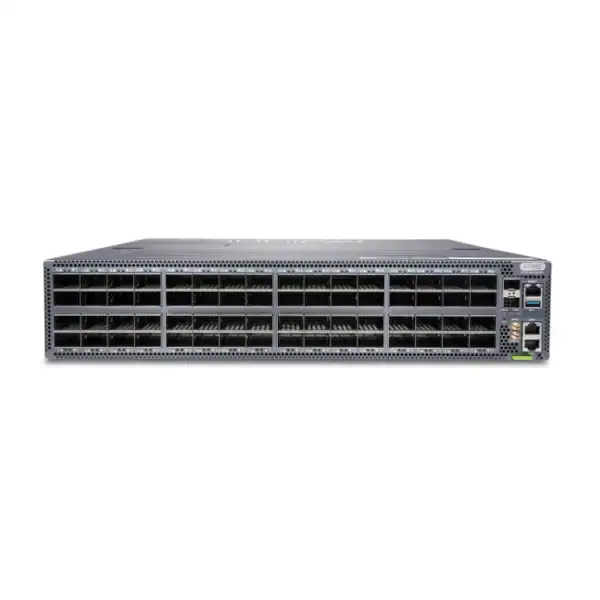
The QFX5240-64OD is Juniper’s fixed 2U, 64-port 800GbE OSFP platform for high-capacity leaf, spine and AI-fabric roles. Its value is not simply the headline 800GbE port speed: it is the combination of 51.2 Tbps unidirectional switching capacity, Broadcom Tomahawk 5 silicon, Junos OS Evolved, high-speed breakout choices, congestion-control functions for RoCEv2 traffic, and operational integration suited to modern data-center fabrics.
Direct answer: what the QFX5240-64OD is and when it fits
Why the QFX5240-64OD is different from an ordinary high-speed switch
The QFX5240-64OD sits in a class of switches intended for fabrics where aggregate bandwidth, east-west traffic behavior and port-radix decisions have direct consequences for application performance. A conventional enterprise access or aggregation switch may be evaluated primarily by the number of user-facing ports, PoE capability, uplink speed and Layer 2 or Layer 3 features. The QFX5240-64OD has a different design center. Its 64 native 800GbE OSFP ports and 51.2 Tbps unidirectional switching capacity are aimed at data-center architectures where a small number of high-capacity switching nodes can interconnect many high-speed leafs, GPU-facing networks, storage endpoints or large routing domains.
That distinction matters for procurement. An 800GbE switch is not automatically the correct choice simply because a new server or GPU cluster supports 400GbE or 800GbE networking. The fabric must be designed around oversubscription objectives, endpoint count, expected traffic patterns, cable reach, transceiver power, redundancy, routing scale and operational tooling. The QFX5240-64OD can be an excellent fit where those requirements line up, but it can be materially oversized where the real need is a modest 100GbE or 400GbE leaf. The right buying question is therefore not “is 800GbE faster?” but “does the fabric need this port density, radix, latency profile and breakout flexibility, and can the surrounding optics and servers use it efficiently?”
Juniper positions the QFX5240 family for AI data-center leaf/spine use as well as conventional data-center leaf, spine and super-spine roles. This is significant because AI and machine-learning clusters often produce synchronized, high-volume traffic patterns that can expose congestion and load-balancing weaknesses. The platform supports RoCEv2-related congestion mechanisms such as Priority Flow Control, Explicit Congestion Notification and DCQCN, alongside dynamic load balancing. Those capabilities do not remove the need for careful queue, PFC, ECN and fabric design; they provide the mechanisms required to implement a controlled loss-aware or lossless transport strategy.
For a Dubai or UAE data-center project, the operational environment also deserves equal weight with the switching specification. Rack depth, 200–240 V power availability, airflow direction, cooling capacity, cabling pathways and optic power limits all influence whether the selected bill of materials will work as designed. The QFX5240-64OD is a dense 2U system, so a technically correct quotation should be driven by the complete rack and connectivity plan rather than by the base chassis part number alone.
Core hardware specification
| Parameter | QFX5240-64OD detail | Buyer relevance |
|---|---|---|
| Form factor | Fixed 2U chassis | Plan two rack units plus service clearance, cable bend radius and front-to-back airflow. |
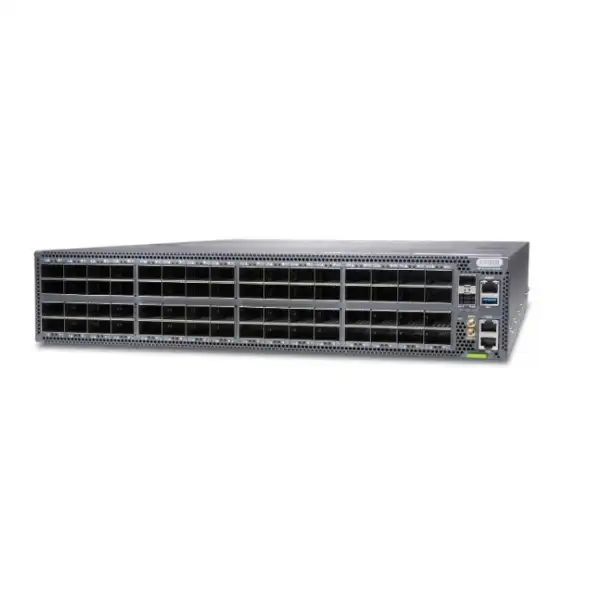
| Network ports | 64 × 800GbE OSFP, plus 2 × SFP+ service/network ports | The OSFP form factor is a primary difference versus the QFX5240-64QD, which uses QSFP-DD. |
| Switching capacity | 51.2 Tbps unidirectional / 102.4 Tbps bidirectional | Supports high-radix 800GbE fabrics without relying on a modular chassis. |
| Forwarding rate | Up to 21.2 Bpps | Relevant to very high packet-rate environments; application behavior still depends on packet size and traffic profile. |
| Switch ASIC | Broadcom Tomahawk 5 class switching silicon | Optimized for very high bandwidth and shallow-buffer data-center switching. |
| Packet buffer | 165 MB total | Congestion-control design is important; this is not a deep-buffer WAN router. |
| Latency | Approximately 700–750 ns store-and-forward as stated for the QFX5240 line | Useful for latency-sensitive east-west workloads, although end-to-end job performance depends on the complete fabric. |
| Control-plane CPU | Intel 4-core 2.2 GHz Ice Lake | Runs the control and management plane independently of the high-speed forwarding ASIC. |
| Memory and storage | 32 GB DDR4; two 480 GB internal SSDs | Supports Junos OS Evolved operations, local software images and platform resiliency functions. |
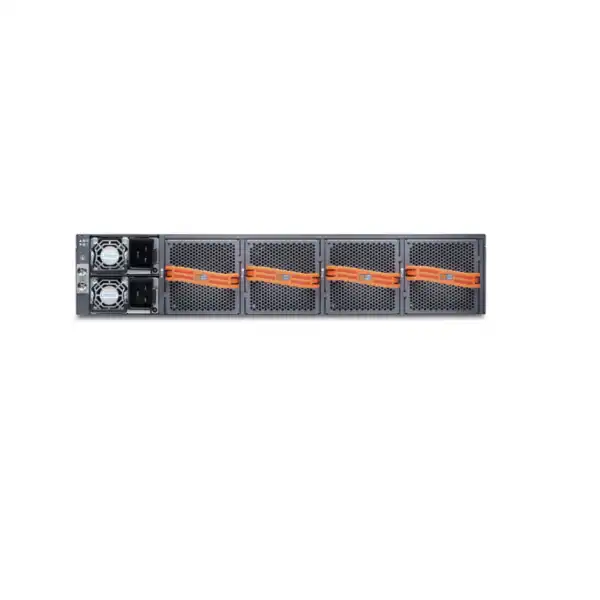
| Power | Two hot-pluggable AC power supplies with 1+1 redundancy; 200–240 V platform configuration | Dual independent rack power feeds should be considered where the facility design supports them. |
| Cooling | Four hot-pluggable fans, airflow-out / ports-to-PSU direction | Rack hot-aisle/cold-aisle orientation must match the ordered airflow variant. |
| Operating system | Junos OS Evolved | Check the intended release train and feature support before migration or standardization. |
| Chassis size / weight | About 43.8 × 8.8 × 64.8 cm; approximately 22 kg fully loaded without optics | Important for rack depth, handling and installation planning. |
Power draw varies materially with ambient temperature, optic type and traffic load. Juniper’s current line data lists typical QFX5240-64OD consumption around 613 W under a stated DAC-based test condition and a substantially higher maximum under a high-temperature, optics-loaded condition. Treat these as planning references rather than a substitute for the final rack power calculation.
Port architecture and breakout planning
The defining physical characteristic of the QFX5240-64OD is its OSFP-based 800GbE front panel. Each native high-speed port is designed around 800GbE operation, while Junos supports channelization to lower-speed interfaces for different fabric and endpoint requirements. Juniper documents 800GbE, 2 × 400GbE, 4 × 200GbE and 8 × 100GbE channelization modes at the individual OSFP-port level. However, the maximum practical system port counts are constrained by supported port-group combinations and platform rules. Juniper’s current QFX5240 line specification lists the QFX5240-64OD at up to 64 × 800GbE, 128 × 400GbE, 256 × 200GbE and 256 × 100GbE in the documented maximum breakout profiles, while mixed-speed designs can use a larger total logical-port count subject to the platform port checker. This is precisely why a bill of materials should be designed from the required endpoints backward rather than by multiplying theoretical lane counts.
For a spine role, many buyers will use the QFX5240-64OD as a high-radix aggregation point with 800GbE or 400GbE links toward leaf switches. For a leaf role in an AI environment, the same chassis may use breakout connectivity toward servers, DPUs, NICs or storage systems while keeping high-capacity links toward the spine. The correct pattern depends on the peer device connector type. A server may expose OSFP, QSFP-DD, QSFP112 or another physical form factor even where the electrical Ethernet speed is compatible. Cable assembly and transceiver selection therefore cannot be inferred from speed alone.
Breakout planning also influences operations. Every logical sub-interface becomes part of the monitoring, labeling, cabling and failure-domain model. A design that maximizes breakout density may reduce chassis count, but it can increase cabling complexity and make maintenance more sensitive to a single physical port or cable assembly. A design that keeps more native 800GbE links may simplify the physical layer while requiring peer devices that can accept the same rate. Neither approach is universally preferable; the correct balance depends on cluster topology, endpoint generation, expected growth and operational practices.
Two SFP+ ports are also provided on the QFX5240 platform. They are not a substitute for the 64 OSFP fabric ports, but they can be relevant to service or auxiliary connectivity depending on the architecture and supported software configuration. The chassis additionally provides a dedicated RJ-45 management port, RJ-45 console access and USB, giving operators a conventional out-of-band path for commissioning and recovery. These interfaces should be included in the rack cabling schedule rather than treated as an afterthought.
Optics are part of the design, not an accessory line item
Match reach and fiber plant
Select DAC, AOC or optical modules according to actual rack-to-rack distance, fiber type, connector topology and peer interface. A transceiver that fits the OSFP cage is not automatically supported for every distance, breakout mode or peer device.
Validate high-power optic placement
Juniper specifically notes that not every front-panel port supports high-power optics such as certain 800G coherent modules. On the QFX5240-64OD, designated middle-row ports support high-power optics; the platform port checker should be used before assigning them.
Confirm breakout assemblies
A 2 × 400GbE, 4 × 200GbE or 8 × 100GbE logical requirement may need a specific passive copper, active optical or fiber breakout solution. The remote ends, FEC requirements and supported cable lengths must align with the peer device.
Include thermal impact
High-speed optical modules add heat and power load. Dense optical configurations need a rack-level thermal and power budget, especially where Dubai data-center cooling design, cabinet density or redundant power feeds impose project constraints.
Use current compatibility data
Supported transceivers and cable combinations evolve with hardware and software qualification. The quotation should be checked against Juniper’s current hardware compatibility information instead of relying on a generic “800G OSFP” description.
One QFX5240-64OD-specific detail deserves special attention: Juniper’s current hardware documentation identifies the high-power-optic-capable positions as ports 1, 2, 5, 6, 9, 10, 13, 14, 17, 18, 21, 22, 25, 26, 29, 30, 33, 34, 37, 38, 41, 42, 45, 46, 49, 50, 53, 54, 57, 58, 61 and 62. The purpose of preserving this detail in the buying process is not to force a specific design; it is to prevent an apparently correct optic count from becoming an installation problem. Any high-power optical requirement should be mapped to the supported positions and checked again against the current port checker at the time of deployment.
AI/ML fabric use: what the features mean in practice
The QFX5240-64OD is frequently evaluated for AI and accelerated-compute clusters because those workloads can create unusually synchronized traffic. Distributed training often moves large volumes of data between GPUs or accelerator nodes, and many flows may become active at nearly the same time. A network that looks lightly loaded on average can still experience microbursts, queue buildup or transient congestion. High link speed alone does not solve those behaviors. Fabric design has to manage how traffic is spread, how congestion is signaled, and how endpoints respond.
RoCEv2 is a central part of many Ethernet-based AI fabrics. It allows RDMA traffic to operate over routable Ethernet/IP, supporting low-overhead data movement between endpoints. The QFX5240 line supports RoCEv2 along with Priority Flow Control, Explicit Congestion Notification and DCQCN. PFC can pause selected traffic priorities under congestion instead of dropping frames indiscriminately. ECN can mark packets to signal congestion before loss occurs, while DCQCN provides a congestion-control approach used with RoCEv2 endpoints. These mechanisms need coordinated configuration across the switch and host side; enabling a single feature without an end-to-end policy can create undesirable behavior.
PFC watchdog support is relevant because poorly controlled pause behavior can create persistent congestion or pause storms. Dynamic load balancing is also useful in fabrics with multiple equal-cost paths because it can improve traffic distribution compared with static hashing in appropriate designs. Juniper additionally supports configurable hash-bucket behavior and selective dynamic load-balancing mechanisms on the platform. These are engineering tools, not automatic guarantees of application speed. Their effect depends on the actual topology, flow sizes, transport behavior and endpoint implementation.
For GPU clusters, the meaningful sizing exercise begins with the server/NIC generation and the topology. A cluster where every compute node has dual 400GbE adapters has different leaf-port and oversubscription requirements from a cluster using 200GbE interfaces. The number of GPUs per server, the ratio of frontend to backend networking, storage architecture and job distribution model all influence how much bandwidth must leave each rack. If the leaf-to-spine links are undersized, the availability of 800GbE ports on the spine does not by itself prevent bottlenecks. Conversely, deploying 800GbE everywhere can add cost and optic complexity where the workloads cannot consume it.
For this reason, a QFX5240-64OD quotation for AI use should be accompanied by a port map and traffic assumption. At minimum, that map should identify the number of racks, leaf switches per rack, uplinks per leaf, required link speed, expected oversubscription target, redundancy model, GPU or NIC interface type and growth horizon. With those inputs, the 64OD can be evaluated as a real fabric component rather than as a standalone high-speed appliance.
Cloud-ready IP and EVPN-VXLAN fabric roles
The QFX5240-64OD is not limited to GPU networking. Juniper positions the QFX5240 line for IP fabrics and EVPN-VXLAN fabrics in leaf, spine and super-spine roles. That makes the platform relevant to large private clouds, service-provider-style data centers, high-scale colocation environments and enterprises consolidating multiple application zones onto a routed underlay. The value of EVPN-VXLAN is that it separates the physical IP fabric from tenant or workload overlay connectivity, helping scale Layer 2 adjacency and segmentation without extending traditional spanning-tree domains throughout the data center.
In a pure spine role, the QFX5240-64OD may primarily forward routed underlay traffic between leaf switches. In a leaf role, it may also participate more directly in VXLAN tunnel termination, EVPN control-plane signaling, VLAN/VNI mapping and endpoint learning, depending on the design. In a super-spine role, high-radix 800GbE connectivity can provide an additional stage for larger fabrics. The correct placement depends on how many leaf nodes must be interconnected, required east-west capacity and fault-domain boundaries.
Scale numbers should be interpreted in the context of the selected feature set and software release. Juniper’s published QFX5240 material describes 136,000 MAC address scale and large IPv4/IPv6 unicast route capacities, including multi-million-entry routing information base figures and high forwarding-table capacities. However, real designs rarely maximize every table simultaneously. Enabling overlays, multicast, ACLs, telemetry and specific forwarding profiles can change resource use. A buyer with unusually large route, MAC, ARP/ND or VXLAN scale should validate the exact combination against the current Junos OS Evolved release and Juniper scale documentation before ordering.
The practical advantage of the QFX5240-64OD in a cloud fabric is therefore the combination of port density and control-plane functions rather than any single protocol checkbox. It can provide the physical bandwidth to reduce the number of switching stages while still fitting into Junos-based routing, EVPN and automation practices. That can simplify architecture, but only if the chosen optics, software, operational tooling and migration plan are aligned with the intended fabric.
Junos OS Evolved, automation and operational visibility
Junos OS Evolved
The QFX5240 runs Junos OS Evolved rather than classic Junos OS. This matters during migration because image strategy, supported features, operational commands and automation testing should be aligned to the chosen release.
Telemetry
Junos telemetry can stream operational data for capacity planning, congestion analysis and troubleshooting. In dense fabrics this is more useful than relying solely on periodic polling because microbursts and queue behavior can occur on much shorter timescales.
APIs and scripting
Juniper documents support for automation approaches including Terraform, Ansible, zero-touch provisioning, Python and Junos operational/event scripting. Existing automation should still be validated against the target software version and configuration model.
Apstra Data Center Director
The QFX5240 can operate with Juniper’s intent-based data-center automation tooling. Apstra can be relevant where teams want blueprint-driven fabric design, validation and assurance rather than device-by-device configuration.
Rollback and recovery
Junos operational practices such as configuration rescue and rollback reduce change risk, but they still depend on disciplined release, backup and change-control procedures appropriate to the environment.
Management isolation
The dedicated management interface and console port allow an out-of-band design. For critical fabrics, maintaining a separate management path is valuable when the production data plane is unavailable or being reconfigured.
Operational tooling should be selected according to the team’s existing model. A network group already standardized on Junos CLI and NETCONF-style automation may prefer direct Junos operations, while a larger multi-rack fabric may benefit from intent-based lifecycle management. Software subscriptions and automation platforms can affect the commercial scope, so the desired management method should be stated before quotation rather than added after the hardware order.
Quality of service and congestion control
The QFX5240 line provides ten hardware queues per port, comprising eight unicast and two multicast queues according to Juniper’s published platform specifications. It supports Layer 2 and Layer 3 classification and rewrite functions, port scheduling, shared-buffer behavior, policing and shaping. These features matter in mixed data-center fabrics because different traffic classes can have very different sensitivity to loss, latency and burst behavior.
For general IP and EVPN workloads, standard queuing and congestion-avoidance policies may be sufficient. For RoCEv2 environments, the design becomes more sensitive. PFC is usually scoped to selected priorities rather than enabled indiscriminately. ECN thresholds need to reflect the fabric speed, queue behavior and endpoint response. DCQCN or another supported host-side congestion-control mechanism must be coordinated with switch behavior. Incorrect threshold design can cause oscillation, queue buildup or pause propagation even when the switch itself is operating normally.
The platform’s 165 MB packet buffer reinforces this point. QFX5240 is designed as a high-throughput, low-latency data-center switch rather than a deep-buffer router intended to absorb sustained oversubscription. The best result comes from a fabric that has enough bandwidth and path diversity that buffers are used for transient bursts rather than as a permanent substitute for capacity. Buyers expecting significant sustained ingress-to-egress speed mismatch should model that condition instead of assuming buffer size will mask it.
If the project includes storage traffic, GPU synchronization, backup traffic and tenant application flows on the same physical fabric, the QoS policy should be documented before rollout. Define which classes are loss-sensitive, which are latency-sensitive, which can be shaped, and how congestion will be observed. This turns the switch’s QoS features into an operational policy rather than a collection of unused capabilities.
Power, cooling and rack planning for Dubai data centers
Dense 800GbE networking moves part of the design challenge from switching capacity to facility engineering. The QFX5240-64OD uses a 2U fixed chassis with redundant hot-pluggable AC power supplies and four hot-pluggable fan modules. The airflow direction on the QFX5240-64OD-AO is front-to-back, described by Juniper as airflow out / ports-to-PSU. The rack orientation must match the facility’s cold-aisle and hot-aisle design so that the switch does not draw hot exhaust air from adjacent equipment.
Power consumption must be calculated with the optics included. Juniper’s typical platform figure is measured under a defined 25°C condition using DACs and excludes optical transceiver consumption, while its maximum test uses a more demanding temperature and optics scenario. A real production rack can land anywhere between those references depending on link population and module type. If the switch is populated with high-power 800G optics, the transceiver contribution can be meaningful. The PDU, UPS allocation, breaker capacity and redundant feed design should therefore be sized from the final bill of materials.
Physical dimensions are about 43.8 cm wide, 8.8 cm high and 64.8 cm deep. The chassis weight is roughly 22 kg fully loaded without optics. These values are manageable in a standard data-center rack, but rear clearance, cable bend radius and service access still need to be checked. High-density fiber can become difficult to maintain if patching is allowed to block airflow or if breakout harnesses are routed without strain relief and labeling.
Environmental specifications list an operating temperature range of 0°C to 40°C at sea level and non-condensing operating humidity from 5% to 90%. Those numbers describe supported equipment conditions, not an invitation to run racks at the upper thermal boundary. In Gulf-region facilities, inlet temperature control, airflow containment and clean filter practices remain important because outside climate raises the consequence of cooling faults even when the data hall is normally controlled.
A procurement package for the QFX5240-64OD should therefore include rack unit position, rack depth, airflow orientation, A/B power availability, plug and PDU standards, expected optic population, cable exit direction and management-cable routing. Resolving those details before delivery prevents many of the practical problems that otherwise appear during installation.
Where the QFX5240-64OD fits best
800GbE spine for large fabrics
The 64 native 800GbE ports provide high radix for connecting many leaf switches at 400GbE or 800GbE. This can reduce the number of spine devices or switching stages required for a target bisection bandwidth, depending on resilience and oversubscription goals.
AI/ML leaf or spine
RoCEv2, PFC, ECN, DCQCN and dynamic load-balancing capabilities make the platform relevant to GPU and accelerator clusters where congestion behavior and multipath utilization influence job completion time.
High-speed storage fabrics
Large distributed storage environments can consume substantial east-west bandwidth. The QFX5240-64OD can provide a high-capacity routed fabric where endpoint speeds and traffic engineering justify 400/800GbE uplinks.
EVPN-VXLAN cloud fabric
For private cloud or multi-tenant data centers, the switch can serve in leaf, spine or super-spine roles while participating in Junos-based IP and EVPN-VXLAN architectures.
Aggregation of 400GbE domains
Using 2 × 400GbE channelization from OSFP ports, the chassis can aggregate a substantial number of 400GbE links. The physical cable/optic choice and supported port pattern should be validated before final port assignment.
Growth-oriented core refresh
Organizations moving from 100/400GbE toward 800GbE may use the QFX5240-64OD to create a higher-capacity fabric core while preserving lower-speed connectivity through supported breakout modes during the transition.
When this switch may be more than you need
The QFX5240-64OD should not be treated as the default answer for every data-center refresh. If most endpoints remain at 10/25/100GbE and the fabric has modest east-west traffic, a lower-density or lower-speed QFX platform may deliver the required result with simpler optics and a lower total project cost. Likewise, if only a small number of 800GbE links are needed, buying 64 native ports can leave a large amount of unused capacity.
A second reason to evaluate another model is connector strategy. The QFX5240-64OD uses OSFP, while the QFX5240-64QD uses QSFP-DD for its 800GbE ports. Organizations that have standardized around QSFP-DD optics, cables or peer hardware may find the 64QD a cleaner physical fit even though the switching capacity and chassis class are closely related. Conversely, OSFP can be attractive for deployments aligned to OSFP-based 800G optics and server connectivity. Connector choice should follow the full link ecosystem rather than a preference for one cage type in isolation.
A smaller 32-port OSFP design in the QFX5241 family can also be worth evaluating where 64 high-speed ports are unnecessary. The tradeoff is lower aggregate capacity and fewer native interfaces, but the reduction in rack, power or optical expenditure can be meaningful for smaller pods. At the opposite end, organizations planning 1.6TbE-generation infrastructure should evaluate newer platforms rather than assuming an 800GbE switch provides the right long-term ceiling.
Finally, deep-buffer requirements deserve separate treatment. QFX5240 is a shallow-buffer, high-throughput data-center switch. Networks that must absorb sustained speed transitions or long-haul congestion may need a routing platform with a different buffer architecture. Matching platform design to traffic behavior is more important than choosing the model with the highest headline switching number.
QFX5240-64OD versus nearby alternatives
| Model / option | Key physical difference | When to compare it |
|---|---|---|
| QFX5240-64OD | 64 × 800GbE OSFP, 2U, 51.2 Tbps unidirectional | Best starting point when the design explicitly calls for high-density OSFP 800GbE and 64-port radix. |
| QFX5240-64QD | 64 × 800GbE QSFP-DD in the same 2U capacity class | Compare when existing optics, cabling or peer interfaces favor QSFP-DD rather than OSFP. |
| QFX5241-32OD | 32 × 800GbE OSFP, 1U, 25.6 Tbps unidirectional | Compare for smaller pods or fabrics that need OSFP 800GbE but do not require 64 native ports. |
| Lower-speed QFX designs | 100/400GbE-oriented port mixes and lower aggregate capacity | Compare when server and fabric links remain predominantly 100/400GbE and an 800GbE core would provide little practical benefit. |
The comparison should be made on total fabric economics rather than chassis price alone. Optic count, breakout harnesses, power consumption, rack units, spare strategy, software subscriptions and operations can shift the preferred model. A 32-port switch may require more devices to reach the same radix, while a 64-port switch may carry unused capacity. A QSFP-DD model may simplify an existing optical ecosystem even if the OSFP model appears equivalent at the Ethernet layer. These are architectural tradeoffs, not merely catalogue differences.
Licensing, software releases and support: what to confirm
Hardware capability and usable software functionality should be treated separately in the purchasing process. The QFX5240-64OD runs Junos OS Evolved, and Juniper feature support develops across releases. A design that depends on a particular EVPN behavior, telemetry sensor, congestion-control feature or automation interface should be validated against the intended Junos OS Evolved release rather than assuming every feature behaves identically across all software trains.
Licensing and subscriptions can also affect the final solution. The exact entitlement required depends on which Junos features, automation services, management platform capabilities and support terms are being purchased. Apstra Data Center Director, for example, is an operational layer rather than a physical property of the switch, so an organization planning intent-based fabric management should include that software scope explicitly. A buyer planning to manage the switch directly through Junos may have a different commercial requirement.
Support level is a separate decision from licensing. Large AI or cloud fabrics often have stricter restoration objectives than general enterprise networks because one failed spine or fabric link can affect a large amount of compute capacity. The support term, replacement expectations, software access and escalation path should therefore be aligned with the business impact of downtime. Where the switch is part of a redundant Clos fabric, redundancy may reduce immediate application impact, but it does not remove the need for timely hardware replacement.
For quotations, state whether the requirement is hardware only, hardware plus vendor support, hardware plus software subscriptions, or a complete design-and-deployment scope. This avoids comparing offers that appear similar on the chassis line but differ significantly in the included operational entitlement.
A practical deployment journey
Define the fabric role
Decide whether each QFX5240-64OD will be a leaf, spine, super-spine, end-of-row switch or a combination across separate fabrics. Record redundancy and failure-domain objectives.
Build the port map
List every peer device, link speed, connector, expected reach and redundancy link. Use this to determine native 800GbE versus breakout consumption and remaining growth capacity.
Validate optics and cables
Check exact supported Juniper transceivers or cable assemblies, FEC behavior, breakout mode and high-power optic placement against current compatibility information.
Confirm rack services
Reserve two rack units, verify front-to-back airflow, dual 200–240 V power, PDU capacity, management cabling, fiber management and maintenance clearance.
Choose the software baseline
Select a supported Junos OS Evolved release that covers the required protocols, telemetry and congestion features. Standardize it across equivalent fabric nodes where practical.
Stage and test
Validate interfaces, breakout modes, routing adjacencies, EVPN behavior, PFC/ECN settings where used, telemetry, alarms, rollback and out-of-band access before production cutover.
Migrate in controlled stages
Move leafs, racks or pods according to a documented sequence. Preserve rollback options and verify application traffic after each stage rather than changing the entire fabric at once.
Migration from 100GbE or 400GbE fabrics
A transition to the QFX5240-64OD does not require every endpoint to move to 800GbE on the same day. Breakout support makes staged migration practical, but it needs an intentional plan. Existing 100GbE or 400GbE leaf switches can often connect to an 800GbE-capable spine through supported breakout or compatible optical arrangements, allowing the spine layer to be upgraded before all server-facing interfaces change. This can extend the useful life of existing leafs while creating headroom for later high-speed pods.
The migration risk is primarily at the physical and control-plane boundaries. On the physical side, verify optics, FEC, breakout coding and fiber polarity. On the control-plane side, verify BGP, EVPN, routing policy, MTU, QoS and timer behavior with the existing switches. A new spine can be feature-compatible in principle yet still encounter practical mismatches if interface defaults or policy conventions differ.
Where the old fabric is based on classic Layer 2 designs, introducing a QFX5240-based IP fabric may involve a broader architectural change. The project should identify where Layer 2 gateways move, how default gateways are distributed, how VLANs map to VXLAN segments, and how north-south routing is handled. Application teams may need to validate multicast, storage, clustering or security dependencies before migration. The switch hardware is only one element of that transformation.
For organizations already using Junos and EVPN-VXLAN, the migration can be more incremental. Existing automation templates, naming conventions and monitoring can be adapted, but they should still be regression-tested against Junos OS Evolved. If older QFX devices run classic Junos OS, operators should not assume every operational command, package or script maps directly without validation.
A sound migration plan defines measurable acceptance criteria: expected link speeds, routing adjacency count, ECMP path count, EVPN route state, packet loss thresholds, latency expectations, queue health, telemetry collection, management reachability and redundancy behavior during link or device failure. Testing these items converts a hardware installation into a controlled network change.
Common purchasing mistakes to avoid
Ordering the chassis before the port map
This can produce the wrong connector strategy, insufficient breakout assemblies or unused capacity. Port mapping should drive the bill of materials.
Treating every 800G optic as interchangeable
Form factor, reach, power class, FEC, fiber type and platform qualification all matter. High-power modules also have port-position restrictions on this chassis.
Ignoring airflow direction
A mismatch between switch airflow and rack aisle design can undermine cooling even when the equipment is otherwise compatible.
Comparing quotes without software scope
Hardware-only, support-included and automation-subscription offers are not equivalent. License and support assumptions should be stated explicitly.
Assuming 800GbE eliminates congestion
Oversubscription, synchronized flows and endpoint behavior can still create congestion. Fabric capacity, ECMP, QoS and RoCE tuning remain engineering decisions.
Skipping rack-level power calculations
The switch base consumption and the optic load are different. A dense optical build should be evaluated against PDU, UPS and cooling budgets together.
High availability and failure-domain design
At the device level, the QFX5240-64OD provides redundant hot-pluggable power supplies and replaceable fans. Those features protect against certain component failures, but data-center availability comes primarily from fabric topology. A spine failure, leaf failure, optic failure, cable break or software event should have an understood impact on the application. In a Clos design, multiple equal-cost paths and redundant switches can preserve connectivity when a member fails, provided endpoint and routing configurations are designed for that condition.
Power redundancy should use genuinely independent sources where possible. Connecting both power supplies to the same PDU or upstream circuit preserves PSU redundancy but not feed redundancy. The same principle applies to out-of-band management: if both production and management traffic depend on the same upstream switch or cable pathway, operators may lose access during the exact failure they need to diagnose.
Software maintenance is another availability consideration. A fabric with enough path diversity can often support rolling maintenance without taking the entire environment offline. That requires route convergence, ECMP behavior and application tolerance to be tested. BFD can help detect certain failures quickly, but aggressive timers should be selected with care to avoid instability. Maintenance windows should include prechecks, postchecks and rollback criteria rather than assuming the routing protocol will handle every operational mistake.
Spare strategy should also reflect business impact. Some environments hold a cold spare chassis or spare optics on site; others rely on vendor replacement service. The right approach depends on the number of deployed switches, redundancy level, delivery logistics and acceptable time to restore full redundancy. High-cost 800GbE optics may deserve a different spares ratio from the chassis itself because transceiver failures occur at a different granularity.
Security and management considerations
A data-center switch should be treated as part of the security control plane even when its primary function is forwarding. Management access to the QFX5240-64OD should be restricted to authorized networks and administrators, with role-based privileges, secure protocols, logging and configuration change control. SNMPv3 is preferable to older unprotected SNMP versions where monitoring requirements allow it, and management-plane ACLs should limit which systems can reach the device.
Zero-touch provisioning can speed large deployments, but bootstrap security matters. Juniper documents secure zero-touch provisioning capability for the platform family, allowing organizations to automate onboarding while maintaining device identity controls. The implementation should be integrated with the organization’s certificate, image-validation and provisioning workflow rather than exposing an unrestricted bootstrap path.
Configuration archives and authentication should be handled outside the individual switch as well. Central AAA, structured backups and version-controlled automation make it easier to reconstruct changes after an incident. Telemetry and event logs should feed a monitoring or analytics system that can correlate interface changes, queue events, routing transitions and environmental alarms.
Security features and exact software behavior can vary by Junos OS Evolved release. A procurement or migration project with formal compliance requirements should include a release-specific hardening review rather than relying on a generic platform checklist. That is especially important when the switch is used in a multi-tenant data center or connects business-critical AI infrastructure.
Sizing the QFX5240-64OD for a real project
The fastest way to determine whether the 64OD fits is to convert the network requirement into a port-and-bandwidth model. Begin with the number of leafs or endpoints and the target link speed. If a spine must connect 48 leaf switches with two independent uplinks from each leaf distributed across two spine devices, each spine might need 48 fabric-facing ports at the selected speed, leaving room for expansion. If the uplinks are 400GbE, OSFP breakout can be used; if they are 800GbE, native ports are consumed one-for-one. This simple mapping quickly shows whether 64 physical ports provide a sensible radix.
Next, calculate oversubscription. A leaf with 32 server-facing 400GbE links represents 12.8 Tbps of edge bandwidth. If it has four 800GbE uplinks, the nominal uplink bandwidth is 3.2 Tbps, creating a 4:1 ratio before considering traffic direction and workload patterns. Whether that is acceptable depends on the workload. General cloud applications may tolerate oversubscription that would be undesirable for tightly synchronized GPU traffic. The QFX5240-64OD can supply more spine capacity, but the design must allocate enough physical links to use it.
Then check failure conditions. If one spine, one uplink or one leaf fails, what is the remaining bandwidth? A design that looks nonblocking in normal operation may become heavily oversubscribed during maintenance. For critical AI clusters, the degraded-state performance target may be nearly as important as the normal-state target because long training jobs can be sensitive to network disruption.
Finally, add a growth margin that is connected to a real expansion plan. Reserving ports for “future growth” is useful only if the likely future endpoint type and speed are known. A plan to add eight more 400GbE leafs is different from a plan to adopt 800GbE GPU NICs. The QFX5240-64OD’s native 800G density makes it attractive where that migration is plausible, but the optics and cable strategy should anticipate the same horizon.
Fourteck can use these inputs to structure a practical port map and identify whether a single pair of QFX5240-64OD switches, multiple spine nodes or a different QFX model provides the right balance of bandwidth, fault tolerance and spare capacity.
Procurement in Dubai and the UAE
For Dubai and UAE buyers, the most useful quotation is a configuration-aware quote rather than a bare chassis price. The QFX5240-64OD can require a substantial optical and cabling bill depending on how many ports are populated and at what distance. Support, software, rack accessories, power cords and deployment services can also change the total project value. Comparing only the switch hardware line can therefore lead to a misleading purchasing decision.
Lead time and availability should be confirmed against the exact required part numbers at the time of order. High-speed optics, specialized breakout cables and particular support terms may have different availability from the chassis. If a project has a fixed migration date, the order should identify long-lead components early and avoid assuming that all 800G parts are interchangeable alternatives.
Regional deployment planning should also include import and site requirements where applicable, but technical acceptance should remain the priority. Verify that delivered components match the quoted airflow, power and optic variants before installation. Record serial numbers, software baseline and support entitlement as part of handover. For larger projects, a staging phase can catch port, optic or software issues before equipment is moved into the production data hall.
Fourteck’s role can range from supplying the specified Juniper QFX5240-64OD hardware to helping define the complete solution scope. For a faster and more accurate response, provide the intended switch role, quantity, port map, optic reaches, rack location, desired support term and whether configuration, migration or onsite installation is required.
Frequently asked buyer questions
Does the QFX5240-64OD provide 64 native 800GbE ports?
Yes. The 64OD model provides 64 OSFP network ports designed for 800GbE operation. Supported channelization can convert those ports into lower-speed logical interfaces, subject to platform port-group and compatibility rules.
What is the difference between 64OD and 64QD?
The most visible difference is the 800GbE connector form factor: QFX5240-64OD uses OSFP, while QFX5240-64QD uses QSFP-DD. The correct choice depends heavily on the intended optics, cable ecosystem and peer interfaces.
Can the 800GbE ports break out to 400GbE or 200GbE?
Yes. Juniper documents channelization modes including 2 × 400GbE and 4 × 200GbE per OSFP port, with supported system maximums and mixed-speed combinations governed by the platform’s port rules.
Can it be used for 100GbE connections?
Yes, supported breakout modes include 100GbE. The exact maximum port count and cable/optic combination should be validated using current Juniper port and hardware compatibility guidance.
Is it suitable for RoCEv2?
The QFX5240 line supports RoCEv2-related functions including PFC, ECN and DCQCN. Successful operation still depends on endpoint support and coordinated network-wide congestion configuration.
Does it support EVPN-VXLAN?
Yes. Juniper positions the QFX5240 line for IP and EVPN-VXLAN data-center fabrics. Exact feature scale and behavior should be checked against the target Junos OS Evolved release.
Does every port accept high-power 800G optics?
No. Juniper states that only designated middle-row ports on the QFX5240-64OD support high-power optics such as certain coherent modules. The port checker should be consulted for the intended optic.
What operating system does it use?
QFX5240 runs Junos OS Evolved. Organizations migrating from devices that run classic Junos OS should validate their software processes, configuration templates and automation against the selected release.
Is the switch power redundant?
Yes, the normal QFX5240-64OD configuration uses two hot-pluggable AC power supplies in a 1+1 redundant arrangement. Facility-level redundancy still depends on connecting them to independent power paths where required.
How much rack space is required?
The switch itself occupies 2U. Installation planning should also account for a chassis depth of about 64.8 cm, cable bend radius, rear access, airflow clearance and the surrounding patching layout.
Can it be managed with Apstra?
Yes, Juniper positions QFX5240 with Apstra Data Center Director for intent-based data-center operations. The required subscription and deployment scope should be included explicitly in the commercial design.
What information is needed for a Dubai quotation?
Provide quantity, target topology, port speeds, peer devices, optic reaches, fiber type, breakout needs, support term, software/automation requirements, rack power and whether installation or migration services are required.
Technical due-diligence checklist before ordering
A useful pre-order review should answer the following questions in one design record. First, what is the exact switch role and how many devices are required for the desired redundancy? Second, which peer devices connect to every high-speed port and what are their physical connector types? Third, which links run at 800GbE, 400GbE, 200GbE or 100GbE, and which require breakout? Fourth, what is the physical reach and fiber/copper medium for each link? Fifth, do any required transceivers fall into the high-power category that must be mapped to designated ports?
The review should then cover software. Record the target Junos OS Evolved release, routing protocols, EVPN/VXLAN requirements, QoS classes, RoCEv2 congestion policy, telemetry sensors, automation method and management platform. If Apstra will be used, define whether the fabric is a new blueprint or an integration with existing operations. If third-party automation is used, validate the APIs, templates and rollback behavior in staging.
Facility requirements come next: rack unit, depth, airflow, power-feed voltage, PDU outlets, A/B power source, expected optic power, inlet temperature, management cabling and grounding. Confirm the correct rack-mount hardware and power cords for the site. For installations in existing cabinets, check rail compatibility and available service clearance rather than assuming a 2U device will fit solely because two rack units are free.
Finally, define commercial boundaries. Identify required support term, software subscriptions, spare optics, spare power or fan components, onsite staging, installation, configuration, migration, testing and documentation. This makes the quote comparable and reduces the risk of discovering critical dependencies after the chassis has been delivered.
The result of this due diligence should be a concise bill of materials linked to a port map and deployment plan. For a platform as dense as the QFX5240-64OD, that documentation provides far more purchasing certainty than a product-only order.
Decision recap
What Fourteck needs from you for an accurate QFX5240-64OD quotation
Number of switches and whether each unit is leaf, spine, super-spine, end-of-row or spare.
Counts of 800GbE, 400GbE, 200GbE and 100GbE links, including anticipated growth.
Leaf models, GPU/NIC types, storage interfaces or other switches at the far end of each link.
Rack-local DAC/AOC distances, multimode or single-mode fiber, and building or data-hall cross-connect requirements.
IP fabric, EVPN-VXLAN, RoCEv2, AI backend, storage, telemetry, QoS and routing scale expectations.
Junos release policy, Apstra or other automation, vendor support term and required operational coverage.
Dubai/UAE data-center location, rack depth, airflow, power feeds, PDU standards and installation access.
Supply only, staging, configuration, installation, migration, testing, documentation or post-deployment assistance.
Build the QFX5240-64OD quotation around your real fabric
The Juniper QFX5240-64OD is a strong platform when your design genuinely needs 64-port OSFP 800GbE density, high-radix switching and modern data-center fabric functions. The next step is to validate the physical links, optics, breakout pattern, Junos requirements, rack power and support model so the order arrives as a deployable solution rather than an incomplete chassis purchase.

Reviews
There are no reviews yet.