
Juniper ACX7100-32C Cloud Metro Router Dubai
A high-density 1U routing platform for operators and enterprises planning 100GbE and 400GbE metro aggregation, secure transport, data-center interconnect, service-provider edge or large-scale IP/MPLS evolution in Dubai and the wider UAE.
Direct answer: what is the ACX7100-32C and who is it for?
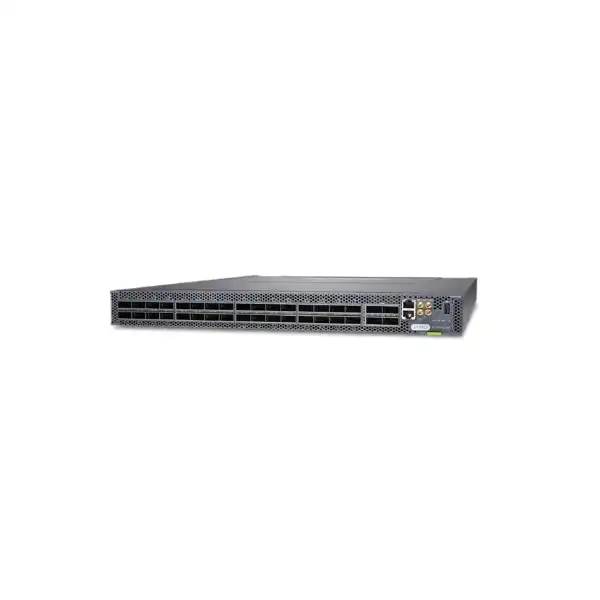
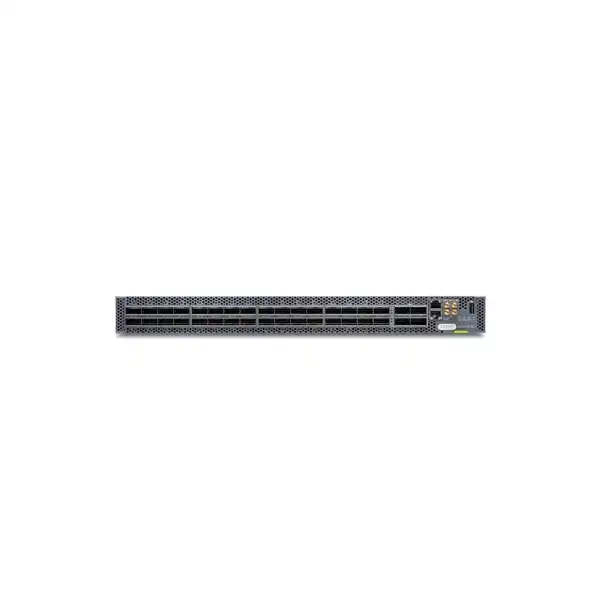
The Juniper ACX7100-32C is a fixed 1U Cloud Metro router in the ACX7000 family. Juniper positions it as a high-capacity platform for the transition from 100 Gigabit Ethernet toward 400 Gigabit Ethernet, with up to 4.8 Tbps of throughput, deep-buffer capability, MACsec-ready high-speed interfaces and the Junos OS Evolved software foundation. Its built-in interface layout is centered on 32 QSFP28/QSFP-DD positions for high-speed services and four QSFP56-DD positions capable of 400GbE operation, with supported breakout options that can change the effective port mix.
It is mainly used where a buyer needs dense metro aggregation, wholesale transport, large-enterprise WAN aggregation, secure data-center interconnect, service-provider PE or aggregation functions, or spine/leaf roles that benefit from 100GbE and 400GbE connectivity. It is not the natural first choice for a branch, a low-density access site or an environment dominated by 1GbE and 10GbE endpoints. Those requirements usually point to another ACX model or to a different routing architecture.
The most important factor to confirm before ordering is the complete port-and-service design, not merely the chassis model. The intended number of 100GbE and 400GbE links, breakout requirements, optic types and distances, MACsec use, timing requirements, service features, software release, license tier, AC or DC power, redundancy policy and rack environment all affect the bill of materials and implementation plan.
FourTeck can help convert those design inputs into a Dubai/UAE quotation covering the correct ACX7100-32C hardware variant, supported transceivers, breakout components where needed, relevant software entitlements, power and airflow checks, migration planning and installation or configuration scope. The objective is to quote a deployable system rather than a bare router that later proves incomplete.
Why the ACX7100-32C is a distinctive high-capacity metro platform
The ACX7100-32C occupies a specific place in Juniper’s metro-routing portfolio. It combines a fixed, one-rack-unit chassis with a port distribution aimed at sites where 100GbE is already a normal aggregation speed and 400GbE is required for uplinks, interconnects or future growth. That makes the product materially different from access-oriented platforms that provide many SFP-based 1/10/25/50GbE ports. The ACX7100-32C is designed around high-speed QSFP connectivity, so its value is strongest when the network plan already calls for substantial aggregated bandwidth.
Juniper documents 4.8 Tbps of throughput for the platform. In practical buying terms, this means the chassis should be evaluated as part of a traffic-engineering and service architecture rather than solely by counting physical ports. A service provider might use it to aggregate multiple 100GbE rings or edge domains into 400GbE transport. A data-center operator might evaluate it for high-capacity interconnect or IP fabric roles. A large enterprise could use it at a core or metro edge where encrypted high-speed links, deterministic routing and multiple service types need to coexist.
The platform also fits Juniper’s Cloud Metro direction, which emphasizes consistent software, automation, telemetry and flexible underlay/overlay choices. Junos OS Evolved is common across the ACX7000 family, helping organizations standardize operational workflows as they deploy different chassis sizes at different network tiers. That consistency can matter more than a single headline throughput number when a network team is trying to simplify software management, automation pipelines and troubleshooting across many metro locations.
However, density alone does not guarantee fit. If a site needs dozens of native 10GbE or 25GbE access connections, the ACX7100-48L may provide a more natural physical interface mix. If the site requires modular expansion or different environmental ratings, another ACX7000 platform can be more appropriate. The ACX7100-32C is strongest when high-speed fan-out and 100/400GbE transport are central requirements rather than occasional exceptions.
ACX7100-32C key hardware specifications
| Specification | ACX7100-32C detail | Buyer relevance |
|---|---|---|
| Form factor | Fixed 1U chassis | High capacity in limited rack space; rack depth and cable management still need checking. |
| Throughput | Up to 4.8 Tbps | Suitable for dense 100GbE aggregation and 400GbE uplink designs when service scale also fits. |
| High-speed ports | 32 x QSFP28/QSFP-DD high-speed positions plus 4 x QSFP56-DD 400GbE positions | Optic form factor, link speed and breakout plan must be designed together. |
| Maximum 400GbE port count | 4 | Useful for metro core, DCI or aggregation uplinks; compare ACX7100-48L if six 400GbE positions are preferred. |
| Operating system | Junos OS Evolved | Feature support depends on software release and entitlement; release validation is part of design. |
| Dimensions | About 44.09 cm W x 4.45 cm H x 59.49 cm D; roughly 63.3 cm depth with FRU handles | Cabinet depth, rear clearance and cable bend radius should be checked before installation. |
| Fully loaded weight | Approximately 12.9 kg | Relevant to rack loading and handling procedures. |
| Power | AC or DC variants; 1+1 PSU redundancy | Select the power model that matches the facility distribution and resilience policy. |
| Power consumption | Juniper lists about 570 W typical and 960 W maximum without optics under documented conditions | Actual site draw depends on traffic, ambient conditions and installed optics, especially high-power coherent modules. |
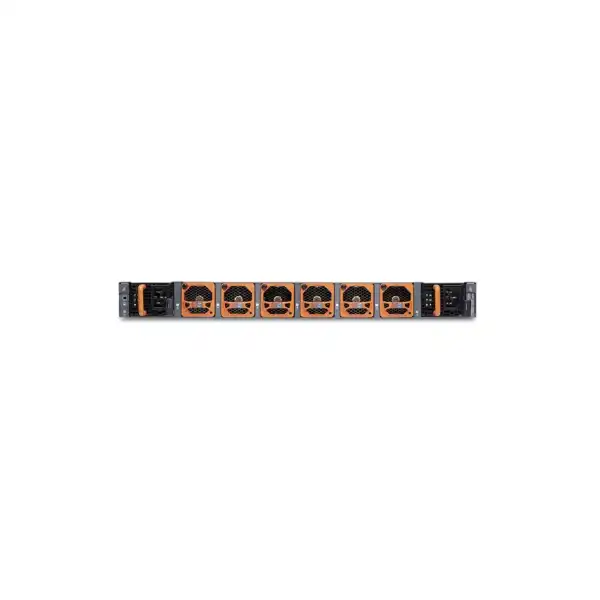
| Cooling | 6 fan modules, front-to-back airflow, 5+1 fan redundancy | Rack hot-aisle/cold-aisle direction must align with platform airflow. |
| Operating temperature | 0°C to 40°C normal operating range; Juniper also documents short-term conditions under applicable guidelines | Dubai installations need controlled rack-room temperature, clean airflow and realistic optic heat planning. |
| Management and service ports | RJ-45 console, RJ-45 management, USB Type A and timing-related interfaces | Supports local operations, out-of-band management and synchronization design. |
Specifications should be matched against the exact ordered hardware SKU and current Juniper documentation. Optics, licenses, support and implementation services are separate design decisions and should not be inferred from the chassis specification alone.
Understanding the 32 x 100GbE and 4 x 400GbE interface architecture
The headline interface count is simple, but purchasing the right optics and breakout components requires more detail. Juniper identifies 32 high-speed ports in the main group and four 400GbE-class QSFP56-DD ports. The 32-port group is designed for high-speed services and supports channelization options on specified port groups. The four 400GbE ports are especially flexible because they can operate as high-capacity uplinks or be broken out into lower-speed lanes where Juniper supports that mode.
The published maximum port-capacity table demonstrates why a buyer should not treat each physical cage as one fixed service. Depending on supported breakout combinations, the ACX7100-32C can present a larger number of logical lower-rate interfaces than the physical front-panel count suggests. Juniper documents maximum combinations that include up to four 400GbE ports, up to 48 100GbE interfaces, and higher logical counts at 50GbE, 25GbE or 10GbE when supported breakout patterns are used. These maximums are architecture limits, not a promise that every speed combination can be used simultaneously in any arbitrary pattern.
That distinction matters in metro design. For example, an operator might keep the 32 main ports as 100GbE customer or ring-facing services and use the four 400GbE positions for core-facing links. Another design might use selected breakout modes to connect multiple 25GbE or 50GbE services. The proper configuration depends on the exact Junos release, transceiver support, breakout cable or optic choice, and the port-group restrictions documented by Juniper.
There is also a narrow 1GbE exception documented for timing use: Juniper notes 1GbE optics support on the ACX7100-32C for PTP grandmaster-clock connectivity using a QSA adapter on a specified port. That is not equivalent to the router being a general-purpose 1GbE access platform. If a project includes many low-speed services, it is better to choose an access-optimized model rather than depend on exceptional port behavior.
Four high-value deployment patterns
Metro aggregation
For carriers and service providers, the ACX7100-32C can sit at an aggregation point where multiple high-speed access, business, mobile or wholesale services converge. Its 100GbE density reduces the need to consume large numbers of rack units for aggregation, while 400GbE uplinks can provide a clean path toward higher-capacity metro cores. The value is strongest when service growth is already driving 100GbE links rather than merely being forecast many years out.
Data-center interconnect
High-speed interfaces, MACsec support and routing flexibility make the platform relevant when data centers or major campus hubs need 100GbE or 400GbE IP connectivity across metro distances. The transport design must still identify whether links are direct optics, coherent ZR/ZR+ modules, leased wavelengths or third-party optical systems. The router does not remove the need to validate optical budgets, reach, fiber type and encryption requirements.
Large-enterprise core or WAN edge
Organizations with substantial campus, private-cloud or multi-site traffic can evaluate the ACX7100-32C as a high-speed routing node where redundant 100GbE links, advanced routing policy, VPN services and secured interconnects are required. It is most appropriate when the enterprise network resembles a provider-scale environment in traffic volume and operational maturity. Smaller sites usually do not need this density.
IP fabric roles
Juniper also positions the ACX7100-32C for top-of-rack and spine-leaf data-center applications. Buyers should validate the exact EVPN, VXLAN, routing-scale, buffering and telemetry requirements against the planned Junos OS Evolved release. The product’s suitability depends not only on port speed but on how its feature set integrates with the wider fabric design, control plane and automation stack.
Routing, MPLS, EVPN and Segment Routing capabilities
The ACX7000 family supports a broad set of modern service-provider and large-enterprise routing capabilities, and the ACX7100-32C benefits from that common software direction. Juniper’s current family documentation includes Layer 2 and Layer 3 services, MPLS, L2VPN, L3VPN, VPLS, VPWS, EVPN service models, Segment Routing for IPv4 and IPv6, SR traffic engineering, fast-reroute functions and associated routing protocols. The exact combination available in a production network is determined by software release, license tier and platform-specific feature notes.
For a buyer, the useful question is not simply whether the datasheet lists EVPN or SRv6. The design needs to define the underlay, overlay and service model. An EVPN-MPLS deployment, for example, assumes that the underlying MPLS environment, IGP and BGP design are ready and that the selected Junos release supports the chosen service behavior on ACX7100-32C. An EVPN-VXLAN fabric has different underlay and operational expectations. SR-MPLS or SRv6 introduces its own addressing, policy, resiliency and traffic-engineering considerations.
Juniper release notes also show that capabilities have expanded over time. That is a reminder to avoid designing from a generic feature list alone. A function that exists on today’s software may not exist in an older installed release, and a specific EVPN behavior may have caveats or prerequisites. FourTeck’s pre-sales process can therefore include the intended Junos OS Evolved release, the targeted routing features and the required interoperability with existing Juniper or multivendor infrastructure.
This release-aware approach reduces two common procurement risks: buying hardware that has ample forwarding capacity but lacks a required service behavior in the chosen software train, or buying more licenses than the actual architecture needs. Feature validation should happen before the final bill of materials is approved.
MACsec and zero-trust security considerations
Juniper identifies MACsec as a security capability of the ACX7100-32C and states that the model provides MACsec capability across its high-speed ports. This is important for metro transport and data-center interconnect because MACsec can protect Ethernet frames on supported links without requiring every application to implement its own encryption. It can be especially relevant when traffic crosses shared building infrastructure, carrier-managed fiber, metro dark fiber or other environments where link-layer confidentiality is required.
Hardware capability does not automatically mean that every MACsec deployment is ready without additional entitlement or design work. Juniper publishes separate ACX Junos Evolved MACsec license SKUs for 100G and 400G bandwidth classes. The correct licensing model must be checked against the intended software version, throughput, port use and commercial terms. A quotation should therefore distinguish between chassis hardware, base or feature software, MACsec entitlements and support rather than presenting encryption as a zero-cost assumption.
The wider ACX7000 security approach also includes secure boot and device-identity mechanisms intended to strengthen trust in the platform. These capabilities are valuable, but they should sit within a broader operational security plan covering role-based administration, AAA integration, SSH policy, management-plane separation, software-image control, configuration backup, logging and change management. A secure router can still be operated insecurely if access and lifecycle practices are weak.
For buyers in regulated or security-sensitive UAE environments, the design discussion should identify whether MACsec is mandatory on every high-speed circuit or only on selected links. That decision affects license scope, optics choices, interoperability testing and the operational runbook for key management and troubleshooting.
Precision timing, SyncE and PTP for mobile and synchronized services
Timing can be a decisive requirement in mobile transport and other synchronized networks. Juniper’s ACX7000 documentation lists Synchronous Ethernet, Precision Time Protocol, transparent-clock functions, primary/client functions and boundary-clock capabilities, together with advanced timing classes on supported platforms. Juniper specifically identifies Class D verification for the ACX7100-32C in the ACX7000 family feature material. The hardware also provides timing-oriented physical interfaces including time-of-day, pulse-per-second and 10 MHz functions.
A buyer planning 4G/5G xHaul, distributed radio networks or any service with strict phase and frequency synchronization should treat timing as a system design rather than a checkbox. The required clock hierarchy, PTP profile, primary reference source, holdover expectations, SyncE deployment, boundary-clock placement and GNSS or external timing architecture must be mapped end to end. The router can participate in that architecture, but site design and software configuration determine whether the intended timing performance is achieved.
The published note regarding 1GbE optic use for a PTP grandmaster clock via a QSA adapter on a specified port illustrates this point. It is a targeted timing accommodation, not a general low-speed access capability. Projects that mix timing feeds with high-speed transport should document which port is reserved, which adapter and optic are required, and how redundancy is provided.
For procurement, the useful inputs are the timing source, target PTP profile, accuracy class, number of timed sites, physical connector requirements and whether the ACX7100-32C will act as client, boundary clock, transparent clock or another role. This information prevents a router quotation from being separated from the synchronization architecture it is expected to support.
Junos OS Evolved and operational model
The ACX7100-32C runs Junos OS Evolved. Juniper describes Junos OS Evolved as a modern Linux-based operating system with modular software architecture. For network teams already using Junos, this provides familiar routing concepts while introducing a software foundation designed for portability, automation and component-oriented updates. The practical value is operational consistency across the ACX7000 family rather than a requirement to manage each hardware platform as an isolated appliance.
Juniper documents multiple management and automation paths for the platform. These include the Junos OS Evolved CLI and programmatic mechanisms such as NETCONF, YANG, telemetry and OpenConfig, while Juniper Routing Director, formerly associated with the Paragon Automation naming, can be used for onboarding, management and monitoring. Juniper Routing Assurance can also provide routing-focused operational insights for supported deployments. Buyers should select only the management components that fit their operating model and budget.
Automation readiness is valuable when dozens or hundreds of metro devices must be deployed consistently. Zero-touch provisioning can reduce manual staging, while templated configuration, structured telemetry and API-driven workflows can help operators standardize changes. However, automation does not eliminate design governance. Teams still need approved templates, credential handling, inventory accuracy, rollback planning and release management. A badly designed template can scale an error just as efficiently as it scales a correct configuration.
When FourTeck scopes an ACX7100-32C project, it can be useful to identify whether the buyer expects basic CLI deployment, integration with an existing Junos automation framework, new controller adoption, telemetry export to third-party systems or a broader Cloud Metro operational model. That decision affects services, licensing, onboarding and acceptance testing.
Licensing: what must be confirmed before a Dubai quotation
Licensing is one of the most important parts of an ACX7100-32C purchase because Juniper offers different software entitlement models and feature tiers. Current Juniper licensing documentation lists Advanced and Premium options for 100G and 400G bandwidth classes, Cloud Data Center licenses for the ACX7100-32C, and dedicated MACsec license SKUs. Subscription terms can include one-, three- or five-year periods, while some offerings are also documented in perpetual form. The exact commercial model should be confirmed against the intended feature set and current Juniper policy at quotation time.
A buyer should begin by identifying what the router must actually do. If the requirement is primarily IP routing and high-speed aggregation, the entitlement need may differ from a design using advanced traffic engineering, data-center features or widespread MACsec. If the environment requires 400GbE services on encrypted links, licensing can differ from a deployment that uses only 100GbE unencrypted connections. Support subscriptions and management software can also be separate commercial items.
The safest approach is to create a feature-to-license matrix before purchase. List the required protocols and services, the number and speed of encrypted links, the planned Junos OS Evolved release, the desired subscription duration, the support level and any Juniper automation products. Then map those needs to current Juniper licensing SKUs. This prevents overbuying and reduces the risk of discovering during implementation that a required feature is not entitled.
FourTeck can incorporate that matrix into the UAE quotation. Because software names and commercial packaging can evolve, final license SKUs should be validated at the time of order rather than copied from an old bill of materials or assumed from a similar ACX model.
Optics, coherent ZR/ZR+ and fiber planning
A high-speed router purchase is incomplete without an optical plan. The ACX7100 line is designed to support high-power ZR/ZR+ transceivers on supporting ports, which can simplify metro and data-center interconnect architectures by allowing coherent optics to terminate directly in the router where the specific transceiver and software combination is supported. This can reduce the need for separate transponder equipment in some designs, but it does not eliminate optical engineering.
The quotation should specify the required link speeds, fiber type, connector type, reach, number of fiber pairs, expected loss budget and whether the link uses direct point-to-point fiber, a passive optical path, a DWDM line system or carrier-provided wavelength. For short-reach 100GbE or 400GbE data-center links, the optic family may be very different from a metro coherent design. Breakout configurations can require dedicated breakout optics or cables and must match the supported port mode.
Coherent optics also add power and heat. Juniper’s published chassis power values are stated without optics, so rack power planning must include the actual transceiver population. A chassis filled with high-power coherent modules can have a materially different thermal profile from one populated with short-reach optics. This is particularly important in Dubai, where data-center room cooling should be designed with realistic internal heat loads even though the equipment operates in conditioned space.
Compatibility should be confirmed through the current Juniper Hardware Compatibility Tool rather than by form factor alone. Two optics may both fit a QSFP-DD cage yet differ in supported speed, wavelength, power, firmware behavior or application. The same principle applies to adapters, direct-attach cables and breakout assemblies.
When requesting a quote, provide a simple circuit schedule: local port speed, remote device, distance, fiber type, required encryption, redundancy and any DWDM channel information. That usually produces a more accurate bill of materials than asking for a generic quantity of ‘100G optics’ or ‘400G optics.’
Power, airflow and rack planning for UAE installations
The ACX7100-32C is compact in height but not shallow. The chassis is approximately 59.5 cm deep before rear FRU handles and around 63 cm including those projections. Juniper also specifies maintenance clearance beyond the chassis. A rack that is technically deep enough to accept the router can still be unsuitable if there is inadequate rear service space, cable bend radius or airflow clearance. The mechanical plan should therefore use the actual cabinet dimensions and not assume that every 19-inch rack is equally suitable.
Cooling is front to back on the documented ACX7100-32C variants. The six fan modules operate with redundancy, and the power-supply airflow is matched to the chassis direction. Data-center hot-aisle/cold-aisle orientation should be checked before the router is installed. Mixing airflow directions in a rack can cause recirculation, increased fan speed and thermal alarms even when the room temperature appears acceptable.
Juniper lists both AC and DC variants with two power supplies and 1+1 redundancy. The AC input supports the expected data-center voltage range, while the DC model is designed for -48 VDC to -60 VDC environments. The facility team should confirm feed type, connector and cable requirements, breaker capacity, grounding, A/B power distribution and whether each power supply is connected to an independent source. Redundant PSUs only provide meaningful power resilience when the upstream feeds are also redundant.
The published typical draw of roughly 570 W without optics is based on defined conditions and should not be treated as a fixed consumption figure. Juniper also lists a maximum of 960 W without optics. Actual usage varies with workload, optics, environment and unit variation. Power and cooling design should therefore use a conservative engineering allowance based on the intended optic population, not the lowest headline number.
For Dubai sites, the router should be installed in a clean, temperature-controlled environment. Outdoor or poorly conditioned telecom rooms require a separate environmental review. High ambient temperature outside the data room makes reliable HVAC, containment and monitoring especially important to the overall system even if the rack itself remains within the specified operating range.
High availability: what the fixed chassis does and does not provide
The ACX7100-32C provides redundancy for key field-replaceable infrastructure components. Juniper documents dual power supplies with 1+1 redundancy and six fan modules with a 5+1 redundancy model. These design choices allow a single supported power-supply or fan fault to be handled without immediately taking the router out of service, assuming the rest of the installation is correctly designed.
That should not be confused with chassis-level redundancy. The ACX7100-32C is a fixed 1U router, so a site requiring protection against an entire chassis failure should normally deploy two devices and design the network protocols accordingly. Dual-homing, LAG, EVPN multihoming, redundant routing adjacencies, MPLS or Segment Routing protection, diverse optical paths and physically separate power feeds are examples of mechanisms that can contribute to end-to-end resilience.
Availability also depends on maintenance strategy. A pair of routers can still experience common-mode outage if both use the same software defect, share a single upstream circuit, depend on one PDU or are changed simultaneously. Mature designs separate failure domains and define upgrade sequencing, rollback procedures and monitoring. The modular architecture of Junos OS Evolved can improve software-operational flexibility, but production change planning remains necessary.
During procurement, specify whether the project requires one router, an active/active or active/standby pair, dual 400GbE paths, diverse metro fiber, redundant timing sources and independent A/B power. Those requirements have a much larger effect on system availability than the chassis line item by itself.
ACX7100-32C versus ACX7100-48L
The closest comparison inside the ACX7100 line is the ACX7100-48L. Both platforms provide 4.8 Tbps of throughput in a 1U fixed form factor and run Junos OS Evolved, but their port distributions are intentionally different. The ACX7100-32C focuses on dense high-speed QSFP connectivity with 32 high-speed ports and four 400GbE positions. The ACX7100-48L instead provides 48 SFP56 ports for 10/25/50GbE services and six 400GbE ports.
| Decision area | ACX7100-32C | ACX7100-48L |
|---|---|---|
| Primary native port emphasis | Dense 100GbE-class QSFP connectivity | Dense 10/25/50GbE SFP56 connectivity |
| 400GbE ports | 4 | 6 |
| Typical fit | 100/400GbE aggregation, DCI, high-bandwidth transport | Access/edge aggregation with many 10/25/50GbE services |
| Typical power without optics | Higher documented typical draw | Lower documented typical draw |
Choose the ACX7100-32C when the access-facing side is already heavily 100GbE or when high-speed fan-out is a priority. Evaluate the ACX7100-48L when many downstream devices connect at 10GbE, 25GbE or 50GbE and only a smaller number of 100/400GbE uplinks are needed. A network that is expected to remain predominantly 10GbE for years may gain little from purchasing a 32C simply because it has a larger high-speed headline.
The comparison should also include licensing, supported optics, timing, MACsec requirements, environmental conditions and feature-scale needs. Port geometry is usually the first discriminator, not the only one.
When a different ACX7000 model may be a better fit
Lower-speed access sites
If the requirement is dominated by 1/10/25GbE access with only a few 100GbE uplinks, a smaller ACX7000 platform can be more economical and physically appropriate. Buying 100GbE density that will not be used consumes budget, power and optical cost without creating practical value.
Need for modular expansion
The ACX7100-32C is fixed. If a site requires more adaptable I/O expansion, different environmental classes or a chassis architecture designed around modular growth, compare the ACX7300 or ACX7500 options. The correct platform depends on how the site is expected to evolve, not only today’s port count.
Many 10/25/50GbE links
Within the ACX7100 line, the 48L is naturally suited to projects with many SFP56-based 10/25/50GbE connections. Breakout on the 32C can solve selected fan-out needs, but a design should not use breakout merely to imitate a port layout that another model provides natively.
Different availability objective
A project that requires modular control planes, specialized redundancy or a different failure-domain model should compare other Juniper routing families. Two fixed ACX7100-32C devices can provide strong network-level resilience, but the architecture is not the same as a larger modular chassis.
Environmental edge requirements
If the installation sits outside a conventional controlled data-center environment, verify temperature, dust, airflow and site-rating requirements before selecting the 32C. Other ACX models are designed for different environmental conditions and may be better suited to challenging edge facilities.
Migration planning from 10/40/100GbE toward 100/400GbE
The ACX7100-32C is often considered when an existing network is reaching the limits of 10GbE, 40GbE or early 100GbE aggregation. Migration should be designed around service continuity rather than a simple hardware swap. Start by documenting current links, VLANs, routing adjacencies, MPLS labels, VPN services, QoS policies, MTU values, multicast functions, timing dependencies, management addresses and monitoring integrations. These details are more important to migration success than the physical act of mounting the new router.
Next, classify which circuits remain at their existing speed, which move to 100GbE and which justify 400GbE. This determines optic quantity, breakout requirements and whether the ACX7100-32C’s port mix fits the transition. A migration that retains dozens of 10GbE circuits may require a staged architecture with an access layer rather than direct connection of every legacy service to the new chassis.
Routing and service migration should be separated into controllable steps. A common approach is to install and validate the new chassis, establish management, upgrade to the approved software release, test optics, bring up core-facing links, build routing adjacencies, create service templates and migrate customer or application circuits in planned groups. If the design uses MACsec or precise timing, validate those features before high-volume service cutovers.
Rollback should be explicit. Each migration window should define what condition triggers rollback, which original ports remain available, how configuration state is preserved and who approves progression. Monitoring baselines taken before migration help distinguish genuine new-platform issues from pre-existing network behavior.
For UAE organizations with critical operations, FourTeck can scope the supply separately from professional services or combine them into a project that includes staging, configuration, migration support and handover. The correct model depends on the customer’s internal network team and change-control process.
Quality of service, buffering and service assurance
Juniper describes the ACX7100-32C as a deep-buffer platform and the ACX7000 family as supporting rich QoS, congestion-management and service-assurance functions. Deep buffering can be useful in metro and data-center transport where traffic arriving from multiple high-speed sources becomes temporarily congested toward a slower or oversubscribed destination. Buffering does not create bandwidth, but it can absorb short bursts and help reduce avoidable packet loss when QoS policy is correctly engineered.
The network design should define traffic classes, scheduler behavior, shaping, policing, queue allocation and congestion policy according to real services. Voice, mobile transport, storage replication, enterprise VPN and best-effort Internet traffic have different delay and loss sensitivities. A router with sophisticated QoS features will not automatically deliver service-level objectives unless classification and scheduling are aligned across the path.
Operational visibility is equally important. Juniper’s ACX7000 feature set includes functions such as streaming telemetry, OpenConfig, syslog, flow visibility and active service-assurance tools depending on platform and release. These can feed NOC systems and automation platforms with more useful information than simple link-up/link-down status. Teams can monitor utilization, errors, latency indicators and service health before congestion becomes a customer complaint.
When sizing the ACX7100-32C, include peak traffic, burst behavior, oversubscription ratios and service-class requirements. Throughput capacity is necessary, but an accurate service design also considers how traffic is prioritized and observed during abnormal conditions.
Management, telemetry, logging and day-two operations
Day-two operations determine whether a high-capacity router remains manageable over its service life. The ACX7100-32C supports conventional out-of-band management as well as automation-oriented interfaces. A sound deployment assigns management IP addressing, AAA integration, NTP, DNS, secure remote access, logging destinations, telemetry collectors, configuration backup and software-repository procedures before production traffic is added.
Telemetry is most valuable when the receiving platform has defined thresholds and ownership. Simply exporting large amounts of data can create cost without insight. Identify the operational questions first: which interfaces are approaching saturation, where are errors increasing, which BGP or IS-IS adjacencies are unstable, what is the optical power trend, whether a queue is dropping traffic, and whether timing quality is degrading. Then select the telemetry and alerting needed to answer those questions.
Software lifecycle management also deserves planning. Junos OS Evolved release selection should be based on the features required by the design, interoperability testing, support status and organizational change policy. The newest release is not automatically the right release for every production environment. Conversely, remaining indefinitely on an older train can block feature improvements and security fixes. A controlled upgrade policy with staging and rollback is preferable to both extremes.
Configuration consistency is especially important in a metro fleet. Templates, structured configuration generation and automated compliance checks can reduce drift. However, templates should still allow site-specific values for addressing, port maps, optics, timing sources, customer services and redundancy. The goal is repeatability without pretending every site is identical.
A procurement discussion that includes operations can reveal additional requirements such as spare optics, local console cables, support contract level, remote hands, lab hardware or a staging service. Those items may be modest compared with the router price but can materially improve restoration time and deployment quality.
Procurement and bill-of-materials checklist
1. Exact chassis variant
Confirm AC or DC power, airflow direction and the current orderable Juniper SKU. The chassis description alone is not enough because power modules and commercial bundles can differ.
2. Port schedule
List each planned link by speed, quantity, remote endpoint and redundancy role. Mark which links require 100GbE, 400GbE or breakout.
3. Optics and cabling
Specify reach, fiber type, connector, coherent or non-coherent requirement, DWDM parameters and whether matching optics are required at the remote end.
4. Software and licenses
Define routing features, data-center functions, MACsec use, bandwidth class, license term and any Juniper management subscriptions.
5. Support and spares
Choose the support objective and consider spare transceivers, power components or other FRUs based on site criticality and replacement logistics.
6. Implementation services
Decide whether the requirement is supply-only, staging, rack installation, base configuration, migration assistance, automation integration or a complete deployment service.
What affects ACX7100-32C pricing in Dubai and the UAE?
The cost of an ACX7100-32C deployment cannot be represented accurately by a chassis price alone. The hardware variant, software entitlement, support term, optic population, breakout components, coherent modules, spare strategy, professional services and quantity all influence the final project value. A two-router resilient DCI deployment with 400ZR-class optics and MACsec licensing is commercially very different from a single chassis used for lab validation with a handful of short-reach transceivers.
Lead time and supply route can also affect a Dubai quotation. High-end routing hardware and specialized coherent optics may have different availability from standard campus equipment. FourTeck should confirm current availability and commercial validity when the request is submitted rather than promising stock from a static product page. For project planning, indicate the required delivery date and whether partial delivery is acceptable.
Support duration should be chosen deliberately. A longer software or support term can simplify budgeting and lifecycle coverage, while a shorter subscription can align with a defined project phase. The right choice depends on the organization’s procurement policy and expected service life. It is also useful to distinguish manufacturer support from local professional services; they solve different problems.
For the most accurate quote, provide quantity, AC/DC preference, each port speed and reach, license features, support term, delivery location and implementation scope. Those inputs let the commercial offer reflect the actual network instead of an incomplete list that must be revised repeatedly.
Important limitations and conditions to understand
First, the ACX7100-32C is not a universal access router despite its supported breakout capabilities. Its physical design is optimized for high-speed QSFP connectivity. A project with a large population of 1GbE, 10GbE or 25GbE endpoints should compare an access-oriented platform instead of relying on extensive adapters and breakouts.
Second, published protocol support is release-dependent. Juniper’s release notes show that EVPN and SRv6 functions have been introduced and expanded across Junos OS Evolved versions. A feature listed in current family literature may not exist in an older release, while an earlier caveat may have been removed in a later release. Implementation must therefore reference the targeted software version and current Feature Explorer data.
Third, MACsec hardware support does not remove license and interoperability checks. The deployment should verify the required bandwidth license, remote-device support and operational key-management approach. Similarly, support for high-power coherent optics does not mean any third-party ZR/ZR+ module should be assumed compatible.
Fourth, the published typical and maximum power values exclude optics. High-power transceivers can materially increase rack power and heat. Data-center power budgeting should account for the real optic population, not only the base system.
Finally, 4.8 Tbps throughput is a platform capacity figure, not a substitute for validating every scale dimension of a production design. Route scale, MAC scale, labels, queues, EVPN instances, timing sessions and other control-plane or service limits should be checked when the proposed network is large or unusually complex.
Use-case sizing questions that improve design accuracy
How much traffic exists today?
Measure peak and 95th-percentile traffic on existing links, not just circuit rates. If a 100GbE uplink averages only a small fraction of capacity, a 400GbE migration may be driven by resilience or consolidation rather than immediate bandwidth. Understanding the reason helps justify the design.
What is the growth horizon?
Estimate realistic traffic growth over the intended service life. A high-density platform can reduce future forklift upgrades, but over-sizing far beyond foreseeable needs can increase power, optics and software cost. Growth assumptions should be documented rather than implied.
Which services need protection?
Identify whether resilience is per link, per service, per router or per site. This determines whether one or two ACX7100-32C units are needed and whether 400GbE uplinks require physical path diversity.
Which links need encryption?
MACsec requirements can be defined per circuit. Encrypting every port may require different licensing and operational planning from securing only inter-data-center links. Remote-end compatibility must also be confirmed.
Are timing services required?
Mobile backhaul and precision-timing projects need SyncE/PTP architecture, clock-source planning and physical timing interfaces. A normal enterprise DCI project may not need those features at all.
What must interoperate on day one?
List peer routers, switches, optical systems, management platforms, AAA services and monitoring tools. Interoperability is usually manageable, but assumptions about transceivers, LACP, EVPN, routing timers or telemetry formats should be validated before migration.
Installation and commissioning workflow
A disciplined installation begins before the router reaches the rack. The engineering team should confirm the cabinet unit location, front-to-back airflow, rail or mounting hardware, power feeds, grounding, cable paths, optic inventory and management-network availability. Labels for every planned interface should be prepared from the approved port schedule. This prevents the field team from deciding the architecture while standing in front of the rack.
After physical installation, power and fan status should be verified before production optics are inserted in bulk. The management interface, console access, software version, licensing state and base security settings can then be validated. If a software upgrade is required to support the planned features, perform it before service configuration and document the approved image and rollback image.
Optics should be installed according to the design, with link diagnostics checked for expected transmit and receive levels where available. For coherent or long-reach links, compare measured optical conditions with the engineered budget rather than accepting link-up as the only pass criterion. For breakout ports, verify the exact channelization and interface naming before connecting customer services.
The logical commissioning stage includes IGP and BGP adjacency checks, MPLS or Segment Routing validation, EVPN service tests, QoS verification, MACsec operation where applicable, timing tests where applicable, telemetry and syslog checks, and failover tests across redundant links or routers. Acceptance should include both normal operation and at least the failures that the design claims to survive.
Handover should leave the operations team with the as-built port map, device inventory, configuration backup, license record, software version, optic list, support entitlement and tested rollback procedure. A technically successful installation without usable documentation creates unnecessary operational risk later.
Dubai and UAE deployment considerations
For Dubai and wider UAE projects, the technical product is the same Juniper platform, but local deployment conditions influence the commercial and engineering plan. Data-center location, rack ownership, access procedures, delivery restrictions, power standard, spare-parts strategy and whether installation work must occur during a defined maintenance window should all be clarified early. These details affect implementation effort even when they do not change the router specification.
Environmental planning is particularly relevant. The ACX7100-32C is designed for controlled equipment spaces, and Juniper’s normal operating range should be respected. In the UAE climate, the external ambient temperature can be far above the equipment limit, so the data room’s HVAC, airflow containment and monitoring are part of the reliability architecture. A telecom room with uncertain cooling should not be treated as equivalent to a conditioned data-center hall.
Fiber availability can also shape the design. Metro DCI may use dark fiber, provider wavelengths or managed Ethernet services. A coherent 400G design requires different optical and operational inputs from a carrier-delivered 100G handoff. If the customer controls both endpoints, FourTeck can help define matching optics and router configurations. If a carrier owns the transport layer, the handoff specification should be obtained before optics are ordered.
Commercially, Dubai buyers should request a current quote for the exact hardware, licenses, optics, support and services. Static online pricing is rarely sufficient for an enterprise routing system because configurations vary and availability changes. A complete requirement allows the quotation to be both faster and more accurate.
Frequently asked buyer questions
Is the ACX7100-32C a 400GbE router?
Yes. It provides four QSFP56-DD positions that support 400GbE, alongside 32 high-speed QSFP positions intended primarily for 100GbE-class services and supported lower-speed modes. The overall platform throughput is up to 4.8 Tbps. Exact port combinations depend on supported channelization.
Can it be used for 10GbE or 25GbE?
Supported breakout modes can provide lower-speed logical interfaces on specified port groups, but the chassis is not designed as a native high-density SFP access platform. If the project needs many 10/25/50GbE interfaces, compare the ACX7100-48L or other access-oriented ACX models.
Does the ACX7100-32C support MACsec?
Juniper documents MACsec capability on the ACX7100-32C high-speed ports. Separate MACsec licensing is documented for relevant bandwidth classes, so the final order should include the correct entitlement for the intended encrypted links and software version.
Does it run normal Junos?
The platform runs Junos OS Evolved, Juniper’s modern Linux-based routing operating system used across the ACX7000 family. Network teams familiar with Junos concepts should still validate release-specific syntax and feature support for the chosen architecture.
Are optics included with the router?
Do not assume they are. The optics plan should be quoted according to port speed, reach, fiber type and remote-end compatibility. High-speed QSFP and coherent modules can represent a significant part of the deployment cost and power budget.
Can the platform be used for data-center interconnect?
Yes, DCI is a strong use case when 100GbE or 400GbE IP transport, MACsec, routing and potentially coherent optics are required. The optical path, encryption, routing design and redundancy model still need engineering.
Does 1+1 power supply redundancy protect against a chassis failure?
No. Dual PSUs protect against a supported power-supply failure when correctly connected to resilient feeds. Chassis failure resilience requires a second router and a network design that can move traffic around the failed device.
What information is needed for an accurate UAE quote?
Provide quantity, AC or DC preference, number and speed of ports, optic distances, fiber type, breakout needs, MACsec requirement, routing and EVPN features, support term, delivery location and whether FourTeck should include installation or migration services.
Decision recap for ACX7100-32C buyers
Model fit
Choose the 32C when dense 100GbE and 400GbE connectivity is central. Compare other models if low-speed native access ports or modularity are more important.
Capacity
Use the 4.8 Tbps figure as part of a complete scale review that also checks port mix, routing tables, services, queues and growth assumptions.
Licensing
Map required features and encrypted bandwidth to the current Juniper license tier and term. Do not assume all advanced functions are included with the chassis.
Optics
Select transceivers from the real circuit plan, including reach, fiber, coherent requirements, breakout and remote-end compatibility.
Deployment
Check rack depth, airflow, A/B power, cooling, management, timing and migration steps before delivery to site.
Resilience
Dual PSUs and fans protect components; full service resilience normally requires redundant routers, links and failure-domain planning.
What FourTeck needs from the buyer for a precise quotation
A short requirements note is enough to start. The following inputs allow the hardware, licensing, optics and services to be matched accurately:
Number of routers, single or redundant design, and target site roles.
100GbE, 400GbE and breakout quantities with remote endpoints.
Fiber type, distance, connector and coherent/DWDM requirements.
AC or DC feeds, A/B distribution and rack environment.
MPLS, EVPN, SR/SRv6, MACsec, timing, telemetry and management needs.
Required manufacturer support duration and service-level expectations.
Dubai/UAE site, data center, rack constraints and delivery requirements.
Supply only, staging, configuration, installation, migration or full handover.
Plan a deployable Juniper ACX7100-32C solution, not just a chassis purchase
For a Dubai or UAE project, FourTeck can help turn your port schedule, bandwidth growth, optics, MACsec, timing, software, support and installation requirements into a coherent ACX7100-32C bill of materials. The result should match the network you intend to operate on day one and the capacity path you expect to need later.

Reviews
There are no reviews yet.