
Juniper ACX7100-48L Cloud Metro Router Dubai
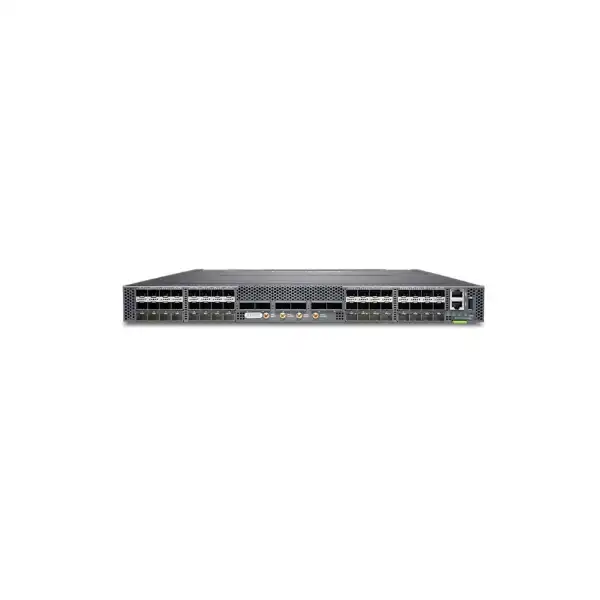
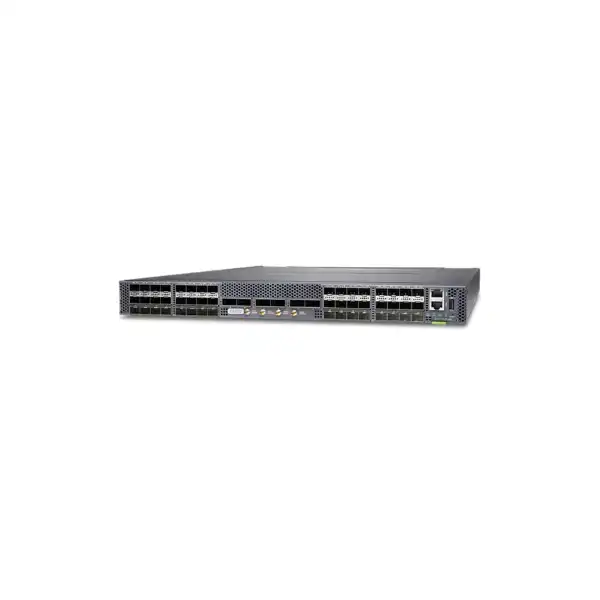
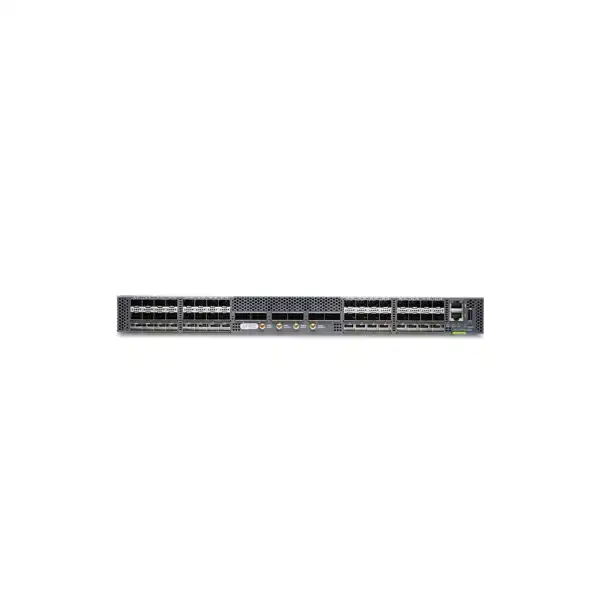
A dense fixed-form-factor router for metro aggregation, high-capacity enterprise edge, wholesale transport and data-center interconnect designs that need a practical mix of native 10/25/50GbE access-facing interfaces and 400GbE uplinks. The ACX7100-48L combines a 1U chassis, 4.8 Tbps forwarding capacity, Junos OS Evolved, high-precision timing capabilities and a flexible choice of AC or DC power and airflow direction.
Direct answer: what is the Juniper ACX7100-48L?
The Juniper ACX7100-48L is a fixed-configuration, high-performance Cloud Metro router in the ACX7000 family. It is primarily used where operators need dense multiservice Ethernet aggregation with a broad speed transition from 10GbE, 25GbE and 50GbE at the edge toward 100GbE breakout or native 400GbE in the aggregation and core-facing direction. Its 1U form factor and 4.8 Tbps forwarding capacity make it particularly relevant to service providers, wholesale networks, data centers, edge-computing locations and large enterprises consolidating multiple high-speed services.
The strongest fit is not defined by throughput alone. Buyers should focus first on port mix, optics and breakout design, airflow direction, AC versus DC power, software feature entitlement, timing requirements and the intended migration path. The ACX7100-48L is attractive when many native 10/25/50GbE interfaces are required in one rack unit, but a different ACX platform may be more appropriate if the design is dominated by native 100GbE ports, needs modular slot expansion or calls for an environmentally hardened form factor.
FourTeck can help translate the logical network requirement into the exact chassis variant, compatible transceivers and cables, licensing scope, support term, rack and power prerequisites, implementation plan and commercial bill of materials for deployment in Dubai or elsewhere in the UAE.
Where the ACX7100-48L fits in a modern network
The ACX7100-48L is built for networks that are moving beyond simple access aggregation and need a platform capable of supporting multiple service types at high density. In many metro designs, the practical challenge is not merely carrying more traffic; it is carrying different classes of traffic, at different interface speeds, while preserving operational consistency and a path to future capacity. The 48L addresses that problem with a dense bank of SFP56 ports for lower-speed aggregation and six high-speed QSFP56-DD interfaces that can be used for 400GbE and supported breakout configurations.
That makes the platform relevant at locations where dozens of 10GbE, 25GbE or 50GbE links arrive from access systems, enterprise services, mobile infrastructure, data-center racks or edge-compute clusters and need to be consolidated into higher-capacity uplinks. Rather than deploying separate devices for low-speed fan-in and high-speed transport, a design can use one platform to reduce the number of boxes, simplify cabling and maintain a common Junos operational model. The exact benefit depends on the service topology, resiliency design and supported optics selected for the project.
For service providers, this can translate into a compact metro aggregation point capable of participating in IP/MPLS and segment-routing architectures while supporting Ethernet service requirements. For wholesale operators, the same density is useful when multiple customer or partner handoffs need to be aggregated without consuming a large amount of rack space. In a data-center or edge-compute design, the bidirectional airflow options and 400GbE capability can make the router useful where high-speed east-west or north-south connectivity intersects with provider-grade routing requirements.
Large enterprises should evaluate the ACX7100-48L when they operate a carrier-like WAN, private metro network, large campus aggregation environment or data-center interconnect architecture. It is not a typical branch router and is not intended to replace a small enterprise WAN appliance. Its value appears when the business has genuine high-capacity interface density, sophisticated routing or timing requirements, or a strong reason to standardize on the Juniper ACX and Junos OS Evolved ecosystem.
Dense metro aggregation
Forty-eight native 10/25/50GbE SFP56 interfaces allow the platform to aggregate many lower-speed services without relying on a chassis full of separate line cards. This is particularly useful when access links are not all moving to 100GbE at the same time.
High-speed uplink growth
Six 400GbE QSFP56-DD ports provide a high-capacity path toward core, spine, interconnect or transport-facing connections. Supported breakout modes can also create intermediate interface speeds when the design requires them.
Operational continuity
Junos OS Evolved provides a consistent software environment across the ACX7000 family. For teams already operating Juniper routing platforms, that continuity can reduce retraining and make automation, configuration management and troubleshooting easier to standardize.
Port architecture: the main reason to choose the 48L
The defining characteristic of the ACX7100-48L is its interface distribution. It provides 48 SFP56 ports supporting native 10GbE, 25GbE and 50GbE service rates on a port-by-port basis, together with six QSFP56-DD ports for 400GbE. One of the 48 lower-speed ports has a documented restriction to 10GbE/25GbE operation, so a detailed port map should be created when a design intends to use the maximum possible 50GbE count. The important purchasing implication is that the hardware should be sized from the real interface schedule rather than from a headline port total.
The six high-speed ports can support breakout modes, including combinations that expose 100GbE or other lower rates, subject to the supported port configuration and optics or cable type. This gives network designers a useful migration bridge. A site may initially need a mixture of 100GbE uplinks and 400GbE trunks, then move more of those links to 400GbE as traffic grows. Breakout should nevertheless be treated as an engineering decision, because it affects the number of physical connectors, lane mapping, cable type, transceiver selection, remote-end compatibility and operational documentation.
The platform is therefore especially compelling where the network has a wide speed gradient. A metro node may have multiple 10GbE enterprise handoffs, 25GbE or 50GbE access connections, several 100GbE transport links and one or more 400GbE core uplinks. A device that can absorb those requirements in one rack unit can simplify physical design. By contrast, if nearly every customer or downstream system already presents native 100GbE interfaces and only a small number of lower-speed ports are needed, the ACX7100-32C or another platform may deserve comparison because its native port distribution is different.
A quotation should therefore include an agreed port matrix: quantity of 10GbE, 25GbE, 50GbE, 100GbE and 400GbE connections; fibre type and reach for each circuit; whether DAC or AOC is acceptable; whether breakout is required; and whether spare capacity must be reserved for growth. That exercise prevents the common problem of buying enough aggregate bandwidth but the wrong physical interface mix.
Core hardware specifications for procurement
| Specification | ACX7100-48L detail |
|---|---|
| Form factor | Fixed 1U chassis, approximately 59.49 cm deep. |
| Forwarding capacity | Up to 4.8 Tbps. |
| Native lower-speed interfaces | 48 x SFP56 supporting 10GbE/25GbE/50GbE, with one port limited to 10GbE/25GbE. |
| High-speed interfaces | 6 x 400GbE QSFP56-DD with supported breakout options. |
| Dimensions | 17.36 x 1.75 x 23.42 in. / 44.09 x 4.45 x 59.49 cm (W x H x D). |
| Fully configured weight | Approximately 26.9 lb / 12.2 kg. |
| Power options | AC 115/240 V or DC -48 V to -60 V, depending on ordered chassis variant. |
| Power draw without optics | Typical 270 W and maximum 620 W under Juniper’s published measurement conditions; actual consumption varies by traffic, environment and optics. |
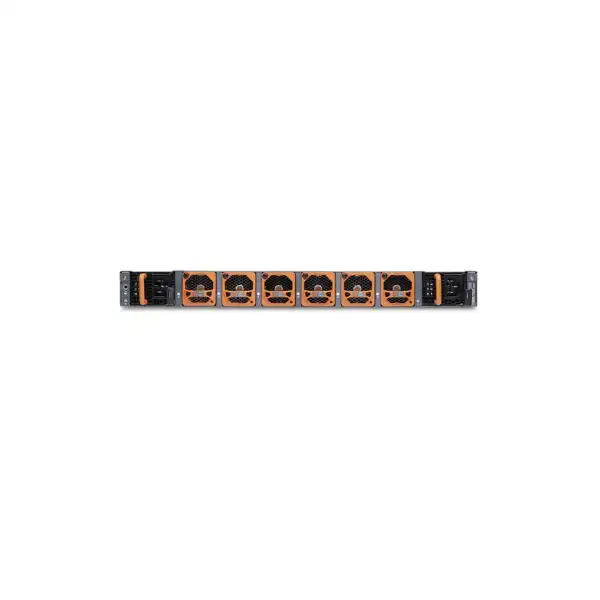
| Cooling | Six field-replaceable fan modules; airflow-in and airflow-out chassis variants are available. |
| Operating environment | 0°C to 40°C normal operating range, with documented short-term operation up to 55°C; 5% to 90% noncondensing humidity. |
| System software | Junos OS Evolved. |
Published chassis numbers are useful for rack, power and thermal planning, but they should not be treated as a complete installation design. Optics can materially affect heat load and total power, and local rack geometry, cable-management depth, PDU outlet orientation and cold-aisle/hot-aisle direction can determine which chassis option is practical. For a Dubai data center or telecom room, the most reliable approach is to validate these details against the intended rack and site standard before the purchase order is released.
Junos OS Evolved and multiservice routing capabilities
The ACX7100 family is powered by Junos OS Evolved, Juniper’s modernized network operating system for platforms designed around current cloud and service-provider requirements. For a buyer, the value of this operating environment is not just the command-line interface. It is the ability to integrate the router into a broader operational model that includes configuration automation, telemetry, service assurance and policy-driven routing. Organizations already running Juniper infrastructure can often reuse established standards for routing policy, change control, observability and software lifecycle management.
Juniper positions the ACX7000 family with support for advanced technologies including MPLS, segment routing, SRv6, EVPN-VXLAN, telemetry and programmable service architectures. The exact feature set available to a specific deployment depends on software release, entitlement and platform-specific exceptions, so a design should map required protocols to the planned Junos OS Evolved release rather than assuming every family capability is automatically active in every configuration. This is especially important for networks using specialized service-provider functions, advanced scale targets or features that have been introduced in newer software trains.
In a metro aggregation role, MPLS and segment routing capabilities can help the router participate in a converged underlay carrying multiple service types. EVPN-based designs can be relevant where operators are modernizing Ethernet services, data-center interconnect or cloud-oriented transport. Telemetry and automation become increasingly important as interface density grows, because a manually operated aggregation layer becomes difficult to maintain consistently across many sites. The ACX7100-48L should therefore be considered not only as a piece of forwarding hardware but also as part of the network operating system, automation and assurance architecture.
For enterprise buyers, this means the technical evaluation should involve both the network engineering team and the operational team. Engineers may focus on interfaces, routing protocols and resiliency, while operations teams need to understand onboarding, monitoring, alarm handling, software upgrade workflows, configuration backups, role-based access and integration with existing toolchains. If the organization has standardized on a different management platform, the integration effort should be reviewed before the router is selected.
For service providers, the same principle applies at larger scale. A platform that fits the physical topology but cannot be integrated cleanly into provisioning, assurance and lifecycle workflows can create long-term operating cost. The strongest ACX7100-48L deployments therefore align hardware, software, licensing and operational processes from the beginning.
Segment routing and MPLS
Useful for provider and large-scale private networks that need deterministic forwarding, service separation and scalable traffic-engineering models. Feature and scale validation should be tied to the selected software release and intended control-plane architecture.
EVPN-VXLAN
Relevant to modern Ethernet service and data-center-oriented designs where operators want a control-plane-driven model. The benefit is highest when the rest of the network and operational stack are built to use EVPN rather than treating it as an isolated feature.
Automation and telemetry
High-density metro networks benefit from streaming visibility and repeatable configuration. Buyers should define how telemetry is collected, which events trigger operational action and how changes are validated across the network.
Precision timing, mobile transport and latency-sensitive services
Timing is an important reason the ACX7100 family is considered for mobile and converged metro networks. Juniper documents support for Synchronous Ethernet, Precision Time Protocol and advanced timing functions, with synchronization interfaces including time-of-day and pulse inputs and outputs. These capabilities matter where frequency and phase synchronization must be distributed through the packet network, such as parts of 4G/5G transport or other systems that depend on precise network timing.
The presence of timing features does not eliminate the need for a timing architecture. A mobile transport design should identify the upstream time source, required clock class, holdover expectations, boundary-clock or transparent-clock roles where applicable, failure behavior and the exact interfaces used for timing distribution. If an external GNSS receiver is part of the solution, physical placement, antenna path, grounding and resilience must also be considered. Timing performance is a system property, not something that can be guaranteed by selecting the router alone.
Deep buffering is another platform characteristic Juniper highlights for service-delivery assurance. In practical terms, buffering can help absorb bursts and speed transitions, but it should not be used as a substitute for correct capacity planning or quality-of-service design. Traffic models, oversubscription ratios, latency budgets and queue behavior remain important. For low-latency services, the objective is to create a predictable network in which congestion is controlled rather than merely buffered.
A buyer evaluating the ACX7100-48L for mobile backhaul, fronthaul-adjacent aggregation or other timing-sensitive applications should include synchronization and QoS requirements in the design review. FourTeck can use those inputs to ensure the proposed hardware, optics, software and implementation scope match the operational requirement rather than treating timing as an unchecked datasheet item.
Security: platform trust, encryption and operational controls
High-capacity aggregation equipment is part of the trust boundary of a network, so security should be addressed at both the hardware and software layers. Juniper identifies secure boot, device identity and tamper-resistant design elements across the ACX7000 family, together with MACsec capabilities under appropriate licensing and platform conditions. These mechanisms can contribute to a zero-trust network design by improving device authenticity and protecting selected Ethernet links from interception or modification.
MACsec is most useful when the threat model requires link-layer encryption across a physical Ethernet segment, such as a data-center interconnect, provider handoff or metro link that must be cryptographically protected. It is not automatically equivalent to an end-to-end VPN, and the remote endpoint must support a compatible MACsec configuration. Buyers should therefore define which interfaces require encryption, the required data rates and whether both endpoints can support the intended cipher and key-management model. The relevant software entitlement should be included in the quotation rather than assumed to be part of the base chassis.
Operational hardening remains equally important. Management-plane access should be restricted, authenticated and logged. Administrative roles should be aligned to least-privilege principles, unused services should be disabled, management traffic should be separated where practical, and configuration changes should be auditable. Software images and upgrade procedures should be controlled through a formal lifecycle process. A high-performance router can still become an operational risk if credentials, management access or change controls are weak.
For regulated enterprises and service providers in the UAE, the security review may also need to consider internal governance, customer contractual requirements and sector-specific controls. The ACX7100-48L can be part of that architecture, but compliance is determined by the full deployment, configuration and operational process rather than by the product name alone.
Automation, assurance and day-two operations
Juniper positions the ACX7000 family as automation-ready, with integration into Juniper routing management and assurance capabilities and with active-assurance functionality embedded in the platform family. The practical value is that network teams can move from a device-by-device operating model toward repeatable onboarding, monitoring and validation. This becomes increasingly valuable when dozens or hundreds of metro nodes must be kept consistent through software upgrades, service changes and capacity expansion.
Before deployment, the operations team should decide how the router will be onboarded, where configuration truth will live, how backups are maintained, which telemetry streams are consumed, how alarms are normalized and what constitutes a successful service test. If an existing automation framework is already in place, the ACX7100-48L should be integrated into that system rather than creating a parallel workflow. If the organization is beginning an automation journey, the deployment can be used to establish standardized templates for interface naming, routing policy, QoS, security and monitoring.
Service assurance deserves special attention in metro environments because a link can remain technically up while customer experience is degraded by loss, latency, jitter or misconfiguration. Active testing and telemetry can help detect those conditions, but useful assurance requires defined baselines and ownership. A monitoring platform that generates large numbers of alerts without clear response procedures can create noise rather than resilience. Buyers should therefore include monitoring design and operational handover as part of the implementation project.
Software lifecycle planning is also a day-two issue. The chosen Junos OS Evolved release should be evaluated for feature support, interoperability, maintenance policy and the organization’s upgrade cadence. In a resilient pair or ring, the upgrade sequence should be designed to preserve service. Lab or pre-production validation is advisable where the router carries critical provider or enterprise traffic, particularly if new protocol features, optics or interoperability changes are being introduced.
The result should be an operating model in which the ACX7100-48L is not just installed but continuously observable, recoverable and maintainable. That is where the investment in a carrier-class platform produces long-term value.
Airflow, cooling and rack planning in Dubai
The ACX7100-48L is available in airflow-in and airflow-out variants, and this choice should be made before ordering. Juniper’s hardware guidance requires the fan modules and power-supply modules in a chassis to use matching airflow directions. Mixing airflow directions can impair cooling and trigger alarms. This is more than a part-number detail: the selected airflow must align with the site’s cold-aisle and hot-aisle design, rack orientation and the direction in which cabling and field-replaceable units are accessed.
In a professionally managed data center, the correct direction is usually determined by the rack standard. In a smaller telecom or enterprise room, the environmental review should be more explicit because front and rear temperatures can vary, cable bundles can obstruct intake paths and room air conditioning may not produce the same controlled airflow as a large facility. Dubai’s external climate does not mean the router is expected to operate at outdoor ambient conditions; it should be installed in a properly conditioned environment within its published operating limits.
The chassis is approximately 59.49 cm deep, so rack depth and rear clearance should be confirmed. Space is also needed for fibre bend radius, cable-management hardware, power cords and removal of fan or power modules. A 1U device can still create a difficult installation if the rack is shallow or if dense fibre cabling blocks rear service access. For sites using high-power coherent optics, thermal planning should consider the additional power and heat generated by the transceivers.
A useful pre-installation checklist therefore includes rack type, usable depth, front and rear clearance, cold-aisle direction, power feed, grounding, PDU receptacles, cable-management route, nearby heat sources and expected optics population. These details are inexpensive to validate before purchase and costly to correct during a production migration.
Power design: AC, DC, redundancy and real consumption
Juniper offers the ACX7100-48L in AC and DC chassis variants. The AC models are suited to sites with conventional data-center power, while the DC models support telecom-style -48 V to -60 V feeds. The decision should follow the facility standard rather than preference. Power conversion, breaker design, cabling, receptacles and maintenance procedures differ between AC and DC installations, and mixing AC and DC power-supply modules in the same chassis is not supported.
The platform uses redundant field-replaceable power modules. Redundancy is valuable only when the two supplies are connected to appropriately independent power sources. Connecting both modules to the same single PDU or branch circuit may provide protection against a power-supply failure but not against upstream power loss. For critical deployments, the design should identify the A and B feeds, breaker capacity and expected failover condition.
Juniper publishes a typical power figure of approximately 270 W without optics under stated test conditions and a maximum chassis figure of 620 W without optics. These numbers should be used as planning references, not a guaranteed site measurement. Optics, traffic profile, ambient temperature and component variation affect actual consumption. High-power coherent modules can add meaningful load, so dense 400GbE or ZR/ZR+ deployments should be calculated from the chosen transceiver inventory.
For quotation and rack planning, FourTeck can help create a practical power budget that separates chassis consumption from optical-module consumption and identifies the required AC or DC feed, airflow version and spare power components. This makes the bill of materials more reliable and gives facilities teams the information they need before installation day.
Optics, DAC, AOC and breakout selection
Optics are one of the most important dependencies in an ACX7100-48L order. The chassis port count does not tell you which transceivers are required, because the correct module depends on interface speed, fibre type, distance, connector style, optical budget and the capabilities of the device at the far end. Juniper supports a range of transceiver, direct-attach copper, active optical cable and breakout options, but compatibility should always be checked against the current hardware compatibility information for the exact router and software release.
For 10GbE, 25GbE and 50GbE ports, the design may use short-reach or long-reach optical modules depending on the physical network. Inside a data center, DAC or AOC can be attractive for short runs because they reduce the number of separate optical modules and fibre patch components. Across campus, metro or provider fibre, optical transceivers are usually required. The fibre plant must match the selected wavelength, reach and connector arrangement, and any patch panel or cross-connect loss should be included in the link budget.
At 400GbE, module choice becomes even more consequential. Short-reach data-center links, longer campus or metro links and coherent transport applications can use very different optics with different power consumption, fibre requirements and cost. Juniper highlights an efficient thermal design that supports high-power ZR/ZR+ optics on supporting ports, but a project still needs to confirm the exact supported transceiver and the remote-end optical specification. Coherent optics should not be ordered simply because the router can physically accept a high-power module.
Breakout changes the physical design. Converting one high-speed port into multiple lower-speed interfaces can be economical and flexible, but it requires the correct breakout cable or optical approach and the remote endpoints must map to the resulting lanes. Documentation should clearly identify the parent port, child interfaces, cable labeling and service assignment so later troubleshooting does not become confusing.
Spare optics also deserve planning. A service-provider environment may keep spares for common module types, while a high-cost coherent optic may be held centrally rather than at every site. The right spare policy depends on failure impact, replacement logistics and support coverage. Buyers should distinguish between chassis support and the operational strategy for optics, because a replacement router does not restore a failed fibre module if no compatible spare is available.
For a clean quotation, provide a per-link schedule showing speed, distance, single-mode or multimode fibre, connector, remote device, required breakout and whether third-party optics are permitted by policy. From that schedule, a precise optical bill of materials can be created.
Software licensing and support are part of the design
The ACX7100-48L should not be quoted as hardware only unless the buyer has already established the required software entitlement and support model. Juniper publishes capacity-based software options for the ACX platform, including advanced and premium subscription or perpetual arrangements at defined capacity levels, as well as separate options associated with MACsec and data-center use cases. Product packaging can change over time, so the exact commercial configuration should be validated at the time of quotation.
Licensing should be driven by the features and capacity the network will actually use. A routing design that requires a particular advanced function may need a different entitlement from a basic aggregation deployment. Likewise, enabling encrypted high-speed links may introduce licensing requirements that are not present in an unencrypted design. Buyers should prepare a feature list before ordering rather than choosing a license tier solely by product name.
Support is a separate operational decision. Subscription licenses may include software support according to the selected offering, while perpetual arrangements can require separately purchased support. Hardware support levels should be matched to service criticality and the organization’s ability to keep local spares. A metro aggregation node carrying many customer circuits may justify a more aggressive replacement target than a lab or secondary site.
The software term also affects lifecycle budgeting. A one-year term may reduce initial commitment but create annual renewal administration, while a multi-year term can align costs with a project or service contract. Perpetual options may suit organizations with a different capital model, but ongoing support still needs consideration. There is no universally correct choice; the best option depends on the procurement policy, expected platform life, feature set and operating model.
FourTeck can structure the commercial discussion around required forwarding capacity, software features, encryption, management and support duration so the quotation reflects the complete operational requirement. This prevents a common enterprise-network problem in which the chassis arrives on time but a required feature or support entitlement is missing from the order.
Designing for resiliency and high availability
The ACX7100-48L has redundant field-replaceable fans and power supplies, but network-level high availability requires more than redundant components inside one chassis. If the node is critical, designers should consider whether a single router remains a failure domain for forwarding, control plane, cabling or maintenance. In many provider and large-enterprise networks, resilient service is achieved with two routers, diverse uplinks and a routing design that can carry traffic when one node or path is unavailable.
The physical topology should separate shared risks where practical. Two routers mounted in the same rack and powered from the same branch circuit are not equivalent to diverse infrastructure. Uplinks that share the same fibre route can fail together even if they terminate on different interfaces. The appropriate level of diversity depends on business impact and cost, but it should be explicitly chosen rather than assumed.
Protocol convergence should also be tested against the service objective. Segment routing, MPLS, EVPN and conventional IP routing can all be built resiliently, but convergence behavior depends on topology, timers, fast-reroute mechanisms, traffic-engineering policy and adjacent equipment. A design that looks redundant on a diagram can still experience an unacceptable interruption if failover has not been validated under realistic traffic.
Maintenance is another reason to deploy redundancy. Software upgrades, optics replacement and physical work are safer when traffic can be drained or rerouted away from one node. The operational plan should define how maintenance mode is entered, how traffic is verified on alternate paths, how rollback is performed and how monitoring confirms restoration after the work.
For buyers, the practical question is not whether the ACX7100-48L itself is reliable; it is what availability target the service needs and how many independent components and paths are required to achieve it. The answer may be a single router for a noncritical edge location, a resilient pair for an aggregation hub or a wider ring or fabric architecture for provider-grade availability.
Migration planning from 10/25/50GbE toward 100/400GbE
One of the strongest reasons to evaluate the ACX7100-48L is its ability to sit between current lower-speed services and a higher-speed future. Many networks do not upgrade every link at once. Enterprise handoffs may remain at 10GbE for years, access systems may move through 25GbE or 50GbE, and core links may already be shifting toward 400GbE. A router with both dense SFP56 connectivity and high-speed QSFP56-DD ports can support that uneven transition.
A migration plan should start with the existing circuit inventory. Record each interface speed, VLAN or service role, routing adjacency, optics type, fibre path and downstream dependency. Then define the target port assignment on the ACX7100-48L. This exposes any mismatch early, such as a requirement for more native 100GbE connections than the breakout design comfortably supports or a need for 1GbE interfaces that does not match the platform’s intended port profile.
The cutover sequence should protect service continuity. Where a parallel build is possible, the new router can be installed, powered, upgraded to the approved software release, configured, monitored and tested before production links move. Individual circuits can then be migrated in controlled groups, with pre-defined rollback steps. For sites with limited rack or fibre capacity, a more tightly coordinated cutover may be necessary and should include a detailed method of procedure.
Routing changes need the same discipline as physical cabling. A circuit that is physically active may still fail to pass production traffic because of policy, MTU, QoS, VLAN, MPLS label or security differences. Validation should include control-plane adjacency, forwarding tests, expected route preference, service MTU, traffic counters, latency or loss measurements where relevant and monitoring-system visibility.
When migrating from another vendor or from an older Juniper platform, configuration should be translated by intent rather than copied mechanically. Interface names, default behavior, feature syntax and scale assumptions can differ. The target design is an opportunity to remove legacy configuration, standardize policy and document the network more clearly.
A good migration ends with updated diagrams, port maps, optics inventory, support information and a tested recovery procedure. That documentation becomes essential when the router later expands from 100GbE breakout links to native 400GbE or when additional 25/50GbE services are added.
Practical use cases for the ACX7100-48L
Service-provider metro aggregation
A provider can aggregate a large number of 10/25/50GbE access or customer-facing links and connect upstream at 100GbE or 400GbE. The fixed 1U footprint helps where rack space is constrained, while MPLS, segment-routing and timing capabilities fit modern metro architectures. The key design questions are oversubscription, resiliency, software entitlement and optical reach.
Wholesale and carrier Ethernet
Wholesale networks frequently need many service handoffs with consistent operational behavior. The 48L can provide dense port distribution while participating in a routed or MPLS underlay. Buyers should define the service model, demarcation responsibility, protection mechanism, QoS treatment and required telemetry before deciding the final configuration.
Large-enterprise metro WAN
An enterprise operating multiple campuses, data centers or industrial sites over private or leased metro fibre may use the platform as a high-capacity aggregation router. It makes sense when the network has carrier-scale interface density or routing requirements; smaller WAN environments should compare more compact and lower-capacity alternatives.
Data-center edge and interconnect
The combination of 400GbE capability, flexible lower-speed aggregation and airflow direction options can suit data-center edge or interconnect roles where provider-grade routing is required. Designers should compare the ACX feature set with dedicated data-center switching platforms when the primary requirement is leaf-spine switching rather than metro routing and services.
Mobile and converged edge transport
Precision timing, deep buffering and high-capacity aggregation make the family relevant to mobile transport and other latency-sensitive networks. The platform must still be engineered within a full synchronization and QoS architecture, including clock source, traffic classes, failure behavior and link protection.
When the ACX7100-48L may not be the best fit
A balanced product evaluation should identify situations where another model is more appropriate. The ACX7100-48L is optimized around a dense 10/25/50GbE fan-in plus 400GbE uplink profile. If a design requires a large number of native 100GbE interfaces with fewer lower-speed ports, the ACX7100-32C deserves comparison because its built-in interface distribution is oriented differently. Choosing the 48L and then relying heavily on breakout simply to recreate a native 100GbE-heavy design may be less elegant than starting with a platform whose ports already match the requirement.
A modular ACX platform should also be considered when future changes are likely to require line-card replacement, broader interface flexibility or chassis-level expansion beyond a fixed 1U configuration. Fixed systems are efficient and simple when the intended port mix is known, but a modular system can offer a different growth model. The tradeoff is usually greater rack space, different power characteristics and higher platform complexity.
At the other end of the scale, the ACX7100-48L can be excessive for a site with only a handful of 10GbE links and modest routing needs. Buying 4.8 Tbps of forwarding capacity does not create value if the network will never use the density or advanced functions. A smaller platform can reduce acquisition cost, power consumption and operational complexity.
The correct shortlist therefore starts with interfaces, traffic, resiliency, features, environment and expected growth. The product name should follow those requirements, not lead them.
ACX7100-48L versus ACX7100-32C: choosing the right port profile
| Decision point | ACX7100-48L | ACX7100-32C |
|---|---|---|
| Primary native port profile | 48 x 10/25/50GbE SFP56 | 32 x 40/100GbE |
| 400GbE ports | 6 | 4 |
| Forwarding capacity | 4.8 Tbps | 4.8 Tbps |
| Best starting point when… | The site aggregates many 10/25/50GbE links and needs several high-speed uplinks. | The site is dominated by native 40/100GbE connectivity. |
| Airflow consideration | Airflow-in and airflow-out variants available. | Published with front-to-back airflow design. |
Both models sit in the same ACX7100 line and share the 4.8 Tbps class, but they solve different port-density problems. A buyer should not treat the 48L as automatically superior because it has more individual interfaces or more 400GbE ports. The better model is the one that minimizes unnecessary breakout, matches the installed optical environment and leaves sensible growth headroom.
Procurement considerations for Dubai and UAE projects
Enterprise networking procurement is most reliable when the commercial bill of materials is generated from an agreed technical design. For the ACX7100-48L, the exact chassis suffix matters because it defines AC or DC power and airflow direction. An apparently minor mismatch can create a site problem even when the base model name is correct. The quote should therefore state the full hardware part number rather than simply “ACX7100-48L.”
Optics and cabling should be itemized separately. The buyer should know how many SFP56 and QSFP56-DD modules are included, which speeds and reaches they support, whether any breakout cable is required and whether spare modules are part of the commercial scope. If existing optics are intended for reuse, their exact part numbers and compatibility should be checked in advance. Reusing unsupported or wrong-reach optics can delay a migration even when the router is otherwise ready.
Licensing and support should appear clearly in the proposal, with term, feature level and service coverage identified. If the deployment relies on MACsec, advanced routing functions, management integrations or other licensed capability, the quote should connect each entitlement to the technical requirement. Support coverage should also distinguish hardware replacement, software support and any implementation or managed-service element provided by FourTeck.
UAE projects may involve delivery to a data center, telecom room, office, warehouse or project staging site. The logistics plan should confirm receiving requirements, rack availability, installation access, change-window constraints and any pre-staging activity. For multi-site rollouts, serial-number tracking and asset labeling can simplify later support.
Where pricing is requested, it is useful to specify whether the buyer needs hardware supply only, supply plus optics, configuration and staging, on-site installation, migration assistance, testing, documentation or ongoing support. These are materially different scopes. A low hardware-only price may not be the lowest project cost if the organization later needs emergency engineering services to complete deployment.
FourTeck can prepare an itemized quotation for the Dubai and UAE market after the interface schedule, power and airflow requirements, licensing need, support term and implementation scope are known. That information produces a quote that is easier for both engineering and procurement teams to approve.
Implementation journey: from requirement to production service
Frequently asked buyer questions
Is the ACX7100-48L a switch or a router?
It is a Cloud Metro router designed for high-performance multiservice routing and aggregation. It supports Ethernet interfaces and can participate in data-center-oriented technologies, but its positioning is broader than a conventional Layer 2 switch. Buyers should evaluate it according to the routing, service, timing and automation requirements of the network rather than selecting it solely for port density.
How much throughput does the ACX7100-48L provide?
Juniper publishes up to 4.8 Tbps of forwarding capacity for the ACX7100-48L. That figure describes the platform class; actual network design must still consider interface distribution, traffic direction, oversubscription policy, packet profile, software features and the capacity of adjacent devices. The goal is to size the complete path, not just one chassis.
How many 400GbE ports are available?
The ACX7100-48L includes six 400GbE QSFP56-DD ports. These ports also support documented breakout options. If the project plans to use several of them in breakout mode, create a detailed lane and cable map so the remaining native 400GbE capacity is clear.
Does it have native 100GbE ports?
The 48L’s primary low-speed bank is 48 x 10/25/50GbE SFP56, while 100GbE is obtained through supported breakout from the high-speed QSFP56-DD ports. If a deployment needs many native 100GbE interfaces, compare the ACX7100-32C or another platform whose built-in port profile is centered on 100GbE.
Can all 48 SFP56 ports run at 50GbE?
The published interface notes indicate that one of the 48 SFP56 ports supports 10GbE/25GbE only. Therefore, a design seeking the maximum possible 50GbE population should validate the exact port assignment. This is a good example of why the physical port map matters more than a headline count.
Which operating system does the router use?
The ACX7100-48L runs Junos OS Evolved. The software release should be selected according to required features, interoperability, maintenance policy and the organization’s tested deployment standard. Feature support should be validated against the intended release before a production change.
Can it be used for 5G transport?
The ACX7100 family is designed for Cloud Metro and 4G/5G-related use cases and includes advanced timing functions such as Synchronous Ethernet and PTP. Suitability for a specific mobile network depends on the complete timing, QoS, latency, resiliency and interface architecture. The router should be validated as one element of that system.
Does it support MACsec?
The ACX7000 family includes MACsec capabilities, and Juniper publishes separate MACsec software options. Encryption requirements should be mapped to exact interfaces, speed and remote-end compatibility, and the corresponding entitlement should be included in the commercial configuration. Do not assume every deployment enables encrypted links by default.
Can I use AC power in a data center?
Yes. AC variants are available, as are DC variants for telecom-style power environments. The power type must be selected with the correct airflow suffix and matched to the site’s PDU and redundancy design. AC and DC power-supply modules should not be mixed in the same chassis.
Why does airflow direction matter?
The ACX7100-48L is sold in airflow-in and airflow-out versions. The fans and power supplies must use matching airflow, and the chassis should be oriented according to the facility’s hot-aisle/cold-aisle design. Ordering the wrong direction can create a cooling conflict that is difficult to correct after installation.
Are optics included with the router?
Optics should be treated as separate bill-of-material items unless the commercial proposal explicitly includes them. The required module depends on speed, distance, fibre type and remote endpoint. A precise quote should list each transceiver, breakout cable, DAC or AOC by intended link rather than bundling an unspecified optics allowance.
Is the router suitable for coherent ZR or ZR+ optics?
Juniper states that the ACX7100 thermal design supports unrestricted use of high-power ZR/ZR+ transceivers across supporting ports. The exact optic must still be verified for compatibility, reach, optical design and remote-end requirements, and its power contribution should be included in the rack thermal budget.
What should I provide for an accurate FourTeck quotation?
Provide the required quantity, preferred AC or DC power, airflow direction if known, interface counts by speed, optical distances, fibre type, breakout requirements, routing and service features, encryption needs, support duration, delivery location and whether staging, installation or migration assistance is required. If some details are unknown, provide the network objective and current equipment list so they can be determined during design review.
Technical buyer guidance: questions to resolve before the purchase order
A technically correct router can still be the wrong purchase if the surrounding assumptions are incomplete. Before ordering the ACX7100-48L, confirm what will connect to every port, how much traffic each service is expected to carry, which routing or transport protocols are mandatory and what outage is acceptable during failure or maintenance. Those answers determine whether one chassis is sufficient, whether two are required and how the upstream and downstream network should be arranged.
Next, validate the physical layer. Identify the fibre plant, patch panels, distance and connector type for each optical link. Determine whether 100GbE is delivered by breakout, whether the remote device supports the corresponding lane configuration and whether 400GbE links are short-reach, long-reach or coherent. Confirm that the rack has enough depth and that the selected airflow matches the site. Verify the available power type and whether true A/B redundancy exists.
Then review the software requirement. List the protocols and services the router must support, the intended Junos OS Evolved release, any automation or assurance platform integration and any encryption requirement. Map that list to the necessary software entitlement and support plan. If the router will join an existing multivendor network, include interoperability testing for the critical control-plane and service functions.
Finally, define the implementation boundary. Decide who will rack the equipment, connect power, install optics, load software, apply configuration, migrate circuits, perform service tests and produce as-built documentation. A clear responsibility matrix reduces risk, especially for after-hours change windows. Buyers who need only supply can keep the scope simple, while organizations with limited in-house routing resources may prefer a complete deployment service.
These questions create a procurement package that engineering, facilities, security, operations and purchasing teams can all review. They also reduce quotation revisions because the exact chassis, optics, licenses and services are known before the order is placed.
Decision recap
What FourTeck needs for an accurate ACX7100-48L quotation
If the final port map or license tier is not yet known, FourTeck can work from the current topology, projected traffic and service requirements to identify the missing decisions before the commercial configuration is finalized.
Plan the Juniper ACX7100-48L deployment around your real network
The ACX7100-48L is a strong option when dense 10/25/50GbE aggregation, high-speed 400GbE connectivity and Juniper’s Cloud Metro operating model align with the project. The most reliable purchase is an engineered configuration that also gets power, airflow, optics, breakout, licensing, support and migration details right. Share your interface schedule or current topology with FourTeck for a Dubai/UAE quotation built around the actual deployment.

Reviews
There are no reviews yet.