
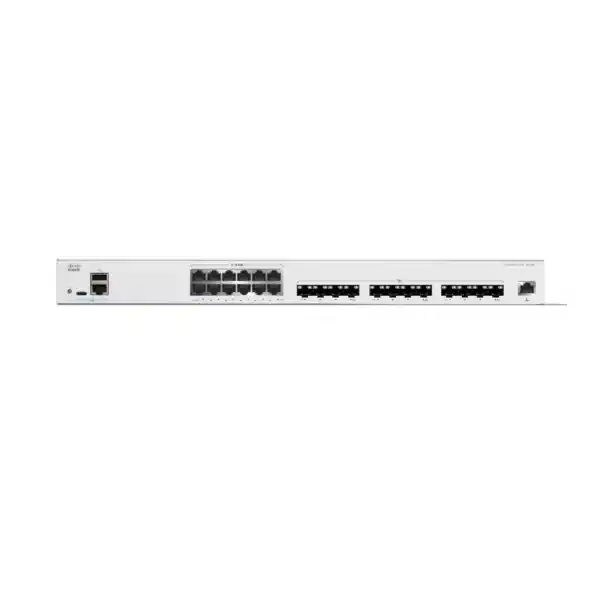
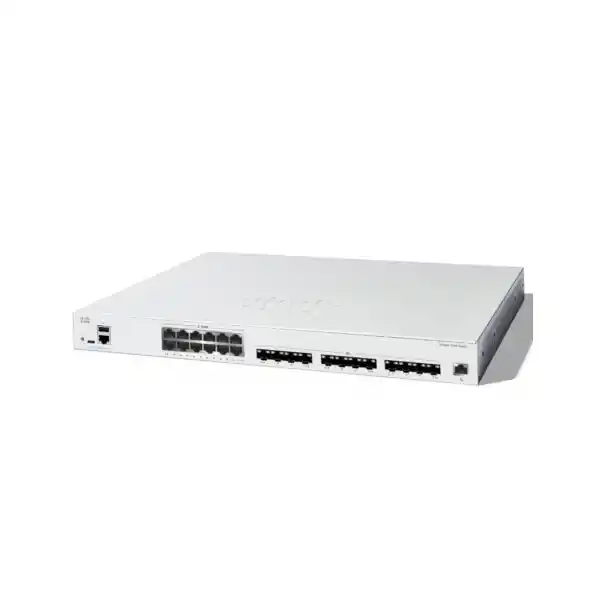
Cisco Catalyst C1300-24XTS Network Switch
The Cisco Catalyst C1300-24XTS is designed for networks that have moved beyond one-gigabit aggregation and now need a practical mix of copper and fiber at 10 Gigabit Ethernet speed. With twelve 10G copper interfaces, twelve 10G SFP+ interfaces and a dedicated Gigabit Ethernet out-of-band management interface, it can consolidate server links, storage connections, distribution uplinks, virtualization hosts, firewalls and high-bandwidth workgroups into a compact 1RU switching platform. For organizations in Dubai, Abu Dhabi, Sharjah and across the UAE, the model is particularly useful where existing Cat6A copper and fiber infrastructure must coexist without forcing every connected device into one media type.
Cisco specifies 480 Gbps switching capacity and 357.12 million packets per second forwarding for the C1300-24XTS, with wire-speed, nonblocking operation across the family. The platform adds Layer 2 segmentation, Layer 3 routing, access control, QoS, multicast controls, hardware stacking, resilient link aggregation and multiple management methods in a form factor aimed at enterprise branch and advanced SMB deployments.
Mixed-media 10G density
Twelve RJ-45 10 Gigabit Ethernet ports and twelve SFP+ 10 Gigabit Ethernet ports allow the switch to aggregate copper-connected servers and appliances while also serving fiber uplinks, inter-rack links and long-distance building links.
Layer 3 intelligence
The C1300 family supports wire-speed IPv4 and IPv6 routing, static and dynamic route functions, RIP v2, policy-based routing, DHCP server and relay services, plus extensive Layer 3 interface options for VLANs, ports and link aggregates.
Hardware stacking
Up to eight compatible switches can operate as a stack with a unified data, control and management plane. Cross-stack LAG, VLAN, QoS and monitoring capabilities simplify expansion compared with independently managed switches.
Business-class operations
Administrators can work through the browser interface, full CLI, SNMP, Cisco Business Dashboard, mobile management, secure SSH/HTTPS access and Cisco Network Plug and Play workflows for repeatable branch deployment.
Why the C1300-24XTS matters in a modern UAE network
Many small and mid-sized organizations no longer have a simple access-switch problem. Virtualized servers can easily push several gigabits of east-west traffic. Backup windows become shorter. NAS and iSCSI systems are expected to move large datasets without disrupting user applications. Firewalls increasingly expose 10GbE interfaces, Wi-Fi aggregation can exceed the capacity of a single one-gigabit uplink, and application teams expect low-latency access to local compute resources. The C1300-24XTS addresses this transition point by offering a full set of twenty-four 10G data interfaces rather than a conventional one-gigabit switch with only a small number of 10G uplinks.
The split between twelve copper and twelve SFP+ interfaces is particularly useful in existing UAE server rooms because migration rarely happens all at once. Some devices may already have SFP+ network interface cards and direct-attach copper cables. Others may expose 10GBASE-T ports because the server or appliance is designed around RJ-45. Building uplinks usually remain fiber because of distance, grounding and electromagnetic considerations. A mixed-port switch lets the network architect keep each connection on the most practical medium without adding separate copper and fiber aggregation switches merely to accommodate interface type.
For procurement teams, the most important distinction is that C1300-24XTS is a high-speed data switching model rather than a PoE access switch. It is best positioned around servers, storage, security appliances, aggregation links and 10G-capable endpoints. If the project also includes IP phones, cameras or wireless access points that require switch-delivered power, those endpoints should generally connect to appropriate PoE access switches, which can then uplink into the C1300-24XTS at 10 Gigabit Ethernet where bandwidth planning supports it.
Physical port map
- 12 × dedicated 10 Gigabit Ethernet copper interfaces for RJ-45 connectivity.
- 12 × dedicated 10 Gigabit Ethernet SFP+ interfaces for optical transceivers or supported direct-attach options.
- 1 × Gigabit Ethernet out-of-band management interface for an isolated management network.
- Cisco standard RJ-45 console interface and USB Type-C console/file-management capability in the platform family.
- Rack-mountable 1RU chassis for standard communications-room and data-rack installation.
Core hardware resources
- 480 Gbps switching capacity and 357.12 Mpps forwarding at 64-byte packet size.
- 8 MB aggregate packet buffer dynamically shared across ports on the C1300-24XTS.
- 1 GB SLC flash, 1 GB DDR4 DRAM and a 1.5 GHz dual-core ARM CPU listed for the C1300 family.
- Up to 32,000 MAC address entries for Catalyst 1300 10G models.
- Jumbo frame support up to 9,000 bytes, with a 2,000-byte default MTU noted in Cisco specifications.
10 Gigabit Ethernet architecture and traffic engineering
A switch with twenty-four 10G interfaces can theoretically present 240 Gbps of one-way edge bandwidth. Because Ethernet switching capacity is commonly represented as aggregate full-duplex throughput, a 480 Gbps switching fabric corresponds naturally to the ability to carry traffic simultaneously in both transmit and receive directions across the full 24-port 10G complement. Cisco describes the family as wire-speed and nonblocking, which is a critical characteristic when the switch is used for high-throughput aggregation rather than lightly loaded access ports.
Forwarding rate matters for workloads that create very large numbers of small packets. At 357.12 Mpps for 64-byte packets, the C1300-24XTS is engineered to keep packet-processing performance aligned with its interface density. In practical network design, this gives the architect freedom to place transactional applications, virtualized workloads, backup traffic and east-west server communication on the same physical platform while still applying policy through VLANs, ACLs, QoS and routing. Capacity planning should nevertheless consider traffic patterns rather than relying only on headline fabric numbers. A backup server capable of saturating 10GbE, for example, can create sustained load very different from an application server whose traffic arrives in short bursts.
The 8 MB shared packet buffer is relevant when multiple high-speed ingress streams converge on one egress interface. Buffering does not replace proper bandwidth design, but it can absorb short bursts and reduce packet loss when microbursts occur. Large sustained oversubscription still requires traffic engineering, aggregation, QoS or additional links. The best deployment therefore starts with an application map: identify hosts that routinely exceed one gigabit, note the direction of large flows, record where several servers converge on a firewall or storage device, and then allocate copper, SFP+ and LAG capacity accordingly.
Jumbo frame capability up to 9,000 bytes can be helpful in selected server, storage and virtualization networks because larger frames reduce per-packet overhead. Jumbo frames must be enabled consistently across the complete Layer 2 or routed path where they are intended to operate. Mixing MTU expectations can lead to dropped traffic, fragmentation where possible, or application behaviour that is difficult to diagnose. For UAE customers integrating NAS, SAN gateways, virtualization clusters or high-throughput backup systems, FourTeck recommends documenting the intended MTU on the quotation and implementation plan rather than enabling jumbo frames as a general optimization without end-to-end validation.
Copper and SFP+ design: choosing the right medium
The most visible architectural advantage of the C1300-24XTS is that it does not force the customer to choose between an all-copper or all-fiber 10G switch. Twelve RJ-45 ports are available for servers, firewalls, workstations or appliances with 10GBASE-T. Twelve SFP+ ports are available for optical fiber, supported DAC cabling and other compatible SFP+ connectivity. This arrangement can reduce the need for media converters and helps maintain a clean rack layout when different device classes expose different native interfaces.
Copper 10GbE is convenient when structured cabling is already available, especially for short to moderate distances inside a server room or office. However, 10GBASE-T should be engineered with cable category, channel length, patching quality and thermal density in mind. Cat6A is commonly selected for dependable 10GBASE-T structured cabling, while actual support over other cable types depends on channel conditions and standards compliance. When purchasing the switch, the copper port count should therefore be compared with the number of existing 10GBASE-T endpoints rather than simply assuming that every installed RJ-45 cable can be upgraded to 10GbE without a cabling survey.
SFP+ interfaces are more flexible for fiber distance and inter-rack connectivity. Cisco’s published compatibility tables include common 10G options such as SFP-10G-SR for multimode fiber and SFP-10G-LR for single-mode fiber, as well as short direct-attach copper assemblies. Transceiver selection should match the fiber type, connector plant, required reach and support policy. For building-to-building links in Dubai industrial sites, campuses, warehouses and hospitality properties, single-mode fiber may offer a cleaner long-term path. Inside a data rack, DAC can reduce cost and power for very short links when both endpoints support the same cable type.
A good bill of materials separates switch ports from optics. The quotation should identify how many SR, LR or DAC connections are required, which fiber patch cords are needed, whether existing optical distribution frames terminate LC connectors, and whether spare transceivers are required. This avoids a common procurement problem in which a high-performance switch arrives correctly specified but cannot be installed because the optical accessories were not mapped to actual link distances and fiber types.
Hardware stacking for growth and resiliency
Unified operation
Cisco supports front-panel hardware stacking for up to eight compatible switches. A stack operates with unified data, control and management planes, allowing the group to be configured and monitored as a single logical system rather than as a loose collection of individually administered devices. This reduces IP management overhead, simplifies port inventory and creates a clearer operational model as the number of interfaces grows.
Cross-stack services
The stack architecture supports functions such as cross-stack link aggregation, QoS, VLAN operations and port mirroring. Cross-stack LAG is especially useful when a critical server, firewall pair or downstream switch can split member links across separate stack members. A physical failure of one member then does not necessarily remove the entire logical uplink, provided the rest of the design is also redundant.
Family compatibility
Cisco groups stack compatibility by family, and cross-stacking between families is not supported. The C1300-24XTS belongs to the high-speed C1300 family group alongside the C1300-12XT-2X, C1300-12XS, C1300-16XTS, C1300-24XS and C1300-24XT. Procurement should therefore confirm the exact models intended for one stack before ordering expansion units.
Front-panel bandwidth planning
Stacking uses high-speed 10 Gigabit Ethernet front-panel interfaces, so those interfaces become part of the stack interconnect design instead of endpoint connectivity. The number of ports reserved for stack topology, whether a ring or chain is used, and the resulting bandwidth should be planned before assigning every 10G interface to servers or uplinks.
Stacking should be treated as an architecture decision, not merely a management convenience. In a two-switch server aggregation design, for example, separate uplinks can be distributed across members while the stack maintains a single control and management context. In a larger eight-unit deployment, port count becomes substantial and failure domains need more deliberate design. Power feeds, rack positions, uplink diversity and stack interconnect cabling should all be documented. Where a very high level of campus-core redundancy, modular supervisor architecture or advanced enterprise routing is required, a different Catalyst platform may be more appropriate; the C1300-24XTS is optimized for sophisticated branch and SMB environments where value, 10G density and manageable complexity are the priorities.
Layer 2 switching and segmentation
A high-speed switch is only useful if its segmentation features can control how traffic is grouped and forwarded. The Catalyst 1300 Series supports extensive VLAN functionality, including port-based and IEEE 802.1Q tag-based VLANs, management VLANs, MAC-based VLANs, protocol-based VLANs, IP subnet-based VLANs, private VLANs, guest VLANs and dynamic VLAN assignment through RADIUS in conjunction with 802.1X. Cisco specifies support for up to 4094 VLAN identifiers, with a subset reserved for internal use. This gives designers enough logical segmentation for multi-department offices, shared facilities, managed services, labs and multi-tenant environments without requiring separate physical switches for every traffic class.
Spanning Tree support includes traditional 802.1D, Rapid Spanning Tree through 802.1w, Multiple Spanning Tree through 802.1s, and Cisco PVST+/Rapid PVST+ functionality. Correct spanning-tree design remains important even when link aggregation is used. Redundant physical paths can protect availability, but unmanaged loops can take down an Ethernet domain quickly. Root placement, edge-port settings, BPDU Guard and Root Guard should be configured intentionally rather than left to accidental topology outcomes.
Link aggregation using IEEE 802.3ad LACP can combine multiple physical interfaces into a logical channel. Cisco specifies up to eight groups and up to eight ports per group, with additional candidate-port flexibility for dynamic aggregation. At 10GbE speed, even a two-member LAG can provide 20 Gbps of aggregate link capacity across multiple flows, though the bandwidth available to any single flow depends on the hashing method and traffic characteristics. LAG should therefore be used both for resiliency and aggregate throughput, not as a guarantee that one TCP session will automatically consume the total capacity of every member.
Multicast controls such as IGMP snooping, IGMP querier functions, multicast VLAN registration and related mechanisms are useful in surveillance, IPTV, digital signage and certain market-data or media-distribution environments. The 10G Catalyst 1300 models support large multicast group tables, helping prevent multicast traffic from flooding ports that have not requested it. For hospitality, education and media customers in the UAE, this allows high-bandwidth multicast services to coexist with ordinary data traffic more efficiently when VLAN and IGMP design are aligned.
Additional Layer 2 safeguards such as loopback detection, UDLD, DHCP Option 82 relay behaviour, private VLAN edge isolation and Q-in-Q capabilities extend the switch beyond basic office segmentation. Q-in-Q and VLAN translation can be relevant in managed building networks or service-provider style handoffs where customer VLANs must cross an intermediate Ethernet domain. These features should be configured only when the operational team has a clear tagging plan, because double-tagging and VLAN translation can complicate troubleshooting if diagrams and interface descriptions are incomplete.
Layer 3 routing capabilities
The C1300-24XTS is not limited to Layer 2 forwarding. Cisco positions the Catalyst 1300 as a managed Layer 3 switch and specifies wire-speed IPv4 and IPv6 routing. On the 10 Gigabit Ethernet C1300 models, Cisco lists support for up to 7,168 combined dynamic and static IPv4 routes and up to 256 IP interfaces. This scale is useful for branch networks that want local inter-VLAN routing, server-segment routing or routed handoffs without sending every internal packet to an external firewall or router.
Layer 3 interfaces can be created on physical ports, link aggregation groups, VLAN interfaces and loopback interfaces. That flexibility supports common patterns such as switched access VLANs with routed SVIs, point-to-point routed links to firewalls, routed port channels to other switches, and loopback addresses for stable management or routing identifiers. CIDR support allows summarization and efficient address planning, while static routes provide a predictable mechanism for smaller deployments where a full dynamic routing design is unnecessary.
RIP version 2 is supported for dynamic routing on the C1300 family, together with policy-based routing that can direct traffic to different next hops based on ACL classification. It is important to distinguish the C1300 from the C1300X in this area: Cisco lists OSPFv2 and OSPFv3 support for C1300X models only. Customers that specifically require OSPF as a routing protocol should therefore not assume that every Catalyst 1300-series SKU provides the same routing feature set. The routing protocol requirement must be validated against the chosen model before purchase.
The switch can also provide IPv4 DHCP server functions for multiple pools or scopes and can relay DHCP across Layer 3 domains. UDP relay can assist with selected broadcast-based services. These features can simplify small branch environments, but larger enterprises often keep DHCP and IP address management on centralized server infrastructure. The decision should be based on operational ownership: using the switch as a DHCP server can reduce hardware dependencies at a small site, while centralized DHCP may provide better visibility, auditing, failover and integration across many UAE locations.
In security-sensitive designs, inter-VLAN routing on the C1300-24XTS should not be confused with next-generation firewall inspection. The switch can route at wire speed and enforce ACL-based policy, but it does not replace advanced threat inspection, application control, sandboxing or other security services delivered by a dedicated firewall platform. A common architecture is to route low-risk internal VLANs directly on the switch where performance is important, while sending trust-boundary traffic, internet access, guest traffic and sensitive zones through a firewall. FourTeck can help map the routing boundary to the security policy so that performance and inspection requirements are balanced correctly.
Security controls for access, infrastructure and management
Identity and admission
IEEE 802.1X authentication can integrate switch ports with a RADIUS server, including guest and unauthenticated VLAN options, dynamic VLAN assignment, multiple host/session modes and MAC authentication. This supports a more controlled access model than simply trusting any device connected to a wall socket or rack patch panel.
Anti-spoofing protections
DHCP snooping, IP Source Guard and Dynamic ARP Inspection can work together to reduce rogue DHCP, source-IP spoofing and ARP manipulation risks. These features depend on correct trusted/untrusted port classification and should be rolled out with an accurate topology and DHCP binding strategy.
ACL policy
Cisco specifies up to 2,048 ACL rules on Catalyst 1300 10G models. Matching can use MAC addresses, VLAN IDs, IPv4/IPv6 attributes, protocols, TCP/UDP ports, DSCP, Ethernet type, ICMP, IGMP and other fields, with ingress and egress application and support for time-based ACL policy.
Secure administration
HTTPS, SSH, SCP, RADIUS and TACACS+ provide stronger administrative options than unsecured management. SNMPv3 adds authenticated and encrypted monitoring capability, while privilege levels and secure sensitive-data handling help separate operational roles and protect credentials.
Infrastructure protection also includes BPDU Guard, Root Guard, loop guard, port security, storm control, DoS prevention, private VLANs and Private VLAN Edge. Cisco Secure Core Technology is intended to maintain access to management and protocol traffic under heavy traffic conditions, while platform trust features include chip-guard and boot-integrity visibility. The practical value of these functions depends on configuration discipline. A secure switch should have an isolated management VLAN or out-of-band network, restricted administrative source addresses, centralized AAA where appropriate, SNMPv3 rather than community-string monitoring, encrypted management protocols, regular configuration backups and documented firmware maintenance. The dedicated GE management port on the C1300-24XTS makes a physically separate management path possible, which is valuable in server rooms where recovery access should remain independent of production VLAN state.
Quality of Service for voice, video, storage and critical applications
The C1300 platform provides eight hardware queues and supports strict-priority and weighted round-robin scheduling. Classification can use port, 802.1p class of service, IP precedence, Type of Service, DSCP, DiffServ and ACL-based matching. These tools allow the network engineer to distinguish latency-sensitive voice or real-time video from ordinary office traffic and from high-volume background transfers such as backups.
Rate limiting and shaping are available on ingress and egress, with controls that can operate by VLAN, port or traffic flow depending on the function. This can prevent a noncritical workload from overwhelming a constrained uplink. It can also be used in service-provider style or shared-building networks to enforce a predictable traffic envelope. QoS should not be configured as a collection of isolated markings. The correct workflow starts by identifying applications, deciding which devices are trusted to mark DSCP, defining queue behaviour, confirming uplink capacity and validating results during real traffic conditions.
Cisco also lists iSCSI traffic optimization in the feature set. In storage networks, deterministic performance depends on more than switch priority: host NIC configuration, multipathing, storage controller design, MTU, link aggregation, flow distribution and backup timing can all influence results. The C1300-24XTS provides the bandwidth and traffic-control tools to build a capable 10GbE storage fabric for many SMB and branch requirements, but a design review is advisable when the storage environment has strict latency, lossless-Ethernet or very high availability requirements.
Management options for local and multi-site operations
Cisco designed the Catalyst 1300 family for organizations that may not run the same operational stack as a large campus built around higher-end Catalyst platforms. The switch therefore offers multiple management paths. The built-in web interface supports browser-based configuration with simplified and advanced views, wizards, monitoring, maintenance functions and search. Engineers who prefer traditional operations can use a full CLI. SNMP versions 1, 2c and 3 are available for integration with monitoring platforms, and the device supports standard network operations such as syslog, ping, traceroute, configuration transfer and time synchronization.
Cisco Business Dashboard can manage Catalyst 1200 and 1300-series devices together with supported Cisco Business infrastructure. An embedded probe can reduce the need to install a separate probe appliance or virtual machine at a branch. For managed service providers and internal IT teams with multiple UAE offices, this can simplify device discovery, monitoring and lifecycle administration. Cisco Network Plug and Play provides a near-zero-touch provisioning workflow, which can help standardize rollout when new sites use a repeatable template.
The out-of-band Gigabit Ethernet management port is significant for mature operations. Production ports can be placed in routing, switching or aggregation roles while the management interface remains on a separate administrative network. In a fault scenario, this separation can improve access when production VLANs are unavailable or undergoing changes. For higher resilience, the management network itself should have protected reachability, controlled routing and appropriate authentication; simply using the OOB port does not automatically make management secure.
For projects that require deployment assistance, migration planning, structured rack work, monitoring integration or multi-vendor coordination, FourTeck’s UAE IT services team can align switching configuration with servers, firewalls, wireless infrastructure and WAN handoffs. Customers evaluating broader networking and infrastructure options can also review the FourTeck UAE portfolio for complementary solutions.
Deployment topology 1: 10G server and virtualization aggregation
A common C1300-24XTS deployment is a compact virtualization or application-server aggregation layer. Hypervisors with 10GBASE-T NICs can connect to the copper side, while storage, backup appliances and inter-switch links use SFP+. The exact mix depends on the installed hardware. VLAN trunks can carry separate management, virtual-machine, backup, storage and migration networks without requiring a dedicated physical switch for each traffic class.
When a hypervisor has two 10GbE NICs, links can be split across two stacked C1300-24XTS units where the host teaming method and switch configuration are compatible. This can preserve connectivity through a single-switch outage. The same concept can be applied to storage systems with redundant controllers, firewalls with aggregate interfaces or server clusters that require multiple network paths.
Bandwidth planning should separate peak from average use. VM migration can briefly consume most of a 10GbE link. Backup jobs may create long sustained flows. Storage replication can be bursty or continuous depending on the product. Interactive application traffic usually needs predictable latency rather than maximum bulk throughput. QoS, LAG and scheduled operations can keep these workloads from competing destructively.
If the server estate is still mostly one-gigabit, a 24-port all-10G switch may be premature as an access layer. In that case, the C1300-24XTS can still make sense as a distribution or aggregation switch, with one-gigabit or multigigabit access switches feeding it over 10G uplinks. This protects the high-speed interfaces for links that actually need them.
Deployment topology 2: firewall, internet edge and branch distribution
High-speed firewall adjacency
Modern firewalls frequently provide 10G SFP+ or 10GBASE-T interfaces. The C1300-24XTS can aggregate multiple internal VLANs and present one or more high-bandwidth links to the firewall. Policy design determines whether inter-VLAN traffic is switched locally or forced through the firewall for inspection.
Access-switch aggregation
PoE access switches serving phones, cameras and wireless access points can uplink at 10GbE into the C1300-24XTS. This keeps endpoint power delivery on the correct access model while using the C1300-24XTS as a high-capacity distribution layer for multiple floors, departments or tenant zones.
Resilient uplinks
Where the upstream firewall, router or core supports link aggregation, multiple 10G interfaces can be bundled for aggregate bandwidth and path resiliency. With a hardware stack, member links can be spread across different switches to reduce dependence on one chassis.
Security boundary awareness
ACLs on the switch can enforce infrastructure-level policy, but deep application inspection belongs on a firewall. FourTeck can coordinate the switching design with dedicated security appliances through the FourTeck global solutions portfolio when a broader multi-site architecture is being planned.
Deployment topology 3: storage, backup and high-speed file services
Backup and storage are among the clearest reasons to move from one-gigabit switching to 10GbE. A one-gigabit link can become the limiting factor even when disks, SSD arrays and servers can move data much faster. The C1300-24XTS provides enough 10G interfaces to dedicate high-speed links to NAS appliances, backup repositories, database servers and virtualization hosts while still reserving SFP+ interfaces for upstream connectivity.
For iSCSI or other IP storage, switch performance is only one component of the solution. NIC teaming or multipathing, storage-controller design, path symmetry, MTU, flow control expectations, VLAN isolation, queueing and host configuration all influence behaviour. Cisco includes iSCSI optimization and eight QoS queues in the platform feature set, but storage vendors may publish their own network requirements. Those requirements should take priority when they are more specific. Where the storage platform uses two controllers, each controller should have path diversity that survives a single cable, NIC or switch failure when the application requires it.
For customers purchasing servers alongside the switching layer, the FourTeck Server Dubai site provides a natural reference point for rack-server and infrastructure planning. Matching switch media to server NICs at quotation stage reduces last-minute adapter changes and helps ensure that optics, DACs, rails, patching and power planning are treated as one implementation rather than unrelated purchases.
Sizing the C1300-24XTS correctly
The most reliable sizing method starts with interface inventory. Count every device that needs 10GBASE-T, every device that needs SFP+, every uplink, every stack interconnect and every planned spare. Do not count only today’s servers. Include firewall interfaces, future storage nodes, redundant links, inter-building fiber, access-switch uplinks and test or migration ports. Because the C1300-24XTS has a fixed 12/12 copper-to-SFP+ split, media balance matters just as much as total port count.
Next, map redundancy. A server that uses two 10G links consumes two ports, not one. A downstream access switch with a two-member uplink consumes two ports. A firewall HA pair can require multiple inside, outside, DMZ or synchronization connections depending on the architecture. Stacking can improve resilience, but stack interconnects also use front-panel 10G interfaces. A project that looks like a twelve-port requirement on a simple device list can become a twenty-port requirement once redundancy is included.
Then estimate throughput by traffic domain. North-south internet traffic may be limited by firewall or WAN bandwidth. East-west server traffic may be much larger. Backup and storage traffic may run at full line rate for extended periods. Multicast video behaves differently again. The 480 Gbps switch fabric is substantial, but congestion usually occurs on specific egress links rather than across the fabric as a whole. Identify those convergence points and decide whether they need LAG, traffic shaping, QoS or a different topology.
Finally, leave operational headroom. A switch should not be quoted with every usable port allocated on day one unless expansion is impossible by design. Spare ports simplify maintenance, migration and fault isolation. A reasonable plan often leaves interfaces available for temporary parallel connections during cutover. If projected demand exceeds the fixed media mix or port count, evaluate a second compatible switch and stack design early rather than adding it reactively after the network is in production.
FourTeck can size the model from a port schedule, rack elevation, logical network diagram or simple list of connected devices. The more precise the input, the more accurate the optics, DAC, copper and redundancy bill of materials will be.
UAE environmental, rack and power considerations
Thermal range
Cisco specifies an operating range of -5°C to 50°C for the C1300-24XTS, with a 0°C minimum ambient temperature for cold start. This is not an invitation to run the switch in an uncontrolled hot room. UAE communications rooms should still be air-conditioned with sufficient airflow, clean filters and rack spacing that keeps exhaust paths clear.
Acoustics and fan
Cisco lists one fan for the C1300-24XTS and acoustic output below 39 dBA at 25°C. The unit is therefore more suitable for a communications room or rack than for a silent executive workspace. Dust loading and high ambient temperature can also affect cooling behaviour, so maintenance conditions matter.
Power input
The model uses an internal universal 100–240V AC, 50–60 Hz power supply according to Cisco specifications. UPS sizing should include the switch together with optics, adjacent network devices and the required runtime target. Where resilience is important, the wider rack power architecture should avoid a single unprotected PDU or breaker dependency.
Mechanical profile
The C1300-24XTS is approximately 444.3 × 273 × 43.94 mm and weighs about 4.2 kg. Its 1RU format fits standard racks, but front-to-rear cable management should be planned carefully because twenty-four 10G links plus management and console cabling can create a dense patching area.
Reliability, warranty and lifecycle planning
Cisco specifies a limited lifetime warranty with return-to-factory replacement for the Catalyst 1300/X family and complimentary one-year access to the Small Business Support Center. Warranty terms, entitlement, regional handling and replacement logistics should still be confirmed against the exact purchase channel and invoice at the time of order. Network availability depends not only on warranty but also on the architecture around the switch.
The C1300-24XTS supports dual software images, allowing administrators to maintain a fallback image while performing upgrades. Good lifecycle practice includes configuration backup before change, release-note review, maintenance-window planning, rollback criteria and post-upgrade validation. In a stacked environment, software compatibility across all members should be checked before introducing a new unit. A spare switch can also be justified in remote or business-critical sites where return-to-factory replacement time would exceed the allowable outage.
Cisco publishes an MTBF figure of 427,188 hours for the C1300-24XTS at 25°C. MTBF is a statistical reliability metric, not a guaranteed service life for one individual unit. Operating temperature, power quality, dust, fan condition, transceiver quality and handling all affect real deployments. For UAE installations, keeping the rack environment within recommended temperature and humidity, using conditioned UPS power, cleaning filters and monitoring environmental alarms can contribute more to practical uptime than relying on an MTBF number alone.
Migration from older 10G switching and Cisco Business 350
Cisco identifies the Catalyst C1300-24XTS as a migration product for corresponding CBS350-24XTS models in its end-of-sale documentation. That makes it a logical consideration for organizations replacing older Cisco Business 350 10G switching while retaining a familiar branch and SMB operational model. A migration should still be treated as a configuration project rather than a direct hardware swap, because syntax, feature behaviour, firmware defaults and management workflows can change between product generations.
Before cutover, export the existing configuration and separately document VLAN IDs, trunks, native VLANs, LAG membership, spanning-tree roles, ACLs, static routes, authentication settings, SNMP, syslog, NTP, management addressing and any multicast configuration. This produces a human-readable baseline rather than depending solely on importing a configuration file. It is also an opportunity to remove obsolete VLANs, unused trunks and historical exceptions that no longer serve the network.
Physical migration should identify which old interfaces are copper, which are SFP+, which optics are reusable and which links need new transceivers. Compatibility should be validated against Cisco’s current supported-module list. For critical links, avoid changing switch, transceiver, fiber path and endpoint configuration at the same moment unless the maintenance window allows detailed troubleshooting. Staged change reduces variables and makes rollback simpler.
After cutover, validate more than link lights. Test default-gateway reachability, inter-VLAN routing, LAG state, spanning-tree root and blocked ports, MAC learning, multicast membership, DHCP, authentication, ACL behaviour, management monitoring and application performance. If jumbo frames are used, test the effective MTU end to end. For stacked deployments, verify member roles, stack topology and failover behaviour before declaring the migration complete.
Operational checklist after installation
Baseline configuration
Set hostname, management addressing, secure administrator credentials, time zone, NTP, DNS where required, SSH/HTTPS, SNMPv3, syslog destination and configuration backup. Disable or restrict insecure management protocols unless there is a documented legacy requirement.
Interface hygiene
Add meaningful port descriptions, shut unused interfaces where policy requires it, document VLAN access/trunk mode, confirm LACP state and label physical patching. Interface descriptions should match rack and patch-panel records so technicians can diagnose incidents without guesswork.
Security validation
Confirm management access restrictions, AAA reachability, DHCP snooping trust boundaries, Dynamic ARP Inspection behaviour, port security and ACL hit patterns. Security features should be introduced in stages so a configuration error does not unexpectedly isolate production devices.
Monitoring baseline
Record normal CPU, interface utilization, errors, drops, temperature, fan state, LAG status and spanning-tree topology after commissioning. A baseline makes later troubleshooting much faster because the operations team can compare an incident against known-good behaviour.
Licensing and software expectations
The current Cisco Catalyst 1300 datasheet focuses on the integrated switching, routing, security and management feature set and does not present a model-specific application-license tier for the C1300-24XTS in the way some higher-end enterprise platforms are marketed. Because Cisco commercial programs, support entitlements and cloud-management offerings can evolve independently of hardware specifications, buyers should confirm the exact software entitlement, support package and any optional management subscriptions included with the quotation at the time of purchase.
This distinction matters in total-cost planning. The switch’s local web interface, CLI, SNMP and embedded management capabilities are part of the product feature set, but service contracts and centralized operational platforms may have their own commercial terms. Procurement teams should ask for a bill of materials that separates the switch hardware, optics or DACs, support, installation, configuration and any optional management services. That produces a cleaner comparison than evaluating only the switch chassis price.
For enterprise customers with formal lifecycle policy, FourTeck can also document the delivered software release, approved upgrade path and support entitlement as part of handover. This reduces uncertainty when the operations team later needs technical assistance, firmware updates or replacement handling.
Who should choose the C1300-24XTS?
The strongest fit is an organization that genuinely needs multiple 10GbE connections and benefits from an even mix of copper and SFP+. Examples include a branch with several virtualization hosts, a server room containing both 10GBASE-T appliances and SFP+ storage, a distribution layer aggregating multiple 10G access uplinks, a high-performance design studio with 10GbE workstations, or a hospitality and education environment carrying large amounts of internal video or server traffic.
It is also attractive for customers that want advanced Layer 2 and practical Layer 3 functions without moving directly to a larger campus-core platform. Hardware stacking, 32,000 MAC entries, large VLAN scale, ACLs, QoS and multiple management options give the model more depth than a simple unmanaged or smart switch. At the same time, the product remains focused on branch and SMB operational simplicity rather than the complete feature depth of Cisco’s higher-end enterprise campus systems.
The model is less appropriate when most endpoints need PoE, when only one or two 10G uplinks are required, or when the network depends on advanced routing protocols such as OSPF directly on this specific C1300 model. In those cases, another Catalyst 1300/1300X model or a different Catalyst family may provide a better balance of port type, PoE budget, routing capability and cost.
The decision should therefore begin with the network role. If the device is intended to be a 10G server, storage or distribution switch, the C1300-24XTS is compelling. If it is intended primarily to power phones, cameras and Wi-Fi access points, start with the PoE access-switch requirement and use 10G aggregation only where traffic demand justifies it.
Detailed technical specification summary
| Category | Cisco Catalyst C1300-24XTS |
|---|---|
| 10G copper interfaces | 12 × 10 Gigabit Ethernet copper |
| SFP+ interfaces | 12 × 10 Gigabit Ethernet SFP+ |
| Management | 1 × GE out-of-band management, web UI, CLI, SNMP, Cisco Business Dashboard, mobile app, PnP |
| Switching capacity | 480 Gbps |
| Forwarding rate | 357.12 Mpps at 64-byte packet size |
| Packet buffer | 8 MB aggregate, dynamically shared |
| MAC table | Up to 32,000 entries for 10G Catalyst 1300 models |
| Jumbo frames | Up to 9,000 bytes |
| CPU / memory | 1.5 GHz dual-core ARM CPU, 1 GB DDR4 DRAM, 1 GB SLC flash for C1300 platform |
| Stacking | Hardware stacking up to 8 compatible switches; ring and chain options; cross-stack LAG support |
| Layer 2 | 802.1Q VLANs, RSTP/MSTP, PVST+/RPVST+, LACP, private VLAN, Q-in-Q, IGMP snooping, VLAN translation and more |
| Layer 3 | IPv4/IPv6 routing, static routes, RIP v2, PBR, DHCP server/relay; OSPF is reserved for C1300X models |
| Security | 802.1X, RADIUS/TACACS+, DHCP snooping, DAI, IP Source Guard, ACLs, port security, storm control, secure management |
| QoS | 8 hardware queues, strict priority, WRR, DSCP/CoS classification, policing and shaping |
| Dimensions | 444.3 × 273 × 43.94 mm |
| Weight | Approximately 4.2 kg |
| Power input | Internal universal 100–240V AC, 50–60 Hz |
| Operating temperature | -5°C to 50°C; 0°C minimum ambient for cold start |
| Cooling / noise | 1 fan; less than 39 dBA at 25°C |
| Warranty | Limited lifetime, return-to-factory replacement per Cisco published family terms |
Cabling and transceiver planning guide
A correct switch order can still fail as an implementation if the media plan is incomplete. Begin with every SFP+ link and record the endpoint, distance, fiber type, connector, expected speed and whether the link remains inside one rack. Very short same-rack connections may be suitable for supported direct-attach copper. Multimode fiber links commonly use short-reach 10G optics where the fiber plant supports them. Longer building or campus links may require single-mode optics such as 10G LR. The transceiver at each end must be compatible with its local device, and both ends must use optical types that are designed to interoperate across the installed fiber.
For 10GBASE-T links, record cable category, installed distance, patch-panel path and whether the cable certification report is available. One-gigabit operation on a legacy cable does not automatically guarantee stable 10GbE operation. In dense racks, high-quality short patch leads and proper bend radius improve reliability and cable management. If the existing plant is uncertain, test the channel before commissioning servers that will depend on it.
Transceiver spares should be considered when fiber links are business critical or deployed at remote sites. It is often more practical to keep one tested spare of each commonly used optical type than to wait for a replacement during an outage. The same applies to DAC lengths: a one-meter cable may be perfect for adjacent devices but unusable when rack placement changes. A small allowance for installation geometry prevents last-minute substitutions.
Common design mistakes to avoid
Decision recap: when C1300-24XTS is the right choice
Choose the Cisco Catalyst C1300-24XTS when the network needs a compact, rack-mountable 24-port 10GbE switch with an even split between copper and SFP+, and when branch/SMB-class Layer 3 functionality is sufficient. Its 480 Gbps switching capacity, 357.12 Mpps forwarding rate and high-speed hardware stacking make it suitable for server aggregation, high-throughput workgroups, storage networks and distribution roles where one-gigabit switching has become a bottleneck.
The strongest architectural benefits appear when mixed media, 10G density and operational simplicity matter at the same time. Twelve 10GBASE-T ports can serve copper-connected infrastructure while twelve SFP+ ports handle fiber, DAC, long-distance uplinks or optical server connections. The dedicated OOB management interface preserves an independent administrative path, and the security, QoS, VLAN and routing toolkit is deep enough for sophisticated segmentation without making the switch unnecessarily complex for a branch network.
Quotation input checklist for UAE projects
A precise quotation is faster when the network requirement is described in engineering terms. Provide as many of the following items as possible. FourTeck can work from a formal bill of materials, an existing switch configuration, a rack diagram or even a structured list of endpoints, but clear inputs reduce changes after the order is placed.
Port and media count
Number of 10GBASE-T devices, number of SFP+ devices, access-switch uplinks, firewall links, storage links, stack links and spare-port target.
Optics and distance
Fiber type, link length, SR/LR requirement, DAC length, connector format, patch-panel details and whether transceiver spares are required.
Logical network
VLAN list, IP subnets, routing requirements, DHCP design, ACL policy, multicast requirements, voice/video QoS and management-network details.
Availability target
Single switch or stack, cross-stack LAG needs, firewall or server teaming, UPS arrangement, maintenance window and acceptable outage duration.
Services
Supply only, rack installation, configuration, migration, testing, documentation, remote support, on-site UAE support or multi-site rollout.
Commercial detail
Delivery emirate, required delivery date, warranty/support expectation, tax documentation, customer reference requirements and project contact.
Consult FourTeck for Cisco Catalyst C1300-24XTS in Dubai and UAE
For a production-ready C1300-24XTS deployment, FourTeck can help validate the switching role, confirm the copper/SFP+ ratio, map optics and DACs, plan stacking, review VLAN and routing requirements, and integrate the switch with servers, firewalls, wireless access, structured cabling and monitoring. This is particularly valuable when the project is replacing an older 10G switch, consolidating several one-gigabit aggregation points, or introducing redundant server and storage links.
A technically complete quotation can include the switch, supported transceivers, DAC cables, fiber patch cords, copper patch leads, rack accessories, UPS considerations, configuration services, migration and handover documentation. If the design spans several UAE sites, the same standard can be replicated with consistent VLAN naming, management addressing, firmware baselines and monitoring templates.
Send the required port schedule and deployment location to FourTeck for model confirmation before purchase. The goal is not simply to supply a 24-port 10G switch; it is to ensure that every port, optic, cable and logical feature has a defined role in the final network.

Reviews
There are no reviews yet.