
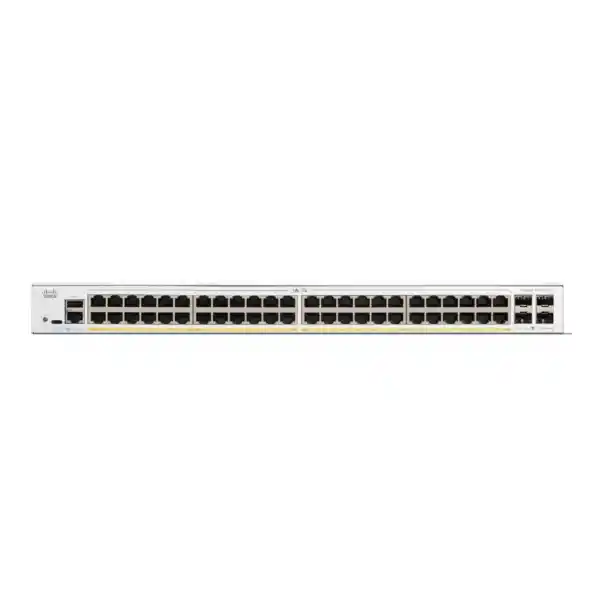
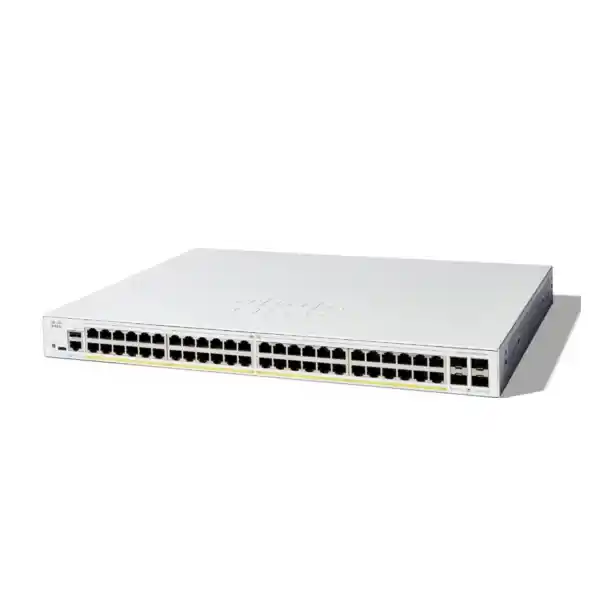
Cisco Catalyst C1300-48FP-4G Network Switch in UAE
The Cisco Catalyst C1300-48FP-4G is a managed 48-port Gigabit Ethernet access switch engineered for organizations that need dense PoE+ delivery, dependable Layer 2 switching, practical Layer 3 routing, business-class security, and straightforward day-to-day administration. With forty-eight 10/100/1000 Mbps PoE+ copper interfaces, four 1 Gigabit SFP uplinks, a 740-watt PoE budget, and nonblocking wire-speed performance, it is well suited to UAE office floors, schools, hospitality properties, retail environments, clinics, warehouses, distributed branches, IP surveillance deployments, unified communications networks, and wireless access infrastructures.
What is the Cisco Catalyst C1300-48FP-4G?
The Cisco Catalyst C1300-48FP-4G is a fixed, managed enterprise-class switch in the Catalyst 1300 family, positioned for small and medium-sized businesses, branch locations, and organizations that want richer control than an unmanaged or basic smart switch can provide. The exact C1300-48FP-4G model combines 48 copper Gigabit Ethernet downlink ports with IEEE 802.3af PoE and 802.3at PoE+ support, giving network designers the ability to connect and power compatible IP phones, Wi-Fi access points, cameras, door controllers, thin clients, small IoT gateways, and other powered devices through the same structured cabling used for data. The 740W power budget is the defining feature of the “FP” variant: it is designed for installations where PoE density matters, not merely for environments where a handful of devices need power.
On the uplink side, the switch provides four Gigabit Ethernet SFP interfaces. This is a critical model-selection detail. The “4G” suffix identifies four 1GbE SFP uplinks; it is not the same product as the C1300-48FP-4X, which uses 10GbE SFP+ uplinks and belongs to the subset of Catalyst 1300 models that support hardware stacking. The C1300-48FP-4G should therefore be selected when four 1GbE fiber or compatible SFP uplinks are adequate for the access-layer design and when standalone management is acceptable. Where a design requires multi-gigabit access, 10GbE uplinks, or front-panel hardware stacking, another Catalyst 1300 or Catalyst 1300X SKU may be more appropriate.
For UAE customers, the practical value of the C1300-48FP-4G lies in consolidation. A single 1U switch can deliver substantial PoE capacity across a full 48-port access layer while providing the segmentation, security, monitoring, quality-of-service, and routing controls expected in a professionally operated network. Instead of separating user access, phones, cameras, and access points across several lightly utilized switches, the C1300-48FP-4G can serve as a dense edge platform when the traffic profile and 1GbE uplink design are appropriately sized.
48 Gigabit PoE+ Ports
Forty-eight 10/100/1000BASE-T interfaces support data and PoE+, making the switch suitable for dense endpoint environments without requiring separate local power for each compatible device.
740W Total Budget
The high aggregate power budget supports PoE-heavy access layers. Correct engineering still requires calculating powered-device draw, startup demand, class negotiation, headroom, and future endpoint growth.
4 × Gigabit SFP
Four dedicated SFP ports support fiber-based or compatible copper-transceiver uplinks. The 4G model is a 1GbE-uplink design, so aggregation bandwidth should be validated against application demand.
104 Gbps / 77.38 Mpps
Cisco specifies nonblocking wire-speed switching, with 104 Gbps switching capacity and 77.38 million packets per second forwarding for 64-byte packets on this exact model.
C1300-48FP-4G Port Architecture and Access-Layer Role
A 48-port access switch is often purchased based on port count, but port count alone does not determine whether a switch is the right fit. The C1300-48FP-4G provides forty-eight 1GbE copper interfaces for endpoint attachment and four 1GbE SFP interfaces intended primarily for uplinks, inter-switch connections, server-side attachment where 1GbE is sufficient, or fiber runs to another network location. The design gives a total of 52 Gigabit Ethernet interfaces. In a conventional business topology, the copper ports face users and powered devices while one or more SFP interfaces connect upstream to a firewall, router, distribution switch, core switch, or remote telecommunications room.
Because all 48 access ports are Gigabit Ethernet rather than multigigabit, the model is particularly appropriate for endpoints whose practical throughput requirement is at or below 1Gbps. This includes most desktop PCs, standard IP phones, many surveillance cameras, printers, building-control endpoints, point-of-sale systems, and a large installed base of enterprise access points that use 1GbE Ethernet uplinks. For new high-density Wi-Fi 6E or Wi-Fi 7 designs where individual access points can exceed 1Gbps of wired throughput, a Catalyst model with 2.5GbE or faster multi-gigabit access ports may provide a better long-term fit.
The four SFP uplinks provide design flexibility when the switch needs fiber connectivity between floors, buildings, cabinets, or equipment rooms. Fiber can be advantageous for longer distances, electrically noisy environments, inter-building links, or areas where copper grounding and surge concerns must be minimized. The correct SFP transceiver depends on fiber type, distance, connector standard, and upstream equipment compatibility. A UAE deployment may use multimode optics for internal building links or single-mode optics for longer campus pathways, but the optical bill of materials should always be matched to the cable plant and link budget rather than selected only by connector appearance.
It is equally important to understand the uplink ceiling. Four 1GbE SFP ports can be aggregated or assigned to separate upstream functions, but they do not provide 10GbE per interface. A 48-port access layer serving many data-heavy workstations, high-bitrate cameras, large wireless populations, backup traffic, or centralized storage may experience upstream oversubscription even though the switch fabric itself can forward traffic at wire speed. FourTeck therefore recommends sizing the C1300-48FP-4G from the traffic model backward: identify endpoint types, estimate realistic simultaneous loads, account for north-south and east-west traffic, then confirm whether 1GbE SFP uplinks meet the operational objective.
740W PoE Budget: What It Means in a Real Deployment
Power over Ethernet is one of the strongest reasons to select the C1300-48FP-4G. Cisco specifies a 740W power budget across 48 PoE-capable ports, with support for IEEE 802.3af PoE and IEEE 802.3at PoE+. PoE+ can deliver higher per-port power than basic PoE, which is useful for devices such as feature-rich access points, pan-tilt-zoom cameras, video phones, badge readers with auxiliary loads, and selected IoT appliances. The maximum supported power mode of the switch should not be confused with the actual draw of every endpoint: most real powered devices consume less than their negotiated class maximum during normal operation.
A useful first-pass calculation is total device requirement. For example, a network with 24 IP phones averaging 7W, 12 cameras averaging 13W, and 8 wireless access points averaging 20W has an estimated steady draw of 484W before engineering margin. That scenario fits comfortably within 740W, but a production design should also allow for cable loss, device startup behavior, future growth, replacement devices with higher power requirements, and any features that raise camera or access-point consumption. A PoE budget that appears generous on day one can become constrained after several years of endpoint upgrades.
The “full PoE” positioning of the 48FP variant is especially useful when many ports may simultaneously approach PoE+ levels. Pure arithmetic shows that 48 ports multiplied by 30W equals 1,440W, which is greater than the switch’s 740W aggregate budget; therefore, the switch cannot deliver 30W to all 48 ports at the same time. This is normal for many PoE switches and illustrates why aggregate budgeting matters. A rough 740W divided by 48 ports yields approximately 15.4W per port if power were distributed evenly. Real networks do not distribute power evenly, so the correct method is to sum the maximum expected or engineered allocation of each powered device and retain reserve capacity.
Cisco also supports intelligent PoE behaviors within the Catalyst 1300 family, allowing administrators to operate powered-device environments with more control than a passive injector approach. From an operational standpoint, centralizing endpoint power at the switch can simplify remote recovery because a port can be administratively cycled without visiting the device location. It can also integrate endpoint power continuity with a UPS protecting the network rack. In a Dubai office, hotel, clinic, or warehouse, this can reduce the number of small local power adapters distributed across ceilings, cabinets, desks, and camera mounts.
PoE design must also consider facility power and cooling. At full PoE load, the switch and attached powered devices represent a significant electrical load in the rack. UPS capacity, circuit loading, PDU rating, heat extraction, cabinet ventilation, and room air conditioning should be calculated accordingly. The C1300-48FP-4G is an actively cooled model, and Cisco specifies one fan with acoustic output around 48.7 dBA at 25°C. That makes a closed or dedicated communications room preferable to a quiet executive office, conference room, or open workspace where fan noise may be noticeable.
Switching Performance, Packet Forwarding, and Oversubscription
Cisco rates the C1300-48FP-4G at 104 Gbps switching capacity and 77.38 Mpps forwarding capacity for 64-byte packets, with a nonblocking wire-speed switching architecture. The 104 Gbps figure corresponds to the aggregate bidirectional capacity necessary to support 52 Gigabit Ethernet interfaces at line rate. In other words, the internal switching fabric is engineered so that local traffic between ports does not need to be constrained by a lower-capacity backplane figure under normal specification conditions.
The 77.38 Mpps value is particularly meaningful when evaluating workloads composed of small packets. Throughput in gigabits per second and packet-forwarding rate measure different stresses. Large frames can consume bandwidth without producing extreme packet rates, while small packets increase per-packet processing demand. Business networks commonly carry a mix of voice, DNS, transactional traffic, control-plane exchanges, video, file transfer, and general web sessions. A switch designed for wire-speed forwarding helps avoid situations where the fabric becomes the bottleneck before physical port speed is reached.
However, access-layer design still requires understanding traffic direction. The switch can move traffic efficiently between local ports, but a large portion of modern business traffic eventually heads upstream toward the internet, cloud services, data center resources, security appliances, or centralized servers. The C1300-48FP-4G has 1GbE SFP uplinks, so northbound capacity can be more constrained than local switching capacity. Link aggregation can increase aggregate throughput across multiple physical links when the upstream device and traffic distribution support it, but a single conversation is generally associated with one member link according to the load-balancing algorithm. LAG improves aggregate capacity and resilience; it does not convert multiple 1GbE interfaces into one universally usable multi-gigabit flow for every individual session.
This distinction is important for surveillance. Forty-eight IP cameras might each generate only several megabits per second, making a 1GbE uplink perfectly adequate for a well-designed video network. By contrast, forty-eight office users simultaneously synchronizing large cloud files or multiple high-capacity access points feeding a shared uplink can place greater pressure on uplink bandwidth. Similar considerations apply to backups, virtualization hosts, NAS traffic, software deployment systems, and media workflows.
The C1300-48FP-4G also includes a 1.5 MB packet buffer according to Cisco’s current Catalyst 1300 specifications. Buffering helps absorb short bursts and contention, but it is not a substitute for correct uplink sizing or traffic engineering. QoS, VLAN separation, link aggregation, and appropriate application design work together with switch hardware to maintain predictable performance. A technically sound deployment begins with expected traffic characteristics rather than assuming that a 48-port switch automatically needs—or does not need—a particular uplink speed.
Layer 2 Features for Structured Enterprise Access Networks
At Layer 2, the Catalyst C1300 family provides a broad set of switching controls that allow the C1300-48FP-4G to operate as more than a simple Ethernet fan-out device. VLAN support is central to this role. Cisco supports up to 4094 VLAN identifiers with a reserved internal range, along with port-based and IEEE 802.1Q tag-based VLANs. Administrators can separate users, voice devices, surveillance systems, wireless infrastructure, guest access, servers, building automation, management interfaces, and other traffic classes into discrete broadcast domains. This segmentation can reduce unnecessary broadcast propagation and establish clear policy boundaries for routing and security controls.
The platform also supports several specialized VLAN mechanisms, including MAC-based, protocol-based, and IP subnet-based VLAN assignment, management VLANs, private VLAN functions, protected-port behavior, guest or unauthenticated VLANs, and dynamic VLAN assignment through RADIUS in conjunction with 802.1X authentication. These capabilities are useful where physical switch ports do not map permanently to a single user type. In a hot-desking environment, for example, authentication-driven policy can help assign network access based on endpoint or user identity rather than relying only on the wall outlet selected.
Loop prevention and controlled redundancy are provided through spanning-tree technologies. The family supports classic IEEE 802.1D Spanning Tree Protocol, IEEE 802.1w Rapid Spanning Tree, and IEEE 802.1s Multiple Spanning Tree. Cisco also lists PVST+ and Rapid PVST+ support. The operational value is protection against accidental Layer 2 loops while enabling deliberate redundant paths. In a business network, an unmanaged loop can quickly create a broadcast storm and destabilize connectivity, so spanning-tree configuration should be treated as an intentional design component rather than left entirely to chance.
Link aggregation using IEEE 802.3ad LACP allows multiple physical interfaces to be combined into logical bundles. Cisco specifies support for up to eight link-aggregation groups with up to eight member ports per group, subject to platform rules and candidate-port behavior. LACP can be used toward servers, another switch, a firewall pair where supported, or network-attached infrastructure. It can provide both aggregated bandwidth and link resilience, provided the neighboring device is configured compatibly.
These Layer 2 functions are particularly relevant in UAE deployments that grow incrementally. A new office may initially use only a few VLANs and one uplink, but later add IP telephony, CCTV, guest Wi-Fi, access control, and additional branches. Starting with a managed platform makes it possible to introduce policy and segmentation without replacing the access switch simply because the network has become more complex.
Layer 3 Routing: Capabilities and Important Model Boundaries
The Catalyst C1300 line is positioned as a managed Layer 3 switching platform. For the C1300-48FP-4G, that means the switch can perform IP routing functions that would otherwise require every internal subnet exchange to traverse an external router. Cisco specifies wire-speed IPv4 routing, IPv6 routing, Layer 3 interfaces on physical ports, LAGs, VLAN interfaces, and loopback interfaces, along with Classless Inter-Domain Routing. For conventional branch and SMB environments, these capabilities can simplify internal routing between user, voice, camera, wireless, guest, and management networks.
Cisco’s current specification for standard C1300 models includes up to 990 combined dynamic and static IPv4 routes and up to 128 IP interfaces. The platform also supports RIP version 2 for dynamic routing and Policy-Based Routing for directing packets to a different next hop based on IPv4 or IPv6 access-control criteria. DHCP server functions can serve addresses from multiple pools, while DHCP relay can forward client requests across Layer 3 boundaries to a centralized server. UDP relay can assist selected broadcast-based service discovery or BOOTP/DHCP scenarios across routed domains.
A model-specific limitation must be made clear: OSPF is listed by Cisco for Catalyst C1300X SKUs, not the standard C1300 family that includes the C1300-48FP-4G. Buyers planning a routed access design with OSPF should therefore not assume that the C1300-48FP-4G provides that protocol simply because it supports Layer 3 routing. If OSPF is a firm requirement, FourTeck can help select a suitable C1300X or another Cisco Catalyst model based on the broader topology.
The decision about where to route should also account for security architecture. Inter-VLAN routing on the switch can keep local traffic efficient, but it may bypass a firewall if all VLAN gateways are located on the switch and no additional policy enforcement is inserted. For networks that require inspection between user, server, guest, CCTV, and operational-technology segments, it may be more appropriate to terminate selected VLANs on a firewall or use routed boundaries that deliberately force sensitive flows through security controls. The correct answer depends on trust zones, application dependencies, latency, throughput, and compliance objectives.
For customers building secure routed designs around the access layer, FourTeck can align switching with broader cybersecurity architecture through its UAE technology practice at FourTeck UAE. The goal is to prevent a common procurement mistake: choosing a switch by port count without considering where routing, policy enforcement, DHCP, gateway resilience, and monitoring should live in the final network.
Security Controls for the Wired Access Edge
A managed access switch sits at a sensitive point in the network because every attached endpoint reaches the rest of the infrastructure through it. The Catalyst C1300 family includes controls intended to reduce unauthorized access, protect management sessions, limit unwanted traffic, and strengthen first-hop security. Secure Shell provides encrypted command-line access, while HTTPS/SSL protects browser-based administration. SNMPv3 can provide authenticated and encrypted monitoring for network-management systems. These management protocols should be used in place of insecure legacy methods wherever operational tooling permits.
IEEE 802.1X authentication is a particularly useful capability for organizations that want identity-aware wired access. The platform can act as an authenticator and integrate with RADIUS for authentication and accounting. Cisco documents guest VLAN and unauthenticated VLAN behavior, single- and multi-host modes, multiple sessions, time-based 802.1X, dynamic VLAN assignment, and MAC authentication. In practice, this allows a network team to move from “anything plugged into this socket is trusted” toward a model where users or devices must establish an approved identity or fall into a restricted network segment.
Access Control Lists can filter or rate-limit traffic according to network policy. At the edge, ACLs can be used to restrict management access, isolate device classes, limit legacy protocols, reduce lateral movement, or ensure that selected endpoints can reach only the systems they require. ACL design should remain understandable and supportable. Overly complex filtering directly on the access switch can become difficult to troubleshoot, so a strong design uses switching ACLs for precise edge controls while reserving deeper application inspection and threat prevention for appropriate firewalls or security gateways.
IPv6 security should be considered even in networks where IPv4 remains dominant. Cisco lists IPv6 first-hop security features such as Router Advertisement Guard, Neighbor Discovery inspection, DHCPv6 Guard, neighbor binding tables, and binding integrity checks. These mechanisms are useful because unmanaged IPv6 behavior can create unintended traffic paths or expose hosts to rogue advertisements. Dual-stack deployments should have explicit policy rather than leaving IPv6 unmonitored simply because business applications still primarily use IPv4.
Physical security remains part of the access-layer threat model. A switch with powerful remote-management capabilities should be installed in a locked rack or communications room, protected by an appropriately sized UPS, and connected to a management network that is not broadly reachable from user VLANs. Configuration backups, role-based administrative practices, logging, firmware management, and credential control are as important as protocol features on the datasheet.
Quality of Service for Voice, Video, Wireless, and Business Applications
When a single access switch carries voice, cameras, wireless traffic, business applications, and general internet usage, Quality of Service becomes a practical method of protecting time-sensitive traffic during periods of congestion. QoS does not create bandwidth; instead, it determines how the available bandwidth is classified, queued, scheduled, and policed when multiple traffic classes compete for the same constrained interface. This is especially relevant on the C1300-48FP-4G because 48 Gigabit access ports may converge onto 1GbE uplinks.
A typical office can mark voice packets for expedited handling, provide controlled priority to collaboration traffic, preserve management traffic, and constrain lower-priority bulk transfers. A surveillance environment may need to ensure that camera streams remain stable without allowing video to consume all available upstream bandwidth. A hospitality network may distinguish operational systems from guest access. QoS policy should be based on actual application behavior and trusted marking boundaries rather than blindly honoring every DSCP value sent by endpoints.
Voice VLAN capabilities can simplify IP telephony deployment by placing phones into a dedicated broadcast and policy domain. In many desk deployments, a computer connects through the Ethernet pass-through port on an IP phone, allowing voice and user data to share a single wall outlet while remaining logically separated. The switch can then apply different VLAN and QoS behavior to each traffic class. Correct LLDP or discovery configuration, DHCP options, call-control reachability, and PoE settings must be aligned with the chosen phone platform.
QoS becomes most effective when paired with capacity planning. If sustained uplink utilization is routinely near line rate, prioritization may protect voice but still leave other applications slow. At that point the correct solution may be additional aggregated uplinks, traffic redistribution, an alternative 10GbE-uplink switch such as a 4X model, or a different aggregation architecture. FourTeck treats QoS as one tool in the design rather than a substitute for sufficient bandwidth.
IP Telephony
The 740W PoE budget can power large phone estates while voice VLANs, QoS, LLDP, 802.1X, and VLAN segmentation support structured UC deployments. Port-by-port power demand should be checked against phone models, expansion modules, and any passthrough devices.
CCTV and Surveillance
Forty-eight powered ports make the model suitable for camera aggregation when Gigabit access and 1GbE SFP uplinks match the recording design. Calculate camera bitrates, retention architecture, NVR placement, multicast requirements, and uplink utilization before deployment.
Wireless Access
PoE+ can support many enterprise access points, but the switch uses 1GbE access ports. Confirm the wired interface speed and maximum draw of each AP; higher-generation radios may benefit from multigigabit switching even when PoE capacity is sufficient.
Branch Infrastructure
Layer 3 routing, VLANs, DHCP services, secure management, ACLs, and monitoring tools make the switch suitable for branch-office access where network policy needs more structure than a basic unmanaged switching layer can provide.
Management, Provisioning, Monitoring, and Operational Visibility
Operational simplicity is one of the reasons organizations choose the Catalyst 1300 family for branch and SMB deployments. The switch includes a browser-based management interface with simple and advanced operating modes, configuration wizards, monitoring pages, system-maintenance functions, online help, and search capabilities. This gives smaller IT teams a practical way to manage the switch without depending exclusively on a command-line workflow while still retaining the deeper features expected from a managed platform.
Cisco Business Dashboard integration is another relevant management option. The platform supports an embedded probe capability, reducing the need for a separate onsite probe appliance or virtual machine in supported deployments. This can help discover, monitor, and manage a portfolio of Cisco small-business networking devices across one or more sites. Cisco also provides a mobile application for supported Cisco Business and Catalyst 1200/1300 products, useful for initial setup and basic network-management tasks.
For rollout automation, Cisco Network Plug and Play can support near-zero-touch device provisioning scenarios. This is useful when a central team prepares branch configurations and wants local staff to perform only basic physical installation. A well-designed provisioning process still requires disciplined templates, secure credentials, IP addressing, firmware policy, and validation steps, but automation can reduce inconsistent manual configuration when multiple similar locations are deployed.
Traditional enterprise monitoring protocols remain available. SNMP versions 1, 2c, and 3 are supported, including traps and SNMPv3 user-based security. Syslog, DNS client functionality, NTP/SNTP-related services, secure management protocols, and other standard tools enable integration into existing operations. In production, FourTeck generally recommends using authenticated and encrypted management methods, sending logs to a centralized location where practical, synchronizing time accurately, and restricting management interfaces to a dedicated administrative network.
For customers who need implementation and lifecycle assistance beyond hardware supply, FourTeck’s IT Services UAE practice can support broader activities such as network assessment, structured deployment planning, configuration standardization, migration coordination, documentation, troubleshooting, and infrastructure support. The exact service scope can be aligned to the customer’s internal team and project requirements.
Important: C1300-48FP-4G Does Not Provide the Same Uplink or Stacking Design as C1300-48FP-4X
Cisco’s product naming makes two 48-port full-PoE models appear similar: C1300-48FP-4G and C1300-48FP-4X. They should not be treated as interchangeable. The C1300-48FP-4G on this page has four Gigabit SFP uplinks. The C1300-48FP-4X has four 10 Gigabit SFP+ uplinks. That is a tenfold interface-speed difference per uplink port and can materially change the suitability of the switch for high-throughput access-layer designs.
Hardware stacking is another distinction. Cisco’s current Catalyst 1300 specification identifies selected 4X, multigigabit, 10GbE, and C1300X families for front-panel hardware stacking. The C1300-48FP-4G is not listed among those hardware-stacking models. Therefore, this product page intentionally does not claim hardware stacking for the C1300-48FP-4G. If the network requires multiple switches to operate as one hardware stack with stack-level failover, the bill of materials should move to a supported SKU rather than assuming the 4G model provides the same function.
This matters when replacing older Cisco Business switches or creating a new standard. A project may initially ask for “48-port Cisco full PoE” without distinguishing uplinks or stacking. That wording is insufficient for correct procurement. The design team should specify access speed, PoE budget, uplink speed and media, number of uplinks, link aggregation, stacking requirement, routing protocols, redundancy, rack power, acoustic constraints, and expected traffic. Only then can a precise Cisco SKU be selected.
For modest branch networks, CCTV distribution, phone-heavy office floors, and many conventional access deployments, four 1GbE SFP uplinks may be entirely adequate. Paying for 10GbE where it is not needed can be unnecessary. Conversely, selecting 1GbE uplinks for a data-intensive floor because the switch has 48 access ports can create an avoidable bottleneck. The right choice comes from the traffic model, not from choosing the model with the largest headline number.
Physical Design, Rack Integration, Cooling, and UAE Environmental Planning
The C1300-48FP-4G is designed for rack installation and measures approximately 444.3 mm wide by 350 mm deep by 43.94 mm high, which corresponds to a conventional 1U-height chassis. Cisco specifies a weight of approximately 6.48 kg for this model. The switch uses an internal universal 100–240V AC, 50–60Hz power supply. These dimensions make it compatible with standard 19-inch racks using the supplied rack-mounting hardware, but a complete rack design must allocate space for horizontal or vertical cable management, patch panels, optical routing, UPS capacity, PDUs, and ventilation.
A 48-port full-PoE switch can create substantial cable density. Forty-eight copper patch leads plus up to four optical or SFP uplink connections can quickly obstruct airflow and make port tracing difficult if cable management is not planned. A typical installation places a patch panel near the switch and uses correctly sized patch cords to reduce loops of excess cable. Labeling should identify wall outlet, VLAN or service where operationally useful, and patch-panel position. For CCTV or access-control deployments, device identifiers can be mapped to physical switch ports to accelerate troubleshooting.
Thermal planning deserves extra attention in the UAE. Cisco specifies an operating temperature range up to 50°C at sea level for this family, but a network rack should not be designed to operate continuously at the maximum rating. Elevated ambient temperatures reduce thermal margin and can accelerate component aging. Communications rooms in Dubai, Abu Dhabi, Sharjah, Ajman, Ras Al Khaimah, Fujairah, or Al Ain should have stable cooling, clean airflow paths, controlled dust exposure, and monitoring where the network is business-critical.
Cisco specifies one fan for the C1300-48FP-4G and an acoustic figure of approximately 48.7 dBA at 25°C. This is not a fanless switch. It should therefore be placed in a location where active cooling noise is acceptable. A dedicated IT room, secure rack room, or back-office cabinet is generally more appropriate than a quiet reception desk, meeting room, studio, or executive workspace. At higher ambient temperature and load, fan behavior may become more noticeable.
Power planning must include both the switch electronics and PoE load. Cisco publishes worst-case consumption with PoE that can exceed 800W depending on input voltage and load. The UPS should be sized for the expected real load, desired runtime, power factor, other rack equipment, battery aging, and expansion—not simply for the nominal 740W PoE budget. If the same UPS also powers a firewall, router, NVR, servers, wireless controller, optical equipment, and multiple switches, a full load schedule is essential.
Where the access switch connects to rack-mounted compute, storage, or virtualization equipment, customers can coordinate broader infrastructure through FourTeck’s Server Dubai resources. Network and server sizing should be treated as one system: NIC speeds, LAG design, VLAN trunks, storage traffic, hypervisor requirements, redundancy, and backup flows can directly affect switch and uplink selection.
IPv6 Readiness and Dual-Stack Network Design
IPv6 capability is increasingly relevant even when an organization has no immediate plan to migrate every workload away from IPv4. Modern operating systems enable IPv6 by default, service providers and cloud platforms continue to expand IPv6 support, and unmanaged IPv6 traffic can exist inside a network even when administrators believe the environment is “IPv4 only.” The Catalyst C1300 family supports dual IPv4/IPv6 operation, IPv6 host functionality, IPv6 routing, neighbor and router discovery, stateless address autoconfiguration, path MTU discovery, Duplicate Address Detection, ICMPv6, DHCPv6 client behavior, and related services.
The switch also supports IPv6 QoS and IPv6 ACL functions, allowing policy to extend beyond IPv4. First-hop security features such as RA Guard, Neighbor Discovery inspection, DHCPv6 Guard, and neighbor binding controls can help reduce common local-segment risks. These controls are most effective when deployed as part of a documented IPv6 strategy. Simply blocking selected IPv6 packets without understanding endpoint behavior can disrupt legitimate services, while ignoring IPv6 entirely can create visibility gaps.
For a new UAE office or branch, a practical approach is to select switching infrastructure that does not force an immediate hardware replacement when IPv6 requirements become more important. Addressing plans, firewall policy, DHCPv6 or SLAAC decisions, DNS behavior, monitoring, security tooling, and WAN provider support can then evolve independently. The C1300-48FP-4G’s IPv6 feature set allows the access layer to participate in that transition.
Dual-stack networks should be tested as dual-stack networks. Troubleshooting methods that look only at IPv4 can miss why a host selects one path over another. DNS responses, route preference, Router Advertisements, security rules, and application support all affect outcome. A capable switch is one component; operational readiness depends on documentation and monitoring across the entire network.
Sizing the C1300-48FP-4G for IP Cameras
Surveillance is a natural use case for a 48-port, 740W PoE switch, but the switch should be sized using both power and bandwidth. Begin with the camera list. Record each camera’s maximum or engineered PoE draw, resolution, frame rate, codec, average and peak bitrate, recording mode, and whether infrared illumination, heaters, pan-tilt-zoom motors, speakers, analytics, or auxiliary outputs affect power consumption. Add reserve capacity for replacements and future expansion. A fixed camera that consumes 7W presents a very different load from a high-end PTZ unit that can approach PoE+ limits.
Next, model traffic. If 40 cameras average 8 Mbps each, the aggregate recording stream is roughly 320 Mbps before protocol overhead and burst variation. A single 1GbE uplink may accommodate that traffic with reasonable headroom, particularly if viewing stations or NVR resources are local. If cameras run at much higher bitrates, multiple NVRs are accessed across the uplink, or other endpoint types share the switch, the traffic profile changes. Link aggregation can distribute multiple flows across more than one 1GbE path where the upstream architecture supports it.
VLANs can separate cameras from user workstations, while ACLs or firewall policy can restrict camera access to NVRs, management systems, time services, DNS, and any required cloud endpoints. Camera networks should not automatically have unrestricted access to the corporate LAN. Switch management should remain on a protected administrative VLAN. Where multicast is used for live viewing, IGMP snooping and multicast design should be checked to prevent unnecessary replication across every port.
UPS sizing is particularly important for security systems. A 740W PoE budget means the access switch can become the power source for dozens of cameras. If a power interruption occurs, a small UPS designed only for the switch’s idle electronics may provide very little runtime once all cameras are drawing power. The target backup duration should be determined from security policy and the total rack load, then validated against the UPS manufacturer’s runtime curves.
Finally, redundancy requirements should be explicit. Because this exact 4G model is not a hardware-stacking SKU, a design requiring stack-level redundancy should use a different switch family or architecture. In less critical installations, redundancy may instead be provided through dual uplinks, redundant upstream equipment, spare switch strategy, or rapid replacement procedures. The business impact of losing 48 cameras from one access switch should determine the resilience level.
Sizing the C1300-48FP-4G for Wi-Fi Access Points
Wireless access points are another major PoE use case, but access-point generation matters. Many established enterprise APs use a 1GbE wired interface and fit naturally on the C1300-48FP-4G. Newer high-performance Wi-Fi 6, Wi-Fi 6E, and Wi-Fi 7 products can use 2.5GbE, 5GbE, or faster wired interfaces to avoid a 1GbE Ethernet bottleneck. The C1300-48FP-4G cannot provide multigigabit copper access; each RJ-45 interface tops out at 1GbE. It may still operate with a faster-capable AP at 1GbE if the AP supports negotiation to that rate, but the network designer should understand the performance tradeoff.
PoE must be checked separately from data speed. An access point may require PoE+ power even when its data link negotiates at 1GbE. The switch’s 740W budget gives substantial aggregate capacity, but the AP manufacturer’s exact power requirement should be verified, including whether disabling optional radios or USB functions is required under reduced power. An undersupplied AP may boot with features disabled, operate unpredictably, or fail to deliver its intended radio capacity.
Wireless networks also concentrate client traffic. Thirty access points carrying hundreds of active users can generate significant northbound demand even if no individual AP reaches 1Gbps. Four 1GbE SFP uplinks provide several options for distribution, but the upstream design should be tested against expected concurrency, internet bandwidth, local application use, roaming behavior, controller location, guest breakout architecture, and any centralized security inspection.
VLAN design is usually tied closely to the wireless SSID structure. Corporate, guest, voice, IoT, and operational SSIDs can map to separate VLANs and security zones. The access switch trunks those VLANs toward the APs and upstream network. Careful allowed-VLAN configuration reduces accidental exposure and keeps the topology understandable. DHCP relay, routing, or firewall interfaces can then be placed according to the security model.
For a greenfield high-density wireless project, FourTeck may recommend a multigigabit Catalyst SKU rather than the C1300-48FP-4G. For conventional office Wi-Fi, moderate-density hospitality, schools, and branches where 1GbE wired AP connectivity is sufficient, the C1300-48FP-4G can still be an efficient high-PoE platform. The decision should be based on AP specifications and client-load forecasts rather than the Wi-Fi marketing generation alone.
Sizing the C1300-48FP-4G for IP Phones and Unified Communications
IP telephony environments often benefit from dense PoE access because every desk phone can be powered from the network rack. Most desk phones draw far less than the 30W PoE+ ceiling, so a 740W budget can support a large number of handsets with substantial headroom. Power planning should still account for high-end video phones, sidecar expansion modules, integrated displays, USB accessories, conference units, and any models that draw significantly more than a basic voice handset.
Voice VLANs help isolate phone traffic from user data, while QoS can prioritize latency-sensitive signaling and media during congestion. Many phones include a downstream PC port, allowing one wall jack and one switch port to carry tagged voice traffic and untagged or separately tagged workstation traffic. This saves cabling but makes edge-port configuration more important. LLDP-based discovery, VLAN assignment, DHCP options, call-control reachability, and security policy must align with the selected phone system.
802.1X and MAC-based authentication can be relevant when both phone and workstation share a port. Multi-session or multi-host authentication modes allow policies to distinguish attached devices according to the design. RADIUS-backed dynamic VLAN assignment can provide more identity-driven control, but it also increases dependency on AAA infrastructure. Deployment testing should include phone boot sequence, DHCP, certificate behavior if used, authentication fallback, emergency-calling requirements, and behavior during RADIUS outages.
Voice quality depends on more than the switch. WAN jitter, packet loss, firewall inspection, SIP or signaling policy, internet service quality, PBX capacity, codec choice, and wireless conditions can all affect calls. The C1300-48FP-4G provides the access-layer mechanisms required for a well-structured voice network, but end-to-end validation remains necessary.
For UAE organizations integrating IP telephony with a broader switching refresh, FourTeck can coordinate the access-layer plan with phone counts, PoE draw, VLANs, QoS, cabling, call-control location, and WAN requirements. This reduces the chance that a switch is procured correctly for port count but incorrectly for power, uplink bandwidth, or segmentation.
Designing Fiber Uplinks for the Four SFP Ports
The four SFP interfaces are one of the most important engineering points on the C1300-48FP-4G. They allow the switch to connect through compatible 1GbE transceivers instead of consuming copper access ports for every uplink. Fiber is frequently used between floors and buildings because it provides reach beyond standard copper Ethernet and electrical isolation between network locations. The exact optic must match both ends of the link.
For short internal building links, multimode fiber may be appropriate when installed cable supports the required transceiver and distance. For longer campus or inter-building paths, single-mode fiber can provide much greater reach. Connector type, strand count, patch-panel presentation, polarity, optical loss, transceiver wavelength, and remote-device compatibility should all be recorded in the bill of materials. “SFP” describes a module form factor, not a guarantee that every optic will work in every port.
Redundant fiber paths can improve availability. Two SFP links might connect to separate upstream switches where the topology and spanning-tree design support redundancy, or multiple links can form a LAG to increase aggregate bandwidth and tolerate a member-link failure. A pair of physically diverse fiber routes can reduce common-cause cable damage, but only if the pathways are genuinely separate. Two patch cords in the same tray do not provide the same resilience as diverse risers or conduits.
Because the SFP ports are 1GbE, designers should also ask whether the access switch is expected to aggregate enough traffic to justify 10GbE. If a floor has dozens of power users, high-capacity Wi-Fi APs, local servers, storage access, or heavy cloud synchronization, the C1300-48FP-4X may provide a better uplink architecture with four 10GbE SFP+ ports. If the floor mostly carries phones, cameras, normal office users, or low-to-moderate application traffic, 1GbE uplinks can remain practical.
Uplink selection is therefore not an accessory decision made after purchasing the switch; it is part of switch selection itself. FourTeck can review the existing fiber plant, upstream core or firewall ports, expected traffic, distance, and redundancy requirement before finalizing optics and patching.
Example UAE Deployment Topologies
Office floor: A C1300-48FP-4G can serve as a floor access switch for desktops, IP phones, printers, meeting-room devices, access points, and door controllers. User, voice, corporate Wi-Fi, guest Wi-Fi, IoT, and management traffic are segmented into VLANs. One or more SFP links connect to the building distribution layer. The firewall remains responsible for internet security and, where required, inspection between higher-risk internal zones.
Surveillance aggregation: The switch powers cameras directly over structured cabling, with the camera VLAN isolated from users. An NVR or VMS server may sit locally on the same access layer or upstream in a server room. Bandwidth is calculated from camera bitrates rather than from port count. UPS runtime is sized from the actual PoE load because the switch effectively becomes a centralized camera power source.
School or training center: Ports can serve classroom access points, phones, smart displays, teacher workstations, lab devices, and surveillance. VLANs separate staff, students, guest devices, security systems, and infrastructure management. QoS protects voice and selected interactive applications. Authentication policies can be introduced using 802.1X and RADIUS as identity requirements mature.
Retail or hospitality branch: The switch can connect point-of-sale terminals, phones, access points, CCTV, signage, back-office PCs, access control, and building systems. Segmentation prevents guest or IoT traffic from sharing the same unrestricted network as payment or business systems. Remote management and centralized logging reduce the need for frequent onsite troubleshooting.
Warehouse: High PoE availability supports cameras and access points distributed across the site, while fiber uplinks can reach remote cabinets beyond conventional copper distance. Industrial areas should still be assessed for temperature, dust, surge, and enclosure requirements because the C1300-48FP-4G is an enterprise rack switch rather than a hardened industrial Ethernet switch.
Migration from Cisco Business 350 and Other Legacy Access Switches
Organizations refreshing Cisco Business switching should treat migration as a configuration and architecture project, not only as a hardware swap. Cisco positions Catalyst 1300 models as successors for multiple Cisco Business 350 use cases, but exact replacement selection must preserve the characteristics that matter: PoE budget, number of ports, uplink type, uplink speed, Layer 3 functions, VLAN design, authentication, monitoring, optics, and redundancy. A legacy 48-port switch with 10GbE uplinks should not automatically be replaced by the C1300-48FP-4G simply because both have 48 copper ports.
Before migration, export and document the existing configuration. Record VLAN IDs and names, access-port assignments, trunks and allowed VLANs, native VLAN settings, LAG membership, spanning-tree priorities, voice settings, PoE requirements, static routes, DHCP relay destinations, ACLs, SNMP configuration, syslog servers, NTP sources, AAA servers, management addressing, DNS, administrative users, and any special port parameters. Also identify stale configuration that should not be copied forward.
Firmware should be planned before cutover. A new switch may ship with an earlier software release than the organization’s desired standard. Upgrade procedures, release notes, configuration compatibility, rollback planning, and maintenance windows should be considered. For multi-site organizations, standardizing firmware and configuration templates reduces long-term support complexity.
The physical migration sequence should minimize downtime. Patch panels can be mapped in advance, critical devices identified, and ports staged with the correct VLAN and PoE settings before users are moved. Uplink optics should be tested, management reachability validated, and monitoring confirmed. For phone or camera networks, PoE startup can cause many devices to boot simultaneously; the team should allow enough time for endpoint registration and verify power consumption after migration.
Post-cutover validation should check more than link lights. Confirm VLAN reachability, DHCP behavior, DNS, voice calls, camera recording, wireless controller connectivity, internet access, routing, redundancy, management authentication, logs, SNMP polling, and expected uplink utilization. A disciplined migration turns the switch refresh into an opportunity to simplify the network rather than copying years of accumulated configuration mistakes.
Reliability, Warranty, and Support Planning
Cisco specifies a limited lifetime warranty with return-to-factory replacement for the Catalyst 1300 series and complimentary access to the Small Business Support Center for one year. Warranty terms should always be checked against the exact regional SKU, purchase channel, and current Cisco policy at the time of order. A warranty is valuable, but it is not the same as a high-availability design or an onsite spare.
The operational impact of a switch failure depends on what the switch powers. A C1300-48FP-4G might support 48 phones, 40 cameras, dozens of users, or an entire branch. If the business cannot tolerate the corresponding outage, resilience should be designed at a system level. Options can include a spare switch held onsite, distribution of critical endpoints across multiple switches, redundant upstream paths, rapid replacement agreements, documented configuration backups, and alternate communications procedures.
Cisco publishes an MTBF figure of approximately 1,469,406 hours at 25°C for the C1300-48FP-4G. MTBF is a statistical reliability metric, not a promise that a particular unit will operate for a specific number of years. Environmental quality, power stability, ambient temperature, dust, ventilation, installation quality, and electrical events all influence real-world reliability. The switch should be installed within rated conditions and protected from preventable environmental stress.
Configuration backup is one of the simplest resilience measures. A replacement switch can be installed much faster when the team has a current startup configuration, documented firmware version, port map, VLAN plan, optics list, administrative access procedure, and tested backup. Relying on undocumented manual reconstruction during an outage increases restoration time and error risk.
Organizations operating across the Middle East and Africa can also coordinate regional network requirements through FourTeck’s Africa technology platform when projects extend beyond the UAE. Standardized model selection, configuration templates, support documentation, and spares strategy can simplify multi-country operations while still accounting for local power, logistics, telecom, and site conditions.
Technical Specification Summary
| Product | Cisco Catalyst C1300-48FP-4G Network Switch |
| Access interfaces | 48 × 10/100/1000BASE-T RJ-45 Gigabit Ethernet |
| PoE support | IEEE 802.3af PoE and IEEE 802.3at PoE+ |
| PoE power budget | 740W total |
| Uplink interfaces | 4 × 1 Gigabit Ethernet SFP |
| Total system ports | 52 Gigabit Ethernet interfaces |
| Switching capacity | 104 Gbps |
| Forwarding capacity | 77.38 Mpps for 64-byte packets |
| Packet buffer | 1.5 MB |
| IPv4 routing | Wire-speed IPv4 routing; up to 990 combined dynamic/static IPv4 routes and up to 128 IP interfaces on standard C1300 |
| Dynamic routing | RIP v2; OSPF is listed for C1300X SKUs, not this standard C1300-48FP-4G model |
| VLAN support | 802.1Q and multiple advanced VLAN assignment and isolation features; VLAN ID space up to 4094 with internal reservation |
| Spanning tree | STP, RSTP, MSTP, PVST+ and Rapid PVST+ support |
| Link aggregation | IEEE 802.3ad LACP; up to 8 groups and up to 8 ports per group within platform rules |
| Hardware stacking | Not listed by Cisco for the C1300-48FP-4G; use an eligible Catalyst 1300/1300X stacking SKU if stacking is required |
| Management | Web UI, Cisco Business Dashboard support, Cisco Business mobile app support, Network Plug and Play, SNMP and secure administrative protocols |
| Dimensions | 444.3 × 350 × 43.94 mm |
| Weight | Approximately 6.48 kg |
| Power input | Internal universal 100–240V AC, 50–60Hz |
| Cooling | Actively cooled, one fan; approximately 48.7 dBA at 25°C |
| Operating temperature | Approximately -5°C to 50°C at sea level; cold-start minimum is 0°C |
When the C1300-48FP-4G Is the Right Choice
Choose the C1300-48FP-4G when the project needs a high-density 48-port managed access switch, most endpoints require no more than 1Gbps, PoE demand is significant, and 1GbE SFP uplinks match the traffic model. This combination is common in phone-heavy offices, CCTV deployments, moderate-density wireless environments, education sites, healthcare branches, retail stores, hotels, warehouses, and distributed enterprise locations where endpoint count and power density are more important than 10GbE northbound capacity.
The model is also attractive where the network team wants advanced segmentation and routing without moving immediately to a higher-end campus chassis architecture. VLANs, Layer 3 interfaces, IPv4 and IPv6 routing, RIP v2, PBR, DHCP functions, ACLs, spanning tree, LACP, 802.1X, secure management, and monitoring provide a substantial toolkit for structured business networks.
The 740W PoE budget makes it preferable to lower-budget 48-port PoE variants when powered-device density is high. If an organization plans to populate most ports with phones, cameras, or access points, starting with the full-PoE model can avoid later power shortages. It also provides room for endpoint replacements that draw more power than the original devices.
The switch is particularly suitable when it can operate as a standalone access device. If the organization requires front-panel hardware stacking, 10GbE uplinks, multi-gigabit copper access, OSPF, or a much larger route scale, the requirements point toward a different Catalyst 1300/1300X model or another Cisco family. The goal is not to make every feature fit one product; it is to select the model whose boundaries match the actual design.
When You Should Select a Different Cisco Catalyst Model
You need 10GbE uplinks: A 48-port access switch can generate more than 1Gbps of aggregate northbound traffic even when individual user ports are lightly loaded. If performance modeling shows that 1GbE SFP uplinks are too restrictive, consider the C1300-48FP-4X or another model with SFP+ uplinks. This is particularly relevant for high-density wireless, virtualization access, centralized storage, large backup flows, media production, and data-heavy engineering teams.
You need multigigabit downlinks: Wi-Fi 6E and Wi-Fi 7 access points may support 2.5GbE or faster Ethernet. If the goal is to deliver their full wired capacity, choose a multigigabit Catalyst model rather than accepting 1GbE negotiation on the C1300-48FP-4G.
You need hardware stacking: The C1300-48FP-4G is not in Cisco’s list of supported front-panel hardware-stacking SKUs. Do not design a stack around this model. Select an eligible 4X, MGP, 10GbE, or C1300X family model according to Cisco’s current compatibility rules.
You need OSPF: Cisco documents OSPF v2/v3 support for C1300X SKUs rather than the standard C1300 family. If dynamic routing with OSPF is part of the campus or branch architecture, select the correct routing-capable model.
You need industrial environmental hardening: Warehouses, outdoor cabinets, factories, or utility installations may exceed the environmental expectations of a standard enterprise rack switch. If temperature, dust, vibration, surge, or enclosure conditions are severe, evaluate Cisco industrial Ethernet options or a purpose-built protected installation.
You need redundant internal power supplies: The C1300-48FP-4G uses a fixed internal power design. Mission-critical access layers that require dual hot-swappable power supplies, field-replaceable components, or more advanced campus resiliency may require a higher Catalyst tier.
UAE Procurement and Bill-of-Materials Considerations
A complete C1300-48FP-4G quotation should include more than the switch chassis. The bill of materials needs to reflect how the switch will actually be connected, powered, mounted, protected, and supported. At minimum, the project team should identify required SFP transceivers, fiber patch cords, copper patch cords, rack position, cable managers, PDU outlets, UPS capacity, management addressing, and any installation services. If the site is a migration, existing transceivers and cabling should be checked for compatibility rather than assumed reusable.
Power-cord selection should match the regional order and site PDU standard. Cisco offers regional variants and ordering options, and the switch uses an internal universal 100–240V supply. The physical plug and PDU interface still matter. For a new rack, the PDU should be rated for the aggregate equipment load and leave capacity for future growth. Where two power circuits are available, the wider rack architecture can distribute equipment appropriately even though this switch itself has a single internal power supply.
Optics should be specified by link requirement. Record the fiber mode, strand availability, connector type, distance, upstream equipment, and desired redundancy. For inter-building routes, consider pathway and surge strategy at the system level. Fiber provides electrical isolation, but rack grounding and facility electrical protection remain important.
Licensing and support expectations should be confirmed at quotation time. The Catalyst 1300 series is designed to provide substantial switching functionality without the same operational model used by some higher-end Catalyst platforms, but customers should still validate current Cisco software, support, dashboard, and warranty terms for the exact region and use case. Firmware maintenance, configuration backup, remote support access, and responsibility boundaries should be defined before installation.
Procurement teams should also confirm lead time, exact product identifier, power-cord variant, warranty source, and serial-number traceability. FourTeck can prepare a project-specific quotation for Dubai and the wider UAE, but technical validation should happen before purchase so the supplied model matches uplink speed, PoE demand, routing, security, and availability requirements.
Deployment Methodology for a Production Network
A successful deployment starts with discovery. Inventory existing endpoints, network ranges, VLANs, trunks, WAN circuits, firewalls, servers, wireless equipment, cameras, phones, access-control systems, and monitoring tools. Identify which devices need PoE, their power requirements, and which ports must remain available for growth. Measure existing uplink utilization during realistic business periods rather than estimating entirely from internet-circuit speed.
The design stage converts discovery into a target architecture. Define VLANs, IP subnets, gateway location, DHCP sources, routing boundaries, security zones, ACL responsibilities, 802.1X requirements, QoS classes, spanning-tree root strategy, LAGs, uplink media, management addressing, logging, NTP, DNS, SNMP, administrative access, and firmware standard. Document whether the C1300-48FP-4G is a standalone switch and how loss of that switch affects the site.
Staging should occur before the maintenance window where possible. Update firmware, apply baseline security settings, create VLANs, configure management access, stage uplinks, set PoE policies, build port profiles, configure logging and monitoring, and save a known-good configuration. Label the switch and intended uplinks. Validate optics on a bench when practical.
During cutover, migrate in controlled groups. Begin with management and uplink connectivity, then move noncritical endpoints before business-critical devices. Watch logs and interface counters. Verify DHCP, ARP or neighbor tables, VLAN membership, power draw, PoE status, and uplink utilization. For phones and access points, allow time for boot, firmware checks, controller or PBX registration, and client reconnection.
Post-deployment validation should include end-to-end application tests. Confirm internet access, internal server access, DNS, printing, voice, video calls, wireless roaming, camera recording, access-control communication, management login, SNMP polling, syslog receipt, NTP synchronization, route tables, ACL behavior, and redundancy. Save the final running configuration and update diagrams and port maps to reflect reality.
Operational handover should provide more than credentials. Deliver the network diagram, IP plan, VLAN list, physical port map, uplink and optic details, firmware version, backup file, support contacts, warranty information, UPS assumptions, and a concise recovery procedure. This documentation has high value months or years later when a fault occurs or the network expands.
Frequently Asked Technical Questions
Does the C1300-48FP-4G have 48 PoE+ ports?
Yes. The model provides 48 Gigabit Ethernet RJ-45 ports with PoE+ capability and a total 740W PoE power budget. The budget is shared across ports, so endpoint power requirements must be calculated in aggregate.
Can every port deliver 30W simultaneously?
No. Forty-eight ports at 30W would require 1,440W, while the switch provides a 740W total PoE budget. Real deployments therefore need a device-by-device PoE calculation and sensible reserve margin.
Are the uplinks 10 Gigabit?
No. The C1300-48FP-4G has four 1 Gigabit SFP uplinks. The C1300-48FP-4X is the similarly named model with four 10 Gigabit SFP+ uplinks.
Does this exact model support hardware stacking?
Cisco does not list the C1300-48FP-4G among the Catalyst 1300 hardware-stacking SKUs. If front-panel hardware stacking is mandatory, choose a supported model such as an appropriate 4X, multigigabit, 10GbE, or C1300X SKU.
Does it perform Layer 3 routing?
Yes. The standard C1300 family supports IPv4 and IPv6 routing, static and dynamic route functions, Layer 3 interfaces, RIP v2, PBR, DHCP server, and DHCP relay. OSPF is documented for C1300X models rather than this C1300 SKU.
Is it suitable for Wi-Fi 7 access points?
It may power compatible PoE+ access points, but each copper port is 1GbE. Many Wi-Fi 7 APs can use multigigabit Ethernet, so a multigigabit switch may be more appropriate when maximum AP throughput is required.
Is the switch fanless?
No. Cisco specifies one fan for the C1300-48FP-4G and an acoustic level of about 48.7 dBA at 25°C. A dedicated rack or communications room is preferable for noise-sensitive sites.
Can FourTeck help with installation?
Yes. Project scope can include assessment, bill-of-material validation, rack planning, PoE and uplink sizing, VLAN and IP design, configuration, migration, testing, documentation, and ongoing infrastructure support.
Why Source Cisco Catalyst C1300-48FP-4G Through FourTeck UAE?
Network switch procurement is most effective when product selection is tied to a design decision. FourTeck approaches the C1300-48FP-4G as part of the access architecture rather than simply as a 48-port hardware item. The project can be reviewed for endpoint count, PoE demand, uplink bandwidth, optical media, VLAN segmentation, routing, firewall boundaries, QoS, management, rack power, UPS capacity, and growth. This helps customers avoid overbuying features that are unnecessary or underbuying uplink and resilience where they are operationally important.
UAE organizations also benefit from local coordination. A deployment in Dubai may involve an office tower with fiber risers and strict maintenance windows; a warehouse in Jebel Ali may emphasize AP and camera coverage; a clinic may prioritize segmentation and availability; a hospitality site may need guest, operations, voice, and security traffic isolated across the same access layer. The correct switch configuration depends on those differences even when the underlying hardware is identical.
For organizations with existing firewalls, servers, wireless systems, or telephony platforms, the switch can be validated against the surrounding environment. Uplink transceivers, VLAN tags, LACP behavior, routing responsibilities, DHCP placement, monitoring, and power can then be coordinated before shipment. This reduces onsite surprises such as missing optics, incompatible port speeds, insufficient UPS capacity, or an unexpected need for stacking.
FourTeck can also advise when the C1300-48FP-4G is not the ideal model. A transparent model-selection process may point to C1300-48FP-4X for faster uplinks, a multigigabit variant for modern wireless, a C1300X model for OSPF or expanded capabilities, or another Catalyst family for more advanced enterprise requirements. That is a better outcome than forcing a product into a role it was not designed to fill.
Pre-Deployment Engineering Checklist
1. Endpoint Inventory
Count desktops, phones, cameras, APs, printers, controllers, signage, IoT devices, servers, and spare ports. Record which devices require PoE and their expected maximum draw.
2. PoE Calculation
Sum engineered power demand, include startup and growth margin, and verify the design fits inside the 740W aggregate budget. Do not assume 30W can be delivered to all 48 ports simultaneously.
3. Uplink Requirement
Confirm whether four 1GbE SFP ports are sufficient. If sustained traffic or application design requires 10GbE, choose a 4X or other higher-speed model before procurement.
4. Fiber and Optics
Document fiber type, distance, connector, patching, remote device, redundant paths, and compatible SFP modules. Include optical patch cords and accessories in the bill of materials.
5. VLAN and IP Plan
Define user, voice, CCTV, wireless, guest, IoT, server, and management segments. Decide gateway location, DHCP source, routing, ACLs, and where firewall inspection is required.
6. Rack and Power
Reserve 1U rack space plus cable-management room, validate cabinet depth, calculate UPS and PDU load, and confirm ventilation and room cooling for a high-PoE active-fan switch.
Decision Recap: Is the C1300-48FP-4G Correct for Your Network?
The Cisco Catalyst C1300-48FP-4G is a strong fit when you need forty-eight 1GbE PoE+ access ports, a large 740W aggregate power budget, four 1GbE SFP uplinks, advanced managed Layer 2 features, practical Layer 3 routing, secure administration, and business-focused deployment tools. It offers enough PoE density for many phone, camera, and access-point installations while maintaining 104 Gbps internal switching capacity and wire-speed forwarding characteristics.
Its boundaries are equally important. It is not a multigigabit access switch, its SFP uplinks are 1GbE rather than 10GbE, OSPF is not a standard C1300 feature for this SKU, and the C1300-48FP-4G is not listed among Cisco’s supported hardware-stacking models. Those are not defects; they define the intended deployment envelope. A properly sized office, branch, CCTV, voice, or moderate-density wireless network may not need the cost or complexity of faster or stackable models.
A final buying decision should therefore answer five questions: How many powered endpoints will be connected? What is their combined PoE requirement? How much traffic must move through the uplinks during peak periods? Is hardware stacking or advanced dynamic routing required? What resilience is expected if one 48-port switch fails? If the answers align with 1GbE access, 740W PoE, 1GbE SFP uplinks, standalone operation, and standard C1300 Layer 3 capabilities, the C1300-48FP-4G is a technically coherent choice.
Quotation Input Checklist for Dubai and UAE Projects
Plan the C1300-48FP-4G Around Your Actual PoE, Uplink, and Security Requirements
For a production deployment, send FourTeck your endpoint list, PoE requirements, current switch or topology, fiber details, rack environment, VLAN plan, and target city. The technical team can use that information to validate whether the C1300-48FP-4G is the correct SKU or whether a 10GbE-uplink, multigigabit, stacking-capable, or C1300X alternative is more appropriate.
This design-first approach is especially valuable for projects that combine network switching with firewalls, wireless, IP telephony, CCTV, servers, or multi-site connectivity. A switch that is correct on paper must also fit the surrounding architecture, operational model, and growth plan.
• Validated switch SKU and quantity
• PoE budget and headroom calculation
• SFP and fiber recommendation
• VLAN, routing, and uplink design
• UPS and rack-power estimate
• Deployment and migration scope

Reviews
There are no reviews yet.