
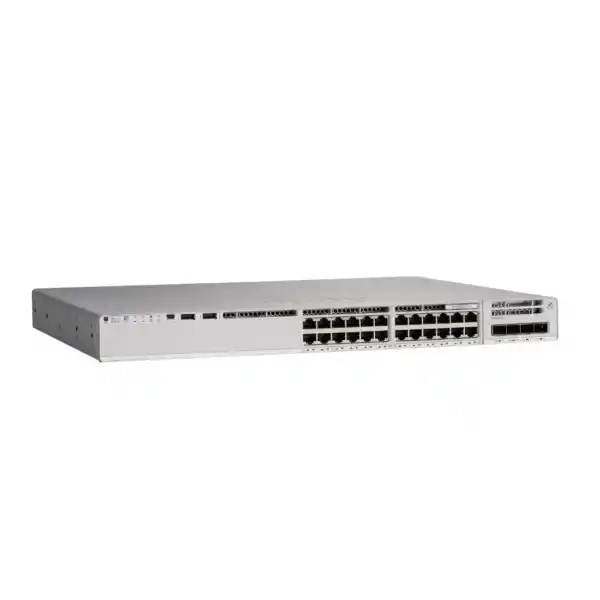
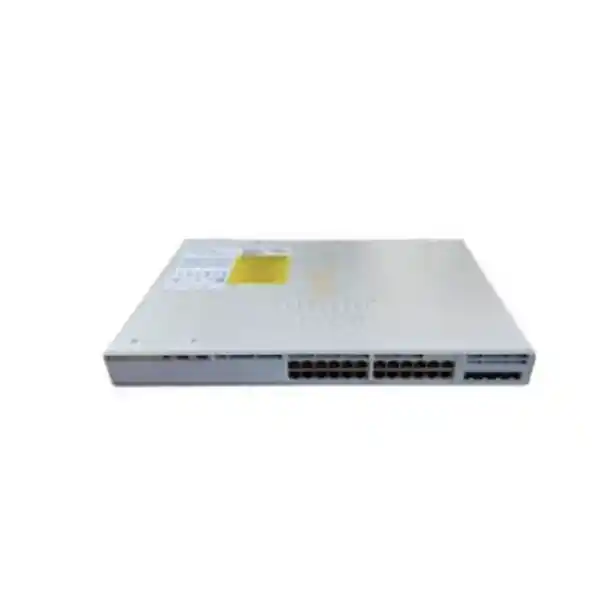
Cisco Catalyst C9200L-24P-4G Network Switch UAE
The Cisco Catalyst C9200L-24P-4G is a 24-port Gigabit Ethernet PoE+ access switch with four fixed 1G SFP uplinks, StackWise-80 support, Cisco IOS XE software, enterprise segmentation controls and a power architecture designed for dependable edge connectivity. It is especially relevant for UAE organizations that need a compact one-rack-unit switching platform for IP phones, wireless access points, cameras, user workstations, printers, building systems and other powered or non-powered Ethernet devices without moving to a higher-cost multigigabit or 10G-uplink access design.
Best fit: enterprise access-layer deployments requiring 24 PoE+ copper ports and 1G fiber uplinks.
PoE capacity: 370 W with one 600 W AC supply; platform power design can support up to 740 W with the supported dual-supply configuration.
Stacking: optional StackWise-80 architecture for multi-switch access blocks.
What the C9200L-24P-4G is designed to solve
A modern access switch has to do more than provide Ethernet ports. It sits at the point where people, phones, access points, cameras, sensors and operational technology enter the network, so its design affects user experience, fault isolation, security enforcement, power delivery and the amount of operational effort required to run the site. The Cisco Catalyst C9200L-24P-4G is designed for that access-layer role. Its twenty-four 10/100/1000BASE-T PoE+ interfaces can carry ordinary workstation traffic or power IEEE PoE devices, while four fixed 1G SFP interfaces provide fiber or copper-transceiver uplink flexibility to a distribution layer, core, firewall zone, data room or another switching block.
For UAE deployments, that combination is useful in offices where access bandwidth is still predominantly 1 Gbps per endpoint and where upstream traffic can be engineered around one or more 1G SFP links or aggregated uplinks. Typical examples include business floors with IP telephony, clinics, warehouses with handheld terminals, hotels with room or back-office connectivity, retail branches, school blocks, government satellite sites, showrooms, small server rooms and distributed operational sites. The switch is also suitable as a standardization platform when an organization wants Cisco IOS XE across multiple locations without deploying a larger Catalyst model at every branch.
The important sizing point is that this is the 4G fixed-uplink variant. Its uplink interfaces are 1G SFP, not 10G SFP+. Where a design requires sustained multi-gigabit northbound capacity, dense Wi-Fi traffic aggregation, high-volume east-west video traffic or growth toward 10G uplinks, the C9200L-24P-4X or a higher platform may be a more appropriate comparison. FourTeck can help UAE teams evaluate access-port count, uplink oversubscription, PoE load and stacking requirements before the bill of materials is finalized.
Gigabit Ethernet edge connectivity for powered and non-powered devices.
Dedicated uplink interfaces for fiber or supported SFP media options.
A practical power pool for phones, cameras and standard enterprise access points.
Platform forwarding fabric sized for the 24-port 1G access model and uplinks.
Hardware packet forwarding performance for the standalone switch.
Optional C9200L stacking architecture for resilient access blocks.
Port architecture and traffic engineering
The front-panel architecture is straightforward: twenty-four Gigabit Ethernet PoE+ downlink interfaces and four fixed 1G SFP uplink interfaces. That simplicity is an advantage when the design objective is a predictable branch or floor switch. Endpoint ports can be divided into data, voice, camera, wireless, management and building-services VLANs. The SFP interfaces can be assigned as routed links, 802.1Q trunks, EtherChannel members or other supported uplink roles depending on the software license and release. Because the uplinks are fixed, there is no separate modular uplink card to select for this specific C9200L-24P-4G model.
The 56 Gbps standalone switching capacity and 41.67 million packets per second forwarding rate are appropriate for the platform’s 1G port mix. With stacking, Cisco lists up to 136 Gbps switch capacity and 101 Mpps forwarding rate for this model. Those numbers should be interpreted as platform capabilities, not as a guarantee that every real application will achieve an identical traffic profile. Actual throughput depends on packet size, enabled features, traffic distribution, uplink design, routing and policy operations, cabling, optics and the behavior of connected devices.
For network architects, the more useful exercise is an oversubscription model. A switch serving twenty-four office endpoints rarely sees every access port transmitting at line rate simultaneously. However, a switch serving many cameras, backup clients, high-resolution content endpoints or busy access points can build sustained northbound traffic. If two 1G uplinks are combined into an EtherChannel, the aggregate offers additional path capacity, but individual flows still hash across members rather than becoming a single 2 Gbps session. Designs with expected aggregate traffic well above the practical capacity of 1G uplinks should consider the 4X variant or a higher-capacity access family before purchase.
PoE+ engineering: turning a watt budget into an endpoint plan
PoE is often where access-switch designs fail during procurement. Counting twenty-four PoE-capable ports is not enough; the electrical load must also fit within the available PoE power pool. The C9200L-24P-4G uses a 600 W AC power-supply option and provides a 370 W PoE budget in a single-supply configuration. With the supported dual-supply configuration, Cisco lists up to 740 W available for PoE on this model. The second supply can therefore be considered both in the context of power availability and in the broader resilience design, but the exact operating policy should be matched to the intended redundancy and load plan.
A reliable quotation starts with the real endpoint inventory. Twenty desk phones at 7 W each represent a very different load from twenty-four high-feature wireless access points or PTZ cameras. The correct method is to record the maximum expected power draw per endpoint, add a design margin for device replacement and future growth, and then compare the total against the PoE budget. A deployment of twelve phones, six cameras and four access points may fit comfortably, while another deployment with fewer devices may exceed the budget if the devices have much higher power requirements. Port count and watt count must therefore be calculated independently.
The switch supports IEEE 802.3af and 802.3at power standards, making it suitable for common PoE and PoE+ endpoint categories. It is still important to verify each endpoint’s standard, power class and cabling conditions. Non-standard passive PoE equipment should not be assumed compatible. Long cable runs, poor copper quality, incorrect termination and excessive bundle heating can introduce practical problems even when the switch has sufficient rated wattage. In UAE buildings, structured cabling should be validated against the intended thermal and installation environment, especially in ceiling spaces and densely bundled pathways.
For sites that combine switches with firewalls, servers, UPS systems and rack power distribution, FourTeck can coordinate the broader infrastructure scope through FourTeck IT Services UAE. The objective is to size the switch, UPS runtime, power distribution and rack thermal load as one system rather than as unrelated components.
Example: voice-led branch
Assume eighteen IP phones drawing approximately 7 W each, four ceiling access points drawing approximately 18 W each, and two fixed cameras drawing approximately 10 W each. The indicative powered-device load is about 218 W before engineering margin. That profile can fit within a 370 W PoE pool, leaving room for startup variation, replacement devices and a modest amount of growth. Exact device data sheets must still be used for the final calculation.
The design can place phones in a voice VLAN, workstations in a data VLAN, AP management in an infrastructure VLAN and cameras in an isolated security VLAN. QoS classification, DHCP snooping, 802.1X or other access policies can then be applied according to the organization’s security baseline and license capabilities.
Example: surveillance-heavy site
A camera-oriented site may use fewer than twenty-four ports but consume more power and generate more continuous traffic. PTZ cameras, heaters, infrared arrays or advanced analytics endpoints can have materially higher wattage than desk phones. In this scenario the engineer should model both the PoE envelope and the uplink load created by sustained video streams. A switch that is acceptable electrically may still need a different uplink model if the aggregate video rate approaches the practical limits of the 1G SFP design.
For surveillance traffic, segmentation, multicast behavior, recorder placement and failure domains also matter. Keeping camera networks controlled and predictable can reduce the impact of broadcast or security events on business traffic.
StackWise-80 and resilient access design
The C9200L family supports StackWise-80. For this model, stacking is not simply a method of placing multiple switches in the same rack; it is a design mechanism that can simplify management and provide a more coherent access block. Cisco specifies 80 Gbps stacking bandwidth for C9200L models. A stack can be useful when a floor needs more than twenty-four ports, when uplinks need to be distributed across physical members, or when operations teams want a reduced management footprint compared with individually administered switches.
The stack interface requires the appropriate C9200L stack kit and stack cabling. That hardware should be included in the bill of materials when stacking is part of the deployment plan; it should not be assumed to be present because the switch is stack-capable. Stack cable length also matters in rack layout. A design with switches immediately adjacent in a cabinet needs different cable planning from a layout with intervening equipment or physically separated positions. Cable routing should avoid blocking airflow, power-supply access or service paths.
Resilience should be designed end to end. A switch stack can reduce some device-level failure concerns, but it does not remove dependence on upstream topology, power, optics or cabling. A well-designed access block may spread uplinks across different stack members, terminate those uplinks on redundant upstream devices where appropriate, use redundant switch power supplies, and feed those supplies from independent UPS or power-distribution paths when the site demands higher availability. Conversely, a small branch may decide that a single switch and single uplink are acceptable because business impact and budget are modest. Availability engineering should match the service requirement rather than applying the same topology everywhere.
When stacked, Cisco lists 136 Gbps switch capacity and 101 Mpps forwarding for the C9200L-24P-4G. These figures reflect the platform with stacking and help explain why stack design is more than a physical port-count expansion. For practical deployment, engineers should also consider control-plane roles, failure recovery, software maintenance procedures and the operational impact of adding or replacing a member.
Performance and scalability reference
Enough Layer 2 table scale for typical branch and access-layer endpoint populations, while still requiring proper broadcast-domain design.
Cisco lists 8,000 direct and 3,000 indirect routes for C9200L scale. Feature and template planning remains important.
Useful for routed-access and branch designs that remain inside the platform’s intended scale.
Supports IPv6 planning while reinforcing the importance of route-scale forecasting for larger environments.
A broad VLAN namespace with substantial SVI scale for segmented access networks.
Buffering for Gigabit models; QoS and congestion design remain important during microbursts or oversubscribed uplink conditions.
Additional published C9200L platform figures include 1,000 multicast routing entries, 1,000 QoS scale entries, 1,500 ACL scale entries, 16,000 Flexible NetFlow entries on Gigabit Ethernet models, 2 GB DRAM, 4 GB flash, 128 PVST instances, 13,000 STP virtual ports and jumbo frames up to 9198 bytes. These are engineering ceilings, not recommended targets. Production networks should retain operational headroom and verify feature interactions in the intended IOS XE release.
Layer 2 design: VLANs, spanning tree and endpoint control
In a conventional enterprise access design, most C9200L-24P-4G ports operate as Layer 2 access interfaces. VLANs separate user groups, services, security zones and operational functions. A branch may have corporate data, voice, guest access, CCTV, printer, building management and network-management VLANs. The switch supports up to 4094 VLAN IDs at the platform level, but a clean design normally uses only the VLANs required at a site. Carrying every corporate VLAN to every access switch increases broadcast scope, troubleshooting complexity and the chance of configuration mistakes.
Spanning Tree Protocol remains relevant whenever Layer 2 redundancy creates potential loops. C9200L platform scale includes 128 PVST instances and substantial virtual-port capacity. Whether an organization uses Rapid PVST+, MST or another approved topology, root placement and failure behavior should be intentional. An uplink should not become the accidental spanning-tree root path because of default values. Engineers should define root priorities at the distribution layer, use appropriate edge-port behaviors, and apply protections such as BPDU Guard where the architecture calls for them.
Endpoint control should also be treated as part of Layer 2 design. Port security, DHCP snooping, Dynamic ARP Inspection, IP Source Guard, storm-control, 802.1X, MAB and related capabilities can reduce the attack surface when deployed correctly and supported by the selected software tier. The actual control set should be validated against the organization’s authentication, ISE, NAC and identity strategy. Turning on every feature without operational planning can create support problems; leaving access ports unprotected can create avoidable risk. The correct balance is a documented edge policy with tested exception handling for phones, printers, cameras and non-802.1X devices.
For customers combining switching with perimeter protection, secure remote access or branch firewall modernization, the FourTeck Firewall Dubai team can align access-layer segmentation with firewall zones and inter-VLAN security policy instead of treating the switch and firewall as isolated projects.
Layer 3 and routed-access considerations
The Catalyst 9200 family can participate in Layer 3 enterprise designs, but feature availability depends on the Network Essentials or Network Advantage software level and on the running IOS XE release. This distinction matters during procurement because the hardware model name C9200L-24P-4G does not, by itself, identify whether the ordered unit is the -E or -A software variant. Cisco ordering references list C9200L-24P-4G-E for Network Essentials and C9200L-24P-4G-A for Network Advantage. FourTeck quotations should therefore state the required license tier rather than assuming all C9200L-24P-4G units provide the same advanced routing capability.
For a small site, the switch may perform basic inter-VLAN routing and use a default route toward a firewall. In a larger campus, the access switch may remain Layer 2 with SVIs and routing concentrated at distribution. Routed access can reduce Layer 2 failure domains and improve deterministic path control, but it also introduces routing policy, address planning and operational requirements at the edge. The right architecture depends on organization size, troubleshooting skill, redundancy goals and the selected Catalyst license.
Cisco’s C9200L scale figures include 11,000 total IPv4 routes, divided into 8,000 direct and 3,000 indirect routes, plus 3,000 IPv4 routing entries and 1,500 IPv6 routing entries. Those numbers make clear that the platform supports meaningful Layer 3 operation while remaining an access-class switch rather than a core routing platform. Route scale should be reviewed when many VRFs, summaries, dynamic peers or redistributed prefixes are expected. Network architects should also maintain margin for software changes and feature interactions.
Where the access network terminates near local application servers, storage or virtualization hosts, the switch should not automatically be selected as a server aggregation switch merely because it has available ports. Server-facing designs often need higher uplink bandwidth, larger buffers, multigigabit or 10/25G interfaces and different resiliency characteristics. For those projects, FourTeck can coordinate switching requirements with Server Dubai infrastructure planning to avoid a mismatch between access-layer hardware and data-center traffic patterns.
Cisco IOS XE: operations, automation and lifecycle
The C9200L-24P-4G runs Cisco IOS XE, which gives organizations a common operational model across the Catalyst 9000 family. For experienced Cisco teams, that means familiar CLI workflows as well as modern programmability and management options. Cisco positions the platform for automation, visibility and policy-based operations, with management capabilities varying according to the base network license, subscription tier and tooling in use. The platform can therefore fit both traditional command-line environments and organizations moving toward controller-based operations.
Software lifecycle planning is essential. A switch should be deployed on an IOS XE train that is supported for the required features, security posture and surrounding infrastructure. Upgrading is not simply a matter of loading the newest image; teams should review release notes, open caveats, compatibility with transceivers and endpoints, stack behavior, controller versions, authentication infrastructure and licensing state. Change windows should include configuration backup, rollback planning and post-upgrade validation of interfaces, routing, PoE, spanning tree, logs and monitoring.
Automation can reduce configuration drift across many UAE branches. NETCONF, RESTCONF, model-driven telemetry, APIs and controller workflows can be incorporated according to the selected software capabilities and enterprise toolchain. A repeatable branch template can define VLANs, trunks, authentication settings, QoS, logging, SNMP or telemetry, NTP, AAA, banners and interface standards. The benefit is not automation for its own sake; the benefit is consistent intent, faster rollout and easier auditing. Human review remains important for site-specific addressing, uplink paths and exceptions.
Organizations that are not ready for full controller adoption can still gain value from disciplined IOS XE operations. Standard configuration templates, version control, centralized authentication, scheduled backups, syslog, monitoring and documented change procedures provide a strong operational baseline. The switch does not force a single management style; the procurement decision should therefore consider the team’s current operating model and desired direction over the equipment lifecycle.
Licensing: Network Essentials, Network Advantage and subscription terms
Cisco offers the C9200L-24P-4G with Network Essentials or Network Advantage base software. The corresponding hardware ordering suffix identifies the base tier: -E denotes Network Essentials and -A denotes Network Advantage. Cisco also offers term-based Catalyst or Cisco DNA subscription options in Essentials and Advantage levels, commonly available in three-, five- or seven-year terms. Current Cisco ordering guidance requires subscription licensing on new orders and aligns the subscription tier with the network license tier. Because commercial packaging evolves, the exact part number and subscription combination should be confirmed on the quotation date.
Network Essentials is aimed at foundational enterprise switching, while Network Advantage expands capabilities for organizations that need more advanced routing, segmentation and policy functions. The important purchasing lesson is to choose the tier from required features, not from the assumption that a more expensive license is automatically necessary. A straightforward Layer 2 branch may be fully served by the Essentials feature set, while a routed-access, advanced segmentation or specific assurance design may require Advantage. Cisco Feature Navigator and the current licensing matrix should be checked for any feature that is a hard project requirement.
Subscription licensing should also be recorded in asset and renewal processes. A term subscription is not the same as the perpetual network base license. Teams should know the start date, term, Smart Account ownership, virtual-account placement, support scope and renewal responsibility. Poor license governance can create avoidable operational work years after installation when the original project team is no longer available.
For a production order, FourTeck recommends stating the required base tier, subscription term, support coverage and Cisco Smart Account details in the procurement checklist. That approach reduces ambiguity between a generic C9200L-24P-4G request and the exact orderable software configuration that the customer intends to operate.
Choose Network Essentials when
The site is primarily an access-layer deployment with conventional VLANs, PoE endpoints, standard Layer 2 security and basic Layer 3 requirements; advanced routing or segmentation features are not part of the design; and the organization’s management model fits the Essentials capabilities. Always validate every mandatory feature against the current Cisco licensing matrix before ordering.
Choose Network Advantage when
The architecture requires features beyond the Essentials tier, such as advanced routing, segmentation or policy functions identified in the current Cisco feature matrix. Advantage should be justified by the design rather than selected purely from model name. The final BoM must use the appropriate -A hardware/software bundle and matching subscription tier.
Security architecture at the access edge
Access switches are security enforcement points because they see devices before traffic reaches a firewall or application service. The C9200L-24P-4G can participate in a layered enterprise security design through identity-aware access, segmentation, Layer 2 protections, ACLs, telemetry and policy capabilities that vary by license and release. The objective is to make an Ethernet jack a controlled access point rather than an implicitly trusted connection.
An enterprise baseline may include centralized AAA for administrators, role-based access to management functions, secure management protocols, SNMPv3 or telemetry, authenticated NTP, syslog, SSH, unused-port shutdown, BPDU protection on edge ports, DHCP snooping, source validation and 802.1X with fallback methods for devices that cannot authenticate interactively. The exact policy should be tested because phones, printers, cameras, badge readers and industrial devices can behave differently under authentication or reauthorization events.
Segmentation is equally important. Cameras should not share unrestricted access with finance workstations. Guest wireless infrastructure should be separated from internal administration. Building-management controllers may need narrow application paths rather than general network reachability. Voice devices may need dedicated QoS and DHCP behavior. The switch can provide VLAN and access-policy boundaries, while a firewall or upstream security layer can enforce inter-zone controls. Where an organization uses Cisco identity or software-defined access tooling, the switching platform can participate in broader policy workflows subject to the appropriate license and architecture.
Security also includes software maintenance and supply-chain discipline. Equipment should be sourced through a trusted channel, serials and licensing should be recorded, IOS XE versions should be tracked, and configuration backups should be protected. FourTeck’s UAE technology team can align switching procurement with installation, migration and support requirements for multi-site projects.
Uplink sizing: the most important limitation to understand
The C9200L-24P-4G uses four fixed 1G SFP uplinks. This is not a defect; it is a deliberate product position. For many branches and conventional offices, 1G uplinks are sufficient and economically sensible. The risk appears when the product is selected from access-port count alone and the northbound traffic requirement is never calculated. Twenty-four 1G edge ports can theoretically offer far more aggregate endpoint bandwidth than a single 1G uplink can carry, so oversubscription is inherent in typical access designs.
Oversubscription is acceptable when traffic is bursty and most endpoints do not transmit at line rate simultaneously. Office PCs, phones and printers usually fit that pattern. It becomes less comfortable when the site has many high-bitrate cameras, local backup windows, large engineering files, content-production workflows, dense Wi-Fi client populations or applications that constantly move data to centralized servers. In those cases, engineers should measure or estimate busy-hour traffic rather than rely on a generic access ratio.
Multiple 1G uplinks can be aggregated with EtherChannel where the upstream design supports it. This increases aggregate capacity and can add path resilience, but it does not turn every individual conversation into a multi-gigabit flow. Hashing distributes flows across member links. A single large TCP session may remain bound to one member, while many independent sessions can distribute more effectively. This behavior is why an aggregate of four 1G interfaces is not operationally identical to one 4G interface.
If uplink demand is expected to grow, compare the C9200L-24P-4G with the C9200L-24P-4X, which uses 1/10G fixed uplinks, or with another Catalyst platform appropriate to the required feature set. Buying the lower-uplink model and replacing it early can cost more than selecting the right variant during the initial design.
QoS for voice, video and business applications
Quality of Service is important whenever delay-sensitive traffic shares an uplink with bulk traffic. The C9200L platform provides QoS capabilities and a published scale of 1,000 QoS entries. In a voice-enabled branch, endpoint markings should not simply be trusted from every device. A common design establishes a trust boundary at the phone or switch port, classifies traffic, preserves valid voice markings and remarks untrusted traffic according to policy. Queuing then protects latency-sensitive traffic during congestion.
QoS cannot create bandwidth that does not exist. If a 1G uplink is chronically saturated, queuing can prioritize critical applications but lower-priority traffic will still experience delay or loss. The correct order of operations is to size bandwidth first and use QoS to manage contention and service objectives. Monitoring should confirm whether congestion is occasional and controllable or persistent enough to require additional uplink capacity.
Video surveillance requires a different treatment from interactive voice. Camera traffic may be continuous and predictable, which helps capacity planning, but large groups of cameras can consume substantial aggregate bandwidth. Business video conferencing is more burst-sensitive and may require careful prioritization. Wireless traffic can include voice, meetings, downloads and guest applications simultaneously. The access switch should therefore be configured as part of an end-to-end QoS design that includes the upstream switches, WAN edge and firewall rather than using isolated queue settings at one hop.
When migrating from older Catalyst generations, QoS syntax and default behaviors should be reviewed rather than copied blindly from legacy templates. IOS XE provides modern policy constructs, but policy intent should be revalidated against the new topology, application mix and software release.
Flexible NetFlow, monitoring and troubleshooting visibility
Visibility is one of the strongest arguments for choosing an enterprise access platform over an unmanaged or lightly managed switch. C9200L Gigabit Ethernet models support a published Flexible NetFlow scale of up to 16,000 flows. Flow telemetry can help operations teams understand which endpoints communicate, where bandwidth is going, and whether unexpected traffic patterns appear after a change or security event. It should be integrated with a collector and retention strategy rather than enabled without a plan for consuming the data.
Traditional monitoring also remains valuable. Interface counters reveal errors, drops, utilization and duplex problems. Syslog captures state transitions and security events. SNMP or modern telemetry can feed infrastructure monitoring systems. LLDP and CDP aid topology and endpoint identification. PoE status identifies powered-device allocation and faults. Spanning-tree state exposes path selection. EtherChannel counters show member distribution. Routing tables and neighbor state validate Layer 3 behavior. A mature operations team combines these signals rather than relying on a single dashboard metric.
Troubleshooting should start at the symptom boundary. If a phone loses power, check PoE allocation, cable condition, port state and endpoint negotiation before assuming a routing problem. If users report slowness, inspect errors, utilization, queue drops, uplink aggregation and path changes before replacing hardware. If a VLAN is unavailable, verify access mode, trunk allowed lists, spanning tree, SVI status and upstream routing. A well-documented C9200L deployment gives engineers clear checkpoints at each layer.
For distributed UAE networks, centralized monitoring is particularly useful because many incidents occur far from the main IT team. Standard device naming, site codes, management IP conventions, NTP and log destinations make remote troubleshooting faster and reduce dependence on local hands.
Physical design, rack planning and environmental fit
The C9200L-24P-4G is a one-rack-unit switch. Cisco lists chassis dimensions of approximately 1.73 × 17.5 × 11.3 inches, or 4.4 × 44.5 × 28.8 cm, with depth extending to approximately 12.9 inches or 32.9 cm in the configuration reflected in Cisco’s dimensional table. The published weight is about 10.38 lb or 4.71 kg. These dimensions make the switch suitable for standard 19-inch racks and many branch cabinets, but installers should still account for rear power-supply clearance, stack cabling, fiber bend radius and front-to-rear service access.
C9200L models use fixed fans rather than field-replaceable fan modules, while the chassis provides two power-supply slots. The switch should be installed with the airflow path unobstructed. Cable managers should keep patch cords from blocking the front intake or rear exhaust area. In compact wall cabinets, depth and heat accumulation deserve particular attention because a cabinet that physically accepts a 1RU switch may still provide poor airflow after a UPS, firewall and patch panels are installed.
UAE installations can range from climate-controlled data rooms to small telecom closets exposed to higher ambient temperatures, dust or inconsistent housekeeping. The equipment room should stay within Cisco’s specified operating environment and should be protected from direct heat sources, moisture and contamination. Where cooling is marginal, the correct solution is not to assume the switch will tolerate continuously elevated temperatures; the room or cabinet should be improved to match equipment requirements.
Cisco publishes an MTBF figure of approximately 392,210 hours for the C9200L-24P-4G. MTBF is a statistical reliability measure, not a warranty that an individual switch will run for a specific number of years. Practical availability depends on power quality, thermal environment, maintenance, software, upstream redundancy and the organization’s spare strategy.
Rack deployment checklist
Confirm 1RU space, rail or rack-mount hardware, front and rear service clearance, patch-panel location, fiber management, UPS capacity, available socket type, redundant power-feed requirements, grounding practice, stack cable route, SFP access, console access and cabinet ventilation. Label every uplink, stack cable and power feed before handover so the physical topology matches network documentation.
Branch cabinet checklist
Measure cabinet depth rather than assuming rack-unit count is sufficient. Confirm door clearance with patch cords installed, maintain airflow around fixed fans, avoid tight fiber bends, separate power and data where practical, verify UPS runtime at realistic PoE load, and ensure local staff can identify the switch without disconnecting live cables. Remote branches benefit from clear photographs and port maps stored with the site record.
Optics and uplink media selection
The four fixed uplink ports are SFP interfaces operating at 1 Gbps. The correct transceiver depends on media type, fiber grade, distance, connectorization and the supported Cisco optics matrix for the hardware and software release. Short multimode links inside a building may use one optic type, while longer single-mode links between buildings or across a campus may require another. Copper SFP options may be considered where supported, but copper uplinks should still be engineered for distance, grounding and electromagnetic environment.
Do not select optics solely by connector appearance. A pair of LC connectors can represent different wavelengths and fiber types. Both ends of the link must use compatible optics, and the fiber plant must support the wavelength and distance. Existing multimode fiber should be identified by type because older fiber may have different distance characteristics than newer OM3 or OM4 cabling. Single-mode links should be checked for optical budget, patch-panel loss and any intermediate cross-connects.
For resilient uplinks, two fibers should preferably follow independent physical paths when the business requirement justifies it. Two logical links routed through the same tray or conduit can fail together during construction damage. In multi-building UAE campuses, civil-path diversity and outdoor fiber protection can matter more than the choice of switch. The network design should therefore document both logical redundancy and physical-path redundancy.
When requesting a quote, state whether SFP optics, fiber patch cords and upstream transceivers are required. A switch-only quotation may otherwise omit the components needed to turn the uplink ports into a working link.
Deployment topologies for UAE businesses
Single branch topology: One C9200L-24P-4G serves phones, PCs, printers, access points and cameras. One or two SFP uplinks connect to a local firewall or aggregation switch. VLANs separate user, voice, wireless and security traffic. This is the simplest deployment and works well when a single switch failure is an accepted site risk or when a spare replacement process exists.
Two-switch resilient branch: Two C9200L switches form an access block, potentially using StackWise-80 with the required stack kit. Uplinks are distributed across members and connect to resilient upstream infrastructure. This design reduces the impact of a single access-switch or uplink failure and provides additional port growth. Power supplies can be selected with redundancy objectives in mind, and UPS feeds can be separated where the electrical design supports it.
Floor access topology: Each office floor has one or more switches connected by fiber to a building distribution pair. User VLANs may remain local to the floor or extend as required by the campus architecture. The key design questions are uplink bandwidth, spanning-tree or routed-access strategy, endpoint authentication, PoE load and how much failure isolation the building needs. The 4G model fits floors where 1G uplinks are sufficient; higher-throughput floors should be compared with 10G-uplink variants.
Retail or hospitality topology: The switch powers phones, point-of-sale peripherals, access points, cameras and back-office devices. Segmentation prevents guest or surveillance traffic from mixing freely with payment or corporate systems. Centralized management and standardized templates are valuable because many locations may be administered by a small IT team. Local UPS sizing should include the PoE load so phones and access points do not fail immediately during short power interruptions.
For multi-country organizations, FourTeck can also coordinate regional requirements through its broader global technology presence, while the UAE project retains a local procurement and deployment focus.
Migration from older Cisco access switches
Organizations replacing older Catalyst access platforms should treat migration as a redesign checkpoint rather than a like-for-like hardware swap. Legacy configurations may contain VLANs no longer in use, outdated spanning-tree priorities, obsolete SNMP communities, local administrator accounts, permissive trunk lists, inconsistent QoS commands or interface descriptions that no longer match reality. Moving to a C9200L creates an opportunity to simplify and standardize the access layer.
The first step is discovery. Export the running configuration, inventory connected devices, identify PoE consumption, record uplink media, capture VLAN and trunk requirements, note any special multicast behavior, and check whether phones or access points rely on option-specific DHCP services. Measure busy-hour uplink utilization if possible. This data reveals whether the C9200L-24P-4G is the correct model or whether 48 ports, higher PoE budget, multigigabit access or 10G uplinks are required.
The second step is configuration translation. IOS XE syntax is familiar to Cisco engineers, but unsupported or legacy commands should not be pasted into a production template without review. Build a clean baseline containing management, AAA, NTP, logging, spanning tree, VLANs, uplinks, endpoint security, QoS and monitoring. Apply site-specific variables separately. Lab validation is especially useful when migrating 802.1X, voice VLANs, third-party phones, cameras or unusual industrial endpoints.
The final step is cutover control. Label cables before removal, preconfigure the new switch, validate optics and stack components, schedule a rollback window, and verify critical services after migration. Post-cutover checks should include PoE state, phone registration, DHCP, DNS, internet reachability, application access, camera streams, wireless AP join status, spanning-tree state, routing neighbors and monitoring alarms. A successful migration is measured by service stability and clean documentation, not merely by link LEDs.
Where several UAE branches are being refreshed, a pilot site can expose template issues before the full rollout. Standardized packing lists, pre-staging and port-mapping sheets then reduce field variation across subsequent sites.
Sizing methodology before ordering
A strong switch quotation begins with four independent calculations: port count, PoE wattage, uplink throughput and feature licensing. Port count asks how many Ethernet devices connect today and how many are expected during the equipment lifecycle. PoE wattage asks how much power those devices can draw. Uplink throughput asks how much traffic leaves the switch during the busiest period. Licensing asks which Layer 2, Layer 3, automation, assurance and segmentation capabilities the design actually requires. If any one of these four is ignored, the selected switch can be wrong even when the other three look correct.
For port count, reserve sensible growth capacity rather than filling all twenty-four interfaces on day one. Spare ports help when a department adds desks, a camera is relocated or a second access point is needed. The amount of headroom depends on the site. A stable equipment room may need little growth, while a changing office floor may benefit from substantial spare capacity. If the plan requires more than twenty-four ports immediately, compare a 48-port model or a two-switch design rather than assuming unmanaged extensions will be added later.
For PoE, use the endpoint’s maximum or design draw and include startup behavior. For uplinks, model busy-hour traffic and growth. For licensing, create a short mandatory-feature list and map each item to Cisco’s current feature matrix. For optics, document both ends of every link. For stacking, include stack kits and appropriate cable lengths. For resilience, decide whether a second PSU is required and whether it must be on a separate power source.
This methodology also makes quotations easier to compare. Two suppliers can appear to quote the same C9200L-24P-4G while including different licenses, subscription terms, PSUs, optics, support levels or stack components. A component-level bill of materials eliminates that ambiguity.
When the C9200L-24P-4G is the right choice—and when it is not
It is a strong fit when the access layer needs twenty-four 1G PoE+ ports, the endpoint power requirement fits the available PoE budget, 1G SFP uplinks satisfy the traffic plan, Cisco IOS XE is part of the operating standard, and optional StackWise-80 provides the desired growth or resilience model. It is also attractive when the organization wants a Catalyst 9000 family access switch without paying for multigigabit downlinks or 10G fixed uplinks that the site does not need.
Consider the C9200L-24P-4X instead when the access design is otherwise correct but northbound capacity needs 10G SFP+ capability. This is common in busier floors, dense wireless environments or camera deployments with large aggregate traffic. Choosing 4X at the outset can preserve growth capacity and reduce future replacement cost.
Consider a 48-port model when the rack has enough structured cabling density that two separate 24-port switches would add unnecessary complexity. Conversely, two 24-port switches may be preferable when fault isolation or physical distribution matters more than port density.
Consider a higher Catalyst family when the design requires greater routing scale, higher uplink speed, multigigabit access, more advanced hardware features or a role closer to campus distribution/core. An access-switch purchase should not be stretched into a different architectural role simply because the model is familiar.
The correct decision is therefore not “Is the C9200L-24P-4G a good switch?” It is “Does its access count, PoE envelope, 1G uplink architecture, stacking model and licensed feature set match this site’s measured requirements?” That question produces a defensible procurement decision.
UAE procurement and project-delivery considerations
Enterprise switch purchasing in the UAE should account for more than hardware availability. The quotation should identify the exact software suffix, subscription term, PSU configuration, stack components, optics, support coverage and any required installation services. Model shorthand can conceal material differences. “C9200L-24P-4G” describes the hardware family and uplink type, but the final orderable configuration must reflect Network Essentials or Network Advantage and the applicable subscription packaging.
Lead time can also differ between base hardware, power supplies, optics and accessories. A project can have the switches in hand but still be blocked by missing SFPs, stack kits or rack hardware. For scheduled office moves and branch openings, the bill of materials should therefore be validated as a complete operational set. Staging can begin before site delivery by assigning management addresses, loading an approved IOS XE release, applying base configuration, registering licensing, and validating stack formation where applicable.
Warranty and support requirements should match business criticality. A small non-critical branch may accept standard replacement processes, while a customer-facing operation may require a support contract with faster hardware replacement and software support. Organizations should also decide whether they maintain local cold spares. A spare can reduce outage duration but must be stored, tracked and periodically checked rather than forgotten in a cabinet.
FourTeck can supply the switch as part of a wider UAE deployment that includes design review, configuration, rack integration, optics, structured migration planning and post-cutover validation. The objective is a working access layer with a traceable bill of materials and supportable configuration, not simply delivery of a sealed switch.
Frequently asked technical questions
Does the C9200L-24P-4G have 10G uplinks?
No. This model has four fixed 1G SFP uplink ports. If 10G fixed uplinks are required, compare the C9200L-24P-4X or another appropriate Catalyst platform.
How many PoE ports are available?
All twenty-four access ports are PoE+ capable. The number of simultaneously powered devices depends on each device’s demand and the total available PoE budget, not only on port count.
What is the PoE budget?
Cisco lists 370 W PoE with one PWR-C5-600WAC supply for the C9200L-24P-4G and up to 740 W in the supported dual-supply configuration. Final design should calculate endpoint wattage and desired power redundancy.
Can the switch be stacked?
Yes. C9200L models support StackWise-80. The appropriate C9200L stack kit and stack cable must be included when stacking is required.
What is the standalone switching performance?
Cisco lists 56 Gbps switching capacity and 41.67 Mpps forwarding rate for the C9200L-24P-4G. With stacking, the listed figures are 136 Gbps and 101 Mpps respectively.
Is Network Advantage included?
Not necessarily. The model is offered in Network Essentials (-E) and Network Advantage (-A) variants. The quotation must state which software tier is included.
Can I use this as a core switch?
It is primarily an enterprise access platform. A small network may use it for combined switching and routing roles, but campus core and high-throughput server aggregation designs should be assessed against higher-capacity platforms.
Does it support jumbo frames?
Cisco lists jumbo frame support up to 9198 bytes for C9200L models. End-to-end MTU planning is still required; every device and link on the path must support the intended MTU.
How much memory does the C9200L platform have?
Cisco lists 2 GB DRAM and 4 GB flash for C9200L models. These are platform resources and should not be compared directly with general-purpose server memory because the switch uses dedicated networking hardware and an embedded operating environment.
What should I send FourTeck for an accurate quote?
Provide switch quantity, required Network Essentials or Advantage tier, subscription term, endpoint count, estimated PoE wattage, uplink media and distance, optics requirements, stack requirement, second PSU requirement, support level, delivery emirate and whether configuration or installation services are needed.
Technical specification summary
| Access ports | 24 × 10/100/1000BASE-T PoE+ Gigabit Ethernet |
| Fixed uplinks | 4 × 1G SFP |
| Power supply | PWR-C5-600WAC option; two power-supply slots |
| PoE budget | 370 W with one 600 W AC supply; up to 740 W with supported dual-supply configuration |
| Stacking | StackWise-80 support; 80 Gbps stacking bandwidth |
| Switching capacity | 56 Gbps standalone; 136 Gbps with stacking |
| Forwarding rate | 41.67 Mpps standalone; 101 Mpps with stacking |
| MAC scale | 16,000 addresses |
| IPv4 route scale | 11,000 total routes: 8,000 direct + 3,000 indirect; 3,000 IPv4 routing entries |
| IPv6 routing entries | 1,500 |
| VLAN IDs / SVIs | 4094 VLAN IDs / 512 SVIs |
| Packet buffer | 6 MB for Gigabit Ethernet C9200L models |
| Flexible NetFlow | Up to 16,000 flow entries on Gigabit Ethernet models |
| Memory | 2 GB DRAM / 4 GB flash |
| Jumbo frames | Up to 9198 bytes |
| Dimensions | Approx. 1.73 × 17.5 × 11.3 in / 4.4 × 44.5 × 28.8 cm; depth may extend to approx. 12.9 in / 32.9 cm depending on power-supply configuration |
| Weight | Approx. 10.38 lb / 4.71 kg |
| Software | Cisco IOS XE; Network Essentials or Network Advantage ordering variants |
Specifications, feature availability, software packaging and licensing can change by IOS XE release and Cisco commercial program. Final project quotations should verify current orderable part numbers, supported optics and required licenses.
Decision recap: should you deploy the C9200L-24P-4G?
Choose it
You need 24 Gigabit PoE+ ports, 1G SFP uplinks are adequate, Cisco IOS XE is desired, the endpoint power load fits the PoE budget, and StackWise-80 offers useful scale or resilience.
Compare alternatives
Your uplinks need 10G, Wi-Fi or camera traffic is expected to exceed practical 1G aggregation, you need multigigabit access, or your route and policy scale is moving beyond an access-class platform.
Verify before PO
Confirm -E or -A software tier, subscription term, second PSU, stack kit, stack cable length, SFP optics, support coverage, IOS XE target release and installation scope.
Quotation input checklist
Providing the items below lets FourTeck build a precise UAE bill of materials without guessing about licenses, optics or power components.
Number of switches, emirate, branch names and whether units are independent or stacked.
Network Essentials or Network Advantage plus required subscription tier and term.
Phones, APs, cameras and other powered devices with model numbers or maximum wattage.
Fiber type, link distance, connector type, upstream switch model and required number of links.
Second PSU requirement, StackWise requirement, redundant uplinks and UPS feed design.
Pre-staging, configuration, migration, rack installation, testing, documentation and support expectations.
Plan the C9200L-24P-4G as part of the network, not as an isolated line item
The strongest deployment outcome comes from matching access ports, PoE, uplinks, software, optics, power and support to the real site. FourTeck can help UAE organizations validate the bill of materials, compare the 4G and 4X uplink variants, plan stacking and PSU redundancy, select supported optics, prepare IOS XE configurations and coordinate cutover requirements.
For branch refreshes, new offices, campus expansions or multi-site standardization, provide the quotation checklist above. The resulting design can then be reviewed against actual traffic and endpoint requirements before equipment is ordered.
Validated switch variant, license tier, PoE calculation, uplink recommendation, optics list, stacking accessories, PSU plan, pre-staging scope, migration sequence and post-cutover acceptance checks.

Reviews
There are no reviews yet.