
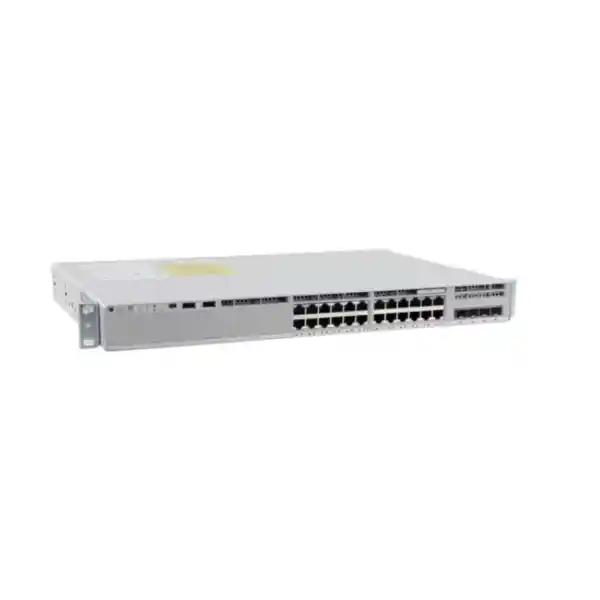
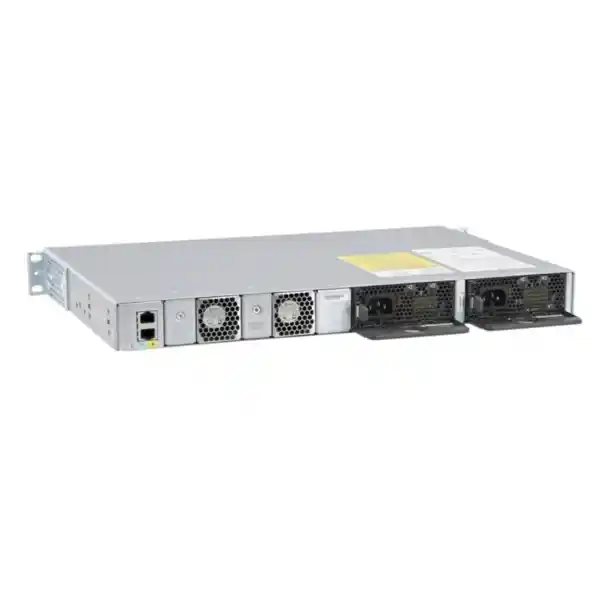
Cisco Catalyst C9200L-24P-4X Network Switch
The Cisco Catalyst C9200L-24P-4X is a fixed-uplink, stackable enterprise access switch designed for organizations that need dependable Gigabit Ethernet at the user edge, integrated PoE+ for powered devices, and high-speed 10 Gigabit Ethernet uplinks without moving into a larger modular access platform. Its 24 copper access ports, four fixed 1/10G SFP+ uplinks, StackWise-80 capability, Cisco IOS XE operating system, and dual power-supply bays make it well suited to offices, schools, clinics, hotels, retail branches, government facilities, warehouses, and distributed enterprise sites across Dubai, Abu Dhabi, Sharjah, and the wider UAE.
For network teams replacing older Catalyst 2960-class access switching, standardizing branch closets, or building a consistent campus edge, the C9200L-24P-4X offers a balanced architecture: enough PoE density for common voice, wireless, security, and IoT loads; enough uplink bandwidth for modern aggregation; and enough software depth for secure segmentation, automation, telemetry, and resilient Layer 2/Layer 3 operations when the correct license tier is selected.
Direct answer: what is the C9200L-24P-4X built to do?
The C9200L-24P-4X is an enterprise access-layer switch. It is intended to connect end-user and edge devices such as desktop computers, VoIP handsets, Wi-Fi access points, surveillance cameras, badge readers, printers, thin clients, building-management controllers, and small server or appliance endpoints. Each of its 24 RJ-45 downlink ports supports 10/100/1000 Ethernet and PoE+, allowing a single copper cable to carry both data and power to compatible endpoints. Four fixed SFP+ uplink interfaces support 1 Gigabit or 10 Gigabit optical or direct-attach connectivity, giving the switch a strong northbound path toward a distribution switch, collapsed core, firewall zone, server aggregation layer, or another access switch where the design calls for it.
The platform is stackable using Cisco StackWise-80. Up to eight supported C9200L members of the same license level can be combined under one logical management and control plane. For a site using eight 24-port members, this creates a practical access block of up to 192 copper edge ports before accounting for design choices, reserved interfaces, and uplink topology. Stacking does not turn the C9200L into a chassis switch, but it can significantly simplify operations because configuration, management, and cross-stack resiliency are handled at the stack level rather than as eight unrelated switches.
The model is especially attractive where a 24-port PoE+ footprint is the correct density. A branch with fifteen phones, six access points, and several cameras may have no reason to deploy a 48-port chassis. Conversely, a site requiring many multigigabit access ports for high-performance Wi-Fi should evaluate Catalyst models with mGig support rather than assume every C9200L copper port can operate above 1 Gbps. Correct model selection starts with endpoint speed, PoE class, uplink oversubscription, resiliency requirements, optics, licensing, and expected growth—not simply with the number of visible RJ-45 sockets.
Core hardware specifications
| Access interfaces | 24 × 10/100/1000BASE-T RJ-45 ports with PoE+ |
| Fixed uplinks | 4 × 1/10 Gigabit Ethernet SFP/SFP+ uplink ports |
| Switching capacity | 128 Gbps; 208 Gbps switch capacity when stacking bandwidth is included |
| Forwarding performance | 95.23 Mpps; up to 155 Mpps with stacking bandwidth included in Cisco platform figures |
| Stacking | StackWise-80, 80 Gbps stack bandwidth, up to 8 supported C9200L members with compatible license level |
| Default AC PSU for PoE model | PWR-C5-600WAC class power supply; two power-supply slots |
| PoE budget | 370 W with one supported 600 W AC PSU; hardware budget can rise to 740 W with a second supported PSU, while 24 × 30 W PoE+ ports impose a 720 W endpoint-delivery ceiling by port count |
| Memory | 2 GB DRAM and 4 GB flash for C9200L Gigabit models |
| Packet buffer | 6 MB on 24/48-port C9200L Gigabit Ethernet models |
| MAC / VLAN scale | Up to 16,000 MAC addresses and 4,094 VLAN IDs for the C9200L family |
| Jumbo frames | Up to 9,198 bytes |
| Chassis | 1.73 × 17.5 × 11.3 in (4.4 × 44.5 × 28.8 cm) chassis depth class; approximately 4.71 kg for C9200L-24P-4X |
| Cooling | Two fixed fans with redundancy; fans on C9200L are not field-replaceable modules |
Platform capacities are design limits rather than sizing targets. Production networks should leave operational headroom for control-plane activity, route growth, bursts, maintenance, and future services.
Access-layer architecture and UADP-based forwarding
Cisco positions the Catalyst 9200 family as an enterprise access platform built on programmable forwarding technology rather than as a simple unmanaged or lightly managed Ethernet switch. The C9200L family uses the UADP 2.0 mini architecture to perform forwarding and policy operations in hardware. In practical terms, this is important because enterprise access switching must do more than move frames from one port to another. A modern access switch may need to apply VLAN classification, access-control policy, quality of service, security group information, routing lookups, multicast handling, telemetry accounting, and other features at line rate while keeping latency and CPU utilization predictable.
For the C9200L-24P-4X, the 128 Gbps switching-capacity figure reflects a port mix that can drive twenty-four 1 Gbps downlinks and four 10 Gbps uplinks in a nonblocking access-oriented design envelope. The four 10G uplinks are particularly valuable because a 24-port switch can aggregate many simultaneous client sessions without forcing all northbound traffic through a single 1G trunk. A typical enterprise design might use two 10G links in a port channel toward a distribution pair, retaining the remaining uplinks for secondary paths, dedicated services, or future changes. The correct topology depends on whether the upstream system is a stack, virtual switching pair, routed core, firewall cluster, or another design.
The 6 MB packet buffer should be considered in the context of access switching rather than compared superficially with large data-center switches. Access workloads typically involve many lower-speed endpoints converging on faster uplinks. Congestion can still occur, especially during microbursts, backup windows, imaging events, high-resolution camera traffic, or oversubscribed wireless usage. Quality-of-service planning therefore remains important. Voice VLANs, real-time collaboration, business-critical SaaS, surveillance, guest traffic, and bulk transfer workloads should not all be treated identically merely because the physical switch has adequate aggregate bandwidth.
The C9200L family scale includes up to 16,000 MAC addresses, up to 11,000 combined IPv4 ARP and learned route entries in Cisco’s stated platform table, 3,000 IPv4 routing entries, 1,500 IPv6 routing entries, 1,000 multicast routing scale entries, 1,500 ACL scale entries, 1,000 QoS scale entries, 512 switched virtual interfaces, and 16,000 Flexible NetFlow entries on Gigabit Ethernet models. These numbers do not mean every deployment should deliberately operate at the maximum simultaneously. Hardware tables are partitioned among features, and software releases, templates, license tiers, and feature combinations affect practical scale. A proper low-level design should validate the specific feature set against the intended Cisco IOS XE release.
The result is a switch that can serve as a disciplined enterprise edge rather than a collection of independent ports. When VLANs, 802.1X, DHCP snooping, Dynamic ARP Inspection, port security, ACLs, QoS, routing, telemetry, and automation are designed coherently, the access layer becomes an active security and operations boundary. That is often the real reason organizations move from older unmanaged or legacy access hardware to Catalyst 9200: not because Gigabit Ethernet itself is new, but because operational consistency, policy enforcement, software lifecycle, and visibility have become essential.
24-port PoE+ design: how to size power correctly
Single-PSU deployment
With one supported 600 W AC power supply, Cisco lists a 370 W available PoE budget for the C9200L-24P-4X. This is enough for many mixed phone, camera, and access-point deployments, but it must be calculated rather than assumed.
Dual-PSU deployment
Adding a second supported power supply increases power availability and resiliency. Cisco lists up to a 740 W PoE budget with two supported 600 W AC supplies, while the 24 PoE+ ports themselves can deliver a maximum theoretical 720 W at 30 W per port.
Operational design
A resilient design should ask what PoE remains after a power-supply failure. If the site must keep every critical phone and access point powered during a PSU fault, normal-state consumption needs enough headroom to fit inside the surviving supply budget.
Endpoint classification
Do not size only from the device label. Confirm negotiated PoE class and actual maximum requirement for each phone, AP, camera, sensor, or accessory. USB modules, expansion key modules, heaters, IR illuminators, and radios can change consumption.
PoE planning is one of the most common causes of access-switch sizing mistakes. A 24-port PoE+ label does not guarantee that every endpoint can draw its maximum power simultaneously under every power-supply state. In a simple example, twelve IP phones averaging 8 W, six wireless access points budgeted at 22 W, and four cameras budgeted at 15 W create a design load of 288 W before adding margin. That fits within a 370 W single-supply budget, but the remaining capacity should be evaluated against startup behavior, model variation, future devices, and the requirement to survive a power-supply failure. If the same closet later receives additional high-power access points or PTZ cameras, the original margin can disappear quickly.
The distinction between available chassis PoE budget and port-level capability also matters. The C9200L-24P-4X supports full PoE+ access density in the sense that the 24 copper ports are PoE+ capable. IEEE 802.3at PoE+ supports up to 30 W sourced at the switch port. Twenty-four times 30 W equals 720 W. Therefore, although the redundant power configuration may expose a 740 W platform power budget, actual endpoint delivery across 24 PoE+ ports is constrained by the port count and PoE+ per-port limit. This nuance is useful during procurement because it prevents an inflated interpretation of the power-supply figure.
A second power supply should also be viewed as a resilience component, not merely as a way to increase PoE. If all powered endpoints consume more than the surviving PSU can support, the switch may remain operational during a PSU failure while some PoE loads cannot all be maintained. Criticality-based planning can mitigate this. Phones used for emergency calling, security devices, door controllers, or business-critical Wi-Fi can be prioritized, while nonessential endpoints are assigned lower priority. Network operations teams should document those priorities and test failure scenarios rather than waiting for a live outage to discover the resulting behavior.
For UAE facilities with centralized UPS systems, a dual-PSU design can also be connected to independent power feeds or UPS circuits where the electrical design permits. This reduces the chance that a single PDU, breaker, or UPS output failure removes both switch power paths. The switch’s electrical redundancy should be considered together with rack PDU design, UPS autonomy, environmental monitoring, generator strategy, and cooling. Network availability is only as strong as the weakest part of the closet infrastructure.
Four 10G SFP+ uplinks: why the “4X” matters
Cisco’s C9200L naming differentiates fixed-uplink variants. In C9200L-24P-4X, “24P” identifies a 24-port PoE+ access model and “4X” denotes four fixed SFP+ uplinks capable of 10 Gigabit Ethernet operation, with 1G support as well. This is materially different from the C9200L-24P-4G, which provides four fixed 1G uplinks. For networks expecting sustained wireless, collaboration, surveillance, or east-west user traffic, the 10G uplink option gives far more design freedom and a longer useful life.
Uplink capacity should be selected using traffic patterns rather than a simplistic formula that adds all access-port speeds. Twenty-four 1G clients rarely transmit at line rate simultaneously, but bursty workloads can create congestion. A single 10G uplink provides ten times the nominal bandwidth of a 1G uplink, while a two-link 10G EtherChannel can provide aggregate bandwidth and path resilience when supported by the upstream design. The remaining SFP+ interfaces may be used for additional port-channel members, separate routed links, an alternate upstream, or another approved topology.
Optics must be ordered according to media, distance, fiber type, and upstream compatibility. Short-range multimode fiber may be appropriate inside a building or campus, while single-mode optics may be needed for longer risers or inter-building links. Direct-attach copper can be useful for very short rack-level connections where supported. The network bill of materials should include SFP/SFP+ modules, patch leads, fiber cassettes, cleaning supplies, cable management, and spare optics where operational policy requires them. Buying the switch without the correct transceivers can delay commissioning even when the chassis arrives on time.
Where the access closet feeds a redundant distribution pair, uplink design should consider both physical and logical failure domains. Two fibers routed through the same tray to the same upstream switch are not equivalent to two diverse links toward independent upstream nodes. Cross-stack EtherChannel and related high-availability designs can improve resiliency when the upstream architecture supports them. The final topology should be validated end to end, including spanning-tree behavior, routed adjacencies, port-channel hashing, convergence targets, optics diagnostics, and maintenance procedures.
StackWise-80 and access-layer resilience
The C9200L family supports Cisco StackWise-80 with 80 Gbps of stacking bandwidth. The stack kit is an optional hardware component rather than something that should be assumed to be included in every chassis order. Cisco supports up to eight C9200L stack members, and fixed C9200L models are stacked with compatible C9200L members rather than mixed with modular C9200 units or unrelated Catalyst families. Cisco documentation also specifies matching license level requirements for supported stack membership, so procurement should standardize the intended license tier across the stack.
Stacking changes day-to-day operations substantially. Instead of treating each access switch as an independent management target, the stack operates as a single logical switch from the perspective of configuration and control. This can simplify VLAN provisioning, software operations, monitoring, and uplink design. It also allows cross-stack EtherChannel, where member links of a logical port channel terminate on different physical stack members. If one member fails, the surviving physical member can retain an active link in the same logical channel, provided the overall design is correct.
For a 24-port model, an eight-member stack represents as many as 192 copper access ports plus the fixed uplink interfaces. That density may be useful in larger wiring closets, but it should not automatically be treated as preferable to multiple smaller stacks. Failure domains, software maintenance, rack power, cable complexity, stack-cable routing, blast radius, and operational ownership should be considered. A single very large stack can be operationally simple, but a fault or maintenance event affecting the logical system can influence more users at once.
Stack cables should be physically routed to form the recommended resilient ring and should not be strained or bent beyond acceptable limits. Cisco offers the C9200L stack kit with a default 0.5 m stack cable and alternative 1 m and 3 m options. Rack elevation therefore matters. If units are not adjacent, cable length and airflow become part of the design. A clean stack installation should document stack member numbers, switch priorities, cable paths, power feeds, serial numbers, management addresses, uplink members, and the intended replacement procedure.
High availability is broader than stacking. The Catalyst 9200 platform supports features such as rapid spanning-tree mechanisms, cross-stack EtherChannel, err-disable recovery, and resilient control-plane behavior in supported stack configurations. A sound design layers these mechanisms rather than relying on one technology. Redundant power, diverse uplinks, stable spanning-tree or routed boundaries, upstream redundancy, tested failover, and monitored environmental conditions all contribute to practical availability.
Cisco IOS XE: operations, automation, and lifecycle control
The C9200L-24P-4X runs Cisco IOS XE, giving network teams a modern enterprise software platform with familiar Cisco CLI workflows plus programmatic interfaces and model-driven operational capabilities. For traditional administrators, standard configuration, show commands, syslog, SNMP, AAA, and troubleshooting processes remain available. For automation-oriented teams, IOS XE supports open interfaces such as NETCONF and RESTCONF with YANG data models, allowing configuration systems to work with structured data rather than relying only on terminal-screen scraping.
Automated provisioning can reduce branch deployment time. Instead of staging every switch manually, organizations can predefine software images, baseline configuration, VLAN policy, authentication settings, management addresses, NTP, logging, telemetry, and security controls. The objective is not automation for its own sake; it is repeatability. A manually configured fleet tends to accumulate small differences that later become outages or security exceptions. Template-driven deployment makes it easier to demonstrate what “standard” means and to detect drift.
Model-driven telemetry is useful where near-real-time operational visibility is needed. Rather than repeatedly polling every counter, the switch can stream selected telemetry according to subscriptions. Operations platforms can use this data for interface utilization, errors, queue behavior, environmental state, route or adjacency status, and other observability use cases supported by the software. The exact telemetry paths and collection design should be validated against the selected IOS XE release and management platform.
Cisco also provides security mechanisms intended to protect the platform itself, including signed software images, Secure Boot, and Trust Anchor technologies. These controls help establish confidence that the device is booting authorized software and that the hardware/software chain has not been trivially altered. They complement rather than replace operational security practices such as restricted management access, AAA, role separation, configuration backups, logging, secure protocols, patching, and physical rack security.
Software lifecycle planning should be part of every switch purchase. A switch may remain in production for many years, during which software trains, recommended releases, vulnerability advisories, feature requirements, and management integrations change. Before rollout, define an approved IOS XE release, lab-test the intended configuration, document upgrade and rollback procedures, and align maintenance windows with business impact. Cold patching on the Catalyst 9200 family can address certain fixes but requires rebooting for activation, so redundancy and maintenance planning remain necessary.
FourTeck can align switching deployment with broader UAE infrastructure services through FourTeck IT Services UAE, particularly where switch installation is part of a wider project involving structured cabling, rack cleanup, VLAN migration, wireless refresh, firewall changes, or multi-site standardization.
Licensing: Network Essentials, Network Advantage, and newer subscription choices
The hardware name C9200L-24P-4X does not by itself tell you the full software entitlement. Cisco has historically offered orderable variants such as C9200L-24P-4X-E with Network Essentials and C9200L-24P-4X-A with Network Advantage. Cisco’s current Catalyst 9200 documentation also describes unified switching licensing through Cisco Networking Subscription, with Switching Essentials and Switching Advantage tiers, while Cisco DNA subscription options remain relevant to specific ordering and lifecycle scenarios. Procurement teams should therefore quote the exact software tier and subscription term rather than ask only for “a C9200L-24P-4X.”
Network Essentials provides the foundational switching, Layer 2, basic Layer 3, automation, visibility, and security capabilities expected in mainstream access deployments. Network Advantage extends the platform toward more advanced routing, segmentation, multicast, scale, and security functions. The precise feature matrix changes with software release and licensing model, so a design that requires a particular routing protocol, segmentation feature, assurance capability, or fabric function should be checked against Cisco’s current matrix before purchase.
This distinction is commercially important. It is possible to buy the correct physical switch and still discover that the intended feature is outside the purchased entitlement. The reverse problem also occurs: an organization can over-license hundreds of access ports for advanced capabilities that the network design never intends to use. A good bill of materials maps features to business requirements first, selects the tier second, and only then finalizes part numbers and subscription terms.
Stacking also reinforces the need for license consistency. Cisco states that C9200L stack members should use the same license level. A branch-refresh project should therefore avoid mixing ad hoc software tiers unless the design and Cisco support rules explicitly allow the intended arrangement. Standardizing license level simplifies replacement stock as well: a spare switch can be introduced more predictably when hardware, software, stack kit, license tier, and baseline configuration have been planned as one system.
When requesting a quotation, specify whether the design needs Essentials-level access switching or Advantage-level capabilities, whether centralized management or assurance is required, and what subscription horizon fits the organization’s budgeting model. This enables a procurement response that reflects the real operational requirement instead of treating licensing as an afterthought.
Secure access controls at the wired edge
The enterprise access layer is often the first infrastructure component that sees a device when it connects to the network. That makes the switch a valuable enforcement point. Rather than placing every endpoint into a broad trusted VLAN, organizations can use identity, endpoint posture, VLAN segmentation, access-control lists, security group policy where licensed and designed, and Layer 2 protection features to reduce the attack surface. The C9200L family is intended for this type of policy-driven edge deployment.
IEEE 802.1X can be used to authenticate users or devices before normal network access is granted. In environments containing non-802.1X endpoints such as printers, cameras, building controllers, or older embedded devices, designs may combine 802.1X with MAC Authentication Bypass or other policy mechanisms. The security model should be tested carefully because access-control failures can disrupt operational technology and physical-security systems just as easily as desktop users.
DHCP snooping, Dynamic ARP Inspection, IP source guard, port security, storm control, BPDU Guard, Root Guard, and related access-layer safeguards can mitigate common local-network threats and configuration mistakes when deployed correctly. These controls should be enabled according to topology. For example, DHCP snooping requires accurate trust boundaries, and BPDU Guard belongs on edge ports where downstream switching is not expected. Copying a generic security template without understanding the connected device roles can create false positives and outages.
Management-plane security deserves equal attention. Use centralized AAA where feasible, encrypted management protocols, restricted management VLANs or out-of-band paths, access-control lists for administrative sources, authenticated NTP, secure logging design, and strong credential practices. Disable unused services. Preserve configuration archives and audit changes. Where the switch is managed through centralized tools, protect API credentials and service accounts with the same seriousness as interactive administrator accounts.
Physical security remains relevant because an access switch often sits closer to users than a core switch. Communications rooms should be locked, racks should be secured, console access should be controlled, patching should be labeled, and unused copper ports should be administratively disabled or placed into controlled states. In hospitality, retail, schools, clinics, and shared office buildings, these controls prevent unauthorized physical access from undermining sophisticated logical policy.
Where the switch forms part of a broader security architecture, integration with firewall segmentation and secure internet access should be designed end to end. FourTeck’s Firewall Dubai practice can be referenced when the Catalyst access layer must align with perimeter firewalls, internal zones, VPN services, or branch security policy.
Network segmentation, routing, and campus design choices
A C9200L-24P-4X can participate in designs ranging from simple Layer 2 access to routed access, depending on the software entitlement and architecture. In a conventional campus, user, voice, wireless, CCTV, printer, IoT, and management VLANs may terminate upstream on a distribution layer, with the access switch providing Layer 2 edge connectivity. This keeps gateway policy centralized and can simplify smaller sites. In other designs, selected Layer 3 functions can move closer to the edge to reduce spanning-tree scope and improve convergence.
The platform scale supports up to 512 SVIs and thousands of routing entries at the family level, but the right number for a particular site is normally much smaller. A branch with ten VLANs should not be made more complex merely because the switch can support hundreds. VLAN count, routing adjacency count, ACL structure, multicast, first-hop redundancy, and route policy should be proportional to the operational capability of the team supporting the network.
Voice networks often use a dedicated voice VLAN while user computers attached through the same IP phone use a data VLAN. The switch can classify and prioritize voice traffic, provide PoE to the handset, and enforce access policy on the edge. Wireless access points may carry multiple SSIDs mapped to VLANs or tunnels depending on the wireless architecture. Cameras may use dedicated surveillance VLANs with tightly controlled reachability toward recording servers and management platforms. Printers and IoT devices frequently benefit from separate policy zones because they may have weaker endpoint security than managed laptops.
Quality of service should follow application requirements. Voice and interactive media are latency sensitive, while backups and software distribution tolerate delay. The access switch can classify and queue traffic, but an end-to-end QoS policy is needed to preserve markings and treatment across uplinks, WAN edges, wireless controllers, firewalls, and service-provider networks. Applying priority only on the access switch cannot fix congestion elsewhere.
Segmentation should be documented in a matrix that identifies each endpoint class, VLAN or virtual network, address range, DHCP source, DNS policy, authentication method, allowed destinations, QoS profile, monitoring requirements, and owner. This turns the switching configuration into an implementation of business policy rather than a collection of interface commands.
Deployment patterns for UAE organizations
Corporate floor
A single C9200L-24P-4X can support desks, IP phones, printers, access points, meeting-room devices, and selected cameras on a small office floor. Dual 10G uplinks can connect the floor to redundant distribution where the upstream topology supports it.
Branch office
For a branch with fewer than 24 active edge connections, the switch provides enterprise policy and PoE without the unused density of a 48-port model. It can connect upstream to a local firewall or branch aggregation layer according to the site architecture.
Hospitality
Hotels can use the platform for staff networks, phones, Wi-Fi access points, CCTV, door or building systems, and back-office devices, with segmentation controlling which device classes can communicate across operational zones.
Education
Schools and training centers can place classrooms, staff, administration, voice, wireless, cameras, labs, and IoT into separate policy domains while using stackable access closets to simplify management and replacement.
Retail
Retail sites can separate POS, staff, guest Wi-Fi, cameras, digital signage, and management traffic. A 24-port footprint often suits individual stores, while centralized templates can standardize many branches.
Light industrial and warehouse
Warehouses may connect office users, scanners, Wi-Fi APs, surveillance, printers, and controllers where environmental conditions are compatible with enterprise switching. Harsh locations may require specialized industrial switches instead.
The same product can therefore appear in many sectors, but the design inputs differ. A hotel may care intensely about PoE density and guest isolation. A school may prioritize identity and content-policy segmentation. A retail chain may value template-based automation and consistent support more than advanced routing. A logistics site may need long fiber uplinks and high camera traffic. Product selection should follow the workload.
Sizing methodology: choose the switch from the endpoint list upward
The most reliable way to size a C9200L-24P-4X deployment is to start with an endpoint schedule. Count every active connection by type: user workstation, IP phone, wireless AP, camera, printer, AV controller, access-control panel, IoT gateway, building-management device, hypervisor management port, small server, and anything else expected in the closet. Add spare ports for near-term growth and operational flexibility. If the design already uses 22 of 24 ports on day one, a 24-port switch may be technically sufficient but operationally restrictive.
Next, record required access speed. The C9200L-24P-4X copper ports are 1G-class interfaces. That is ample for many desktops, phones, cameras, printers, and conventional access points. If the wireless design requires 2.5G, 5G, or 10G multigigabit Ethernet to avoid a wired bottleneck, choose a Catalyst model with mGig ports. A 10G uplink does not make the 1G copper downlink ports multigigabit.
Then build the PoE budget. Record each powered device’s worst-case requirement rather than its idle draw. Include accessory loads. Sum the values and add reasonable headroom. Compare the result with the one-PSU and redundant-PSU budgets. Decide whether all endpoints must remain powered after one PSU fails. If yes, size normal load to fit the surviving supply or identify lower-priority devices that may be shed during failure.
Uplink sizing comes next. Estimate normal and peak traffic from wired users, APs, cameras, and local services. Consider whether traffic flows northbound to a data center or internet gateway, east-west between local VLANs, or toward local storage. Two 10G uplinks may be appropriate for redundancy even when average utilization is low. A camera-heavy switch can produce more sustained traffic than an office switch with the same number of ports.
Finally, map software requirements. Identify whether the design uses only foundational access switching or requires advanced routing, segmentation, multicast, fabric, automation, or assurance. Select Essentials or Advantage-class licensing accordingly. Verify the feature against the intended IOS XE release. Only after these steps should the part number, subscription, optics, stack kit, power supply, support coverage, rack accessories, and services be finalized.
For larger UAE projects, this methodology can be repeated per closet and consolidated into a bill of materials. A standard may use C9200L-24P-4X for small closets, 48-port PoE models for dense floors, and multigigabit variants where high-performance Wi-Fi requires it. Standardization does not mean forcing one SKU everywhere; it means using a controlled set of SKUs mapped to clear design rules.
Cabling, optics, rack, and physical installation considerations
A switch deployment succeeds only when the physical layer is engineered with the same care as the configuration. For copper access ports, structured cabling quality directly affects Gigabit Ethernet reliability and PoE delivery. Existing cabling should be tested if its condition or category is uncertain. Long runs, damaged terminations, poor patch cords, electrical noise, or marginal legacy cable can create intermittent faults that appear to be switch problems.
For SFP+ uplinks, identify fiber mode and connector type before ordering optics. Multimode and single-mode fiber are not interchangeable assumptions. Verify distance, patch-panel path, loss budget, polarity, and the interface type on the upstream switch. Where existing fiber is reused, test and clean it. Dirty connectors are a common source of optical power loss. Spare optics and patch leads can materially reduce mean time to repair in sites where replacement logistics are slow.
The C9200L-24P-4X is a compact 1RU access chassis. Rack planning should allow front cable management, rear power access, airflow, stack-cable routing, and service clearance. Avoid crushing fiber jumpers or creating sharp bends behind a shallow rack. If two power supplies are installed, label both power feeds and connect them according to the facility redundancy plan. If the rack is served by separate UPS-backed PDUs, document which PSU connects to which feed.
Cooling matters in UAE communications rooms. The switch’s fixed redundant fans can tolerate a fan failure according to the platform design, but the fans themselves are fixed on C9200L models rather than field-replaceable fan modules. Environmental monitoring, clean airflow, filter maintenance at the room level, correct rack spacing, and reliable air conditioning therefore protect the broader investment. A hot, dusty, unmonitored closet can shorten equipment life regardless of brand.
Where switching is part of a data-room or server-room build, associated infrastructure planning can be coordinated with Server Dubai by FourTeck for rack, server, and related infrastructure requirements, while keeping the network bill of materials aligned with the physical environment.
Automation and observability for multi-site operations
A single switch can be managed manually without much difficulty. The operational challenge appears when an organization has twenty, fifty, or hundreds of switches distributed across offices, stores, schools, clinics, or warehouses. At that scale, configuration consistency, inventory, software compliance, backup, telemetry, incident response, and change control become more important than the time required to type a command on one switch.
IOS XE provides several paths toward automation. NETCONF and RESTCONF with YANG models allow controllers and automation frameworks to read and change structured configuration. Cisco Plug and Play mechanisms can assist device onboarding. Model-driven telemetry can stream operational state. APIs can be integrated into broader workflows that create a branch, allocate VLANs, push an approved template, validate interfaces, register monitoring, and archive configuration without relying on a unique sequence of manual steps at each location.
The practical benefit is controlled variance. For example, every access switch might be required to use the same NTP sources, logging destinations, AAA servers, management ACLs, SNMP or telemetry policy, DHCP snooping defaults, spanning-tree protections, interface descriptions, and naming convention. Automation can establish the standard and then report deviations. That makes audits and troubleshooting easier because an engineer can distinguish an approved exception from accidental drift.
Observability should include both faults and capacity. Interface errors, optical levels, CPU and memory trends, PoE consumption, temperature, fan status, power-supply state, uplink utilization, stack status, authentication failures, spanning-tree changes, routing adjacency changes, and configuration events can all reveal developing issues. Thresholds should be tuned to the environment. An uplink operating at 65 percent for a short backup burst may be normal, while a PoE budget remaining above 95 percent all day may signal a capacity risk.
For organizations standardizing across multiple countries, a consistent operating model can also reduce support variation. FourTeck’s broader enterprise infrastructure capability is available through FourTeck UAE, with regional projects able to align switching standards, security, wireless, cabling, and support processes under a common technical design.
Migration from legacy Catalyst access switches
Many C9200L projects are refreshes rather than greenfield builds. The existing environment may use Catalyst 2960, 2960-X, older 3560/3750 families, or mixed access hardware accumulated over years. A successful migration does not begin by copying the old configuration verbatim. Legacy configurations often contain obsolete commands, inherited exceptions, unused VLANs, old authentication methods, inconsistent trunks, and workarounds that no longer serve a purpose.
Start with discovery. Export current configurations, MAC tables, LLDP/CDP neighbor information, interface utilization, PoE usage, VLAN membership, trunk lists, spanning-tree roles, routed interfaces, DHCP relay, ACLs, AAA settings, logging, NTP, SNMP, and software versions. Identify endpoints connected to every active port. Record critical services that cannot tolerate an unplanned outage. Then design the target-state configuration according to current policy rather than historical accident.
Uplink migration deserves careful attention. If the old switch uses 1G SFP uplinks, the new C9200L-24P-4X can support 1G in its fixed uplink ports, which can simplify an interim migration. The final design can later move to 10G where upstream interfaces, optics, and fiber support it. If port-channel membership or spanning-tree topology changes during the migration, model the convergence behavior before the cutover.
PoE should be verified endpoint by endpoint. Some old switches may have lower PoE budgets or may have been operating near their limits. A new switch can expose previously hidden issues, such as phones with add-on modules drawing more power than documented, cameras using higher power at night when IR illuminators activate, or access points changing power requirements after a radio upgrade. Baseline the real environment before declaring the new budget sufficient.
Authentication migrations require a fallback plan. Moving from open access or port security to 802.1X can produce unexpected failures in embedded devices. Pilot the policy on a representative subset, identify supplicant limitations, configure approved fallback methods, and coordinate with endpoint teams. The goal is stronger access control without disrupting patient systems, retail devices, phones, cameras, or operational technology.
After cutover, retain the old switch only according to the approved rollback window, then update inventory and support records. Capture the final as-built configuration, rack elevation, serial number, software release, stack member, power feeds, uplink optics, and monitoring registration. A migration is not complete when traffic starts passing; it is complete when the new state is documented and supportable.
Performance interpretation: 128 Gbps and 95.23 Mpps in practical terms
Cisco lists the C9200L-24P-4X at 128 Gbps switching capacity and 95.23 million packets per second forwarding rate, measured with 64-byte packets for the forwarding metric. These numbers are useful for comparing platform capability, but they do not directly predict application response time. User experience depends on endpoint performance, WAN latency, firewall policy, wireless conditions, server capacity, congestion, packet loss, DNS, and application architecture as well as the access switch.
The 128 Gbps figure is consistent with the physical port architecture: twenty-four 1G access interfaces and four 10G uplinks represent 64 Gbps of one-direction aggregate line rate, or 128 Gbps when full-duplex transmit and receive capacity are counted. That gives the switch a balanced fabric for its intended interface set. It does not mean every access port will transmit 1 Gbps of useful application data continuously in a real office; Ethernet overhead, traffic patterns, and endpoint behavior apply.
Stacking figures should also be interpreted correctly. Cisco lists switch capacity with stacking at 208 Gbps and forwarding with stacking at 155 Mpps for this model, while StackWise-80 provides 80 Gbps of stack bandwidth. Stacking adds an internal path between members; it does not turn each 10G uplink into a faster interface. Traffic should still be engineered so that local forwarding stays local where appropriate and cross-stack traffic does not become an avoidable bottleneck.
For performance troubleshooting, monitor actual interface utilization, discards, errors, queue drops, EtherChannel balance, CPU, and endpoint behavior before assuming the switch is undersized. An access switch with 5 percent average utilization can still experience microbursts. Conversely, a 10G uplink occasionally reaching high utilization may be acceptable if queues remain healthy and applications are unaffected. Capacity management should rely on trend data rather than isolated snapshots.
UAE procurement and deployment factors
Enterprise switch procurement in the UAE should account for more than chassis availability. The quote should identify the exact hardware and license variant, software subscription term where applicable, power supplies, stack kits and cables, SFP/SFP+ optics, support coverage, patch leads, rack accessories, installation services, configuration scope, and delivery requirements. A lower chassis-only price can become more expensive when required accessories are added later under urgent timelines.
Stock planning is especially important for multi-site rollouts. If a project uses twenty identical switches, retaining a compatible spare may be more valuable than minimizing the initial count. A spare should match the deployed license model, have the correct stack accessories available, and be covered by a documented replacement process. Configuration backups, software images, and license/account access should be maintained so the replacement can be introduced quickly.
Environmental readiness should be surveyed before delivery. Verify rack space, depth, power sockets, UPS load, PDU redundancy, earthing, room cooling, dust control, patch-panel capacity, fiber availability, and cable management. In older commercial buildings, network closets may have evolved organically and may not be suitable for a resilient stack without remediation. Discovering this during installation can turn a one-night migration into a delayed project.
For distributed Gulf or African operations, standardization can reduce the support burden. The same logical VLAN, management, monitoring, and security templates can be adapted to each country while respecting local ISP, addressing, regulatory, and facility differences. Organizations extending UAE network standards into African branches can reference FourTeck Africa for regionally coordinated infrastructure requirements.
Before placing an order, confirm the intended delivery location, quantities, software tier, support requirement, PoE load, uplink media, stack design, and installation scope. This is particularly important for C9200L because fixed uplinks are part of the chassis; choosing the 4G versus 4X model is a hardware decision, not a field-replaceable uplink module change.
When the C9200L-24P-4X is the right choice—and when it is not
Strong fit
Choose this model when a closet needs up to 24 primarily 1G wired endpoints, PoE+ for phones/APs/cameras, fixed 10G fiber uplinks, stackability, Cisco IOS XE operations, and enterprise access security. It is particularly efficient for smaller sites where a 48-port switch would leave substantial unused density.
Evaluate another model
Choose a different Catalyst model when the access layer needs many 2.5G/5G/10G multigigabit ports, higher PoE classes such as UPOE/UPOE+, more than 24 copper ports per unit, modular uplinks, a different stacking architecture, or feature scale beyond the C9200L family’s intended access role.
The key distinction is that the C9200L-24P-4X is optimized for conventional enterprise Gigabit access with strong uplinks, not for every possible edge workload. Many modern Wi-Fi 6 and Wi-Fi 6E access points can operate effectively on 1G in smaller environments, but high-density wireless designs may benefit from multigigabit wired connections. Similarly, standard IP phones and cameras are usually comfortable within PoE+, while specialized PTZ cameras, high-power radios, displays, or advanced access points may require higher PoE classes.
A model-selection review should therefore compare the actual endpoint schedule against the platform rather than comparing marketing labels. Port speed, PoE class, uplink type, stack technology, licensing, route and policy scale, environmental requirements, and lifecycle support all matter.
Operational checklist before commissioning
Frequently asked technical questions
Does the C9200L-24P-4X provide 10G on the 24 copper access ports?
No. The 24 RJ-45 access ports are 10/100/1000 Ethernet. The four fixed SFP/SFP+ uplink ports support 1G or 10G operation. If the endpoint side requires 2.5G, 5G, or 10G multigigabit copper, evaluate a Catalyst model specifically offering mGig access interfaces.
How much PoE is available?
Cisco lists 370 W with one supported 600 W AC power supply and up to 740 W with two supported supplies. Because there are 24 PoE+ ports rated to 30 W each, the port-count ceiling for simultaneous 30 W delivery is 720 W. Design for the surviving PSU state if power redundancy is required.
Is the second power supply included?
Do not assume it is included. The C9200L PoE chassis has two power-supply slots, but quotation configuration determines what is supplied. Specify whether the deployment requires a second matching PSU for redundancy and increased PoE capacity.
Is the StackWise kit included?
Stacking hardware is an orderable accessory. Cisco identifies C9200L-STACK-KIT for the fixed C9200L family. The standard kit includes the stack adapters and a short data stack cable; longer supported cable options are available for rack-layout requirements.
How many switches can be stacked?
Cisco supports up to eight C9200L members in StackWise-80 under the supported compatibility and license conditions. An eight-member stack of 24-port models provides up to 192 copper access interfaces before design reservations.
Can a C9200L be stacked with a modular C9200?
No. Cisco’s stacking guidance states that fixed C9200L models are not mixed in the same stack with modular C9200 models or unrelated Catalyst families. Select stack members from the supported C9200L compatibility set and align license levels.
What is the switching capacity?
Cisco lists 128 Gbps switching capacity and 95.23 Mpps forwarding for C9200L-24P-4X. With the stacking bandwidth included in Cisco’s platform table, the corresponding figures are 208 Gbps and 155 Mpps.
Does it support Layer 3?
The Catalyst 9200 family supports Layer 3 functionality, but the exact routing feature set depends on license tier and IOS XE release. Network Essentials covers foundational functions, while Network Advantage adds more advanced routing, segmentation, multicast, scale, and security capabilities. Quote the license against the required protocols.
Can it power wireless access points?
Yes, if the AP’s Ethernet speed and PoE requirement fit the port. The switch provides 1G PoE+ access ports. APs requiring multigigabit Ethernet or higher PoE classes may be better paired with a different Catalyst model.
Is it suitable for IP surveillance?
Yes for many camera deployments. Check each camera’s PoE class, codec bit rate, retention architecture, VLAN/security policy, and uplink bandwidth. PTZ cameras, heaters, IR illuminators, or specialized models can consume more power than basic fixed cameras.
Which license should be purchased?
Use the lowest tier that fully supports the required production feature set and management model. Essentials is appropriate for many standard access networks; Advantage should be selected where advanced routing, segmentation, assurance, or security capabilities are required. Validate the feature matrix against the software release and ordering model.
What should be included in a complete quotation?
Include exact switch/license SKU, subscription term, second PSU if required, StackWise kit and correct cable length, SFP/SFP+ optics, patch cords, support coverage, rack accessories, installation, configuration, migration, documentation, testing, and any spare-hardware policy.
Decision recap for network architects and procurement teams
The Cisco Catalyst C9200L-24P-4X is a strong access-layer choice when the design calls for twenty-four conventional Gigabit Ethernet edge ports, PoE+ power, high-capacity fixed 10G uplinks, stackability, and Cisco IOS XE. Its most important architectural strengths are not isolated specifications but the way those specifications fit together. Twenty-four 1G PoE+ downlinks match the density of a small to medium wiring closet. Four SFP+ uplinks remove the 1G northbound limitation common on older access switches. StackWise-80 provides a path to multi-switch logical systems. Dual power-supply bays improve resiliency and can increase available PoE. IOS XE adds automation, telemetry, policy, and lifecycle capabilities expected from modern enterprise infrastructure.
The model should not be chosen solely because it belongs to the Catalyst 9200 family. Confirm that 1G is sufficient for every copper endpoint. Confirm that PoE+ is sufficient for every powered device. Confirm the required total PoE budget in normal and failed-PSU states. Confirm whether four fixed 10G uplinks meet current and future aggregation needs. Confirm the stack size and cable lengths. Confirm the exact routing, segmentation, authentication, telemetry, and management features against the intended license tier and IOS XE release. Confirm the optics and physical cabling. Confirm the support and spare strategy. These checks turn a product purchase into an engineered solution.
For most UAE office, branch, education, hospitality, retail, and general enterprise environments where these conditions are met, the C9200L-24P-4X can provide a durable access foundation with significantly more operational depth than unmanaged or legacy edge switching.
Quotation input checklist
Number of switches, delivery emirate, building/site count, rack locations, and rollout schedule.
Essentials or Advantage requirement, subscription term, and centralized management/assurance expectations.
Count and model of phones, APs, cameras, IoT devices, and maximum power requirement per endpoint.
Whether a second PSU is required and whether both feeds connect to independent UPS/PDU circuits.
1G or 10G, optic type, fiber mode, distance, port-channel requirement, and upstream switch/firewall model.
Number of members, stack kit quantity, cable lengths, member layout, and resilience requirement.
Existing switch model, configuration conversion, cutover window, rollback plan, and endpoint testing.
Rack installation, patching, VLANs, routing, 802.1X, QoS, monitoring, documentation, and handover needs.
Plan the C9200L-24P-4X as a complete access solution
A production-ready quote should match the switch to real endpoint count, PoE draw, uplink media, license tier, stack design, support requirement, and migration scope. Share the current switch model, number of ports in use, powered-device inventory, uplink type, and whether resilient power or stacking is required. This allows the final bill of materials to include the accessories that are commonly missed when only a chassis part number is requested.
FourTeck can support design, supply, installation, migration, testing, and documentation for Cisco Catalyst access switching in the UAE, including integration with firewalls, wireless networks, structured cabling, server rooms, and centralized operations.
• Quantity and site location
• Essentials or Advantage
• PoE device count and models
• 10G optic and fiber requirement
• Stack / redundant PSU requirement

Reviews
There are no reviews yet.