
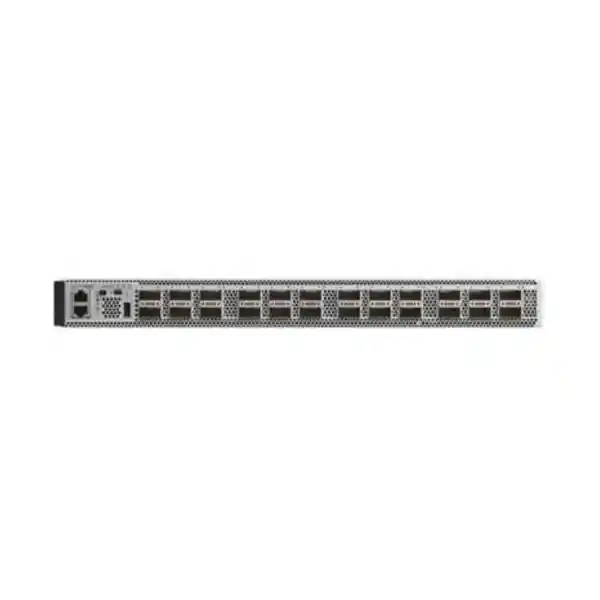
Cisco Catalyst C9500-24Q Network Switch in the UAE
The Cisco Catalyst C9500-24Q is a fixed-configuration, enterprise-class core and distribution switch designed for organizations that need dense 40 Gigabit Ethernet aggregation without moving immediately to a chassis. Its 24 native QSFP+ interfaces give network architects a compact way to aggregate access-layer blocks, connect distribution peers, build resilient routed campus cores, or provide high-speed links between buildings and network rooms. In a 1RU form factor, the platform combines wire-speed switching, Cisco IOS XE programmability, high-availability features, advanced routing, segmentation, policy enforcement, telemetry, and operational tooling suitable for medium-to-large campus environments.
For UAE deployments, the practical value of the C9500-24Q is not simply its port count. A successful project depends on matching optics, fiber type, routing scale, redundancy method, software entitlement, power design, rack airflow, uplink oversubscription, migration sequencing, and operational support to the real campus. FourTeck approaches the model as part of an engineered solution rather than as an isolated box, helping teams in Dubai and across the UAE validate whether 40GbE QSFP+ density is the correct fit for the network lifecycle.
Model at a glance
Direct answer: what is the Cisco C9500-24Q best suited for?
The C9500-24Q is best suited to campus core and distribution roles where many 40GbE links are required in a compact fixed switch. A typical deployment aggregates multiple access or distribution switches, terminates high-bandwidth inter-building fiber, provides Layer 3 routing between campus blocks, or forms a resilient pair of core switches. It is particularly relevant when an existing design already uses 40G QSFP+ optics or when the organization has a substantial installed base of access switches whose uplinks are 40GbE. It can also be useful as a high-capacity aggregation device for server, security, or service appliances when interface type, traffic profile, and software feature requirements align.
The platform should not be selected only because 24 QSFP+ ports sound fast. Network sizing has to account for the number of downstream blocks, expected east-west traffic, oversubscription ratio, uplink redundancy, routing table size, multicast behavior, security policy scale, application growth, and whether 100G or 400G migration is expected during the useful life of the design. If a new greenfield campus expects rapid 100G adoption, a newer Catalyst 9500 high-performance or Catalyst 9500X model may be more appropriate. If the design is centered on existing 40G infrastructure, however, the C9500-24Q can remain a strong fit because its interface density and mature operational model allow a clean, predictable aggregation layer.
FourTeck can review these architectural questions as part of a UAE network refresh. The objective is to confirm the switch model before procurement, not after optics, subscriptions, and rack accessories have already been ordered. Organizations needing broader networking and infrastructure assistance can also use the FourTeck UAE portfolio for integrated enterprise networking requirements.
Core hardware specifications and engineering implications
24 native 40GbE QSFP+ ports
The front panel provides 24 QSFP+ interfaces designed for standard 40 Gigabit Ethernet connectivity. This density supports high-capacity campus aggregation, inter-switch trunks, routed links, and fiber-rich distribution designs. Port planning should include optic type, fiber reach, patching standard, connector cleanliness, and whether any legacy 10G or 1G connectivity will be handled through supported adapters or other switches.
Up to 1.92 Tbps switching capacity
The model is specified for up to 1,920 Gbps of switching capacity. This figure is important when calculating aggregate full-duplex port bandwidth and oversubscription. The switching fabric is designed so the switch can serve as a serious aggregation platform rather than a simple high-speed edge device.
Up to 1.44 Bpps forwarding
Packet forwarding performance reaches up to 1,440 million packets per second. Packet-rate capacity matters for environments with large numbers of small packets, security events, telemetry streams, or highly distributed application traffic because a pure gigabit-per-second calculation does not capture packet-processing demand.
Cisco UADP 2.0 XL architecture
The switch uses Cisco’s programmable UADP 2.0 XL forwarding architecture. The value of a programmable ASIC is its ability to support sophisticated forwarding, access control, QoS, telemetry, and segmentation functions in hardware while Cisco IOS XE provides the control and management plane.
16 GB DRAM and 16 GB flash
The C9500-24Q platform class includes 16 GB of DRAM and 16 GB of flash. For operations teams this supports the modern IOS XE software model, image management, logs, packages, and platform services. Software image strategy should still include validated upgrade paths, maintenance windows, rollback planning, and configuration backups.
1RU fixed chassis
The chassis is approximately 1.73 x 17.5 x 21.5 inches and occupies one rack unit. Cisco lists a system weight of roughly 25.75 lb with two power supplies and built-in fans for this chassis class. These dimensions should be considered against cabinet depth, cable-management clearance, PDU placement, and service access.
Port architecture: why 24 QSFP+ interfaces change campus design
A 24-port 40GbE switch presents a different design problem from a conventional access switch. Each physical interface can represent a major campus block, a high-capacity routed adjacency, a distribution pair interconnect, or a backbone link spanning buildings. That means interface allocation must be considered at the architectural level. An unused port may be deliberately reserved for failure recovery, future building additions, a secondary path, or temporary migration coexistence. Conversely, using every interface on day one can create operational pressure when the network expands because there is no spare physical capacity for parallel migration.
Cisco’s C9500-24Q design maps groups of ports into the internal forwarding architecture, and the platform uses high-speed SERDES connectivity between the front-panel cages and UADP forwarding resources. The practical result is that traffic can be forwarded at high rates across the chassis while policy, routing, and QoS decisions are handled in hardware. Engineers should still distribute critical links sensibly, document interface roles, and avoid assuming that physical symmetry alone guarantees application resilience. The resilient behavior of a core depends on control-plane design, link aggregation, routing convergence, power redundancy, physical path diversity, and upstream/downstream device design.
QSFP+ ports also make the optic bill of materials critical. A switch without the correct transceivers, fiber plant, breakout strategy, patch leads, cleaning tools, and spare optics is not deployment-ready. FourTeck can help verify the complete interconnect stack so that the hardware, optics, cabling, and topology are treated as one engineered system rather than separate purchase orders.
Optics, fiber, reach, and interface planning
The C9500-24Q uses QSFP+ interfaces for 40 Gigabit Ethernet. In real deployments, the choice of transceiver is determined by link distance, fiber type, connector system, budget, and existing campus standards. Short-reach multimode optics can be economical inside a data room or between nearby network closets where the fiber plant supports the required modal bandwidth. Long-reach single-mode optics are more common across buildings, large campuses, utility corridors, and metropolitan links. The optic specification must be matched to actual measured path length and loss budget; selecting an optic purely from a nominal distance label can create instability if connectors, splices, patch panels, or aging fiber add excessive attenuation.
For UAE campuses, fiber paths may pass through outdoor ducts, underground chambers, building risers, hot service spaces, and mixed-generation patch infrastructure. A core upgrade is an ideal time to audit the physical layer. Engineers should verify whether each path is OM3, OM4, OS2, or another type; confirm connector polarity and cleanliness; inspect patch panels; record end-to-end attenuation where appropriate; and identify routes that share a single physical conduit. Logical redundancy is undermined if two supposedly independent 40G links follow the same tray, duct, or building entrance.
Where 10GbE compatibility is required, supported adapters and approved optical combinations may provide migration options, but these should be validated against Cisco’s transceiver compatibility guidance and the specific IOS XE release in use. Designers should not assume that every generic breakout cable, DAC, AOC, or third-party optic behaves identically. Operational stability at the campus core justifies disciplined qualification. A saving on transceiver cost can be erased quickly by intermittent errors, FEC mismatches, DOM alarms, flapping links, or uncertain support status.
Procurement should also include sensible spares. In a 24-port core, keeping one or two spare optics of each critical type can be more valuable than holding an unused chassis with no compatible transceivers. Document optic serial numbers, installed ports, fiber endpoints, patch-panel references, and optical power readings during commissioning. These records shorten troubleshooting time and make later moves, additions, and changes significantly safer.
Campus core and distribution use cases
Collapsed core
In a medium or large campus, two C9500-24Q switches can form a collapsed core/distribution layer that aggregates building access blocks. This reduces the number of architectural tiers while preserving redundant high-speed paths. Routing boundaries, failure domains, and uplink utilization must be modeled carefully so that a single maintenance event does not push the remaining device or link set beyond safe utilization.
Three-tier campus core
Large organizations may retain a dedicated core above multiple distribution pairs. In this role, the C9500-24Q can provide 40G routed or switched links between distribution blocks and the central core, with traffic engineering driven by routing metrics, equal-cost paths, and capacity planning. The design is particularly effective where 40G is already the campus backbone standard.
Inter-building aggregation
Universities, healthcare campuses, government estates, hospitality developments, industrial sites, and large commercial properties often require many fiber links between buildings. A 24-port 40G platform can aggregate those links while supporting Layer 3 boundaries that limit spanning-tree domains and improve convergence predictability.
Security services aggregation
The switch can provide high-speed connectivity between campus networks and security services such as next-generation firewalls, inspection clusters, WAN edges, and data-center gateways when interface speeds and topology are compatible. For perimeter and security architecture assistance, organizations can coordinate with FourTeck Firewall Dubai resources.
Routing scale and Layer 3 design
A campus core switch is often more valuable as a router than as a simple Layer 2 forwarding device. The C9500-24Q supports enterprise routing under Cisco IOS XE and is designed for environments that use protocols such as OSPF, EIGRP, BGP, IS-IS, PIM, and policy-based routing depending on the chosen software entitlement and release. The correct protocol is determined by topology, operational standards, convergence requirements, multivendor interoperability, and the skill set of the engineering team. A good design keeps the core’s role understandable and avoids importing unnecessary complexity from the WAN or data center.
Cisco publishes hardware scale figures for the C9500 family, with the C9500-24Q class supporting up to 64,000 MAC addresses, up to 64,000 indirect IPv4 routes, up to 80,000 IPv4 host entries, up to 32,000 indirect IPv6 routes, and up to 40,000 IPv6 host entries under relevant scale templates and software conditions. These maximum figures should not be treated as a design target. Production networks need headroom for transient routing states, summarization failures, route leaks, ARP or neighbor bursts, multicast growth, and future services. A safe design typically operates comfortably below hardware ceilings and uses route summarization or topology boundaries where possible.
The switch supports up to 4,094 VLAN IDs and a substantial set of switched virtual interfaces, but again, a large supported number is not an invitation to create a flat, operationally complicated campus. Segmentation should align with security policy and organizational boundaries. Where possible, Layer 3 links between network tiers reduce dependence on spanning tree and make failures easier to localize. VLANs that must stretch should have a clearly documented business reason and a known failure-domain impact.
IPv6 planning deserves the same rigor as IPv4. Dual-stack networks consume forwarding resources differently and introduce additional neighbor-discovery behavior, first-hop security requirements, and operational tooling considerations. When purchasing the C9500-24Q for a new lifecycle, organizations should confirm that monitoring, IPAM, security controls, application teams, and operational runbooks are ready for IPv6 rather than treating it as a future feature that will be enabled without architectural preparation.
High availability: building resilience around the switch
High availability has several layers. At the chassis level, the C9500-24Q provides two power-supply slots and supports redundant power design. At the system level, enterprise deployments commonly use a pair of switches so that no single chassis becomes the only path between users and critical services. At the topology level, downstream access or distribution switches should be dual-homed where supported, and the upstream WAN, firewall, or data-center connectivity should also have redundant paths. At the facility level, power supplies should ideally feed separate PDUs connected to independent UPS or electrical sources when the site design permits.
Cisco StackWise Virtual can be used on supported Catalyst 9500 designs to create a system virtualization model in which two physical switches operate as a logical pair for certain functions, including multichassis EtherChannel. Whether StackWise Virtual is the best choice depends on operational preference and failure-domain philosophy. Some organizations prefer a tightly coupled pair because it simplifies downstream port-channeling and gateway behavior. Others prefer independent Layer 3 nodes because each device remains an autonomous routing system. Both approaches can be resilient when engineered correctly.
For StackWise Virtual designs, the inter-switch and dual-active-detection paths must be treated as critical infrastructure. Their port selection, bandwidth, physical diversity, and failure behavior should be documented before cutover. Engineers should test not only a clean reload but also fiber loss, one-sided control-plane interruption, upstream path loss, downstream member failure, and partial power events. A highly available network is one whose failure modes have been rehearsed and whose monitoring can distinguish a healthy failover from an unstable split-brain or repeated reconvergence event.
For independent Layer 3 designs, dynamic routing and first-hop resiliency determine convergence. Equal-cost routing, summarization, Bidirectional Forwarding Detection where appropriate, and carefully tuned protocol timers can help, but aggressive timers should not be copied from templates without validation. CPU load, optic stability, WAN latency, and control-plane behavior all affect whether fast timers improve resilience or create false failure detection.
Quality of Service and traffic engineering
At 40GbE speeds, QoS remains important because congestion has not disappeared; it has simply moved. A core uplink can still become oversubscribed when many access blocks converge toward a smaller number of WAN, firewall, data-center, or internet links. Voice, video, transactional traffic, storage, backup, surveillance, guest internet, and software distribution can all compete during peak periods. The C9500 platform’s UADP architecture supports hardware-based classification, marking, queuing, policing, and scheduling capabilities that allow architects to define predictable behavior under congestion.
The best QoS design is end-to-end. Trust boundaries should begin at well-defined access points, markings should be preserved or rewritten according to policy, and each network tier should use compatible queue behavior. A core switch cannot rescue poorly classified traffic if all applications arrive with identical markings. Conversely, complex core policies provide little value if congestion occurs at a WAN edge that uses completely different class definitions. For UAE enterprises with mixed branches and cloud connectivity, QoS should be mapped across campus, firewall, SD-WAN or MPLS, internet edge, and cloud egress where business applications require deterministic treatment.
Queue design should be based on measured traffic rather than assumptions. Telemetry, NetFlow-style visibility, interface counters, and application monitoring can reveal whether priority traffic is genuinely latency-sensitive and whether bulk traffic is consuming links at predictable times. This evidence helps define class bandwidth, policing rates, and remediation actions. It also prevents a common mistake: over-prioritizing too many applications until the priority queue itself becomes congested.
Security, segmentation, and policy enforcement
A modern campus core participates in security even when firewalls remain the primary inspection point. The switch can enforce access control lists, separate routing domains, carry scalable segmentation constructs, apply control-plane protection, validate management access, and support encrypted link technologies under appropriate hardware and software conditions. The exact feature set depends on IOS XE release, license tier, design mode, and interoperability requirements, so the security architecture should be validated against the proposed software baseline rather than assumed from the family name alone.
Segmentation decisions should begin with business trust boundaries. User, server, voice, building-management, CCTV, guest, contractor, OT, and management networks often have different security requirements. The core can provide routing boundaries and policy enforcement points, but deep inspection may still belong on a firewall or dedicated security service. One efficient pattern is to keep local east-west traffic routed in the campus when policy allows, while steering sensitive cross-zone flows to security controls. Another pattern centralizes inter-segment inspection. The right choice depends on traffic volume, latency, compliance requirements, firewall capacity, and operational simplicity.
Management-plane hardening is equally important. Use dedicated management addressing, authenticated administrative access, role-based privileges, secure protocols, centralized AAA, configuration logging, NTP, syslog, SNMPv3 or modern telemetry, and protected out-of-band access where available. Disable unnecessary services and maintain software versions according to Cisco security advisories and organizational patch policy. A fast forwarding plane does not compensate for weak administrative controls.
When a deployment also requires firewall modernization, segmentation review, VPN architecture, or security policy redesign, FourTeck can coordinate networking with security implementation rather than treating them as independent projects. This is especially useful when a new core changes routing adjacencies, default gateways, or transit networks connected to the perimeter.
Cisco IOS XE operations and programmability
Cisco IOS XE provides the software foundation for the Catalyst 9500 family. For operations teams, this means a familiar CLI combined with APIs, model-driven telemetry, automation interfaces, software package management, and integration with Cisco management platforms. The practical benefit is not that every network must become fully automated on day one. Rather, the platform gives teams a path from traditional command-line operations toward repeatable, auditable workflows without replacing the hardware.
Configuration automation is most valuable for high-risk, repetitive changes: interface templates, VLAN creation, routing-policy updates, telemetry configuration, NTP and AAA standards, logging destinations, and compliance checks. A well-designed automation pipeline validates intended state, takes backups, applies bounded changes, and confirms post-change behavior. It should not simply send a large block of CLI commands faster than a human. The C9500-24Q can participate in controller-driven or API-driven environments, but governance and source-of-truth accuracy remain the responsibility of the network team.
Software lifecycle management is another major operational consideration. Enterprises should define a preferred IOS XE release train based on Cisco recommendations, security support, feature compatibility, bug exposure, and interoperability with neighboring platforms. Before upgrade, verify ROMMON or boot requirements where relevant, available storage, license behavior, optic support, StackWise Virtual compatibility, routing-protocol changes, and management platform support. A lab or representative staging environment can reduce risk for complex campuses.
FourTeck’s broader IT Services UAE capability can support planning around configuration standards, migration execution, monitoring integration, and ongoing infrastructure operations when the requirement extends beyond switch supply.
Performance sizing: translating 1.92 Tbps into a real design
The headline switching capacity of up to 1.92 Tbps corresponds to the aggregate bidirectional bandwidth associated with twenty-four 40GbE ports. In a pure forwarding-capacity discussion, this means the platform is built to handle a substantial amount of traffic within a single rack unit. Network sizing, however, is not performed by comparing one number on a data sheet with another. The topology determines which links can be simultaneously active, where oversubscription occurs, and what happens when a redundant path is lost.
Consider a collapsed-core design with eight access or distribution blocks, each dual-connected to a pair of C9500-24Q switches using 40G links. Under normal operation, traffic may be balanced across both core nodes. If one core fails, the surviving links can see a sudden increase in utilization. The design must ensure that remaining port channels, firewall uplinks, WAN links, and data-center paths have sufficient headroom for this failure state. A network that runs at 75 to 85 percent during normal operation may become unstable under single-node failure even though the switch itself has spare fabric capacity.
Packet-per-second performance also matters. Up to 1.44 billion packets per second is a large forwarding rate, but small-packet workloads can stress systems differently from large sequential flows. Voice signaling, microservices, DNS, security scans, telemetry, backup metadata, and distributed applications can generate high packet counts without saturating link bandwidth. Monitoring should therefore capture both bits per second and packets per second, as well as drops, queue depth, errors, and CPU/control-plane indicators.
A sound capacity plan defines normal utilization, peak utilization, growth rate, failure-state utilization, and migration-state utilization. Migration state is often forgotten: during a phased cutover, temporary links or parallel routing can produce unusual traffic patterns. Reserving physical and bandwidth headroom makes the transition safer and avoids forcing the production network into an overcommitted state simply because the final topology will be more efficient.
MAC, ARP, IPv6 neighbor, and policy scale
Cisco publishes platform-scale values that help architects determine whether a switch can support the expected number of endpoints, routes, policies, and flows. For the C9500-24Q family class, up to 64,000 MAC addresses is sufficient for many enterprise campuses, but endpoint count alone does not predict MAC consumption. Virtualization, wireless mobility, hypervisors, IoT platforms, building systems, and bridged security zones can multiply Layer 2 entries. If large Layer 2 domains are extended across many buildings, the core may learn far more addresses than the number of directly connected user devices suggests.
ARP and IPv6 neighbor tables require similar attention. A large number of directly attached subnets, server segments, wireless clients, or silent IoT devices can consume host entries even when the routing table is small. During failures or mass reconnect events, neighbor discovery and ARP learning can occur in bursts. Network teams should monitor utilization rather than assuming a static endpoint inventory represents worst-case conditions.
ACL scale is influenced by feature composition and hardware resource allocation. Policy entries can grow rapidly when security rules are expanded across many VLANs or when object-based policies are compiled into multiple hardware entries. The correct approach is to validate the anticipated policy set on the chosen software version and monitor hardware utilization after deployment. If segmentation requirements are very large, it may be more efficient to use scalable identity or fabric-based policy mechanisms rather than replicating thousands of conventional ACL lines across interfaces.
These scale questions are especially important during consolidation. Replacing several older distribution switches with a smaller number of high-density core switches can aggregate forwarding state that was previously distributed across multiple devices. The new platform may have significantly greater capacity, but the design review should calculate the combined state rather than compare each legacy switch individually.
Power, airflow, rack, and environmental planning in the UAE
The C9500-24Q occupies one rack unit but requires more planning than its height suggests. Cisco lists a depth of roughly 21.5 inches for this chassis class, so cabinet depth must also accommodate power connectors, cable bend radius, rear service access, and PDU placement. Dense QSFP+ cabling at the front can create significant patching volume. Horizontal cable managers should be sized so fibers are protected from excessive bends and technicians can remove a transceiver without disturbing adjacent links.
The switch supports redundant power supplies, and enterprise designs should use two supplies when availability requirements justify it. Redundancy is strongest when each PSU connects to a separate PDU and, where facility design permits, to independent UPS or electrical circuits. Connecting two PSUs to the same overloaded PDU provides device-level redundancy but does not protect against upstream power failure. Power documentation should include circuit identifiers, breaker ratings, PDU outlet numbers, and UPS runtime expectations.
Environmental limits also matter in Gulf deployments. Cisco specifies an operating range of 0 to 40°C for the C9500 platform class, with relative humidity from 5 to 90 percent noncondensing and operating altitude up to approximately 1,800 meters. Data rooms in the UAE normally operate well inside those limits, but cooling failure can raise inlet temperature quickly. Monitoring systems should alarm on room temperature, device sensors, fan status, PSU status, and airflow obstruction before thermal shutdown becomes a risk.
Airflow orientation must be coordinated across the rack. Mixing front-to-back and back-to-front equipment without containment planning can cause hot exhaust to feed neighboring inlets. Blanking panels, clean cable paths, sufficient rear clearance, and controlled room airflow can improve reliability. Dust control is also important in environments near construction, industrial areas, or frequently opened equipment rooms. Preventive maintenance should include visual inspection and facility filtration checks rather than relying solely on device temperature alarms.
Where the core is being installed beside compute, storage, or appliance infrastructure, FourTeck can also coordinate requirements through Server Dubai infrastructure services so cabinet, power, and interconnect planning are considered across the rack rather than device by device.
Licensing and software entitlement planning
Catalyst 9500 procurement typically involves both hardware and software entitlement choices. Cisco has historically offered Network Essentials and Network Advantage feature tiers together with Cisco DNA subscription levels for management, automation, assurance, and advanced capabilities. Exact ordering constructs, term options, and entitlement requirements can change over product and software lifecycles, so a current bill of materials should be validated at the time of quotation rather than copied from an old deployment.
The correct license level is determined by required features, not by the most expensive package available. A campus using straightforward Layer 3 routing and standard resiliency may have different requirements from a software-defined access deployment, a network using advanced segmentation, or an environment that depends on controller-based assurance and automation. The engineering team should list required features first, map them to the current Cisco entitlement model, and then confirm term and support requirements.
Licensing also affects lifecycle operations. Smart licensing behavior, account association, internet reachability, proxy requirements, air-gapped environments, virtual account structure, and renewal ownership should be established before production cutover. The technical team should know who owns the Cisco account relationship, who receives renewal notices, and how licenses are transferred or replaced if hardware is RMA’d.
For quotations, FourTeck can separate mandatory hardware, power supplies, optics, licensing, support, and services so procurement teams can understand what is required for day-one operation and what is optional. This prevents a common problem in enterprise switching projects: purchasing the chassis first and discovering later that the correct subscriptions, support coverage, or transceivers were not included.
Migration methodology for replacing an existing campus core
A core migration is one of the highest-impact changes in an enterprise network because many services converge at the core. The safest approach begins with discovery. Capture the current physical topology, routing adjacencies, VLAN database, spanning-tree roots, port channels, first-hop gateways, multicast configuration, DHCP relay, ACLs, QoS policy, static routes, management services, NTP, logging, monitoring, out-of-band access, optic types, fiber paths, and business dependencies. Configuration alone is not enough; operational state and traffic patterns reveal undocumented behavior.
The target design should then be built as an explicit source of truth. Interface numbers, port-channel membership, IP addressing, routing process IDs, route filtering, VLAN ownership, gateway placement, management addressing, and optic assignment should be mapped before hardware is installed. Each legacy link should have a destination on the new platform or a deliberate retirement decision. Ambiguous items should be resolved during planning rather than during the outage window.
Staging reduces risk. The C9500-24Q should be powered, licensed, upgraded to the approved IOS XE release, configured with management access, tested for redundancy, and validated with representative optics before installation. Where possible, build the core pair and establish its interconnects in advance. Pre-test routing adjacencies and management systems in an isolated or lab environment. Check that backups and rollback configurations are available and readable.
The cutover plan should be sequenced so that services are moved in manageable groups. For a routed campus, it may be possible to move one distribution block at a time while maintaining coexistence between old and new cores. For large Layer 2 designs, spanning-tree root movement and gateway migration may require more careful sequencing. Every step should have a verification action: interface status, error counters, routing neighbor state, route table, default path, application reachability, DNS, DHCP, internet access, voice registration, wireless control, and monitoring alarms.
Rollback criteria should be objective. Examples include inability to establish required routing adjacencies within a defined change phase, widespread application failure, instability in the new core pair, unexpected loop formation, or loss of management visibility. Rollback should be planned as carefully as implementation, including preserved legacy patching, configuration snapshots, and staff roles. A rollback that requires improvisation is not a reliable contingency.
Post-cutover work includes monitoring for errors and drops, confirming path symmetry, checking CPU and memory trends, validating route and MAC counts, documenting final patching, backing up configurations, updating network diagrams, and removing temporary migration links. User acceptance should include critical business applications rather than only ping tests. FourTeck can provide project-level assistance when a UAE customer requires planning, staging, change-window execution, and post-migration validation as one coordinated service.
Monitoring, telemetry, and operational observability
A campus core should be monitored at multiple layers. Basic availability checks confirm that the device responds, but they do not show whether it is approaching a capacity or stability threshold. Interface telemetry should include utilization, packets per second, discards, queue drops, CRC errors, optical receive and transmit levels where available, flaps, and port-channel member state. System monitoring should include CPU, memory, temperature, fan status, power-supply status, process health, routing-neighbor state, and high-availability events.
Routing visibility is essential because a core can be reachable while forwarding traffic incorrectly. Monitor neighbor changes, route-count deviations, default-route presence, BGP update volume where relevant, multicast neighbor state, and unusual ARP or NDP growth. A baseline of normal route and endpoint counts makes anomalies easier to detect. For large networks, alerts based on percentage deviation from baseline can be more meaningful than fixed thresholds copied from another site.
Configuration change auditing should show who changed the switch, when, and what was modified. Centralized AAA and command accounting are useful controls, while automated configuration backups provide recovery. Syslog and telemetry should be sent to reliable collectors with synchronized time. NTP consistency across switches, firewalls, servers, controllers, and monitoring platforms makes incident analysis significantly easier because events can be correlated accurately.
Optical monitoring is particularly valuable on a 40G fiber core. Gradual receive-power degradation can signal dirty connectors, damaged patch leads, aging optics, or worsening splice loss before a link fails. Recording initial commissioning levels provides a baseline for future troubleshooting. If the organization operates several sites, these metrics can be centralized to identify recurring environmental or cabling problems rather than treating each link incident as isolated.
Operational security and lifecycle maintenance
The C9500-24Q will often remain in service for years, so lifecycle discipline matters as much as day-one configuration. Maintain an asset record containing serial numbers, support identifiers, software versions, license state, power-supply details, optics, rack location, management IP, and logical role. Link that record to configuration backups and network diagrams. This turns hardware replacement or audit work into a controlled process rather than a search across spreadsheets and email threads.
Security advisories should be reviewed regularly. Not every advisory requires emergency action, but the organization should be able to determine whether the installed software and enabled features are affected. A predictable maintenance cadence makes upgrades less disruptive and prevents the network from falling so far behind that a future update becomes a large, multi-step jump. Keep at least one validated fallback image where platform guidance permits and maintain console or out-of-band access for recovery.
Administrative access should use secure protocols and centralized identity. Local accounts remain useful for emergency access but should be controlled, audited, and rotated according to policy. Restrict management-plane reachability with dedicated VRFs, ACLs, or out-of-band networks where appropriate. Disable legacy protocols that are not required. Use secure SNMP versions or modern telemetry rather than community-string-based monitoring when the environment supports it.
Physical security is also part of lifecycle protection. Core racks should have controlled access, documented patching, clearly labeled power feeds, and protected console ports. In shared equipment rooms, fiber jumpers should be routed so unrelated maintenance cannot easily disturb core links. Small operational details reduce the likelihood that a routine task becomes a major outage.
When the C9500-24Q is the right choice — and when it is not
The C9500-24Q is a strong choice when a campus needs many native 40G QSFP+ links, values the Catalyst 9000 operational ecosystem, requires enterprise routing and segmentation, and expects a fixed 1RU platform to provide adequate capacity over the planned lifecycle. It is especially sensible when existing access or distribution switches already use 40G uplinks, because the organization can preserve established optic standards and avoid an unnecessary interface transition during a wider campus refresh.
It may be less suitable for a greenfield network whose long-term design clearly requires large numbers of 100G or 400G interfaces. In that case, a newer high-performance Catalyst 9500 or Catalyst 9500X model may provide a longer runway. It may also be oversized for a small office that needs only a few 10G uplinks and basic Layer 3 services. Paying for high-density 40G capacity that will remain unused is not efficient simply because the switch is enterprise-class.
The model should also be reconsidered if the application demands specialized data-center behavior, extremely deep buffers, storage-focused protocols, or interface features better aligned with the Nexus portfolio. Campus switching and data-center switching can overlap technically, but their operational models, feature priorities, and traffic patterns differ. Selecting by port speed alone can blur those distinctions.
FourTeck can compare the C9500-24Q with alternative Catalyst models based on actual port maps, growth, software features, optics already owned, and budget. The goal is to produce a bill of materials that fits the architecture rather than steering every customer toward the same platform.
UAE procurement considerations
Enterprise switch procurement in the UAE should distinguish between the base chassis and a deployable solution. A complete quotation may need the switch, two power supplies, appropriate power cords, rack accessories, optics, patch leads, console or management accessories, required software entitlements, Cisco support coverage, installation services, migration support, and optional spares. The exact list depends on whether the project is a new build, a replacement, or an expansion of an existing Catalyst estate.
Optics can represent a significant portion of the project cost. A 24-port 40G switch populated with long-reach single-mode transceivers has a very different budget from the same chassis using a small number of short-reach links. Procurement teams should therefore avoid comparing quotations that contain different transceiver assumptions. Each quoted optic should map to a specific planned link or a clearly identified spare quantity.
Lead time and lifecycle status should also be checked at the moment of purchase. The C9500 family has evolved substantially, and newer Catalyst models may be preferred for some new deployments even where the C9500-24Q remains technically suitable. FourTeck can help position the requested model against current availability and the customer’s installed base. This matters when spare strategy, standardized software, and long-term support are more important than buying the newest interface speed.
For organizations with sites outside the UAE, the architecture should also account for consistency across regions. A headquarters core in Dubai may connect to branches or data centers in the GCC, Africa, Europe, or Asia. Standardizing routing design, management, monitoring, and security policy across sites can reduce operational overhead even when hardware models differ. The FourTeck global site provides a broader point of reference for multi-region requirements.
Finally, confirm responsibility boundaries. Identify whether the customer’s team, FourTeck engineers, a carrier, or another integrator owns fiber testing, patching, firewall changes, WAN routing, Cisco account administration, maintenance windows, and application validation. Clear ownership prevents deployment delays and makes support escalation faster if an issue appears during cutover.
Detailed technical specification table
| Category | C9500-24Q detail | Design significance |
|---|---|---|
| Front-panel connectivity | 24 x 40GbE QSFP+ | Dense 40G aggregation for campus core and distribution links. |
| Switching capacity | Up to 1.92 Tbps | Supports high aggregate throughput in a 1RU fixed platform. |
| Forwarding rate | Up to 1,440 Mpps | Important for small-packet and high-flow environments. |
| ASIC architecture | Cisco UADP 2.0 XL platform architecture | Hardware-accelerated forwarding, QoS, ACL, and telemetry functions. |
| DRAM | 16 GB | Supports IOS XE control-plane and platform services. |
| Flash | 16 GB | Stores software images, packages, logs, and operating files. |
| MAC address scale | Up to 64,000 | Suitable for large campus Layer 2 environments when designed with headroom. |
| IPv4 indirect routes | Up to 64,000 | Supports substantial enterprise routing tables; design below maximum. |
| IPv4 host entries | Up to 80,000 | Relevant for directly attached endpoints, ARP scale, and gateway-heavy designs. |
| IPv6 indirect routes | Up to 32,000 | Supports enterprise dual-stack routing with capacity planning. |
| IPv6 host entries | Up to 40,000 | Relevant for NDP-heavy dual-stack campus environments. |
| VLAN IDs | 4,094 | Allows broad segmentation, though architecture should avoid unnecessary Layer 2 sprawl. |
| Jumbo frames | Up to 9,198 bytes | Useful for selected applications when MTU is engineered end-to-end. |
| Rack height | 1RU | Compact fixed-core deployment with high port density. |
| Approx. dimensions | 1.73 x 17.5 x 21.5 in. | Check cabinet depth, rear clearance, cable bend radius, and PDU placement. |
| Power design | Two power-supply slots | Enables redundant PSU architecture when dual supplies and independent feeds are used. |
Published maximums vary by software release, feature combination, hardware template, and Cisco documentation revision. Final designs should validate the exact IOS XE release and feature set intended for deployment.
40G today, 100G tomorrow: lifecycle strategy
The most important strategic question around the C9500-24Q is whether 40G remains the correct interface speed for the intended lifecycle. Many existing campuses still have substantial 40G infrastructure because access and distribution switches were deployed during a period when 40G was the standard high-capacity uplink. In these environments, replacing the core with another 40G-dense platform can be economically rational because it preserves optics, fiber designs, downstream hardware, and operational familiarity.
A greenfield or rapidly expanding campus may benefit from starting with 100G-capable core ports instead. The argument is not that every application needs 100G today. Rather, higher-speed interfaces can extend the time before another core replacement is required. If access-layer refreshes planned over the next three to five years will introduce 100G uplinks, installing a 40G-only core now may create a bottleneck in the refresh sequence.
Migration economics should include more than switch price. Moving from 40G to 100G can require new optics, possibly new breakout patterns, different patching, validation of fiber quality, changes to neighboring switches, and revised redundancy designs. If the current infrastructure has a large inventory of validated QSFP+ optics and adequate capacity, reusing that ecosystem can reduce project risk. If optics are already end-of-life or capacity is close to exhaustion, a newer platform may be more cost-effective over the full lifecycle.
FourTeck can model both paths: a C9500-24Q design optimized for current 40G infrastructure and an alternative design using newer Catalyst 9500 high-performance or 9500X hardware. Comparing total bill of materials, expected growth, support horizon, power, optics, and migration impact provides a better decision than comparing chassis prices alone.
Deployment patterns for different UAE environments
Corporate headquarters: A headquarters campus often has several access stacks, wireless aggregation points, security appliances, data-center links, and WAN edges. Two C9500-24Q switches can provide a resilient high-speed core, with 40G links toward distribution or access blocks and redundant connections to firewalls and server networks. The design should prioritize clear routing boundaries, controlled Layer 2 extension, and maintenance without widespread user disruption.
Education and large campus estates: Universities and schools may have many buildings connected by fiber. The C9500-24Q’s 24 QSFP+ ports can aggregate multiple building distribution switches while supporting multicast-heavy services, wireless, CCTV, digital learning platforms, and internet access. Physical path diversity is critical because campus ducts can create hidden shared-risk groups.
Healthcare: Hospitals and medical campuses combine conventional IT traffic with imaging, voice, wireless clinical devices, building systems, and high availability requirements. Core design should emphasize redundant power, path diversity, stable multicast and routing, strict management controls, and change processes that minimize service interruption. Traffic baselining can identify whether image transfer or backup windows create concentrated 40G demand.
Hospitality and mixed-use developments: Hotels, resorts, malls, and large properties frequently carry guest internet, corporate services, IPTV, surveillance, access control, building automation, voice, and tenant networks. Segmentation and QoS are important because traffic types have different security and latency needs. A 40G aggregation core can consolidate numerous distribution blocks while keeping service domains logically separated.
Government and public-sector networks: These environments often require strong operational controls, auditability, redundancy, and long support lifecycles. The C9500-24Q can fit where approved 40G architectures are already established. Procurement should confirm software entitlement, support coverage, security baseline, spare strategy, and lifecycle expectations as part of governance.
Industrial and logistics sites: Large warehouses, ports, manufacturing sites, and industrial campuses may have long fiber runs and distributed network rooms. Environmental quality, dust, cabinet cooling, and physical path resilience deserve extra attention. The core may aggregate standard IT plus OT-adjacent networks, requiring careful segmentation and change coordination.
Common design mistakes to avoid
Buying the chassis before validating optics
A 40G core is only deployable when the optical bill of materials matches every link. Confirm distance, fiber type, connector, compatibility, and spare requirements before purchase.
Ignoring the single-failure traffic state
Normal utilization can look comfortable while the surviving core or uplinks overload during a node or path failure. Size the network for degraded-state capacity, not only average traffic.
Extending Layer 2 without a reason
Large Layer 2 domains increase failure scope and state. Route between tiers where possible and stretch VLANs only when application or mobility requirements justify it.
Treating StackWise Virtual as automatic resilience
Virtualization simplifies some designs but still requires correct interconnect, dual-active detection, power diversity, and failure testing. Logical pairing does not eliminate physical failure modes.
Using maximum scale as a target
Published table limits describe supported scale under defined conditions. Production designs should preserve headroom for convergence, bursts, software changes, and future growth.
Skipping post-cutover baselining
After migration, record interface utilization, packet rate, route counts, MAC and ARP state, optic power, CPU, memory, and error counters so future incidents can be compared with a known-good baseline.
Frequently asked technical questions
How many 40GbE ports does the C9500-24Q have?
It provides 24 native 40 Gigabit Ethernet QSFP+ front-panel ports. This makes the model suitable for 40G-rich core and distribution environments where many high-capacity fiber links must terminate in one fixed 1RU switch.
What is the switching capacity?
Cisco specifies up to 1.92 Tbps of switching capacity and up to 1.44 Bpps of forwarding performance for the C9500-24Q class. Actual network performance still depends on topology, traffic distribution, optics, and configuration.
Is the C9500-24Q suitable as a campus core?
Yes. The Catalyst 9500 family is positioned for enterprise campus core and distribution roles. The C9500-24Q is particularly appropriate where the core needs many 40G QSFP+ connections and where Cisco IOS XE routing, resiliency, segmentation, and operations align with the network standard.
Does it support redundant power?
The chassis provides two power-supply slots. A resilient deployment normally uses dual supplies connected to separate power distribution paths where the facility design supports that arrangement.
Can two C9500 switches operate as a virtual pair?
Cisco supports StackWise Virtual on relevant Catalyst 9500 platforms and software releases. This can enable system virtualization and multichassis EtherChannel designs. The exact configuration and feature support should be verified against the intended IOS XE release.
Should I choose C9500-24Q or a 100G-capable model?
Choose based on current interface requirements and lifecycle. C9500-24Q is compelling when 40G infrastructure is established and sufficient. For greenfield designs or expected 100G growth, compare newer Catalyst 9500 high-performance or 9500X platforms before finalizing procurement.
What should be included in a UAE quotation?
A practical bill of materials may include the chassis, dual power supplies, correct power cords, QSFP+ optics, fiber patch leads, software entitlements, Cisco support, spare optics, rack accessories, staging, migration, and post-installation validation. The exact package depends on the customer’s topology.
Can FourTeck assist with deployment rather than supply only?
Yes. A typical FourTeck engagement can include topology review, bill-of-material validation, optics selection, configuration planning, staging, migration execution, redundancy testing, monitoring integration, and documentation according to project scope.
Decision recap: is C9500-24Q a fit for your network?
Choose the C9500-24Q when the answer to most of the following questions is yes: your core or distribution layer needs a high density of native 40G QSFP+ interfaces; your environment is standardized on Cisco IOS XE; your access or distribution switches already use 40G uplinks; a 1RU fixed platform provides enough physical capacity; the published routing and endpoint scales are comfortably above your design requirements; your resiliency architecture uses redundant switches and power; and your lifecycle does not require an immediate move to large quantities of 100G or 400G ports.
Reconsider the model if the new network is expected to become 100G-heavy during the early years of the project, if the design requires specialized data-center capabilities, if only a handful of 40G links are needed, or if a modular chassis is required for line-card expansion. Also compare lifecycle support, current ordering status, software entitlement, and optic reuse. A technically capable switch can still be the wrong commercial choice if the rest of the network is moving to a different interface generation.
Strong fit indicators
Existing 40G campus backbone, many QSFP+ links, mature Cisco operations, need for fixed 1RU core, requirement for enterprise routing and high availability, and a planned lifecycle that remains compatible with 40G aggregation.
Reasons to compare alternatives
Greenfield 100G design, rapid bandwidth growth, specialized data-center requirements, need for 400G interfaces, insufficient lifecycle runway, or a topology that would leave most of the 24 QSFP+ ports unused.
Quotation input checklist
Providing the following information allows FourTeck to build a cleaner, more accurate C9500-24Q proposal and reduces the risk of missing optics, licenses, or installation items.
Number and model of access/distribution switches, current core model, and whether the network is Layer 2, Layer 3, or mixed.
Count each production link, redundant path, inter-switch link, firewall or WAN link, and planned future connection.
OM3, OM4, OS2 or unknown; approximate distance; connector type; patch-panel path; and whether existing optics will be reused.
OSPF, EIGRP, BGP, multicast, VRFs, policy routing, IPv6, route counts, and any external routing adjacencies.
StackWise Virtual, independent Layer 3 pair, downstream port-channels, gateway redundancy, and failure-state bandwidth expectations.
Required Cisco Network/DNA functions, management platform, automation, assurance, segmentation, and subscription term preferences.
Cabinet depth, available rack units, PDU outlet type, redundant electrical feeds, airflow orientation, and UPS architecture.
Supply only, staging, configuration, rack installation, migration, after-hours cutover, testing, documentation, or ongoing support.
Plan the Cisco Catalyst C9500-24Q deployment with FourTeck UAE
A successful C9500-24Q project starts with architecture and ends with verified operations. FourTeck can help customers confirm whether the model is appropriate, design the redundant topology, validate fiber and QSFP+ optics, select software entitlements, prepare configurations, stage the switches, execute migration, and produce as-built documentation. For environments where the core connects firewalls, servers, WAN edges, wireless infrastructure, and multiple buildings, coordinating these dependencies under one migration plan can significantly reduce change-window risk.
When requesting a quotation, include the expected number of 40G links, approximate distances, existing switch models, preferred redundancy method, routing protocols, and whether installation or migration services are needed. If the exact design is not yet finalized, FourTeck can use those inputs to identify where discovery is required before a definitive bill of materials is issued.
For broader UAE infrastructure planning, visit FourTeck UAE, or speak with the technical team about switching, security, server connectivity, and managed IT requirements as an integrated project.
Consultation outputs can include
• Model and lifecycle validation
• Redundant topology proposal
• QSFP+ optic and fiber mapping
• License and support alignment
• Rack, power, and airflow review
• Migration and rollback procedure
• Post-cutover validation checklist

Reviews
There are no reviews yet.