
Cisco Secure Firewall 6170 Dubai
A 2RU Cisco Secure Firewall 6100 Series platform for very high-throughput enterprise, data-centre and telecommunications security designs where inspection capacity, encrypted traffic handling, connection scale and modular high-speed interfaces must be engineered as one system rather than purchased as isolated specifications.
Direct answer for buyers evaluating the Cisco Secure Firewall 6170
The Cisco Secure Firewall 6170 is the higher-capacity model in Cisco’s Secure Firewall 6100 Series. It is a standalone modular security services platform built for environments where ordinary branch or campus firewalls do not provide enough throughput, encrypted-traffic processing, interface density or connection scale. Cisco positions the 6100 family for high-performing data-centre and telecommunications infrastructure, and the 6170 sits above the 6160 on published performance and memory.
Why the Cisco Secure Firewall 6170 is a specialised buying decision
The Cisco Secure Firewall 6170 should not be approached as a generic firewall appliance with a single throughput number. Its scale changes the design conversation. At this level, buyers are usually protecting core data-centre connectivity, internet peering, large server estates, service-provider infrastructure, cloud on-ramps, high-volume business applications or environments where a security outage has a broad operational impact. The appliance can process extremely large volumes, but the useful outcome depends on how the traffic enters the chassis, which inspection services are enabled, how encrypted sessions behave, which network modules are installed, and what load the surviving node must carry during a failure.
Cisco publishes different performance values for Firewall Threat Defense and Adaptive Security Appliance software because the two software paths serve different operational priorities. Threat Defense provides the advanced next-generation security capabilities associated with application visibility, intrusion prevention and related services. ASA can deliver higher stateful firewall throughput where a traditional ASA operating model is required. That distinction matters because a buyer cannot safely compare the 6170 with another platform unless the comparison uses the same software mode, test profile and security-service combination.
For Threat Defense, Cisco lists 700 Gbps for firewall plus Application Visibility and Control using a 1024-byte profile, 600 Gbps for AVC plus IPS, 600 Gbps for NGFW throughput with firewall, AVC and IPS, 550 Gbps for IPsec VPN in the specified test profile, and 150 Gbps for TLS decryption. Cisco also lists up to 105 million concurrent sessions with AVC and 2.7 million new connections per second with AVC. These are significant figures, but Cisco explicitly notes that real performance varies with enabled features, traffic protocol mix, packet size and software releases. The correct interpretation is therefore capacity guidance for engineering, not a promise that every production deployment will reproduce laboratory values.
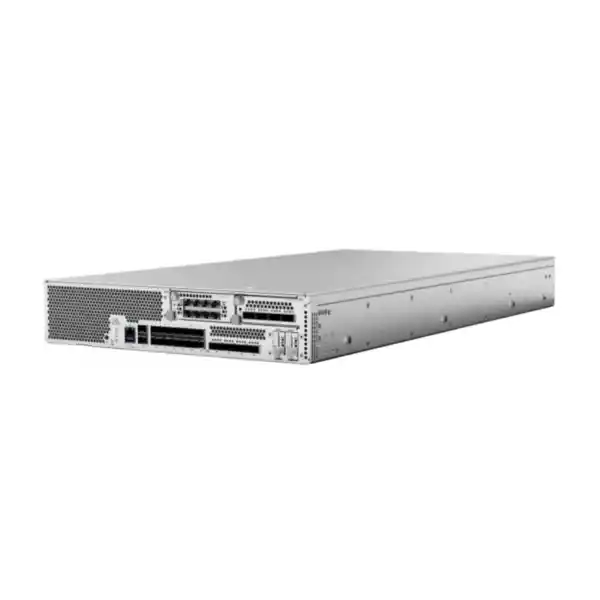
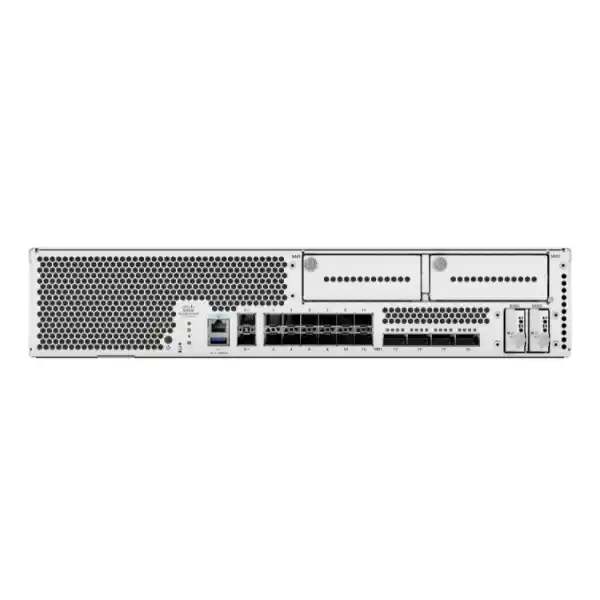
The 6170 also carries a modular I/O architecture. It includes twelve fixed 1/10/25/50 Gigabit Ethernet SFP56 ports and four fixed 40/100/200 Gigabit Ethernet QSFP56 ports, plus two network-module bays. That gives architects a large starting interface set before optional modules are selected. Yet the port list alone does not answer the procurement question. Optics, fibre type, breakout design, transceiver compatibility, switch port capabilities, link aggregation, redundancy and the exact traffic path must all be mapped before the bill of materials is complete.
In Dubai and the wider UAE, this level of firewall is typically part of an infrastructure project rather than an isolated box purchase. The practical scope may involve rack allocation, dual power feeds, structured fibre, upstream and downstream switch changes, management-plane connectivity, change windows, migration from older Cisco Firepower or ASA platforms, policy validation, logging integration, Smart Licensing and support coverage. A good quotation therefore begins with the architecture and only then finalises the hardware line items.
Cisco Secure Firewall 6170 key specifications
| Specification | Cisco Secure Firewall 6170 |
|---|---|
| Product family position | Higher-capacity model in the Secure Firewall 6100 Series, above the 6160. |
| Form factor | 2RU, designed for a standard 19-inch four-post rack. |
| Threat Defense firewall + AVC | Up to 700 Gbps in Cisco’s stated 1024-byte test profile. |
| Threat Defense NGFW | Up to 600 Gbps for firewall + AVC + IPS in Cisco’s published profile. |
| Threat Defense IPsec VPN | Up to 550 Gbps in Cisco’s published test profile. |
| TLS decryption | Up to 150 Gbps in Cisco’s specified TLS test conditions. Production values depend on cipher mix, session behaviour and enabled services. |
| FTD concurrent sessions with AVC | Up to 105 million. |
| FTD new connections per second with AVC | Up to 2.7 million. |
| Maximum VPN peers | Up to 60,000 in Cisco’s published scalability table. |
| Fixed data interfaces | 12 × 1/10/25/50 GbE SFP56 plus 4 × 40/100/200 GbE QSFP56. |
| Management interfaces | 2 × 1/10/25 GbE SFP28 management ports in Cisco’s current hardware installation documentation. |
| Network module bays | Two front-accessible optional network-module slots for additional or specialised interfaces. |
| System memory | 24 × 96 GB according to Cisco’s current hardware guide. |
| Storage | Cisco’s ordering guide lists two SSD bays with two 7.2 TB SSDs included for the 6170 configuration. |
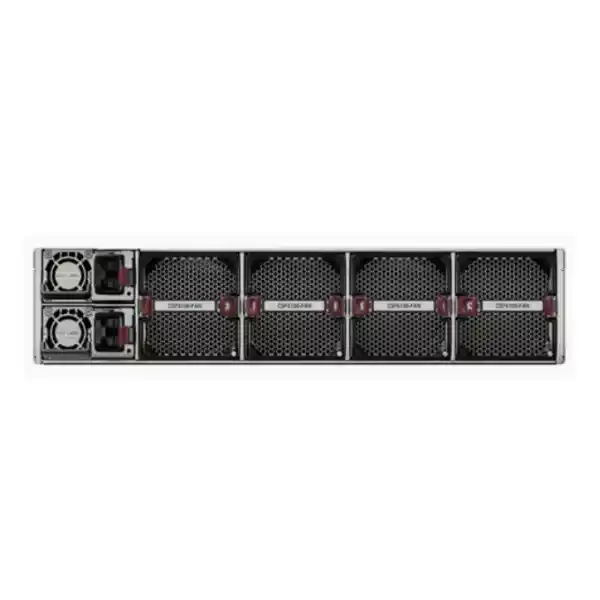
| Power supplies | Two hot-swappable, load-sharing power supplies; 1+1 redundancy. Up to 3000 W each depending on PSU configuration. |
| Typical / maximum input power | Approximately 2010 W typical and 2760 W maximum in Cisco’s published 6170 hardware specification. |
| Dimensions | 3.5 × 16.9 × 32.5 inches (8.89 × 42.93 × 82.55 cm). |
| Fully loaded chassis weight | About 66 lb (29.94 kg). |
| Airflow | Front to rear, supporting cold-aisle to hot-aisle data-centre layouts. |
Published performance numbers are not substitutes for a sizing exercise. Cisco states that performance can vary with enabled features, traffic protocol mix, packet sizes and software releases. A UAE quotation should therefore state the design assumptions used to select the 6170 rather than relying on a single headline figure.
Performance sizing: turning Cisco’s numbers into a production design
Firewall sizing becomes more difficult as the inspection stack becomes more complete. An internet-edge project may begin with a 100 Gbps or 400 Gbps physical link, but the useful firewall requirement is rarely identical to the line rate. Some traffic may be encrypted, some may need intrusion prevention, some may be exempt from decryption, some may arrive in small packets, and the application mix may create much higher connection rates than a simple bulk-throughput benchmark. The 6170 offers substantial performance headroom, yet that headroom should be allocated deliberately.
Start with measured peak traffic rather than average utilisation. Security platforms experience the peaks created by backups, content delivery, large customer events, software distribution, replication, internet bursts and DDoS-related connection pressure even when the normal business day is quieter. If the design uses two appliances in active/standby mode, consider what the active unit must handle after a failure. A pair that is comfortable only while traffic is artificially split can create a dangerous failure state if one appliance must immediately absorb the full load.
Next separate raw firewalling from advanced inspection. Cisco’s Threat Defense figures show 700 Gbps for firewall plus AVC and 600 Gbps for NGFW with firewall, AVC and IPS. That difference is a reminder that security services consume resources. Real deployments can involve additional policy complexity, security intelligence, logging, encrypted traffic analysis, network address translation, routing, VPN, file or malware controls and other functions. The appropriate design margin depends on the exact policy set and traffic composition.
Encrypted traffic deserves its own worksheet. Cisco publishes 150 Gbps of TLS decryption for the 6170 under a defined test methodology. The production requirement should instead consider the percentage of traffic eligible for decryption, the certificates and trust model, cipher suites, session reuse, certificate pinning exceptions, privacy and regulatory rules, application breakage testing, and the amount of traffic intentionally bypassed. A design may have plenty of general firewall throughput while encrypted inspection becomes the limiting factor.
Connection scale can also be decisive. Cisco lists up to 105 million concurrent FTD sessions with AVC and 2.7 million new connections per second. High-volume e-commerce, carrier networks, distributed applications, DNS-heavy workloads, microservice gateways and public services can create connection dynamics that do not resemble large-file throughput. When connection churn is the primary stressor, the sizing discussion should include peak CPS, concurrent session duration and failure-recovery behaviour rather than just gigabits per second.
VPN capacity needs the same discipline. The published FTD IPsec number reaches 550 Gbps under Cisco’s stated profile and the platform supports up to 60,000 VPN peers according to the data sheet. Those are different dimensions: one describes aggregate throughput and the other peer scale. A deployment with thousands of tunnels but low traffic behaves differently from a smaller number of high-throughput site-to-site connections. Cryptographic algorithms, tunnel topology, routing, failover expectations and cloud connectivity can all affect the usable architecture.
A robust sizing package for the Cisco Secure Firewall 6170 should therefore record current peak throughput, three-year or five-year growth, encrypted percentage, IPS requirement, connection rate, session count, VPN scale, desired headroom, HA mode, failure-state target, and required interface speeds. That evidence allows a buyer to decide whether the 6170 is appropriate, whether the 6160 is sufficient, or whether the design should use a clustered architecture rather than a single pair.
Interface architecture, optics and optional network modules
Fixed SFP56 connectivity
The chassis provides twelve fixed 1/10/25/50 GbE SFP56 ports. These are valuable when a design needs multiple routed, transparent, port-channel or security-zone connections without consuming optional network-module slots. The actual speed and media still depend on compatible transceivers and the connected switch or router.
Fixed QSFP56 connectivity
Four fixed 40/100/200 GbE QSFP56 ports support high-capacity uplinks and aggregation designs. Buyers should confirm whether the project uses native 40G, 100G or 200G links, whether breakout is required, and which switch-side optics, fibre plant and link configuration are compatible.
Two network-module bays
Two optional network-module positions allow the firewall to add ports or specialised media. Cisco lists standard modules including 8-port 1/10G SFP+, 8-port 1/10/25G, 4-port 40G, 4-port 40/100/200G and 2-port high-speed modules including 400G-capable options, subject to software and module compatibility.
Fail-to-wire module choices
Cisco also provides hardware-bypass or fail-to-wire module variants for selected 1G, 10G and 25G media. The operational behaviour and software support must be validated for the selected mode. Cisco notes, for example, that ASA can use these modules as regular interfaces but does not provide the hardware-bypass functionality.
Management and console access
The current Cisco hardware guide lists two 1/10/25 GbE SFP28 management ports, one serial console interface and one USB 3.0 port. Dedicated management connectivity should be designed before installation so initial configuration, ongoing administration and recovery do not depend on production data paths.
The module list should not be copied directly into a purchase order without mapping it to the network design. A 400G-capable module is not useful merely because it is the fastest option. It becomes appropriate when the connected switching fabric, traffic engineering and redundancy plan genuinely require that speed. Conversely, using many lower-speed ports may increase operational complexity if a smaller number of high-capacity port channels would produce a cleaner topology.
Optics are one of the most common missing items in firewall quotations. SFP, SFP28, SFP56, QSFP and QSFP-DD families cover different physical and electrical capabilities, while fibre type and reach determine the actual transceiver selection. The buyer should provide rack-to-rack distance, single-mode or multimode fibre type, connector standard, switch model, switch port speed and whether the links use direct attach, optical transceivers or breakout cabling. That prevents a situation where the chassis arrives but the deployment cannot be connected.
Interface redundancy should also be aligned with appliance redundancy. If two 6170 units form an HA pair, each unit needs a complete and symmetric physical path to upstream and downstream infrastructure. Port-channel design, switch redundancy, VLAN mapping, routing adjacencies and failure domains should be tested as a system. The firewall can be extremely powerful while still being undermined by a single upstream switch, a single fibre path or a mis-sized interconnect.
Threat Defense or ASA: choose the operating model before ordering
Cisco offers the Secure Firewall 6170 with either Threat Defense or ASA software. Cisco’s current ordering guide identifies separate appliance part numbers: CSF6170-A-TD-K9 for Threat Defense and CSF6170-A-ASA-K9 for ASA. The choice should be made from security and operations requirements, not from familiarity alone, because it affects feature behaviour, management, performance expectations, licensing and migration work.
Threat Defense is the natural direction for organisations that want Cisco’s modern next-generation firewall capabilities. The 6170 FTD performance table includes application visibility, IPS, NGFW, VPN and TLS decryption metrics, and the platform can be managed in Cisco’s Secure Firewall management ecosystem. Current Cisco documentation also identifies the 6100 Series as a target for version 10.0 and later in supported migration paths. That makes software release planning a core deployment dependency, particularly when the source environment is on an older Firepower release.
ASA remains relevant where an organisation deliberately requires the ASA software model. Cisco publishes 6170 ASA performance figures of up to 750 Gbps stateful inspection firewall throughput in its listed test profiles, up to 370 Gbps IPsec VPN in the stated ASA test profile, up to 5.5 million new connections per second, up to 180 million concurrent firewall connections, up to 60,000 VPN peers, and security-context scalability up to 250. The exact ASA release and ASDM compatibility must be verified; Cisco’s current compatibility material lists the 6170 with ASA 9.24 and coordinating management compatibility.
The decision is not simply that ASA is faster or Threat Defense is more secure. They are different software choices with different operational models. A buyer migrating from a large ASA estate may value configuration continuity and familiar procedures, while a buyer standardising advanced inspection, threat controls and modern policy management may choose Threat Defense even when the project requires more migration work. The selected mode should be stated explicitly on the bill of materials and implementation statement of work.
Choose Threat Defense when
The project requires Cisco’s current NGFW security stack, application visibility, IPS-led inspection, TLS decryption strategy, integrated modern policy workflows and a design aligned with the Secure Firewall Threat Defense platform. Licensing and management architecture must be included in the design.
Evaluate ASA when
The requirement is specifically for ASA software, traditional stateful firewalling or an established ASA operational model. Confirm that required modules, features and the exact ASA/ASDM release are supported on the 6170, and do not assume Threat Defense feature behaviour carries across unchanged.
Licensing and subscription planning
Licensing is a separate design layer from the chassis. Cisco Smart Licensing provides the entitlement framework, while specific Threat Defense services can require additional subscriptions or feature licenses. The project team should define which security capabilities are required at the same time as the hardware is sized because enabling advanced services changes both the commercial bill of materials and the expected performance profile.
For Threat Defense, Cisco documentation describes Smart Licensing and service entitlements for features such as IPS and URL filtering, along with other security services depending on the chosen package. A carrier-oriented deployment may also need a Carrier license; Cisco lists the Secure Firewall 6100 family, including the 6170, among supported devices for that term-based entitlement. The exact subscription package should be selected from the current Cisco ordering tools rather than inferred from an older bundle name because packaging and license structure can evolve.
High availability introduces a licensing detail that is easy to overlook. Cisco’s current cloud-delivered management licensing guidance states that both FTD units in an HA pair must have the same licenses and that the HA configuration requires entitlements for both devices. This is a practical reason to price the architecture rather than just a single chassis. If a production requirement is truly HA, the commercial comparison should use the two-unit protected design and its matching entitlements, not a single appliance price.
Cisco’s network security ordering guide provides a Secure Firewall 6100 two-unit HA bundle part number and advises using the bundle unless there is an explicit reason not to. The value of that guidance is procurement consistency: both appliances and required components can be aligned as an identical pair. FourTeck can use the architecture to determine whether the project should be quoted as an HA bundle or with explicitly itemised chassis and subscriptions.
Before a UAE purchase order is placed, the licensing worksheet should state the software mode, management method, subscription term, required security services, HA or cluster topology, Smart Account ownership, support level and renewal responsibility. That avoids a frequent deployment problem in which the hardware is delivered but the required security feature cannot be activated because the entitlement or account workflow was not part of the procurement scope.
High availability, clustering and resilience design
A firewall in the 6170 class normally protects services important enough that resilience must be designed explicitly. Cisco lists FTD high availability as active/standby, with active/active behaviour available through clustering in the published 6100 Series material, and the data sheet lists clustering up to 16 nodes. ASA supports active/active and active/standby high availability and clustering. The correct topology depends on traffic scale, network design, failure domains, maintenance objectives and operational capability.
Active/standby remains straightforward when one unit can carry the required production load by itself. That requirement is important. A pair of 6170 appliances should not be considered resilient merely because two chassis are present. The surviving appliance, its links, its upstream switches, its routes and its security-policy state must all support the intended traffic during a failure. Capacity headroom should therefore be calculated for degraded mode rather than normal mode only.
Clustering is relevant when a single appliance does not provide the desired aggregate capacity or when a scale-out architecture is operationally appropriate. Cisco describes clustering as grouping multiple Threat Defense nodes into a single logical device to combine increased throughput and redundancy with unified management behaviour. However, cluster design adds networking and operations considerations that a simple HA pair may avoid. The project should validate cluster-control connectivity, data interfaces, surrounding switch architecture, routing, failure handling, software release support and feature compatibility.
It is also important to separate published roadmap items from available functionality. Cisco’s current 6100 Series data sheet still marks FTD Multi-Instance as available in a future release. That means a design should not assume multi-instance capability on the 6170 unless the exact selected software release and Cisco compatibility documentation explicitly confirm it. If segmentation requires separate logical firewalls today, the architect should validate whether VRFs, ASA security contexts, clustering or another supported approach meets the requirement.
Physical resilience extends beyond the software topology. The 6170 has dual hot-swappable, load-sharing power supplies with 1+1 redundancy and four field-replaceable fan modules. A proper data-centre installation should connect redundant PSUs to independent power paths where possible, preserve front-to-rear airflow, and reserve enough rack depth for the 32.5-inch chassis plus cable management. A dual-PSU firewall connected to the same PDU is not protected from that PDU’s failure.
Operational resilience also requires recovery planning. Configuration backup, Smart Licensing access, management-plane reachability, console access, spare strategy, support contract, tested failover procedures and documented rollback all contribute to availability. The platform provides the hardware capabilities; the deployment process must convert them into a reliable service.
Physical installation requirements in UAE data centres
Power deserves more attention than it receives on many firewall projects. A maximum input figure of 2760 W per chassis means an HA pair can represent a meaningful data-centre power and cooling load. The final consumption depends on configuration and workload, but the facility team should reserve capacity using the vendor’s maximum guidance and the actual PSU configuration. This is especially important in older cabinets, colocation racks with fixed power allocations, or sites where two independent feeds have different available headroom.
The 6170’s physical depth also affects cabinet selection. A nominal 19-inch rack width does not guarantee adequate depth for a 32.5-inch chassis, rear power cables, airflow and front fibre management. Measure the cabinet, not just its RU count. Plan the cable path so dense SFP/QSFP connectivity can be serviced without blocking airflow or stressing fibre bends.
Environmental operating limits from Cisco include an operating temperature range of 0°C to 40°C and non-condensing humidity guidance. UAE data-centre facilities normally provide controlled conditions, but commissioning should still verify cold-aisle temperature, airflow direction and alerting. A large security platform should be treated as critical infrastructure with monitored power and environmental conditions, not as an office-room appliance.
Migration to the Cisco Secure Firewall 6170
The 6170 is new enough that many deployments will be migrations from an existing Cisco Firepower, Secure Firewall or ASA estate rather than greenfield installations. Cisco’s current Threat Defense model migration guidance includes the Secure Firewall 6100 Series, including the 6160 and 6170, as supported targets at version 10.0 and later for specified source platforms. The exact supported path still depends on the source model, source release and target release, so migration compatibility should be checked before a hardware change is scheduled.
A migration project begins with inventory. Export or document interface mappings, VLANs, routing, access-control policies, NAT, VPNs, object groups, certificates, identity integrations, logging destinations, management dependencies, dynamic routing, high-availability settings and custom features. Large firewalls often accumulate years of policy history, including obsolete rules. Moving every object unchanged can preserve unnecessary risk and complexity, so a migration window is also an opportunity for controlled policy cleanup.
Interface mapping is particularly important because the 6170 offers a different physical-port architecture from many older appliances. A source system may use several 10G or 40G ports while the new design standardises on 100G or 200G connectivity. Cisco’s migration tooling can support interface mapping for supported migrations, but the network team must still decide which source zone, VLAN, port-channel or routed interface maps to which target interface. The new firewall should reflect the desired future topology, not merely reproduce old cabling choices.
Licensing must be ready before the cutover. Cisco’s migration documentation states that the Smart Licensing account must contain the required target-device entitlements and the device must be registered and enrolled appropriately. A migration can fail operationally even when configuration import succeeds if the target lacks the services needed to enforce the intended policy. The project plan should therefore treat licensing verification as a pre-change acceptance gate.
Testing should be layered. First validate the chassis, software release, management reachability, licenses, interfaces and HA state. Then test routing and basic firewalling, followed by NAT, VPN, IPS, TLS decryption exceptions, application controls, logging and integrations. Finally test failure scenarios, including link loss, appliance failover and upstream/downstream redundancy. A high-performance platform does not remove the need for methodical service validation.
Rollback must be defined before the change starts. The old firewall should remain recoverable until the new platform passes acceptance tests. Document triggers for rollback, how routing or switching will be restored, how DNS or VPN endpoints are handled, and who has authority to make the decision. In large UAE enterprise or service-provider environments, a clear rollback procedure can be more valuable than an optimistic migration timetable.
FourTeck can scope migration separately from hardware supply so the buyer can see exactly what is included: configuration assessment, supported-path validation, target build, policy migration, interface remapping, onsite or remote cutover, post-change testing and documentation. That separation is useful because a simple like-for-like replacement and a redesign of a complex security edge are very different professional-service efforts.
Where the Cisco Secure Firewall 6170 fits well
High-capacity internet edge
Large organisations with multiple high-speed upstream links can use the 6170 as part of a resilient perimeter architecture where application visibility, IPS and encrypted-traffic policy must operate without forcing a lower-speed security choke point.
Data-centre security boundary
The fixed 50G and 200G-class interfaces plus optional modules suit aggregation designs that connect high-throughput switching fabrics while keeping inspection capacity in the same class as modern data-centre network links.
Telecommunications infrastructure
Cisco positions the 6100 Series for telecommunications mobility and other ultra-high-end environments. Carrier-specific security requirements, SCTP-related inspection and appropriate Carrier licensing should be validated when the platform is used in that role.
Large VPN aggregation
The platform’s published VPN throughput and peer scale can support very large encrypted WAN or partner connectivity designs, provided tunnel algorithms, routing, failover and real traffic profiles are engineered rather than assumed from maximum values.
High connection-rate services
Public digital services, cloud gateways and distributed application platforms that generate very high new-connection rates can benefit from the 6170’s connection scalability when the firewall is sized against actual CPS and session duration.
Growth-sensitive consolidation
Where several security zones or legacy appliances are being consolidated, the 6170 can provide headroom, but the design must validate policy scale, interfaces, routing and segmentation so consolidation does not create an oversized single failure domain.
When the 6170 may be the wrong choice
The largest model is not automatically the best model. If the organisation’s measured traffic, encryption workload and growth plan fit comfortably within the 6160, paying for 6170 capacity may not improve security. Cisco publishes 6160 Threat Defense values of 600 Gbps firewall plus AVC, 550 Gbps NGFW, 450 Gbps IPsec VPN and 100 Gbps TLS decryption, compared with 700, 600, 550 and 150 Gbps respectively for the 6170. That makes the 6160 a real alternative when the additional 6170 headroom is not required.
A smaller Secure Firewall family may also be more appropriate for a branch, medium enterprise, ordinary campus edge or data-centre segment whose links and session scale are far below the 6100 class. Oversizing can increase acquisition cost, support cost, rack power and operational complexity without delivering proportional value. The selection should be based on a workload model, not the assumption that buying the highest number protects the project from all future growth.
The 6170 may also be unsuitable if the physical environment cannot support its rack depth, power draw, cooling or high-speed optical connectivity. A 2RU form factor sounds compact, but approximately 32.5 inches of chassis depth and up to 2760 W of published maximum input power per appliance are significant. In a constrained communications room, a different platform or facility upgrade may be needed before the firewall can be installed responsibly.
Software requirements can change the conclusion as well. If the project depends on a capability that Cisco has not yet released for the 6100 platform, such as the multi-instance item still marked as future in the current data sheet, the buyer should not purchase first and hope for software alignment later. Validate the exact software release and feature matrix before committing to the architecture.
Finally, if the project requires capacity beyond a single appliance or single HA pair, clustering may be more appropriate than simply choosing the 6170. The architecture should compare scale-up and scale-out approaches, including switch design, operational maturity, failure behaviour and software support. The goal is the right security service, not the biggest individual chassis.
Cisco Secure Firewall 6160 vs 6170
| Decision point | Secure Firewall 6160 | Secure Firewall 6170 |
|---|---|---|
| Firewall + AVC | 600 Gbps | 700 Gbps |
| NGFW | 550 Gbps | 600 Gbps |
| IPsec VPN | 450 Gbps | 550 Gbps |
| TLS decryption | 100 Gbps | 150 Gbps |
| FTD concurrent sessions with AVC | 75 million | 105 million |
| FTD new connections per second with AVC | 1.5 million | 2.7 million |
| System memory | 24 × 64 GB | 24 × 96 GB |
| Best fit | Ultra-high-end designs that fit within the lower 6100 performance tier and do not need 6170 headroom. | The higher-capacity 6100 option for more throughput, TLS headroom, CPS and session scale. |
Both models share the 2RU chassis class, fixed-interface pattern and two network-module bays. The selection should therefore be driven mainly by required processing scale and growth rather than an assumption that the larger model has a fundamentally different physical connectivity concept. If 6160 capacity meets the failure-state requirement with sensible headroom, it deserves consideration. If encrypted inspection, CPS, sessions or future traffic materially exceed the 6160 comfort zone, the 6170 provides a stronger margin.
Procurement checklist for a Cisco Secure Firewall 6170 quotation
A complete quotation should identify more than the chassis. Cisco lists separate part numbers for Threat Defense and ASA, and an HA bundle can be appropriate when the requirement is a protected pair. The exact line items then depend on interface modules, optics, power, software subscriptions, support and implementation. The following checklist helps prevent a partial bill of materials.
Confirm Threat Defense or ASA. Use the correct chassis PID and validate release compatibility.
Single appliance, HA pair or cluster. Calculate surviving-node load and specify identical entitlements where required.
Identify IPS, URL-related controls and other required security services, term length, Smart Account and renewal owner.
Select optional modules only after confirming interface count, speed, media and software compatibility.
Provide fibre type, distance, connected switch model, port speed and breakout requirements.
Confirm rack depth, 2RU allocation, PDU feeds, PSU type, available power and cooling capacity.
Define management platform, management network, console access, admin roles and logging destinations.
State source model and release, policy scale, interface changes, VPNs, NAT, routing and required change window.
Specify Cisco support coverage, response expectations, local implementation support and operational handover needs.
UAE availability and FourTeck specialist resources
For Dubai and UAE projects, FourTeck can coordinate Cisco Secure Firewall 6170 supply with the practical elements that determine whether the platform can be commissioned successfully: model selection, interface planning, module and optics validation, licensing scope, high-availability design, migration services, rack installation and post-deployment support. Availability, lead time and commercial pricing should be confirmed against the exact part numbers and project configuration at quotation time.
For broader UAE infrastructure requirements, visit FourTeck UAE. For firewall-focused product and deployment enquiries, use Firewall Dubai by FourTeck. Projects that also require server, switching, storage, migration or managed infrastructure work can be coordinated through FourTeck IT Services UAE. International organisations coordinating multi-country infrastructure can also reference FourTeck global.
The useful procurement conversation is not simply “Is a 6170 in stock?” The correct questions are “Which 6170 PID matches the software mode, which licenses are needed, what optical and module configuration fits the network, can one unit carry the failure-state traffic, and what implementation work is required?” Answering those points produces a quotation that is easier to approve internally and far less likely to encounter surprises during deployment.
Frequently asked buyer questions
Is the Cisco Secure Firewall 6170 a next-generation firewall?
Yes, when deployed with Cisco Secure Firewall Threat Defense, the 6170 is designed to deliver next-generation firewall capabilities. Cisco publishes separate Threat Defense performance metrics for firewall plus application visibility, IPS-enabled inspection, NGFW throughput, IPsec VPN and TLS decryption. The platform also supports ASA software, so the exact capabilities depend on which software mode is ordered and deployed.
What is the maximum published NGFW throughput of the 6170?
Cisco lists up to 600 Gbps for NGFW throughput with firewall, Application Visibility and Control, and IPS in its 1024-byte Threat Defense test profile. Cisco also lists 700 Gbps for firewall plus AVC. These are laboratory-style published figures; production throughput varies with enabled services, packet sizes, protocol mix, encrypted traffic and software release.
How much TLS decryption capacity does Cisco publish for the 6170?
Cisco publishes up to 150 Gbps TLS decryption for the 6170 under a defined test profile. A real decryption design must account for the percentage of traffic decrypted, cipher and key characteristics, session behaviour, certificate exceptions, application compatibility and privacy policy. The 150 Gbps figure should be used as a sizing reference, not as a guaranteed result for every encrypted traffic mix.
How many sessions can the 6170 support?
Cisco’s current Secure Firewall 6100 Series data sheet lists up to 105 million concurrent sessions with AVC for the 6170 and up to 2.7 million new connections per second with AVC. ASA has a separate scale profile with up to 180 million concurrent firewall connections and up to 5.5 million new connections per second. Use the values for the software mode actually being evaluated.
What ports are built into the chassis?
The 6100 Series hardware includes twelve fixed 1/10/25/50 GbE SFP56 ports and four fixed 40/100/200 GbE QSFP56 ports. The chassis also provides two network-module bays for additional or specialised interfaces. Optics are selected according to speed, reach, fibre plant and connected equipment; they should not be assumed merely from the port type.
Does the 6170 support 400G connectivity?
Cisco lists optional network-module capability that includes a 2-port 40/100/200/400 GbE QSFP-DD module for the Secure Firewall 6100 Series. The exact module PID, selected software release, interface mode, compatible optics and switch-side design must be confirmed before ordering. The fixed chassis ports themselves are listed up to 200G.
Can I buy one 6170 now and add HA later?
Technically a future expansion may be possible, but it is usually better to design the required resilience from the beginning. An HA project needs a second compatible appliance, matching interface design, appropriate licensing, switching and routing redundancy, and enough capacity for failure-state operation. Cisco provides a 6100 two-unit HA bundle in its ordering guidance, which can simplify a planned protected deployment.
Does an HA pair need duplicate Threat Defense licenses?
Cisco’s current licensing guidance states that both Threat Defense units in an HA configuration must have the same licenses and that two entitlements are required, one for each device. The quotation should therefore include licensing for the pair rather than treating the standby chassis as an unlicensed spare.
Does the 6170 support clustering?
Yes. Cisco’s current 6100 Series material lists clustering for both Threat Defense and ASA, with published scalability up to 16 units. The exact supported cluster size, feature behaviour and software requirements should be validated against the release being deployed because clustering is a software-sensitive architecture and Cisco documentation can evolve between releases.
Does the 6170 support FTD multi-instance today?
Cisco’s current Secure Firewall 6100 Series data sheet still marks FTD Multi-Instance as an item for a future release. Buyers should not design around that capability unless the exact selected release and Cisco compatibility documentation explicitly confirm availability. Where logical separation is required, evaluate the supported options for the chosen software mode.
How much rack power should be planned?
Cisco lists approximately 2010 W typical input power and 2760 W maximum for the 6170. Facilities should plan from the actual PSU configuration and vendor maximum guidance, especially for an HA pair. Dual PSUs should ideally connect to independent facility power paths, and the cabinet must provide enough cooling for the real load.
Is the 6170 suitable for an ordinary office branch?
Usually not. The 6170 is an ultra-high-end platform intended for demanding data-centre, telecommunications and very large enterprise workloads. A branch with far lower traffic should normally be evaluated against smaller Cisco Secure Firewall models. Oversizing increases cost, rack power and complexity without automatically improving protection.
Can the 6170 replace an older Firepower 4100 or 9300 deployment?
Potentially, and Cisco’s current Threat Defense model migration guidance includes the 6100 Series as a supported target for specified source platforms at version 10.0 and later. However, the migration path depends on source model and release, target release, feature compatibility, interface mapping and licensing. A replacement should be validated as a migration project rather than assumed to be a direct hardware swap.
What information is needed for a Cisco Secure Firewall 6170 price in Dubai?
Provide the required software mode, quantity, HA or cluster design, peak and projected throughput, security services, encrypted percentage, interfaces and optics, network modules, VPN scale, management method, subscription term, rack and power details, migration source and support requirement. Those inputs determine the real solution price far more accurately than a chassis-only request.
Implementation journey for a 6170 project
This sequence matters because the 6170’s value depends on integration. Ordering hardware before traffic and interface requirements are known can produce unnecessary module costs or missing components. Installing before licensing and management are ready can delay commissioning. Migrating before failure-state testing can create a resilience gap. A structured implementation turns the platform’s capabilities into an operational security service.
Decision recap before approving the purchase
What FourTeck needs from you for an accurate 6170 quotation
A short technical brief is enough to begin. Provide the exact details you already know; unknown values can be identified during sizing. The most useful information is:
Plan the Cisco Secure Firewall 6170 as a complete security architecture
For a high-capacity firewall, accurate sizing and a complete bill of materials are more valuable than a chassis-only price. FourTeck can help you confirm whether the 6170 is the right 6100 model, select Threat Defense or ASA, design HA or clustering, identify modules and optics, align licensing, verify rack power and plan migration for a Dubai or UAE deployment.

Reviews
There are no reviews yet.