
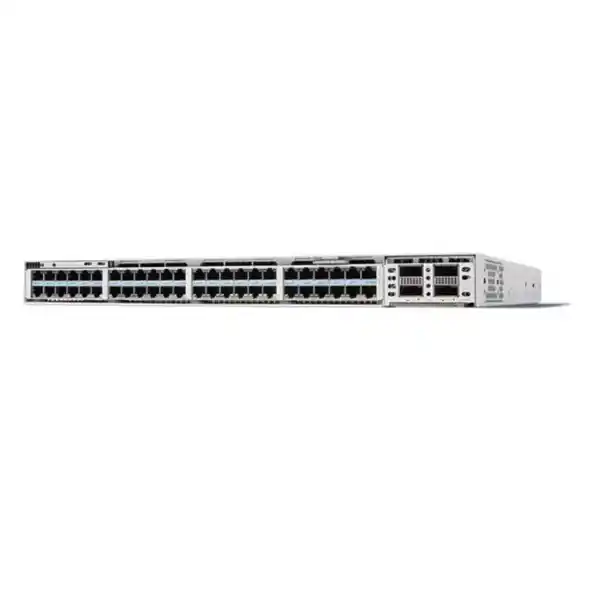
Cisco C9350-48U Smart Switch
The Cisco C9350-48U is a 48-port Gigabit Ethernet access switch engineered for organizations that need dependable wired access, substantial Power over Ethernet capability, high-speed modular uplinks and a modern operational model. Each copper downlink supports 10/100/1000 Mbps Ethernet and the platform is designed for up to 60W Cisco UPOE per port, making it suitable for IP phones, video endpoints, surveillance cameras, access-control devices, lighting gateways, building sensors, thin clients and other powered edge systems that exceed traditional PoE+ budgets.
For UAE campuses and distributed enterprises, the platform combines Cisco Silicon One A100/L hardware forwarding, a published 496G bandwidth specification for this SKU, modular uplinks up to 200G, StackWise-1.6T, hardware telemetry, secure boot controls, field-replaceable fans and up to three power supplies. The result is an access-layer switch that can be designed for today’s 1G endpoint estate without creating an uplink, resilience or PoE ceiling that forces premature replacement.
C9350-48U at a glance
What the Cisco C9350-48U is designed to do
The C9350-48U sits at the enterprise access layer: the point where users, phones, cameras, badge readers, wireless infrastructure, printers, building systems and many other endpoint classes enter the corporate network. It is not simply a port-density device. Cisco has designed the C9350 family to combine traditional campus switching with policy enforcement, routing, telemetry, programmable operations, flexible management and high-availability stacking. The 48U model is specifically the 48-port 1G copper variant with 60W UPOE capability, so it targets environments in which endpoint throughput is usually 1 Gigabit or less but power density, security and uplink capacity are strategically important.
That combination matters in real UAE deployments. Many enterprises still have extensive Category 5e or Category 6 horizontal cabling and a very large installed base of 1G endpoints. Re-cabling every desk or device for multigigabit access may not produce useful business value, while replacing older PoE switches can be essential because modern endpoints demand more power, better segmentation and higher upstream bandwidth. The C9350-48U lets network teams preserve the economics of 1G edge access while modernizing the switching architecture around it.
The platform is therefore a strong fit for campus closets, enterprise floors, education blocks, clinical and administrative networks, hospitality buildings, retail back offices, logistics facilities, government environments and smart-building projects. A correct design should still be based on endpoint count, PoE draw, uplink traffic, failure-domain requirements, optics, licensing, rack depth, thermal conditions and growth assumptions rather than on port count alone.
Core hardware specifications for the C9350-48U
Downlink interfaces
Forty-eight fixed RJ-45 copper ports support 10 Mbps, 100 Mbps and 1 Gigabit Ethernet. This makes the switch suitable for mainstream wired endpoints and high-density access environments where 1G remains the practical endpoint standard.
Power over Ethernet
The 48U variant supports up to 60W Cisco UPOE per downlink, aligned with IEEE 802.3bt Type 3 power levels. The maximum platform PoE capability is up to 2,880W, subject to installed power-supply configuration and power-sharing design.
Switching and forwarding
Cisco publishes a 496G bandwidth specification and 369.024 MPPS forwarding rate for the standalone C9350-48U. With stacking, published values rise to 2,096G switching capacity and 1,559.424 MPPS forwarding rate for the SKU.
Silicon architecture
The C9350-48U uses Cisco Silicon One A100/L for hardware-based forwarding. The C9350 platform provides programmable forwarding resources, scalable table allocations and hardware telemetry suitable for enterprise access and routed-edge roles.
High-speed uplinks
The base chassis uses a field-replaceable uplink network-module slot. For the C9350-48U, Cisco supports the C9350-NM-2C and C9350-NM-8Y options, providing up to 200G aggregate modular uplink bandwidth.
Stacking and resilience
StackWise-1.6T supports up to eight C9350 switches in one logical stack, with dedicated rear connectors. StackPower+ can pool power across supported stack members to improve utilization and redundancy planning.
Cisco Silicon One A100/L: why the forwarding architecture matters
Access switches increasingly have to perform far more work than basic Ethernet bridging. They classify traffic, enforce security policies, collect flow telemetry, route between subnets, support multicast, apply quality-of-service treatment and maintain thousands of hardware table entries while sustaining predictable forwarding latency. The C9350 family addresses that requirement with Cisco Silicon One A100/L application-specific integrated circuits. On the C9350-48U, this provides the hardware foundation for line-rate switching and the programmable resource model that underpins the broader platform.
Cisco’s published platform scale includes up to 64,000 MAC addresses, up to 192,000 IPv4 routes in the standard platform table view, up to 96,000 IPv6 routes, up to 64,000 ARP entries, up to 2,000 switched virtual interfaces, 4,094 VLAN IDs and jumbo frames up to 9,216 bytes. The default access-oriented SDM template balances resources between Layer 2 forwarding, Layer 3 routing, access control lists, quality of service and telemetry. Those numbers should not be interpreted as a requirement to drive a wiring-closet switch to every maximum simultaneously; they illustrate that the hardware has headroom for complex enterprise access designs rather than being limited to simplistic edge forwarding.
The ASIC design also affects future operating models. Flexible hardware tables and programmable pipelines allow Cisco to expose features through IOS XE without replacing the switching hardware for every change in policy or telemetry requirements. In practice, this gives network architects a stronger platform for segmentation, route scale, monitoring and evolving security policy than a fixed-function SMB-class smart switch.
For procurement teams comparing the C9350-48U with lower-cost 48-port PoE switches, the correct comparison is therefore not only “48 ports versus 48 ports.” It is the complete forwarding system: ASIC capability, uplink architecture, stack fabric, table scale, hardware telemetry, software lifecycle, redundancy options, licensing model and operational tooling. Those factors determine whether the switch remains useful when the network grows from a simple access layer into a policy-driven enterprise fabric.
48-port 1G access design: where this model fits best
The C9350-48U deliberately uses 1G copper downlinks rather than multigigabit ports. That is an advantage when the endpoint estate is dominated by 100 Mbps and 1G devices and the engineering objective is power density, availability and uplink headroom rather than 2.5G, 5G or 10G connectivity at every desk. Common examples include IP phones, standard office workstations, access controllers, many surveillance cameras, digital signage players, embedded building controllers, point-of-sale devices, printers, thin clients and general IoT equipment. These endpoint categories rarely gain operational value from a multigigabit PHY, but they can benefit significantly from improved PoE power, segmentation, monitoring and switch redundancy.
The 48-port format is particularly efficient in medium and high-density telecommunications rooms. A typical floor can use one or more 48-port access switches with patch-panel layouts that map cleanly to rack units and copper bundles. When multiple switches are stacked, the operations team can manage them as a unified switching system while preserving distributed forwarding. That can reduce configuration complexity compared with treating every access switch as an isolated device.
Where the C9350-48U is not the best fit is equally important. If a deployment includes Wi-Fi access points or workstations that genuinely require 2.5G, 5G or 10G copper on the downlink, a multigigabit C9350 variant should be evaluated. If the access layer does not require PoE, the C9350-48T may be more economical. If only 30W PoE+ is required and there is no need for higher-power endpoints, the C9350-48P may be sufficient. Correct model selection is a function of actual endpoint requirements, not simply choosing the highest PoE rating available.
FourTeck can align the switch choice with an existing campus or branch architecture through the FourTeck UAE networking portfolio, especially where switching, security, wireless, structured cabling and support need to be planned as one system rather than purchased as unrelated components.
UPOE engineering: understanding the 60W-per-port capability
The defining feature of the C9350-48U is its 60W UPOE access capability. Each of the 48 downlinks can support higher-power devices than a conventional 30W PoE+ port. This is useful for endpoints such as advanced PTZ cameras, compact computing devices, building controls, multi-radio devices, access-control panels and other powered equipment whose peak draw can exceed the comfortable envelope of 802.3at PoE+. It also gives designers room for future endpoint replacement without immediately replacing the access switch.
However, “60W per port” and “60W on all 48 ports at the same time” are not the same statement. Forty-eight ports multiplied by 60W equals 2,880W, which is the switch’s published maximum PoE capability. Delivering that amount depends on the installed power supplies, their input voltage, operating mode and redundancy policy. Cisco ships the C9350-48U with an 850W-class primary PSU by default in the ordering guide, and the published available PoE for a single default 850W supply is substantially lower than 2,880W. Additional or upgraded power supplies are needed when a design requires a larger shared PoE pool.
This is why PoE should be engineered from the endpoint inventory rather than from the switch’s theoretical maximum. For every powered device, record the negotiated class, typical draw, worst-case draw, quantity, criticality and growth factor. Then calculate the required switch budget and decide how much power must remain available after a power-supply failure. A system that can deliver enough watts under normal conditions but loses half its cameras after a single PSU failure has not been designed for true redundancy.
The UAE’s 230V electrical environment can be advantageous when using the 1600W supply because Cisco specifies the full 1600W output in the 180V–264V input range. Even then, the final bill of materials should be checked against the exact Cisco power-budget tables and the intended N+1 policy. FourTeck can size the switch, PSU combination, rack PDU capacity and UPS allocation together rather than treating the network and electrical design as separate exercises.
Power-supply architecture and practical PoE budgeting
Up to three field-replaceable PSUs
The C9350 chassis provides three power-supply bays. One supply is the minimum. Additional supplies can increase available PoE power and can be used to create fault-tolerant power designs. Because the supplies are field replaceable, maintenance can be planned without replacing the chassis.
850W and 1600W choices
Cisco’s ordering information identifies the 850W supply as the default for the C9350-48U and a 1600W option for higher-power configurations. The 1600W PSU delivers its full rated output at 230V-class input, which is relevant for UAE facilities planning high PoE density.
Combined power mode
The chassis can operate with combined power resources so the system can use capacity from multiple installed supplies. The actual available PoE figure depends on the specific PSU mix and Cisco’s share-ratio calculations, so the final configuration must be validated against the official power table.
Redundancy versus maximum watts
A design optimized only for maximum output is different from one optimized for N+1 resilience. Critical sites should decide how much endpoint power must survive a PSU outage, then select the number and capacity of supplies around that requirement rather than around normal-load figures alone.
Modular uplinks: 200G headroom without replacing the base switch
The access layer is often constrained not by the downlink speed of one user but by the aggregate demand of dozens of users, wireless devices, cameras and local services converging onto a small number of uplinks. The C9350-48U addresses this with a modular uplink slot rather than fixed low-speed uplinks. Cisco supports the C9350-NM-2C and C9350-NM-8Y network modules on this SKU, with total uplink bandwidth of up to 200G.
The C9350-NM-2C provides two high-speed QSFP-class ports supporting 100G or 40G operation, allowing a simple design with one or two very high-capacity fiber links toward the distribution or core layer. The C9350-NM-8Y provides a more granular option: eight 25G/10G/1G interfaces or a four-port 50G operating mode. This flexibility is useful when an enterprise needs multiple uplinks, diverse paths, migration between speeds or compatibility with an existing distribution layer that is not yet standardized on 100G.
The important procurement point is that the uplink module is not simply an afterthought. The base switch does not include the final uplink topology by itself. The bill of materials must define the network module, compatible transceivers or DAC/AOC cables, fiber type, connector type, link distance and redundancy design. Choosing a 100G-capable module but pairing it with unsupported optics, incorrect fiber or an incompatible remote interface does not create a working uplink.
For new UAE campus projects, a useful approach is to size uplinks around expected aggregate utilization and convergence patterns, then select enough headroom for future growth. A 48-port 1G switch does not automatically need 100G upstream, but high PoE density can indicate a concentration of video, wireless or building devices that generate meaningful aggregate traffic. The modular design lets architects choose the right uplink today and preserve a migration path as the distribution layer evolves.
StackWise-1.6T: scale multiple access switches as one system
Cisco StackWise-1.6T is a major architectural advantage when several C9350 switches serve the same telecommunications room or access block. Cisco supports up to eight members in a stack using dedicated rear-panel stack connectors and high-speed stack cables, with aggregate stacking bandwidth up to 1.6 Tbps. The stack behaves as a unified system from an operational perspective while forwarding remains distributed across member hardware.
For network teams, the practical benefit is simpler topology and better failure handling. A stack can present a common control plane, simplify configuration consistency and allow uplinks to be distributed across different physical members. In a resilient design, one uplink can terminate on one switch and another uplink on a separate member, reducing the chance that a single switch failure removes the entire closet from the network. The stack fabric carries traffic between members without forcing all east-west traffic through external links.
Stacking also changes capacity planning. Cisco publishes 2,096G switching capacity and 1,559.424 MPPS forwarding for the C9350-48U when stacking is included in the SKU calculations, reflecting the additional stack fabric available to the system. An eight-member stack can support up to 384 1G access ports. That density can be useful in large floor distributors, but a single large stack also becomes a significant operational and power domain, so designers should decide whether one eight-switch stack or several smaller stacks better matches maintenance, blast-radius and organizational requirements.
Stack cable length is part of the physical design. Cisco offers dedicated StackWise-1.6T cable options in 50 cm, 1 m and 3 m lengths. Cable selection should match the exact rack placement and avoid unnecessary slack that obstructs airflow or maintenance access. When stack members are distributed across multiple racks, rack position, cable reach and rear-access servicing need to be drawn before ordering.
StackPower+ and resilient power domains
The C9350 platform supports StackPower+, a power-sharing architecture that can combine available power resources across supported switch members. This is valuable because network access power is no longer consumed only by the switch itself. Cameras, phones, sensors, door systems and other devices may all depend on the access stack for power. A fault in one local power supply can therefore affect dozens of operational endpoints unless the design provides another source of usable capacity.
StackPower+ lets architects think in terms of a shared power pool rather than isolated switch-by-switch reserves. This can improve utilization because spare capacity in one member can help satisfy demand elsewhere in the stack. It can also support redundancy goals without consuming additional rack units for separate power shelves. The feature does not remove the need for careful electrical engineering: upstream circuits, rack PDUs, UPS systems, power-supply count and expected PoE load must still be sized for the desired failure scenario.
For critical UAE deployments, a sensible design review asks several questions at once: What happens if one PSU fails? What happens if one rack PDU loses input? What happens if one UPS path is unavailable? Which powered endpoints are business critical? How much PoE should remain after a failure? Which switches are connected to which electrical feeds? When these questions are answered together, the C9350’s multi-PSU design and StackPower capabilities become part of an end-to-end availability strategy rather than merely product features.
Physical design, airflow and rack planning
Chassis dimensions
The C9350-48U chassis is approximately 4.4 x 44.5 x 38.3 cm without the extended power-supply depth. With a 500W or 850W PSU, the installed depth is about 42 cm; with a 1600W PSU, depth increases to about 50.1 cm.
Weight
Cisco lists the C9350-48U at about 14.14 lb, or 6.42 kg, with its default power supply. Final rack loading should include additional power supplies, network modules, optics, cables and cable-management hardware.
Cooling
Three field-replaceable fan modules support N+1 cooling redundancy. The chassis uses front-to-back airflow, so racks should preserve clear intake and exhaust paths and avoid recirculation caused by blocked rear space or poor containment.
Environmental range
Cisco specifies operation from -5°C to 45°C up to roughly 1,800 m altitude, with reduced maximum temperature at higher altitude. Cold start requires 0°C minimum ambient. Humidity is specified at 10% to 95% non-condensing.
Rack depth is especially important when the 1600W PSU is used. A cabinet that comfortably accepts the base chassis may become cramped once longer power supplies, power cords, stack cables and fiber bend radius are included. For production deployments, measure usable rail-to-door clearance rather than relying only on nominal cabinet depth. Maintain service access to rear fans and PSUs so field replacement does not require disturbing unrelated patching.
IOS XE: enterprise operations beyond basic switch management
The C9350 series runs Cisco IOS XE, giving the C9350-48U an operational model designed for large enterprise networks. IOS XE provides the familiar command-line workflow many network engineers expect, while also supporting model-driven interfaces such as NETCONF, RESTCONF and YANG. That combination is important when organizations are moving from individually configured switches toward automated infrastructure. Engineers can still troubleshoot locally, but repeatable configuration and telemetry workflows can be integrated into orchestration systems.
Streaming telemetry allows the switch to export operational data in a structured way rather than relying only on periodic polling. This helps monitoring systems understand interface state, utilization, errors, environmental conditions and other metrics with better timeliness and scale. Flexible NetFlow provides hardware-assisted flow visibility, which can be used for traffic analysis, capacity planning and security investigations. SPAN and ERSPAN capabilities support packet-analysis workflows when deeper inspection is required.
IOS XE also supports on-box programmability and application-hosting concepts. Cisco publishes 16 GB of DRAM and 18 GB of flash for the C9350 platform, with optional SSD capacity up to 240 GB and resources for application hosting. These capabilities should be treated as part of a specific solution design rather than as generic compute capacity. If a project depends on a hosted application or a particular telemetry package, verify the software release, license level, resource allocation and application support matrix before procurement.
For UAE organizations with established Cisco operational practices, this software environment can reduce retraining and simplify integration with existing monitoring, automation and change-management processes. For teams adopting cloud operations, the same hardware can also participate in Cisco’s newer flexible management model rather than forcing a completely separate hardware family.
Flexible management: cloud, device and on-premises choices
Cisco positions the C9350 Series around a unified hardware concept with flexible management. Depending on operating mode and software availability, the switch can be integrated with the Cisco Meraki dashboard for cloud-oriented provisioning, monitoring and troubleshooting, or with Cisco Catalyst Center for on-premises enterprise network management. Device-centric CLI workflows remain relevant as well. This flexibility is valuable for organizations that are standardizing on one hardware platform while different business units or sites use different operational models.
Cloud management can reduce the need to operate a dedicated controller infrastructure and can simplify inventory, monitoring and centralized workflows for distributed sites. On-premises management can be preferable where organizations already operate Catalyst Center, require local control, have established software-defined access workflows or must align with specific security and data-governance practices. A device-managed operating model remains useful for engineers who need direct configuration control or for migration phases where automation tooling is not yet standardized.
The decision should be made before rollout because management mode affects onboarding, operational ownership, templates, troubleshooting and licensing expectations. A mixed estate can be supported, but it should be intentional. Define who owns switch configuration, where source-of-truth resides, how backups are maintained, how firmware is governed, how alerts are integrated with the service desk and how role-based access is enforced.
Organizations that want implementation support around controller integration, monitoring, migration and managed operations can combine the hardware purchase with FourTeck UAE IT services so that the access switch becomes part of a documented operational platform rather than an isolated box installed in a rack.
Security architecture at the access edge
The access layer is one of the most security-sensitive locations in an enterprise network because it is where users and devices first connect. The C9350 platform includes hardware and software capabilities intended to enforce identity-aware policy, segmentation, access control and traffic visibility close to that connection point. Cisco publishes support for high-scale security ACLs, Cisco TrustSec, software-defined access, Flexible NetFlow, IP device tracking and additional enterprise security functions within the platform.
Hardware ACL processing is particularly important. When security policy is enforced in the forwarding ASIC, the switch can filter traffic without sending ordinary data flows to a slower general-purpose CPU path. This allows enterprises to deploy meaningful segmentation and policy at access scale while maintaining predictable performance. The exact ACL capacity depends on SDM allocation and feature combination, so policy design should consider both logical requirements and hardware table consumption.
The platform also incorporates a hardware-rooted trust model. Cisco describes Trust Anchor technologies, image signing and Secure Boot mechanisms that validate system authenticity and help prevent unauthorized software changes. Runtime integrity and secure software update practices complement that boot-time validation. These features are relevant for regulated organizations, government networks and enterprises that treat network infrastructure as part of the security control plane rather than as passive connectivity.
Some advanced functions advertised for the C9350 family, including portions of post-quantum cryptography, inline threat protection and specific application-recognition capabilities, may depend on software release and licensing availability. A production design should therefore verify the exact IOS XE release and subscription entitlement required for each planned security feature instead of assuming that every roadmap capability is active in every installed software version.
Segmentation, routing and policy scale
The C9350-48U can participate in both Layer 2 and Layer 3 enterprise designs. Traditional campus deployments may use VLANs at the access layer with routed uplinks or centralized default gateways. More distributed designs can place switched virtual interfaces and routing closer to the edge. Cisco publishes support for IP routing, IPv6 routing, IP multicast routing, software-defined access and programmable policy resources on the C9350 platform, giving architects flexibility to choose the appropriate boundary between access and distribution.
Scale values are substantial for an access switch: up to 4,000 active VLANs, approximately 2,000 SVIs, 64,000 MAC addresses, up to 192,000 IPv4 routes in the published default platform table view and significant ACL and NetFlow resources. In normal campus practice, most access switches will operate far below these maxima. The value is that a complex segmentation design is less likely to be constrained by tiny hardware tables that were sized for basic branch switching.
Quality of service is also important in a converged access network. Voice, interactive video, control traffic, backup flows and general user data may share the same uplinks. The switch can classify, mark, queue and police traffic according to enterprise policy. The design should map endpoint trust boundaries carefully: blindly trusting markings from every connected device can undermine the QoS model, while overly aggressive remarking can harm latency-sensitive applications. Define which endpoint classes are trusted and where markings are normalized.
For multicast applications such as video distribution, digital signage or specialized operational systems, the platform supports IGMP/MLD snooping and multicast routing resources. Again, the practical requirement is end-to-end design. A switch may support multicast efficiently, but incorrect querier placement, PIM design or VLAN boundaries can still create flooding and unstable behavior. The access platform provides the capability; the architecture determines the outcome.
Visibility, telemetry and troubleshooting
Enterprise access incidents are frequently difficult because the symptom is experienced by an endpoint while the root cause may be cabling, DHCP, authentication, spanning tree, routing, QoS, power, DNS, application behavior or upstream congestion. The C9350 platform includes multiple visibility mechanisms intended to reduce the gap between “the user cannot connect” and a defensible technical diagnosis.
Flexible NetFlow provides flow records that describe who is communicating, in which direction, on which protocol and at what volume. Streaming telemetry can export detailed device and interface state to external systems. SPAN and ERSPAN allow selected traffic to be mirrored for packet capture or security analysis. IP Device Tracking can improve awareness of connected devices and address bindings. These functions are particularly valuable when a wiring closet serves hundreds of endpoints and the operations team cannot physically inspect each device.
For capacity planning, telemetry should be collected before congestion becomes visible to users. Monitor access-port utilization, uplink percentiles, queue drops, errors, discards, PoE allocation, PSU state, temperature and fan health. A 48-port switch with dual 25G or 100G-class uplinks may have abundant aggregate bandwidth, but traffic can still bottleneck at a specific downstream server, WAN circuit or distribution interface. Data from the switch should be correlated with upstream infrastructure rather than interpreted in isolation.
A strong support process also preserves configuration history and software state. Record the switch serial number, installed network module, PSU models, stack position, license tier, IOS XE version, optics, upstream interfaces and rack location. When a fault occurs, this inventory can eliminate hours of uncertainty and makes replacement or escalation materially faster.
Unified licensing for the 48-port platform
The C9350 Series uses Cisco’s newer unified licensing model. The ordering guide identifies switching license options for 48-port access platforms in Essentials and Advantage tiers. For a new subscription, Cisco states that unified switching licenses require a minimum 36-month term. The license provides access to the relevant software capabilities and is also tied to Cisco’s unified support model for the platform.
This means licensing should be treated as part of the hardware bill of materials rather than an optional administrative detail discovered after the switch is delivered. The correct tier depends on required features, management mode and enterprise agreement structure. Organizations should also decide who owns the Cisco Smart Account, how licenses are assigned, how renewals are governed and how procurement records map to the operational inventory.
Cisco’s current ordering model supports flexible management choices, including Meraki dashboard and Catalyst Center workflows. Those capabilities do not eliminate the need to validate the feature matrix for the selected license. If the project depends on advanced segmentation, specialized routing, security functions or management integrations, list those functions explicitly during quotation and confirm that the proposed license tier satisfies them.
For multi-year UAE projects, subscription lifecycle planning matters as much as day-one configuration. Document renewal dates, budget ownership, escalation contacts and the business impact of license expiration. A switch can remain physically installed for many years, so the operational and commercial model should be designed over the intended service life rather than only through the initial procurement cycle.
High availability: design beyond a single switch
A high-end access switch is only one component of an available network. The C9350-48U includes architecture that supports resilient design: StackWise-1.6T, up to three power supplies, N+1 fan redundancy, StackPower+, modular uplinks and enterprise routing and switching protocols. The way those features are combined determines the real availability of the site.
At minimum, critical deployments should avoid terminating every upstream path on one physical stack member. Distribute uplinks across different members and, where the campus design permits, across separate distribution devices. If PoE endpoints are operationally critical, provision enough power so that a single PSU failure does not force the switch to remove power from essential devices. Place redundant PSUs on independent electrical paths when the facility supports it.
Software maintenance is another availability domain. Cisco describes extended fast software upgrade and maintenance update capabilities intended to reduce disruption for selected update scenarios. Even with those capabilities, change windows should include configuration backup, compatibility review, stack health checks, rollback planning and verification of downstream services. A non-disruptive software feature cannot compensate for poor change control or an incompatible image.
The final availability target should be expressed in business terms: which rooms, cameras, phones or systems must remain connected through which failure? Once that is known, the number of switches, stack topology, uplinks, PSUs, power feeds and spares can be designed around a measurable objective instead of simply checking a “redundant” box on a product datasheet.
Use case: enterprise office floors and corporate campuses
Corporate office environments are a natural fit for the C9350-48U when each floor or zone contains a mix of wired users, IP phones, meeting-room systems, cameras and building devices. The 48-port format maps well to high-density patching, while 60W UPOE provides flexibility for devices that need more than standard PoE+. High-speed modular uplinks allow the access layer to connect to modern distribution switches without being limited to legacy 1G or 10G uplink designs.
A common design uses two or more C9350 switches in a StackWise domain, with uplinks distributed across different members. User and device VLANs are segmented according to corporate policy, voice traffic receives controlled QoS treatment, cameras and building systems are isolated from general user networks, and telemetry is exported centrally. The stack can simplify management while retaining the physical resilience of multiple forwarding members.
The main sizing questions are endpoint count, actual PoE demand and uplink oversubscription. A floor with 48 office PCs may consume little PoE, while a floor with 30 cameras and multiple collaboration appliances may consume far more power even though the port count is lower. Design the switch around the complete endpoint profile and reserve capacity for growth, moves and temporary devices.
Use case: surveillance and physical security networks
Video surveillance is one of the strongest reasons to select a 60W-capable access switch. Fixed cameras may consume modest power, but PTZ cameras, heated housings, illuminators, multi-sensor cameras and analytics-capable edge devices can require substantially more. The C9350-48U gives security architects the ability to mix lower-power and higher-power devices on one access platform while retaining enterprise switching, telemetry and redundancy features.
Bandwidth planning is equally important. Forty-eight cameras producing sustained video can create significant upstream traffic, particularly at high resolution, high frame rates or low compression. The 200G-class modular uplink options provide ample interface headroom, but the actual uplink speed should be selected from measured or calculated camera bit rates plus growth and failover factors. Where redundant recording paths are used, test how traffic behaves during failover rather than assuming normal-state averages are sufficient.
Security camera networks should normally be segmented from user devices and tightly controlled. Access control lists, routing policy, monitoring and device tracking can help reduce lateral movement and unauthorized access. Organizations deploying switching as part of a broader perimeter and segmentation architecture can coordinate the access layer with FourTeck Firewall Dubai solutions so that camera VLANs, management networks and upstream security zones are designed consistently.
Use case: education, healthcare and smart-building edge
Education campuses often combine classroom endpoints, phones, access points, cameras, digital signage, door systems, environmental sensors and laboratory equipment in the same access layer. Healthcare sites add clinical workstations, medical support systems, nurse-call infrastructure, cameras and tightly controlled operational devices. Smart buildings add lighting gateways, occupancy sensors, controllers and automation equipment. These are exactly the environments where a port’s power requirement can be as important as its data rate.
The C9350-48U supports this mixed estate with 48 1G ports and 60W UPOE capability, but network policy should separate endpoint classes even when they share the same physical switch. VLAN segmentation, ACLs, identity policy and dedicated management networks can reduce the risk that a compromised IoT endpoint becomes a path to sensitive systems. Telemetry should be used to establish normal device behavior and identify unexpected traffic patterns.
For facilities systems, power continuity needs special attention. A building controller or access device may continue operating through a local power outage only if the switch, PSU and UPS chain are also protected. Identify life-safety and business-critical devices separately from general convenience endpoints and allocate redundancy accordingly. The C9350 provides the technical building blocks, but availability must be engineered from mains input to the powered endpoint.
C9350-48U versus nearby C9350 models
| Model | Downlinks | PoE profile | Best fit |
|---|---|---|---|
| C9350-48U | 48 x 10/100/1000 | Up to 60W UPOE per port | High-density 1G access with higher-power endpoints |
| C9350-48P | 48 x 10/100/1000 | Up to 30W PoE+ | 1G access where 30W endpoint power is sufficient |
| C9350-48T | 48 x 10/100/1000 | Data only | Wired access without powered endpoints |
| C9350-24U | 24 x 10/100/1000 | Up to 60W UPOE per port | Lower-density closets needing the same higher-power profile |
The decision between these models should be driven by endpoint speed, endpoint power and port density. Paying for 60W UPOE on every port is valuable only when the environment has a real requirement for higher-power endpoints or wants that headroom for future devices. Conversely, choosing a 30W model for a project that later introduces 45W–60W devices can force an expensive switch replacement. The design phase should therefore classify present and planned endpoints by both data rate and power class.
Cabling and endpoint considerations
The 1G downlinks use standard copper Ethernet cabling, but high-power PoE places more emphasis on cable quality, conductor size, bundle temperature and termination quality than data-only Ethernet. Existing Category 5e or Category 6 cabling may support 1G data perfectly yet still deserve inspection before being used for sustained high-power PoE across large bundles. Poor terminations and high resistance can create voltage drop and unnecessary heat.
For new installations, the structured-cabling design should consider the expected PoE class, bundle size, ambient temperature and pathway. Patch cords are part of the electrical path and should not be treated as irrelevant accessories. Use standards-compliant components from known manufacturers and preserve documented channel length. For surveillance or building deployments, field wiring may pass through hotter spaces than the equipment room, so environmental conditions along the complete cable route matter.
During commissioning, verify negotiated speed, PoE class and actual power draw for representative endpoint types. A device that boots correctly in a lab may draw more power during camera movement, radio transmission, lighting activation or software updates. Design from peak requirements where service continuity matters, and record port-to-device mapping so future troubleshooting can correlate physical endpoints with switch telemetry.
UAE deployment considerations
Enterprise switching in the UAE is shaped by building density, high cooling loads, centralized facilities management, mixed greenfield and brownfield cabling, and an increasing number of IP-connected operational devices. The C9350-48U is well suited to this environment when the access layer needs to consolidate data and power on one copper infrastructure. However, procurement should account for more than the chassis itself.
First, confirm rack and environmental conditions. Even though the switch supports enterprise operating temperatures, telecommunications rooms should be maintained within a controlled range with clean front-to-back airflow. Desert dust, poorly sealed rooms and overloaded air-conditioning can reduce reliability long before an absolute temperature limit is reached. Use closed cabinets or appropriate filtration where building conditions justify it and maintain service clearance for the rear fan and PSU modules.
Second, use the local 230V supply environment intelligently. Higher-output PSUs can deliver their full rated output in the appropriate high-voltage input range, but the facility still needs correct branch circuits, PDUs and UPS capacity. A stack populated with high-power PoE devices may represent several kilowatts of electrical load once power conversion losses and other rack equipment are included. Network and facilities teams should review the load together.
Third, maintain a region-appropriate spare strategy. Critical sites may keep spare PSUs, fan modules, optics, stack cables or even a chassis on hand depending on service-level requirements and supply-chain tolerance. For organizations operating beyond the UAE, FourTeck can coordinate common architecture and sourcing through its global technology services presence and FourTeck Africa network for multi-country standardization.
Migration from older Cisco access switches
Replacing an older access layer with C9350-48U switches is not simply a hardware swap. Mature campuses accumulate years of VLANs, access control lists, spanning-tree tuning, QoS policies, authentication configuration, monitoring exceptions and undocumented endpoint dependencies. A successful migration starts by collecting the running configuration and operational state of the existing switch, then deciding which behavior should be preserved and which should be redesigned.
Inventory every physical port by connected device, negotiated speed, PoE draw, VLAN, authentication state and business owner. Identify uplink trunks, EtherChannels, spanning-tree roles, routing adjacencies, management networks and out-of-band access. If the existing access switch uses older stacking technology, do not assume stack cables or stack modules are reusable; the C9350 uses its own StackWise-1.6T cabling and platform-specific components.
Review optics and uplink speeds carefully. A migration is an opportunity to move from older 10G uplinks to 25G, 50G or 100G where justified, but that change may require new optics and distribution-side interfaces. If the upstream switch cannot support the desired module speed, select a compatible operating mode rather than buying optics that will never establish link.
Finally, establish a rollback path. Keep the old switch configuration and physical patch mapping, pre-stage the C9350 configuration, validate management access before moving users, and test representative endpoint classes after cutover. For PoE-heavy environments, confirm that high-power devices negotiate correctly and that the installed PSU pool has the expected reserve after migration.
Sizing methodology for a C9350-48U deployment
A repeatable sizing method reduces both overspending and hidden capacity risk. Start with ports, but do not stop there. Count active endpoints, expected adds and moves, spare ports for operations and the number of ports reserved for temporary or special-purpose devices. Many enterprises target a practical spare-port margin instead of deploying switches at 100% occupancy on day one.
Next, calculate PoE. For every powered endpoint, record its maximum required watts rather than only its typical draw. Sum the values, apply a growth factor and decide what percentage of that load must remain powered after a PSU failure. This step determines whether the default 850W supply is adequate or whether additional or higher-output supplies are necessary.
Then calculate uplink traffic. Estimate sustained and peak traffic by device class. Forty-eight normal office users may have low simultaneous utilization, while forty-eight cameras can generate steady traffic. Include local traffic patterns and failover behavior. Select an uplink module and interface speed that provide enough capacity with resilience, not simply the maximum module available.
Finally, size operational scale: VLANs, SVIs, routes, security policies, NetFlow, multicast entries and automation requirements. Most projects will be well within C9350 capacity, but the exercise exposes architectural assumptions early. Document software and licensing features required by the design, then confirm that the chosen subscription tier and IOS XE release support them.
A complete sizing record should therefore include switch count, stack count, port utilization, PoE requirement, PSU design, uplink module, optics, stack cables, rack units, rack depth, PDU outlets, UPS watts, license tier, management platform and spare strategy. That information can be converted directly into a quotation and implementation plan.
Performance interpretation: what 496G and 369.024 MPPS mean
Cisco publishes a 496G bandwidth specification and 369.024 million packets per second forwarding rate for the C9350-48U. These values describe the switch’s hardware-forwarding capability for the SKU, not a promise that every application will experience that exact throughput. Real application performance depends on frame size, protocol behavior, uplink capacity, policy configuration, endpoint capability and upstream network design.
For a 48-port 1G access switch, the most useful interpretation is that the hardware is designed with substantial switching headroom relative to normal edge traffic. Forty-eight 1G downlinks represent 48G of one-direction access bandwidth, and high-speed modular uplinks can far exceed traditional access-switch uplink ratios. The switch is therefore not architecturally trapped behind a small internal fabric even when multiple traffic classes and services are enabled.
Packet-per-second capability matters because small packets create more forwarding work per unit of bandwidth than large packets. Voice, control traffic and certain security or transaction workloads can generate many packets without consuming huge bandwidth. Hardware forwarding protects the switch from becoming CPU-bound under ordinary line-rate traffic. Control-plane protection and sensible policy design remain important because not all packets are handled in the same way; traffic punted to the CPU is governed by different limits.
The stacking figures add another dimension. Cisco publishes 2,096G switching capacity and 1,559.424 MPPS for the C9350-48U with stacking. Those figures reflect the additional stack fabric and provide the basis for distributed forwarding across members. Architects should still design uplinks and traffic locality carefully so the stack fabric is not used unnecessarily for every flow.
Routing and access-layer design choices
The C9350-48U supports enterprise IP routing, which gives designers several choices for where Layer 3 boundaries should live. In a traditional campus model, user VLANs may extend across access switches and route at the distribution layer. In a routed-access model, the access switch can participate directly in Layer 3 adjacencies toward distribution. Software-defined access introduces another policy model based on fabric concepts and segmentation.
Routed access can reduce spanning-tree scope and create clearer failure domains, but it may require changes to endpoint mobility, gateway placement and operational workflows. Layer 2 access remains simpler in many established networks and can be perfectly valid when redundancy and spanning-tree design are well understood. The C9350 provides the hardware and software flexibility to support either approach; the correct choice depends on campus architecture, team skills and migration constraints.
If the switch is used for significant routing, verify route scale, protocol features, multicast requirements and license entitlement. The published hardware tables are generous, but feature interaction matters. A campus using extensive ACLs, large routing tables and high NetFlow scale at the same time should validate the selected SDM template and resource allocation rather than assuming every published maximum can be achieved concurrently.
For IPv6, the platform supports IPv6 routing and related forwarding resources. Organizations planning dual-stack access should treat IPv6 as a first-class design component, including addressing, RA guard, DHCPv6 behavior, ACLs, monitoring and security policy. Turning on IPv6 without equivalent security controls can create visibility gaps even when IPv4 is tightly governed.
Quality of Service for voice, video and control traffic
A converged access switch carries traffic with very different latency and loss requirements. Voice is sensitive to delay and jitter, interactive video needs sustained bandwidth, control traffic should remain responsive, surveillance can generate persistent high-volume streams, and ordinary user traffic is often bursty. The C9350 platform supports enterprise QoS capabilities so these classes can be identified and treated according to business policy.
The first design question is classification. IP phones and managed collaboration endpoints may be trusted to mark traffic correctly under a controlled policy, while arbitrary user devices generally should not be allowed to self-assign high-priority markings. The switch can normalize or remark traffic at the access boundary. Once classified, traffic can be placed into appropriate queues and scheduled according to policy.
QoS is most useful when implemented end to end. Prioritizing voice on an access switch does not help if the upstream WAN circuit ignores markings or if a firewall later reclassifies the traffic. Define the QoS model across access, distribution, core, WAN and security infrastructure. Monitor queue drops and actual application performance after deployment rather than assuming the configuration is correct because it matches a template.
High-speed uplinks reduce the frequency of congestion but do not eliminate it. Microbursts, downstream bottlenecks and failover events can still create contention. A well-designed QoS policy is therefore an insurance mechanism as well as a day-to-day traffic-management tool.
Energy and thermal planning for high-PoE closets
High-PoE access switches can become meaningful electrical loads. The switch itself consumes power, while the majority of facility draw may be passed through to dozens of attached endpoints. A design approaching the C9350-48U’s maximum 2,880W PoE capability should be treated as a multi-kilowatt rack load once conversion losses and neighboring equipment are included.
That power ultimately becomes heat in the building. Some heat is generated in the switch and its PSUs, while most endpoint power is dissipated at the powered devices distributed throughout the facility. Telecommunications rooms still need adequate cooling for the switch chassis, optics, UPS systems and adjacent equipment. Cisco’s redundant fan design supports hardware availability, but it cannot compensate for an undersized room cooling system or blocked airflow.
For UAE sites, review cooling resilience during seasonal peak conditions and after-hours periods. Some buildings reduce HVAC outside business hours while cameras, access-control systems and network equipment remain fully active. If the network closet depends on shared comfort cooling, verify that the temperature remains within acceptable limits during those periods.
Power and environmental telemetry should be incorporated into monitoring. Track PSU state, fan state, temperature and PoE allocation. Trend these values over time so capacity problems are visible before they become outages. If new endpoint projects are added later, update the PoE and UPS calculations instead of assuming unused ports automatically imply unused electrical capacity.
Operations, maintenance and spares
The C9350-48U is designed with field-replaceable components that support enterprise maintenance. Three fan modules can be serviced from the rear, power supplies are field replaceable, the uplink network module is modular and stack connections use dedicated cables. This serviceability allows organizations to replace failed components without discarding the entire chassis, but it also creates a need for accurate spare-part planning.
A spare strategy should reflect business criticality and procurement lead time. A small office might rely on vendor replacement services, while a hospital, airport-adjacent facility, logistics hub or high-availability corporate campus may keep fan modules, PSUs, optics and stack cables locally. Some organizations also maintain a configured cold-spare switch for rapid replacement. The cost of a spare should be compared with the operational cost of waiting for one during an outage.
Configuration and software backups are just as important as physical spares. Store the intended configuration, IOS XE image information, license details, network module inventory and stack-member mapping in a controlled repository. When hardware is replaced, engineers should know exactly how to restore the device’s role without reconstructing it from memory.
Routine maintenance should include visual inspection of airflow paths, review of hardware alarms, fan and PSU health, interface error trends, stack status, license state and software lifecycle. These checks are low effort compared with the disruption of discovering degraded redundancy only after a second failure occurs.
Procurement checklist for the Cisco C9350-48U
1. Base switch
Confirm C9350-48U quantity, country deployment, rack location and required delivery schedule. Record whether the switch is a new deployment, replacement or member of a planned stack.
2. Uplink module
Choose C9350-NM-2C or C9350-NM-8Y based on required 100G/40G or 25G/10G/1G/50G interface strategy. Verify remote-side compatibility.
3. Optics and media
Define transceiver type, fiber mode, connector, distance and speed for every uplink. Do not assume optics from an older platform are automatically supported.
4. PoE budget
Calculate endpoint watts, growth and failure-state reserve. Use this result to determine whether the default PSU is adequate or additional/1600W supplies are required.
5. Stack hardware
Choose StackWise cable lengths and StackPower cables where required. Confirm rack position so cables physically reach without obstructing service access.
6. Licensing
Select the appropriate 48-port Essentials or Advantage unified switching subscription and confirm management, security and routing feature needs.
7. Power and rack
Verify PDU outlets, IEC power cords, UPS capacity, cabinet depth, airflow and rear service clearance. Account for the longer 1600W PSU if selected.
8. Support and spares
Define support level, RMA expectations and local spare requirements for PSU, fan, optics, cables or complete chassis according to site criticality.
Why a complete bill of materials matters
Enterprise switch quotations can appear deceptively simple when they list only the chassis. The C9350-48U is a modular system in several important areas: the final uplink module must be selected, the power-supply design may need expansion, stack cables are chosen according to topology, and licensing is part of the current ordering model. Optics, fiber media, power cords and mounting requirements also affect whether the delivered hardware can be installed immediately.
A technically complete quotation therefore starts with the intended topology. How many switches per closet? Which switches form each stack? What are the uplink speeds and destinations? How many watts of PoE are required in normal operation and after a PSU failure? Which management platform will be used? Which license tier is needed? What optics and cable lengths are required? The answers produce a bill of materials that can be checked before purchase.
This approach reduces two common forms of waste: buying expensive components that the architecture cannot use, and buying an incomplete system that requires emergency follow-on orders during installation. It also makes commercial comparison between suppliers fairer because each quotation is based on the same functional requirement rather than an arbitrary list of part numbers.
Decision recap: when the C9350-48U is the right choice
Choose it for high-power 1G access
The strongest use case is a 48-port 1G edge where many devices need PoE and some require more than 30W. The 60W UPOE capability provides useful power headroom without paying for multigigabit downlinks that the endpoint estate may not use.
Choose it for resilient campus closets
StackWise-1.6T, multiple field-replaceable PSUs, StackPower+, redundant fans and modular uplinks support access designs that must survive component failures and scale across multiple switches.
Choose it for modern operations
IOS XE, programmable interfaces, telemetry, flow visibility and flexible management options fit organizations that want automation and centralized operations rather than standalone web-managed switching.
Consider another model when requirements differ
If endpoints need 2.5G/5G/10G, evaluate a multigigabit model. If 30W PoE is enough, compare the 48P. If PoE is unnecessary, compare the 48T. Model selection should follow the endpoint profile.
Quotation input checklist
To produce an accurate Cisco C9350-48U quotation and avoid missing accessories, prepare the following information. Exact answers are not required for every field at the first discussion, but the more complete the input, the faster the bill of materials can be validated.
FourTeck consultation for Cisco C9350-48U deployments in the UAE
A production-ready C9350-48U design should connect technical requirements to a complete bill of materials. FourTeck can assist with switch sizing, uplink-module selection, optics, stacking, PSU and PoE calculations, rack considerations, licensing, implementation planning and integration with the surrounding routing, wireless and security environment.
For a high-density PoE project, the most useful inputs are the endpoint list and power requirements. For a campus upgrade, provide the current switch models, uplink speeds and topology. For a new building, share the structured-cabling plan, rack schedule, distribution architecture and expected device counts. These inputs allow the recommendation to be based on actual operational demand rather than generic assumptions.
The objective is not simply to supply a 48-port switch. It is to ensure the ordered C9350-48U configuration has the correct PSU capacity, uplink interfaces, optics, stack accessories, license level and support coverage for the site where it will operate.
Recommended information to send
- Required switch quantity and UAE site location
- Endpoint count and maximum PoE draw
- Preferred uplink speed and fiber distance
- Stack member count and rack layout
- Power redundancy and UPS requirement
- Management platform and license preference
- Target delivery and implementation window
Technical summary
The Cisco C9350-48U Smart Switch is a 1RU, 48-port 1G enterprise access platform with up to 60W UPOE per port, Cisco Silicon One A100/L forwarding, a published 496G standalone bandwidth specification, 369.024 MPPS forwarding, modular uplinks up to 200G, StackWise-1.6T and a maximum platform PoE capability of 2,880W when the power-supply configuration is sized appropriately. It supports the operational and security functions expected from a modern Cisco campus access platform while preserving the economics of Gigabit Ethernet at the endpoint.
Its strongest value appears in networks where endpoint bandwidth is predominantly 1G but edge power requirements are increasing. Smart buildings, surveillance, healthcare, education, corporate campuses and mixed IoT environments can use the 60W power envelope without moving every access port to a costlier multigigabit PHY. At the same time, the uplink module and stack architecture leave substantial room for aggregation growth.
The final configuration should always be engineered. Confirm PSU count against required PoE, choose the network module against real uplink speeds, validate optics and cabling, select the proper license tier and size redundancy around the business impact of failure. When those choices are made correctly, the C9350-48U can serve as a long-lived access-layer foundation for secure and resilient UAE enterprise networks.

Reviews
There are no reviews yet.