
Branch Firewall • Secure SD-WAN • VPN • Application-Aware Security
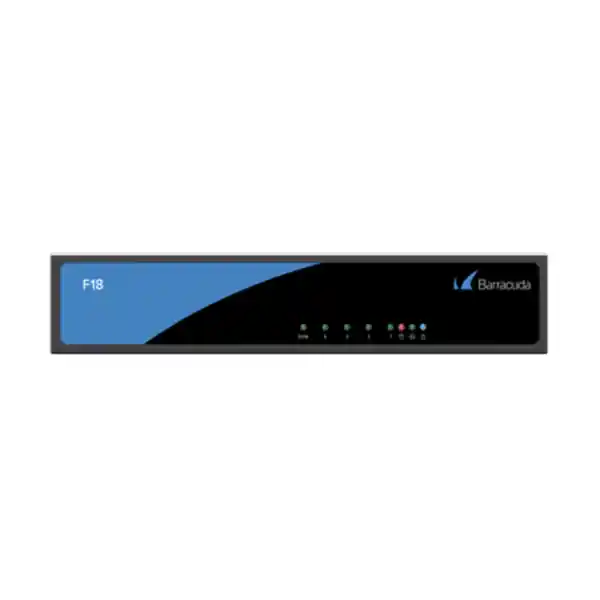
Barracuda CloudGen Firewall F18 Revision B in Dubai, UAE
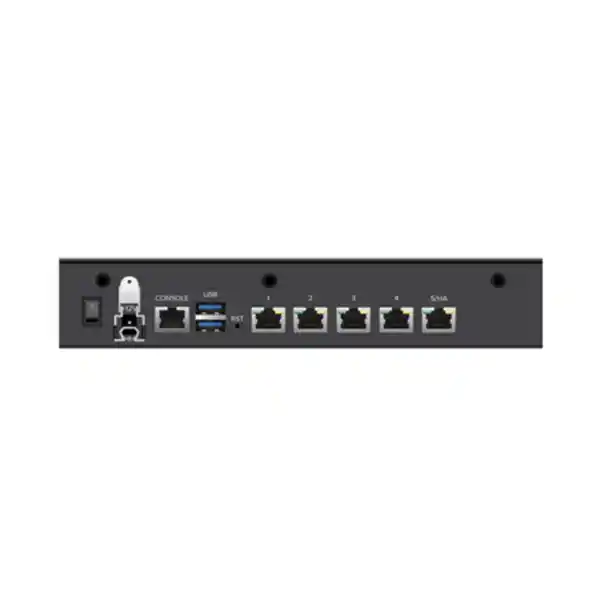
The Barracuda CloudGen Firewall F18 Revision B is a compact, fanless desktop security gateway designed for branch offices and distributed sites that require integrated firewalling, encrypted connectivity, application-aware control and WAN resilience without moving to a large rack appliance. Its physical platform provides five 10/100/1000 Mbps RJ45 Ethernet interfaces, two USB 3.0 ports, an RJ45 serial console, SSD storage and a single external power supply in a 232 × 153 × 44 mm chassis. For UAE projects, the real value of the F18 Revision B is not simply its small footprint; it is the ability to combine local security enforcement with centralized policy, VPN and SD-WAN architecture across many remote locations.
Direct answer
Choose the F18 Revision B when you need a compact branch firewall with five copper Gigabit interfaces and Barracuda CloudGen security, VPN and SD-WAN capabilities. Size it against inspected throughput, encrypted traffic, user count, concurrent sessions, WAN diversity and subscription requirements rather than raw ISP speed alone.
What the F18 Revision B is designed to do
In a modern branch network, the firewall is expected to do considerably more than translate addresses and block unsolicited inbound connections. Users reach Microsoft 365, cloud ERP, CRM, voice services, private applications and public SaaS directly from the branch. IoT devices, printers, payment terminals, cameras and building systems frequently coexist with corporate laptops on the same physical site. The edge therefore needs to identify traffic, enforce application and user policy, inspect threats where licensed and configured, maintain encrypted links to other sites, and select the appropriate WAN path when more than one carrier is available.
The Barracuda CloudGen Firewall platform addresses this branch-edge requirement with stateful firewalling, application control, VPN, routing and secure SD-WAN functions that can be managed as part of a distributed architecture. For organizations using Barracuda Firewall Control Center, configuration and lifecycle tasks can be centralized instead of treating every branch as an isolated security appliance. This operating model is particularly useful in the UAE for retail chains, clinics, professional offices, warehouses, construction project locations and geographically distributed service companies where qualified network staff may not be permanently stationed at every site.
FourTeck approaches the F18 Revision B as a design component rather than a box-only purchase. A correct deployment starts by confirming the exact hardware revision and serial, mapping WAN and LAN interfaces, validating subscription status, selecting a firmware release that is supported for the appliance, calculating inspected traffic demand, and documenting the VPN, VLAN, routing and failover policy. For broader network and security integration in the UAE, organizations can also review FourTeck UAE services alongside the firewall deployment.
Barracuda CloudGen Firewall F18 Revision B hardware specifications
Network interfaces
5 × 10/100/1000 Mbps RJ45 Ethernet. Port 1 is the documented default management interface. The five copper interfaces can be assigned according to the approved WAN, LAN, VLAN trunk, DMZ or other logical design.
Local connectivity
2 × USB 3.0 interfaces plus 1 × RJ45 serial console. These interfaces support appliance administration and recovery workflows; the production network design should use the Ethernet ports for routed and switched network connectivity.
Compute and memory
Barracuda documentation distinguishes serial-dependent configurations: earlier documented units use a dual-core Intel Celeron with 4 GB RAM, while later documented units use a quad-core Intel Atom with 8 GB RAM. Verify the exact serial before capacity assumptions.
Storage
SSD storage with a documented capacity of 80 GB or higher. Local storage supports the appliance software and operational data, but retention and reporting expectations should be planned around the selected management and reporting architecture.
Physical format
Desktop, fanless chassis measuring 232 × 153 × 44 mm. Appliance weight is approximately 2.0 kg. L-shaped rack mounting brackets are not included in the standard packaging and must be sourced separately where required.
Power and environment
Single external 45 W power supply, 100–240 V AC input and 12 V DC output. Documented operating range is 0°C to 40°C with 5%–95% non-condensing humidity. The fanless design supports quiet office installation.
Revision B matters: verify the appliance, not only the model name
Barracuda uses hardware revisions when a model is updated. That means an F18 is not automatically interchangeable with every other F18 for documentation, hardware assumptions or lifecycle planning. The label on the appliance identifies the model revision, and procurement records should capture the complete designation: Barracuda CloudGen Firewall F18 Revision B. This is especially important when purchasing replacement hardware, extending support, migrating an existing configuration or standardizing spares across many branches.
The Revision B hardware documentation contains a further serial-dependent distinction. Units documented below serial number 3503571 use an Intel Celeron two-core processor and 4 GB of RAM, while units documented above that threshold use an Intel Atom four-core processor and 8 GB of RAM. That is a meaningful operational detail. Two appliances carrying the same marketing model and revision can therefore have different documented compute and memory resources depending on serial range. When a customer is evaluating a used, transferred, warehouse-stock or replacement F18 Revision B, the serial number should be recorded before final sizing.
This hardware design also explains why generic statements about a dedicated security ASIC should be avoided. Barracuda’s published F18 Revision B hardware specifications identify Intel processor platforms rather than advertising a proprietary packet-processing ASIC for this appliance. Performance planning should therefore be based on the published model throughput figures and, more importantly, on the combination of enabled functions, firmware, encrypted traffic, packet size, connection rate and policy complexity in the real deployment.
For UAE buyers, revision and serial verification is part of sensible commercial due diligence. Before deployment or renewal, confirm the physical label, exact serial, power adapter, included accessories, entitlement state and supported software path. Where the appliance is being reused, do not assume an old configuration, old license file or previous branch policy is appropriate for the new site. Build a deployment record that ties the device identity to its intended branch, WAN circuits, management ownership and change-control process.
Port map and interface planning for a five-port branch firewall
The F18 Revision B has five 10/100/1000 Mbps copper Ethernet ports. Barracuda identifies them as p1 through p5 in the operating system, with physical port 1 documented as the management port by default. A five-port appliance can support several useful branch designs, but the available port count must be allocated deliberately. Using every port simply because it exists can create an inflexible layout that becomes difficult to expand later.
Single-WAN branch
One interface can serve the primary ISP, one can connect to a managed switch as an 802.1Q VLAN trunk, and remaining ports can be reserved for a DMZ, secondary switch, out-of-band segment or future WAN. This layout maximizes flexibility when a capable managed access switch is already present.
Dual-WAN branch
Two ports can terminate independent internet circuits, while a third carries LAN VLANs. The remaining interfaces can be reserved for a physically isolated guest, voice, server or management segment, subject to policy and switching design.
WAN plus private circuit
A branch may use one public internet circuit and one MPLS, metro-Ethernet or carrier-managed private path. Security and routing policies can then determine which applications use direct internet, encrypted overlay or the private transport.
Segmented micro-branch
Where no managed switch is available, physical interfaces can separate corporate endpoints, operational technology, payment systems or guest access. Physical separation can simplify small sites, but it consumes ports rapidly and may limit later growth.
VLAN trunking is usually the more scalable design when several logical networks must share a single physical link to a managed switch. The CloudGen platform supports 802.1Q VLANs, allowing branch designers to create separate security zones for users, voice, printers, cameras, guest Wi-Fi, servers and management without dedicating a firewall port to every segment. The trade-off is that switch configuration becomes part of the security boundary: VLAN IDs, tagging, allowed VLAN lists, native VLAN behavior and switch port security must be documented and tested.
Because every Ethernet interface is Gigabit copper, the platform is best aligned with branch access and WAN connections at or below 1 GbE physical interface speed. Even when an ISP circuit is marketed at 1 Gbps, do not equate link speed with full-featured security throughput. Stateful forwarding, VPN encryption, intrusion prevention, application control, TLS inspection and malware scanning impose different processing demands. The correct question is not “Does the firewall have Gigabit ports?” but “Can the chosen policy stack sustain the expected mix of inspected and encrypted traffic with acceptable latency and headroom?”
Published F18 performance figures and how to interpret them
Published Barracuda F18 family comparison material has listed reference figures of approximately 1.0 Gbps firewall throughput, 190 Mbps VPN throughput, 400 Mbps IPS throughput, 300 Mbps next-generation firewall throughput, 80,000 concurrent sessions and 8,000 new sessions per second. These figures are useful for initial model comparison, but they are not a promise that every F18 Revision B will deliver the same rate in every production configuration. Benchmark methodology, traffic mix and enabled functions matter.
| Metric | F18 family reference | What it means in design |
|---|---|---|
| Firewall throughput | 1.0 Gbps | Baseline packet forwarding under test conditions; not equivalent to full security inspection. |
| VPN throughput | 190 Mbps | Useful reference for encrypted site traffic; encryption method, packet size and bidirectional load affect actual results. |
| IPS throughput | 400 Mbps | Reference for traffic processed with intrusion-prevention inspection under benchmark conditions. |
| NGFW throughput | 300 Mbps | More representative than raw firewall speed when application control, IPS and web filtering are enabled. |
| Concurrent sessions | 80,000 | Indicates connection-table scale; user count alone does not predict session demand. |
| New sessions per second | 8,000 | Indicates connection-establishment capacity in benchmark conditions; bursts can matter for web-heavy or NAT-heavy branches. |
A sizing exercise should start with the services that will actually be enabled. A branch carrying ordinary internet browsing with stateful firewalling and selective application control has a very different load from a branch that decrypts a large portion of outbound TLS, scans files, runs advanced threat analysis, terminates multiple VPN tunnels and handles dozens of SaaS-heavy users. HTTPS now represents much of business traffic, so TLS inspection policy can be one of the largest determinants of CPU load and perceived user experience.
Packet size also changes performance. Large-packet throughput benchmarks are easier on packet-processing resources than workloads dominated by small packets. Voice signaling, DNS, interactive business applications and some security tools can create many small flows even when total Mbps is modest. Likewise, a site with only 40 users can produce a large concurrent-session count if every endpoint maintains cloud sync, web applications, messaging, endpoint security, software updates and background APIs.
For that reason, FourTeck recommends designing with headroom. The appliance should not be selected to run permanently at the edge of a published benchmark. Account for growth in ISP bandwidth, increasing SaaS use, additional VLANs, future VPN destinations, security features that may be enabled later and short-term traffic bursts. If the site requires sustained security-inspected throughput close to or above the F18 family’s reference limits, a larger CloudGen platform should be considered instead of weakening inspection merely to fit the appliance.
A practical sizing methodology for Dubai and UAE branch sites
Firewall sizing is a workload exercise. Start by collecting the current and planned WAN circuits. Record the contracted speed, actual busy-hour utilization, latency, packet loss and whether the link is symmetric. Then identify how much traffic remains local, how much travels through VPN, and how much exits directly to public cloud services. A 500 Mbps business internet service does not automatically require 500 Mbps of VPN throughput if only 80 Mbps crosses the encrypted corporate overlay. Conversely, a 200 Mbps site can be demanding if almost every byte is decrypted and inspected.
1. Measure traffic
Capture peak and 95th-percentile WAN usage, major application categories, encrypted percentage and expected growth. Include backup, software distribution and cloud synchronization windows.
2. Count sessions
Estimate endpoints, users, cameras, phones and IoT devices. A single user can create hundreds of concurrent connections through browsers, collaboration tools and background agents.
3. Define inspection
List IPS, application control, URL filtering, malware protection, TLS inspection and advanced threat services. Determine which traffic is inspected, exempted or bypassed by policy.
4. Define VPN
Separate site-to-site, remote-user and SD-WAN encrypted traffic. Record expected simultaneous tunnels, encryption policy and path failover behavior.
5. Add headroom
Allow capacity for burst traffic, firmware changes, signature updates, additional cloud use and WAN upgrades. Avoid designing around an appliance running continuously near saturation.
6. Validate lifecycle
Confirm the exact revision, serial, firmware path, license eligibility, subscription state and support options before committing a business-critical branch to the platform.
User count is only a secondary sizing input. A 25-person accounting office with ordinary SaaS access may be lighter than a 10-person video-production branch synchronizing large files to cloud storage. A retail location with few employees can still generate heavy session counts from POS systems, digital signage, cameras, guest Wi-Fi and telemetry. A clinic may need strict segmentation and encrypted inter-site application flows even if internet bandwidth is moderate. Use workload classes, not a single users-per-firewall rule.
When the F18 Revision B is intended for an existing branch, a short monitoring period on the current edge can provide much better inputs than estimates. Capture bandwidth by hour, application mix, NAT session counts, VPN peaks and latency-sensitive flows. During migration, compare those observations with the chosen CloudGen policy stack. For a greenfield site, base estimates on comparable branches and apply a conservative growth factor rather than assuming the opening-day workload will remain static.
Next-generation firewall policy: beyond ports and protocols
Traditional access control evaluates source, destination, service and connection state. Cloud applications make that model incomplete because many unrelated applications share TCP 443 and encrypted HTTPS. Barracuda CloudGen Firewall extends policy with application awareness so administrators can identify traffic based on application context and then allow, block, report, throttle or prioritize it according to business need. Application definitions are maintained through update services, and organizations can create custom application definitions where standard classifications do not match a specific internal service.
Application control is most valuable when it supports a clear policy objective. A useful policy may distinguish approved collaboration services from recreational streaming, prioritize voice and ERP over bulk downloads, or restrict high-risk application categories from user VLANs. Avoid creating hundreds of arbitrary application rules with no owner or review process. Complex rulesets increase operational risk and can make troubleshooting slower, especially when a branch has limited on-site support.
Identity-aware policy can further improve control by associating users or groups with network access decisions where the environment is integrated appropriately. This enables business policies that make more sense than IP-only controls, such as allowing an administrative team to reach a finance application while denying the same access from guest or unmanaged devices. Identity integration must still be designed for resilience: define what happens if directory services or authentication connectors become unreachable, and avoid making critical operational traffic depend on a fragile identity path without fallback planning.
Good firewall policy follows least privilege and clear zone boundaries. Start with a small set of meaningful zones: WAN, trusted users, voice, servers, management, guest and operational devices, for example. Document each allowed flow by source zone, destination, application or service, business owner and logging requirement. This creates a ruleset that can be audited. It also makes later migration easier because the policy describes business intent rather than a collection of unexplained IP addresses accumulated over years.
Intrusion prevention, malware controls and encrypted-traffic visibility
Barracuda CloudGen Firewall can apply intrusion detection and prevention to network traffic to identify exploit patterns, threats and known malicious behavior. IPS should be positioned as part of a layered control set, not as a substitute for secure endpoint configuration, patching, email protection or identity security. At a branch edge, its value is the ability to inspect traffic crossing security boundaries and stop or report patterns that violate policy or match known attack signatures.
Encrypted traffic creates a design choice. Without TLS inspection, a firewall can still make decisions using network metadata and application indicators where available, but it cannot inspect the full encrypted payload. With TLS inspection, the firewall decrypts eligible sessions, applies inspection and then re-encrypts the connection. This can improve application identification and allow security services to inspect content that would otherwise remain opaque. It also increases processing demand and introduces certificate, privacy, compatibility and operational considerations.
A UAE deployment should define TLS inspection policy before enabling it broadly. Determine which user groups and categories are in scope, which financial, healthcare or certificate-pinned applications require exemption, how the enterprise trust certificate is distributed to managed endpoints, and how failures will be logged and supported. Test line-of-business applications because some clients do not tolerate interception. The correct policy is rarely “decrypt everything” or “decrypt nothing”; it is a controlled set of inspection rules aligned to security risk, business requirements and applicable organizational policies.
URL filtering and application categorization can help enforce acceptable-use controls, while malware and advanced threat capabilities depend on the appropriate Barracuda subscriptions. Advanced Threat Protection is not simply assumed from ownership of the hardware; subscription planning must be part of the bill of materials. The same applies to continuously updated application and security intelligence. When requesting a quote, state which services are required and for what subscription term so the commercial proposal can be compared accurately.
Where DNS reputation or sinkholing controls are enabled, they can help disrupt access to known malicious destinations and expose potentially infected endpoints. These controls are strongest when incident response ownership is clear. Blocking a malicious domain is useful, but the organization should also know who receives the alert, how the endpoint is identified, whether it is isolated, how evidence is collected and when it is returned to service. Branch security becomes effective when detection is connected to an operational response process.
Secure SD-WAN: why the F18 can be more than an internet firewall
Distributed organizations often spend more effort keeping branches connected than protecting the local LAN. A branch may have two broadband providers, an MPLS circuit, a wireless backup service or a mix of transports. Users expect Microsoft 365, cloud applications, voice and private services to remain available when one path degrades. Barracuda CloudGen Firewall integrates SD-WAN functions with the security gateway so path selection and policy can respond to application and link conditions instead of relying only on static route preference.
Barracuda’s SD-WAN architecture can evaluate links and steer traffic according to policy, including failover, load distribution and application prioritization. The practical benefit is that a branch can use more than one connection without treating the backup line as idle insurance. Critical traffic can be associated with higher-quality paths, while less-sensitive traffic uses other available capacity. If a preferred link falls below acceptable conditions or fails, policy can move eligible traffic to an alternate transport.
This is particularly relevant in Dubai and the wider UAE where organizations may combine business broadband, dedicated internet access and private carrier services across branches. The design should still distinguish physical diversity from logical diversity. Two circuits entering the same building through the same duct, terminating on the same carrier infrastructure or depending on the same upstream service may fail together. SD-WAN can select among available paths, but it cannot create resilience that does not exist in the underlying access design.
Barracuda’s TINA technology is central to CloudGen site-to-site connectivity. TINA, or Transport Independent Network Architecture, extends the vendor’s VPN approach with capabilities used by secure SD-WAN. Barracuda describes the platform as able to use multiple active, load-sharing connections and to improve WAN reliability by measuring and selecting transport paths. For a branch project, the key design tasks are to define each transport, assign its intended SD-WAN class or role, determine which applications can use fallback paths, and make sure routing remains predictable during failover.
Application-aware direct internet breakout can reduce the latency and backhaul cost of sending every SaaS session through headquarters. Instead of hairpinning a Dubai branch’s Microsoft 365 traffic through a remote data center, the branch can send eligible internet traffic locally while still enforcing the required firewall and security policy. Private application traffic can continue across encrypted tunnels. This split model is often more efficient, but it requires careful DNS, identity, security inspection and route design so cloud services behave consistently.
Quality of service should be mapped to business outcomes. Real-time voice and interactive applications are sensitive to delay, jitter and loss, while backups and software downloads are usually tolerant of delay. SD-WAN policy can prioritize the former and move the latter when needed. Before migration, classify the applications that truly require low latency. Do not label every business application “critical,” because a policy where everything has top priority provides no meaningful prioritization during congestion.
For multi-site projects, central policy consistency is as important as local path intelligence. A secure SD-WAN rollout should define naming standards, network objects, transport labels, logging, failover thresholds, tunnel templates and branch exceptions before dozens of appliances are deployed. FourTeck can integrate the firewall with broader IT services in the UAE where branch rollout also requires switching, wireless, server, endpoint or ongoing network support.
VPN architecture: site-to-site, remote access and transport independence
The F18 Revision B can participate in encrypted connectivity between branches, headquarters, data centers and remote users through the CloudGen Firewall platform. Barracuda supports standard IPsec as well as its TINA VPN technology. The choice depends on interoperability, topology and required SD-WAN behavior. IPsec is widely used when connecting to third-party firewalls or cloud gateways. TINA is typically preferred between CloudGen Firewalls when the deployment needs Barracuda-specific transport, optimization or SD-WAN functions.
A tunnel design begins with addressing. Every site needs a documented set of local and remote networks with no unintended overlap. Overlapping RFC1918 addressing is a common problem during mergers, partner connections and rapid branch rollouts. NAT can sometimes work around overlap, but it complicates troubleshooting and application logging. If a new branch is being built, allocate non-overlapping subnets from an enterprise IP plan before the firewall configuration is created.
Next define routing. Small deployments may use static routes, while larger networks may benefit from dynamic routing such as BGP or OSPF where supported by the architecture. Barracuda CloudGen Firewall supports common dynamic routing protocols and can integrate routing with VPN designs. Dynamic routing reduces manual route maintenance, but it also increases the importance of route filters, summarization, metric design and failure-domain planning. A branch should not accidentally advertise a default route or internal prefix that disrupts the wider enterprise.
Remote access should be treated separately from site-to-site connectivity. Define which users require remote access, what identity and multifactor controls protect it, which internal applications are reachable, whether split tunneling is permitted and how endpoints are assessed. Barracuda licensing documentation describes unlimited VPN clients at the base-license level for supported client-to-site, TINA and IPsec functions, but feature availability and subscription requirements can vary by software version and deployment model. Confirm the current entitlement against the exact appliance and planned firmware.
Encryption settings must be selected for security and interoperability, not simply copied from old templates. Review the allowed algorithms, authentication methods, key lifetimes and certificate strategy. Remove obsolete settings when both peers support stronger alternatives. For third-party VPNs, document the exact phase parameters and traffic selectors. For CloudGen-to-CloudGen tunnels, standardize TINA templates so all branches follow the same operational model unless a site has a justified exception.
Finally, test failure behavior. Disconnect the primary WAN, introduce loss or latency where possible, and confirm that tunnels recover through the intended alternate path. Verify application sessions after failover, not just whether the tunnel status turns green. Some applications tolerate address or path changes poorly. A successful branch acceptance test should cover tunnel establishment, route convergence, DNS reachability, critical application access, logging and recovery when the preferred WAN returns.
Routing, NAT, segmentation and policy design
A branch firewall is often the local routing boundary between user, guest, server, voice and operational networks. CloudGen Firewall supports IPv4 and IPv6, NAT, VLANs and dynamic routing protocols including BGP, OSPF and RIP. The platform can therefore support simple default-route branches as well as more structured routed environments. The correct design depends on whether the firewall is the branch’s default gateway, whether a Layer 3 switch performs internal routing, and where security inspection should occur.
If the firewall is the gateway for every VLAN, inter-VLAN traffic can be controlled directly by firewall policy. This provides strong visibility and segmentation but sends east-west traffic through the appliance, consuming resources. If a Layer 3 switch routes locally, high-volume internal traffic can remain on the switching fabric, but some security boundaries may be bypassed. A hybrid model can route trusted high-volume traffic on the switch while forcing sensitive zones through the firewall. Document the intended security boundary before assigning gateways.
NAT design should remain as simple as practical. Source NAT is commonly used for outbound internet access, destination NAT for publishing approved internal services, and policy exceptions for VPN or specialized application flows. Every inbound NAT rule should have a corresponding security justification, limited destination service and named owner. Avoid broad inbound exposure. Where a public service can be placed behind a reverse proxy, cloud security service or dedicated DMZ rather than directly on a user network, use the architecture that reduces blast radius.
Segmentation is especially important for mixed-purpose branches. Guest Wi-Fi should not be able to reach corporate endpoints. Cameras and building systems generally need only specific management and cloud destinations. Voice systems may require defined SIP, RTP and management flows. Payment or regulated systems can require additional isolation. The firewall policy should express these boundaries explicitly and log denied cross-zone traffic during initial deployment so unexpected dependencies can be identified safely.
Avoid using a single flat LAN merely because the site is small. The operational cost of creating a few sensible VLANs at deployment is typically lower than retrofitting segmentation after a security event or compliance requirement. The F18’s five physical interfaces, combined with 802.1Q VLAN capability, allow a small branch to establish a structured network even when only one or two ports connect to access switches.
Central management, zero-touch deployment and repeatable branch operations
The operational case for CloudGen Firewall becomes stronger when an organization has many sites. Managing each appliance independently can lead to inconsistent objects, different firewall rules, firmware drift and unclear ownership. Barracuda Firewall Control Center is designed to centralize management across distributed CloudGen environments. That supports common policy, templates, monitoring and coordinated configuration rather than forcing administrators to log in to every branch separately.
Zero Touch Deployment is intended to reduce the need for skilled personnel at the remote location. In a properly prepared environment, an appliance can be shipped to the branch, connected and powered on so it can reach the required management services and retrieve configuration. The value is not simply faster installation; it is repeatability. A standardized branch template can apply the same naming, security policy, VPN structure and management settings across locations while leaving only site-specific values such as local addressing and WAN parameters to vary.
Zero-touch still requires pre-deployment engineering. The team must know which physical port is connected to which circuit, whether the ISP uses DHCP, static addressing, PPPoE or another handoff, what DNS and default-gateway behavior is expected, and whether outbound connectivity needed for enrollment is permitted. The branch must receive a simple cabling guide with labels that a non-specialist can follow. If LTE or another fallback device is involved, its Ethernet handoff and address behavior should also be documented.
Configuration automation APIs can further support organizations that integrate firewall lifecycle into service management or infrastructure automation. Automation should be treated carefully: use source-controlled templates, change review, role-based access, secrets management and test environments. An API makes configuration faster, including mistakes. The best automation workflow validates intended changes and keeps a recoverable configuration state before pushing policy to production branches.
For managed service environments, licensing and central management can also be structured around pool concepts depending on the active Barracuda licensing model. Because Barracuda licensing has evolved across software releases and hardware generations, buyers should not assume that a historical F-Series license model exactly matches a current commercial offer. Confirm entitlement, support and management architecture for the specific serial number and target software release when the quotation is prepared.
Licensing and subscriptions: specify the security outcome in the quote
A Barracuda CloudGen Firewall appliance and its software entitlements should be planned together. Barracuda documentation describes a base license for the firewall platform and additional subscriptions for update services, malware protection, Advanced Threat Protection, Advanced Remote Access and Firewall Insights. The exact packaging and eligibility can change over time, and newer CloudGen software introduces VFC licensing structures in supported scenarios. For an F18 Revision B, the purchasing process should therefore validate the serial-specific entitlement and planned firmware rather than quoting generic “full security” without a license breakdown.
The base license historically provides core firewall capabilities including SD-WAN, VPN functionality and application-control reporting, with other services depending on active subscriptions. Energize Updates is important because continuously updated security and application intelligence loses value when signatures and categorization data become stale. Barracuda documentation has required Energize Updates during the first year of hardware purchase in the relevant licensing model, with renewal affecting access to updated capabilities afterward.
Malware Protection and Advanced Threat Protection are separate considerations. If the organization expects file scanning, cloud-based sandboxing or advanced threat analysis, these requirements must be stated explicitly. Do not evaluate two reseller quotes solely on appliance price if one includes security subscriptions and another does not. Compare term length, support level, replacement coverage, update entitlement, management requirements and renewal assumptions.
Base platform
Confirm the hardware license status, serial association and entitlement required to operate the appliance on the planned software release.
Energize Updates
Plan for current application and security information where those capabilities depend on update services. Record term and renewal date.
Threat subscriptions
Specify malware and advanced threat requirements rather than assuming they are included with the base appliance.
Support and replacement
Define support response, hardware replacement expectations and warranty status, especially for older installed-base or replacement appliances.
For an existing appliance, licensing review should happen before a migration window is booked. Confirm that the serial can be activated or transferred as intended, that the required subscriptions are active, and that the organization has access to the relevant Barracuda management account. A technically correct firewall that cannot obtain the expected entitlement or updates can derail deployment just as effectively as a cabling problem.
For a new commercial request, state whether the objective is hardware-only replacement, full security renewal, branch expansion or a managed rollout. That lets the solution team prepare a bill of materials that reflects the actual outcome. FourTeck can coordinate firewall supply and implementation through the dedicated Firewall Dubai practice while keeping subscription scope visible in the quotation.
UAE deployment engineering: power, temperature, cabling and site readiness
The F18 Revision B is fanless, compact and designed for desktop use, but environmental planning still matters. Barracuda documents a 0°C to 40°C operating range and 5% to 95% non-condensing humidity. In the UAE, do not install the appliance in unconditioned outdoor cabinets, hot ceiling voids, poorly ventilated electrical rooms or locations exposed to dust and direct sunlight simply because it has no fan. A fanless enclosure reduces acoustic noise and moving parts, but the appliance still relies on ambient conditions to dissipate heat.
Place the firewall in a secure, ventilated communications area. Keep the external power brick supported and avoid tight cable bends at the DC connector. The documented power input accepts 100–240 V AC through the external supply, which is convenient for UAE power environments when the supplied adapter and appropriate approved mains connection are used. Connect the DC plug to the appliance according to Barracuda’s safety guidance and do not replace the power adapter with an unverified supply.
Because the appliance has a single external PSU, upstream power resilience must be provided by the site. Use an appropriately sized UPS for the firewall, access switch, ISP termination equipment and any ONT or modem required for connectivity. Backing up only the firewall is not sufficient if the ISP handoff loses power. For a critical site, calculate runtime across the entire network path and define what should happen during a prolonged outage.
Label every cable at both ends. A five-port device can become confusing during emergency troubleshooting if WAN1, WAN2, trunk and management cables are indistinguishable. The as-built document should map physical port number, OS notation, connected device, switch port, VLAN role, IP addressing and service provider. Take a photo of the installed appliance and patching after handover. This simple record often saves significant time when a branch is supported remotely months later.
If the branch uses structured cabling, confirm copper category, termination quality and negotiated speed. A damaged patch lead can silently force a Gigabit port to negotiate at 100 Mbps, creating an apparent firewall-performance problem. Acceptance testing should record interface speed and duplex, error counters, WAN latency and packet loss before and after the firewall goes live. Test both uplinks independently when dual WAN is used.
Rack installation requires planning because L-shaped rack brackets are not included in the standard F18 Revision B package according to Barracuda hardware documentation. If the appliance will be rack-mounted, verify the appropriate accessory and physical fit before arriving on site. A small shelf is sometimes used in communications cabinets, but the final method should secure the appliance and preserve ventilation rather than leaving it loose on top of other equipment.
For broader branch infrastructure, firewall deployment should align with switching, Wi-Fi and server design. Where the project includes those adjacent systems, using a single documented VLAN and IP plan reduces integration errors. FourTeck can coordinate this wider technical scope through its UAE network portfolio and, where regional operations extend beyond the Emirates, customers can also reference FourTeck Africa for cross-region infrastructure planning.
Recommended branch deployment topologies
The F18 Revision B can fit several branch patterns. The right topology should minimize single points of failure, keep security boundaries understandable and leave enough interfaces for growth. The examples below are architectural starting points rather than fixed configuration templates.
Small office with one ISP
ISP → F18 Revision B → managed PoE switch → segmented users, voice and Wi-Fi. A single 802.1Q trunk carries VLANs to the switch. Remaining firewall ports can be kept for a DMZ, management path or future second WAN. This is simple, scalable and suitable when site availability requirements permit a single carrier.
Dual-ISP resilient branch
ISP1 + ISP2 → separate F18 interfaces → VLAN trunk to access switching. SD-WAN or route policy controls preferred and fallback paths. Critical SaaS and VPN traffic can be mapped to the better link, with less-sensitive traffic shifted during congestion or failure according to policy.
Private WAN plus internet breakout
One interface terminates private WAN/MPLS, one terminates internet, and another carries LAN VLANs. Private applications follow the enterprise route, while approved SaaS and public web traffic can break out locally through security policy. VPN can provide overlay resilience where required.
Retail or service location
Separate VLANs isolate POS, corporate devices, guest Wi-Fi, cameras and management. Rules allow only necessary flows between zones. Dual WAN can protect payment and cloud access. The design should prioritize transactional traffic while containing untrusted guest and IoT devices.
High availability and business-continuity considerations
A branch can have redundant WAN links and still fail if there is only one firewall. The F18 Revision B hardware itself uses a single external power supply, so appliance availability should be considered separately from carrier availability. For branches where downtime has significant business impact, evaluate whether the solution should use two firewalls in a supported high-availability design or whether a larger platform and different redundancy model is more appropriate. The answer depends on software support, licensing, network topology and the organization’s recovery target.
If a redundant firewall pair is planned, every surrounding dependency must also be reviewed. Two firewalls connected to one access switch do not protect against switch failure. Two WAN circuits on the same ONT or carrier device may not be independent. Two appliances connected to one non-redundant UPS still share a power failure domain. Business continuity is a path problem: ISP, demarcation, firewall, switching, wireless, DNS, authentication and application reachability all form part of the service.
For smaller branches where a second appliance is not justified, recovery procedures become more important. Keep current configuration backups, device records, subscription information, firmware references and a tested replacement process. Know who holds the spare, how licensing is transferred or activated, and whether a nontechnical user at the site can replace cables under remote guidance. The goal is to reduce mean time to restore service even when active/standby redundancy is not deployed.
Failover testing should be part of handover. Simulate loss of each WAN path, power-cycle upstream carrier equipment during a controlled window, verify tunnel recovery and confirm that core applications work after convergence. Record expected and observed recovery behavior. A topology diagram is not evidence of resilience until the failure path has been tested.
Migration from an existing firewall to the F18 Revision B
Firewall migrations fail most often because undocumented dependencies are discovered during the change window. Before building the CloudGen configuration, export the existing rule base, NAT rules, objects, routes, VPN definitions, DHCP settings, DNS forwarding behavior, interface addresses and authentication integrations. Then classify each item as required, obsolete or needing redesign. Do not blindly reproduce years of accumulated rules on the new platform.
Create a normalized network-object list with consistent naming. Replace duplicate objects, identify hosts that no longer exist and assign business owners to sensitive rules. Translate service groups and NAT behavior carefully because vendor syntax differs. A rule that looks equivalent in a migration spreadsheet may behave differently when connection state, application control, source NAT order or routing is considered.
VPN migration requires coordination with every peer. For third-party IPsec tunnels, record public peer addresses, protected networks, proposals, lifetimes, authentication keys or certificates and route behavior. Schedule peer changes where both ends need modification. For Barracuda-to-Barracuda environments, consider whether the migration is an opportunity to standardize TINA and SD-WAN templates rather than carrying forward a collection of one-off tunnel definitions.
Plan the cutover sequence. Pre-stage the F18, update it to the approved release, install entitlements, configure management access, build interfaces and policy, and validate as much as possible off-path. During the change window, move WAN and LAN connections methodically, checking link negotiation and ARP behavior. Keep a rollback plan with the original firewall configuration preserved. Do not erase or repurpose the old unit until the new branch has passed agreed acceptance tests.
Acceptance testing should include outbound internet access, DNS, DHCP where applicable, all business-critical internal applications, inbound published services, each site-to-site tunnel, remote access, inter-VLAN policy, guest isolation, logging, security updates and failover. Test from representative user networks rather than only from an administrator laptop. Capture before-and-after latency and throughput on important flows so performance concerns can be investigated with evidence.
After migration, monitor denied traffic and unusual application classifications for a defined observation period. Some blocked connections are signs of a correct security policy; others expose forgotten dependencies. Review them with application owners instead of opening broad rules. This is the point where a technically functional migration becomes a clean security implementation.
Operational hardening after go-live
A firewall should enter production with a defined management baseline. Restrict administrative access to dedicated management networks or trusted sources, use named administrator accounts, apply strong authentication, and avoid exposing management services directly to the public internet unless the architecture explicitly requires and protects that path. Review role permissions so help-desk or monitoring accounts do not receive configuration privileges they do not need.
Keep firmware and security services within a supported, tested maintenance process. “Latest” is not automatically the right production release on change day; validate compatibility, release notes, hardware support and known issues. Use a staged update approach where possible, beginning with a pilot branch before rolling the same version to many sites. Record current and target releases in change control.
Logging should answer operational questions. At minimum, administrators need visibility into denied connections, security detections, VPN state, WAN link status, configuration changes and system health. Excessive logging of low-value events can make useful information harder to find and increase storage demand, while insufficient logging makes incident investigation impossible. Define retention and external reporting according to the organization’s requirements.
Configuration backups should be automated or scheduled and periodically validated. A backup is useful only if the organization knows how to restore it to appropriate replacement hardware. Store configuration data securely because it can contain network addressing, object names, certificates or other sensitive information. Keep at least one recovery copy separate from the device itself.
Review rules regularly. Temporary vendor access, project NAT rules and troubleshooting exceptions often remain long after their purpose has ended. Assign an expiry or review date to temporary rules. Remove unused objects and document permanent exceptions. A small F18 branch may have fewer rules than a data-center firewall, which makes disciplined cleanup easier and more valuable.
Monitor resource and link trends over time. If inspected throughput, session count or CPU pressure increases as the branch grows, plan an upgrade before users experience persistent latency. Similarly, if the site upgrades from a few hundred Mbps to Gigabit-class internet, revisit appliance sizing rather than assuming the existing firewall can consume the new circuit with every security service enabled.
Best-fit use cases for Barracuda CloudGen Firewall F18 Revision B
Distributed branch office
A compact location that needs secure internet access, encrypted connectivity to headquarters and standardized policy from a central operations team.
Retail or service outlet
A site with payment, corporate, guest and IoT networks that must be segmented while maintaining cloud and private application access.
Clinic or professional office
A smaller office requiring controlled user access, VPN connectivity, application-aware policy and separation of guest or device networks.
Project or temporary site
A compact deployment where remote management, standardized configuration and quick branch activation are more important than high port density.
SD-WAN edge
A branch with two or more WAN transports that needs application-aware path policy, encrypted overlay connectivity and local security enforcement.
Installed-base replacement
A controlled replacement or spare for an environment already standardized on compatible Barracuda CloudGen architecture, subject to revision, serial, firmware and licensing validation.
When the F18 Revision B is not the right size
A technically capable product can still be the wrong product for a specific site. The F18 Revision B should not be selected merely because it is available or familiar. If a branch requires sustained inspected throughput well beyond the F18 family’s published NGFW or IPS reference figures, has a large number of high-bandwidth users, terminates heavy VPN traffic, requires more physical interfaces, or is expected to receive significantly faster WAN circuits during its service life, a larger model deserves evaluation.
Port density can also be decisive. Five 1GbE copper interfaces are adequate for many small branch designs, especially when VLAN trunks concentrate LAN networks on a managed switch. They are less suitable when the architecture needs many physically separated zones, multiple dedicated WANs, optical SFP connectivity or multi-gigabit Ethernet. Do not solve a physical-interface mismatch with unnecessary adapters or unmanaged switches simply to force the appliance into the design.
Environmental and availability requirements may also point elsewhere. The F18 is a desktop, fanless unit with a single external power supply. A critical data-center or industrial deployment may require rack-oriented hardware, redundant power or different environmental tolerances. Similarly, if the site demands an active/standby design, confirm the supported high-availability topology, licensing and surrounding network redundancy before using two small appliances as a substitute for a platform designed around stricter availability requirements.
Finally, lifecycle status matters. Hardware revision, software version, subscription eligibility and vendor support must be confirmed for any procurement, particularly when dealing with an established model family. A low acquisition price does not compensate for a platform that cannot meet the organization’s required software or support horizon. Treat lifecycle validation as a mandatory sizing dimension alongside performance.
Procurement guidance for UAE buyers
A complete procurement request should identify the product as Barracuda CloudGen Firewall F18 Revision B, not simply “Barracuda F18.” Include the target site, expected deployment role and whether the request is for a new branch, expansion, replacement or spare. If replacing an installed unit, provide the existing model, revision and serial so compatibility, licensing and configuration migration can be evaluated before the order is placed.
State the WAN services and expected throughput. Include both primary and secondary carrier speeds, whether the handoff is Ethernet, whether static public addressing is provided, and whether the ISP device operates in bridge or routed mode. If the firewall will terminate PPPoE or another carrier-specific session, identify that requirement. For private WAN circuits, record the provider handoff, VLAN tagging and routing arrangement.
List the security services required in the commercial scope. If the organization needs Energize Updates, Malware Protection, Advanced Threat Protection, Advanced Remote Access, Firewall Insights or specific support coverage, state the term. If the request is a renewal, provide current entitlement details. This prevents a common procurement error where hardware cost is compared without equivalent software and support.
Include required accessories. The F18 Revision B package documentation lists the appliance, network cable, external power brick and cable, USB recovery media and quick-start material, while the rack bracket is not included by default. If the device is going into a rack, request the correct mounting solution. If spare power supplies, patch cords or UPS integration are part of the project, include them in the bill of materials rather than treating them as site-day surprises.
For installation services, define deliverables: configuration build, migration, VPN setup, SD-WAN policy, VLAN design, application control, security profiles, central management integration, documentation, testing and handover. A product quote and a deployment quote are not the same. The more clearly the expected outcome is stated, the easier it is to compare proposals on equivalent scope.
When procurement spans multiple countries, keep the technical standard consistent but adapt carrier, logistics, support and power considerations by region. FourTeck can support UAE-centered deployments while coordinating related regional requirements through approved FourTeck channels. The objective should be a common branch architecture with controlled local variations, not a different firewall policy at every site.
Technical FAQ for the Barracuda CloudGen Firewall F18 Revision B
How many Ethernet ports does the F18 Revision B have?
It has five 10/100/1000 Mbps RJ45 Ethernet interfaces. Port 1 is documented as the default management port. Interface roles can be assigned according to the approved design.
Is the appliance fanless?
Yes. Barracuda documents the F18 Revision B as a fanless desktop appliance. It should still be installed in a ventilated location within the specified operating-temperature range.
Does every Revision B unit have the same CPU and RAM?
The published hardware page distinguishes serial ranges. Earlier documented units use a dual-core Intel Celeron and 4 GB RAM; later documented units use a quad-core Intel Atom and 8 GB RAM. Confirm the exact serial.
What storage does it use?
The published specification lists SSD storage at 80 GB or higher. Hardware components can change over a product life, so verify the delivered appliance where exact component details matter.
What are the reference throughput figures?
F18 family comparison material has listed approximately 1.0 Gbps firewall, 190 Mbps VPN, 400 Mbps IPS and 300 Mbps NGFW throughput, with 80,000 concurrent sessions and 8,000 new sessions per second. Treat these as benchmark references.
Can it support dual WAN?
Yes, a five-port layout can dedicate two Ethernet interfaces to independent WAN connections and use remaining interfaces for LAN, trunk or other zones. SD-WAN policy can then manage eligible path selection and failover.
Does it support VLANs?
CloudGen Firewall supports IEEE 802.1Q VLANs. A trunk to a managed switch is a common way to support multiple branch security zones without dedicating one physical firewall port to every network.
Does it support site-to-site VPN?
Yes. CloudGen Firewall supports IPsec and Barracuda TINA VPN. TINA is central to Barracuda-to-Barracuda secure SD-WAN designs, while IPsec is commonly used for third-party interoperability.
Can it inspect HTTPS traffic?
CloudGen Firewall supports SSL/TLS inspection on eligible models and subscriptions. Decryption policy should be tested for application compatibility and sized for the added processing load.
Is Advanced Threat Protection automatically included?
No assumption should be made. Barracuda documents Advanced Threat Protection as a subscription capability. Confirm the exact entitlement and term in the quotation.
Can it be centrally managed?
CloudGen environments can use Barracuda Firewall Control Center for centralized policy and operations. This is useful for repeatable multi-branch deployment and governance.
Is the rack bracket included?
Barracuda’s F18 Revision B hardware documentation states that L-shaped rack-mount brackets are not included in standard packaging and must be ordered separately where required.
Decision recap: should you deploy the Barracuda F18 Revision B?
The F18 Revision B is strongest when the site is truly a branch-class environment: moderate inspected throughput, five or fewer required physical Ethernet roles, a preference for compact fanless hardware, and a network strategy that benefits from Barracuda VPN, application control, SD-WAN and centralized management. It can be an efficient edge for a distributed organization because the appliance is small while the operating model can still be enterprise-wide.
Good fit indicators
Small or medium branch, 1GbE copper access, moderate VPN demand, manageable inspected traffic, one or two WAN links, VLAN-based segmentation, central policy requirements and a need for secure SD-WAN or repeatable branch deployment.
Re-check sizing if
The branch expects sustained heavy TLS inspection, high VPN throughput, rapid user growth, multi-gigabit WAN, many physical security zones, high-volume east-west routing, strict redundant-power requirements or a long support horizon that must be validated against product lifecycle.
The most important purchasing rule is to validate the exact appliance, not the family name. Confirm Revision B, serial-specific CPU and RAM, supported firmware path, active or obtainable licenses, required subscriptions, support status and accessories. Then validate performance against the intended security profile. This protects the project from two common errors: under-sizing a firewall because only raw throughput was considered, and purchasing hardware that cannot meet the required lifecycle or entitlement plan.
If those checks are positive, the F18 Revision B can provide a structured security and connectivity foundation for a compact UAE branch. If they are not, move to a larger or newer model rather than reducing security services to make the appliance fit. FourTeck’s role is to align the product with the branch requirement, not simply to ship the smallest device that can pass traffic.
Quotation input checklist
For an accurate Barracuda CloudGen Firewall F18 Revision B quotation in Dubai, provide the information below. A complete input set lets the engineering and sales teams distinguish hardware, licensing, implementation and ongoing support instead of mixing them into an ambiguous single line item.
FourTeck consultation for Barracuda CloudGen Firewall F18 Revision B
A successful branch firewall project combines hardware selection, entitlement validation, network architecture, security policy and operational handover. FourTeck can assist with F18 Revision B assessment in Dubai and the UAE, including exact model and revision verification, serial-based hardware confirmation, subscription scoping, WAN and VLAN planning, VPN and SD-WAN design, migration from an existing firewall, testing and post-deployment documentation.
For existing Barracuda environments, share the current topology and installed-base details so the new branch or replacement appliance can be aligned with established management and VPN standards. For new deployments, share the site profile and performance requirements so the design can determine whether the F18 Revision B has sufficient security headroom or whether a larger CloudGen appliance is more appropriate.
The consultation should produce a clear outcome: validated appliance choice, defined license scope, port and VLAN map, WAN policy, VPN topology, inspection profile, implementation steps, acceptance tests and support responsibilities. That converts a product purchase into a controlled network-security deployment.
Before you request pricing
✓ Confirm Revision B and serial number if the appliance already exists.
✓ Provide primary and backup WAN speeds.
✓ List required security subscriptions.
✓ Identify VPN peers and remote-user needs.
✓ State whether TLS inspection is required.
✓ Include rack-mount or accessory requirements.
✓ Define migration, onsite and support scope.
Final technical recommendation
Select the Barracuda CloudGen Firewall F18 Revision B for a Dubai or UAE branch only after matching the full security workload to the appliance. Its five Gigabit copper ports, fanless desktop format, SSD storage and CloudGen feature set make it practical for compact sites, but capacity should be judged using inspected and encrypted traffic rather than the physical port speed. Published F18 family benchmarks provide useful comparison points, while serial-specific hardware differences make exact appliance verification particularly important.
Use the platform’s strengths deliberately: segment branch networks, centralize policy where appropriate, design TINA or IPsec VPN cleanly, apply SD-WAN rules to meaningful application classes, and license the security services the business actually requires. Build monitoring, backups, firmware maintenance and failover testing into the operating model from day one. Where the branch requirement exceeds the platform’s throughput, interface density or lifecycle target, choose a larger or newer appliance instead of accepting persistent performance or support risk.
For a product and deployment proposal, provide FourTeck with the quotation checklist above. That information enables a technically grounded recommendation covering appliance, subscriptions, implementation and support rather than a box-only estimate.

Reviews
There are no reviews yet.