
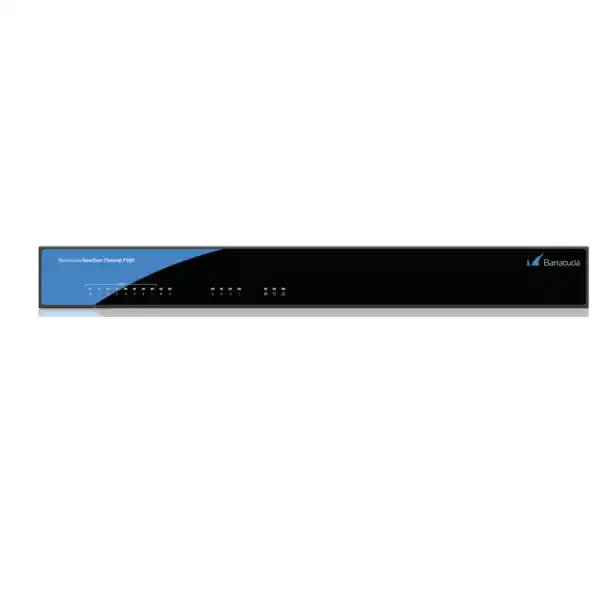
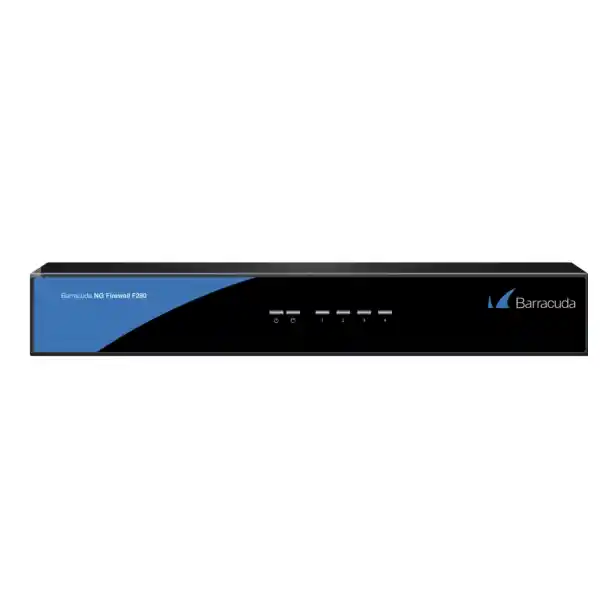
Barracuda CloudGen Firewall F280 Revision C
A compact, port-dense Barracuda CloudGen Firewall platform for UAE branch security, resilient WAN architecture, SD-WAN, site-to-site VPN, segmentation, and centrally controlled network policy. The F280 Revision C combines twelve copper Gigabit Ethernet ports, four 1GbE SFP interfaces, integrated Wi-Fi, enterprise firewall software, and a practical desktop form factor for distributed offices that need more physical interface flexibility than a small edge appliance without moving immediately to a large rack platform.
12 x 1GbE RJ45 + 4 x 1GbE SFP, 4-core AMD R-Series CPU, 4 GB RAM, SSD storage of 100 GB or better, integrated 802.11b/g/n Wi-Fi, USB 3.0, and RJ45 serial console connectivity.
Dense physical segmentation for WAN, LAN, DMZ, server, management, guest, voice, and controlled service networks.
Four fixed 1GbE optical SFP interfaces for structured fiber handoffs, switch uplinks, or resilient edge design.
AMD R-Series quad-core architecture paired with solid-state storage for branch firewall services and operational logging.
Compact 300 x 219 x 44 mm chassis with included L-shaped rack-mount brackets for flexible installation.
What the F280 Revision C is designed to solve
The Barracuda CloudGen Firewall F280 Revision C sits in a useful part of the enterprise edge spectrum. Many UAE organizations do not need a very large data-center firewall at every remote location, yet their branches have grown beyond the point where a minimal four-port or five-port appliance is operationally comfortable. A modern branch may have dual internet circuits, a dedicated management network, a voice or unified communications segment, guest Wi-Fi, local servers, building-management equipment, CCTV, point-of-sale systems, a corporate user VLAN, a separate administrator segment, and one or more switch uplinks. When all of these functions are forced through too few physical ports, the design can become dependent on extensive VLAN trunking and switch configuration. The F280 Revision C addresses that practical problem with twelve Gigabit copper interfaces and four Gigabit SFP interfaces, giving architects more options for physical separation where it is valuable while still supporting logical segmentation and policy-driven routing.
For organizations building secure WANs across Dubai, Abu Dhabi, Sharjah, the wider UAE, and regional offices, the appliance can serve as a controlled branch termination point for encrypted site-to-site connectivity. Barracuda CloudGen Firewall software supports the vendor’s TINA VPN technology as well as standards-based IPsec. TINA is particularly relevant in all-Barracuda environments because Barracuda uses it as the foundation for advanced SD-WAN capabilities. A logical VPN can use multiple transports, and routing decisions can account for link health and performance. That makes the platform suitable for locations where business continuity depends on combining fiber broadband, leased lines, broadband internet, or other available WAN services rather than trusting a single carrier path.
The F280 Revision C is also useful when an organization wants an edge platform that combines network firewalling with application visibility, SSL inspection, VPN, centralized administration, and optional security subscriptions rather than operating multiple independent products. The exact services enabled should be determined by the purchased Barracuda licenses, the traffic profile, encryption levels, inspection requirements, and the expected lifecycle of the deployment. FourTeck therefore treats the appliance specification as one part of the sizing decision rather than assuming that a model number by itself guarantees suitability for every user count or every encrypted workload.
Verified hardware architecture and interface map
Ports 1 through 12
Twelve 10/100/1000 Mbit RJ45 Ethernet interfaces provide the main copper connectivity bank. Barracuda documentation maps these interfaces as p1 through p12. Port 1 is identified for management in the default configuration, while port 4 is identified with DHCP in the documented default port configuration. Production deployments should still follow the current Barracuda quick-start and software configuration guidance rather than assuming factory defaults match the final network architecture.
Ports 13 through 16
Four 1GbE fiber SFP interfaces are mapped as p13 through p16. Barracuda identifies the underlying F280 Revision C fiber module implementation as fixed and non-replaceable. These ports are valuable for fiber-fed distribution switches, optical service handoffs, inter-building links, or environments where electrical isolation and cable distance make fiber preferable to copper.
Management and service access
The appliance provides two USB 3.0 ports and an RJ45 serial console interface. These physical access options matter during staging, recovery, or low-level troubleshooting because they provide operational paths that do not depend entirely on the production data network. Good deployment practice is to document console access, administrator credentials, support entitlement, backup procedures, and recovery media before the appliance enters production.
Integrated wireless
Revision C includes integrated Wi-Fi supporting IEEE 802.11b/g/n. In enterprise designs, that capability should be treated as an architectural choice rather than automatically used as the primary office WLAN. Larger offices often deploy dedicated managed access points for capacity, roaming, RF planning, and centralized wireless policy, while integrated firewall Wi-Fi can remain useful for smaller sites, controlled administrative access, or specific branch scenarios.
The physical system uses a four-core AMD R-Series processor with 4 GB RAM and SSD storage listed as 100 GB or better. Appliance weight is approximately 2.3 kg, and the chassis dimensions are 300 mm wide, 219 mm deep, and 44 mm high. The platform uses a fan for cooling and a single external AC power supply. Barracuda specifies 90–264 V AC input at 50–60 Hz, which is compatible with common enterprise power environments in the UAE when used with the appropriate supplied power components. Maximum listed power draw is 90 W, while maximum heat dissipation is 52 W or 180 BTU. The documented operating range is 0°C to +40°C with 10% to 95% non-condensing operating humidity, so equipment-room temperature and airflow remain important in Gulf deployments, especially in small communications closets where ambient temperature can rise significantly after business hours or during HVAC interruption.
Interface density as a security design advantage
Port density is not merely a convenience feature. It can influence how clearly a branch network is segmented and how easily the environment can be troubleshot. A design that uses a dedicated firewall interface for a sensitive OT segment, payment network, server enclave, guest zone, or management switch can create a clean demarcation between trust zones. This does not eliminate the need for VLANs, access control, or switch hardening, but it can reduce the number of places where trunk configuration errors could unintentionally bridge security domains. With twelve copper interfaces available, the F280 Revision C gives a designer enough physical options to reserve ports for WAN services and still retain substantial LAN-side flexibility.
A typical UAE branch might use two interfaces for separate internet connections, one for a corporate access-switch stack, one for a voice network, one for guest or contractor traffic, one for CCTV, one for a local server or virtualization host, one for a building management or IoT segment, and one for out-of-band administrative access. The remaining copper and SFP interfaces can support future growth, resilient switch uplinks, dedicated DMZs, or migration paths. There is no requirement to allocate ports in that exact way; the point is that the physical design can be driven by security and operations rather than by scarcity.
The four SFP ports add another layer of flexibility. Enterprises that use fiber between floors or buildings can terminate appropriate 1GbE optical links directly at the firewall or use SFP uplinks to distribution switches. Because the F280 Revision C fiber interfaces are fixed 1GbE SFP rather than 10GbE SFP+, architects should account for the uplink speed ceiling and choose the platform according to expected aggregate traffic. A branch that truly requires sustained multi-gigabit inspection, 10GbE switching, or large east-west aggregation should be evaluated against larger Barracuda models rather than attempting to stretch the F280 beyond its physical interface profile.
FourTeck can help translate business zones into an interface and VLAN matrix before configuration begins. This planning step is especially valuable during firewall replacement projects because existing networks frequently contain undocumented dependencies. Mapping subnets, DHCP scopes, static routes, NAT rules, public IP allocations, VPN peers, DNS dependencies, switch trunks, voice gateways, server services, and remote-management paths reduces cutover risk. For organizations comparing different edge models, the Firewall Dubai resource can be used alongside a formal FourTeck sizing exercise to identify an appropriate platform class.
SD-WAN architecture for resilient UAE branches
Barracuda CloudGen Firewall SD-WAN is built around the ability to use multiple VPN transports over different WAN connections within a logical tunnel. This is important because WAN resilience is more than simple link failover. A branch may have two circuits that are both technically reachable while one suffers high latency, packet loss, or unstable throughput. An SD-WAN design can use measured conditions and policy to steer traffic toward the more suitable transport, preserve availability when a link fails, and apply bandwidth management according to application or business priority. The precise behavior depends on configuration, topology, software version, and the connectivity available at both sites.
Barracuda’s TINA protocol is central to this architecture when both tunnel endpoints are CloudGen Firewalls. Barracuda documents TINA as its primary protocol for firewall-to-firewall VPN connectivity and uses it for advanced capabilities including multiple encapsulation transports, heartbeat monitoring, fast failover, continuous bandwidth and throughput evaluation, and SD-WAN. IPsec remains relevant for interoperability with other vendors and third-party VPN endpoints. In mixed estates, network teams may therefore operate TINA for Barracuda-to-Barracuda sites while retaining IPsec tunnels for partner networks, legacy devices, cloud gateways, or external organizations.
For a Dubai headquarters with branches in Abu Dhabi, Sharjah, Ras Al Khaimah, or overseas offices, the design process should start with application requirements instead of circuit labels. Voice and real-time collaboration are sensitive to latency and packet loss; backup traffic consumes bandwidth but can often tolerate delay; cloud business applications may require predictable internet breakout; sensitive server applications may need private routing and tightly controlled paths. SD-WAN policy should reflect these differences. A well-designed branch policy can keep critical sessions on the best available transport, shift traffic when performance deteriorates, and prevent bulk traffic from consuming bandwidth needed by interactive applications.
Redundancy also requires attention beyond the firewall. If both WAN circuits enter the building through the same duct, terminate on the same provider device, or depend on the same upstream infrastructure, logical dual-WAN configuration may not provide the level of resilience the business expects. Power, carrier diversity, last-mile diversity, upstream routing, DNS availability, switch redundancy, and remote-management access should all be considered. The F280 Revision C gives the network team sufficient physical interfaces to implement multiple WAN and LAN paths, but overall service continuity depends on the complete design.
VPN strategy: TINA, IPsec, remote access, and encryption overhead
A firewall purchase should account for the type and volume of encrypted traffic, not simply the raw speed of the internet circuit. Site-to-site VPN, client-to-site remote access, TLS inspection, and application-layer security consume compute resources. The real operational question is how many simultaneous encrypted flows the branch will process, what cryptographic algorithms are required, how traffic is distributed across tunnels, and what inspection services are applied after decryption. This is why FourTeck avoids presenting a single historical throughput number as a promise for every F280 Revision C deployment. Performance must be matched to the actual policy set and software release.
For CloudGen-to-CloudGen site connectivity, TINA offers a Barracuda-native approach with multiple transport options and rapid failure detection. It can be especially useful when a business wants to make active use of two WAN links rather than treating the secondary line as dormant insurance. For connectivity to non-Barracuda peers, standards-based IPsec allows the F280 to participate in conventional enterprise VPN architectures. During migration, this flexibility can help organizations replace legacy firewalls gradually instead of forcing every site to change at the same time.
Remote-user requirements should be assessed separately from site-to-site requirements. Barracuda’s base licensing documentation includes client-to-site VPN capability within the CloudGen Firewall feature set, while additional remote-access capabilities may depend on subscriptions and the desired user experience. The planning process should identify user platforms, authentication sources, MFA requirements, split-tunnel policy, access to internal applications, DNS behavior, certificate lifecycle, endpoint posture expectations, and support requirements. Security policy should grant remote users only the networks and services required for their role rather than extending unrestricted internal access through an encrypted tunnel.
Encryption also changes troubleshooting. Once branch traffic is encapsulated, routing tables, tunnel state, policy matching, MTU, fragmentation, asymmetric paths, NAT, and transport health all become possible fault domains. A production handover should therefore include a documented tunnel inventory, peer addresses, protected networks, authentication methods, certificate expiry information, failover rules, monitoring thresholds, and escalation contacts. Good documentation turns a sophisticated SD-WAN and VPN platform into an operationally manageable service rather than a configuration known only to the engineer who deployed it.
Security services and policy architecture
Application-aware control
Application-oriented visibility helps security teams reason about traffic by business use rather than relying exclusively on IP addresses and port numbers. In practice, policy should distinguish approved collaboration, productivity, cloud, infrastructure, and administrative traffic from unwanted or high-risk use. Application control is most useful when paired with ownership, logging, exception handling, and periodic policy review.
SSL inspection planning
Barracuda licensing documentation lists SSL inspection among base capabilities for supported CloudGen models. Encrypted traffic inspection can improve security visibility, but it requires certificate distribution, compatibility testing, privacy decisions, bypass rules for sensitive applications, and realistic sizing because decryption and re-encryption add processing load.
Intrusion prevention
IPS should be deployed with attention to traffic direction, exposed services, false-positive handling, signature updates, and the applications that genuinely need protection. A blanket approach can create unnecessary processing and operational noise. A risk-based policy focuses deeper inspection on exposed, sensitive, or high-value services while maintaining clear logging and incident workflows.
Malware and ATP options
Barracuda lists Malware Protection and Advanced Threat Protection as subscription options in the CloudGen licensing family. These services should be evaluated against the organization’s endpoint security, email security, sandboxing, SOC processes, and acceptable inspection latency so the firewall layer contributes meaningful defense rather than duplicating controls without operational integration.
Licensing: what UAE buyers should validate before purchase
Firewall hardware and security licensing must be quoted together. Barracuda’s current CloudGen Firewall licensing documentation states that a hardware appliance uses a base license bound to the MAC address of the first network interface and that Energize Updates is mandatory for the first year of a hardware purchase. Barracuda also describes optional or additional offerings such as Malware Protection, Advanced Threat Protection, Advanced Remote Access, and Firewall Insights. The correct bundle depends on the security outcome the customer expects. A branch that only needs encrypted site connectivity has a different licensing profile from a site that requires advanced malware inspection, richer reporting, and remote-access services.
The procurement team should request a quote that clearly separates the appliance, mandatory first-year entitlement, optional security subscriptions, support level, term length, and any implementation services. This prevents a common problem in security procurement: comparing two prices that represent different service levels. A lower hardware figure may not include the subscription components required to reproduce the intended design. Conversely, purchasing every possible security service without defining who will operate it can increase cost without improving risk management.
Renewal planning should start before deployment. Subscription expiry dates, support contacts, account ownership, and license administration should be documented in the organization’s asset register. If the firewall protects a revenue-critical site, renewal ownership should not depend on a single employee’s mailbox. The buyer should also verify the exact support and lifecycle status for the quoted appliance serial number and software branch at the time of purchase. Barracuda’s model lifecycle tables distinguish revisions, so it is important that purchase orders explicitly state F280 Revision C rather than the generic F280 family name.
FourTeck can help customers align hardware, entitlement, and deployment scope. For wider procurement, integration, and UAE technology requirements, organizations can also review FourTeck UAE and the FourTeck IT Services UAE portfolio when firewall installation is part of a broader branch build, migration, managed support, or infrastructure refresh.
Sizing the F280 Revision C without misleading headline numbers
The most reliable firewall sizing process begins with traffic characteristics. Internet bandwidth is only one variable. Two offices can each have a 500 Mbps circuit while placing radically different demands on a security appliance. One office may carry mostly web and SaaS traffic with moderate connection counts; the other may terminate many VPNs, inspect encrypted traffic, publish services, run substantial east-west segmentation, and generate large numbers of short-lived sessions. The second site can consume much more firewall resource even though the WAN circuit speed is identical.
FourTeck therefore recommends gathering at least four categories of measurements. First, identify peak and 95th-percentile WAN utilization for each circuit, not just the purchased bandwidth. Second, record concurrent users, devices, server workloads, guest traffic, and IoT endpoints. Third, define security services such as IPS, SSL inspection, malware protection, application control, web policy, and remote access that will be active simultaneously. Fourth, document the number of site-to-site tunnels, routing protocols, NAT rules, security policies, and public services. These inputs allow the architecture team to size with operational headroom rather than relying on a laboratory maximum.
Interface capacity is another sizing dimension. F280 Revision C ports are Gigabit-class, and the four optical interfaces are 1GbE SFP rather than 10GbE. If the branch core requires 10GbE firewall uplinks, the F280 is not the appropriate physical platform regardless of CPU performance. Likewise, a branch expecting large growth in east-west inspected traffic should consider whether routing that traffic through a 1GbE interface architecture creates an avoidable bottleneck. Correct sizing includes topology, not just packets per second.
Finally, plan for change. A firewall typically remains in service through bandwidth upgrades, application migrations, new cloud adoption, and security-policy expansion. A model that is adequate at installation but already near its expected ceiling may force an early replacement. Capacity headroom should be treated as an engineering reserve for encrypted traffic growth, additional inspection, temporary bursts, failover scenarios, and future software features. When business continuity is important, the better question is not “can the F280 carry today’s average load?” but “can the complete design remain within acceptable utilization during peak conditions and when one path or service fails?”
High availability and branch continuity design
A firewall can be the most capable component in a branch and still represent a single point of failure if deployed alone. When the business impact of downtime justifies redundancy, the architecture should evaluate a high-availability pair and the surrounding dependencies required to make failover meaningful. This includes duplicate power paths where possible, resilient WAN handoffs, switch connectivity to both firewall nodes, compatible software and licensing, synchronized configuration, and monitoring that detects degraded states before users report an outage.
The port density of the F280 Revision C helps when building resilient branch topologies because separate links can be assigned to multiple upstream or downstream devices. However, HA is not achieved merely by installing two appliances. If both firewalls connect to one unmanaged switch, one carrier modem, one power strip, or one building distribution path, the apparent redundancy may not survive the failure that matters. The design should map each failure domain and determine whether it is acceptable, mitigated, or intentionally retained because of budget or site constraints.
Operational procedures are equally important. Administrators should know how configuration changes are synchronized, how software upgrades are staged, how failover is tested, and what evidence confirms that sessions or tunnels are operating on the intended node. Planned maintenance should include an explicit rollback method. If a branch relies on VPN to reach central services, the test plan should confirm that remote routes, DNS, authentication, and critical applications remain usable after failover rather than validating only that the standby firewall becomes active.
Organizations with smaller branches may reasonably choose a single F280 when business risk does not justify a duplicate appliance. In that case, resilience can still be improved with documented configuration backups, a spare-hardware strategy, clear vendor support entitlement, remote console procedures, dual WAN circuits, and predefined replacement steps. High availability is a business continuity decision, not a checkbox, and the correct solution varies according to the site’s revenue impact, user population, available support staff, and acceptable recovery time.
Network segmentation blueprint for an F280 branch
A strong branch configuration normally begins with a zone model. Instead of treating the LAN as one trusted network, the architect defines functional trust zones and controls traffic between them. A corporate-user zone may reach approved business applications but not building controllers. A guest zone should normally receive internet access without lateral access to corporate systems. CCTV systems can be restricted to the recorder, management station, NTP, DNS, and approved vendor services. Voice devices may require call-control, provisioning, and media paths but should not automatically reach finance or server subnets. Administrative interfaces deserve their own management zone with access restricted to authorized support endpoints.
The F280’s twelve copper ports allow some of these zones to be physically separated, while VLAN tagging can aggregate others through managed switches. The decision should be based on risk, cable infrastructure, switch capabilities, and troubleshooting needs. Physical separation is easy to understand and can limit the impact of certain switch misconfigurations, but it consumes interfaces and cabling. VLANs provide scalability and efficient use of uplinks but depend on consistent switch and firewall configuration. Most enterprise branches use both techniques.
Policy should be written from required communication flows rather than broad source-to-any rules. For each zone, document allowed destinations, services, authentication dependencies, internet requirements, logging level, and inspection profile. Denied traffic logs can be useful during migration to discover missing application dependencies, but production logging should be tuned so security teams can distinguish meaningful events from background noise. Rule naming standards and ownership metadata make future review easier. Temporary rules should have an expiry or review date so emergency changes do not become permanent architecture.
Segmentation also affects routing. The firewall may act as the default gateway for multiple security zones, or Layer 3 switching may remain on the campus switch with selected traffic routed through the firewall. Placing gateways on the firewall provides direct control over inter-zone traffic but can increase traffic load across firewall interfaces. Keeping routing on the switch can improve local performance but requires careful enforcement so sensitive VLANs cannot bypass security inspection. The correct model depends on traffic volume and security requirements. The F280’s 1GbE port architecture should be considered when deciding how much east-west traffic to route through the appliance.
Routing, NAT, and internet breakout design
The firewall becomes easier to operate when routing and NAT are designed as separate, documented concerns. Routing determines where traffic should go; NAT changes addresses to meet internet, publishing, partner, or overlapping-network requirements. During firewall migrations these functions are often inherited from an older device with years of incremental changes. Recreating every legacy rule without understanding its purpose can preserve obsolete exposure and technical debt. A better approach is to export the existing configuration, map rules to owners and services, remove unused entries where safely possible, and rebuild policy in a logical order.
Dual-WAN branches require special attention to default routes, return paths, and source NAT. Sessions sent out one provider should return through a path compatible with stateful inspection. Public services may require provider-specific NAT or DNS considerations, while site-to-site tunnels must account for which external addresses are reachable on each transport. If dynamic routing is used, the route design should avoid accidental preference changes that bypass security policy or produce asymmetric traffic. Route monitoring and SD-WAN decisions should be coordinated rather than configured independently.
Local internet breakout can reduce dependence on a central data center for SaaS traffic, but it changes the security boundary. A distributed organization needs consistent filtering, logging, DNS policy, incident response, and remote administration across all breakout sites. Centralized management is therefore as important as the branch hardware. Configuration standards should define common objects, naming conventions, security profiles, and exceptions so dozens of F-Series appliances do not gradually diverge into unique and difficult-to-support configurations.
For hybrid environments, firewall routes may also need to integrate with cloud networks, MPLS, provider VPNs, or SD-WAN paths. The migration plan should specify route preference during cutover and how rollback will work if a new path fails. Testing should include not only ping but representative application sessions, DNS resolution, authentication, voice traffic, file access, cloud SaaS, remote management, and externally published services. Firewall routing is successful only when business flows work through the intended path and unwanted flows remain blocked.
UAE deployment considerations: power, heat, cabling, and operations
The Gulf operating environment makes physical installation discipline important. Barracuda specifies an operating temperature range of 0°C to +40°C for the F280 Revision C. A properly air-conditioned server room is normally well within that range, but small telecom closets can become much warmer than the office area around them. Cooling failures, blocked vents, equipment stacked directly against the firewall, dust accumulation, and overloaded cabinets can all shorten hardware life or cause instability. The appliance uses active fan cooling, so installation should preserve airflow and make routine inspection possible.
Power design should include a suitable UPS and surge protection according to the site’s standards. The F280 Revision C uses a single external power supply rather than dual internal hot-swappable power supplies, so the power path should be treated as part of the risk assessment. In a single-appliance branch, a quality UPS can protect against short interruptions and provide time for controlled shutdown. In a high-availability design, each firewall should ideally connect through independent protected power paths where the facility can support them. The external power brick and cables should remain identifiable as part of the appliance kit, and replacement procedures should use vendor-approved power components.
Cabling should be labeled at both ends with a scheme that maps directly to the firewall interface plan. This sounds basic, but clear labels reduce outage duration during WAN troubleshooting and emergency changes. Copper WAN links, switch uplinks, SFP fiber pairs, console access, and HA links should be distinguishable without tracing every cable through a crowded cabinet. For optical interfaces, the transceiver type, fiber mode, wavelength, and remote endpoint must be compatible. Because the F280 Revision C uses fixed 1GbE SFP interfaces, the design should specify approved and compatible optics rather than assuming any SFP will operate correctly.
Physical asset records should include the full model and revision, serial number, support entitlement, installation location, rack or shelf position, WAN circuit details, management IPs, software version, backup location, and escalation ownership. Barracuda specifically distinguishes hardware revisions in its documentation and lifecycle tables, so recording “F280” alone is insufficient. The inventory should say “F280 Revision C.” This precision matters when engineers check firmware compatibility, replacement hardware, or lifecycle status years after installation.
Firmware compatibility, lifecycle control, and change management
Barracuda’s hardware model documentation lists the F280 Revision C with a minimum software requirement of 8.0.4 plus Hotfix 1039 or higher. That minimum is a compatibility floor, not a recommendation to deploy an old release. Production systems should run a currently supported software branch appropriate for the organization’s feature requirements, support entitlement, and change policy. Before installation or upgrade, administrators should review Barracuda release notes, known issues, upgrade paths, and hardware support statements for the exact appliance revision.
Lifecycle management is especially important because prior F280 revisions have separate end-of-sale and end-of-life histories. Revision C is a distinct hardware revision and should be tracked independently. Procurement teams should verify the current lifecycle and support position at quote time, especially when purchasing through secondary inventory channels or replacing older F280 Revision A or Revision B units. A low purchase price is not valuable if the device cannot receive the software, subscriptions, or support required for the intended production period.
Change management should define how configuration is backed up before updates, who approves maintenance, how HA failover is handled, how monitoring is suppressed during planned work, and what triggers rollback. For branch estates, phased rollout is preferable to upgrading every site simultaneously. A pilot group representing typical network conditions can reveal application compatibility or tunnel behavior issues before the change reaches critical sites. The pilot should include encrypted traffic, SD-WAN paths, remote access, NAT, published services, and monitoring integrations.
Configuration discipline is just as important as software currency. Administrators should maintain versioned backups, document significant policy changes, review unused rules, and periodically validate administrator accounts and authentication. Emergency changes should be reconciled into the formal design. If centralized management is used, access to that platform becomes a high-value control point and should receive strong authentication, least-privilege roles, secure management networking, and reliable backup. Firewall security includes the security of the people, processes, and management systems that can change the firewall.
Migration methodology for replacing an existing firewall
1. Discover
Collect interface assignments, VLANs, subnets, static and dynamic routes, WAN addressing, public IPs, NAT, security rules, objects, VPNs, authentication dependencies, certificates, DHCP, DNS settings, logging targets, monitoring, administrative access, and any special application requirements. Compare the documented configuration with actual traffic so obsolete rules are not blindly recreated.
2. Design
Create the F280 Revision C interface map, security zones, routing table, NAT plan, VPN design, SD-WAN policy, inspection profiles, administrator model, logging architecture, and rollback strategy. Confirm that 1GbE physical interfaces are appropriate for the planned traffic and that selected subscriptions cover all required security functions.
3. Stage
Update to an approved supported release, register licensing, configure management, apply baseline hardening, create zones and routes, establish policies, load certificates, prepare VPN peers, configure logging, and validate configuration backups. Where possible, perform staging on an isolated network before connecting production WAN and LAN circuits.
4. Cut over and validate
Move circuits according to an approved sequence and test internet, DNS, identity services, cloud applications, internal servers, voice, remote access, VPN, published applications, monitoring, and backup paths. Confirm that security logs show intended rule matches. Keep rollback conditions objective so the team can make a fast decision if a critical dependency fails.
Logging, monitoring, and day-two operations
A firewall that is configured correctly on day one can still become risky if nobody monitors changes, health, or unusual traffic. Day-two operations should define the events that require immediate response and the information that should be retained for trend analysis. WAN link state, VPN tunnel health, CPU and memory utilization, storage condition, interface errors, administrative logins, configuration changes, repeated policy denials, security detections, and license or subscription state are all relevant. The exact telemetry destination depends on whether the organization uses Barracuda management tools, a SIEM, an MSP platform, or internal monitoring systems.
Alerting should be actionable. If every transient tunnel event generates a critical ticket, engineers will stop trusting notifications. Thresholds and persistence timers should distinguish a brief provider fluctuation from a sustained outage. For SD-WAN, the team should monitor not only whether a transport is up but also whether its quality deteriorates. Periodic reports can help identify circuits that technically remain available while delivering poor business performance.
Security logging requires enough context to support investigation. Administrators should be able to determine which source device communicated with which destination, through what rule, using what application or service, and whether security inspection changed or blocked the session. Time synchronization is critical because logs from firewalls, servers, endpoints, identity systems, and cloud applications must align during incident response. NTP design should therefore be part of the branch baseline rather than an afterthought.
Capacity trends should be reviewed before users experience performance issues. Growth in encrypted traffic, session counts, WAN utilization, policy complexity, or site-to-site tunnels can gradually change the suitability of the appliance. Monitoring data gives the organization evidence for upgrade planning. If utilization consistently approaches operational limits during normal peaks, the next model should be evaluated before a bandwidth upgrade or new inspection feature creates an emergency replacement requirement.
Who should choose the Barracuda F280 Revision C?
The F280 Revision C is well suited to organizations that value dense 1GbE interface connectivity in a compact appliance and want Barracuda CloudGen Firewall capabilities at the branch edge. It is a practical candidate for medium branch offices, retail or service locations with multiple segmented networks, distributed businesses standardizing on Barracuda, managed service deployments, secure remote facilities, and sites using multiple WAN transports for resilient connectivity. It can also fit organizations that want fiber and copper connectivity in the same appliance without requiring 10GbE interfaces.
It is particularly compelling where physical segmentation is useful. Twelve copper ports allow a branch to dedicate interfaces to separate security domains, while four optical SFP ports can connect distribution switching or fiber services. The integrated Wi-Fi option can support selected small-site or administrative use cases. The compact desktop form factor is convenient for locations without a full server rack, while included L-shaped rack-mount brackets provide additional installation options when the appliance is placed in structured infrastructure.
The model should not be selected merely because the user count appears moderate. Sites requiring 10GbE uplinks, sustained multi-gigabit security inspection, exceptionally high encrypted traffic, large numbers of public services, heavy SSL decryption, or extensive future growth may be better served by a larger platform. Likewise, businesses requiring dual internal power supplies or a different physical resilience profile should compare higher models. FourTeck’s role in the design process is to identify when the F280 is the right fit and when moving up a platform class avoids unnecessary operational compromise.
Organizations with offices beyond the UAE can standardize architecture while still accounting for local carrier and support conditions. For multinational projects, the FourTeck global site provides a broader entry point for infrastructure discussions. A standard branch blueprint can reduce engineering effort, but each country deployment should still validate circuit types, lead times, power, local support, import constraints, and available on-site technical resources.
When the F280 Revision C may not be the right model
Good procurement includes knowing when not to buy a product. The F280 Revision C is built around 1GbE interfaces. If the branch core or WAN architecture requires native 10GbE connectivity, choosing a firewall with SFP+ interfaces is more appropriate. Using multiple 1GbE links does not automatically substitute for a 10GbE design because traffic distribution, session paths, switch topology, and inspection processing still matter. A larger model can simplify architecture and provide expansion headroom.
The single external power supply can also influence high-availability planning. An HA pair can mitigate appliance failure, but customers that specifically require redundant hot-swappable power within each chassis should consider platforms designed for that expectation. Physical requirements such as rack depth, structured cabling, optical transceiver type, and environmental conditions should be checked before ordering rather than discovered during installation.
Security-service intensity can be another reason to move upward. SSL inspection, IPS, malware controls, VPN encryption, application identification, and extensive logging can all contribute to platform load. If a site intends to inspect most encrypted traffic while running high WAN utilization and multiple tunnels, capacity must be validated with substantial headroom. Older published F280-family marketing figures should not be treated as a guarantee for Revision C under every contemporary workload. Current Barracuda sizing guidance and a realistic traffic model should drive the decision.
Finally, highly centralized enterprises may decide that some branches need a different architecture altogether, such as a larger centralized firewall with lighter local edge functions, a virtual appliance, or a cloud-native control point. The F280 Revision C is a physical branch firewall; it should be selected because local enforcement, connectivity, and resiliency requirements justify it. Architecture should follow business and traffic needs, not product familiarity alone.
Technical specification reference
| Category | Barracuda CloudGen Firewall F280 Revision C |
|---|---|
| Copper Ethernet | 12 x 10/100/1000 Mbit RJ45 Ethernet |
| Fiber Ethernet | 4 x 1GbE SFP, fixed network module implementation |
| USB | 2 x USB 3.0 |
| Serial console | 1 x RJ45 serial console |
| Integrated Wi-Fi | IEEE 802.11b/g/n |
| Processor | AMD R-Series, 4 cores |
| Memory | 4 GB RAM |
| Storage | SSD, 100 GB or better |
| Chassis | Desktop, 300 x 219 x 44 mm |
| Appliance weight | Approximately 2.3 kg |
| Cooling | Fan |
| Power supply | Single external AC supply, 90–264 V, 50–60 Hz |
| Maximum listed power draw | 90 W |
| Heat dissipation | Up to 52 W / 180 BTU |
| Operating temperature | 0°C to +40°C |
| Operating humidity | 10% to 95%, non-condensing |
| Compliance listed by Barracuda | CE emissions, CE electrical safety, FCC emissions, RoHS compliance |
Specifications should be validated against the current Barracuda product documentation and the exact quoted appliance before purchase because manufacturers may revise technical details, packaging, software requirements, or lifecycle information.
Implementation detail: building a clean port and VLAN plan
Before connecting cables, create a simple matrix containing firewall port, OS notation, physical medium, connected device, VLAN mode, IP addressing, security zone, and purpose. For example, p1 may remain a protected management interface during staging; p2 and p3 may terminate primary and secondary WAN; p5 may connect a corporate switch trunk; p6 may serve a voice zone; p7 may support CCTV; and one SFP port may connect a fiber distribution switch. The actual mapping should be designed for the site, but documenting it in advance prevents accidental reuse of a port for an incompatible role.
For trunk links, list every allowed VLAN explicitly and verify the native or untagged behavior on both sides. Mismatched tagging is one of the most common causes of failed migrations because the firewall and switch can both appear healthy while traffic is placed in different Layer 2 contexts. The test plan should confirm gateway reachability from each VLAN and policy behavior between zones. If DHCP runs on the firewall, validate scope, gateway, DNS, lease time, reservations, and relay requirements. If DHCP is external, test helper or relay behavior through the final routing path.
For WAN ports, record the provider circuit ID, demarcation device, handoff speed, static or dynamic addressing, VLAN tags if any, gateway, DNS, usable public ranges, and technical support number. If PPPoE or another provider-specific method is used, credentials and recovery contacts must be stored securely. Circuit documentation should identify whether the handoff is copper or fiber and which device owns link negotiation. This information becomes critical during an outage when multiple vendors are troubleshooting the same path.
For SFP interfaces, avoid assuming a fiber link is operational simply because the transceiver fits physically. The remote optic, wavelength, mode, and fiber type must match, and patch-panel polarity should be verified. Optical power levels can help diagnose marginal links. If the branch does not need the SFP ports at deployment, they can remain available for future switch upgrades or secondary fiber services. The key advantage is having those options built into the Revision C hardware from the start.
Security hardening baseline
A production firewall should be deployed with a documented hardening baseline. Administrative access should be restricted to designated management networks or secure remote administration paths. Default or temporary staging credentials should be changed before production, individual administrator accounts should be preferred over shared credentials, and strong authentication should be used wherever supported by the organization’s identity and MFA architecture. Management services should not be exposed broadly to the internet unless there is a clearly justified and protected design.
Security policies should follow least privilege. New rule requests should identify the source, destination, service or application, business purpose, owner, duration, and inspection requirements. Broad temporary rules may be useful during controlled cutover troubleshooting, but they should be time-bounded and removed or tightened after validation. Address and service objects should use consistent naming so engineers can understand intent without opening every rule. Duplicate or shadowed rules should be reviewed during periodic policy hygiene.
Configuration backup is part of hardening because recovery from a failed change or hardware problem depends on a known-good state. Backups should be protected, access-controlled, and tested. The organization should know how to recover the F280 Revision C, how licensing is restored or transferred under support procedures, and which software version the backup expects. Console access and recovery media are valuable only if staff know where they are and can use them during an outage.
Log forwarding should protect against local evidence loss and support centralized detection. Administrator changes, authentication events, policy blocks, threat events, VPN status, and system alarms should reach an appropriate monitoring or SIEM platform when required by the organization’s security operations model. Retention should reflect legal, contractual, and operational requirements. A firewall produces useful security information, but it becomes effective control only when there is a process to review and act on that information.
Remote branch standardization and centralized operations
The value of a CloudGen Firewall platform increases when distributed sites follow a common design. Standard interface roles, consistent security-zone names, common VPN templates, shared logging destinations, and repeatable monitoring reduce deployment time and support complexity. Standardization does not mean every branch is identical. A retail outlet, warehouse, professional office, and industrial site may have different local systems. The goal is to keep the architecture predictable while allowing documented site-specific variations.
A branch template can define mandatory elements such as primary and secondary WAN, corporate LAN, guest zone, management network, VPN, NTP, DNS behavior, administrator controls, default-deny rules, logging, and backup. Optional modules can cover CCTV, voice, local servers, OT, public services, or local internet breakout. This modular approach is easier to audit than building each firewall from a blank configuration. It also creates a repeatable quotation and installation process for growing businesses opening new UAE or regional locations.
Zero-touch or centrally orchestrated deployment capabilities can reduce the need for highly specialized staff at every branch, but they do not remove the need for accurate circuit and cabling information. Someone on site still needs to identify the correct WAN handoff, LAN uplink, power source, and appliance. Good deployment packs include photos or diagrams, cable labels, provider information, contact details, and a simple checklist that a local technician can follow while the network engineer performs configuration remotely.
For organizations expanding from the UAE into multiple countries, standardization can simplify procurement and support while local variations are handled in the site bill of materials. The firewall may be common, but optics, power cords, rack accessories, carrier technologies, and on-site support arrangements can differ. FourTeck can integrate firewall deployment into wider network and infrastructure planning rather than treating it as an isolated appliance purchase.
Procurement checks for the UAE market
A complete quotation should identify the exact hardware revision: Barracuda CloudGen Firewall F280 Revision C. This prevents ambiguity with older F280 revisions that have different hardware and lifecycle histories. The quote should list the appliance part number where available, included accessories, mandatory first-year licensing, optional subscriptions, support tier, term, delivery scope, installation services, and VAT treatment. If optical connectivity is required, transceivers should be quoted separately and matched to the fiber specification.
Delivery lead time matters when a firewall is tied to a branch opening, office move, or ISP activation. Procurement should work backward from the required cutover date and allow time for receipt, registration, licensing, firmware preparation, staging, testing, and change approval. Treating the hardware delivery date as the same as the production-ready date creates unnecessary project risk. Critical sites may also justify purchasing the HA peer, spare optics, spare patch leads, and replacement power components as part of the initial project.
Support scope should be explicit. Some customers need only supply of the appliance, while others require configuration, migration, after-hours cutover, remote monitoring, on-site troubleshooting, or managed changes. Responsibilities for Barracuda vendor escalation, ISP escalation, switch configuration, endpoint certificate deployment, MFA integration, and SIEM integration should be identified before implementation. A firewall project crosses multiple technical boundaries, and unclear ownership is a common source of delay.
Organizations considering related network, compute, or branch infrastructure can coordinate procurement through FourTeck rather than managing every component independently. This can be useful when a firewall refresh coincides with switch replacement, server deployment, Wi-Fi changes, or managed IT services. The technical design should still maintain vendor-appropriate boundaries and validated compatibility, but project coordination can reduce scheduling conflicts during branch cutover.
Frequently asked technical questions
Does Revision C have 10GbE ports?
No. Barracuda documents twelve 1GbE RJ45 ports and four 1GbE SFP ports for the F280 Revision C. If native 10GbE SFP+ is required, a different CloudGen Firewall hardware model should be evaluated.
Are the SFP network modules replaceable?
Barracuda lists the F280 Revision C 1GbE SFP network module implementation as fixed and non-replaceable. Compatible SFP transceivers are still inserted into the SFP cages, but the underlying interface module is not a field-replaceable expansion card.
Can it support dual WAN?
Yes, the interface density allows multiple WAN connections, and CloudGen Firewall SD-WAN can use multiple VPN transports. The exact configuration depends on ISP handoffs, addressing, routing, and the remote VPN topology.
Does the F280 Revision C include Wi-Fi?
Yes. Barracuda documents integrated IEEE 802.11b/g/n Wi-Fi. Larger enterprises may still prefer dedicated managed access points for capacity and centralized RF management.
What is the storage configuration?
The documented system uses SSD storage with a capacity of 100 GB or better. Actual shipping details should be confirmed on the quoted appliance because manufacturers can revise component sourcing while maintaining the supported specification.
What software does Revision C require?
Barracuda’s hardware model table lists version 8.0.4 plus Hotfix 1039 or higher as the minimum compatibility requirement. Production systems should use a currently supported release selected according to Barracuda upgrade guidance and the customer’s support policy.
Is Energize Updates required?
Barracuda’s current licensing documentation states that Energize Updates is mandatory for the first year for hardware CloudGen Firewall purchases. Subscription scope and renewal requirements should be validated in the final quotation.
Can FourTeck handle migration?
FourTeck can scope staging, rule and object migration, VPN planning, WAN cutover, segmentation, testing, documentation, and UAE implementation support as part of a project rather than supplying the appliance alone.
Decision recap: where the F280 Revision C fits
Choose the Barracuda CloudGen Firewall F280 Revision C when the branch needs a compact security appliance with unusually flexible Gigabit interface density, Barracuda VPN and SD-WAN capabilities, integrated Wi-Fi, and a software platform that can combine routing, segmentation, application-aware policy, encryption, and optional advanced security subscriptions. It is strongest where twelve copper ports and four fiber ports simplify real branch architecture instead of forcing every security zone through a minimal port set.
Medium branches, multi-zone offices, distributed organizations, dual-WAN sites, Barracuda-standardized estates, 1GbE fiber/copper environments, and locations that value physical segmentation.
10GbE core requirements, sustained multi-gigabit inspection, very heavy TLS decryption, exceptionally high VPN concentration, or large future bandwidth increases.
Quotation input checklist
For an accurate UAE quotation and sizing review, provide the information below. The more complete the input, the easier it is to determine whether one F280 Revision C, an HA pair, or a larger CloudGen model is appropriate.
Plan the F280 Revision C around your actual network
The correct firewall project combines hardware, subscriptions, WAN architecture, segmentation, migration, and operational ownership. FourTeck can help UAE customers validate whether the F280 Revision C has the right interface profile and capacity margin, define a clean branch design, and prepare a deployment plan that accounts for circuit diversity, VPN, inspection, high availability, logging, and future growth.
A successful deployment should leave the customer with more than an installed appliance. The deliverable should include an accurate as-built port map, network and VLAN design, route and NAT documentation, VPN inventory, administrator access model, backup process, monitoring plan, licensing record, and clear support escalation path. That operational package is what turns the firewall into maintainable infrastructure.
Share your circuit speeds, user count, active security services, VPN topology, interface requirements, and HA expectations for a model and licensing review.
Product specifications, subscriptions, software requirements, and lifecycle information can change. Final procurement should be based on the current Barracuda documentation, the exact F280 Revision C appliance quoted, and a workload-specific sizing review. FourTeck can assist with current commercial availability and project scope in the UAE.

Reviews
There are no reviews yet.