
Barracuda CloudGen Firewall F400.F20 Revision C
A high-density 1U CloudGen Firewall platform for organizations that need copper access, 1GbE fiber aggregation, 10GbE uplinks, dual hot-swap power resilience, secure SD-WAN, VPN, application-aware policy enforcement, and a deployment architecture that can scale from a UAE headquarters to regional branch networks.
Choose the F400.F20 Revision C when the design requires the F400 performance class but also benefits from four dedicated 1GbE SFP ports and dual hot-swap power supplies. That combination makes the .F20 variant especially relevant for rack-based enterprise deployments where fiber handoffs, redundant power feeds, and flexible WAN/LAN segmentation matter.
What the F400.F20 Revision C is designed to solve
Enterprise firewall selection is rarely about a single throughput number. A UAE organization may need to terminate multiple internet circuits, separate corporate and operational networks, carry VLAN trunks from distribution switches, connect to fiber-based metro Ethernet, maintain encrypted site-to-site connectivity, provide remote-access services, inspect application traffic, and continue operating during a power-supply failure. The Barracuda CloudGen Firewall F400.F20 Revision C is positioned for exactly this type of multi-role edge where connectivity diversity and service continuity are as important as security inspection.
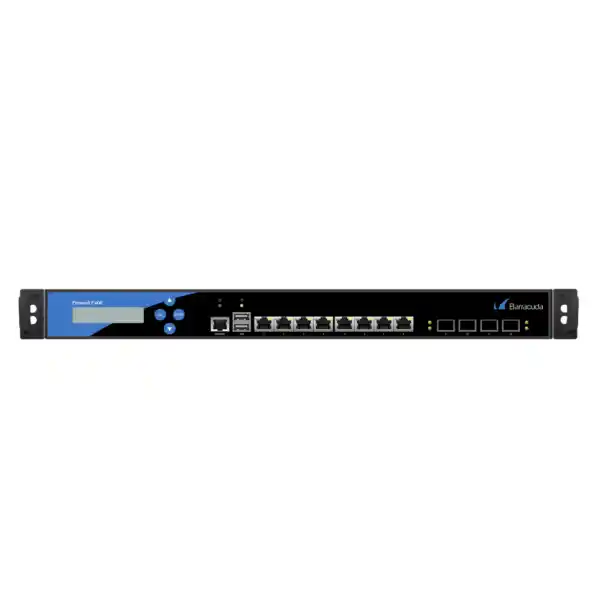
The hardware layout gives network architects fourteen production Ethernet interfaces before logical VLAN subinterfaces are even considered: eight 10/100/1000 Mbps RJ45 ports, four 1GbE optical SFP ports, and two 10GbE optical SFP+ ports. The first copper interface is identified by Barracuda as the management port in the documented port map, while the remaining interfaces can be planned around WAN, LAN, DMZ, transit, HA, management, monitoring, partner, or service-provider connections according to the selected design. This interface mix is a practical advantage in environments where not every carrier or switch connection arrives on the same media type.
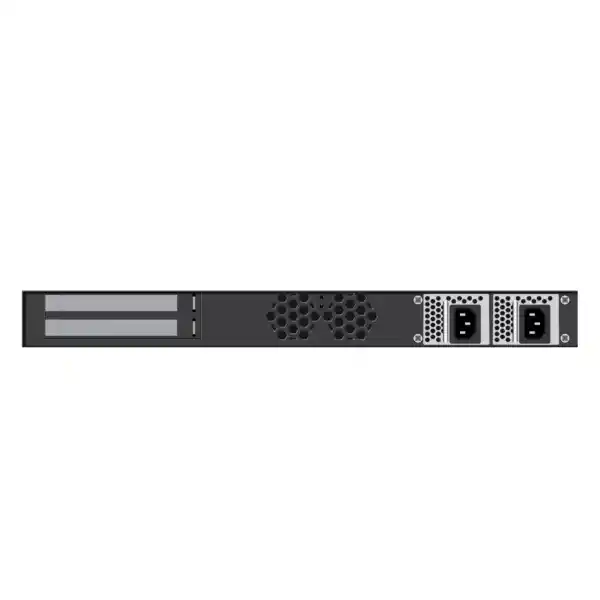
The .F20 hardware also differs from the basic F400 configuration in its power architecture. Barracuda documents dual hot-swap internal power supplies for F400.F20, compared with a single internal supply on the standard F400. For server rooms and data-center racks with A/B power, that enables a cleaner resilience design: one PSU can be connected to each independent PDU or UPS path. Power redundancy does not replace a complete high-availability strategy, but it removes a common single-component failure point inside the appliance and is one reason the F400.F20 is a better fit than the base F400 for business-critical perimeter roles.
F400.F20 Revision C hardware at a glance
Published performance profile and how to read it correctly
Barracuda has published F400-class performance values of up to 13 Gbps firewall throughput, up to 3.6 Gbps VPN throughput, up to 4.2 Gbps IPS throughput, up to 3.7 Gbps next-generation firewall throughput, and up to 3.1 Gbps threat-protection throughput. The same published performance table lists 500,000 concurrent sessions and 20,000 new sessions per second for the F400 class. These figures are useful for product positioning, but they should never be interpreted as a guaranteed application throughput for every deployment. Barracuda explicitly describes performance values as measured under optimized conditions and notes that results vary with system configuration and infrastructure.
| Metric | Published F400-class value | Design interpretation |
|---|---|---|
| Firewall | Up to 13 Gbps | Baseline packet-forwarding indicator, not a substitute for inspected-traffic sizing. |
| VPN | Up to 3.6 Gbps | Relevant to site-to-site encrypted traffic; tunnel count, crypto choices and packet profile still matter. |
| IPS | Up to 4.2 Gbps | Useful when intrusion prevention is a primary inspection function. |
| NGFW | Up to 3.7 Gbps | Better starting point for application-aware security than raw firewall throughput. |
| Threat protection | Up to 3.1 Gbps | Use as a reference when multiple security services are expected to be active. |
| Concurrent sessions | 500,000 | Important for busy user populations, internet gateways and NAT-heavy applications. |
| New sessions | 20,000/s | Helps characterize connection churn from web, SaaS, mobile, DNS, API and microservice workloads. |
For an actual Dubai deployment, FourTeck recommends sizing from the protected traffic mix rather than from ISP bandwidth alone. A 2 Gbps internet circuit does not automatically mean that a 2 Gbps security appliance is adequate, because SSL inspection, application classification, IPS, malware services, logging, VPN encryption, east-west segmentation, and burst traffic can all increase processing requirements. Equally, an organization with several gigabits of aggregate WAN capacity may have a much lower simultaneously inspected load. The design should therefore separate link capacity, sustained traffic, peak traffic, encrypted percentage, inspection policy, session count, user count, VPN utilization and growth headroom.
Port architecture: why the .F20 interface mix matters
The F400.F20 Revision C uses a fixed interface layout rather than field-replaceable expansion modules. Barracuda documents eight copper ports p1 through p8, four 1GbE optical ports p9 through p12, and two 10GbE optical ports a1 and a2. The 10GbE ports use fixed Intel X710 interfaces, while the four 1GbE SFP ports use fixed Intel i350-AM4 interfaces. This matters during procurement because the port density is known in advance and the appliance should be selected only after the desired physical topology has been mapped. If the project requires a different number of copper, SFP, or higher-speed interfaces than this fixed combination provides, the correct decision may be another firewall model rather than an attempt to treat the F400.F20 as modular hardware.
In a typical UAE head-office design, the two 10GbE SFP+ ports can be allocated as redundant or aggregated northbound connections to a core switching layer, while the four 1GbE SFP ports can be used for service-provider fiber handoffs, dedicated DMZ switching, building-to-building links, or isolated partner circuits. The copper ports can then support internet CPE devices, management, HA links, local access switches, monitoring systems, out-of-band equipment, or additional routed zones. This is only an example; CloudGen Firewall policy and interface configuration should follow the actual Layer 2 and Layer 3 architecture rather than a fixed template.
A key engineering decision is whether to use dedicated physical interfaces for security zones or to carry multiple VLANs over fewer trunks. Dedicated ports can simplify fault isolation and make physical paths obvious, while VLAN trunks improve interface efficiency and scalability. The two approaches can also be combined. For example, a 10GbE trunk can carry multiple internal security zones to a core switch, while separate copper or SFP interfaces terminate internet links and management networks. The F400.F20 gives enough media diversity to support both patterns without immediately forcing media converters or external aggregation devices into the design.
Transceiver selection deserves equal attention. A 1GbE SFP cage does not imply compatibility with every optic on the market, and a 10GbE SFP+ cage does not eliminate the need to match optical wavelength, fiber type, connector type, distance, and switch or carrier requirements. Bill of materials preparation should therefore identify whether each link uses short-range multimode, long-range single-mode, DAC, or another supported medium, and the chosen transceivers should be checked against Barracuda support guidance and the peer device. This small procurement step prevents a surprisingly large number of installation-day failures.
Hardware platform, serial-specific CPU revisions and rack planning
Barracuda documentation for F400 Revision C identifies a serial-number-dependent CPU implementation. For F400.F20 units below the documented serial threshold, the platform is listed with an Intel Pentium Gold Series processor configuration; above the threshold, the documentation lists an Intel Core i3 configuration. Because hardware components can change over a product revision and Barracuda explicitly cautions that published component lists may not reflect every delivered appliance, procurement teams should capture the actual serial number and hardware inventory when exact CPU detail is contractually or operationally important.
This distinction is a useful reminder that appliance sizing should be based on the model’s supported performance envelope and validated configuration, not on assumptions drawn from a consumer-style CPU comparison. Security appliances are integrated systems whose forwarding, memory, storage, software version, drivers, inspection engines, cryptography and network interfaces work together. A later CPU implementation does not automatically translate to a simple linear increase in every workload, and the correct baseline remains the vendor-published model specification plus deployment-specific testing where critical.
Rack and environmental facts
The appliance is a 1U rack-mount chassis measuring approximately 440 × 440 × 44 mm. Barracuda lists the F400.F20 appliance weight at about 9.3 kg, excluding shipping carton, and specifies fan cooling. Operating temperature is documented at 0°C to +40°C with non-condensing operating humidity from 5% to 85%. These limits make controlled rack-room cooling and airflow management important in UAE deployments, particularly in communications rooms that experience elevated ambient temperatures when building cooling is reduced after hours.
The F400.F20 uses internal AC power supplies with 100–240 V, 50–60 Hz auto-sensing input. Barracuda publishes a maximum power draw figure of 300 W for the F400.F20 variant. For resilient installation, each PSU should be connected to an appropriately designed and independently protected power path where the site provides A/B infrastructure. UPS sizing, PDU loading, grounding and generator transition behavior remain part of the site electrical design and should not be inferred solely from the appliance’s maximum wattage.
Secure SD-WAN for multi-carrier UAE networks
Barracuda CloudGen Firewall integrates SD-WAN capabilities with its security policy framework. In practical terms, this means a site can use multiple WAN connections as transports within a logical VPN design rather than treating every circuit as an isolated tunnel. Barracuda documents dynamic bandwidth and round-trip-time detection, performance-based transport selection, balancing and bandwidth management as components of its SD-WAN approach. The objective is not simply link redundancy; it is to make path selection responsive to the quality and availability of the underlying carriers while keeping security policy associated with the traffic.
This can be useful in Dubai and wider UAE deployments where an enterprise combines primary fiber, secondary business internet, MPLS, or other carrier services. A design can reserve a premium low-latency path for voice or business-critical applications while allowing less critical flows to use lower-cost capacity. When a preferred transport degrades, policy can shift sessions according to defined conditions. Barracuda also documents traffic-duplication capabilities for selected scenarios, where packet streams can traverse primary and secondary VPN transports to reduce loss for sensitive traffic. Such features should be applied selectively because duplication consumes bandwidth on more than one path.
Barracuda’s SD-WAN design uses its TINA VPN protocol for multi-transport SD-WAN between CloudGen Firewall endpoints. That has an architectural implication: organizations should identify which branches will use Barracuda at both ends and which external sites require standards-based IPsec interoperability. A mixed estate is possible, but the feature set available on a Barracuda-to-Barracuda TINA connection is not necessarily identical to a generic third-party IPsec tunnel. During migration, engineers should classify tunnels by peer type, business criticality, routing requirements, encryption settings, NAT behavior, failover requirements and operational ownership.
The F400.F20’s physical interfaces complement this software capability. Multiple copper and fiber WAN handoffs can terminate directly on the appliance, while the 10GbE ports can connect into the internal core. This reduces the need to collapse every carrier path through one external switch, although a switched handoff architecture may still be preferred for HA pairs or carrier demarcation. For organizations planning multi-site modernization, FourTeck’s Firewall Dubai practice can align the appliance, WAN design and migration sequence rather than treating firewall hardware as an isolated purchase.
Firewall policy, application control and SSL inspection
CloudGen Firewall’s forwarding firewall combines conventional Layer 3 and Layer 4 access policy with application-aware controls. Barracuda documentation describes an access rule set that evaluates traffic against matching criteria and an application rule set that can be evaluated when Application Control is enabled. This layered policy model allows an administrator to begin with network intent—source, destination, service and action—and then add application identity or other security controls where the use case requires deeper inspection.
Application Control is particularly valuable where port-based rules no longer describe actual application behavior. Modern SaaS platforms, collaboration suites, content-delivery networks and web applications often share TCP 443, while applications can use port hopping or encrypted sessions. Barracuda states that its application controls use deep packet inspection and behavioral analysis to classify applications and sub-applications and support policy by user, group, application category, location and time. This gives administrators a way to distinguish business traffic from unwanted or lower-priority usage even when the flows share the same transport port.
SSL inspection can extend visibility into encrypted traffic, but it should be designed carefully. Technically, decrypting TLS traffic increases processing work and introduces certificate, privacy, compatibility and exception-management requirements. Operationally, some applications use certificate pinning or other behaviors that do not tolerate interception, while regulated or sensitive categories may be intentionally bypassed according to organizational policy. The right deployment therefore starts with a defined inspection scope, trusted certificate distribution, change control, exception handling and monitoring. Throughput sizing should use the expected inspected percentage rather than assuming every byte of link capacity is equivalent.
Policy quality also depends on rule hygiene. A firewall with hundreds of overlapping objects and broad any-to-any exceptions becomes difficult to audit even if the platform itself is capable. During a migration to F400.F20, existing rules should be classified as required, obsolete, duplicate, temporary or unknown; service objects should be normalized; destination NAT and source NAT dependencies should be documented; and rule order should be reviewed for shadowing. This creates an opportunity to improve security posture rather than simply reproduce historical policy on new hardware.
Intrusion prevention, malware controls and advanced threat protection
The CloudGen Firewall forwarding security stack includes intrusion prevention capabilities for detecting and blocking network attacks. Barracuda documentation describes IPS as monitoring network traffic against predefined, continuously updated patterns and supporting protection for both IPv4 and IPv6 traffic. IPS is one of the reasons it is important to separate raw firewall throughput from inspected throughput: pattern matching, normalization and security analysis add work that a basic stateful forwarding benchmark does not represent.
Barracuda also offers Malware Protection and Advanced Threat Protection subscriptions beyond the core firewall functions. Advanced Threat Protection can analyze suspicious files using cloud-based intelligence and sandbox-style execution for unknown content. The licensing relationship matters during quotation: the hardware appliance is only one element of the solution, and the chosen subscription set determines which security services are available and maintained. A technically complete bill of materials should therefore list both the F400.F20 hardware and the intended subscriptions, support level, term, replacement entitlement and any centralized management requirements.
Threat prevention should be tuned to traffic context. A public web server DMZ may require a different inspection profile from outbound employee browsing, site-to-site ERP traffic, DNS, SMTP relays or backup replication. Applying every possible inspection engine indiscriminately can create unnecessary performance overhead or compatibility risk; applying too little inspection can leave high-value traffic exposed. The better approach is to define policy profiles by zone and application function, then validate them with representative traffic before full enforcement. Logging should include enough context for incident investigation without overwhelming storage or SIEM ingestion budgets.
Security subscriptions also have an operational lifecycle. Signature and engine updates, license status, certificate expiry, support entitlement and replacement processes should be monitored alongside interface and CPU utilization. FourTeck can integrate the firewall project with broader IT services in the UAE, including migration planning, implementation coordination and operational handover, so that prevention features are tied to documented ownership rather than enabled once and forgotten.
VPN architecture: site-to-site, client access and interoperability
Barracuda CloudGen Firewall supports site-to-site and client-to-site VPN use cases, including its TINA protocol and standards-based IPsec. The base license documentation lists unlimited VPN clients in the sense of the product license model, but engineering capacity remains bounded by appliance performance, authentication infrastructure, traffic profile and operational requirements. Organizations should therefore distinguish licensing entitlement from safe concurrency sizing. A design with hundreds of lightly used remote users is different from one where every user transfers large engineering files or runs persistent voice and video across the tunnel.
For site-to-site architecture, each peer should be documented with local and remote networks, routing method, encryption proposal, authentication method, DPD or keepalive behavior, NAT requirements, tunnel monitoring and failover expectation. When dynamic routing is used, route advertisement and filtering should be planned separately from VPN establishment. When static routes are used, engineers need to consider failback behavior and asymmetric paths. In multi-carrier SD-WAN designs, TINA can provide several transports under one logical tunnel, but third-party interoperability may rely on traditional IPsec and therefore follow a different resilience pattern.
Remote access adds identity and endpoint considerations. Authentication sources may include directory or RADIUS systems depending on the solution design, and advanced remote-access capabilities can involve additional subscriptions. Multi-factor authentication should be planned as a security control rather than treated as a late add-on. The project should also define split-tunnel versus full-tunnel behavior, DNS handling, access groups, posture or Zero Trust integration where applicable, logging, client distribution, certificate lifecycle and support procedures for remote users.
The F400-class published VPN throughput of up to 3.6 Gbps provides a useful upper reference, but encryption algorithm, packet size, concurrent tunnel count and enabled inspection can influence observed results. A safe design keeps headroom for failover. If two appliances form an HA pair, each should normally be able to carry the expected critical workload when the peer is unavailable. Likewise, if two WAN links are load-shared during normal operation, the remaining path should be evaluated against the traffic that must survive when one carrier fails.
High availability: dual power is valuable, but it is not the whole HA design
The dual hot-swap power architecture of F400.F20 Revision C protects against a power-supply module failure and enables connection to independent power paths, but the appliance itself can still be a single point of failure. Organizations that require firewall continuity during hardware, software or maintenance events should evaluate a redundant firewall pair. Barracuda supports high-availability architectures in its CloudGen Firewall platform, including active-passive operation. The goal is to preserve protected traffic and critical network functions when one member becomes unavailable.
A robust HA topology must address more than the firewall pair. Every upstream and downstream dependency should be checked: internet routers, carrier CPE, core switches, optics, patch panels, power, UPS, DNS, authentication, routing adjacencies and management access. Connecting two firewalls to one unstacked access switch still leaves a switch single point of failure. Connecting both firewall PSUs to the same PDU leaves a power-distribution single point. Designing HA means tracing the complete service path from external carrier to protected workload and identifying where redundancy truly exists.
Interface planning is especially important on the F400.F20 because an HA pair doubles physical connectivity requirements. If each firewall needs two 10GbE core links, several WAN connections and dedicated HA or management links, the switching and optic bill of materials grows quickly. VLAN-based designs can reduce cable count but increase reliance on shared switching infrastructure. Dedicated links can increase physical isolation but consume more ports. There is no universal answer; the topology should reflect the site’s failure domains and operational preferences.
Maintenance workflow should be tested before production sign-off. The team should perform controlled failover, restore the primary member, verify session behavior, test routing reconvergence, confirm monitoring alerts, and record the expected LED and management states. It is also wise to simulate loss of a WAN path and, where operationally permitted, loss of one PSU feed. Successful HA is not defined by a checkbox in configuration; it is defined by predictable service behavior under the failures the design claims to tolerate.
Licensing and subscription planning
Barracuda’s hardware CloudGen Firewall licensing combines a base license with subscription services. Current Barracuda documentation states that the hardware base license is bound to the appliance identity and that Energize Updates is mandatory for the first year of a hardware purchase. If Energize Updates is not renewed after the first year, Barracuda notes that the hardware can continue with the base license but with limited functionality. Because subscriptions govern updates and additional security capabilities, renewal planning should be considered part of firewall lifecycle management rather than an administrative afterthought.
The base license documentation includes next-generation firewall functions such as Application Control reporting, SSL inspection on supported models, SD-WAN and VPN client capabilities. Additional subscriptions are available for services such as Malware Protection, Advanced Threat Protection, Advanced Remote Access and Firewall Insights. Exact bundles, commercial names and entitlements can evolve, so the quotation should state the requested security outcome and then map it to the currently orderable Barracuda subscription SKU rather than relying on an old bundle name from a previous project.
A procurement worksheet should capture at least six commercial dimensions: appliance hardware, subscription tier or components, subscription duration, support level, hardware replacement entitlement and management architecture. A customer with one stand-alone F400.F20 may need a different support and licensing strategy from a customer operating dozens of CloudGen Firewalls under centralized control. Multi-year subscriptions may simplify budgeting, while annual terms may fit other procurement policies. The engineering team should also understand what happens at expiry so that a commercial renewal does not become an unexpected operational incident.
FourTeck can prepare the firewall supply as part of a wider UAE infrastructure project through FourTeck UAE. For accurate quotation, customers should provide the intended number of appliances, HA requirement, subscription term, security services, support expectation, transceiver types and target software release. This produces a bill of materials that can be validated against the deployment design instead of quoting only a chassis and leaving critical subscriptions or optics unresolved.
Firmware compatibility, lifecycle discipline and Revision C identification
Barracuda lists F400.F20 Revision C with a minimum software baseline in its hardware model documentation, including CloudGen Firewall 8.0.3 with the specified hotfix level or 8.0.4 and later in that product-generation context. This should not be read as a recommendation to deploy an old release. For a new installation, the target firmware should be selected from currently supported releases after checking Barracuda’s release notes, upgrade paths, known issues and support policy. Existing appliances should be inventoried before migration because the installed revision, serial number and running software determine the safe upgrade sequence.
The revision itself should be physically verified. Barracuda notes that hardware revision information appears on the appliance label. This matters because an F400 Revision B, standard F400 Revision C and F400.F20 Revision C do not have identical hardware characteristics. The .F20 variant specifically adds the four 1GbE SFP interfaces and dual hot-swap power design. Treating every unit called “F400” as interchangeable can lead to incorrect optics, rack cabling, power design or replacement planning.
Configuration backup and rollback planning are equally important. Before an upgrade or migration, administrators should capture configuration exports, license state, interface maps, routing tables, VPN definitions, certificates, access policies, NAT rules, authentication dependencies and monitoring integrations. If the deployment uses centralized management, its software compatibility should be reviewed with the managed firewall release. Operational teams should know how to reach the serial console and management interface if network access is lost.
The F400 Revision C hardware page documents one RJ45 serial console port with 19200 baud, 8 data bits, one stop bit, no parity and no handshake, as well as two USB 2.0 ports and a front LCD/keypad interface. These out-of-band and local-access facilities may seem secondary during normal operation, but they become valuable during recovery, initial staging or troubleshooting. A proper rack handover should therefore leave console access documented and physically possible rather than burying the appliance where no technician can reach its management interfaces.
Sizing methodology for a Dubai enterprise edge
The safest way to decide whether F400.F20 is the right model is to build a workload profile. Begin with every WAN and private circuit, recording committed bandwidth, burst bandwidth, directionality and expected growth. Then estimate how much traffic will pass through security inspection and how much will be encrypted by site-to-site or remote-access VPN. Add expected concurrent sessions, new connections per second, number of users, SaaS intensity, public server traffic, backup replication, VoIP, video, DNS and any unusual high-connection-rate applications. This creates a set of design requirements that can be compared with F400-class limits and tested against headroom targets.
Next, identify the failure case. If the site normally spreads 2 Gbps across two internet providers but must survive on one 1 Gbps link, the firewall may experience a different traffic shape during failure. If two firewalls operate as an HA pair, each member should generally be sized to carry the required workload alone. If a 10GbE core connection carries east-west segmentation as well as north-south internet traffic, internal inspected volume may exceed internet bandwidth. These scenarios are why simple “users versus model” charts can be misleading for enterprise deployments.
Inspection policy changes sizing too. Application Control, IPS, SSL inspection and threat services consume different resources and may interact. The published threat-protection figure of up to 3.1 Gbps is more relevant to a security-heavy deployment than the raw 13 Gbps firewall figure, but even that value is an optimized benchmark rather than a promise for every policy. Maintain operating headroom for logging bursts, software updates, attack conditions, failover, new applications and traffic growth. A firewall that runs near saturation during normal business hours has little resilience when conditions change.
Finally, validate physical connectivity. Count required copper, 1GbE SFP and 10GbE SFP+ ports per appliance, then repeat the calculation for the HA peer if applicable. Include spare interfaces for migration and troubleshooting where possible. Map each optical link to a transceiver and peer-port type. Confirm rack space, depth, dual power feeds and cooling. Only after these dimensions are known should the hardware and licensing bill be frozen. This method turns the F400.F20 from a product selection into a documented engineering decision.
Deployment patterns for headquarters, data center and regional branch aggregation
At a headquarters perimeter, the F400.F20 can act as the security boundary between multiple service-provider links and an internal core. The two 10GbE SFP+ interfaces are well suited to high-speed switch connectivity, while copper and 1GbE optical interfaces can terminate internet, private WAN or DMZ links. Logical VLAN interfaces can segment corporate users, servers, voice, guest access, management and externally published services. Security policy should be built around trust boundaries and application requirements rather than simply mirroring VLAN numbers.
In a data-center edge role, session scale, east-west traffic and public service publishing may become more important than user count. NAT design, asymmetric routing, load balancers, upstream BGP or static routing, server VLANs and monitoring integrations should be documented early. The F400.F20’s 1U form factor and dual hot-swap power suit conventional racks, but capacity planning must include the combined load of internet, private connectivity and any internal segmentation that traverses the firewall. If the required inspected throughput or port density exceeds the platform envelope, a larger CloudGen model should be selected rather than reducing security controls to fit the appliance.
As a regional hub, the firewall can terminate multiple branch VPNs and apply SD-WAN policies across diverse carriers. Here the key metrics become aggregate encrypted throughput, tunnel count, route scale, branch failover behavior and central application traffic. A hub outage can affect many remote sites simultaneously, so HA, dual power and support response are more important than at a noncritical small branch. Central logging and configuration governance should also be designed to avoid per-site policy drift.
For organizations combining firewall modernization with server or virtualization upgrades, network changes should be coordinated with compute maintenance windows. VLAN migrations, default-gateway moves, new DMZ designs and routing changes can affect both teams. FourTeck’s Server Dubai infrastructure coverage can be paired with firewall implementation planning when a project spans network security and data-center systems, reducing the risk of treating interconnected changes as separate workstreams.
Migration from an existing firewall: engineering sequence
A successful firewall replacement begins with discovery, not configuration. Export the existing policy, interface definitions, routing tables, NAT rules, VPN settings, certificates, objects, user groups, DHCP or DNS dependencies, monitoring destinations and public IP mappings. Identify which rules have active traffic and which are historical. Record the current carrier demarcations and physical media. Capture baseline latency, packet loss, utilization and application behavior so that post-cutover validation has an objective reference.
The next stage is policy translation. Security platforms use different object models and feature names, so a one-to-one mechanical conversion can preserve obsolete rules or create subtle semantic differences. Translate business intent first: who should reach what service, through which path, with which inspection and logging. Then implement that intent in CloudGen Firewall constructs. VPNs should be rebuilt with validated cryptographic proposals and peer coordination rather than copied blindly. NAT behavior, especially source selection for multi-WAN traffic, needs explicit testing.
Staging should include software update, licensing, time synchronization, administrator access, backup, interface labeling and monitoring before the production window. Each physical port should be mapped to its peer device and cable label. For SFP and SFP+ links, optics should be installed and link-tested where possible. If the appliance will join an HA pair, synchronization and failover should be tested in staging. If centralized management is involved, the device should be enrolled and policy deployment validated before it becomes the live gateway.
Cutover plans need both forward and rollback steps. Define the exact cable moves, routing changes, DNS or public-NAT dependencies, expected outage, validation tests and rollback trigger. Keep the old firewall configuration intact until the new environment is accepted. After traffic moves, verify internet access, critical SaaS, inbound services, VPNs, DNS, authentication, application policy, logging and monitoring. Test from multiple zones rather than from a single administrator laptop. If HA is part of the design, perform a controlled failover after basic service is stable.
Post-cutover, monitor session count, CPU, memory, interface errors, drops, VPN quality, IPS events and user-reported anomalies. Temporary migration rules should have owners and expiry dates. Documentation should be updated with the final port map, IP addressing, device serials, support details, subscription terms and backup location. This disciplined approach reduces the chance that the project is declared complete while undocumented exceptions or single points of failure remain hidden.
UAE procurement considerations: support, logistics, optics and acceptance
Enterprise firewall procurement in the UAE should be tied to the deployment specification. The request for quotation should state “Barracuda CloudGen Firewall F400.F20 Revision C” rather than only “F400,” because the sub-model changes physical interfaces and power resilience. It should also identify whether one appliance or an HA pair is required, the subscription term, security services, support level, hardware replacement requirement, and quantity and type of optical transceivers. Rack accessories, power cords and console requirements should be checked against the final site standard.
Lead time can be influenced by model availability, subscription processing and optic selection. Projects with fixed migration dates should therefore separate technical approval from logistics risk. The engineering team can approve an exact bill of materials while procurement confirms supply. Substituting a different F400 revision or non-.F20 unit because it is available sooner may invalidate the approved interface and power design. Any substitution should return to engineering review before purchase.
Acceptance criteria should be defined before delivery. A sensible checklist includes model and revision verification, serial-number capture, chassis condition, PSU count, boot test, interface inventory, license activation, selected software version, configuration backup, optic compatibility, HA synchronization where relevant and support entitlement. For critical projects, staging can be completed before the equipment arrives at the final rack so that the maintenance window focuses on network integration rather than basic appliance preparation.
FourTeck can support supply and deployment coordination across Dubai and the wider UAE. The important commercial principle is traceability: every quoted line should map to a design requirement. Hardware maps to throughput and interfaces; subscriptions map to security services; optics map to physical links; support maps to recovery objectives; implementation maps to migration tasks. This makes technical evaluation clearer and reduces ambiguity when comparing proposals from different suppliers.
Operations, observability and day-two management
A firewall is an operational system, not a one-time installation. Day-two management should include configuration backup, license monitoring, security update verification, certificate renewal, administrator review, log retention, health alerts, interface utilization and vulnerability response. The objective is to detect both security events and capacity issues before they become outages. A link running at high utilization, an optic accumulating errors or a VPN with rising latency may not trigger a security incident, but each can affect user experience and business continuity.
CloudGen Firewall supports reporting and management functions that can be integrated into an organization’s monitoring approach. SNMP and IPFIX support are available in the platform for network visibility, while central management options can be valuable in multi-firewall estates. Monitoring architecture should decide which system is authoritative for appliance health, security events, traffic analytics and configuration compliance. Sending every event to every platform creates noise; sending too little leaves blind spots.
Capacity dashboards should track more than average Mbps. Peak throughput, concurrent sessions, new-session rate, encrypted traffic, WAN path quality, packet drops, interface errors and resource utilization help explain whether the firewall has sufficient headroom. Trends should be reviewed over weeks and months, particularly before major SaaS rollouts, office expansions, data-center migrations or new branch deployments. If sustained load approaches the practical operating envelope, scale should be addressed before the next peak rather than after users see degradation.
Operational governance also includes change quality. Firewall rules should have business owners, purpose and review dates where feasible. Temporary access must expire. New NAT rules should be tested for overlap. VPN peers should have documented contacts. Firmware updates should follow maintenance and rollback procedures. Support cases should include serial number, software version, logs and reproducible symptoms. These practices often deliver more real-world security value than adding another inspection feature to an unmanaged rule base.
Security architecture beyond the perimeter
The F400.F20 can serve as a strong enterprise enforcement point, but modern security architecture should avoid assuming that a perimeter firewall alone defines trust. Users access SaaS directly, workloads run in public cloud environments, partners connect remotely, and compromised credentials can make an apparently valid session dangerous. Firewall policy should therefore be coordinated with identity, endpoint security, MFA, DNS security, email security, segmentation and logging. The appliance becomes one component of layered control rather than a single defensive boundary.
Barracuda positions CloudGen Firewall as an enforcement point that can participate in Zero Trust Network Access architectures with SecureEdge Access. The design principle is useful even when ZTNA is not deployed immediately: access should be granted to the minimum required resources based on identity and context, not because a user happens to be on a broad internal subnet. Network segmentation can reduce the blast radius of a compromised host and make policy intent easier to audit.
For server environments, consider separating public DMZ, application, database, management, backup and infrastructure services where the risk model justifies it. East-west inspection can improve control but may increase firewall traffic substantially, so its capacity effect must be included during sizing. For branch environments, separate guest, corporate, voice and IoT networks. For remote access, use MFA and group-based authorization. For administrators, isolate management interfaces and restrict access from trusted management networks rather than exposing device administration broadly.
Log integration closes the loop. Firewall events should feed the incident-response process with enough context to identify source, destination, application, user, action and policy. Time synchronization is fundamental because event correlation fails when systems disagree about timestamps. Retention should match business and compliance requirements. Alerting should focus on actionable conditions: repeated denied access may be normal internet noise, while an unexpected administrative login, disabled security service or sudden surge in outbound sessions may deserve immediate attention.
F400.F20 compared with the standard F400 Revision C
| Attribute | F400 Revision C standard | F400.F20 Revision C |
|---|---|---|
| 1GbE copper | 8 × RJ45 | 8 × RJ45 |
| 1GbE fiber | Not present on the basic standard port set | 4 × SFP |
| 10GbE fiber | 2 × SFP+ | 2 × SFP+ |
| Power supplies | Single internal | Dual hot-swap internal |
| Form factor | 1U rack mount | 1U rack mount |
The most important difference is therefore not a marketing feature but physical architecture. Both products belong to the same F400 family, yet the .F20 gives the engineer four additional 1GbE optical ports and a redundant hot-swap power design. For an office that only needs copper WAN/LAN and can accept a single PSU, the standard variant may be sufficient. For a data-center or headquarters rack with fiber carrier handoffs and dual power feeds, the .F20 can materially simplify the build.
This comparison is why the precise model suffix must appear on purchase orders, asset registers, maintenance contracts and replacement requests. A replacement labeled only “F400 Revision C” may not reproduce the required fiber and power layout. Conversely, paying for .F20 hardware adds little value if the deployment will not use its interface density or redundant power. Selection should follow the physical and availability design, not a generic preference for the higher sub-model.
Frequently asked technical questions
Does F400.F20 have 10GbE?
Yes. Revision C F400.F20 has two 10GbE optical SFP+ interfaces, labeled A1 and A2 in Barracuda’s port documentation. They are useful for high-speed uplinks but still require compatible transceivers and peer interfaces.
Does it have 1GbE fiber?
Yes. The .F20 sub-model adds four 1GbE SFP ports in addition to eight 1GbE RJ45 ports. This is one of the major hardware differences from the basic F400 Revision C configuration.
Are the power supplies redundant?
The F400.F20 is documented with dual hot-swap internal power supplies. To gain resilience, connect them to independent power paths where the facility provides separate PDUs or UPS feeds.
Can it be used for SD-WAN?
Yes. SD-WAN is part of the CloudGen Firewall platform, with multi-transport VPN, dynamic bandwidth and latency measurement, policy-based path selection and related traffic-management capabilities.
Is 13 Gbps the expected inspected speed?
No. The 13 Gbps figure is the published up-to firewall throughput. Barracuda publishes lower up-to figures for VPN, IPS, NGFW and threat-protection workloads, and real results depend on configuration and traffic.
Should I buy one unit or two?
One unit can fit nonredundant deployments, but critical perimeter or hub roles should evaluate an HA pair. Dual PSUs protect against a PSU failure; they do not protect against failure or maintenance of the entire firewall.
Decision recap: when the F400.F20 Revision C is a strong fit
The F400.F20 Revision C is a strong candidate when a Dubai or UAE organization needs an enterprise rack firewall with a balanced combination of copper access, 1GbE optical handoffs, 10GbE core connectivity and redundant hot-swap power. Its physical design is especially compelling where fiber circuits must terminate directly on the firewall or where an operations standard requires A/B power feeds. The F400 performance class also provides substantially more headroom than small branch appliances for VPN, IPS and application-aware security workloads.
Quotation input checklist for FourTeck UAE
Providing the following information enables a technically matched quotation instead of a generic hardware price. Unknown items can be confirmed during discovery, but identifying them early reduces revision cycles and helps ensure that the delivered appliance, subscriptions and optics match the approved network design.
Internet edge, data-center firewall, SD-WAN hub, branch aggregation, DMZ, segmentation gateway or mixed role.
One appliance or two-node HA pair, including whether each site needs independent redundancy.
Carrier, bandwidth, handoff type, public IP allocation and whether links are load-shared or standby.
Count of RJ45, 1GbE SFP and 10GbE SFP+ connections plus fiber type and expected distance.
IPS, Application Control, SSL inspection, malware services, ATP, remote access and reporting requirements.
Number of site-to-site peers, remote users, aggregate encrypted traffic and third-party interoperability needs.
Requested duration, support level, replacement service and any enterprise licensing arrangement.
Existing firewall vendor/model, rule count, NAT, VPNs, routing, authentication and required maintenance window.
Plan the Barracuda F400.F20 deployment around your real network
FourTeck can help translate circuit bandwidth, security policy, VPN demand, interface media, HA requirements and subscription objectives into a deployment-ready bill of materials for the Barracuda CloudGen Firewall F400.F20 Revision C. The recommended outcome is not simply a firewall SKU; it is a validated edge design covering hardware revision, optics, software target, licensing, power, rack placement, migration and acceptance testing.
For organizations with multi-site or hybrid infrastructure, the same engagement can coordinate network security with switching, server, WAN and operational requirements. This avoids isolated purchasing decisions and gives the implementation team a clear reference architecture. The F400.F20 is most valuable when its 1GbE fiber density, 10GbE uplinks and redundant power are deliberately used as part of that architecture.

Reviews
There are no reviews yet.