
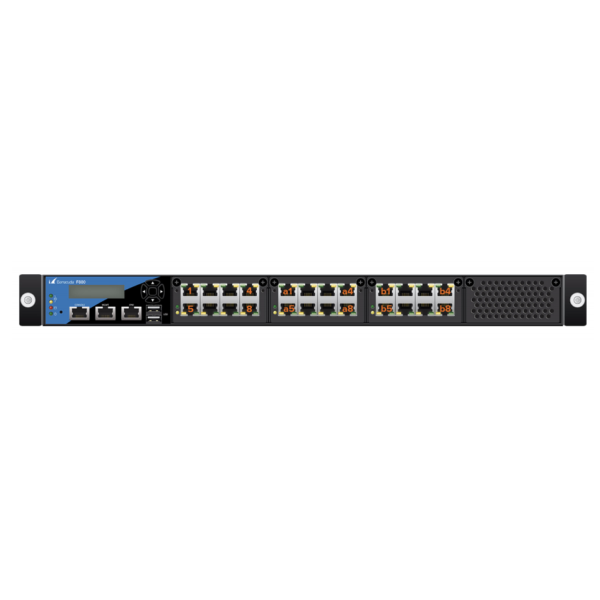
Barracuda CloudGen Firewall F800.CCC Revision D
A dense 24-port 1GbE security appliance for organizations that need resilient edge security, WAN aggregation, VPN services, segmentation and centralized operational control without wasting rack space. FourTeck helps UAE enterprises translate the hardware platform into a deployment design that matches real interface counts, security policy, resilience targets, application flows and future growth.
24-core Intel Xeon • 32GB RAM • SSD 430GB or higher • 1U rack mount • dual hot-swap AC power.
Useful for multi-zone LAN, server, WAN handoff, DMZ, management and service-network connections where copper Ethernet remains the operational standard.
A server-class multicore architecture designed to execute firewall, routing, VPN and security-service workloads on a general-purpose CPU platform.
32GB RAM and SSD capacity of 430GB or higher support system operation, configuration data, logging functions and local appliance services.
Redundant internal AC power supplies support power-path resilience when correctly connected to separate protected feeds or UPS-backed PDUs.
What the F800.CCC Revision D is designed to solve
The Barracuda CloudGen Firewall F800.CCC Revision D is best understood as a dense enterprise firewall platform for environments where the security boundary must connect many physical Ethernet segments while also delivering advanced routing, encrypted connectivity and centralized security control. The CCC designation matters because it identifies the all-copper front-end configuration: 24 one-gigabit RJ45 Ethernet interfaces. That port density can reduce dependence on intermediate switches for certain security zones, simplify direct attachment of WAN circuits or routed service networks, and give architects more freedom to separate traffic physically rather than relying exclusively on VLAN trunks.
In a Dubai headquarters, regional hub, co-location rack, industrial campus or multi-tenant enterprise network, a firewall at this level often performs several roles at once. It may terminate internet circuits, provide encrypted site-to-site connectivity, segment internal departments, control access to application tiers, exchange routes with core switching, steer traffic across SD-WAN paths and enforce security policy for inbound and outbound services. The important design question is therefore not simply whether the appliance has enough ports. It is whether the total architecture—interfaces, zones, routing tables, inspection services, VPN encryption, high availability, logging, subscriptions and operational processes—matches the organization’s risk and performance requirements.
FourTeck approaches the F800.CCC as a platform to be engineered, not a box to be dropped into a rack. We map the existing network, identify north-south and east-west flows, document addressing and VLAN requirements, determine which services must remain directly attached, review change windows, and build a migration path with rollback logic. For wider UAE infrastructure planning, organizations can also coordinate switching, wireless, servers and structured IT requirements through FourTeck UAE, while dedicated firewall design and deployment resources are available through Firewall Dubai.
Verified hardware specification profile
Barracuda’s published Revision D information identifies the F800.CCC as a 1U rack-mount appliance with 24 × 1GbE RJ45 Ethernet interfaces. The system platform uses an Intel Xeon processor with 24 cores, 32GB of RAM, and solid-state storage specified at 430GB or higher. The appliance also provides two USB 2.0 ports, one RJ45 serial console interface, a dedicated management port and IPMI connectivity. These details are important in procurement because the F800 family contains different front-panel variants; the CCF and CCE models use different copper and optical combinations, while this page is specifically for the CCC Revision D configuration.
Physical dimensions are approximately 440mm wide × 550mm deep × 44mm high, corresponding to a standard 1U appliance. Appliance weight is approximately 10.9kg. This makes rack depth, rail compatibility, front-to-rear airflow planning, PDU reach and service clearance practical considerations during site preparation. Even when the nominal rack-unit requirement is only 1U, engineers should confirm that adjacent equipment does not obstruct cooling paths and that the cabinet can support safe removal of either hot-swap power supply during maintenance.
Power, thermal and environmental planning
The Revision D appliance uses dual internal hot-swap AC power supplies with an input range of 100–240V at 50–60Hz. Barracuda lists maximum power draw at 550W and estimated power consumption at 322W. For a production deployment, the electrical design should not assume that redundancy is achieved merely because two power supplies are present. Each PSU should be connected to an independent protected power path wherever the facility design permits, ideally through separate UPS-backed PDUs or separate resilient feeds. This prevents one failed strip, circuit or UPS output from defeating the value of dual power supplies.
The documented operating temperature range is 0°C to 40°C with non-condensing operating humidity from 10% to 85%. In UAE facilities, this reinforces the need for controlled data-room cooling, clean airflow and environmental monitoring. A firewall should not be exposed to the ambient conditions of an unconditioned telecom enclosure simply because the cabinet is indoors. Dust, thermal cycling and persistent high inlet temperatures can erode reliability. Barracuda lists a system MTBF above seven years, but real-world service life depends strongly on power quality, cooling, maintenance and the operating environment.
Port architecture: why 24 × 1GbE RJ45 can be strategically useful
Port count is not just a convenience specification. On a firewall, physical interfaces can become security boundaries. The F800.CCC Revision D gives network architects 24 copper one-gigabit interfaces that can be allocated to separate WANs, internal routed segments, DMZs, service-provider handoffs, management networks, partner networks, test environments, backup links or other trust zones. In environments where direct attachment is preferred, this can reduce the need to carry every zone through a single large 802.1Q trunk and can make troubleshooting easier by giving engineers clear physical demarcation points.
A common deployment pattern is to reserve a subset of interfaces for ISP handoffs and HA-related connectivity, then use grouped interfaces for internal core connectivity and selected dedicated zones. Another pattern is to connect the firewall to redundant core switches with carefully engineered link aggregation or routed links, while dedicating individual copper ports to out-of-band management, service provider CPE, guest networks, voice security boundaries, OT demarcation or isolated server zones. The correct design depends on switch capabilities, spanning-tree design, routing protocol selection, failure domains and whether Layer 2 adjacency is actually required across the firewall boundary.
The CCC configuration is particularly attractive where the surrounding infrastructure is predominantly copper. However, buyers should distinguish port density from uplink speed. All 24 production interfaces on the CCC variant are 1GbE RJ45, so an architecture requiring native 10GbE optical firewall connectivity should be evaluated against a different F800 interface variant or a newer platform that better matches the target media and speed. It is poor design practice to select a firewall solely because it has many ports if the required north-south aggregate bandwidth will be constrained by interface speed or if the core network is already standardized on 10/25GbE optical links.
For campus consolidation projects, FourTeck can assess whether direct firewall attachment, VLAN trunking, routed access or a mixed model offers the cleanest design. Where the firewall project also requires server-side network changes, rack preparation or adjacent compute infrastructure, Server Dubai can be used as a complementary infrastructure resource.
Compute architecture, packet processing and realistic sizing
General-purpose multicore design
The published platform specifies a 24-core Intel Xeon CPU. For technical accuracy, it is better to describe this as a server-class multicore processing architecture rather than claim a proprietary packet-processing ASIC that Barracuda does not specify for this model. Firewall behavior therefore depends on software architecture, CPU scheduling, packet path, enabled services and the traffic mix. This distinction matters when comparing appliances from different vendors because synthetic headline throughput numbers may be produced under different conditions and are rarely interchangeable.
Security services change the load
A firewall forwarding large packets through simple stateful policies is solving a different problem from one decrypting VPN traffic, inspecting applications, applying SSL inspection, enforcing malware controls and logging detailed session metadata. CPU, memory and storage utilization must be considered across the entire feature set. During sizing, FourTeck separates base routing and firewall demand from inspection demand so the proposed configuration has operational headroom rather than merely passing an idealized laboratory threshold.
Sessions and packet rate matter
Two sites can each average 500Mbps and still place very different demands on a firewall. A backup replication flow might involve relatively few long-lived sessions, while a large user population browsing SaaS applications can generate many short sessions and DNS/TLS transactions. Small packets increase packet-per-second processing demand. Before purchase, collect interface utilization, flow records, session counts, VPN concurrency and peak-hour statistics rather than using only monthly ISP bandwidth.
Headroom is part of resilience
An HA pair should be sized so that one appliance can sustain the required production workload during maintenance or failure. Running each node near saturation under normal conditions leaves no safe failover margin. Headroom should also account for growth, software updates, new security services, remote-access peaks and emergency routing changes. The target is not maximum utilization; the target is predictable behavior when the network is under pressure.
Important note on published throughput figures
This product page intentionally does not publish a guessed firewall, VPN or threat-inspection throughput figure for the F800.CCC Revision D. Barracuda’s current Revision D hardware documentation clearly identifies the physical platform, interface configuration and environmental specifications, but current performance values should be validated against the exact Barracuda datasheet, software release, enabled subscriptions and test methodology relevant to the intended deployment. Presenting an unverified number could produce a materially incorrect design decision.
When FourTeck prepares a quotation, the engineering team can align the requested security profile with the currently supported software and licensing combination. This is particularly important for older or long-lived appliance families because firmware support, subscription availability and platform lifecycle can change independently of the physical hardware specification. The safest procurement process is to confirm the exact serial/model revision, software target and licensing entitlement before committing the appliance to a new production role.
Firewall policy and segmentation design
A strong F800.CCC deployment begins with security zones and traffic intent, not with copying a legacy rule base line by line. The migration process should identify which applications need to communicate, which source identities or networks initiate those sessions, which services are required, and where NAT, inspection or logging must occur. Broad rules such as “any to any” frequently accumulate in long-lived environments because they make migrations easier in the short term, but they reduce visibility and can preserve unnecessary trust relationships for years.
The 24-port format gives teams the option to combine logical and physical segmentation. Internet-facing services can be isolated from internal applications; user networks can be separated from server networks; management interfaces can be restricted to controlled administrative paths; partner or contractor connectivity can terminate in dedicated zones; and OT or facility networks can be placed behind explicit policy boundaries. Where VLANs are used, their trunks and allowed VLAN lists should be documented as carefully as firewall rules because an unintended trunk can bypass an otherwise well-designed trust model.
FourTeck normally recommends a rule-base cleanup before cutover: remove confirmed obsolete rules, replace service groups that have become too broad, document temporary exceptions, review NAT dependencies and attach business ownership to critical rules. This makes the new platform easier to operate after migration and gives security teams a stronger baseline for future audits.
Routing and WAN edge integration
A CloudGen Firewall can sit at the intersection of internet, MPLS, leased line, private cloud, public cloud and site-to-site VPN connectivity. The routing design should therefore consider not only which routes exist, but how they are learned, preferred and withdrawn during failure. Static routing can be appropriate for simple sites, while dynamic routing may be preferable for data centers and regional hubs where failover convergence and route scale are more demanding.
Before introducing a new firewall, document every upstream and downstream adjacency, next hop, route redistribution point and asymmetric path. Stateful security devices are sensitive to traffic taking different forward and return paths because the session state may exist on only one node or interface path. Multi-WAN designs should define how source NAT changes during failover, how inbound services remain reachable, and whether DNS or provider routing must be adjusted when circuits change.
The F800.CCC’s copper port count is well suited to environments with multiple physical service-provider handoffs, but the operational design should still remain simple. More interfaces do not automatically mean more resilience. True resilience comes from independent carriers, diverse last-mile paths, correct route tracking, tested failover logic, redundant power and a clear process for responding when one dependency is lost.
SD-WAN use cases for distributed UAE and regional networks
Barracuda positions SD-WAN capabilities as part of the CloudGen Firewall base feature set. In practical enterprise design, SD-WAN is valuable because it allows security and transport policy to be considered together. A branch or regional hub may have fiber internet, broadband, MPLS and cellular backup links, each with different cost, latency, jitter and failure characteristics. Rather than treating every circuit as an interchangeable default route, policy can steer traffic according to application needs and path quality.
For example, voice and interactive collaboration traffic may be directed toward a path with lower latency and jitter, while bulk backup replication can use a lower-cost link. Business-critical SaaS traffic may break out locally with appropriate security inspection rather than backhauling through a headquarters data center. Private application traffic can continue across encrypted tunnels between sites. The result is not merely “using two ISPs”; it is a controlled overlay in which route decisions, security policy and transport performance are coordinated.
The F800.CCC can be especially useful at a hub where multiple physical circuits and internal zones converge. However, a successful SD-WAN deployment depends on reliable monitoring, consistent naming, clear failover priorities and application-specific test cases. Engineers should measure baseline latency, loss and jitter on every circuit, then test how the network behaves during partial degradation—not just complete disconnection. Many production incidents occur when a circuit remains electrically up but becomes unusably slow or lossy. Path-quality logic is most valuable when it can react to that degraded state.
For UAE organizations extending IT operations across multiple offices, FourTeck can combine the firewall project with managed infrastructure and operational support planning through IT Services UAE. This helps align connectivity, monitoring, change control and support escalation around the firewall rather than treating each component as an isolated purchase.
VPN architecture: site-to-site, client access and encrypted overlays
Site-to-site connectivity
Enterprise deployments frequently use the firewall to connect branches, data centers, cloud networks and partner sites. The design should define encryption domains, routing behavior, tunnel monitoring, rekey parameters, failover paths and ownership of overlapping address space. Where many sites are involved, a standardized template reduces configuration drift and makes incident response more consistent.
Remote-access services
Remote access should be sized according to simultaneous users, authentication design, expected application mix and encryption load. A remote user connecting only to an internal portal is not equivalent to a user tunneling full desktop, voice, file transfer and video traffic. MFA integration, identity lifecycle and device posture controls should be considered as part of the access model.
Cloud and hybrid paths
Encrypted connectivity to public cloud environments should be designed with route symmetry, redundancy and cloud-side limits in mind. Two tunnels terminating on one local appliance do not create end-to-end resilience if both depend on one ISP or one power domain. The topology should identify each dependency explicitly and test failure at multiple layers.
Cryptographic governance
Long-lived VPN estates accumulate legacy algorithms and pre-shared keys. A migration is an opportunity to review cipher policy, certificate use, key rotation, peer definitions and administrative ownership. Crypto settings should align with organizational standards and interoperability requirements rather than simply reproducing the oldest settings that still connect.
High availability and failure-domain engineering
For a firewall protecting a headquarters or data-center edge, availability design should assume that components will fail. The objective is to decide which failures can occur without causing a business outage and then engineer every dependency around that objective. A pair of F800.CCC appliances can form part of a resilient firewall architecture, but the surrounding topology determines whether the service is truly highly available.
Start with power. Each appliance has dual hot-swap power supplies, so each PSU should ideally land on a different protected PDU or power feed. Then examine network connectivity. If both firewalls connect to one access switch, that switch remains a single point of failure. If both WAN circuits enter through the same provider CPE, the CPE may be the limiting failure domain. If both management interfaces depend on one switch with no out-of-band path, a fault can make remote diagnosis difficult even when traffic is still forwarding.
State synchronization, heartbeat links, interface monitoring and failover triggers must be planned carefully. Engineers should define which interface failures cause a node transition and which do not. An overly aggressive trigger can create unnecessary failovers; an incomplete trigger can leave traffic pinned to a node whose critical upstream path has failed. Failover testing should therefore include cable pulls, switch shutdowns, ISP failure, power-feed loss, process restart and planned software maintenance. Testing only the “failover button” does not validate the surrounding network.
Capacity planning for HA must also use the failure case as the design case. If two active resources collectively carry the normal load but one remaining unit cannot carry the full workload during an outage, the architecture is not resilient under peak demand. FourTeck designs headroom so planned maintenance can occur without emergency traffic reduction or disabling security services merely to keep the surviving node responsive.
Management, IPMI and operational access
The platform includes dedicated management connectivity and IPMI, which is valuable when designed as part of a secure management plane. Administrative access should not share the same trust assumptions as user traffic. Management IPs can be placed in a restricted network accessible only from approved administrator workstations, jump hosts or secure remote-management services. Authentication, logging and privileged-access practices should be consistent with the organization’s security policy.
IPMI can provide low-level hardware management capabilities that remain useful during operating-system or service issues, but out-of-band interfaces require strong protection because they can expose powerful administrative functions. They should be isolated from public access, restricted by network policy, configured with strong credentials and included in vulnerability-management processes. Where possible, management traffic should traverse a separate operational path so network engineers can reach the appliance even if the production routing plane is disrupted.
The appliance also provides an RJ45 serial console. A console path is valuable for commissioning and recovery, especially during initial installation or when IP configuration is unavailable. Data-center teams should document console access, cable type, terminal settings and physical authorization so the recovery method is usable during an incident rather than becoming an undocumented last resort.
Centralized control and multi-site governance
Barracuda CloudGen Firewall environments can be managed as stand-alone systems or through Firewall Control Center architectures. Central management becomes increasingly important as the number of sites grows because human consistency becomes the limiting factor. A centralized operating model can standardize objects, security policy, VPN templates, software deployment and change governance across distributed firewalls.
The operational benefit is not simply “one dashboard.” The larger benefit is policy inheritance and controlled variance. Security teams can define what must remain common across all locations while allowing site-specific addressing, WAN circuits or local services. This reduces configuration drift and makes audits more meaningful because the organization can distinguish approved variation from accidental divergence.
Licensing strategy should be chosen with the management model in mind. Barracuda documents both single licensing and enterprise or pool licensing concepts for supported deployments. A procurement review should confirm the correct entitlement for the exact hardware, software release, central management design and subscription requirements rather than assuming that all features are permanently included with the chassis purchase.
Licensing and subscriptions: what buyers should verify
Barracuda’s licensing documentation distinguishes the base firewall license from update and security subscriptions. The base functionality documented for CloudGen Firewall includes firewall capabilities, SD-WAN, VPN functionality, application-control reporting and SSL inspection on supported models. Barracuda also offers subscriptions for update services and additional security capabilities such as malware protection, advanced threat protection, advanced remote access and analytics-related functions. Exact availability and commercial packaging can change with software generation and product lifecycle, so the quotation must identify precisely which subscriptions are included.
For hardware appliances, Barracuda describes licensing as tied to the hardware identity and activation process. Administrators should plan outbound connectivity required for licensing and updates, particularly in highly restricted management networks. If the firewall must operate in a network where direct internet access from infrastructure devices is prohibited, the activation and update path should be designed deliberately rather than discovered during installation.
The phrase “licensed firewall” can be ambiguous in procurement. One supplier may quote only the appliance, another may include the base license but not the desired security subscription, and another may include a one-year service bundle. FourTeck recommends comparing quotations line by line: hardware part number, appliance revision, base entitlement, Energize Updates period, malware or threat subscriptions, remote-access features, central-management licensing, vendor support term, partner implementation, HA quantity and any transceivers or cables. This prevents a lower apparent price from becoming a higher total project cost after missing entitlements are added.
Support status is equally important for a mature appliance family. Before placing a new F800.CCC Revision D into production, confirm the targeted software release is supported on the hardware and verify applicable end-of-sale, end-of-support and subscription-renewal timelines. Lifecycle alignment should match the organization’s intended service period; a firewall is an infrastructure investment, and a technically functional chassis may still be a poor new purchase if its remaining supported lifecycle is shorter than the project horizon.
Security service planning beyond basic firewall rules
Application-aware control
Modern applications often share TCP 443, so port-based filtering alone provides limited context. Application-aware controls can help identify and govern traffic based on application characteristics rather than only destination port. Policy should still be aligned to business ownership. Blocking an application because it looks non-standard may disrupt approved workflows, while allowing broad application categories can create unnecessary exposure.
SSL inspection
Encrypted traffic inspection can improve visibility, but it must be deployed carefully. Performance load, certificate trust, privacy policy, application compatibility and bypass requirements all need attention. Sensitive categories and certificate-pinned applications may require exceptions. A phased rollout with telemetry is safer than enabling inspection globally during the migration window.
Threat and malware services
Advanced security subscriptions can add inspection depth, but procurement must verify entitlement and operational design. Security services are only useful when alerts are monitored and response workflows exist. Teams should define who reviews detections, how false positives are handled, what data is retained and how incidents are escalated to the broader security function.
Logging and analytics
Firewall logs support troubleshooting, audit, security analysis and capacity planning. Logging strategy should identify local retention, external collectors, SIEM integration, time synchronization and log volume. Recording everything without retention planning can be expensive; recording too little can make incident reconstruction impossible. The correct balance depends on regulation, risk and operational needs.
A practical sizing methodology for the F800.CCC
A reliable firewall sizing exercise uses measured demand and documented service assumptions. Start by collecting at least several weeks of bandwidth utilization from all existing WAN and major internal firewall interfaces. Record average and peak throughput in both directions. Then obtain session-count data, connection creation rates where available, packet-per-second indicators, VPN utilization and the percentage of traffic that will undergo deeper inspection. Identify seasonal peaks such as backups, month-end processing, software distribution, video events or remote-work surges.
Next, distinguish today’s traffic from the project horizon. A firewall commonly remains in service for several years, so include expected user growth, new branches, cloud migrations, increased SaaS usage, higher ISP speeds and security-service expansion. If a current internet circuit is 1Gbps but a 2Gbps or 5Gbps upgrade is already planned, the interface architecture of the CCC model may itself become the limiting factor. This is why the 24 × 1GbE specification must be considered in the same conversation as total processing capacity.
Then define the failure case. For an HA pair, calculate whether one appliance can carry peak production traffic with the required security services still enabled. Add headroom for software behavior, unexpected traffic shifts and future growth. Security teams should resist the temptation to size to an exact percentage of a published benchmark. Benchmark conditions may differ in packet size, protocol, number of rules, enabled inspection engines, logging and encryption. A reasonable design uses vendor data as one input, then applies real workload measurements and engineering margin.
Finally, validate the physical topology. Count interfaces by purpose: WAN, HA, core links, DMZ, management, service-provider edge, partner zone, guest, OT, lab and reserve capacity. Confirm which links need 1GbE copper and which need higher-speed optical media. Port count should include redundancy; a zone that connects to two separate switches consumes two physical links even though it represents one logical service. By documenting this before purchase, the organization can determine whether the CCC variant is the correct member of the F800 family rather than discovering an optical or speed mismatch during installation.
FourTeck can turn this sizing information into a bill of materials and migration plan that includes appliance quantity, HA design, licenses, subscriptions, cables, rack requirements, switch changes, implementation tasks, acceptance tests and support responsibilities.
Data-center edge deployment
At a data-center edge, the F800.CCC can separate internet-facing, partner and internal traffic while participating in the routing topology. The design should determine whether the firewall operates with Layer 3 routed links to the core, VLAN trunks, or a combination. Routed designs can reduce Layer 2 failure domains and make path ownership clearer, while VLAN trunks may be efficient where many smaller zones must traverse a limited number of switch links.
Inbound publishing requires careful NAT and service mapping. Every externally reachable application should have an owner, documented source requirements where possible, TLS strategy, logging plan and backend dependency map. If public services are moving from an old firewall, preserve DNS TTL considerations and upstream routing behavior in the migration plan. A technically correct NAT rule is not sufficient if the upstream provider still routes the public block toward the previous device.
Data-center deployments should also plan for maintenance. Engineers need a safe procedure for software upgrades, HA failover, PSU replacement and interface troubleshooting. Management and console access should remain available even when production paths are being changed.
Headquarters and campus edge deployment
At a headquarters, the firewall often faces a more diverse mix of users, Wi-Fi, voice, servers, guest networks, internet circuits and remote-access sessions. The 24 copper ports can provide flexibility for directly attached service segments, but segmentation should remain intentional. Large campuses are generally easier to scale when the switching layer handles local VLAN access and the firewall enforces security boundaries at selected routed aggregation points.
Internet breakout policy should account for SaaS traffic, content controls, DNS architecture and cloud identity dependencies. Remote-access traffic should be tested against business applications rather than only a basic ping. If voice or video traffic traverses VPN or multiple WAN links, quality testing should include latency, jitter and packet loss during failover.
Campus changes can affect many users simultaneously, so cutover planning should include a communications plan, technical bridge, rollback checkpoint and representative application testing. FourTeck can coordinate these dependencies with the customer’s LAN, server, ISP and application teams to reduce the chance that a non-firewall dependency delays the project.
Branch aggregation, hub-and-spoke and regional connectivity
A regional hub firewall often terminates many tunnels and becomes a routing concentration point. This changes the sizing emphasis. Internet throughput may be modest while encrypted branch traffic, route count and session aggregation are significant. If the hub also provides centralized internet breakout for branches, the firewall must process both inter-site traffic and consolidated north-south internet traffic. During failure of a second regional hub, it may need to absorb an even larger load.
Tunnel design should consider scale and operational consistency. Naming conventions, address objects, shared-key or certificate policies, monitoring, routing metrics and failover behavior should be standardized. A branch that has two WAN links may build redundant tunnels to the hub, but the route policy must still determine which path is active and what happens when quality degrades. An overlay that technically remains up while the underlay suffers high packet loss can be worse than a clean failure because users experience severe degradation without triggering an obvious outage.
For organizations with offices outside the UAE, central policy can reduce operational inconsistency, but regional connectivity design must consider local ISP quality, latency and regulatory requirements. It may be more efficient for some sites to use local internet breakout while maintaining secure encrypted paths to shared services. The firewall architecture should therefore separate security intent from transport assumptions: users should receive consistent security policy even when their optimal network path differs by country.
FourTeck’s broader regional capability can be referenced through FourTeck Global when a deployment spans multiple countries. The objective is to keep technical standards, documentation and support responsibilities consistent even when circuits, carriers and local site conditions differ.
Migration from an existing firewall: engineering sequence
Discovery
Collect interface maps, routing tables, VPN definitions, NAT, security rules, service objects, certificates, authentication dependencies, monitoring integrations and ISP details. Capture live traffic because configuration files often contain obsolete objects that are no longer used.
Design
Create the target zone model, interface allocation, VLAN plan, IP addressing, routing behavior, HA topology and management design. Decide which legacy rules will migrate, which will be consolidated, and which require application-owner confirmation.
Build
Stage the appliance, apply the supported software version, activate licensing, configure management access, create routing and security policy, prepare VPNs, integrate logging and test administrative recovery paths before production cutover.
Validate
Test representative user applications, published services, VPN peers, routing failover, DNS, authentication, management tools and monitoring. Validation should be application-based, not limited to ICMP reachability.
Cutover
Move links or routes according to a controlled runbook, record checkpoints and retain a practical rollback path. The team should know exactly which observation triggers rollback instead of debating the threshold during the maintenance window.
Handover
Deliver updated diagrams, addressing, rule ownership, license details, backup procedures, support contacts, software baseline and change notes. Operational documentation is part of the production system, not an optional project artifact.
UAE deployment considerations: racks, power, cooling and carrier handoffs
Firewall installations in Dubai and the wider UAE range from Tier-rated data centers to office server rooms and industrial telecom spaces. The same appliance can experience very different reliability depending on the facility. Site readiness should therefore verify rack depth, rail mounting, vertical clearance, front and rear service access, airflow direction, PDU outlet types, UPS capacity, grounding and ambient temperature. Because the F800 Revision D is approximately 550mm deep, cabinet depth should be checked rather than assumed from the 1U height.
Power design deserves particular attention. The appliance supports 100–240V AC and includes dual hot-swap supplies. In a properly resilient installation, each PSU should connect to an independent protected path. If the rack has A and B PDUs, distribute the two supplies accordingly. If only one UPS exists, the dual PSU design still protects against an individual power-supply failure but not against UPS failure. Document the actual failure coverage so stakeholders understand what “redundant power” means in the specific room.
Cooling in UAE environments must be assessed at the appliance inlet, not from the room’s thermostat alone. Dense racks can create hot spots, particularly when cabling obstructs exhaust paths or when mixed airflow directions recirculate heat. Barracuda’s documented maximum operating temperature is 40°C, but good engineering practice is to maintain substantially lower stable inlet temperatures rather than operate near the ceiling. Environmental monitoring and preventive cleaning can improve long-term reliability where dust exposure is a concern.
Carrier handoffs should also be identified precisely. Some providers deliver copper Ethernet directly, while others terminate optical circuits on provider equipment and present copper to the customer firewall. Because the CCC model is a copper 1GbE configuration, confirm the physical media, negotiated speed, duplex and handoff ownership for every WAN. If native optical or multi-gigabit connectivity is required directly on the firewall, another interface configuration may be more appropriate.
Finally, plan access for vendor and support personnel. Data-center entry permissions, remote-hands procedures, console availability and labeling can determine how quickly an incident is resolved. A technically excellent firewall configuration can still suffer long outages if the team cannot identify the correct cable, power feed or management path during an emergency.
Monitoring and observability
A firewall should expose enough telemetry to answer three categories of questions: is the platform healthy, is the network path healthy, and is the security policy behaving as intended? Platform monitoring includes CPU, memory, storage, interface state, environmental status and HA condition. Network monitoring includes bandwidth, errors, drops, latency, routing changes and tunnel state. Security monitoring includes blocked sessions, threat events, authentication failures and policy hits.
Alert thresholds should be actionable. If every transient link event generates an urgent notification, engineers begin ignoring alerts. If thresholds are too broad, the first sign of trouble may be a user complaint. Baselines help distinguish normal daily peaks from genuine anomalies. For WANs, monitoring should include performance quality rather than only interface up/down status.
Time synchronization is essential for correlation across firewall, switches, servers, identity platforms and SIEM systems. During an incident, a five-minute clock difference between systems can create substantial confusion. NTP sources, timezone configuration and log forwarding should therefore be part of the commissioning checklist.
Backup, recovery and configuration governance
Firewall configuration is business-critical data. Backups should be created on a defined schedule, stored outside the appliance and protected from unauthorized modification. A backup strategy is only proven when restoration has been understood and, where practical, tested. Teams should also keep copies before significant upgrades or rule-base changes.
Configuration governance benefits from change tickets that record purpose, requestor, implementation steps, validation and rollback. This is especially important for NAT and routing changes because a small syntax change can affect a large portion of the network. Emergency changes should still be documented afterward so the running configuration does not drift from the design record.
For appliance recovery, retain installation media or vendor-supported recovery resources and document access to serial console and management networks. Recovery planning should also include licensing dependencies and vendor support contacts so a replacement or rebuilt unit can be returned to service efficiently.
Security policy design for zero-trust-style segmentation
A traditional perimeter firewall model assumes that traffic becomes trusted once it is inside the corporate network. Modern architectures increasingly reject that assumption. The F800.CCC’s interface density can support stronger internal segmentation by creating explicit boundaries between users, servers, management systems, development environments, guest networks, partner connectivity and sensitive application tiers. The objective is not to insert a firewall between every device; it is to place policy enforcement at meaningful trust boundaries where compromise should not automatically spread.
A good segmentation policy begins with application dependency mapping. If an application server requires database access, define the exact destination and service rather than allowing the entire application subnet to reach the entire database subnet. If administrators require SSH or RDP, route that access through controlled jump hosts and restrict source networks. If monitoring systems need SNMP, syslog or API access, create explicit rules for those flows. This turns the rule base into a model of intended communication rather than an accumulation of convenience exceptions.
Physical ports can be useful for high-value zones because they make the boundary visible and reduce dependence on trunk configuration. However, physical separation does not remove the need for logical controls. Each interface still needs an IP plan, zone assignment, routing policy, access rules, logging and monitoring. For VLAN-based zones, the switching configuration becomes part of the security architecture and should be reviewed during firewall changes.
Segmentation projects should be phased. Start with visibility, then enforce low-risk boundaries, monitor denied traffic and work with application owners before tightening critical paths. Attempting to move directly from a flat network to strict least privilege in one maintenance window can create avoidable outages. A controlled migration improves both security and confidence in the final policy.
Lifecycle, firmware and change-management considerations
The F800.CCC Revision D is a specific hardware generation, and Barracuda documentation indicates software compatibility requirements for the Revision D family. Before deployment, confirm the currently supported firmware branch for the exact appliance and the vendor’s lifecycle status. Do not assume that a version installed on an existing unit is the best baseline for a new deployment. The supported target may depend on licensing, migration path and operational feature requirements.
Upgrade planning should include configuration backups, release-note review, known-issue review, HA sequencing, application validation and a rollback decision. Security appliances frequently sit in paths that affect almost every business service, so even a routine maintenance task should have a change plan proportional to that risk. When possible, upgrades should be tested on a non-production platform or validated first in a controlled maintenance window with technical stakeholders available.
The appliance documentation also lists known issues for specific early firmware behavior on Revision D. This reinforces the broader principle that hardware and software cannot be assessed separately. A chassis may be electrically healthy while a particular release has an issue that affects recovery, console behavior or management workflow. Operations teams should therefore maintain both a hardware inventory and a software/firmware inventory and tie each change to the specific appliance revision.
Before acquisition—especially for replacement, refurbished, spare or channel-stock units—verify serial eligibility, warranty or support status, license transfer conditions and the ability to obtain the required software. FourTeck can help validate these commercial and technical dependencies as part of the procurement process so the appliance arrives ready for the intended operational model rather than becoming an unsupported shelf asset.
How to compare the F800.CCC with alternative firewall choices
| Decision factor | F800.CCC strength | When to evaluate another platform |
|---|---|---|
| Copper interface density | 24 × 1GbE RJ45 provides many direct copper security-zone connections. | If the design requires fewer ports but faster 10/25GbE uplinks, a different interface profile may fit better. |
| Rack space | 1U form factor provides high port density in limited rack height. | If deeper chassis dimensions or thermal characteristics conflict with the cabinet, verify alternatives. |
| Power resilience | Dual hot-swap internal AC supplies support redundant power design. | If DC power or a specialized telco power environment is required, confirm another supported model. |
| Hardware generation | Mature appliance architecture can fit existing Barracuda estates and operational skills. | For a new long-term deployment, compare remaining lifecycle, support horizon and newer interface speeds. |
| Central operations | Fits CloudGen Firewall management and licensing concepts for distributed environments. | If the organization is standardizing on another security ecosystem, evaluate migration cost and operational consistency. |
Who should consider this model?
Organizations with an established Barracuda CloudGen environment, a requirement for many copper 1GbE security interfaces, a 1U rack constraint, multi-WAN aggregation or branch-hub security responsibilities may find the F800.CCC Revision D a practical fit—subject to lifecycle, licensing and current performance validation.
Who should be cautious?
New deployments expecting multi-gigabit or 10GbE native data paths, rapid long-term bandwidth growth, or a support horizon beyond the mature platform’s lifecycle should compare current Barracuda alternatives before standardizing on the F800.CCC solely because of its port count.
What must be confirmed before ordering?
Confirm exact Revision D hardware, power supplies, rail kit, support status, software compatibility, base licensing, security subscriptions, HA quantity, throughput requirements, VPN load, physical media, rack depth and implementation scope. These items directly affect project success.
FourTeck deployment scope for Barracuda CloudGen Firewall projects
A firewall purchase becomes operationally valuable only after the design, migration and handover are complete. FourTeck can support the F800.CCC Revision D across the full project lifecycle: discovery of the existing environment, hardware and license validation, high-level and low-level design, staging, software preparation, management-plane hardening, interface and VLAN creation, routing, NAT, security policy, VPN migration, high availability, logging integration, cutover, testing and documentation.
During discovery, we focus on dependencies that are commonly missed: public IP ownership, ISP router settings, application source whitelists, third-party VPN peers, DNS records, certificate files, authentication servers, monitoring source addresses, switch trunks and out-of-band access. These details often determine whether a cutover is smooth. The new firewall can be fully configured yet still fail to deliver a service if an upstream ACL, stale ARP entry, DNS TTL or partner whitelist remains tied to the old environment.
During implementation, testing is performed by service category. Internet access, published applications, site-to-site VPNs, remote access, DNS, email flow, identity services, monitoring, logging, management access and failover should each have an acceptance step. This produces a clear record of what was validated and makes troubleshooting faster because the team can isolate a problem to one dependency instead of treating the whole migration as a black box.
After cutover, the project should leave the customer with a maintainable system: current diagrams, interface descriptions, routing summary, critical NAT mapping, policy ownership, backup procedure, software baseline, license inventory and support escalation route. Good documentation reduces operational risk every time the network changes after the original implementation team has moved on.
Frequently asked technical questions
Does the F800.CCC Revision D have 10GbE ports?
The CCC Revision D interface profile is specified with 24 × 1GbE RJ45 Ethernet ports. Other F800 Revision D variants use different interface combinations, including optical options. If your core or WAN requires native 10GbE connectivity, confirm the appropriate variant or a different appliance.
How much RAM and storage does it have?
Barracuda documents 32GB of RAM and SSD mass storage with a capacity of 430GB or higher for the Revision D platform. Hardware components can change within vendor manufacturing tolerances, so exact delivered configuration should be confirmed against the unit and order documentation.
Is the power supply redundant?
The appliance uses dual hot-swap internal AC power supplies. To obtain meaningful power resilience, connect them to independent protected power paths where possible. Two PSUs attached to the same unprotected power strip do not provide full power-path redundancy.
Can it be used for SD-WAN and VPN?
CloudGen Firewall supports SD-WAN and VPN functions as part of its platform capabilities. Actual design and capacity must be validated for the intended software, licensing, tunnel count, traffic volume, encryption profile and high-availability requirement.
Can FourTeck migrate from another firewall vendor?
Yes. Migration can include discovery, rule and NAT translation, route redesign, VPN recreation, HA build, testing and cutover. Cross-vendor migrations should be treated as policy redesign exercises rather than literal one-to-one syntax conversions because object models and security features differ.
Should I buy a single appliance or an HA pair?
For business-critical edges, an HA pair is generally preferable because it supports maintenance and hardware-failure resilience. The final choice should reflect downtime tolerance, upstream network redundancy, support model and budget. Buying two appliances without redundant switches, power and WAN paths does not eliminate all single points of failure.
Detailed procurement and quotation guidance
A technically accurate quotation should begin with the exact model string: Barracuda CloudGen Firewall F800.CCC Revision D. The revision and CCC suffix are important because interface layout changes between sub-models and revisions. If the unit is being sourced as replacement stock, spare inventory or a mature-platform expansion, request photographic or serial confirmation where appropriate so the delivered appliance matches the intended I/O layout.
The bill of materials should then state quantity and HA requirement. A high-availability deployment usually requires two compatible appliances with appropriate licensing and support. Confirm that both power supplies are present for each unit and that rails or rack brackets are included as required. Verify patch cable categories for 1GbE copper connections and document whether ISP handoffs need media converters or provider CPE because the CCC front panel does not provide native SFP/SFP+ data interfaces.
Licenses and subscriptions should appear as separate, readable line items. Clarify the base hardware entitlement, update subscription period, security-service subscriptions, remote-access requirements, central management or pool licensing, vendor support duration and any renewal assumptions. If the organization already has a Barracuda enterprise agreement or Firewall Control Center, confirm whether the new appliance can use existing entitlements or requires additional capacity.
Implementation scope should identify responsibilities for staging, migration, switch changes, ISP coordination, testing and after-hours cutover. If third-party VPN partners must modify peer settings, assign those actions early because external change schedules can become the critical path. Likewise, public DNS changes, application whitelists and cloud security groups may need owners outside the network team.
The final quotation should include acceptance criteria. Rather than defining success as “firewall installed,” list required services: internet, internal routing, published applications, VPN peers, remote access, authentication, logging, monitoring, HA failover and management access. Clear acceptance criteria protect both the customer and implementation team by defining what must be proven before the change is closed.
Operational hardening checklist after deployment
Why technical validation matters for Revision D procurement
Network-security hardware can remain physically operational for many years, which creates a secondary market and long-lived installed base. That makes precise revision identification especially important. A product family name alone may hide differences in interface layout, software requirements, power components or supported options. The F800.CCC Revision D should therefore be procured and documented by its exact revision, not simply as “F800.”
For an existing Barracuda customer replacing a failed or aging unit, compatibility with the current configuration and license model can be more important than comparing raw hardware specifications. For a new customer, remaining support lifecycle and availability of current subscriptions may be more important than acquisition cost. These are different buying scenarios and should not be evaluated with the same checklist.
FourTeck’s role is to connect the commercial quote to the operational requirement. We can review whether the appliance fits the required interface media, whether 1GbE ports align with the network core, whether two units are needed for HA, whether power and rack infrastructure are ready, whether the selected software and licensing are current, and whether the project includes enough implementation effort for safe migration.
This approach reduces the risk of buying a firewall that appears correct by model family but is wrong for the actual network. For enterprise security projects, exact fit is more important than nominal feature count.
Decision recap: is the Barracuda F800.CCC Revision D right for your network?
Strong fit when
You need a mature Barracuda CloudGen hardware platform with a dense set of copper one-gigabit interfaces, a 1U rack footprint, redundant hot-swap AC power, server-class multicore compute and integration with an existing Barracuda operational model. It can be especially suitable for WAN hubs, segmented headquarters networks and environments with many direct copper service connections.
Re-evaluate when
Your design requires native 10GbE or faster production interfaces, a long new lifecycle beyond the platform’s remaining support horizon, very high inspection bandwidth or a different security ecosystem. In these cases, compare current alternatives instead of selecting the F800.CCC only because it is available or familiar.
Validate before purchase
Confirm exact hardware revision, software support, licensing, subscriptions, HA quantity, measured traffic profile, VPN demand, security inspection features, interface media, rack depth, power feeds, carrier handoffs and support term. These factors determine whether the appliance is a sound production choice.
Quotation input checklist for FourTeck UAE
For a precise commercial and technical proposal, provide the following information. Even partial data is useful; FourTeck can help identify gaps during discovery.
Plan the F800.CCC Revision D as an engineered security system, not just a hardware purchase
The Barracuda CloudGen Firewall F800.CCC Revision D offers a distinctive combination of 24 × 1GbE copper interfaces, a 24-core Intel Xeon platform, 32GB of memory, SSD storage, 1U rack density and dual hot-swap AC power. Those characteristics can make it a strong fit for established Barracuda environments and copper-dense edge designs, provided the appliance’s lifecycle, software support, licensing and real workload capacity align with the project.
FourTeck UAE can review the existing topology, verify the proposed bill of materials, design HA and interface allocation, validate licensing requirements and prepare a migration plan with test and rollback steps. The result is a firewall deployment that is easier to support, easier to audit and better aligned to the business services it protects.
Send your current firewall model, WAN speeds, HA requirement, number of VPN sites/users and required subscription term.
FourTeck can then validate whether this exact F800.CCC Revision D is suitable or recommend a better-fit alternative.

Reviews
There are no reviews yet.