
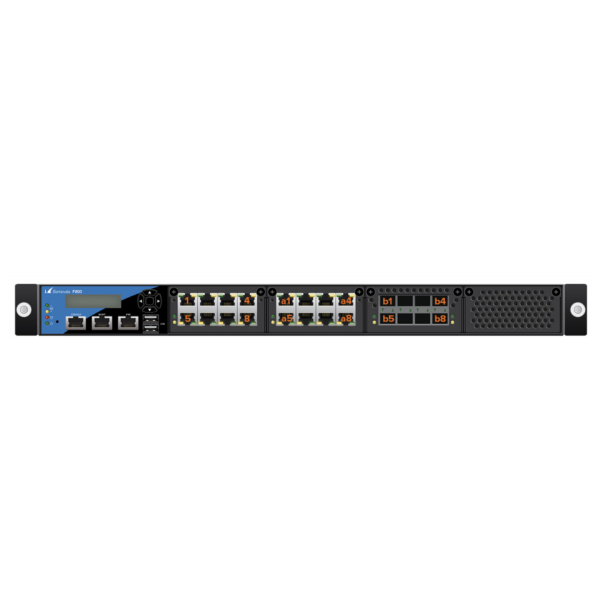
Barracuda CloudGen Firewall F800.CCF Revision D
The Barracuda CloudGen Firewall F800.CCF Revision D is built for enterprises that need a robust physical security gateway at headquarters, data-center edges, regional aggregation points, and large branch hubs. Its CCF port configuration combines sixteen 1 Gigabit Ethernet copper interfaces with eight 1 Gigabit SFP fiber interfaces in a compact 1U platform, giving network architects the flexibility to connect carrier handoffs, switching fabrics, server zones, DMZ segments, management networks, and redundant WAN paths without depending on external media converters for every uplink.
For organizations in Dubai, Abu Dhabi, Sharjah, and across the UAE, FourTeck positions the F800.CCF as an enterprise security platform rather than simply a perimeter appliance. Correct deployment begins with traffic modeling, interface planning, high-availability design, VPN and SD-WAN requirements, inspection policy, logging strategy, and a clear firmware and licensing plan. The hardware foundation—24-core Intel Xeon CPU, 32 GB RAM, SSD storage, dual hot-swap power, dedicated MGMT and IPMI connectivity, and field-replaceable network-module options—supports this type of disciplined architecture.
What is the Barracuda F800.CCF Revision D?
The Barracuda F800.CCF Revision D is a rack-mounted CloudGen Firewall appliance designed for high-demand enterprise network-security roles. The “F800” identifies the appliance class, “Revision D” identifies the hardware revision, and “CCF” identifies the interface configuration. In this CCF configuration, the platform exposes sixteen fixed 1GbE copper RJ45 data interfaces and eight fixed 1GbE optical SFP data interfaces. This is materially different from the F800.CCC model, which emphasizes copper density, and the F800.CCE model, which combines copper with native 10GbE SFP+ ports. That distinction matters during procurement because the model suffix directly affects how the unit fits into an existing switching and carrier topology.
At a practical level, the F800.CCF is well suited to organizations that have a mixed copper-and-fiber access environment. Examples include a Dubai headquarters with multiple ISP circuits delivered over copper Ethernet, a data-center cross-connect delivered through 1GbE optics, dedicated DMZ switches on fiber, a private MPLS or Ethernet service, a management network, and multiple internal security zones. Rather than forcing a one-media design, the appliance provides enough native interfaces to build separation directly at the firewall while preserving the option to aggregate VLANs over trunks when that is operationally preferable.
The hardware platform is only one layer of the solution. Barracuda CloudGen Firewall is intended to enforce stateful policy, network segmentation, NAT, VPN connectivity, application-aware controls, intrusion-prevention functions, secure branch connectivity, and centralized administration according to the organization’s selected subscription and deployment architecture. FourTeck therefore treats appliance selection as part of a complete security engineering exercise. UAE customers can engage FourTeck Firewall Dubai for sizing, migration planning, high availability, interface mapping, policy implementation, and post-deployment support rather than purchasing capacity based only on a headline throughput value.
F800.CCF Revision D hardware specifications
Interface configuration
The CCF model provides 16 x 1GbE RJ45 Ethernet data ports plus 8 x 1GbE SFP data ports. Separate management connectivity includes a dedicated 10/100/1000 RJ45 MGMT port and a dedicated 10/100/1000 RJ45 IPMI port. This separation lets operators design out-of-band access independently from production forwarding interfaces.
Processor and memory
Revision D uses a 24-core Intel Xeon processor and 32 GB of RAM. For firewall engineering, these resources provide the compute and memory foundation required for concurrent policy processing, VPN duties, inspection services, routing functions, management processes, logging activity, and operational headroom within the supported software environment.
Storage and recovery
The published hardware profile specifies SSD storage of 430 GB or higher. The appliance package includes a USB flash drive for recovery and installation. Storage should be considered in context with logging architecture: high-volume organizations normally forward security and event records to centralized systems instead of treating appliance-local storage as a long-term enterprise archive.
Rack and serviceability
The chassis is a 1U rack-mount system measuring approximately 440 x 550 x 44 mm and weighing about 10.9 kg. Barracuda documentation lists the rail kit and L-shaped rack-mount brackets in the package. Dual hot-swap power supplies improve serviceability and support redundant feed design in properly engineered racks.
Environmental envelope
The specified operating range is 0°C to 40°C with 10% to 85% non-condensing humidity. For UAE installations, that makes conditioned data-center or communications-room operation essential. Rack inlet temperature, air recirculation, UPS loading, power-feed redundancy, and HVAC alarms should be treated as part of firewall availability planning.
Power profile
The appliance uses internal AC power supplies with 100–240 V input, 50–60 Hz auto-sensing operation. Published figures include a 550 W maximum power rating and approximately 322 W estimated consumption. Dual-feed deployments should map each PSU to separate protected PDUs or UPS-backed circuits where the facility design allows it.
Why the CCF port mix matters in real enterprise networks
Port count by itself does not define a successful firewall deployment. What matters is whether the physical interface mix matches the handoffs and failure domains in the target network. Sixteen copper Gigabit interfaces provide considerable flexibility for local switching links, ISP CPE devices, management-adjacent services, dedicated server segments, temporary migration links, and point-to-point connections where fiber is unnecessary. Eight SFP ports add direct optical connectivity for distribution switches, long in-building runs, data-center cross-connects, protected uplinks, and environments where electrical isolation is desirable.
A common mistake is to consume physical ports without a zoning plan. Before installation, FourTeck maps each interface to a role: Internet uplink, secondary ISP, private WAN, HA synchronization or control design as supported by the intended topology, trusted core, server zone, DMZ, guest services, voice infrastructure, backup network, management path, monitoring path, or spare capacity. The goal is not to use every interface immediately. The goal is to preserve clean failure boundaries, make troubleshooting predictable, and maintain room for migration and expansion.
The SFP interfaces also require deliberate transceiver selection. Optical type, wavelength, connector, fiber grade, distance, switch-side compatibility, and the transceiver support matrix should be validated before shipment. A 1GbE SFP cage is not automatically equivalent to a 10GbE SFP+ interface, and a CCF appliance should not be specified when the project fundamentally requires several native 10GbE firewall uplinks unless an approved expansion-module design is part of the bill of materials. This is one reason the exact F800 suffix must be included in quotations and technical submittals.
Field-replaceable network module options
ET074 — 8 x 1GbE SFP
The ET074 option adds eight 1GbE fiber SFP interfaces using an Intel I350-AM4 network controller. For an F800.CCF deployment, this can extend optical port density when more fiber-connected security zones, access switches, carrier handoffs, or aggregation links are required. Module compatibility should be confirmed against the exact F800 Revision D chassis and supported Barracuda module combinations before ordering.
ET075 — 8 x 1GbE RJ45
The ET075 option adds eight copper 1GbE RJ45 ports, also based on the Intel I350-AM4 family. This is useful when the firewall must terminate additional local Ethernet segments or multiple service-provider devices and the native sixteen copper interfaces do not provide enough physical separation for the planned topology.
ET076 — 4 x 10GbE SFP+
The ET076 option adds four 10GbE SFP+ interfaces using an Intel X710 controller. This is the most important expansion path when a CCF deployment needs higher-speed optical connectivity to core switching or selected data-center networks. 10GbE design still requires workload sizing because faster interfaces do not mean every enabled inspection service can sustain line rate under every traffic mix.
Expansion modules should be designed into the solution from the start rather than treated as an afterthought. Module selection can influence switch architecture, rack cabling, optics procurement, HA symmetry, spare strategy, and future migration. In an HA pair, both firewalls should normally be engineered with matching hardware and interface capabilities so that failover does not introduce an unexpected physical or logical constraint. FourTeck can include approved module selection, compatible optics, patching, and port-plan documentation in the project bill of materials.
Dedicated MGMT and IPMI interfaces
The appliance includes separate RJ45 management interfaces for MGMT and IPMI. In enterprise operations, dedicated management is not merely convenient; it can materially improve recoverability. A firewall administrator should be able to reach the appliance through a controlled management path even when a production VLAN, routing policy, or upstream switch configuration is being changed.
IPMI provides an out-of-band hardware-management path that can be incorporated into a restricted management network. Because out-of-band interfaces are powerful, they should never be casually connected to user-access networks or exposed to the public Internet. Segregated management switching, ACLs, jump hosts, MFA-protected administrative workflows, logging, and credential governance should be used according to the organization’s security policy.
Console, display and onsite operations
F800 Revision D includes an RJ45 serial console and a front-panel display. Barracuda publishes serial settings of 19200 baud, 8 data bits, one stop bit, no parity, and no handshake. The front display can provide basic appliance, network, time, uptime, serial, shutdown, reboot, management-IP, and recovery-related functions.
These physical administration capabilities are valuable during initial deployment and recovery, particularly when production routing is not yet operational. FourTeck installation plans normally include console-access readiness, management IP assignments, rack labeling, redundant power checks, interface labels, and a documented rollback path before production cutover begins.
Firewall architecture and policy engineering
Enterprise firewall performance is inseparable from policy quality. A powerful appliance with poorly organized rules can become difficult to audit, troubleshoot, and change. FourTeck structures CloudGen Firewall policy around business zones and service intent rather than creating an ever-growing sequence of ad hoc source-and-destination exceptions. Typical zones can include Internet edge, corporate users, server networks, public services, partner access, OT or building systems, guest networks, management infrastructure, backup systems, voice services, and cloud-connected segments.
Rules are then built with explicit source, destination, service, application or inspection requirements, logging policy, NAT behavior, and ownership. The organization should know why each rule exists, who requested it, what dependency it supports, and when it can be reviewed. This approach reduces rule shadowing, broad “any-any” exceptions, undocumented temporary access, and accidental exposure during later network changes. It also makes migration from an existing firewall more controlled because old rules can be classified, rationalized, and tested rather than copied blindly.
Network Address Translation deserves the same discipline. Source NAT for outbound users, static or destination NAT for published services, policy-based NAT, overlapping networks, partner VPN translations, and multi-ISP behavior all need to be mapped before cutover. The firewall should become a deterministic policy enforcement point, not a place where operators discover undocumented dependencies during an outage window.
For UAE enterprises with multiple offices, data centers, and cloud environments, consistent naming conventions are especially useful. Object names should identify site, function, subnet, and environment in a predictable format. Service groups should be purpose-driven. Administrative comments should explain exceptions. Change control should capture before-and-after state. These practices are not specific to one firewall brand, but they substantially improve the operational value of a platform such as the F800.CCF.
Sizing the F800.CCF correctly
Sizing should not be based on Internet circuit speed alone. A 1 Gbps WAN does not necessarily mean a 1 Gbps firewall requirement, and a 10 Gbps uplink does not automatically mean the firewall must inspect 10 Gbps continuously. Engineers need to determine which traffic actually crosses the firewall, which services are enabled, how much east-west segmentation is enforced, the number of VPN tunnels and remote users, expected new sessions per second, concurrent sessions, encrypted-traffic characteristics, application mix, packet-size distribution, branch aggregation requirements, failover headroom, and the growth expected over the intended service life.
Security inspection changes the performance envelope. Stateful packet forwarding is less computationally demanding than workloads that combine intrusion prevention, application controls, malware defenses, SSL/TLS inspection, logging, and VPN encryption. Any published performance figure should therefore be read together with its test methodology and enabled feature set. FourTeck avoids promising production throughput from a single marketing number without understanding the customer’s inspection stack.
Internal segmentation can also consume more capacity than Internet access. A headquarters may have only a moderate Internet circuit while pushing large volumes between users, data-center services, backup systems, partner zones, and private WANs through the firewall. If the F800.CCF becomes the segmentation gateway for many VLANs, aggregate inspected traffic may exceed external WAN bandwidth by a wide margin. This is one reason interface topology and routing design are considered alongside security-service sizing.
High availability introduces another rule: each node must be capable of carrying the required production load after a failover. A pair should not be sized on the assumption that both members are always available to share essential capacity unless the validated architecture explicitly supports that operating model. Maintenance, software upgrades, hardware events, circuit changes, and data-center incidents all make single-node survivability a core requirement.
High-availability design for UAE enterprise environments
Symmetric hardware
HA pairs should be specified with matching model, revision, expansion modules, optics, firmware path, and licensing assumptions. Physical asymmetry can convert a simple failover into an interface-capacity or cabling problem.
Independent power
Dual hot-swap PSUs are most valuable when connected to independent protected power paths. Where facility design permits, each firewall and each PSU feed should be mapped to avoid a single PDU or UPS event taking down the full security stack.
Switch diversity
Redundant firewalls should not both depend on one access switch if the objective is resilient service. Core, WAN, and management connectivity should be reviewed for device-level and path-level diversity.
Failover testing
A design is not complete until failover behavior is tested. Planned tests should cover node failure, power loss, interface loss, upstream path loss where relevant, administrative failover, recovery, and application impact.
High availability must also account for routing. Static routes are simple but may not react to every upstream condition. Dynamic routing can improve convergence but requires careful metric, filtering, authentication, and neighbor design. Multi-ISP environments may need health checks and policy logic so traffic exits through an appropriate path and inbound services remain reachable when a circuit fails. VPN peers may need secondary endpoints. Public DNS may be part of the failover architecture for published applications. Each of these dependencies should be tested as a complete service chain rather than treating firewall state as the only indicator of availability.
UAE environmental and rack planning
The F800 Revision D operating-temperature specification tops out at 40°C. That is not a problem in a correctly engineered UAE data center, but it makes facility discipline essential. Firewalls should be installed in continuously conditioned environments with monitored rack inlet temperature, sensible cable management, unobstructed airflow, and capacity planning for heat load. A communications room that becomes warm during overnight HVAC setbacks can push infrastructure outside its expected operating envelope even when daytime conditions appear acceptable.
Power planning should start with the appliance’s dual hot-swap supplies and the site’s UPS and PDU architecture. The objective is to prevent maintenance or a single supply path from interrupting service. Rack elevation drawings should reserve 1U per appliance plus the space required by the surrounding switching, patching, cable-management, and power hardware. The published appliance depth of approximately 550 mm should be checked against rack depth and rear clearance, especially in wall-mounted or shallow communications cabinets that were originally installed for access switches rather than server-class appliances.
Noise is another practical factor. Enterprise rack appliances use active cooling and are intended for technical spaces, not quiet offices. Published noise levels vary with fan duty and ambient temperature. In branch or office environments, the firewall should therefore be placed in a secure equipment room that can support both acoustic and thermal requirements. FourTeck’s wider UAE IT services capability can coordinate rack readiness, switching, UPS dependencies, structured cabling, migration windows, and operational documentation as part of a broader infrastructure project.
Routing and multi-WAN design
The F800.CCF can sit at the boundary between several routing domains: Internet carriers, private WAN services, internal core networks, DMZs, and VPN overlays. Before configuration, architects should decide where routing intelligence belongs. Some enterprises keep the firewall focused on security enforcement and use core routers for complex internal routing. Others use the firewall as a strategic routing point because it already interconnects security zones and WAN edges. Both approaches can be valid, but they create different operational responsibilities.
In multi-WAN designs, simple route availability is not enough. The firewall should determine whether a path actually reaches a useful target, not merely whether the local Ethernet interface is electrically up. A provider CPE can remain linked while the upstream service is impaired. Health checks, route policies, SD-WAN logic where licensed and applicable, and carefully chosen monitoring targets help distinguish local interface state from end-to-end service health.
Asymmetric routing must also be considered. Stateful firewalls expect to observe traffic in a manner consistent with their connection tracking. If outbound traffic leaves through one node or path while return traffic arrives through another unexpected path, sessions can fail or bypass intended controls. BGP, OSPF, static-route metrics, ECMP behavior, source NAT, provider routing, and HA topology can all affect symmetry. The network team should document expected traffic paths for normal operation and for every major failover scenario.
UAE organizations with local and international carriers may additionally require route preference based on service quality, application category, or destination. Business-critical SaaS, voice, video, cloud workloads, and large backup flows do not have identical requirements. Policy design should prioritize deterministic, supportable behavior rather than creating an overly complicated ruleset that only one engineer understands.
VPN architecture for branches, partners and remote access
A central enterprise firewall often becomes a VPN aggregation point. That can include site-to-site IPsec tunnels to UAE branches, international offices, partner networks, disaster-recovery sites, infrastructure hosted in public cloud environments, and temporary project locations. Remote-access requirements may add another layer for administrators and users. The F800.CCF should therefore be sized not only for raw traffic but also for the number of tunnels, concurrent encrypted sessions, cryptographic overhead, rekey behavior, inspection applied after decryption, and the resilience expected during failover.
Tunnel naming, encryption domains, routing, and key-management practices should be standardized. Organizations that build dozens or hundreds of tunnels without conventions often struggle later with overlapping address space, undocumented partner subnets, duplicated policies, and unclear ownership. A design workbook should record peer endpoints, local and remote networks, authentication method, encryption parameters, routing model, monitoring method, business owner, support contact, and failover behavior.
Cloud connectivity deserves special attention because public cloud routing can be highly dynamic. Azure, AWS, or other cloud environments may use multiple tunnels, route-based VPN constructs, BGP, redundant gateways, or transit architectures. The on-premises firewall should be integrated with the cloud design rather than configured in isolation. Route propagation, overlapping RFC1918 ranges, NAT requirements, DNS behavior, and security policy all need to be considered across both sides.
For partner VPNs, least-privilege access is critical. A tunnel should not automatically become a trusted extension of the internal LAN. Partner networks should terminate into specific security zones and receive only the application access they require. Logs should make it possible to distinguish partner traffic from internal user traffic, and contracts or project records should define how access is reviewed and removed when the relationship changes.
Segmentation strategy: beyond the Internet edge
The highest value of an enterprise firewall can come from internal segmentation rather than Internet filtering. Flat networks allow compromised endpoints to scan, authenticate to, and attack systems far beyond their legitimate business need. By using the F800.CCF as a controlled boundary between key zones, organizations can reduce lateral movement and improve visibility into cross-zone traffic.
A practical segmentation strategy usually begins with business risk. Domain controllers, virtualization infrastructure, backup repositories, database servers, public-facing services, administrative workstations, IoT devices, CCTV systems, building-management systems, guest networks, developer environments, and third-party support systems should not all share one trust level. The firewall can enforce explicit paths between these groups, while routing and switching are structured to prevent easy bypass.
Segmentation design must avoid unnecessary hairpinning. Sending every low-risk local flow through a firewall can create latency, complexity, and capacity requirements without delivering proportional security value. The architecture should identify which boundaries genuinely need stateful inspection or advanced controls. Core switching can continue to handle trusted high-volume paths where appropriate, while the firewall protects higher-risk transitions.
In data-center designs, interface density and VLAN trunks can be combined. Dedicated physical ports may be reserved for carriers, HA-adjacent functions, management, or high-risk DMZs, while tagged VLAN trunks carry multiple logical security zones to redundant switches. The exact balance depends on failure-domain goals, switch architecture, traffic volumes, and operational standards. The F800.CCF’s mix of copper and SFP interfaces gives architects several ways to implement this balance.
Application-aware security
Modern policy often needs more context than TCP or UDP port numbers. Applications can use common web ports, encrypted sessions, dynamic endpoints, and cloud delivery networks. Where the subscribed CloudGen Firewall features and policy design support application-aware controls, administrators can align rules more closely with business intent. The important design principle is to define approved use, exceptions, logging, and user impact before enforcing restrictive policy broadly.
Intrusion prevention
IPS can help detect and block exploit patterns crossing protected boundaries. Its effectiveness depends on current signatures, sensible policy, placement, and operational review. Aggressive settings should be tested against production applications, while exceptions should be documented narrowly. IPS events should feed a monitoring workflow so blocked attacks and false positives are investigated rather than simply accumulated in logs.
Encrypted traffic decisions
TLS encryption can conceal both legitimate and malicious activity. Decryption policies, where used, must balance visibility, privacy, application compatibility, certificate management, performance, and organizational policy. Sensitive categories, pinned applications, financial services, and regulated traffic may require specific handling. Capacity planning should reflect the cost of decrypting, inspecting, and re-encrypting traffic rather than assuming clear-text test results.
Threat logging and response
A firewall is most useful when security events enter an operational process. Logs should be forwarded to appropriate SIEM, SOC, or centralized monitoring platforms with reliable time synchronization and retention. Alert rules should focus on events that require action, and analysts should have enough context to relate a network event to users, systems, applications, and change history.
Firmware baseline and lifecycle planning
Barracuda’s hardware model documentation identifies CloudGen Firewall 9.0.4 or later as the required firmware baseline for F800.CCF Revision D. That requirement should be built into deployment planning, especially when an organization is replacing an older Barracuda appliance or migrating configuration from a previous hardware generation. A configuration that works on an older branch of firmware may contain syntax, features, or operational assumptions that require validation on the target release.
Firmware upgrades should be handled as controlled infrastructure changes. Administrators need release-note review, configuration backup, compatibility verification, maintenance windows, monitoring, rollback procedures, and HA sequencing. If the environment uses centralized management, VPN clients, authentication integrations, dynamic routing, external logging, or automation, those dependencies should be checked against the intended firmware version before production upgrade.
Lifecycle planning also includes support entitlement and hardware support. Enterprise firewalls protect critical services and should not be deployed with an undefined support path. Procurement should document appliance support, software or security subscriptions, renewal dates, license ownership, serial-number records, RMA process, and the internal team responsible for renewals. These records should be stored somewhere accessible to operations staff rather than only in a purchasing mailbox.
For customers purchasing through FourTeck UAE, the objective is to align hardware delivery, licensing, firmware readiness, and implementation milestones so the appliance can be commissioned without avoidable delays. The broader FourTeck UAE team can coordinate network infrastructure dependencies alongside the firewall project when switching, servers, cabling, Wi-Fi, telephony, or data-center services are part of the same transformation.
Migration from an existing firewall
Replacing a production firewall is not a matter of copying IP addresses into a new appliance. The existing firewall often contains years of accumulated routing, NAT, VPNs, service objects, policy exceptions, certificate dependencies, monitoring integrations, administrator accounts, and undocumented workarounds. A safe migration starts with discovery. FourTeck collects the active interface map, VLANs, routes, dynamic-routing relationships, NAT rules, security policies, VPN definitions, public IP usage, DNS dependencies, authentication systems, logging destinations, and high-availability behavior.
The next stage is normalization. Duplicate objects can be consolidated. Expired temporary rules can be removed. Broad rules can be challenged. Old partner networks can be verified. NAT entries can be mapped to actual applications. Unused public IPs can be identified. The objective is to migrate business requirements, not historical clutter. This step often improves security and makes the new platform easier to operate.
Cutover planning should identify every service that could be affected. Inbound applications require public DNS and NAT validation. Site-to-site VPNs may need peer changes. Remote users may need a new client profile or gateway address. Dynamic-routing neighbors may need authentication or timer changes. Monitoring systems may need updated credentials or SNMP settings. ISP devices may cache ARP information. Cloud routes may need adjustment. Each dependency belongs in a runbook with an owner and validation test.
A rollback plan is equally important. Teams should know what conditions trigger rollback, how long they will troubleshoot before reverting, which physical cables or switch configurations must be restored, and how configuration changes made during the window will be reconciled. The old firewall should remain available according to the approved rollback strategy until the new environment passes technical and business validation.
After cutover, FourTeck recommends a stabilization period with elevated monitoring. Engineers review denied traffic, VPN stability, interface errors, CPU and memory behavior, session counts, routing changes, application complaints, and security events. Fine tuning is normal after a major firewall migration, but changes should remain controlled and documented rather than becoming emergency exceptions that permanently weaken policy.
Deployment topology examples
Headquarters Internet edge
An HA pair connects two or more ISPs, redundant core switches, a DMZ switching layer, and a dedicated management network. Copper ports terminate provider CPE and local service networks while SFP links connect distribution switching. Dynamic or policy-based routing determines preferred Internet paths and failover behavior. Public applications are isolated from user networks through separate zones.
Data-center segmentation gateway
The appliance enforces policy between application tiers, shared services, management networks, backup systems, partner access, and external connectivity. VLAN trunks or multiple physical interfaces create logical boundaries. High-volume trusted flows may remain on the core while higher-risk transitions cross the firewall for stateful inspection and logging.
Regional VPN hub
The F800.CCF aggregates encrypted connections from many branches and selected cloud environments. Tunnel design uses standardized route-based architecture, documented addressing, and monitoring. Internet breakout policies can be centralized or distributed depending on branch requirements, while the hub maintains visibility into traffic entering critical central resources.
Hybrid-cloud security edge
On-premises networks connect to public cloud workloads through redundant VPN or carrier connectivity. The firewall controls traffic between corporate networks and cloud segments, while routing policies account for cloud gateway design. Address overlap, DNS, identity, inspection, and application dependency mapping are resolved before migration.
Licensing and subscription planning
The hardware appliance and the security-service entitlement must be planned together. A quotation should identify exactly which CloudGen Firewall licenses, subscriptions, support level, term length, and centralized-management requirements are included. Organizations should avoid comparing two firewall quotations only by chassis price because one offer may include security services and support that another omits.
Feature requirements should be mapped to business outcomes. If intrusion prevention is mandatory, it belongs in the licensing and sizing model. If application-aware controls are required, the design should confirm the relevant entitlement and policy use. If the firewall will participate in SD-WAN, centralized management, advanced remote access, or other Barracuda capabilities, the commercial bill of materials should reflect that architecture. Support coverage should align with the criticality of the protected site.
Renewal governance matters just as much as initial purchase. Security subscriptions expiring unexpectedly can create operational or risk issues. Procurement and IT teams should record contract numbers, subscription terms, renewal dates, partner contacts, serial numbers, and budget owners. Renewal planning should begin far enough in advance to allow commercial approvals and avoid lapses.
FourTeck can prepare a solution quotation that separates appliance hardware, subscriptions, optional network modules, optics, professional services, installation, migration, documentation, and support. This helps technical and procurement teams understand what is included and makes future expansion easier to plan. For multinational or multi-country projects, FourTeck Global can be referenced for broader coordination while the UAE deployment remains aligned with local delivery and support needs.
Operations, monitoring and change control
A firewall should enter production with an operations model already defined. The team needs named administrators, access methods, role separation, escalation paths, configuration-backup procedures, change windows, monitoring thresholds, log retention, and periodic review. Shared generic administrator accounts should be avoided where individual accountability is possible. Management access should originate from controlled networks or jump hosts, and administrative events should be logged.
Monitoring should cover both security and platform health. Security teams care about blocked threats, suspicious applications, scanning, authentication anomalies, policy violations, and VPN events. Infrastructure teams care about interface state, errors, packet drops, CPU, memory, disk usage, routing neighbors, tunnel health, power-supply state, HA synchronization, and temperature-related alarms. Combining these perspectives gives a more complete picture than watching only whether the firewall responds to ping.
Configuration backups should be automatic where possible and tested for recoverability. A backup that has never been restored is an assumption, not a recovery plan. Major changes should have pre-change exports, documented commands or GUI changes, expected outcomes, test cases, and rollback steps. Firmware upgrades deserve the same discipline.
Capacity metrics should be reviewed over time. Traffic grows, SaaS adoption changes flow patterns, new branches create tunnels, cloud migrations add east-west communication, and security teams enable additional inspection. Quarterly or semiannual reviews can compare observed utilization against design headroom. This allows expansion or platform refresh to be budgeted before the firewall becomes a bottleneck.
Operational documentation should include a rack diagram, physical-port map, logical-zone diagram, IP addressing, routing summary, ISP details, NAT inventory, VPN inventory, HA behavior, management access procedure, logging destinations, support information, license records, and critical troubleshooting notes. A technically advanced firewall is easier to support when this information is available to more than one engineer.
Security hardening checklist for the F800.CCF
Hardening is not a one-time commissioning task. New services, administrators, VPN partners, routing changes, and application exceptions continually alter the security posture. A recurring review process should compare the running configuration against the organization’s intended architecture. The outcome should be actionable: remove stale objects, close unused access, update documentation, test failover, verify backups, and confirm that monitoring is still receiving useful events.
Procurement considerations in Dubai and the UAE
Enterprise firewall procurement should identify the exact model and revision. “Barracuda F800” is not sufficient because interface layouts differ by suffix and hardware changes by revision. For this page, the required product is Barracuda CloudGen Firewall F800.CCF Revision D. Purchase documentation should preserve that complete designation so receiving teams can validate the delivered hardware against the approved design.
The bill of materials should also state whether optional ET074, ET075, or ET076 modules are required; how many compatible optics are needed; whether spare transceivers are included; whether rail hardware is part of the shipment; which support and subscription terms are included; and whether professional services cover configuration only or a complete migration. If an HA pair is required, quantity and symmetry must be explicit.
Lead time matters for project planning. Hardware, subscriptions, transceivers, and expansion modules may not share the same availability. A cutover date should therefore be scheduled after the full solution has been received, inventoried, licensed, staged, and tested. Shipping a chassis without the required optics or license entitlement can delay deployment even when the main appliance arrives on time.
UAE projects may additionally require vendor registration, technical submittals, commercial approvals, site access permits, after-hours work authorization, change advisory board approval, and coordination with Internet carriers or data-center operators. FourTeck can structure the engagement around these dependencies so installation engineering and procurement progress together.
Organizations that are still evaluating firewall architecture can use the Firewall Dubai specialist site to engage with FourTeck for enterprise security requirements, while broader infrastructure and integration needs can be coordinated through the approved FourTeck UAE channels already linked on this page.
Detailed physical installation guidance
Before racking the F800.CCF, verify rack depth, rail compatibility, free 1U space, airflow direction, rear service clearance, PDU receptacles, UPS capacity, and cable pathways. The appliance should be installed so both power supplies can be removed and replaced without disturbing adjacent devices. Copper patch cords and fiber jumpers should have sufficient service loops but should not obstruct fans or create sharp bends.
Each interface should be labeled at both ends using the approved port plan. Labels should identify the firewall hostname, physical port, connected device, and remote port where practical. Fiber connections should also record optic type and wavelength. During a high-pressure incident, accurate labels reduce the risk of disconnecting the wrong circuit. They also simplify remote-hands work in colocation facilities.
Power feeds should be labeled and tested. If two independent PDUs are available, PSU A and PSU B should be connected to different protected feeds according to facility standards. Engineers should verify that pulling either feed leaves the appliance operational. For an HA pair, testing should extend to combinations of firewall and PDU events to confirm the architecture actually survives the failures it was designed to tolerate.
The dedicated MGMT and IPMI interfaces should be patched to the appropriate management switching infrastructure before production cutover. Access should be tested from authorized jump hosts or administrator networks. Console access should also be validated. These steps make recovery far easier if a routing or policy mistake temporarily removes normal management reachability.
Finally, the installed hardware should be photographed and documented. Rack-unit positions, serial numbers, power feeds, interface labels, expansion modules, and connected switches should be captured in the handover record. Physical documentation is particularly valuable in large UAE sites where the team managing the firewall may not be the same team that has onsite data-center access.
Performance methodology: how to interpret firewall numbers
Firewall data sheets commonly publish multiple performance figures because there is no single universal definition of “firewall speed.” Plain stateful forwarding, VPN encryption, intrusion prevention, application inspection, and mixed security services consume resources differently. Packet size also affects results: processing a large number of small packets can be more demanding than moving the same number of bits in large packets because the device performs work per packet and per session.
Session behavior matters as well. A network carrying long-lived data transfers may have modest connection rates, while a busy web service, proxy environment, DNS platform, or user population accessing many cloud applications may create many new sessions per second. Concurrent-session capacity, session setup rate, latency, and inspection workload should all be considered. The correct appliance is the one that meets the full traffic profile with headroom, not simply the circuit’s advertised Mbps or Gbps value.
VPN figures depend on cryptographic algorithms, tunnel count, packet characteristics, and whether decrypted traffic is subjected to further controls. TLS inspection can be influenced by cipher suites, key exchange, certificate behavior, and the proportion of traffic that is exempt from decryption. IPS performance varies with signature set and traffic. Logging can add operational load, especially if local storage or remote collectors are slow.
FourTeck’s sizing process therefore starts with measurement where possible. Existing firewall statistics, NetFlow or IPFIX data, ISP graphs, SIEM records, VPN counts, application inventories, and business growth plans provide better inputs than estimates alone. Peak utilization should be studied over weeks or months rather than a single quiet day. Projected growth, new branches, cloud migrations, mergers, and planned segmentation should be added to the baseline.
The final design includes safety margin for failover, software upgrades, security-service expansion, and normal traffic bursts. Oversizing without reason wastes budget, but undersizing a central firewall can force an early replacement or create pressure to disable inspection features during peak load. Balanced engineering protects both performance and security objectives.
Network design considerations for the 8 x 1GbE SFP interfaces
The eight native SFP ports are a defining feature of the CCF variant. They allow direct 1GbE optical connectivity without consuming an expansion slot or adding external conversion hardware. In campus and data-center designs, these ports can connect distribution switches located beyond copper distance limitations, provide electrical isolation between network areas, terminate fiber-delivered provider services, or support redundant optical paths to different switching stacks.
Optics must be selected as a system. The firewall transceiver, remote switch transceiver, fiber type, connector, wavelength, and distance must all match. Multimode and single-mode optics are not interchangeable simply because they fit the same cage. Fiber plant documentation should identify whether links use OM3, OM4, OS2, or another medium and what connector presentation is available at the patch panel.
Spare optics are worth considering for critical sites. A transceiver is easy to replace if an identical supported spare is already onsite, but a specialized optic can become a lengthy procurement issue during an outage. The same applies to fiber jumpers. Standardizing optic types across the firewall and switching environment can simplify spares and troubleshooting.
Port-channel or link-aggregation designs should be validated against the intended CloudGen Firewall configuration and connected switches. Aggregation can improve bandwidth or resilience in appropriate designs, but it does not replace end-to-end failure planning. Both members of a bundle traversing the same switch, fiber tray, or patch panel may still share a physical failure domain.
Where 10GbE is required, the optional ET076 module can provide four 10GbE SFP+ interfaces for F800 Revision D. This option should be planned during sizing because 10GbE connectivity can concentrate large traffic volumes onto fewer physical links. The security-processing workload behind those links remains the key capacity consideration.
Network design considerations for the 16 x 1GbE RJ45 interfaces
Sixteen native copper ports provide considerable flexibility in enterprise and service-provider-facing designs. They can terminate Ethernet WAN handoffs, connect access or DMZ switches, support physically isolated appliance networks, and provide temporary parallel connections during migration. However, dense physical connectivity should not lead to undocumented point-to-point sprawl. Each port should have a purpose, owner, IP plan, security zone, switch or carrier dependency, and monitoring expectation.
Copper Ethernet is sensitive to cabling quality and distance. Category rating, patch-panel condition, termination, electromagnetic environment, and total channel length should be appropriate for Gigabit Ethernet. In older office buildings, a firewall upgrade can expose cabling problems that were masked by 100 Mbps negotiation or underutilized links. Interface counters should be checked for errors and negotiation issues during commissioning.
Provider devices should be clearly distinguished from internal switching ports. A physically adjacent copper jack may belong to an ISP CPE, an MPLS router, a building network, or a corporate switch. Color-coded patching and labels reduce mistakes. WAN-facing ports should also have their speed and duplex expectations documented, especially where carrier equipment uses fixed settings or nonstandard presentation.
Not every security zone needs its own physical port. VLAN tagging can carry multiple logical zones over one trunk when the switching architecture and risk model allow it. Dedicated ports are most useful where physical separation improves assurance, troubleshooting, failure isolation, or carrier connectivity. The F800.CCF gives designers enough copper density to make that choice intentionally.
If sixteen ports are not enough, the optional ET075 module adds eight more 1GbE RJ45 interfaces. Expansion should be evaluated against rack cabling, interface numbering, documentation, HA symmetry, and the possibility that a switch-based VLAN architecture may be simpler than adding many direct point-to-point links.
Business continuity and disaster-recovery planning
A firewall can become a single point of business dependency even when deployed as an HA pair. True resilience requires the services around it to survive. Internet circuits, upstream routers, core switches, DNS, identity services, VPN peers, power, cooling, management access, and logging systems can each affect perceived firewall availability. Disaster-recovery planning should therefore model service chains rather than devices.
For a primary UAE data center, a secondary site may terminate backup VPNs or publish alternate services. Routing and DNS should be designed so traffic can reach the secondary location when needed. If public applications fail over between sites, certificate, NAT, health-check, and application-state dependencies must be understood. If users rely on remote-access VPN during an office outage, authentication services must also remain reachable.
Configuration backup is essential but not sufficient. Recovery procedures should identify replacement-hardware steps, license reassignment where applicable, firmware baseline, configuration restore, interface mapping, optics, cabling, validation tests, and who can authorize emergency changes. Keeping these instructions in an inaccessible internal server defeats their purpose during a major outage; critical recovery documents should be available through a protected alternate path.
Periodic disaster-recovery exercises should include the firewall stack. Teams can validate alternate Internet paths, failover tunnels, recovery credentials, configuration backups, remote management, and communication procedures. The objective is to find hidden dependencies during a planned exercise rather than during a real incident.
FourTeck can incorporate firewall continuity into wider infrastructure resilience projects, including switching, server, backup, and connectivity dependencies. The most reliable designs are those where technical resilience, operational ownership, and documented recovery steps reinforce one another.
Who should consider the Barracuda F800.CCF Revision D?
The F800.CCF Revision D is most relevant to medium-to-large enterprises and infrastructure-heavy sites that need more interface density and processing capacity than a branch-class appliance. It can fit headquarters, regional hubs, colocation environments, private data centers, managed service environments, education campuses, healthcare networks, logistics operations, hospitality groups, financial organizations, and industrial enterprises—provided the sizing model validates the expected traffic and inspection load.
It is especially attractive when the physical network uses a meaningful combination of copper and 1GbE fiber. Organizations with sixteen or fewer key copper-connected segments and several fiber uplinks can use the native CCF interface set efficiently. If the design needs more 1GbE fiber, more copper, or selected 10GbE links, approved Revision D expansion modules create additional options.
The model may be less suitable when the core requirement is extremely high native 10GbE density, very small branch deployment, silent desktop operation, or a virtual/cloud-only security model. In those cases, another Barracuda hardware suffix, appliance family, virtual deployment, or different architecture may fit better. Product selection should be driven by topology and workload, not brand familiarity.
FourTeck’s role is to translate the customer’s actual network into a supported bill of materials and deployment plan. That includes validating the CCF suffix, Revision D hardware, firmware baseline, licensing, module requirements, optics, HA quantity, implementation services, and support expectations before purchase approval.
FourTeck UAE implementation methodology
A FourTeck firewall project can begin with a technical discovery workshop covering current topology, WAN circuits, routing, public services, VPNs, segmentation, security policies, identity dependencies, logging, high availability, data-center facilities, and change constraints. Existing configurations and traffic statistics are reviewed where available. The result is a requirements baseline and an initial port and capacity model.
The design stage converts that information into a target architecture. Engineers define interface roles, addressing, zones, routing, NAT, VPNs, HA behavior, management access, logging, security-service policy, optics, and expansion modules. Assumptions and exclusions are recorded. This prevents commercial and technical scope from diverging later.
Staging occurs before the production cutover whenever project conditions allow. The appliance is inventoried, firmware is validated, licenses are applied, base configuration is built, management access is secured, objects are created, routing and VPNs are prepared, and monitoring integrations are configured. For migrations, the old and new rulesets are compared against the approved design rather than copied without review.
During cutover, the team follows a runbook with defined checkpoints. Physical cabling, upstream switching, carrier handoffs, routing, NAT, VPNs, published services, user access, monitoring, and failover are tested. Business owners validate critical applications. If a blocking issue cannot be resolved within the approved window, the documented rollback procedure protects service continuity.
Handover includes configuration records, diagrams, port maps, credential-transfer procedures, backup guidance, support information, and outstanding actions. Customers can also discuss ongoing administration and infrastructure support through FourTeck’s UAE service channels when they prefer a managed operational model.
Frequently asked technical questions
How many native data ports does the F800.CCF Revision D have?
It has 24 native data interfaces: 16 x 1GbE RJ45 copper ports and 8 x 1GbE SFP fiber ports. Dedicated MGMT and IPMI ports are separate from this CCF data-interface mix.
Does the CCF model have native 10GbE ports?
The standard CCF data-interface set is 1GbE copper and 1GbE SFP. F800 Revision D supports the optional ET076 module, which adds four 10GbE SFP+ interfaces when a supported expansion design is required.
What processor and memory are specified?
Barracuda’s Revision D hardware documentation specifies an Intel Xeon processor with 24 cores and 32 GB of RAM for the F800 Revision D platform.
What storage is included?
The published specification lists SSD storage with a capacity of 430 GB or higher. Exact delivered component details should be verified against the shipped appliance and current vendor documentation.
Is the appliance suitable for redundant power?
Yes. Revision D uses dual hot-swap internal AC power supplies. To benefit from that redundancy, each supply should be connected to an appropriately independent protected power path where the facility permits.
What firmware baseline is required?
Barracuda’s current hardware-model documentation lists CloudGen Firewall 9.0.4 or higher for F800.CCF Revision D. Upgrade planning should always use current release notes and the support guidance applicable at deployment time.
Can FourTeck supply an HA pair?
Yes. An HA quotation can include two matching appliances, subscriptions, modules, optics, rack and power considerations, implementation, migration, failover testing, and documentation based on the customer’s target architecture.
Can FourTeck migrate from another firewall brand?
Yes. Migration projects can start from policy, NAT, routing, VPN, and interface exports from the incumbent platform. Rules are rationalized and rebuilt to match the Barracuda operating model, then validated through a controlled cutover plan.
Technical validation before ordering
Before a purchase order is released, FourTeck recommends validating the exact interface requirement. Count the number of copper links, 1GbE optical links, and 10GbE links required on day one and during the expected growth period. Identify whether links are routed, switched, tagged, aggregated, or dedicated. Document the connector and optic requirement for every fiber path. Confirm whether expansion modules are part of the initial build or reserved for future use.
Next, validate the traffic model. Capture current peak and average Internet traffic, internal segmentation flows, VPN volume, branch aggregation, published-service traffic, new session rates where available, and growth projections. Identify which security functions will inspect each major flow. Confirm whether TLS inspection is in scope and whether application exceptions exist. Add failover headroom.
Then validate integration. List core and access switches, routing protocols, ISP handoffs, public address blocks, cloud gateways, identity providers, NTP, DNS, SIEM, SNMP or monitoring systems, backup systems, certificate authorities, and remote-access dependencies. Every integration should have an owner and test case.
Finally, validate operations. Decide who administers the firewall, how management access is controlled, where backups are stored, how firmware updates are approved, who receives security alerts, what support SLA is required, and how subscription renewals are governed. Procurement is complete only when the organization can both deploy and operate the platform responsibly.
This validation prevents a common problem: buying technically powerful hardware that does not fit the real network because a transceiver, module, route dependency, license, or operational requirement was missed. A short design review before ordering can save much more time during a production cutover.
Recommended quotation input checklist
Site and availability
Provide site location, rack availability, required deployment date, working-hour restrictions, data-center access requirements, desired support level, and whether the solution is standalone or high availability.
Connectivity
List all ISP, MPLS, SD-WAN, cloud, partner, core-switch, DMZ, and management connections. State copper or fiber presentation, link speed, optic type, and redundancy expectation for each path.
Traffic and users
Share current and projected bandwidth, peak utilization, branch count, VPN tunnel count, remote users, major applications, internal segmentation traffic, and expected growth over the intended service life.
Security services
Identify required inspection services, application controls, IPS, encrypted-traffic policy, remote access, centralized management, logging or SIEM integration, and compliance or audit requirements.
Migration scope
Provide the current firewall model, configuration export where permitted, routing protocols, NAT inventory, VPN inventory, public IP ranges, maintenance window, rollback constraints, and application validation contacts.
Commercial scope
State desired subscription term, support expectations, professional-service requirements, optics and modules, spare requirements, training or handover needs, and whether related infrastructure should be quoted.
Decision recap: when the F800.CCF Revision D is the right fit
Choose the Barracuda CloudGen Firewall F800.CCF Revision D when your architecture benefits from a high-capacity 1U enterprise firewall with a strong mix of native Gigabit copper and fiber connectivity. Its sixteen 1GbE RJ45 and eight 1GbE SFP interfaces can support complex WAN, core, DMZ, server, management, and segmentation topologies without forcing all connections through one or two trunks. The 24-core Intel Xeon processor, 32 GB RAM, SSD storage, dual hot-swap power supplies, dedicated management ports, and supported expansion modules provide a solid hardware base for demanding enterprise deployments.
Do not choose it by model number alone. Validate the CCF physical interface layout against your switch and carrier handoffs. Confirm whether ET074, ET075, or ET076 expansion is needed. Size the platform using real inspected traffic, VPN load, session behavior, segmentation flows, and failover requirements. Align the firmware baseline and subscriptions with the intended features. Design HA, power, routing, monitoring, and management access as complete systems.
For UAE deployments, facility readiness also matters. The appliance belongs in a conditioned rack environment with proper depth, airflow, redundant protected power, documented cabling, and controlled management access. Projects in Dubai data centers or enterprise communications rooms should coordinate site access, rack elevation, cross-connects, ISP changes, and cutover approvals before the hardware is scheduled for production.
When these engineering decisions are handled before procurement, the F800.CCF becomes part of a predictable security architecture rather than an isolated appliance purchase. FourTeck can provide the product, validated bill of materials, licensing, modules, optics, implementation, migration, documentation, and ongoing support needed to turn the hardware into an operational enterprise firewall solution.
What FourTeck needs to quote accurately
Send the quantity required, standalone or HA requirement, preferred subscription term, number and type of WAN links, copper and fiber port requirements, 10GbE requirements, current firewall model, estimated throughput, VPN count, branch count, and target deployment date. If you already have a network diagram, interface schedule, or existing firewall configuration summary, include it for faster technical validation.
FourTeck can then determine whether the native CCF interface set is sufficient or whether an ET074, ET075, or ET076 module should be included. The quotation can also specify optics, implementation, migration, onsite services, documentation, and support so there is a clear distinction between product-only supply and a turnkey deployment.
Consultation and solution design
For complex environments, a pre-sales design session can reduce risk before commercial approval. The session can cover topology, HA, routing, interface assignments, VPN architecture, segmentation, security services, logging, cloud connectivity, migration approach, maintenance windows, and operational ownership.
This is particularly useful when the F800.CCF will replace a different firewall brand, become a central VPN hub, enforce internal segmentation, or sit between multiple carriers and redundant core switches. FourTeck can coordinate firewall design with the wider network and data-center dependencies so the final implementation is technically coherent.
Request a Barracuda F800.CCF Revision D quotation in the UAE
FourTeck can provide a product-only quotation or a complete enterprise deployment package covering hardware, subscriptions, supported expansion modules, optics, high availability, staging, migration, onsite cutover, validation, documentation, and support. Share your interface plan and traffic requirements so the solution can be sized around the real workload rather than a generic estimate.
For broader infrastructure projects, FourTeck can also coordinate related network, server, security, communication, and support requirements through its UAE and global delivery channels. The objective is a deployable, supportable design with a clear bill of materials and implementation scope.

Reviews
There are no reviews yet.