
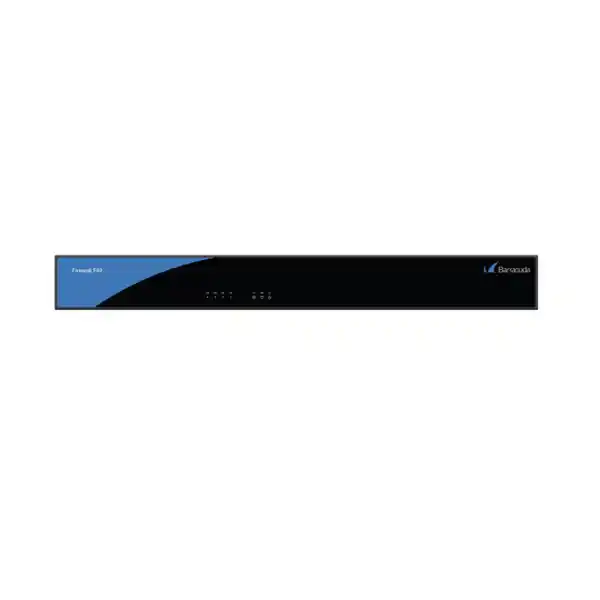
Barracuda CloudGen Firewall F82 DSL Annex A
The Barracuda CloudGen Firewall F82 DSL Annex A is a compact security and WAN-edge appliance designed for branch offices that need integrated copper Ethernet, Annex A DSL, fiber handoff flexibility and Wi-Fi in one desktop platform. In the UAE, it is most relevant today for organizations that already operate F82 appliances, need a controlled spare or replacement, are maintaining a standardized legacy branch design, or are planning a migration from the F82 to a supported successor platform without disrupting routing, VPN, security policy or WAN connectivity.
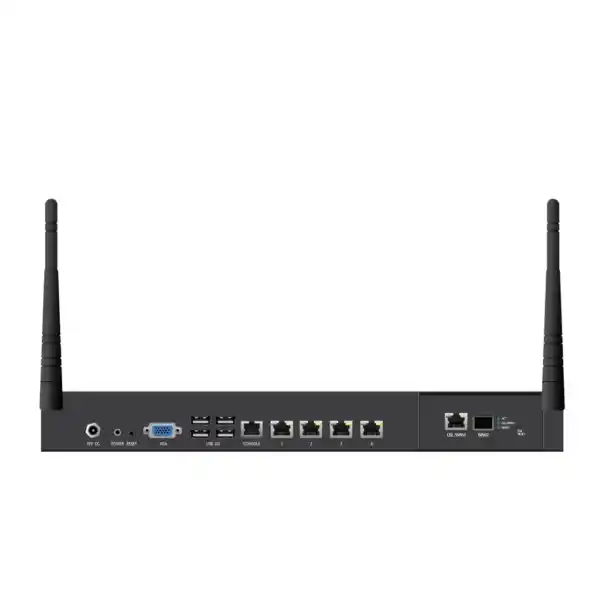
F82 Annex A interfaces: 4 × 10/100/1000 RJ45, 1 × RJ11 Annex A DSL, 1 × 1GbE SFP, integrated 802.11b/g/n Wi-Fi.
Published legacy performance: up to 1.35 Gbps firewall, 240 Mbps VPN, 500 Mbps IPS and 400 Mbps NGFW throughput.
Lifecycle: Barracuda lists F82 Rev. A EoS/EoHS as 28 Feb 2022 and EoFS/EoL as 28 Feb 2027. New deployments should be evaluated against the successor path before purchase.
What the Barracuda F82 DSL Annex A is designed to do
The F82 DSL Annex A was created for distributed organizations that needed more than a basic broadband router at a small branch. Its value proposition is the consolidation of WAN access, firewall enforcement, encrypted connectivity and local branch networking into one compact platform. The Annex A variant specifically integrates a DSL interface through an RJ11 connector, while also providing a 1GbE SFP interface for an optical handoff and four Gigabit Ethernet copper ports. That combination gave branch architects several choices: terminate a DSL circuit directly on the appliance, use Ethernet from an ISP router or ONT, accept fiber through the SFP interface, and retain additional Ethernet interfaces for LAN, secondary WAN or segmented networks. Integrated Wi-Fi adds another access method, although enterprise wireless design should still consider coverage, channel planning, security policy and whether a dedicated WLAN platform is more appropriate.
The appliance belongs to Barracuda’s CloudGen Firewall F-Series architecture, where the firewall is expected to participate in routing and connectivity decisions rather than acting only as a perimeter filter. Features associated with the platform include stateful firewalling, application control, intrusion prevention, TLS inspection, web filtering, dynamic routing, site-to-site and client-to-site VPN, traffic shaping, provider selection and SD-WAN functions. For a multi-site business, that matters because branch availability is often determined by the interaction between the security policy and the WAN policy. A link can remain technically online while a cloud application is unusable because of latency, packet loss or routing asymmetry. Application-aware path selection and multiple uplinks are intended to make that behavior visible and controllable.
For UAE buyers in 2026, however, the F82 must be viewed through its lifecycle status. Barracuda identifies F82 Revision A, part number family BNGF82a, with an End-of-Sale and End-of-Hardware-Support date of 28 February 2022 and an End-of-Firmware-Support / End-of-Life date of 28 February 2027. The published successor is F180B used with a third-party DSL SFP transceiver where DSL continuity is required. This makes the F82 a lifecycle-management product rather than the default choice for a greenfield branch. FourTeck therefore approaches F82 requests by first identifying the operational reason for the model: exact replacement, spare pool, migration staging, lab compatibility, contractual standardization or an existing estate that must remain consistent during a phased refresh.
Lifecycle status matters before you quote or deploy
A firewall is not comparable to an unmanaged switch that can continue performing a narrow Layer 2 function for years without substantial software dependency. A next-generation firewall depends on firmware, security signatures, application definitions, compatibility testing, cryptographic libraries, threat intelligence and vendor support. Barracuda’s hardware lifecycle documentation explains that once a model reaches End of Firmware Support, later firewall releases are no longer tested or supported on that hardware and customers should transition to a successor or another supported model. The F82’s published EoFS/EoL date is 28 February 2027, so any procurement in the UAE should explicitly document what happens before and after that date.
That does not mean an existing F82 stops forwarding packets on the lifecycle date. It means the risk model changes. A device can remain powered and functional while becoming a poor place to terminate critical internet traffic if its supported firmware path, defect remediation and current security services are constrained. If an organization needs a replacement F82 because a branch has failed and a larger migration is scheduled later, a like-for-like unit may be operationally justified. If an organization is opening a new branch expected to run for five years, choosing the successor platform is normally the more defensible architecture. FourTeck can support both scenarios, but the quotation should clearly state the lifecycle assumptions so that procurement, IT operations and security teams make the same decision.
F82 DSL Annex A hardware at a glance
The Annex A hardware configuration is practical because it exposes several branch-edge media types without requiring a separate chassis. Four 10/100/1000 Mbps RJ45 Ethernet interfaces handle standard copper connections. The integrated DSL port uses RJ11 for Annex A service. A 1GbE optical SFP interface can accommodate compatible fiber transceivers and fiber-based handoffs. Integrated Wi-Fi supports IEEE 802.11b/g/n. The unit is a desktop-class appliance measuring approximately 378 × 160 × 44 mm and weighing about 2.2 kg according to the archived model data. The power supply is a single external unit and historical specifications list maximum storage of 50 GB.
These physical details influence real deployments. A branch may need one interface for LAN, one for a broadband Ethernet WAN, one for a DMZ or voice network and another for a secondary circuit. If the DSL interface is used, the appliance can reduce dependence on a separate DSL CPE in designs where the carrier settings and line standard are compatible. The SFP port is especially useful when the provider presents a fiber interface or when electrical isolation and longer physical runs are required. Before ordering optics, the transceiver type, wavelength, fiber mode, connector and interoperability should be checked rather than assuming that any 1GbE SFP will be suitable.
Annex A: what it means for the WAN circuit
Annex A identifies the DSL variant intended for service over traditional analog telephone line infrastructure. It is not interchangeable with every DSL service merely because the connector appears familiar. The access technology, carrier configuration, line profile and local telecommunications design must be compatible with the integrated modem. The F82 product family also existed in an Annex B/J variant using a different physical presentation. That is why the complete product string, “F82 DSL Annex A,” matters in procurement; substituting the wrong F82 DSL submodel can create a physical or service mismatch even when the firewall software features are otherwise similar.
In UAE environments, many current enterprise sites use fiber, Ethernet or provider-managed CPE rather than direct DSL termination, so the integrated Annex A modem may be used only at older branches or specialized locations. During migration, organizations should confirm whether preserving native DSL termination is actually necessary. If the service can be handed off as Ethernet by the carrier, the replacement design may become simpler. If direct DSL remains mandatory, Barracuda’s published successor guidance points to F180B with a third-party DSL SFP transceiver, which changes the bill of materials and makes compatibility validation important before cutover.
Technical specification reference
| Category | Barracuda F82 DSL Annex A | Design interpretation |
|---|---|---|
| Model / revision | F82 DSL, Revision A / BNGF82a family | Verify label and exact submodel before replacing an installed unit. |
| Form factor | Desktop / compact branch appliance | Suitable for branch IT rooms, shelves or approved mounting arrangements. |
| Copper Ethernet | 4 × 10/100/1000 Mbps RJ45 | Plan LAN, DMZ and alternate WAN roles before assigning interfaces. |
| DSL | Integrated Annex A, 1 × RJ11 | Carrier and line-profile compatibility must be confirmed. |
| Fiber | 1 × 1GbE SFP | Optic, connector, wavelength and fiber type are separate BOM decisions. |
| Wireless | Integrated IEEE 802.11b/g/n | Useful for modest branch requirements; dedicated WLAN may be preferable at scale. |
| Firewall throughput | Up to 1.35 Gbps | Do not equate basic firewall throughput with inspected application traffic. |
| VPN throughput | Up to 240 Mbps | Encryption load, tunnel count and packet size affect real performance. |
| IPS throughput | Up to 500 Mbps | Threat inspection can become the sizing constraint on faster links. |
| NGFW throughput | Up to 400 Mbps | Use this class of figure when application control and security inspection matter. |
| Recommended users | 50–100 historical guidance | User count is only a starting point; traffic profile is more important. |
| Dimensions | Approx. 378 × 160 × 44 mm | Confirm cabinet depth, ventilation and cable bend radius. |
| Weight | Approx. 2.2 kg | Allow for PSU, cabling, shelf or mounting hardware. |
| Power | Single external power supply | UPS protection and spare PSU strategy are recommended for critical branches. |
| Lifecycle | EoS 28 Feb 2022; EoFS/EoL 28 Feb 2027 | Treat new purchases as legacy or transition use, not default greenfield standard. |
Performance values are vendor-published “up to” figures from legacy F82 documentation and can vary by firmware, configuration, enabled services, packet sizes, traffic mix, encryption, logging and surrounding network conditions.
Why throughput numbers need engineering context
Firewall datasheets present several throughput figures because the workload changes dramatically when security services are enabled. A stateful firewall test with large packets and a limited policy set is fundamentally different from inspecting real application traffic, applying signatures, decrypting TLS, logging sessions and enforcing user or application policy. The F82’s published 1.35 Gbps firewall throughput therefore should not be interpreted as a promise that a branch will sustain a 1 Gbps internet circuit while every next-generation inspection feature is enabled. The more relevant published numbers for a security-heavy deployment are 500 Mbps IPS and 400 Mbps NGFW throughput, and even those remain laboratory “up to” values rather than guaranteed production figures.
A practical sizing exercise starts with the branch’s peak bidirectional traffic, not the carrier’s headline speed. Measure or estimate office productivity traffic, SaaS access, cloud backups, software distribution, video meetings, remote desktop, voice, guest traffic, branch-to-data-center flows and internet breakout. Then identify which flows require TLS inspection, IPS, application control, web filtering and malware analysis. Encrypted web traffic can be especially expensive because the firewall must participate in cryptographic sessions before inspecting content. If the branch uses a large number of short-lived SaaS connections, session setup rate can matter as much as raw Mbps. If large backup transfers dominate, sustained throughput matters more.
The WAN topology also changes the calculation. A site may have a 100 Mbps primary fiber link and a 50 Mbps backup circuit; in that case the F82’s published security figures can appear comfortable. Another site may have been upgraded from DSL to 500 Mbps or 1 Gbps business broadband while keeping the original firewall. The internet upgrade can expose the firewall as the new bottleneck, especially with inspection enabled. This is common in long-lived branch estates because carrier bandwidth grows faster than security appliance refresh cycles. A lifecycle review is therefore a good time to compare actual traffic against both the F82’s historical figures and a supported successor’s current capacity.
FourTeck’s sizing approach separates mandatory security from optional inspection. We identify traffic that cannot bypass controls, define peak load, reserve headroom for bursts and future growth, and then test whether the selected appliance remains within a comfortable operating range. The goal is not to buy the largest firewall. It is to avoid a design in which ordinary business growth forces administrators to disable inspection to recover speed. For customers standardizing security across multiple Emirates or across the wider region, the same methodology also makes model selection repeatable from small branches to larger offices.
Stateful firewalling
The CloudGen platform applies stateful inspection and forwarding so policy decisions can account for connection state rather than treating every packet in isolation. In a branch design, stateful policy forms the baseline control layer for internet egress, inbound services, inter-VLAN flows, management access and communication between local users and centralized resources. NAT, port address translation and object-based policy construction can be combined with routing and application controls. The important design task is to keep rules explicit and maintainable: source zones, destination zones, service objects, user identities, applications and logging requirements should reflect the branch’s intended trust boundaries instead of reproducing years of ad-hoc exceptions.
Application control
Application-aware policy helps administrators treat traffic according to what it is doing, not only which TCP or UDP port it uses. Modern applications may use HTTPS for very different functions, so a port-only rule can be too broad. Application identification can support selective blocking, prioritization, provider selection and visibility. In a UAE branch, this can help protect bandwidth for Microsoft 365, ERP, CRM, voice and sanctioned collaboration platforms while restricting risky or non-business traffic. Policy should be tested carefully because cloud applications evolve, use distributed content networks and may share infrastructure with other services.
Intrusion prevention
IPS adds signature and protocol-level detection intended to stop exploits, malformed traffic and known attack techniques that a basic stateful firewall may permit. The security benefit is significant, but IPS processing also consumes capacity. Administrators should enable appropriate signature sets, keep definitions current within the supported software lifecycle, monitor false positives and review blocked events rather than assuming a default policy will match every environment. The F82’s historical 500 Mbps IPS figure should be treated as a ceiling under test conditions, not a sizing target for sustained production load.
TLS inspection
Encrypted traffic increasingly contains both legitimate business content and threats, making TLS inspection important in some security policies. It is also operationally sensitive because the firewall must establish trusted inspection relationships, manage certificates and process encryption at scale. Applications using certificate pinning or strong end-to-end validation can require exclusions. Privacy and organizational policy must also be considered. On an older appliance such as the F82, TLS-heavy traffic is one of the reasons a branch that appears correctly sized by plain firewall throughput can experience less headroom once a complete security policy is enabled.
Web and malware controls
URL categorization, web policy and malware protection allow a branch firewall to enforce acceptable-use and threat-prevention controls directly at the internet edge. Their effectiveness depends on current subscriptions, reachable cloud services where applicable, supported firmware and correct policy placement. During an F82 lifecycle review, licensing should be examined alongside hardware condition. A device that boots and forwards traffic is not necessarily delivering the protection level assumed by the business if subscriptions, signatures or supported firmware have lapsed.
Identity-aware controls
User-aware security policy can make branch access more precise by associating traffic with people or groups rather than only source IP addresses. This can be useful for staff categories, administrators, guests, contractors and privileged systems. Identity integration must be designed for failure conditions: if a directory connector or authentication service becomes unavailable, the firewall’s fallback behavior should remain secure and predictable. For migrations, existing identity mappings and exception logic should be documented before moving policies to a successor appliance.
SD-WAN and application-based provider selection
One of the most useful characteristics of the CloudGen Firewall family is that WAN transport decisions and security enforcement can be coordinated on the same platform. In a conventional branch, the default route points to one ISP until the interface fails, after which a secondary route may become active. That approach detects hard outages but often reacts poorly to partial degradation. A circuit with heavy packet loss, elevated latency or unstable quality may remain “up” while real-time applications become unusable. SD-WAN logic is intended to make path choice more responsive to service conditions and application requirements.
The F82’s multiple physical WAN options can support branch resilience designs, for example DSL as one path and Ethernet or fiber as another. The actual roles depend on the carrier handoffs and configuration. Application-based provider selection can then steer selected traffic according to policy. A voice or interactive business application may prefer the path with lower delay and jitter, while bulk software updates can use a lower-priority transport. Traffic shaping and QoS can protect critical services when bandwidth is constrained. The design should define what happens during congestion, not merely during complete circuit failure.
For UAE offices, dual-carrier resilience can be particularly valuable where a branch supports sales operations, payment workflows, contact-center functions, cloud ERP or remote access to centralized systems. Resilience is strongest when failure domains are genuinely independent. Two services delivered over the same last-mile infrastructure may fail together. Likewise, a second WAN is of little value if the firewall depends on a single unprotected power source and the site has frequent power interruptions. A complete availability design therefore considers carriers, physical paths, CPE, firewall power, switching, DNS, VPN hubs and cloud dependencies.
When migrating from an F82, preserve the intent of the WAN policy rather than blindly copying every setting. First document primary and secondary transports, SLA thresholds, route preference, application steering, NAT behavior, VPN tunnel dependencies and inbound services. Then decide whether each rule remains appropriate for the replacement. Newer bandwidth levels may justify different thresholds, and newer applications may need different treatment. FourTeck can use the existing F82 as a source of operational knowledge while still producing a cleaner successor configuration.
Site-to-site VPN design
A branch firewall commonly terminates encrypted tunnels to a head office, data center, disaster-recovery site or cloud environment. Barracuda has historically positioned the CloudGen platform with site-to-site VPN and SD-WAN connectivity as core functions. For F82 sizing, the legacy published VPN throughput of up to 240 Mbps is a useful reference but not a guarantee. Cipher choice, packet size, number of tunnels, simultaneous inspection and route processing all affect production performance. A 200 Mbps branch circuit does not automatically mean a 200 Mbps encrypted application flow will be sustained under every policy combination.
Operationally, the tunnel is only one component. Reliable design requires correct routing, stable endpoint addressing or dynamic peer handling, coordinated subnets, NAT exemptions where appropriate, policy symmetry, monitoring and failover behavior. If multiple WANs are present, determine whether tunnels should fail over, remain established on multiple transports or use SD-WAN bonding logic. During migration, pre-shared keys, certificate material, peer identifiers and encryption proposals should be handled as sensitive configuration data and validated in a controlled change window.
Remote-access and zero-trust considerations
Client-to-site access can be useful for branch administrators, traveling staff or emergency operations, but remote access should not be treated as a permanent substitute for application-level identity controls. Barracuda’s broader CloudGen feature set includes remote access, multi-factor authentication integrations and optional advanced remote-access functions. The exact capability available on an installed F82 depends on firmware, active subscriptions and the organization’s licensing. Before promising a feature on a legacy appliance, validate the entitlement and supported software level.
For current UAE security programs, a migration project is an opportunity to decide which services should still be exposed through traditional VPN and which can move toward zero-trust or application-specific access. Administrators may continue to need network-level VPN, while general users might benefit from narrower access scopes. The security target is least privilege: users should reach the systems they require, from approved devices and authenticated contexts, without receiving unnecessary network reachability. That policy objective should drive the architecture regardless of whether the F82 remains temporarily in service.
No hidden “ASIC” claim: size the F82 by published results
Some firewall vendors publish extensive information about proprietary security processors, packet-processing ASICs or dedicated acceleration engines. The public F82 material used for this page does not identify a named security ASIC architecture for the F82 DSL Annex A. FourTeck therefore does not make an unsupported claim that the appliance contains a particular accelerator or that a specific traffic class is offloaded to custom silicon. The correct engineering approach is to use Barracuda’s published system-level throughput figures and then apply margin for the actual inspection policy.
This distinction matters because architecture labels can be misleading when separated from a workload. What a branch needs is predictable performance with its own mix of encrypted web traffic, VPN, signatures, application control, NAT, logs and routing. Whether that result is achieved in general-purpose compute, specialized silicon or a combination is secondary to measured behavior and supportability. For a lifecycle-stage appliance, supported firmware and security update continuity are at least as important as packet-processing architecture. A modern successor with current software support can be the better security choice even when the older platform appears adequate by raw throughput alone.
Routing, VLANs and branch segmentation
Barracuda CloudGen Firewall supports common enterprise routing concepts including IPv4, IPv6 and dynamic routing protocols such as BGP, OSPF and RIP, along with VLAN tagging. On a small F82 branch, static routes may be sufficient, but dynamic routing becomes valuable when the site has multiple WANs, multiple VPN paths or complex internal segmentation. The firewall can participate directly in route exchange so network reachability adapts to path changes. That capability should be used deliberately; an unnecessary dynamic-routing domain can add complexity to a small office, while a carefully designed one can eliminate fragile static-route dependencies.
VLAN segmentation is often more important than the physical port count. Four copper ports do not limit the branch to four IP networks because an 802.1Q trunk to a managed switch can carry multiple VLANs. A typical design may separate corporate users, servers or appliances, voice, guest wireless, building-management systems and administrative management traffic. The firewall can then enforce policy between segments. The security benefit comes from the policy, not merely from creating VLAN IDs. Rules should define which systems may initiate connections, which services are required, how DNS and NTP are provided and whether internet access is direct or proxied through security services.
For branches with industrial, facilities or IoT equipment, segmentation is especially useful because many embedded devices have long lifecycles and limited endpoint security. Barracuda’s current CloudGen feature descriptions include support for several industrial protocols, but a legacy F82 deployment should validate the exact firmware feature set before relying on any specific protocol awareness. Even without specialized inspection, network isolation, strict allow-list policy, controlled management access and logging can materially reduce exposure. A migration should preserve those boundaries and, where possible, tighten rules that have accumulated over time.
Addressing design also deserves review. Branches built years ago may contain overlapping RFC1918 networks that complicate VPNs, cloud connectivity and mergers. Replacing an F82 can be a convenient point to renumber, but changing IP space can affect printers, PBX systems, access control, cameras and hard-coded application settings. FourTeck can stage the migration so routing and NAT preserve connectivity while addressing is rationalized in phases. The objective is a supportable topology, not simply a one-for-one interface mapping.
DHCP and local services
CloudGen Firewall can provide infrastructure functions such as DHCP server or relay and DNS-related services. At a small branch, hosting DHCP locally can simplify operation because users can still obtain addresses when a central site is unreachable. In a larger standardized environment, DHCP relay to central services may improve consistency. The choice should account for WAN failure behavior. If local users need internet access during a VPN outage, dependencies such as DHCP, DNS and authentication must remain available enough to support that mode.
Monitoring and telemetry
SNMP, IPFIX and platform logging can feed operational monitoring so teams see link utilization, session behavior, threats and device health. Legacy hardware should be monitored closely because increasing CPU load, storage pressure, interface errors or thermal issues may be early indicators that the platform is running out of practical headroom. Monitoring should also verify security service status; a green WAN interface alone does not prove that IPS definitions, subscriptions and management connectivity are healthy.
Central management
Barracuda Firewall Control Center is designed for centralized administration of distributed firewalls, including templating, multi-administrator workflows and zero-touch deployment capabilities across supported systems. For organizations with many branches, centralized policy is essential to control drift. An F82 replacement project should identify which settings are globally inherited and which are branch-specific. Migrating a box without understanding template relationships can either omit required policy or accidentally overwrite local settings.
Zero-touch deployment
Zero-touch workflows reduce the need to send firewall specialists to every branch, especially when sites are geographically distributed. A device can be shipped to the location, physically connected according to a prepared plan and then brought under centralized configuration. For legacy F82 stock, zero-touch capability still depends on the exact supported firmware and management environment. For successor deployments, FourTeck can pre-stage naming, addressing, WAN parameters and policy templates so on-site work is limited to cabling and verification.
Wi-Fi on the F82: useful, but not a substitute for wireless design
The F82 DSL family includes integrated Wi-Fi supporting IEEE 802.11b/g/n. For a small office, maintenance room, kiosk or temporary branch, integrated wireless can reduce the number of devices required to provide basic connectivity. It can also support initial deployment tasks where a local wired connection is inconvenient. However, the presence of an access point inside a firewall should not be confused with a modern enterprise WLAN architecture. Coverage, capacity, roaming, interference, radio placement and contemporary client expectations all need separate consideration.
The physical location that is best for a firewall is frequently poor for Wi-Fi. Firewalls are often installed in communications cabinets, equipment rooms or secure corners where metal enclosures and building construction attenuate radio signals. A centrally located ceiling access point normally provides better coverage than a security appliance mounted near the WAN entry point. If a branch has multiple rooms, high client density, voice over Wi-Fi or strong roaming requirements, dedicated access points and a planned wireless design are more appropriate.
Security segmentation also matters. Corporate wireless, guest wireless and operational devices should not automatically share one trust zone because they use the same radio. VLAN mapping, firewall rules and authentication should separate traffic according to business purpose. Guest access should be isolated from corporate resources, and management interfaces should be accessible only from administrative networks. When replacing an F82 that provides local Wi-Fi, capture the SSIDs, authentication method, VLAN assignments, DHCP behavior and guest policies before cutover so users are not surprised by a firewall migration that inadvertently becomes a wireless outage.
Where customers need a broader network refresh, FourTeck can coordinate firewall work with switching and wireless services through FourTeck IT Services UAE. This is useful when the legacy F82 has become the limiting component in a branch that has already moved to faster internet, newer Wi-Fi standards and more cloud-dependent applications.
Power, mounting and physical deployment in UAE sites
The F82 is a compact desktop appliance with a single external power supply. That makes installation straightforward but creates a clear physical dependency: one PSU and one input path feed the device. In a business-critical branch, connect the firewall to an appropriate UPS and verify that the upstream ISP equipment and access switch are also protected. A firewall that remains powered is not useful if the provider ONT, DSL splitter, switch or Wi-Fi system shuts down at the same time. The UPS should be sized for the combined communications stack and expected outage duration, not merely the firewall’s draw.
Environmental conditions deserve attention in UAE deployments. Communications equipment should operate in a controlled, ventilated space within vendor temperature and humidity requirements. Avoid placing the firewall directly in unconditioned ceiling voids, warehouses or cabinets exposed to heat and dust unless the enclosure and environmental design are suitable. The external power brick needs airflow, and cables should be secured so movement does not pull on the appliance ports. For fiber, maintain bend radius and protect connectors from contamination. For DSL, identify the carrier demarcation and any splitter or surge-protection requirements.
Barracuda’s accessory documentation indicates that F82 Rev. A shipments included the security appliance, power cord, external power supply, standard Ethernet cable, USB thumb drive, Wi-Fi antennas, rack-mount brackets and wall-mount kit, although actual contents of any legacy or secondary-market unit can differ. A UAE quotation for replacement stock should therefore state exactly what is included. Do not assume that antennas, mounting hardware, recovery media or the original PSU are present merely because they were part of the original package.
Before a remote installation, FourTeck recommends photographing the existing F82 front and rear connections, labeling every cable, recording serial and model information, identifying the WAN handoff type and confirming power connector compatibility. These simple steps prevent many avoidable cutover delays. A branch technician should know which cable belongs to DSL, SFP, primary LAN, secondary WAN and management access before the old device is disconnected.
Where the F82 still makes operational sense
A lifecycle-stage appliance can still have a legitimate role when the requirement is narrow and time-bounded. The clearest case is an emergency replacement for an existing F82 branch where changing platforms immediately would create greater operational risk than restoring the known configuration. A compatible spare can reduce outage duration while the organization prepares a planned successor migration. Another use case is a laboratory or test environment that must reproduce a production configuration for troubleshooting before the estate is fully retired. Some organizations also maintain a controlled pool of legacy devices for contractual or application compatibility during phased transformation programs.
The important controls are scope and exit plan. The unit should not quietly become a five-year greenfield standard simply because it is familiar. Procurement records should identify the intended service period, supported firmware, subscription requirements, spare availability and migration target. If the device will remain internet-facing near or beyond the published 28 February 2027 EoFS/EoL date, the security team should explicitly accept or mitigate the resulting support risk. FourTeck can provide a replacement quotation together with a successor option so the business sees the immediate restoration cost and the longer-term modernization path at the same decision point.
When the better answer is F180B or another supported successor
Barracuda’s lifecycle table names F180B as the successor to the F82, with a note that a third-party DSL SFP transceiver is required when DSL connectivity must be preserved. This is an important architectural change: instead of relying on the F82’s integrated RJ11 Annex A modem, the successor path can separate the firewall from the DSL physical layer through an SFP-based module. That approach may make future WAN transitions easier because the firewall platform is not tied to one legacy copper access method, but the exact DSL SFP must be validated for service compatibility.
A successor makes most sense when the site is expected to stay operational beyond the F82 lifecycle, bandwidth has grown, security inspection is heavier or the organization is standardizing on currently supported firmware. Newer software support is not merely a maintenance benefit. It affects vulnerability remediation, protocol compatibility, cryptographic support, management features, security signatures and interoperability with cloud services. If a branch processes payment data, sensitive corporate traffic, regulated information or high-value remote access, operating on an actively supported platform is an important component of risk management.
Migration does not have to mean redesigning everything at once. The replacement can initially reproduce the F82’s core VLANs, routing and VPN topology, then enable improved policy in controlled phases. For example, a branch can first move WAN termination and tunnels, validate application connectivity, then tighten segmentation or expand TLS inspection after the network is stable. This staged method separates connectivity risk from security-policy change and makes troubleshooting clearer.
FourTeck can provide UAE sourcing and deployment coordination through FourTeck UAE and firewall-focused consultation through Firewall Dubai. The objective is to quote the product that fits the branch’s actual lifecycle and WAN requirements rather than forcing a legacy model into a greenfield design.
Existing F82 replacement workflow
1. Identify exact hardware. Confirm F82 Revision A and Annex A rather than Annex B/J. Capture the serial number, appliance label and current interface usage.
2. Export and document configuration. Record software version, routing, VPNs, objects, rules, NAT, certificates, authentication integration, WAN parameters and management relationships.
3. Check support and subscriptions. Determine what entitlements remain active and whether the intended firmware is supported for the time the replacement will operate.
4. Stage the unit. Match required firmware and prepare configuration in a controlled environment where possible. Verify interface mappings instead of assuming physical port numbering will match every past diagram.
5. Cut over with rollback. Define a maintenance window, test plan and rollback trigger. Validate internet access, critical applications, VPNs, inbound services, DNS, voice and monitoring before closing the change.
F82-to-successor migration workflow
1. Discover dependencies. Separate branch-specific settings from inherited central-management templates and identify any hard-coded peer addresses, certificates or DSL settings.
2. Re-size the branch. Use current peak traffic and inspection requirements rather than the bandwidth that existed when the F82 was first installed.
3. Choose WAN presentation. Decide whether to retain DSL through a validated transceiver, accept Ethernet from carrier CPE, or move to fiber/business broadband.
4. Translate policy intentionally. Preserve required behavior but remove obsolete objects, dead rules and historical exceptions that no longer have owners.
5. Monitor after cutover. Compare latency, loss, throughput, tunnel stability, application logs and security events against a pre-change baseline, then tune rather than declaring success after a single ping test.
Firmware and configuration management
Barracuda documentation for the F82 identifies Revision A as a model that requires CloudGen Firewall firmware 8.0.1 or higher in the hardware reference, while later migration documentation has included F82 support on newer trains. Firmware planning should follow Barracuda’s model-specific lifecycle and release notes rather than choosing a version by number alone. A version can be technically installable yet unsuitable because it is out of support, contains a known issue relevant to the branch or sits outside the organization’s approved software baseline.
Before any upgrade, preserve a configuration backup and understand the supported upgrade path. Major version jumps can include migration requirements, changes in defaults and feature behavior. If the F82 is supporting a critical remote site, upgrade risk must be balanced against lifecycle risk. A branch that has no local technical staff may require a tested spare, out-of-band access or an agreed rollback method before touching firmware. Upgrading purely because “a newer version exists” is not a change plan.
Configuration quality also affects performance. Extremely broad logging, unnecessarily large rule sets, duplicated objects, abandoned VPN definitions and unused services can make troubleshooting difficult and increase administrative risk. A migration is an opportunity to rationalize the configuration. Each rule should have a purpose, owner and logging requirement. Management services should be restricted to trusted networks. Administrative accounts should be individual where possible, use strong authentication, and be integrated with the organization’s access-control process.
For multi-site estates, configuration consistency is best enforced through centralized templates and documented exceptions. Branches often drift when local emergency changes remain permanently. FourTeck can compare an existing F82 against the intended standard, identify deviations and determine which should be carried to the replacement. This produces a cleaner outcome than cloning every historical setting without review.
High availability: what the platform supports and what the branch really needs
Barracuda CloudGen Firewall supports active-passive high-availability concepts with encrypted HA communication and transparent failover capabilities on supported designs. Whether HA is justified at an F82-class branch depends on business impact, not simply technical possibility. Two firewalls can protect against an appliance failure, but they do not eliminate single points of failure in WAN circuits, power, switching or carrier equipment. A complete availability review should identify the failures that the business is actually trying to survive.
For a small office, a cold spare may provide a better cost-to-risk balance than a live HA pair if the branch can tolerate a short replacement window. For a site handling continuous transactions or operational processes, active-passive firewalls and dual carriers may be justified. If the current design uses one F82 and integrated DSL, moving to a supported successor pair can also force a rethink of physical WAN termination. A single DSL line still fails as one service even if two firewalls can access it, so true resilience may require two independent access circuits or a carrier design that supports redundant handoff.
HA configuration also needs state synchronization, interface consistency, monitored links, failover testing and change discipline. Administrators should test not only manual failover but realistic scenarios such as primary WAN failure, upstream switch failure and loss of one firewall. DNS and application sessions should be observed during tests. If a failover has never been tested under production-like conditions, its success is an assumption rather than an established control.
In a lifecycle-stage F82 environment, investing in a new F82 HA pair is generally harder to justify than applying the same budget to a supported replacement architecture. Existing paired systems may continue to be maintained during transition, but the 2027 EoFS/EoL date should be visible in the resilience roadmap. Availability and security support are connected: a highly available pair of unsupported security appliances can still represent unacceptable cyber risk.
Small UAE branch
A small office with 20–40 active staff may still fit comfortably within F82-class traffic levels if internet usage is moderate and the device remains in a supported firmware state. The correct question is not employee count alone. A team making constant HD video calls and syncing large cloud data can create more load than a larger office using primarily transactional applications. Measure peak WAN demand and enabled inspection. If the site will remain open past February 2027, a supported successor should be part of the plan.
Retail or service outlet
Retail, clinic, hospitality and service locations often need segmentation between payment or business systems, guest access, IoT devices and management networks. Availability can be more important than raw throughput because even modest bandwidth loss can stop core transactions. Dual WAN, controlled VPN connectivity and strict inter-zone policy are useful. If a legacy F82 is retained, document replacement stock, licensing and the exact timeline to a supported platform so a hardware incident does not become an emergency architecture decision.
Warehouse or industrial edge
Warehouses and industrial-adjacent sites may have scanners, cameras, building systems, controllers and vendor-maintained equipment alongside normal users. Network segmentation is central to risk reduction. The firewall should restrict device classes to the services they require and prevent unmanaged systems from reaching administrative networks. Environmental conditions also matter: desktop appliances need protected, ventilated installation. Where heat, dust or vibration are significant, a rugged platform may be more suitable than extending the life of an F82.
Regional branch estate
Organizations with branches across the UAE and Africa benefit from standardized templates, central visibility and a small number of approved hardware profiles. If F82 remains in the estate, classify it as a legacy profile with a retirement date rather than mixing it indefinitely with supported platforms. For customers coordinating cross-border infrastructure, FourTeck Africa can support regional planning while the UAE team maintains local procurement and deployment coordination.
Licensing and security subscriptions: treat the software as part of the appliance
A firewall purchase decision is incomplete without licensing. Barracuda’s CloudGen portfolio separates core platform capability from subscriptions and support services such as Energize Updates, malware protection, Advanced Threat Protection, Advanced Remote Access and Firewall Insights. The exact bundle, availability and renewal eligibility for a specific F82 serial number can depend on its history and lifecycle stage. A secondary-market chassis with no transferable or renewable entitlement is not equivalent to a fully supported unit simply because the hardware model is identical.
Energize Updates historically covers items such as firmware updates, IPS signature updates, application-control definitions and web-filter updates, while other advanced functions may require additional subscriptions. Security teams should map required controls to the subscriptions that deliver them. If IPS is mandatory, verify that signatures remain available on the planned software version. If Advanced Threat Protection is required, confirm both entitlement and the traffic workflows that will use it. If remote access relies on advanced authentication, verify the associated service and client compatibility.
Lifecycle rules complicate legacy licensing. Barracuda’s policy states that certain subscription renewals can continue beyond hardware EoL, but functionality is limited to the last supporting firmware release and later firmware may be unsupported or malfunction. That distinction is important for budgeting: the ability to renew a service does not restore full current-platform support. The organization must decide whether maintaining the legacy platform is a temporary bridge or an accepted long-term risk.
For quotation accuracy, provide the existing serial number when available, current support status, required term and desired security services. FourTeck can then separate hardware availability from subscription eligibility and migration services. This avoids a common procurement mistake where a replacement appliance arrives but cannot be operated under the assumed support model.
Security policy design for an F82 branch
A good branch rule set is small enough to understand and specific enough to enforce intent. Start with zones: trusted user networks, server or service networks, guest access, voice, management, IoT or facilities, WAN and VPN. Then define flows that are actually required between those zones. Corporate users may need internet access and selected internal applications; guests may need internet only; cameras may need to reach a recorder and time server; phones may need call-control, DNS and NTP; administrators may need management interfaces. Everything else can remain denied until justified.
Policy ordering matters because broad rules can shadow specific controls. An “allow LAN to any” rule inserted early for troubleshooting can remain for years and defeat segmentation. During an F82 review, identify rules with zero hits, duplicate objects, temporary names and destinations that no longer exist. Logging should be sufficient for incident investigation but not so indiscriminate that useful events disappear in noise or storage is exhausted. High-value denies, administrative access and unusual outbound traffic deserve particular visibility.
Outbound filtering is often underused. A branch should not assume that all internal devices are trusted simply because they are inside. Malware, compromised IoT equipment or unauthorized software can initiate outbound sessions. Application control, DNS reputation, web filtering and egress rules can reduce this risk. For devices that require only a few cloud endpoints or management services, allow-listing may be practical. For general users, category and application policy may provide a better balance between security and usability.
Policy changes should be managed with evidence. Record who requested the change, business purpose, source and destination, service, expiration where temporary, and expected logging. Test in a controlled manner and review after implementation. This discipline is more valuable than any single firewall feature because it prevents the rule base from becoming an undocumented record of past emergencies. If the F82 is migrated to a successor, carry forward the business intent and audit trail rather than only the syntax.
Performance sizing methodology for UAE procurement
For a branch firewall quote, FourTeck recommends collecting at least four numbers: current internet circuit speed, observed peak throughput, expected growth over the next three years and the percentage of traffic subject to deep security inspection. Add the number of site-to-site tunnels, remote-access users, VLANs and significant public-facing services. Then identify high-bandwidth activities such as cloud backup, video surveillance upload, software distribution, file replication and 4K conferencing. This produces a workload model that is more reliable than using employee count alone.
Next, choose a safety margin. Running a security appliance continuously near its maximum tested capacity leaves little room for bursts, attack traffic, policy growth or new inspection features. Practical designs often target a lower sustained utilization so the firewall can absorb spikes without introducing latency. The exact margin depends on business criticality and traffic variability. A branch with predictable transactional traffic can be sized differently from a creative office that transfers large media files throughout the day.
Consider upstream and downstream asymmetry. Some DSL services provide much lower upload bandwidth than download bandwidth. This can affect VPN performance, cloud backup and video conferencing even if the firewall has ample processing capacity. If the F82 is being retained because of integrated Annex A DSL, verify whether the DSL line itself is the true bottleneck. In many cases, moving the carrier service to fiber or Ethernet has more impact on user experience than tuning the firewall. Conversely, once the WAN is upgraded, the F82 may immediately become the limiting device.
Finally, account for the lifecycle. Even if an F82 can technically handle the measured load today, a design intended to operate for several years crosses the published 28 February 2027 EoFS/EoL boundary. A supported successor should therefore be compared in the same quotation. Hardware sizing and support horizon are both capacity questions: one asks whether the system can process the traffic, and the other asks whether it can safely receive the software maintenance needed throughout the planned service life.
For broader UAE infrastructure planning, the main FourTeck global site can be used alongside the local UAE and firewall specialist channels, while this page remains focused on the F82 DSL Annex A branch-security use case.
Deployment topology examples
Topology A — Direct Annex A DSL branch: the RJ11 DSL interface terminates the supported DSL service, the firewall performs NAT and security inspection, and a copper Ethernet interface connects to the managed LAN switch. VLAN trunks can carry corporate, guest, voice and IoT networks. This is the topology most dependent on the exact Annex A submodel and carrier compatibility. It is useful for preserving an existing design but should be evaluated against the upcoming lifecycle deadline.
Topology B — Ethernet primary with DSL backup: a provider router or ONT presents the primary WAN as Ethernet while the integrated DSL line is retained as a lower-bandwidth backup. SD-WAN or provider-selection policy can move critical applications when the primary path fails or degrades. In this design, test whether inbound services and VPN tunnels fail over correctly and whether DNS or public IP changes affect remote connectivity.
Topology C — SFP fiber handoff plus copper WAN: the 1GbE SFP receives a compatible fiber service while one copper port connects to a secondary Ethernet provider. This can provide media diversity, but true carrier diversity depends on the upstream paths. Document optics carefully because fiber type, wavelength and connector mismatch are common causes of failed installations.
Topology D — Branch with centralized VPN breakout: user traffic is encrypted to a central security or data-center hub rather than broken out locally. The F82 must then process significant VPN traffic, making the 240 Mbps legacy VPN figure more relevant than the 1.35 Gbps basic firewall number. Latency also increases because SaaS traffic may travel through the hub. Modern designs often prefer local secure breakout for cloud applications, but centralized patterns can still be required by policy.
Topology E — Migration coexistence: the F82 remains connected during a controlled successor rollout. The new firewall is staged on separate interfaces or a temporary network, configuration is validated, and the final carrier/LAN cutover is performed only after policy and tunnel testing. Coexistence reduces pressure during change windows but requires clear routing and addressing to avoid duplicate gateways or accidental loops.
Procurement checks specific to legacy F82 hardware
Legacy security appliances require more due diligence than current-stock hardware. First, determine whether the unit is new-old-stock, refurbished, previously registered or pulled from a working environment. Physical condition alone does not establish licensing or support eligibility. Record the serial number where possible and confirm the exact hardware revision. F82 Annex A and Annex B/J should not be treated as interchangeable because the integrated DSL interface differs.
Second, confirm included accessories. The original F82 Rev. A package could include the appliance, power accessories, Ethernet cable, recovery media, Wi-Fi antennas and mounting items, but a legacy resale unit may include only the chassis and power supply. If the appliance will use Wi-Fi, antennas matter. If wall or rack mounting is planned, mounting hardware matters. If the PSU has been replaced, verify that it is electrically appropriate and from a trusted source.
Third, check software and entitlement assumptions before the purchase order is approved. If the organization’s objective is to restore an existing licensed deployment, the process may differ from attempting to activate a previously owned unit under a new account. Support, subscriptions and registration should be confirmed through authorized channels. FourTeck will distinguish hardware supply from vendor entitlement rather than implying that a used device automatically includes active security services.
Fourth, ask why the F82 is being requested. If the answer is “because it is already in the standard,” compare that standard with the published 2027 lifecycle date. A procurement standard should not outlive the support horizon of the hardware it mandates. If the answer is “we need one unit to restore a failed site for six months,” a legacy spare can be a rational bridge. The same product can be appropriate or inappropriate depending on the intended duration and security context.
Finally, document the successor. Even if the immediate order remains F82, include the expected F180B or other supported platform, WAN-media requirements, estimated migration date and any DSL transceiver dependency. This turns a reactive replacement into part of a managed lifecycle program.
Operational hardening checklist
Restrict administration. Management interfaces should be reachable only from defined administrative networks or secure remote-management paths. Avoid exposing administrative services broadly to the internet. Use named administrative accounts, strong authentication and multi-factor authentication where supported and licensed.
Maintain time and logging. Accurate NTP is essential for correlating firewall events with authentication, server and endpoint logs. Forward important logs to a centralized system if the organization has one. Set alerts for WAN failures, VPN instability, security-service errors, storage pressure and repeated administrative failures.
Back up configuration. Store backups securely and label them with device, date and firmware. A backup is only useful if the organization knows how to restore it on compatible hardware. For a lifecycle-stage model, keep enough documentation to migrate critical settings if a like-for-like replacement is unavailable.
Review certificates. VPN, TLS inspection, web services and management interfaces may depend on certificates that expire independently of the appliance. Track expiry dates and private-key custody. During migration, do not copy certificate material casually between systems without understanding ownership and trust.
Remove obsolete exposure. Review DNAT and port-forward rules for services that have been retired. Old inbound rules are a frequent source of unnecessary risk. Where public access remains necessary, restrict sources where possible and ensure the published application is patched and monitored.
Test recovery. Know how the branch behaves if the primary WAN, VPN hub or firewall fails. Maintain contact information for the local site, carrier and support team. A short written recovery procedure often reduces downtime more than an undocumented collection of advanced features.
Questions customers frequently ask about the F82 DSL Annex A
Is the F82 DSL Annex A still a current-generation Barracuda firewall?
No. Barracuda’s lifecycle table lists F82 Rev. A End of Sale / End of Hardware Support as 28 February 2022 and End of Firmware Support / End of Life as 28 February 2027. It can still be relevant for existing estates and short-term replacement needs, but greenfield deployments should normally compare a supported successor.
What is the difference between F82 Annex A and Annex B?
The Annex A version uses an RJ11 integrated DSL interface, while the Annex B/J version uses a different DSL presentation. Both families include four Gigabit Ethernet copper ports, a 1GbE SFP and integrated Wi-Fi. The exact DSL submodel must match the required service.
Can the F82 use fiber internet?
It has a 1GbE SFP interface that can be used with compatible optics or handoffs. The service design must match the transceiver, wavelength, connector, speed and provider requirements. Many UAE fiber services are presented through an ONT as copper Ethernet, in which case an RJ45 interface may be used instead.
Can it handle a 1 Gbps internet line?
The historical basic firewall figure is up to 1.35 Gbps, but the same archived data lists 500 Mbps IPS and 400 Mbps NGFW throughput. A 1 Gbps line with full security inspection can therefore exceed practical F82 headroom. Use measured branch traffic and enabled features to size the firewall rather than the basic throughput number alone.
Does the F82 support Wi-Fi?
Yes, the F82 DSL documentation lists integrated IEEE 802.11b/g/n Wi-Fi. For modern offices, dedicated access points may provide better coverage, capacity, roaming and newer wireless standards.
What successor does Barracuda list?
Barracuda’s lifecycle documentation lists F180B as the F82 successor and notes a third-party DSL SFP transceiver when DSL capability must be retained. Exact replacement architecture should be validated against current service and licensing requirements.
Can FourTeck help migrate the configuration?
Yes. Migration work can cover interface mapping, VLANs, routes, firewall policies, NAT, VPNs, authentication dependencies, certificates, WAN failover, management integration and post-cutover validation. The objective is to preserve required connectivity while removing obsolete configuration and aligning the successor with the intended support lifecycle.
UAE deployment and support scope from FourTeck
FourTeck can assist with product sourcing, branch firewall replacement, migration planning, WAN handoff validation, configuration staging and post-cutover testing. For an F82 request, the first engineering decision is whether the customer needs the exact legacy unit or should move directly to a supported successor. That distinction affects hardware availability, license discussions, DSL handling, downtime planning and long-term security risk.
A typical engagement can include discovery of the current F82 configuration, identification of carrier interfaces, review of IP addressing and VLANs, documentation of VPN peers, evaluation of current bandwidth, review of active security services, successor sizing and a structured cutover plan. Where the wider network needs improvement, switching, Wi-Fi, UPS and monitoring can be included so the firewall upgrade is not constrained by older adjacent infrastructure.
For organizations maintaining multiple sites, FourTeck can also help define repeatable branch standards: small, medium and large firewall profiles; approved WAN topologies; minimum security subscriptions; standard VLANs; logging requirements; management templates and spare strategy. This converts one-off hardware replacement into an operating model that is easier to support and audit.
Decision framework: keep, replace like-for-like, or migrate
Keep the existing F82 temporarily when the appliance is stable, current traffic is within safe capacity, required security services remain available, the organization understands the February 2027 lifecycle boundary and a funded migration is already planned. This can avoid unnecessary emergency change while preserving a controlled retirement schedule.
Replace like-for-like with another F82 when a failed unit must be restored quickly and the configuration, DSL service or operational procedures make a platform change impractical during the outage. The replacement should be treated as a bridge. Confirm model, Annex A variant, licensing, firmware compatibility, accessories and the remaining service window before purchase.
Migrate to a supported successor when the site is new, expected to remain active beyond the F82 EoL date, has outgrown the old performance envelope, requires stronger security inspection, is moving to faster WAN circuits or needs a standardized current support model. This is normally the preferred choice for planned modernization.
The most expensive outcome is often an unplanned hybrid: buying legacy hardware today without a migration budget, then being forced into an urgent replacement later because support, firmware or capacity becomes a blocker. A simple two-option quotation — immediate F82 continuity and supported successor migration — gives decision-makers visibility into both short-term and lifecycle cost.
Migration testing: what should be proven before the change is closed
A firewall cutover should have a written acceptance test. Start with Layer 1 and Layer 2: links up, expected speed and duplex, correct VLAN tags and stable optics. Then verify Layer 3: interface addresses, default route, dynamic routes if used, gateway reachability and DNS resolution. Confirm that the branch can reach the internet and any central data-center or cloud destinations required for management.
Next validate policy. Test at least one representative user from each important VLAN. Confirm allowed applications work and blocked paths remain blocked. If the branch publishes services, test them from an external network rather than only from inside. Verify NAT behavior, public DNS and any IP allow-lists at third-party services because a WAN change can alter source addresses.
VPN testing should cover each critical peer, not merely tunnel status. A tunnel can show established while routes, selectors or firewall rules prevent actual application traffic. Test named business services across the tunnel and confirm return-path symmetry. For remote access, verify authentication, MFA if used, address assignment and access scope. For dual WAN, fail the primary path deliberately and observe recovery; then restore it and confirm sessions and routes settle as intended.
Security services need functional checks too. Confirm IPS, application control, web policy, malware protection and logging are active according to the agreed design. Check that management dashboards and alerts receive data. If TLS inspection is enabled, test common business applications and known exclusion categories to identify certificate or pinning issues before users discover them.
Finally, compare performance with the baseline. Measure latency, packet loss, DNS response, representative download/upload rates, VPN throughput and CPU or resource utilization during a busy period. A successful migration is not only “the network is up”; it means critical services operate within expected performance and security policy, with monitoring in place to detect later problems.
Why FourTeck keeps lifecycle information visible on this product page
Legacy model pages are useful because organizations do not replace every firewall the moment a manufacturer stops selling it. Existing estates continue to need documentation, compatible spares, migration planning and model identification. Removing older products from a catalog entirely can make those operational tasks harder. At the same time, presenting an old firewall exactly like a current model can mislead procurement teams. The responsible approach is to keep the technical information available while making the lifecycle position clear.
For the F82, the dates are material: 28 February 2022 for End of Sale / End of Hardware Support and 28 February 2027 for End of Firmware Support / End of Life. The successor identified by Barracuda is F180B, with third-party DSL SFP hardware required if the integrated DSL function must be replicated. These facts change the recommended use case. An F82 can still be the right answer for a short continuity requirement, but it is generally not the right baseline for a branch being designed to operate well into the next hardware lifecycle.
Lifecycle transparency also helps finance and operations. A lower purchase price for legacy hardware can be attractive until the business accounts for migration labor, limited replacement stock, support constraints and the probability of another refresh. Conversely, forcing an immediate platform migration during an outage can increase downtime and implementation risk. By showing both the technical specifications and the lifecycle dates, FourTeck allows customers to choose the appropriate tradeoff rather than hiding it.
If your requirement is a UAE F82 spare, an exact Annex A replacement, or a migration from F82 to a current Barracuda platform, provide the installed serial number, firmware, WAN type and desired timeline. That information is enough to turn a generic product request into an actionable technical quotation.
Compatibility points to confirm before ordering
DSL service
Confirm that the local carrier service actually requires Annex A direct termination and that all line parameters are compatible. If the provider supplies managed CPE with Ethernet handoff, the integrated modem may not be needed.
SFP optics
Specify 1GbE optic type, multimode or single-mode fiber, wavelength, connector, distance and provider requirements. For successor DSL-over-SFP designs, validate the exact third-party DSL transceiver separately.
Firmware
Do not assume the configuration can be restored to any firmware version. Match supported migration paths, backup compatibility and the remaining F82 lifecycle support window.
Licensing
Confirm registration, subscriptions, support term and any advanced services. Hardware ownership alone does not guarantee entitlement to current security updates or optional features.
Power and mounting
Verify external PSU, cable, antennas and mounting hardware. Legacy stock can differ from original factory contents, so required accessories should appear explicitly on the quotation.
Policy dependencies
Inventory VPN keys and certificates, dynamic-routing peers, directory integration, public IP allow-lists, VLAN trunks, NAT rules and management templates before replacement or migration.
Commercial planning for UAE and regional projects
Firewall procurement in the UAE often involves more than the appliance. A complete budget may include hardware, support, subscriptions, optics, DSL transceiver hardware, rack or wall accessories, UPS capacity, professional services, travel to remote sites, after-hours cutover and post-deployment support. Separating these line items helps procurement compare alternatives fairly. A cheaper chassis can become more expensive if it requires specialized accessories or a second migration shortly afterward.
For multi-branch customers, spare strategy should be centralized where practical. Maintaining one tested spare for several identical branches can be more efficient than buying excess hardware for every site, provided logistics meet the recovery target. As the F82 approaches EoL, spare availability may become less predictable, which strengthens the case for accelerating standardization on a supported successor. Once branches move to the newer profile, the old spare pool can be reduced systematically.
Lead time should also include entitlement and configuration work. A firewall arriving at a warehouse is not the same as a deployable firewall. If the branch is remote, pre-stage firmware, configuration and labels before shipping. Include a simple cable map and an on-site test checklist. Where a carrier change is involved, align the firewall cutover with the provider activation date and keep the existing circuit available until validation is complete if the contract permits.
Organizations that operate outside the UAE should account for local carrier standards, import logistics, support coverage and site access. The network design can remain standardized while the physical WAN modules and deployment process vary by country. FourTeck can use a common technical template while adapting the bill of materials to each site’s actual service.
Decision recap: is the Barracuda F82 DSL Annex A right for your requirement?
Good fit when
You need an exact short-term replacement for an installed F82 Annex A, a tested spare for a legacy estate, or a controlled bridge during an already planned migration. The existing traffic level is within the platform’s practical capacity and the organization accepts the remaining lifecycle window.
Review carefully when
The branch now uses several hundred Mbps of inspected traffic, relies heavily on TLS inspection, has upgraded to high-speed fiber, needs current long-term security support or will remain in service after 28 February 2027. A supported successor is likely to provide a better risk and lifecycle position.
Avoid as a default when
You are opening a new site with a multi-year operating horizon and have no technical dependency on the F82. Choosing an appliance already past End of Sale and approaching End of Firmware Support creates an avoidable refresh requirement.
Best next action
Request two options: exact F82 continuity if required and a supported successor design. Compare hardware, subscriptions, WAN media, migration effort, capacity and expected service life rather than evaluating chassis price alone.
Quotation input checklist
To prepare a technically correct UAE quotation without unnecessary back-and-forth, provide the following information. If some details are unknown, photographs of the installed firewall and cabling can often resolve the hardware side quickly.
F82 spare, failed-unit replacement, additional legacy branch, or migration to successor.
Serial number, F82 Rev. A confirmation and clear photo of the product label.
Carrier, access type, Annex requirement, line handoff and whether direct RJ11 termination must be preserved.
Ethernet or fiber handoffs, bandwidth, public IP details and desired primary/backup behavior.
Installed CloudGen Firewall version and any planned upgrade or organizational software baseline.
Support, Energize Updates, malware protection, ATP, remote access and reporting requirements.
WAN speed, peak Mbps, number of users, cloud applications, VPN load and large data transfers.
VLAN count, IP subnets, guest network, voice, servers, IoT and management networks.
Number of site-to-site peers, remote-access users, cloud connections and failover expectations.
IPS, application control, web filtering, TLS inspection, malware protection and logging scope.
Rack or wall space, UPS, temperature, remote-hands availability and approved maintenance window.
How long the branch must remain on F82 and the expected date for migration to supported hardware.
Structured consultation for F82 continuity or migration
For an existing Barracuda CloudGen Firewall F82 DSL Annex A, the fastest route to a reliable decision is a short technical review. FourTeck will determine whether the request should stay as a like-for-like F82 supply, be treated as a temporary recovery device, or be converted into a supported successor migration. The review can cover WAN media, DSL requirements, current firmware, licensing, traffic volume, security inspection, VPN dependencies, branch segmentation and deployment timing.
You receive a recommendation aligned to the site’s actual operational horizon rather than a generic model comparison. If the F82 must remain temporarily, the scope can include configuration staging and rollback planning. If migration is preferred, the scope can include successor sizing, DSL-to-SFP or Ethernet handoff planning, policy translation and cutover testing. This creates a clear path from the legacy appliance to a supportable branch-security standard.
Model label photo showing F82 and revision.
Current WAN handoff — RJ11 DSL, RJ45 Ethernet or SFP fiber.
Firmware version and support/subscription status if known.
Goal — immediate replacement, spare, or migration project.
Technical note and specification responsibility
The F82 performance and hardware values on this page are based on Barracuda’s published product documentation for the F82 DSL family and should be treated as reference specifications, not guaranteed production results. Network performance depends on firmware, enabled security features, traffic patterns, packet sizes, encryption, logging, interface media and upstream infrastructure. Lifecycle dates are particularly important because the model is no longer a current-generation sale platform.
Before purchase or deployment, FourTeck recommends validating the exact unit, serial, firmware, subscription eligibility, DSL line standard and any optical transceivers. Product availability, support eligibility and accessories can vary for legacy stock. Where the intended service period extends beyond the F82 lifecycle, request a supported successor option as part of the same quotation.

Reviews
There are no reviews yet.