
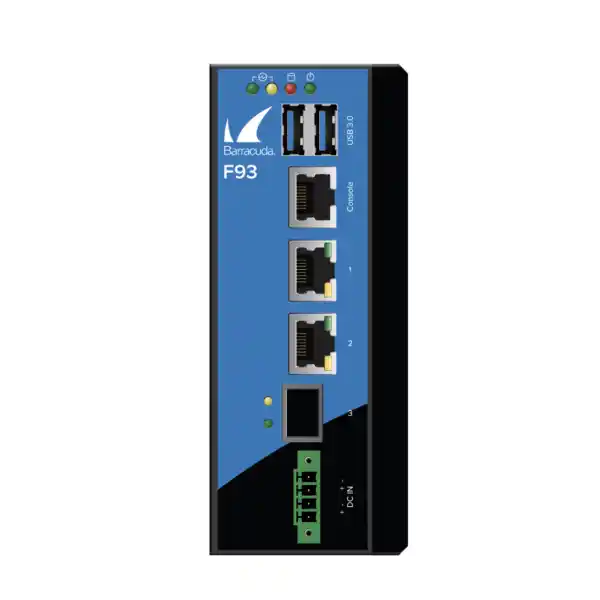
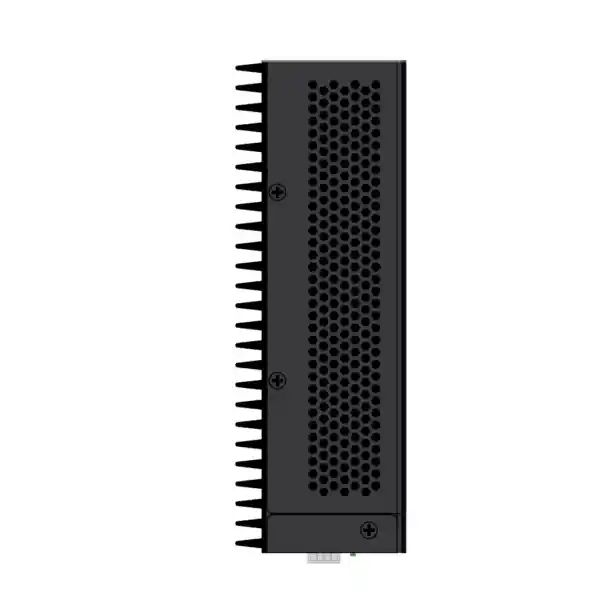
Barracuda CloudGen Firewall F93 Rugged Revision A
A compact, fanless DIN-rail CloudGen Firewall for industrial sites, utilities, transport systems, remote cabinets, production environments and distributed operational technology networks in the United Arab Emirates. The F93a.R brings policy enforcement, VPN, SD-WAN and next-generation security to locations where environmental tolerance, DC power, physical footprint and centralized operations matter as much as raw throughput.
Best suited to rugged edge, OT segmentation and secure site connectivity where two copper Gigabit interfaces plus one Gigabit SFP are sufficient and a fanless DIN-rail form factor is preferred.
What is the Barracuda CloudGen Firewall F93 Rugged Revision A?
The Barracuda CloudGen Firewall F93 Rugged Revision A, identified in Barracuda hardware documentation as the F93a.R, is an industrialized member of the CloudGen Firewall family. It is not simply a small office firewall placed inside a metal enclosure. Its hardware format, fanless cooling, DIN-rail mounting, DC input range and locking power connector make it suitable for operational environments in which a conventional desktop appliance may be mechanically inconvenient or thermally inappropriate. It is intended to sit close to industrial assets, edge switches, controllers, telemetry systems, remote site networks or other equipment that benefits from localized security enforcement.
For UAE deployments, that distinction matters. A firewall installed inside a conditioned office rack faces a very different operating environment from one mounted in a plant room, utility cabinet, roadside communications enclosure, warehouse control zone, solar facility, water infrastructure site or remote building-management location. The F93 Rugged addresses the physical side of that requirement while still participating in the same broader CloudGen Firewall security and management architecture used for enterprise networking, including stateful firewalling, intrusion prevention when appropriately licensed, application-aware controls, encrypted connectivity and software-defined WAN functions.
The central design question is therefore not whether the F93 Rugged can replace every branch firewall. It cannot and should not. The correct question is whether its port density, performance class and industrial form factor align with the traffic, segmentation and environmental profile of the site. FourTeck positions the F93 Rugged for projects where ruggedization and secure connectivity are primary requirements and where engineering teams can validate traffic volume, inspection requirements, uplink design, redundancy expectations and licensing before procurement.
2× 1GbE RJ45 + 1× 1GbE SFP
A compact three-interface design supports copper and fiber edge connectivity without adding a larger rack appliance.
Intel Atom, 2 cores
General-purpose x86 processing with 4GB RAM and a 100GB SSD in the documented Revision A hardware platform.
Compact, fanless, DIN-rail
Built for industrial mounting scenarios where low moving-part count and compact installation are operational advantages.
12–36V DC input
Locking Phoenix-style DC connectivity supports integration into industrial power architectures and engineered edge cabinets.
−20°C to +70°C appliance range
The documented appliance operating range makes it materially better suited to harsh technical spaces than ordinary office-class equipment.
OT edge and remote site security
Designed for localized policy enforcement, segmentation, VPN and SD-WAN at distributed industrial or infrastructure locations.
Hardware architecture and engineering profile
The F93 Rugged Revision A uses an Intel Atom X-Series processor with two cores, 4GB of RAM and a 100GB solid-state drive. Barracuda does not document a proprietary security ASIC for this model, so it is more accurate to understand the platform as a software-driven security appliance running on a compact x86-class embedded architecture. That matters when sizing it: throughput should be evaluated against the enabled inspection stack and the traffic profile, not inferred from port speed alone. Three Gigabit interfaces do not imply three gigabits per second of full threat inspection, and an industrial edge firewall should never be selected using interface labels as a substitute for workload sizing.
The 4GB memory footprint is appropriate to the appliance class but reinforces the need to keep the role focused. The F93 Rugged is an edge security device, not a high-density data-centre firewall. It is strongest when assigned a clearly scoped function such as protecting one industrial zone, terminating a remote site connection, isolating a building automation segment, securing a machine network, or creating a controlled boundary between operational and enterprise networks. When many VLANs, very high session counts, intensive encrypted inspection, multiple large VPN aggregates or heavy security service stacks are expected, a larger Barracuda platform may be the better engineering decision.
The 100GB SSD provides local persistent storage for the appliance operating environment and related system requirements. Because the platform is fanless, cooling does not depend on an internal fan, reducing one mechanical failure point and avoiding fan intake behavior that can draw particulate matter into an enclosure. Fanless does not mean thermally indifferent, however. Heat still has to leave the chassis by conduction and convection, so cabinet design, mounting orientation, spacing, surrounding device heat load and ambient temperature must be considered. In hot UAE technical environments, a firewall rated for a wide operating range can still be compromised by an enclosure that traps heat above the vendor limit.
The appliance measures approximately 52 × 150 × 130 mm and weighs about 1.2 kg according to Barracuda hardware documentation. That compact footprint is valuable when retrofitting security into existing industrial panels or communications cabinets. The DIN-rail clip included with the platform supports familiar industrial mounting practice, while the absence of a conventional rack form factor keeps the device close to field equipment. For design teams, the practical result is a security node that can be introduced at the physical boundary where trust changes rather than forcing every OT segment to backhaul unfiltered traffic to a distant central firewall.
Port map: copper, fiber, management and console considerations
| Physical label | OS notation | Interface type | Typical design use |
|---|---|---|---|
| 1 | p1 | 10/100/1000Mb RJ45 | Management or protected-side connectivity, subject to final configuration |
| 2 | p2 | 10/100/1000Mb RJ45 | WAN/uplink or deployment interface; used for DHCP in documented zero-touch workflows for F93 ruggedized hardware |
| 3 | p3 | 1GbE SFP fiber | Fiber uplink, long-run plant connection or optical integration where appropriate transceiver and media are selected |
Port 1 is documented as the management port in the factory-oriented hardware table. Port 2 has a special operational relevance to zero-touch deployment because Barracuda documentation identifies p2 as the DHCP client listening interface used by the F93 ruggedized platform during that workflow. Production addressing, routing, zones and interface roles should be designed explicitly after onboarding. The physical labels therefore provide a starting point, not a permanent security architecture.
The single 1GbE SFP interface is particularly useful in industrial networks because optical fiber can be preferable across electrically noisy environments, long distances or building-to-building links. The SFP network controller is fixed at the appliance level rather than being a field-replaceable network module. The transceiver inserted into the SFP cage still has to be selected for the intended optical standard, wavelength, fiber type and distance. Procurement should therefore treat the firewall and transceiver decision as two coordinated items, especially where existing plant fiber is already terminated to a specific standard.
Two USB 3.0 ports and a DB9 RS232 serial console are also documented. The serial console is important in industrial and remote operations because out-of-band troubleshooting may be needed when IP access is unavailable. Site handover should record console access procedures, cable requirements, credential ownership and escalation paths. Remote sites often fail operationally not because the firewall lacks security functions, but because basic recovery details were not documented for field technicians.
With only three data interfaces, topology design deserves attention. If the site requires separate WAN, enterprise LAN, OT LAN, DMZ and management paths as distinct physical interfaces, the F93 Rugged may need VLAN trunking through a managed switch, or the project may require a larger firewall with more physical ports. VLAN trunking can be entirely valid, but it concentrates multiple logical security zones onto fewer physical links and makes switch configuration part of the security boundary. FourTeck recommends documenting which segmentation is physical, which is VLAN-based, and what happens to critical traffic if the upstream switch fails.
Rugged power design for industrial cabinets
The power subsystem is one of the clearest reasons to choose the F93 Rugged instead of an office-oriented compact firewall. The appliance accepts 12–36V DC input and uses a locking Phoenix-style connector. Barracuda documentation lists a maximum power draw of 60W and a maximum current figure of 2.5A at 24V DC. These values should be incorporated into power budgeting rather than treated as nominal consumption. Industrial panel design should account for conductor sizing, protective devices, supply derating, DC distribution, grounding practices and the thermal effect of every device sharing the enclosure.
An external power supply is not necessarily included with the appliance and may need to be ordered separately depending on the selected power arrangement and regional bundle. Barracuda documentation also describes dual power capability using two external PSU adapters. That can be useful when the site requires redundant feeds, but redundancy only exists if the upstream power paths are actually independent. Two adapters connected to the same single-point UPS or the same unprotected circuit can improve component redundancy without eliminating the larger power-domain failure. Engineering drawings should identify the actual failure domains.
The DC input range can integrate well with automation panels, telecommunications power environments and infrastructure sites where controlled DC is already available. It can also simplify projects that deliberately avoid adding an AC adapter inside a crowded industrial enclosure. At the same time, integrators should verify the quality, stability and protection of the DC source. Voltage spikes, incorrect polarity, loose terminals or poorly engineered grounding can create failures no firewall software can mitigate. The locking connector helps maintain mechanical integrity, but it does not replace electrical engineering discipline.
For UAE projects, cabinet thermal calculations are especially important. The firewall appliance itself is documented for operation from −20°C to +70°C, while accessory power supplies can have their own environmental limits. An outdoor or semi-conditioned cabinet exposed to solar gain can exceed ambient air temperature substantially. A valid design therefore evaluates the highest local internal cabinet temperature, not only the weather forecast or nominal room set point. Where needed, shading, filtered ventilation, active cooling, heat exchangers or climate-controlled enclosures should be part of the infrastructure scope.
Performance: interpret the published numbers correctly
Barracuda has published F93a.R performance figures in the rugged and CloudGen Firewall appliance literature, including firewall throughput up to 1.5Gbps and approximately 240Mbps for VPN or SD-WAN-class performance depending on the generation and terminology of the datasheet. Published tables have also listed up to 400Mbps IPS, up to 400Mbps NGFW throughput, up to 380Mbps threat-protection throughput, approximately 80,000 concurrent sessions and about 8,000 new sessions per second. These are useful sizing anchors, but they are not a guarantee that every production workload will achieve the headline number.
The reason is straightforward: firewall performance depends on packet size, traffic direction, application mix, enabled inspection engines, encryption, rule complexity, logging, software version and the number of simultaneous flows. A large-packet UDP forwarding test is easier than inspecting diverse enterprise traffic with IPS, application control, web filtering, antivirus and encrypted tunnels active. Barracuda itself characterizes performance figures as “up to” values measured under optimized conditions and notes that actual results can vary with system configuration and infrastructure.
For industrial sites, average bandwidth can also be misleading. A supervisory control network may use modest sustained throughput but create operationally critical bursts, many long-lived sessions or strict latency expectations. A CCTV backhaul, historian replication task, engineering workstation update, remote desktop session and cloud telemetry feed can all cross the same firewall even if the core control protocol itself is lightweight. Sizing should therefore examine peak traffic, flow count, security services and business impact rather than simply reading the ISP circuit speed.
A practical sizing approach begins with the expected peak bidirectional traffic on each security boundary, then applies the inspection profile that will actually be enabled. Next, add growth headroom for new devices, software updates, additional telemetry and future segmentation. Finally, consider failover scenarios. If the site will temporarily carry traffic for another segment during maintenance or if a redundant architecture could place full load on one surviving firewall, the surviving platform must still remain within an acceptable operating envelope.
Where the required inspected throughput approaches the published ceiling, the safer option is usually to move to a larger model rather than engineer a design that depends on benchmark-perfect conditions. The F93 Rugged is compelling because it solves a specialized environmental and form-factor problem. It should not be stretched beyond that role when a higher-capacity rugged or branch platform would provide healthier operational margin.
Security services: from stateful policy to threat inspection
Stateful firewalling
CloudGen Firewall separates host-local traffic from forwarded traffic and applies access and security policy to connections crossing protected network boundaries. This provides the core enforcement layer for zone-to-zone control.
Intrusion prevention
With the relevant Energize Updates entitlement, IPS policies can inspect traffic for exploit patterns, anomalies and known malicious behavior, with centrally distributed signature updates available in managed environments.
Application control
Application Control can make application identity part of policy decisions instead of relying only on IP addresses and ports, improving visibility and control where applications share common transports.
TLS inspection
SSL/TLS inspection can provide deeper visibility into encrypted application traffic where policy, certificate governance, privacy requirements and endpoint trust are designed to support decryption.
Malware and ATP options
CloudGen Firewall can combine local scanning with subscription-based malware capabilities and Advanced Threat Protection for deeper analysis, subject to the selected license package and traffic protocol support.
Web and reputation controls
Subscription services can extend policy with updated filtering and reputation intelligence so remote or industrial edge sites can enforce organizational security standards locally.
A strong OT security design does not enable every feature indiscriminately. Industrial traffic can include legacy devices, deterministic control behavior and vendor support constraints. The correct process is to discover and classify flows, build least-privilege policy, test inspection effects in a controlled change window and then enable deeper services where risk reduction justifies the operational impact. IPS, TLS inspection and malware controls are powerful, but production control networks require deliberate rollout rather than generic office-network templates.
Operational technology and industrial-control use cases
Operational technology security is fundamentally a problem of controlled trust. Industrial devices often need to communicate with a specific controller, historian, engineering workstation, vendor service or supervisory system, but they rarely need unrestricted access to the broader corporate network or internet. The F93 Rugged can be positioned at a cell, area, building or remote-site boundary so that required flows are explicitly allowed while unnecessary paths are denied or inspected.
One common architecture places the appliance between a local industrial switch and the upstream enterprise or wide-area network. In that role, the firewall can restrict inbound administration, control outbound access, terminate encrypted site connectivity and provide a policy boundary around assets that may not support modern endpoint security software. Another architecture uses the F93 Rugged to isolate a machine network or building-management segment from a shared site LAN. The security value comes from narrowing communication paths and creating enforceable choke points rather than assuming every device on the site should trust every other device.
Remote utility and infrastructure sites are another strong fit. Pump stations, telemetry cabinets, solar assets, substations, roadside systems and distributed facilities frequently have minimal local IT staff. A centrally managed firewall can provide consistent configuration while reducing the number of changes a field technician must make on site. Zero-touch deployment is particularly valuable here because the device can be staged to obtain connectivity and contact centralized management without requiring the installer to build the entire policy manually at the remote location.
Industrial protocol awareness can improve policy design, but it should be paired with network-level segmentation. Application identification is not a substitute for good zone architecture. If a PLC network should only communicate with two supervisory servers, the rulebase should express that restriction at the network layer first; application-aware inspection can then add another layer of context. This layered model is easier to audit and reduces dependence on any single detection method.
For organizations aligning with IEC 62443 concepts or internal OT-security frameworks, the F93 Rugged can support a zones-and-conduits approach by enforcing boundaries between groups of assets. Compliance, however, is a property of the overall system and process, not a certification automatically inherited from installing a firewall. Asset inventory, secure remote access, patch governance, identity, logging, backup, change management, incident response and physical security remain essential alongside the network control point.
SD-WAN and resilient site connectivity
CloudGen Firewall includes SD-WAN capabilities that allow policy to consider available uplinks and application requirements rather than treating every connection as a static route. At a distributed industrial site, this can help combine primary and secondary connectivity such as fiber, business broadband or an upstream cellular router. The exact topology depends on the available interfaces and supporting equipment, but the operational objective is to keep critical traffic on the most appropriate path and provide a controlled failover method when the preferred circuit fails.
Because the F93 Rugged has a limited number of physical interfaces, multi-uplink designs need to be engineered carefully. A fiber SFP uplink and copper connection can support useful combinations, but the requirement for LAN, management, secondary WAN and separate OT zones can quickly consume ports. VLANs through an industrial managed switch can extend logical segmentation, but that choice should be documented and tested. The firewall is only one component of an SD-WAN design; upstream modems, routing handoffs, provider addressing and failover behavior are equally important.
Application-based provider selection is valuable when certain services deserve higher-quality links. For example, operational telemetry and interactive engineering access may need low latency and stability, while bulk software downloads can tolerate a less preferred path. Policy can be designed so that important application classes use the stronger transport when available while lower-priority traffic uses alternate capacity. This is more meaningful than simple active/standby routing because the network can make path decisions aligned to business or operational behavior.
For UAE organizations with remote facilities, SD-WAN should be paired with provider-diversity analysis. Two circuits are not truly diverse if they share the same last-mile trench, upstream aggregation or building entry point. When high availability matters, FourTeck can help map the firewall design to the actual carrier architecture, local power domain and switching topology so that failover testing validates real independence rather than only configuration syntax.
VPN architecture for remote plants, branches and engineering access
The CloudGen Firewall platform supports site-to-site and client-to-site VPN services, including Barracuda’s TINA technology and IPsec options within the broader product family. For the F93 Rugged, the primary industrial value is secure connectivity between a remote site and a central network or management zone. A VPN can protect traffic across public or third-party transport while keeping routing and security policy under enterprise control.
Site-to-site VPN is commonly used for permanent connectivity between a plant, facility or remote cabinet and a headquarters, data centre or cloud-connected hub. The tunnel design should define which subnets are reachable, whether routing is static or dynamic, how failover works across alternate transports, and how monitoring distinguishes an underlay outage from a tunnel problem. Industrial networks should avoid broad “any-to-any” encryption domains merely because a VPN is secure cryptographically. Encryption protects transport; it does not automatically provide least privilege.
Client-to-site access can support engineers, administrators or authorized vendors, but remote access into OT should generally be more tightly controlled than ordinary office VPN. Recommended controls include named accounts, strong authentication, role-based authorization, time-bounded vendor access, jump hosts where appropriate, restricted destination networks and detailed logging. The firewall should be part of a complete remote-access chain rather than the sole control protecting critical industrial equipment.
The published performance class around 240Mbps for VPN/SD-WAN-style workloads should be considered when the site will carry large encrypted backups, camera traffic, software distribution or replicated data. A control network may need only a small fraction of that bandwidth, while a converged remote site can consume it quickly. Size the encrypted workload separately from ordinary firewall forwarding because cryptographic processing changes the resource profile.
Organizations should also document tunnel ownership and certificate lifecycle. Long-lived industrial sites can remain installed for many years, while certificates, cryptographic policy and remote-access requirements evolve. A reliable design includes a process for certificate renewal, credential removal when contractors change, VPN peer updates, key rotation and recovery if centralized management is unavailable.
Centralized management and zero-touch deployment
Distributed firewalls create a management challenge when each appliance is configured independently. CloudGen Firewall environments can be centrally managed through Barracuda Firewall Control Center, which is particularly relevant to fleets of remote industrial or branch devices. Central policy management helps standardize configuration, distribute updates, coordinate security patterns and reduce site-by-site administrative drift.
Zero-touch deployment can reduce staging effort at remote sites. Barracuda documents support for zero-touch deployment across F-Series hardware and specifically identifies port p2 as the DHCP client port used by the F93 ruggedized appliance in the onboarding workflow. In practical terms, the firewall can be delivered to a location where an installer connects the specified interface to a network that provides DHCP and internet reachability. The device can then establish the connectivity needed for centrally orchestrated deployment, assuming the Control Center and provisioning prerequisites have been prepared correctly.
The benefit is operational consistency rather than magic. Someone still needs to plan addressing, security zones, VPN parameters, licensing, certificates, software versions, rollback strategy and acceptance tests. Zero touch simply reduces the amount of expertise required at the physical installation point. This is valuable for geographically dispersed UAE sites where a field technician may be comfortable mounting equipment and connecting cables but should not be expected to design firewall policy on location.
A robust rollout model separates factory or staging tasks from site tasks. Staging should define the intended configuration and verify serial numbers, licensing, software baseline and management registration. Site installation should verify power polarity, grounding, enclosure temperature, DIN-rail mounting, copper/fiber labeling and uplink readiness. Central operations should then confirm that the device has checked in, received the intended configuration, established tunnels and is forwarding only approved traffic. This division of responsibility makes rollout repeatable.
Large fleets should also use change windows and configuration governance. A central platform can accelerate deployment, but it can also propagate a bad change quickly. Policy templates, peer review, staged rollout groups and tested rollback procedures reduce that risk. The goal is to combine the efficiency of centralized management with the caution required for industrial networks.
Licensing and subscriptions: what UAE buyers should specify
Barracuda CloudGen Firewall hardware uses a base license associated with the appliance, while additional security capabilities and update services depend on subscription entitlements. Barracuda documentation identifies Energize Updates as mandatory for the first year of a hardware firewall purchase. The licensing family can also include Malware Protection, Advanced Threat Protection, Advanced Remote Access and Firewall Insights. Exact bundles, support levels and renewal terms should be confirmed on the commercial quotation because the useful security posture depends on more than the hardware chassis alone.
Energize Updates is particularly important because current security controls need current intelligence. Barracuda documentation ties IPS signature updates and full Application Control behavior to an active Energize Updates subscription. A firewall can continue to provide certain base capabilities after entitlement changes, but buyers should not assume that a hardware purchase permanently includes every cloud-fed security service. Renewal planning therefore belongs in the lifecycle budget from the beginning.
Advanced malware and threat protection should be selected according to traffic exposure and inspection strategy. If the F93 Rugged protects a tightly controlled machine segment that has no web browsing and only a few defined industrial flows, the security stack may differ from a remote branch that also supports user traffic. Conversely, a site that allows engineering workstations, file transfer or internet-connected maintenance activity can benefit from deeper threat controls. Subscription choice should follow the risk model instead of applying identical licensing mechanically to every location.
Centralized environments should also decide whether individual licensing, pool licensing or enterprise arrangements better fit the operating model. Barracuda provides mechanisms for managed firewalls through Firewall Control Center, including assignment and update of supported license types. Fleet scale, growth plans and administrative ownership affect the commercial choice. A project with two rugged firewalls has different operational economics from a rollout of dozens or hundreds of sites.
When requesting a FourTeck quotation, specify the desired subscription duration, support level, threat-security features and any redundancy requirements at the same time as the appliance. This reduces the risk of receiving hardware that cannot be deployed with the intended functionality on day one. For related UAE network-security planning, customers can review FourTeck Firewall Dubai and broader enterprise solutions through FourTeck UAE.
Sizing methodology for the F93 Rugged
Correct firewall sizing is a workload exercise. Start with the security boundary: identify every source network, destination network, uplink and service that will cross the F93 Rugged. Then estimate peak throughput in both directions, concurrent sessions, connection rates and the proportion of traffic that will be encrypted or deeply inspected. Industrial protocols may use modest bandwidth, but surrounding services such as Windows updates, historian synchronization, remote desktop, camera streams, backups and engineering downloads can dominate the real traffic profile.
Next, define the security feature stack. Basic stateful firewall forwarding has a different performance profile from IPS, application control, web filtering, malware scanning and TLS inspection running together. The published threat-protection figure is generally a more realistic reference than raw firewall throughput when multiple inspection services are enabled. Where the design depends on consistently high inspected throughput, reserve headroom rather than sizing the appliance exactly to the benchmark.
Session count is equally important. Industrial systems often maintain long-lived TCP connections, while user or IoT traffic can create many short sessions. Published figures around 80,000 concurrent sessions and 8,000 new sessions per second provide an upper performance reference, but operational design should remain comfortably below limits. Logging intensity, policy complexity and software services also consume resources. Monitoring after deployment is essential to validate the original assumptions.
Then assess interfaces. The F93 Rugged provides two copper Gigabit interfaces and one Gigabit SFP. That is elegant for a simple three-zone design, but complex sites may require more logical networks. VLANs can increase segmentation without adding physical ports, yet they shift dependency to the connected switch. If the firewall must directly terminate several WAN circuits, a DMZ, an OT LAN, an IT LAN and a dedicated management network, a higher-port-density model may be more appropriate.
Environmental sizing is the final layer. Confirm the worst-case cabinet temperature, humidity, ingress protection of the enclosure, vibration environment and power quality. The firewall carries IP20 protection, so the appliance itself is not a sealed outdoor device. If it is installed in dusty, wet or exposed conditions, a suitable outer enclosure is mandatory. IP20 primarily addresses limited solid-object protection and does not provide weatherproofing. Outdoor deployment therefore depends on the cabinet, not the firewall chassis alone.
A good sizing document ends with a margin statement: current peak load, projected growth, enabled services, expected failover load and chosen platform headroom. This creates an auditable reason for selecting the F93 Rugged and makes future capacity reviews easier.
Deployment patterns that match the platform
1. OT zone boundary
Place the F93 Rugged between an industrial cell or area network and the site backbone. Permit only required controller, historian, engineering and monitoring flows. This reduces lateral movement opportunities and creates a policy checkpoint close to the assets being protected.
2. Remote infrastructure site
Use the firewall at a small unattended facility with local Ethernet, a fiber or copper uplink, and encrypted connectivity to a central site. Central management and zero-touch deployment simplify fleet operations where local IT expertise is limited.
3. Industrial DMZ edge
Protect a small intermediary network containing jump services, data-transfer nodes or monitoring systems between OT and enterprise zones. The appliance can enforce directional access rules and reduce uncontrolled direct connectivity.
4. Building-management segmentation
Separate BMS, HVAC, access-control or facilities systems from the office LAN while preserving approved management and telemetry flows. This is useful when facilities devices cannot host modern endpoint agents or should not share trust with user endpoints.
5. Secure machine or production line
Create a controlled boundary around specialized machinery, test equipment or manufacturing cells. The firewall limits communication to approved services and can provide secure remote access through a governed path.
6. Rugged branch edge
Deploy the appliance where a small branch has environmental constraints that rule out ordinary desktop hardware. VPN and SD-WAN capabilities can connect the location into the enterprise while maintaining local security enforcement.
Segmentation strategy for industrial networks
The most valuable firewall rule in an industrial environment is often a denied path that never needed to exist. Many legacy networks evolved as flat Layer 2 domains because operational simplicity was prioritized over security. That architecture creates broad trust: a compromised engineering laptop, unmanaged vendor device or misconfigured system can potentially reach equipment far outside its intended scope. The F93 Rugged can support a transition toward explicit segmentation by introducing routed security boundaries at selected points.
Start by grouping assets according to function and required communication, not only physical location. Controllers that communicate with the same supervisory servers may belong in one security zone even if they occupy different cabinets, while a vendor-maintained subsystem may deserve its own zone despite sharing a room. The firewall policy should then describe the authorized conduits between zones using source, destination, service, application context and inspection controls as appropriate.
Avoid using “any” objects as a permanent shortcut. During discovery, broader logging rules can help identify legitimate flows, but the production target should be a concise allowlist with documented owners. Every permitted cross-zone service should have a business or operational reason. If a controller only needs NTP, DNS through approved infrastructure and a specific historian connection, the firewall should not also allow general internet browsing.
Management traffic deserves its own treatment. Administrative access to the firewall, switches, PLCs and servers should originate from controlled management stations or jump hosts rather than from arbitrary user networks. If p1 is retained for management, document the management source ranges and protect them. If management is carried over a tagged interface, ensure that the switch and VLAN configuration do not accidentally expose it to untrusted hosts.
Segmentation changes should be introduced with operations teams, because an undocumented dependency can interrupt production. Packet captures, flow logs, asset inventories and maintenance windows help convert assumptions into verified policy. The firewall becomes most effective when its rulebase reflects the real process relationships of the site instead of a generic network diagram.
UAE environmental and installation planning
The United Arab Emirates combines sophisticated infrastructure with demanding environmental conditions. Industrial security equipment may be installed in fully conditioned control rooms, partially cooled warehouses, rooftop plant areas, telecom cabinets, utility spaces or remote outdoor enclosures. The F93 Rugged’s wide documented operating-temperature range is useful, but the installation must be designed around the actual microenvironment of the appliance.
Solar loading is one of the most commonly underestimated factors. An outdoor cabinet exposed to direct sun can develop internal temperatures substantially higher than ambient shade temperature. Nearby drives, power supplies and network switches add further heat. The firewall’s 60W maximum draw is part of the enclosure heat budget, not an isolated specification. Designers should assess worst-case internal temperature with all equipment active and with cooling components operating in their degraded or maintenance state.
Dust and humidity are also important. The appliance is documented to IP20, so it should not be treated as dust-tight or water-resistant. In harsh areas it belongs inside an appropriately rated enclosure with cable glands, filtration or sealing suitable for the location. Non-condensing humidity limits must be respected. Rapid temperature transitions can produce condensation even when average humidity appears acceptable, so environmental control should consider operating cycles, door opening and maintenance conditions.
Fiber connectivity can be helpful where electromagnetic interference, distance or ground potential makes copper less desirable. The single SFP port gives designers an optical option, but transceiver compatibility and fiber type must be confirmed. Industrial sites often contain legacy multimode fiber, single-mode backbone links and media converters accumulated over years. A survey should record connector type, wavelength, strand availability, loss budget and remote switch capability before the transceiver is ordered.
Power quality should receive equal attention. Industrial sites can experience switching transients, generator transitions and DC bus fluctuations. The 12–36V DC input offers flexibility, but the source should be engineered with appropriate protection and grounding. If redundant external adapters are chosen, place them on genuinely independent upstream supplies where resilience is a project requirement.
FourTeck can coordinate firewall deployment with broader IT services in the UAE, helping align network security with switching, cabling, remote-site connectivity, commissioning and operational handover rather than treating the appliance as an isolated box.
High availability, resilience and failure-domain thinking
Rugged hardware is only one part of availability. A site can use an industrial firewall and still experience an outage because the upstream switch, power supply, carrier circuit, SFP, fiber path or configuration fails. Resilience therefore starts by identifying failure domains. If the process can tolerate a short outage, a single F93 Rugged may be appropriate. If connectivity is mission critical, the design should evaluate redundant firewall architecture, redundant switching, independent power and diverse WAN paths.
The dual-power capability described for the F93 Rugged can reduce the chance that a single power adapter failure takes the firewall offline, but it should be integrated thoughtfully. Use independent protective devices and, where possible, independent DC or AC source paths. Document which power source feeds each adapter. During commissioning, fail each feed deliberately and confirm that the appliance remains stable.
Network redundancy must also be tested under realistic conditions. If an SFP fiber link is the primary uplink and copper is the backup, verify route convergence, VPN behavior, SD-WAN policy, monitoring alerts and return-path symmetry. Failover that works for a simple ping can still break industrial applications if session state, source addressing or upstream routing changes unexpectedly. Application owners should participate in acceptance tests for critical services.
Configuration resilience is another failure domain. Maintain current backups, document recovery procedures and ensure administrators can access the serial console if network management is unavailable. Centralized management should not become a single point of operational dependency without contingency procedures. Sites that must continue operating during a management-system outage should have a clear understanding of which functions are local and which require centralized services.
Finally, spare strategy should reflect logistics. For remote facilities, replacement time may matter more than component MTBF. Barracuda supports cold-spare licensing processes in the CloudGen Firewall family, but entitlement transfer and support workflow should be confirmed before relying on a spare. A spare appliance has little value if nobody has documented how to activate, configure and physically replace it during an outage.
Logging, monitoring and incident response
A firewall that blocks threats but provides poor operational visibility is difficult to run. The F93 Rugged should be integrated into the organization’s monitoring model so that administrators can see interface state, tunnel health, policy matches, security events, resource utilization and abnormal traffic. Centralized logging is especially important at remote sites because local access may be slow or restricted during an incident.
OT environments benefit from baseline-driven monitoring. Normal industrial traffic is often more predictable than office traffic: controllers poll known devices, historians receive recurring data, and engineering access occurs during defined windows. Deviations can therefore be meaningful. Firewall logs can reveal a device suddenly initiating internet connections, a vendor workstation scanning new addresses, or a protocol appearing between zones where it was not previously observed. These events should feed a broader incident process rather than remain only inside the appliance interface.
Logging policy needs balance. Recording every permitted packet indefinitely can overwhelm storage and analysis, while logging too little erases valuable evidence. Define which rules log session starts, session ends, denies and security events. High-risk conduits such as remote administration or vendor access usually deserve stronger audit detail than routine telemetry. Retention should align with organizational policy, investigation needs and any applicable regulatory obligations.
Time synchronization is essential. Firewall logs are only useful when their timestamps correlate with switches, servers, controllers and monitoring systems. Use approved NTP sources and verify that remote sites maintain accurate time even during partial connectivity failures. Incident investigations become unnecessarily difficult when devices disagree by minutes or hours.
Operational monitoring should also include capacity. Track interface utilization, CPU, memory, session counts and security-engine behavior over time. This creates evidence for upgrades before performance becomes a production problem. A rugged firewall can remain physically healthy for years while its workload gradually outgrows the original sizing assumption.
Change management and lifecycle operations
Industrial firewalls often remain in service longer than typical office edge devices, so lifecycle planning should begin at installation. Record the exact model and revision, serial number, software version, license state, installed SFP, power arrangement, IP addressing, VLANs, routing, VPN peers and physical cabinet location. Photographs of wiring and labels can be surprisingly valuable during remote troubleshooting.
Software upgrades should be scheduled around operational risk. Review release notes, backup configuration, verify the rollback process and understand whether a reboot is required. In a fleet, upgrade a small representative group before deploying broadly. Sites with unique industrial protocols or vendor equipment may need additional validation because a change that is harmless for office traffic can expose an undocumented compatibility issue in a control environment.
Rule changes should have owners and reasons. Over time, temporary exceptions are a major source of policy decay. Every emergency allow rule should carry a review date, and rules for decommissioned devices should be removed. Periodic recertification can compare the rulebase with the current asset inventory and process design. Central management makes this easier, but governance still requires people to decide what is legitimately needed.
Subscription renewal is another lifecycle task. Security intelligence, support and advanced services depend on active entitlements. Track renewal dates centrally and align them with budget cycles. If a site is scheduled for decommissioning or hardware refresh, that plan can inform whether a multi-year renewal makes sense. Conversely, allowing a critical site subscription to lapse accidentally can reduce the security functions expected by the design.
Hardware replacement should be planned before end-of-life pressure appears. Keep a record of vendor lifecycle notices, supported software versions and spare availability. Rugged installations may require site permits, access windows or specialized technicians, so a refresh can take longer than replacing an office rack appliance. Lifecycle visibility prevents procurement from becoming an emergency.
When the F93 Rugged is the right choice—and when it is not
Choose it when
The site needs a compact, fanless, DIN-rail firewall with industrial DC input and a wide operating temperature range.
Two copper Gigabit ports plus one Gigabit SFP are sufficient for the planned topology or VLAN design.
The traffic and inspection workload fit comfortably within the F93 performance class with appropriate headroom.
Centralized management, VPN or SD-WAN are valuable for a distributed remote location.
Select a larger platform when
The design requires many dedicated physical interfaces, multiple high-speed uplinks or dense segmentation without relying on VLAN trunks.
Inspected throughput, encrypted traffic or session volume approaches the published limits of the appliance.
The site aggregates substantial CCTV, backup, user and application traffic in addition to OT control flows.
High availability or future expansion would be constrained by the compact platform and available ports.
This distinction protects the project from two common mistakes: buying an oversized enterprise appliance solely because the environment is industrial, or choosing the smallest rugged firewall solely because average bandwidth looks low. The F93 Rugged is a specialized tool. It is highly effective when the environmental need and security workload match its design envelope.
Procurement details for UAE projects
A complete quotation should identify more than the firewall model. The BOM should state Barracuda CloudGen Firewall F93 Rugged Revision A, selected licensing term, required security subscriptions, support level, power-supply arrangement, SFP transceiver if fiber is used, mounting expectations and any cabling or industrial enclosure work. If the appliance will be centrally managed, include the relevant Control Center requirements in the architecture and commercial scope.
Power deserves explicit line items because the external supply may need to be ordered separately. Confirm whether the project will use the industrial DC input directly, one external adapter, or a redundant pair. If the client provides the DC source, record its voltage range and available current so commissioning does not discover an incompatible supply at the last minute. Where adapters are specified, confirm plug type, input voltage suitability and environmental placement.
Fiber projects should specify the SFP rather than leaving it as an assumption. Document single-mode or multimode fiber, speed, wavelength, connector type and distance. Because the appliance exposes one 1GbE SFP interface, the connected switch or carrier handoff must support a compatible Gigabit optical standard. If the existing network uses SFP+ at 10GbE only, confirm backward compatibility or use an appropriate intermediary design rather than assuming the ports will negotiate.
For multi-site rollouts, include staging and labeling. Each device should be associated with a site code before shipment, and the rollout sheet should record serial number, intended hostname, management assignment, WAN method and installation contact. This enables zero-touch workflows to remain controlled even when many appliances are being deployed in parallel.
FourTeck can also support projects extending beyond the UAE through its Africa technology network, which is useful for organizations standardizing rugged security across regional sites while maintaining a common technical design and documentation approach.
Technical specification reference
| Barracuda CloudGen Firewall F93 Rugged Revision A | |
|---|---|
| Model designation | F93a.R / F93 Revision A Rugged |
| CPU | Intel Atom X-Series, 2 cores |
| Memory | 4GB RAM |
| Storage | 100GB SSD |
| Copper interfaces | 2 × 10/100/1000Mb RJ45 |
| Fiber interface | 1 × 1GbE SFP optical interface |
| USB | 2 × USB 3.0 |
| Serial console | 1 × DB9 RS232 |
| Form factor | Compact industrial, DIN-rail mountable |
| Cooling | Fanless |
| Appliance dimensions | Approx. 52 × 150 × 130 mm |
| Appliance weight | Approx. 1.2 kg |
| Operating temperature | −20°C to +70°C appliance range |
| Storage temperature | −55°C to +85°C |
| Operating humidity | 5% to 90%, non-condensing |
| DC input | 12–36V DC |
| Maximum power draw | 60W |
| Maximum current at 24V DC | 2.5A |
| Power connector | Locking Phoenix-style connector |
| Protection class | IP20 |
| Published firewall throughput | Up to 1.5Gbps under vendor test conditions |
| Published VPN / SD-WAN-class throughput | Around 240Mbps in published F93a.R performance tables; terminology varies by datasheet generation |
| Published IPS throughput | Up to 400Mbps in published performance tables |
| Published NGFW throughput | Up to 400Mbps in published performance tables |
| Published threat-protection throughput | Up to 380Mbps in published performance tables |
| Published concurrent sessions | Up to 80,000 in published performance tables |
| Published new sessions per second | Up to 8,000 in published performance tables |
Specifications and performance figures are based on Barracuda documentation for the F93 Revision A rugged platform and are subject to vendor change, software version, enabled services, configuration and test methodology. Confirm the current manufacturer datasheet and exact commercial bundle before final purchase.
Design notes for brownfield industrial sites
Brownfield environments deserve special attention because diagrams and reality often differ. Before inserting the firewall, perform passive discovery where possible. Record active IP addresses, MAC vendors, switch uplinks, VLANs, routing, multicast behavior and recurring communication pairs. Industrial systems may contain undocumented static routes, hard-coded IP addresses or broadcast dependencies that a new routed boundary will expose.
Do not assume every legacy protocol will tolerate NAT or asymmetric routing. If the security design changes addressing, test the application behavior with the control-system vendor. Some protocols embed addresses in payloads or depend on broadcast discovery. In those cases, segmentation may require specific routing, proxies or architecture changes rather than a simple firewall rule.
Maintenance access is another brownfield issue. A machine vendor may connect periodically using a laptop and expect direct Layer 2 reachability. Replacing that practice with controlled remote access or a jump host improves security but changes the support process. The project should involve the vendor early and record the approved method in service documentation so technicians do not bypass the firewall during the next outage.
Rollback planning is essential during the first cutover. Label cables, retain the original topology diagram and define exactly how to restore the previous path if a critical application fails. A successful firewall installation is not one in which every cable is changed at once; it is one in which each control is introduced methodically and validated against process requirements.
After stabilization, tighten policy based on observed traffic. Temporary broad rules used during migration should not become permanent. Review logs with operations personnel, identify legitimate flows and convert the rulebase into explicit least-privilege policy. This staged process is often safer than attempting perfect industrial policy from incomplete documentation before the firewall sees real traffic.
Security architecture beyond the firewall
The F93 Rugged is most effective as one layer in a defense-in-depth architecture. Endpoint controls remain important on engineering workstations and servers that can support them. Managed switches should enforce appropriate VLAN and port-security settings. Identity systems should govern administrative access. Backups should protect critical configurations and process data. Monitoring should correlate firewall events with endpoint, server and operational telemetry.
Physical security matters too. A DIN-rail firewall in an unlocked cabinet can be bypassed by moving a cable. Cabinets should be controlled according to site risk, and network ports should be labeled without exposing unnecessary security details to casual access. Console access and spare ports should be treated as administrative interfaces, not convenience connections.
Remote-access architecture should minimize direct exposure of control assets. Even when the firewall supports client VPN, organizations may prefer a layered model in which remote users authenticate strongly, land on a hardened jump host and then access only approved targets. Session recording or additional approval can be added for sensitive environments. The firewall enforces network policy around this path, while identity and host controls govern the user session itself.
Patch management is another complementary control. An IPS can reduce risk from known exploits, but it should not become a permanent excuse to avoid supported updates. Industrial patching may require long validation cycles, so network controls can provide compensating protection while updates are tested. The long-term objective should still be to reduce known vulnerabilities where vendor support and process safety allow.
For broader network modernization, FourTeck can combine firewall architecture with enterprise infrastructure, site connectivity and managed support. The value is not simply adding devices; it is ensuring that switching, addressing, routing, security policy, monitoring and operational documentation work together as one system.
Frequently asked technical questions
Is the F93 Rugged fanless?
Yes. Barracuda documents the F93 Revision A Rugged as a fanless compact industrial appliance. Fanless cooling is helpful in industrial cabinets, but the enclosure must still dissipate heat and remain within the operating-temperature limit.
Can it mount on DIN rail?
Yes. DIN-rail mounting is a defining mechanical feature of the rugged model, and Barracuda documentation lists a DIN-rail mounting clip with the appliance packaging.
Does it have a fiber port?
Yes. The F93a.R provides one 1GbE SFP interface in addition to two 1GbE copper RJ45 interfaces. The correct SFP transceiver must be selected for the project’s fiber type and distance.
Can it run from industrial DC power?
Yes. The appliance supports a documented 12–36V DC input using a locking Phoenix-style connector, making it suitable for properly engineered industrial DC distribution systems.
Is the power supply included?
Barracuda documentation notes that an external power supply is not included in the standard packaging and may need to be ordered separately. Confirm the chosen power method on the quotation.
Can it work in very hot spaces?
The appliance is documented for −20°C to +70°C operation, but the actual enclosure temperature must stay within the limit. Outdoor cabinets exposed to direct sun can be significantly hotter than ambient conditions.
Is it weatherproof?
No. The device is documented as IP20. Outdoor, wet, dusty or exposed installations require a suitably rated protective enclosure designed for the local environment.
Does it support zero-touch deployment?
Yes. Barracuda documents zero-touch deployment for F-Series appliances and identifies p2 as the DHCP client interface for the F93 ruggedized model during the onboarding workflow.
Does it support VPN?
Yes. CloudGen Firewall supports site-to-site and client-to-site VPN capabilities. The design should confirm protocol, authentication, routing, redundancy and expected encrypted throughput.
Is IPS included automatically forever?
Current IPS intelligence depends on subscription services. Barracuda documentation requires a valid Energize Updates subscription for IPS pattern updates. Licensing should be confirmed for the intended term.
Can it replace a large branch firewall?
Only when the workload and interface requirements fit. The F93 Rugged is optimized for compact industrial edge roles. High traffic, dense port requirements or heavy inspection may justify a larger platform.
Can FourTeck assist with deployment?
Yes. FourTeck can scope the appliance, licensing, fiber/copper connectivity, segmentation, migration, testing and handover as part of a UAE network-security project.
Decision recap: is the F93 Rugged Revision A suitable for your site?
Choose the Barracuda CloudGen Firewall F93 Rugged Revision A when the site needs a physically compact, fanless, DIN-rail security platform with industrial DC input, a fiber option and centralized CloudGen Firewall capabilities. Its strongest use cases are OT segmentation, remote infrastructure, small industrial branches, building-management networks and secure edge zones where the traffic profile remains within the model’s performance class.
Do not choose it only because the name says “rugged.” Validate the complete design: interface count, VLAN dependence, inspected throughput, VPN load, concurrent sessions, high-availability requirement, cabinet temperature, IP protection, power source, fiber standard, licensing and support. The right firewall is the smallest platform that satisfies these requirements with sensible growth and failover headroom—not the smallest appliance that can technically pass today’s traffic.
DIN rail, cabinet dimensions, thermal margin, IP-rated enclosure where needed and correct grounding.
Two copper Gigabit ports and one Gigabit SFP match the logical and physical topology.
Required IPS, application control, malware, TLS inspection, VPN and SD-WAN functions are licensed and sized.
Management, monitoring, backups, upgrade windows, spare strategy and remote support processes are defined.
Quotation input checklist
Providing the following information enables a more accurate UAE quotation and avoids undersizing, missing accessories or unclear commissioning scope.
Plan a Barracuda F93 Rugged deployment with FourTeck UAE
FourTeck can help validate whether the F93 Rugged Revision A is the right model for your industrial or remote-site workload, then scope licensing, SFP connectivity, power architecture, VLAN segmentation, VPN, SD-WAN, zero-touch staging and commissioning. The objective is a deployable design rather than a hardware-only quotation.
For UAE organizations standardizing security across multiple sites, the same engagement can define naming, policy templates, monitoring, change control and rollout documentation so each rugged firewall becomes part of a repeatable operating model. Begin with the site topology, environmental conditions, peak traffic and required security services; FourTeck can translate those inputs into the appliance, subscription and implementation scope.
A correctly sized rugged firewall, complete BOM, deployment plan, segmentation policy approach and documented handover for UAE operations.

Reviews
There are no reviews yet.