
Industrial Edge Security • Dubai & UAE
Barracuda Secure Connector SC3 for Secure IoT, OT and Micro-Branch Connectivity
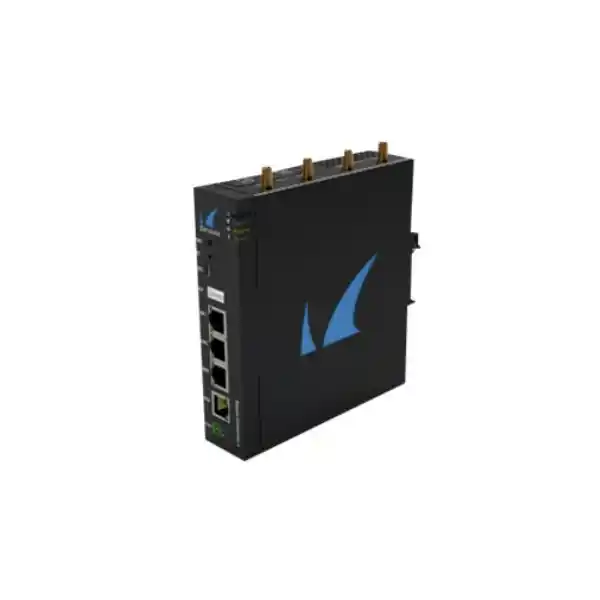
The Barracuda Secure Connector SC3 is a ruggedized compact network appliance built for organizations that need to connect small remote networks, industrial equipment, machines, kiosks, retail systems, telemetry devices, branch infrastructure or other operational endpoints to a centrally governed security architecture. Rather than treating every tiny site like a conventional office branch with a full-sized firewall stack, the SC3 provides a focused edge platform that can establish protected connectivity, support resilient uplinks and participate in Barracuda centralized management at scale.
3 × 1 GbE LAN
PoE+ Receiving WAN
DIN-Rail Ready
Wi-Fi / LTE Options
Centralized Lifecycle Control
What the Barracuda Secure Connector SC3 is designed to solve
Distributed enterprises increasingly operate networks in places where a conventional branch firewall is either physically oversized, operationally complicated or financially difficult to justify. Examples include automated teller machines, vending installations, surveillance and access-control points, HVAC controllers, building-management equipment, water-treatment installations, traffic systems, medical diagnostics devices, manufacturing cells, remote telemetry cabinets, renewable-energy locations, smart-city assets and small retail or service locations. These environments still need identity-aware policy, encrypted communications, segmentation, controlled internet access, centralized configuration and predictable failover. The SC3 is intended for precisely this edge problem.
At the network edge, the appliance aggregates local Ethernet-connected devices through three Gigabit LAN switch interfaces and uses its WAN connection to reach the organization’s secure overlay. Depending on the chosen SC3 variant and design, Wi-Fi or integrated cellular connectivity can add alternative access methods. Barracuda’s Secure Connector architecture is built around centrally managed VPN and policy workflows, allowing a large number of remote devices or micro-networks to be administered from the data center or security operations architecture rather than configured independently at each physical site.
For a UAE deployment, this architecture is especially useful when sites are geographically distributed across Dubai, Abu Dhabi, Sharjah, Ajman, Ras Al Khaimah, Fujairah or Umm Al Quwain, or when equipment must be installed inside industrial cabinets, warehouses, retail back rooms, substations, remote compounds or managed facilities. The ability to standardize one edge design and replicate it across many small sites can reduce the operational inconsistency that commonly appears when organizations use consumer routers, unmanaged LTE gateways or one-off VPN devices.
FourTeck can help organizations position the SC3 within a broader security and connectivity plan. For UAE infrastructure planning, customers can also explore Firewall Dubai for perimeter and branch security requirements, FourTeck UAE for wider enterprise infrastructure sourcing, FourTeck IT Services UAE for implementation and lifecycle support, and FourTeck Africa when the same secure edge standard must be extended to regional operations beyond the Gulf.
SC3 family model selection: SC30, SC31, SC34 and SC35
SC3 is a hardware family rather than a single connectivity combination. Selecting the correct submodel matters because the Ethernet platform is common while wireless and cellular capabilities vary. The decision should be driven by the access circuits available at the installation point, the need for secondary connectivity, radio policy, environmental constraints and whether the appliance must operate as a Wi-Fi client or local access point.
SC30
Core rugged Ethernet model. It provides the SC3 wired platform without integrated Wi-Fi or integrated cellular radio. It is a strong fit where the site already has reliable wired WAN and the protected equipment is Ethernet-based, or where an approved external modem is preferred for backup connectivity.
SC31
Adds integrated 2.4 GHz Wi-Fi capability supporting access-point or client-mode use cases. It is suitable for locations where Wi-Fi provides local device attachment or where the uplink design benefits from wireless client connectivity while cellular service is not required.
SC34
Adds integrated 3G/UMTS and 4G/LTE capability while omitting integrated Wi-Fi. This configuration is appropriate when cellular resilience or cellular primary access is required but the local protected segment remains wired.
SC35
Combines integrated Wi-Fi with integrated cellular support, providing the broadest native access flexibility in the SC3 family. It is typically the preferred candidate for sites that may need wired WAN, Wi-Fi and cellular options in a single rugged edge appliance.
Model capabilities should always be validated against the exact hardware revision, country radio approvals, carrier requirements and current Barracuda ordering information before purchase. Integrated-radio requirements are particularly important in regulated, industrial, healthcare and critical-infrastructure environments.
Physical interfaces and port-map engineering
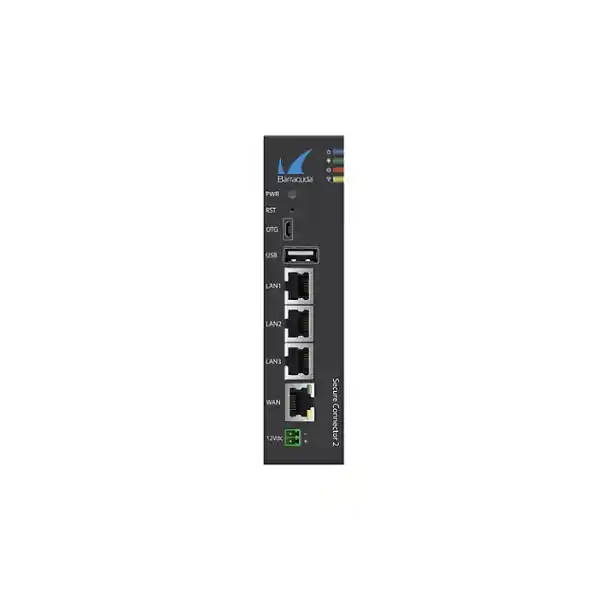
The SC3’s physical layout is deliberately simple. The default Ethernet mapping provides one WAN interface and three LAN switch ports, all operating at 10/100/1000 Mbps over RJ45. Barracuda documentation identifies the WAN interface as the management-capable interface in the default hardware mapping. The three LAN ports allow a small protected segment to be created without adding an external switch for very small installations, though a managed industrial or enterprise switch may still be advisable when more ports, VLAN separation, PoE delivery to downstream endpoints or redundancy are required.
| Function | SC3 Interface | Published Capability | Design Use |
|---|---|---|---|
| WAN | 1 × RJ45 | 10/100/1000 Mbps; PoE+ recipient | Primary routed uplink, management reachability and secure overlay establishment. |
| LAN | 3 × RJ45 switch ports | 10/100/1000 Mbps each | Connection of controllers, IoT gateways, terminals, small switches or protected endpoint groups. |
| USB | 1 × host interface | Hardware documentation identifies USB support; detailed SC3 pages identify USB 3.0 | Approved peripheral or modem use cases subject to firmware and compatibility guidance. |
| Console / service | Service connectivity | Model/revision dependent console or OTG servicing interfaces | Initial installation, diagnostics and recovery under approved support procedures. |
The port count should not be interpreted as an invitation to flatten all local equipment into one trust zone. The three LAN ports are a convenience, not a substitute for segmentation architecture. In industrial deployments, a design may place the SC3 upstream of a managed switch where VLANs separate machine networks, cameras, maintenance laptops, building-management controllers and vendor access. The Secure Connector can then participate in the routed and encrypted edge design while policy is enforced in the appropriate Barracuda security layer.
Cable management and cabinet placement are also important. The appliance should be mounted so that Ethernet connectors are not mechanically stressed, cellular and Wi-Fi antennas have suitable clearance, ventilation is not obstructed, and power wiring conforms to the site’s low-voltage practices. When mounted inside metal cabinets, radio performance must be assessed carefully because the enclosure can attenuate LTE and Wi-Fi signals. External antenna positioning, cable loss, carrier coverage and cabinet grounding can materially affect real-world availability even when the network configuration is correct.
Rugged hardware platform and environmental characteristics
SC3 is differentiated from ordinary small-office networking hardware by its rugged mechanical design. Barracuda describes the platform as a rugged, fanless, DIN-rail-capable appliance. Fanless construction removes a common mechanical failure point and is well suited to cabinets and remote installations where dust, maintenance access and acoustic concerns make active cooling undesirable. The metal enclosure can be mounted by DIN rail or wall methods, and the hardware documentation also references magnetic mounting capability. These options give installation teams flexibility when integrating the appliance into control panels, equipment rooms and compact technical spaces.
Dimensions and mass
Published appliance dimensions are approximately 3.07 × 4.72 × 5.91 inches, with documentation also presenting equivalent mechanical drawings in millimeters. Appliance weight is approximately 1.15 kg. These dimensions make SC3 compact enough for edge cabinets while still providing a robust metal chassis and multiple radio/connection options.
Temperature and humidity
Current Secure Connector specifications list the rugged SC3 operating temperature range at approximately -4°F to +158°F, equivalent to about -20°C to +70°C, with operating humidity in the 5% to 95% range. Project engineers should still validate site conditions, enclosure temperatures and airflow before deployment.
A wide temperature specification is valuable in the UAE, but ambient temperature is not the only engineering variable. A sealed outdoor cabinet in direct sunlight can reach internal temperatures significantly above the published weather forecast. Heat generated by power supplies, switches, industrial controllers and cellular radios can accumulate when the cabinet lacks effective thermal design. The SC3 should therefore be specified as part of the enclosure system, not simply checked against the outdoor ambient figure. Consider solar loading, cabinet material, shade, ventilation strategy, filter maintenance, ingress protection and the thermal characteristics of neighboring equipment.
For dusty industrial or construction-adjacent environments, the network team should also consider connector protection and enclosure ingress rating. The SC3 itself is ruggedized, but a complete deployment includes power terminations, Ethernet patching, antennas and upstream circuits. The overall reliability of the installation is limited by the weakest component. Using industrial-grade patching, strain relief, correctly rated power components and protected antenna feed-throughs can make the difference between a stable multi-year deployment and recurring field service calls.
Power design: PoE+ receiving WAN and auxiliary DC input
The SC3 supports two practical power approaches: power through its WAN-side PoE+ receiving capability or power through an auxiliary DC input. Barracuda documentation identifies the WAN PoE+ input as compatible with IEEE 802.3at Type 2 power sourcing equipment and lists a PoE voltage range of approximately 37 V to 54 V. The auxiliary DC input accepts a wide nominal range of approximately 12 V to 57 V. The published maximum power draw for SC3 hardware is 60 W, while the optional external power supply is specified for universal AC input and 12 V DC output.
A critical installation rule is that the auxiliary DC input and PoE power must not be used simultaneously as parallel power sources. Barracuda specifically warns against operating the appliance with both 12 V DC and PoE active at the same time. When a project uses the DC input, the design should disable or otherwise ensure that PoE is not being delivered to the WAN interface. Installation teams should incorporate this requirement into method statements, rack or cabinet labeling and commissioning checklists so that later maintenance does not accidentally introduce dual power feeds.
PoE-powered operation can simplify a small edge site because one Ethernet cable can provide upstream data and appliance power. This reduces the number of local AC adapters and may allow the SC3 to inherit backup runtime from a centrally protected PoE switch or UPS. However, the upstream switch must have an adequate PoE budget and the cable path must be engineered correctly. Long copper runs, poor terminations or underspecified power sourcing can create instability. For remote cabinets, the power architecture should also consider surge protection, grounding and how the upstream PoE source behaves after utility interruptions.
DC power can be attractive in industrial environments that already maintain protected low-voltage distribution. The broad input range provides integration flexibility, but the system designer must follow Barracuda’s wiring and polarity guidance and ensure that field power is within specification. The appliance documentation indicates that the external AC power supply may be optional rather than included as standard, so procurement teams should validate whether the selected order includes the required PSU, power connector, regional mains lead and mounting accessories. Missing an apparently minor power accessory can delay deployment across dozens or hundreds of remote sites.
ARM-based architecture, storage and edge-computing capability
The SC3 is not positioned as a high-throughput data-center firewall that depends on large multicore x86 processors or specialized security ASICs. Its hardware documentation identifies an ARM Cortex-A7 processor with 2 GB of RAM. That architecture reflects the appliance’s job: provide reliable, centrally governed edge connectivity for small sites and machine networks while keeping size, power and thermal demands under control. For buyers comparing the SC3 with enterprise branch firewalls, this distinction is important. The relevant design metric is not the number of ASIC engines but whether the appliance can deliver the required secure edge functions, tunnel throughput, interfaces and lifecycle management for the protected micro-network.
Published SC3 documentation identifies on-board storage plus microSD-based storage. The platform’s storage and memory resources support its firmware, configuration and edge functionality rather than large local logging databases. In a managed architecture, centralized visibility and policy control are therefore fundamental parts of the solution. The edge device should be treated as an element of a distributed system rather than an isolated security appliance.
Barracuda also highlights edge-computing support through centrally manageable container technology. This can be valuable when organizations want selected processing logic to run close to equipment instead of sending every data point to a remote cloud or data center. Example patterns include local preprocessing, protocol translation, device-side control logic, telemetry normalization or integration components. Container support does not mean every arbitrary workload should be placed on an SC3. Resource consumption, security boundaries, lifecycle ownership and application support must be engineered carefully. The primary network and security role of the appliance should never be jeopardized by an uncontrolled edge application.
For OT and IoT programs, the most important architectural benefit is separation of responsibilities. The network/security team can maintain secure connectivity, segmentation and policy while operational teams can define approved edge-processing logic under a controlled deployment framework. This reduces pressure to install unmanaged mini-PCs or ad-hoc computing devices inside remote cabinets. When containerization is used, FourTeck recommends documenting image provenance, update responsibilities, resource limits, rollback procedures, local data-retention needs and incident-response ownership before the deployment becomes operationally critical.
Secure overlay connectivity and TINA VPN architecture
A core concept in the Secure Connector design is encrypted overlay connectivity back to Barracuda security infrastructure. Barracuda’s architecture uses its Traffic Independent Network Architecture, commonly referred to as TINA, to establish secure tunnels between remote Secure Connector appliances and central or regional VPN endpoints. Depending on the design generation and Barracuda platform in use, those endpoints can be implemented through CloudGen Firewall, Secure Access Controller or SecureEdge-oriented architecture. Central management coordinates configuration and policy so that large numbers of SC devices can be rolled out using repeatable templates instead of manual site-by-site rule creation.
This model is particularly relevant for machine networks because the endpoints behind an SC3 may not be capable of running modern VPN clients, certificates or endpoint-security agents. A programmable logic controller, building controller, camera recorder, kiosk computer or diagnostic unit may have a fixed operating environment. The SC3 creates the security and routing boundary around those devices. The protected endpoint communicates through the local LAN, while the connector handles secure transport and integration with centrally managed controls.
When designing a large-scale Secure Connector network, tunnel topology should be aligned with application geography. For UAE-only workloads, a local or regional security endpoint may reduce latency and avoid unnecessary international hairpinning. For multinational operations, multiple regional endpoints can distribute connection load and improve resilience. The central management plane should maintain consistent templates while routing and security policy recognize local application paths. The objective is to make the remote site simple without forcing all traffic through one distant bottleneck.
The secure overlay also needs a disciplined underlay. Fixed broadband, enterprise internet, MPLS, cellular and Wi-Fi can all have different characteristics for latency, packet loss, fragmentation and NAT behavior. Barracuda’s current FSC 3.x release notes include improvements for robust VPN establishment in environments that drop fragmented packets, illustrating why transport behavior matters. During proof-of-concept testing, organizations should simulate the real access network rather than testing only from a clean corporate LAN.
FourTeck can assist with underlay and overlay validation by documenting carrier circuits, IP addressing, NAT requirements, DNS, upstream firewalls, secure tunnel endpoints, management reachability and failover behavior. This is especially useful in brownfield industrial environments where the network team may not control the ISP router, cellular carrier NAT or local switching already present at the site.
Published performance and correct sizing methodology
Barracuda’s published Secure Connector specifications list approximately 300 Mbps firewall throughput for the SC3 family and approximately 30 Mbps VPN throughput under the stated AES-128/SHA test profile. Wi-Fi-equipped variants are listed with approximately 80 Mbps UDP Wi-Fi access-point throughput. These figures are useful reference points, but they should be treated as controlled specification values rather than guaranteed application throughput under every combination of packet size, encryption, latency, radio conditions, policy and traffic mix.
Published SC3-family firewall UDP throughput reference.
Published VPN reference using the vendor’s stated AES-128/SHA test profile.
A sizing exercise should begin with the actual protected application, not the nominal speed of the WAN circuit. A remote pumping station may have a 100 Mbps or 1 Gbps carrier handoff yet generate only a few megabits of telemetry. Conversely, a surveillance site could generate sustained video streams that exceed the appropriate encrypted throughput profile even though the number of devices is small. Define expected average traffic, peak traffic, bidirectional flows, packet size distribution, simultaneous sessions and whether traffic traverses the encrypted overlay or exits locally.
Latency sensitivity matters as much as bandwidth. Industrial control, voice, real-time monitoring and transaction systems may perform poorly when traffic is repeatedly hairpinned through distant security hubs. Determine where applications live, which flows require central inspection, which destinations can use local breakout under policy, and whether failover paths materially change round-trip latency. For LTE designs, test the carrier network at the exact installation location and at representative times of day because radio performance can vary with sector loading and indoor attenuation.
Finally, size the central VPN or Secure Access Controller infrastructure for the number of Secure Connectors, expected simultaneous tunnels and aggregate traffic. Barracuda licensing associates Secure Connector deployments with Access Controller capacity and pool licensing, so an edge rollout of hundreds or thousands of devices must be planned as a system. Adding more SC3 units without checking central session scale, license limits and hub throughput can create a bottleneck far from the remote site.
Wi-Fi engineering for SC31 and SC35
SC31 and SC35 add integrated 2.4 GHz Wi-Fi based on IEEE 802.11b/g/n support. The wireless function can operate in access-point or client mode, which makes it useful in two very different architectural roles. In access-point mode, the SC3 can provide local wireless attachment for approved endpoints. In client mode, Wi-Fi can serve as a network-side connection where a wired WAN is unavailable or impractical. The mode should be chosen deliberately, because the RF, security and availability implications differ.
In access-point mode, the first question is whether the protected device population actually requires 2.4 GHz Wi-Fi. Many industrial sensors and legacy IoT devices use 2.4 GHz because of its longer propagation and broad compatibility, but the band can be congested. Warehouses, retail floors and offices may have multiple existing WLAN systems, Bluetooth devices and other industrial emitters. Conduct a spectrum or site assessment where reliable wireless performance is operationally important. A small number of low-rate IoT endpoints may work well in conditions that would be unsuitable for high-bandwidth client traffic.
In client mode, the SC3’s upstream dependency becomes the external WLAN. This can be useful in temporary installations, managed facilities or environments where the local landlord provides Wi-Fi connectivity, but the security design must assume that the underlay is untrusted. The encrypted Barracuda overlay protects traffic across that transport, while management should still define what happens when the WLAN SSID changes, credentials expire or the RF environment deteriorates.
Antenna placement is critical. SC3 documentation identifies Wi-Fi antennas for the radio-equipped models. Avoid placing the device deep inside grounded metal cabinets unless the antenna design explicitly accounts for the attenuation. Keep antennas clear of high-current electrical equipment and consider interference generated by industrial machinery. The correct physical installation can produce a larger reliability improvement than incremental configuration changes made after commissioning.
For higher-density enterprise wireless access, the SC3 should not be considered a replacement for a purpose-built managed WLAN platform. Its Wi-Fi capability is best understood as a practical edge-connectivity option within the Secure Connector use case. Where a site has dozens or hundreds of wireless users, multiple SSIDs, roaming requirements or advanced RF optimization needs, use a dedicated enterprise wireless solution and connect that network to the secure edge architecture through appropriately segmented Ethernet.
Cellular connectivity for SC34 and SC35
SC34 and SC35 include integrated cellular capabilities covering GSM, UMTS and global 4G/LTE bands in the vendor’s published hardware specification. The LTE implementation is identified as Category 4, with supported regional bands spanning common 800, 850, 900, 1800, 2100 and 2600 MHz frequencies. This enables the SC3 to operate in locations where fixed access is unavailable, or to provide an independent failover path when the wired carrier fails.
Cellular failover is most valuable when it is genuinely independent. If the primary wired circuit and cellular service ultimately share the same local power source, same physical duct, same carrier core dependency or same building distribution room, the apparent redundancy may be weaker than expected. A resilient design considers carrier diversity, antenna placement, UPS runtime, signal strength and how traffic is prioritized when the backup link has less bandwidth or a usage-based data plan.
For UAE deployment, the procurement team should confirm SIM format, enterprise APN requirements, public versus private addressing, carrier-grade NAT behavior and whether inbound reachability is needed. Many cellular services use private addressing behind carrier NAT, which may be entirely acceptable when the SC3 initiates outbound secure tunnels. However, troubleshooting procedures and management assumptions should reflect that topology. If a private APN or static addressing service is required, it should be agreed with the carrier before large-scale rollout.
Signal quality should be measured in the final cabinet location, not assumed from a mobile phone test outside the room. Metal cabinets, underground areas, utility spaces and equipment rooms can reduce RF strength substantially. The integrated cellular models use external antennas, allowing placement to be optimized, but antenna extension introduces cable loss and must be engineered within radio limits. For remote industrial sites, document the final antenna type, cable length, connector type and mounting position so replacement work can reproduce the validated installation.
Barracuda also supports selected USB cellular modem options for the Secure Connector platform. This can provide design flexibility when an external modem better matches a regional carrier or when organizations want a replaceable modem strategy. Compatibility depends on current Barracuda firmware and approved hardware, so modem choice should be validated at the time of procurement rather than inferred from generic USB support.
Firewall, routing and infrastructure services in the Secure Connector design
The SC3 participates in a broader Barracuda network-security stack with support for common infrastructure and routing functions. Published Secure Connector capability includes IPv4 and IPv6, DHCP server and relay functions, policy-based firewalling for TCP and UDP, stateful packet inspection and forwarding, VLAN support using IEEE 802.1Q, DNS-related functions, SNMP/IPFIX visibility and integration with dynamic routing technologies in the broader CloudGen Firewall environment. The exact location where a given security function is enforced depends on the architecture: some controls are local to the edge or connector workflow, while advanced inspection may be performed at CloudGen Firewall or SecureEdge security layers.
This distinction matters when preparing a bill of materials. A Secure Connector is not simply a miniature replacement for every CloudGen Firewall feature at a large branch. The architecture is optimized for large numbers of compact remote sites. Application control, URL filtering, malware inspection and other next-generation security services may be centrally applied depending on the chosen Barracuda topology and licensing. The solution should therefore be designed from the security policy backward rather than from the appliance SKU forward.
For example, a remote ATM or machine network may need only a tightly restricted set of connections to central services. In that scenario, segmentation and encrypted transport are the priorities, and complex local internet browsing controls may be unnecessary. A small retail kiosk network, by contrast, may need cloud applications, payment services, vendor support and local internet access. The policy design must identify source devices, destination services, allowed protocols, inspection requirements and failover behavior. The SC3 then becomes the edge enforcement and connectivity element within that documented trust model.
VLAN strategy should also be intentional. If the site includes management, operational technology, surveillance and corporate endpoints, avoid placing everything in a single layer-2 domain just because only a few ports are available. A small managed switch can create separate VLANs and trunks where appropriate. The resulting subnets can be routed and controlled according to the organization’s security zones. In critical infrastructure, this segmentation supports incident containment and reduces the blast radius of a compromised endpoint.
Dynamic routing can be useful at larger or more complex sites, but simplicity is valuable at micro-branches. Many Secure Connector deployments can use deterministic addressing and centrally generated configuration templates. Introduce BGP, OSPF or other routing protocols only when they solve a specific topology requirement and can be operationally supported. Consistency across hundreds of sites is often more valuable than maximizing protocol sophistication at each edge location.
Centralized lifecycle management and template-driven deployment
The operational value of Secure Connector becomes most visible at scale. Configuring one small edge appliance is easy; configuring five hundred identical appliances manually is not. Barracuda’s architecture uses centralized management to create, distribute and maintain Secure Connector configurations. Current FSC 3.x guidance states that SC3 hardware is supported in the FSC 3.x software generation and that configuration is managed through Control Center configuration templates rather than the legacy SC Editor. FSC 3.0 and later also require a compatible Firewall Control Center generation, making management-platform version planning an important prerequisite.
A template-driven rollout begins with a golden configuration that expresses what should be common across all sites: security zones, tunnel behavior, management controls, DNS settings, monitoring, logging, baseline routing and failover logic. Site-specific parameters such as local subnets, carrier settings, device identifiers or regional endpoints are then introduced in a controlled way. This reduces configuration drift and makes it easier to audit the estate because differences between sites are intentional rather than accidental.
Organizations should maintain separate templates for materially different site classes. A cellular-only water-monitoring station should not inherit every setting from a retail kiosk with wired broadband and local Wi-Fi. Similarly, an OT site with strict maintenance windows may require a different update cadence from a noncritical digital-signage deployment. Grouping devices by operational profile lets the security team preserve standardization without forcing one universal configuration onto incompatible use cases.
Change management is especially important for remote systems that may be difficult to visit. Before applying a firmware or policy update to the entire fleet, stage it on representative test appliances and then roll it through controlled cohorts. Validate tunnel establishment, cellular behavior, DHCP, VLANs, upstream DNS, application reachability and failover. Barracuda’s recent FSC 3.x release notes include fixes related to uplink reachability and retained LTE settings, illustrating why version-specific behavior should be tested rather than assumed.
Monitoring should distinguish between appliance health and site-service health. An SC3 may be reachable while the protected machine is offline, or the machine may be operational locally while the secure tunnel is down. Integrate alerts with clear ownership so facilities, network operations, cybersecurity and application teams know which condition they are expected to resolve. This avoids unnecessary dispatches and turns the Secure Connector estate into an observable infrastructure platform rather than a collection of remote black boxes.
Licensing and central capacity planning
Secure Connector deployments require more than hardware. Barracuda documentation describes an Access Controller license and a Secure Connector Energize Updates pool license for traditional Control Center-based architectures. The number of Secure Connector instances licensed in the pool determines how many connectors can attach, and the pool size must align with the maximum VPN connection capacity of the chosen Access Controller or corresponding central architecture. Current product generations may also be deployed with SecureEdge-oriented management, so the exact subscription and controller requirements should be validated against the target software architecture at quotation time.
For budgeting, separate the solution into four layers: edge appliance hardware, central or cloud management/security components, recurring software subscriptions, and implementation or operations services. A project that prices only the SC3 unit can underestimate the total cost of a functioning deployment. Conversely, centralized management can lower operational cost significantly by reducing the amount of individual field configuration required.
Capacity planning should include expected growth. If the first phase contains 120 devices but the three-year roadmap contains 800, choose management and controller architecture with that target in mind. Consider simultaneous tunnel count, aggregate VPN throughput, geographical distribution, high-availability requirements and failure-domain size. A controller outage affecting every field device is a different business risk from an individual SC3 outage at one site, so resilience investment should be concentrated appropriately.
FourTeck recommends that customers request a license and architecture validation as part of the quotation rather than treating licensing as a post-purchase activation task. This helps ensure the quoted SC3 hardware, controller subscriptions, support level and software compatibility are mutually aligned. It also gives procurement teams a clearer view of recurring costs and renewal dates, which is important when large fleets are purchased in phases.
Deployment topology patterns for UAE organizations
Industrial machine cell
Place the SC3 at the edge of a machine or small OT segment. Local controllers connect through the integrated LAN switch or an external managed switch. Only required flows are carried over the secure overlay to central historians, engineering systems or vendor-management zones. Cellular can provide backup where fixed plant connectivity is unavailable.
Retail micro-branch
Use the SC3 to connect point-of-sale support equipment, kiosks, signage or small operational networks to centralized services. A wired primary circuit can be combined with cellular resilience on SC34 or SC35 designs, while access policies restrict the site to approved applications and management paths.
Smart building / facility cabinet
Connect BMS controllers, environmental sensors, access-control gateways and maintenance networks from a technical cabinet. DIN-rail mounting and wide-temperature operation fit control-panel use, while secure tunnels reduce the need to expose building devices directly to public networks.
Remote telemetry or utility site
At remote compounds, the cellular-capable models can form the primary or backup transport for telemetry gateways and control devices. The design should include antenna engineering, UPS/DC integration, environmental enclosure checks and centralized alarm handling for loss of carrier or secure tunnel state.
Each topology should be built around explicit trust boundaries. The SC3 can make remote connectivity easier, but convenience should not lead to broad any-to-any access. Define what the remote devices need, where their applications reside, how vendors perform maintenance, and what should happen when the primary WAN is unavailable. A small site with five devices can still represent a high operational risk if those devices control physical processes or handle regulated transactions.
OT and IoT segmentation strategy
The most secure SC3 deployments start by assuming that remote devices have different risk profiles. Industrial controllers may run long-lived firmware that cannot be patched quickly. Building systems may be maintained by third-party contractors. Cameras and sensors may have limited authentication. Retail terminals may need access to cloud services but should never communicate freely with facilities equipment. The network architecture should therefore isolate device classes and allow only necessary flows.
At a very small site, physical port separation may be enough to support a simple trust model if the surrounding architecture can enforce it. At more complex sites, use an external managed switch and VLANs to create explicit network segments. Map each VLAN to a business purpose, not a vague label such as “IoT.” Examples might include safety controllers, telemetry, maintenance access, surveillance, payment systems and corporate management. Document permitted source/destination pairs and protocol requirements before creating firewall rules.
Remote maintenance requires particular attention. Many OT environments historically solved vendor access by leaving a modem, remote-desktop computer or broad VPN path permanently available. A Secure Connector architecture allows that pattern to be redesigned. Maintenance access can traverse the centrally managed security environment and be restricted by source, destination, time window and approved services. Where identity-aware controls are available in the broader Barracuda stack, use them to ensure that network location alone is not treated as sufficient authorization.
Logging and telemetry should be planned with the same care as connectivity. Decide which events must be retained centrally, how long logs are required, what constitutes a security incident and whether industrial monitoring systems need flow telemetry. SNMP and IPFIX support can feed operational visibility, but alert volume should be tuned. A fleet of hundreds of devices can generate overwhelming noise if every transient cellular event produces a high-severity incident.
Segmentation also improves recovery. If one remote device is compromised, narrow policy can prevent it from scanning neighboring systems or using the secure tunnel as a broad path into the enterprise. For organizations aligning with zero-trust principles, the SC3 is most effective when treated as a policy-controlled gateway for explicitly authorized communications rather than as a transparent extension cable between remote and central networks.
High availability, multi-uplink design and failover testing
Secure Connector is designed for resilient edge connectivity, and Barracuda highlights multi-uplink and automatic-failover concepts as key platform benefits. Reliability, however, depends on how those uplinks are engineered. A wired primary connection and integrated LTE backup provide strong path diversity only when both are independently powered, independently routed and available at the installation location. A backup service that shares the same upstream building switch or fails when the same local breaker trips may not satisfy the business requirement.
Define failover behavior in operational terms. How quickly must the protected application recover? Can active sessions be re-established automatically? Does the backup path allow the same destinations and DNS resolution? Is the application sensitive to source-IP changes? Does the cellular plan permit the required traffic volume? Does the secure tunnel automatically reconnect after primary service restoration? These questions should be answered during commissioning rather than discovered during the first outage.
Test at least four fault scenarios: loss of the primary carrier while the appliance remains powered, loss of the upstream PoE source, loss of cellular coverage or SIM service, and reboot of the SC3 with one uplink unavailable. Verify that remote monitoring clearly identifies which path is active. Current FSC 3.x release notes document improvements to post-reboot reachability when a primary WAN path lacks connectivity, making firmware currency and regression testing relevant to resilience behavior.
Where the remote site is business-critical, consider whether one SC3 is itself an acceptable single point of failure. Secure Connector is compact and rugged, but any hardware appliance can fail. Some environments may justify a spare-on-site strategy, pre-staged replacement units or a dual-device topology. The correct approach depends on outage cost, travel time, site accessibility and whether local staff can replace equipment. In remote desert, utility or unmanned installations, replacement logistics may be more important than raw device MTBF.
Operational runbooks should include SIM replacement, antenna checks, cable diagnostics, power verification, factory-reset escalation and configuration recovery. Standardizing these procedures across UAE sites reduces mean time to repair and helps first-line support distinguish carrier faults from appliance faults or application outages.
Security policy design for remote assets
The policy baseline for an SC3 site should begin with deny-by-default assumptions. Remote device groups should be allowed to reach only the central services or external destinations they require. For a telemetry gateway, that may be a small set of broker, DNS and time services. For a kiosk, it may include application APIs, payment endpoints and management platforms. For a building controller, permitted communications may be limited to a management server and carefully defined engineering access.
Application-layer controls available in the wider Barracuda security platform can add visibility beyond basic ports and IP addresses. This is useful because modern applications may share common HTTPS transports. However, encrypted application inspection should be introduced with consideration for device compatibility, certificate handling and operational impact. Some embedded systems fail when TLS is intercepted, while others use certificate pinning. Test representative devices before enabling broad decryption policies.
Industrial protocols require special care. Barracuda’s broader Secure Connector and CloudGen materials reference industrial protocol awareness for technologies including S7, IEC standards, MODBUS and DNP3. Whether and where these controls are applied depends on the architecture and licensed security layer. Organizations should avoid assuming that protocol awareness alone makes an insecure control design safe. Network zoning, authenticated engineering access, device hardening and operational monitoring remain essential.
Outbound internet access should be justified per device class. Many operational devices do not need unrestricted web access. Blocking unnecessary egress reduces exposure to command-and-control infrastructure and prevents compromised devices from reaching arbitrary destinations. At the same time, cloud-managed IoT products may depend on dynamic endpoint lists or content-delivery networks, so policy must balance restriction with maintainability.
Management access to the SC3 itself should be treated as privileged infrastructure access. Restrict management sources, use centralized administrative workflows, maintain role separation and record change activity. Field technicians may need physical access for cabling or replacement but should not automatically receive unrestricted policy administration. This separation is particularly important when deployments span multiple facilities operators, contractors or managed-service teams.
UAE procurement, project staging and installation planning
A successful UAE rollout starts with an exact bill of materials. Specify the SC3 submodel, quantity, power method, optional external PSU, Wi-Fi antennas where applicable, cellular antennas where applicable, DIN-rail or wall-mount requirements, SIM services, Ethernet patching and any external managed switches. Verify current Barracuda part numbers and regional availability when the purchase order is prepared because vendor hardware components and packaging can change across revisions.
For projects involving cellular models, confirm radio approvals and carrier compatibility for the destination country. Even when a modem is marketed as global, enterprise deployment should validate supported bands, SIM profile, APN configuration and contract terms with the selected operator. If the same design will be exported from the UAE into Africa, the Gulf or other regions, do not assume the UAE radio and carrier configuration can simply be cloned. Each destination may have different LTE bands, operator requirements, import rules and power standards.
Staging should occur before devices are dispatched to remote sites. Record serial numbers, hardware revisions, intended site IDs and configuration-template assignments. Apply the approved firmware baseline, verify controller compatibility, validate tunnel establishment and test the intended power method. For cellular units, insert and activate the correct SIM, check signal and confirm that the secure overlay operates through the carrier network. Label the device with the site identifier and support contact details before shipping.
At installation, use a commissioning checklist that captures cabinet location, power source, WAN handoff, LAN connections, antenna placement, IP addressing and remote reachability. Photograph the installed unit and cable labels where organizational policy permits. This documentation is invaluable when a support engineer later has to troubleshoot the site without visiting it. For facilities with multiple similar cabinets, include room, panel and rack identifiers rather than only the building address.
Spare strategy should reflect the deployment scale. A fleet of a few local sites may be covered by next-business-day replacement services, while a fleet of hundreds of remote sites may justify centrally held preconfigured spares. When replacement speed is critical, keep the process simple: a field technician should be able to move clearly labeled cables and antennas, power the replacement device and allow centralized configuration to restore service with minimal manual input.
Migration from ad-hoc routers and legacy remote-access devices
Many Secure Connector projects begin with an inconsistent installed base: consumer LTE routers at some sites, basic industrial gateways at others, old IPsec appliances in a third group and direct internet exposure at legacy locations. Replacing that mixture with SC3 should be treated as a migration program rather than a hardware swap. The existing device may perform hidden functions such as DHCP, NAT, static routes, port forwarding, DNS relay or VPN access that are not fully documented.
Start with discovery. Capture the existing WAN type, addressing, carrier details, local subnets, connected MAC addresses, current DNS and NTP sources, application destinations and inbound maintenance methods. Where possible, collect traffic flows before migration to identify dependencies. This prevents a common failure mode in which the new secure design is correct according to documentation but a legacy device depended on an undocumented cloud endpoint or hard-coded gateway.
Next, define the target policy rather than cloning every legacy rule. Migration is an opportunity to remove broad inbound access, eliminate unused NAT rules and segment devices that were previously flat. Create the Secure Connector template based on current business requirements, then add narrowly scoped exceptions only when testing demonstrates a legitimate need. This creates a more secure baseline than copying years of accumulated technical debt.
Cutover planning should include rollback. Keep the original router configuration available until the SC3 has passed application validation. Where downtime is tightly constrained, pre-stage cabling or use a short maintenance window. Test local device connectivity, central application reachability, tunnel status, failover and remote management before declaring the site complete. For unattended assets, arrange an on-site contact or remote power-control method when possible.
After migration, update documentation immediately. Remove obsolete public IPs and VPN accounts from inventories, disable unnecessary old services, recover decommissioned hardware and ensure monitoring points to the new site identity. A secure migration is incomplete if the old remote-access pathway remains active after the SC3 goes live.
Operations, firmware governance and troubleshooting
Remote edge infrastructure must be maintained as a lifecycle service. Establish a supported firmware baseline and review Barracuda release notes before scheduling updates. FSC 3.x is the relevant software generation for SC3 hardware, and current release guidance includes platform requirements and behavior changes that can affect configuration workflows. Avoid treating a firmware upgrade as a generic patch action; verify Control Center compatibility, template behavior, cellular settings, tunnel establishment and any containers running at the edge.
Use phased deployment rings. A practical fleet model includes laboratory devices, pilot sites, low-risk production sites and critical sites. Updates move through those rings only after predefined validation criteria are met. For cellular SC3 units, verify that LTE configuration persists correctly and that the device returns to the expected uplink after reboot. For Wi-Fi variants, test client or access-point operation. For PoE-powered devices, confirm that the upstream switch can power-cycle the appliance if remote recovery is required.
Troubleshooting should proceed from physical to logical layers. First verify power and LED state. Confirm WAN link, upstream gateway reachability and DNS. For cellular links, check SIM state, carrier registration, signal strength and APN settings. Next verify secure-tunnel status and central controller reachability. Only after those layers are healthy should the engineer troubleshoot specific application flows. This sequence reduces wasted time investigating firewall policy when the real fault is a failed carrier or unplugged LAN cable.
Barracuda’s SC3 LED indicators provide practical field clues, including power state, VPN status, WAN internet state and WWAN status on cellular models. Installation teams should include a simple LED reference in field runbooks so non-network staff can report meaningful status. A photograph of the front panel can often help a remote engineer distinguish power, carrier and tunnel problems immediately.
Factory reset should be an escalation step, not a first response. Resetting a remote appliance can remove useful state and create additional recovery work if central provisioning is not prepared. Maintain serial-number mapping, template assignments and replacement procedures so that support can recover the device predictably. When hardware must be opened or physically serviced, follow Barracuda warranty guidance rather than removing seals or components without authorization.
When SC3 is the right fit—and when to choose a larger firewall
Choose SC3 when the business problem is secure connectivity for a small, distributed edge network and the published throughput, port density and management model are appropriate. It is particularly compelling for large fleets of similar sites, machine networks, cabinets and micro-branches where rugged installation, centralized configuration and optional cellular access matter more than high local throughput.
A larger CloudGen Firewall or SecureEdge site appliance may be a better fit when the site has hundreds of users, multi-gigabit WAN circuits, high VPN demand, large numbers of local VLANs, advanced local inspection requirements, numerous physical interfaces or complex routing. Branch offices with significant east-west traffic and security-service demand generally need more compute and port capacity than the SC3 is designed to provide. The right question is not whether the larger firewall is “better,” but whether its capabilities match the site profile.
The SC3 can also coexist with larger infrastructure. A manufacturing campus may use high-capacity firewalls at the data center and plant perimeter while SC3 appliances secure individual remote lines, outbuildings or third-party equipment zones. This hierarchical design lets the organization standardize security without forcing the same appliance class into every physical location.
For mixed estates, FourTeck can map site categories to appliance classes. This process typically groups locations by bandwidth, number of users or devices, WAN diversity, local security requirements, environmental conditions and criticality. The result is a repeatable decision matrix that simplifies procurement and avoids both under-sizing and unnecessary overinvestment.
Why UAE organizations deploy Secure Connector through an integrator
The appliance itself is only one component of a production edge-security system. Real deployments require controller compatibility, licensing, tunnel architecture, IP design, cellular or WAN provisioning, power engineering, mounting, template development, segmentation, logging, monitoring and operational handover. An experienced integrator can coordinate those layers so that the project does not stall between cybersecurity, network, facilities and telecom teams.
FourTeck can support customers from design through deployment. The engagement can include requirements discovery, submodel selection, bill-of-material validation, lab testing, centralized management preparation, site template creation, controller integration, pilot deployment, staging, installation support and post-cutover monitoring. For organizations operating across multiple countries, the same architecture can be adapted to regional carriers and site standards while preserving consistent security policy.
The goal is operational repeatability. A well-designed SC3 program makes the hundredth site easier to deploy than the first because the configuration, labeling, power design, monitoring and support workflow have already been standardized. That repeatability is one of the strongest reasons to choose a centrally managed secure edge platform instead of continuing to add isolated routers as new sites appear.
Technical specification recap
| Platform family | Barracuda Secure Connector SC3; variants SC30, SC31, SC34 and SC35. |
|---|---|
| WAN Ethernet | 1 × 10/100/1000 Mbps RJ45; PoE+ recipient capability. |
| LAN Ethernet | 3 × 10/100/1000 Mbps RJ45 switch ports. |
| Wi-Fi | Integrated 2.4 GHz 802.11b/g/n on SC31 and SC35; AP or client mode. |
| Cellular | Integrated GSM/UMTS/4G LTE on SC34 and SC35; published LTE Category 4 support. |
| CPU / memory | ARM Cortex-A7 architecture; 2 GB RAM per Barracuda hardware documentation. |
| Firewall performance | Published reference up to 300 Mbps UDP firewall throughput. |
| VPN performance | Published reference around 30 Mbps using vendor AES-128/SHA test profile. |
| Mechanical design | Rugged fanless metal chassis; DIN-rail and wall-mount capable; magnetic mounting documented. |
| Dimensions | Approximately 3.07 × 4.72 × 5.91 inches. |
| Operating temperature | Published range approximately -20°C to +70°C. |
| Auxiliary DC | Published 12 V to 57 V DC input range. |
| PoE power | WAN PoE+ recipient, IEEE 802.3at Type 2; do not combine simultaneously with auxiliary 12 V DC power. |
Specifications can change by hardware revision, firmware generation and regional availability. Final procurement should be based on the exact vendor quote, part number and current Barracuda documentation for the supplied unit.
Decision recap: is Barracuda Secure Connector SC3 suitable for your project?
Choose SC3 when
You need a rugged, compact and centrally managed connector for small remote Ethernet networks, IoT or OT devices; published VPN performance fits the application; DIN-rail or cabinet installation is useful; and wired, Wi-Fi or cellular access can be selected through the appropriate SC3 variant.
Consider a larger platform when
The site needs substantially higher encrypted throughput, many physical ports, large local user populations, intensive local security services, complex routing or a broad branch-office feature set. In those cases a larger CloudGen Firewall or SecureEdge site appliance may be more appropriate.
Quotation input checklist
To receive an accurate SC3 quotation and deployment recommendation, provide the project team with enough information to select the correct submodel and management architecture. A concise technical brief reduces back-and-forth and helps ensure that accessories, licenses and connectivity options are included from the beginning.
Number of UAE and international locations, rollout phases and expected three-year growth.
Wired internet, MPLS, Wi-Fi client requirement, cellular primary, cellular backup or mixed access.
Quantity, Ethernet/Wi-Fi needs, VLANs, protocols and whether an external switch is required.
Average and peak bandwidth, VPN traffic, video, telemetry, application latency and critical flows.
PoE+, auxiliary DC, AC adapter requirements, DIN rail, wall mount and cabinet environmental conditions.
Existing Barracuda Control Center, CloudGen Firewall, Secure Access Controller or SecureEdge environment.
FourTeck UAE Consultation
Plan a repeatable SC3 edge-security architecture for Dubai and the UAE
FourTeck can review your remote-site profile, recommend SC30, SC31, SC34 or SC35 variants, validate management and license dependencies, and prepare a deployment approach for wired, Wi-Fi and LTE locations. For larger projects, we can help build a site-class matrix, staging workflow, configuration-template plan and rollout checklist so that each new location follows the same security standard.
Share the expected site count, WAN options, connected devices, bandwidth requirements, mounting environment and existing Barracuda infrastructure. We can then align hardware, licenses, accessories and implementation scope into a project-ready quotation.

Reviews
There are no reviews yet.