
Cisco ASR 9902 Aggregation Services Router in the UAE
The Cisco ASR 9902 is engineered for operators and enterprises that need dense multi-rate Ethernet, service-edge scale and carrier-class resiliency without consuming the rack footprint of a large modular routing system. With up to 800 Gbps of nonblocking, full-duplex data capacity in only 2RU, the platform is well suited to metro aggregation, business provider edge, internet peering, cloud edge, data center interconnect, broadband network gateway, mobile edge and high-capacity enterprise WAN roles.
For UAE projects, the ASR 9902 gives network architects a practical way to consolidate multiple 10G, 25G, 40G and 100G services into a redundant fixed system while retaining Cisco IOS XR operational consistency with broader ASR 9000 deployments. That combination is especially valuable in Dubai and Abu Dhabi environments where rack density, deterministic throughput, peering growth, secure inter-site transport and long service lifecycles all matter.
Cisco ASR 9902 at a Glance
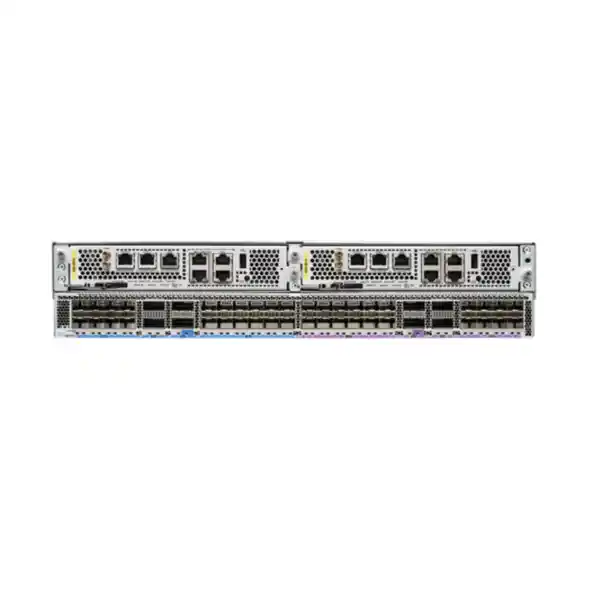
The ASR 9902 combines a fixed forwarding architecture, two route processors, integrated switch fabric, redundant power and redundant fan resources in a compact enclosure. Cisco specifies a maximum fixed-board data bandwidth of 800 Gbps. The front panel provides two QSFP-DD ports, six QSFP28 ports, sixteen SFP28 dual-rate ports and twenty-four SFP+ ports. This layout allows a network team to mix high-capacity uplinks and lower-rate aggregation ports without installing separate line cards. The platform is available as a service-edge optimized system and its route processor design includes a 64-bit Intel CPU with 32 GB of DDR4 memory.
Nonblocking full-duplex capacity for dense service-edge and aggregation workloads.
Designed for locations where rack efficiency is important but carrier-class routing is required.
Two QSFP-DD, six QSFP28, sixteen SFP28 and twenty-four SFP+ front-panel interfaces.
Supports two 1.6 kW AC or two 1.6 kW DC power modules; AC and DC supplies are not mixed.
Why the ASR 9902 Matters in Modern Aggregation Designs
Aggregation architecture is increasingly shaped by three simultaneous pressures: traffic growth, service diversity and operational simplification. A metro or enterprise edge device may have to accept 10G handoffs from legacy systems, 25G connections from modern compute or access infrastructure, 40G transitions from earlier optical designs and 100G uplinks toward a core, cloud or internet exchange. If those interfaces are distributed across several appliances, operators inherit more power domains, more software images, more failure points and more complex troubleshooting. The ASR 9902 addresses that problem by concentrating these rates into one fixed chassis while using the same IOS XR software family associated with the wider ASR 9000 portfolio.
That architectural consistency is particularly relevant to service providers and large enterprises that already operate Cisco routing at core or edge layers. Engineers can apply established operational practices for routing policy, telemetry, fault handling and maintenance instead of introducing a second operating model merely to solve a rack-density problem. The fixed architecture also simplifies initial bill-of-material planning because the primary data interfaces are integrated into the platform rather than selected as separate modular line cards. This does not eliminate the need for careful optics and licensing design, but it narrows the number of chassis components that must be specified.
In the UAE, high-capacity edge designs often sit at the intersection of enterprise campuses, carrier hotels, data centers, cloud on-ramps, internet exchanges and regional connectivity. A 2RU platform can be attractive when colocation rack space is expensive or when a network team needs an aggregation node inside a constrained meet-me-room. The same form factor is also useful for distributed edge locations where deploying a very large modular chassis would be operationally excessive. The correct design decision should still be based on required route scale, subscriber scale, service features, optics, future bandwidth, redundancy topology and software release support rather than on chassis size alone.
Integrated Port Architecture and Practical Port Mapping
The ASR 9902 front panel is designed to support several Ethernet rates in parallel. The two QSFP-DD positions are capable of 10G, 40G and 100G operation, while the six QSFP28 positions also support 10G, 40G and 100G. Sixteen SFP28 ports operate at 25G or 10G, and twenty-four SFP+ ports provide 10G Ethernet for LAN connectivity and supported WAN/OTN applications. The ability to mix rates is central to the product’s role as an aggregation platform because a single chassis can receive many lower-speed service handoffs and groom them toward larger uplinks.
| Interface group | Quantity | Supported rates | Typical design role |
|---|---|---|---|
| QSFP-DD | 2 | 10G / 40G / 100G | Core, peering, DCI or high-capacity service uplinks |
| QSFP28 | 6 | 10G / 40G / 100G | Flexible 100G aggregation and transition links |
| SFP28 | 16 | 25G / 10G | Server, access, aggregation and provider handoff connections |
| SFP+ | 24 | 10G LAN / WAN OTN | Dense 10G edge and transport service termination |
A useful port-mapping exercise starts by separating east-west, north-south and service-facing traffic. Reserve enough 100G interfaces for redundant upstream paths, then allocate 25G and 10G ports according to actual handoff requirements. Engineers should not assume that every physical combination can be used at maximum line rate without checking the platform’s total bandwidth and supported interface breakout rules for the intended IOS XR release. Optics power, lane mapping, FEC behavior and transceiver compatibility should also be validated before the purchase order is finalized.
Route Processor and Control Plane
The fixed-chassis route processor is designed for service-edge operation and includes a 64-bit Intel CPU with 32 GB of DDR4 memory. The platform supports two route processors for redundancy. In a production design, the routing control plane should be treated as an independent reliability domain from forwarding interfaces. Configuration synchronization, route-policy consistency, software maintenance procedures and failure testing all need to be planned so that the redundant architecture provides meaningful operational resilience rather than merely duplicated hardware.
Integrated Switch Fabric
Unlike a large modular ASR 9900 chassis that uses multiple removable line cards and fabric components, the ASR 9902 integrates its fixed data interfaces and switching architecture into the compact system. This improves rack efficiency and makes capacity planning easier for a known set of Ethernet requirements. The tradeoff is that physical port expansion is bounded by the fixed chassis. Network teams therefore need a realistic three-to-five-year traffic model before selecting the platform for a site expected to grow rapidly.
Cisco IOS XR 64-bit: Operational Foundation for Carrier Networks
The ASR 9902 runs Cisco IOS XR 64-bit, and Cisco identifies ASR 9902 support beginning with IOS XR 7.4.1. IOS XR is designed around modular processes, high availability and service-provider routing requirements. That matters because high-capacity routing failures are rarely caused only by raw forwarding limitations. Operational risk is often introduced through software lifecycle management, inconsistent configuration, uncontrolled routing policy changes, telemetry gaps or insufficient rollback planning. A carrier-oriented operating system gives teams a framework for separating operational functions, applying software maintenance updates and running large routing environments with a predictable control model.
For an enterprise that is considering the ASR 9902 as a WAN core or internet edge router, IOS XR also changes the skills profile required from the operations team. Engineers who have worked only with campus-oriented platforms should plan for XR configuration hierarchy, route-policy language, software package management, commit workflows and platform-specific verification commands. This is a benefit when the organization wants provider-grade operational discipline, but it should be recognized as part of deployment readiness. Runbooks, role-based access, change windows, backups, telemetry and configuration validation should be established before live traffic is moved.
The wider ASR 9000 software family supports advanced IP, MPLS, Segment Routing, SRv6, EVPN, VXLAN, L2VPN, L3VPN, multicast, OAM and high-availability technologies, with exact capability dependent on the selected hardware, feature license and IOS XR release. Consequently, the design phase should map every required service to a validated release matrix. This is especially important when a project requires a specific EVPN route type, Segment Routing behavior, BNG subscriber feature, advanced optical function or telemetry mechanism. FourTeck can support that design validation through its UAE engineering practice at FourTeck IT Services UAE.
IP/MPLS, Segment Routing and Service Provider Edge Design
A major reason to select the ASR 9902 instead of a conventional enterprise aggregation switch is its service-edge routing context. The ASR 9000 family is built for converged IP and MPLS transport, business VPN services and internet-scale routing. In a provider edge role, the platform can participate in Layer 3 VPN and Layer 2 VPN architectures, apply routing policy, enforce service separation through VRFs and carry customer traffic across an MPLS or Segment Routing domain. Exact scale and feature combinations remain software and license dependent, so engineers should design from the service model outward rather than from the port count inward.
For MPLS networks, the architectural discussion should cover IGP choice, BGP route distribution, label distribution method, traffic engineering strategy, convergence objectives and failure domains. Legacy deployments may use LDP and RSVP-TE while newer designs increasingly use Segment Routing with an IGP control plane and centralized path computation. ASR 9000 software supports Segment Routing and traffic-engineering capabilities, allowing the ASR 9902 to fit into modernized cores where operators want simpler label distribution and programmable traffic paths. The right design depends on existing infrastructure, operational maturity and interoperability requirements rather than on a blanket preference for one control-plane technology.
For enterprise WAN aggregation, the same technologies can be applied in a more controlled scale. An organization with several UAE data centers, campus hubs and cloud interconnection points may use the ASR 9902 to terminate high-capacity WAN circuits while maintaining multiple VRFs for production, management, partner, shared services and regulated traffic. BGP can be used toward carriers or cloud networks, while an internal IGP supports loopback reachability and underlay convergence. Where operational simplicity is preferred, the router can still be deployed with conventional IPv4 and IPv6 routing without introducing MPLS at the enterprise edge.
Convergence engineering is as important as routing scale. BFD, ECMP, fast-reroute techniques and carefully controlled IGP metrics can reduce outage duration when a link or upstream path fails. However, aggressive timers should not be configured without considering CPU load, optical behavior and neighboring device capabilities. A resilient design combines physical diversity, logical diversity and deterministic routing policy so that traffic follows the intended secondary path under real failure conditions.
BGP Peering, Internet Edge and Route Policy Engineering
The ASR 9902 is explicitly positioned by Cisco for internet peering and internet-edge use cases. In this role, raw interface speed is only one design dimension. The router must also handle the control-plane demands of BGP sessions, route-policy evaluation, community processing, prefix filtering, maximum-prefix protection, path selection and convergence. Before deployment, the engineering team should estimate the number of upstream providers, IX peers, private network interconnections, customer BGP sessions and internal route-reflector relationships that will terminate on the device.
A secure internet edge starts with explicit routing policy. Import and export rules should be documented by peer class rather than configured as ad-hoc one-off statements. Prefix lists, RPKI-related policy where supported in the architecture, BGP communities, local preference, MED handling and AS-path controls should follow a consistent convention. Default-route acceptance should be deliberate, not incidental. If full internet tables are required, the project should validate the exact route scale for the chosen IOS XR version and activated feature set, including headroom for growth and IPv6.
The physical design should avoid making the ASR 9902 itself the single point of failure. Dual-router internet edge pairs are common when uptime requirements justify independent devices, power feeds, cross-connects and upstream paths. Multi-chassis designs can use deterministic routing to shift traffic during maintenance without depending on a single control plane. The 2RU footprint makes it practical to deploy a pair even in colocation environments where rack units are tightly managed.
In Dubai data centers and carrier hotels, cross-connect design can become as important as router selection. Optic reach, fiber type, patch-panel loss, meet-me-room topology and carrier handoff specification should be confirmed for each circuit. A technically correct router BOM can still fail at installation if the ordered transceiver does not match the service provider’s wavelength, connector, FEC or distance requirement. FourTeck’s broader UAE infrastructure portfolio is available through FourTeck UAE for projects that require coordinated routing, cabling, compute and site-integration planning.
Data Center Interconnect and Cloud Edge
For data center interconnect, the ASR 9902 provides a useful combination of 100G capacity, compact depth, service-provider routing features and optical flexibility. DCI design should begin by defining what is being stretched between facilities. Some applications need only routed IP connectivity. Others require Layer 2 extension, EVPN services, MPLS VPN connectivity, high-capacity replication paths or cloud exchange connectivity. Each model has different failure characteristics, convergence behavior and operational implications.
A routed DCI is generally easier to isolate because each site remains a separate failure domain. Where Layer 2 extension is mandatory, EVPN-based approaches can provide control-plane learning and multihoming behavior that is more scalable than traditional flood-and-learn models. The ASR 9000 family supports EVPN and related service capabilities, but teams must validate the specific feature combinations for ASR 9902 and the target XR release. This is particularly important when the DCI design depends on EVPN-VPWS, EVPN over MPLS, IRB or integration with data-center VXLAN fabrics.
Replication traffic deserves separate capacity planning. Storage, backup and virtualization traffic can arrive in sustained high-volume bursts that are very different from normal user traffic. If multiple 100G circuits share the same chassis, the design should reserve bandwidth for failover conditions, not just normal operation. For example, a topology that runs two links at 50 percent utilization may behave well during normal conditions but immediately create congestion if one link fails and the surviving path must carry both traffic streams. QoS policies and application-aware scheduling should reflect those failure-state requirements.
Cloud edge design has similar principles. The router may terminate carrier Ethernet, private cloud connectivity or exchange-based services while advertising controlled enterprise prefixes. Route filtering, VRF separation, BGP communities and redundant physical paths should be defined before activation. The ASR 9902’s port mix can support both high-capacity northbound cloud paths and 10G/25G southbound interconnections to firewalls, data center cores or service appliances, allowing the platform to act as a clean boundary between transport and security layers.
MACsec and Encryption-Aware Edge Architecture
Cisco specifies MACsec support on all ASR 9902 data ports, with feature licenses available for 10G, 40G and 100G MACsec rights to use under the traditional licensing model. MACsec is useful when traffic must be protected over an Ethernet link while retaining line-rate Layer 2 or Layer 3 transport characteristics. It can be applied to inter-building links, carrier Ethernet handoffs, DCI circuits and selected service-provider transport segments where both endpoints support compatible MACsec behavior.
Encryption must be designed as part of the link, not added as a checkbox after the circuit is commissioned. The engineering team should confirm cipher support, key-management approach, interface rate, peer compatibility, MTU implications, monitoring and licensing. A MACsec-capable router on one side does not create an encrypted service unless the remote endpoint and transport architecture support the same method. For circuits delivered through third-party service providers, the demarcation model should be reviewed to determine whether MACsec is terminated directly between customer devices or whether intermediate network elements affect the service.
MACsec also does not replace firewall policy or application security. It protects Ethernet frames on the secured link, whereas firewalls inspect and control traffic according to security policy. In a UAE enterprise design, the ASR 9902 may sit upstream or downstream of dedicated next-generation firewalls. FourTeck’s Firewall Dubai practice can be integrated into the routing project where the edge architecture requires high-throughput security inspection, segmentation and resilient firewall clustering in addition to carrier routing.
Timing, SyncE, PTP, GPS and Mobile Edge Readiness
The ASR 9902 is designed for timing-sensitive service-provider applications. Cisco lists hardware-based IEEE 1588 support, GPS and BITS interfaces, SyncE on Ethernet ports and support for PTP telecom profiles including G.8265.1, G.8275.1 and G.8275.2. These features are important in mobile transport and other networks where frequency and phase synchronization must be distributed accurately across packet infrastructure.
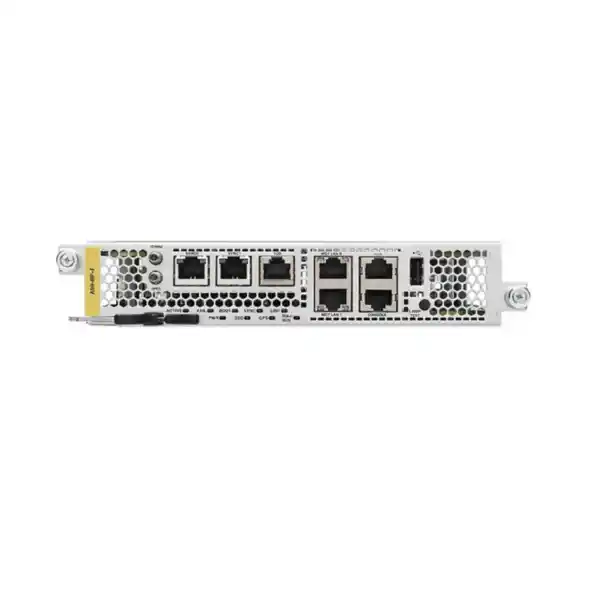
A mobile edge deployment is not simply a matter of enabling PTP globally. The clock architecture needs defined grandmaster sources, boundary or transparent clock roles where relevant, holdover strategy, source-priority rules, SyncE quality levels and failure behavior. Engineers should also map the physical timing interfaces. The ASR 9902 route processor provides time-related connectivity that includes GPS-related 10 MHz, 1PPS and Time-of-Day interfaces as well as BITS interfaces. This allows the chassis to participate in networks where external timing references and packet-based synchronization are both required.
For 4G and 5G transport, timing performance should be validated end to end rather than device by device. Each intermediate node, optic, packet scheduling policy and transport segment can affect recovered clock quality. QoS becomes part of timing engineering because PTP packets must receive predictable treatment under congestion. Similarly, asymmetric paths can introduce timing error even when individual devices are standards-compliant. A production acceptance plan should include measurements against the operator’s synchronization budget.
The compact 19-inch depth and front-to-back airflow can make the ASR 9902 easier to integrate into mobile edge locations than deeper modular systems. Nevertheless, site environmental conditions remain important. Cisco specifies an operating temperature range of 5 to 40 degrees Celsius and notes that limitations may apply with high-power optics. In UAE deployments, rack cooling, inlet temperature, filtration and hot-aisle design should therefore be treated as mandatory engineering inputs, especially in edge rooms with variable environmental control.
Broadband Network Gateway and Subscriber Edge Considerations
Cisco identifies Broadband Network Gateway as one of the potential ASR 9902 use cases. BNG architecture places very different demands on a router compared with basic aggregation because capacity must be considered across subscribers, sessions, policies, addressing, QoS, control-plane transactions and service accounting. A BNG design should never be sized from the 800 Gbps bandwidth figure alone. Subscriber scale, session establishment rate, IPv4 and IPv6 address models, CGN integration, DHCP or PPPoE behavior, RADIUS interaction and policy complexity can become the true limiting dimensions.
The ASR 9902 traditional feature-license list includes an in-line CGv6 translation license, full-scale VRF licensing and tunnel or mobile-related licenses. Those options indicate that the platform can be adapted to richer service-edge functions, but the exact feature matrix must be matched to the intended BNG architecture and software release. When a service provider needs subscriber services, FourTeck should validate the requested session count, address families, authentication flow, policy enforcement and redundancy model before recommending a final configuration.
Redundancy for BNG is more complex than installing two routers. Subscriber state and service continuity must be considered during failures or maintenance. The design may distribute subscribers across independent gateways, use routing to steer access nodes, or rely on platform-supported redundancy features. The correct model depends on access technology, subscriber control protocol and operational objectives. Planned switchover testing should be part of acceptance, including authentication behavior and user experience during a gateway failure.
For UAE ISPs, managed service providers and large private networks offering multi-tenant services, the ASR 9902 can provide a high-density edge foundation when its scale aligns with subscriber requirements. It is particularly attractive where the organization wants IOS XR service-provider capabilities in a smaller chassis. The platform should be treated as a strategic edge node rather than a generic Ethernet concentrator, and the procurement process should include a formal service-scale worksheet in addition to the physical port BOM.
High Availability: What Redundancy Means in Practice
The ASR 9902 supports redundant route processors, redundant power supplies, redundant fan resources and software redundancy. This removes several obvious single-component failure points inside the chassis, but true service availability depends on the surrounding architecture. A router with two power supplies is still vulnerable if both supplies are connected to the same PDU. Two uplinks do not provide real path diversity if both fibers share the same tray, riser or carrier node. Two routers do not create a resilient edge if they terminate the same upstream circuit or depend on a common firewall cluster without validated failover.
For a critical UAE deployment, the preferred engineering method is to map failure domains explicitly. Power feed A and B should be documented from utility or UPS source through PDU and device inlet. Fiber routes should be documented to the building or meet-me-room boundary. Upstream carrier diversity should be confirmed contractually and physically where possible. Management access should have an out-of-band path that remains available when production routing is impaired. Redundant NTP, DNS, AAA, telemetry collectors and configuration repositories should also be considered because operational dependencies can become hidden single points of failure.
Within IOS XR, high availability is supported by modular software architecture and routing resiliency mechanisms. Features across the ASR 9000 family include Nonstop Forwarding, Nonstop Routing and fast convergence technologies. The exact behavior of a route-processor switchover should still be tested with the customer’s routing protocols and traffic patterns. Some control-plane sessions may reconverge differently depending on neighbor capabilities and configured timers. Maintenance procedures should therefore be verified in a staging environment or during a controlled pre-production window.
The goal is not merely to survive a component failure. The goal is to preserve the intended business service. Acceptance tests should include power supply removal, fan alarm verification, route-processor switchover, individual uplink failure, peer loss, optic removal and management-path failure as appropriate. Monitoring should confirm that alarms are generated, the surviving path carries expected traffic and the operational team can identify the root cause quickly. This turns redundancy from a hardware specification into an operational capability.
AC Power Design
The ASR 9902 supports up to two 1.6 kW AC power modules in a 1+1 redundant arrangement. For resilient installations, each module should be fed from a separate protected power path where site infrastructure allows. Cable type, receptacle, PDU rating and rack power budget must be checked against the ordered PSU and local facility standard. The 1.6 kW rating is a power-supply capacity specification, not an instruction to assume the chassis constantly consumes that amount.
DC Power Design
The platform also supports up to two 1.6 kW DC modules in a redundant arrangement. DC-powered telecom sites should validate feed voltage, breaker sizing, grounding, conductor gauge and return path according to the facility’s standards. Cisco states that AC and DC supplies are not mixed in the same chassis, so the power architecture must be selected as part of the initial BOM rather than treated as an interchangeable afterthought.
Physical Installation, Cooling and UAE Environmental Planning
Cisco lists the ASR 9902 dimensions, including ejector hardware, at approximately 87.63 mm high, 439.74 mm wide and 482.60 mm deep, with a chassis weight of about 21.04 kg when configured with two route processors, two power supplies and three fan modules. The platform supports 2-post and 4-post installation in 19-inch and 23-inch racks. Front-to-back airflow is used, which aligns well with standard hot-aisle/cold-aisle data center practice when the rack orientation is correct.
The short depth can be particularly useful in edge and telecom racks that cannot accept very deep equipment. Even so, mechanical planning should include room for front fiber management, transceiver insertion, rear power cabling, airflow and service access. The optional cable-management and air-filter components should be considered where site conditions justify them. Dense fiber connections on a 48-port faceplate can become difficult to operate if patch cords are not labeled and routed systematically.
UAE environmental conditions make cooling design especially important for remote and semi-conditioned locations. Cisco specifies a normal operating temperature range of 5 to 40 degrees Celsius and relative humidity of 10 to 85 percent. High-power optics can introduce additional limitations, so a design using many long-reach or coherent-related modules should be checked for thermal support. Engineers should measure actual rack inlet temperature rather than relying only on room thermostat readings because recirculation or blocked airflow can create localized hot spots.
Dust management should also be part of the operational plan. A well-cooled room can still suffer reduced reliability if filters and airflow paths are neglected. Preventive maintenance should include inspection of intake areas, verification of fan health and review of environmental alarms. In desert climates, building pressure, door seals and maintenance practices can materially affect particulate load. For critical sites, environmental sensors should feed the same monitoring platform used for network and power alarms so that rising temperature or humidity is identified before it becomes a routing incident.
Optics, Fiber and OTN/DWDM Planning
The ASR 9902 supports Cisco pluggable interfaces across its 10G, 25G, 40G and 100G ports, and Cisco notes that applicable transceivers are compatible with ASR 9000 modular and compact chassis. Optic selection should be treated as a separate engineering discipline because the same Ethernet rate may be delivered through different lane structures, wavelengths, reaches, connector types and FEC requirements. A 100G port label does not tell you whether a specific QSFP28, QSFP-DD or breakout optic is correct for a given circuit.
For short-reach data-center links, teams may choose multimode solutions or passive/direct-attach approaches where supported. Longer campus, metro and carrier links typically require single-mode optics with the correct reach budget. Loss calculations should include fiber attenuation, patch panels, connectors, splices and engineering margin. If a carrier provides the far-end optic or transponder, obtain the exact handoff specification before ordering customer-side modules. FEC mode should be included in that checklist because mismatched FEC can prevent a link from coming up even when wavelength and connector are correct.
Cisco lists DWDM support based on OTN concepts defined in ITU-T G.709, including Forward Error Correction benefits. This can make the ASR 9902 useful in transport environments where packet routing and optical transport are closely integrated. The twenty-four SFP+ ports support 10G LAN and WAN/OTN use cases, and an advanced optical feature license is listed under the traditional model. Projects that intend to use OTN or advanced optical behavior should verify the exact supported optics, modes and software release before procurement.
Fiber management matters operationally at this density. Use clear port labels that match the logical interface description, circuit ID, far-end device and carrier identifier. Keep redundant paths in physically separate cable bundles where possible. Document optic serial numbers and DOM baseline readings during commissioning. These details make later troubleshooting much faster because technicians can distinguish a degrading optical path from a routing or protocol issue without replacing components unnecessarily.
QoS, OAM and Service Assurance
High-capacity routers still require traffic engineering because congestion can occur at any oversubscribed service edge. The ASR 9000 software family supports hierarchical QoS and extensive service-provider QoS capabilities. For the ASR 9902, policies should be constructed around actual service objectives such as voice priority, mobile signaling, business VPN guarantees, internet best effort, replication traffic and control-plane protection. Simply enabling multiple queues without a documented traffic model rarely produces predictable results.
QoS design starts with classification. Traffic can be identified by interface, VLAN, DSCP, MPLS experimental or traffic-class bits and other supported criteria. The design then defines marking, policing, shaping and scheduling. In provider environments, per-customer or per-service hierarchy may be required so one tenant cannot consume bandwidth reserved for another. In an enterprise edge, the hierarchy may be simpler but still needs to protect critical applications during failure states when traffic is concentrated onto fewer links.
Operations, Administration and Maintenance functions provide another layer of service assurance. Cisco lists NetFlow, IEEE 802.1ag, IEEE 802.3ah, ITU Y.1731, IP SLA, VCCV, ping and traceroute among the ASR 9902’s carrier-class monitoring capabilities. These tools help operators isolate whether a fault is local Ethernet, an end-to-end service path, an MPLS pseudowire, a latency problem or a routing issue. The most useful deployment defines OAM tests before an outage occurs and stores baseline measurements for comparison.
Monitoring should include interface errors, CRCs, optical levels, policy drops, oversubscription drops, routing-neighbor state, CPU and memory health, power and fan alarms, synchronization state and service-specific KPIs. Cisco documents per-port byte and packet counters that can distinguish several drop and traffic categories. Telemetry dashboards should make these counters actionable. A graph that only shows utilization can miss rising CRCs, queue drops or optical degradation that precede a more visible outage.
Licensing and Commercial Model Planning
The ASR 9902 has been offered under both Flexible Consumption Model and Traditional Business Model structures. The flexible model is intended to support a pay-as-you-grow approach with capacity and software subscription options, while the traditional model uses chassis, hardware and feature licenses. Because licensing programs evolve, a quotation should be validated against the current Cisco ordering tool and the exact IOS XR feature requirements at the time of purchase rather than copied from an old bill of materials.
Cisco’s ASR 9902 traditional ordering information includes the ASR-9902 chassis, A99-RP-F route processor, 1.6 kW AC or DC power supplies, ASR-9902 fan tray, mounting kits, cable management and air filter. Feature-license examples include up-to-eight-VRF activation, full-scale VRF, in-line CGv6 translation, advanced optical capabilities and MACsec rights for 10G, 40G and 100G. Tunnel, mobile, lawful-intercept and network-virtualization related licenses are also listed. Not every deployment requires all of these options.
A disciplined licensing exercise begins with a service feature matrix. List each required function: number of VRFs, BNG services, MACsec rate, OTN/DWDM behavior, Segment Routing, EVPN, subscriber functions, telemetry and support level. Then map those requirements to hardware, software and entitlement. This prevents two common procurement errors: under-licensing a platform so a planned service cannot be activated, or over-buying features that are not part of the network design.
Support coverage should be included in the commercial model. A carrier-edge router is usually part of a long-lived service platform, and access to software updates, technical support and replacement processes can be critical. UAE buyers should evaluate lead times for chassis, spares, optics and power components as part of the lifecycle plan, not only the initial capital cost. For organizations with multiple countries or future regional expansion, FourTeck also maintains an Africa-focused infrastructure presence through FourTeck Africa.
Sizing Methodology: How to Decide Whether the ASR 9902 Fits
A correct ASR 9902 recommendation should be based on multiple simultaneous scale dimensions. Start with bandwidth. Record current average, busy-hour and peak throughput by service, then project growth over the expected lifecycle. Add failure-state headroom so the remaining uplink or router can carry traffic when a peer link or device is unavailable. Avoid designing normal-state utilization so high that a single failure immediately creates sustained congestion.
Next evaluate port density. Count required 100G, 40G, 25G and 10G interfaces separately. Identify which ports must be reserved for core uplinks, which terminate customers or access devices, which connect firewalls and which are required for management or migration. Account for port-channel members and physically diverse paths. Then validate that the selected optics and breakout modes are supported on the intended physical ports and software release.
Control-plane scale is the third dimension. Document IPv4 and IPv6 route counts, VRFs, BGP peers, IGP adjacencies, BFD sessions, EVPN routes, VPN prefixes, multicast state and subscriber sessions where relevant. Service-provider platforms can hit one scale boundary while still having plenty of forwarding bandwidth. The design should therefore compare required scale against Cisco’s release-specific validated limits rather than relying on a single generic platform number.
Finally consider operations. Does the team already know IOS XR? Is configuration automation planned? Are monitoring systems compatible? Is there an out-of-band management path? Are maintenance windows available for software upgrades? Is a second chassis required for site-level redundancy? These questions determine whether the router can be operated safely after installation. FourTeck’s role in a professional deployment is to translate the customer’s service inventory into a validated BOM, interface plan, licensing set and implementation sequence rather than simply supply a chassis.
As a rule of thumb, the ASR 9902 is a strong candidate when the required capacity fits comfortably inside an 800 Gbps fixed platform, 10/25/40/100G interfaces satisfy the physical service mix, IOS XR features align with the service model and the network benefits from carrier-grade redundancy in a 2RU footprint. A larger modular ASR system is generally more appropriate when future port or fabric expansion beyond the fixed chassis is a central requirement.
Typical UAE Deployment Topologies
Dual Internet Edge
Deploy two ASR 9902 routers in separate failure domains, each connected to diverse upstream carriers or IX fabrics. Run controlled BGP policy between providers and internal networks. Connect downstream firewalls or core switches with redundant 100G or 25G links. This model suits large enterprises, hosting providers and data centers requiring multiple internet paths.
Metro Aggregation Pair
Use a redundant pair to aggregate many 10G and 25G service nodes into 100G transport toward a core. MPLS, Segment Routing or routed IP can provide the service underlay. Timing support makes the same design relevant to mobile transport when PTP and SyncE are required.
DCI Edge
Place the routers at two data centers and use diverse 100G inter-site paths. Carry routed IP, EVPN or MPLS services according to application needs. Integrate with data-center cores through 100G or 25G links while preserving a clear demarcation between the transport WAN and the switching fabric.
Cloud Connectivity Hub
Terminate private cloud or exchange connections on dedicated VRFs, use BGP for controlled prefix exchange and connect security inspection layers downstream. The multi-rate interface mix supports multiple provider handoffs without forcing every adjacent device to operate at 100G.
Migration from Existing Edge Routers
Replacing a production edge router requires more planning than exporting the old configuration and importing it onto the new platform. The migration should begin with a service inventory that identifies every physical circuit, subinterface, VLAN, VRF, BGP peer, static route, policy, QoS attachment, ACL, route map or route policy, timing dependency, management path and monitoring integration. Unknown legacy configuration should be treated as a risk item rather than copied automatically.
The ASR 9902’s multi-rate interfaces can simplify staged migration because 10G, 25G, 40G and 100G connectivity can coexist. A common method is to install the new chassis in parallel, establish management and routing reachability, preconfigure new uplinks, validate BGP or IGP adjacencies, then move service-facing links in controlled groups. Where physical ports or optics differ from the old router, media and patching should be completed before the change window.
Route policy deserves special attention. Different Cisco operating systems may express policy in different syntax and may have different defaults. The migration team should test inbound and outbound advertisements with representative peers before carrying production traffic. Maximum-prefix thresholds, community handling, next-hop behavior, default-route logic, AS-path filters and IPv6 policy should all be checked. A route leak at a high-capacity edge can create broader impact than a simple link outage.
Rollback should be explicit. Define what constitutes failure, who has authority to roll back, how old links will be restored and how route convergence will be observed. Keep the old platform powered and configuration-frozen until the new path is stable unless the physical migration makes that impossible. During the cutover, monitor interface errors, optical receive levels, routing tables, forwarding paths, CPU load, QoS drops and application reachability.
After migration, perform a second-pass cleanup. Remove temporary static routes, test policies, unused interfaces and emergency workarounds. Update diagrams and inventory with final port assignments, optics and serial numbers. Capture performance baselines so the operations team knows what healthy traffic and environmental conditions look like on the new platform.
Security Hardening for an ASR 9902 Deployment
Carrier routers require deliberate management-plane and control-plane protection. The management network should be isolated from customer and internet traffic wherever possible. Administrative access should use authenticated, encrypted protocols, role-based authorization and centralized AAA. Local credentials should be restricted to break-glass use and protected by documented operational controls. Console and auxiliary access should be physically secured in data-center environments.
Routing protocol sessions should be protected with peer filters, authentication where appropriate and explicit source restrictions. BGP policies should reject unauthorized prefixes and prevent accidental advertisement of internal or special-use networks. Control-plane policing should be tuned to protect CPU resources from excessive management, routing or exception traffic without blocking legitimate protocol behavior. Changes to control-plane policy should be tested carefully because an overly restrictive rule can look like a network failure.
Software lifecycle is also part of security. The deployment should define an IOS XR release strategy, maintenance cadence and process for reviewing Cisco security advisories. Image integrity, configuration backups and rollback procedures should be part of the standard operating model. Where automation systems push configuration, use version-controlled templates and peer review so that a centralized error does not propagate simultaneously to multiple edge routers.
MACsec can protect selected Ethernet links, but it should be combined with broader segmentation and security inspection where required. In an internet-edge design, the ASR 9902 is usually responsible for routing, service separation and transport security functions while a dedicated firewall platform enforces application-aware security policy. Keeping those responsibilities clear makes both troubleshooting and compliance easier.
Operational Runbook Recommendations
A production ASR 9902 should be accompanied by an operational runbook that covers startup checks, daily health review, incident triage, software upgrade, route-policy change, optics replacement, route-processor switchover and power-maintenance procedures. The runbook should identify the normal state of every critical routing neighbor and uplink. Engineers should not need to reconstruct expected topology during an outage.
Baseline data should include CPU and memory, interface utilization, queue drops, CRC errors, optical receive and transmit levels, routing table size, BGP prefix counts, IGP adjacency state, BFD state, timing state and environmental alarms. Trend these values over time. Capacity planning becomes much more accurate when it is based on observed growth rather than one-time traffic snapshots.
Change control should separate service-affecting policy modifications from routine administration. For BGP and routing-policy changes, capture the pre-change route state, expected advertisement delta and rollback command sequence. For software maintenance, verify boot variables, package state, route-processor redundancy and available storage before the window. A maintenance plan that has been rehearsed is much safer than one built from memory at midnight.
FourTeck can support design, staging, implementation documentation and handover for UAE projects. The goal should be to leave the customer with a platform that is not only correctly installed, but understandable and maintainable by the operations team that will own it after project closure.
Procurement Checklist for Dubai and UAE Projects
A complete ASR 9902 quotation should define the chassis and service requirement rather than list only a base router SKU. The procurement team and network architect should confirm the following items together:
Chassis model, two route processors where required, power-supply type and quantity, fan modules, rack-mounting kit, cable management, filters and any site-specific accessories.
Exact count of 100G, 40G, 25G and 10G circuits, required breakout modes, spare ports, link aggregation and migration ports.
Transceiver model, reach, fiber type, connector, wavelength, FEC, carrier handoff requirement, patch cords and spares.
IOS XR release target, licensing model, VRF scale, MACsec, advanced optical, BNG/CGN-related functions and other service entitlements.
Cisco support level, replacement expectations, software entitlement, local implementation support and spare strategy.
Rack depth, rack units, power feeds, PDU sockets, grounding, cooling, fiber paths, cross-connects, management network and change-window access.
Important Compatibility and Design Notes
Cisco’s published specifications state that the ASR 9902 supports a maximum 800 Gbps fixed-board bandwidth and line-rate performance per supported SFP+, SFP28, QSFP28 or QSFP-DD interface at the configured rate. Physical port capability should not be interpreted as unlimited simultaneous aggregate bandwidth beyond the platform total. The supported combination of rates, breakout behavior and optics should be validated in the release-specific documentation.
The platform supports AC or DC power modules, but Cisco does not support mixing AC and DC supplies in the same chassis. If dual-feed redundancy is required, both feeds should use the selected common PSU type and should originate from appropriately independent facility power paths.
Operating temperature is specified from 5 to 40 degrees Celsius, with possible restrictions for high-power optics. Thermal design should be checked for the intended transceiver mix and local rack conditions rather than assumed from room temperature alone.
Feature availability, scale and licensing can vary by IOS XR release and commercial model. Final purchase orders should therefore be based on a current validated bill of materials and software feature matrix.
When to Choose the ASR 9902 — and When to Choose Something Else
Strong Fit
Select the ASR 9902 when you need 10/25/40/100G aggregation, service-provider routing, internet peering, DCI, mobile timing, BNG-related functions or high-capacity WAN edge in a compact 2RU chassis. It is particularly compelling when IOS XR standardization, redundant internal components and 100G density are more important than modular slot expansion.
Consider a Different Platform
Choose a smaller enterprise router if the site only needs low-rate branch connectivity and does not need carrier features. Choose a larger modular routing system if projected bandwidth or port growth will exceed the fixed 800 Gbps architecture, if very large interface expansion is required, or if the project depends on service scale beyond the validated limits of the fixed chassis.
Decision Recap for Network Architects
The Cisco ASR 9902 sits in a useful architectural middle ground. It delivers the control-plane and service orientation of the ASR 9000 family but packages the forwarding system into a fixed 2RU form factor. For many metro, DCI, peering and enterprise WAN use cases, that is exactly the right balance: enough scale to consolidate a meaningful edge, enough interface diversity to absorb mixed generations of Ethernet, and enough redundancy to operate as production infrastructure without consuming the footprint of a large modular chassis.
The decision should be positive when five conditions are met. First, the projected normal and failover throughput fit comfortably within the 800 Gbps architecture. Second, the integrated two QSFP-DD, six QSFP28, sixteen SFP28 and twenty-four SFP+ ports fit the physical service map. Third, IOS XR and ASR 9000 service features match the routing, MPLS, EVPN, timing, BNG or internet-edge requirements. Fourth, the organization can operate IOS XR with appropriate change control and monitoring. Fifth, the fixed platform still has enough capacity headroom for the expected lifecycle.
If any one of those conditions is uncertain, the right next step is not to guess. Build a sizing worksheet, confirm the current release-specific feature limits, validate optics, define the redundancy topology and review licensing. This avoids the two costly extremes of buying a platform that is undersized on day one or over-engineering the site with a much larger chassis than the service profile requires.
Quotation Input Checklist
Internet edge, PE, metro aggregation, DCI, cloud edge, WAN core, mobile edge or BNG.
Count of 100G, 40G, 25G and 10G links, plus planned spares and LAG members.
Fiber type, distance, connector, wavelength, FEC and carrier handoff details.
BGP peers, route tables, VRFs, IGP neighbors, BFD sessions and IPv6 requirements.
MPLS, SR, EVPN, L2VPN/L3VPN, MACsec, BNG, OTN/DWDM, timing and QoS requirements.
Single chassis, dual chassis, dual carriers, diverse power, fiber path and maintenance strategy.
AC or DC, feed count, PDU specification, grounding and facility constraints.
Supply only, staging, migration, configuration, testing, handover and ongoing support.
Plan a Cisco ASR 9902 Deployment with FourTeck UAE
FourTeck can help UAE customers convert a routing requirement into a deployment-ready ASR 9902 bill of materials covering chassis components, AC or DC power, optics, licensing, interface mapping, IOS XR feature validation, high-availability topology and migration planning. The most useful starting point is your expected traffic, port mix, routing scale and service role.
For projects involving Dubai colocation, carrier cross-connects, enterprise WAN, data-center interconnect, service-provider aggregation or internet peering, provide the quotation checklist above. FourTeck can then align the hardware to the actual architecture instead of issuing a generic chassis-only quote.
100G aggregation
Internet peering
DCI and cloud edge
Mobile transport
Enterprise WAN core

Reviews
There are no reviews yet.