
Cisco ASR 9903 Aggregation Services Router for Dubai and UAE Networks
The Cisco ASR 9903 is a compact 3RU member of the ASR 9000 family built for operators that need very high throughput, service-provider resiliency and multi-rate Ethernet density without dedicating the rack footprint of a large modular chassis. It delivers up to 3.6 Tbps of nonblocking, full-duplex system capacity when the fixed platform is combined with the appropriate 2 Tbps Port Expansion Card, while retaining the operational model of Cisco IOS XR used across the wider ASR 9000 portfolio.
For UAE service providers, cloud operators, large enterprises, government networks, mobile backhaul environments and inter-data-center architectures, the ASR 9903 can be positioned as a provider-edge router, metro aggregation node, internet peering router, cloud edge, data-center interconnect platform or high-capacity enterprise border. Its design combines integrated 10G and 100G interfaces, optional 25G/100G/200G/400G expansion, redundant control and fabric resources, redundant power and cooling, packet timing functions and a 64-bit IOS XR software architecture suited to long-lived carrier networks.
Direct Answer: What is the ASR 9903?
It is a fixed-form-factor, service-edge-optimized ASR 9000 router with a base fixed board providing up to 1.6 Tbps of data bandwidth and a dedicated expansion slot that can add either a 2 Tbps high-speed PEC or an 800 Gbps high-density PEC.
Why the Cisco ASR 9903 Matters in a Modern UAE Aggregation Design
Aggregation routers are increasingly required to do more than collect access links. A modern edge may have to terminate hundreds or thousands of routed adjacencies, carry large MPLS or Segment Routing service tables, maintain deterministic convergence, enforce traffic policy, participate in internet or private peering, transport latency-sensitive mobile traffic, expose streaming or standards-based telemetry, and provide timing distribution for mobile infrastructure. At the same time, UAE operators often need to place this capability into constrained exchange rooms, metro sites, modular data-center rows or enterprise facilities where rack units, power feeds and cooling headroom have real commercial cost.
The ASR 9903 addresses that design tension with a compact fixed chassis that still provides carrier-grade redundancy. The platform supports two route processors, two integrated switch fabrics, four power-supply modules and four fan modules in a redundant configuration. That architecture lets designers avoid treating a small-footprint router as a single-control-plane appliance. The intention is to preserve the fault-domain discipline expected in service-provider networks while obtaining substantially higher interface density per rack unit than many legacy edge designs.
A second advantage is migration flexibility. The integrated board gives a strong 100G and 10G base, while the optional Port Expansion Card lets the same chassis be adapted for either higher-speed 100G/200G/400G growth or denser 10G/25G aggregation. This matters when the access side and core side of a network evolve at different rates. An operator may begin with many 10G handoffs and 100G uplinks, then gradually introduce 400G transport or interconnects without redesigning every site around a new chassis class.
FourTeck positions the platform within a full network architecture rather than as an isolated hardware purchase. Customers evaluating routing, firewall segmentation and data-center connectivity can review our Firewall Dubai solutions and broader FourTeck UAE infrastructure portfolio when planning how the ASR 9903 will connect to security, WAN, compute and cloud environments.
Hardware Architecture: Fixed Throughput with Modular Growth
Base Fixed Board
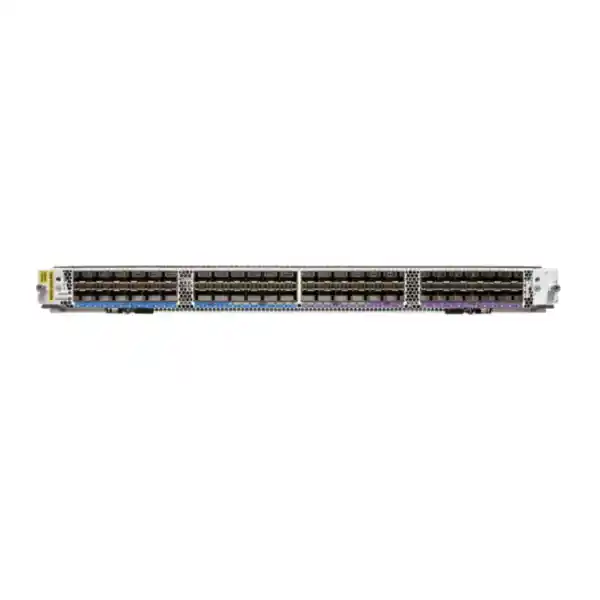
The ASR 9903 fixed board supports up to 1.6 Tbps of data bandwidth. Its faceplate integrates sixteen QSFP28-based ports and twenty SFP+-based ports. The 100G-class integrated interfaces can be arranged in supported combinations that let the designer trade some 100G usage for additional 10G fan-out. This is useful where a single chassis must aggregate mixed-speed metro access while still presenting large uplinks toward a core or DCI layer.
2T High-Speed PEC
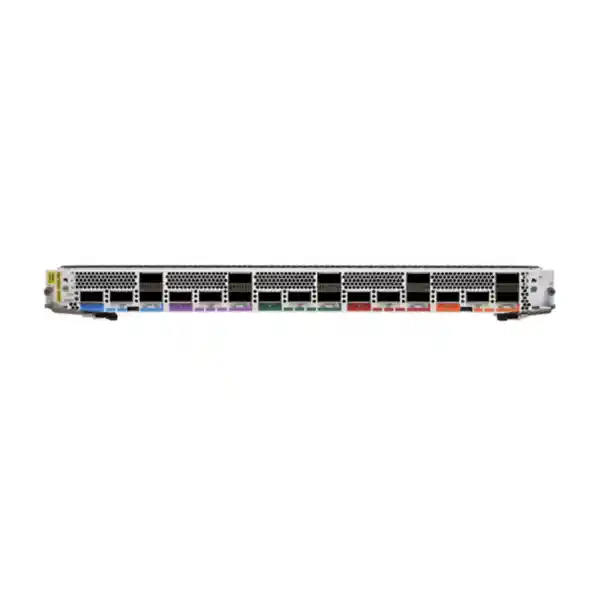
The A9903-20HG-PEC provides up to 2 Tbps of expansion bandwidth through twenty physical ports. Fifteen are QSFP28-based interfaces for lower-rate and 100G use, while five are QSFP-DD/QSFP28 multi-rate ports designed for 100G, 200G and 400G evolution. The 400G capability is licensed per applicable port, which enables staged capacity activation rather than forcing every high-speed lane to be enabled on day one.
800G Density PEC
The A9903-8HG-PEC targets dense 10G and 25G aggregation. It offers forty-eight physical ports, with thirty-two SFP28/SFP+ positions capable of 25G/10G operation and additional SFP+ connectivity for 10G. This option is attractive for sites where the main requirement is to consolidate a large number of access, edge, mobile or enterprise handoffs rather than maximize the number of 400G core-facing ports.
Control and Management
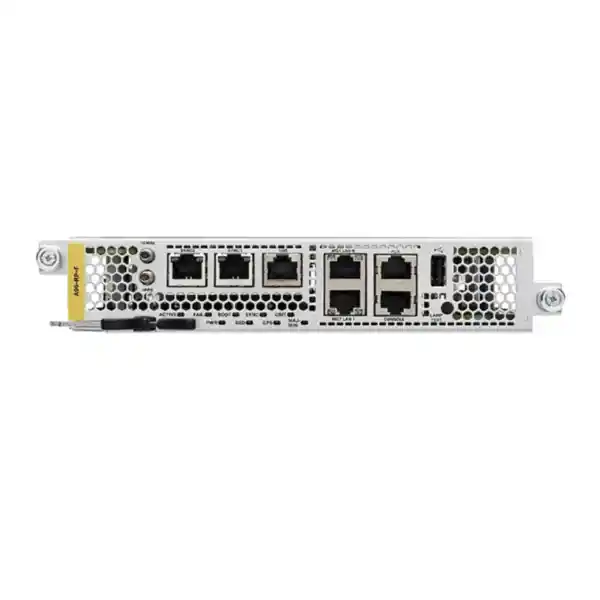
The service-edge route processor uses a 64-bit Intel CPU and includes 32 GB of DDR4 memory by default. Front-panel management resources include console and auxiliary serial access, two management Ethernet interfaces, USB, GPS timing interfaces including 10 MHz, 1PPS and Time-of-Day, plus dual BITS interfaces. These facilities simplify out-of-band management and synchronization integration in carrier facilities.
Port Map and Bandwidth Planning
A correct ASR 9903 design begins with port-role mapping, not a simple count of cages. The integrated board, breakout behaviors and two PEC families have different intended uses. A procurement bill of materials should therefore identify each physical port by expected speed, optic type, fiber reach, traffic role, protection scheme and required software entitlement. This avoids the common mistake of reading a platform-level list of supported speeds and assuming every interface can operate at every rate.
| Component | Physical Interface Profile | Bandwidth Role | Typical Design Use |
|---|---|---|---|
| Fixed board | 16 QSFP28 + 20 SFP+ | Up to 1.6 Tbps | 100G core/aggregation plus 10G service handoffs |
| A9903-20HG-PEC | 15 QSFP28 + 5 QSFP-DD/QSFP28 | Up to 2 Tbps | 100G aggregation with 200G/400G migration |
| A9903-8HG-PEC | High-density SFP28/SFP+ | Up to 800 Gbps | Dense 10G/25G access aggregation |
For the fixed board, Cisco documents supported operating combinations that include sixteen 100G interfaces, fifteen 100G interfaces plus ten 10G interfaces, or fourteen 100G interfaces plus twenty 10G interfaces. Later IOS XR port-mode support also allows selected interfaces to be configured for 25G, 10G and 1G breakout modes where supported by the hardware and software combination. That flexibility is valuable when consolidating older 1G or 10G circuits, but it must be validated against the exact port, optic, breakout cable and IOS XR release being ordered.
On the 2T PEC, the five QSFP-DD positions are the strategic growth interfaces. They can support high-speed operation including 200G and 400G, while the remaining QSFP28 ports provide strong 100G density. The physical compatibility of QSFP-DD cages with QSFP28-class modules also supports a migration path in which a site can begin with 100G optics and later adopt higher-rate modules where the optical budget, peer device and license model are ready. This can protect rack and chassis investment during a multi-year capacity plan.
The 800G PEC solves a different problem. It is not the preferred choice when the main target is several 400G uplinks; instead it is useful when the site must fan in many 10G or 25G services. Examples include enterprise WAN aggregation, mobile backhaul collection, wholesale Ethernet aggregation, regional data-center leaf or border handoffs, and environments where many legacy 10G services will coexist with newer 25G devices.
Carrier-Grade Redundancy and Failure-Domain Design
High port density has limited value if a router introduces a new single point of failure. The ASR 9903 is designed around redundant route processors, switch fabrics, power supplies and cooling. In a fully redundant build, two route processors provide control-plane resiliency, two integrated fabric elements protect forwarding fabric availability, up to four power modules allow feed-level redundancy, and four fan modules provide cooling redundancy. IOS XR adds software-level resilience through a modular architecture that is designed for high availability and controlled maintenance.
For a Dubai metro or data-center deployment, the hardware should be mapped to independent facility failure domains. A dual-feed AC design should place redundant power supplies on separate PDUs backed by independent UPS paths wherever the facility permits. A DC deployment should use separate protected feeds and correctly sized breakers and conductors. The router supports 1.6 kW AC or DC power modules, but AC and DC modules are not mixed in the same chassis. At high-line AC input, a 2+2 redundant power arrangement is supported; at low-line AC input, Cisco documents a 3+1 arrangement. This distinction matters during rack-level electrical design because the same chassis may require a different number of active modules depending on feed voltage.
Redundant control does not eliminate the need for network-level redundancy. A resilient ASR 9903 design commonly uses diverse upstream peers, independent fiber paths, separate optical distribution routes, routing protocol fast-convergence features, BFD where appropriate, ECMP or protected next hops, and service-level redundancy such as multihoming. The objective is to prevent a surviving chassis from becoming isolated because both uplinks share the same duct, patch panel, transport shelf or remote router.
Maintenance planning should consider the entire software and hardware lifecycle. Redundant RPs can reduce the operational impact of some control-plane events, but upgrade behavior, feature compatibility and hitless expectations must be checked against the selected IOS XR release, configuration and service mix. FourTeck treats resiliency as an end-to-end design exercise covering chassis, software, optics, transport diversity, routing policy and facility infrastructure.
Cisco IOS XR: Operational Model for Service-Provider Scale
The ASR 9903 runs 64-bit Cisco IOS XR and was introduced with support beginning in the IOS XR 7.1.25 train. IOS XR is designed for carrier core and edge environments where software modularity, process separation, structured configuration, automation interfaces and predictable operational controls are essential. For organizations already operating ASR 9000 systems, the common software family can reduce the number of operational models engineers must maintain across edge and aggregation layers.
A production architecture can use familiar IP routing protocols such as BGP and IGPs alongside MPLS and Segment Routing services, subject to release and license support. Segment Routing over an MPLS data plane can integrate with L3VPN, VPWS, VPLS and EVPN service constructs, allowing an operator to simplify transport-state design while maintaining sophisticated service delivery. Modern IOS XR releases also include extensive EVPN capabilities, and Cisco continues to publish current ASR 9000 software documentation for Segment Routing and EVPN functions. Because feature matrices change by release and hardware, the exact combination required for a deployment must be validated rather than inferred from the family name alone.
For internet peering, BGP policy architecture is normally one of the most important design areas. The router may be asked to receive full or partial internet tables, maintain multiple upstreams, apply communities, local preference, MED, prefix filtering, route policies, maximum-prefix safeguards and RPKI-related controls depending on the operational standard. Capacity planning should examine route scale, convergence expectations and memory headroom rather than only interface throughput. The right question is not whether the chassis has a 100G or 400G port; it is whether the complete control plane, forwarding scale, policy complexity and telemetry load fit the intended role with sufficient growth margin.
For MPLS provider-edge use, designers should document the expected number of VRFs, VPN routes, attachment circuits, labels, pseudowires, bridge domains and EVPN instances. The traditional license model includes options for limited or full-scale VRF capability, while flexible-consumption licensing offers capacity-oriented Essentials and Advantage software entitlements. A design requiring large-scale L3VPN or advanced service functions should therefore include the software bill of materials at the same time as hardware selection.
Operations teams can also use carrier OAM mechanisms including NetFlow, Ethernet OAM standards, Y.1731, IP SLA, VCCV, ping and traceroute. These tools allow the network to be monitored from multiple layers: physical link condition, packet counters, forwarding behavior, service continuity, delay or loss measurements and traffic-flow visibility. The best operational design defines which telemetry is collected, at what sampling or polling rate, where it is exported, how long it is retained, and what thresholds trigger remediation.
Automation should be planned from the start. IOS XR provides model-driven management interfaces in addition to traditional CLI operations. Enterprises and carriers can build repeatable configuration workflows, compliance checks and telemetry pipelines around structured data models. FourTeck can integrate router deployment with broader UAE IT services for monitoring, automation, migration and managed infrastructure operations.
Service Capabilities: Metro Ethernet, MPLS, EVPN, Segment Routing and Peering
Provider Edge and L3VPN
The ASR 9903 can be used as a business PE where customer VRFs, routed attachment circuits and MPLS transport converge. A PE design should size the number of VRFs, IPv4 and IPv6 prefixes, BGP sessions, route targets, labels and policy objects. It should also account for future customer growth and route-leak or shared-services designs. Full-scale VRF requirements may influence software licensing, making entitlement planning part of architecture rather than an afterthought.
Metro Ethernet Aggregation
High-density 10G, 25G and 100G options allow the chassis to aggregate Ethernet services from access rings, provider edge nodes, enterprise campuses and transport systems. Operators can combine routed interfaces with Layer 2 service constructs as required by the solution. Capacity planning should measure both north-south throughput and local service replication or protection paths so that failure scenarios do not oversubscribe surviving uplinks.
EVPN Services
EVPN can provide a BGP-based control plane for Layer 2 and Layer 3 service reachability. Within the ASR 9000 software family, EVPN supports route types used for Ethernet auto-discovery, MAC/IP advertisement, inclusive multicast, Ethernet segment operation and IP prefix advertisement. Exact scale and feature availability are release dependent, so a production design should align the target EVPN functions with the chosen IOS XR maintenance release.
Segment Routing
Segment Routing can reduce reliance on per-flow signaling state in the core and provide policy-based traffic engineering through ordered segments. SR-MPLS can integrate with existing MPLS service models, enabling staged modernization instead of a forced wholesale redesign. Design work should define SID allocation, IGP extensions, policy calculation, fast reroute objectives, controller integration if used, and interoperability with legacy MPLS domains.
Internet Peering
A peering deployment can use 100G or higher-rate interfaces toward upstream providers, IX fabrics or private interconnects. Routing policy should include strict prefix filters, community handling, local-preference strategy, default-versus-full-table decisions, maximum-prefix protection and a documented failover policy. DDoS detection and diversion workflows may also be integrated elsewhere in the architecture depending on the operator security model.
Data-Center Interconnect
For DCI, the platform can provide high-capacity routed or service-provider interconnect between facilities. The design should distinguish between simple routed IP transport, MPLS-based services, EVPN-based extension and application-specific overlays. Optical reach, latency, failure-domain separation and MTU must be engineered end to end. 400G-capable PEC interfaces can be valuable when multiple 100G circuits are expected to consolidate over time.
Timing and Synchronization for 4G/5G Mobile Edge Networks
Packet transport for mobile networks has timing requirements that are different from ordinary enterprise WAN traffic. The ASR 9903 includes hardware-based IEEE 1588 capabilities, SyncE support on Ethernet interfaces, GPS timing connectivity and BITS interfaces. Cisco documents support for PTP telecom profiles including G.8265.1, G.8275.1 and G.8275.2. These features make the platform relevant for mobile edge and aggregation environments where frequency, phase or time synchronization must be transported with the packet service.
A proper timing architecture still requires more than enabling PTP. Engineers should define the clock hierarchy, grandmaster redundancy, boundary-clock or transparent-clock roles, SyncE source selection, holdover expectations, asymmetry considerations, quality-level propagation, packet prioritization and failover behavior. Fiber-path asymmetry and transport devices between clocks can materially affect precision, so the router should be evaluated as one component of the complete timing chain.
The ASR 9903 chassis depth excluding the ejector is approximately 600 mm and the platform uses front-to-back airflow, characteristics that can help in compact edge facilities where telecom cabinets and hot-aisle/cold-aisle practices differ from large core data centers. In UAE mobile edge rooms, thermal design should still account for local facility conditions, optic power draw and dust-control practices rather than relying only on nominal room temperature.
Deployment Topologies for the Cisco ASR 9903
The same chassis can serve very different roles. The following patterns illustrate how to think about the platform within a topology. They are architecture examples, not fixed templates; protocol selection, scale, licensing and redundancy must be validated for each project.
1. Dual Metro Aggregation Pair
Deploy two ASR 9903 routers as independent aggregation nodes in the same metro site or separate facilities. Access rings or edge routers are dual-homed where possible, while multiple 100G or 400G links connect toward the core. IGP fast convergence, BFD and ECMP can minimize interruption after link or node failure. The design should ensure that a single surviving router and its uplinks can carry the required protected traffic load.
2. Business Provider Edge
Use the platform to terminate enterprise L3VPN, internet, Ethernet or wholesale services. Integrated 10G interfaces can serve lower-rate handoffs while 100G interfaces face metro transport or the MPLS core. The 800G PEC is especially useful if service count grows faster than individual circuit bandwidth. VRF, route and service scale should be reviewed against the expected customer base and software entitlement.
3. Internet Edge and Peering
Connect multiple upstream providers, internet exchanges and private peers through high-speed Ethernet. Separate external BGP policy from internal routing, maintain route filtering and maximum-prefix controls, and design internal links with sufficient capacity to survive upstream shifts. The 2T PEC provides a path toward 400G peering where exchange or transit capacity justifies the speed.
4. Data-Center Interconnect Edge
Place the router at the border of two or more data centers to provide routed underlay, MPLS transport or EVPN-related service interconnection. Use diverse long-haul or metro optical paths, validate MTU through every transport element, and define whether encryption occurs on the router, optical layer or a dedicated security device. High-rate ports allow growth from multiple 100G waves toward consolidated 400G services.
5. Mobile Backhaul / Fronthaul Aggregation
Combine packet aggregation with PTP, SyncE, GPS and BITS timing resources. The design should prioritize synchronization architecture, QoS classification, low-latency paths and deterministic failover. 10G and 25G density can accommodate radio or cell-site aggregation while 100G/400G uplinks provide scalable transport toward mobile core or regional aggregation.
6. Large Enterprise Border
Large enterprises with multiple carriers, private cloud links and high-volume internet traffic can deploy the ASR 9903 as a border platform when carrier-grade routing and high throughput are required. Firewalling should remain in a dedicated security architecture unless the design explicitly assigns security functions elsewhere. For complementary compute and infrastructure planning, FourTeck also provides server and data-center solutions in Dubai.
Sizing Methodology: How to Choose the Right ASR 9903 Configuration
Sizing a service-provider router only by the headline throughput figure is risky. The correct ASR 9903 configuration should be derived from traffic, interfaces, services, control-plane scale, optics, redundancy, timing, software and growth. FourTeck uses a structured sizing process so the bill of materials reflects the actual topology rather than a generic chassis bundle.
Step 1: Build the Physical Port Inventory
List every day-one and forecasted port with speed, media, connector, wavelength, reach and peer device. Separate 1G, 10G, 25G, 40G, 100G, 200G and 400G requirements. Identify where breakout is planned and where a native interface is preferred. Record whether each link is access-facing, customer-facing, core-facing, DCI, peering, management or timing related. This inventory quickly indicates whether the fixed board is sufficient, whether the dense 800G PEC is appropriate, or whether the 2T high-speed PEC is required.
Step 2: Calculate Normal and Failure-State Throughput
Measure bidirectional traffic during normal operation, then model one or more realistic failures. A pair of routers may each run at forty percent during normal conditions but one chassis could reach eighty percent after peer failure. Similarly, a four-link LAG may have substantial headroom until one or two members are lost. Capacity planning should account for packet-size distribution and burst behavior, not only average Mbps. Service-provider edges often experience synchronized traffic shifts when routing reconverges, so transient load is part of the design.
Step 3: Define Routing and Service Scale
Record BGP peers, IPv4 and IPv6 routes, VPN routes, VRFs, labels, EVPN instances, bridge domains, pseudowires, access circuits, multicast state and policy objects. Full internet tables and large VPN environments can stress control-plane resources long before interface capacity is exhausted. Include a multi-year growth factor and an operational reserve so the router does not begin life near a published maximum. Published maximum scale values should also be checked against the exact IOS XR release because support can evolve across software trains.
Step 4: Select the PEC by Traffic Shape
Choose A9903-20HG-PEC when the project needs additional 100G capacity and a credible path to 200G or 400G. Choose A9903-8HG-PEC when the requirement is dominated by many 10G/25G ports. Do not select the 2T card merely because its bandwidth number is larger if the site actually needs dozens of low-speed SFP interfaces; conversely, do not select the dense 800G card for a site expected to turn up several 400G uplinks within the lifecycle.
Step 5: Size Power, Rack and Cooling
The chassis is approximately 131.57 mm high, 443.86 mm wide and 762 mm deep including ejector hardware, with a depth of about 600 mm excluding the ejector. A fully populated chassis with two RPs, four PSUs and four fan modules is approximately 37 kg before considering some project-specific additions. Confirm cabinet depth, rail compatibility, cable-management space and rear clearance. The router is designed for 19-inch racks and front-to-back airflow. AC or DC 1.6 kW power modules are available, with redundancy determined by input type and voltage.
Step 6: Validate Optics and Fiber Plant
For each Ethernet link, match the optic to fiber type, distance, connectorization, patch losses and peer compatibility. A 100G short-reach design inside a data hall has different requirements from a 100G or 400G metro span. Breakout applications require compatible cabling and lane mapping at both ends. High-power optics may impose additional thermal limitations, so optic selection is part of the environmental calculation as well as the optical budget.
Step 7: Map Software Entitlements
Document whether the project uses Flexible Consumption Model licensing or the traditional business model and list every required capacity or feature entitlement. Typical considerations include Edge Essentials or Advantage capacity licensing, VRF scale, advanced IP functions, CGN or other optional capabilities where applicable. A technically correct chassis with an incomplete license bill of materials can delay deployment just as effectively as a missing optic.
Optics, Breakout and Cabling Engineering
The ASR 9903 supports a broad range of Ethernet speeds across its fixed and expansion interfaces, but a production design must translate speed requirements into exact transceiver and fiber choices. QSFP28 is commonly used for 100G-class interfaces, SFP+ for 10G, SFP28 for 25G, and QSFP-DD for 200G/400G-class expansion on the high-speed PEC. Mechanical compatibility does not guarantee optical or protocol compatibility, so each transceiver must be validated against Cisco support, the router software release and the peer platform.
Inside a data center, multimode or short-reach single-mode optics may minimize cost depending on distance and fiber plant. Across a metro network, LR, ER, coherent or transport-system handoffs may be required. Where a DWDM system is already present, the ASR 9903 may connect with grey optics to a transponder or directly to supported optical components depending on the end-to-end architecture. The optical design must account for transmit power, receiver sensitivity, patch-panel loss, connector loss, splice loss, fiber attenuation, dispersion where relevant and an engineering margin for aging and future patch changes.
Breakout can increase useful density by dividing a high-rate physical interface into multiple lower-rate logical links where supported. This is useful when aggregating 10G or 25G devices without consuming one large cage per endpoint. However, breakout affects port numbering, lane assignment, cable selection and operational documentation. Every breakout should be reflected in diagrams, inventory systems and monitoring tools so engineers can map a failed lane to the correct physical cable.
For 400G migrations, verify the peer interface standard, FEC mode, optic type and fiber characteristics. A port that is licensed for 400G still requires compatible optics and a remote endpoint capable of the same Ethernet mode. FourTeck can quote the chassis, PEC, power, rack accessories and optics as one validated system rather than leaving critical interconnect components to separate procurement cycles.
Power, Thermal and Physical Installation Planning in the UAE
The ASR 9903 supports up to four 1.6 kW AC or DC power modules. AC and DC modules are not mixed in the same chassis. With 200–240V AC high-line input, Cisco specifies a 2+2 redundant arrangement; with 90–130V low-line input, the design uses 3+1 redundancy. DC supports a 2+2 arrangement. UAE facilities commonly provide 220–240V nominal AC, making high-line design the normal reference, but the actual PDU output and facility standard should always be confirmed before ordering power cords and feed assignments.
The platform is rated for an operating temperature range of 5°C to 40°C under documented conditions, with potential limitations when high-power optics are installed. Nominal operating relative humidity is 10 to 85 percent. The chassis uses front-to-back airflow, so cabinet orientation should align with the room’s cooling direction. Blank panels, cable bundles or adjacent equipment should not obstruct inlet or exhaust paths. The air filter and fan trays should be included in a maintenance plan, particularly in environments where dust loading can be significant.
Rack depth deserves explicit verification. The chassis depth including ejector hardware is roughly 762 mm, although the depth excluding ejectors is about 600 mm. Allow additional clearance for fiber bend radius, power leads, cable management and maintenance access. A shallow telecom cabinet that appears sufficient from the chassis-only depth may become impractical once front and rear service loops are included.
A complete installation package should document rack unit position, total rack weight, rail or mounting kit, PDU outlets, breaker ratings, A/B feed mapping, grounding, fiber paths, copper management, airflow direction and nearby heat sources. This prevents installation-day surprises and supports future change control.
Operations, Monitoring and Troubleshooting Strategy
The operational value of an aggregation router depends on how quickly the team can detect, isolate and correct faults. The ASR 9903 provides packet counters and carrier OAM capabilities that can be incorporated into a multi-layer monitoring model. At the physical layer, engineers should collect interface state, optical levels where exposed, error counters, CRCs, FEC information where relevant and transceiver alarms. At the Ethernet and service layers, loss, delay, continuity and policy-drop data can help distinguish congestion from transport defects.
NetFlow can support traffic visibility, capacity analysis and anomaly detection when configured within scale and export limits. IP SLA and standards-based OAM can provide synthetic measurements for path availability and performance. VCCV can assist with pseudowire verification in applicable MPLS services. Ping and traceroute remain useful, but mature service-provider operations avoid relying on them as the only health indicators because they do not always represent service-specific forwarding behavior.
A telemetry plan should define normal baselines for CPU, memory, route counts, BGP convergence, interface utilization, buffer or drop indicators, temperature, fan state, power state, optics and timing health. Thresholds should be set with enough context to avoid both alert fatigue and late detection. For example, a 70-percent-utilized uplink may be acceptable under steady load but dangerous if the design requires it to absorb a second link during failure.
Configuration management should use version control or equivalent change tracking, peer review and rollback procedures. Structured automation can reduce human error when hundreds of interfaces, VRFs or policies are configured repeatedly. Pre-change validation should check routing adjacencies, service state, hardware alarms and redundancy status; post-change validation should confirm that these return to expected baselines.
For critical UAE networks, FourTeck can combine project delivery with monitoring, documentation, migration support and operational handover. The objective is to provide the customer team with topology diagrams, port maps, IP plans, routing policy documentation, optic inventory, software versions, license records and test results rather than handing over only a powered chassis.
Security Architecture Around the ASR 9903
A service-provider edge router is a critical security boundary even when it is not itself the organization’s firewall. The security design should protect the management plane, control plane and forwarding plane separately. Out-of-band management should use isolated management networks, strong authentication, role-based access, centralized logging and secure management protocols. Console and auxiliary access should be physically controlled, and unused management services should remain disabled.
The control plane should use routing-protocol authentication where appropriate, strict neighbor definitions, prefix filters, maximum-prefix safeguards and route policies that reject unexpected advertisements. Internet-facing BGP sessions should have clear inbound and outbound policy with change control. Infrastructure addresses should be filtered from customer-facing paths. Control-plane protection policies should be validated so they defend the router without blocking legitimate routing, timing or OAM traffic.
The data plane should be designed with anti-spoofing, ACLs or service policies appropriate to the network role. DDoS mitigation is normally an architecture involving detection, traffic engineering and filtering or scrubbing resources; the ASR 9903 can participate in routing and diversion workflows but should not be presented as a substitute for a dedicated security stack where deep inspection is required. Enterprise internet edge designs may therefore pair the router with next-generation firewalls that provide stateful inspection, IPS, application controls, VPN and security analytics.
Operational security also includes software lifecycle discipline. IOS XR release selection should follow Cisco recommendations, feature compatibility and an organization’s maintenance policy. Security advisories should be monitored, maintenance windows scheduled and rollback plans documented. Golden configuration standards can prevent drift across redundant routers and metro sites.
Licensing and Ordering Considerations
Cisco makes the ASR 9903 available under both a Software Flexible Consumption Model and a traditional business model. Under the flexible-consumption approach, the chassis and software can be aligned to a pay-as-you-grow structure with capacity and software entitlements activated according to the deployment. Typical ordering components include the ASR-9903-FC chassis, flexible-consumption route processors, a choice of the 2T or 800G PEC, AC or DC power modules, fan trays, rack mounting kit, cable management and air filter. Edge Essentials and Edge Advantage capacity licenses are available in 100G and 400G increments, with Software Innovation Access terms depending on the commercial model.
Under the traditional model, the ASR-9903 chassis and A99-RP-F route processors are paired with the required PEC and accessories. Optional feature licenses can expand capabilities such as VRF scale and advanced IP services. Because license part numbers and commercial programs evolve, quotations should be based on the customer’s current Cisco agreement, software release and intended feature set rather than copied from an older static bill of materials.
A robust quote identifies hardware and software separately. Hardware should include chassis, two route processors if full redundancy is required, the selected PEC if needed, sufficient power modules for the chosen feed design, fan modules, rack kit, cable management, air filter and every optic or cable. Software should document capacity entitlements, feature level, subscription or support terms, smart-account requirements and any optional functions. Services should cover staging, software loading, configuration, migration, testing and handover if the customer needs implementation.
FourTeck recommends avoiding generic requests such as “ASR 9903 full option” because there is no single configuration that is optimal for all networks. A dense 25G aggregation site, a 400G peering edge and a BNG or large-VRF provider edge can require materially different hardware and licensing choices even though the chassis model is identical.
UAE Procurement and Deployment Factors
UAE projects frequently combine strict delivery schedules with requirements for manufacturer support, approved optics, redundant power, precise rack planning and formal implementation documentation. The router should therefore be procured as a system, not as a chassis-only line item. Before commercial approval, confirm the target site, required delivery date, rack standard, available AC or DC feeds, optical distances, peer equipment, requested IOS XR release, software entitlement and support coverage.
For Dubai data centers, cross-connect lead times can be as important as router delivery. If the ASR 9903 will connect to an internet exchange, carrier meet-me room, cloud on-ramp or another data center, the port order should be coordinated with the facility cross-connect and remote-side interface. Optic reach and connector type must match the cross-connect service. For metro fiber, route distance and patch losses need to be confirmed before choosing optics.
For government, telecom and large-enterprise projects, documentation may include serial tracking, support entitlement, configuration backup, software compliance, topology drawings, acceptance test procedures and escalation contacts. A staged factory or lab test can validate power redundancy, RP state, interface operation, routing policy, failover and monitoring before the router reaches the production site.
Customers planning broader WAN refreshes can use the ASR 9903 project as an opportunity to rationalize address plans, routing policy, optical standards, telemetry, rack power and security handoffs. This often reduces long-term operating cost more than simply replacing an old router port-for-port.
Technical Specification Summary
| Form factor | 3RU, 19-inch rack mounting, front-to-back airflow |
| Maximum platform capacity | Up to 3.6 Tbps nonblocking full-duplex with the appropriate 2T PEC configuration |
| Fixed-board bandwidth | Up to 1.6 Tbps |
| Integrated interfaces | 16 QSFP28-based ports plus 20 SFP+-based ports, with supported operating combinations determined by port mode |
| 2T PEC | A9903-20HG-PEC: 20 physical ports, including 15 QSFP28 and 5 QSFP-DD/QSFP28 multi-rate ports; up to 400G on supported high-speed ports with required licensing |
| 800G PEC | A9903-8HG-PEC: high-density 10G/25G interface profile with up to 800 Gbps bandwidth |
| Route processors | Two supported for redundancy; service-edge RP with 64-bit Intel CPU and 32 GB DDR4 memory by default |
| Switch fabric | Two integrated fabrics for redundant operation |
| Power | Up to four 1.6 kW AC or DC modules; AC/DC mixing not supported |
| Cooling | Four fan modules in redundant configuration; front-to-back airflow |
| Timing | Hardware IEEE 1588, SyncE, GPS interfaces and BITS; telecom PTP profiles supported according to software release |
| Operating system | Cisco IOS XR 64-bit; ASR 9903 support began with release 7.1.25 |
| Dimensions | Approx. 131.57 x 443.86 x 762 mm including ejector hardware; depth about 600 mm excluding ejector |
| Weight | Approx. 37 kg for chassis with two RPs, four PSUs and four fan modules |
| Operating temperature | 5°C to 40°C, with possible limitations for high-power optics |
ASR 9903 Selection Scenarios
Choose the Base Chassis First When
Your day-one requirement fits within the integrated interface combinations and the site needs a compact carrier-class edge with redundant control, power and cooling. This can be appropriate for 100G-heavy aggregation where the fixed ports provide sufficient headroom and a PEC can be added later when growth is better understood.
Choose the 2T PEC When
You need more 100G ports now or have a realistic 200G/400G migration plan. Peering, DCI and core-facing aggregation frequently fit this profile. The five QSFP-DD high-speed positions provide a controlled path toward 400G while the other ports maintain strong 100G density.
Choose the 800G PEC When
Your limiting factor is the number of 10G and 25G handoffs rather than raw per-port speed. Metro access, mobile aggregation and enterprise service concentration can benefit from the higher low-speed port density without dedicating external breakout shelves.
Reconsider the ASR 9903 When
Your projected capacity, service scale or slot growth requires substantially more than one PEC can deliver, or when you need a modular chassis with multiple independent line-card slots. In that case a larger ASR 9900 platform may offer a better lifecycle fit even if its initial rack and power footprint is higher.
Migration Planning from Legacy Aggregation Platforms
A router refresh should preserve service continuity while reducing legacy complexity. Start by exporting the current device inventory, routing tables, VRFs, interface descriptions, QoS policies, ACLs, BGP policies, MPLS services, timing settings and monitoring configuration. Separate functions that must be reproduced exactly from functions that should be redesigned. Old platforms often accumulate workarounds that should not be carried into a modern IOS XR deployment.
Next, create a service migration matrix. Each customer circuit or network-facing interface should have a source port, destination ASR 9903 port, optic, VLAN or encapsulation, IP addressing, routing neighbor, QoS policy, expected traffic, rollback method and test owner. If breakout ports are introduced, include lane mapping. If 100G or 400G replaces multiple 10G links, confirm the remote equipment and LAG or routing changes required.
Routing migration can be performed through parallel adjacency where topology allows. Bring up new IGP or BGP sessions, validate route-policy behavior, adjust metrics or preference to move traffic, monitor loss and latency, and retain a defined rollback path until acceptance criteria are met. MPLS or EVPN services should be tested at service level, not only by confirming that the control-plane session is established.
For internet edges, compare received and advertised prefixes before and after migration. For provider-edge services, compare VRF route counts and customer reachability. For mobile networks, validate timing state and synchronization alarms. For DCI, verify MTU, ECMP behavior and application flows. Post-migration monitoring should continue through at least one representative traffic cycle so abnormal utilization or route churn can be detected.
A staged deployment also allows the team to standardize templates for subsequent routers. Once one ASR 9903 site has a proven configuration, monitoring profile and acceptance test, later sites can be deployed faster with lower configuration variance.
Decision Recap: Is the Cisco ASR 9903 the Right Platform?
The ASR 9903 is a strong fit when a project needs service-provider-grade routing in a compact 3RU form factor, high integrated 100G density, flexible 10G/25G aggregation, a path toward 200G/400G, redundant control and power, IOS XR operations, advanced routing services and packet-timing support. It is particularly compelling for metro aggregation, business PE, internet peering, DCI and mobile-edge roles where space efficiency and resilient architecture must coexist.
Technical Strengths
- Up to 3.6 Tbps nonblocking full-duplex capacity.
- Base 1.6 Tbps fixed board with integrated 100G and 10G.
- Optional 2T PEC for high-speed growth to 400G.
- Optional 800G PEC for dense 10G/25G aggregation.
- Dual RPs and fabrics plus redundant power and fans.
- IOS XR with carrier routing, MPLS, EVPN and Segment Routing capabilities subject to release and license.
Best-Fit Environments
- Telecom and ISP metro aggregation.
- Business provider-edge services.
- Internet transit and exchange peering.
- Data-center interconnect.
- 4G/5G packet aggregation with timing requirements.
- Large enterprise borders that need carrier-class routing density.
Quotation Input Checklist for an Accurate ASR 9903 Bill of Materials
Send the following technical details with your quotation request. Even partial information helps FourTeck separate the day-one requirement from optional growth items and prevents over-ordering or missing critical components.
Plan the Cisco ASR 9903 as a Complete Edge System
A successful ASR 9903 deployment aligns hardware, port expansion, optics, software entitlement, routing scale, power redundancy and migration methodology. FourTeck UAE can prepare a configuration around your actual traffic profile rather than a generic bundle, including chassis, redundant route processors, power and cooling, the appropriate PEC, optics, rack accessories, software licensing and implementation services.
For projects across Dubai, Abu Dhabi and the wider UAE, provide the quotation checklist above and your target deployment role. We can then map fixed-board ports, select the 2T or 800G expansion strategy, validate optical reach, define power redundancy and identify the software entitlements required for the planned service architecture.
Consultation Scope
✓ Architecture and capacity sizing
✓ 10G/25G/100G/200G/400G port mapping
✓ PEC and optic selection
✓ AC/DC redundancy planning
✓ IOS XR and license mapping
✓ Migration, testing and handover

Reviews
There are no reviews yet.