
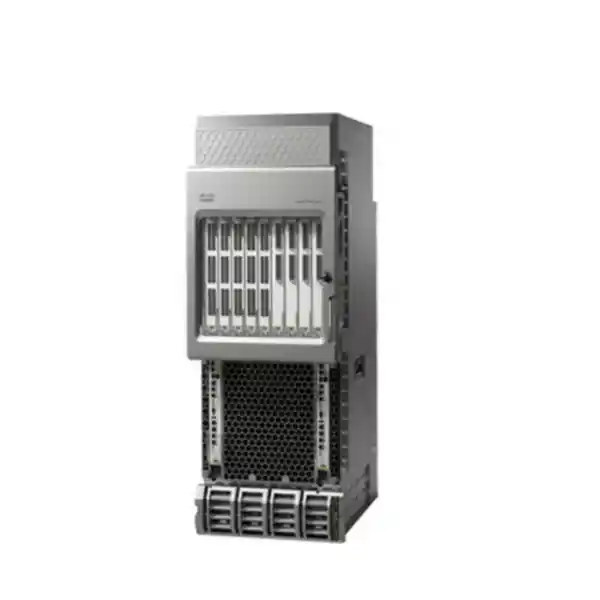
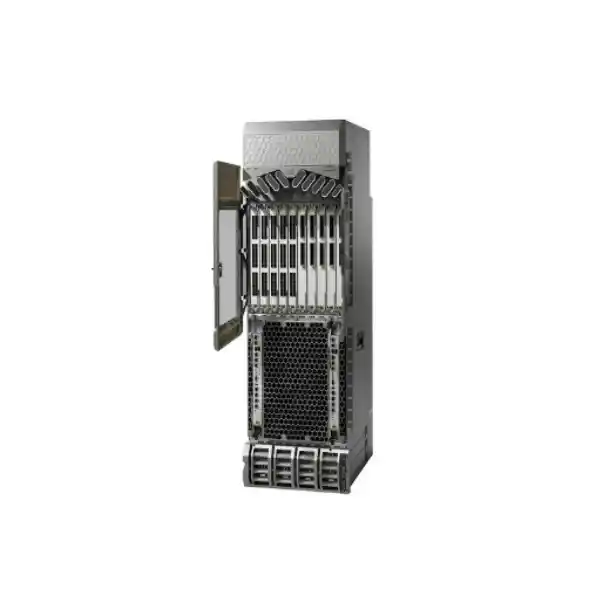
Cisco ASR 9912 Aggregation Services Router
The Cisco ASR 9912 is a modular, high-capacity routing platform for service-provider edge, aggregation, IP/MPLS core, peering, broadband infrastructure and demanding enterprise transport environments. Its ten line-card slots, dedicated switch-fabric architecture, redundant control plane, front-to-back cooling and flexible AC or DC power design make it especially relevant where predictable scale, operational resilience and long service life matter more than compact branch-style form factors.
10 Line-Card Slots
A large modular chassis gives architects room to combine service-edge and packet-transport interfaces while preserving a clean growth path.
Up to 7 Fabric Cards
Dedicated switch-fabric cards support parallel switching planes and resilient high-throughput forwarding independent of the route-processor slots.
Dual Route Processors
Redundant route-processor slots are designed for nonstop service objectives, maintenance flexibility and robust operational separation.
30 RU, Front-to-Back
The airflow direction and carrier-class mechanical format suit engineered equipment rooms, PoPs and telecom facilities with planned hot/cold paths.
What the Cisco ASR 9912 is designed to do
The Cisco ASR 9912 Aggregation Services Router belongs to the ASR 9000 family, a platform line created for high-scale routing roles in environments where packet forwarding, service intelligence, protocol depth, deterministic quality of service and hardware resilience all need to coexist. In practical network terms, the ASR 9912 can sit between metro access and a national core, between a broadband aggregation domain and internet transit, at a high-density enterprise WAN hub, inside a service-provider peering edge, or as a large MPLS provider-edge platform supporting many customer and infrastructure services at once.
The chassis does not force every deployment into one interface profile. Its value comes from modularity. Architects can choose line cards according to service requirements, interface speeds, QoS depth, buffering characteristics, optics, licensing and traffic engineering goals. That means a UAE ISP can build a 100G-centric peering node, a telecom operator can create a multi-service MPLS edge, and a large enterprise or public-sector organization can use the same chassis family principles for resilient data-centre interconnection and high-capacity WAN consolidation.
Because the product has been in the market for many years, correct design requires more than choosing the chassis name. Route-processor generation, fabric-card generation, line-card generation, optics, IOS XR release, feature licenses, power modules and software support must be treated as one validated bill of materials. FourTeck approaches the ASR 9912 as an engineered system rather than an isolated hardware SKU, which is essential when the goal is predictable throughput, future expansion and an operationally supportable UAE deployment.
ASR 9912 chassis architecture at a glance
| Design area | ASR 9912 characteristic | Engineering implication |
|---|---|---|
| Line-card capacity | Ten line-card slots | Supports high interface density and phased capacity expansion. |
| Route processing | Two dedicated route-processor slots | Enables redundant control-plane design and maintenance planning. |
| Switch fabric | Up to seven dedicated fabric-card slots; 6+1 operation supported with appropriate generation | Fabric scale should be matched to installed line-card generation and throughput target. |
| Airflow | Front-to-back | Rack layout and cooling path should follow the same direction to minimize recirculation. |
| Rack footprint | 30 RU chassis, approximately 17.60 in wide and 30.03 in deep with door | Cabinet depth, floor loading, service clearance and cable bend radius need pre-installation review. |
| Power | Modular AC or DC power, with resilient feed design options | Electrical capacity must be calculated against actual card population and redundancy objective. |
Dedicated switch fabric and why it matters
One of the defining architectural elements of the ASR 9912 is that switching fabric is located on dedicated fabric cards rather than being treated as an incidental function of the route processor. The fabric is organized as parallel planes. Packets arriving on an ingress line card are classified and handled by the forwarding resources associated with that line card, transported across the fabric, and delivered to the appropriate egress line card. Separating these roles helps the system scale while keeping packet forwarding and control-plane responsibilities logically distinct.
For third-generation line-card environments, Cisco documents fabric-card arrangements in which each fabric card contributes per-slot capacity and a fully populated seven-card fabric can operate with six active planes plus one redundant plane. In that arrangement, the chassis can provide up to 1.38 Tbps of fabric capacity per line-card slot. Earlier line-card generations use different fabric-capacity assumptions, so the number should never be applied blindly to every ASR 9912 configuration. A design review must map the specific fabric-card part number, line-card generation and redundancy mode before quoting effective system bandwidth.
This distinction is important in real procurement. A chassis with ten line-card positions does not automatically guarantee that every possible card can run at its maximum theoretical interface rate under every fabric combination. High-density interfaces, especially 100G and higher-speed multi-rate cards, must be paired with the correct switching resources. A good bill of materials therefore starts with traffic demand, desired oversubscription ratio, failure behavior and interface map, and only then selects the fabric and line-card mix.
For UAE operators planning long-lived PoPs, this modular fabric approach also creates an operational benefit: capacity can be engineered as a system. Instead of replacing an entire routing shelf because one element reaches a scaling limit, the platform allows appropriately supported components to be aligned with the next stage of growth, subject to Cisco compatibility and software-release requirements.
Route processors
The ASR 9912 provides two dedicated route-processor slots. In a resilient design, dual processors are used to separate control-plane continuity from any single hardware failure and to support maintenance strategies aligned with high availability.
Route-processor selection affects memory, control-plane scale, software capabilities, boot architecture, telemetry and compatibility with later IOS XR releases. The correct processor should therefore be selected from the supported combinations for the intended service life rather than simply matching an existing legacy configuration.
Line-card strategy
ASR 9000 line cards span multiple generations, interface densities and service profiles. Options have included 1G, 10G, 40G, 100G, 200G and 400G-oriented families, depending on card generation, modular-port-adapter choice, chassis compatibility and IOS XR release.
Service-edge optimized variants prioritize richer QoS and subscriber or service features, while packet-transport optimized variants target networks that need strong forwarding with a more basic QoS profile. Mixed environments are possible when validated as part of the complete configuration.
Interface design: 10G, 40G, 100G and higher-speed planning
Interface planning for an ASR 9912 should start with service topology rather than raw port count. A provider edge may need hundreds of 10G customer-facing or aggregation circuits, a metro core may concentrate traffic into 100G trunks, and a peering node may require fewer ports but a stronger emphasis on route scale, 100G optics reach and resilient cross-connects. The chassis can accommodate different line-card families, but each card has its own performance, optics, breakout and licensing rules.
Cisco has offered fixed and modular 100G options for the ASR 9000 family. Examples include four-port and eight-port 100 Gigabit Ethernet line cards supporting line-rate 100G interfaces, as well as modular cards that accept port adapters for combinations of 10G, 40G or 100G connectivity. Other card generations introduce multi-rate and higher-density designs. Because the ASR 9912 spans a long platform history, procurement must distinguish currently appropriate cards from legacy parts that may still be operational in installed networks but may not be optimal for a new build.
Breakout capability can be useful when a core-facing 100G physical interface needs to support multiple 10G logical connections through an approved breakout optic or cable arrangement. However, breakout support is card- and software-specific. It should be validated against the exact hardware part number, transceiver type, connector standard, desired reach and IOS XR version. For telecom rooms in Dubai, Abu Dhabi and other UAE locations, fiber plant documentation should also record whether each circuit is single-mode or multimode, the expected optical budget, patch-panel count, connector loss and any intermediate passive equipment.
FourTeck can align the router BOM with structured fiber, optics and rack infrastructure through the broader FourTeck UAE portfolio, helping reduce the common gap between a router specification and the physical connectivity needed to place it into production.
IOS XR operating model
The ASR 9912 runs Cisco IOS XR, an operating system designed for large-scale routing platforms and service-provider networks. IOS XR uses a modular architecture intended to isolate processes, support operational resilience and provide the routing, MPLS, segment-routing, telemetry, security and service functions expected in carrier environments. Exact capabilities depend on installed hardware, software release and licensing.
Operationally, IOS XR encourages disciplined configuration management. Candidate changes, commit workflows, rollback mechanisms and structured configuration hierarchies help teams reduce the risk associated with maintaining a large edge or core router. In production networks, this matters because the device may carry many independent services at the same time. A seemingly small change to a route policy, QoS policy or BGP neighbor can affect multiple customers or upstreams if change control is weak.
Modern IOS XR releases also support automation and telemetry methods that can integrate the router with orchestration and monitoring systems. Depending on release and feature set, engineers can use model-driven interfaces, programmatic management and streaming telemetry rather than relying exclusively on screen-scraped CLI operations. This is valuable for UAE networks moving from individual-device administration toward intent-based operations, automated compliance checks and large-scale performance observability.
Software selection must still be treated conservatively. The newest release is not automatically the right release for every installed line card, route processor or service feature. A production plan should examine the Cisco compatibility matrix, release notes, recommended maintenance release, known caveats, security advisory exposure and lifecycle window before an upgrade is approved.
Routing scale and service-provider protocol depth
The ASR 9912 is intended for environments where routing protocols are part of the service architecture, not merely a method of learning a default route. Typical deployments use BGP for internet peering, transit, MPLS VPN control planes and inter-domain routing; IS-IS or OSPF for interior gateway routing; MPLS for label-switched transport; and policy frameworks to control how routes are originated, accepted, preferred, propagated and protected.
A high-capacity chassis can be deployed as a provider edge router hosting many virtual routing instances, an aggregation router connecting access rings or remote PoPs, or a peering edge handling large external BGP tables. But route scale is not a single universal number. It depends on route-processor memory, forwarding hardware, address family, label use, feature combination and software release. Engineers should therefore size route scale using the expected IPv4, IPv6, VPNv4, VPNv6, multicast and label populations with an operational margin rather than relying on an isolated headline figure.
Policy design is equally important. Prefix limits, route filters, RPKI-related validation architecture where supported, max-prefix protection, BFD, graceful restart considerations and neighbor-specific communities can reduce the blast radius of routing errors. At the provider edge, route reflectors and next-hop design determine convergence and control-plane load. At internet edges, teams must consider traffic-engineering policy, local preference, MED, communities and selective advertisement toward multiple upstreams.
For a UAE carrier or enterprise with multiple data centres, cloud on-ramps or international circuits, the ASR 9912 can become a central policy enforcement point. That makes documentation, review and out-of-band access as important as port capacity. A strong implementation includes pre-change configuration backups, standardized templates, peer-group policy logic, management-plane filtering and clear rollback steps for every routing migration.
MPLS, VPN services and segment-routing evolution
ASR 9000 platforms are widely associated with MPLS service-provider networks because they can combine IP routing with label-switched forwarding and service-edge functions. In a classic MPLS architecture, the ASR 9912 may act as a provider edge node terminating customer VPNs while participating in a provider core built with label distribution, traffic engineering and internal routing protocols. It can also be deployed as a high-density aggregation point that hands traffic toward separate core routers.
L3VPN services are often the most familiar use case, but designs may also incorporate Layer 2 VPN technologies, Ethernet services, pseudowires or EVPN-related architectures depending on hardware and software support. The critical design point is service isolation: customer routing domains, label allocation, QoS, MTU and failure behavior must be planned together. A mismatch between provider MTU and customer encapsulation can create hard-to-diagnose fragmentation or packet loss; an incomplete route-target policy can leak or suppress routes; and inconsistent QoS can undermine an otherwise correct VPN design.
Networks evolving toward segment routing should review whether the intended IOS XR release and installed hardware support the exact SR-MPLS, traffic-engineering, fast-reroute and control-plane functions required. Segment routing can simplify parts of the MPLS control plane by encoding forwarding behavior through segments, but it does not eliminate the need for careful underlay, IGP, path-computation, MTU, resiliency and operational planning.
FourTeck can combine router engineering with implementation services from FourTeck IT Services UAE, covering migration plans, staging, configuration review, maintenance-window execution and post-cutover validation for multi-site routing projects.
Quality of Service: designing for real traffic, not only port speed
A router can have sufficient aggregate bandwidth and still deliver poor service when congestion is unmanaged. The ASR 9000 line-card portfolio includes service-edge optimized and packet-transport optimized variants with different QoS capabilities. This allows the hardware profile to follow the deployment model: customer-facing service edges may require deeper hierarchical QoS, while a pure transport role may need a simpler policy set focused on class-based scheduling and congestion protection.
QoS design starts with a traffic model. Engineers should identify control traffic, routing protocols, real-time voice and video, business-critical applications, best-effort internet, bulk transfer, replication and potentially unwanted or low-priority traffic. Classification and marking should be consistent across the network, and trust boundaries must be explicit. A DSCP value received from an unmanaged customer should not automatically receive premium treatment without policy validation.
The next stage is queueing and scheduling. Priority queues can protect delay-sensitive traffic but should be policed or otherwise controlled so they do not starve other classes. Weighted queues can provide predictable bandwidth shares. Shaping can enforce contracted rates, while policing can protect infrastructure or apply service limits. On large provider-edge systems, hierarchical policies may represent parent physical interfaces, subinterfaces and individual customer services.
Capacity planners should test QoS behavior during failure scenarios, not only under normal routing. When one of two 100G uplinks fails, surviving traffic may converge onto the remaining path. That is exactly when queueing policy becomes most important. A FourTeck design review can calculate normal and failure-state utilization, classify oversubscription risk and recommend the line-card and policy profile that matches the service objective.
High availability and failure-domain planning
Carrier-grade availability is created by layers of redundancy rather than by one feature. The ASR 9912 contributes several hardware building blocks: dual route-processor slots, multiple switch-fabric cards, multiple power modules, redundant power feeds and dual fan trays. Each building block addresses a different failure domain. A resilient design needs all of them aligned with upstream and downstream topology.
Dual route processors reduce dependence on a single control-plane module. A multi-plane switch fabric reduces dependence on a single forwarding interconnect. Redundant AC or DC feeds protect against a single electrical source failure when facility infrastructure is designed accordingly. Multiple fan elements and fan trays protect cooling. Online insertion and removal support on compatible line cards helps maintenance teams replace or add hardware without treating every component event as a complete chassis outage.
However, a redundant chassis is not the same as a redundant network. If all customer circuits enter one line card, that line card remains a concentration risk. If both core uplinks use the same fiber path, a cable cut can defeat control-plane and power redundancy. If both BGP upstreams terminate on one remote carrier site, an external failure can still isolate the router. Good architecture spreads critical services across cards, paths, power feeds, upstream peers and, where required, physically separate routing nodes.
For high-availability UAE applications, FourTeck recommends documenting the expected behavior for each failure: route-processor switchover, one fabric-card failure, one fan-tray event, one power feed loss, one line-card failure, one uplink failure and a complete router outage. The test plan should specify convergence targets, traffic loss tolerance, monitoring alarms and escalation procedures for each condition.
Power architecture for UAE facilities
Power design is a major part of ASR 9912 deployment because a fully populated carrier chassis represents a meaningful electrical and thermal load. Cisco documents pay-as-you-grow AC and DC power options, including 6 kW and 3 kW AC modules and 4.4 kW and 2.1 kW DC modules in relevant power systems. The platform supports resilient feed models, including N+N approaches for AC and N+1 approaches for DC, subject to the installed power-tray and module configuration.
For AC operation, the platform uses 200–240V input ranges in supported configurations. Facility engineers should calculate the actual load from the selected route processors, fabric cards, line cards, optics and fan demand rather than reserving capacity from a generic chassis maximum alone. The design should include PDU rating, breaker size, plug type, A/B feed topology, UPS runtime, generator capacity and any local data-centre derating rules.
DC power is common in telecom environments because it integrates with established -48V battery systems. Cisco documents a worldwide DC range of approximately -40 to -72V for applicable modules. In a DC site, engineers should validate cable gauge, lug specifications, breaker/fuse protection, distribution-panel capacity, grounding and polarity. Battery autonomy calculations must include the router plus other critical equipment in the same load domain.
No power design should assume that installing one additional line card is electrically free. Expansion plans should reserve both slot capacity and power headroom. The preferred BOM therefore includes a growth-state calculation: what the chassis consumes today, what it will consume after planned card additions, and what redundancy remains after the loss of one feed or module.
Cooling, rack space and physical installation
The Cisco ASR 9912 is a 30 RU platform, so installation must be planned as a facilities project rather than a simple rack-mount task. Cisco lists a chassis width of approximately 17.60 inches and depth of approximately 30.03 inches with the door, with a base chassis weight exceeding 100 kg before all line cards and power modules are installed. A more substantially populated configuration can weigh significantly more. Rack floor loading, rail compatibility, cabinet depth and lifting method therefore need advance approval.
Airflow is front-to-back. This is favorable for conventional hot-aisle/cold-aisle layouts, but only when the rack and room preserve that direction. Blank panels, brush strips and cable management can reduce hot-air recirculation. Front intake areas must not be blocked by vertical cable managers or dense patch cords. Rear exhaust must have adequate clearance. In dusty or construction-adjacent environments, room filtration and housekeeping should be addressed because carrier routing equipment relies on continuous airflow.
Two fan trays, each containing multiple high-efficiency fans, provide cooling redundancy. Fan speed is variable so thermal performance responds to operating conditions. Even with this resilience, sustained room temperatures outside the approved equipment envelope can shorten component life and increase fan power. UAE installations should pay particular attention to HVAC redundancy, especially in edge sites that may experience high ambient temperatures during a cooling failure.
For projects where the ASR 9912 sits beside compute, storage or network-security platforms, FourTeck can coordinate rack, server-room and infrastructure planning through Server Dubai solutions, helping ensure cabinet depth, PDU density, structured cabling and thermal layout are considered as one environment.
Internet edge and peering deployment
At an internet edge, the ASR 9912 can aggregate high-speed transit, IX and private-peering circuits while maintaining large BGP policy sets. The design objective is not simply to accept routes; it is to control traffic entering and leaving the network. Multiple upstreams allow organizations to select paths by business relationship, performance, regional reach or cost. Internet exchanges can improve local traffic efficiency, while private network interconnects may provide predictable connectivity to major partners and cloud environments.
BGP security and hygiene should be built into the baseline. Operators commonly apply explicit inbound and outbound prefix policy, bogon filtering, maximum-prefix thresholds, AS-path controls, community handling and route dampening or convergence policy where appropriate. Infrastructure ACLs should protect the router itself. Control-plane policing and management-plane restrictions help ensure that forwarding demand or hostile traffic cannot unnecessarily consume route-processor resources.
DDoS design is also relevant at high-capacity edges. The router can participate in mitigation architectures using BGP signaling, remote triggered black hole techniques, FlowSpec or external scrubbing workflows depending on software, policy and provider integration. The exact method should be selected carefully because an aggressive mitigation policy can create its own outage. Detection, signal authorization, route-policy boundaries and rollback mechanisms are necessary.
For organizations in Dubai that need firewalling, edge security or traffic-inspection planning around the routing layer, the Firewall Dubai practice can be aligned with ASR 9912 routing so security appliances, upstream peers and protected network zones are sized around realistic throughput and failure-state traffic.
Metro aggregation and provider-edge design
Metro networks often combine large numbers of access circuits with a smaller number of high-speed core links. The ASR 9912 is well suited to this pattern because its modular slots can be allocated to interface densities that match the access layer while preserving high-capacity uplinks. A telecom operator may use several cards for access-ring termination and reserve additional slots for 100G or higher-speed trunks toward regional core nodes.
The architectural question is where to place service termination. If customer VPN, QoS and policy functions are terminated at the ASR 9912, the chassis acts as a provider edge. This can centralize service intelligence and reduce complexity in access devices. If the router is used primarily for transport, services may remain terminated elsewhere and the ASR 9912 becomes a high-capacity aggregation or label-switching node. The correct approach depends on fault isolation, scale, operations and service lifecycle.
Ring protection and uplink diversity should be planned with physical topology. Two logically separate links that share the same duct or building riser do not deliver true path resilience. Carrier environments should document fiber route, patch panels, intermediate ODFs and provider handoff points. Interface numbering and descriptions should reflect this physical information so operations teams can identify whether two links are actually diverse.
Convergence testing is essential. Failure of a ring member, uplink, line card or upstream router should be simulated in a controlled environment or maintenance window. BFD timers, IGP settings, MPLS protection behavior and BGP next-hop handling should be tuned to meet service objectives without creating unstable protocol behavior.
Enterprise WAN and data-centre interconnect use cases
Although the ASR 9912 is fundamentally a service-provider-class platform, some large enterprises, government organizations, utilities, transport operators and cloud environments have requirements that resemble carrier networks. They may operate several data centres, private optical transport, thousands of routes, large MPLS domains or many high-capacity external connections. In such environments, a modular carrier router can consolidate functions that would otherwise require several smaller platforms.
A data-centre interconnect design may use multiple 100G circuits between Dubai and Abu Dhabi sites, with additional paths to disaster-recovery facilities or cloud connectivity locations. The ASR 9912 can serve as the routed transport boundary, enforcing path policy and isolating WAN behavior from the internal data-centre switching fabric. This can be valuable where operations teams want a clear demarcation between campus/DC switching and wide-area routing.
Large public-sector or utility networks may also use MPLS-based segmentation to isolate operational technology, business systems, surveillance, voice and external partner access. In that case the router becomes part of a policy framework. VRF design, route-target policy, QoS, multicast requirements and cybersecurity controls must all be documented. The design should also include management access when the production network is impaired, typically through a dedicated management network or terminal-server path.
The platform is not automatically the best answer for every enterprise. A 30 RU chassis is excessive if the requirement is only a few low-speed WAN connections. FourTeck therefore sizes the ASR 9912 when port density, service depth, throughput, control-plane scale, resilience or future expansion justify a chassis of this class.
Optics and fiber engineering
High-speed routing projects fail surprisingly often at the optics layer. A line card may support the target speed, but the chosen transceiver may not match fiber type, reach, connector, wavelength plan or the equipment at the far end. For every ASR 9912 interface, the BOM should identify the exact line-card port type, Cisco-supported optic or compatible approved optic policy, fiber mode, connector type, distance and optical budget.
Short-reach links inside a data centre may use multimode optics where supported, while metro and long-haul links generally use single-mode modules. 100G connections can involve several optical standards with very different reach and fiber requirements. Breakout options may introduce parallel fiber or different connector formats. Coherent or transport-assisted links require an entirely different design process, often involving DWDM systems rather than a simple client optic.
Optical budget should include transmitter power, receiver sensitivity, fiber attenuation, connector loss, splice loss and engineering margin. The number of patch panels matters. A circuit that is comfortably within budget on straight fiber can become marginal after multiple ODFs and cross-connects. Receiving power should be measured during commissioning and recorded as a baseline so future degradation can be detected.
UAE sites frequently interconnect through carrier-neutral data centres, telecom exchanges and managed fiber providers. In such environments, the quotation should separate router optics from carrier cross-connect charges and should document whether the service provider presents dark fiber, wavelength service, Ethernet handoff or another transport type. This avoids ordering the wrong transceiver for the actual demarcation.
IPv6 readiness and dual-stack operations
The ASR 9000 family supports IPv6 routing in service-provider and enterprise designs, allowing the ASR 9912 to participate in dual-stack networks, IPv6 transit, VPN services and modern internet-edge deployments. The architecture should not treat IPv6 as a duplicate of IPv4 configuration. Address planning, security policy, neighbor discovery, routing filters, monitoring and customer allocation all require their own design decisions.
At an internet edge, IPv6 BGP policy should be explicit and tested independently. Prefix limits, bogon filters and announcement rules should reflect IPv6 allocation practices. Infrastructure addressing can use a structured plan for loopbacks, point-to-point links and management. Where MPLS VPN services carry IPv6, the route-control and label architecture must be validated for the chosen design.
Operations tooling also needs parity. Monitoring systems should collect IPv6 interface status, routing neighbors, latency and traffic. Access-control policy should protect IPv6 management traffic with the same seriousness as IPv4. A network that enables IPv6 forwarding but does not update security and monitoring can create blind spots even if the routing itself works correctly.
For greenfield UAE projects, FourTeck recommends designing IPv4 and IPv6 together. Even where immediate customer demand is mostly IPv4, a dual-stack-ready addressing and policy framework avoids disruptive retrofits later and allows the routing platform to support regional and global internet evolution.
Security hardening for a carrier router
A core or edge router should be hardened as critical infrastructure. Security starts with the management plane. SSH access should be restricted to defined management networks, unused services disabled, authentication centralized where appropriate, and privilege models aligned with operational roles. Local emergency credentials should be controlled and audited. Management traffic should not be exposed directly to customer or internet-facing interfaces unless there is a very specific, protected requirement.
The control plane needs separate protection. Routing protocols should use neighbor authentication or other supported safeguards where practical, infrastructure ACLs should filter packets addressed to the router, and control-plane policing should limit classes of traffic that could consume processor resources. BGP sessions should be restricted to expected peers, TTL-security mechanisms considered where suitable, and routing policy used to ensure that unexpected prefixes cannot enter or leave the network.
Software lifecycle is also a security control. IOS XR versions should be tracked against Cisco security advisories and software maintenance recommendations. Emergency patching plans should consider hardware compatibility and route convergence. A preproduction lab or spare chassis can be valuable for operators who run complex feature combinations and cannot safely validate major upgrades on production systems.
Logging and telemetry should support investigation. Syslog, SNMP or model-driven telemetry, AAA records, configuration-change history and time synchronization should be centralized. NTP design deserves attention because event correlation becomes difficult when routers, firewalls and monitoring systems disagree on time.
Monitoring, telemetry and operational visibility
A high-capacity router should be monitored at more than the interface-up/interface-down level. Operations teams need visibility into traffic, queue drops, optical levels, route-neighbor state, CPU and memory, fabric status, power modules, fan trays, temperature sensors and line-card health. Baselines make these metrics more useful because a sudden change from normal behavior is often more significant than crossing a generic threshold.
Traffic monitoring should distinguish utilization from congestion. A 100G link averaging 40 percent may still experience microbursts that overflow a queue, while a well-engineered link can operate at a higher average without dropping traffic. Queue statistics, packet drop counters and QoS class utilization help reveal whether the bottleneck is on the physical interface, inside a policy hierarchy or upstream.
Optical monitoring provides an early warning of fiber problems. Receive power trending downward over weeks can indicate contamination, connector degradation, bend loss or fiber issues. CRC errors may point to physical-layer impairment even when a link remains operational. Transceiver temperature and laser bias can provide additional clues when supported by the optic and platform.
Modern model-driven telemetry can complement traditional polling by streaming state at higher frequency. The right method depends on the management stack already used by the organization. FourTeck can integrate router monitoring into existing NMS and logging platforms rather than forcing a separate operational island for one device family.
Capacity planning methodology for the ASR 9912
Capacity planning should be quantitative. Start by listing every current interface, its speed, average utilization, 95th-percentile utilization, peak observed traffic and projected growth. Next, identify new services expected during the planning horizon. Separate customer-facing access from core, peering, DCI and management links. This creates an interface map rather than an arbitrary line-card count.
Then model normal and failure states. If four 100G uplinks normally share traffic, determine what happens when one fails. If customer-facing capacity totals 600G but core capacity is 400G, decide whether this is acceptable oversubscription and whether traffic profiles justify it. If not, add core capacity. Repeat the exercise for fabric resources, line-card throughput and power.
Route scale should be modeled separately from bandwidth. Count internet routes, VPN routes, internal infrastructure prefixes, IPv6 routes, labels and expected customer growth. Apply headroom so the design is not operating near a platform ceiling on day one. Similarly, subscriber or service scale—if relevant—must account for feature combinations and line-card capabilities rather than one global chassis number.
Finally, build a three-stage BOM: day-one configuration, planned expansion and maximum credible configuration during the expected lifecycle. Reserve slots, fabric capacity, power, optics and software entitlements for the growth stage. This prevents the common situation where a chassis still has empty slots but cannot accept the desired expansion without a wider upgrade to fabric, power or control-plane modules.
FourTeck quotations can document these assumptions explicitly, giving procurement and engineering teams a shared basis for evaluating cost, headroom and upgrade paths.
Licensing and software entitlement considerations
Cisco licensing has evolved over the lifecycle of the ASR 9000 family, and specific line cards or software capabilities may use feature licenses, consumption models or entitlement structures that vary by generation and IOS XR release. Procurement should therefore avoid assuming that a used, spare or previously installed line card automatically carries every license required for a new service.
The correct approach is to define required features first: routing protocols, MPLS services, QoS capabilities, subscriber features, segment-routing functions, encryption where applicable, telemetry and any scale-specific licenses. The hardware bill of materials is then checked against Cisco software licensing requirements and the organization’s support model. This is especially important when mixing older and newer cards in an existing chassis.
Support entitlement should be treated separately from the hardware purchase price. A core router may remain in service for many years, and access to software fixes, technical support and replacement services can materially affect operational risk. Organizations should choose a support level based on service criticality and availability of onsite spares rather than selecting the lowest-cost option by default.
For existing ASR 9912 installations, FourTeck can review the current chassis inventory, software release and service objectives before proposing an expansion. This often avoids unnecessary replacement while identifying components that should be modernized to support later IOS XR releases or higher-speed interfaces.
Migration from an existing core or aggregation router
A routing migration should be engineered around service continuity. The safest method is usually parallel deployment: rack and power the ASR 9912, stage software, configure management, establish out-of-band access, install line cards and optics, validate physical links, then migrate routing and services in controlled groups. This allows engineers to compare new and old systems before moving critical traffic.
Configuration conversion needs review rather than mechanical translation. Route policies may use different syntax, default behavior may have changed between software generations, and legacy QoS constructs may need redesign. Interface naming, MTU, bundle configuration, BFD and routing timers should be checked line by line. If the previous platform was not IOS XR, operational procedures and troubleshooting commands will also change.
The migration plan should define rollback for every phase. A BGP peering move can be reversed by restoring the old cross-connect and neighbor state. A Layer 3 VPN migration may require route-target or route-reflector coordination. A physical fiber move should have verified patch labels and spare jumpers. The more services that are moved simultaneously, the harder rollback becomes, so phased cutovers are preferable when business constraints allow.
Post-migration validation should compare route counts, BGP neighbor state, IGP adjacency, MPLS labels, VPN reachability, QoS counters, interface errors, latency, packet loss and monitoring alarms against the pre-change baseline. A cutover is not complete merely because ping succeeds; it is complete when the intended service behavior has been verified.
Staging and acceptance testing
Hardware audit
Verify chassis serials, route processors, fabric cards, line cards, power modules, fan trays, optics and accessories against the approved BOM before rack installation.
Software baseline
Confirm IOS XR release, packages, licensing status, boot variables, configuration register behavior, management reachability and time synchronization.
Forwarding tests
Validate line-rate or representative traffic, MTU, packet loss, QoS queues, ECMP behavior, link bundles, failover and route convergence with a defined test matrix.
Resiliency tests
Exercise route-processor switchover, fabric-card failure, feed loss, selected line-card events and uplink failure so expected alarms and traffic impact are documented.
Formal acceptance testing turns deployment assumptions into evidence. It is especially useful for a chassis such as the ASR 9912 because many components can be independently redundant or modular. The acceptance document should record component inventory, software version, baseline sensor readings, interface optical levels, routing scale, test results and any deviations accepted by the customer. This becomes the reference point for future maintenance and expansion.
Lifecycle operations and spare strategy
A long-lived routing platform needs a spare strategy matched to business impact. For a single ASR 9912 serving a critical site, organizations should consider which failures can be tolerated through internal redundancy and which still require a replacement part. Dual route processors and redundant fabric reduce the urgency of some failures, but a failed line card carrying unique circuits may still create immediate service impact.
Common spare candidates include optics, fan components where operationally appropriate, power modules and selected line cards. The exact inventory depends on lead time, support contract and how many identical chassis are deployed. A provider with ten ASR 9912 systems can often maintain a centralized spare pool more economically than an organization with one remote chassis.
Software lifecycle needs similar planning. Maintain a current inventory of hardware revisions and IOS XR releases. Review security advisories regularly. Schedule maintenance releases before software becomes too old to support new optics, line cards or security fixes. Keep validated configuration backups outside the chassis and test restore procedures. If automation generates configuration, preserve both the source template and the rendered device configuration.
FourTeck can structure lifecycle support around the installed environment, combining hardware supply, onsite assistance, configuration review and infrastructure services. This approach is particularly useful for organizations that want one UAE technical partner to coordinate routing hardware with adjacent security, server-room and connectivity requirements.
UAE procurement and deployment factors
Buying a carrier router in the UAE involves more than comparing hardware prices. The quotation should identify whether equipment is new, authorized, refurbished or sourced from secondary channels; whether Cisco support entitlement is available; whether transceivers are included; which power modules and power cords are provided; and which software licenses are required. These distinctions can materially change both cost and operational risk.
Lead time should be checked for every major component. A chassis may be available while the desired high-density line card or optic has a longer delivery window. Project schedules should therefore be driven by the longest-lead critical component, not the chassis alone. For expansions, engineers should capture the current hardware inventory first so new parts are guaranteed to be compatible with installed fabric and route processors.
Data-centre access and change control can also affect timeline. Dubai and Abu Dhabi colocation facilities may require advance method statements, work permits, rack elevation approval, cross-connect orders or remote-hands scheduling. If a 30 RU chassis is being added to an existing rack row, facility teams may need to approve power, floor load and cooling before delivery.
For projects that include international sites or regional backbone expansion, FourTeck can coordinate requirements with the wider FourTeck global network solutions portfolio while maintaining the UAE deployment as the engineering reference point.
How to size an ASR 9912 bill of materials
A useful quotation starts with service requirements. FourTeck normally separates requirements into traffic, interfaces, control-plane scale, resiliency, facilities and lifecycle. Traffic defines throughput and oversubscription. Interfaces define line-card and optic selection. Control-plane requirements define route-processor and software needs. Resiliency determines fabric, power and topology choices. Facilities determine rack and power fit. Lifecycle requirements determine support and spare strategy.
1. Ports
List quantity, speed, connector, fiber type, reach, breakout requirement and whether each interface is access, core, peering or management.
2. Traffic
Capture current average, 95th percentile, peak, expected annual growth and failure-state utilization for every high-capacity path.
3. Services
Identify BGP, IS-IS or OSPF, MPLS, L3VPN, L2 services, QoS hierarchy, multicast, segment routing and telemetry requirements.
4. Redundancy
Define route-processor, fabric, power-feed, line-card, link and chassis-level failure objectives with measurable convergence targets.
5. Facility
Validate rack units, depth, weight, cable clearance, cooling direction, A/B power, breaker size, PDU capacity and grounding.
6. Lifecycle
Agree on IOS XR target, support entitlement, maintenance release policy, spares, monitoring integration and expansion assumptions.
Example deployment profiles
ISP peering edge
A UAE ISP can deploy dual ASR 9912 routers at separate facilities, each carrying internet transit, IXP and private peering. High-speed line cards provide 100G-class connectivity, while BGP policy controls inbound and outbound traffic.
Design priorities include full route scale, upstream diversity, DDoS signaling, management-plane protection, high-availability power and enough surviving capacity for one-router or one-uplink failure.
Metro MPLS aggregation
A carrier can terminate multiple metro rings and customer links on the ASR 9912, then forward toward a national MPLS core over redundant high-speed trunks. Service-edge optimized cards can support richer QoS where customer policy terminates locally.
Design priorities include line-card fault domains, VRF and route-target scale, QoS hierarchy, MPLS convergence, optical reach and physical fiber diversity.
Enterprise DCI core
A large enterprise can use the ASR 9912 to aggregate routed DCI, cloud and WAN circuits. The router creates a clear wide-area routing boundary while the internal data-centre fabrics remain optimized for switching and application connectivity.
Design priorities include deterministic path policy, 100G capacity, dual-site architecture, route filtering, telemetry, MTU consistency and documented failover between data centres.
Government multi-service edge
A government or critical-infrastructure network can use VRFs and MPLS services to separate departments, operational technology, voice, surveillance and partner connectivity while maintaining common core transport.
Design priorities include segmentation assurance, security policy, change control, out-of-band management, redundant power and tested disaster-recovery procedures.
ASR 9912 versus smaller fixed or modular routers
The ASR 9912 should be selected when the network genuinely benefits from a large modular chassis. Compared with smaller routers, it consumes more rack space, power and cooling, and its BOM contains more independent components. Those costs are justified when the organization needs many high-speed interfaces, multiple line-card fault domains, substantial service scale or a long growth runway.
A smaller router may be preferable for a branch, compact enterprise edge or low-density peering location. Modern fixed platforms can deliver very high throughput in 1 or 2 RU, and for some designs they offer a better balance of power and density. The tradeoff is reduced modularity and potentially fewer independent hardware failure domains. Choosing between them requires an architecture decision, not brand preference.
The ASR 9912 is strongest when the deployment expects incremental line-card growth, mixed interface types, service-provider feature depth or chassis-level resiliency. It can also be valuable when an organization already operates ASR 9000 infrastructure and wants operational consistency, spare commonality or IOS XR skills reuse.
FourTeck can compare the ASR 9912 with alternative Cisco routing platforms based on actual port counts, throughput, power, route scale, software features and five-year expansion assumptions. This helps prevent both under-sizing and expensive over-sizing.
Important compatibility note before ordering
The ASR 9912 has supported multiple generations of route processors, fabric cards and line cards across its lifecycle. Compatibility is therefore combination-specific. A line card that is physically associated with the ASR 9000 family may require a particular fabric generation, route processor or IOS XR release. Similarly, higher-speed multi-rate cards may have requirements that do not apply to older 10G or 100G cards.
A production quotation should never be created by choosing ten arbitrary line cards and adding them to a chassis. FourTeck validates the system as a whole: chassis revision, route processors, fabric cards, line cards, power modules, optics, licensing and software. Existing customers should provide a current inventory output so expansion parts can be checked against installed components.
This compatibility validation is especially important for organizations considering refurbished or secondary-market hardware. Such equipment can be useful in lifecycle support or budget-sensitive expansions, but only when provenance, supportability, entitlement and hardware generation are understood before purchase.
Why FourTeck for Cisco ASR 9912 projects in UAE
FourTeck supports projects from initial sizing through operational handover. For a carrier-grade router, that means the engagement can include requirement discovery, architecture review, BOM validation, optics selection, power and rack assessment, IOS XR staging, configuration development, migration planning, onsite installation, acceptance testing and monitoring integration.
The objective is to remove gaps between teams. Procurement needs exact part numbers and lead times. Network engineering needs compatibility and scale. Facilities needs power, rack and cooling figures. Security needs management-plane and routing-policy controls. Operations needs documentation and alarms. A coordinated design makes these requirements visible before equipment arrives onsite.
For new deployments, FourTeck can build a greenfield architecture around desired services. For existing ASR 9912 environments, we can assess whether growth can be supported through line-card, fabric, processor or software changes. When replacement is more appropriate, the assessment can document why, helping the customer compare lifecycle cost against continued expansion.
The result is a router deployment that is sized for the actual UAE network rather than copied from a generic reference configuration.
Decision recap: when the ASR 9912 is a strong fit
The Cisco ASR 9912 is a strong candidate when an organization needs a large modular routing chassis with ten line-card positions, dedicated resilient fabric, dual route processors and carrier-class power and cooling. It is most compelling where interface density, service-provider features and long-term expansion justify the 30 RU footprint.
High-density aggregation, peering, MPLS edge or DCI where multiple high-speed line cards are expected.
Different interface generations and service profiles can be engineered into one chassis when compatibility is validated.
Dual control plane, multi-plane fabric, redundant cooling and resilient power designs support critical-service objectives.
A smaller modern router may deliver better space and power efficiency when only a few interfaces are required.
Quotation input checklist
For a precise ASR 9912 UAE quotation, provide the information below. Partial information is acceptable; FourTeck can help complete the design where details are not yet finalized.
Current router model, installed ASR 9912 inventory if expanding, IOS XR version, current routing protocols and approximate route scale.
Counts of 1G, 10G, 40G, 100G, 200G or 400G-oriented interfaces, including expected breakout and growth requirements.
Fiber type, approximate distance, connector type, carrier handoff and whether optics are required in the supply scope.
BGP peering, IP transit, MPLS VPN, Layer 2 services, segment routing, multicast, QoS hierarchy and management requirements.
Single or dual chassis, desired route-processor/fabric redundancy, A/B power feeds, redundant uplinks and acceptable outage during failure.
Rack availability, cabinet depth, AC or DC supply, PDU or DC panel capacity, cooling arrangement and installation location in UAE.
Plan your Cisco ASR 9912 deployment with FourTeck UAE
Send FourTeck your interface map, current topology or target service requirements. Our team can turn the information into a validated chassis, route-processor, fabric, line-card, optics and power proposal aligned with your IOS XR and resilience objectives.
For existing systems, include inventory details and the intended expansion so compatibility can be reviewed before parts are quoted. For greenfield networks, include three-year traffic growth and failure-state capacity targets so day-one purchasing does not restrict later expansion.

Reviews
There are no reviews yet.