
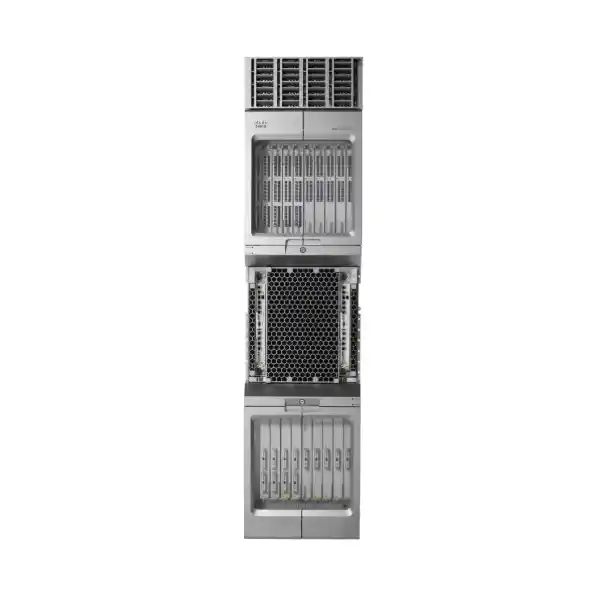
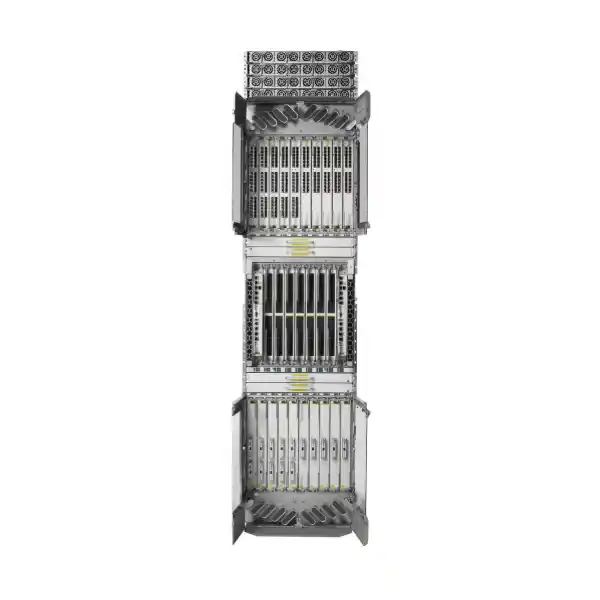
Cisco ASR 9922 Aggregation Services Router
A high-capacity 44RU modular platform for service-provider core, metro aggregation, peering, mobile transport and large-scale multiservice edge designs, with twenty line-card slots, redundant control planes, dedicated fabric architecture and Cisco IOS XR.
For operators in Dubai, Abu Dhabi and the wider UAE, the ASR 9922 provides a chassis architecture designed to absorb multi-generation interface upgrades while preserving operational consistency across routing, MPLS, Segment Routing, EVPN, multicast, timing and high-availability requirements.
Direct answer: what is the Cisco ASR 9922 and where does it fit?
The Cisco ASR 9922 is the largest modular chassis in the Cisco ASR 9000 family. Cisco lists it as a 44 rack-unit platform with twenty vertical line-card slots, two route-processor slots and seven dedicated switch-fabric-card slots. In current Cisco portfolio material the platform scales up to 160 Tbps, which makes it appropriate for environments where the routing system must combine very high interface density, long service life, broad IP/MPLS feature depth and carrier-grade hardware redundancy in a single chassis. Its purpose is not simply to provide many Ethernet ports. The value of the architecture is that packet forwarding is distributed across line cards while control, fabric, power and cooling components are designed for redundancy and replacement without turning the chassis into a monolithic failure domain.
In a UAE network, the ASR 9922 can be positioned at a national or metro core, a large internet peering edge, a broadband or business-services edge, a mobile aggregation layer, a cloud interconnect hub, or a consolidation point between data centres and transport networks. It is especially relevant when an operator wants to mix generations of Ethernet interfaces, move from 10G or 100G toward 400G, maintain deep routing and MPLS functionality, and avoid forklift replacement of the chassis each time the service mix changes. The system can support line cards across several ASR 9000 generations, subject to the selected route processor, switch fabric, optics and Cisco IOS XR release. That compatibility has to be engineered as a complete bill of materials rather than assumed from the chassis name alone.
The ASR 9922 uses dedicated switch-fabric cards rather than integrating the entire fabric into the route processor. This separation is important at scale because the control-plane role and high-capacity packet transport role can evolve independently. Two route processors provide active and standby control functions, while the fabric-card architecture uses multiple parallel planes. Cisco documentation describes seven switch-fabric-card slots and a 6+1 redundant design. Each forwarding line card connects through the chassis backplane to the fabric, allowing packet traffic to move between ingress and egress slots without forcing the central route processor to perform per-packet forwarding. The design is therefore well aligned with large service-provider networks in which route scale, convergence, interface density and forwarding throughput all have to grow together.
FourTeck approaches an ASR 9922 opportunity as an architecture exercise, not a chassis-only sale. The correct proposal includes interface forecasts, route scale, MAC and label scale, multicast requirements, QoS depth, subscriber or service-edge needs, timing, optical reach, redundancy targets, rack loading, electrical feeds, heat output, software licensing and migration sequencing. Customers can coordinate UAE procurement and network design through FourTeck UAE, with adjacent implementation planning available through FourTeck IT Services UAE.
Cisco ASR 9922 hardware architecture in practical engineering terms
Twenty line-card slots
Twenty vertical line-card slots give the ASR 9922 the physical scale needed for high-density metro, core and edge deployments. The slot count is significant because capacity planning can be performed by service role instead of only aggregate throughput. A provider may dedicate groups of slots to 100G peering, 400G core uplinks, 10G enterprise handoffs, aggregation toward optical transport, or specialized service-edge cards. Slot planning should reserve headroom for growth, failure replacement and migration; filling every slot on day one can reduce operational flexibility even when the chassis technically supports it.
Dual route processors
Two route processors are used for redundant system control. Cisco documentation identifies the RP as the main control element in ASR 9922 and ASR 9912 systems, with active and standby roles. Modern RP options such as RP2, RP3 and RP3-X support different software releases, route scale and line-card generations. The route processor selection affects control-plane capacity, software compatibility, memory, storage, operational longevity and the practical scale of routing protocols. It should therefore be sized against the complete feature set rather than selected solely because a particular RP physically fits the chassis.
Seven fabric-card slots
The dedicated fabric subsystem is one of the defining characteristics of the ASR 9922. Seven fabric-card slots support parallel switching planes with fabric redundancy. Cisco specifies a 6+1 redundant fabric design for the chassis. The fabric carries traffic between line cards and is engineered for active/active operation. This matters when high-rate traffic must traverse the backplane predictably under normal operation and continue through component failures. When newer high-capacity line cards are introduced, the selected fabric generation must be checked for compatibility and bandwidth so that the system is not constrained by an older fabric configuration.
Four fan trays and modular power
The ASR 9922 uses four fan trays, with Cisco documenting twelve high-efficiency variable-speed fans per tray for the referenced configuration. The chassis also uses four Power Entry Modules in the common fully equipped arrangement. AC and DC options are available, with pay-as-you-grow power architecture and feed redundancy. In a UAE data centre, the electrical and cooling plan must be validated against the actual line-card mix because a sparsely populated chassis and a fully loaded high-capacity chassis have very different heat and power profiles.
The physical chassis is approximately 77 inches high, corresponding to 44RU, and Cisco’s published dimensional data places the width at about 17.6 inches and depth around 30.7 inches with doors. The referenced chassis weight is about 413 lb with four PEMs and chassis, while a more populated common configuration including two RP2 cards, seven Fabric Card 2 modules, four fan trays and four PEMs is listed at about 639.5 lb before adding the line cards and power modules themselves. These figures make mechanical planning a serious part of the deployment. A rack must be rated for the static load, the floor must support the cabinet and adjacent equipment, the data-centre team needs safe installation procedures, and front-to-back airflow must not be blocked by decorative doors, cable bundles or insufficient hot-aisle extraction.
Switch-fabric design: why the ASR 9922 separates control and forwarding capacity
On the ASR 9922, route processing and switch-fabric functions are separated into dedicated card types. Earlier modular routing designs often concentrated more switching fabric capability on the route switch processor. For the 9922 architecture, dedicated fabric cards form the high-speed path between line cards, while the route processor concentrates on system control, routing protocols, management and platform coordination. This is an architectural advantage because forwarding bandwidth can be built from multiple fabric planes and the control-plane hardware can be upgraded on its own lifecycle.
Each fabric plane provides a path across the chassis. Cisco describes the 9912 and 9922 fabric as multiple parallel, nonblocking planes with centralized Virtual Output Queue arbitration associated with the route processor. From an engineering perspective, VOQ mechanisms are important because congestion needs to be handled before a burst on one egress destination causes unnecessary head-of-line blocking for unrelated traffic. The forwarding architecture is designed so the line cards perform distributed packet-processing decisions while the fabric transports packets between the source and destination slots. That division helps the platform scale across many interfaces and services without forcing all traffic through a single central packet processor.
The seven fabric-card slots are normally considered in the context of 6+1 redundancy. A network architect should not interpret redundancy as a reason to ignore capacity calculations. The correct method is to verify that the desired service throughput remains supportable after the failure or removal of a fabric card, and that the chosen fabric generation supports the line-card generation and software release. Newer fifth-generation line cards can offer very high per-slot bandwidth, while older line cards may have lower throughput or different fabric connectivity. Mixing line-card generations can be a practical migration strategy, but the fabric design needs to be checked against the highest-performance modules in the system and against the target failure scenario.
Cisco’s current product material lists the ASR 9922 at up to 160 Tbps. That headline capacity is a platform maximum, not a guarantee that any random combination of route processors, fabrics, line cards and licenses will deliver the same result. Achieving high chassis throughput requires a compatible high-capacity fabric configuration and line cards capable of driving the required per-slot bandwidth. The difference between physical slot capacity, provisioned interface bandwidth, licensed software capacity and measured forwarding throughput should be explicit in the bill of materials and low-level design. FourTeck therefore treats the 160 Tbps figure as a design ceiling to be validated for each configuration, not a default performance statement for every ASR 9922 chassis.
This distinction becomes especially important when the chassis is being refreshed rather than purchased new. A used or existing ASR 9922 may contain older route processors or fabric cards that are perfectly suitable for current 10G and 100G traffic but are not the preferred foundation for a large 400G expansion. A proper audit records the exact PIDs, hardware revisions, installed memory, power modules, fan generation, optics, IOS XR train and active licenses before a growth plan is approved.
Interface strategy from 1G and 10G access to 100G and 400G transport
One of the strongest reasons to select a modular ASR 9922 is the ability to build an interface mix around actual traffic roles. Cisco’s ASR 9000 ecosystem includes line cards for 1 Gigabit Ethernet, 10 Gigabit Ethernet, 25 Gigabit Ethernet, 40 Gigabit Ethernet, 100 Gigabit Ethernet and 400 Gigabit Ethernet, with support dependent on card generation, route processor, switch fabric and software. That range allows a chassis to act as a convergence point between legacy and current services rather than forcing separate boxes for each speed. A service provider can retain large numbers of lower-speed customer-facing connections while increasing core and peering bandwidth through 100G or 400G uplinks.
For high-density 10G environments, Cisco has published 48-port dual-rate 10GE/1GE line cards that can be installed in the ASR 9922. Twenty such slots can theoretically create very large 10G port counts; Cisco documentation specifically describes a fully populated chassis using those cards as delivering 960 ports of 10 Gigabit Ethernet or 960 ports of 1 Gigabit Ethernet. In a real design, however, a chassis is rarely optimized around a single card type forever. A more realistic architecture reserves some slots for high-speed core-facing interfaces and others for access or aggregation roles. Engineers should also check oversubscription characteristics on older cards rather than assuming line-rate performance for every port combination.
At 100G, the ASR 9000 family offers multiple generations and densities. Early cards may provide four or eight 100G ports, while later generations substantially increase density and per-slot capacity. At 400G, fifth-generation options allow the 9922 to participate in modern high-capacity backbone and data-centre interconnect designs. Cisco documentation includes fifth-generation line cards such as the A99-4T-FC and 10-port 400G variants, and current route-processor and fabric documentation lists these modules among supported components for the ASR 9922 when the required software and system elements are present.
Optics are part of the router design, not an afterthought. For UAE deployments, the optical plan should classify every circuit by distance, fibre type, connector, patch-panel loss, dispersion budget where relevant, and whether the service is grey optics into a transport system or direct coherent/DWDM integration. Short-reach links inside a data centre may use different modules from metro links between facilities, while long-haul routes may terminate on optical transport equipment. DOM telemetry, fibre cleanliness and spare optic strategy are operational factors that directly affect mean time to repair.
Port speed also needs to be mapped to traffic engineering. A 400G uplink is not automatically useful if the downstream aggregation is fragmented into many congested 10G links or if policy and queue design were sized for an older traffic profile. FourTeck develops interface matrices that show current utilization, 95th percentile growth, protected versus unprotected traffic, oversubscription targets and projected bandwidth for three to five years. This enables slot allocation to be driven by business demand rather than by headline port density.
For organisations combining core routing with security, WAN and data-centre infrastructure, the ASR 9922 can be integrated into a broader UAE architecture alongside solutions available through Firewall Dubai. The router remains the high-capacity transport and service platform, while firewalls, DDoS controls, application security and segmentation systems are placed according to the required trust boundaries and traffic flows.
Cisco IOS XR: operational model for always-on service-provider networks
Cisco IOS XR is the operating system associated with the ASR 9000 family. It was built around distributed operation, process isolation and large-scale routing requirements. On an ASR 9922, that software model complements the distributed forwarding hardware: control-plane protocols run on the route processor, forwarding state is programmed to line cards, and many platform functions can be managed without treating the router as one indivisible software process. For providers, this matters because a core or aggregation router may carry hundreds or thousands of customer services simultaneously; operational events should be contained wherever possible rather than forcing a chassis-wide restart.
Modern IOS XR releases support a broad set of service-provider technologies. Depending on software, hardware and licenses, the ASR 9000 portfolio supports IPv4 and IPv6 routing, BGP, IS-IS, OSPF, MPLS, Layer 3 VPN, Layer 2 VPN, EVPN, Segment Routing, SRv6, multicast, traffic engineering, QoS, Ethernet OAM, MPLS OAM, access controls, timing functions, IRB and high-availability mechanisms such as Nonstop Routing and Nonstop Forwarding. The value of the platform lies in combining transport and service functions under one operational environment, allowing a provider to standardize telemetry, configuration practices, routing policy and troubleshooting procedures.
BGP design is often one of the first sizing considerations for an ASR 9922. A large peering edge may hold multiple full internet tables, IPv6 routes, VPN routes and policy-derived paths. Route-reflector interaction, add-path, multipath, BGP communities, large communities and traffic-engineering policy can further increase control-plane state. The selected route processor therefore needs adequate memory and CPU headroom, and the design should consider convergence behavior during a peer flap rather than only steady-state route count. A platform that can hold a table is not automatically sized to reconverge that table within the desired service objective under multiple simultaneous events.
For MPLS and Segment Routing networks, label scale and policy scale are equally important. Segment Routing can reduce protocol complexity by encoding path intent through segment identifiers, but operators still need disciplined IGP design, locator or SID planning, policy control, fast reroute and telemetry. EVPN can unify Layer 2 and Layer 3 service control, yet MAC, IP and route-type scale should be checked against the line cards and route processor. The ASR 9922 provides the physical room and forwarding capacity for large deployments, but the practical service scale is always a combination of software release, hardware generation, feature set and desired convergence behavior.
Operational automation should be planned from the beginning. IOS XR platforms can be integrated with model-driven management, telemetry and orchestration frameworks. In a large network, configuration generation, pre-change validation, state collection and compliance checks are safer and more repeatable when automated than when every action depends on manual CLI. The goal is not to eliminate engineers; it is to give engineers deterministic workflows, peer-reviewed templates, rollback paths and measurable intent. Change windows become less risky when interface descriptions, routing policies, prefix limits, QoS profiles and service parameters are generated from a controlled source of truth.
Software lifecycle planning should also be tied to hardware lifecycle. An ASR 9922 may contain components from different generations, and not every IOS XR release supports every historical card combination. Before an upgrade, the operator should check release notes, compatibility matrices, ROMMON or firmware dependencies, minimum route-processor requirements and licensing. Lab validation or a representative staging chassis is recommended for networks with complex MPLS, multicast, timing or subscriber features. The correct upgrade is the release that supports the required hardware and features with acceptable operational risk, not simply the highest version number available.
Core, peering and transit design with the ASR 9922
National and metro core
In a core role, the ASR 9922 can aggregate high-capacity links from multiple metro or regional nodes and forward them across redundant backbone paths. Core design should emphasize fast convergence, deterministic IGP behavior, Segment Routing or MPLS transport policy, resilient optics, equal-cost multipath and failure-domain isolation. The large slot count allows operators to dedicate interfaces to separate rings, data centres or optical systems while retaining capacity for upgrades. Paired chassis are typically preferred over a single massive router when the business requirement calls for site or system-level resilience.
Internet peering edge
At an internet edge, the ASR 9922 can terminate many high-speed transit and peering sessions while providing routing policy, prefix protection, flow visibility and capacity for DDoS diversion architectures. Engineers should define maximum-prefix limits, RPKI validation workflows, local-preference policy, community conventions and graceful-maintenance procedures. The platform scale is useful when multiple 100G and 400G peering links converge in one facility, but the design should preserve path diversity across separate routers and power domains rather than making a single chassis the only external gateway.
Data-centre interconnect
For data-centre interconnect, the ASR 9922 can provide IP/MPLS or Segment Routing transport between large facilities and connect to EVPN or routed data-centre fabrics. The router should be positioned according to the chosen demarcation: it may act as a WAN edge with eBGP toward the data-centre fabric, as a provider edge supporting EVPN services, or as an optical handoff point. Latency, MTU, failure detection and route-leaking policy must be engineered end to end, particularly when storage replication or latency-sensitive applications share the link.
Cloud and wholesale interconnect
Large carriers and enterprises can use the platform to aggregate private cloud connections, wholesale Ethernet services, carrier handoffs and international capacity. VRF design, route targets, QoS, committed information rates and service OAM should be standardized so growth does not create one-off configurations. The chassis can provide physical scale, but operational simplicity depends on service templates and automation. A small number of well-defined service types is easier to monitor and troubleshoot than hundreds of customer-specific exceptions.
A UAE deployment should also account for regional traffic patterns. Dubai is a major connectivity and data-centre market, and high-capacity routers may serve traffic that is locally exchanged, carried between Emirates, handed to international transit, or extended toward African and Middle Eastern networks. For organisations building cross-border infrastructure, FourTeck also supports regional planning through FourTeck Africa, helping align core-router configurations, optics and spares across multiple operating territories.
Mobile transport, timing and converged service edge
The ASR 9000 family was designed for converged service-provider networks, and the ASR 9922 can be used where mobile, business, broadband and wholesale traffic share the same transport infrastructure. Mobile networks place particular emphasis on timing, predictable latency, fast convergence and strict QoS because radio access and packet core services can react poorly to congestion or synchronization faults. Cisco documents an integrated timing infrastructure across the ASR 9000 family, including support for timing inputs and distribution mechanisms such as SyncE and other synchronization sources depending on hardware and software.
In a mobile aggregation role, engineers should classify traffic by service objective rather than simply by VLAN or source interface. Control-plane signaling, user-plane traffic, synchronization, management and enterprise APN services may have different latency and loss tolerances. Hierarchical QoS can be used to enforce bandwidth guarantees and shaping structures, but queue design needs to be validated against the chosen line cards because hardware generations differ in queue scale and buffering behavior. A policy that works on one service-edge card should not be assumed to map identically to every other card in a mixed chassis.
Segment Routing can simplify the transport underlay for mobile and metro networks by reducing dependence on legacy signaling protocols, while still providing path engineering and fast reroute. Operators may use TI-LFA or other fast-convergence mechanisms depending on IOS XR capabilities and topology. The design objective is to restore traffic quickly after fibre or node failures without creating unstable routing oscillation. That requires consistent IGP metrics, link-delay measurement where used, accurate SRLG information and realistic testing of failure sequences.
EVPN can provide a modern control plane for Ethernet and routed services that previously depended on large Layer 2 domains or traditional L2VPN signaling. On a high-scale chassis, EVPN can consolidate many business and mobile services, but route-type scale, MAC movement, multihoming design and route-target policy must be documented. The technology is most effective when it is used to reduce complexity and failure domains, not merely layered on top of existing complexity.
For timing-sensitive deployments, the router should be integrated with the operator’s synchronization architecture from day one. Engineers should record primary and secondary timing references, quality levels, holdover behavior, alarm thresholds, SSM policy and the impact of line-card replacement. Timing is often invisible when it works and business-critical when it fails. Treating it as a formal design domain prevents synchronization faults from being misdiagnosed as radio, transport or application problems.
High availability: designing beyond component redundancy
Cisco provides extensive hardware redundancy in the ASR 9922: dual route processors, multiple fabric planes, redundant power feeds, modular power supplies, multiple fan trays and software high-availability mechanisms. These capabilities are necessary for carrier-class design, but resilient service depends on the surrounding architecture. A chassis with redundant internal components can still be a single failure domain if all upstream circuits use one duct, both power feeds originate from one UPS, all optics terminate on one transport shelf, or all customer services route through one node.
The preferred design for critical infrastructure normally uses at least two routing systems placed in separate physical or logical failure domains. Links should be diverse where possible, and routing protocols should reconverge without depending on manual intervention. BFD timers, IGP timers and BGP convergence should be tuned conservatively enough to avoid false positives while meeting the availability objective. Excessively aggressive timers can create instability under control-plane stress, while very slow timers extend outage duration. Validation must include real interface failures, fabric or line-card events, route-processor switchover and loss of external transport.
Graceful maintenance is another part of availability. Before removing a card or upgrading software, traffic should be drained using routing metrics, BGP policy, Segment Routing policy or service-specific controls. Operators should verify that the alternate path has enough capacity to absorb the traffic. A router that runs at 80 or 90 percent utilization during normal operation may technically have redundant links but still experience congestion during maintenance. Capacity planning therefore needs an N-1 view, and for very critical networks possibly an N-2 or maintenance-plus-failure scenario.
Spare strategy should reflect the installed hardware generation. A large ASR 9922 can contain route processors, fabric cards, line cards, fan trays, PEMs, power modules and optics with different failure impacts. Keeping an expensive spare for every possible component may not be economical, but keeping no critical spares can create long restoration times. FourTeck can help classify parts into on-site hot spares, regional spares and order-on-failure items based on lead time, operational impact and installed base.
Configuration and software redundancy are equally important. Golden configuration templates, backed-up certificates, validated software images, install logs, rollback procedures and out-of-band access reduce recovery time during complex faults. Redundant hardware is most valuable when the operations team can confidently use it.
Power, cooling and rack engineering for UAE data centres
The physical scale of the ASR 9922 makes facilities engineering part of the network design. Cisco specifies 44RU height, front-to-back airflow and modular AC or DC power. Current chassis documentation lists worldwide-ranging AC input of 200 to 240V at 50 to 60Hz and DC input from -40 to -72V, with supported power modules including 6kW and 3kW AC and 4.4kW and 2.1kW DC options depending on the system configuration. AC and DC supplies are not mixed in the same chassis. Power modules share load and the platform supports feed and power-module redundancy patterns.
A quotation should never estimate facility demand from the empty chassis rating alone. Every route processor, fabric card and line card contributes to the power budget, and high-density 400G interfaces can materially change the load. Optics also consume power and add heat. Cisco power calculators and validated hardware documentation should be used to model both normal and failure-state consumption. The electrical design must account for feed redundancy, breaker sizing, inrush considerations, local standards, PDU capacity and any data-centre derating rules.
Cooling is especially important in Gulf-region deployments because the external climate increases the cost and operational importance of data-centre heat rejection. The router itself is intended for controlled indoor environments, and Cisco lists a nominal operating range of 5 to 40 degrees Celsius with short-term conditions extending beyond that range under specified limits. The correct operational target is not to run the system near the short-term maximum; it is to maintain stable inlet temperature and clean airflow so fans do not remain at unnecessarily high speed and component life is not compromised.
The ASR 9922 uses four fan trays with multiple variable-speed fans. Cable management should preserve front intake and rear exhaust paths. Dense fibre panels, copper management and power cords should be routed so they do not obstruct field-replaceable units. Engineers should ensure there is enough service clearance to remove a line card, fabric card or fan tray without dismantling unrelated cabling. Labeling should be visible from the service side and should map to the logical port database.
Because the chassis can weigh hundreds of kilograms once populated, rack and floor loading require formal approval. The router should be installed in an appropriate four-post or supported telecom rack or cabinet according to Cisco installation guidance. The cabinet depth, rail arrangement, airflow and door design must be compatible with the chassis. Cisco notes that doors are not recommended in some enclosed-cabinet situations; facility teams should avoid restrictive doors or filters that create excessive pressure drop.
FourTeck’s deployment checklist includes rack-unit reservation, adjacent equipment clearance, cable entry, fibre bend radius, PDU socket count, feed diversity, earthing, thermal sensors, aisle orientation and lifting procedures. These details are not peripheral. They determine whether a technically correct router can be installed safely and maintained efficiently over its service life.
Environmental and compliance considerations
Cisco documents the ASR 9912 and ASR 9922 for telecom-grade environmental and regulatory requirements. Published specifications include nominal operating temperature from 5 to 40 degrees Celsius, nominal relative humidity from 5 to 90 percent, storage temperature from -40 to 70 degrees Celsius, storage relative humidity from 5 to 93 percent and operation across a broad altitude range. The platform is designed against relevant NEBS, ETSI, EMC and safety standards listed in Cisco documentation. For UAE procurement, these manufacturer specifications should be combined with site-specific civil defence, electrical, rack, grounding and data-centre rules.
Dust management deserves particular attention in regional facilities. Even in high-quality data centres, construction activity or maintenance can temporarily increase particulate levels. The ASR 9922 uses chassis filters and high-volume airflow, so filter inspection and cleaning should be included in preventive maintenance. Operators should follow Cisco service instructions rather than adding third-party filters that could restrict airflow. A clogged or overly restrictive filter can raise fan speed and inlet-to-component temperature even when the room appears cool.
Grounding and bonding are equally important for a large telecom chassis. The installation should follow the manufacturer’s protective-earth and grounding requirements and the facility’s bonding system. In DC telecom environments, feed polarity, breaker design and return arrangements must be validated by qualified electrical personnel. Fibre links reduce many copper-induced transient risks, but management, timing and power interfaces still require proper electrical practice.
For multi-country operators, a standardized environmental template helps avoid inconsistent installations. The same router model may be deployed in Dubai, Nairobi, Kampala or another market, but ambient conditions, utility quality, rack standards and spare logistics differ. Standardizing the logical design while adapting the physical installation to each site provides better operational consistency than forcing one facilities template everywhere.
Routing scale, memory and control-plane sizing methodology
Choosing a route processor by name alone is not enough. The control plane must be sized for all routes, labels, VPNs, peers, policies and convergence events expected over the life of the router. Start with present route counts and then separate them by address family: IPv4 unicast, IPv6 unicast, VPNv4, VPNv6, EVPN, labeled unicast and any additional address families. Record BGP paths per prefix, not just prefixes, because multipath, route reflectors and policy can multiply the number of stored paths. Add projected growth and a reserve margin for route leaks or temporary churn.
Next, count protocol adjacencies and session behavior. A peering router may have hundreds of eBGP sessions, while a provider-edge router may have many VRFs, route targets and customer policies. A core router may carry fewer BGP sessions but large IGP and Segment Routing state. CPU consumption during steady state can be modest, yet a mass reconvergence event can create a much higher temporary load. The engineering target should include acceptable convergence under stress, not just stable idle utilization.
Policy complexity also affects operations. Thousands of route-policy objects, prefix sets and community sets can be difficult to audit even if the route processor has enough memory. Operators should use hierarchy and naming standards to reduce duplication. Large peer groups should share policy where business rules are common, with exceptions documented explicitly. Model-driven configuration and source control can help identify unintended changes before deployment.
Control-plane policing protects the route processor from malformed or excessive traffic. The policy should permit expected routing, management, timing and diagnostic traffic while limiting untrusted or high-rate control-plane flows. Because the ASR 9922 may sit at an internet or service edge, infrastructure ACLs, management-plane restrictions and anti-spoofing policy are important. Security policy should be validated so that legitimate BFD, ICMP, routing protocols or management access are not unintentionally blocked during an outage.
Finally, select the RP and IOS XR release as a matched pair with the target line cards and switch fabric. Cisco’s newer RP3 and RP3-X documentation identifies support for the ASR 9922 and multiple modern line-card generations. A migration may require staged upgrades: for example, updating route processors and fabric before introducing fifth-generation line cards. The implementation plan should include software compatibility, configuration changes, licensing and rollback at each stage.
QoS and service-edge engineering
High throughput alone does not guarantee service quality. An aggregation router often carries traffic with different commercial and technical priorities: enterprise voice, internet access, mobile user plane, business VPNs, cloud connections, management, control traffic and wholesale services. QoS must define how these classes behave when an interface, fabric path or downstream circuit becomes congested. The ASR 9000 platform offers service-edge-oriented line-card variants and hierarchical QoS capabilities, but exact scale and queue behavior vary by hardware generation.
A practical QoS design starts with a small number of classes tied to measurable service objectives. Every class should have a clear purpose, classification rule, queue behavior and drop strategy. Complex policies with many classes are difficult to validate and often provide no business benefit. Classification should occur as close as practical to the trust boundary. Customer markings should be rewritten or policed when the service contract does not permit arbitrary priority markings.
Hierarchical shaping is valuable when a physical high-speed interface carries many logical services. A provider may shape each customer or subinterface to a committed rate and then schedule those services under a parent interface policy. This prevents one customer from consuming all available bandwidth while allowing statistical sharing where appropriate. Engineers must account for Ethernet overhead, burst sizes and policer behavior so the implemented rate corresponds to the commercial service definition.
Buffering should be understood rather than treated as unlimited insurance. Large buffers can absorb bursts but can also increase latency under sustained congestion. Real-time classes need controlled delay, while bulk traffic may tolerate more buffering. The best design prevents chronic congestion through adequate capacity and uses QoS to manage short-term contention and enforce service contracts.
When line cards from multiple generations are mixed, the same high-level QoS intent may require different hardware-specific validation. FourTeck can document common service templates and then map them to the selected card types, helping ensure that an upgrade from 10G to 100G or 400G does not silently change customer behavior.
MPLS, Segment Routing, EVPN and service convergence
The ASR 9922 is well suited to networks that need to combine IP forwarding with MPLS or Segment Routing services. Traditional MPLS deployments may use LDP, RSVP-TE or BGP-based service signaling, while newer designs often move toward Segment Routing with an IS-IS or OSPF underlay. The migration path does not have to be a single event. Many operators introduce Segment Routing in parallel with existing MPLS services and progressively move traffic policies and VPNs as operational confidence grows.
Segment Routing reduces the number of protocols needed to express paths because segments are distributed through the routing system. Policy can select explicit or dynamic paths without maintaining per-tunnel state in every transit node. That can improve scale and simplify traffic engineering, but the network still needs careful SID allocation, metric design, failure protection and telemetry. A poorly planned SR network can be as difficult to operate as a poorly planned RSVP network; the benefit comes from disciplined architecture and automation.
EVPN adds a modern BGP control plane for Layer 2 and Layer 3 services. It can support multihoming, MAC/IP advertisement and routed integration without relying on flood-and-learn behavior across the entire provider network. On an ASR 9922, EVPN can be useful for data-centre interconnect, business Ethernet, mobile and wholesale applications. Scale planning needs to include EVPN routes, MAC entries, ARP or ND state, multihoming Ethernet segments and the expected rate of endpoint movement.
For L3VPN services, route-target design and VRF policy determine both security and operational simplicity. A shared-services VRF, extranet or internet breakout can create accidental route leakage if import and export policy is not controlled. Standard route-target conventions and automated validation reduce that risk. The same principle applies to EVPN and Segment Routing: the router may have enormous scale, but service correctness comes from predictable policy.
OAM should be built into the service model. Ethernet OAM, MPLS OAM, BFD, path tracing, synthetic probes and telemetry give the NOC objective data during incidents. Operators should define which tests are expected to work for each service before go-live. Troubleshooting is faster when an engineer can distinguish physical loss, routing convergence, MPLS label failure, policy drop and application behavior through known diagnostic steps.
Security posture for an internet-facing aggregation router
The ASR 9922 is a routing and service platform rather than a replacement for a dedicated next-generation firewall. Nevertheless, router security is critical because the system may be reachable from untrusted networks and because a control-plane compromise can affect large amounts of traffic. Management access should be restricted to dedicated networks or secure jump hosts, preferably with out-of-band reachability that remains available during data-plane incidents. AAA should be centralized where practical, with role-based privileges and local emergency credentials protected by operational controls.
Infrastructure ACLs and control-plane policing should reduce exposure to unwanted traffic. Routing sessions should use authentication where supported and appropriate. BGP peers require maximum-prefix limits, sensible session policies and route filtering. RPKI-based origin validation can reduce acceptance of invalid route origins when integrated with a well-designed routing policy. Prefix filters for customers should reflect authorized address space, and bogon or martian filtering should be applied in the correct direction without disrupting legitimate special-use traffic.
DDoS planning needs both detection and mitigation paths. The router can export flow or telemetry information to detection systems and can participate in diversion, blackhole or filtering workflows. Large attacks should not be assumed to fit through an inline firewall. Service providers often combine upstream coordination, remote-triggered blackholing, BGP FlowSpec, scrubbing services or dedicated mitigation platforms depending on their architecture and threat model. The ASR 9922 provides high-capacity routing, but the mitigation strategy should be designed as an end-to-end system.
Management services that are not required should be disabled. SNMP communities, if still used, require tight source restrictions; secure alternatives and modern telemetry should be preferred where feasible. SSH keys, certificates and automation credentials should be rotated and stored securely. Configuration backups need encryption and access control because they reveal topology, addressing, policy and sometimes credentials.
Security operations should also cover supply chain and software integrity. Record chassis and module serial numbers, validate software images, control who can insert removable media, and maintain an approved-software baseline. Router hardening is most effective when it is incorporated into the deployment template rather than added after the system is carrying production traffic.
Licensing and commercial model: avoid designing hardware without software rights
Cisco offers ASR 9000 hardware through traditional and flexible-consumption commercial approaches, and current Cisco documentation includes the ASR-9922 chassis in the Flexible Consumption Model. Under flexible consumption, software capacity and feature rights are associated with installed hardware and licensed bandwidth or feature tiers. Exact licensing depends on the line cards, software generation and feature set, so quotations should identify both the hardware PIDs and the required software licenses. Assuming that a chassis or line card automatically includes every routing feature can create procurement delays during deployment.
A clean bill of materials separates chassis, route processors, switch fabric, line cards, optics, fan and power components, software entitlements, support and spares. For an expansion project, it should also distinguish existing reusable assets from new purchases. This prevents double-buying and exposes compatibility issues early. A line card may be physically installable but require a newer RP, fabric or IOS XR version; a new software version may require a different licensing arrangement; a 400G optic may require a specific port mode or breakout configuration.
Licensing should be mapped to the migration schedule. If only a portion of the chassis will be activated initially, the flexible model may support staged capacity growth. However, the financial comparison should include expected expansion, support term and operational overhead. A lower first-year cost is not always a lower five-year cost, and a traditional purchase is not always preferable merely because it is familiar.
FourTeck can prepare a commercial-technical matrix showing each hardware item, purpose, quantity, redundancy role, software dependency and planned slot. That matrix becomes a useful reference for procurement, installation and future expansion because it explains why each component exists rather than presenting a flat list of part numbers.
How to size an ASR 9922 correctly
1. Build the traffic forecast
Collect present interface utilization, busy-hour data, 95th percentile traffic, service growth and known commercial commitments. Separate east-west, north-south, peering, transit and customer traffic. Model normal operation and at least one major failure. The router should have enough protected capacity to carry traffic after a link, card or peer is lost, not merely enough capacity for the average day.
2. Count interfaces by speed and reach
List every required 1G, 10G, 25G, 40G, 100G and 400G port. Identify breakout needs and whether interfaces are short-reach, metro or long-haul. Add spare ports for maintenance and growth. Map the interface list to actual compatible line cards rather than using abstract bandwidth totals. This exposes slot pressure and optics requirements early.
3. Model forwarding and fabric
Check per-slot forwarding capacity, card oversubscription and fabric generation. Validate throughput after the loss of a fabric plane. A chassis with large aggregate port bandwidth can still be constrained if older line cards or fabric components are used. The design should state expected line-rate and oversubscription assumptions explicitly.
4. Size route and service scale
Count BGP prefixes and paths, VPN routes, EVPN routes, MAC entries, labels, ACLs, QoS policies, multicast groups and peers. Include growth and churn. Then select the route processor, line-card type and software release that support the required scale. Service-edge cards may be appropriate when advanced QoS scale is more important than simple transport density.
5. Validate power and cooling
Use the proposed cards and optics to calculate actual power demand. Verify normal and redundant-feed conditions, PDU capacity, breaker allocation and heat rejection. Confirm front-to-back airflow and maintenance clearance. A high-density line-card upgrade may require facility changes even when the chassis itself does not change.
6. Reserve lifecycle headroom
Leave slot, power, fabric and control-plane margin for future services. Forecasting to the exact limit creates an expensive migration problem later. For strategic core nodes, capacity should be planned so a new line card or 400G wave can be added without redesigning the whole facility. Spare strategy and software roadmap should be part of the same lifecycle plan.
Migration planning from an existing core or aggregation platform
A core-router migration is not just a cabling exercise. The existing router often contains years of routing policy, service exceptions, QoS behavior, multicast state, access lists and operational workarounds. The safest migration begins with discovery: export the running configuration, inventory interfaces and optics, map routing adjacencies, collect traffic statistics, identify all VRFs and services, and compare actual configuration with the network design documents. Differences should be resolved before the new chassis is introduced.
The new ASR 9922 should be staged with production-equivalent route processors, fabric, line cards and IOS XR. Baseline tests include hardware diagnostics, power-feed failure, RP switchover, fabric-card failure, line-card OIR, optics, management access and software installation. Routing tests then validate IGP, BGP, MPLS or Segment Routing, VPNs, multicast, QoS and telemetry. The objective is to confirm both expected behavior and failure behavior before customer traffic is moved.
Services are typically migrated in groups that can be observed and rolled back. Engineers may move one peering link, one metro ring, one customer aggregation group or one VRF family at a time depending on topology. Routing metrics and BGP policy should make the preferred traffic path explicit during each phase. Capacity on old and new systems must be monitored because temporary asymmetric routing can place unexpected load on one side.
A rollback plan needs objective triggers. Examples include unexpected route loss, sustained packet loss, incorrect QoS, control-plane instability or customer-impacting latency. The team should know exactly how to restore routing preference and physical connectivity. Rollback is not a sign of failure; it is a designed control that reduces risk and allows engineers to investigate without extending customer impact.
After migration, the old platform should not be decommissioned immediately unless operational policy requires it. A defined observation period allows route and traffic patterns to stabilize. Documentation should be updated with new slot maps, optic serials, fibre IDs, software versions, license information and test results. The operational handover should include NOC runbooks and common fault procedures.
Monitoring, telemetry and day-two operations
A router with 20 line-card slots can produce a large amount of operational data. Monitoring should focus on signals that indicate service health and impending capacity problems rather than collecting metrics without purpose. Core dashboards should include interface utilization, errors, discards, optical power, fabric health, line-card state, CPU, memory, temperature, fan status, power-feed state, route counts, BGP session status, IGP adjacency status, label or EVPN state and system alarms.
Streaming telemetry can provide more frequent and structured data than traditional polling for many use cases. High-resolution interface counters help engineers identify microbursts or short congestion events that five-minute averages hide. Telemetry should be designed with retention and query needs in mind; collecting every counter at one-second intervals from a large chassis fleet can create its own storage and processing problem.
Optical monitoring is particularly useful for proactive maintenance. Receive power trends can reveal dirty connectors, degrading fibre or marginal links before complete failure. Thresholds should be based on optic specifications and measured link budgets, not generic alarm values. When a circuit is handed through a transport provider, the operations process should identify which side owns each optical segment and how evidence is shared during troubleshooting.
Capacity management should use trend data to trigger upgrades before emergency thresholds. A 100G or 400G interface can still become a bottleneck if growth is ignored. Define warning levels that consider failure-state capacity: for example, an interface might be considered operationally full at a utilization lower than 100 percent because it must carry additional traffic after another link fails.
Change telemetry is equally valuable. Record routing state, traffic and alarms before and after maintenance. Automated comparison can identify unintended route-count changes or interface errors quickly. The most mature operating model treats monitoring as a validation tool for every planned change, not just as an alarm system after faults occur.
Why a 44RU chassis can still be efficient in the right design
A 44RU router occupies substantial rack space, so it should be selected where consolidation and scale justify the footprint. The ASR 9922 can replace multiple smaller chassis when a site needs very high interface density and shared control, fabric, power and operational tooling. Consolidation can simplify spares, software management and cabling. It can also reduce the number of inter-chassis links required between separate aggregation systems.
However, consolidation should not eliminate architectural redundancy. Two smaller routers may be preferable to one large router in some facilities, while two ASR 9922 chassis may be appropriate in very large core sites. The decision depends on traffic concentration, failure-domain policy, rack space, power, fibre layout and growth. The correct comparison measures protected throughput per rack, per kilowatt and per operational domain, not just nominal chassis capacity.
The pay-as-you-grow concept is useful because an operator can install the chassis and common components with only part of the line-card capacity populated, then add cards as services grow. This reduces the frequency of chassis replacement and can preserve cabling and operating procedures. The downside is that a large chassis has an upfront space and facility requirement even when partially populated. That tradeoff should be explicit in the business case.
For a UAE service provider expecting sustained 100G and 400G growth, the ASR 9922 can be a strong long-term platform when the site has adequate power and rack capacity. For a smaller enterprise with only a handful of high-speed uplinks, a compact ASR 9900 model or another routing platform may be more efficient. FourTeck’s role is to match platform scale to the traffic and service requirement rather than defaulting to the largest chassis.
Procurement and support considerations for Dubai and the UAE
Enterprise and service-provider router procurement should include more than a model name and quantity. The ASR 9922 is a chassis ecosystem containing route processors, fabric cards, line cards, optics, power entry modules, power supplies, fan assemblies, filters, licenses and support coverage. A quote should clearly state whether each item is new, spare, required for redundancy or required only for expansion. It should also show the compatibility assumptions used to select the parts.
Lead time can vary substantially between chassis, high-end line cards and optics. For projects tied to data-centre launches, carrier migrations or capacity deadlines, procurement sequencing matters. Common components and spares may be ordered ahead of service-specific optics. If the project uses existing ASR 9000 inventory, every reused component should be checked for hardware revision, support status and software compatibility before the final design is approved.
Support strategy should match business criticality. A national core node may require stronger replacement and escalation coverage than a lab or backup site. Customers should record serial numbers and support entitlement at acceptance. Spare modules stored on site should be tested and kept under suitable environmental conditions. Optics should be labeled by type and reach so emergency replacements do not depend on reading tiny part numbers during an outage.
For international operators headquartered in or connected through the UAE, standardizing hardware across regions can reduce spare complexity. The ASR 9912 and ASR 9922 share several component families, including route processors and fabric generations, which can help with common sparing when correctly engineered. Cross-region standardization should still respect local power and facility differences.
FourTeck supports regional sourcing, architecture discussions and implementation coordination through FourTeck Global. The objective is to provide a traceable bill of materials that the network, procurement and data-centre teams can all review before purchase.
ASR 9922 configuration examples by deployment objective
High-density peering node
A peering-focused chassis may use modern high-density 100G and 400G cards, redundant current-generation route processors and fabric cards, with software sized for multiple internet tables and extensive BGP policy. Slots can be grouped by IXP, transit, private network interconnect and core-facing links. Spare ports should be retained for emergency transit or temporary migration. The design should include RPKI validation architecture, flow telemetry, DDoS diversion and strict control-plane protection.
Metro aggregation hub
A metro hub may combine 10G and 100G aggregation with 400G backbone interfaces. Service-edge optimized cards can be selected where hierarchical QoS and large service scale are required. Segment Routing or MPLS transports customer VPNs across the core, while EVPN can be used for modern Ethernet services. Timing inputs and SyncE are considered when mobile traffic is part of the mix. Capacity is measured against ring or node failures so the metro does not congest during protection events.
Core backbone router
A core configuration prioritizes high per-slot bandwidth, resilient fabric, simple forwarding policy and fast convergence. Most interfaces may be 100G or 400G, with fewer customer-specific features than a service edge. IGP and Segment Routing design is kept deterministic, and the route processor is sized for topology and policy growth. Paired chassis are placed on diverse power and fibre paths. Monitoring emphasizes link utilization, fabric health, optical performance and convergence events.
Multiservice provider edge
A provider-edge configuration may carry L3VPN, EVPN, Layer 2 services, multicast and internet access simultaneously. It needs greater policy, QoS and service-state scale than a simple core node. VRF and route-target standards are critical. Line-card selection balances density with service-edge features. Automation is strongly recommended because the router can host a large number of customer services, and manual configuration drift becomes a significant operational risk at this scale.
These examples are design patterns, not fixed bills of materials. The exact RP, fabric, line cards and software must be selected against the target release and feature matrix. FourTeck can convert the required traffic and services into a slot-by-slot architecture and quotation.
Common design mistakes to avoid
Buying only on the 160 Tbps headline: the platform maximum depends on appropriate high-capacity line cards, fabric and supporting components. An older installed chassis may require an RP and fabric refresh before it can take full advantage of modern fifth-generation cards.
Ignoring N-1 capacity: a network can look comfortably provisioned until one 400G link or line card fails. Capacity plans should model the largest credible failure and planned maintenance at peak traffic.
Assuming every ASR 9000 card works with every software release: hardware generations have specific compatibility requirements. Verify exact PIDs against the selected IOS XR train, RP and fabric.
Underestimating facility requirements: a 44RU chassis can approach or exceed several hundred kilograms once populated and may consume substantial power. Rack, floor, PDU and cooling validation should happen before delivery.
Overcomplicating service policy: the hardware may support large policy scale, but operational complexity still creates risk. Standardize routing policy, QoS and service templates.
Leaving optics to the final purchase order: transceiver type, reach, fibre plant, patch loss and transport-system compatibility can determine whether the link works. Optical design should be completed with the router BOM.
Treating redundancy as a checkbox: dual RPs and redundant fabrics do not protect against site-level, fibre-route or upstream-provider failures. The network architecture must provide independent paths and systems.
Technical specification summary for quotation planning
| Category | Cisco ASR 9922 planning reference |
|---|---|
| Form factor | 44RU modular chassis, approximately 77 in / 1955 mm high |
| Line-card slots | 20 vertical line-card slots |
| Route processors | 2 redundant RP slots; supported RP generation depends on software and target card mix |
| Fabric | 7 dedicated fabric-card slots with 6+1 redundant architecture |
| Maximum platform capacity | Cisco currently lists up to 160 Tbps; realized capacity depends on installed system components |
| Interfaces | ASR 9000 portfolio options across 1G, 10G, 25G, 40G, 100G and 400G; compatibility must be verified per line card |
| Airflow | Front-to-back |
| Fan architecture | 4 fan trays; published configuration uses 12 variable-speed high-efficiency fans per tray |
| Power | Modular AC or DC; multiple supported power-module capacities; redundant feed and module designs |
| Nominal operating temperature | 5°C to 40°C |
| Operating system | Cisco IOS XR; exact feature availability depends on release, hardware and licensing |
| Typical roles | Core routing, metro aggregation, internet edge, peering, MPLS/SR provider edge, mobile transport, DCI and wholesale services |
Specifications should be verified against the final Cisco hardware and IOS XR release documentation before order placement. Individual cards, optics and software features may have additional environmental, licensing and compatibility requirements.
Decision recap: when the Cisco ASR 9922 is the right platform
Choose the ASR 9922 when
- You need very high chassis throughput and twenty modular line-card slots.
- The site is expected to grow from 100G toward dense 400G connectivity.
- You require deep IOS XR routing, MPLS, Segment Routing, EVPN or service-edge capabilities.
- Carrier-grade component redundancy and long lifecycle are more important than compact size.
- The data centre can support 44RU, high power density and substantial chassis weight.
Consider a smaller platform when
- The site needs only a small number of 100G or 400G ports.
- Rack or power availability makes a 44RU chassis inefficient.
- Failure-domain design benefits more from several compact routers than from a large chassis.
- The routing feature set is modest and does not require ASR 9922 service scale.
- Growth forecasts do not justify the facility and common-component investment.
The best choice is based on protected throughput, service scale, failure-domain architecture, facility cost and five-year growth. FourTeck can compare the ASR 9922 against smaller ASR 9900 chassis using the same traffic and service assumptions so the selection is technically and commercially defensible.
Quotation input checklist for Cisco ASR 9922 UAE
Providing the following information allows FourTeck to build a more accurate chassis, line-card, optics, licensing, power and services proposal. Approximate values are acceptable for the first design pass, but final quantities should be validated before ordering.
Plan the ASR 9922 as a complete routing system, not a chassis SKU
A successful ASR 9922 deployment aligns chassis capacity, route processors, switch fabric, line cards, optics, licensing, electrical feeds, cooling, software release and operational design. FourTeck UAE can support the process from initial traffic model and slot plan through quotation, staging, migration and handover.
For the fastest technical review, provide the port counts, required routing features, target traffic, preferred redundancy and whether the project is a new installation or an upgrade of an existing ASR 9000 environment.

Reviews
There are no reviews yet.