
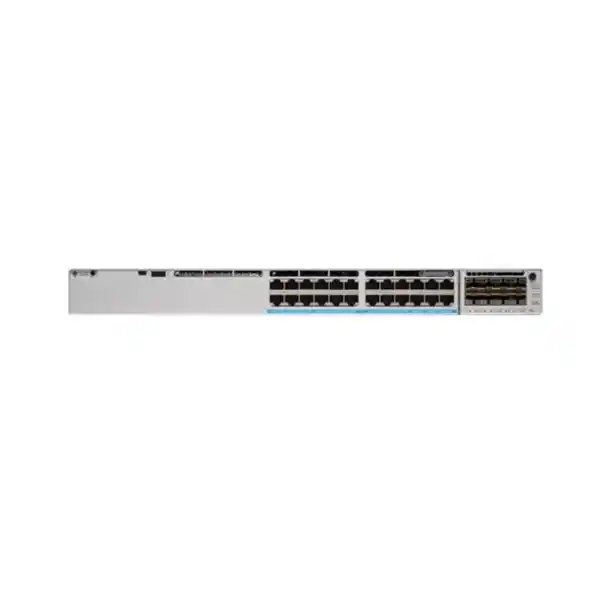
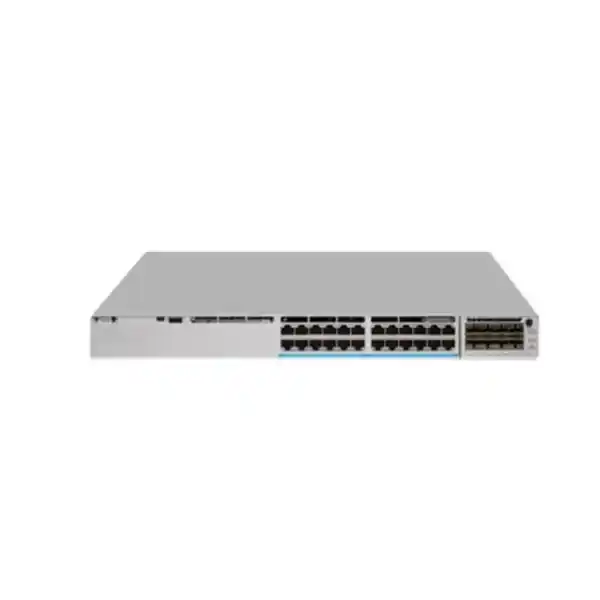
Cisco C9350-24U Smart Switch
A 24-port 1 Gigabit Ethernet access switch with up to 60W Cisco UPOE per downlink, high-bandwidth modular uplinks, Silicon One packet forwarding, StackWise-1.6T resiliency and Cisco IOS XE programmability for modern enterprise networks.
Enterprise access closets that need reliable 1G user connectivity plus higher-power PoE for advanced endpoints.
Direct answer: what is the Cisco C9350-24U?
The Cisco C9350-24U is a stackable fixed-form-factor enterprise access switch in Cisco’s C9350 Smart Switch family. It provides twenty-four copper downlink ports supporting 10 Mbps, 100 Mbps and 1 Gigabit Ethernet, with each downlink designed to deliver up to 60 watts of Cisco Universal Power over Ethernet. That combination targets organizations that still have a large installed base of Gigabit Ethernet endpoints but increasingly need more power at the edge for devices such as advanced wireless access points, pan-tilt-zoom cameras, multi-sensor security devices, video collaboration systems, digital signage, building automation gateways and other powered endpoints that can exceed traditional 30W PoE+ requirements.
The platform is built around Cisco Silicon One A100/L packet-processing technology for hardware-based forwarding. For the C9350-24U specifically, Cisco positions the switch with 448 Gbps of bandwidth specification, 333.312 million packets per second of forwarding rate, and up to 200 Gbps of modular uplink bandwidth when paired with supported network modules. The uplink slot is important because it lets the access design move beyond a fixed 10G uplink model: an organization can select high-speed fiber uplinks appropriate for the aggregation layer and future migration plan rather than replacing the whole access switch when the backbone requirement changes.
For high availability, the C9350 family supports StackWise-1.6T, allowing compatible C9350 switches at the same license level to operate as a unified stack with up to eight members. The platform also supports StackPower+ for shared power architecture across a power domain, subject to the supported topology and cabling. Cisco IOS XE provides the operating environment, with routing, segmentation, telemetry, programmability, automation and security capabilities whose exact availability can depend on software release and license level. For UAE buyers, the practical value is not simply higher headline performance; it is the ability to build access closets with stronger PoE engineering, faster uplinks, simplified operations and a clearer growth path.
Key technical specifications at a glance
Downlink access
24 fixed RJ-45 copper ports supporting 10M/100M/1G Ethernet. The port profile is optimized for mainstream enterprise edge connectivity where 1G remains sufficient for users, phones, sensors and many powered infrastructure devices.
Power over Ethernet
Up to 60W UPOE on each downlink. The theoretical port-rated ceiling is 1,440W across 24 ports, but the usable PoE budget depends on the installed PSU combination, redundancy mode and chassis power requirements.
Packet processing
Single Cisco Silicon One A100/L ASIC architecture for hardware packet forwarding. The C9350-24U is specified at 448 Gbps standalone switching bandwidth and 333.312 Mpps forwarding rate.
Uplink flexibility
Supports up to 200G of modular uplink bandwidth with supported modules such as the two-port 100G/40G option or the eight-port multirate fiber option capable of 25G/10G/1G or four 50G operation.
Stacking
StackWise-1.6T provides up to 1.6 Tbps aggregate stacking bandwidth and supports stacks of up to eight C9350 members, simplifying control, operations and resilient access-layer design.
System resources
The C9350 platform specification includes 16 GB DRAM, 18 GB flash, support for optional SSD capacity up to 240 GB, 4,094 VLAN IDs, up to 4,000 active VLANs and 9,216-byte jumbo frames.
Why the 24-port 60W UPOE profile matters
Choosing an access switch is increasingly a power-design decision as much as it is an Ethernet-port decision. Traditional office networks were dominated by desktop computers and IP phones, so 15W or 30W PoE allocations covered most endpoints. A modern UAE office, hotel, healthcare facility, logistics hub or smart building can look very different. Wireless access points may run several radios; cameras can include heaters, illuminators, PTZ motors or onboard analytics; room systems may combine touch displays, microphones and video processors; and building gateways can aggregate multiple sensors. A switch that offers up to 60W per port gives the network team more freedom to deploy these endpoints without scattering local AC adapters across ceilings, walls and meeting spaces.
The C9350-24U has a port-rated PoE ceiling of 1,440W because twenty-four ports at 60W equals 1,440W. That number should never be confused with the guaranteed power available from a base configuration. Cisco’s published power tables show that a C9350-24U using the default 850W power supply has a lower available PoE budget in a single-PSU configuration, while adding or upgrading power supplies can increase available PoE toward the platform’s port-limited maximum. This distinction is critical during quotation. A project with twelve devices drawing 55W each has a very different PSU requirement from a project with twenty-four phones drawing 8W each, even though both use the same switch model.
A sound design therefore begins with endpoint power classes and realistic consumption, not only the number of ports. FourTeck can align switch, PSU and redundancy choices with the actual endpoint inventory. For broader UAE infrastructure planning, visit FourTeck UAE for enterprise networking coverage and integration support. The objective is to avoid two common mistakes: buying unnecessary PSU capacity that never gets used, or under-sizing power so new cameras, access points or collaboration devices cannot be enabled later without an unplanned hardware change.
PoE budget engineering for real projects
A professional PoE design should separate four numbers: endpoint maximum draw, endpoint normal draw, switch port capability and total available PoE budget. Endpoint maximum draw is the worst-case power requested by the powered device. Normal draw is what the device typically consumes in daily operation. The switch port capability is the maximum the port can provide under the applicable PoE standard and negotiation. Total available PoE budget is the power the chassis can allocate after considering its installed power supplies and internal consumption. These values are related but they are not interchangeable.
For example, consider a branch office with eight wireless access points budgeted at 35W each, eight PTZ cameras budgeted at 45W each and eight IP phones budgeted at 10W each. The design allowance is 720W before reserve. Adding a 20 percent engineering margin raises the target to roughly 864W. That means a single default PSU configuration may not be sufficient even though no individual endpoint exceeds the 60W port limit. Conversely, a twenty-four-port deployment of low-power phones could consume less than 250W in total, making the physical 60W port capability valuable for future flexibility without requiring the maximum power configuration on day one.
Redundancy also changes the equation. If a deployment must maintain all critical PoE loads after a PSU failure, the surviving power subsystem needs enough remaining capacity to power the switch and required endpoints. It is not enough to install two power supplies and call the design redundant; the post-failure load needs to be modeled. This becomes especially important in healthcare, security, hospitality and industrial environments where an access-layer power interruption can take cameras, access points or operational devices offline.
Cisco C9350 switches can support multiple hot-swappable power supplies, and the platform can operate with load-sharing approaches documented by Cisco. Exact power availability varies with the selected PSU combination and operating mode, so quotation should be based on the current Cisco power table for the specific chassis. FourTeck’s project approach is to collect device count, powered-device model, expected watts per endpoint, growth allowance and redundancy objective before finalizing PSU quantities. This produces a bill of materials that is aligned with actual use rather than a generic accessory list.
Cisco Silicon One A100/L and forwarding architecture
The C9350 generation is notable because Cisco has brought Silicon One technology into enterprise switching. On the C9350-24U, a single A100/L ASIC provides the hardware forwarding foundation. For an access switch buyer, the significance is not the ASIC name itself; the value comes from the forwarding scale, programmable packet-processing pipeline and architectural headroom that support modern segmentation, telemetry, policy and routing demands without turning the access layer into a software-forwarding bottleneck.
Cisco specifies the C9350-24U with 448 Gbps of bandwidth and 333.312 Mpps forwarding performance. With stacking included, the published switching capacity rises to 2,048 Gbps and the forwarding rate with stacking is 1,523.712 Mpps. These numbers are useful when comparing platforms, but they should be interpreted in the context of topology. Twenty-four 1G full-duplex access ports contribute a relatively modest portion of the total fabric demand. The real benefit of the higher system capacity is that the switch can combine access traffic with fast uplinks, hardware policy processing and stack traffic while preserving a significant performance margin.
The platform scale also includes up to 64,000 MAC addresses and large routing tables, with Cisco publishing up to 192,000 IPv4 routes in the general scale table and substantial hardware resources for ACL and flow entries. The exact usable scale depends on software templates, feature combinations and the way IPv4 and IPv6 entries share hardware resources. This is important for architects building large campuses, routed access designs, SD-Access fabrics or environments that need extensive segmentation. A raw maximum value should not be assumed to be simultaneously available for every table at once.
In practical enterprise terms, the C9350-24U is designed to behave as more than a simple Layer 2 edge switch. It can participate in sophisticated routing, policy and visibility designs while maintaining deterministic hardware forwarding. That makes it suitable for organizations standardizing on a single access platform across conventional office floors, branches, high-power PoE zones and secure campus edge locations.
Modular uplinks: designing beyond 10G
The uplink slot is one of the most strategically valuable features of the Cisco C9350-24U. Instead of tying the switch to a fixed uplink speed for its full lifecycle, Cisco supports field-replaceable network modules that can be selected according to aggregation architecture. The C9350-24U supports up to 200 Gbps of modular uplink bandwidth with compatible modules. This provides a substantial performance envelope for a 24-port Gigabit access switch and helps prevent uplink oversubscription from becoming the first constraint as endpoint traffic grows.
C9350-NM-2C
Two dual-rate 100G/40G QSFP-class uplink ports, providing up to 200 Gbps aggregate uplink bandwidth. This can suit access closets that need very high-speed redundant links to distribution or core switches.
C9350-NM-8Y
Eight multirate fiber ports operating at 25G/10G/1G or a four-port 50G mode, also providing up to 200 Gbps aggregate uplink bandwidth. This is useful when link-count flexibility matters as much as peak speed.
A 100G uplink is not automatically the correct choice for every 24-port 1G switch. Many branches can operate comfortably on dual 10G or 25G links. The design question is whether the uplink must accommodate only local user traffic or also east-west flows, wireless backhaul, camera recording streams, routed services, virtualization access, application hosting, or future switch expansion. The network module should be selected after calculating traffic concentration and understanding the port types supported by the upstream switch.
Optics and cabling are part of the decision. A QSFP-based 100G design has different transceiver, fiber and patching requirements from an SFP-based 25G design. Distance, fiber type, connector standards, available patch panels and upstream port compatibility must all be checked. FourTeck can coordinate the access switch with data-center and server-side infrastructure available through Server Dubai, helping align switch uplinks with the broader aggregation and compute environment.
StackWise-1.6T: resilient access as one logical system
Cisco StackWise-1.6T is designed to combine multiple C9350 switches into a single operational stack with up to 1.6 Tbps aggregate stacking bandwidth. Cisco documents support for up to eight members in a C9350 stack, with compatible C9350 models operating at StackWise-1.6T speeds when the license level is aligned. Dedicated rear stacking connectors keep stack traffic separate from front-panel uplinks, which means an architect does not need to sacrifice a high-speed network-module port simply to build the stack.
The operational advantage is consolidation. Instead of managing several access switches as completely independent devices, the stack can present a unified system and common control plane. This can simplify configuration, VLAN deployment, software operations, monitoring and link aggregation. It also enables distributed forwarding so local traffic can continue to be handled efficiently while the stack provides a resilient system view. In access closets with two or more switches, this architecture can reduce the number of individual configuration points and make uplink redundancy easier to design.
A stack still requires engineering discipline. Cable topology matters, physical placement affects cable lengths, software compatibility must be planned, and maintenance procedures should account for master or active-member behavior. Cisco provides StackWise cable options in multiple lengths, and C9350 StackWise-1.6T cables are specific to this generation; they should not be assumed interchangeable with older Catalyst 9300 stacking cables. During migrations, existing rack drawings and spare-cable inventories should therefore be reviewed rather than automatically reused.
For a UAE campus refresh, a practical pattern is to deploy two or more C9350 access switches in each communications room, create resilient stack connectivity, dual-home uplinks toward a distribution pair, and size power supplies according to the actual PoE load. This produces a cleaner failure domain and gives operations teams a repeatable design across floors and buildings. The stack bandwidth also creates significant headroom compared with conventional low-speed stacking methods, which is useful as uplink rates rise.
StackPower+ and resilient power domains
StackPower+ extends the idea of pooling resources from data to power. Cisco describes it as a 55V power-sharing architecture that can consolidate available power supplies across connected switches into a shared domain. Up to four switches can participate in a StackPower+ ring. The value is straightforward: instead of sizing every chassis as a completely isolated power island, engineers can design a shared power domain that improves utilization and can provide capacity or redundancy across members.
This is especially relevant for a UPOE switch such as the C9350-24U because powered-device demand is often uneven. One switch in a rack may serve high-power wireless and security devices, while another carries mostly low-power phones or user endpoints. A shared power model can give the overall system more flexibility, although the final design still needs to account for failure scenarios and supported cabling. The objective is not simply to maximize the number of watts in the rack; it is to maintain the required powered endpoints when a power supply or feed becomes unavailable.
Facilities design also matters. In a critical deployment, separate AC circuits or UPS feeds may be preferred for redundant power supplies. The electrical plan should consider switch input, connected PoE load, UPS runtime, breaker capacity and heat output. A switch delivering hundreds of watts to endpoints ultimately draws that energy from the facility, so a high-PoE network refresh can materially change UPS and cooling requirements in telecommunications rooms. This is particularly important in the UAE, where room temperature control and reliable HVAC operation are essential to maintaining equipment within rated environmental limits.
FourTeck can coordinate logical network design with physical infrastructure requirements through FourTeck IT Services UAE. For projects with substantial PoE demand, we recommend documenting device wattage, PSU combinations, power-feed diversity, UPS assumptions and thermal load in the same implementation pack rather than treating them as separate disciplines.
Cisco IOS XE: automation, telemetry and operational consistency
The C9350 Series runs Cisco IOS XE, giving the switch a familiar enterprise operating model while adding modern programmability and telemetry. Cisco documents model-driven interfaces including NETCONF and RESTCONF with YANG data models, streaming telemetry, on-box Python capabilities and container-based application hosting. For operations teams, this enables a transition from device-by-device CLI changes toward repeatable automation without abandoning CLI access when it is needed for diagnostics or specialized configuration.
Model-driven management matters when an organization has dozens or hundreds of switches. A VLAN or interface policy that is manually configured on every device becomes a consistency risk. APIs and structured data models allow configuration to be generated from templates, validated before deployment and collected in machine-readable form. Streaming telemetry can feed monitoring platforms with selected operational data at regular intervals, improving visibility compared with occasional polling alone. The benefit is not automation for its own sake; it is reducing configuration drift, shortening troubleshooting time and making change control more predictable.
IOS XE also supports centralized management options across on-premises, cloud-connected and hybrid operational models. The exact capabilities available to a customer depend on software release, license entitlement and management platform. This should be confirmed during procurement rather than assuming that every software feature is included with every hardware purchase. A C9350 project should therefore specify not only chassis and modules but also the desired operational model: standalone IOS XE management, Cisco centralized management, SD-Access integration, API-based automation or a hybrid approach.
For migration projects, operational consistency is often the strongest reason to standardize. Network teams can define golden configurations, AAA policy, SNMP or telemetry settings, NTP, syslog, interface templates, QoS, routing and security baselines, then deploy the same structure across access closets. This reduces the variation that accumulates when switches are installed over many years by different teams. The C9350-24U provides a hardware platform capable of supporting that standardized operational model while adding more power and uplink headroom than legacy access devices.
Layer 2, Layer 3 and campus segmentation roles
The Cisco C9350 platform supports enterprise Layer 2 switching, IP routing, IPv6 routing, multicast capabilities and advanced segmentation features. This allows the C9350-24U to serve in traditional access architectures, routed access designs and software-defined campus frameworks. The right model depends on the organization’s fault-domain strategy, routing standards and operational maturity.
In a conventional Layer 2 access design, endpoint VLANs extend from the C9350-24U toward distribution switches where inter-VLAN routing and policy are applied. This model remains common because it centralizes routing and can simplify some access configurations. However, large Layer 2 domains can make spanning-tree behavior, broadcast scope and failure containment more important. The C9350 supports large VLAN and spanning-tree scale, but scale alone does not justify extending Layer 2 farther than operationally necessary.
In routed access, Layer 3 boundaries move closer to the edge. This can shrink Layer 2 failure domains and create more deterministic uplink behavior. The C9350’s hardware routing resources, forwarding capacity and high-speed uplinks make it capable of participating in such designs. Depending on the architecture, dynamic routing protocols, equal-cost paths and first-hop functions can be placed at the access layer. This approach requires stronger IP design discipline and usually benefits from automation because more switches participate directly in the routing topology.
Segmentation can also extend beyond simple VLAN separation. Cisco TrustSec, VXLAN-related capabilities, access control lists and SD-Access can be part of a broader zero-trust or identity-aware campus architecture, subject to software and licensing. The switch should be considered one enforcement point in a system that also includes identity services, authentication, endpoint posture, firewall policy and monitoring. For organizations building a coordinated segmentation strategy, FourTeck’s Firewall Dubai practice can help align campus access policy with perimeter and internal security controls.
A sound C9350 deployment therefore starts with an architecture decision: where does Layer 2 end, where does Layer 3 begin, how are identities authenticated, how is policy expressed, and how is traffic observed? Hardware selection is only one part of answering those questions.
Security architecture at the access edge
Modern enterprise security assumes that the LAN is not automatically trusted simply because it is inside the building. The access switch is where users, phones, cameras, wireless access points, printers, controllers and IoT devices first enter the wired network, so it is a natural enforcement and visibility point. The C9350 Series is designed with hardware-scale access control and segmentation features, Cisco Trust Anchor technologies and support for modern cryptographic capabilities across the platform.
At a practical level, access security can include IEEE 802.1X authentication, MAC Authentication Bypass for devices without supplicant support, dynamic VLAN or policy assignment, DHCP snooping, Dynamic ARP Inspection, IP Source Guard, port security, device tracking and ACL enforcement. The exact feature set and scale should be validated for the required IOS XE release and license. These controls are most effective when they are deployed as part of an identity design rather than as isolated interface commands.
Cisco also positions the C9350 family for advanced cryptography, including hardware-based security mechanisms and support for newer post-quantum approaches as software capabilities mature. Some security functions described for the family may be introduced or expanded in future IOS XE releases, so procurement specifications should distinguish between hardware readiness and currently available software functionality. This is especially important in regulated or government projects where a feature must be available and certified at the time of acceptance, not merely planned.
The hardware root-of-trust approach helps protect the integrity of the switch itself. Secure boot and signed software validation are designed to reduce the risk of unauthorized software or tampered code entering the platform. Combined with strong administrative AAA, role-based access, secure management protocols, centralized logging and disciplined patching, these controls make the access switch part of a layered security architecture. FourTeck recommends integrating switch security requirements into the same policy matrix used for identity, firewalls, endpoint protection and monitoring so that enforcement decisions remain consistent across the environment.
Application visibility, telemetry and troubleshooting
High availability depends on seeing problems before users describe them. Cisco C9350 Series capabilities include Flexible NetFlow, SPAN and ERSPAN traffic mirroring, device tracking, model-driven telemetry and application visibility features. Together, these tools can provide operations teams with a richer view of what is happening at the access layer: which endpoints are connected, how interfaces are behaving, where traffic is flowing and whether errors, drops or policy events are increasing.
Flexible NetFlow is useful for building traffic records without capturing every packet. Engineers can analyze source and destination patterns, protocols, byte volumes and flow behavior to identify unexpected traffic or validate capacity assumptions. SPAN and ERSPAN are more appropriate when packet-level analysis is required. A local analyzer can receive mirrored traffic with SPAN, while ERSPAN can transport mirrored traffic across an IP network to a remote analysis point. These functions should be used with performance and privacy considerations in mind, especially in environments carrying sensitive or regulated data.
Streaming telemetry improves the monitoring model by allowing selected operational data to be exported at defined intervals using structured formats. Compared with periodic CLI collection, this can provide more consistent time-series data for interface utilization, environmental metrics, queue behavior or other platform statistics. When integrated with a network assurance or observability platform, telemetry can help detect trends such as rising uplink utilization, intermittent interface errors or increasing PoE consumption before they become service-impacting.
Troubleshooting should also be designed into the deployment. Standard descriptions, consistent interface templates, synchronized time, centralized syslog, reliable DNS and NTP, out-of-band management, configuration backup and clearly documented uplink paths make a major difference during incidents. The C9350 hardware provides extensive visibility, but operations teams only benefit if telemetry destinations, logs and management access are configured from day one. FourTeck can include these operational baselines in deployment services so the installed switch is delivered as a manageable system rather than an isolated box.
Application hosting and edge services
The C9350 platform includes resources for application hosting, with Cisco publishing platform capabilities that include dedicated DRAM allocation, CPU resources, app-facing interfaces and optional SSD storage. This allows selected container-based services to run directly on the switch instead of requiring a separate appliance in every communications room. Cisco cites examples such as ThousandEyes and Cisco Spaces, subject to supported software and licensing.
The architectural advantage is proximity to the network edge. A monitoring application hosted on the switch can observe conditions close to users and endpoints without relying entirely on a distant server. This can improve path visibility for branch or campus monitoring and reduce the need for small external appliances. It also creates opportunities for localized services in sites where rack space is limited.
Application hosting should not be treated as unlimited general-purpose compute. The switch remains first and foremost a network infrastructure device, so supported applications, resource allocation and operational impact should be carefully validated. The platform data sheet lists 16 GB system DRAM, with 8 GB app-hosting DRAM allocation, 4 vCPU for application hosting, two 1/10G app interfaces and optional SSD capacity up to 240 GB. These resources are substantial for network-adjacent services but are not a replacement for a normal server cluster.
For organizations considering switch-hosted applications, FourTeck recommends defining the operational owner before deployment. Network teams need to know who patches the hosted application, how logs are retained, how storage is monitored, what happens during switch upgrades and how failure of a stack member affects the service. When these questions are answered, application hosting can reduce footprint and provide useful edge intelligence. When they are ignored, it can blur responsibility between networking and systems teams. The technology is most effective when application hosting is treated as a deliberate architectural function rather than an unused feature included in the chassis.
Physical design, rack depth and environmental planning
The C9350-24U chassis is a 1RU platform. Cisco lists chassis dimensions of approximately 4.4 x 44.5 x 38.3 cm, or 1.73 x 17.5 x 15.1 inches, before accounting for the additional depth of installed power supplies and cabling. The published weight with the default power supply is approximately 6.35 kg. These dimensions suit standard 19-inch enterprise racks, but a proper installation review should include rear clearance for power supplies, fan servicing, stacking cables, power cables and cable management.
Airflow and temperature are important in UAE installations. Cisco specifies an operating range that varies with altitude, including operation up to 45°C at lower elevations within the documented limits. That does not mean a telecommunications room should be intentionally run near the maximum temperature. Higher ambient temperature reduces thermal margin and can increase fan activity, component stress and the impact of HVAC failures. A well-designed communications room should maintain stable cooling, monitor temperature and humidity and keep intake and exhaust paths unobstructed.
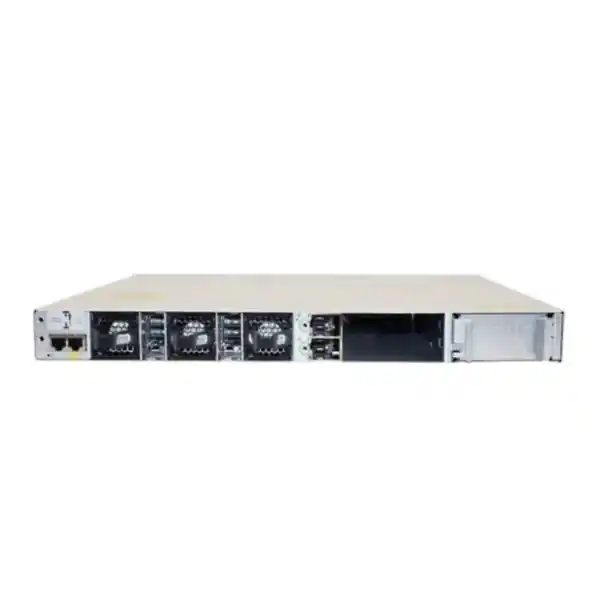
The C9350 family uses three field-replaceable fan modules with N+1 redundancy. Rear-accessible fans and hot-swappable power supplies improve serviceability, but technicians still need physical access. Racks placed tightly against walls or filled with unmanaged power cables can turn a simple field replacement into an outage risk. For dense deployments, rear cable trays, vertical PDUs and clearly labeled power feeds are strongly recommended.
Power input planning should reflect the actual PSU model. Cisco’s 500W and 850W supplies accept a broad 90V to 264V input range, while the 1600W supply has different behavior depending on input voltage. UAE deployments normally operate on 230V-class mains, which can be beneficial for high-capacity PSU operation, but rack PDUs, IEC cable types, UPS output and breaker ratings still need to be matched. The correct approach is to build a rack-level power schedule showing each PSU, feed, phase or circuit assignment and estimated load.
Finally, do not overlook patching density. Twenty-four copper downlinks plus high-speed fiber uplinks and stack cables create a compact but cable-intensive rack unit. Horizontal cable managers and patch-panel alignment should be planned so that front ports remain visible and removable. Good physical discipline reduces troubleshooting time and makes future switch replacement significantly safer.
Choosing the right C9350 model: 24U vs 24P vs multigigabit options
The C9350-24U is not automatically the correct choice for every 24-port access closet. It is optimized for environments that need 1G copper connectivity and up to 60W per port. If most endpoints require only standard 30W PoE+, the C9350-24P can provide similar 24-port 1G access with a lower per-port power profile. If the deployment needs no PoE at all, the C9350-24T may be more appropriate. Selecting the U model simply because it has a larger power number can increase cost without delivering operational value.
The opposite mistake is under-specifying port speed. The C9350-24U downlinks top out at 1G. If an organization is deploying Wi-Fi 7 access points or high-performance devices that require 2.5G, 5G or 10G copper, a multigigabit C9350 model should be evaluated instead. Higher-power UPOE alone does not solve a bandwidth bottleneck. A wireless AP that can transmit several gigabits of aggregate traffic may be power-compatible with a 60W 1G port but still constrained by the 1G Ethernet link.
That distinction makes endpoint profiling essential. Build a table that records port count, required data rate, PoE class, expected power draw, cable category, special VLAN or authentication needs, and growth horizon. Then map those requirements to switch SKUs. Mixed environments may benefit from combining models in the same C9350 stack, provided Cisco’s stacking and licensing compatibility requirements are met. For example, one switch could serve ordinary user and phone ports while another multigigabit model handles the newest access points.
The correct choice therefore depends on what the edge will look like over the next several years, not only what is connected today. If the project has stable 1G endpoints but growing power needs, the C9350-24U is compelling. If both power and bandwidth are rising, move to a multigigabit model. If power needs are modest, a lower-PoE SKU may be more economical. FourTeck can prepare a model comparison based on the endpoint schedule rather than relying on generic product rankings.
Migration from Catalyst 9300 and older access switches
A C9350 deployment is often part of a refresh rather than a greenfield build. Existing networks may use Catalyst 9300, 3850, 3650, 2960-X or mixed generations accumulated over several upgrade cycles. A successful migration should treat configuration, optics, stacking, power, licensing and operational tooling as separate compatibility workstreams. Copying an old configuration verbatim onto a new platform is rarely the best approach.
Start by classifying the legacy configuration. Some commands represent business intent, such as VLANs, routing, AAA, QoS and access policy. Others are platform-specific implementation details that may no longer be required. The new deployment is an opportunity to remove unused VLANs, obsolete SNMP communities, forgotten local users, abandoned trunks and inconsistent interface descriptions. A clean baseline reduces technical debt and makes later automation easier.
Stacking requires particular attention. C9350 StackWise-1.6T and StackPower cabling should be ordered specifically for the C9350 platform and should not be assumed compatible with earlier Catalyst generations. This means a rack refresh may require new rear cable routing even when the new chassis occupies the same rack units as the old switch. Similarly, network modules and transceivers must be checked for platform support. The correct optical form factor and speed do not guarantee that every legacy optic is supported in every new module.
PoE migration should compare actual endpoint consumption with the old and new power subsystems. Replacing a lower-power switch with the C9350-24U can create future capacity, but the project only realizes that capacity if adequate PSUs and facility power are installed. UPS runtime calculations should be updated because the access layer may now be capable of powering more devices than before.
Finally, plan rollback. Migration runbooks should document old-to-new port mapping, configuration checkpoints, software image, license status, stack role, uplink sequence, authentication dependencies and validation tests. FourTeck can provide staged implementation support and broader infrastructure services through FourTeck Global for multi-site projects that extend beyond the UAE.
Sizing the switch for UAE offices, campuses and specialized facilities
The C9350-24U is especially useful in access closets where port density is moderate but endpoint power can be high. In a corporate office floor with fewer than twenty-four active data drops, the switch can serve users, phones, room systems and wireless access points while leaving spare ports for growth. The 24-port form factor can be more appropriate than a 48-port unit when rack space is available but power density, fault isolation or department separation makes smaller access blocks desirable.
In hospitality, a 24-port switch can serve a zone of high-power access points, IP cameras, door controllers and building automation endpoints. The design should account for the fact that hotel networks are often expected to operate continuously and may have limited maintenance windows. Stacking, redundant power and carefully planned uplinks become more important than maximizing port utilization. A switch running at only 60 percent port occupancy may be the right design if it creates a better failure domain and room for expansion.
Healthcare environments introduce additional concerns. Connected medical and operational devices may have strict uptime requirements, and network changes can require formal approval. The switch’s power redundancy, hardware forwarding and segmentation capabilities can support such environments, but device classification, authentication behavior and change procedures should be validated before deployment. A camera or access point can often tolerate a brief reboot; a clinical workflow device may not. The network design should identify critical loads explicitly.
Education campuses can benefit from the C9350-24U in wireless-heavy buildings, labs or classrooms where access points, cameras and AV endpoints dominate. Schools and universities also tend to have predictable seasonal maintenance windows, making stack upgrades and phased migration easier to schedule. The high-speed uplink options are valuable when multiple buildings aggregate into a central core.
Government and regulated organizations may prioritize secure boot, segmentation, AAA, logging and lifecycle support. The C9350’s architecture is aligned with modern enterprise security, but procurement teams should specify mandatory software functions, compliance requirements and support entitlements in the bill of materials. FourTeck can help translate high-level tender requirements into specific chassis, module, power, software and service line items.
Licensing and software planning
Hardware and software procurement should be designed together. Cisco’s current switching portfolio uses unified licensing options with Essentials and Advantage tiers and multiple subscription terms. The exact license required depends on the network features, management mode, automation requirements and enterprise agreement structure. Because licensing evolves, the current Cisco ordering guide and feature matrix should be checked at quotation time rather than relying on a legacy Catalyst license description.
A practical requirements workshop should list every software function that is mandatory: Layer 3 routing protocols, segmentation, SD-Access participation, advanced security, telemetry, application hosting, cloud management, support level and term. These requirements can then be mapped to the appropriate license tier. This prevents two costly outcomes: purchasing an advanced license that is never used, or installing hardware only to discover that a required feature is not enabled by the selected entitlement.
Software release planning is equally important. Cisco documentation may list hardware capability before every associated feature is available in production software. Some advanced functions can be introduced in later IOS XE releases. An acceptance document should therefore specify the target IOS XE release and confirm that required features are supported on that release for the C9350-24U. Production deployments should also follow an organization’s normal software qualification process rather than installing the newest release simply because it is available.
Support entitlement affects operational risk. Critical campus switches should have a support plan aligned with the organization’s replacement and escalation expectations. Spare strategy also matters: some customers hold an onsite spare chassis or PSU, while others rely on vendor replacement service. The correct model depends on site criticality, logistics, maintenance windows and the ability to reroute users during a failure.
FourTeck quotations can separate hardware, network module, optics, stacking components, power supplies, licenses and support so that procurement teams understand exactly what is included. That transparency is particularly useful in tenders, where a low chassis price can be misleading if essential uplinks, redundant PSUs or licenses are omitted.
Recommended architecture patterns
Pattern 1: resilient office access
Deploy two C9350 switches in a StackWise-1.6T pair, use redundant fiber uplinks to a distribution pair, divide critical PoE endpoints across members and provide redundant PSUs sized for the post-failure load. This is a strong baseline for commercial office floors.
Pattern 2: high-power edge zone
Use C9350-24U units for access points, PTZ cameras and collaboration systems that can exceed 30W. Calculate the actual PoE requirement, select PSU combinations accordingly, and reserve capacity for device replacement with higher-power models.
Pattern 3: routed access
Terminate Layer 3 closer to the access layer and use high-speed uplinks toward aggregation. This can reduce Layer 2 failure domains and simplify path control but benefits from consistent automation and routing standards.
Pattern 4: mixed-speed C9350 stack
Combine a 1G high-power C9350-24U with compatible C9350 multigigabit members where different endpoint classes coexist. Keep license compatibility, stacking support and software release alignment in the design.
These patterns are starting points, not universal templates. Uplink count, spanning-tree or routing design, power feed diversity, management mode, floor layout, cabling and endpoint authentication all affect the final architecture. FourTeck can adapt the design to the customer’s current core, firewall, wireless and WAN topology rather than forcing a generic reference diagram onto an existing environment.
Procurement considerations in the UAE
Enterprise switch procurement is most successful when the bill of materials is treated as a system. The chassis itself is only the first line item. A complete C9350-24U deployment can also require a network module, optics or DACs, stack cables, StackPower cables, additional power supplies, rack accessories, licensing, support and installation services. Missing any of these can delay deployment even when the switch chassis arrives on schedule.
UAE projects often have site-specific logistics. Equipment may be delivered to a central Dubai or Abu Dhabi warehouse and later distributed to branches, free-zone facilities, hotels, schools or remote sites. Serial-number capture, labeling and staging can reduce installation errors. For multi-site rollouts, it is useful to preconfigure naming, software versions, management settings and standard templates before dispatch so that field teams focus on physical installation and validation.
Optics deserve separate verification. The uplink module determines form factor and supported speeds, but the transceiver must also match fiber type and distance. A single-mode 100G optic intended for a long campus link is not the same as a short-reach multimode option. Patch-panel connector type, polarity and existing fiber plant should be validated before ordering. Where existing fiber is undocumented, an optical survey or test can prevent expensive transceiver changes after delivery.
Power accessories should be checked against the rack PDU and UPS. PSU wattage alone does not confirm plug compatibility or circuit capacity. Redundant power should ideally terminate on independent power paths where the site electrical design supports it. For large PoE rollouts, total rack consumption can rise significantly, so UPS runtime and air-conditioning capacity may need to be revisited.
Finally, procurement teams should request a clearly itemized quote that identifies what is included and what is optional. FourTeck can provide chassis, accessories, design support, staging and implementation as a coordinated package. This reduces the risk of receiving technically correct components that are incomplete as a deployable system.
Implementation methodology
A disciplined C9350-24U implementation can be divided into discovery, design, staging, installation, migration, validation and handover. Discovery captures the current topology, port usage, VLANs, IP addressing, routing, authentication, uplinks, power, rack space, software versions and operational dependencies. This phase is where hidden constraints are usually found, such as an old camera that depends on a static port configuration or an access point that requires a specific native VLAN during provisioning.
Design converts those findings into a target architecture. The output should include switch count, stack layout, uplink module, optic types, power-supply configuration, management addressing, VLAN and routing model, AAA integration, telemetry destinations, logging, NTP, QoS, security policy and migration sequencing. For critical sites, the design should include failure scenarios: what happens if an uplink fails, a PSU fails, a stack member reboots or the authentication service becomes unavailable.
Staging is where hardware is assembled and standardized before the maintenance window. Switches can be inventoried, powered on, upgraded to the approved software release, licensed, stacked, configured with the baseline and tested. Staging also verifies that the ordered network module and optics are recognized. This is much safer than discovering an incompatible component while users are waiting for service restoration.
During migration, port mapping and labeling are critical. Each legacy interface should map to a destination interface with the correct VLAN, access policy, voice settings, PoE behavior and description. Uplinks should be migrated according to the planned redundancy sequence. Validation should cover connectivity, routing, authentication, DHCP, DNS, application reachability, voice registration, wireless AP status, camera feeds, PoE load, stack health and monitoring visibility.
Handover closes the project with as-built diagrams, configuration backups, serial numbers, software details, support information, administrator access procedures and known exceptions. The goal is to leave the operations team with a documented platform they can support confidently, not a deployment that only the installation engineer understands.
Performance planning and oversubscription
Access switches are often evaluated by multiplying port speed by port count, but real network performance depends on traffic patterns and uplink design. Twenty-four 1G downlinks create 24 Gbps of one-direction aggregate access capacity, while the C9350-24U can support far higher uplink bandwidth. That means the platform can be engineered with very low oversubscription at the uplink layer if the application requires it. In many offices, however, average endpoint utilization is far lower than 1G, so a pair of 10G or 25G uplinks may already provide ample capacity.
High-power PoE endpoints can change traffic patterns. Modern access points may aggregate traffic from many wireless users, and high-resolution cameras can transmit continuous streams. An access closet serving ten cameras and ten APs behaves differently from one serving twenty desktop users who spend much of the day in SaaS applications. Traffic sizing should therefore be based on endpoint type, not only endpoint count.
The C9350-24U’s 448 Gbps bandwidth specification provides substantial internal headroom relative to its 24 x 1G downlinks. The modular uplink choices allow the designer to tailor backbone bandwidth. A common approach is to start with redundant 25G or 40G links when supported by the aggregation layer and preserve the option to move to 100G as traffic grows. Where the core already supports 100G, dual 100G uplinks can provide both capacity and path redundancy, though such bandwidth may exceed the needs of a single access closet.
Oversubscription is not inherently bad; it is an economic design tool. The goal is to choose a ratio that matches workload behavior and growth expectations. Monitoring after deployment is equally important. Interface utilization, queue drops and flow records can validate whether the assumed ratio is working. If an uplink consistently operates near saturation, the modular architecture gives a clear upgrade path without replacing the access chassis.
For latency-sensitive voice, video or control traffic, QoS design matters alongside bandwidth. The C9350 supports enterprise QoS capabilities, but queueing and classification should be aligned across the access, distribution, WAN and wireless layers. Excess capacity is useful, but it does not replace consistent end-to-end QoS policy where service differentiation is required.
Operational lifecycle and maintenance
The useful life of an enterprise switch is usually measured in years, so operational lifecycle planning deserves the same attention as day-one installation. The C9350-24U includes field-replaceable power and fan components, modular uplinks and software capabilities that can evolve through IOS XE releases. These features help extend platform usefulness, but only if organizations maintain a consistent lifecycle process.
Software maintenance should follow a defined cadence. Security advisories, recommended releases, bug fixes and feature requirements need to be reviewed periodically. Critical production networks often standardize on a qualified release rather than continuously chasing the newest image. Stack upgrade behavior, maintenance windows and rollback procedures should be documented. Configuration backups and software images should be stored outside the switch so recovery does not depend on the failed device.
Hardware health monitoring should include fan status, temperature, PSU state, PoE utilization, stack links and interface error counters. Rising CRC errors may indicate cabling problems; repeated PoE negotiation events can reveal endpoint or cable faults; high temperature can expose room cooling issues. These signals are most valuable when centralized monitoring generates actionable alerts rather than simply collecting raw data.
Spare strategy depends on risk. A large campus may keep spare PSUs, fans, optics and even a spare switch chassis onsite. A smaller office may rely on vendor replacement support. Either approach can work if recovery time is understood. The key is avoiding an undefined middle ground where everyone assumes someone else has the necessary spare.
Documentation should remain current as ports, VLANs and uplinks change. Automated configuration backups and inventory tools can reduce the effort. For organizations using APIs and telemetry, lifecycle processes can increasingly be integrated into network automation pipelines. The C9350’s programmability supports that direction, allowing the operations model to mature over the platform’s life instead of being locked to manual configuration.
Frequently asked technical questions
Does every port deliver 60W simultaneously?
Each downlink is rated for up to 60W UPOE, but simultaneous delivery across all ports depends on installed power supplies and operating mode. The 24-port mathematical ceiling is 1,440W, while a base PSU configuration provides less available PoE. Size PSUs from actual load and redundancy requirements.
Are the downlinks multigigabit?
No. The C9350-24U downlinks support 10M/100M/1G. If endpoints require 2.5G, 5G or 10G over copper, evaluate a C9350 multigigabit model instead.
Can it use 100G uplinks?
Yes, with a supported network module. The C9350-24U supports up to 200G aggregate modular uplink bandwidth, including a two-port 100G/40G module option.
How many switches can be stacked?
Cisco documents up to eight C9350 members in a StackWise-1.6T stack, subject to supported model and license compatibility. Use C9350-specific stack cables.
Does it support Layer 3 routing?
Yes, the C9350 platform supports enterprise IP routing, IPv6 routing and multicast capabilities. Exact protocol and advanced-feature availability should be checked against the selected license and IOS XE release.
What is the default power supply?
Cisco’s ordering information lists an 850W-class default PSU for the C9350-24U. Additional or higher-capacity PSUs can be selected to increase PoE capacity or redundancy, subject to current ordering rules.
Decision recap: when the C9350-24U is the right switch
Choose it when
- You need 24 copper access ports at up to 1G.
- Some endpoints require more than 30W PoE.
- You want 40G, 50G or 100G-class uplink options.
- StackWise-1.6T resilience is part of the design.
- You need IOS XE routing, automation, telemetry and security capabilities.
Reconsider it when
- Endpoints require 2.5G, 5G or 10G copper access.
- Your PoE requirement never exceeds 30W per port.
- You need more than 24 access ports in one chassis.
- A fixed low-speed uplink platform is sufficient and cost is the primary driver.
- You do not need advanced enterprise switching features.
The C9350-24U occupies a useful middle ground: it keeps the simplicity and cabling familiarity of 1G copper access while adding a significantly stronger power profile, modern Cisco Silicon One forwarding, high-bandwidth modular uplinks and a high-capacity stacking architecture. That makes it a strong refresh candidate where endpoint power is increasing faster than endpoint Ethernet speed.
Quotation input checklist
A precise quote can be prepared much faster when the technical inputs are complete. Use the following checklist to avoid omissions in chassis, power, optics and licensing.
Final consultation panel: build the C9350-24U as a complete access solution
The best C9350-24U design is a coordinated solution, not a chassis-only purchase. Switch quantity, uplink modules, transceivers, stack topology, PoE budget, PSU redundancy, electrical feeds, software licensing and migration services should be engineered together. FourTeck can review an existing network or work from a new project bill of quantities and produce a configuration aligned with the customer’s technical, operational and commercial requirements.
For a greenfield project, provide floor plans or rack locations, endpoint counts, wireless and camera schedules, server or core-switch details, and required uplink distances. For a refresh, provide the current switch model, interface usage, configuration exports, optics, stack layout and known pain points. These inputs allow a more accurate recommendation and help identify where the C9350-24U should be used versus another C9350 SKU.
FourTeck can also help coordinate adjacent infrastructure such as firewalls, servers, structured network services and site implementation. This is particularly useful in UAE projects where networking, security, wireless and compute upgrades often occur in the same maintenance window. A single integrated design reduces interface gaps between vendors and creates a clearer acceptance test.
Cisco C9350-24U UAE supply and deployment
FourTeck can supply and integrate the Cisco C9350-24U Smart Switch for UAE enterprise deployments, including suitable uplink modules, optics, power supplies, stacking accessories, licensing and implementation services. Product availability, lead time, support entitlement and final configuration should be confirmed against the current Cisco ordering system at the time of quotation.
Share the endpoint count, uplink target, PoE requirement and site topology to receive a technically matched bill of materials instead of a generic chassis quote.

Reviews
There are no reviews yet.