
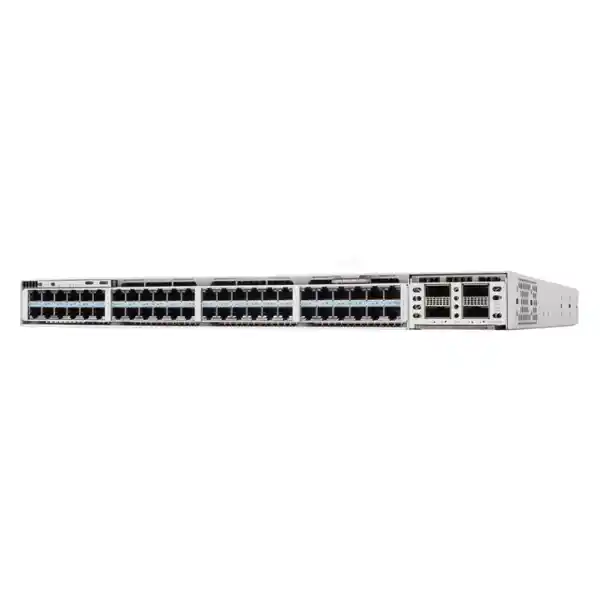
Cisco C9350-48HX Smart Switch in Dubai, UAE
The Cisco C9350-48HX is a 48-port high-density multigigabit enterprise access switch engineered for campuses that need 10 Gigabit Ethernet at the edge, high-power Power over Ethernet, resilient stacking and large uplink capacity in the same 1RU platform. It is especially well suited to Wi-Fi 6E and Wi-Fi 7 access points, smart-building devices, high-resolution surveillance, collaboration endpoints, demanding workstations and converged IT/OT access networks.
For Dubai and UAE organizations planning a refresh of campus access infrastructure, the C9350-48HX provides a practical path from traditional 1G access to a multi-rate edge where each copper port can adapt to endpoint speed requirements while delivering up to 90W UPOE+. Its dual Cisco Silicon One A100/L ASIC design, StackWise-1.6T architecture and modular uplink options support growth without forcing a complete access-layer redesign when wireless, video, AI-enabled endpoints or smart-building systems increase bandwidth demand.
Choose it when your access layer needs 48 full multigigabit copper ports, up to 10G per endpoint, 90W UPOE+ capability, dense Wi-Fi 7 support, high uplink headroom and stacking that can operate as a unified access system. It is designed for premium enterprise access rather than basic 1G edge switching.
Cisco C9350-48HX overview: a premium multigigabit access switch for the next campus cycle
The Cisco C9350-48HX belongs to the C9350 Series Smart Switch family and is positioned primarily for enterprise campus access. The model combines 48 RJ-45 multigigabit downlinks with high-power UPOE+, a high-bandwidth stacking fabric and selectable modular uplinks. That combination matters because the modern access layer is no longer sized only around desktop PCs and 1G phones. A single wiring closet can now serve Wi-Fi 7 access points with multi-radio designs, 4K and 8K surveillance, digital signage, building automation controllers, edge compute appliances, AV-over-IP systems, badge readers, environmental sensors and high-performance engineering workstations. Those endpoint classes create very different bandwidth and power profiles, and the C9350-48HX is designed to accommodate them in one platform.
A traditional access switch might provide 48 one-gigabit ports and a limited PoE budget, which becomes a bottleneck when newer wireless access points exceed one gigabit of aggregate radio throughput or require more than 30 watts. The C9350-48HX raises both ceilings. Every access port can negotiate multi-rate Ethernet from legacy 10/100 Mbps through 1G, 2.5G and 5G to 10G, while UPOE+ can deliver up to 90W to compatible powered devices. This lets UAE network teams preserve structured copper investments while introducing higher-speed endpoints selectively instead of replacing every cable and endpoint simultaneously.
Cisco uses dual Silicon One A100/L ASICs in this model. At the platform level, the C9350 family supports high forwarding scale, large route and MAC tables, extensive ACL resources and application hosting. For the C9350-48HX specifically, Cisco lists 1760G of bandwidth specification and 1309.44 million packets per second of forwarding, increasing to 3360G switching capacity and 2499.84 Mpps when stacking is included. These figures position the switch for densely loaded access closets where numerous multigigabit clients can communicate simultaneously without forcing the administrator to oversubscribe low-capacity uplinks.
FourTeck can position the C9350-48HX as part of a broader UAE network modernization project involving firewalls, wireless, structured cabling, identity, monitoring and support. Organizations can also review FourTeck UAE enterprise solutions when the switch is being procured as one component of a larger branch, campus or smart-building architecture.
48-port 10G multigigabit edge
The defining hardware capability of the C9350-48HX is its forty-eight copper downlink ports, each able to support a range of Ethernet speeds that includes 10 Mbps, 100 Mbps, 1 Gbps, 2.5 Gbps, 5 Gbps and 10 Gbps. The value is not simply the peak 10G number. In real networks, multi-rate negotiation lets a single switch serve legacy printers, 1G phones, 2.5G access points, 5G high-density wireless devices and 10G workstations without dedicating separate access platforms for each speed tier.
This is particularly relevant when upgrading buildings with Cat6 or Cat6A cabling in Dubai. An engineer can validate cable category, distance, patching quality and electromagnetic conditions, then enable the highest reliable endpoint speed rather than treating every link identically. The result is a more economical migration path than a wholesale fiber-to-the-desk redesign for workloads that can remain on balanced copper.
90W UPOE+ for high-power endpoints
The C9350-48HX can provide up to 90W per port using UPOE+ and IEEE 802.3bt Type 4 capability. This power envelope expands the types of devices that can be connected without a local AC adapter. High-end Wi-Fi access points, pan-tilt-zoom cameras, lighting controllers, building automation gateways, digital signage systems and certain thin-client or edge appliances can all benefit from centralized power delivered from the network closet.
Centralized power is also operationally important. When access switches are backed by UPS systems, power to connected endpoints can remain protected during short utility disturbances. Network teams can remotely cycle PoE on a port for troubleshooting and can plan endpoint power as a measurable capacity rather than distributing hundreds of small power adapters across ceilings and occupied spaces.
Port architecture and endpoint design methodology
Selecting a C9350-48HX should begin with a port-by-port endpoint inventory rather than a generic device count. Forty-eight physical ports do not automatically equal forty-eight identical requirements. A well-designed closet may contain several endpoint classes, each with different traffic patterns, power draw and resiliency expectations. Wireless access points may need 5G or 10G plus 60W to 90W. Fixed cameras may need 1G and 15W to 30W. PTZ cameras may require more power. Collaboration endpoints may carry latency-sensitive voice and video. Building systems may transmit little traffic but need long operational lifecycles and careful segmentation. User workstations may be 1G today but include engineering or media systems that justify 5G or 10G.
A practical sizing exercise therefore maps each planned port to five attributes: negotiated speed target, maximum power demand, VLAN or VRF placement, quality-of-service class and expected growth horizon. Once those values are known, the architect can calculate whether one C9350-48HX is sufficient or whether a stack is preferable. The same exercise determines whether the uplink module should be 2 × 100G, 4 × 100G, 8 × 25G, 4 × 50G or another supported configuration. It also prevents a common design mistake in which a premium access switch is purchased with an uplink profile that becomes the new bottleneck.
For Wi-Fi 7 projects, endpoint speed should be considered alongside radio design. A wireless access point does not necessarily generate 10G of sustained northbound traffic, but multi-radio operation, high client density and new channel widths can push aggregated throughput above legacy 1G. A 2.5G, 5G or 10G wired uplink therefore protects the wireless investment from an avoidable access-layer ceiling. The C9350-48HX is useful when the same closet must support a mixture of premium APs and conventional wired devices because the ports can negotiate down to lower rates where appropriate.
For smart-building deployments, the power plan becomes equally important. Do not size the switch only by the number of PoE-capable ports. Sum the maximum expected draw of each powered device, then add engineering margin for endpoint replacements and future growth. Cisco states that the model can reach a total PoE budget of 4320W with an appropriate power-supply combination, but the available budget depends on the installed PSUs, input voltage and redundancy mode. A quotation should therefore specify the switch chassis, each PSU, power cords, stacking components, uplink module and optics rather than treating the base PID as a complete deployment bill of materials.
This detailed approach is especially useful for hospitality, healthcare, education and mixed-use properties where the access switch may power hundreds of devices across multiple closets. For UAE implementation support covering switching, cabling, wireless and on-site services, organizations can coordinate the network portion with FourTeck IT Services UAE.
Silicon One performance, forwarding scale and why it matters at access
| Technical area | C9350 platform capability | Design relevance |
|---|---|---|
| ASIC architecture | 1–2 Cisco Silicon One A100/L ASICs; C9350-48HX uses dual ASICs | Hardware foundation for high-density forwarding, policy and stacking. |
| C9350-48HX bandwidth | 1760G standalone bandwidth specification | Provides headroom for 48 multigigabit downlinks plus high-speed uplinks. |
| Forwarding | 1309.44 Mpps standalone specification | Important for dense small-packet and mixed enterprise traffic loads. |
| Memory | 16 GB DRAM and 18 GB flash at platform level | Supports modern IOS XE operations, features and local services. |
| MAC scale | Up to 64,000 MAC addresses | Suitable for large segmented campuses and dense endpoint populations. |
| Routing scale | Up to 192,000 IPv4 routes and 96,000 IPv6 routes at platform scale | Enables access, distribution and selected collapsed-core designs where routing scale matters. |
High switching capacity is most useful when the surrounding design can use it. A C9350-48HX with dozens of 5G or 10G endpoints should not feed a distribution layer through a single low-rate uplink unless oversubscription is intentional and validated against application behavior. A professional design examines the ratio between aggregate edge capacity and northbound bandwidth, but it also considers the fact that most access traffic is bursty. The objective is not necessarily a 1:1 ratio between every potential downlink and uplink. The objective is to provide enough headroom that realistic simultaneous demand does not create persistent congestion.
The platform includes substantial forwarding resources for modern campus segmentation. Cisco documents up to 4094 VLAN IDs, up to 4000 active VLANs, up to 2000 switched virtual interfaces, jumbo frames up to 9216 bytes, large IPv4 and IPv6 route scales, ACL capacity and NetFlow resources. These figures should not be interpreted as a recommendation to build the largest possible table on every access switch. Instead, they indicate that the platform has room for sophisticated segmentation, telemetry and routed-access models without being limited to a simple Layer 2 edge role.
The C9350 architecture also supports application hosting resources, including platform allocations for DRAM, vCPU and appgig connectivity. App hosting can be useful when enterprises want approved local applications or services close to the access layer, though the exact application strategy should be validated against Cisco software requirements and operational standards. The key point for procurement teams is that the C9350 family is designed as a programmable enterprise platform rather than a fixed-function unmanaged switch.
For networks where policy enforcement and access switching sit behind next-generation perimeter or segmentation firewalls, the C9350-48HX can be integrated with broader security projects supported through FourTeck Firewall Dubai.
StackWise-1.6T: scaling beyond a single 48-port switch
Cisco StackWise-1.6T is one of the most important architectural features of the C9350 Series. The design uses dedicated rear-panel stacking connections to form multiple physical switches into a unified logical system with a common operational model and distributed forwarding. Cisco states that up to eight switches can be stacked, with aggregate stack bandwidth reaching 1.6 Tbps. For the C9350-48HX, this makes it possible to scale high-density multigigabit access while retaining a simpler management and resiliency model than operating every switch as an unrelated standalone device.
Stacking changes the design conversation in several ways. First, uplinks can be spread across different stack members so that the failure of one switch or one uplink does not necessarily isolate the entire closet. Second, access ports can be distributed across members while configuration and operational procedures are centralized. Third, a stack can expand incrementally as a building grows. A closet that begins with two switches can add members later, provided physical rack space, power, cooling, optics, cabling and design constraints have been planned correctly.
Cisco highlights that an eight-switch C9350-48HX stack can support very large numbers of multigigabit and UPOE+ ports. The practical implication is that the stacking fabric is intended to remain relevant even when the access layer is carrying multiple high-speed endpoints per member. This is important because weak stacking bandwidth can become a hidden bottleneck if traffic between members or toward uplinks traverses the stack. The 1.6 Tbps design gives network architects far more room than legacy stack architectures designed during the 1G access era.
A stack should still be engineered rather than assembled casually. Stack cable lengths must match physical rack placement. Members need consistent software and supported combinations. Power redundancy should be reviewed for each chassis. Uplinks should be placed with failure domains in mind. Spanning Tree, routing, EtherChannel and first-hop redundancy choices must align with the campus design. The switch stack is a building block, not a substitute for architecture.
For high-availability sites in Dubai, common designs include dual-homed stacks connected to redundant distribution switches using high-speed fiber uplinks. The exact uplink rate depends on traffic demand and building scale. Two 100G links may be adequate for one environment, while a dense media, research or Wi-Fi-heavy campus may justify four 100G paths or distributed uplinks from more than one member.
Modular uplinks: choose bandwidth according to the campus design
The base C9350 switch uses field-replaceable uplink network modules rather than forcing every deployment into one fixed uplink pattern. This is useful for enterprises because a 48-port access switch may be connected to very different upstream systems. One site may have existing 10G distribution optics and migrate later. Another may be building a greenfield 100G access-to-distribution fabric. A third may prefer multiple 25G links because the distribution platform has SFP28 capacity. The C9350 family supports network modules that accommodate these scenarios.
C9350-NM-4C
Four 100G/40G QSFP-class ports, providing up to 400 Gbps of uplink bandwidth. Cisco identifies this module as supported on C9350-48HX and C9350-48TX. It is a strong choice for dense access closets that need maximum high-speed northbound capacity.
C9350-NM-2C
Two 100G/40G ports for up to 200 Gbps total uplink bandwidth. This module can suit designs where dual 100G uplinks provide the required capacity and resilience without the cost or optic count of four 100G ports.
C9350-NM-8Y
Eight 25G/10G/1G ports or a four-port 50G mode, delivering up to 200 Gbps. This is useful when distribution connectivity requires more individual links, 25G migration or mixed optical speeds.
C9350-NM-8L
Eight high-speed 50G/25G/10G/1G fiber uplink ports with up to 400 Gbps total bandwidth. Cisco lists support for the C9350-24Y and C9350-48HX, making it another high-density option for flexible fiber designs.
Uplink selection should be performed together with the optics and fiber audit. A 100G port does not guarantee that existing building fiber can carry every desired optic type over the installed distance. The architect should confirm multimode or single-mode fiber, connector type, strand availability, patch-panel quality, path length, optic standards and compatibility at both ends. Existing 10G SR links often use multimode fiber and may be reusable for some upgrades, but a 100G migration can have different optical requirements. Treat the uplink module, optics and physical fiber as one system.
Oversubscription should also be intentional. Forty-eight 10G-capable ports represent a large theoretical edge capacity, but few enterprise access closets sustain every port at line rate simultaneously. A well-designed network uses traffic measurements, application profiles and growth assumptions to select the upstream capacity. For example, a Wi-Fi-heavy floor with high concurrent client activity can justify substantially more uplink bandwidth than a conventional office floor where most endpoints are idle much of the day.
When the switch is part of a multi-country rollout, FourTeck can also coordinate sourcing and architecture across regional operations through FourTeck Africa for organizations linking UAE headquarters with African branches or project sites.
Power architecture and PoE budget planning for C9350-48HX
The C9350-48HX includes three power-supply bays and supports hot-swappable field-replaceable power supplies. Cisco offers 500W, 850W and 1600W AC PSU families across the C9350 series, while the C9350-48HX uses the 1600W supply as the default power option in Cisco’s current platform table. The model can reach 4320W of PoE power across its 48 ports when configured with an appropriate combination of power supplies. That 4320W figure equals 90W across all 48 access ports, but achieving the full budget requires a deliberate PSU configuration rather than simply installing the base chassis.
Cisco’s published power table shows why the bill of materials matters. With one 1600W PSU, available PoE for C9350-48HX is substantially below the maximum possible 4320W because the chassis itself consumes power and reserve rules apply. Adding secondary and tertiary supplies increases the available endpoint budget. The exact figure varies depending on the wattage of the additional PSUs. Therefore, if a project specifies dozens of 60W or 90W endpoints, the reseller or engineer should calculate the required supply combination at quotation stage instead of assuming the switch can automatically power every port at maximum draw.
Power redundancy introduces a second dimension. Some customers want the maximum possible PoE capacity, while others prioritize N+1 resilience so that endpoint power remains available after the loss of one PSU. Those goals can require different supply counts. A resilient design should consider both the normal operating budget and the reduced budget after the failure of one power supply. If losing a PSU causes the available PoE power to drop below the live endpoint load, some devices may be shut down or denied power even though the switch itself continues operating.
For UAE facilities, input voltage and electrical circuit planning also matter. Cisco specifies 1600W output at 230V input for the high-capacity PSU, while lower input voltage can reduce the available output. Dubai commercial facilities commonly provide suitable 230V power, but the installation still needs correctly rated circuits, PDUs, IEC connections and UPS capacity. A fully populated PoE closet can draw multiple kilowatts. This has consequences for UPS runtime, generator sizing, rack PDU capacity, breaker allocation, cable management and thermal load.
Consider a simple endpoint mix. Suppose a closet has 16 Wi-Fi 7 access points budgeted at 60W each, 16 PTZ cameras budgeted at 45W, eight collaboration devices at 30W and eight low-power devices at 15W. The theoretical endpoint budget is 2040W before engineering margin. If the same closet is expected to add more wireless or building endpoints during the next three years, designing only for 2040W would be short-sighted. A better approach adds growth margin and then validates the reduced-power state under PSU failure.
PoE telemetry can also become an operational tool. Network teams should monitor actual per-port power draw over time and compare it with design assumptions. Endpoints often consume less than their maximum rating during normal operation, but sizing should not rely solely on average consumption if worst-case behavior can occur during startup, radio activation, camera movement or peripheral use. The safest design combines manufacturer maximums, measured data and an explicit safety margin.
The C9350-48HX therefore belongs in projects where access switching and facilities engineering are coordinated. It can centralize substantial endpoint power, but the electrical and cooling infrastructure around the rack must be designed for that capability.
Cooling and environmental planning
The C9350 chassis uses three field-replaceable fan modules with N+1 cooling redundancy. Cisco’s enhanced airflow design is intended to preserve operation even if one fan fails, while rear access allows service without disturbing front-panel copper connections. This supports enterprise availability goals, but the rack still needs correct front-to-back airflow and enough room to avoid recirculation.
Cisco specifies an operating range reaching 45°C at lower altitude conditions and 40°C up to approximately 10,000 feet, with 10% to 95% non-condensing humidity. Those are equipment limits, not a target room temperature. UAE network rooms should normally be maintained well below maximum equipment limits so that fans, power supplies and adjacent systems have thermal margin during HVAC faults or unusually high load.
A high-PoE configuration can produce significant heat because power conversion losses and the switch’s own electronics add to room load. Facilities teams should include the access closet in cooling calculations, especially where multiple C9350-48HX switches, UPS units and high-capacity PSUs are installed in the same rack.
Physical form factor and rack impact
The C9350-48HX is a 1RU switch with chassis dimensions of approximately 4.4 × 44.5 × 47.2 cm and a documented weight of about 8.5 kg with the default power supply. When high-capacity power supplies are installed, rear depth can extend beyond the bare chassis. Rack depth, cable bend radius, rear service clearance and PDU placement should be checked before deployment.
Dense 48-port copper switching creates substantial patching. Good installations use horizontal and vertical cable managers, port labeling, consistent patch-cord lengths and separate pathways for copper, fiber and power. This matters even more when stacking cables and multiple 100G uplinks are added to the rear or uplink area.
In a large campus, consistent rack standards reduce troubleshooting time. Engineers should be able to identify switch member numbers, uplinks, stack connections, PSU feeds and patch-panel mappings without tracing unlabelled cables during an outage.
Security capabilities and zero-trust access considerations
Modern access switches are enforcement points, not just Ethernet fan-out devices. Cisco positions the C9350 family with integrated security capabilities designed to support zero-trust network access, segmentation and policy enforcement across users, devices and workloads. The switch participates in a wider architecture where endpoint identity, authentication, authorization, telemetry and segmentation are coordinated rather than implemented as isolated static VLANs.
At the port edge, enterprises can apply controls appropriate to user devices, access points, cameras, printers, building systems and OT equipment. The exact policy design depends on the authentication method and security platform in use, but common enterprise approaches include 802.1X, MAC Authentication Bypass for devices that cannot run a supplicant, dynamic policy assignment, DHCP snooping, source validation, port security, ACLs and segmented routing. The C9350 platform’s large security ACL scale and hardware forwarding resources help maintain policy as the number of endpoints and segments grows.
Cisco also positions the platform for integration with Cisco Identity Services Engine and broader zero-trust workflows. In a mature deployment, the network does not assume that every device connected to a trusted office jack should have broad access. Instead, identity and device context influence which resources the endpoint can reach. A managed corporate laptop can receive one policy, a visitor another, a camera a tightly constrained policy and a building controller an isolated OT segment.
The C9350 family includes support for modern cryptographic and platform-security directions, including Cisco’s emphasis on post-quantum readiness and hardware preparation for advanced inline threat protection capabilities. Procurement teams should separate current generally available features from roadmap or hardware-ready functions and validate exact software release requirements before making compliance claims. The key procurement point is that C9350 is a current-generation security-aware switching architecture with room for evolving software capabilities.
For regulated UAE environments, the network design should document who can administer the switch, how configuration changes are audited, how software images are controlled, how management traffic is isolated, which authentication services are trusted and how logs are exported to monitoring or SIEM platforms. Security depends on operational discipline as much as silicon capability.
Flexible management: cloud, device and on-premises operational models
Cisco C9350 Series Smart Switches are designed to support more than one management model. Cisco documents cloud management options through the Meraki dashboard as well as on-premises management through Cisco Catalyst Center, in addition to device configuration workflows using console, SSH and CLI according to the selected operating mode and software support. This flexibility allows an enterprise to standardize hardware while choosing the operational model that best matches its governance and staffing.
A cloud-managed model can be attractive to distributed organizations because inventory, monitoring and many day-to-day workflows can be centralized without deploying a full controller stack at every location. A device-centric IOS XE model can suit teams with established CLI automation, existing configuration standards or requirements for detailed local control. Catalyst Center can support centralized on-premises management, assurance and automation for organizations that prefer controller capabilities within their own environment.
The decision should be made at architecture stage, not after switches arrive on site. Licensing, onboarding, templates, telemetry, administrator roles and operational procedures can differ. If an enterprise is replacing an older Catalyst access layer, it should assess whether the existing network-management system supports the C9350 release and whether feature parity exists for critical workflows. If it is moving from another vendor, configuration translation and operational training may be just as important as hardware installation.
Management traffic should be treated as a protected service. Use dedicated management addressing, appropriate VRFs or out-of-band paths where required, authenticated administrative access, role-based control, centralized AAA, logging and time synchronization. Changes should be backed by configuration management and documented rollback procedures. The faster and more capable the switch, the more important disciplined change control becomes because one configuration error can affect many high-bandwidth endpoints at once.
For multi-site UAE networks, a consistent operating model simplifies support. Standardized switch templates, VLAN naming, interface descriptions, telemetry, image versions and uplink policies reduce troubleshooting variance between Dubai, Abu Dhabi, Sharjah and other locations.
Licensing and software planning
Cisco uses unified licensing approaches for the C9350 Series through Cisco Networking Subscription models and Enterprise Agreements, with license administration through Cisco Smart Accounts and Smart Software Manager. Because licensing can evolve and may vary by management choice, feature tier, term and commercial program, a correct quotation should identify the exact software subscription required for the intended operating mode rather than listing only the hardware PID.
This is especially important in tenders. A line item reading “C9350-48HX switch” is incomplete if the project expects cloud management, advanced automation, assurance, security integrations or specific software support. The procurement team should state required license duration, management platform, support coverage and renewal expectations. Doing so avoids comparing quotations that appear cheaper only because one supplier omitted necessary software or support components.
Cisco Smart Accounts provide centralized visibility into software entitlements. Enterprises should decide which corporate Smart Account will own the licenses before delivery, particularly when multiple subsidiaries, system integrators or regional IT teams participate in the project. Correct account assignment reduces delays during onboarding and makes future renewal or support cases easier to manage.
Software release planning is equally important. Network teams should select an IOS XE release according to Cisco recommendations, hardware support, feature requirements and internal change-management policy. In large estates, a staged upgrade process is preferable: validate the release in a lab or pilot closet, confirm interoperability with wireless, NAC, monitoring and automation systems, then roll out by site with documented backout procedures.
Support coverage should match business criticality. A branch training room may tolerate longer restoration windows than a hospital, data-sensitive government campus or 24-hour hospitality property. The hardware and subscription architecture should therefore be matched to the service-level objective rather than purchased as a generic bundle.
Ideal C9350-48HX deployment scenarios in Dubai and the UAE
High-density Wi-Fi 7 campus
Universities, enterprise headquarters and public venues can use 5G or 10G copper links to high-end access points while delivering the required PoE power from the same wiring closet.
Smart building backbone
Lighting gateways, controllers, sensors, cameras and building automation endpoints can converge onto a secure Ethernet access layer with centralized power and segmentation.
Healthcare access
Hospitals and clinics can combine wireless, cameras, collaboration, clinical support systems and staff endpoints while using policy controls to separate device classes.
Hospitality and mixed-use towers
Hotels and large developments can support guest wireless, IP surveillance, staff systems, digital signage, building services and high-power ceiling devices from common access closets.
Media and engineering floors
10G-capable copper access is useful for workstations that move large files, access centralized storage or run bandwidth-intensive design and production workflows.
Converged IT/OT access
Sites connecting office IT with operational technology can use segmentation, ACLs, identity and routed boundaries to reduce unnecessary trust between endpoint classes.
Wi-Fi 6E and Wi-Fi 7 access-layer design with the C9350-48HX
Wireless refreshes are a major reason to consider the C9350-48HX. Modern access points can contain multiple radios, support wider channels and serve many simultaneous clients. Even when a single client does not require multi-gigabit throughput, the aggregated traffic from dozens or hundreds of clients can exceed a legacy 1G wired uplink. The access switch therefore needs a copper interface faster than 1G and enough PoE to power the AP’s full radio configuration.
The first design step is to match the AP Ethernet interface to the switch port. Some access points use 2.5G or 5G, while premium Wi-Fi 7 models may support 10G. The C9350-48HX avoids creating separate switch tiers because the same port can negotiate across these rates. The second step is to verify PoE class and maximum draw. If the AP requires 60W or 90W for full feature operation, the project should reserve that amount in the PoE budget. Underpowering an AP can result in disabled radios, reduced transmit features or failure to boot, depending on the device.
The third step is uplink sizing. A floor with forty high-end APs might have an enormous theoretical aggregate link rate, but real traffic depends on client counts, channel utilization, application mix and RF design. Historical utilization data from the old network, predictive wireless design and growth targets should guide the uplink decision. In a high-density event venue or education campus, 100G uplinks can be justified far earlier than in a quiet office branch.
The fourth step is QoS. Wireless encapsulation and access-layer queues should align with business application priorities. Voice, interactive video and critical control traffic should receive treatment appropriate to enterprise policy, while bulk backups and software downloads should not be allowed to dominate constrained links. The C9350’s QoS and ACL resources provide the hardware basis, but the policy still needs to be designed end to end across wireless, switching and WAN layers.
The fifth step is resiliency. If a stack serves multiple APs, split critical uplinks across stack members and distribution devices. Where APs use dual Ethernet connections, verify the intended redundancy or aggregation design and the wireless vendor’s support model. Ensure RADIUS, DHCP, DNS and controller services are reachable through redundant paths so that a local switch event does not cascade into a broad wireless outage.
Finally, treat cabling as part of the wireless upgrade. A Wi-Fi 7 AP connected through poor-quality copper cannot realize the benefit of a 5G or 10G port. Certify cabling where required, check patch cords, review bundle sizes for PoE heating and ensure grounding and pathways meet the project standard.
Smart building, surveillance and UPOE+ design
The 90W-per-port capability of the C9350-48HX expands the access switch from a data device into a significant building power-distribution element. This can simplify installation because ceiling or wall-mounted endpoints may no longer need nearby AC outlets. However, the more building services depend on PoE, the more carefully the network rack must be designed as critical infrastructure.
Surveillance is a clear example. Conventional fixed IP cameras may consume modest power, but high-end PTZ models with heaters, IR illumination, motors or advanced analytics can draw far more. A 90W-capable port provides headroom for such endpoints. High-resolution cameras can also generate sustained traffic, especially at high frame rates or with multiple streams. The access design should therefore calculate both power and bandwidth, and the surveillance VLAN should be protected with appropriate ACLs and monitoring.
Building automation endpoints often have lower bandwidth but greater lifecycle expectations. Controllers may remain installed for many years and may not support the same authentication features as modern PCs. This is where identity-aware policy, MAC-based authorization, static segmentation and tightly scoped ACLs can be useful. The goal is to give the building device exactly the connectivity it needs without granting unrestricted access to user networks.
Digital signage, room systems and AV-over-IP introduce another traffic profile. Some devices transmit multicast video or high-bit-rate streams. The C9350 platform supports extensive multicast and IGMP/MLD snooping scale, but AV deployments still require careful multicast architecture, querier placement, QoS and uplink capacity. A powerful switch does not eliminate the need to understand traffic behavior.
Centralized PoE can improve maintainability because a remote support team can inspect port state, see power draw and reset an endpoint without physically reaching a ceiling device. That can reduce operational cost in large properties. At the same time, a switch or UPS outage can affect many building systems at once. Redundant power, spare parts, monitoring and documented incident procedures are therefore essential when the network becomes part of the building-control environment.
For critical towers and campuses, FourTeck can assist with the switching layer, security perimeter and structured service planning so that data, endpoint power and operational support are considered together rather than purchased as disconnected components.
Layer 2, Layer 3, segmentation and campus architecture
Although the C9350-48HX is primarily an access platform, its route scale and forwarding resources allow it to participate in routed-access, distribution and selected collapsed-core architectures. The right role depends on network size, fault-domain design and operational preference. Some enterprises keep Layer 2 at the edge and terminate SVIs at distribution. Others route from the access layer to reduce spanning-tree dependence and contain broadcast domains. The C9350 provides the hardware scale for sophisticated Layer 3 use, but architecture should remain consistent across the campus.
Routed access can improve convergence and make path behavior easier to reason about in large networks, but it requires competent routing design, IP addressing and automation. If every access stack participates in OSPF, IS-IS or another routing framework, configuration consistency becomes critical. Summarization, route filtering, first-hop gateway placement and failure testing should be planned before rollout. A platform capable of 192,000 IPv4 routes does not mean every campus needs that many; it means the hardware has substantial capacity when routing is used.
Layer 2 networks still have valid use cases. Many enterprise access designs use VLANs extended only within a closet or building, with redundant Layer 3 distribution. In that model, Rapid PVST or MST behavior, EtherChannel, loop protection and trunk policy must be standardized. The C9350 platform supports a large number of active VLANs and spanning-tree instances, but limiting unnecessary VLAN extension usually improves fault containment.
Segmentation should follow business and security needs rather than organizational fashion. User devices, voice, wireless infrastructure, cameras, guest traffic, building systems, printers, servers and OT equipment often deserve different policy boundaries. VLANs are one mechanism, but large organizations may also use VRFs, software-defined segmentation or identity-based policy. The access switch becomes the point where the endpoint is classified and attached to the appropriate policy domain.
For Dubai enterprises with multiple offices, segmentation rules should be consistent between sites. A camera should not receive a completely different security posture simply because it is installed in another building. Standard templates and centralized policy reduce drift. When local exceptions are necessary, document them explicitly so support engineers understand why one site differs.
The C9350-48HX is therefore best viewed as part of a campus architecture rather than a standalone box. Its performance, uplinks, stacking and policy capabilities are most valuable when the surrounding routing, security, wireless and management systems are designed to use them coherently.
Cabling requirements for 2.5G, 5G and 10G copper access
Multigigabit Ethernet is valuable because it can extend higher speeds over balanced twisted-pair copper, but the achievable rate depends on the cabling channel. A C9350-48HX port can support 10G, yet the installed cable, patch panels, connectors and distance determine whether 10G is realistic and reliable. A network refresh should therefore include a structured-cabling assessment rather than assuming every existing run can operate at the switch’s maximum speed.
Cat6A is the conventional choice for new 10GBASE-T enterprise installations because it is designed to support 10G over the full channel distance under standard conditions. Cat6 may support 10G over shorter runs depending on installation quality and alien crosstalk conditions. Older cabling may still support 2.5G or 5G, which is one reason multigigabit switches are useful during staged upgrades. The architect can match endpoint speed to verified channel capability instead of forcing a binary 1G-or-10G decision.
High-power PoE adds another cabling consideration: heat. Delivering significant power through bundles of copper cables raises conductor temperature. Large bundles, high ambient temperature and dense PoE loading may require derating or design changes according to cabling standards and the manufacturer’s specifications. UAE installations should pay special attention to cable pathways above ceilings or in risers that may experience elevated temperatures.
Cable certification is strongly recommended for critical 5G and 10G links. A continuity tester can confirm that conductors are connected, but it does not prove that the channel meets high-frequency performance requirements. Certification helps identify insertion loss, return loss, crosstalk, length and termination problems before they become intermittent network incidents.
Patch cords also matter. A high-quality permanent link can be degraded by poor or damaged patch leads. Standardize approved patch cords, keep bend radius under control, avoid tight bundling around power cables and document the full channel from switch port to endpoint outlet.
Availability engineering: redundant power, stacks, uplinks and operational recovery
High availability is achieved by removing single points of failure that matter to the service. The C9350-48HX provides useful building blocks: multiple PSU bays, N+1 fan architecture, StackWise-1.6T and modular high-speed uplinks. A resilient design combines these features with redundant distribution paths, UPS power, diverse circuits and operational procedures.
Start with power. If the switch powers critical APs, cameras or building devices, use enough PSUs that the desired PoE load can survive the loss of one supply. Feed redundant PSUs from separate rack PDUs where the facility design permits. Ideally, those PDUs map to independent UPS or electrical paths so that one failed breaker or PDU does not remove all switch power. Verify that each power path has enough capacity to support failover load.
Next consider stack resilience. Spread key uplinks across different members. Avoid connecting every critical device to one member simply because patch-panel layout is convenient. Where endpoint redundancy exists, separate paths physically and logically. Maintain spare stack cables and understand member replacement procedures. In large operations, keep standardized spare units or a support contract that meets the restoration objective.
Uplink resilience should address both component and path failure. Two uplinks to the same distribution switch protect against one transceiver or cable failure but not against upstream switch failure. Dual-homing to separate distribution devices creates stronger fault isolation. Where the building has multiple risers, diverse fiber routes can protect against a cable cut, though true physical diversity must be verified rather than assumed from patch-panel labels.
Software resiliency matters as much as hardware. Standardize tested releases, back up configurations, monitor environmental and hardware alarms, and rehearse rollback procedures. Change windows should include clear validation steps: confirm stack health, uplink state, routing neighbors, PoE budget, endpoint reachability and monitoring before the change is closed.
A high-end switch reduces some failure risks, but it also concentrates more services into one platform. The design should therefore assume that components can fail and make the recovery path predictable.
Telemetry, NetFlow, monitoring and troubleshooting
Visibility is essential in multigigabit access networks because congestion can move. When old access networks were limited to 1G ports and 10G uplinks, bottlenecks were often obvious. In a C9350-48HX environment with 5G and 10G clients, 100G uplinks and large PoE budgets, troubleshooting should rely on telemetry rather than assumptions. The platform supports large NetFlow entry scale, hardware counters, interface statistics and integration with centralized management systems.
Baseline key metrics before users report problems. Monitor interface utilization, errors, discards, negotiation rates, PoE draw, temperature, fan state, PSU state, stack health, uplink loss, CPU and memory. For access ports, track unexpected speed downgrades because a link designed for 5G that repeatedly negotiates at 1G may indicate cabling or endpoint issues. For uplinks, track microbursts and queue drops, not just five-minute average utilization.
NetFlow or equivalent flow telemetry helps identify which sources, destinations and applications are consuming bandwidth. This is useful when a high-capacity uplink becomes congested despite normal-looking endpoint averages. A few backup jobs, camera streams or large data transfers may account for most of the load. Flow data turns that question into evidence.
PoE monitoring should be part of the same operational dashboard. Watch ports approaching configured limits, devices cycling power unexpectedly and changes in aggregate budget. If a PSU fails, the network-management system should alert operators before users discover that some endpoints lost power. Temperature alerts are equally important in UAE closets where an HVAC issue can quickly become a network availability problem.
Configuration compliance should be monitored as well. Access interfaces should match templates for authentication, VLAN assignment, storm control, spanning-tree edge behavior, QoS and descriptions. Uplinks should have consistent port-channel and routing parameters. Automation can detect drift before it turns into an outage.
The operational goal is to make the C9350-48HX observable enough that support teams can distinguish endpoint, cable, switch, stack, uplink and upstream problems quickly. Faster hardware without better visibility only shortens the time in which faults can affect many users.
Comparing C9350-48HX with adjacent C9350 models
The C9350 family includes several access models, and the 48HX should be chosen for its specific combination of full 10G multigigabit density and 90W UPOE+. It is not automatically the best-value model for every closet. If a site needs only conventional 1G user access and 30W PoE, lower-tier C9350 P models may be more economical. If endpoints need 60W but not 10G, U models can fit. If the network needs 10G multigigabit data but no PoE, the 48TX may be appropriate. If a design needs a different multigigabit mix, the 48HXN or 48HM can be evaluated.
| Model | Access profile | PoE profile | Best fit |
|---|---|---|---|
| C9350-48HX | 48 × full multigigabit up to 10G | Up to 90W UPOE+ per port | Premium Wi-Fi 7, smart building and high-density multi-rate access |
| C9350-48TX | 48 × multigigabit up to 10G | No PoE | High-speed data-only copper access |
| C9350-48U | 48 × 1G-class access | Up to 60W UPOE+ | High-power endpoints where multigigabit speed is not required |
| C9350-48P | 48 × 1G-class access | Up to 30W PoE+ | Conventional enterprise user access with standard PoE devices |
The comparison should be driven by endpoint inventory. If only six ports in a closet need 10G and the rest are ordinary 1G devices, using a C9350-48HX everywhere may not be economically optimal. Conversely, if the building is expected to replace most APs with Wi-Fi 7 over the next few years, buying a 1G-only access switch today can create a second refresh sooner than necessary.
Power is another differentiator. A 60W switch can support many modern endpoints, but high-end APs, PTZ cameras and building devices may need 90W. If only a few such endpoints exist, separate injectors are technically possible but add operational complexity. A native 90W-capable switch keeps power centralized and monitored.
The best selection balances current requirements, three-to-five-year growth, rack power, uplink architecture, licensing and total lifecycle cost rather than purchasing the highest specification by default.
UAE procurement and bill-of-materials checklist
A production-ready C9350-48HX purchase should be quoted as a complete system. The switch PID is only the starting point. UAE procurement teams should request a bill of materials that reflects the actual network design, support objective and licensing model. This makes supplier quotations comparable and reduces last-minute delays during installation.
The quotation should also state lead time, warranty or support entitlement, installation scope, configuration assumptions and whether optics are Cisco-branded or third-party. If third-party optics are proposed, the customer should understand the support implications. For critical environments, vendor-approved optics and clearly documented spares can simplify troubleshooting and escalation.
UAE projects frequently require staged delivery across several locations. Label each switch and accessory set by site or closet so that uplink modules, PSUs and stack cables do not become mixed during rollout. Pre-stage software, licenses and baseline configuration before site installation where possible. This shortens maintenance windows and reduces configuration errors in live buildings.
For greenfield projects, coordinate switch delivery with rack, UPS, PDU, cooling and cabling completion. Installing the network before environmental infrastructure is ready can expose equipment to dust, unstable power and poor cooling. For brownfield upgrades, schedule port migration waves, maintain rollback maps and ensure old switches remain available until critical endpoints have been validated on the new platform.
A complete bill of materials is one of the strongest indicators of a well-engineered C9350-48HX project. It turns a product purchase into a deployable system.
Migration strategy from legacy Catalyst access switches
Replacing an older access layer with C9350-48HX switches should be treated as a service migration, not a hardware swap. The old network contains operational knowledge embedded in VLANs, trunks, authentication rules, DHCP protections, voice settings, QoS, port descriptions, monitoring and exception configurations. Blindly copying a legacy configuration can preserve obsolete design choices, while rebuilding from scratch can miss business-critical exceptions. A structured migration process balances both risks.
Begin with discovery. Export current configurations and inventory each active interface. Record MAC addresses, VLAN assignments, PoE draw, link speed, neighbor data, authentication method and utilization. Identify unused ports rather than assuming every configured interface is needed. Map old uplinks and downstream switches. Confirm spanning-tree root placement, port channels and routed adjacencies.
Next define the target standard. Decide how access ports will be configured, which security controls are mandatory, how voice and wireless ports differ, what QoS policy will be applied and how management will work. Create templates rather than manually redesigning each port. Exceptions should be explicit and justified. This is an opportunity to remove years of configuration drift.
Lab validation should reproduce critical edge cases. Test 802.1X and MAB, IP phones with attached PCs, high-power APs, cameras, printers, multicast devices, DHCP snooping, port channels, routing, stack failover and monitoring. Verify that existing cabling negotiates the expected multigigabit speed. Validate optics and upstream compatibility before the maintenance window.
During cutover, migrate in logical groups and test after each group. A floor-by-floor or patch-panel-by-patch-panel plan is easier to control than moving all forty-eight ports and troubleshooting afterward. Confirm critical services such as wireless controllers, RADIUS, DHCP, DNS, voice systems, cameras and building applications immediately after each migration wave.
After cutover, establish a new baseline. Capture interface speeds, errors, PoE draw, uplink utilization, routing neighbors and endpoint counts. Compare against the old network and investigate unexpected differences. Keep the rollback hardware available until the site has passed the agreed validation period.
A disciplined migration lets the organization use the C9350-48HX as a modernization platform rather than carrying old limitations into new hardware.
Performance sizing examples
Example one is a corporate office floor with twelve Wi-Fi 7 APs at 5G, twenty-four user endpoints at 1G, four video-room systems at 2.5G and eight spare ports. Even though the theoretical aggregate exceeds the traffic generated in daily use, the APs can create large bursts. Dual 25G or 50G uplinks may be sufficient depending on measured usage, but a pair of 100G uplinks can provide more growth headroom and simplify standardization across larger floors. The PoE requirement may be moderate if most wired users are not powered from the switch.
Example two is a smart-building closet with sixteen 60W APs, sixteen 45W PTZ cameras, eight 30W room panels and eight 15W controllers. The endpoint power budget is around two kilowatts before margin. The engineer should select enough 1600W supplies to support that load with the desired failure tolerance. Uplink bandwidth must account for camera streams and wireless traffic, which can be sustained rather than purely bursty.
Example three is a media production floor with twenty 10G workstations, several 10G NAS-facing workflows and high-speed wireless. In this environment, traffic may be east-west or northbound at high rates for long periods. A 4 × 100G uplink module can be more appropriate than a lower-capacity option, and distribution switches must have the matching interface density and backplane capacity. Storage design and jumbo-frame policy should be evaluated end to end rather than enabled only on the access switch.
Example four is a university classroom block. Most endpoints are low bandwidth, but each classroom may have an AP, AV device, phone and control panel. The key constraints may be PoE density, multicast behavior and peak wireless demand between classes. A stack can provide a simple operational domain while high-speed uplinks protect against simultaneous class transitions or content distribution.
These examples demonstrate why the C9350-48HX should be sized from workload behavior rather than port count alone. The switch has enough flexibility to fit several designs, but the optimal PSU, uplink and stack configuration changes with the application mix.
Frequently asked technical questions
Does every C9350-48HX port support 10G?
Yes. Cisco specifies 48 multigigabit copper downlinks supporting rates through 10G. Lower negotiated speeds are also supported, allowing mixed endpoint types on the same switch.
Can every port provide 90W?
The hardware supports up to 90W UPOE+ on all 48 ports, but simultaneous full-power operation requires the PSU configuration and available PoE budget to support the total 4320W endpoint requirement.
Is an uplink module included?
Cisco treats the uplink as a field-replaceable network module selected according to deployment needs. The quotation should specify the chosen module and optics explicitly.
How many switches can be stacked?
Cisco StackWise-1.6T supports stacking of up to eight C9350 switches in a unified system, subject to supported model and software combinations.
Is it suitable for Wi-Fi 7?
Yes. Cisco specifically positions the C9350-48HX for Wi-Fi 6, 6E and 7 deployments because it combines high-rate multigigabit Ethernet with up to 90W per-port power.
Can it be managed from the cloud?
Cisco provides Meraki dashboard management options for the C9350 family along with device-centric and Catalyst Center operating models. Exact capabilities depend on selected mode and software release.
What rack depth should be planned?
The bare chassis is approximately 47.2 cm deep, and high-capacity PSUs plus cabling require additional rear clearance. Confirm actual rack, PDU and cable-management dimensions before installation.
Is it overkill for normal 1G access?
It can be. If a closet has no realistic multigigabit or high-power requirement, a lower C9350 model may provide better value. C9350-48HX is most compelling where future Wi-Fi, endpoint and PoE demands justify its premium capabilities.
Technical specification summary
| Product | Cisco C9350-48HX Smart Switch |
| Primary role | High-density enterprise campus access; also applicable to selected distribution or collapsed-core designs |
| Downlink ports | 48 × RJ-45 multigigabit Ethernet |
| Downlink speeds | 10M / 100M / 1G / 2.5G / 5G / 10G |
| PoE capability | Up to 90W UPOE+ per port, IEEE 802.3bt Type 4 capable |
| Maximum total PoE | Up to 4320W with suitable PSU configuration |
| ASIC | Dual Cisco Silicon One A100/L ASICs |
| Bandwidth specification | 1760G standalone; 3360G including stacking specification |
| Forwarding rate | 1309.44 Mpps standalone; 2499.84 Mpps with stacking specification |
| Stacking | StackWise-1.6T, up to eight switches |
| Uplinks | Field-replaceable modules supporting combinations of 1G, 10G, 25G, 40G, 50G and 100G; up to 400G module bandwidth |
| Memory | 16 GB DRAM and 18 GB flash at platform level; optional SSD support up to 240 GB |
| Power-supply bays | 3 |
| Fan bays | 3 field-replaceable fans with N+1 cooling design |
| Dimensions | Approximately 4.4 × 44.5 × 47.2 cm chassis |
| Weight | Approximately 8.5 kg with default power supply |
Decision recap: when the Cisco C9350-48HX is the right choice
Choose C9350-48HX when
You need many 2.5G, 5G or 10G copper endpoints; Wi-Fi 7 is part of the campus roadmap; 60W to 90W PoE endpoints are common; high-speed 100G-class uplinks are required; or access-stack bandwidth must remain strong under dense traffic.
Consider another model when
Most endpoints will remain at 1G for the full lifecycle, PoE demand is below 30W or 60W, high-speed uplinks are unnecessary, or the project budget is better spent on wireless, cabling, security or redundancy rather than unused 10G access capacity.
The strongest business case occurs when the switch prevents a second access-layer replacement during the same building lifecycle. If Wi-Fi, smart-building and high-power endpoint plans indicate that legacy 1G access will become limiting, the C9350-48HX can provide a longer runway. If those requirements are unlikely, a lower model may deliver better total value.
Quotation input checklist for FourTeck UAE
For an accurate C9350-48HX quotation, provide as much of the following information as possible. These inputs allow the bill of materials to include the correct power, uplink, optics, stacking and licensing components instead of quoting an incomplete base chassis.
Plan a Cisco C9350-48HX deployment with FourTeck Dubai
FourTeck can support C9350-48HX procurement, technical sizing, uplink selection, PoE calculations, stacking, optics, migration planning and integration with wireless and security infrastructure across Dubai and the UAE. A useful engagement starts with the endpoint list, building topology, existing distribution platform and the organization’s availability target.
Before ordering, validate the complete architecture: access speed, power, cabling, uplinks, optics, stacking, licenses, support and rack infrastructure. This prevents the common situation where a high-performance switch arrives without the modules, power capacity or optical components required for deployment.

Reviews
There are no reviews yet.