
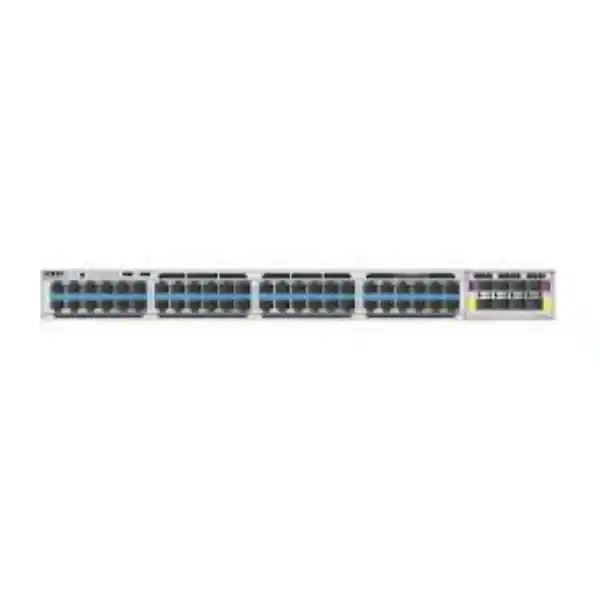
Cisco C9350-48HXN Smart Switch
A high-density Cisco campus access switch for organizations that need a practical mix of 5G and 10G copper access, high-power UPOE+, Wi-Fi 7 readiness, resilient stacking, modular 100G-class uplinks and enterprise-scale policy enforcement without overbuilding every edge port to the maximum speed tier.
The C9350-48HXN is designed for enterprise access layers where 48 high-power multigigabit copper ports are needed, but only part of the edge requires 10G. It provides 36 ports that scale through 1G, 2.5G and 5G plus 12 ports that can additionally reach 10G. This tiered port architecture is well suited to dense Wi-Fi 7 access points, smart-building devices, security cameras, high-performance workstations and converged IT/OT environments.
What the C9350-48HXN is designed to solve
Modern enterprise access networks in Dubai are no longer built around a simple assumption that every desk device needs exactly 1 Gbps and every access switch can be sized by port count alone. Wi-Fi 7 access points can present multiple multigigabit Ethernet options, smart cameras increasingly combine high-resolution video with analytics, building systems consolidate onto IP, engineering workstations require higher sustained throughput, and organizations expect access switches to participate in segmentation, telemetry, automation and resilient policy enforcement. The Cisco C9350-48HXN addresses that shift by combining a differentiated edge-port mix with high-power PoE and a switching architecture intended for current and future campus requirements.
The defining design choice is the split between 36 ports with multigigabit operation through 5G and 12 ports that extend through 10G. In many real deployments this is more efficient than buying a platform where every port is designed for 10G even though only selected radios, workstations, media systems or local aggregation devices can use that bandwidth. The HXN model lets architects reserve the twelve 10G-capable copper ports for the highest-demand endpoints and use the remaining 36 multigigabit ports for devices that need more than 1G but do not require a full 10G access link. That makes the model particularly relevant for floors with mixed Wi-Fi generations, hybrid workplace endpoints, smart-building systems and progressively upgraded edge infrastructure.
Core hardware specification overview
Downlink architecture
48 RJ-45 multigigabit access ports. Thirty-six ports support 10/100 Mbps and 1/2.5/5 Gigabit Ethernet, while twelve ports support 10/100 Mbps and 1/2.5/5/10 Gigabit Ethernet. This creates a deliberate performance tier for mixed-density enterprise edge designs.
Power over Ethernet
Up to 90W UPOE+ per port is supported, with the chassis platform capable of a maximum 4320W PoE budget when appropriately equipped. Actual available PoE is determined by the installed power supplies, redundancy policy, input power and switch configuration.
Silicon and forwarding
The C9350-48HXN uses a Cisco Silicon One A100/L ASIC. Cisco specifies up to 1.3 Tbps ASIC capacity for the platform architecture, with a system profile that combines switching traffic and high-bandwidth stack connectivity.
Stacking and uplinks
StackWise-1.6T provides up to 1.6 Tbps stack bandwidth with as many as eight C9350 members at the same license level. The HXN supports modular uplink choices that scale to 200 Gbps aggregate uplink bandwidth.
Understanding the 36-port 5G plus 12-port 10G design
The C9350-48HXN should not be treated as a generic 48-port 10G copper switch. Its value comes from the way its port groups are intentionally differentiated. The thirty-six 5G-class ports are suited to access points, user devices and IoT or operational endpoints where multigigabit Ethernet is useful but where 10G capability would not materially change the application experience. The twelve 10G-capable ports are the premium tier for high-throughput wireless, content creation, workstation, edge compute, local server or specialized device connectivity. Designing around these tiers can improve both capital efficiency and cabling discipline because the highest-speed copper ports can be reserved for endpoints that actually require them.
For wireless-first offices, one sensible approach is to map the twelve 10G ports to the highest-density Wi-Fi 7 areas and assign the 5G ports to standard meeting rooms, office zones and lower-density coverage cells. In education, the 10G ports can be assigned to lecture halls, auditoriums, labs and high-density common areas while the remaining radios use 2.5G or 5G. In healthcare, the faster tier may be reserved for imaging-adjacent workflows, high-capacity wireless areas or edge appliances, while other clinical and administrative areas remain on multigigabit links. In smart buildings, the same principle applies to high-resolution camera clusters, AV systems, building controllers and local gateways.
The switch therefore rewards careful endpoint classification. Before ordering, FourTeck recommends building a port schedule that records each endpoint type, expected negotiated speed, PoE class, cable category, growth requirement and redundancy need. A port schedule exposes whether the twelve 10G-capable ports are sufficient for the expected high-speed devices and whether the remaining 36 multigigabit ports align with the project. This is more reliable than selecting by headline port count alone, especially in Wi-Fi 7 and intelligent-building projects where both bandwidth and power draw vary significantly between endpoint classes.
Cisco Silicon One at the access layer
The C9350 generation moves Cisco enterprise access switching onto Silicon One architecture. For the C9350-48HXN, Cisco identifies a single A100/L ASIC with up to 1.3 Tbps of ASIC switching capacity. In practical design terms, this is relevant because the platform is expected to combine large numbers of multigigabit edge links, high-speed uplinks, stacking, policy enforcement and telemetry in a single access-layer system. The ASIC architecture provides hardware resources for switching, routing, ACL enforcement, QoS and flow visibility so that the access layer can do more than simply bridge Ethernet frames.
Cisco publishes platform-scale figures including 16 GB of DRAM, 18 GB of flash, optional SSD capacity up to 240 GB, 4094 VLAN IDs with up to 4000 active VLANs, large MAC and route tables, hardware Flexible NetFlow resources and programmable functions. Exact scale should always be validated against the intended SDM template and the feature mix being enabled. Route scale, ACL scale, flow scale and IPv6 scale share hardware resources; a design that pushes one table heavily can influence the practical capacity available to other functions.
For architects, the important takeaway is that the C9350-48HXN is positioned as an intelligent enterprise access platform rather than an unmanaged high-speed port expander. It can participate in routed access, segmentation, SD-Access, multicast, QoS and telemetry strategies. That allows campus designs to distribute policy and routing decisions closer to users and devices while preserving centralized management and observability.
Wi-Fi 6E and Wi-Fi 7 access switching
Wireless upgrades are one of the strongest reasons to evaluate the C9350-48HXN. Wi-Fi 6E and Wi-Fi 7 access points can exceed the practical ceiling of a 1G Ethernet uplink, particularly when deployed in dense environments with wide channels, multiple radios, high client concurrency and high-performance backhaul. Multigigabit Ethernet allows existing or upgraded copper cabling to negotiate intermediate speeds such as 2.5G and 5G, while selected ports on this model can reach 10G. This gives network teams a smoother migration path than forcing an immediate change to fiber at every access-point location.
The bandwidth story is only half of Wi-Fi 7 switching. Modern access points can also have substantial power requirements because they incorporate multiple radio chains, processing capacity, USB or IoT functions and additional feature sets. The C9350-48HXN supports UPOE+ with up to 90W per port, making it suitable for devices that exceed traditional 30W PoE+ budgets. However, per-port capability and total switch budget are separate design questions. A switch that can deliver 90W to an individual port does not necessarily have enough installed PSU capacity to deliver 90W simultaneously to all 48 ports. Full-power wireless designs therefore require a proper total-load calculation and the correct combination of power supplies.
For a Dubai office, hotel, education campus, retail environment or government facility, a good wireless access design should inventory access-point models, maximum PoE requirements, expected negotiated Ethernet speed, cable length, cable category and redundancy objectives. The result can then be mapped to the HXN port tiers. If more than twelve access points genuinely need 10G copper, a different port mix or a multi-switch design may be more appropriate. If most radios will operate at 2.5G or 5G and only selected high-density cells need 10G, the HXN can be an efficient fit.
90W UPOE+ and practical PoE engineering
Cisco specifies up to 90W UPOE+ capability on the C9350-48HXN access ports. This makes the platform suitable for high-power endpoints such as advanced wireless access points, pan-tilt-zoom cameras, digital signage, smart-building gateways, access-control equipment, certain thin-client or display configurations and other IEEE 802.3bt powered devices. The headline maximum chassis PoE budget is 4320W, which mathematically corresponds to 90W across 48 ports. Reaching that level, however, depends on installing and configuring sufficient power-supply capacity. The default order uses an 850W AC power supply, so a default single-PSU chassis cannot provide the maximum PoE budget.
Cisco supports up to three field-replaceable power supplies in the C9350 chassis. The platform supports 500W, 850W and 1600W AC PSU options, subject to model and ordering rules. The 1600W supply reaches its highest output with suitable high-line input, which is especially relevant in the UAE where enterprise racks typically have access to 220–240V AC power. Additional PSUs can be used to expand available PoE, introduce N+1 redundancy, or do both. Because redundancy consumes reserve capacity, a design that must survive one PSU failure should not allocate every available watt during normal operation.
A professional PoE calculation should work from endpoint consumption rather than merely from maximum standards. For example, a Wi-Fi access point may support a 90W input class but draw far less during ordinary use. Some organizations design to maximum negotiated power for worst-case assurance; others use a measured or vendor-specified maximum draw plus headroom. Either approach should include startup behavior, future firmware features, USB attachments, camera heater loads, lighting peaks and the possibility that endpoint models may change during the lifecycle of the switch.
FourTeck can help build a PoE matrix that assigns each of the 48 ports a planned device, maximum power draw, negotiated class and criticality rating. The matrix can then be tested against normal PSU capacity and a chosen failure scenario. This is particularly useful for surveillance and building-control networks, where losing PoE during a PSU event could disable cameras, access-control points or wireless coverage even if the switch itself remains operational.
Modular uplinks: designing the path to distribution and core
The C9350-48HXN uses field-replaceable uplink network modules rather than fixed uplink ports, and the base switch does not include an uplink module. For this model, Cisco documents up to 200 Gbps of aggregate modular uplink bandwidth using supported modules such as the C9350-NM-2C or C9350-NM-8Y. The C9350-NM-2C provides two 100G/40G QSFP-class uplinks for a straightforward high-capacity connection to a campus distribution or core layer. The C9350-NM-8Y offers a more granular set of SFP-based uplinks, supporting eight ports in 1G/10G/25G operation or a four-port 50G mode, with an aggregate ceiling of 200 Gbps.
Choosing between these options depends on topology. A dual-100G architecture is attractive when the switch or stack connects to two resilient distribution nodes and each uplink should carry large aggregated flows. The eight-port module is valuable when the access layer needs more physical uplink paths, mixed-speed migration, links to multiple aggregation devices, or gradual upgrades from 10G to 25G or 50G. Optics, fiber type, link distance, breakout requirements and transceiver compatibility must be planned at the same time as the module.
In a dense Wi-Fi deployment, uplink oversubscription should be calculated from realistic traffic patterns rather than by adding every downlink line rate. Forty-eight access ports can theoretically represent very large aggregate edge bandwidth, but end devices seldom transmit at maximum line rate concurrently. The correct uplink size depends on user behavior, east-west traffic, cloud usage, media workloads, local server access, application architecture and growth. For most enterprise access layers, dual 25G, 50G or 100G uplinks provide substantial headroom, but high-density venues, creative workloads and edge-compute environments can justify higher capacity.
StackWise-1.6T: scale without multiplying control planes
The C9350 family supports Cisco StackWise-1.6T with up to 1.6 Tbps of stacking bandwidth. Up to eight C9350 switches can operate in a stack, subject to Cisco compatibility and same-license-level requirements. This is useful in large access closets because multiple physical switches can be managed as a unified system rather than as eight independent access devices. A single logical stack simplifies port provisioning, software operations, uplink design and high-availability planning while the high-speed stack interconnect carries traffic between members.
For the HXN model, Cisco highlights the ability of an eight-member stack to scale to hundreds of multigigabit and UPOE+ ports. The exact mix in a real project may include other C9350 models, which can be valuable when one closet requires a combination of high-power copper, standard 1G access and fiber-facing interfaces. Mixed-model stacking should always be validated against current Cisco documentation, software release and license level before procurement, but the architectural concept enables a more modular campus design than forcing every stack member to have the same edge-port profile.
Stack design should include more than the switches. StackWise cables are available in multiple lengths and need to match the physical arrangement of the rack. A good ring topology avoids a single stack-cable failure isolating members. Cable routing should leave adequate service loops without obstructing power-supply or fan replacement. Uplink placement can also be distributed across different stack members so that the loss of one member does not remove all upstream connectivity.
From an operations perspective, stacking can reduce the number of management endpoints and simplify configuration consistency, but it also concentrates the impact of software changes and maintenance events. Change-control procedures should therefore include stack-health verification, software compatibility review, configuration backup, redundant uplink checks and a rollback plan. For mission-critical Dubai environments, FourTeck can help translate the logical stack design into a physical rack elevation, cable schedule and failure-domain plan.
StackPower+ and resilient power architecture
C9350 switches also support StackPower+, which creates a shared power domain between connected switches. Cisco describes StackPower+ as a 55V power-sharing architecture that can pool power supplies and redistribute available capacity according to demand. Up to four switches can participate in a StackPower+ ring. This can be valuable when a stack contains heavy PoE loads because additional power supplies installed in one member can contribute to the shared domain, and power capacity can be planned at the group level rather than strictly switch by switch.
Shared power does not remove the need for engineering. The total number, wattage and input source of the installed PSUs still determines the available power. If the requirement includes redundancy, the design must reserve enough capacity to tolerate the planned failure scenario. It is also important to consider PDU circuits and upstream UPS sizing: adding multiple 1600W supplies to a rack can substantially increase potential load, and the electrical infrastructure needs to support both steady-state operation and failure redistribution.
For high-power surveillance, hospitality and smart-building deployments, StackPower+ can make the rack more resilient without adding separate external PoE injectors. It also creates an opportunity to optimize PSU utilization, but the final bill of materials should explicitly state the power-supply mix, power cords, StackPower cables, AC feed assignment and redundancy mode. This avoids a common procurement problem in which the switch hardware is ordered correctly but the power architecture is underspecified.
High availability, serviceability and rack planning
Power supplies
The chassis provides three PSU bays and supports hot-swappable, field-replaceable power supplies. Multiple PSUs can increase PoE capacity and support redundancy. The C9350-48HXN default ordering configuration uses an 850W AC PSU, so high-power designs should specify additional or upgraded supplies rather than assuming the maximum PoE budget is included by default.
Cooling
Three field-replaceable fan modules provide front-to-back airflow with redundancy. Rack layout should keep intake and exhaust paths clear, preserve access to rear service components and align with data-center hot/cold aisle practices where applicable.
Physical format
The HXN belongs to the deeper C9350 chassis group, approximately 4.4 cm high and 44.5 cm wide, with chassis depth around 47.2 cm and greater installed depth once power supplies are fitted. Rack depth, door clearance, rear cable bend radius and PDU placement should be checked before installation.
Out-of-band access
The rear panel includes console and dedicated management connectivity. For resilient operations, connect out-of-band management to a separate management network and document console access so the switch can be reached even when production routing is unavailable.
Layer 2, Layer 3 and campus policy roles
Although the C9350-48HXN is primarily positioned for campus access, the platform supports a broad set of Layer 2 and Layer 3 capabilities. Cisco lists enterprise switching, IP routing, IP multicast routing, IPv6 routing, IPv6 multicast routing, enterprise QoS, Flexible NetFlow, programmability and Software-Defined Access support for the C9350 family. This allows the switch to operate in conventional VLAN-based access designs, routed-access models or policy-driven campus architectures.
In a traditional access design, the switch can terminate user, voice, wireless, camera and building-system VLANs and forward them toward distribution. In routed access, Layer 3 boundaries can be moved closer to the edge, reducing spanning-tree dependence and creating deterministic routed links upstream. In Cisco SD-Access environments, the C9350 can participate in fabric-based segmentation and policy enforcement, subject to software and licensing requirements. The best model depends on the customer’s operational maturity, existing Cisco architecture, controller strategy and change-control processes.
Quality of Service is particularly important when a single access switch carries voice, video, wireless backhaul, cameras, business applications and IoT telemetry. Rather than treating all traffic equally, QoS policies can classify, mark, queue and police traffic according to application importance. Proper QoS is not a substitute for adequate uplink capacity, but it can preserve latency-sensitive voice and collaboration during transient congestion. QoS policy should be consistent with upstream distribution, WAN and security appliances to avoid rewriting or losing markings across the network.
Multicast support matters for IPTV, video distribution, building-control systems, financial feeds and some discovery protocols. The switch should be sized for the expected number of groups, receivers and routed multicast entries rather than assuming multicast scale is unlimited. In large campuses, VLAN, route, multicast and ACL scale should be reviewed together against the chosen SDM template and software release.
Security and segmentation at the wired edge
The access switch sits directly between users, access points, cameras, sensors, phones and the rest of the enterprise. That makes it an important policy enforcement point. The C9350 platform provides hardware resources for access-control lists, segmentation and telemetry, allowing organizations to implement controls close to where traffic enters the network. Cisco highlights technologies such as TrustSec, VXLAN, Flexible NetFlow, IP Device Tracking, SPAN and ERSPAN across the platform’s security and visibility capabilities.
A practical segmentation model for a Dubai enterprise might separate corporate clients, voice, guest wireless, building management, surveillance, access control, printers, AV devices and contractor systems. Segmentation can be implemented with VLANs and routed boundaries, with ACLs between zones, or through more advanced fabric-based policy. The correct approach depends on the security architecture and on where firewalls are positioned. The switch should enforce local access policy without becoming an uncontrolled bypass around central security inspection.
Endpoint visibility is also important. Flow telemetry can help identify heavy talkers, unexpected application paths and network behavior that would otherwise be invisible in a pure port-status view. Device tracking helps map IP and MAC information to physical access points. SPAN and ERSPAN provide traffic-copy mechanisms for analysis tools and security sensors. These functions are most effective when they are designed into the monitoring architecture from the beginning rather than enabled reactively after an incident.
Cisco has also documented advanced cryptographic and inline protection capabilities for the C9350 platform, with some features tied to specific or future software releases. For procurement, the safe approach is to treat any feature that is release-dependent as something to verify against the exact IOS XE target version and selected license before it becomes a mandatory design requirement. FourTeck can validate feature availability during solution design so a project does not rely on a roadmap capability that is not enabled in the intended production release.
Physical and software integrity matter as well. Cisco describes secure boot, image signing and runtime integrity mechanisms on the platform. These measures complement operational controls such as restricted management access, AAA integration, configuration backups, role-based administration, secure management protocols and a documented upgrade process.
Management models: on-premises, cloud and operational consistency
The C9350 family is part of Cisco’s unified networking direction, where hardware, software, licensing and support are intended to provide consistent management choices across deployment models. For organizations using Cisco Catalyst Center, the switch can fit into a centralized on-premises operations model for inventory, configuration, assurance and campus workflows. Other customers may use direct IOS XE administration, automation interfaces and monitoring platforms according to their operational standards.
The most important design decision is not simply which dashboard to use. It is how configuration authority, software lifecycle, telemetry, identity and change management will be governed. Large UAE enterprises often have separate network operations, security and infrastructure teams. A good management design defines who can push switch configuration, how changes are approved, where backups are stored, how compliance is checked, how alerts reach the NOC and how an emergency rollback is performed.
For a new C9350 deployment, FourTeck recommends creating a standardized baseline template before rolling out dozens of switches. The baseline can define management VRF, NTP, DNS, AAA, logging, SNMP or streaming telemetry, access-port templates, uplink policy, spanning-tree or routed-access settings, QoS, security controls and licensing registration. Standardization shortens deployment time and reduces configuration drift across floors, buildings and branch sites.
Application hosting and local edge services
Cisco C9350 switches include resources for on-box application hosting. The platform documentation identifies dedicated CPU and memory allocations for app hosting, dual application-facing ports and optional SSD storage up to 240 GB. This can support approved containerized services and monitoring functions at the network edge without requiring a separate appliance for every local service.
Potential use cases include experience monitoring, local observability, network service applications and edge integrations. The architecture can be useful at remote or distributed sites where placing an additional server is undesirable. However, application hosting should be treated as a managed infrastructure function. Resource allocation, application support status, storage endurance, security patching and lifecycle ownership should be defined before relying on an on-box application for production services.
The switch’s primary role remains networking, so application workloads should never be allowed to compromise forwarding stability or operational recoverability. For most customers, app hosting is best considered an optional capability that can consolidate selected edge functions while keeping core application workloads on appropriate compute platforms.
Deployment topology 1: high-density Wi-Fi 7 office floor
Consider a Dubai office floor with several hundred users, collaboration spaces, meeting-room AV, IP phones, access-control readers, cameras and 20 to 30 wireless access points. The C9350-48HXN can form the foundation of a converged access closet. The 10G-capable ports can be assigned to the busiest Wi-Fi 7 radios and any local high-throughput endpoints, while the 5G-class ports serve standard access points and other multigigabit devices. Lower-speed devices can still negotiate 1G or 100M as appropriate, so the switch does not require every endpoint to operate at multigigabit rates.
If one switch does not provide enough ports, a second or third C9350 can be added into a StackWise-1.6T design. Upstream connectivity can be split across members and connected to redundant distribution switches using high-speed fiber. The uplink module should be selected based on the expected aggregate user traffic and resiliency target. A pair of 100G links may be appropriate in very dense environments, while 25G or 50G designs may be sufficient for more typical offices.
The PoE plan should be built from the access-point and device schedule. High-end Wi-Fi 7 access points may need higher PoE classes, but phones, readers and many cameras require much less. By summing realistic maximum power and adding headroom, the project can determine whether one, two or three PSUs are required and how much reserve should remain after a PSU failure. This prevents unnecessary overbuying while still protecting critical devices.
Deployment topology 2: surveillance and smart-building convergence
Large commercial buildings increasingly carry surveillance, door access, lighting control, environmental sensors, room systems and building gateways over the same structured network infrastructure. The C9350-48HXN can support this convergence because it combines high PoE capability, multigigabit access, segmentation and resilient switching. Cameras that need higher bandwidth or power can use the appropriate port tier, while lower-bandwidth devices negotiate at standard Ethernet speeds.
The network should still preserve security boundaries. Cameras, access control and building automation should not simply share the same user VLAN. Separate segments, ACLs and firewall policies should define which management systems can reach each device group. A dedicated operations network may be used for management controllers and NVR infrastructure. Flow monitoring can help detect unexpected communication paths or sudden changes in device behavior.
Power resiliency is particularly important in this topology. If a switch PSU fails and the network continues forwarding but the available PoE budget falls below demand, non-prioritized endpoints may lose power. The design should therefore identify critical cameras, door systems and wireless radios, configure appropriate power priorities, and ensure enough redundant capacity exists for the required failure case. Upstream UPS runtime must also be considered because a fully equipped high-PoE access stack can represent a significant electrical load.
For UAE facilities teams, environmental conditions matter as well. The switch is intended for controlled enterprise spaces, not direct outdoor exposure. Telecom rooms should maintain suitable temperature, humidity, airflow and dust control. Front-to-back airflow requires clear rack paths, and deeper chassis dimensions should be confirmed against wall-mounted or compact cabinets before installation.
Deployment topology 3: campus access with routed uplinks
In larger campuses, the C9350-48HXN can be used in a routed-access topology where each access stack forms Layer 3 adjacencies to the distribution layer. This reduces reliance on large Layer 2 fault domains and can simplify failure convergence. User and device VLANs may terminate on the access stack, while routing carries traffic upstream toward security, application and WAN services.
A routed design requires disciplined IP addressing, routing protocol selection, summarization and policy. It also changes how services such as DHCP relay, multicast, first-hop redundancy and wireless integration are implemented. Organizations migrating from a traditional spanning-tree campus should therefore treat routed access as an architecture project rather than a switch-by-switch setting. The benefit is a more deterministic topology with clear fault domains and the opportunity to use high-speed routed uplinks efficiently.
The HXN’s modular high-speed uplinks and StackWise bandwidth make it suitable for this model. However, route scale and feature requirements must be validated against the chosen SDM template, IOS XE release and license. A campus with thousands of routed access prefixes, multicast groups or security objects should undergo explicit scale review before implementation.
How to size the C9350-48HXN correctly
Correct sizing starts with six separate questions: port count, port speed, PoE demand, uplink bandwidth, feature scale and redundancy. Treating any one of these as a substitute for the others leads to avoidable redesign. A switch may have enough physical ports but not enough 10G ports. It may have enough Ethernet bandwidth but insufficient PoE reserve. It may have sufficient power but the wrong uplink module. Or it may be mechanically unsuitable for a shallow cabinet.
Port count: count active endpoints, then add growth. Growth should be realistic and location-specific. A floor with 42 planned devices may technically fit into 48 ports, but six spare ports can disappear quickly when temporary devices, access-point additions or new cameras are introduced. For critical sites, leaving 15–25 percent physical headroom is often more operationally comfortable than filling every port from day one.
Speed tiers: classify every device according to expected negotiated Ethernet speed. Count how many genuinely need 10G. If the project requires 20 or 30 simultaneous 10G copper endpoints per switch, the HXN port mix may not be the right choice. If 10G is limited to a dozen premium endpoints and the rest fit 1G/2.5G/5G, the HXN is directly aligned with that requirement.
PoE: calculate both normal and maximum draw, then add a margin. Determine whether the system must maintain all critical loads after one PSU failure. Include any devices expected to be added during the project warranty period. The maximum 4320W platform number should never be used as a default available-power assumption.
Uplinks: estimate real aggregate traffic and choose the uplink module, optics and fiber path accordingly. Use dual links to different upstream devices when high availability is required. Confirm whether the aggregation layer has matching port speeds and optical interfaces.
Feature scale: document VLAN count, MAC scale, route scale, multicast, ACL entries, QoS policies and flow monitoring. Large networks should validate the appropriate SDM profile instead of relying on generic maximum numbers.
Redundancy: define the failure scenario. Is the requirement to survive one uplink failure, one switch-member failure, one power-supply failure, one PDU failure, or an entire rack power feed failure? The answer changes the stack topology, PSU count, uplink placement and UPS architecture.
Copper cabling for 2.5G, 5G and 10G access
Multigigabit Ethernet is valuable because it can deliver more than 1G over twisted-pair cabling, but actual reach and performance depend on cable category, installation quality, interference and channel construction. Existing cabling should not be assumed to support 10G simply because it terminates in an RJ-45 jack. Older or marginal channels may run reliably at 1G or 2.5G but fail qualification at higher speeds.
For new Wi-Fi 7 builds, Cat6A is commonly selected for long-term 10G readiness and improved alien crosstalk performance, especially where cables are bundled. For existing Cat5e or Cat6 infrastructure, certification testing can identify which links are suitable for multigigabit operation. Cable length, patch cords, patch panels and workmanship all contribute to channel performance.
PoE adds a thermal dimension. High-power PoE on large cable bundles can increase conductor temperature. Structured cabling design should consider cable gauge, bundle size, ambient temperature and standards-based derating. This is important in ceiling spaces and dense pathways common in commercial towers. A network upgrade that increases both data rate and PoE load may justify recertifying the cabling plant rather than reusing it without testing.
FourTeck can coordinate switching and cabling requirements so that the network design does not specify 5G or 10G edge performance on channels that cannot reliably carry those speeds. The cabling report should become part of the commissioning record together with switch port maps and PoE schedules.
Power, UPS and thermal planning for UAE racks
The C9350-48HXN can become a substantial power load when used near its PoE ceiling. UAE enterprise sites commonly provide 230V-class mains power, which aligns well with high-output enterprise PSUs, but the rack electrical design must still be engineered. Total input power includes switch electronics, PoE delivery, conversion losses and any redundant power supplies that become active during a failure. The upstream PDU, circuit breaker and UPS must all be sized for the intended maximum condition.
A useful design process is to calculate four scenarios: expected normal load, planned growth load, single-PSU failure load and maximum credible load. The UPS should then be checked for both power rating and runtime. A 10-minute runtime may be sufficient for generator transfer in one facility, while a remote branch might need far longer. If a switch stack powers critical security or access-control devices, the UPS architecture should be reviewed jointly by network, facilities and security teams.
Thermal output also rises with power consumption. Even efficient PSUs produce heat, and PoE power passing through the switch contributes to rack and telecom-room thermal conditions. Air-conditioning must be designed for the full rack, not just the switch. Blocked front intake, hot-air recirculation or undersized wall cabinets can reduce reliability. The C9350 uses front-to-back airflow, so rack placement should maintain a clear cool-air intake and unobstructed rear exhaust.
In dusty or construction-active spaces, keep telecom rooms sealed and filtered where possible. Dust accumulation can reduce cooling efficiency and increase maintenance requirements. Environmental monitoring for temperature and humidity is recommended for important access rooms, particularly where multiple high-PoE switches are installed in the same rack.
Licensing and software planning
Cisco C9350 Series Smart Switches use Cisco’s unified licensing approach. Licensing can be provided through Cisco Networking Subscription structures or Enterprise Agreements, with Smart Accounts and Cisco Smart Software Manager used for centralized software-license administration. The precise subscription, feature entitlement and support package should be selected against the required management and security functions rather than added at the end of the hardware order.
For a quotation, customers should state whether the switch will be managed with Catalyst Center, whether SD-Access is part of the architecture, what routing and security features are required, and what software term aligns with organizational standards. Existing Cisco Enterprise Agreement customers may need the new switches mapped into their current agreement rather than purchased as isolated licenses. Organizations without a Cisco Smart Account should plan account ownership and access before deployment so licenses can be registered and managed by the correct business entity.
Software release selection is equally important. Cisco’s current C9350 documentation lists IOS XE software requirements for the platform, and later releases add features, bug fixes and hardware support. Production deployment should use a Cisco-recommended release that supports the exact switch, uplink module, optics and required features. Do not choose a release only because it is the newest available image; operational stability, field experience and compatibility are often more important than having the latest feature.
FourTeck can align the hardware, subscription, support and software release plan before order finalization. This reduces the chance of receiving the switch hardware while discovering that required management or advanced features were not included in the licensing scope.
Operations, automation and telemetry
A modern access switch should expose more than interface up/down state. The C9350 platform supports programmable operations and hardware flow visibility, allowing network teams to integrate switching into broader automation and observability workflows. Depending on the management architecture, configuration can be standardized through controllers, APIs, templates or infrastructure automation tools, while telemetry can feed monitoring and analytics platforms.
For large rollouts, automation is most valuable when the configuration model is stable. Create reusable profiles for user access, voice, cameras, Wi-Fi access points, building systems and uplinks. Each profile can define VLAN behavior, authentication, PoE, QoS, security controls and monitoring. This reduces manual differences between switches and makes troubleshooting more predictable because a given endpoint type should look similar across every access closet.
Telemetry design should answer operational questions: Which links are approaching capacity? Which ports are drawing unexpectedly high PoE? Which clients are generating abnormal traffic? Which uplinks are dropping packets? Which stack member is overheating? Which devices are negotiating at a lower speed than expected? Monitoring these indicators helps identify cabling faults, endpoint issues and capacity bottlenecks before users report a service failure.
For organizations that need integration or outsourced engineering, FourTeck’s IT Services UAE team can align switch deployment with broader LAN, Wi-Fi, security, monitoring and migration activities.
Where the C9350-48HXN fits in a security architecture
The C9350-48HXN is a network switch, not a substitute for an enterprise firewall. Its role is to provide secure access, segmentation, visibility and high-speed forwarding at the campus edge. North-south internet traffic, inter-zone inspection, remote-access policy and application-layer threat prevention are typically handled by dedicated security platforms. The strongest architecture combines switch-level identity and segmentation with appropriate firewall enforcement points.
For customers designing a complete campus security stack, FourTeck’s Firewall Dubai resource can be used alongside the access-switch design to plan perimeter and internal security controls. The switching and firewall teams should agree on VLAN boundaries, routing ownership, default gateways, inspection points and logging so traffic does not bypass intended policy.
At branch or remote locations, the C9350 may connect to a firewall pair that provides WAN, SD-WAN, internet and VPN services. At larger campuses, access stacks typically connect to distribution or core infrastructure before reaching centralized firewall zones. In both cases, the switch provides the first layer of control over which device can connect to which access port and how that device is classified.
Cisco C9350-48HXN versus a full 48-port 10G multigigabit model
The HXN is attractive when the network needs high-performance multigigabit access but does not require 10G capability on every downlink. A full 48-port 10G multigigabit model offers maximum uniformity and may be preferable when most edge devices will eventually need 10G. The HXN instead creates a blended design: twelve premium 10G ports and thirty-six ports that top out at 5G. That can match real endpoint distributions more closely in many enterprise buildings.
The decision should be based on a five-year port forecast, not today’s endpoint list. If a project currently has eight 10G-capable access points but expects twenty within two years, buying only twelve 10G ports may force an early switch expansion. If the organization expects the majority of endpoints to remain at 2.5G or 5G, paying for 48 10G-capable ports may not produce business value. Port forecasting should include wireless refresh cycles, workstation requirements, AV growth and local edge devices.
The HXN also has a documented 200G aggregate modular uplink ceiling, whereas other C9350 variants may support higher aggregate uplink bandwidth. That distinction matters in unusually bandwidth-intensive access layers. For standard enterprise floors, 200G can be substantial; for dense content-production, research or edge-compute environments, architects should compare expected traffic against the uplink ceiling and consider alternative C9350 models if necessary.
Use case matrix for Dubai and UAE organizations
Corporate campuses
A strong fit where Wi-Fi 7, high-power APs, collaboration systems and segmented user networks share the same access layer. The mixed 5G/10G port profile can match premium and standard workplace zones without unnecessary 10G everywhere.
Education
Suitable for high-density wireless in auditoriums, lecture halls and labs, with 10G ports reserved for the busiest radios and 5G ports used for classrooms and general coverage. PoE supports cameras, phones and smart-campus devices.
Hospitality and retail
Supports guest Wi-Fi, POS, digital signage, cameras, access control and IoT across converged network closets. High-power PoE and segmentation are valuable where many device categories share structured cabling.
Healthcare and smart buildings
Well aligned with mixed wireless, surveillance, building control and specialized endpoint requirements. Careful PoE redundancy and security segmentation are especially important for operationally critical devices.
UAE procurement considerations
Enterprise switching procurement should produce a complete, deployable bill of materials rather than a bare chassis line item. For the Cisco C9350-48HXN, that means confirming the switch PID, uplink network module, optics or DAC/AOC connectivity, stacking cables, StackPower cables if used, power-supply quantity and wattage, power cords, software subscription, support coverage, rack accessories and any optional SSD. Missing any one of these can delay commissioning even if the switch itself arrives on time.
Lead times can vary by configuration and supply conditions. High-capacity optics and specific power supplies may have different availability from the base switch, so the quotation should be reviewed as one solution. For phased projects, ensure that future stack members and uplink modules will remain compatible with the planned software release and stack architecture. Serial-number and entitlement records should be captured at delivery and mapped to the customer’s Cisco Smart Account where appropriate.
Customers purchasing for Dubai, Abu Dhabi, Sharjah or other UAE locations should also define installation responsibilities. A supply-only quote is different from a deployment that includes rack installation, stacking, configuration migration, acceptance testing and documentation. FourTeck’s main UAE technology site can be used for broader infrastructure coordination when the switch is part of a larger network, server, security or communication project.
For organizations with regional offices outside the UAE, procurement can also be coordinated with wider coverage through FourTeck Africa where relevant, helping standardize network designs across countries while accounting for local delivery and support requirements.
Implementation workflow recommended by FourTeck
1. Discovery: collect current switch models, port usage, Wi-Fi access-point inventory, PoE consumption, uplink speeds, VLANs, routing protocols, security controls and management tools. Document physical rack constraints and available AC power.
2. Port and power design: classify all endpoints into 1G, 2.5G, 5G and 10G groups and map them to the C9350-48HXN port tiers. Build a PoE matrix and size PSU capacity for normal operation plus the required redundancy scenario.
3. Uplink and stack design: choose the uplink module, fiber type, optics and StackWise topology. Decide whether uplinks are distributed across stack members and whether StackPower+ is required. Create a rack elevation and cable plan.
4. Software and licensing: confirm the production IOS XE release, Cisco subscription, support level and Smart Account ownership. Validate every mandatory feature against the selected release and license.
5. Staging: upgrade software, apply the baseline configuration, test management connectivity, validate stack formation, confirm PSU and fan health, test PoE behavior and verify uplink optics before the maintenance window.
6. Migration: move uplinks and access ports according to a documented sequence. Track critical services such as wireless, telephony, cameras and building systems separately. Keep rollback steps and old-switch configurations available until acceptance is complete.
7. Acceptance and documentation: record final port maps, stack status, software version, licensing, serial numbers, PoE budget, uplink utilization, monitoring status and configuration backups. Update network diagrams so operations teams inherit an accurate production record.
Technical details that should be validated before purchase
The C9350-48HXN has a strong published feature set, but enterprise procurement should still validate the exact design inputs. First, confirm the number of endpoints that need 10G because only twelve downlinks include 10G capability. Second, confirm the total PoE demand and redundancy target because the default 850W PSU does not unlock the maximum 4320W PoE budget. Third, select the uplink module at order time; the switch base configuration does not include a modular uplink card.
Fourth, verify the exact optics and fiber plant. A 100G uplink is useful only when the upstream switch, optic type and fiber infrastructure match. Fifth, check rack depth and rear service clearance. The HXN chassis is deeper than many legacy access switches, and power supplies add installed depth. Sixth, validate the required IOS XE feature set and license. Any feature marked by Cisco as release-dependent should be verified against the current recommended software.
Finally, validate the electrical and cooling environment. High-power PoE switching changes the load profile of a telecom room. If several C9350-48HXN switches are deployed together, the total power and heat can be significant. The correct solution therefore combines network, cabling, electrical and cooling design rather than treating the switch as an isolated device.
Why choose FourTeck for Cisco C9350-48HXN deployment in Dubai
FourTeck approaches enterprise switching as a design and lifecycle problem rather than a simple hardware transaction. The C9350-48HXN can deliver substantial access capacity, but the result depends on the surrounding decisions: which ports are allocated to 10G endpoints, how PoE is budgeted, which uplink module is used, how the stack is cabled, what redundancy level is required, how the switch is licensed and how the new platform is integrated into monitoring and security operations.
For greenfield projects, the engagement can include logical and physical design, bill of materials, rack planning, configuration templates, software staging, installation and acceptance. For migration projects, FourTeck can review the existing Catalyst environment, identify configuration dependencies, map old ports to new switch ports and plan a low-risk cutover. For Wi-Fi refresh projects, switch sizing can be aligned directly with AP uplink speeds and PoE requirements rather than treating wired and wireless infrastructure as separate purchases.
The goal is to deliver a switch configuration that is ready for the customer’s actual traffic, devices and operational model. This reduces hidden costs caused by missing PSUs, insufficient uplinks, wrong optics, undersized cabling or licensing gaps and gives the operations team a cleaner platform to manage after handover.
Decision recap: is the C9350-48HXN the right model?
Strong fit when
You need 48 high-power copper ports, most endpoints fit within 1G/2.5G/5G, up to twelve premium devices need 10G, Wi-Fi 7 readiness is important, 90W-per-port capability is required for selected endpoints, stacking is needed and a maximum of 200G modular uplink bandwidth is appropriate for the access layer.
Review alternatives when
More than twelve edge ports per switch require 10G, the access layer needs more than 200G aggregate modular uplink bandwidth, the project is data-only and does not need high-power PoE, rack depth is severely constrained, or a lower-cost 1G platform already meets the endpoint roadmap.
Plan carefully around
PoE power-supply sizing, 10G port allocation, uplink-module choice, optic compatibility, StackWise cable lengths, StackPower design, IOS XE release, licensing, Smart Account ownership, UPS capacity and the structured cabling qualification required for higher multigigabit speeds.
Best procurement outcome
A complete bill of materials that includes chassis, correct PSUs, selected network module, optics, stack cables, StackPower cables if needed, licensing, support and deployment services, with port and power schedules verified before the purchase order is released.
Quotation input checklist
To receive an accurate Cisco C9350-48HXN quotation for Dubai or the wider UAE, provide as much of the following information as possible. The more complete the design inputs are, the more precisely the switch, PSU, uplink and licensing bill of materials can be prepared.
Ports and endpoints
Number of Wi-Fi access points; AP models; number of 10G-required devices; number of 5G/2.5G devices; phones; cameras; access-control devices; AV endpoints; workstations; IoT devices; and required spare-port percentage.
PoE and electrical
Maximum PoE draw per device, required redundancy level, available rack AC voltage, UPS capacity, PDU outlets, dual-feed availability and whether critical devices must remain powered through a PSU failure.
Uplinks and optics
Required uplink speed, number of upstream switches, fiber type, approximate distance, existing optics, connector type, current distribution/core model and whether links will use 25G, 40G, 50G or 100G.
Stacking and software
Number of switches in each stack, rack arrangement, approximate stack-cable lengths, StackPower requirement, management platform, required IOS XE features, routing protocols, SD-Access requirement and Cisco Smart Account status.
Structured consultation for Cisco C9350-48HXN Dubai projects
FourTeck can review an existing switch schedule or design a new C9350-48HXN access layer from the ground up. The consultation can cover port tiering, Wi-Fi 7 integration, PoE budget, PSU redundancy, StackWise-1.6T layout, StackPower+, 25G/50G/100G uplinks, optics, cabling qualification, IOS XE software, unified licensing, monitoring, rack power and implementation planning.
For a complete quotation, send the floor or rack count, endpoint inventory, access-point models, required switch quantity, target uplink speed, redundancy requirement and any preferred Cisco licensing term. FourTeck will use those inputs to produce a deployable bill of materials rather than a chassis-only estimate.

Reviews
There are no reviews yet.