
Enterprise Access Switching • Dubai & UAE
Cisco C9350-48T Smart Switch
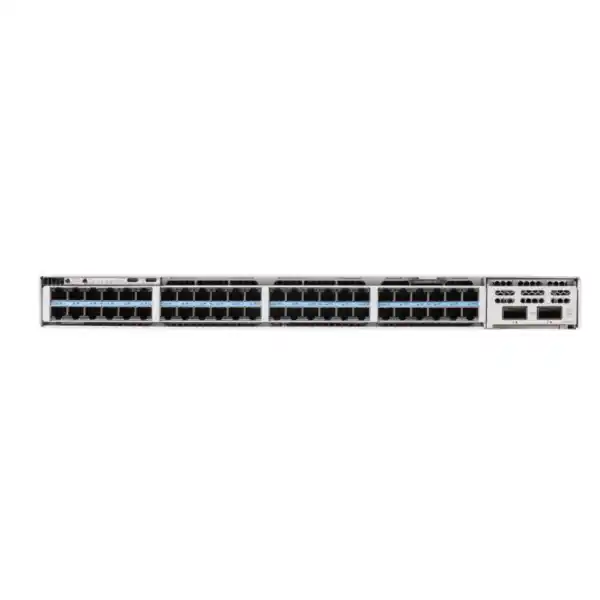
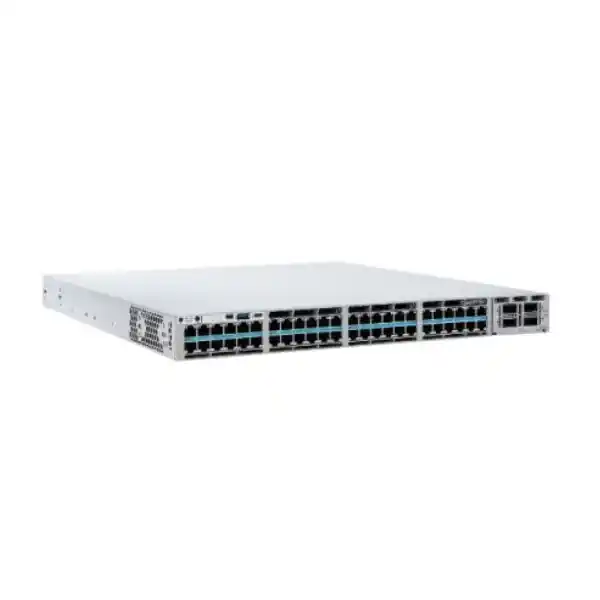
A high-density 48-port 1 Gigabit Ethernet, data-only enterprise access switch built for organizations that need modern Cisco IOS XE operations, scalable forwarding, flexible high-speed uplinks, strong segmentation, resilient stacking and a clear migration path beyond earlier generation campus switching. The C9350-48T is especially appropriate when endpoint power is supplied separately and the design objective is reliable wired access rather than PoE delivery.
Direct answer: what is the Cisco C9350-48T?
The Cisco C9350-48T is a fixed, stackable enterprise access switch with forty-eight copper downlink interfaces supporting 10 Mbps, 100 Mbps and 1 Gigabit Ethernet. It is the data-only 48-port member of the Cisco C9350 family, so it does not provide PoE, PoE+ or UPOE power on the access ports. That distinction matters in real projects: the 48T is aimed at workstations, printers, appliances, controllers, servers, security devices and other endpoints that already have independent power, while PoE-dependent phones, wireless access points and cameras normally require a C9350 PoE-capable variant or separate injectors.
The switch uses a Cisco Silicon One A100/L ASIC for hardware forwarding and supports modular uplink choices so the access layer can connect to distribution or core infrastructure at significantly higher speed than the individual 1G edge ports. Cisco specifies 496 Gbps of bandwidth for the C9350-48T, 369.024 Mpps forwarding performance, and up to 2096 Gbps switching capacity with stacking. The platform supports StackWise-1.6T and can form a unified stack of up to eight C9350 switches when the design, software and licensing requirements are aligned.
For Dubai and UAE buyers, the practical value is a dense wired-access platform that can replace aging access switches without forcing a PoE purchase where PoE is not required. It gives enterprise teams a current Cisco platform for Layer 2 switching, IP routing, policy enforcement, telemetry, programmability, segmentation and centralized management while preserving conventional 1G copper connectivity to the desk. For project planning, FourTeck can align the chassis, uplink module, optics, stacking cables, software subscription, support approach and rack-power design so the delivered bill of materials matches the intended topology.
Key Cisco C9350-48T specifications at a glance
48-port wired access
Forty-eight RJ-45 downlinks support 10/100/1000 Ethernet for dense office, campus and branch access where endpoint power is not delivered by the switch.
Silicon One forwarding
A Cisco Silicon One A100/L ASIC handles hardware packet forwarding and provides the programmable resource foundation for modern enterprise policy and scale.
496 Gbps bandwidth
Cisco lists 496 Gbps bandwidth for this SKU and 369.024 million packets per second forwarding, with higher aggregate capacity when used in a stack.
Modular uplinks
Field-replaceable network modules support high-speed uplink designs using 1G, 10G, 25G, 40G, 50G and 100G options depending on the selected module and optics.
StackWise-1.6T
Dedicated rear stacking connectivity supports an aggregate 1.6 Tbps stack architecture and up to eight switch members for resilient, unified operation.
Cisco IOS XE
The platform runs Cisco IOS XE, supporting enterprise Layer 2 and Layer 3 functions, APIs, model-driven telemetry, automation and multiple management approaches.
Why the C9350-48T is different from a basic 48-port Gigabit switch
A simple 48-port Gigabit switch can provide physical connectivity, VLANs and basic uplinks, but an enterprise access layer has to do considerably more. It must enforce segmentation, survive component failures, support large policy tables, maintain predictable forwarding under load, expose useful telemetry, integrate with identity and management systems, and provide a lifecycle path for software operations. The C9350-48T is designed around those broader enterprise requirements. Its purpose is not merely to add forty-eight copper ports; it is to become part of a controlled campus or branch architecture.
This difference shows up in the forwarding resources. Cisco lists up to 64,000 MAC addresses on the C9350 platform, up to 192,000 IPv4 routes in the published performance table, up to 96,000 IPv6 routes, up to 2,000 switched virtual interfaces, hardware NetFlow scale, high-capacity ACL resources, and 9216-byte jumbo frames. These figures are not all simultaneously consumable at maximum values because hardware resources are allocated according to platform templates and the enabled feature mix, but they demonstrate why the platform is positioned for enterprise access rather than small unmanaged or lightly managed networks.
For a UAE network manager, this translates into design headroom. A switch selected for a large office floor today may later need additional VLANs, routed access, richer policy, telemetry or stack expansion. Choosing a platform with modern forwarding and management resources reduces the probability that a future operational requirement forces an early hardware replacement. The 48T is therefore particularly attractive where the organization knows it does not need PoE on those ports but still wants the control-plane, security, management and resilience characteristics of a current enterprise switching platform.
Port architecture and access-layer design
48 × 1G data downlinks
The forty-eight fixed copper interfaces are suited to traditional enterprise endpoints such as desktop computers, thin clients, printers, badge or time-attendance terminals with local power, building-management controllers, KVM appliances, storage or backup devices with 1G requirements, branch security appliances, AV endpoints with independent power, and selected server or infrastructure management connections. Auto-negotiated 10/100/1000 support also accommodates legacy endpoints that have not yet moved to Gigabit speed.
Because the model is data-only, designers should validate every intended endpoint before finalizing the bill of materials. An IP phone or access point that relies on switch-delivered power cannot simply be patched into a C9350-48T and powered over the network. This makes endpoint classification an important pre-sales step: separate powered and non-powered device counts, identify ports that need 802.3af/at/bt power, then determine whether a mixed estate of 48T and PoE models or a uniform PoE platform is more operationally efficient.
Modular uplink slot
The C9350 design separates access ports from the high-speed uplink choice. The base switch does not inherently include the modular uplink interface required for every deployment, so the uplink module must be selected as part of the order. Cisco offers modules that can deliver combinations of 1G, 10G, 25G, 40G, 50G and 100G connectivity, enabling the access layer to match existing distribution hardware or prepare for a future backbone upgrade.
This modular approach prevents the switch from being locked to a single uplink format. A current office may need dual 10G links to distribution, while a larger campus refresh may prefer 25G or 100G-capable aggregation. The correct module depends on the number of uplinks, optics type, fiber plant, oversubscription target, redundancy model and upstream transceiver capabilities. FourTeck therefore treats the uplink module and optics as design components rather than optional accessories to be chosen after the chassis is purchased.
Uplink sizing: how much bandwidth should a 48-port 1G access switch receive?
The correct uplink rate is not automatically forty-eight Gigabits because endpoint traffic is rarely synchronized at full line rate. Instead, designers estimate the concurrency and traffic profile of the users attached to the switch. A standard knowledge-worker floor with web applications, SaaS, email, collaboration and occasional file transfer may run comfortably on redundant 10G uplinks. A media, engineering, virtualization, backup or data-processing environment can drive much higher sustained northbound load and may justify 25G, 40G, 50G or 100G uplinks.
One useful sizing method is to classify endpoints by expected peak throughput rather than link speed. Forty endpoints that each average 20 Mbps during a busy hour represent only 800 Mbps of aggregate demand, but burst behavior, east-west traffic, backups, software distribution, internet breakout location and simultaneous application launches can create much larger peaks. A safe design therefore uses measured utilization where available, applies growth assumptions, and preserves redundancy so the surviving uplink can carry acceptable traffic if one link fails.
For dual-homed access designs, also consider whether links operate as an EtherChannel, multichassis arrangement upstream, or routed links. The topology affects convergence, loop prevention, load distribution and failure domains. In a StackWise design, uplinks can be distributed across different stack members so that the access layer retains northbound connectivity after a member, cable, interface or power event. The value of the modular uplink architecture is that the C9350-48T can be aligned to this design rather than forcing one fixed uplink speed.
For Dubai office towers and distributed UAE campuses, fiber distance and available strands are equally important. Existing multimode fiber may be appropriate for short in-building runs at some speeds, while single-mode fiber is often preferred for longer inter-building or campus links. Optics must match the selected uplink module, wavelength, fiber type, connector standard, distance and upstream port. A quotation should therefore include exact transceiver and patching requirements instead of listing only the switch chassis.
Silicon One A100/L architecture and packet-forwarding behavior
The C9350 generation moves enterprise access switching onto Cisco Silicon One technology. In the C9350-48T, a single A100/L ASIC provides the hardware forwarding engine for the switch. Hardware forwarding matters because access-layer traffic should not depend on the general-purpose CPU for routine packet movement. Once the forwarding tables and policies are programmed into hardware, packets can be switched or routed at deterministic rates while the CPU remains available for control-plane protocols, management and system services.
Cisco specifies 496 Gbps of bandwidth and 369.024 Mpps for the C9350-48T. These values provide enough architectural capacity to support the forty-eight 1G access interfaces plus high-speed uplink requirements without treating the switch as an oversimplified port aggregator. With stacking, Cisco lists 2096 Gbps switching capacity and 1559.424 Mpps forwarding rate for this SKU. The published system design also includes scalable packet buffering and programmable resource tables, which are important when traffic patterns are bursty or the switch has to combine forwarding with policy, visibility and segmentation functions.
It is useful to distinguish ASIC capacity from real application performance. A switch can forward packets rapidly but still be constrained by uplink oversubscription, server limits, WAN capacity or policy design. The objective of good access-layer engineering is therefore not to chase the highest theoretical number; it is to ensure the switching fabric is not the bottleneck for the expected workload. On a 48-port 1G access switch, a modern ASIC with substantial policy and routing resources provides confidence that the device can handle traffic and operational features together.
The architecture also supports growth in segmentation and telemetry. As enterprises increase ACL usage, collect flow records, deploy more SVIs, or move from pure Layer 2 access to routed designs, hardware table allocation becomes more important. Cisco uses SDM templates to partition ASIC resources for deployment roles. This means architects should validate scale requirements for the exact software release and feature set rather than assuming every maximum table value can be combined at once. For large UAE campus projects, that validation is part of responsible switch sizing.
StackWise-1.6T: scaling beyond a single 48-port switch
Cisco StackWise-1.6T is one of the most important design characteristics of the C9350 family. It provides dedicated rear-panel stacking connectivity with up to 1.6 Tbps aggregate stacking bandwidth and supports stacks of up to eight C9350 members. Instead of operating as eight isolated switches, a properly configured stack functions as a unified system with a common operational view and distributed forwarding. For larger floors or wiring closets, that can reduce management overhead while preserving modular growth.
Stacking is particularly useful when port demand grows in increments that do not justify a chassis-based platform. A network team can begin with one or two members and add switches while maintaining a common stack architecture, subject to license alignment, software compatibility and supported member combinations. The physical stack cables are specific to the C9350 platform. Cisco explicitly distinguishes the StackWise-1.6T cables from older Catalyst 9300-era stack cables, so migration projects should not assume existing cables can be reused.
For resiliency, uplinks can be spread across separate stack members. If the design uses an aggregated uplink bundle with links on different members, a single member failure does not necessarily disconnect the entire access stack. Power feeds should also be diversified across rack PDUs or UPS outputs where available. The platform supports multiple field-replaceable power supplies and N+1 concepts at the chassis level, providing additional resilience options even for a data-only model.
A stacking decision should still consider failure domain size. An eight-member stack simplifies management, but a single logical system also concentrates operational dependence on the stack architecture. Some enterprises prefer smaller stacks per closet or routed standalone access switches for stronger fault isolation. The C9350-48T supports either style, so the correct topology depends on the availability target, team operational model, change-control practices, cabling plan and upstream design.
Power, cooling and physical deployment
1RU form factor
The chassis is 1.73 inches high and 17.5 inches wide, fitting standard enterprise 19-inch rack deployments with the appropriate mounting hardware.
Approx. 6.26 kg
Cisco lists the C9350-48T at approximately 13.8 lb or 6.26 kg with the default power supply, useful for rack-load and handling planning.
500W default PSU
The data-only 48T is supplied with a 500W AC power supply by default, while the platform architecture supports multiple field-replaceable power-supply bays.
Three fan modules
Three rear-accessible field-replaceable fan modules provide N+1 cooling redundancy, supporting serviceability and continuous operation during a fan failure.
Physical sizing matters in UAE equipment rooms because rack depth, cable bend radius, hot-aisle clearance and UPS design vary substantially between sites. Cisco lists the 48T chassis at 15.1 inches deep without the power supply and approximately 16.5 inches with a 500W or 850W supply. Before delivery, the rack should be checked for front-to-rear clearance, rear service access, stack-cable routing and the ability to remove power supplies or fans without colliding with vertical PDUs.
Cisco specifies AC input from 100V to 230V and platform operating conditions up to 45°C at lower altitude ranges, with reduced maximum temperature at higher altitude. In Dubai, the switch normally operates in an air-conditioned telecom room, but cooling design should account for actual rack density, UPS heat, neighboring PoE switches and the consequences of HVAC failure. The correct design uses stable environmental control rather than treating the published maximum operating temperature as a normal target.
Power consumption is substantially below the 500W PSU rating because the C9350-48T has no PoE load. Cisco’s published tests show consumption varying with traffic and selected network module. That gives facilities teams a better planning basis than simply multiplying PSU ratings by switch count. For capacity planning, however, consider both expected steady-state load and redundancy behavior, and ensure the UPS and PDU design can support the surviving feeds during a failure scenario.
Cisco IOS XE: operational consistency and automation
Cisco IOS XE is the software foundation of the C9350 series. For teams already operating Cisco enterprise switching, that continuity reduces the operational jump compared with moving to a completely different network operating system. IOS XE supports traditional CLI workflows while also providing model-driven interfaces such as NETCONF, RESTCONF and YANG models, streaming telemetry and on-box automation capabilities. This makes the C9350-48T relevant both to classic network operations and to infrastructure-as-code programs.
In practical terms, automation can reduce repetitive configuration work across many switches. VLANs, interface policies, routing settings, monitoring configuration and compliance parameters can be generated or validated from centralized tooling rather than entered manually device by device. API-based methods are especially valuable across multiple branches or large campuses where configuration drift creates security and troubleshooting problems. Teams can use controller-led workflows, enterprise automation platforms or custom tools based on organizational standards.
Streaming telemetry improves visibility by allowing selected operational data to be exported at useful intervals to monitoring systems. Traditional SNMP polling remains common, but model-driven telemetry can provide more granular insight into interfaces, queues, system health and selected state information. Combined with Flexible NetFlow and endpoint visibility features, this helps network teams diagnose congestion, unexpected traffic, policy issues and performance degradation without relying solely on user-reported symptoms.
Software lifecycle planning remains important. New platform capabilities can depend on particular IOS XE releases, and some functions may be introduced after the hardware becomes available. Production deployments should therefore use a Cisco-recommended software train that meets the required feature set and organizational change policy. Before a large rollout, validate templates, authentication, routing, uplink optics, stack behavior and management integrations in a representative pilot environment.
Layer 2 switching capabilities for enterprise access
At the access layer, predictable Layer 2 behavior remains fundamental. The C9350 platform supports enterprise VLAN switching, spanning-tree functions, link aggregation and policy features required to connect large numbers of endpoints safely. Cisco lists support for up to 4094 VLAN IDs and up to 4000 active VLANs on the platform, along with significant spanning-tree scale. Most deployments will use far fewer, but the scale is useful in large campuses, multi-tenant environments and segmented enterprise networks.
VLAN design should correspond to security and operational boundaries rather than arbitrary switch-port groups. Separate corporate clients, management interfaces, OT devices, printers, guest systems, building-management endpoints and infrastructure services according to the organization’s policy model. Access ports should be configured deliberately, with unused ports disabled or placed into restricted states. Trunk ports should allow only required VLANs, reducing unnecessary broadcast propagation and exposure.
Link aggregation can increase uplink bandwidth and redundancy where multiple physical interfaces connect to the upstream system. Designers should ensure the upstream topology supports the desired EtherChannel or multichassis configuration and that hashing behavior is appropriate for the traffic mix. A bundle of two 10G links can provide 20G aggregate capacity across multiple flows, but one individual flow generally remains constrained by the capacity of a single member link depending on hashing and protocol behavior.
Spanning tree remains relevant in Layer 2 topologies even when modern designs minimize large Layer 2 domains. Root placement, edge-port behavior, BPDU protection and loop prevention need explicit configuration. Accidental loops at user ports can cause severe outages, so access-edge protections should be part of the standard template. Where architecture permits, routed access or overlay designs can further reduce Layer 2 fault domains, but the choice should reflect the organization’s skills, applications and upstream architecture.
Layer 3 routing and routed-access opportunities
The C9350 platform is not limited to Layer 2 access. Cisco documents IP routing, IPv6 routing, multicast routing and enterprise routing capabilities for the family, with substantial route-table resources. This enables routed-access designs in which Layer 3 boundaries can be moved closer to the edge, reducing dependence on large spanning-tree domains and improving failure isolation. The correct feature availability depends on software and license level, so routing requirements should be identified before procurement.
Routed access can be useful in modern campus environments because each access block becomes a smaller fault domain. Instead of extending many VLANs across large parts of the campus, the switch or stack can terminate local networks and exchange routes upstream. This can improve convergence and simplify certain troubleshooting scenarios. However, it changes addressing, gateway placement, policy design and operational procedures, so it should not be adopted merely because the hardware supports it.
The published C9350 resource scale includes up to 192,000 IPv4 routes and up to 96,000 IPv6 routes in the platform performance table, plus up to 64,000 ARP entries and significant multicast resources. Actual effective scale varies with SDM templates and combined feature usage. In an access environment, these capacities are normally far above the number of directly connected user networks, leaving room for summarised internal routes, overlay or fabric functions, and policy use cases where supported.
For UAE enterprises with multiple sites, the access switch should be considered within the total routing architecture. Branches may use local routing to firewalls or SD-WAN devices, while a campus may use routed links to a distribution layer. FourTeck’s UAE IT services team can help map the switching design to existing firewall, WAN and network-management practices so the switch does not become an isolated technology decision.
Security architecture: segmentation, ACLs and identity-aware policy
Enterprise access ports are security enforcement points because they are where users, unmanaged devices and operational systems enter the network. The C9350 platform supports hardware ACL enforcement, Cisco TrustSec capabilities and segmentation mechanisms that help constrain communication according to policy. ACL scale is substantial, but effective policy should still be designed carefully. Thousands of rules do not automatically create strong security; clear identity, segmentation boundaries, logging and lifecycle processes matter more.
A common deployment uses 802.1X authentication with a policy system such as Cisco ISE to identify users or devices before assigning access. Where 802.1X cannot be used, MAC Authentication Bypass or profiling may support selected legacy endpoints. The switch then enforces the resulting VLAN, downloadable ACL or group-based policy according to the architecture. This enables different access treatment for managed laptops, contractors, printers, IoT devices and unknown endpoints connected to the same physical switch.
TrustSec can reduce the operational burden of expressing every policy purely through IP addresses. Security Group Tags represent identity or role, allowing policy to follow the logical group rather than static subnets in supported designs. VXLAN and software-defined access architectures can extend segmentation across larger campus environments. These approaches require controller, identity, licensing and design decisions, so they should be evaluated as a solution architecture rather than enabled piecemeal.
Switch security also includes protecting the control and management planes. Administrative access should use authenticated, encrypted protocols, role-based privileges and centralized AAA where possible. Unused services should be disabled, management interfaces isolated, configuration backups protected, and logging forwarded to centralized systems. Cisco’s platform trust features, secure boot mechanisms and signed software help protect system integrity, but operational controls remain essential to the overall security posture.
Visibility with Flexible NetFlow, SPAN and telemetry
A modern access switch should help operators understand what is happening, not merely pass traffic. The C9350 platform supports Flexible NetFlow, SPAN and ERSPAN along with model-driven telemetry and device-tracking functions. These tools serve different purposes. NetFlow provides summarized traffic records that show who communicated with whom, using which protocols and how much data. SPAN copies selected packets for deeper inspection, while telemetry exports structured operational state to monitoring platforms.
Flexible NetFlow is particularly useful for capacity planning and incident investigation. A team can identify top talkers, unexpected application flows, backup traffic appearing during business hours, unusual east-west communication or a sudden shift in destination patterns. Cisco lists substantial flow-table resources for the C9350 platform, though practical scale depends on the selected template, record design and other hardware-resource consumption. Flow monitoring should therefore be planned, not enabled everywhere with oversized records by default.
SPAN and ERSPAN support packet-level troubleshooting. Local SPAN sends mirrored traffic to an analyzer connected to the switch, while ERSPAN can encapsulate mirrored traffic and transport it across an IP network to a remote analysis system. This is useful when the security or network-operations team is not physically located near the wiring closet. Mirroring must be sized carefully because oversubscribed monitor destinations can drop copied packets and create misleading captures.
Telemetry complements these tools by providing ongoing health and performance indicators. Interface errors, utilization, queue behavior, environmental status and protocol state can be monitored centrally. In distributed UAE environments, centralized visibility reduces the need for repeated site visits and helps teams distinguish endpoint problems from cabling faults, uplink congestion or switch issues before dispatching field engineers.
Management choices: CLI, controller and cloud-assisted operations
The C9350 platform supports multiple management approaches, allowing enterprises to align the hardware with their operating model. Traditional Cisco teams can manage through local CLI and standard network-management systems. Cisco Catalyst Center can provide centralized on-premises orchestration, assurance and lifecycle workflows. Cisco also positions the platform within a broader cloud-management strategy. The correct mode depends on security policy, operational maturity, controller investment and desired automation depth.
CLI remains essential for detailed troubleshooting, but large estates benefit from standardization. A manually configured switch can be perfectly secure, yet maintaining hundreds of manually configured devices introduces inconsistency risk. Centralized templates, configuration compliance and automated deployment reduce drift. For new offices or branches, plug-and-play style provisioning can accelerate rollout by applying software and configuration according to a controlled workflow.
Catalyst Center is useful when the organization wants topology, inventory, assurance, automation and policy functions in a Cisco campus environment. It can help operators move from device-by-device administration toward intent-based workflows. However, controller adoption should be planned with server or appliance sizing, integration, licensing, certificates, identity and operational processes. The switch does not become easier simply because a controller exists; the management platform must be integrated into change management and incident response.
Cloud-assisted or hybrid models can reduce dependence on local management infrastructure and support distributed teams, but they require review of data governance, internet dependency, role-based access, logging and organizational policy. For many Dubai enterprises, a hybrid approach is attractive: local forwarding and CLI remain available while centralized cloud or controller tooling improves visibility and standardization. The C9350 gives teams flexibility to choose the operating model rather than forcing a single management method.
Licensing and subscription planning
Software licensing is part of the C9350 purchase, not an administrative task to resolve after hardware delivery. Cisco has moved the platform toward unified licensing and subscription models, with Essentials and Advantage feature tiers available in the broader switching licensing framework. Organizations should define the required routing, automation, security, assurance and controller features before selecting the exact license. A lower-tier license can be cost-effective when requirements are straightforward, while advanced features may justify the higher tier.
Subscription term is also important. Cisco ordering structures commonly offer multiple durations, and enterprise agreements can change the commercial approach. The correct term should match asset lifecycle, budgeting practice and organizational software policy. A five-year campus refresh may prefer aligned subscriptions across all switches, while a rapidly changing branch program may use a different procurement cadence. The goal is to avoid a mixed estate with inconsistent entitlements and renewal dates that create operational overhead.
Cisco Smart Accounts and Smart Software Manager provide centralized license administration. Procurement teams should confirm the customer Smart Account, virtual account structure and intended ownership before placing orders, especially when a reseller or integrator is involved. Incorrect account assignment can create delays during deployment and renewal. For multinational groups, align UAE devices with the global licensing governance model rather than creating isolated local accounts without coordination.
FourTeck can quote hardware and software together so the bill of materials reflects the intended feature set. License choice should be documented alongside network design assumptions, not hidden as a commercial footnote. That enables technical approvers to verify that the purchased subscription supports the planned capabilities and prevents unexpected upgrade requirements late in the project.
High availability beyond stacking
Resilience is created by combining multiple mechanisms rather than relying on one feature. StackWise protects against some member-level failures and simplifies a multi-switch access block. Multiple power-supply bays allow redundancy options. Three field-replaceable fans provide N+1 cooling protection. Uplinks can be distributed across separate members and upstream devices. Software features support rapid convergence. Together, these elements help the access layer remain available through component failures and maintenance events.
Power architecture deserves specific attention even on a data-only switch. A second power supply can improve resilience, but only if it is connected to an independent power source where possible. Two PSUs plugged into the same single PDU do not protect against that PDU failing. In critical racks, use separate UPS-backed feeds or redundant PDUs supplied from independent sources according to site electrical design. Document which power bay connects to which feed to simplify maintenance.
Uplink diversity should follow the same principle. Two links connected to the same upstream switch protect against an individual cable or port failure but not against upstream chassis failure. A distribution design using two upstream systems can improve availability, subject to the supported Layer 2 or Layer 3 architecture. Fiber paths should also be physically diverse where the business impact justifies it; two fibers in the same conduit do not provide protection against a cable cut affecting that conduit.
Finally, configuration and software are part of availability. Standardized templates, tested rollback procedures, configuration backups and a staged upgrade process reduce human-error risk. Many campus outages are caused by configuration changes rather than hardware defects. A resilient C9350 deployment therefore combines hardware redundancy with disciplined operations.
Where the Cisco C9350-48T fits in Dubai and UAE networks
Corporate office floors
Ideal for dense wired desks, printers and business endpoints when phones or wireless APs are powered separately or connected to dedicated PoE switches.
Branch offices
Provides a consistent enterprise access platform for branches that need forty-eight 1G data ports, routing, segmentation and centralized management without a large PoE requirement.
Campus administration
Suitable for user-access blocks in universities, healthcare administration areas, government offices and enterprise campuses with structured fiber uplinks.
Data and management networks
Can serve 1G management, backup or infrastructure networks where PoE is unnecessary and policy, routing and telemetry remain important.
Retail and distributed sites
Useful for larger retail, logistics or service locations where most wired devices use local power and the organization wants standardized Cisco operations.
Network refresh programs
A strong option when replacing older Catalyst access platforms and retaining 1G copper while upgrading stacking, uplink, security and management capabilities.
When the C9350-48T is not the right model
The 48T should not be selected solely because it has the right port count. If the access switch must power IP phones, Wi-Fi access points, cameras, badge readers, IoT gateways or other PoE devices, a PoE-capable C9350 model is usually more appropriate. Using dozens of external injectors defeats the operational simplicity of centralized PoE and increases cabling, power and support complexity. The 48T is strongest when the majority of attached endpoints are genuinely data-only.
It may also be unsuitable where edge devices need Multigigabit access above 1G. High-performance Wi-Fi 6E or Wi-Fi 7 access points, engineering workstations, certain servers and specialized endpoints can justify 2.5G, 5G or 10G copper downlinks. In those cases, a C9350 Multigigabit model should be evaluated. Buying a 1G-only edge platform for endpoints already demanding higher speed can create an immediate bottleneck.
For small branches needing fewer than forty-eight ports, a lower port-density platform may be more cost-efficient. Conversely, very large access blocks might benefit from a chassis architecture or a different stacking and redundancy model. The correct product is determined by port count, endpoint power, downlink speed, uplink bandwidth, routing scale, security features, licensing and operational model together.
The purpose of a product page is therefore not to claim that the C9350-48T fits every deployment. Its value is specific: dense 1G copper data access on a current Cisco enterprise platform, with modern stacking, modular uplinks, software capabilities and hardware scale. If those requirements match the project, the 48T is compelling. If they do not, selecting another model early is cheaper than forcing the wrong switch into the design.
C9350-48T versus PoE and Multigigabit alternatives
| Decision area | C9350-48T | PoE C9350 variants | Multigigabit C9350 variants |
|---|---|---|---|
| Downlink role | 48 × 1G data | 1G data plus endpoint power | 1G to multi-gig data, depending on model |
| PoE | No | Yes, model dependent | Available on selected models |
| Best fit | Wired clients with local power | Phones, APs, cameras and powered endpoints | High-speed APs and multi-gig clients |
| Power planning | Simpler, no endpoint PoE budget | Requires PoE wattage calculation | Depends on model and endpoint power |
A mixed access layer is often the most rational design. For example, one C9350-48T can serve locally powered desktop and printer ports while a PoE model serves access points, phones and cameras. The tradeoff is inventory diversity. Standardizing on PoE everywhere simplifies sparing but increases power-supply capacity and may raise purchase cost. FourTeck can model both approaches and compare chassis count, PSU requirements, port utilization, uplink needs and operational simplicity.
Migration from older Catalyst access switches
A C9350-48T deployment is often part of a refresh rather than a greenfield installation. Migration planning should begin with inventory. Record existing switch models, software versions, VLANs, trunks, port descriptions, authentication methods, ACLs, routing, SNMP, telemetry, spanning-tree roles, EtherChannels, optics, stack design, management IPs and connected endpoint types. Do not assume the old configuration can be copied line-for-line to a new platform; some commands, defaults, licensing dependencies or interface naming conventions may differ.
Cabling is the next constraint. The 48T preserves RJ-45 1G access, so existing Category 5e or better structured cabling can usually continue to serve 1G endpoints if it meets standards and passes testing. Uplink fiber deserves closer review because the new modular uplink may use different optics, speeds or connectors from the old switch. Existing stack cables from earlier generations should not be reused for C9350 StackWise-1.6T, because Cisco specifies platform-specific stack cables.
Configuration migration should be staged. Build the target template, test authentication and critical applications, validate routing and uplinks, then migrate a representative access block before scaling. During cutover, preserve rollback ability. Port maps should identify critical endpoints so teams know which devices require manual validation. If DHCP snooping, dynamic ARP inspection, 802.1X, voice VLANs or other access controls are enabled, verify behavior before moving large numbers of users.
For organizations upgrading multiple UAE sites, standardization can turn a refresh into an operational improvement. Use the migration to normalize naming, logging, NTP, AAA, telemetry, interface templates, software versions and documentation. A hardware replacement that copies years of configuration inconsistencies onto a new switch wastes much of the value of the refresh.
Structured cabling and optics considerations in UAE deployments
The access ports use conventional copper Ethernet, but their performance still depends on cabling quality. For 1GBASE-T, Category 5e or better structured cabling is commonly used. Cable certification matters in older buildings, where patch-panel terminations, split pairs, damaged jacks or excessive channel length can create intermittent errors that are mistakenly attributed to the switch. A refresh project should review error counters on existing ports and test suspicious cable runs before cutover.
Fiber uplinks require more detailed matching. The selected network module determines interface form factor and supported speeds, while the transceiver determines optical standard, wavelength and reach. Multimode and single-mode optics are not interchangeable, and a link must use compatible optics at both ends. The fiber plant must also support the selected optic and distance. For campus links between buildings, route diversity and outdoor fiber specifications may be as important as bandwidth.
When designing redundant uplinks, label fibers and patch cords consistently at both ends. Use documented rack elevations and fiber maps. In large Dubai towers, riser fiber may be shared between tenants or managed by building facilities, so delivery timelines should include access approvals and cross-connect work. A switch can be installed in minutes, yet an undocumented or unavailable fiber pair can delay the entire migration.
FourTeck’s Dubai server and infrastructure practice can coordinate switching with rack, compute and structured equipment-room requirements when the C9350-48T is part of a broader data-center or server-room upgrade rather than a standalone network purchase.
Capacity planning: ports, growth and oversubscription
Forty-eight physical ports do not mean forty-eight usable ports should be allocated on day one. Good access design preserves spare capacity for moves, additions, troubleshooting and unexpected growth. A common planning target is to leave a percentage of ports unassigned, especially in offices where seating changes or new equipment appears over time. The exact reserve depends on rack space, cabling density, budget and how quickly another switch can be added.
Port utilization should be measured in two dimensions: occupancy and bandwidth. A port can be physically occupied but carry very little traffic, while one server or backup endpoint can consume much more than dozens of user ports. Uplink sizing must therefore use traffic measurements rather than port count alone. Historical monitoring from the existing network is ideal because it captures real application peaks and daily patterns.
Growth planning should include technology shifts. The 48T downlinks remain 1G, so a user population expected to require 2.5G or 5G at the desktop within the switch lifecycle may be better served by a different model. Conversely, most office users remain well below 1G sustained throughput, and Gigabit access can continue to be highly cost-effective. The design question is whether the endpoint class needs higher access speed, not whether higher speed exists in the market.
Stack growth also affects uplinks. Adding a second or third 48T to a stack doubles or triples port capacity, but the original uplink bundle may not scale proportionally. Design uplink modules and upstream ports with the intended final stack size in mind. It is often cheaper to select an uplink module with future headroom at the beginning than to replace the module and optics after the access stack expands.
Performance scale and hardware tables
| Resource | Published C9350 platform scale | Design meaning |
|---|---|---|
| MAC addresses | Up to 64,000 | Large Layer 2 endpoint scale for enterprise access. |
| IPv4 routes | Up to 192,000 in the performance table | Supports routed access and large enterprise routing requirements. |
| IPv6 routes | Up to 96,000 | Provides headroom for IPv6-capable campus architectures. |
| SVIs | Up to 2,000 | Supports many routed VLAN interfaces where required. |
| Jumbo frames | 9216 bytes | Useful for selected storage, server or encapsulation designs when end-to-end MTU is aligned. |
| DRAM / Flash | 16 GB / 18 GB | Supports IOS XE software, routing and platform services. |
These published numbers are platform maxima and should not be interpreted as a guarantee that every maximum can be reached simultaneously. ASIC resources are shared and can be allocated through SDM templates. Feature combinations, IPv6 entry consumption, ACL types, NetFlow records and software release can change effective scale. Large designs should therefore validate the exact resource profile against the intended template and Cisco release documentation.
Quality of Service for business-critical applications
Even though the C9350-48T is data-only, Quality of Service remains important because wired endpoints can carry voice softphone traffic, video meetings, virtual desktop sessions, business applications and large data transfers at the same time. QoS classifies and marks traffic, applies queuing behavior and protects important applications during congestion. Without a consistent QoS policy, a bulk transfer can compete with latency-sensitive traffic at an oversubscribed uplink.
A good QoS design starts with trust boundaries. Do not automatically trust every endpoint marking. Managed devices may apply approved DSCP values, while unknown clients can attempt to mark traffic as high priority. The switch can classify or remark traffic based on port, application or policy context. Queues should then be sized so priority traffic receives low latency without allowing one class to starve the rest of the network.
QoS becomes most relevant at contention points, especially uplinks. Forty-eight access ports can theoretically offer far more aggregate edge bandwidth than a pair of 10G uplinks. This oversubscription is normal and economically efficient because users rarely transmit at full speed simultaneously. QoS ensures that when contention does occur, business-important traffic receives appropriate treatment rather than simply competing on a first-come basis.
Policies should be end-to-end. Marking traffic on the access switch has limited value if the distribution, WAN, firewall or internet edge ignores those markings. For multi-site UAE deployments, align campus QoS with SD-WAN and carrier classes where applicable. Test application behavior under realistic congestion so policies are based on observed requirements rather than assumptions.
Application hosting and local compute capabilities
The C9350 platform includes enhanced application-hosting resources, reflecting the broader trend toward programmable edge infrastructure. Cisco documents x86 multicore CPU resources, DDR5 memory allocation for hosted applications, local SSD options up to 240 GB and dedicated application connectivity. This enables selected container-based workloads to run on the switch platform, reducing the need for a separate small server in certain edge use cases.
Application hosting can support monitoring or observability functions such as enterprise agents where Cisco provides supported packages and licensing. The architectural advantage is proximity to traffic and infrastructure. A hosted application can collect data locally and continue providing selected functions even when centralized systems are remote. However, application hosting should not be confused with a general-purpose server platform; compute and storage resources are designed for supported network-edge workloads.
Before using app hosting, validate CPU, memory, storage, software release and support requirements. Also consider operational ownership. If the network team manages the switch but another team owns the containerized application, responsibilities for patching, backup and troubleshooting must be clear. Uncontrolled applications on network infrastructure can introduce risk, so deployment should follow the same security and lifecycle discipline as other enterprise workloads.
For most C9350-48T buyers, app hosting will not be the primary purchase driver. The more important point is that the platform has modern compute and programmability resources, offering headroom for future operations and observability use cases without changing the fundamental access-switch role.
Environmental and reliability considerations
Cisco publishes an MTBF figure of 357,320 hours for the C9350-48T, indicating a platform engineered for enterprise reliability. MTBF is a statistical reliability measure rather than a prediction of exactly how long any individual switch will run. Real availability depends on power quality, cooling, software, cabling, maintenance and redundancy. A high-MTBF switch installed in an overheated rack with unstable power can still experience failures.
Operating environment should therefore be managed actively. The C9350 platform supports environmental monitoring and field-replaceable fans. Rack temperatures, fan status and power-supply state should be collected by the monitoring system so early warnings are visible. In Dubai, the greatest environmental risk is often not normal ambient temperature but the effect of an HVAC outage in a closed telecom room. Temperatures can rise quickly when multiple network and server devices are operating in a small space.
Dust control also matters. Air intake paths should remain clear, filters or room maintenance should follow facility standards, and equipment should not be installed in construction areas without protection. During office fit-outs, drywall dust can contaminate fans and heatsinks. Network hardware should ideally be installed after heavy construction and cleaning are complete.
Power quality should be protected by enterprise UPS systems where business continuity requires it. UPS sizing must consider actual switch load, the rest of the rack, battery runtime target and redundant feeds. For critical closets, monitored PDUs can provide additional visibility into circuit load and help avoid overloading during future expansion.
Procurement in Dubai: what should be included in the BOM?
A complete C9350-48T bill of materials should include more than the chassis. The base SKU must be paired with the required software subscription, an uplink module appropriate to the topology, compatible transceivers, fiber or copper patching, stack cables if stacking is used, additional power supplies if redundancy is required, power cords appropriate to the site, rack-mounting hardware and any planned SSD option. Support and lifecycle services may also be part of the commercial package.
Uplink selection is the most common source of incomplete quotations. The switch may be physically delivered but unable to connect to the intended distribution layer because the module or optics were not specified. To prevent this, the quotation request should name the upstream switch model and port type, desired uplink speed, number of redundant links, fiber type and distance. If those details are unknown, a site survey or configuration review should precede final ordering.
Stacking is another area where accessories matter. C9350 uses StackWise-1.6T-specific cables in available lengths. Cable length should match the physical rack layout. Two switches mounted adjacent to each other can use short cables, while separated rack positions may require longer options. Avoid unnecessarily long cables because they complicate cable management and obstruct rear service access.
For organizations purchasing across multiple UAE locations, standardize a small set of approved BOM profiles. One profile might represent a standalone 48T with dual 10G uplinks, another a two-member stack with higher-speed uplinks and redundant PSUs. Standard profiles accelerate procurement, reduce configuration variability and simplify sparing.
For wider enterprise requirements, the FourTeck UAE main site provides access to broader networking, security and infrastructure capabilities beyond this individual switch model.
Configuration baseline for a production deployment
A production switch should begin with a documented baseline. Management addressing, hostname standards, DNS, NTP, timezone, logging, AAA, local emergency credentials, SSH parameters and management ACLs should be defined before user ports are activated. The switch software version should be selected according to Cisco guidance and organization policy. Disable unused legacy services and ensure configuration archives are stored securely.
Access ports should use templates based on endpoint type. A corporate workstation template may include an access VLAN, authentication, port-security controls, storm control and edge spanning-tree settings. A printer or building-management template may use a different authentication method and restricted ACL. Infrastructure ports should have explicit descriptions and stronger controls. Unused ports should be administratively disabled and placed in an unused VLAN or equivalent protected state.
Trunks and uplinks require deliberate VLAN allow-lists, link aggregation where needed, MTU alignment and routing or spanning-tree settings that match the upstream design. If the access layer is routed, routing adjacencies and route filtering should be validated. If Layer 2 extends upstream, root-bridge placement and failure behavior should be tested. Never rely solely on default spanning-tree behavior in a large production campus.
Monitoring is part of the baseline, not an afterthought. Configure syslog, telemetry or SNMP according to the operations platform. Track interface errors, utilization, environmental state, stack status and power-supply status. Define alert thresholds that are actionable. An alert system that generates thousands of low-value notifications can hide real problems, so monitoring should focus on signals tied to operational response.
Deployment validation and acceptance testing
Before users are migrated, perform structured acceptance tests. Confirm every ordered component is present, including uplink modules, optics, stack cables, power supplies and licenses. Record serial numbers and assign them to the correct inventory location. Verify the switch boots cleanly, recognizes all modules, reports healthy fans and power supplies, and runs the approved software release.
Test uplinks at the intended speed and confirm error-free operation. Validate link aggregation, routing adjacencies, VLAN trunks and spanning-tree roles. For stacks, verify all members join with the intended numbering and priority, then test member and uplink failure scenarios. If redundant power supplies are installed, remove one feed at a controlled time and confirm the switch remains operational without unexpected alarms.
Endpoint validation should include DHCP, DNS, authentication, internet access, internal applications and policy enforcement. Test at least one device from each endpoint class. If 802.1X is used, verify both successful authentication and failure behavior. If guest or restricted access is part of the design, test those states as well. Security controls are only useful when failure modes have been validated.
Performance testing does not need to saturate every port, but baseline measurements are valuable. Confirm expected latency and throughput through the uplink, monitor errors, and compare traffic counters to the expected topology. For large environments, capture baseline CPU, memory, temperature, interface utilization and flow data after normal users return. These values help future troubleshooting because operators can compare an incident against a known healthy state.
Finally, update diagrams, rack elevations, fiber maps, IP address management, asset registers and support documentation. A network is maintainable only when the documentation reflects the installed system. Hand over configuration backups and credential procedures according to the organization’s security process.
Security hardening checklist for the C9350-48T
Management-plane controls
Use centralized AAA, strong role separation, SSH, restricted management subnets, secure SNMP versions where required, synchronized time and centralized logging. Keep emergency local credentials protected and audited.
Access-edge controls
Apply 802.1X or approved alternatives, edge-port protections, DHCP snooping and ARP protection where appropriate, storm control, unused-port shutdown and endpoint-specific policy templates.
Segmentation
Separate user, infrastructure, IoT, guest and operational networks. Use ACLs, TrustSec or fabric segmentation according to the architecture, and document allowed inter-segment flows.
Software lifecycle
Track Cisco security advisories, use approved IOS XE releases, test upgrades before production and maintain a change plan with rollback. Remove unsupported or obsolete configurations during lifecycle reviews.
Switch hardening should align with the wider security architecture. The access switch enforces local policy but does not replace perimeter or internal firewalls. For projects that combine switching and security refresh, the Firewall Dubai practice can align access segmentation with firewall zones, east-west controls, secure remote connectivity and logging strategy.
Operational lifecycle: patching, upgrades and change control
Switch lifecycle management continues long after installation. Cisco regularly releases IOS XE software containing new features, bug fixes and security updates. Organizations should maintain an approved software baseline and a process for reviewing relevant advisories. The newest release is not automatically the best production release; stability, feature compatibility, controller support and Cisco recommendations should guide selection.
Stacks require particular upgrade planning because multiple members operate as one system. Pre-checks should confirm stack health, sufficient storage, software compatibility and redundancy. Maintenance windows should include time for verification and rollback. In-service or faster upgrade capabilities may reduce disruption for supported scenarios, but they do not remove the need for testing. Critical applications should still be reviewed for sensitivity to brief control-plane or path changes.
Configuration drift should be monitored continuously. Changes made for troubleshooting often remain in place after the incident, creating long-term inconsistency. Centralized configuration management can compare running configurations against approved templates and flag deviations. Every production change should be traceable to a ticket or change record with purpose, implementation steps and rollback plan.
Hardware lifecycle should also be tracked. Record purchase date, warranty or support status, serial number, installed power supplies, uplink module and optics. When Cisco announces end-of-sale or end-of-support milestones in the future, asset records make it easier to plan replacement before operational risk increases. A disciplined lifecycle process turns the switch from a one-time purchase into a managed enterprise asset.
Example deployment topology: resilient office access
Consider a Dubai headquarters floor with approximately seventy locally powered wired devices and separate PoE switching for wireless access points and phones. Two C9350-48T switches can form a StackWise-1.6T stack, providing ninety-six available copper ports with capacity for growth. User and infrastructure VLANs terminate at the stack or upstream distribution layer depending on the chosen design. Uplinks are distributed across both members so a single switch failure does not remove all northbound connectivity.
If traffic measurements show ordinary office utilization, dual 10G uplinks may provide substantial headroom. If the same floor contains engineering workstations, large file transfers or local virtualization hosts, a higher-speed uplink module may be preferred. The module selection is therefore based on measured and projected traffic rather than the number of access ports. Fiber optics are selected to match the distance and upstream ports.
A second power supply can be added to each member for resilience, with feeds split across independent rack PDUs where available. The stack is monitored through Catalyst Center or the organization’s network management platform, with NetFlow exported for traffic visibility and centralized AAA controlling administration. Endpoint authentication applies role-based access policy, while firewall rules control traffic between protected zones.
This example demonstrates how the 48T should be positioned: not as an isolated box, but as one component in a resilient access system. The chassis, stack, uplinks, power, licensing, identity, monitoring and security policies are engineered together. That integration is where an enterprise switching platform provides value beyond port count.
Frequently asked technical questions
Does the C9350-48T provide PoE?
No. The C9350-48T is the 48-port 1G data-only model. Select a PoE-capable C9350 variant when endpoints require switch-delivered power.
How many downlink ports are included?
There are forty-eight copper RJ-45 downlink interfaces supporting 10 Mbps, 100 Mbps and 1 Gigabit Ethernet.
Are high-speed uplinks fixed?
No. The platform uses a modular uplink slot. The selected module determines the available uplink port count, form factor and supported speed combinations.
Can the switch stack?
Yes. Cisco C9350 models support StackWise-1.6T and stacks of up to eight members when supported hardware, software, licensing and cabling requirements are met.
Can it perform Layer 3 routing?
Yes, the C9350 platform supports enterprise IP routing capabilities. The exact feature set should be verified against the selected software license and IOS XE release.
What is the default power supply?
Cisco lists the PWR-C2-500WAC as the default power supply for the C9350-48T data-only model.
Why buy the Cisco C9350-48T through FourTeck UAE?
Enterprise switch procurement is most successful when the seller understands the topology, not only the part number. FourTeck can help align the C9350-48T chassis with uplink modules, transceivers, stacking accessories, power redundancy, software licensing, rack requirements and migration planning. This reduces the risk of receiving a switch that is technically correct but incomplete for the intended deployment.
For organizations with mixed infrastructure, procurement can also be coordinated across switching, firewall, server and IT-service requirements. That matters when the project involves a new office, data-room expansion or network refresh where multiple technology layers must become operational on the same schedule. FourTeck’s broader global technology site supports customers who need continuity beyond the UAE while the local Dubai team handles regional requirements.
Technical pre-sales should start with the number of data-only ports, PoE ports, required uplink bandwidth, existing upstream switch model, fiber type, redundancy target and license-dependent features. With that information, the configuration can be built accurately before commercial approval. For refresh projects, providing the existing switch model and current uplink details can accelerate migration planning.
FourTeck does not treat the C9350-48T as an isolated SKU. The objective is a complete, supportable access-layer solution with the correct components and a clear implementation path for Dubai and UAE enterprise environments.
Decision recap: is the C9350-48T the right switch for your project?
Choose the Cisco C9350-48T when the access layer needs forty-eight 1G copper data ports without PoE, while still requiring enterprise-grade Cisco IOS XE operations, modern hardware forwarding, modular high-speed uplinks, StackWise-1.6T, Layer 2 and Layer 3 services, scalable policy enforcement, telemetry and a current lifecycle platform. It is especially compelling for dense office floors, branches and campus blocks where locally powered endpoints dominate.
Strong fit
48-port data-only requirement, 1G endpoint speed, need for stacking and modular uplinks, existing Cisco operations, enterprise segmentation and lifecycle management.
Re-evaluate the model
Significant PoE endpoint count, requirement for 2.5G/5G/10G downlinks, very small port requirement, or a design better served by a chassis or alternate architecture.
Quotation input checklist
A complete quotation can be prepared much more accurately when the following information is available. Even approximate answers are useful because they identify which components need validation before ordering.
Number of standalone C9350-48T units or expected members per stack.
Count of data-only, PoE, Multigigabit and special infrastructure endpoints.
Required 10G, 25G, 40G, 50G or 100G connectivity and number of redundant links.
Distribution or core model and available port/transceiver type.
Single-mode or multimode, approximate distance, connector and available strands.
Need for additional PSUs, redundant uplinks, dual upstream systems and resilient power feeds.
Routing, SD-Access, assurance, security, automation and controller requirements.
Supply only, preconfiguration, onsite installation, migration, testing or managed support.
Final consultation panel
For a production-ready C9350-48T design, send the existing switch model, approximate connected-device count, PoE requirements, desired uplink speed, fiber type and whether stacking is required. FourTeck can use those details to validate the correct C9350 model, uplink network module, optics, stack cables, power configuration and software subscription.
If the project is a migration from an older Catalyst environment, include a sanitized port summary or configuration extract. That helps identify trunks, routing, authentication, special VLANs, port-channel requirements and features that may affect the new design. For greenfield offices, a floor plan, rack location and expected device schedule are usually enough to establish an initial BOM.
The result should be a switch deployment that is complete on day one, has clear growth capacity, and aligns with the wider UAE network architecture rather than creating another isolated point solution.

Reviews
There are no reviews yet.